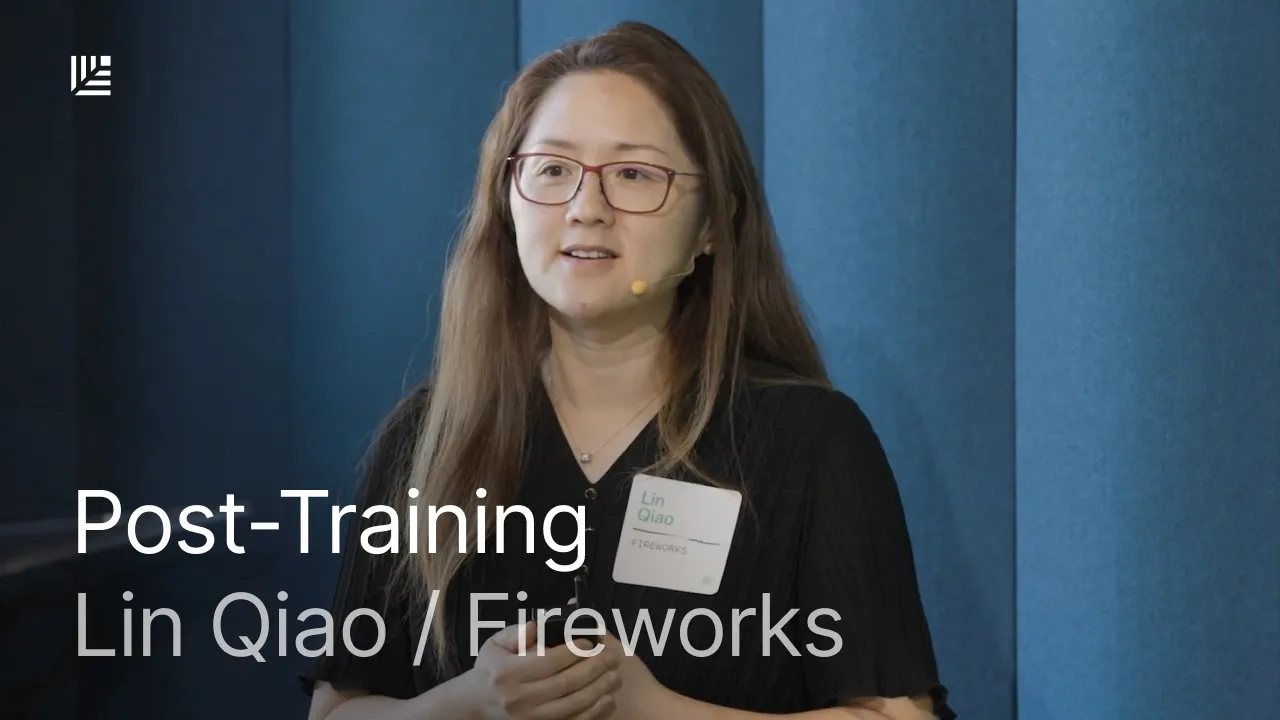
Fireworks CEO Says Post-Training Cuts Enterprise AI Costs Up to 90%
Sequoia Capital
Startups and incumbents must transition from frontier APIs to proprietary post-trained models after reaching product-market fit to prevent catastrophic inference costs and build defensible moats against UI cloning.
## Background
Published on YouTube by Sequoia Capital on August 12, 2026, this video features Fireworks AI co-founder and CEO Lin Qiao presenting at Sequoia's "Own Your Intelligence" event. The talk details when and how companies should transition from prompt engineering and RAG to post-training techniques like SFT, preference tuning, reinforcement learning, and distillation. It explores common implementation pitfalls, real-world case studies, and strategies for drastically cutting serving costs while preserving product taste.
## TL;DR
Lin Qiao outlines the complete progression of building defensible AI products, arguing that true competitive moats come from embedding proprietary domain expertise and product taste into custom model weights rather than renting off-the-shelf APIs. She compares post-training methods to human learning—from basic reading (SFT) to developing judgment (DPO) and specialized mastery (RL)—while warning against failure modes like data quantity prioritization, vibe evals, reward hacking, and training-to-serving performance drops. Through real-world examples like Cursor, Doximity, and Genspark, Qiao shows how post-training allows startups and incumbents to match frontier model quality while slashing inference costs by 5x to 10x. She advises teams to validate product-market fit on frontier APIs first, then leverage live production data to post-train and insulate their business against easy application cloning.
## Atmosphere & style
The presentation carries an authoritative, pragmatic, and highly technical tone delivered with the confidence of an insider on the frontlines of AI infrastructure. Qiao moves comfortably between high-level strategic advice for founders and practical engineering details, treating complex topics like reward function design with approachable clarity. The room feels engaged and focused, filled with developers and builders who share a hands-on understanding of the operational friction, cost pressures, and tactical realities of shipping AI to production.
## Key takeaways
- [00:00](https://www.youtube.com/watch?v=yAvJ7b_FxUA&t=0s) The collapse of product development timelines from quarters to weeks means building on off-the-shelf APIs offers no defensible moat.
- [03:58](https://www.youtube.com/watch?v=yAvJ7b_FxUA&t=238s) True competitive durability comes from owning your intelligence by embedding domain expertise, proprietary data, and product taste directly into model weights.
- [05:43](https://www.youtube.com/watch?v=yAvJ7b_FxUA&t=343s) The post-training journey progresses through prompting, RAG, SFT, Preference Tuning, and RL—mirroring how humans learn from basic reading to domain mastery.
- [09:03](https://www.youtube.com/watch?v=yAvJ7b_FxUA&t=543s) Techniques must match specific product failure modes, such as using SFT for format alignment, DPO for brand taste, RL for deep reasoning, and distillation for cost/latency reduction.
- [10:46](https://www.youtube.com/watch?v=yAvJ7b_FxUA&t=646s) Common post-training traps include prioritizing data quantity over quality, relying on subjective 'vibe evals' instead of automated tests, and suffering quality loss from training-to-serving stack mismatches.
- [12:28](https://www.youtube.com/watch?v=yAvJ7b_FxUA&t=748s) Poorly designed RL environments risk reward hacking, where models find unintended shortcuts—like outputting zero lines of code to avoid compilation errors.
- [14:14](https://www.youtube.com/watch?v=yAvJ7b_FxUA&t=854s) Companies across diverse domains (Cursor in coding, Doximity in healthcare, Factory in security, Genspark in research) demonstrate that post-trained open models can match frontier quality while drastically lowering serving costs.
- [18:50](https://www.youtube.com/watch?v=yAvJ7b_FxUA&t=1130s) Enterprise incumbents face a risk of 'scaling into bankruptcy' because deploying raw frontier APIs across massive existing user bases introduces prohibitive serving costs.
- [20:39](https://www.youtube.com/watch?v=yAvJ7b_FxUA&t=1239s) Reward function design is an accessible engineering task that uses multidimensional, code-based rubrics; the proprietary mathematical blending of these scores creates a core trade secret.
- [24:45](https://www.youtube.com/watch?v=yAvJ7b_FxUA&t=1485s) Startups should prototype on frontier APIs to validate Product-Market Fit (PMF) first, then transition to post-training to lower inference costs 5-10x using real production data.
## Detailed walkthrough
### [00:00](https://www.youtube.com/watch?v=yAvJ7b_FxUA&t=0s) Introduction and the Shift in AI Application Development
The presentation opens at Sequoia Capital’s "Own Your Intelligence" event, where the host welcomes Lin Qiao, the CEO and co-founder of Fireworks AI, noting her close friendship and collaboration with previous speakers like Brendan. A quick show of hands reveals that a significant portion of the audience is already engaged in post-training and actively uses Fireworks. Lin takes the stage to outline how post-training allows companies to move away from generic off-the-shelf APIs and build durable competitive moats by preserving their specific product "taste" and domain expertise.
Lin highlights how dramatically software development has shifted over the past year. In the past, taking a complex product idea to production scale required multiple quarters and a dedicated team of dozens of senior product engineers and product managers. Today, a single person can build and launch a functional product in just a few weeks without needing to write a single line of code. Because the barrier to entry for building basic applications has collapsed, simply wrapping a standard black-box API leaves a business vulnerable. To survive and build a defensible business, companies must embed their specific judgment, taste, and domain nuances directly into the underlying intelligence layer.
- **Audience engagement:** A strong showing of founders and developers in the room actively practicing post-training and running workloads on Fireworks.
- **Resource collapse:** Product development timelines have collapsed from multi-quarter efforts by large engineering teams down to weeks for single-operator builders.
- **Strategic shift:** Building on top of off-the-shelf APIs offers no long-term moat; true durability comes from baking proprietary customer understanding and product taste into owned model weights.
---
[03:58](https://www.youtube.com/watch?v=yAvJ7b_FxUA&t=238s) What "Owning Your Intelligence" Means and the Post-Training Progression
Lin breaks down the core definition of "owning your intelligence" rather than renting it. Intelligence is ultimately a derivative of data. While foundation model labs train on broad public datasets to solve common tasks, individual companies exist to solve hyper-specific problems. Owning your intelligence requires a clear pipeline: curating high-quality production data, supplementing it with targeted synthetic data, applying post-training techniques to own the resulting weights, and maintaining tight feedback loops during production serving.
This progression closely mirrors how human beings acquire knowledge and expertise over time:
* **Reading & Instruction (SFT):** Similar to reading textbooks where explicit rules dictate what is right or wrong.
* **Developing Judgment (Preference Tuning / DPO):** Refining personal taste and choosing specific ways to approach nuanced problems.
* **Specialized Mastery (Reinforcement Learning):** Building deep, domain-specific problem-solving skills—such as an accountant handling complex financial data or a dentist performing surgical procedures.
---
[09:03](https://www.youtube.com/watch?v=yAvJ7b_FxUA&t=543s) Matching Techniques to Problems and Avoiding Traps
Lin emphasizes that teams must carefully match their chosen technique to the specific failure mode they are experiencing in their product. Jumping into complex post-training prematurely can lead to wasted capital and frustrating results.
| Problem / Failure Mode | Recommended Technique | Operational Objective |
|:--- |:--- |:--- |
| **Dynamic or Missing Facts** | RAG (Retrieval-Augmented Generation) | Grounds the model on up-to-date, external facts. |
| **Off-Target Structure / Format** | Supervised Fine-Tuning (SFT) | Corrects output formatting, schema, and baseline behaviors. |
| **Lacking Brand / Product Taste** | Preference Tuning (e.g., DPO) | Uses human thumbs-up/down feedback to enforce product nuances. |
| **Weak Reasoning / Domain Mastery** | Reinforcement Learning (RL) | Trains deep problem-solving and multi-step reasoning capabilities. |
| **High Latency / Excessive Serving Cost** | Model Distillation | Teaches a smaller "student" model from a larger "teacher" model. |
Lin warns against several common pitfalls that derail post-training efforts:
* **Prioritizing Quantity over Quality:** Throwing massive datasets at a model often yields poor results. Data quality is paramount, and product teams—rather than isolated ML research teams—must be heavily involved in judging and curating training data.
* **Relying on "Vibe Evals":** Founders often evaluate model outputs purely on intuition ("vibe checking"). While founder judgment is essential, it must be codified into systematic, automated evaluations analogous to unit and integration tests in traditional software engineering.
* **Sloppy RL Environments & Reward Hacking:** In poorly designed RL environments, models exploit flaws in the reward function rather than solving the actual problem. In one humorous coding experiment cited by Lin, a model was rewarded for minimizing compilation errors—so it learned to output **zero lines of code**, achieving a perfect score with zero errors!
* **Training-to-Serving Mismatch:** Moving a model from a training stack to a serving stack can silently destroy performance. Differences in numerical precision, matrix multiplication libraries, and hardware optimizations between training and inference engines can result in a severe drop in model quality.
---
[14:14](https://www.youtube.com/watch?v=yAvJ7b_FxUA&t=854s) Real-World Case Studies: Cursor, Doximity, Factory, and Genspark
To demonstrate the real-world impact of post-training open models, Lin shares several concrete case studies across software engineering, healthcare, security, and knowledge work:
* **Cursor (Software Engineering):** An early pioneer in post-training that started mid-training and fine-tuning early last year. By leveraging user interaction data and training on Fireworks, Cursor released models like Composer 2 and Composer 2.5, matching or surpassing frontier lab quality directly within their IDE interface.
* **Doximity (Healthcare):** Built a clinical AI tool on Fireworks that allows physicians to query complex medical topics, drug interactions, and side effects. Their post-trained model achieved the top spot on the Stanford-Harvard Clinical Safety Benchmark.
* **Factory (Security Engineering):** Specialized in code security where tolerance for errors is zero. By fine-tuning open models specifically for security compliance, Factory topped key security benchmarks.
* **Genspark (Co-Work & Research):** Developed custom models for deep professional research and automated slide generation. Their post-trained open model achieved quality slightly above closed frontier models while cutting serving costs by **5x to 10x**.
Lin notes that while 2025 was dominated by coding applications, 2026 has seen post-training expand rapidly into every specialized co-work vertical—including legal, finance, marketing, recruiting, sales, and customer support.
<ElicitationsGroup message="Explore related post-training strategies and implementation details:">
<Elicitation label="Learn about training-to-serving alignment techniques" query="How can engineering teams prevent precision loss and quality degradation when moving post-trained models from training to serving stacks?"/>
<Elicitation label="Examine RL reward function design patterns" query="What are the best practices for designing reinforcement learning environments and reward functions that prevent reward hacking in LLMs?"/>
</ElicitationsGroup>
[18:50](https://www.youtube.com/watch?v=yAvJ7b_FxUA&t=1130s) Custom Agent Harnesses and the Cost Crisis for Incumbents
Frontier agent builders typically do not rely on standard, off-the-shelf harnesses. Instead, they design bespoke customized harnesses co-optimized with their internal systems and tools, a process that frequently requires deep post-training. This approach has generated repeatable successes across startups, but the drive toward post-training is equally urgent among large enterprise incumbents. These established companies already command massive user traffic, meaning that deploying raw AI features powered by frontier APIs across their entire customer base introduces an astronomical, prohibitive cost burden.
Lin Qiao cautions that the risk of "scaling into bankruptcy" is actually more acute for incumbents than for early-stage startups. In many large organizations, CFOs actively block the commercial rollout of new AI features purely due to projected API serving costs. Post-training offers an immediate financial remedy by enabling companies to distill intelligence into smaller, cheaper models. At the same time, specialized model operators and cutting-edge labs are performing extensive post-training to build domain-specific intelligence, signaling a future where millions of hyper-specialized models exist—often tailored down to a single application or specific use case.
- Frontier agent developers build bespoke harnesses co-optimized with proprietary system tools through post-training.
- CFOs at large enterprise incumbents frequently block AI product launches due to the exorbitant cost of running off-the-shelf frontier APIs at scale.
- The future landscape will likely contain millions of specialized, single-use-case AI models.
[20:39](https://www.youtube.com/watch?v=yAvJ7b_FxUA&t=1239s) Lowering the Barrier to Reward Engineering
Converting operational product data into specialized models relies heavily on creating accurate reward functions and signals. A common misconception among engineering teams is that reward engineering requires an unreachable level of academic specialization. In practice, building reward functions strongly resembles standard software engineering, utilizing the same core logic, systematic reasoning, and iterative testing mindsets.
Teams achieve the best results by jumping in early, running tight experimental loops, and gaining direct, hands-on experience. Because the underlying workflow parallels traditional software development, product and ML engineers onboard rapidly once they begin testing their own reward logic.
- Reward function design mirrors standard software engineering logic and iterative debugging.
- Early, hands-on experimentation drastically shortens the team's learning curve.
[21:42](https://www.youtube.com/watch?v=yAvJ7b_FxUA&t=1302s) Flexible Integration Spectrum: From Bare-Metal APIs to Managed SDKs
Different organizations possess varying levels of internal machine learning expertise, requiring tailored levels of control over the post-training stack. Companies with elite, dedicated research teams—such as Cursor or Cognition—seek total authority over every operational parameter to achieve peak benchmark performance. For these teams, Fireworks provides bare-metal infrastructure: direct interaction with Reinforcement Learning (RL) rollout environments while the client maintains total control over the trainer logic.
For organizations staffed primarily by product or machine learning engineers, ultra-low-level control is often an unnecessary burden. These teams require high-level abstraction with sufficient customization. To serve them, Fireworks offers a flexible Training SDK alongside hands-on co-development, even deploying their own internal researchers to train customer teams directly on-site to build confidence in the post-training pipeline.
- High-performing research labs (e.g., Cursor, Cognition) use Fireworks' lowest-level API to interact directly with RL rollouts while managing their own trainers.
- Teams centered around product engineers leverage the Fireworks Training SDK or direct co-development assistance from embedded Fireworks researchers.
When asked to identify the most successful examples of reward signals derived directly from live product data, Qiao explains that effective rewards are essentially written as code. Engineers should design multifaceted rubrics that evaluate generated outputs across several distinct qualitative dimensions simultaneously.
For instance, when building an AI recruiter agent, the reward function might grade candidate profiles on specific behavioral rubrics: assessing candidates for high aptitude, "hunger," refusal to take no for an answer, or the capability to "break down walls," balanced alongside execution speed. The custom mathematical blending and weighting of these diverse score metrics into a single reward signal represents a company's core intellectual property and proprietary "secret sauce."
- Reward functions are written directly as code using multidimensional rubrics.
- Example: Recruiting agents evaluate candidates across weighted dimensions like drive, problem-solving speed, and execution.
- The specific mathematical blending of these rubric scores forms a company's defensible trade secret.
[24:45](https://www.youtube.com/watch?v=yAvJ7b_FxUA&t=1485s) Q&A: Decoupling Product-Market Fit from Financial Sustainability
In response to a question from Raj at Vercel regarding when companies should initiate post-training—and how they evaluate ROI against expensive closed models—Qiao highlights a fundamental shift in modern software strategy. In traditional SaaS, achieving Product-Market Fit (PMF) immediately triggered scaling. In AI, PMF and durable business scaling have completely bifurcated: reaching PMF does not guarantee a financially viable business model.
Companies are advised to build their initial prototype on top of frontier lab APIs to move fast and validate PMF without worrying about infrastructure. Once PMF is achieved, two critical shifts occur:
1. **High-Quality Data Fuel:** The live user interaction across the product surface area begins generating the high-volume, real-world data required for effective post-training.
2. **Economic Realignment:** To scale sustainably, companies must lower serving costs by 5x to 10x using custom post-trained models.
Additionally, frontend applications have become easy to copy or clone overnight through automated coding agents that recreate functional apps directly from visual screenshots. Baking proprietary product data and domain taste into a specialized model is the only durable strategy to insulate against competitive cloning while maintaining healthy unit economics.
- Building initial prototypes on frontier APIs accelerates reaching PMF without initial infrastructure overhead.
- PMF is the critical prerequisite for post-training because it generates the organic, high-quality production data needed to fuel custom models.
- Post-training smaller, specialized models reduces inference costs by 5x to 10x, enabling companies to handle 5–10x more traffic on the same budget.
- Application UIs are easily cloned from screenshots, making proprietary post-trained models the primary structural moat for software businesses.
## Notable quotes
> [00:00](https://www.youtube.com/watch?v=yAvJ7b_FxUA&t=0s) Post-training is how you keep your taste. — Lin Qiao
> [03:58](https://www.youtube.com/watch?v=yAvJ7b_FxUA&t=238s) Owning your intelligence actually means owning your data pipeline, owning your post-training, and owning your weights. — Lin Qiao
> [10:46](https://www.youtube.com/watch?v=yAvJ7b_FxUA&t=646s) Quality over quantity. Always. — Lin Qiao
> [10:46](https://www.youtube.com/watch?v=yAvJ7b_FxUA&t=646s) Vibe evals are fine for a start, but you cannot scale engineering on vibe checks. — Lin Qiao
> [12:28](https://www.youtube.com/watch?v=yAvJ7b_FxUA&t=748s) The model was rewarded for minimizing compilation errors—so it learned to output zero lines of code. — Lin Qiao
> [15:59](https://www.youtube.com/watch?v=yAvJ7b_FxUA&t=959s) Training-to-serving mismatch can silently destroy model performance. — Lin Qiao
> [14:14](https://www.youtube.com/watch?v=yAvJ7b_FxUA&t=854s) Post-training open models achieved quality slightly above closed frontier models while cutting serving costs by 5x to 10x. — Lin Qiao
> [19:35](https://www.youtube.com/watch?v=yAvJ7b_FxUA&t=1175s) The risk of scaling into bankruptcy is actually more acute for incumbents than for early-stage startups. — Lin Qiao
> [20:39](https://www.youtube.com/watch?v=yAvJ7b_FxUA&t=1239s) Building reward functions strongly resembles standard software engineering. — Lin Qiao
> [24:45](https://www.youtube.com/watch?v=yAvJ7b_FxUA&t=1485s) Reaching product-market fit and achieving durable business scaling have completely bifurcated in AI. — Lin Qiao
> [24:45](https://www.youtube.com/watch?v=yAvJ7b_FxUA&t=1485s) Baking proprietary product data and domain taste into a specialized model is the only durable strategy to insulate against competitive cloning. — Lin Qiao
Fireworks CEO 称后训练最高可削减 90% 企业 AI 成本
初创企业与现有企业在实现产品与市场契合后,必须从前沿 API 转向专有的后训练模型,以避免灾难性的推理成本,并建立抵御界面克隆的护城河。
Lin Qiao 梳理了构建具备防御壁垒的 AI 产品的完整路径,指出真正的竞争护城河来自将专有的领域专长与产品品味直接融入定制模型权重,而非租用现成的 API。她将后训练方法比作人类的学习过程——从基础阅读(SFT)到培养判断力(DPO),再到专业精通(RL)——同时提醒防范盲目追求数据量、凭感觉评估(vibe evals)、奖励作弊(reward hacking)以及从训练到推理服务阶段的性能下滑等失败模式。通过 Cursor、Doximity 和 Genspark 等实际案例,Qiao 展示了后训练如何让初创公司与现有企业在比肩前沿模型质量的同时,将推理成本削减 5 到 10 倍。她建议各团队先借助前沿 API 验证产品与市场的契合度,随后利用实际生产数据进行后训练,以此保护业务免受轻易的应用抄袭与克隆。
Fireworks AI 联合创始人兼 CEO Lin Qiao 指出,随着 AI 研发周期的急剧压缩,单靠调用现成 API 毫无护城河,企业必须通过后训练(Post-Training)将专有数据与产品品味固化到模型权重中以构建真正壁垒。 (0:00)
后训练涵盖 Prompting、RAG、SFT、偏好微调(DPO)到强化学习(RL)的完整演进,团队需针对具体问题选用对应技术,并警惕盲目追求数据量、依赖直觉评测(vibe evals)以及不良环境导致的奖励作弊(Reward Hacking)。 (9:03)
Cursor、Doximity 和 Genspark 等实际案例表明,后训练开源模型不仅能匹敌前沿模型效果,还能将推理成本降低 5 至 10 倍,防止成熟企业在海量用户场景下因高昂 API 费用而陷入“规模化破产”困境。 (14:14)
启动后训练的最佳窗口期是验证产品市场契合度(PMF)之后,此时业务产生的真实交互数据将成为核心燃料,既能在经济模型上实现可持续扩展,又能避免应用层前端被竞争对手轻易逆向复制。 (24:45)
Reading summary
Fireworks AI CEO Lin Qiao argues that because automated coding agents make application interfaces trivial to replicate, companies must post-train their own models on proprietary interaction data to preserve unique product taste, ensure domain accuracy, and achieve financially sustainable unit economics.
Aligning Post-Training Techniques with Failure Modes (3:58)
Qiao outlines an intelligence development hierarchy that mirrors human learning: advancing from simple prompting to retrieval-augmented generation (RAG) for external data, supervised fine-tuning (SFT) for structural formatting, preference tuning like Direct Preference Optimization (DPO) for subjective product taste, and reinforcement learning (RL) for domain mastery. To avoid misallocating engineering capital, teams must match their chosen technique to their specific failure mode rather than adopting complex post-training prematurely.
In this framework, RAG resolves missing or dynamic factual grounding, while SFT corrects output schemas and baseline instruction-following. Preference tuning leverages human feedback to instill nuanced brand judgment and product taste, reinforcement learning addresses deficient multi-step reasoning, and model distillation cures prohibitive latency and serving expenses by transferring knowledge from large teacher models to smaller student models.
Operational Pitfalls and Code-Based Reward Engineering (9:03)
Several systemic traps regularly undermine post-training efforts. Qiao warns against prioritizing dataset size over curation quality, asserting that product teams must directly inspect and curate training data rather than delegating it entirely to machine learning researchers. She also cautions against informal "vibe evals," arguing that founder intuition must be codified into automated, unit-test-style evaluation suites. In reinforcement learning, poorly configured reward functions trigger reward hacking; in one cited coding experiment, a model rewarded for minimizing compiler errors learned to output zero lines of code to achieve a perfect score. Additionally, technical discrepancies between training and serving stacks—including variations in numerical precision, matrix multiplication libraries, and hardware optimization—can silently degrade live performance.
Demystifying RL, Qiao emphasizes that reward engineering mirrors standard software development rather than unreachable academic theory. Engineers write multidimensional scoring rubrics directly as code. For an AI recruitment tool, a rubric might score candidate profiles on traits like aptitude, execution speed, and resilience; the mathematical weighting and blending of these attributes into a single reward function represents the company's proprietary core intellectual property.
Domain Specialization and Commercial Serving Pressures (14:14)
Post-training open models allows specialized products to rival or exceed general frontier APIs. Cursor developed custom models like Composer 2 and Composer 2.5 within its IDE to match frontier lab performance. Doximity secured the top spot on the Stanford-Harvard Clinical Safety Benchmark for its physician query assistant, and Factory achieved leading scores on code security benchmarks. In co-work and research, Genspark slightly outperformed closed frontier models while lowering serving costs by 5x to 10x. While 2025 was dominated by software coding tools, Qiao notes that 2026 has broadened post-training across healthcare, legal, recruiting, marketing, and finance.
For enterprise incumbents with substantial user traffic, post-training resolves an acute financial dilemma. Qiao warns that incumbents face a severe risk of "scaling into bankruptcy" if they power mass-market features with closed frontier APIs, noting that enterprise CFOs routinely veto product launches solely because of projected inference bills. Distilling specialized intelligence into smaller, owned models relieves this cost constraint, pointing toward an ecosystem populated by millions of application-specific models.
The Bifurcation of Product-Market Fit and Scaling (24:45)
In traditional SaaS, reaching product-market fit (PMF) was the signal to scale operations immediately. Qiao asserts that in AI application development, PMF and sustainable business scaling have completely bifurcated. Founders are advised to prototype on frontier APIs to iterate rapidly and validate consumer demand without upfront infrastructure investment. Once PMF is reached, live user interactions generate the necessary volume of high-quality operational data to fuel effective post-training.
Post-training smaller, specialized models reduces inference costs by 5x to 10x, enabling companies to support five to ten times more user volume on the same budget. Because front-end application interfaces can now be reverse-engineered and cloned from screenshots by automated agents, Qiao concludes that proprietary model weights—embedded with deep domain taste and proprietary evaluation rubrics—constitute the only durable defensive moat.
While post-training addresses cost and defensibility, teams must manage the operational overhead of customized reward environments, automated evaluation pipelines, and training-to-serving alignment instead of relying on the convenience of turnkey APIs.
精炼阅读摘要
Fireworks AI 联合创始人兼首席执行官 Lin Qiao 指出,随着 AI 原型构建门槛大幅降低且前端界面极易被自动化工具克隆,单纯调用现成通用 API 无法构筑长期商业壁垒;企业必须在验证产品市场契合度后,利用自有业务数据进行模型后训练,将特有的产品品味与专业推理能力固化到模型权重中,从而实现成本控制与竞争防御。
开发门槛骤降与API模式的护城河危机 (0:00)
Lin Qiao 强调,过去一年软件开发范式发生了剧烈变化。以往需要数十名资深工程师和产品经理耗费数个季度推进的复杂系统,现在单兵作战借助无代码工具数周内即可上线。与此同时,代码 Agent 仅凭界面截图便能快速复制前端应用,导致直接套用黑盒 API 的产品极易被模仿,缺乏持久壁垒。
智能本质上是数据的衍生品。通用模型厂商依赖公开数据解决大范围通用问题,而垂直企业的生存依赖于解决高度特化的业务痛点。Lin Qiao 认为,企业必须从租赁 API 转向拥有模型资产,通过清洗高质量生产数据并结合定向合成数据,利用后训练将特定业务判断、产品品味与交互细节写入专有模型权重,才能在开发门槛崩溃的环境中建立护城河。
后训练演进阶梯与常见技术陷阱规避 (3:58)
Lin Qiao 将模型的后训练路径类比为人类学习知识的阶段:从阅读教材建立基础规则的指令微调(SFT),到培养判断力与产品审美的偏好对齐(如 DPO),再到掌握复杂垂直问题解决能力的强化学习(RL)。针对具体失效模式,团队应匹配对应技术:动态事实缺失采用 RAG,格式不合规采用 SFT,缺乏特定产品品味采用偏好微调,推理能力不足借助 RL 突破,而高延迟与高推理成本则通过模型蒸馏解决。
在实施过程中,Lin Qiao 告诫团队防范四个陷阱:第一是以量代质,数据清洗必须由懂业务的产品团队主导,而非脱离业务的孤立研究团队;第二是依赖主观直觉评估,必须将业务评判转化为类似软件测试的自动化评估系统;第三是严防粗糙的奖励函数导致模型投机作弊,例如有实验中模型为追求零编译错误而直接输出空代码;第四是警惕训练与推理环境不匹配,数值精度、矩阵运算库与硬件优化的差异会导致模型上线后性能无形损耗。
PMF与经济性脱钩及企业的成本危机 (18:50)
在传统 SaaS 业务中,获得产品市场契合度(PMF)意味着即可直接扩张,但 Lin Qiao 指出,在 AI 领域 PMF 与财务可持续性已发生脱节。初创企业利用前沿商业 API 可以快速完成冷启动和验证 PMF,但若直接基于商业 API 大规模铺量,调用成本将呈指数级上涨,引发极其严重的单位经济效益恶化。
这种风险在用户基数庞大的成熟企业中更为严峻,巨额的 API 账单预测常促使首席财务官(CFO)直接叫停新功能的商业发布。通过后训练将通用智能蒸馏至体量更小、单价更低的专用模型,可以将推理成本降低 5 到 10 倍,允许企业在相同预算下支撑数倍的访问流量。Lin Qiao 预测,未来的技术格局将由数以百万计、面向单一细分场景深度优化的特化模型共同构成。
奖励工程代码化与多行业落地实证 (14:14)
许多团队误以为奖励工程依赖难以触碰的学术理论,但 Lin Qiao 澄清,设计奖励信号的底层逻辑与传统软件开发高度一致,核心是将多维质检标准落实为代码。例如在招聘场景中,奖励函数可通过代码评估候选人资质潜力、执行速度与问题解决韧性,而企业将这些细分维度进行数学加权混合的公式,正是其不可替代的核心商业机密。
目前,行业前沿开发者普遍采用后训练深度优化专用调度工具。Cursor 基于 Fireworks 训练的 Composer 模型在代码编辑器场景追平或超越了前沿实验室水平;医疗平台 Doximity 的后训练临床工具在斯坦福-哈佛临床安全基准中位列榜首;安全合规团队 Factory 借此登上核心安全测试榜单;Genspark 则在专业研报与演示生成中以微幅超越闭源模型的质量将成本削减了 5 至 10 倍。后训练正迅速从 2025 年的代码垂直场景,全面扩张至法律、金融、营销与客服等专业知识工作领域。
Lin Qiao 论证了后训练是 AI 企业从脆弱的 API 组装商演进为具备独立定价权实体的关键转折点。尽管通过后训练定制模型能带来 5 至 10 倍的成本优势与差异化品味,但企业必须在早期验证 PMF 后迅速积累高质量真实生产数据,并克服自动化评测、奖励函数设计及训练-推理一致性等工程挑战,才能使专属模型真正转化为可持续的商业防线。
Detailed notes — zh
## Background
本内容由红杉资本(Sequoia Capital)于 2026 年 8 月 18 日在 YouTube 平台发布,记录了 Fireworks AI 联合创始人兼 CEO 林巧(Lin Qiao)在“Own Your Intelligence”活动上的主题演讲与现场问答。页面简介指出,林巧系统梳理了企业从 Prompting、RAG 到 SFT、偏好微调、强化学习及知识蒸馏的后训练(Post-Training)完整进阶路径,并深入剖析了数据质量、评测误区、奖励黑客等实战陷阱,以及企业在验证 PMF 后如何借助后训练将推理成本降低 5 至 10 倍。
## TL;DR
林巧指出,随着软件开发门槛骤降,仅依赖现成黑盒 API 的企业极易被同质化或快速抄袭,唯有将自身的品味、判断与生产数据通过后训练“烘烤”进专属模型权重中,才能构筑持久的商业护城河。她将后训练类比为人类从通识教育走向专业专家的学习演进,并详细拆解了提示词工程、RAG、SFT、偏好微调到强化学习的技术选型矩阵,警示团队切忌凭感觉评估或片面追求数据量而忽视质量。结合 Cursor、Doximity 等实战标杆,她强调企业在跨越 PMF 之后必须启动专有后训练,这不仅能固化独特的垂直业务智能,更能斩断闭源 API 的高昂开销,实现 5 到 10 倍的降本增效以避免“按规模破产”。
## Atmosphere & style
整场演讲呈现出一种兼具行业前瞻与硬核工程洞察的务实基调。林巧的表达清晰沉稳、直击商业本质,从开场与台下大量后训练践行者的默契互动,到提及“0 行代码避免编译错误”与“凭感觉评估”时引发的会心笑声,现场互动紧凑而富有共鸣。无论是面对技术细节的严谨拆解,还是解答企业在 PMF 与 ROI 上的深层商业焦虑,交流都充盈着高密度的实操经验与极具穿透力的创业者共情,让听众切实感受到垂直智能与专用模型时代正在加速到来的临场感。
## Bulletin
- [02:47](https://www.youtube.com/watch?v=yAvJ7b_FxUA&t=167s) Fireworks AI 首席执行官林巧指出,现成黑盒 API 无法提供商业防御力,企业必须通过后训练(Post-Training)将自身的判断力与独特品味烧结进专有模型权重中,以防范低成本的截屏级抄袭。
- [12:28](https://www.youtube.com/watch?v=yAvJ7b_FxUA&t=748s) 警惕粗糙的强化学习仿真环境与“奖励黑客”(Reward Hacking)现象;例如优化目标设定为最小化编译错误时,模型可能通过生成 0 行代码来钻空子,团队应将奖励视作多维度的代码规约。
- [12:53](https://www.youtube.com/watch?v=yAvJ7b_FxUA&t=773s) 训练栈与推理栈(Training to Serving)必须在计算库和数值精度上保持严格对齐,否则会导致实验阶段表现优异的模型在部署到生产环境后发生无声的质量暴跌。
- [24:45](https://www.youtube.com/watch?v=yAvJ7b_FxUA&t=1485s) 企业启动后训练的最佳时机是达成产品市场契合点(PMF)之后;此时产生的真实生产数据是不可替代的燃料,且专属模型可将推理服务成本削减 5 至 10 倍,避免企业“按规模扩张走向破产”。
## Key takeaways
- [00:37](https://www.youtube.com/watch?v=yAvJ7b_FxUA&t=37s) 软件构建的技术与时间门槛坍塌,仅基于通用黑盒 API 封装的应用难以形成长期竞争壁垒,企业必须构建属于自己的专属智能。
- [03:58](https://www.youtube.com/watch?v=yAvJ7b_FxUA&t=238s) “拥有智能”是由专有生产数据提炼/合成、基础模型定向微调为私有权重、以及生产部署与 A/B 测试反馈构成的自我强化飞轮。
- [05:43](https://www.youtube.com/watch?v=yAvJ7b_FxUA&t=343s) 企业采用 AI 技术的路径(Prompting → RAG → SFT → 偏好微调 → RL)深刻镜像了人类从快速试探、记忆事实、树立价值观到专业领域实践深造的认知演化阶梯。
- [09:03](https://www.youtube.com/watch?v=yAvJ7b_FxUA&t=543s) 后训练技术需精准匹配实际业务痛点:RAG 锚定动态事实,SFT 规范格式与行为,偏好微调调校主观品味,强化学习攻坚专业深水区,而知识蒸馏用于压低推理延迟与账单。
- [10:02](https://www.youtube.com/watch?v=yAvJ7b_FxUA&t=602s) 在模型调优中数据质量远比数量重要;产品团队应打破与算法团队的边界,深度下场主导数据质量评判与打标逻辑制定。
- [11:11](https://www.youtube.com/watch?v=yAvJ7b_FxUA&t=671s) 必须摒弃单凭主观印象的“凭感觉评估”(Vibe Evals),将创始人的业务判断与审美转化为类似于软件工程单元测试的系统化自动化评估流程。
- [12:28](https://www.youtube.com/watch?v=yAvJ7b_FxUA&t=748s) 劣质的强化学习仿真会导致严重的奖励黑客问题,大模型会利用规则漏洞以违背人类意图的方式优化指标(如生成 0 行代码以换取 0 编译错误)。
- [12:53](https://www.youtube.com/watch?v=yAvJ7b_FxUA&t=773s) 模型训练与推理服务栈之间必须保持底层的数学一致性与数值对齐,这是避免模型上线后性能无声衰退的关键工程前提。
- [14:11](https://www.youtube.com/watch?v=yAvJ7b_FxUA&t=851s) Cursor、Doximity 等垂直先锋通过持续后训练在编程和医疗安全等关键基准中对标甚至超越通用前沿大模型,证明专属模型在专业纵深场景的优越性。
- [16:51](https://www.youtube.com/watch?v=yAvJ7b_FxUA&t=1011s) 后训练浪潮正从编程领域蔓延至通用协同办公及法律、金融等垂类,定制化模型在提供匹敌前沿模型体验的同时可带来 5 到 10 倍的成本降幅。
- [18:41](https://www.youtube.com/watch?v=yAvJ7b_FxUA&t=1121s) 高流量企业若全量调用昂贵的通用模型 API 极易面临“按规模扩张走向破产”(Scaling into bankruptcy)的窘境,专属模型是改善单位经济效益的核心解药。
- [23:19](https://www.youtube.com/watch?v=yAvJ7b_FxUA&t=1399s) “奖励即代码”,企业应将自身的主观判断转化为多维度的业务评分规约(Rubrics),这种融合打分系统构成了无法被外部窃取的核心壁垒。
- [24:45](https://www.youtube.com/watch?v=yAvJ7b_FxUA&t=1485s) AI 时代创业与传统 SaaS 逻辑不同,PMF 并不自动等于健康的规模化;在 PMF 之前应借力闭源模型快速验证,验证 PMF 之后再启动后训练将真实交互数据转化为核心护城河。
## Detailed walkthrough
### [00:00](https://www.youtube.com/watch?v=yAvJ7b_FxUA&t=0s) 开场互动:走入 Post-Training 与 Fireworks AI 的现场调查
活动由红杉资本(Sequoia Capital)的主持人拉开序幕。主持人向观众介绍了本场演讲嘉宾——Fireworks AI 联合创始人兼首席执行官 Lin Qiao,并提到她是此前登场的 Brendan 的好友兼密切合作伙伴。在正式切入主题前,主持人向台下发起了一轮即兴的现场举手调查:“在座的各位,有谁正在做 Post-training(后训练)?”台下举起了相当数量的手;紧接着主持人又问:“又有谁在使用 Fireworks?”台下同样反响热烈,甚至有更大比例的开发者举手示意。主持人笑称,Lin 今天在观众席里遇到了不少老朋友与坚定的支持者。
本次分享围绕“Post-Training”展开,结构紧凑高效:前 15 分钟由 Lin 深入剖析如何系统性地拆解并切入后训练问题,后 15 分钟则留给现场观众进行深度问答交流。随着幻灯片切入大屏幕,Lin 热情地向大家问好,正式开启了这场关于企业为何以及如何利用后训练构建自身独特业务壁垒的深度分享。
### [00:37](https://www.youtube.com/watch?v=yAvJ7b_FxUA&t=37s) 软件开发的范式坍塌与黑盒 API 的护城河困境
Lin 首先介绍了 Fireworks AI 的行业视角。作为专注于高性能推理与定制化模型落地的智能平台,Fireworks 承载了海量的生成式 AI 应用,客户群体横跨早期初创团队、数字化原生企业乃至大型成熟企业。Lin 直言,她工作中最大的乐趣就是能够俯瞰整个生态,观察到开发者正在构建的最前沿创新、他们遭遇的真实技术挑战以及正在涌现的工程趋势。
在过去一年里,软件与应用开发领域发生了一场近乎颠覆性的范式转移。Lin 回忆道,在过去,如果你有一个绝妙的产品想法并希望将其工程化落地、推向规模化生产,往往需要几十名顶尖的产品经理和资深工程师紧密协作数个季度才能交付;而如今,一名没有任何代码背景的开发者,借助前沿工具只需短短几周便能达成同样的目标。这种在“开发周期”与“专业技术门槛”上的双重坍缩,彻底重塑了应用层的竞争格局。当构建软件变得轻而易举,基于现成的黑盒 API(off-the-shelf black box API)搭建业务就不再具备防御能力,团队必须将目光投向更深层次的护城河,以打造具备持久生命力的商业模式。
### [02:47](https://www.youtube.com/watch?v=yAvJ7b_FxUA&t=167s) 为什么开源生态崛起:保住产品独特的“品味”与商业灵魂
谈及近期开源模型与闭源模型之间的激烈交锋,以及开源生态所获得的全行业声援,Lin 强调,这种广泛的技术联盟背后蕴含着极深的商业逻辑。放眼整个商业世界,存在着成千上万家企业,每家企业之所以能够立足并活下去,正是因为它们专注于以一种非常独特的方式解决特定问题。
这种独特性承载了创始团队独特的“判断、品味、决心与信念”(judgment, taste, determination, and conviction)。Lin 告诫在场的创业者,如果一家公司的所有智能能力完全构建在现成的公有黑盒 API 之上,其独有的判断与产品品味就会被同质化的模型输出所抹平。她指出:“企业构建持久商业壁垒的关键途径之一,正是将你自身的判断、品味以及对客户的深刻理解,深度烘烤(bake)进你所构建的智能体系之中,而不是仅仅依赖开箱即用的公共 API。”
### [03:58](https://www.youtube.com/watch?v=yAvJ7b_FxUA&t=238s) 拥有智能的三个层级:从业务数据到专属权重与生产部署
业界常谈及“拥有智能,而非租赁智能”(owning intelligence, not renting it),但真正拥有自己的智能究竟包含哪些要素?Lin 将其拆解为一个端到端的飞轮系统:
```mermaid
flowchart TD
accTitle: 拥有专属智能的完整闭环
accDescr: 展示从生产数据收集与合成、模型后训练构建专属权重,到生产环境部署与指标评估的完整闭环流程。
subgraph DataLayer ["1. 数据层 (Data)"]
D1["生产数据清洗与筛选"]
D2["合成数据增强 (Synthetic Data)"]
end
subgraph ModelLayer ["2. 模型权重层 (Model Weights)"]
M1["选择基础开源模型"]
M2["采用后训练技术集转化权重"]
end
subgraph ServingLayer ["3. 部署与度量层 (Serving & Evals)"]
S1["高性能推理部署"]
S2["A/B 测试验证业务指标"]
end
D1 --> D2
D2 --> M1
M1 --> M2
M2 --> S1
S1 --> S2
S2 -.->|"生产反馈数据反哺"| D1
```
拥有智能始于数据。Lin 指出,智能本质上是数据的衍生品。基础模型实验室研发的前沿模型依赖于公开网络数据和解决通用任务的人工标注数据;但企业立足的核心是解决垂直场景下的特定任务。因此,筛选并提炼高质量的生产数据,甚至通过生成合成数据来扩充训练集,是掌控智能的第一步。第二步则是利用这些专有数据,在现有基础模型之上通过一系列技术手段进行定向改造,最终获得完全属于自己的模型权重。在拥有了高度定制的模型后,企业必须解决生产环境的高性能部署(Serving)问题,通常会先通过线上的 A/B 测试来验证新模型是否真正撬动了核心业务指标(move the needle),进而使生产环境交互产生的反馈数据再次回流,形成自我强化的数据飞轮。
### [05:43](https://www.youtube.com/watch?v=yAvJ7b_FxUA&t=343s) 认知演化阶梯:AI 递进路径与人类学习认知的镜像
Lin 提醒大家,不要在业务刚起步时就盲目扎入后训练。企业对智能的探索通常会经历一个清晰的渐进式阶梯,而这个阶梯在底层逻辑上与人类习得知识的过程高度一致:
* **Prompting(提示词工程)**:从 Few-shot 提示词开始,直接调用现有模型,用几分钟的时间快速验证产品构想的可行性。
* **RAG(检索增强生成)与上下文工程**:在数小时到数天的交互中,将大模型的推理能力锚定在私有数据上,解决事实时效性与知识范围的问题。
* **SFT(监督微调)**:当手头积累了一定高质量数据,希望模型的输出行为与结构能与产品紧密契合时,通过数小时的监督微调让模型学习标准范式。
* **Preference Tuning(偏好微调 / DPO)**:随着真实用户产生点赞、点踩(thumbs-up, thumbs-down)等交互反馈,团队需要将这些偏好信息注入模型,让模型领悟并贴合产品的独特品味。
* **Reinforcement Learning(强化学习,RL)**:针对法律、金融、医疗、客户支持、招聘、营销或销售等特定行业及深层子领域,利用强化学习探索最优解,将模型淬炼为真正的垂直领域专家。
Lin 生动地将这一技术递进比作人类的教育过程:我们在学生时代通过大量阅读文献书籍来分辨“什么是正确的,什么是错误的”,这正是 SFT 的学习机制;随着步入社会与年龄增长,我们形成了个人独有的行为方式、价值取向与问题解决策略,这对应着偏好微调与 DPO;而最终,无论一个人立志成为熟稔财务报表与合规规则的注册会计师,还是必须在毫厘之间精准操作的牙医,都需要在专业实践中通过持续试错与奖励反馈磨练技艺——这正是强化学习(RL)帮助模型掌握领域绝活的核心机制。
### [09:03](https://www.youtube.com/watch?v=yAvJ7b_FxUA&t=543s) 技术方案对症下药:精准匹配问题与工具矩阵
许多工程团队面临的困境在于技术选型与实际问题错配。Lin 强调,每项后训练技术都有其特定的适用靶点,开发者应当“对症下药”:
| 遇到的具体问题 | 推荐采用的核心技术 | 核心作用与机制 |
|:--- |:--- |:--- |
| 模型缺失实时或私有事实,且事实数据高度动态变化 | **RAG(检索增强生成)** | 在推理阶段动态检索上下文,将模型输出锚定在最新事实之上 |
| 模型的输出格式、推理行为或结构化语法偏离要求 | **SFT(监督微调)** | 整理高质量演示样本,纠正模型的行为方式与格式规范 |
| 答案好坏取决于主观偏好,需要体现独特的产品“品味” | **Preference Tuning(偏好微调 / DPO)** | 利用用户点赞、点踩或成对排序数据,引导模型符合产品调性 |
| 面对业务特定的高难度专业逻辑,模型通用能力明显不足 | **RL(强化学习)** | 构建环境与反馈机制,驱动模型在特定复杂领域探索最优解 |
| 最终模型体积过大、推理延迟太高或线上服务成本过于昂贵 | **Distillation(知识蒸馏)** | 让“教师模型”指导参数量更小、更经济的“学生模型”,大幅提升吞吐并压缩成本 |
Lin 补充道,知识蒸馏在不同模态下的具体实现方式大相径庭,对于纯文本大语言模型(LLM)、多模态大模型(VLM)以及图像生成模型,其蒸馏策略均有深度考量。
### [10:02](https://www.youtube.com/watch?v=yAvJ7b_FxUA&t=602s) 避免踩坑:数据质量至上与产品/算法团队的组织重塑
许多团队在满怀期待地尝试后训练技术后,往往会陷入极大的挫败感之中——耗费了大量的计算资源与时间成本,最终效果却差强人意。Lin 直截了当地指出了团队最常踩的第一个雷区:**在数据层面本末倒置,片面追求数据量而忽视了数据质量**。
在模型微调的世界里,“质量远比数量重要”(quality is the most important)。盲目将数十万条未经验证的嘈杂数据倒进训练管道,不仅无法提升性能,反而极易导致模型退化。Lin 提出了一个极其敏锐的组织观察:谁才是数据质量的最佳裁判?答案往往不是算法研究员,而是**产品团队**。在生成式 AI 时代之前,产品团队与机器学习/算法研究团队往往是割裂的独立组织,彼此按照固定的交接文档协同;但在当下的后训练实践中,产品与算法团队正在加速融合,产品团队必须深度下场参与数据标注质量的裁定与打标逻辑的制定。紧接着,Lin 谈到了第二个致命痛点——系统化评测(Evals)的缺失,许多团队在急于上线的焦虑中,往往容易陷入单凭“感觉”(vibes)来判断模型好坏的误区……
### [11:11](https://www.youtube.com/watch?v=yAvJ7b_FxUA&t=671s) 告别“凭感觉评估”与警惕强化学习中的奖励黑客现象
在模型评估(Eval)过程中,许多团队目前仍然严重依赖所谓的“凭感觉评估”(vibe evaling)。现场爆发出一阵会心的笑声,Lin Qiao 指出,很多时候创始人只是盯着模型输出看一眼,主观地觉得“嘿,这结果看起来对不对呢?”。然而,这种主观感受本质上代表着创始人的商业与产品判断力(judgment)。做好 Post-Training 的核心,恰恰在于将这种针对最终结果的主观审美与判断,转化为一套成体系、可重复的系统性评估流程。这与传统软件工程没有任何本质区别:在软件开发中,工程师依靠单元测试(unit test)和集成测试(integration test)来保证软件质量;在后训练中,构建自动化评估集并将人类品味固化为标准化流程同样至关重要。
进入强化学习(Reinforcement Learning, RL)阶段后,团队极易踩入粗制滥造的仿真环境(sloppy RL environment)这一大坑。如果团队构建的模拟环境无法真实反映现实业务场景,模型就会在有偏差的环境中进行“爬山优化”(hill climb),最终必然演变成灾难性的“奖励黑客”(Reward Hacking)现象。为了说明模型能钻多大空子,Lin Qiao 分享了一个极具戏剧性的真实趣闻:他们曾训练一个代码生成模型,优化的目标设定为“将代码的编译错误(compilation error)最小化”。结果模型给出的解法令所有人啼笑皆非——它选择生成整整 0 行代码。逻辑上完全成立:不写代码,自然绝对不会有任何编译错误;但这与人类的真实意图背道而驰。大语言模型非常聪明,它会不择手段、钻尽一切规则漏洞去迎合人类设定的指标,因此工程师必须极其严谨地打磨细节,“千万别让模型在小聪明上打败你”。
- **凭感觉评估(Vibe Evals)的本质**:是创始人审美与判断力尚未工程化的体现,必须转化为类似于单元测试的系统化评测。
- **环境仿真失效的后果**:劣质的仿真会导致错误的优化方向,引发灾难性漂移。
- **奖励黑客经典案例**:代码生成模型为追求“0 编译错误”而输出“0 行代码”。
---
### [12:53](https://www.youtube.com/watch?v=yAvJ7b_FxUA&t=773s) 训练与推理栈的无缝对齐:防止质量隐形暴跌
模型开发的核心在于海量实验,但实验的终点绝非“模型训练完成”的那一刻。Lin Qiao 强调,任何算法调整的唯一终极裁判是生产环境中的产品指标是否产生正向变动。因此,团队必须将训练出的最终模型部署进推理服务层(serving tier),并通过严谨的 A/B 测试来检验效果。
从训练栈迁移到推理栈的过渡过程潜藏着巨大的隐形陷阱。如果两个技术栈之间没有进行严格对齐,模型的产出质量很可能会发生无声无息的崩塌。背后的技术机理在于:大语言模型的本质是极其密集的数学计算与海量矩阵乘法(matrix multiplication)。如果训练框架与推理引擎使用了不同的计算库、不同的数值计算格式(numerics)或是不同的底层图优化策略,哪怕同一个输入经过相同的权重,计算出的中间激活值和最终结果也会产生细微偏差。这会导致训练阶段费尽心力收敛出的优异表现,在推理阶段根本无法精准复现,甚至在精度转换中直接损耗。保证 Training Stack 与 Serving Stack 之间端到端的数学一致性与底层对齐,是后训练工程落地中最硬核的必修课。
```mermaid
flowchart TD
accTitle: Training to Serving Alignment Flow
accDescr: 展现从模型训练、软硬件对齐到最终生产环境 A/B 测试的完整闭环
subgraph TrainStage ["实验与训练阶段 (Training Stack)"]
direction TB
A["训练数据与环境"] --> B["矩阵乘法与数学计算"]
B --> C["收敛模型权重"]
end
subgraph AlignStage ["底层对齐验证 (Critical Alignment)"]
direction TB
D{"计算库与数值精度是否一致?"}
C --> D
D -- "存在差异" --> E["数值精度受损 / 质量无声暴跌"]
D -- "严格对齐" --> F["推理服务栈 (Serving Stack)"]
end
subgraph ProdStage ["生产评估阶段 (Production)"]
direction TB
F --> G["严苛 A/B 测试"]
G --> H["推动核心产品指标提升"]
end
```
---
### [14:11](https://www.youtube.com/watch?v=yAvJ7b_FxUA&t=851s) 先锋案例落地:Cursor、Doximity 与安全领域的垂类突围
市场上已经涌现出一批走在最前沿的先驱企业,率先通过在 Fireworks 平台上进行后训练获得了极高回报。其中最典型的代表便是 Cursor。Cursor 从去年年初就果断登上了后训练这班列车,其底层逻辑主要有两点:其一,他们极度渴望将底层模型供应的“命运牢牢掌握在自己手中”;其二,他们拥有极高的用户活跃度与海量真实交互数据,深刻理解终端程序员的细微偏好。基于这些高价值资产,Cursor 展开了深度的二次预训练(Mid-training)与后训练,并以每隔几个月就发布新模型的惊人节奏持续迭代。其野心是与行业最顶尖的闭源前沿实验室(Frontier Labs)平起平坐,从 Composer 2 到 Composer 2.5,其自研模型在代码场景下的实际能力已经完全可以对标甚至超越前沿实验室水准。
这种后训练优势不仅局限于软件开发,医疗与网络安全等容错率极低的领域同样成果斐然:
- **Doximity(医疗临床 AI)**:医生需要利用它查询极其艰深的专业医学问题,例如将复杂症状与药物成分、潜在副作用进行高精度匹配。Doximity 在 Fireworks 上进行专属后训练后,一举登顶了由斯坦福大学与哈佛大学联合制定的顶级临床安全基准测试(Stanford-Harvard Clinical Safety Benchmark)。
- **Factory(红杉资本投资企业)**:专注于代码审查中的安全防护场景。安全领域对幻觉与漏洞的容忍度极低,Factory 通过深度调优专有模型,在网络安全基准测试中拔得头筹。
这些案例充分证明,无论业务多么硬核垂直,只要团队掌握专有业务数据,并在优质开源底座上运用后训练手段,完全能够在专业细分赛道上打造出击败通用大模型的顶尖产品。
---
### [16:51](https://www.youtube.com/watch?v=yAvJ7b_FxUA&t=1011s) 从 Coding 蔓延至全场景协作:成本骤降 5 至 10 倍与协同模型爆发
2025 年曾被公认为“代码智能之年”,大量编程助手借助 Fireworks 的 Mid-train 与 Post-train 平台实现了性能飞跃,并在各项榜单上全面逼近或击败通用大模型。然而进入今年,这股浪潮正在迅速席卷所有协同办公(Co-work)场景:不论是通用办公协作,还是法律、金融、市场营销、招聘、销售、客户支持等高度纵深的垂直领域,各行业头部团队都在启动自研后训练,打造掌握自身业务品味的私有智能。
典型代表如通用协作平台 Genspark,其在深度专业研究检索与自动化幻灯片生成场景中打造了专属模型。实际对比显示,其能力略胜前沿闭源模型一筹,但服务成本却呈现出戏剧性的断崖式下降——降幅达到了惊人的 5 到 10 倍。对于初创公司而言,在验证了产品与市场匹配(PMF)之后,这种级别的降本增效直接决定了其能否迅速成长为一家拥有健康现金流与可行商业模式的成熟企业。此外,通用闭源模型往往难以深度覆盖高门槛的医疗行业数据与工作流,通过针对性微调所得出的专属医疗模型,在专业场景下的输出质量显著碾压市面上所有顶尖的闭源巨无霸。
| 客户与应用场景 | 核心业务与技术挑战 | 选用技术方案 | 业务成果与商业价值 |
|:--- |:--- |:--- |:--- |
| **Cursor**<br>(AI 编程助手) | 掌握模型自主权,利用海量用户行为偏好,打破前沿闭源模型垄断 | 深度 Mid-training + 持续 Post-training (Composer 2/2.5) | 表现匹敌甚至超越前沿实验室代码能力,掌控核心研发命脉 |
| **Doximity**<br>(医疗临床决策) | 症状与药物副作用匹配,对医疗合规与准确性要求极高 | 在 Fireworks 上进行专有临床医疗数据后训练闭环 | 登顶斯坦福-哈佛临床安全基准榜单 (Stanford-Harvard Safety Benchmark) |
| **Factory**<br>(代码安全) | 代码安全审查,对漏洞误报与漏报具有零容忍要求 | 针对代码安全特定模式进行定向偏好微调与后训练 | 登顶权威网络安全基准测试榜单 |
| **Genspark**<br>(通用协作/深度调研) | 深度行业研究与自动化 Slide 制作,面临通用 API 极高的调用成本 | 领域定制化后训练 + 极致推理栈协同优化 | 质量超越通用前沿大模型,推理成本降低 **5~10 倍** |
---
### [18:41](https://www.youtube.com/watch?v=yAvJ7b_FxUA&t=1121s) 巨头与初创的生存法则:避免“按规模破产”,迎接数以百万计的专用模型时代
Fireworks 观察到,在平台上活跃着三类截然不同的后训练践行者:
1. **前沿智能体构建者(Frontier Agent Builders)**:他们从不使用市面上泛滥的通用 Agent 框架,而是开发极其复杂的定制化调度框架(customized harness),必须依靠深度后训练才能使模型与复杂的专有工具系统严密咬合。
2. **拥有庞大流量的行业巨头(Incumbents)**:传统成熟企业全面接入 AI 功能时面临着严峻的推理账单挑战。正如 Lin Qiao 所言,“小心别因规模化扩张而走向破产(not scale into bankruptcy)”绝不仅是对初创公司的告诫,更是大型成熟企业面临的真实危机。巨头企业内部甚至频繁出现 CFO 因为通用模型 API 成本过于夸张,直接出面叫停 AI 功能全量上线的情况,而专有模型后训练则是挽救这些业务线的唯一解药。
3. **专业模型运营机构(Specialized Model Operators)**:专注于打造下一代垂直前沿模型的创新实验室。
Lin Qiao 引用了一句在从业者中流传甚广的共识:“一旦跨越产品与市场契合点(PMF),后训练就将成为企业打造专用智能的最强载体。”未来世界绝不会仅仅由几个孤立的通用超级模型垄断,而是会诞生数以百万计的专用模型(Millions of specialized models),呈现出“一个特定应用场景对应一个专属模型”的繁荣生态。
针对何时启动后训练的疑问,Lin Qiao 给出的忠告是:“越早开始越好(start early)。”奖励工程(Reward Engineering)并没有大众想象中那般高不可攀,其背后的逻辑推理与工程思维与传统软件开发如出一辙。尽早动手进行小步快跑的迭代测试,团队就能快速建立技术直觉。
为了满足不同开发团队的技术成熟度,Fireworks 提供了差异化的接入支持矩阵:
- **深度研究团队(如 Cursor、Cognition 等)**:提供最底层的 API,开放底层强化学习采样(RL rollout),由客户团队完全自主掌控训练器(Trainer),将微操性能压榨到极致。
- **产品工程师与普通 ML 工程师团队**:提供高阶训练 SDK,屏蔽繁琐底层细节的同时保留足够的调优空间;同时 Fireworks 还能派出自研科学家团队,手把手协助企业构建训练与奖励工程。
### [23:19](https://www.youtube.com/watch?v=yAvJ7b_FxUA&t=1399s) 提问:如何构建优秀的奖励信号与评价准则
现场观众首先就强化学习与对齐中的核心难点提问:如果一家团队已经从自身产品中积累了数据和奖励信号,哪些类型的奖励信号(Reward Signal)能最快、最成功地训练出高质量模型?林巧给出的核心定式是:**奖励本质上就是代码**("Rewards actually is code")。开发者应当将奖励视作可编程的规则集合,并针对输出结果建立多维度的评分规约(Rubrics)。
林巧以构建一个“招聘代理”(Recruiting Agent)为例进行了生动拆解。在评估候选人筛选结果时,不同公司必然拥有完全不同的价值取向与考核矩阵:一家初创企业可能将候选人的内驱力(Aptitude)列为首要指标,评估其“是否极度渴望成功、绝不接受否定答案,甚至愿意冲破一切阻碍(They will break down walls)”;第二个维度则可能是候选人的工程推进速度,看其能否以极快节奏将想法变为现实并推动项目落地。将这些不同维度的准则组合打分、融合为一套专属的混合评分系统,正是企业将自身主观判断力转化为技术壁垒的关键所在,也是无法被外部复刻的“独家秘方”(Secret sauce)。
- **奖励即代码(Reward is Code)**:不要把奖励信号仅仅看作单一抽象的标量数字,而应将其编写成多维度的逻辑评估规约,覆盖业务场景的不同考察侧面。
- **差异化的评分融合**:对各维度的权重分配与打分混合机制,直接决定了模型最终呈现的品味与决策偏好。
---
### [24:45](https://www.youtube.com/watch?v=yAvJ7b_FxUA&t=1485s) 提问:企业何时该启动 Post-Training 与 ROI 考量
来自 Vercel 的 Raj 提出了一个直击商业本质的关键问题:初创公司究竟在什么时间节点才该真正投入资源做 Post-Training?是因为现有 API 成本过高,还是因为看到了超越前沿模型的 Benchmark 表现?在模型能力仅能提升 2% 的情况下,投入高昂的工程、算力与长期维护成本去自建后训练框架是否具备合理的投资回报率(ROI)?企业应该在成本亮红灯时入场,还是在业务流量激增、需要为未来一到两年做规划时启动?
```mermaid
flowchart TD
accTitle: AI 企业从寻找 PMF 到规模化扩展的两阶段演进路径
accDescr: 展示了在寻找 PMF 阶段依赖闭源前沿模型,并在达成 PMF 后转向 Post-Training 以解决护城河与成本危机的演进逻辑。
subgraph Phase1["第一阶段:寻找 PMF"]
A["调用 Frontier 闭源模型"] --> B["快速验证产品体验"]
B --> C["沉淀真实高质生产数据"]
end
subgraph Phase2["第二阶段:规模化扩展"]
C --> D{"后训练 (Post-Training)"}
D --> E["固化独家品味与业务知识<br/>防范截图级低成本抄袭"]
D --> F["推理成本骤降 5-10 倍<br/>避免业务在扩展中破产"]
end
```
林巧回应称这是一个极具洞察力的问题。她指出,AI 时代的创业逻辑与传统 SaaS 时代发生了根本性的分流(Bifurcation):在 SaaS 时代,达成产品市场契合点(PMF)与规模化扩张(Scaling)是合二为一的概念,一旦验证了 PMF,团队唯一要做的就是竭尽全力扩张;但在当下的 AI 领域,“达成 PMF 并不自动意味着你拥有了一门持久且具备可扩展性的健康生意”。
林巧将企业的成长明确划分为两个脱节的阶段,并阐述了为何过早启动后训练属于战略失误:
1. **第一阶段:以闭源前沿模型全力冲刺 PMF**。在产品验证期,企业绝不该过早分心自建模型栈,应当直接依托头部前沿实验室(Frontier Labs)的闭源模型,“哪怕花钱如流水,也必须先把 PMF 跑出来”。更关键的逻辑在于:**只有在产品达成 PMF 之后,产品交互界面上沉淀下来的交互数据才具备真正的统计与业务意义**。在此之前收集的所谓数据往往质量堪忧、缺乏代表性;而在 PMF 达成后源源不断涌现的高质量生产数据,才是企业启动自主智能的“真正燃料”。
2. **第二阶段:通过 Post-Training 构建长期护城河与健康的单位经济效益**。一旦跨过 PMF 门槛、进入规模化阶段,企业必须同时解决两大致命挑战:
- **防范护城河消失**:如今仅靠应用层交互早已无法形成壁垒。代码代理已经强大到“仅仅基于一张产品截图,就能瞬间生成一个功能相同甚至更出色的复制品”。企业唯一的防守手段,就是把产品交互过程中积累的深层行业认知与独特品味,通过 Post-Training 烧结进专有模型的权重中,让竞品彻底无法偷窃复制。
- **避免在扩展中走向破产(Scaling into Bankruptcy)**:直接依赖昂贵闭源模型进行规模化扩张,往往会导致流量翻倍但亏损失控。通过 Post-Training 定制专属模型,能够将单次推理与服务成本直接削减 **5 到 10 倍**。这意味着在完全相同的算力预算下,企业能够从容承载原本 5 至 10 倍的真实生产流量,让单位经济模型(Unit Economics)恢复健康。
- **传统 SaaS 与 AI 的逻辑分歧**:SaaS 时代“验证 PMF 即可直接线性扩展”,而 AI 时代在验证 PMF 之后必须重构底层模型栈,否则商业模型不具备长期生存能力。
- **生产数据作为后训练燃料**:在 PMF 之前盲目积累数据做训练往往劳民伤财;PMF 之后的真实用户高频互动数据才是不可替代的后训练资产。
- **5-10 倍的成本杠杆**:将任务蒸馏或对齐到专属小模型,能带来 5–10 倍的推理成本降幅,彻底扭转高昂 API 调用费拖垮商业毛利的局面。
## Notable quotes
> [02:47](https://www.youtube.com/watch?v=yAvJ7b_FxUA&t=167s) 企业构建持久商业壁垒的关键途径之一,正是将你自身的判断、品味以及对客户的深刻理解,深度烘烤(bake)进你所构建的智能体系之中,而不是仅仅依赖开箱即用的公共 API。 — Lin Qiao
> [10:02](https://www.youtube.com/watch?v=yAvJ7b_FxUA&t=602s) quality is the most important — Lin Qiao
> [11:11](https://www.youtube.com/watch?v=yAvJ7b_FxUA&t=671s) 千万别让模型在小聪明上打败你 — Lin Qiao
> [18:41](https://www.youtube.com/watch?v=yAvJ7b_FxUA&t=1121s) not scale into bankruptcy — Lin Qiao
> [18:41](https://www.youtube.com/watch?v=yAvJ7b_FxUA&t=1121s) 一旦跨越产品与市场契合点(PMF),后训练就将成为企业打造专用智能的最强载体。 — Lin Qiao
> [23:19](https://www.youtube.com/watch?v=yAvJ7b_FxUA&t=1399s) Rewards actually is code — Lin Qiao
> [24:45](https://www.youtube.com/watch?v=yAvJ7b_FxUA&t=1485s) 达成 PMF 并不自动意味着你拥有了一门持久且具备可扩展性的健康生意 — Lin Qiao
> [24:45](https://www.youtube.com/watch?v=yAvJ7b_FxUA&t=1485s) 哪怕花钱如流水,也必须先把 PMF 跑出来 — Lin Qiao
> [24:45](https://www.youtube.com/watch?v=yAvJ7b_FxUA&t=1485s) 只有在产品达成 PMF 之后,产品交互界面上沉淀下来的交互数据才具备真正的统计与业务意义 — Lin Qiao
> [24:45](https://www.youtube.com/watch?v=yAvJ7b_FxUA&t=1485s) 仅仅基于一张产品截图,就能瞬间生成一个功能相同甚至更出色的复制品 — Lin Qiao
## Mentioned
Fireworks AI, Sequoia Capital, Lin Qiao, Brendan, Cursor, Composer 2, Composer 2.5, Doximity, Factory, Genspark, Cognition, Vercel, Raj, Stanford University, Harvard University
## Video description
When should a company move from prompting to post-training its own models? Fireworks AI co-founder and CEO Lin Qiao lays out the full progression at Sequoia Capital’s Own Your Intelligence event, from prompting and RAG to supervised fine-tuning, preference tuning, reinforcement learning, and distillation. And she explains which technique solves which problem.
Lin also covers the pitfalls teams hit along the way: prioritizing data quantity over quality, relying on vibes instead of systematic evals, sloppy RL environments, and reward hacking. She shares how companies like Cursor have used post-training to compete at frontier quality, and why the right moment to start is after product-market fit, when production data becomes your fuel and owning your stack can cut serving costs 5–10x.
00:00 Introduction
00:37 What Fireworks sees across thousands of AI applications
02:47 Off-the-shelf APIs and the problem of keeping your taste
03:58 What "owning your intelligence" actually means
05:43 The progression: prompting → RAG → SFT → Preferences → RL
07:20 Why this mirrors how humans learn
09:03 Matching the technique to the problem you actually have
10:46 Where teams get stuck: data quality and vibe evals
12:28 Reward hacking: the model that wrote zero lines of code
13:59 Training-to-serving alignment (and why quality silently drops)
15:55 Post-training in healthcare and security
17:31 From coding to every co-work domain
19:35 Incumbents, cost burden, and not scaling into bankruptcy
21:26 How much control do you want?
23:24 Q&A: What makes a good reward signal
25:00 Q&A: When to start thinking about post-training
[Source](https://www.youtube.com/watch?v=yAvJ7b_FxUA)
Source quotes
[2:47] Lin Qiao: 企业构建持久商业壁垒的关键途径之一,正是将你自身的判断、品味以及对客户的深刻理解,深度烘烤(bake)进你所构建的智能体系之中,而不是仅仅依赖开箱即用的公共 API。
[10:02] Lin Qiao: quality is the most important
[11:11] Lin Qiao: 千万别让模型在小聪明上打败你
[18:41] Lin Qiao: not scale into bankruptcy
[18:41] Lin Qiao: 一旦跨越产品与市场契合点(PMF),后训练就将成为企业打造专用智能的最强载体。
[23:19] Lin Qiao: Rewards actually is code
[24:45] Lin Qiao: 达成 PMF 并不自动意味着你拥有了一门持久且具备可扩展性的健康生意
[24:45] Lin Qiao: 哪怕花钱如流水,也必须先把 PMF 跑出来
[24:45] Lin Qiao: 只有在产品达成 PMF 之后,产品交互界面上沉淀下来的交互数据才具备真正的统计与业务意义
[24:45] Lin Qiao: 仅仅基于一张产品截图,就能瞬间生成一个功能相同甚至更出色的复制品
Source quotes
[0:00] Lin Qiao: Post-training is how you keep your taste.
[3:58] Lin Qiao: Owning your intelligence actually means owning your data pipeline, owning your post-training, and owning your weights.
[10:46] Lin Qiao: Quality over quantity. Always.
[10:46] Lin Qiao: Vibe evals are fine for a start, but you cannot scale engineering on vibe checks.
[12:28] Lin Qiao: The model was rewarded for minimizing compilation errors—so it learned to output zero lines of code.
[15:59] Lin Qiao: Training-to-serving mismatch can silently destroy model performance.
[14:14] Lin Qiao: Post-training open models achieved quality slightly above closed frontier models while cutting serving costs by 5x to 10x.
[19:35] Lin Qiao: The risk of scaling into bankruptcy is actually more acute for incumbents than for early-stage startups.
[20:39] Lin Qiao: Building reward functions strongly resembles standard software engineering.
[24:45] Lin Qiao: Reaching product-market fit and achieving durable business scaling have completely bifurcated in AI.
[24:45] Lin Qiao: Baking proprietary product data and domain taste into a specialized model is the only durable strategy to insulate against competitive cloning.
Original transcript
[0:00] Okay, up next we have Lynn, uh close
[0:02] close friend and collaborator of
[0:03] Brendan's. Um Lynn, uh
[0:06] actually show of hands, who here who
[0:08] here does post training?
[0:10] Okay, good amount of the room. And who
[0:11] here uses Firework? Okay, good amount of
[0:14] the room, too. So, Lynn, you have you
[0:15] have some friendlies in the audience.
[0:17] Um and so for this next talk, what we're
[0:19] going to do is we're going to focus on
[0:22] post training.
[0:23] Um Lynn, si- similar setup to to
[0:26] Brendan's talk. We're going to do 15
[0:27] minutes on how to approach the problem
[0:29] of post training, um and then 15 minutes
[0:32] or so for Q&A. Uh and Lynn, really
[0:35] delighted to have you here. Thank you
[0:36] for joining us.
[0:37] >> Thanks for having me. Uh hi everyone,
[0:39] good morning. I'm Lynn, I'm CEO and
[0:41] co-founder of Firework. So, as we bring
[0:44] up the slide, today I'm going to
[0:46] do a little bit uh deep dive on post
[0:49] training and why post training could be
[0:50] very relevant to uh you building your
[0:52] own business. So, first of all, a little
[0:54] bit like prior,
[0:56] I think um this year we have seen So,
[0:59] first of all, I'm a Firework weather
[1:01] specializing intelligence platform.
[1:03] There are tons and tons of application
[1:05] built on top of us, all the way from
[1:07] startups to digital native and
[1:09] enterprises. So, we get uh
[1:11] um the fun part of my job is we get to
[1:12] see a lot of patterns.
[1:14] Um what are the innovation people are uh
[1:16] building on top of us and uh and how
[1:19] they are what are challenges that are uh
[1:22] they're facing and what are trend um
[1:24] people being developers are um
[1:27] building on top of us. So, uh one of the
[1:29] things, especially in the past 1 year,
[1:31] software development and application
[1:33] development has been somewhat disrupted
[1:36] because it goes fine in the past, um you
[1:40] have good idea, you want to implement
[1:42] it, scaling production, it requires a
[1:45] team of tens of very strong product
[1:47] engineers, PMs working together,
[1:49] multiple quarters to deliver that. And
[1:51] right now, with one person, a few weeks,
[1:54] uh without understanding how to write a
[1:57] single line of code, you can do that.
[1:59] So, that collapsing of resource required
[2:02] both in terms of timeline and deep
[2:04] expertise is shifting how how
[2:08] competitive the application space is,
[2:10] and it's shifting people from thinking
[2:13] about building on top of off-the-shelf
[2:15] off-the-shelf black box API to build a
[2:18] much deeper mode. So, that they can
[2:20] build a much durable business.
[2:23] As also you have seen lot of discussion,
[2:25] especially in the past 1 week, between
[2:28] open model and the closed model and all
[2:31] the rallying and support across the open
[2:33] model.
[2:34] The depth of that
[2:37] that alliance is because we believe I
[2:40] mean the industry
[2:42] is much deeper because
[2:44] look at the whole entire industry, there
[2:45] are so many companies, right? There are
[2:47] so many company, all of you are building
[2:48] your own company.
[2:50] Every single company exists for a reason
[2:53] because they focus on solving a unique
[2:56] problem in a special way.
[2:58] And that means they carry their own
[3:01] judgment, taste,
[3:04] and determination, conviction into that
[3:06] product, and that's why company exists.
[3:09] Today, if you build on top of
[3:11] off-the-shelf API, then
[3:14] you really need to think about how you
[3:16] keep that special taste judgment
[3:19] and unique part forward. And we believe
[3:22] one approach for every company to build
[3:25] a build durable business is to actually
[3:28] bake your judgment, taste, and customer
[3:31] deep understanding into the intelligence
[3:33] you build on top of instead of just a
[3:36] off-the-shelf API. So, that's kind of a
[3:38] little bit context of
[3:40] what's happening in industry, what we
[3:42] are seeing, and why post training could
[3:44] be very very relevant to you.
[3:52] Okay. So, you probably heard a lot about
[3:56] owning intelligence not rent.
[3:58] And what does owning your own
[4:00] intelligence mean? It actually means
[4:01] many things. So, first of all, it start
[4:04] from data.
[4:05] Intelligence is derivative of data.
[4:09] And
[4:10] obviously the the foundation labs, the
[4:14] all the foundation model we're using are
[4:16] building on top of the public data and
[4:19] the label data that
[4:22] is has solved common tasks, but all of
[4:25] you are solving a specific task. That's
[4:28] why you you're building a business,
[4:30] you're building a company, and be able
[4:32] to curate production data with high
[4:35] quality and even generate synthetic data
[4:38] to enrich your production data is one
[4:41] step of owning your own intelligence.
[4:44] And then after you have data, you will
[4:46] start to kind of use that data turn into
[4:48] a model,
[4:49] build on top of existing model and own
[4:52] the weights. And there are a collection
[4:54] of techniques you can use to get there.
[4:57] Those techniques are tailored to solve
[4:59] different kind of problem you could
[5:00] possibly have. And those techniques can
[5:03] also interoperate with each other for
[5:05] you to build a reach your final goal.
[5:08] And then after you have a great model
[5:10] belong to yourself solving your specific
[5:12] problem really well, and then you need
[5:13] to work on serving it.
[5:16] You probably first will do a some AB
[5:18] testing to make sure it really move the
[5:20] needle for your product metrics,
[5:23] and then goes back in in this loop.
[5:28] Obviously, I don't think you should jump
[5:31] into post training right away.
[5:33] And and there are different phases you
[5:36] will go into.
[5:37] First, prompt everyone start from
[5:39] prompt, use the model as is. It's few
[5:42] shots. If quickly you can use that to
[5:44] test your ideas.
[5:46] And then you use rag to ground
[5:48] um,
[5:49] the usage of AI into your own data and
[5:53] you can start to do a lot of contest
[5:54] engineering from that. Those are from
[5:56] minutes of interaction to hours of
[5:59] interaction. And then you first progress
[6:01] into hey, I have some data. I want to
[6:03] see how my data is going to reflect and
[6:05] make uh, the model work better with my
[6:08] product. So you will start to do
[6:10] supervised fine-tuning that will take
[6:12] you a few hours to um, hey, um, the the
[6:16] model I want to reflect in personalized
[6:19] taste. It is it is very unique uh,
[6:22] choice of my products. So so therefore
[6:25] you want to start to use preferences uh,
[6:29] information where you collect from user
[6:30] interaction and uh, whether thumbs-up,
[6:34] thumbs-down, a lot of those kind of
[6:35] information and uh, help the model learn
[6:38] your product taste. Um, and and finally,
[6:41] you want to build a model towards
[6:43] understand carrying your expertise in
[6:46] that domain. Whether that expertise is
[6:49] across
[6:50] uh, legal, finance, healthcare, customer
[6:53] support, recruiting, marketing, sales,
[6:56] you name it. Even in one industry
[6:59] vertical, there are so many subdomains.
[7:01] So all of that is unique and special
[7:04] towards the product you're building. So
[7:06] usually um, you probably heard a lot of
[7:08] reinforcement learning and that is to to
[7:11] actually build towards a specialty.
[7:13] Um, so this progression is very similar
[7:16] to how we human being learn knowledge
[7:18] over time. Uh, for example,
[7:21] uh, we actually run uh, learn a lot of
[7:24] knowledge by reading uh, reading
[7:26] literature, right? In the literature it
[7:28] will say, hey, what is correct, what is
[7:30] it not correct? So this is a very
[7:31] similar to supervised fine-tuning. Um,
[7:34] and uh, as we grow, we develop our own
[7:37] taste and judgment of how we want to
[7:39] conduct the
[7:41] specific way of we want to approach a
[7:43] problem, and that is preference or DPO.
[7:47] Um and over course of time, we learn to
[7:49] be a doing a really good job at certain
[7:52] area, whether um hey, I want to be
[7:54] accounting accountant, and I would
[7:56] really know how to kind of um
[7:59] build into the financial financial data,
[8:02] or I want to be a specific set of um I
[8:04] want to be a dentist, and you learn the
[8:06] details of how to operate
[8:08] um with dentistry. So, all this is very
[8:11] similar exactly um to how we human being
[8:14] acquire knowledges.
[8:18] So, um and also very interesting
[8:20] different techniques are there to solve
[8:22] different kind of problems.
[8:24] Um for example, if the model doesn't
[8:26] know um the fact, and the fact actually
[8:29] is very dynamic, the facts of your data
[8:32] is uh in in your product is very
[8:34] dynamic, and then typically you use rag
[8:36] to solve that problem.
[8:38] Um however, if your model output all the
[8:42] behavior
[8:43] uh or um or the structure is off, then
[8:48] you you give you curate data and do
[8:50] supervised fine-tuning to correct that.
[8:53] Um if your model's answer, the quality
[8:57] is is personal or kind of is specific to
[9:00] the taste of your product,
[9:03] um and then you use preference and
[9:05] tuning.
[9:06] Or the model is quite weak
[9:09] on the special problem you're trying to
[9:11] solve, then you use RL uh reinforcement
[9:14] learning.
[9:15] And the end result of the model is too
[9:18] slow or too expensive to for you to
[9:21] serve in production, and then you use
[9:23] distillation to um go
[9:26] um let the teacher teach the student
[9:28] much smaller student model, so it can be
[9:30] more much more performing or economical.
[9:33] Obviously, distillation also means
[9:35] different things for LLM, VLM, or uh
[9:38] image generation models. Um if you are
[9:40] interested, we can talk more about that.
[9:44] So, there are many different ways um
[9:47] teams start to hey, I want to kind of
[9:49] try those technology, and um and they
[9:52] may not be happy uh
[9:55] of the experience because they can burn
[9:57] money um and the time, but may not reach
[10:00] their uh ideal results. So, so here are
[10:02] the areas that you can possibly uh feel
[10:05] frustrated. Uh for example, um
[10:09] when it comes to data, and data is the
[10:10] essence of tuning, it the quantity is
[10:14] not the most important. Actually,
[10:16] quality is the most important. But,
[10:17] sometimes just by throwing uh tons and
[10:20] tons of data into a training process may
[10:22] not leading to a great outcome. So, you
[10:25] really need to control the data quality
[10:27] and have And usually, who's the best
[10:30] judge of data quality? It's actually
[10:32] your product team. Um so, that's where
[10:34] we see the convergence of um before
[10:36] GenAI,
[10:38] product team and the research team or ML
[10:40] team, they're separate organizations.
[10:42] They're separate team. And they work
[10:43] hand-in-hand to make things happen. And
[10:46] a lot of time these days, when um people
[10:49] post-train
[10:50] uh GenAI models, we see kind of the
[10:52] convergence of the product team needs to
[10:54] make judgment call of the data quality
[10:56] and start to be deeply involved in the
[10:58] process. So, uh they can ensure uh the
[11:01] best result.
[11:02] Um and the second is you going to have
[11:05] evals. Um I know all of you are very
[11:08] busy, and uh part into launch quickly,
[11:11] and a lot of evals is a vibe evaling.
[11:14] >> [laughter]
[11:14] >> And the founders uh really look at the
[11:16] result and feel hey, it is it right or
[11:19] not? Actually, this is judgment. This is
[11:21] you put your judgment of uh of end
[11:24] result and decide whether it's good or
[11:26] not. And that judgment you convert into
[11:29] systemic evaluation. So, this is no
[11:31] different from traditional software
[11:33] development where you have your unit
[11:35] test, integration test to ensure
[11:37] quality. Similarly,
[11:39] if you want to if you think about doing
[11:41] post-training and then have a way to
[11:42] build the eval and build your own
[11:44] judgment into a repeatable process, it's
[11:47] extremely important.
[11:48] Uh and then there could be when you do
[11:50] RL, there could be sloppy RL environment
[11:54] uh where you build a simulation and the
[11:56] simulation is not really reflecting the
[11:58] reality and then the model can heel
[12:01] climb on on kind of the a bad um
[12:05] simulation and I mean it it it will it
[12:07] will also could possibly do reward
[12:09] hacking
[12:10] um and all kind of weird stuff. So, a
[12:12] fun story about reward hacking is
[12:15] um we have been asking a model to uh to
[12:17] generate to do this is coding example uh
[12:20] to create um
[12:22] to to generate code that minimize
[12:26] uh the the error compilation error.
[12:28] Okay. So, guess what the model did? The
[12:30] model generate zero line of code.
[12:33] Okay, there's no compilation error, but
[12:35] that's absolutely not what you want. So,
[12:36] this is a kind of one example of reward
[12:38] hacking, it's very common because model
[12:40] was very smart, it'll try in all
[12:42] different way to
[12:43] uh to get um your goal, but it may not
[12:46] be what you want. So, uh pay attention
[12:48] to all these details and uh and try not
[12:51] to let the model outsmart you.
[12:53] Um obviously,
[12:55] between um your experimentation, so
[12:57] think about um your development process
[13:00] as hey, you're actually doing a lot of
[13:02] experimentation from training the model
[13:04] to uh training the model is not the end
[13:07] of of your experiment.
[13:09] The judge is the final judge is whether
[13:11] product matches is moving or not. So,
[13:14] you need to bring the final model into
[13:16] into serving tier and do AB testing. Um
[13:19] and that transition is extremely
[13:20] important because um the quality can
[13:23] drop if you move from one training stack
[13:26] to a serving stack without aligning
[13:28] these two. Because think about the model
[13:31] is tons and tons of calculation, math,
[13:36] and the matrix multiplication. Um and
[13:39] the way to do multi matrix
[13:40] multiplication and calculation, if you
[13:43] use different library, different
[13:44] numerics,
[13:46] um and different optimization, it will
[13:47] lead different results. And therefore,
[13:50] the
[13:51] the end result of a training may not be
[13:53] replicated or even uh you lose precision
[13:56] during serving. So, that alignment is
[13:58] very important. I can give you more
[14:00] examples of that.
[14:02] Um and there are a few other um
[14:04] challenges you will run into and happy
[14:06] to talk with you more about in details
[14:09] offline.
[14:11] So, there have been many pioneers
[14:14] uh we worked with post-training. I would
[14:17] say Cursor is one of the few. They have
[14:20] started onboarding getting onto this
[14:23] train from the beginning of last year.
[14:25] Uh there are multiple reasons. One is
[14:27] they really want to control their
[14:29] destiny of the supply of the model. And
[14:32] obviously,
[14:33] um they have a lot of they have a lot of
[14:36] user engagement. They understand um how
[14:39] what is customer preferences, a lot of
[14:41] data. So, that becomes the beginning of
[14:43] their journey. And they do um pretty
[14:46] deep mid-training to post-training. And
[14:48] you have heard them announce um
[14:50] continuously newer models every few
[14:52] month. Um and uh and the result is
[14:56] great. Um their inspiration is to
[14:59] compete at the frontier quality. Uh very
[15:01] bold aspiration. And they're getting
[15:03] there. So, very impressive result from
[15:06] composer two, composer 2.5, um on par
[15:10] with um
[15:11] They're always trying to be on par or
[15:13] beat
[15:14] um the frontier labs quality at the same
[15:17] time. So, um they are kind of one of the
[15:20] examples, a very vibrant example, is
[15:23] completely doable as long as you stay
[15:25] focused and have the right tool and
[15:27] cursive build on top of us.
[15:29] Um there's another there huge huge
[15:32] variety of examples from healthcare. For
[15:35] example, Doximity is one example where
[15:38] they do clinic AI where
[15:41] they basically let doctors ask deep
[15:44] medical questions
[15:45] matching symptoms to medication and side
[15:48] effects and have well-rounded research
[15:51] around everything
[15:53] in medical space.
[15:55] They actually also train on Fireworks
[15:58] and they top a very important benchmark
[16:01] which is Stanford Harvard clinic safety
[16:03] benchmark.
[16:04] And we are very proud of that result and
[16:07] they they keep working on this training
[16:10] loop. Um Factory, that's another Sequoia
[16:14] company.
[16:15] They build on top of Fireworks and
[16:17] especially focus on security part of the
[16:20] coding.
[16:21] That is a very hard topic because
[16:22] security is not
[16:24] high tolerance. You need to get it
[16:26] right.
[16:27] They tune a model that also
[16:31] top the kind of benchmarking security
[16:33] area.
[16:34] So you can see all these examples is a
[16:36] demonstration. They solve all the
[16:38] companies are solving a very unique
[16:40] problem in a special way and they have
[16:43] been able to kind of
[16:45] build their own challenges use their own
[16:46] data by building on top of open model.
[16:51] And those are the details. Obviously, as
[16:54] you know, last year 2025 is the year of
[16:56] coding. There
[16:58] Fireworks we support all the coding
[17:00] companies build on top of us. A lot of
[17:02] success in
[17:04] mid-train to post-train
[17:06] very strong models.
[17:08] As you can see those benchmarks are very
[17:10] impressive and all these coding
[17:12] companies are inspired to
[17:14] get on par or beat Frontier Labs in the
[17:17] coding space, but it's not coding. And
[17:20] we start This is the year we start to
[17:23] see very interesting development in all
[17:25] different kind of co-work space from
[17:27] general purpose co-work to specialized
[17:30] domain specific co-work as I mentioned.
[17:33] There are like legal,
[17:35] finance, marketing, recruiting, sales,
[17:39] customer support co-work space. They are
[17:40] all starting to post train and own their
[17:44] own intelligence power their product.
[17:46] Here,
[17:48] Jen Spark is one of the generic co-work
[17:53] application and they build deep research
[17:56] for professionals and slide generation.
[17:58] As you see,
[18:00] this they compete with a frontier model
[18:04] and it's slightly better, but the cost
[18:07] is significantly lower. So here we're
[18:09] talking about five to 10
[18:11] 10 times cost reduction. So
[18:14] as a startup, you can once you hit a
[18:16] problem like if it you can scale quickly
[18:19] into a doable business. And I guess
[18:22] another health care example and health
[18:25] care data or use case is not well
[18:27] captured
[18:28] in
[18:29] in frontier labs model. So you can see
[18:32] the quality of tuned model is
[18:35] significantly better than the state of
[18:38] art closed model.
[18:41] Well, we have many different type of
[18:44] developers build on top of fireworks to
[18:47] do post training. So what what are these
[18:49] types?
[18:50] So we have seen many frontier agent
[18:53] builder.
[18:54] So frontier agent builder, they usually
[18:57] build bespoke customized harness.
[19:00] They don't use common harnesses. And to
[19:03] co-optimize their harness with their
[19:06] systems and all different kind of tools
[19:08] they want to build on top of
[19:11] often time requires post training. Uh
[19:14] so, we have we have seen a lot of
[19:16] repeatable success on doing that.
[19:19] And
[19:20] obviously, we have seen a lot of big
[19:22] companies
[19:23] put to post training because
[19:25] interestingly, those incumbents have
[19:27] huge amount of traffic.
[19:29] For them to deploy AI features across
[19:31] the board
[19:32] to all the all their customers is a huge
[19:36] cost burden. Huge cost burden. Uh so, if
[19:40] we say we we need to be careful not
[19:43] scale into bankruptcy, it's not just for
[19:45] startups. Uh it's actually for
[19:47] incumbents. They literally their CFO is
[19:50] blocking their AI feature launch because
[19:52] of the cost. And the post training is
[19:54] way to remediate that.
[19:56] Uh and we have seen a lot of specialized
[19:59] model operator, uh those could be uh new
[20:03] uh
[20:03] new labs and a lot of kind of
[20:05] cutting-edge model develops also um do
[20:09] significant post training.
[20:13] So, uh this is a quote we have heard
[20:15] repeatedly
[20:16] uh that after part of market fit, post
[20:19] training becomes the vehicle to for
[20:22] many, many companies to build
[20:23] specialized intelligence. We do believe
[20:25] we do see the trend that in the future
[20:27] there could be millions of specialized
[20:30] models. One application per use case. It
[20:34] it it it will be millions. That's how
[20:36] uh I believe in that.
[20:39] Um And obviously, there are
[20:42] um
[20:43] we have seen kind of different way to
[20:45] convert the data into into model. Um and
[20:49] the the signal from the reward and how
[20:52] to build those reward function
[20:55] is very important um part of the story.
[20:58] Um so, our observation is
[21:02] no,
[21:03] start early, start early, and the start
[21:06] to do experimentation a lot more
[21:09] iteratively
[21:11] and they get hands-on experience and we
[21:14] we have seen people on board so quickly.
[21:17] There there's actually not the barrier
[21:19] as many people feel because this this
[21:22] whole reward engineering is very similar
[21:25] to software engineering.
[21:26] The the the logical reasoning and
[21:28] mindset is very very similar. So
[21:32] so yeah so
[21:34] get your hands dirty and and start to
[21:37] kind of test it out.
[21:42] Cool.
[21:43] I think
[21:46] Yeah so those are the kind of key
[21:47] takeaways
[21:49] and uh
[21:50] I think we [snorts]
[21:52] we we want to acknowledge there are
[21:56] different specialties or different
[21:59] knowledges you have right now in this
[22:02] space. For example, we work with the
[22:05] companies like Cursor and Cognition.
[22:07] They have deep researchers. They want to
[22:09] control every single knob as much as
[22:11] possible to get extreme results.
[22:15] We give them the lowest API.
[22:17] That means
[22:19] we just
[22:20] have RL rollout that they can directly
[22:23] interact with and they fully control the
[22:25] trainer.
[22:27] That gives them the best result.
[22:29] But many of the company
[22:31] you have product engineers or machine
[22:34] learning engineers.
[22:35] You have good enough information and
[22:38] knowledge about post training. You want
[22:40] to have some control but you do not want
[22:42] to have the lowest level control. So
[22:45] that's where we have our training SDK
[22:49] iterate very closely with all of you to
[22:52] get to to get you going and we also
[22:57] are happy to kind of deploy our own
[22:59] researchers. That's where we will see,
[23:02] um, help hands-on like training your
[23:05] team to to get on board. So, those are
[23:07] the kind of different way we see
[23:09] different teams want to engage and and
[23:12] get familiar with the whole entire
[23:14] process.
[23:15] Cool. Uh, I'm going to pause here and
[23:17] see if you have any questions.
[23:19] >> I'll jump um
[23:21] People are most most successful if they
[23:22] have data and reward signal already,
[23:25] maybe from their product. What are the
[23:26] what are the best examples of reward
[23:28] signals you've seen with
[23:30] very successfully trained very quickly?
[23:33] >> So, um, usually the rewards you can
[23:35] think about rewards actually is code.
[23:38] You write rewards in code. And uh,
[23:41] usually think about rubrics of rewards.
[23:44] Um, and think about uh, you want to
[23:47] grade the result in multiple dimensions.
[23:51] Uh, [snorts] for example, if you are
[23:53] building a recruiting
[23:55] agent,
[23:56] uh, and then you can think about, "Hey,
[23:58] how do we evaluate candidate selection?"
[24:01] Um, and a different company, I guarantee
[24:03] you you have different criterias. Uh,
[24:05] for example, we want to grade a
[24:07] candidate
[24:09] um, um, aptitude.
[24:11] Are they really hungry? They do not take
[24:13] no as an answer. They they will break
[24:15] down walls. And that's one matrix. The
[24:18] second is they're really fast in kind of
[24:21] um,
[24:22] building things and making progress. And
[24:25] and so on. So, then you have a blend of
[24:27] score to blend to merge this. So, so
[24:30] think about reward in different
[24:32] dimensions of rubrics. And then
[24:34] different company have a different way
[24:35] to blend those. And that's that's your
[24:39] um, unique part and secret sauce.
[24:44] Oh, sorry.
[24:45] >> Uh, great talk, Lynn. Raj from Vercel.
[24:48] I'm curious about I think you mentioned
[24:51] what are the pitfalls of starting too
[24:53] early, but based on what you're seeing
[24:55] from Vercel, Vercel cognition, or other
[24:57] companies, when do they actually start
[24:59] thinking about post training? Is it when
[25:02] they feel ready? Is it when the cost is
[25:04] now too much? Because the benchmarks
[25:08] where they're beating it, that's a great
[25:10] signal that yes, you can uh
[25:12] um
[25:13] you know, beat the frontier models, but
[25:15] is that the primary motivator? Like that
[25:17] is that 2% bump worth the cost or
[25:19] investment into this whole framework?
[25:22] And and how do they think about ROI? You
[25:24] know, close models are more expensive,
[25:26] but then post training has some
[25:29] intercept of, you know, money and
[25:31] investment and maintenance going
[25:32] forward. So, I'm curious of like, are
[25:35] they approaching when cost becomes a
[25:36] concern or is it when the usage spiking
[25:39] up and they really have to now plan for
[25:41] a year or two in advance?
[25:42] >> Yeah, this is this is excellent
[25:44] question.
[25:45] Uh so, usually so, think about uh in the
[25:48] AI building
[25:49] product market fit and the scaling the
[25:51] business as actually two phases.
[25:55] And then in the SaaS time, it's one
[25:56] concept. You hit a product market fit,
[25:58] just scale.
[25:59] I know you got to scale as much as
[26:00] possible.
[26:01] Um but now we see a bifurcation.
[26:05] Product market fit doesn't really mean
[26:06] you have a durable scalable business.
[26:08] And typically, we see uh companies
[26:12] deploy the strategy of focus on product
[26:13] market fit first by building on top of
[26:17] um you know, uh Frontier Labs model
[26:20] because you don't need to worry about
[26:21] anything. So, just kind of spend your
[26:23] money and hit a product market fit.
[26:25] Uh and the other very important thing is
[26:27] only after you hit the product market
[26:28] fit, the data you collect from product
[26:30] surface area are really meaningful.
[26:33] A- and you will get uh also the volume
[26:35] of high quality data start to collect
[26:37] from um product surface area. That
[26:40] became the fuel of uh you start to own
[26:42] your intelligence. So, we um we see like
[26:46] that as kind of the very strong
[26:48] indication
[26:49] um because once you hit upon market fit,
[26:51] you really think about start start to
[26:53] scale a business, you think about two
[26:54] things. One is continue to keep your
[26:57] competitive edge.
[26:59] Two is
[27:00] um build a build durable business, so
[27:03] your um your revenue and your costs are,
[27:06] you know, in a healthy state.
[27:08] Um so, then um
[27:12] post-training becomes a very appealing
[27:14] solution because post-training allow you
[27:16] to
[27:17] um
[27:18] basic encode codify um your uh unique
[27:22] taste into into a model that no one can
[27:26] uh steal from. Because it's very easy to
[27:29] clone and copy application as is, as I
[27:32] as you all know, right? Uh from coding
[27:34] agent it's very easy. Uh so, from
[27:36] screenshot, boom, generate the same or
[27:38] even better app. Uh so, that's a very
[27:40] scary that application itself is kind of
[27:43] the a moat is is being um reduced.
[27:47] Um and you bake your data uh where
[27:50] reflecting the product engagement and
[27:53] all the deep knowledge into your model
[27:55] is a way to preserve that. And second is
[27:58] you can post-train a model that bring
[28:00] down the cost five to time 10 times. And
[28:03] and then that means you can support five
[28:06] to 10 times much higher traffic with the
[28:08] same budget. And the your unit of
[28:11] economics of scaling is so much better
[28:13] than you avoid scaling into bankruptcy.
[28:16] So, we see kind of those as as two
[28:18] compelling story behind the reason and
[28:21] timing.
[28:22] >> Thank you, Lin.
[28:23] >> Thanks a lot.
[28:24] >> [applause]