Mercor Scales AI Data Pipeline to $2 Billion Run Rate on Expert RL Environments
Sequoia Capital
Reinforcement learning environments built by human domain experts are replacing crowdsourced labeling as the primary competitive moat for frontier AI models.
## Background
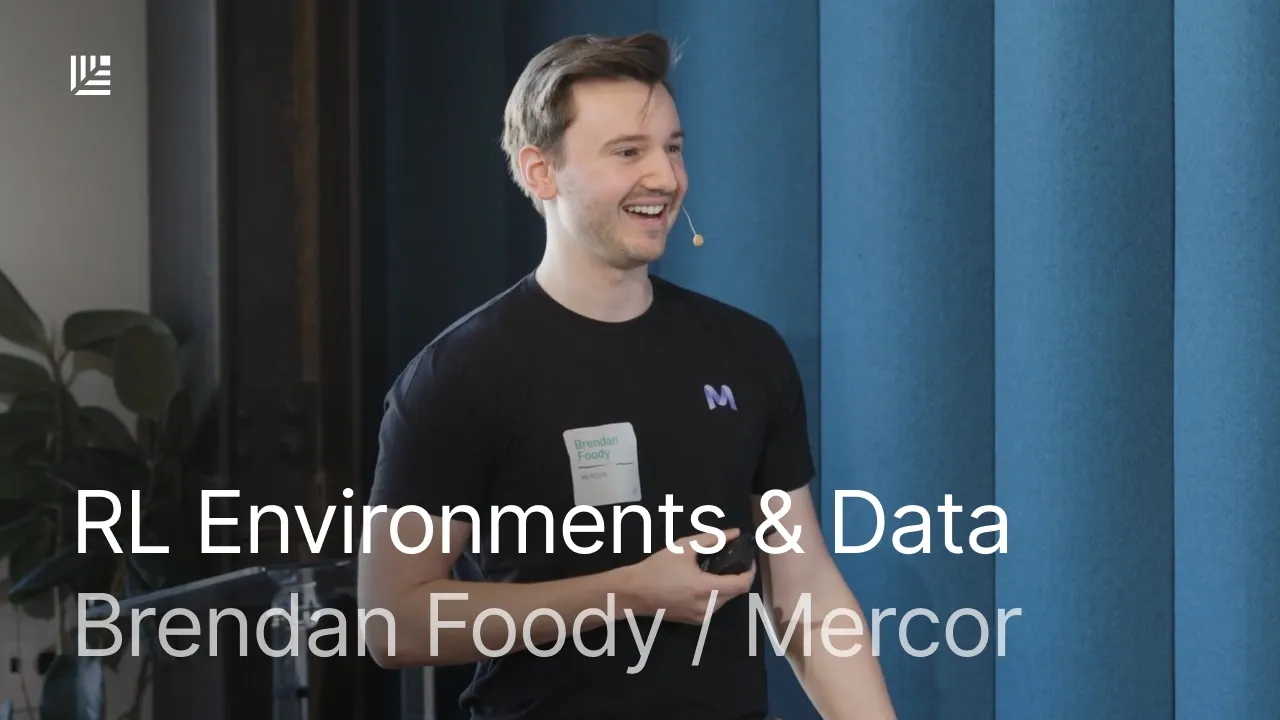
Published on YouTube by Sequoia Capital on August 12, 2026, this video features Mercor CEO Brendan Foody presenting at Sequoia's Own Your Intelligence event. The page description explains that Foody breaks down the core components of RL environments (worlds, apps, tasks), walks through a real legal training environment, and shares post-training results alongside insights on pricing, data quality, and expert-built data pipelines.
## TL;DR
Mercor CEO Brendan Foody details the evolution of AI training data from crowdsourced labeling to expert-built Reinforcement Learning (RL) environments composed of worlds, apps, and task verifiers. He highlights how deep domain expertise from lawyers, engineers, and doctors is essential for measuring frontier model performance where automated feedback falls short. Demonstrating a real-world legal RL environment built with top attorneys, Foody shows how targeted post-training yields massive capability gains on domain-specific benchmarks like corporate law. Finally, he outlines data commercialization models and predicts a future centered on ultra-long-horizon tasks and virtual co-workers.
## Atmosphere & style
The presentation carries an authoritative, insider tone characteristic of a high-stakes tech and venture capital summit. Foody speaks with rapid, analytical precision, blending dense technical taxonomy with clear commercial pragmatism. The atmosphere feels energetic and sharp, transitioning seamlessly from a structured key presentation into a candid, highly practical founder-and-investor Q&A session.
## Key takeaways
- [00:00](https://www.youtube.com/watch?v=a00xIn5kwhM&t=0s) Mercor achieved rapid commercial growth, scaling from a $1 billion to a $2 billion revenue run rate over a four-month period through its focus on post-training RL environments.
- [00:47](https://www.youtube.com/watch?v=a00xIn5kwhM&t=47s) The AI training data market shifted from low-skilled crowdsourcing for supervised fine-tuning (SFT) and RLHF to expert-built, agentic RL environments using Reinforcement Learning with Verifiable Rewards (RLVR).
- [02:29](https://www.youtube.com/watch?v=a00xIn5kwhM&t=149s) A complete real-world RL environment consists of three components: worlds (project/company contexts like docs and emails), apps (high-fidelity software clones like Salesforce or Google Workspace), and tasks (prompts paired with rubric verifiers).
- [03:57](https://www.youtube.com/watch?v=a00xIn5kwhM&t=237s) Human domain experts remain essential for measuring frontier performance because models cannot reliably grade their own subjective work like legal analysis or slide design without introducing noise.
- [05:35](https://www.youtube.com/watch?v=a00xIn5kwhM&t=335s) Constructing comprehensive verifiers that can evaluate a wide range of valid creative solutions without penalizing unexpected approaches represents the hardest technical challenge in environment design.
- [05:35](https://www.youtube.com/watch?v=a00xIn5kwhM&t=335s) Proprietary training data is increasingly recognized as the single most differentiating moat among the three pillars of AI strategy (compute, algorithms, and data).
- [08:18](https://www.youtube.com/watch?v=a00xIn5kwhM&t=498s) Incorporating highly capable open-weight models like GLM-52 and Kimi K3 enables vertical application companies to achieve domain-specific frontier intelligence without training foundation models from scratch.
- [09:45](https://www.youtube.com/watch?v=a00xIn5kwhM&t=585s) Post-training models on domain-specific RL environments can yield dramatic performance jumps on niche tasks (e.g., corporate law accuracy rising from 4.7% to 26.6%) while generalizing to broader benchmarks.
- [11:17](https://www.youtube.com/watch?v=a00xIn5kwhM&t=677s) Companies acquire AI data through three primary commercial structures: custom task-based environment builds, off-the-shelf multi-tenant datasets, and direct hourly expert provisioning.
- [12:49](https://www.youtube.com/watch?v=a00xIn5kwhM&t=769s) RL environment task pricing spans a wide range ($50 to $10,000 per task) dictated by value-based pricing tied to model performance gains or cost-plus pricing based on human expert rates.
- [14:17](https://www.youtube.com/watch?v=a00xIn5kwhM&t=857s) Data quality is defined by environment realism and verifier accuracy, which is validated using trajectory analysis and agentic quality control.
- [16:42](https://www.youtube.com/watch?v=a00xIn5kwhM&t=1002s) Reinforcement Learning with Verifiable Rewards (RLVR) is fundamentally a synthetic data paradigm where models learn iteratively from synthetic trajectories scored by human-guided verifiers.
- [18:05](https://www.youtube.com/watch?v=a00xIn5kwhM&t=1085s) Future RL environment design will focus on ultra-long-horizon tasks (100–1,000 hours) and integrating virtual co-workers to simulate real-world interpersonal dynamics.
- [21:08](https://www.youtube.com/watch?v=a00xIn5kwhM&t=1268s) Fully synthetic rubric and task generation remains bottlenecked by model error rates, making human-driven task creation necessary outside deterministic domains like coding.
- [22:47](https://www.youtube.com/watch?v=a00xIn5kwhM&t=1367s) Provable technical domains like cybersecurity can utilize automated adversarial setups (attacker vs. defender) for verification once human experts architect the environment.
- [23:46](https://www.youtube.com/watch?v=a00xIn5kwhM&t=1426s) Base model trainability for an environment depends on rollout spread; a model with Pass@1 failure but occasional Pass@16 success provides the necessary signal for reinforcement learning.
## Detailed walkthrough
### [00:00](https://www.youtube.com/watch?v=a00xIn5kwhM&t=0s) Introduction and Mercor's Rapid Growth
The session opens with context around Mercor's trajectory, noting that the company grew from a $1 billion to a $2 billion revenue run rate over just a four-month span. This explosive growth positions Mercor directly at the center of how modern tech companies think about post-training models and building proprietary intelligence. The format for the session is structured into a 15-minute presentation by Mercor CEO Brendan Foody focusing on Reinforcement Learning (RL) environments—a critical new frontier topic—followed by 15 minutes of audience Q&A.
[00:47](https://www.youtube.com/watch?v=a00xIn5kwhM&t=47s) A Short History of the Data Market: Crowdsourcing to Agentic Data
Brendan Foody traces the evolution of the AI data training market from its origins in 2020 through the present day, tying it to Mercor's own origin story. In 2020, data generation relied heavily on low-skilled crowdsourcing for behavior cloning. This era focused on supervised fine-tuning (SFT)—input and output pairs—and Reinforcement Learning from Human Feedback (RLHF), where annotators simply selected their preferred model response from multiple options. While this crowdsourced paradigm powered early breakthroughs like GPT-3, ChatGPT, and GPT-4, a massive shift occurred heading into 2024.
The industry moved away from low-skilled behavior cloning and entered the "agentic era" of data. Instead of crowdsourced rankers, labs began seeking the world's highest-skilled domain experts—software engineers, lawyers, doctors, and bankers—working collaboratively in teams to construct frontier evaluations and RL environments. Mercor's first major breakthrough project was scaling up data for deep research agents. Since then, Mercor has scaled across all frontier AI labs and top application-layer companies, including Harvey, Sierra, Cognition, and Ramp. Over the past 12 months, Reinforcement Learning with Verifiable Rewards (RLVR) inside the agentic data framework has evolved into rich RL environments equipped with apps and simulated worlds that teach AI agents how to master workplace tools.
[02:29](https://www.youtube.com/watch?v=a00xIn5kwhM&t=149s) What an RL Environment Is: Worlds, Apps, and Tasks
Foody breaks down the three core architectural components that make up a real-world RL environment:
* **Worlds:** The underlying context of a project or company, encompassing messages, slide decks, documents, spreadsheets, and emails.
* **Apps:** High-fidelity clones of popular software applications (e.g., Salesforce, ServiceNow, Microsoft 365, Google Workspace) that agents can interact with via Model Context Protocol (MCP), Command Line Interfaces (CLI), or Computer-Use Agents (CUA).
* **Tasks:** A combination of prompts and verifiers (such as rubrics or unit tests) used for both model evaluation and RL training.
The core challenge for frontier labs attempting to automate complex computer work using models like Claude is scaling this distribution across every domain in the global economy.
[03:57](https://www.youtube.com/watch?v=a00xIn5kwhM&t=237s) Why Only Humans Can Measure the Frontier
To illustrate the sheer scale of expert labor required, Foody highlights Mercor's talent network throughput over the preceding 24 months. In Q2 alone, Mercor recorded 2.5 million expert hours dedicated to building out RL environments, with growth continuously accelerating.
```
Expert Hours (Q2): 2.5 Million Hours
Target Domains: 205 Bureau of Labor Statistics (BLS) GDP categories
```
Scaling these environments requires covering all 205 domains listed in the Bureau of Labor Statistics' GDP taxonomy across every corresponding application and work scenario. Foody emphasizes that human expertise remains essential because models cannot measure their own frontier performance in most real-world domains. Unlike pure simulation environments like mathematics—where an equation yields a clear binary answer—domains like slide design or legal analysis lack clean programmatic feedback. Asking a model to evaluate its own slide deck is "like asking a human to grade their own homework." Consequently, expert-created rubrics, acting like a university professor grading an essay or a TA reviewing a deck, are indispensable for guiding model learning.
[05:35](https://www.youtube.com/watch?v=a00xIn5kwhM&t=335s) Building Verifiers Is the Hard Part
Constructing accurate verifiers represents the most difficult technical hurdle in environment creation. When designing a complex artifact like a pitch deck, an author must understand the broader problem space: the ten different valid directions the deck could take, alongside dozens of potential mistakes. A verifier must be comprehensive enough to evaluate the full spectrum of valid solutions without penalizing creative or unexpected approaches.
As AI capabilities expand, the techniques developed in collaboration with frontier labs are disseminating to application-layer companies. Data is increasingly recognized as the single most differentiating moat among the three pillars of an AI strategy: compute, algorithms/researchers, and training datasets.
[06:44](https://www.youtube.com/watch?v=a00xIn5kwhM&t=404s) Walkthrough: A Real Legal RL Environment
Foody demonstrates a concrete example of an open-sourced legal RL environment built alongside attorneys from top-tier firms like Latham & Watkins:
* **Scenario Creation:** Experienced lawyers write out realistic project scenarios based on actual Big Law corporate transactions.
* **Data Room Outline:** The lawyers construct a comprehensive data room outline specifying emails, file hierarchies, document types, and file sizes.
* **Model-in-the-Loop Population:** Similar to software engineers using AI coding assistants, human experts use models-in-the-loop to efficiently generate and populate these massive data rooms.
* **Application Integration:** The data room is rendered directly into app clones, such as Google Workspace.
* **Task Prompting:** Trajectories are executed against complex prompts, such as assessing the maximum total liability for *Star Tankers International Limited* versus *Cooper Jefferies Energy Corporation* under the Oil Pollution Act, accounting for every document inside the data room.
* **Rubric Verifiers:** Rubrics score model performance across key legal accuracy criteria while strictly guarding against "reward hacking."
Building reliable verifiers requires extensive agentic quality control, iterative research, agenda validation, and model post-training to ensure every score across hundreds of rolled-out trajectories remains precise.
[08:18](https://www.youtube.com/watch?v=a00xIn5kwhM&t=498s) Leaderboards and What Open Weights Change
Evaluating model performance inside these RL environments yields domain-specific leaderboards. Foody points out recent performance shifts with the inclusion of open-weight and open-access models like GLM-52 and Kimi K3 on the leaderboard. The arrival of highly capable foundation models allows vertical-specific application companies to achieve frontier intelligence directly within their domain without needing to build foundation models from scratch.
[09:45](https://www.youtube.com/watch?v=a00xIn5kwhM&t=585s) Post-Training Results on Apex Agents
To demonstrate the impact of training on RL environments, Foody shares empirical post-training results from **Apex Agents**—a dataset containing 1,800 tasks. Running a post-training pass on GLM-47 using approximately $500,000 in compute delivered dramatic capability improvements:
* **Corporate Law Benchmark:** Model accuracy jumped from **4.7%** to **26.6%**.
* **Cross-Domain Generalization:** Beyond targeted corporate law, the post-trained model demonstrated strong generalization gains on external benchmarks like GDPval and Apex V1 (which lack data rooms), along with nominal gains on general AI benchmarks.
Foody notes that Mercor is actively conducting similar environment builds for partners like Harvey, and predicts that over the next 12 months, dozens of application companies will achieve Cursor-like success by owning their domain-specific intelligence.
[11:17](https://www.youtube.com/watch?v=a00xIn5kwhM&t=677s) Three Ways Companies Buy Data
Foody outlines the three primary commercial structures used by frontier labs and enterprise AI companies to acquire training data:
1. **By Task (Custom Environment Scaling):** The most common structured approach. Customers specify an environment data shape—such as legal RL environments—and pay a fixed rate per completed task (e.g., $2,000 per task). Frontier labs often purchase up to 50,000 custom tasks per month. Individual task complexity varies widely, taking anywhere from a few hours to a full month of human expert labor to complete.
2. **Off-the-Shelf Datasets:** Mercor invests hundreds of millions of dollars building proprietary, multi-tenant datasets that are licensed to multiple customers. Emerging "neo-labs" rely heavily on off-the-shelf data to avoid duplicating capital expenditure across identical domains.
3. **Expert Provisioning (Hourly Model):** Providing raw expert labor hours directly to clients who prefer to manage data curation and environment building internally. While useful for early-stage exploration (e.g., how Harvey initially began working with Mercor), clients typically transition to scaled, task-based deliverables over time.
[12:49](https://www.youtube.com/watch?v=a00xIn5kwhM&t=769s) Q&A: How Do You Price Data?
During the Q&A session, Ali from Astro Guide asks how Mercor prices and values its data datasets. Foody explains that pricing relies on two primary frameworks:
* **Value-Based Pricing (Model Improvement):** Pricing is reverse-engineered from the customer's downstream goal, such as reaching the top of a specific frontier leaderboard. For instance, an enterprise like Nvidia might view a top-tier open-source model as worth $1 billion in commercial value, allowing Mercor to price the constituent training tasks accordingly.
* **Cost-Plus Pricing (Human Capital Basis):** Pricing calculated directly against the cost structure of expert labor. If a complex task requires 10 hours of specialized legal labor at $150/hour, the base cost is $1,500, to which Mercor adds a margin reflective of the task's technical difficulty and frontier differentiation.
As a result of these varying factors, individual task prices range dramatically from **$50 to $10,000 per task**.
[14:17](https://www.youtube.com/watch?v=a00xIn5kwhM&t=857s) Q&A: What "Data Quality" Actually Means
When asked to define data quality and compare human-labeled judgment with automated model graders, Foody splits quality into two distinct dimensions:
* **Realism:** Ensuring the environment, documents, apps, and tasks mirror the exact distribution found in actual professional settings (e.g., realistic Big Law file structures). Domain experts establish detailed taxonomies to maintain this authenticity.
* **Verifier Accuracy:** Ensuring that rubric-based auto-graders score model outputs identically to how a panel of human experts would rank them.
To guarantee verifier accuracy, Mercor executes a technique called **trajectory analysis**. The team rolls out 10 trajectory variations from a target model (e.g., Kimi K3), scores them using the automated rubric, and runs the output through agentic quality control systems alongside human review to verify alignment. Additionally, human preference labels and feedback evaluations are frequently deployed as benchmark tests to audit the auto-graders themselves.
[16:42](https://www.youtube.com/watch?v=a00xIn5kwhM&t=1002s) Q&A: The Misunderstanding About Synthetic Data
Addressing an audience question on how synthetic data generation fits into constructing massive environment data rooms, Foody clarifies a widespread industry misconception surrounding "synthetic data."
He highlights that RLVR itself is fundamentally a bet on synthetic data: instead of paying humans to write static Supervised Fine-Tuning (SFT) responses, models generate thousands of synthetic trajectories that are scored by verifiers so the model can learn iteratively from its own generations. Furthermore, models play an extensive role in populating the actual environment worlds, generating realistic emails, spreadsheets, and files under the direct oversight and architectural guidance of human experts.
[17:16](https://www.youtube.com/watch?v=a00xIn5kwhM&t=1036s) Why Human Experts Are Still Essential for Measuring the Frontier
While AI models like Claude or ChatGPT can dramatically speed up human workflows—whether writing a legal memo or helping experts construct complex data rooms—human expertise remains an irreplaceable element of the data pipeline. Models can handle plenty of execution, but humans are definitionally required to establish the frontier of performance. You cannot simply instruct a model to generate a complex legal environment and then accurately distinguish between high- and low-quality output; the resulting feedback is far too noisy and lacks clear evaluation signals. Measuring performance reliably beyond current model capabilities requires human judgment that sits above that frontier.
- AI models serve as force multipliers for experts building environments, but cannot evaluate their own performance frontier.
- Unassisted model-generated evaluation introduces excessive noise and weak signals.
---
[18:05](https://www.youtube.com/watch?v=a00xIn5kwhM&t=1085s) The Evolution of Data: Deep Research, Apps, and What Comes Next
The massive industry pivot toward RL environments stems from how AI models interact with software. Earlier data paradigms centered around "deep research" environments, where search was the primary tool used alongside human-written evaluation rubrics. By 2025, the focus shifted heavily toward high-fidelity application environments as labs realized the main bottleneck to building useful agents was training them on both local codebases and full desktop applications. To perform effectively across everyday user workflows, agents must learn from data distributions that reflect those exact tools and contexts.
Looking ahead, two massive shifts are set to redefine the RL environment landscape: ultra-long-horizon tasks and virtual co-workers. Current agents are rarely trained on tasks taking longer than 10 hours, but future training must scale to complex workflows spanning 100 to 1,000 hours. Furthermore, while typical human jobs require 60% to 70% of effort to be spent collaborating with colleagues, roughly 1% of current AI evaluations (such as Tau-bench) measure social interactions. Introducing virtual co-workers into environments will bridge this critical realism gap.
- **Deep Research Era:** Focused on light RL environments built primarily around web search tools and rubric evaluations.
- **2025 App Shift:** Expanded into full-fidelity tool and desktop environment simulations to match real-world user distributions.
- **Ultra-Long-Horizon Tasks:** Scaling environment task durations from under 10 hours to 100–1,000 hours.
- **Virtual Co-workers:** Addressing the gap where 60–70% of human work involves interpersonal interaction, but standard benchmarks barely evaluate social dynamics.
---
[21:08](https://www.youtube.com/watch?v=a00xIn5kwhM&t=1268s) The Bottleneck of Rubric and Task Generation
Scaling task and verifier generation remains heavily reliant on human expertise, though copilot workflows can significantly improve efficiency. An AI copilot can assist an expert in crafting tasks by stepping through model trajectories to pinpoint failures. However, relying on a model to independently generate its own evaluation rubrics fails because the model cannot reliably identify its own mistakes; a high rate of incorrect criteria introduces unworkable noise into the post-training process.
Human experts are indispensable for establishing realistic, grounded tasks, with only a few domain-specific exceptions. In software engineering, or when distilling capabilities from a superior frontier model to a weaker one, synthetic task generation can work effectively. Outside of these cases, human-driven task creation remains necessary to maintain dataset integrity.
- Copilot workflows allow experts to audit trajectories faster, but fully automated rubric generation is limited by model error rates.
- Synthetic task creation is effective primarily in deterministic domains like coding or through model distillation setups.
---
[22:47](https://www.youtube.com/watch?v=a00xIn5kwhM&t=1367s) RL Environments in Domain-Specific Fields Like Cybersecurity
In provable domains such as cybersecurity defense and incident response, the data generation dynamic shifts significantly. Rather than relying on human experts to manually grade every single interaction, environments can leverage automated adversarial setups featuring attacker and defender agents.
In these technical domains, human experts are primarily needed upfront to architect high-fidelity, highly diverse network environments. Once the environment is properly configured, the verification process requires far less manual human grading compared to subjective fields like law or writing.
- Human experts design and configure complex, realistic cyber environments to ensure structural diversity.
- Grading and verification can be automated through multi-agent attacker vs. defender setups.
---
[23:46](https://www.youtube.com/watch?v=a00xIn5kwhM&t=1426s) Determining Base Model Trainability and Pass@k Metrics
Determining whether post-training progress is limited by a base model's intrinsic capabilities comes down to evaluating rollout distributions. While parameter count influences overall trainability, the key diagnostic metric is the spread between $\text{Pass}@1$ and $\text{Pass}@16$.
If a model attempts 16 trajectory rollouts on a task and fails every single one, it lacks the foundational capabilities needed to learn from that dataset. The ideal setup for post-training occurs when a model fails at $\text{Pass}@1$ but succeeds once or twice across a 16-rollout sample ($\text{Pass}@16$). This signal provides the precise gradient needed for the agent to optimize its performance during reinforcement learning.
- **$\text{Pass}@16 = 0$:** Indicates the base model is underpowered for the environment and unable to generate useful learning signals.
- **$\text{Pass}@1 \text{ Failure} / \text{Pass}@16 \text{ Success}$:** Represents the target training zone where reinforcement learning yields maximum performance gains.
---
[25:14](https://www.youtube.com/watch?v=a00xIn5kwhM&t=1514s) Custom Data Strategy: In-House vs. Strategic Partnerships
As application companies navigate post-training strategy, building proprietary datasets is essential to maintaining a defensible moat. Mercor addresses this demand by providing siloed, fully exclusive custom data teams dedicated to specific enterprise clients. This model grants companies full ownership of their domain-specific datasets while leveraging specialized external infrastructure.
While some organizations attempt to build out whole talent networks and data platforms entirely in-house, partnering with specialized providers offers significant economies of scale. Following the playbook of frontier AI labs, leveraging established infrastructure and expert pipelines allows application companies to move much faster while retaining full ownership of their core competitive assets.
- Siloed, exclusive data teams allow clients to maintain full IP ownership of proprietary RL datasets.
- Partnering with specialized data providers delivers scale and infrastructure efficiency that are difficult to replicate in-house.
## Notable quotes
> [03:57](https://www.youtube.com/watch?v=a00xIn5kwhM&t=237s) like asking a human to grade their own homework. — Brendan Foody
> [05:35](https://www.youtube.com/watch?v=a00xIn5kwhM&t=335s) Data is increasingly recognized as the single most differentiating moat among the three pillars of an AI strategy: compute, algorithms/researchers, and training datasets. — Brendan Foody
> [06:44](https://www.youtube.com/watch?v=a00xIn5kwhM&t=404s) assessing the maximum total liability for Star Tankers International Limited versus Cooper Jefferies Energy Corporation under the Oil Pollution Act, accounting for every document inside the data room. — Brendan Foody
> [09:45](https://www.youtube.com/watch?v=a00xIn5kwhM&t=585s) Model accuracy jumped from 4.7% to 26.6%. — Brendan Foody
> [12:49](https://www.youtube.com/watch?v=a00xIn5kwhM&t=769s) Individual task prices range dramatically from $50 to $10,000 per task. — Brendan Foody
> [14:17](https://www.youtube.com/watch?v=a00xIn5kwhM&t=857s) Ensuring that rubric-based auto-graders score model outputs identically to how a panel of human experts would rank them. — Brendan Foody
> [16:42](https://www.youtube.com/watch?v=a00xIn5kwhM&t=1002s) RLVR itself is fundamentally a bet on synthetic data: instead of paying humans to write static Supervised Fine-Tuning (SFT) responses, models generate thousands of synthetic trajectories that are scored by verifiers so the model can learn iteratively from its own generations. — Brendan Foody
> [17:16](https://www.youtube.com/watch?v=a00xIn5kwhM&t=1036s) You cannot simply instruct a model to generate a complex legal environment and then accurately distinguish between high- and low-quality output; the resulting feedback is far too noisy and lacks clear evaluation signals. — Brendan Foody
> [18:05](https://www.youtube.com/watch?v=a00xIn5kwhM&t=1085s) Introducing virtual co-workers into environments will bridge this critical realism gap. — Brendan Foody
> [23:46](https://www.youtube.com/watch?v=a00xIn5kwhM&t=1426s) If a model attempts 16 trajectory rollouts on a task and fails every single one, it lacks the foundational capabilities needed to learn from that dataset. — Brendan Foody
## Mentioned
Mercor, Brendan Foody, Sequoia Capital, Harvey, Sierra, Cognition, Ramp, Salesforce, ServiceNow, Microsoft 365, Google Workspace, Bureau of Labor Statistics, Latham & Watkins, Star Tankers International Limited, Cooper Jefferies Energy Corporation, GLM-52, Kimi K3, GLM-47, Apex Agents, Astro Guide, Nvidia, Claude, ChatGPT, Cursor
Mercor CEO Brendan Foody argues that frontier AI training has transitioned from low-skilled crowdsourcing to domain-expert Reinforcement Learning (RL) environments that simulate full workplace software ecosystems. In Foody's view, human domain experts remain essential because foundation models cannot reliably measure their own frontier performance or independently author their own evaluation verifiers.
Architectural Components of Modern RL Environments (2:29)
Foody traces the evolution of AI training from 2020's low-skilled crowdsourcing—focused on supervised fine-tuning and basic preference selection—to the modern agentic era driven by Reinforcement Learning with Verifiable Rewards (RLVR). Enterprise-grade RL environments simulate real-world work through three core layers: "worlds" containing authentic project artifacts such as emails, documents, and spreadsheets; "apps" that clone standard software like Salesforce, Microsoft 365, and Google Workspace via interfaces like Model Context Protocols and Computer-Use Agents; and "tasks" pairing realistic prompts with rubrics or unit tests.
Human Verification as the Primary Bottleneck (3:57)
Constructing accurate verifiers represents the most difficult technical challenge in environment design. Foody states that models cannot grade their own frontier work without introducing excessive noise, comparing unassisted model grading to a student grading their own homework. While models can act as copilots to generate background files or test trajectories, verifiers must be authored and calibrated by elite human practitioners to score diverse valid strategies without penalizing unexpected solutions.
Post-Training Capability Gains and Diagnostic Metrics (9:45)
To demonstrate the real-world impact of RL environments, Foody cites Mercor's Apex Agents dataset of 1,800 tasks. Post-training GLM-47 using approximately $500,000 in compute increased its corporate law benchmark accuracy from 4.7% to 26.6%, while also improving performance on external benchmarks like GDPval. To diagnose whether a base model can learn from a domain dataset, Mercor evaluates rollout distributions between Pass@1 and Pass@16: a model that scores zero across 16 rollouts lacks the baseline capabilities to generate a learning gradient, whereas a model that fails Pass@1 but succeeds once or twice in 16 attempts provides the optimal gradient for reinforcement learning.
Commercial Models and Emerging Horizons (11:17)
Enterprises acquire RL training data through three primary avenues: task-based custom environments priced between $50 and $10,000 per task (with frontier labs purchasing up to 50,000 tasks monthly), licensed off-the-shelf datasets, and hourly expert provisioning. Looking forward, Foody identifies two key horizon shifts: expanding task duration from under 10 hours to ultra-long workflows spanning 100 to 1,000 hours, and embedding simulated virtual co-workers into environments to address the fact that 60% to 70% of human work involves interpersonal interaction, compared to roughly 1% of current AI evaluations.
Foody anticipates that specialized RL environments will enable vertical software companies to reach frontier intelligence by post-training open-weight models, bypassing the need to build foundational models from scratch. However, the model's ongoing expansion depends on whether providers can economically scale high-skill human labor to build verifiers across all 205 Bureau of Labor Statistics GDP categories.
[3:57] Brendan Foody: like asking a human to grade their own homework.
[5:35] Brendan Foody: Data is increasingly recognized as the single most differentiating moat among the three pillars of an AI strategy: compute, algorithms/researchers, and training datasets.
[6:44] Brendan Foody: assessing the maximum total liability for Star Tankers International Limited versus Cooper Jefferies Energy Corporation under the Oil Pollution Act, accounting for every document inside the data room.
[9:45] Brendan Foody: Model accuracy jumped from 4.7% to 26.6%.
[12:49] Brendan Foody: Individual task prices range dramatically from $50 to $10,000 per task.
[14:17] Brendan Foody: Ensuring that rubric-based auto-graders score model outputs identically to how a panel of human experts would rank them.
[16:42] Brendan Foody: RLVR itself is fundamentally a bet on synthetic data: instead of paying humans to write static Supervised Fine-Tuning (SFT) responses, models generate thousands of synthetic trajectories that are scored by verifiers so the model can learn iteratively from its own generations.
[17:16] Brendan Foody: You cannot simply instruct a model to generate a complex legal environment and then accurately distinguish between high- and low-quality output; the resulting feedback is far too noisy and lacks clear evaluation signals.
[18:05] Brendan Foody: Introducing virtual co-workers into environments will bridge this critical realism gap.
[23:46] Brendan Foody: If a model attempts 16 trajectory rollouts on a task and fails every single one, it lacks the foundational capabilities needed to learn from that dataset.
Original transcript
[0:00] Um, Record, I think you guys grew from a
[0:01] 1 to a 2 billion dollar revenue run rate
[0:03] in the last 4 months or so.
[0:06] Um, so this company's off to the races
[0:08] and I think you were just so front and
[0:09] center to how companies are thinking
[0:11] about uh post training their own models,
[0:13] uh building their own intelligence. So,
[0:15] thank you for joining us for this
[0:16] conversation. Um, format-wise what we're
[0:19] going to do is we've 15 minutes or so of
[0:22] content from Brendan. He's going to talk
[0:23] about uh RL environments in particular,
[0:26] which I think is a, you know, new
[0:28] frontier topic. It'll be fun to fun to
[0:30] explore. And then we're going to leave
[0:32] 15 minutes or so at the end for Q&A
[0:34] again. So, uh please keep please keep
[0:37] questions back pocket. I will turn it
[0:38] over to you, Brendan.
[0:39] >> Sweet. So, I'll be talking about RL
[0:41] environments. Starting out, I figured
[0:43] it's helpful to give a little bit of the
[0:45] background on the history of the data
[0:48] market and how that history ties into
[0:51] Record's origin story. Where things
[0:53] really started in 2020 in the era of
[0:56] crowdsourcing data for behavior cloning.
[0:58] So, this was mainly supervised
[1:00] fine-tuning data, inputs and outputs,
[1:02] and RLHF data where you would have a
[1:06] annotator select from a couple of model
[1:08] responses which they preferred. And we
[1:10] were able to make all this progress in
[1:13] fine-tuning GPT-3, making progress
[1:16] towards ChatGPT and GPT-4 in the
[1:18] crowdsourcing era of agentic data. But,
[1:21] what we saw changing in the market,
[1:24] especially as we uh headed into 2024,
[1:27] was this giant transition away from the
[1:30] low-skilled crowdsourcing era of
[1:33] behavior cloning data and moving towards
[1:36] the agentic era of data. Of how do we
[1:38] find the highest-skilled experts in the
[1:40] world that can work collaboratively in
[1:42] teams to build frontier evals and RL
[1:44] environments for the next generation of
[1:46] models models. All the software
[1:48] engineers, lawyers, doctors, bankers, et
[1:50] cetera that could measure the frontier
[1:53] of intelligence and help to use that to
[1:57] improve model capabilities. And so,
[2:00] Mercor grew up with our first big
[2:02] project being deep research. I guess the
[2:04] first prominent RL agent
[2:07] scaling up dramatically with all of the
[2:09] frontier labs to become the primary
[2:11] agentic data vendor to
[2:14] all of the leading labs
[2:16] and also all of the leading application
[2:17] layer companies ranging from Harvey,
[2:19] Cera, Cognition to Ramp. And what's been
[2:22] really exciting over the last 12 months
[2:26] especially is how RLVR within the
[2:29] agentic data paradigm has evolved to
[2:32] also include RL environments with these
[2:35] rich apps and worlds that teach agents
[2:38] how to use all of the tools on
[2:41] our laptops that we use every day. So,
[2:43] I'll be talking about that
[2:45] and of course how this technology that
[2:48] started in the frontier labs is now
[2:51] getting disseminated to the application
[2:53] layer and all of the products that all
[2:55] of you are building
[2:57] as you
[2:58] work on your company. So, high level on
[3:00] what an RL environment is is that it
[3:02] includes three parts. The first part is
[3:04] the worlds. So, this includes all of the
[3:06] messages, slides, docs, sheets, etc.
[3:09] that correspond to everything you would
[3:11] have in a real project or company that
[3:14] you're working on. The second part is
[3:16] the apps which is high fidelity clones
[3:18] of popular applications, Salesforce,
[3:21] ServiceNow, Microsoft 365, etc. that
[3:24] agents can interact with via MCP, CLI,
[3:26] or Kua. And then the third part is the
[3:28] tasks where we have prompts and
[3:30] verifiers. Verifiers could be rubrics or
[3:33] unit tests that can be used either for
[3:35] eval or training. And the barrier for
[3:37] frontier labs to automate everything
[3:40] that you can do on your laptop using
[3:42] Claude is how do they cover the full
[3:44] distribution of all of the worlds, all
[3:47] of the apps, and all of the tasks in the
[3:49] economy. And so, there's been this
[3:51] enormous scale out in order to do that.
[3:54] Um, where humans have been really
[3:57] central to how we build these
[3:58] environments, obviously with models in
[4:00] the loop meaningfully. And so I put a
[4:02] graph here of the amount of expert hours
[4:05] that um,
[4:07] of throughput in from our talent network
[4:09] over the last 24 months. Um,
[4:12] and it's a a pretty crazy trajectory
[4:15] with respect to um, 2.5 million hours
[4:19] um, in Q2 alone with growth sort of
[4:21] accelerating on the amount of expert
[4:23] time uh, used to build out all of these
[4:27] environments. The reason being of course
[4:29] as I mentioned we need to scale out the
[4:31] environment distribution across every
[4:34] category in the economy. Many of you
[4:35] might know GDP val where there's 205
[4:39] domains in the Bureau of Labor
[4:40] Statistics across all the different
[4:42] jobs, but then you have to think through
[4:44] how do we have all of the apps
[4:45] corresponding to all of those jobs, all
[4:47] the different scenarios, all the tasks.
[4:49] Is this enormous build out. Only humans
[4:52] can measure the frontier in most
[4:54] domains, not every domain. There are
[4:55] rare exceptions like math where you have
[4:58] a really clean simulation environment
[4:59] and so uh, the model's able to learn
[5:02] from whether it got the right answer,
[5:03] but in most domains like building a
[5:05] slide deck uh, the model has an
[5:07] incredibly hard time identifying
[5:09] reliably where it made its own mistake.
[5:11] It's as if you would be asking a human
[5:14] to grade their own homework. And so
[5:16] that's why it's really valuable to have
[5:18] a human create a rubric similar to how a
[5:22] professor would create a rubric to grade
[5:23] an essay or a TA would grade that slide
[5:26] deck. Similar to the way that a lot of
[5:27] us learn it's in large part from the
[5:30] feedback we got from those around us
[5:31] rather than
[5:33] uh, purely plugging things into a
[5:35] calculator or clean simulation. Um,
[5:38] and then building these verifiers is
[5:39] hard cuz anytime you're building the
[5:41] slide deck you need to understand the
[5:44] full problem space of what are the 10
[5:46] different slide decks that, you know,
[5:48] could be a good path to go down? What
[5:50] are the dozens of mistakes you could
[5:52] possibly make? And how do you build a
[5:53] comprehensive verifier that captures
[5:56] this full solution area of what's
[5:57] possible? And so, what I'll walk through
[5:59] is a sample RL environment.
[6:01] Excuse me, to also break this down for
[6:03] all of you. Um and part of the reason
[6:06] that this is so cool, which I'll get to
[6:07] in a moment, is that we developed a lot
[6:10] of this technology in collaboration with
[6:13] the labs. These are, of course, ones
[6:15] that we have open-sourced and published
[6:17] to the world, but now that's all
[6:19] starting to get disseminated to the
[6:21] application layer companies that are
[6:24] building and owning their own
[6:25] intelligence. As they realize that the
[6:27] three core pillars of their AI strategy
[6:30] are their compute, their algorithms or
[6:32] researchers, and the data sets they
[6:34] build. And data's often the most
[6:36] differentiating factor. And so, this is
[6:38] one that we published, um
[6:40] as a legal environment, where we have
[6:42] lawyers from top law firms like Latham
[6:45] and Watkins write out a scenario of a
[6:48] real project that they worked on in
[6:50] their big law job. And then they create
[6:52] a full outline for a data room that
[6:55] corresponds to all of the different uh
[6:57] messages, emails, files, size of files.
[7:01] I cut off the full data room cuz it's
[7:03] it's very extensive. Um and of course,
[7:06] there's a lot of model in the loop with
[7:07] how they effectively populate this.
[7:09] Similar to how a software engineer now
[7:11] should not be coding by hand entirely
[7:13] themselves, they should probably be
[7:15] orchestrating agents in how to do this
[7:17] very productively. Um
[7:19] and then we render that data room into
[7:21] the apps, the clones of Google Workspace
[7:23] you can see in this scenario, and have
[7:25] prompts uh to roll out model
[7:27] trajectories against this. And so, in
[7:29] this one, it's evaluating the maximum
[7:32] total liability for Star Tanker uh
[7:34] Tankers International Limited compared
[7:37] to Cooper Jefferies Energy Corporation
[7:38] under the Oil and Petroleum Act, uh
[7:41] considering all of the context uh from
[7:43] this real scenario in the data room. And
[7:44] then as I mentioned, similar to how a
[7:46] professor would create a rubric to grade
[7:48] an essay, they have these key rubric
[7:50] criteria that correspond to what are the
[7:53] characteristics of a of a accurate model
[7:56] response. And making sure that these
[7:58] rubric criteria avoid reward hacking and
[8:01] effectively align with the uh when you
[8:05] roll out 100 trajectories, making sure
[8:06] all of those scores are accurate is
[8:09] incredibly technically challenging. And
[8:11] so there's an enormous amount of
[8:13] research, agenda quality control,
[8:15] training on the data, etc. that goes
[8:17] into how you solve that problem and then
[8:18] ultimately produce these high-quality
[8:20] verifiers and leaderboards um that give
[8:23] you an aggregate model score across how
[8:25] well all of the different models are um
[8:27] doing on a particular domain. And as we
[8:30] can see, one of the big changes over the
[8:32] last few months is that GLM 52 and
[8:35] Chimera K3 are on the leaderboard. And
[8:37] so that is a huge opportunity for all of
[8:40] you because that gives us the foundation
[8:44] to actually achieve frontier
[8:46] intelligence and all of the specific
[8:48] applications uh and verticals that
[8:51] you're focusing on um that's not too far
[8:53] away. And so to give a little bit of
[8:56] context on what that looks like, um I'll
[8:58] share an example of post-training on
[9:00] Apex Agents, which is the data set that
[9:03] I uh or the sample I just showed before,
[9:06] where we have 1,800 tasks in this
[9:08] example. This was post-training run of
[9:11] GLM 47, but we're redoing a lot of them
[9:13] for Chimera K3, so we'll have updated
[9:15] results for you all soon. Where you can
[9:17] see the jumps just on 1,800 tasks with
[9:20] about 500k in compute are pretty
[9:23] dramatic. Um corporate law going from
[9:26] 4.7% to 26.6%,
[9:29] um but notice that this is just Apex
[9:32] Agents data set we gave it, and it
[9:34] actually generalized incredibly well to
[9:37] GDP valve and uh Apex V1, which doesn't
[9:40] have these data rooms.
[9:42] Even just seeing nominal gains and some
[9:45] other benchmarks
[9:47] as well. And so, we're doing a lot of
[9:50] this work of working with customers like
[9:52] Harvey, who I know will present on stuff
[9:54] later to help build out the
[9:58] environments corresponding to their
[10:00] specific domain so that they can build
[10:02] frontier intelligence within that. And I
[10:05] think Andrew talked about how Cursor was
[10:07] a great first example of how an
[10:10] application layer company could build a
[10:13] industry-leading model that, you know,
[10:15] built an enormous amount of value for
[10:16] their customers. And I believe that over
[10:18] the next 12 months, there is going to be
[10:21] dozens of examples just like that where
[10:23] companies own their own intelligence and
[10:25] that is the key source of the modes that
[10:28] they're building. And actually, Josh and
[10:29] I talked about this the other day as
[10:31] well. Um
[10:33] a couple of examples of ways to curate
[10:35] high-quality data sets.
[10:37] The general three that we see most that
[10:40] I'm happy to
[10:42] talk about and send people links to is
[10:44] first by task is the most common.
[10:47] Where people would say, "I really like
[10:48] this data shape of environments in law
[10:53] and we will pay $2,000 per task to scale
[10:56] this up." And
[10:58] as an example, certain frontier labs
[11:00] might buy 50,000 tasks a month from us.
[11:03] And so, it tends to be pretty dramatic
[11:06] scale.
[11:07] And these tasks would generally be very
[11:09] complex. Some would even take humans up
[11:11] to a month to complete that given task.
[11:14] Sometimes it would take just a few
[11:16] hours. And these would be sort of custom
[11:18] per task pricing. Second is
[11:20] off-the-shelf data
[11:22] where we have we've invested hundreds of
[11:24] millions of dollars in building our own
[11:26] data sets that we sell to multiple
[11:28] customers. All these new neo labs are
[11:30] generally airing more towards
[11:32] off-the-shelf data because it doesn't
[11:34] make sense for 10 different labs to all
[11:36] be building their own uh data sets. Um
[11:38] there's a lot of value to building
[11:40] something once that can uh then be
[11:42] applied to everyone. And then the final
[11:44] which um we see a little bit of, but is
[11:46] uh less of our focus anymore, is just
[11:49] providing um the experts so that
[11:52] customers are able to
[11:54] uh or organize the experts on their own
[11:57] um
[11:58] in just an hourly model. Um so we we do
[12:00] a little bit of that when people like
[12:02] that was how Harvey got started with us
[12:04] hiring
[12:05] uh some lawyers, um but it generally
[12:07] moves towards more of these uh scaled
[12:09] offerings of data over time. So, that's
[12:12] a little bit of the background of how to
[12:14] build RL environments, what they are,
[12:16] and I'm really excited about all this
[12:18] technology that we have uh
[12:21] that has previously been limited to the
[12:23] frontier labs all making its way to all
[12:25] of you. And so, happy to answer any
[12:27] questions um
[12:28] about that.
[12:34] Sweet.
[12:35] Go ahead.
[12:37] >> Hey, uh
[12:39] um I'm Ali from Astro Guide. My question
[12:41] is it's kind of open-ended, but simple.
[12:43] How do you price data?
[12:45] Like how do you value data?
[12:47] >> So, there's a so many different ways. I
[12:50] mean,
[12:51] the most natural would be our customers
[12:53] care about model improvement, right? And
[12:56] so, our customers have a given goal of
[12:58] they want to you know, be at the
[13:00] frontier on a given leaderboard. And so,
[13:03] we're able to work backwards from how
[13:05] much is that worth to them and how much
[13:07] should we charge uh per task, how many
[13:09] tasks do we think would get them to that
[13:11] goal. And so, when we think about uh a
[13:13] company like Nvidia, they're probably
[13:15] willing to pay, you know, a billion
[13:17] dollars to have a frontier open-source
[13:19] model. And so, there's a lot of
[13:21] complexity of like how do we you know,
[13:23] price all the different ingredients that
[13:24] go into um making that happen.
[13:28] The other way that we price
[13:31] when it lens we look at it through is
[13:33] also our cost structure to make them
[13:36] where of course
[13:39] when we have a task that takes 10 hours
[13:42] of human time and
[13:44] we're paying the human $150 an hour
[13:47] there might be a $1500 cost basis and so
[13:50] then it becomes a question of what
[13:52] margin do we want to run on top of that
[13:54] based on how differentiated and frontier
[13:56] that specific task is.
[13:59] But it's it's super wide range. Like we
[14:00] have tasks that range from $50 to
[14:03] $10,000. So.
[14:05] >> How do you think about data quality? You
[14:08] mentioned like you know utilize human
[14:10] expert to label data and how do you how
[14:12] do you compare the human label data and
[14:14] you know the frontier lab you know
[14:16] frontier
[14:17] alliance the judgment data? How do you
[14:20] compare them to from your opinion?
[14:23] >> So first question was how do we think
[14:25] about quality? Second one was sort of
[14:27] how do we compare the like judgment of
[14:30] preference labels to the auto graders?
[14:33] >> Yeah.
[14:33] >> So the core spot which is generally when
[14:36] people say data quality they're
[14:38] referring to two things. First is
[14:41] realism and secondly is accuracy of
[14:44] verifiers.
[14:46] On realism it's just like they want to
[14:48] automate everything in the economy that
[14:50] corresponds to corporate law in this
[14:53] case right? And so it's like how do we
[14:54] make sure that this actually reflects
[14:57] the real distribution of what we would
[14:59] see in a real lawyer's environment. And
[15:02] that's one of the reasons that experts
[15:04] create outlines and help to guide all
[15:06] the processes of the data curation.
[15:08] Realism of the environment the apps the
[15:11] tasks everything is incredibly important
[15:14] and and also granularly understanding
[15:16] the taxonomy that drives that realism
[15:18] across the entire distribution that
[15:20] you're looking for. The second part of
[15:23] it relates to the other way people think
[15:25] about quality, which is the accuracy of
[15:27] the verifiers. Cuz the way that you
[15:29] would train one of these models is you
[15:30] might roll out 100 trajectories of Kimi
[15:33] K3 and then use this rubric to score all
[15:36] of those trajectories. And as you can
[15:38] imagine, there's like so many different
[15:41] paths that a model can go down. And so
[15:43] you want to make sure that the way this
[15:45] rubric is doing the scoring is the same
[15:48] as if we were to just have human stack
[15:49] rank those 100 trajectories. And so what
[15:51] we do for that is a process called
[15:53] trajectory analysis, where we roll out
[15:56] 10 trajectories of the model that we're
[15:58] focused on improving,
[16:00] um, and then score all of those, and
[16:02] have some combination of agentic quality
[16:05] control systems and some human review go
[16:08] through to make sure that, um, all of
[16:12] the scores align with, uh, the goals.
[16:15] Um,
[16:16] and sometimes you can also use, uh,
[16:18] human feedback evals or preference
[16:20] labels to as a eval for your auto
[16:22] grader, um, is the other way related to
[16:25] that that you're able to solve for it.
[16:30] Go ahead.
[16:30] >> Um, how much do you think like synthetic
[16:32] data generation plays into all of this,
[16:34] especially like creating these large
[16:36] data rooms?
[16:38] >> So the fascinating thing is I think that
[16:39] there's been a lot of misinterpretation
[16:42] of what people mean when they say
[16:44] synthetic data because, like, RLVR is a
[16:46] bet on synthetic data. It's basically
[16:49] let's roll out a bunch of synthetic
[16:50] model trajectories rather than having
[16:52] the humans write the SFT, and then let's
[16:54] score all of them, and let the models
[16:56] learn from all of these like, uh,
[16:59] synthetic model trajectories. So I think
[17:01] that's the first way that synthetics get
[17:03] used. The second way is that models play
[17:07] giant role in the way that we populate
[17:11] environments and create tasks in the
[17:13] same way that, um, a lawyer that is
[17:16] writing a legal memo should definitely
[17:18] be using
[17:20] Claude or ChatGPT to do that. The
[17:23] experts that are building out these data
[17:24] rooms should definitely be using Claude,
[17:26] ChatGPT, or whatever model
[17:29] to help them do that. And there's a lot
[17:31] of ways that the model can make them
[17:32] more efficient. But the reason that
[17:34] humans are still an essential component
[17:36] of the process that's incredibly
[17:38] differentiated is that you need humans
[17:41] almost definitionally to measure what is
[17:43] beyond the frontier of the model
[17:45] capabilities.
[17:46] Like the models you you can't just tell
[17:48] the model like come up with the legal
[17:49] environment and then like tell me which
[17:51] of your legal memos are like good and
[17:53] bad. It's super noisy and there's not
[17:55] like clear signals associated with that.
[17:57] You need
[17:58] something that has capabilities beyond
[18:00] the frontier of that model to do so
[18:02] reliably.
[18:05] >> Thank you for doing this. Um my question
[18:08] is RL environments seem like they're all
[18:10] the rage now and maybe have been for
[18:11] about a year. I had I hadn't really been
[18:14] hearing about them prior to that and it
[18:15] was all
[18:17] human expert labeling. And so
[18:19] kind of why why why is it all about RL
[18:21] environments now? Is that the most
[18:23] relevant thing for application companies
[18:25] to be thinking about? And is there any
[18:26] something after RL environments?
[18:29] >> Um so I'll I'll start with why it's
[18:32] become the rage and maybe some of the
[18:35] differences also between the deep
[18:36] research paradigm and the like envi- the
[18:39] sort of environments paradigm as we saw
[18:41] it in 2025. And then I'll talk about
[18:43] looking forward what we see evolving in
[18:45] the data landscape. Specifically, I
[18:47] think that the reason the deep research
[18:50] environments were the first was because
[18:51] like deep research had tool use with
[18:53] search. So search was the tool in the
[18:55] environment that the model
[18:58] would work in. But the experts would not
[19:00] necessarily be populating apps. So it
[19:02] was sort of a lighter version of an RL
[19:04] environment where they would just like
[19:06] create rubrics corresponding to this.
[19:08] And again, like I only talk about this
[19:10] stuff cuz it's a couple of years old at
[19:11] this point, so it's no longer
[19:13] uh super confidential. And then for the
[19:16] like trend of apps in 2025, I think that
[19:20] really became giant because people
[19:23] realized that the primary bottleneck to
[19:26] making the models useful was how they
[19:27] started to use both all the context in
[19:30] the code base and all of the tools on
[19:32] our laptops, right? And so if we want
[19:34] this in the user distribution of usage,
[19:37] then we need to get it in the data
[19:39] distribution that the models are
[19:41] learning from.
[19:42] Uh and so there's going to continue be
[19:45] to be this giant scale up of diversity
[19:48] across all three of these categories on
[19:50] a going forward basis, but there's going
[19:52] to be some changes
[19:53] um to maybe name two of those changes
[19:56] that we're thinking about the most. The
[19:58] first one is ultra long horizon. Like
[20:01] right now agents mostly aren't trained
[20:03] to do things that are over 10 hours, and
[20:06] we need to start building tasks for
[20:07] things that might take a human 100 hours
[20:10] or even 1,000 hours to do. And so that's
[20:12] going to be a giant shift. And then the
[20:14] other large shift that we're seeing is
[20:17] introducing virtual co-workers, which
[20:19] corresponds to that. Um like one my
[20:22] favorite questions to ask people when
[20:24] they're thinking about their data
[20:25] distribution is what percentage of tasks
[20:27] that they do in their job require
[20:30] interacting with other people.
[20:32] Uh and most people would say like 60% or
[20:34] 70%. Some people say a lot more, some
[20:36] people say a little bit less. Um but
[20:38] then if you map that on to what
[20:41] percentage of evals measure how well the
[20:44] models can interact with other people,
[20:46] it's like 1%, maybe Tau bench has a
[20:48] little bit of this.
[20:50] Um
[20:51] and so there's this giant realism gap
[20:53] associated with how you actually measure
[20:57] how well agents engage in social
[20:59] interaction um throughout uh all of the
[21:02] different people and other agents that
[21:04] they need to work with uh in their jobs.
[21:07] Good.
[21:08] >> You talked about rubric generation,
[21:10] which is like is it like a bespoke
[21:12] access of verify that you put task? And
[21:14] from what I understood, that's like
[21:16] bottleneck by experts. Have you found
[21:17] any success of like being able to scale
[21:20] that up with your models giving you like
[21:22] some heuristic or even like post any
[21:24] models for
[21:26] >> We have found that you can make it a lot
[21:29] more efficient if you have a like AI
[21:32] copilot that's able to work with the
[21:34] expert in creating the task and the
[21:36] verifier.
[21:37] Um so, the expert can talk to the
[21:40] trajectory and understand exactly what's
[21:42] happening and where it's going wrong.
[21:44] The challenge is just that if you're
[21:46] trying to improve FABLE,
[21:48] FABLE cannot reliably write out the like
[21:53] rubric criteria for where it's making
[21:54] mistakes. It might get like half of them
[21:57] right and half of them wrong, and that
[22:00] amount of noise is unworkable from a
[22:03] training standpoint. Um and so, that's
[22:06] the reason that the the process that
[22:08] requires humans the most is the task
[22:10] creation. Uh like a lot of the
[22:12] environments, we can get
[22:14] like use a lot of synthetic. Uh
[22:17] it's helpful to have humans write the
[22:18] outlines they're familiar with the
[22:19] environment and and uh
[22:22] and they're grounded in reality, a
[22:23] realistic distribution, but with the
[22:26] task that's those tend to really require
[22:29] humans. Um
[22:30] with with rare exceptions, um
[22:33] in code or if you're sort of distilling
[22:37] from like if you have a model that's
[22:38] worse than Kimikaze 3, then it can
[22:41] definitely learn from tasks Kimikaze 3
[22:42] is creating. So, there are there are
[22:43] some exceptions if you're doing it that
[22:45] way.
[22:47] >> Hey, this is uh Nikhil from uh Cribl.
[22:50] So, when we think about RL environments
[22:52] for certain provable domains like cyber
[22:54] defense or incident response, where
[22:57] there's the model is or the agent is
[22:59] trying to find a flaw in an existing
[23:01] system,
[23:02] Do you use uh
[23:04] humans for just authoring that
[23:05] environment or setting it up or do you
[23:07] also use that for grading? Is there Is
[23:09] there a way to scale that up?
[23:11] >> I I actually think cyber is one where
[23:14] you don't necessarily always need humans
[23:16] for the verifiers cuz you can have an
[23:18] attacker and a defender agent.
[23:20] Um
[23:20] and uh I think you're right in saying
[23:23] that for cyber you can have humans more
[23:26] so or or architect what is a realistic
[23:29] like environment um and sort of set up
[23:32] the environment um cuz you do need a lot
[23:35] of diversity.
[23:36] Uh but then it's less human intensive
[23:39] with respect to uh building verifiers.
[23:43] >> Thanks.
[23:46] >> How can you tell when you're limited by
[23:47] the base model?
[23:50] >> What do you mean by that?
[23:51] >> Well, ostensibly you're using the same
[23:53] data set for all these models here and
[23:55] they somewhat land around the same final
[23:57] performance on this list here. But maybe
[24:00] if you try to smaller model, which is
[24:01] maybe a good place to start, it would
[24:03] land much lower. Um what is the cause
[24:05] there? Is it just parameter count or
[24:08] >> So
[24:09] the parameter count will definitely play
[24:12] a role in
[24:14] how effectively the model does insofar
[24:18] as how trainable it is. I think that um
[24:22] the main thing to look at is generally
[24:24] the gap between the like
[24:28] pass at 16 and the pass at one. If you
[24:31] have a model where you roll out 16
[24:33] trajectories and it gets all of them
[24:35] totally wrong, the it's sort of like
[24:38] hopeless that the model is going to
[24:40] learn from that um for the most part.
[24:42] Maybe you roll out another 100
[24:44] trajectories and it gets one of them
[24:45] right. Um
[24:47] versus if you have um
[24:49] the ideal case is that you have
[24:52] um
[24:52] pass at one it fails, but then pass at
[24:55] 16 when you roll out 16 trajectories it
[24:57] gets it right once or twice, and then
[24:59] the model is able to learn very
[25:00] effectively from that. So, that's
[25:02] generally the heuristic we would use for
[25:06] how strong the base model needs to be to
[25:09] effectively learn from a given data set.
[25:14] Cool. Maybe
[25:15] Oh,
[25:16] final question really quick.
[25:19] >> What advice do you have for
[25:21] companies as they partner with you
[25:23] on data that they should rely on
[25:25] themselves as
[25:27] part of their RL post-training versus
[25:29] relying
[25:30] What's the complementary
[25:32] >> Well, I think this is why a giant
[25:34] portion of our business is custom data,
[25:36] where it's like we have teams that are
[25:39] siloed and fully exclusive to
[25:42] critical customers to make sure that we
[25:45] build out the best data sets in the
[25:46] world that they own.
[25:48] And that allows them to maintain their
[25:51] competitive advantage associated with
[25:52] this, while also benefiting from all of
[25:54] the infrastructure that we've built. And
[25:56] I think there are some companies that
[25:57] try to like build out all of the talent
[26:00] network and infrastructure in-house, but
[26:02] I think if you look at what the frontier
[26:03] labs do and the best models do, it's a
[26:05] pretty good indication that there's so
[26:07] many economies of scale from working
[26:09] with a partner that has all of these
[26:11] economies of scale, the platform, the
[26:13] talent network, etc. So, anyways, thanks
[26:16] for all having me.
[26:18] >> [applause]