Sea Expands Credit Book Past $10B, Integrates Stripe in Regional Push
Stripe
Sea is embedding its SPayLater and ShopeePay products into the Stripe Business Network across Southeast Asia to drive growth across underbanked markets.
## Background
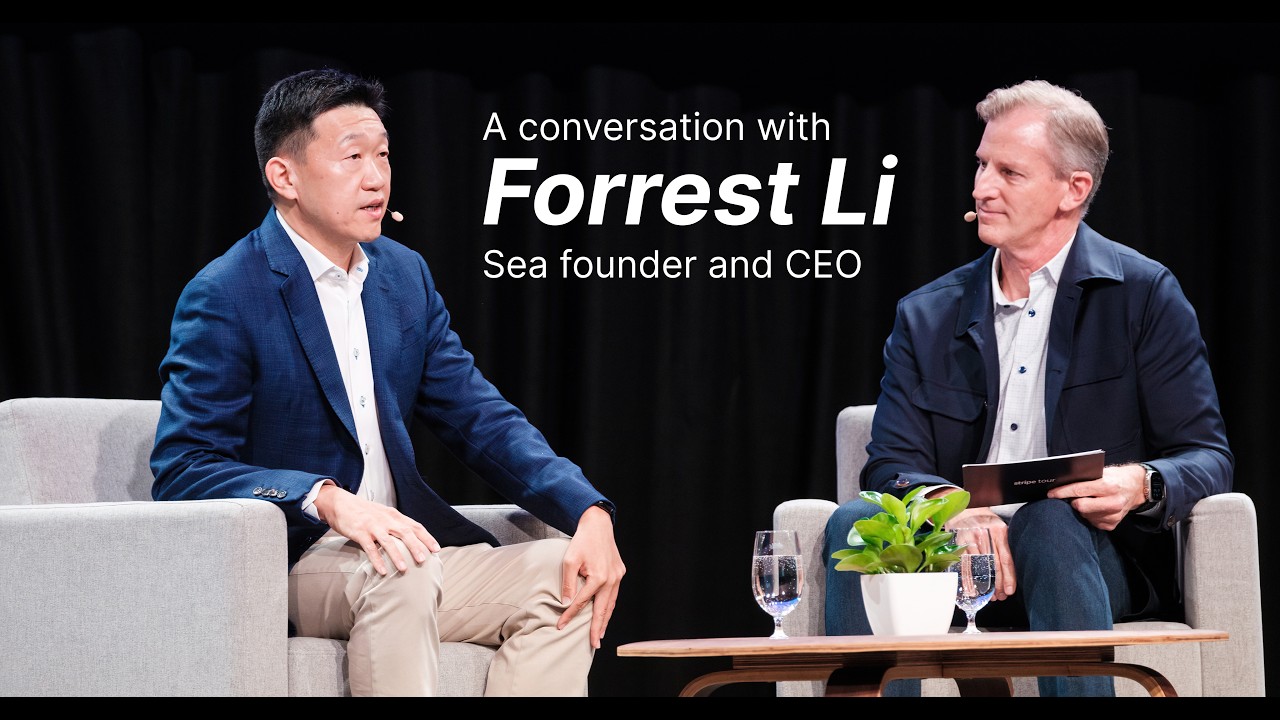
Published by Stripe on YouTube on September 3, 2026, this video features a fireside chat recorded at Stripe Tour Singapore. The session brings together Sea founder and CEO Forrest Li and Stripe Chief Revenue Officer Tyler Bryson for an in-depth conversation.
## TL;DR
Sea founder and CEO Forrest Li shares how his company expanded from a Chinatown shophouse startup into a Southeast Asian tech giant spanning gaming (Garena), e-commerce (Shopee), and digital finance (SeaMoney). He discusses overcoming early payment and logistics bottlenecks, preserving a bottom-up entrepreneurial culture through core values, and leveraging practical AI applications across customer support and game design. Li also details SeaMoney's loan portfolio and integration with Stripe, closing with personal reflections on leading the Football Association of Singapore and the power of founder resilience.
## Atmosphere & style
The conversation carries a reflective, candid, and grounded tone, balancing high-level executive insights with humble operational anecdotes. Forrest Li speaks with quiet conviction and warmth, contrasting starkly with typical tech hubris, while Tyler Bryson acts as an encouraging, engaging host who keeps the dialogue fluid with lighthearted humor. The overall feel is an inspiring yet pragmatic deep-dive into regional scaling, blending the intimacy of an entrepreneurial memoir with the strategic weight of a major industry keynote.
## Key takeaways
- [00:00](https://www.youtube.com/watch?v=CEYGln3s9MM&t=0s) Forrest Li founded Garena in 2009 in Singapore, starting out from a Chinatown shophouse.
- [00:00](https://www.youtube.com/watch?v=CEYGln3s9MM&t=0s) To solve the payment bottleneck for teenagers without credit cards, Garena initially printed and manually distributed physical prepaid cards to internet cafes and convenience stores.
- [05:00](https://www.youtube.com/watch?v=CEYGln3s9MM&t=300s) Sea maintains its day-one startup mindset across 60,000+ employees using programs like the Global Management Associate Program (GMAP).
- [08:00](https://www.youtube.com/watch?v=CEYGln3s9MM&t=480s) Sea operates as a 'multinational startup' that tailors operations bottom-up for each fragmented Southeast Asian market rather than applying rigid foreign playbooks.
- [08:00](https://www.youtube.com/watch?v=CEYGln3s9MM&t=480s) In early Indonesian operations, Shopee manually identified anonymous cash transfers by introducing micro-fraction price variations on products.
- [14:00](https://www.youtube.com/watch?v=CEYGln3s9MM&t=840s) Shopee expanded to Brazil in 2019 after Free Fire gained organic popularity, disrupting the market by lowering fulfillment costs to serve mass-market consumers.
- [14:00](https://www.youtube.com/watch?v=CEYGln3s9MM&t=840s) Sea codified its core culture around five values: 'We serve, We run, We adapt, We commit, We stay humble.'
- [20:00](https://www.youtube.com/watch?v=CEYGln3s9MM&t=1200s) Forrest Li reviews direct customer email escalations personally, finding that over 50% point to broader systemic process issues.
- [20:00](https://www.youtube.com/watch?v=CEYGln3s9MM&t=1200s) SeaMoney grew out of Shopee's operational needs, creating ShopeePay and SPayLater to give unbanked consumers access to credit and flexible payment mechanisms.
- [25:00](https://www.youtube.com/watch?v=CEYGln3s9MM&t=1500s) SeaMoney's loan book exceeds $10 billion across approximately 15 million active borrowers, with an average balance around $200 per person.
- [25:00](https://www.youtube.com/watch?v=CEYGln3s9MM&t=1500s) Stripe announced a regional partnership integrating ShopeePay and SPayLater across its network in Southeast Asia by the end of the year.
- [30:00](https://www.youtube.com/watch?v=CEYGln3s9MM&t=1800s) Over 80% of Shopee's routine customer inquiries are handled by AI chatbots, achieving higher customer satisfaction rates than human support representatives.
- [30:00](https://www.youtube.com/watch?v=CEYGln3s9MM&t=1800s) Garena leverages generative AI to replace outsourced basic art assets and to power human-like NPC teammates in Free Fire for solo players.
- [35:00](https://www.youtube.com/watch?v=CEYGln3s9MM&t=2100s) Forrest Li serves as President of the Football Association of Singapore and owns Lion City Sailors FC, viewing football as a powerful unifier across societal divides.
- [39:21](https://www.youtube.com/watch?v=CEYGln3s9MM&t=2361s) Li advises entrepreneurs to maintain unwavering conviction and staying power, noting he never entertained giving up even during the hardest moments.
## Detailed walkthrough
### [00:00](https://www.youtube.com/watch?v=CEYGln3s9MM&t=0s) Founding Garena and Solving the Regional Payment Bottleneck
In 2009, when Forrest Li founded Garena (which later expanded into Sea), there was widespread skepticism across the global tech ecosystem regarding whether Southeast Asia could sustain a large-scale internet business. Reflecting on those early days during a conversation with Stripe CRO Tyler Bryson at Stripe Tour Singapore, Li recalled sitting in audiences as a young entrepreneur 15 to 20 years prior, seeking advice, experience, and inspiration. Moving to Singapore after studying in the US Midwest—where he candidly admitted to spending more time playing video games than sitting in classrooms—Li recognized a passionate, thriving gaming culture in Southeast Asia. Gamers gathered in internet cafes to play popular PC titles of the era, such as *World of Warcraft* and *League of Legends*. However, international gaming executives routinely dismissed Southeast Asia, citing a complete lack of a viable business case or revenue.
Upon investigating why a massive, highly engaged user base generated no commercial return, Li discovered that the primary obstacle was payment infrastructure. Credit card penetration in Southeast Asia was extremely low at the time, and because the majority of gamers were teenagers, they had no financial mechanism to pay for full game functionality or digital items. To bypass this barrier, Garena constructed a hyper-local, bottom-up solution by designing and producing its own physical prepaid cards. Operating out of a Chinatown shophouse in Singapore that doubled as a warehouse, Li and his team stacked half the office space with bags of prepaid cards. Computer science graduates from top US universities—who had signed up expecting to write world-class code—found themselves walking around Singapore to deliver these prepaid cards directly to convenience stores and individual cybercafes. This manual distribution network unlocked monetization for game developers and allowed gamers to access complete game features, proving that solving local payment friction was the critical breakthrough for early growth.
- Garena was founded in 2009 in a Chinatown shophouse in Singapore.
- Major PC games driving internet cafe culture at the time included *World of Warcraft* and *League of Legends*.
- Lack of credit cards among teenage gamers was the single biggest bottleneck preventing international game developers from monetizing Southeast Asia.
- Garena's initial distribution strategy involved self-designed physical prepaid cards delivered directly to internet cafes and convenience stores by early engineering hires.
[00:05](https://www.youtube.com/watch?v=CEYGln3s9MM&t=5s) Scaling Adjacent Businesses and Preserving a Startup Mindset
Sea’s ability to build three multi-billion-dollar business pillars from scratch—Garena (digital entertainment), Shopee (e-commerce), and SeaMoney (digital financial services)—stems from maintaining an entrepreneurial, day-one startup mindset across a global workforce that has grown to over 60,000 employees. To sustain this culture, Sea relies heavily on its Global Management Associate Program (GMAP). Every year, Sea recruits top fresh graduates from premier universities in Singapore and across the globe for a selective two-year rotational program. These associates rotate through different business units and international markets to gain hands-on operational exposure, guided directly by senior leadership.
Li takes a personal role in the program, participating in final interviews and hosting the annual graduation ceremony. His core directive to every graduating cohort is that regardless of how large Sea becomes, every employee must act as if they are joining a early-stage startup rather than a corporate behemoth. Furthermore, Li stresses that true entrepreneurship cannot merely be a cool lifestyle or a title like "co-founder"; it must be anchored in identifying and solving fundamental, real-world problems. This ethos guided Sea's pivot into e-commerce five years after its founding. Despite starting as a pure-play gaming company, Li was unwilling to accept the absence of a dedicated mobile e-commerce marketplace tailored for Southeast Asia—a model that had already proven immensely successful in the US and China.
- Sea's key talent pipeline is the Global Management Associate Program (GMAP), which selects 10 to 20 top graduates annually for a two-year international rotation.
- Shopee was launched approximately five years after Garena's founding to address the lack of localized e-commerce marketplaces in Southeast Asia.
- Despite scaling to tens of thousands of employees globally, top leadership actively reinforces a "startup mindset" across all business divisions.
[00:08](https://www.youtube.com/watch?v=CEYGln3s9MM&t=8s) The Multinational Startup Approach and Localized Problem-Solving
Winning in Southeast Asia requires recognizing that the region is not a single, homogeneous market, but a highly fragmented group of distinct nations. Li points out that a short two-hour flight from Singapore to Vietnam reveals vast differences in economic development, infrastructure, and consumer lifestyles. While competitors from major tech superpowers like the United States and China often enter Southeast Asia with proven, highly optimized domestic playbooks, these rigid strategies frequently fail when transplanted into local markets. In contrast, operating out of Singapore forced Sea to act as a "multinational startup" from day one. Because the domestic Singaporean market is small, the company had to expand regionally immediately, knowing that what worked in Singapore would rarely work in neighboring countries without bottom-up adaptation.
To illustrate this bottom-up philosophy, Li shared how Shopee solved early payment obstacles in Indonesia when the platform launched nearly a decade ago. While Indonesian consumers could place orders on the Shopee mobile app, most lacked access to online banking or digital payment options. The standard workaround required customers to generate an online payment code, travel physically to an ATM or bank branch, and transfer the funds. Compounding the issue, Indonesian banking security protocols at the time did not transmit buyer account details alongside payments. Shopee would receive bulk bank transfers (e.g., for ten identical water bottles) without any customer identification attached, making order fulfillment impossible through standard software routines.
To solve this without waiting for regional banking infrastructure to evolve, Shopee implemented a creative pricing mechanism. They listed identical items at micro-variations in price—adjusting the total by fractions of a single rupiah (e.g., nominal differences of a few cents or less). The precise price point served as the unique customer identifier on bank ledgers. Back at the office, hundreds of Shopee employees manually matched incoming transfer amounts to corresponding customer orders. This labor-intensive, hyper-localized adaptation allowed e-commerce penetration to scale in a market where traditional Western or Chinese platform models would have stalled.
- Southeast Asia's structural diversity requires bottom-up, country-specific operational solutions rather than copying US or Chinese playbooks.
- Sea adopted the mindset of a "multinational startup" early because Singapore's small domestic market required immediate regional expansion.
- In Shopee's early Indonesian rollout, lack of digital payments required customers to pay via physical ATMs using reference codes.
- To identify anonymous bank transfers in Indonesia, Shopee varied item prices by micro-fractions of a rupiah, using the exact transfer amount as a unique buyer identifier matched by a dedicated back-office team.
[00:14](https://www.youtube.com/watch?v=CEYGln3s9MM&t=14s) Expanding to Latin America and Codifying Sea's Core Values
Shopee’s expansion into Brazil in 2019 offers another example of identifying structural market gaps to fuel international growth. Sea's leadership team first visited Brazil after Garena's self-developed mobile game, *Free Fire*, gained immense organic popularity in the country. During that visit, Li observed that e-commerce penetration in Brazil lagged significantly behind Indonesia, despite Brazilian e-commerce having started much earlier. A deeper investigation revealed that Brazilian logistics costs were exceptionally high—averaging over $5 USD per parcel delivery. To maintain viable unit economics under these legacy shipping rates, existing platforms focused exclusively on high-ticket luxury or expensive electronics (e.g., $100 items where a $5 shipping fee represented a small fraction of the cost). As a result, e-commerce was widely regarded by everyday citizens as an expensive convenience for the wealthy. Recognizing that its Southeast Asian experience in building low-cost logistics networks could democratize online shopping for mass-market consumers, Shopee launched in Brazil to offer affordable goods and efficient delivery.
As an organization grows from a tight-knit founding group into a global operation, maintaining operational discipline requires explicit cultural alignment. Around Sea's fifth year, when the team expanded across multiple regional offices and employees no longer interacted directly with the founders daily, Li convened the leadership team for a weekend retreat to formalize the company's core values. In less than half a day of discussion, the executive team reached unanimous consensus on five fundamental principles, summarized by the acronym "WE SERVE":
Among these five values, Li emphasized that "We stay humble" remains the most vital pillar for sustaining long-term organizational success and continuous learning, particularly when navigating diverse international cultures and competitive landscapes.
- *Free Fire*, Garena's self-developed game, served as Sea's initial entry point into the Brazilian market in 2019.
- In 2019, legacy Brazilian e-commerce focused on high-priced items because average parcel delivery costs exceeded $5 USD, making low-ticket e-commerce non-viable for average consumers.
- Shopee leveraged its Southeast Asian logistics expertise to lower fulfillment costs in Brazil, opening e-commerce to mass-market consumers.
- Sea's five core cultural values were codified in its fifth year: *We serve*, *We run*, *We adapt*, *We commit*, and *We stay humble*.
[20:00](https://www.youtube.com/watch?v=CEYGln3s9MM&t=1200s) Customer Feedback, Money, and the Genesis of SeaMoney and ShopeePay
Forrest Li emphasizes that humility and openness to customer feedback are fundamental values at Sea. He shares that he receives emails daily directly from consumers because his email address is posted online somewhere. Taking these messages seriously, Li notes that when customers bypass standard customer support channels to email him directly, they usually have a strong case. When the entire leadership team reviews these escalated cases, they often find that more than half of the issues point to systemic flaws in their underlying processes or order flows. He even jokingly invites the audience to email him if they ever have an unsatisfactory order on Shopee, though interviewer Tyler Bryson quickly steps in to laughingly clarify that they won't actually be displaying his email address on screen.
Turning the conversation toward financial services, Bryson highlights how Sea moved naturally from gaming into e-commerce and now into financial services for underserved small and medium enterprises (SMEs) needing growth capital. Li explains that their financial services arm, SeaMoney, evolved as a natural extension of Shopee to serve both buyers and sellers in the ecosystem. Addressing early transaction friction in Indonesia—where customers initially had to pay via ATMs—led to the development of the ShopeePay mobile wallet. By allowing users to store money in a digital wallet for seamless Shopee purchases rather than paying transaction-by-transaction, ShopeePay drastically reduced friction and grew into one of the largest standalone mobile wallets in the region, particularly in Indonesia.
- **Direct Leadership Escalations:** Customer emails sent directly to Li are reviewed at the executive level; over 50% reveal broader process or operational flaws rather than isolated errors.
- **ShopeePay Evolution:** Developed to solve friction in cash-heavy markets like Indonesia, turning routine ATM-based payments into a major standalone regional mobile wallet.
[25:00](https://www.youtube.com/watch?v=CEYGln3s9MM&t=1500s) SPayLater, Credit Access, and the Stripe Regional Partnership
As Shopee analyzed purchasing patterns, they noticed significant transaction spikes in the middle and toward the end of the month, corresponding directly to bi-weekly and monthly payroll cycles. Recognizing that Shopee had become an everyday destination for essentials, Sea realized consumers should not have to wait for payday to make necessary purchases. This drove the creation of credit facilities like SPayLater. Credit card penetration in key markets such as Indonesia, Vietnam, and the Philippines remains extremely low—under 20% in Indonesia compared to Western markets—forcing consumers to delay essential purchases, miss payments on school or medical fees, or resort to high-interest loan sharks. Starting with purchase financing on Shopee, Sea eventually expanded into off-platform credit and offline merchant financing as their credit scoring algorithms matured.
Today, SeaMoney operates a loan book exceeding $10 billion with approximately 15 million active outstanding borrowers. This averages out to roughly $200 per person—a modest sum in a market like Singapore, but a transformative amount of capital for daily life and small business growth across broader Southeast Asia. Highlighting this momentum, Bryson announces a major partnership milestone: by the end of the year, ShopeePay and SPayLater will be integrated into the Stripe Business Network across Southeast Asia. SPayLater will serve as the first Buy Now, Pay Later (BNPL) option available on the Stripe platform throughout the region.
- **Loan Book Scale:** Over $10 billion in outstanding loans distributed across approximately 15 million active borrowers.
- **Average Balance:** Roughly $200 per borrower, providing essential credit in underbanked markets.
- **Low Card Penetration:** Credit card adoption remains under 20% in major Southeast Asian markets like Indonesia.
- **Stripe Integration:** ShopeePay and SPayLater will launch across the Stripe platform in Southeast Asia by the end of the year, bringing BNPL capabilities to Stripe merchants.
[30:00](https://www.youtube.com/watch?v=CEYGln3s9MM&t=1800s) Real-World AI Applications: Customer Support and Free Fire Game Development
Turning to artificial intelligence, Bryson asks where Sea is seeing concrete, tangible returns from its AI investments. Li shares that customer service has seen massive efficiency gains through AI-powered chatbots. To ensure customer satisfaction remained high, Sea ran rigorous A/B tests before rolling out automated support. Today, over 80% of routine customer inquiries are handled entirely by AI, yielding satisfaction rates that actually exceed those of human customer support representatives.
Li also details how generative AI has transformed game development for Sea's digital entertainment division, Garena, which operates *Free Fire*—the world's largest mobile game, boasting over 100 million daily active players. In the past, game development required large teams of artists to create initial concepts, sketches, and preliminary assets, much of which was outsourced before senior artists added final touches. Today, AI handles almost the entire initial asset generation process based on descriptive text prompts, allowing senior artists to focus solely on refining the output.
Furthermore, AI has radically upgraded non-player characters (NPCs) and automated bots in *Free Fire*. While basic bots were historically used to onboard new players smoothly without getting crushed by experienced veterans, old bots were predictably simple. Modern AI bots are so intelligent that they are nearly indistinguishable from real players. Sea leverages these AI partners for solo players—who make up nearly half of *Free Fire's* player base—pairing them with intelligent AI teammates to introduce them to the richer, social experience of team-based play.
- **Customer Service Automation:** Over 80% of customer inquiries are resolved entirely by AI chatbots, achieving higher satisfaction scores than human agents.
- **Free Fire Scale:** Over 100 million daily active users worldwide on App Store and Google Play.
- **Art Outsourcing Replacement:** Generative AI text-to-art tools have largely replaced basic asset creation and outsourced concept artwork.
- **AI-Powered Teammates:** Advanced AI bots pair with the roughly 50% of players who play solo to encourage team-based social mechanics.
[35:00](https://www.youtube.com/watch?v=CEYGln3s9MM&t=2100s) Passion for Football and Leading the Football Association of Singapore
Bryson pivots to personal interests, noting that while many chief executives take up golf, Li chose to buy the Lion City Sailors football club and serve as President of the Football Association of Singapore (FAS). Li reflects that building a startup forces founders to abandon almost every hobby due to time constraints, but his lifelong passion for football remained. Watching a 90-minute match provides a complete mental break where he can recharge without thinking about business challenges.
While playing golf might offer networking or deal-making advantages with other CEOs, Li chose football because of its deep emotional resonance with everyday people. He recalls talking with Singaporean taxi drivers who passionately remembered local football's glory days from 20 years ago. Li views his role at FAS like a early-stage startup, where skeptics claim success is impossible after decades of stagnation. He highlights the national team's recent packed match against Thailand at Jalan Besar Stadium, where a full house of fans dressed in red cheered relentlessly and stayed after the whistle despite a loss. In a world fragmented by politics, race, religion, and opinions on technology, Li views those 90 minutes in a stadium as a rare human connection where strangers hug, cry, and celebrate together.
- **Roles in Football:** Owner of Lion City Sailors FC and President of the Football Association of Singapore (FAS).
- **Match Atmosphere:** Cites a recent sold-out national team match against Thailand at Jalan Besar Stadium as proof of the community's deep emotional investment in local sports### Customer Escalations and Process Improvement
Forrest Li discusses the value of direct customer feedback, noting that he receives emails from users daily because his email address is posted publicly online. Rather than dismissing these messages, he takes every single email seriously. He observes that customers only reach out directly to the CEO when standard customer support channels fail to resolve a strong case. When these messages arrive, the entire leadership team reviews the issues to resolve the specific problem and address the root cause, as over half of these escalations reveal systemic flaws in company processes or product flows.
- Li takes escalation emails seriously because customers usually write to him directly only after exhausting standard support options.
- More than 50% of direct customer complaints expose broader process or workflow issues across the company.
- Tyler Bryson jokingly offers to display Li's email address on screen for the audience before clarifying it was just a joke.
[21:40](https://www.youtube.com/watch?v=CEYGln3s9MM&t=1300s) Expanding Financial Services with SPayLater and Stripe
The conversation transitions to Sea's financial services wing, SeaMoney, which originated as a natural extension of the Shopee e-commerce platform to reduce transaction friction for buyers and sellers. Li recounts how payment difficulties in Indonesia initially led to the creation of the ShopeePay mobile wallet. Over time, ShopeePay grew into one of the largest standalone mobile wallets in the region. Furthermore, observing sales surges around mid-month and end-of-month payroll cycles inspired Sea to introduce credit services, allowing consumers to make purchases without being restricted by payday timings.
Li explains that credit card penetration remains under 20% in markets like Indonesia, Vietnam, and the Philippines, leaving many consumers without access to traditional credit. As a result, consumers were often forced to delay essential purchases—such as medical needs or school fees—or resort to high-interest loan sharks. Sea initially offered credit strictly for Shopee purchases, but as credit scoring models matured, they expanded into general lending and offline transactions via SPayLater.
- SeaMoney's loan book currently exceeds $10 billion across its ecosystem.
- Approximately 15 million people currently have outstanding credit with Sea, averaging roughly $200 per borrower.
- Bryson announces that SPayLater and ShopeePay will be integrated into the Stripe Business Network across Southeast Asia by the end of the year.
- SPayLater will serve as the first Buy Now, Pay Later (BNPL) option available across the Stripe platform in Southeast Asia.
[28:34](https://www.youtube.com/watch?v=CEYGln3s9MM&t=1714s) Realizing Tangible Business Results with AI
When discussing artificial intelligence, Li outlines practical applications where Sea is driving operational efficiency and improving user experience. Customer service has seen massive transformation through AI-powered chatbots. Because customer satisfaction and service quality are prioritized over cost-cutting, Sea conducts rigorous A/B testing before deploying AI features broadly. Today, the majority of customer service interactions are handled autonomously by AI with higher customer satisfaction scores than human agents.
Beyond customer service and coding efficiency, Li highlights AI's profound impact on game development for Sea's gaming division, Garena, which operates the global mobile game *Free Fire*. Historically, creating game art required extensive teams of artists to produce initial concept sketches before senior artists provided final touches. AI now handles the preliminary artwork generation based on textual descriptions, allowing human artists to focus on refining the final output.
AI has also transformed non-player characters (NPCs) and matchmaking bots. To prevent new players from being crushed by experienced gamers and churning, bots are used to help beginners build confidence. While legacy bots were predictably robotic, AI-driven bots are now indistinguishable from human players. This allows Sea to pair solo players—who account for nearly half of *Free Fire's* player base—with intelligent AI teammates, introducing them to team-based social play.
- Over 80% of Shopee's customer inquiries are completely handled by AI, yielding higher satisfaction rates than human support agents.
- *Free Fire* records over 100 million daily active users globally.
- Nearly 50% of *Free Fire* players play strictly solo without engaging in social team play.
[33:28](https://www.youtube.com/watch?v=CEYGln3s9MM&t=2008s) Passion for Football and Community Unity
Bryson turns to Li's personal life, noting his roles as President of the Football Association of Singapore (FAS) and owner of the Lion City Sailors football club. While many executives take up golf to network and strike business deals, Li chose football out of a lifelong passion shared with his family and friends. He notes that entrepreneurship often forces founders to abandon hobbies due to the intense focus required, but football remains a vital outlet where he can rest his mind for 90 minutes without worrying about business pressures.
Li compares reviving Singaporean football to leading an early-stage startup, where critics often claim "it will never work" because the national sport has struggled for two decades. However, he remains deeply committed due to the emotional power of the sport to unite people across racial, religious, and political divides. He points to a recent national team match against Thailand at the Jalan Besar Stadium, where a packed crowd dressed in red cheered on the team and stayed behind to show support even after a loss.
- Li serves as the President of the Football Association of Singapore and owns the Lion City Sailors club.
- A recent Singapore vs. Thailand match at Jalan Besar Stadium played to a full house, with fans staying to support the team despite a loss.
- Li invites anyone who shares his passion for elevating Singapore football to email him directly.
[39:21](https://www.youtube.com/watch?v=CEYGln3s9MM&t=2361s) Advice for Founders: Resilience and Adaptability
To close the session, Bryson asks Li for specific advice directed at the entrepreneurs and startup founders in the audience looking to build the next generation of growth in Southeast Asia. Li reflects on his multi-decade entrepreneurial journey, noting that while there were countless dark moments where the company faced immense challenges out of its control, he never once entertained the thought of giving up.
Li emphasizes that staying power and conviction are the ultimate keys to success. Often, simply staying in the game long enough allows complex problems to resolve themselves or reveals unexpected solutions. He advises founders to remain adaptable, stay humble, and trust in their core mission through every up and down.
> "I realized along the entire journey, there's never any single moment—this is truly from the bottom of my heart—I think about giving up... As long as you have that aspiration, you have that conviction yourself, whatever the challenge you face, there's always a way."
## Notable quotes
> [39:21](https://www.youtube.com/watch?v=CEYGln3s9MM&t=2361s) I realized along the entire journey, there's never any single moment—this is truly from the bottom of my heart—I think about giving up... As long as you have that aspiration, you have that conviction yourself, whatever the challenge you face, there's always a way. — Forrest Li
> [14:00](https://www.youtube.com/watch?v=CEYGln3s9MM&t=840s) We serve — Forrest Li
> [14:00](https://www.youtube.com/watch?v=CEYGln3s9MM&t=840s) We run — Forrest Li
> [14:00](https://www.youtube.com/watch?v=CEYGln3s9MM&t=840s) We adapt — Forrest Li
> [14:00](https://www.youtube.com/watch?v=CEYGln3s9MM&t=840s) We commit — Forrest Li
> [14:00](https://www.youtube.com/watch?v=CEYGln3s9MM&t=840s) We stay humble — Forrest Li
## Mentioned
Sea, Forrest Li, Tyler Bryson, Stripe, Stripe Tour Singapore, Garena, Shopee, SeaMoney, ShopeePay, SPayLater, Free Fire, World of Warcraft, League of Legends, Global Management Associate Program (GMAP), Lion City Sailors, Football Association of Singapore (FAS), Singapore, Indonesia, Vietnam, Philippines, Brazil, Thailand, Jalan Besar Stadium
Sea founder and CEO Forrest Li argues that building a multi-billion-dollar enterprise across Southeast Asia required rejecting rigid foreign playbooks in favor of solving hyper-local infrastructure bottlenecks, particularly around payments and credit access. In conversation with Stripe's Tyler Bryson, Li explains how bottom-up operational adaptation propelled Sea from a Singapore gaming distributor into a global conglomerate spanning digital entertainment, e-commerce, and microfinance.
Localized Solutions for Regional Payment Bottlenecks (0:00)
When Garena launched in 2009, Southeast Asia possessed a passionate internet cafe culture centered around PC titles like World of Warcraft and League of Legends, yet international publishers dismissed the region as commercially unviable. Li discovered that the primary obstacle was monetization infrastructure: teenage gamers had no credit cards to purchase digital goods. Garena overcame this friction by manufacturing physical prepaid cards in a Singapore shophouse and tasking its early computer science hires with walking cards directly to cybercafes and convenience stores, proving that manual, hyper-local distribution could unlock regional revenue.
Sea applied this same bottom-up philosophy when launching Shopee in Indonesia nearly a decade ago. Because few shoppers held bank accounts, orders had to be paid in cash at physical ATMs. Indonesian banking security protocols at the time did not transfer customer identity details alongside payment receipts, leaving Shopee with unidentified incoming transfers for identical items. Rather than waiting for banking infrastructure to modernize, Shopee adjusted item prices by micro-fractions of a rupiah. The exact total served as an individualized transaction ID on bank ledgers, which an internal team manually matched to clear orders.
The Multinational Startup Model and Value Codification
Because Singapore's domestic market is inherently small, Sea was forced to operate as a multinational startup from day one. Li emphasizes that Southeast Asia cannot be treated as a single homogeneous market; rigid models developed in the United States or China routinely fail when transplanted without local adaptation. This cross-border execution later guided Shopee's 2019 expansion into Brazil, triggered by the organic popularity of Garena's Free Fire. While Brazilian e-commerce predated Southeast Asia's, average delivery costs exceeded $5 USD, restricting existing platforms to luxury goods. Shopee deployed its low-cost logistics experience to open affordable e-commerce to mass-market consumers.
To preserve organizational agility across a workforce that has grown to over 60,000 employees, Sea relies on its Global Management Associate Program to rotate top graduates through operational leadership roles. During Sea's fifth year, leadership codified five company values: 'We serve', 'We run', 'We adapt', 'We commit', and 'We stay humble'. Li cites humility as the most vital pillar, noting that he still reviews customer escalation emails sent to his personal inbox, where more than 50% of complaints uncover systemic operational and workflow defects.
Expanding Consumer Credit Through SeaMoney and SPayLater (25:00)
SeaMoney emerged as a direct response to customer transaction friction. After building the ShopeePay mobile wallet to eliminate ATM payments in Indonesia, Shopee observed that purchasing activity surged sharply during bi-weekly and monthly payroll cycles. Recognizing that consumers were delaying essential purchases, Sea introduced SPayLater to bridge liquidity gaps between paychecks. With credit card penetration under 20% in major markets such as Indonesia, Vietnam, and the Philippines, consumers historically faced high-interest loan sharks or deferred medical and educational expenses.
As Sea's proprietary credit scoring models matured, lending expanded beyond the Shopee platform into general offline merchant credit. SeaMoney now operates a loan book exceeding $10 billion across roughly 15 million active borrowers, with an average balance of approximately $200 per user. Highlighting this regional scale, Bryson announced that ShopeePay and SPayLater will integrate into the Stripe Business Network by the end of the year, establishing SPayLater as Stripe's first Buy Now, Pay Later partner across Southeast Asia.
Pragmatic AI Integration Across Support and Gaming (30:00)
Addressing Sea's adoption of artificial intelligence, Li stresses that deployment must focus on tangible performance improvements rather than reflexive cost reduction. In customer support, Shopee integrated AI chatbots only after conducting extensive A/B tests to protect service quality. AI currently handles more than 80% of customer service inquiries autonomously, achieving customer satisfaction ratings that surpass those of human support representatives.
In digital entertainment, generative AI has reshaped production workflows for Free Fire, which maintains over 100 million daily active users. AI text-to-image tools have replaced outsourced concept artists for preliminary asset generation, freeing senior game artists to concentrate exclusively on refinement. Furthermore, Sea has upgraded Free Fire's non-player characters with human-like AI agents. These automated bots are paired with solo gamers—who represent roughly half of the game's active player base—to encourage collaborative, team-based social engagement without the intimidation of veteran competition.
Li emphasizes that perseverance and conviction remain the decisive traits for founders navigating emerging markets, reflecting that he never considered giving up despite severe crises across his multi-decade journey. However, the conversation centers primarily on past operational triumphs and does not evaluate future headwinds, such as intensifying e-commerce competition or credit risk management as SeaMoney scales its loan portfolio.
## Background
该视频由 Stripe 于 2026 年 9 月 3 日发布在 YouTube 平台上。根据页面简介,本次内容为 Sea 创始人兼首席执行官李小冬(Forrest Li)与 Stripe 首席营收官 Tyler Bryson 在新加坡 Stripe Tour 大会现场进行的一场炉边对谈。
## TL;DR
李小冬回顾了 Sea 从早期在牛车水店屋依靠地推实体预付卡破局,逐步跨界成长为横跨游戏(Garena)、电商(Shopee)与数字金融(SeaMoney)三大支柱业务的创业历程。他深入拆解了东南亚高度碎片化市场的本地化实操哲学,包括在印尼通过微小差价人工对账突破线下支付瓶颈,以及将在东南亚沉淀的低成本物流能力成功复制到巴西电商市场。此外,李小冬还分享了 AI 在 Shopee 客服闭环与《Free Fire》游戏开发中的真实落地成果,并谈及自己投资新加坡本土足球的初心,最后勉励所有创业者在至暗时刻保持谦逊与永不放弃的韧性。
## Atmosphere & style
对谈整体氛围坦诚沉稳、务实且充满温度,完全没有大厂高管常见的空洞说教,更像是一位穿越无数惊涛骇浪的创业老兵在炉边娓娓道来。Tyler Bryson 的提问节奏紧凑且富有共鸣,李小冬的回答则始终贯穿着低调接地气的谦逊姿态与幽默感。整场对话的情感弧线从早年创业“运点卡、人工对账”的艰辛自嘲,自然过渡到构建百亿级普惠金融与落地 AI 的冷静洞见,并在谈及新加坡足球的民众凝聚力以及“从未想过放弃”的创业韧性时达到精神高潮,令人深受触动。
## Bulletin
- [24:50](https://www.youtube.com/watch?v=CEYGln3s9MM&t=1490s) Sea 旗下信贷业务自营贷款余额突破 100 亿美元,服务约 5,000 万名未充分享受传统银行服务的用户,年底前 SPayLater 将全面接入东南亚地区 Stripe 商户网络。
- [28:10](https://www.youtube.com/watch?v=CEYGln3s9MM&t=1690s) Shopee 站内超过 80% 的日常客服咨询已实现由 AI 机器人独立闭环解决,且客户满意度指标已正式超越纯人工客服团队。
- [30:00](https://www.youtube.com/watch?v=CEYGln3s9MM&t=1800s) 日活超 1 亿的自研射击手游《Free Fire》已实现美术外包全面由 AI 替代,并利用高智能 AI Bot 协助近 50% 的单人及内向型玩家适应团队协作。
- [06:33](https://www.youtube.com/watch?v=CEYGln3s9MM&t=393s) 李小冬指出东南亚本质高度碎片化,中美科技巨头的成熟标准化 Playbook 在此屡屡受挫,必须依赖从基层痛点出发的自下而上定制化解决方案。
## Key takeaways
- [03:20](https://www.youtube.com/watch?v=CEYGln3s9MM&t=200s) 创业初期东南亚青少年玩家群体庞大却无信用卡支付手段,Garena 靠名校程序员挨家挨户向网吧地推自制实体预付卡,打通了商业变现第一道闭环。
- [05:25](https://www.youtube.com/watch?v=CEYGln3s9MM&t=325s) Sea 坚持通过 GMAP 管培项目维持全员“初创心态”,强调即使员工规模突破 6 万人,也必须保持解决未满足需求的创业者韧劲。
- [10:00](https://www.youtube.com/watch?v=CEYGln3s9MM&t=600s) 东南亚市场高度碎片化,新加坡虽小却赋予了 Sea“跨国初创”的本能基因,拒绝照搬中美成功模板,注重自下而上定制落地方案。
- [11:32](https://www.youtube.com/watch?v=CEYGln3s9MM&t=692s) 早期印尼电商用户需线下 ATM 转账且银行隐瞒付款人信息,Shopee 巧用“相差微小印尼盾差价”作为唯一身份识别码,实现订单人工对账履约。
- [15:00](https://www.youtube.com/watch?v=CEYGln3s9MM&t=900s) 借由《Free Fire》爆火契机造访巴西,Sea 发现当地每单逾 5 美元的高昂履约成本将电商畸形异化为富人特权,遂将在东南亚沉淀的下沉低成本物流网络能力成功复刻。
- [17:35](https://www.youtube.com/watch?v=CEYGln3s9MM&t=1055s) 公司五周年确立的五大核心价值观中以“保持谦逊(Stay humble)”为首要准则,李小冬坚持每日亲自查阅客户投诉邮件以反思内部流程漏洞。
- [22:15](https://www.youtube.com/watch?v=CEYGln3s9MM&t=1335s) 针对东南亚信用卡渗透率普遍低于 20% 以及工资发薪日的消费波动,Sea 从 ShopeePay 顺势演进出 SPayLater,填补了广阔的普惠信贷空白。
- [27:00](https://www.youtube.com/watch?v=CEYGln3s9MM&t=1620s) Stripe 与 Sea 达成战略合作,到年底将 SPayLater 作为全东南亚首个先买后付(BNPL)选项整合进 Stripe 全球商户网络。
- [28:10](https://www.youtube.com/watch?v=CEYGln3s9MM&t=1690s) AI 在 Shopee 客服体系中通过严格 A/B 灰度测试验证体验,在处理 80% 以上咨询的同时,满意度成功超越纯人工服务。
- [30:00](https://www.youtube.com/watch?v=CEYGln3s9MM&t=1800s) 全球日活破亿的《Free Fire》将 AI 应用于概念美术批量生成及高拟真对战 Bot,有效降低新人流失率并带动内向玩家参与团队社交。
- [34:00](https://www.youtube.com/watch?v=CEYGln3s9MM&t=2040s) 李小冬收购狮城水手足球俱乐部并投身新加坡足球,视其为具备强烈社会凝聚力的“初创事业”,甘愿放弃高尔夫等传统政商社交形式。
- [38:45](https://www.youtube.com/watch?v=CEYGln3s9MM&t=2325s) 李小冬向创业者分享的终极心法是“脑海中从未闪过任何放弃的念头”,在高度不确定的危机时刻坚守牌桌,辅以快速适应与谦逊心态。
## Detailed walkthrough
### [00:00](https://www.youtube.com/watch?v=CEYGln3s9MM&t=0s) 2009 年的开局:从沉迷游戏的留学生到看见东南亚的游戏荒漠
谈话在轻松而热烈的气氛中开场。Stripe 首席营收官 Tyler Bryson 直奔主题,将时间拨回到 2009 年 Garena 创立之初。在那个时期,外界对东南亚能否诞生大规模互联网企业抱有极其普遍的怀疑与冷眼。面对 Tyler 关于当年为何有勇气切入这片市场的提问,李小冬(Forrest Li)首先向在场观众问好,并特别感谢 Stripe 将大会带到新加坡。看着台下众多年轻的面孔,他感慨这让自己想起了十五二十年前的自己——同样作为年轻的创业者坐在台下汲取经验、建议与灵感。
李小冬坦言,自己本身就是一个狂热的游戏玩家。在来新加坡之前,他在美国留学期间花在打游戏上的时间甚至远多于坐在教室里的时间,Tyler 风趣地打趣称那其实是在“做市场调研”。来到新加坡后,李小冬敏锐地发现这里有着极其浓厚的游戏文化,人们热衷于谈论和玩游戏。彼时移动游戏时代尚未到来,依然是 PC 端游的天下,风靡一时的是《魔兽世界》(World of Warcraft)以及后来的《英雄联盟》(League of Legends)。无论走在东南亚哪个城市的街头,网吧(cyber cafes)里永远坐满了充满激情的年轻人。
然而,当时全球主流游戏行业的高管们对东南亚市场却嗤之以鼻。如果去问游戏大厂的高管是否考虑过东南亚是一个优质市场,得到的答复几乎完全一致:他们在这片区域看不到任何实质性的收入流水,也做不出任何商业立项(business case)。李小冬与团队意识到这其中存在着巨大的认知鸿沟——明明拥有如此庞大且充满热情的玩家群体,商业变现却几乎为零。深入调研后,他们发现核心死穴不在于游戏本身,而在于最底层的支付环节。
```mermaid
flowchart TD
accTitle: Garena早期打通游戏支付闭环的业务流程
accDescr: 展示了从玩家无法支付到自制预付卡地推打通收入闭环的完整过程
subgraph Problem["痛点:支付断层"]
A["东南亚庞大年轻玩家群体"] --> B["网吧端游盛行,体验需求强烈"]
B --> C["信用卡普及率极低,青少年无法付款"]
end
subgraph Solution["破局:自研自发预付卡"]
C --> D["Garena 自主设计并制作实体预付卡"]
D --> E["技术毕业生与团队深入街头地推"]
E --> F["直接配送至便利店与各大网吧"]
end
subgraph Outcome["成效:商业闭环"]
F --> G["玩家便捷购卡充值,畅玩完整游戏"]
G --> H["海外游戏开发商首次实现规模创收"]
end
```
### [03:20](https://www.youtube.com/watch?v=CEYGln3s9MM&t=200s) 牛车水店屋里的自制预付卡与名校程序员的地推传奇
李小冬指出,当时东南亚绝大多数游戏玩家都是十几岁的青少年,而十五二十年前当地的信用卡普及率极低。玩家们即使万分热爱游戏、渴望体验游戏的完整功能与付费内容,手中却没有可用的支付工具。面对这一看似不可逾越的基础设施短板,Garena 采取了一种极其接地气、自下而上的“笨办法”:自主设计、制造并分发实体游戏预付卡。
这段创业早期的岁月充满了戏剧性与艰辛的画面感。李小冬回忆起公司在新加坡牛车水(Chinatown)骑楼店屋(shophouse)里的第一间办公室。每天他走进办公室,感觉就像迈入了一个大货运仓库,半个办公区域密密麻麻堆满了大袋子,里面装的全是他们自己设计并找厂家印制的实体预付卡。更富戏剧性的是当时招聘的团队成员——公司招揽了一些雄心勃勃、刚从美国名校计算机专业毕业的顶尖高材生,他们满怀期待地签下工作合同,以为自己来这里是要编写世界级的顶级代码;结果入职后的一大核心任务,竟是骑着车穿梭在新加坡的街头巷尾送货。
这些年轻的程序员和早期员工不仅要将预付卡铺进便利店,更要挨家挨户送到所有玩家聚集的网吧柜台。这种极致的线下渗透彻底打通了变现链路,让青少年玩家能够轻松用现金买到点卡享受完整的游戏功能,海外游戏开发商也终于第一次在东南亚看到了源源不断的真金白银。李小冬感慨,虽然他们是一家极度热爱游戏的公司,但在创业早期,真正带来决定性业务突破的钥匙反而是最朴实无华的“支付解决方案”。
- **初代办公地点**:新加坡牛车水具有历史特色的骑楼店屋(shophouse),空间狭小且堆满实体卡袋。
- **配送网络**:避开单一的传统便利店渠道,直接渗透至端游核心阵地——街头网吧。
- **双赢结果**:为海外开发商验证了东南亚的商业价值,为 Garena 积累了第一批高度忠诚的核心用户。
### [05:25](https://www.youtube.com/watch?v=CEYGln3s9MM&t=325s) 保持初创之心:GMAP 管培体系与从游戏跨界电商的执念
针对 Tyler 关于 Sea 为何能罕见地从零起步连续打造出三大支柱业务(游戏 Garena、电商 Shopee、数字金融 SeaMoney)的提问,李小冬将这一跨界能力归结为全公司上下始终流淌的强烈“创业精神”(entrepreneurial spirit)。他介绍,公司有着一项坚持多年的核心传统——管理培训生项目 GMAP(General Management Associate Program)。每年他们会从新加坡及全球顶级高校选拔 10 到 20 位顶尖年轻人,将其放入为期两年的多部门轮岗和全球跨区域历练中。
公司的最高管理层每年都会亲自参与管培生项目的终面。李小冬刚参加完最新一期管培生的毕业典礼,他在会上给这些未来骨干留下一句至关重要的忠告:"如果你今天离开这里,把一整天的工作坊和毕业典礼内容忘得一干二净,我只希望你们所有人记住一件事:无论毕业后在公司做什么岗位,请时刻记住你加入的是一家初创公司(startup),而不是一家大企业。"即使如今 Sea 的员工规模已经达到约 6 万人,这种从管理层贯穿至应届生的创业者思维依然是推动业务自我突破与创新的引擎。
与此同时,李小冬强调创业绝非追求一种"当联合创始人很酷"的生活方式标签,而是必须回归商业根本——去识别并解决现实中的特定问题。以 2015 年进军电商为例,当时 Garena 已经在游戏行业深耕了五年,外界普遍质疑一家游戏公司为何要跨界做电商。但当时支撑李小冬的是一个朴素而坚定的信念:电商平台模式在中美两国已经发展得如此成熟完备,而在东南亚竟然还没有一个好用的本土综合电商平台,这种基础设施的空白让他“很难咽下这口气”。正是解决未被满足需求的执念,推动了 Shopee 的诞生。
### [06:33](https://www.youtube.com/watch?v=CEYGln3s9MM&t=393s) 破解东南亚竞争盲区:不可忽视的市场碎片化与本土优势
谈及区域竞争与制胜之道,Tyler 询问外来企业与跨国巨头在进军东南亚时最常犯的认知错误是什么。李小冬分析指出,从宏观数据看东南亚具有无与伦比的吸引力:极其年轻的人口结构、不断提升的生活水平以及蓬勃发展的庞大消费市场。然而,外来竞争对手最容易忽视的致命陷阱,就是将其误认为是一个统一的大市场。
李小冬强调,东南亚本质上是一个“高度碎片化”(fragmented)的复杂区域。例如从新加坡飞往越南只需短短两个小时航程,但两地的经济发展阶段、居民收入水平以及生活方式却有着天壤之别。企业绝不可能用一套标准化模板通吃整个区域,必须深入各个细分市场,制定自下而上的定制化落地解决方案。
回首过往的激烈竞争,Sea 面对的很多强劲对手都直接脱胎自中国或美国等庞大单一市场的大厂。而在李小冬看来,作为一家生于斯长于斯的新加坡本地创业公司,深谙区域内的多元文化与碎片化特征,并以极其敏捷的本地化执行力去攻坚每一个独立市场,正是他们最终能够建立深厚壁垒并脱颖而出的核心关键。
### [10:00](https://www.youtube.com/watch?v=CEYGln3s9MM&t=600s) 告别中美成熟范式:新加坡企业的“跨国初创”基因与自下而上思维
来自中美两国的科技巨头通常在本土市场坐拥极为成熟、经过验证的成功范式(Playbook),他们所有的业务构架都是针对这些打法进行高度优化的。当这些巨头进入东南亚时,往往会想当然地认为:“这套范式在我们的本土市场行之有效,搬到这里也必然能成功。”然而现实往往大相径庭。虽然全球范围内确实存在可以共享的最佳实践,但具体到各个区域市场,外部环境、基础设施和用户习惯都有着天壤之别。
作为一家诞生于新加坡的企业,Sea 从第一天起就面临截然不同的起点。新加坡本土市场体量有限,迫使团队在极其早期的阶段就必须放眼海外,无法只局限于新加坡本土的成功。李小冬回忆道,团队在创业初期便自称为一家“跨国初创企业”(Multinational Startup)。更关键的是,他们很早就清醒地认识到,新加坡与其周边的东南亚邻国存在巨大鸿沟——在新加坡行得通的方案,直接照搬到邻近市场往往根本行不通。因此,每开拓一个新市场,团队都必须放下身段,从最底层的实际需求出发,寻找“自下而上”(Bottom-up)的定制化解决方案,这种思维贯穿了 Sea 的整个成长历程。
- **巨头本土范式的局限**:中美科技巨头习惯于将其高度优化的成功范式向海外复制,但在高度异质化的东南亚市场常常水土不服。
- **“跨国初创”定位**:受限于新加坡狭小的本土市场,Sea 从创立之初就具备跨国运营的思维定式,将出海视为生存本能。
- **自下而上解决问题**:拒绝预设框架,深入每一个邻国市场的本地痛点,量身打造落地方案。
### [11:32](https://www.youtube.com/watch?v=CEYGln3s9MM&t=692s) 印尼电商破局记:ATM付款与“分钱辨人”的土法微创新
谈及“自下而上”的落地哲学,李小冬分享了约十年前在印尼推出电商平台 Shopee 时的真实遭遇。当时团队迅速在东南亚多国上线了应用,印尼消费者很快开始在手机端下单,但团队随即迎面撞上了一个极为棘手的现实:用户能在手机端下单,却无法在手机端完成在线支付,因为当地当时的线上银行和数字支付体系几乎一片空白。用户的典型购物流程变得极其反直觉——在 App 里提交订单后,系统生成一个代码,用户必须顶着烈日出门,亲自跑到线下的 ATM 自动取款机或银行网点输入代码转账。李小冬笑称,如果在线买个东西还要专程跑去物理网点排队付款,大家还不如直接去线下实体店买,“这根本不算什么电子商务”。
更令人抓狂的是,当时印尼的银行系统出于安全和隐私考虑,在买家向平台转账时,完全不会向平台透露付款人的身份或银行账号。这就造成了一个荒谬的困境:平台卖出了十瓶水,账上也确实收到了十笔款项,但后台根本无法分辨哪笔钱是由谁转过来的,自然也就无法安排给正确的买家发货。对于身处新加坡的团队来说,这种问题坐在办公室里凭空想象是永远料想不到的。为了突破这一瓶颈、持续扩大渗透率,团队想出了一个极为奇巧的“土创新”:将同样的十瓶水标出十个极其微小的差异化价格,彼此之间仅相差不到一个印尼盾(Rupiah)。这微小的差价对消费者的钱包毫无实质影响,却让“支付金额本身变成了买家的唯一身份识别码”。凭借这个机制,平台在办公室里安排了数百名员工进行人工比对审核,成功解决了订单匹配与履约难题。
```mermaid
flowchart TD
accTitle: 印尼早期电商支付匹配流程
accDescr: 早期Shopee在印尼面对无在线支付且银行不透露付款人身份时所采用的微小差价匹配方案
subgraph UserSide["用户端行为"]
A["Shopee App 下单"] --> B["获取订单代码"]
B --> C["前往 ATM 或银行网点线下转账"]
end
subgraph BankingConstraint["银行体系限制"]
C --> D["银行完成转账通知 Shopee 账户"]
D -. "安全限制:不提供付款人账号与姓名".-> E["平台收到资金,但无法确认付款人"]
end
subgraph Workaround["Shopee 差异定价创新与人工匹配"]
F["相同商品设置微小差价<br/>(相差极小面额印尼盾)"] --> A
E --> G["金额即身份:微小差价成为识别标记"]
F --> G
G --> H["后台数百名员工人工匹配对账并安排发货"]
end
```
- **线下与线上断层**:印尼早期用户在手机下单后,必须前往物理 ATM 或银行柜台完成转账,严重违背传统电商的便利属性。
- **银行信息屏蔽痛点**:转账记录不透露买家身份与账号,“收到货款却不知该寄给谁”。
- **微小差价识别法**:通过在商品标价上设置极微小的印尼盾尾数差异,使付款金额转化为唯一的身份追踪符,配合数百名人工对账完成履约闭环。这种极接地气的本地化创新,是任何来自中美巨头的现成理论体系里都不曾记载的。
### [15:00](https://www.youtube.com/watch?v=CEYGln3s9MM&t=900s) 远征巴西:从《Free Fire》爆火到击破高昂物流成本
很多人经常困惑地问李小冬:作为一家新加坡和东南亚起家的公司,Sea 究竟为什么会千里迢迢跑到巴西去做电商?这段看似不可思议的跨洲扩张,同样源于对一线真实挑战与机会的敏锐捕捉。2019年,Sea 的管理层全员第一次踏上巴西的土地,起因是旗下自主研发的手机游戏《Free Fire》在巴西市场突然爆红。为了表达对这个关键市场的尊重,管理团队专程飞往当地进行考察。
在考察过程中,团队意外发现了一个反常现象:2019年巴西的电商渗透率竟然远远落后于印尼,而事实上巴西电商起步的时间要比印尼早得多。深入调研后他们找出了症结所在——巴西的物流履约成本极为高昂,当地每递送一个包裹的成本超过 5 美元。在如此高昂的履约费用下,要保证单元经济模型(Unit Economics)成立,平台就只能销售昂贵的高客单价商品;如果卖一件 100 美元的产品,5 美元的物流费尚可承受,但如果要卖一件 10 美元的小商品,单单物流费就吃掉了一半的成本,整个商业模式便彻底瓦解。这就导致巴西的电商市场呈现出反直觉的生态——“电子商务是专属于富人的奢侈服务”。当在街头询问普通百姓时,大家的回答通常是“我们根本买不起电商上的东西”。李小冬和团队意识到,在常识中电商应当是提供物美价廉商品的选择,而巴西的这种供需扭曲恰恰是一次绝佳的机遇。此前 Sea 在东南亚积累了大量搭建下沉物流网络、极致压缩履约成本的实战经验,这赋予了团队坚定的信心与信念,坚信能够将在东南亚磨砺出来的低成本履约能力移植到巴西,打破高价壁垒。
- **涉足契机**:自研游戏《Free Fire》在巴西爆火,促使管理层全员于2019年首次造访该国。
- **市场畸形痛点**:单件包裹物流成本超过 5 美元,迫使平台只能兜售昂贵商品,导致“电商成为富人专属”,普通大众望而却步。
- **核心竞争力迁移**:Sea 将在东南亚多年累积的低成本物流网络搭建经验赋能巴西,成功切入这一巨大未满足需求的市场。
### [17:35](https://www.youtube.com/watch?v=CEYGln3s9MM&t=1055s) 五周年确立的五大核心价值观与“保持谦逊”
泰勒·布赖森(Tyler Bryson)将话题从商业拓展引申至组织构建,指出卓越的企业不仅需要出色的产品,更需要优秀的人才与坚韧的企业文化。对此李小冬深有感触地回应,思考企业文化的问题“永远不会太早,也永远不会太晚”。在初创初期,企业文化往往体现为创始团队的以身作则(Lead by example),员工每天看着领导者如何行事,便自然知晓公司鼓励什么、反对什么,彼时并不需要白纸黑字地大谈特谈文化。
转折点发生在公司成立的第五年左右。当时团队规模迅速膨胀,在不同市场设立了多个分支办公室,绝大多数基层员工很难在日常工作中频繁见到李小冬或核心领导层。由于无法再单纯依靠日常言传身教,管理层意识到必须将公司的基因制度化,明确定义企业的内核与行为准则。于是核心领导团队抽出一个周末聚在一起闭门研讨,令人惊讶的是,大家仅用了半天时间就高度达成共识,凝练出概括团队特质的五大核心价值观:
1. **我们服务(We serve)**:始终把客户放在第一位;
2. **我们奔跑(We run)**;
3. **我们适应(We adapt)**;
4. **我们承诺(We commit)**;
5. **我们保持谦逊(We stay humble)**。
在所有这五条准则中,李小冬特别强调,“保持谦逊”(Stay humble)或许是最核心、最关键的一条。布赖森随即深有共鸣地插话称,谦逊在某些崇尚张扬的美式商业文化中并不总被置于核心位置,但商业世界确实迫切需要更多的谦逊精神。正是这种谦逊敬畏的底层心态,让 Sea 在面对不同的未知市场时始终能够放下傲慢,真正俯身贴近地面解决问题。
### [20:00](https://www.youtube.com/watch?v=CEYGln3s9MM&t=1200s) 倾听用户声音:李小冬每日亲自查阅客户投诉邮件
Sea 集团之所以能够不断优化产品并更好地服务用户,核心信念在于保持谦逊、倾听真实的反馈,从而找准痛点与差距。主持人 Tyler Bryson 提到,许多用户在遇到困难时会选择直接向李小冬升级反馈,这恰恰证明了他们非常在乎平台并渴望帮助平台改进。李小冬坦言,他的个人邮箱不知道在何时被公开到了网上,因此每天都会收到来自普通消费者的直接来信,而他对每一封邮件都“看得非常、非常认真”。
在李小冬看来,用户只有在通过常规客服渠道无法解决问题,且自觉理由充分、诉求强烈时,才会选择直接给最高管理者写信。每当遇到这类情况,整个高管团队都会保持高度关注并介入调查。处理这些个案不仅是为了解决具体问题,更重要的是,超过半数的投诉往往揭示了公司内部业务流程或系统流转中存在的深层隐患。现场李小冬还幽默地打趣,如果台下有谁对 Shopee 的订单不满意,随时欢迎直接发邮件给他,引得主持人笑称“可别真把邮箱投到大屏幕上”。
- **高管可见度**:用户直接写给 CEO 的投诉个案会呈现在整个管理团队面前,作为审视业务流程漏洞的重要依据。
- **流程反思**:超过一半的个案反馈最终揭示了公司在运作流程与机制设计上的缺陷,成为推动系统性改进的契机。
---
### [22:15](https://www.youtube.com/watch?v=CEYGln3s9MM&t=1335s) 普惠金融的萌芽:从 ShopeePay 电子钱包到发薪日信贷洞察
谈及金融服务,李小冬指出 Sea 旗下金融科技业务(SeaMoney)并非凭空规划,而是从电商业务 Shopee 中自然延伸出来的生态闭环,旨在为买家和卖家双向赋能。早期在印尼等东南亚市场,在线支付基础设施极度匮乏,消费者购物后需要频繁跑去线下 ATM 逐笔转账汇款,体验十分割裂。为了消除交易阻力,Shopee 推出了高度集成的移动电子钱包 ShopeePay,让用户可以一次性充值并随时便捷消费,如今它已发展成为印尼乃至整个区域最大的独立移动钱包之一。
随着平台商品种类日益丰富,Shopee 逐渐成为大众日常生活“随时随地、无所不买”的核心消费目的地。与此同时,团队在运营数据中观察到一个奇特现象:平台订单量总会在每月月中和月末出现周期性暴增。进一步分析后他们意识到,这与东南亚劳动者的发薪周期(双周薪或月薪制)高度吻合。用户往往要等到发薪日手头有现金时才敢下单。面对这种受限于薪资周期的刚性消费需求,团队萌生了一个想法:为什么不为消费者提供信用支付支持,打破发薪日的时间枷锁,让日常刚需购物更加自由流畅?
```mermaid
flowchart TD
accTitle: 东南亚消费者从线下支付到信用支付的演进路径
accDescr: 展示了从早期繁琐的线下ATM单笔转账,演进为ShopeePay钱包预充值,再到基于发薪日消费周期洞察推出的SPayLater信贷方案。
subgraph Phase1 ["痛点阶段:线下阻力"]
A["电商刚需下单"] --> B["奔波线下 ATM<br/>逐笔转账付款"]
end
subgraph Phase2 ["钱包整合:降低摩擦"]
B --> C["推出 ShopeePay 电子钱包"]
C --> D["一次性预充值<br/>站内无缝极速结账"]
end
subgraph Phase3 ["信贷升级:打破发薪约束"]
D --> E["数据洞察:月中与月末<br/>订单随发薪日周期性暴增"]
E --> F["推出消费信贷 SPayLater<br/>无需等待发薪即可随时购买"]
end
```
---
### [24:50](https://www.youtube.com/watch?v=CEYGln3s9MM&t=1490s) SPayLater 崛起:低信用卡渗透率下的百亿美元普惠金融
东南亚与西方发达市场截然不同:在欧美,日常消费信贷基本由信用卡全面覆盖;而在印尼、越南、菲律宾等国家,信用卡普及率极低,即使在今天的印尼,信用卡渗透率依然低于 20%。绝大多数民众根本无法从传统银行获得常规信贷工具。一旦面临开学学费、突发医疗支出或家庭紧急开支,普通人要么被迫推迟消费,要么只能转向利率极其高昂的高利贷(Loan Shark)。
Shopee 敏锐抓住了这一巨大的市场空白,初期仅针对平台内的购物场景向用户提供额度;随着用户积累起良好的信用评分和履约记录,信贷额度逐步扩展到全场景借款,并进一步向线下商户延伸,演进为如今家喻户晓的“先买后付”(BNPL)服务——SPayLater。李小冬透露,目前该信贷业务的贷款余额(Loan Book)已突破 100 亿美元,累计向约 5,000 万名未充分享受传统银行服务的用户提供了信贷支持。平均每位借款人的未结清余额约为 200 美元——在新加坡这或许微不足道,但在广大的东南亚下沉市场,这笔资金足以深刻改变普通家庭的生计。
- **信用卡渗透率**:印尼等东南亚主流市场的信用卡普及率至今仍普遍低于 20%,普惠信贷供给严重不足。
- **信贷资产规模**:Sea 旗下信贷业务目前自营发放的贷款余额超过 100 亿美元。
- **服务人群基数**:当前有约 5,000 万人持有未结清信贷余额,人均约 200 美元,兼顾了社会价值与商业可持续性。
---
### [27:00](https://www.youtube.com/watch?v=CEYGln3s9MM&t=1620s) Stripe 与 Sea 深度联手:SPayLater 接入全球商户网络
针对这套普惠金融体系的成功,Tyler Bryson 现场宣布了一项重大合作进展:到今年年底,ShopeePay 与 SPayLater 将正式接入整个东南亚地区的 Stripe 商户业务网络。这意味着 SPayLater 将成为 Stripe 在全东南亚上线的首个“先买后付”(BNPL)支付选项,帮助海内外商户更顺畅地触达东南亚数以千万计的本地消费者。
双方对这一里程碑式的协同合作表达了极高期待。Tyler 强调,这正是将 100 亿美元级信贷能力与全球支付网络相结合的典范,不仅能帮助欠发达地区人群改善生活、助力中小商家实现业务增长,更为全球商户拓展东南亚增量市场打开了全新的通道。
---
### [28:10](https://www.youtube.com/watch?v=CEYGln3s9MM&t=1690s) AI 真实落地:客服机器人让满意度反超人工
在谈到当前火热的人工智能(AI)投资与业务转型时,Tyler 询问 Sea 已经在哪些具体业务场景中看到了最切实的增长与业务回报。李小冬直言,AI 在客服领域的成效最为立竿见影。Shopee 平台每天产生数以百万计的海量订单,虽然大部分疑难个案依然由庞大的专属人工团队负责,但如今绝大多数日常在线咨询已被 AI 聊天机器人全面接管。
李小冬特别强调,团队在推行 AI 客服时态度极其审慎,上线初衷绝非单纯为了削减人力成本,核心指标始终是用户体验的满意度与解决效率。每一项功能在全量推行前都会经过严谨的 A/B 测试对比。当前的数据显示,超过 80% 的客户日常咨询已能完全由 AI 自主闭环解决,更令人振奋的是,AI 客服的客户满意度评分甚至已经超越了纯人工服务。此外,李小冬也点出编程与软件工程效率的提升是 AI 带来的另一项巨大收获。
- **自主处理率**:Shopee 站内超过 80% 的日常客服咨询均已由 AI 机器人 100% 独立承接与闭环,无需人工干预。
- **A/B 测试把关**:全量推行前必须严格通过 A/B 灰度测试验证体验,确保以满意度而非压缩成本为第一导向。
- **体验突破**:AI 聊天机器人的整体客户满意度指标已正式超过人工客服表现。
### [30:00](https://www.youtube.com/watch?v=CEYGln3s9MM&t=1800s) AI 重塑游戏研发与玩家体验:《Free Fire》的美术革新与智能 Bot
谈及生成式 AI 对具体业务的赋能,李小冬(Forrest Li)分享了旗下数字娱乐业务 Garena 的实践。Sea 自研并运营着全球规模最大的移动端射击生存游戏《Free Fire》(在 App Store 与 Google Play 均可下载),全球每日活跃玩家超过 1 亿人。在如此庞大的体量下,AI 正在深远地改变游戏的开发模式。过去,游戏美术需要庞大的画师团队构思概念、手工绘制草图并反复修改,繁重的基础绘图工作通常需要大量外包,最后再由资深美术师进行精修与定稿。如今,几乎所有的美术外包工作都已被 AI 取代:开发人员只需通过文字向 AI 描述心中构想的美术风格与角色特征,AI 就能迅速批量生成概念图,极大压缩了生产周期。
除了视觉资产的生产,AI 对游戏内玩家生态的改造更为深刻。面对 Tyler Bryson 关于 NPC 是否变得更聪明的提问,李小冬揭晓了游戏开发领域的一个“小秘密”:很多新手玩家刚进入游戏时,以为自己是在与其他真实玩家对战,但实际上系统极大概率会为其匹配 Bot(虚拟机器人)。这是为了保护新手的上手体验,防止他们直接遭遇经验丰富的硬核老玩家而惨遭“碾压”,进而因挫败感而流失。早期基于固定规则的 Bot 智商有限,玩家玩上一阵子就会察觉异样,体验随之大打折扣;然而在现代 AI 的赋能下,现在的智能 Bot 表现极其逼真,“你几乎根本分辨不出它们与真人的区别”。
这种高拟真度的智能 Bot 还在《Free Fire》中解决了一个深层次的社交痛点。李小冬指出,《Free Fire》在团队协作模式下趣味性成倍增加,但后台数据显示,仍有近半数玩家长期只玩单人模式(Solo),从不主动寻找队友组队。这部分玩家往往性格内向、有些社交恐惧,不愿跨出社交的第一步。如今,游戏利用 AI 驱动的智能 Bot 作为队友与之组队,让内向的玩家在毫无社交压力的环境下体验团队战术配合的乐趣,以此为桥梁,循序渐进地鼓励他们融入社区并与其他真实玩家产生社交联结。
```mermaid
flowchart TD
accTitle: AI 在游戏玩家生命周期中的赋能路径
accDescr: 展示 AI 如何通过智能匹配与 Bot 协同改善新手留存并促进社交转化
subgraph Onboarding["新手引入阶段"]
A["新玩家进入游戏"] --> B{"匹配机制"}
B -->|"避免被老玩家击溃"| C["高拟真 AI Bot 对战"]
C --> D["建立操作信心与游戏熟悉度"]
end
subgraph Socialization["社交与玩法进阶"]
D --> E{"单人/内向型玩家<br/>(占比近 50%)"}
E -->|"不愿主动组队"| F["匹配高智能 AI 队友"]
F --> G["零压力体验团队战术配合"]
G --> H["激发社交意愿并融入真实玩家社区"]
end
```
- **《Free Fire》全球活跃度**:全球每日有超过 1 亿(100 million+)玩家在线游玩。
- **美术生产线变革**:传统的前期概念草图绘制与外部美术外包工作基本全面交由 AI 提示词生成,仅保留资深艺术家做最终润色与把关。
- **单人玩家群体画像**:即使在强调多人协作的游戏中,依然有接近 50% 的核心玩家由于性格内敛或社恐而仅进行单人对战,AI 队友成为撬动其团队体验的关键杠杆。
---
### [34:00](https://www.youtube.com/watch?v=CEYGln3s9MM&t=2040s) 从狂热球迷到足球拓荒者:把新加坡足球当作“初创公司”来做
访谈节奏随后转向轻松的个人生活。Tyler Bryson 打趣道,李小冬管理着一家市值数百亿美元的商业巨头,但绝大多数 CEO 在业余时间选择打高尔夫,李小冬却买下了新加坡顶级联赛俱乐部狮城水手(Lion City Sailors),并深度投身于新加坡足球的发展事业中。
谈及这项运动,李小冬感慨这源自他骨子里的热爱。他从小就与父母、家人和朋友一起看球、踢球、聊球,足球贯穿了他的成长记忆。李小冬坦言,作为创业者最残酷的代价之一,就是在漫长拼搏的过程中几乎不得不放弃所有的个人爱好——创业需要百分之百的专注,根本抽不出时间兼顾其他。久而久之,他对其他事物逐渐失去了兴趣,唯独对足球的激情自然而然地保留了下来。每当走进球场或坐在电视机前观看 90 分钟的比赛,他的大脑才能获得彻底的放松:“那是唯一能让我完全不用去思考商业、不用去琢磨各种挑战的时刻,我可以全身心地沉浸其中。”他笑着承认,如果自己选择去打高尔夫,或许在商业上更有助益,能结识更多 CEO 甚至促成生意,但他更在乎如何将有限的生命花在自己真正热爱的事物上。
更深层的原因在于足球对整个新加坡社会的凝聚力。李小冬提到,自己在新加坡乘搭出租车时,常常与德士司机聊起足球,几乎每个司机都对此饱含热情,但大家开口闭口总是在怀念“20 年前的新加坡足球辉煌”。这触动了他:“如果你总是谈论 20 年前,你就会永远停留在 20 年前。既然如此,为什么我们不亲自动手去推动改变?”他接手足球相关工作已有一年半,这段经历强烈地唤起了他当年创立 Sea 早期时的记忆——外界充满了怀疑,人们断言“这绝不可能成功,因为这套东西过去 20 年都没奏效过”。但李小冬的信念来源于民众真挚的情感。就在不久前,新加坡国家队在惹兰勿刹体育场(Jalan Besar Stadium)迎战泰国队,全场座无虚席,所有人身披标志性的红色国家队战袍引吭高歌;即便新加坡队最终输掉了比赛,终场哨响后也没有任何观众离场,全场依旧在为球队鼓掌呐喊。
李小冬动情地表示,身处当今这个日趋撕裂的世界,社会充满了分歧——种族、宗教、政治立场各异,甚至连对待 AI 都有爱与恨的对立。然而,在球场内的那 90 分钟里,所有界限都被抹平了,只要身为新加坡人,全场就会为同一支队伍欢呼、同喜同悲;坐在你身旁的陌生人可能在离开球场后与你毫无共同语言,但在那 90 分钟内,他们就是最铁的伙伴,彼此拥抱、欢笑、落泪。这种人性的温度正是当下弥足珍贵的东西。李小冬还在现场向观众喊话:“如果有人拥有同样的信念,渴望为新加坡足球贡献力量,欢迎随时给我发邮件。”
- **社会凝聚力例证**:在惹兰勿刹体育场举办的新加坡对阵泰国的国家队比赛中,主场球迷全场满座(full house),终场告负后全员依然留在看台上为球队声援支持。
- **初心对比**:放弃通过高尔夫球场拓展政商关系网络的机会,选择将精力和资本投入到承载大众情感却常年积弱的本土足球事业中。
---
### [38:45](https://www.youtube.com/watch?v=CEYGln3s9MM&t=2325s) 给创业者的终极建议:“从未有过任何一刻,我想过放弃”
访谈进入尾声,Tyler Bryson 将话题引向现场众多的初创团队创始人。作为在东南亚成功突围的商业领袖,李小冬被问及能给致力于推动下一代增长的创业者们提供怎样的核心建议。
李小冬沉思后表示,多年来无数人追问他取得成功的“独家秘诀”(secret sauce)究竟是什么、到底做对了什么与众不同的事情,他自己也时常反思这个问题。回望整段充满波折的创业长跑,经历过数不清的至暗时刻——公司曾多次陷入看似毫无希望的绝境,面临着海量无法掌控的外部危机,那些艰难的细节“哪怕再聊一个小时也说不完”。但李小冬发现,自己性格中最独特的一点在于韧性:“回顾整段历程,我敢发自肺腑地说,我脑海中从未闪过任何一次想要放弃的念头(there's never any single moment I think about giving up)。”
他总结道,只要内心抱有强烈的抱负与坚定的信念,无论眼前遭遇多么严峻的挑战,最终总能找到破局之道。创业很多时候就是咬紧牙关坚持下去、坚守在牌桌上(stay around and hang in there),有时候时间甚至会替你将难题化解。除了坚信自己并永不言弃之外,他还重申了 Sea 的核心价值观——“保持谦逊”(Stay humble)与“快速适应”(Be adaptive)。在商业环境的风云变幻中灵活调整航向,当你最终穿越所有风暴回望起点时,才会领悟到昔日每一个险些将你击垮的危机时刻,恰恰是构筑未来成功的关键基石。
Tyler Bryson 坦言听到李小冬掷地有声地说出“永不放弃”时自己深受触动、甚至起了鸡皮疙瘩。他代表在场所有创业者、合作伙伴以及东南亚互联网生态圈向李小冬致谢,并表示 Stripe 非常荣幸能成为 Sea 的长期伙伴,共同见证东南亚数字经济未来的腾飞。
## Notable quotes
> [05:25](https://www.youtube.com/watch?v=CEYGln3s9MM&t=325s) 如果你今天离开这里,把一整天的工作坊和毕业典礼内容忘得一干二净,我只希望你们所有人记住一件事:无论毕业后在公司做什么岗位,请时刻记住你加入的是一家初创公司(startup),而不是一家大企业。 — 李小冬(Forrest Li)
> [10:00](https://www.youtube.com/watch?v=CEYGln3s9MM&t=600s) 这套范式在我们的本土市场行之有效,搬到这里也必然能成功。 — 李小冬(Forrest Li)
> [15:00](https://www.youtube.com/watch?v=CEYGln3s9MM&t=900s) 我们根本买不起电商上的东西 — 巴西大众
> [17:35](https://www.youtube.com/watch?v=CEYGln3s9MM&t=1055s) 思考企业文化的问题“永远不会太早,也永远不会太晚”。 — 李小冬(Forrest Li)
> [30:00](https://www.youtube.com/watch?v=CEYGln3s9MM&t=1800s) 你几乎根本分辨不出它们与真人的区别 — 李小冬(Forrest Li)
> [34:00](https://www.youtube.com/watch?v=CEYGln3s9MM&t=2040s) 那是唯一能让我完全不用去思考商业、不用去琢磨各种挑战的时刻,我可以全身心地沉浸其中。 — 李小冬(Forrest Li)
> [34:00](https://www.youtube.com/watch?v=CEYGln3s9MM&t=2040s) 如果你总是谈论 20 年前,你就会永远停留在 20 年前。既然如此,为什么我们不亲自动手去推动改变? — 李小冬(Forrest Li)
> [34:00](https://www.youtube.com/watch?v=CEYGln3s9MM&t=2040s) 这绝不可能成功,因为这套东西过去 20 年都没奏效过 — 外界质疑声音
> [34:00](https://www.youtube.com/watch?v=CEYGln3s9MM&t=2040s) 如果有人拥有同样的信念,渴望为新加坡足球贡献力量,欢迎随时给我发邮件。 — 李小冬(Forrest Li)
> [38:45](https://www.youtube.com/watch?v=CEYGln3s9MM&t=2325s) 回顾整段历程,我敢发自肺腑地说,我脑海中从未闪过任何一次想要放弃的念头(there's never any single moment I think about giving up)。 — 李小冬(Forrest Li)
## Mentioned
李小冬(Forrest Li), Tyler Bryson, Sea, Garena, Shopee, SeaMoney, ShopeePay, SPayLater, Stripe, Free Fire, 魔兽世界(World of Warcraft), 英雄联盟(League of Legends), GMAP(General Management Associate Program), 狮城水手足球俱乐部(Lion City Sailors), 惹兰勿刹体育场(Jalan Besar Stadium), 新加坡国家足球队, 泰国国家足球队
## Video description
Sea founder and CEO Forrest Li joins Stripe Chief Revenue Officer Tyler Bryson for a fireside chat at Stripe Tour Singapore.
[Source](https://www.youtube.com/watch?v=CEYGln3s9MM)
Source quotes
[5:25] 李小冬(Forrest Li): 如果你今天离开这里,把一整天的工作坊和毕业典礼内容忘得一干二净,我只希望你们所有人记住一件事:无论毕业后在公司做什么岗位,请时刻记住你加入的是一家初创公司(startup),而不是一家大企业。
[10:00] 李小冬(Forrest Li): 这套范式在我们的本土市场行之有效,搬到这里也必然能成功。
[15:00] 巴西大众: 我们根本买不起电商上的东西
[17:35] 李小冬(Forrest Li): 思考企业文化的问题“永远不会太早,也永远不会太晚”。
[30:00] 李小冬(Forrest Li): 你几乎根本分辨不出它们与真人的区别
[34:00] 李小冬(Forrest Li): 那是唯一能让我完全不用去思考商业、不用去琢磨各种挑战的时刻,我可以全身心地沉浸其中。
[34:00] 李小冬(Forrest Li): 如果你总是谈论 20 年前,你就会永远停留在 20 年前。既然如此,为什么我们不亲自动手去推动改变?
[34:00] 外界质疑声音: 这绝不可能成功,因为这套东西过去 20 年都没奏效过
[34:00] 李小冬(Forrest Li): 如果有人拥有同样的信念,渴望为新加坡足球贡献力量,欢迎随时给我发邮件。
[38:45] 李小冬(Forrest Li): 回顾整段历程,我敢发自肺腑地说,我脑海中从未闪过任何一次想要放弃的念头(there's never any single moment I think about giving up)。
Source quotes
[39:21] Forrest Li: I realized along the entire journey, there's never any single moment—this is truly from the bottom of my heart—I think about giving up... As long as you have that aspiration, you have that conviction yourself, whatever the challenge you face, there's always a way.
[14:00] Forrest Li: We serve
[14:00] Forrest Li: We run
[14:00] Forrest Li: We adapt
[14:00] Forrest Li: We commit
[14:00] Forrest Li: We stay humble
Original transcript
[0:00] Forrest. Let's jump right in. There's so many questions. that I want to help this audience learn about you and your business. And that's the amazing success you've had. So let's get started with what I call the origin story. It was the year 2009 when Karina launched. there was probably a lot of skepticism about whether Southeast Asia could really build a large scale internet business. Looking back, what was it that was motivating you to enter and grow in this market? Great, yeah. Thank you, Tyler. Thank you for the nice introduction. Before I answer the question, just want to take an opportunity to like, yeah, hello, everyone. I'm Forrest. It's great to see everybody here. I really look forward to have this session together with all of you and actually thank you strive to like bring the Stripe to Singapore. I think it's like this is a great opportunity to bring the, entire tech entrepreneur community together. So I see a lot of like a very young entrepreneurs and the founders in the audience today. This reminds me like about 15, 20 years about myself, like being one of you sitting in the audience, like try to get a experience, get advice, and maybe a little bit of aspirations. So, yeah, thank you for doing this in Singapore. We hope you "We try to do my best job, so I can bring you back every year." Thank you. We'd love to do that. We'd love to do that. So, Forrest, take us back to 2009. What was your founding experience like? I myself is a gamer. Before I came to Singapore, I spent the time I studied in the States, I mean, the mid actually I probably play too much games, like spend too much time in the... You're doing research. Yeah, the game and the comparatively in the classroom. And when I was here, I realized there's such a strong... gaming culture and people love to talk about games and play games. That is still, we are talking about like the back then, is before the mobile game times, is still the PC time. And the famous game is like World of Warcraft. and then later on League of Legends, I'm not sure this is too... too old for the audience, but that's the game we were talking back then. and everybody plays in the in the in the separate cafes all the separate cafes traveling the region you saw a lot of passion and But if you ask any executive from the game industry to say like, what's your plan? Have you ever thought about Southeast Asia being a very, very good game market. And then nobody, like, think about it. They say we never see any revenue and we never see any kind of a business case from Southeast Asia. Actually, then we dive into more details and say, okay, It sounds like there's a gap, like you have such a big user base, people love the games. There's no business case. And actually interesting, because Stripe is really, really famous, is doing fantastic, the best payment solution provider. And back then we realized actually this is the payment issue. and because of Most of the gamers are teenagers. And this is again, this is about 15, 20 years ago, credit card penetration is super, super low. and the people just They even love to play the game, they want to experience the full experience of the game full function nationality but the things like they have no way for them to pay because of most of the games like most of the gamers that don't have the credit card and Then we say that is actually a challenge I still remember the early days, we came out, very kind of like bottom-up menu solutions, and then we decided, okay, if that is the case, let's try to do something differently. So we designed our own prepaid card And uh... and then we distribute our own prepaid card. As you remember, our first office in Chinatown in the shop house. Every day I walk into the office, I walk into a warehouse and half of the office is filled with bags and it's all the bags of our self-designed and self-made prippy car. And then we have some very, very talent, ambitious computer science graduate graduate from the u.s and a town like a the person thinks they send up a job for the word class of coding, but end up like they small one just go around to Singapore and deliver the pre-pay card to not only the convenience store, which is a more common case back then, but actually it's delivered to every single server cafe where game play the game is. And because of that, gamers have easier access to the payment
[5:00] solutions that they can pay for the game I think it's a mutual beneficial, the gold game developers start to see revenue, and the gamers, because by paying, they get a chance to have the full experience of the game. So, yeah, so that's... - That's amazing. It's interesting. It's like, you talk about we are very much into the game, but end up like this payment thing has become a critical breakthrough for us in the early days. Yeah, so I love that idea that he saw an unmet need. and you've found a way to creatively, in this case, prepaid cards, get started. But that payments became the great unlock for growth. C has built an impressive group of companies: Garena, Shopee, Money, all from the ground up. Most companies struggle to be successful with one product. You've been successful with three different products. How do you do that? How do you create success in adjacent opportunities? Throughout the entire company history, I think we just enabled and driven by the strong entrepreneurial spirit. I think that is very, very important. So we have a very, very long history tradition. Every year, We went to the top universities starting from Singapore, over the years, it's pretty much all over the world. Fresh graduate program called, we call it the GMAP. It's like a management associate program. We pick the young talents and every year we select the 10 to 20, and then we put them into a kind of like a two-year rotation program led them to experience a different part of the business and travel to the different places. And every year, the top leadership involved into the final interview and also I just spent the time with their graduation, the latest batch graduation, And actually, the one thing I told them, if you're here today and if you forget everything, about this whole day workshop graduation ceremony. And one thing I hope you all remember, doesn't matter what you do with the company after graduation, is remember you are joining a startup, you are not joining a big company. So that's the key message. So I think that is a way across the entire organization from the top leadership, killed fresh graduate So that's the things I think keep us progressing and keep trying to do things differently and innovation. On the other hand, I think it's related to the things that are just about the payment things. It's not like just, oh, I want to be an entrepreneur, And I hope entrepreneurship is not just lifestyle or things of being cool, being called code founder or like, yes, this is a cool thing. So still need to back to the fundamental to identify what is the specific issue? What is a specific problem? you are trying to solve. This reminds me, like when we started e-commerce uh business right this is a five years after we are in uh into game business like a how come a game company can start a e-commerce business But actually, it's hard for me vaccine to swallow the fact and that there is no such a such a e-commerce marketplace platform in Southeast Asia, and things have been done so well in the US and in China, why such things don't exist in South East Asia, I think that is kind of a fundamental believe we have and the and the say okay yeah if this is opportunity and if we believe in our self let's try to take the opportunity. Wonderful. I love that. So if you were going to remember one thing, you always tell them you're joining a startup. Yes. Even though you're like 60,000 employees now. That's a great way to look at it. A great spirit behind it. Okay, so let's talk about competition. Let's talk about competing. When it comes to winning in Southeast Asia, Forest. What do you think outsiders frequently don't understand about winning here? In a way, if you look at Southeast Asia as a market, there's a lot of fantastic things, It's a very young population and the The life quality is getting better and better. It's a very big consumption market. and there is a large population. So there's a lot of things But on the other hand, It's also a very fragmented market. And you cannot just think about our southeast asia as a as a as a one market and if you think about like a hot different Uh... the difference between Singapore and Vietnam, right? It's a two-hour flight, distance, but in terms of the economic development stage, of the economy and the people's quality lifestyle. There's so much diverse things I think it's critical, it's very, very important to come out up the bottom up solutions for each specific market I think for us, looking back, we benefit a lot by being a Singapore startup. a Singapore company, We see a lot of, like we are competing over the years with a lot of competitors They're pretty much originally coming from either China or US. That is a...
[10:00] pretty much the two very, very big super power in the tech industry and all the things we we are doing But a lot of them, they already have very much a successful proven playbook in their home market, okay, this is how they win the US market, and this is how they win the China market. And they bring that... Everything is very optimized for that playbook. So it's very natural for them when they come to the Southeast Asia, they just say, "Okay, this is our playbook, this is work, our home markets must be working here." and the town I think that is a It's not always the case. There's always a best practices that can be shared across the whole world. But specifically, there's also a lot of things is very, very different. And even like, I think being a Singapore company, The benefit is at the very, very early days, we have to think about to go to other market is not like just a trying to be successful only in Singapore market as a home market. So we kind of remember, we call ourselves in the early days, we're already a multinational startup. So, And another thing is because we identified Singapore is so different, even like a from the neighboring countries, whatever work in Singapore, It doesn't mean it's going to work in the other neighbor, neighboring countries, neighboring markets. So when we go to any market, we have to identify the bottom-up kind of solutions and cases And I think that is very critical in our journey. Can you talk more about bottoms up? I think that's been a theme that we've been talking about, like really solving a need in that market and then growing from there. Can you just describe more of that philosophy? Sure. I mean, I'm happy to give you like two examples. and one is in Indonesia and one is in Brazil. This is both with our e-commerce business, Shopee. Uh... when we kind of like, when we launched the shop here, we launched it quickly, across the southeast asia uh... this is a about like 10 years ago Uh... The interesting thing is we launched the app, people can start to buy things in Indonesia. And then we realized Indonesia, there is a very, very specific challenge Uh, So people can make the order online through our mobile phone app. but they cannot pay online. So it's just the online banking, online payment is not available. So the typical user behavior is that they make a payment online, sorry, they make a purchase online, and then we have to issue them a code. and then they need to travel to an ATM. or like a Bank of Branch, to make the payment like use the code. So that's the, so it's very, very much a counter-intuitive, this is not e-commerce, right? You have to make the, go to some, travel to somewhere else physically to make the payment, then it's maybe just easier to go to the go to the shop to buy the things while you bother to to other online. Actually, what makes things worse is at that time, Indonesia, the entire banking system for the security reason, Uh... when the buyer pay us, They don't tell us, they don't disclose the identity of the player. So they don't let us know what is the bank account number to pay us. So for us, it's like, okay, we sell temple top of waters, and we received the payment but we didn't know who paid us. So, and that's-- - I don't think that's e-commerce. - Yeah, and then we are going to deliver to, right? So I think for those things, you never realize, you suggest being sitting in Singapore, even like this is 10 years ago, you probably don't have such an issue. but this is a become the issue in Indonesia for us all grow to continually increase the penetration And one thing we did is we think about, we still kind of quite innovative, The way we identify the specific buyer is basically put 10 bottle of water we sell at 10 different prices. So if it's Yeah, so it's like probably each part of water with a difference, maybe a part of a partial of one rupiah. So it's like economically it's not much a difference. But I think it's like the price is the same, but by then, the price itself become the identification of the of the buyer. And then we have hundreds of people sitting in the office, Everything they do is just do the matching. But this is the type of localization, solve problems. It's not in some playbook from the United States or from China. Definitely. I think Amazon never have such a problem in the US. Go to an ATM with a code. And another thing, example I want to mention is like
[15:00] - For Zio, I always get this question. So being a Singapore company, a Southeast Asia company, how come you end up in Brazil? Like why are you built up an e-commerce business there And actually, this is also by identify the specific opportunity and the challenge there. So 2019, I brought the entire team to Brazil. This is for all of us. The leadership team is the first time to be in Brazil. And the reason we were there is because of our video game business, we have a self-developed game called Free Fire. and the game suddenly gets popular in Brazil. We say, "Okay, we need to go there at least to pay some respect to the market and And then, At that time, we realized one thing. This is 2019, and the e-commerce penetration in Brazil is already behind. compared to Indonesia, which actually like if you think about Brazil e-commerce, it started much, much, much earlier than Indonesia. and then we dive into a little bit more details And we realized the reason for that, the penetration is so low, is because of the the logistics cost is very, very high. It's like for every single parcel delivered in Brazil, it's a cost of more than five US dollar And to make that logistics cover that logistics cost to make the unique economic work, you can only sell expensive things. If you sell somebody, like sell $100 things, okay, $5 go to Logistics. that you can probably still make money, but you sell like $10 things and half of the cost will go to the logistics system to make the things that don't work. This is end up like being in Brazil, actually, Counterintuitive e-commerce is for the wealthy people. You ask the people on the street, they say, "We cannot afford buying things on e-commerce." So it's very, very, here we already talked about e-commerce offer the lowest price, right? It's a different story. in Brazil. That's why we say, okay, this is a fantastic opportunity. And we have accumulated a lot of experience in Southeast Asia, how to build up the logistics network. how to bring the logistics costs low So this is a specific opportunity to give us the confidence and the conviction So we can probably make something happen in in Brazil. Wow, two amazing examples. And the learning is, Start bottoms up, identify an unmet need, and then get creative to go meet that need. Fantastic. Well, competing isn't just about great products. It's about great people and great culture. I know that you work on culture every day and you're very focused on customer service. Can you talk a little bit more about that theme and how you build a culture focused on that. Yeah, this is a great question. I think by the end of the day, This is probably, you would never too early to think about these cultural questions, and also it would never be too late to think about it. When we started the company, you basically just lead by example, right? everybody to win the company will see what is the what is the right things to do in this company? What is the way to talk about, like, what is the behavior to be encourage or like a disencourage I think we do need to talk about the culture, we just show bad example and people will follow. I remember this is kind of in our year five as the company. and the we grow to the team with the size which It's not like the case everybody can see the leaders can see me can see my like a leadership team on a daily basis. Yeah, so we start to have multiple offices in the different market They may only see me occasionally, like we are not working together on a daily basis. But then we say we need to find a way to kind of tell people what is the culture and what is the company about and what is the way encourage and what is the way this encourage So we bring the leadership together for a weekend, I'd say let's work out our culture, and what is the things about this company, We end up like a figure out five things. We define our culture as we serve. Yeah, so we run. Yeah, we adapt. Yeah, and we commit and we stay humble. So this is the five things We think it's a surprisingly only spend a half a day we figure this out this original consensus this is highly describe who we are, I think it's like actually the first one is we serve, as Tyler just mentioned, is always put a customer at the first And among all the five things, we also believe probably the most important one is to stay humble. Yes, talk about that. I know this is not always a thing in the American culture setting, right? So... We need more humility. Yes. But I think
[20:00] We benefit a lot from that. I think that is a fundamental things we believe and to allow us to serve our customers better. and it allows us to really identify what is the challenge and what is the gap, and how we can make ourselves better It's hard to imagine building something that people need if you're not humble enough to listen, right? Or to be open to feedback. We were talking about the number of escalations that come to you from customers and how valuable that really is because they really care and want your help, want to help you fix something. Yes, that's amazing. Uh... I receive emails from a customer on a daily basis. somewhere my email is posted online, so every day I will receive some emails and I take every email very, very seriously. because I realized People only write to me directly without resolving it through other channels. We always have all the customer service support. things, they can try to figure out, resolve things. But if they have a strong case, I... They want to write to me. And interestingly, actually most of the case, And then we look at the case in a very, very serious way, with the visibility of the entire leadership team. Um... We solved that specific issue, but I would say more than half of the situation, this also reflects something something wrong with our process, with our flow. - There's some truth there. - Yeah, yeah, yeah, yeah. So if any of you have a Any not happy with any Shopee order, whatever. Yeah. Welcome to write to me. We'll put the email up later. I'm sorry. No, we won't do that. Okay. Let's shift to talk about money for a minute. because we've talked about how you saw a need for gaming, you saw a need for commerce, you're now starting to provide financial services to SMEs. And they're really underserved customers for lending and needs for growth. Talk to us about your strategy there. Yeah. It's interesting, as Justin mentioned, we see our financial services called money is a it's a very natural extension from our e-commerce business Shopee to This is just another way to continually help our whole ecosystem, both the buyers and the sellers, And as Justin mentioned, I give the example of originally we have this issue in Indonesia customer to pay us. and then along the way we developed the Shopee Pay wallet This has become a mobile wallet and is highly integrated with Shopee. And today it's become also one of the largest standalone mobile wallet in the region, specifically Indonesia. Initially, this just allows people to go to the ATM, but they can kind of just rather than just make each transaction one by one, they can just store some money into the mobile wallet, And then later on they can just throw our Shopee Pay mobile wallet to make the purchase on Shopee. It's win-win for the merchant and the consumer? Yes, yeah, yeah. It's just to reduce the friction of the entire transactions. And later along the way, we also identified something interesting is we see there is a lot of purchase. There is a lot of like a kind of surge of the purchase usually in the middle of the month and towards the end of the month. So then we realized this is probably like a work very, very well together with the payroll cycle. So a lot of our market and people probably receive their pay like every two weeks or just monthly, and that is the day they start to buy things. In a way, but we also know it's like things like we have more and more like a merchandise on Shopee, and Shopee has become a daily kind of a destination for people for whatever they need is like a basically is a everything, anytime so you want, you can buy from the Shopee. We feel like our customer, our buyer, shouldn't be just restricted by, like, because this is a payday thing. Um... Like this is we start to think about we should offer them offer them a credit and for them to buy things on Shopee and this could be a mutual beneficial Later on we realized actually the reason for that is also because of compared to Indonesia, Vietnam, Philippines, say compared to the western market just simply because of the credit card penetration is very, very low. So in the very high penetration credit card market, and this credit card
[25:00] consumption credit needs so probably can be met by the by the credit card but it's not really the case in our market. Even today, things like Indonesia, say for example, the credit card penetration He said... probably still below 20%. So most of the people, they just don't have the easy access to credit card, either they have to delay their purchase or late payment for the school fees or the medical needs. any family needs or they have to borrow the money from the shark long like things like very base very high interest Um. So for that business, we have to start to like explore with the only give the credit when they buy things on Shopee. And then later on when we see the credit score, when we know that everybody better, we start to lend them so they can spend the money for anything, right? And then later we also expand to to offline is called SPLater, The things like today, that business grows very, very well. And just to give everybody a sense, it's like at this moment, We have a over $10 billion long book, so it's like a way like we land out throughout ourself, land out like over $10 billion. And at this moment, there is about 15 million people have an outstanding credit with us. So if you do the math, it's about $200 per person. So I think, again, so in the Singapore setting, maybe 200, yeah, it's just a, Yeah. Not much, but it's like for a lot of people in our market, and this makes a huge difference. to their daily life. And we're very fortunate we figured out a way we can land at such a big scale. to have so many people to benefit, a for from a from a decent credit facilities and at the same time like a it's also kind of a build it as a sustainable business. think about that $10 billion to 50 million people enabling better lives growing businesses to a need that has long been there, long been there. Yeah. Yeah. Okay. So on that note, I just want to reemphasize how excited we are at Stripe with the partnership. By the end of the year, Shop ePay and S-Pay later, will be available on the Stripe Business Network across Southeast Asia, so thank you for that. This is really great news. This is... Yeah, it's very exciting. We've been wanting to do more partnering together. So this is a great way because this will... SPay Later will be the first buy now, pay later option. will have across the Stripe platform in all of Southeast Asia. So more growth ahead. So thank you for that. Awesome. Thank you. Thank you. Very exciting. Okay, we couldn't do a fireside chat without talking about AI. We have to squeeze this in, but Forrest, I know you're leaning in heavily. You're focused on transforming your business, transforming experiences for your users. But where are you starting to see the most actual tangible results so far? Where do you see um, growth as a result of investing in AI. Sure. I'm happy to give several examples across our business. Probably you have heard any other company talk about the similar case before. but just a love to mention things. For example, the customer service. We have like millions of orders every day. Again, like You can always write to me. This is one way for the customer service. That's a lot of emails. Yes, yeah, yeah. still like a majority, the customer service is handled by our dedicated customer service team. Over the time we realized actually through the chatbot, enabled by AI, the satisfaction rate is very, very high. - Is it as high as the in-person or similar? - Yes, it's like whatever you buy, if you have any questions, like there's always a kind of a customer service channel and you can have a conversation, have a chat, Actually, most of the chat is enabled today by AI. Right. So we launched this very, very carefully, because by the end of the day, It's nothing about the cost, whatever. So we want to make sure people are happy and it's more efficient. So we always do A/B test. before we roll out any such services. And the things that today is more than 80% of the Customer inquiry is 100% handled by AI. and the satisfaction rate It's even higher than the human, the people doing the customer service. So this is, we heard a lot of stories across the industries, different businesses, This has been a very, very clear use case. I think another one is quite, we all see that is on the coding, for the coding efficiency.
[30:00] It's very, very important, but I also want to give like a Uh, uh Well, two other examples is just I find it fascinating. So we operate a video game, we develop our own mobile games and today we run the We develop and operate the largest mobile game in the world called Free Fire. you can download from App Store or like Google Play on your phone, and every day there's more than 100 million people from all over the world play this game. Um... so We continually also develop the new features and the new games. And so far, we have seen a very, very big change in terms of the how the game development of being a impacted by the AI, First thing is like a in the past you need to generate a lot of art, you need to have a big group of artists and to generate a concept and then a draw and then you pick the things you like and you finally touch it, And most of the time, we All sorts is a part of a basic job. We want to have our senior artists do the final touch. But this is now the entire outsourcing work, is pretty much done by AI. You just think about, you just describe to AI, what you are thinking about the arts will look like, what will be the style, what will be the character. I think AI can help generate a lot. Is it making the non-player characters more intelligent too? Are they able to have... This part is that we just talk about the arts. We just talk about the arts. So far, yeah. Yeah, and also it's the same as you mentioned this, and I don't know how many people here are gamers, Every time I'm telling a little secret of the game development, you go to play a new game and most of the time, you feel you are playing with another human, a people, but actually as a new gamer, high chance you are going to play with a bot because we want to make sure the new gamers have a good boarding experience if they immediately a match against some very experienced gamers are going to crash very very badly. And they leave the game. Yeah, they leave the game, they churn from the game. We have the bot, so this has been even before AI, we have the bot to play to help you understand that familiar build up the confidence. But before AI, the bodies are not smart enough. After a while, you'll figure out this is not a people you're playing against. So that is also not a great experience for gamers. But today, actually, the bot is very, very smart. It's really, really, very hard to tell to tell the difference. and uh... that is become a very, very useful tool for us, as I mentioned, Free Fire, every day there's more than 100 million people play the game. and it's a great game if you play as a team game, you play as a team. You can choose to play as a solo player, but you can also choose to play as a team is much, much more fun if you play as a team. But we look at our player base like still almost half of the players They have been playing the game, they enjoy the game, but they only play solo. They never really reach out to other people and say, let's play together or let's team up together. So, and now with this bot feature, we just, pair with them with the ball. If you are kind of a, you are antisocial, you're a little bit nerdy, you don't want to reach out to other people, at least you pair with the but also with AI, you just experience the team-based play and then this is a way to encourage people to actually be much more fun of this game and to encourage to have them have a more social interaction with the other other gamers, other players in the community. Those are great examples. Okay, the time has flown by, but I have some fun questions I want to ask you. You run a multi-billion dollar company, And yet you decided to become president of the Football Association of Singapore. And you own the Lion City Sailors. . Any fans out there? Yeah. All right. Now, most CEOs pick up golf on the side. And you picked up the national sport of Singapore. Tell us about your passion for football. Yeah, yeah. I mean it's a... It started with the passion, and I grew up having always a lot of great memory between I myself and my parents, my family, my friend is like a always a talk about the football, play football together, go to a match together. So this has been a big part of my my life and the I think one one downside of a being entrepreneur is like a along the journey, you pretty much have to give up all your hobbies. It's like you just don't have any time for anything else. You have to be 100% focused. So along the way, I realized
[35:00] I lost the interest or lost the track for most of the other things. Somehow, naturally, football is always there. And when there's a, I realize I start to appreciate it, it's like when I'm kind of go to a football match or even just watch in front of the TV, And for that 90 minutes, It's a kind of a rest for my brain. So that is the only way I don't have to think about the business, how to think about all the challenges and I can be fully enjoying and it's become yeah, a great experience for me. I mean, obviously this is the the personal part and I think Uh... when we think about how we want to spend our time, spend our life, like a focus on what you really what you really enjoy is very, very important. So I know if I pick up a golf, maybe it's to help me on the business side, I can get to know more CEOs, right? Maybe cut some deals by playing golf. But I think it's like... football is a matter a lot to me and along the way so Over the years, I also learned, actually, this is a matters to a lot of people and yeah so forces are from a Singapore and I remember I always have a conversation when I took taxis and we talk about football with a taxi driver. And then everybody like a Number one, they care about it. And the number two is they always talk about Singapore football 20 years ago. Yeah, so if you keep talking about 20 years ago, you will keep talking about 20 years ago forever. then now why we try to do something and try to make the change And actually, I've been in this role for Uh... one half year This is remind me a lot of early days. of the building the company kind of the start of the stage and people don't believe it to people say okay this will never work. This has been work. It hasn't been work for 20 years. But I think for me, the conviction is I see that people care about it. and there's a lot of emotion, and we'll have the a game, so like a like a week ago when the Singapore national team played Thailand and in general Basah Stadium is a full house and everybody wore the national team jersey, the red color, and the chair, and the thing. And even we lost that game, and after the game nobody left, everybody still kind of showed the support, the chair for the team. I think it's like, to me, that matters a lot. in today's world, it's getting crazy. We have so much difference between ourselves, right? Even in Singapore context, there is a There's different races, different religions, and different political views, and people like a love AI, hate AI, so there's so much differences. But at least for that 19 minutes, As long as you are Singaporean, you cheer, everybody cheer for the same team, share the same emotion. and the the people next to you will be your best buddy for that 90 minutes, and these two persons will never have anything in common. out of that stadium but that 19 minutes They are going to hug each other. They laugh together. They cry together. Yeah, I think we all need those human touch and the human part and the This is a very, very important part of memory. If there's anybody share the same conviction, same belief, and want to contribute to Singapore football, please also send me an email. I love the fact that he was describing... this new association that you're leading as the startup. like that same mindset of People will say you can't do it. People will say it's been tried before. But, uh... Forrest, I wouldn't bet against you. I would not bet against you. What do you think? It's going to be incredible to see... that league and your teams grow. And I can't wait to wear the jersey sometime. Okay, let's... This is kind of an interesting question because so many people here in this audience are founders. They're running startups. They're trying to create the next generation of growth in Singapore and Southeast Asia. What is your advice? You've given a lot of great ideas today, but any specific advice to help them keep going and be successful? Yeah, I mean, actually I realize you just very rightly point out pointed that out. It is very, very important just to keep going. So over the years, people always ask me, "Hey, what is your secret sauce? "And what have you done differently to have some success?" I've been keep asking myself that question as well. And actually, very recently, when I reflect my journey, I realize one thing, maybe it's a little bit special, about myself or
[40:00] journey is across the across the entire journey, and there's a lot of ups and downs. Uh, we can spend another hour just tell you how terrible is along the journey, there's multiple times the company, maybe, you don't see the hope, you're seeing it in the dark, And uh... so many, many challenges and a lot of things out of your control. But I realized along the entire journey, there's never any single moment This is truly from the bottom of my heart, I think about giving up. and I never have not kind of a sauce in my mind. I don't know. I think this is maybe just a my character and this is What is the justice happen? naturally, but I do feel as long as you have that aspiration, you have that conviction yourself and whatever the challenge in your face, there's always a way. And then sometimes you just keep going and stay around, hunting there. The problem sometimes even just solved by itself. or like a end of But the very important thing is just Trust yourself, believe yourself. and never, never give up. and along the way, and also as we shared one of our core value is, and also stay humble and being adaptive, I think it's like, As long as you keep the journey and you navigate around all the challenges, and then eventually When you're looking back, you will see all those moments, like, it's very, very critical, and play a very important role in your success. Never give up. Never give up. I got chills when he said that. I think it's so true. Well, Forrest, on behalf of everyone in this room and the broader Internet economy of Southeast Asia, thank you so much for sharing your insights. At Stripe, we're honored to be a partner and look forward to amazing growth ahead. Thank you.