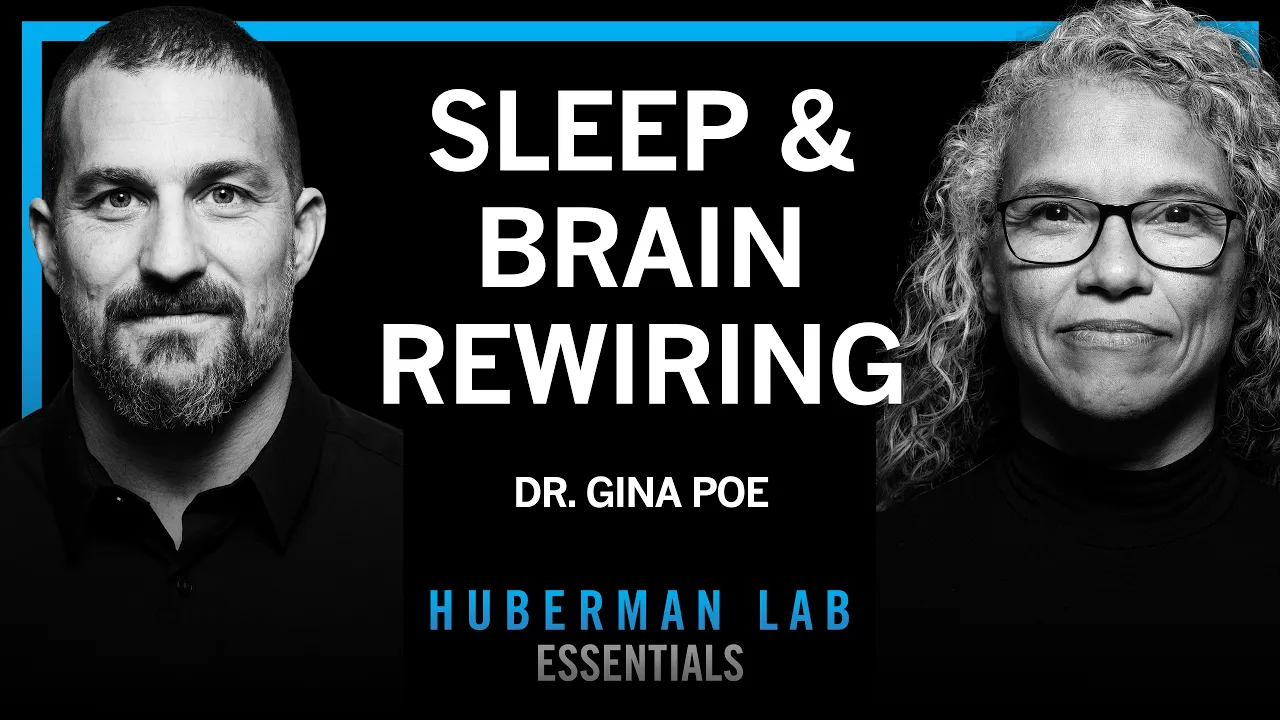
Poe Links REM Norepinephrine Shutdown to Brain Memory Wipe
Andrew Huberman
The complete silencing of locus coeruleus firing during REM sleep is required to clear short-term memory storage and uncouple emotional trauma from physiological distress.
## Background
Published on YouTube by Andrew Huberman on September 3, 2026, this Huberman Lab Essentials episode features Dr. Gina Poe, a Professor of Integrative Biology and Physiology at UCLA. According to the page description, the episode covers the architecture of sleep, how each stage supports memory consolidation, creativity, brain restoration, and emotional processing, as well as science-supported tools for sleep quality and cognitive performance.
## TL;DR
Dr. Gina Poe breaks down the specific biological functions of different sleep stages, explaining how slow-wave sleep drives brain waste clearance, protein synthesis, and growth hormone release during the early night. She details how sleep spindles and REM sleep work in tandem to transfer short-term memories from the hippocampus to the neocortex, build creative mental schemas, and wipe clean short-term storage pathways. Additionally, the conversation highlights how complete silence of the locus coeruleus during REM sleep acts as an overnight therapeutic mechanism to uncouple traumatic memories from visceral physical fear.
## Atmosphere & style
The conversation carries an engaging, highly educational, and scientifically grounded tone as two expert neuroscientists dive deep into brain mechanics. Huberman serves as an appreciative and focused host, asking precise questions that allow Dr. Poe to lead with clear, vivid analogies—like comparing sleep cycles to washing machines or the brain's waste clearance to cleaning up after a party. The dialogue strikes a balance between complex neurobiology and practical human experience, leaving listeners with a sense of clarity and awe regarding the restorative power of sleep.
## Key takeaways
- [00:00](https://www.youtube.com/watch?v=f1NNmiz547U&t=0s) Sleep is a fundamental state driven by a complete shift in brain chemistry, cycling through 90-minute periods of non-REM and REM sleep.
- [00:19](https://www.youtube.com/watch?v=f1NNmiz547U&t=19s) Stage 2 sleep features sleep spindles and K-complexes, representing a vital dialogue between the thalamus and cortex to transfer short-term memories to long-term storage.
- [02:23](https://www.youtube.com/watch?v=f1NNmiz547U&t=143s) Memory consolidation shifts recent experiences from the short-term storage of the hippocampus to the distributed long-term network of the neocortex.
- [04:34](https://www.youtube.com/watch?v=f1NNmiz547U&t=274s) The first deep slow-wave sleep cycle triggers a massive release of growth hormone and a surge in brain protein synthesis to build synaptic infrastructure.
- [04:34](https://www.youtube.com/watch?v=f1NNmiz547U&t=274s) Going to sleep late or altering your sleep timing shifts your circadian clock, causing you to miss the synchronized growth hormone pulse.
- [06:47](https://www.youtube.com/watch?v=f1NNmiz547U&t=407s) Alcohol acts as a potent suppressant of REM sleep and disrupts Stage 2 sleep spindles, effectively blocking memory consolidation.
- [07:45](https://www.youtube.com/watch?v=f1NNmiz547U&t=465s) Middle sleep cycles build and update mental schemas, integrating old and new memories to foster high-level creativity and problem-solving.
- [08:59](https://www.youtube.com/watch?v=f1NNmiz547U&t=539s) Waking up briefly during the night is normal, and sipping fluids slowly rather than gulping them late in the day reduces nighttime urination urges.
- [10:06](https://www.youtube.com/watch?v=f1NNmiz547U&t=606s) REM sleep induces active motor paralysis (atonia) to prevent acting out dreams, whereas sleepwalking occurs during deep slow-wave sleep.
- [12:28](https://www.youtube.com/watch?v=f1NNmiz547U&t=748s) Sleep inertia results from waking up mid-cycle, and commercial sleep trackers should be viewed as general directional tools rather than absolute measures.
- [14:20](https://www.youtube.com/watch?v=f1NNmiz547U&t=860s) The initial 20 minutes of sleep rapidly restore ATP levels from accumulated adenosine, while early slow-wave sleep acts as a bilge pump to clear metabolic waste.
- [18:23](https://www.youtube.com/watch?v=f1NNmiz547U&t=1103s) The locus coeruleus completely shuts off only during REM sleep, allowing the brain to wipe short-term novelty pathways so new learning can occur.
- [18:23](https://www.youtube.com/watch?v=f1NNmiz547U&t=1103s) Calming the sympathetic nervous system before bed helps ensure the locus coeruleus quietens down properly during sleep.
- [22:24](https://www.youtube.com/watch?v=f1NNmiz547U&t=1344s) Increased sleep spindle density after learning drives structural plasticity in distal dendrites to weave new information into existing mental frameworks.
- [22:24](https://www.youtube.com/watch?v=f1NNmiz547U&t=1344s) Pontine-Geniculate-Occipital (P-waves) flood the cortex with glutamate during REM sleep, stimulating distant brain regions to spark creative insights.
- [25:47](https://www.youtube.com/watch?v=f1NNmiz547U&t=1547s) Healthy REM sleep acts as built-in trauma therapy by allowing emotional memories to be processed without the stress neurotransmitter norepinephrine.
- [25:47](https://www.youtube.com/watch?v=f1NNmiz547U&t=1547s) In PTSD, persistent locus coeruleus activity during REM sleep prevents the uncoupling of fear from memory, leaving the brain trapped in distress.
## Detailed walkthrough
### [00:00](https://www.youtube.com/watch?v=f1NNmiz547U&t=0s) Understanding Sleep Architecture & The Ideal Night
Sleep is a fundamental state completely distinct from wakefulness that cannot be replicated by any form of awake rest. The brain chemistry during sleep undergoes a radical transformation, cycling through two primary states: non-REM and REM sleep. Non-REM is further divided into three distinct stages: Stage 1 (a light, dozing state characterized by fast gamma rhythms), Stage 2 (a intermediate phase marked by specific neural conversations), and Stage 3 (deep slow-wave sleep). A complete sleep cycle lasts roughly 90 minutes, and a "perfect night's sleep" typically consists of four to five of these cycles, totaling about 7.5 to 8 hours.
During Stage 2 sleep, the brain exhibits short bursts of activity between 10 and 15 Hz called **sleep spindles**, along with **K-complexes**. These represent a critical dialogue between the thalamus—the gateway to consciousness—and the neocortex, which processes high-level cognition. Waking up from Stage 2 often produces brief, hallucination-like dream reports.
- **Stage 1 (Light Sleep):** Fast gamma rhythms; easy to startle awake.
- **Stage 2 (Transitional Sleep):** Features 10–15 Hz sleep spindles and K-complexes; thalamocortical communication.
- **Stage 3 (Slow-Wave Sleep):** Characterized by large, sweeping slow waves that physically cleanse the brain and restore neural tissue.
- **REM Sleep (Rapid Eye Movement):** High brain activity, vivid emotional dreams, and total motor paralysis.
[02:23](https://www.youtube.com/watch?v=f1NNmiz547U&t=143s) Memory Consolidation Across the Night
The first four hours of sleep are particularly critical for processing recent experiences. If you learn a new skill or encounter novel sensory-motor information during the day, your early-night dreams will directly incorporate those experiences. As the night progresses, memories undergo **consolidation**, transferring from short-term storage in the hippocampus (located deep in the temporal lobe) to long-term storage across the distributed network of the neocortex.
This neural transfer was elegantly demonstrated in landmark research by Sidarta Ribeiro. By tracking memory signals in rats across a full sleep period, Ribeiro observed that with each successive REM sleep period, the memory traces moved step-by-step: first from the hippocampus to the initial projecting cortical area, then to secondary areas, and ultimately across the entire cortex.
> "Stage 2 sleep is really cool because that has something called sleep spindles and K-complexes... It's a unique time when our hippocampus—the sort of like the RAM of our brains—writes it to a hard disk, which is the cortex."
[04:34](https://www.youtube.com/watch?v=f1NNmiz547U&t=274s) Growth Hormone, Protein Synthesis & Bedtime Consistency
Hormone secretion is tightly coupled to sleep architecture. While growth hormone is released in small amounts throughout the day and night, the very first deep slow-wave sleep cycle triggers a massive, concentrated bolus of growth hormone in both men and women. This first sleep phase also initiates a major surge in protein synthesis, constructing the physical synaptic infrastructure required to lock in new memories.
```
First Slow-Wave Sleep Cycle (First ~90 min)
├── Huge Bolus Release of Growth Hormone
└── Surge in Brain Protein Synthesis (Synaptic Building)
```
Missing that initial slow-wave period by staying up late deprives the body of this hormone spike. Even if total daily growth hormone production remains mathematically similar, endocrinological research proves that large pulses achieve physiological effects completely different from low-grade, steady releases. Because every cell operates on an internal circadian clock aligned with melatonin, going to sleep late means the molecular clock has already advanced, missing the receptive window.
- **Circadian Alignment:** Both bedtimes and wake times must remain consistent to keep cellular clocks synchronized.
- **Neurological Marker:** Maintaining a stable bedtime is one of the strongest indicators of long-term neurological health in aging adults.
- **Consequences of Delay:** Shifting sleep onset by even 90 minutes causes you to miss the synchronized growth hormone pulse and key protein-building windows.
[06:47](https://www.youtube.com/watch?v=f1NNmiz547U&t=407s) Alcohol's Destructive Effect on Sleep Architecture
Consuming alcohol before bed drastically degrades sleep quality. Alcohol acts as a potent suppressant of REM sleep and disrupts the crucial Stage 2 transitions where sleep spindles occur. Because sleep spindles represent the precise window when the hippocampus transfers data to the cortical "hard drive," alcohol consumption effectively blocks memory consolidation.
Until the liver fully metabolizes alcohol and clears it from the system, normal sleep architecture remains severely disrupted.
[07:45](https://www.youtube.com/watch?v=f1NNmiz547U&t=465s) Middle Sleep Cycles, Schema Building & Creativity
As sleep progresses into the second and third 90-minute blocks, the proportion of REM sleep increases while growth hormone and melatonin levels taper off. These middle-of-the-night cycles are essential for fostering high-level cognitive creativity and abstract problem-solving.
During these middle phases, the brain actively builds and updates **schemas**. It acts like an automated operating system opening existing folders, scanning old and new memory files, identifying subtle conceptual overlaps, and strengthening novel connections. This structural reorganizing forms the biological foundation of creative insights and "eureka" moments.
Waking up once during the night to use the bathroom is a completely normal feature of human sleep architecture rather than a sign of pathology. Sleep is homeostatically regulated; as long as you aren't intentionally depriving yourself or lying awake stressing, brief awakenings cause no long-term harm.
- **Fluid Management:** The urge to urinate is heavily influenced by drinking speed. Sipping fluids slowly late in the day reduces night waking compared to gulping large volumes.
- **Managing Awakenings:** Taking up to an hour to fall back asleep is acceptable provided you can extend your sleep window in the morning or adjust your schedule the following evening.
[10:06](https://www.youtube.com/watch?v=f1NNmiz547U&t=606s) Late-Night REM, Motor Paralysis & Sleepwalking
The second half of the night is dominated by longer, highly intense REM sleep periods. Although slow-wave sleep is traditionally labeled "deep sleep" due to high arousal thresholds (where waking a person leaves them confused and groggy), REM sleep is functionally the deepest state in adults—especially as slow-wave amplitude naturally declines with age.
```
+--------------------------------------------------------------------------+
| SLOW-WAVE SLEEP vs. REM SLEEP |
+------------------------------------+-------------------------------------+
| Slow-Wave Sleep (N3) | REM Sleep |
+------------------------------------+-------------------------------------+
| • High arousal threshold | • Vivid, narrative, storyline dreams|
| • Partial motor control intact | • Complete muscle paralysis (atonia)|
| • Origin of sleepwalking/talking | • Disconnected from environmental |
| • Brain & body "restorative phase" | sensory input |
+------------------------------------+-------------------------------------+
```
During healthy REM sleep, the brain imposes active motor paralysis (atonia). This prevents individuals from physically acting out their vivid, storyline-driven dreams. In contrast, **sleepwalking** occurs out of deep slow-wave sleep—a hybrid state between sleep and partial wakefulness where complex behaviors (such as cooking, walking, or even driving) can occur without conscious awareness or voluntary control.
Waking up in the middle of a sleep cycle causes profound grogginess known as **sleep inertia**. Dr. Poe compares a 90-minute sleep cycle to a washing machine cycle: interrupting it mid-way is like pulling out soaking, soapy clothes before the spin and dry cycles finish. While the first cycle of the night can run long (105–110 minutes), subsequent cycles average 90 minutes. Waking up at the tail end of REM sleep typically leaves a person clear-headed and fully functional.
Commercial sleep trackers can be useful directional tools, but current wearable technology is only roughly 70% accurate at correctly identifying specific sleep stages. They should be used for general awareness rather than strict lifestyle management.
> "I liken it to a washing machine cycle... You don't want to open the washing machine and try and function, put them on and wear them around while they're soaking wet and full of soap. You have to wait until the cycle is through."
[14:20](https://www.youtube.com/watch?v=f1NNmiz547U&t=860s) Brain Waste Clearance & The "Power Nap" Mechanics
During waking hours, intense neural plasticity consumes immense amounts of ATP (the primary cellular energy currency) and causes proteins to unfold or misfold. Additionally, when neurons fire action potentials, their membranes physically expand and become slightly more translucent.
The first 20 minutes of sleep are dedicated to metabolic restoration, rapidly converting accumulated **adenosine** back into usable ATP—which explains the profound restorative effect of brief "power naps." Following this initial recharge, the sweeping slow waves of deep sleep trigger the clearance of metabolic waste, sweeping away misfolded proteins and cellular debris accumulated during wakefulness, much like clearing out guests after a party so the venue can be cleaned.
<FollowUp label="Would you like a walkthrough of Part 2 of this episode?" query="Provide a detailed, faithful walkthrough for Part 2 of the transcript for Dr. Gina Poe on Huberman Lab."/>
[16:02](https://www.youtube.com/watch?v=f1NNmiz547U&t=962s) The Brain's Bilge Pump: Waste Clearance During Slow-Wave Sleep
Dr. Gina Poe explains that during slow-wave sleep, neurons undergo a coordinated cycle of firing and silence. When neurons fire, sodium enters the cells, pulling water in and causing them to expand slightly; when they go silent, they contract. Because a massive portion of neurons fire and go silent in unison, the entire brain undergoes a synchronized, rhythmic expansion and contraction. Poe likens this process to a "bilge pump of the brain," which actively flushes fluids through the tissue to clear out metabolic debris and misfolded proteins, while glial cells assist in vacuuming up and transferring the waste.
Andrew Huberman points out that this night-time flushing leaves the brain in a pristine state for the next day's cognitive demands. Poe uses a vivid analogy to illustrate this: think of the brain as a house host to a massive party. If you don't clean up the mess afterward and try to hold another party the next day, the venue gets cluttered, and guests struggle to move around or enjoy themselves. Over time, failing to clear this cellular trash makes daily cognition—the "partygoers" navigating the space—increasingly difficult. Huberman notes that this washout primarily happens during the first third of the night when slow-wave sleep predominates. Poe confirms that if someone stays up until 1:00 AM or 2:00 AM, they do not simply delay this process; they miss the slow-wave sleep window entirely, as their late sleep will instead be dominated by Stage N2 and REM sleep. However, if an individual normally sleeps from 2:00 AM to 10:00 AM, their circadian rhythms (including melatonin release and morning corticosterone rises) shift accordingly, preserving the natural sequence.
- **Cellular mechanism:** Sodium influx pulls water into neurons during firing, causing slight swelling; silence causes contraction.
- **Glial role:** Glia actively clean up cellular debris and transport it out during these slow waves.
- **Timing:** Early-night slow-wave sleep is non-negotiable for waste clearance; going to sleep late skips the washout window rather than postponing it.
[18:23](https://www.youtube.com/watch?v=f1NNmiz547U&t=1103s) The Locus Coeruleus, Norepinephrine, and Synaptic Pruning
Huberman introduces the locus coeruleus, prompting Poe to break down its vital role as the brain's central source of norepinephrine (noradrenaline). This neurotransmitter acts much like adrenaline in the body, priming us to respond to our environment. Tonic, steady firing of the locus coeruleus (around 2 Hz during wakefulness) maintains alertness. A sudden burst of firing—triggered by an unexpected stimulus like a loud noise—instantly switches our attention, enabling rapid "one-trial learning." However, hyperactive locus coeruleus firing drives panic, whereas falling asleep reduces its tonic firing rate down to approximately 1 Hz.
Crucially, REM sleep is the *only* state in which the locus coeruleus shuts off completely. Poe stresses that this absolute silence is required to erase and downscale synapses that are no longer serving us—such as outdated facts or information sitting in the brain's short-term "novelty encoding pathway" that has already been consolidated into long-term structures. She compares this process to carrying around a thumb drive all day. During sleep, information written on the thumb drive is transferred to long-term cortical memory, and during REM sleep, the thumb drive must be wiped clean. If the locus coeruleus fails to turn off, the brain's short-term RAM remains cluttered, preventing new learning and causing traumatic or outdated memories to remain hyper-salient and maladaptive.
- **Firing states:** High bursts = attentional shifts / panic; ~2 Hz = normal wakefulness; ~1 Hz = slow-wave sleep; 0 Hz (complete silence) = REM sleep.
- **Synaptic clearing:** Complete silence during REM sleep allows the brain to clear its "thumb drive" (novelty encoding pathways) so new learning can occur the following day.
- **Calm bedtime routine:** Poe recommends entering sleep in a calm state using deep breathing, warm baths, meditation, or light reading to quiet the sympathetic fight-or-flight system and prevent high locus coeruleus activity during sleep.
[22:24](https://www.youtube.com/watch?v=f1NNmiz547U&t=1344s) Sleep Spindles, P-Waves, and the Cellular Basis of Creativity
Poe and Huberman discuss sleep spindles—bursts of brain activity occurring in N2 sleep—and their critical role in intelligence and memory consolidation. Poe highlights that an individual's baseline spindle density per minute strongly correlates with general intelligence. More importantly, whenever you learn new material during the day, your spindle density increases that night. If spindle density fails to rise after a learning session, the new information will not be successfully integrated into the brain's existing cognitive structures ("schemas").
Recent research by scientists like Julie Seibt and Anita Lüthi demonstrates that sleep spindles trigger immense structural plasticity in the distal dendrites of cortical neurons. While proximal dendrites listen to sensory input from the external world via the thalamus, distal dendrites engage in an internal cross-talk between the hippocampus and the cortex. Spindles cause massive calcium surges into these distal branches, physically "sewing" new memory traces into existing cortical schemas. Working alongside spindles are Pontine-Geniculate-Occipital waves (P-waves/PGO waves), which originate in the pons and flood the cortex with glutamate. This random internal excitation during REM sleep acts as a substitute for external sensory input, generating vivid dreams and co-activating distant brain regions to spark creative breakthroughs and novel insights.
- **Spindle density:** Increases directly in response to daytime learning; vital for integrating new information into long-term mental frameworks.
- **Distal dendrites:** Experience large calcium influxes during spindles, driving high levels of structural plasticity.
- **P-waves (PGO waves):** Brainstem-derived bursts of glutamate that stimulate widespread cortical activity during REM, forming the biological engine behind dreams and creative synthesis.
[25:47](https://www.youtube.com/watch?v=f1NNmiz547U&t=1547s) REM Sleep as Built-in Trauma Therapy
Huberman notes that the combination of REM sleep, muscle paralysis, and the complete suppression of the locus coeruleus resembles a built-in mechanism for overnight trauma therapy. Poe agrees, addressing why immediately debriefing trauma victims can sometimes backfire: reliving an event while emotional arousal remains high—without first calming the sympathetic nervous system before sleep—prevents the locus coeruleus from shutting off, causing the brain to continually re-encode the trauma's emotional distress.
During healthy REM sleep, the brain's emotional centers (like the amygdala) are highly active, but the complete absence of norepinephrine allows the cognitive details of a memory to be uncoupled from its painful autonomic response. This separation enables a person to recall a traumatic event, acknowledge that it happened, and remember that they were terrified, without re-experiencing the racing heart, sweating, and panic. In post-traumatic stress disorder (PTSD), the noradrenergic system fails to downscale during REM sleep. As a result, the locus coeruleus stays active, re-stitching intense fear into the memory every night and leaving the individual trapped in a cycle of reliving the event as if it were happening anew. Huberman concludes the discussion by thanking Poe for providing such a rich, actionable overview of sleep architecture.
- **Therapeutic uncoupling:** Healthy REM sleep allows the brain to process emotional memories without norepinephrine, stripping away the physiological fight-or-flight reaction.
- **Mechanism of PTSD:** Persistent locus coeruleus activity during REM sleep repeatedly welds visceral fear back onto traumatic memories.
- **Practical takeaway:** Lowering sympathetic nervous system arousal prior to sleep is necessary for REM sleep to act adaptively rather than reinforcing distress.
## Notable quotes
> [02:23](https://www.youtube.com/watch?v=f1NNmiz547U&t=143s) Stage 2 sleep is really cool because that has something called sleep spindles and K-complexes... It's a unique time when our hippocampus—the sort of like the RAM of our brains—writes it to a hard disk, which is the cortex. — Dr. Gina Poe
> [12:28](https://www.youtube.com/watch?v=f1NNmiz547U&t=748s) I liken it to a washing machine cycle... You don't want to open the washing machine and try and function, put them on and wear them around while they're soaking wet and full of soap. You have to wait until the cycle is through. — Dr. Gina Poe
## Mentioned
Dr. Gina Poe, Andrew Huberman, University of California, Los Angeles, UCLA, Huberman Lab, Sidarta Ribeiro, Julie Seibt, Anita Lüthi
Neurobiologist Dr. Gina Poe and Andrew Huberman outline how distinct sleep stages drive physical neural repair, schema consolidation, and overnight emotional regulation. They emphasize that circadian alignment and lowering pre-sleep sympathetic arousal are critical for hormone release, waste clearance, and trauma processing.
Slow-Wave Sleep and Metabolic Brain Clearance (16:02)
Sleep begins with metabolic restoration, where the first 20 minutes rapidly replenish adenosine back into cellular ATP, explaining the efficacy of short naps. During early deep slow-wave sleep (Stage 3), neurons execute synchronized cycles of firing and silence. Poe explains that sodium influx during firing pulls water into neurons, causing them to swell, while subsequent silence causes them to contract. This rhythmic expansion functions as a biological bilge pump, flushing fluid through brain tissue while glial cells vacuum up cellular debris and misfolded proteins.
Spindles, Dendritic Plasticity, and Memory Consolidation (22:24)
Memory processing relies on Stage 2 transitional sleep, defined by 10–15 Hz sleep spindles and K-complexes that coordinate communication between the thalamus and the neocortex. Poe notes that baseline spindle density correlates with general intelligence and increases directly following daytime learning. Citing research by Julie Seibt and Anita Lüthi, Poe describes how spindles trigger substantial calcium influxes into the distal dendrites of cortical neurons, physically integrating short-term hippocampal memories into long-term cortical networks. As demonstrated in rodent studies by Sidarta Ribeiro, memory traces step across cortical regions with successive sleep cycles. Alcohol disrupts this process by suppressing REM sleep and degrading the Stage 2 spindle windows required for consolidation.
Locus Coeruleus Silence and Emotional Trauma Processing (18:23)
The locus coeruleus, the brain's primary source of norepinephrine, modulates alertness by firing at approximately 2 Hz during wakefulness and 1 Hz during slow-wave sleep. Healthy REM sleep is the sole state in which the locus coeruleus shuts off completely (0 Hz). Poe explains that this total silence allows the brain to downscale outdated synapses and clear its short-term novelty storage for subsequent learning. Furthermore, this noradrenergic silence enables REM sleep to function as endogenous trauma therapy: the amygdala processes emotional memories while the autonomic fight-or-flight response remains inhibited, decoupling memory content from visceral panic. In post-traumatic stress disorder, persistent locus coeruleus activity during REM prevents this uncoupling, continually reinforcing traumatic fear responses.
Sleep Inertia, Motor Paralysis, and Nighttime Awakenings (10:06)
Normal sleep cycles last approximately 90 minutes. Healthy REM sleep enforces absolute motor paralysis (atonia) to prevent the enactment of narrative dreams, whereas sleepwalking originates as a hybrid state out of deep slow-wave sleep. Poe compares waking mid-cycle to opening an unfinished washing machine, causing profound grogginess known as sleep inertia; waking at the conclusion of a cycle leaves the individual clear-headed. Poe also notes that waking up once per night to urinate is a normal physiological occurrence influenced by fluid intake rate, while commercial sleep trackers remain only roughly 70% accurate when identifying specific sleep stages.
Poe and Huberman conclude that sleep quality depends on strict temporal alignment rather than total duration alone, as delaying sleep onset skips non-negotiable early-night slow-wave clearance windows and growth hormone surges. They emphasize entering sleep in a calm state to suppress locus coeruleus activity, though consumer tracking devices still face technical limitations in accurately measuring these stage transitions.
[2:23] Dr. Gina Poe: Stage 2 sleep is really cool because that has something called sleep spindles and K-complexes... It's a unique time when our hippocampus—the sort of like the RAM of our brains—writes it to a hard disk, which is the cortex.
[12:28] Dr. Gina Poe: I liken it to a washing machine cycle... You don't want to open the washing machine and try and function, put them on and wear them around while they're soaking wet and full of soap. You have to wait until the cycle is through.
Original transcript
[0:00] Welcome to Huberman Lab Essentials,
[0:01] [music] where we revisit past episodes
[0:04] for the most potent and actionable
[0:06] science-based tools for mental health,
[0:08] physical health, and performance.
[0:11] I'm Andrew Huberman and I'm a professor
[0:13] of neurobiology and opthalmology at
[0:15] Stanford School of Medicine. And now for
[0:17] my discussion with Dr. Gina Poe. Dr.
[0:20] Gino Poe, welcome.
[0:21] >> Thank you.
[0:22] >> I've really been looking forward to this
[0:24] conversation. I know that many people
[0:25] are going to be excited to learn about
[0:27] your work as it relates to sleep, as it
[0:30] relates to problem solving, creativity,
[0:32] and a number of other important topics.
[0:34] To start things off, I would love for
[0:36] you to educate us a bit about this thing
[0:38] that we are all familiar with and yet
[0:40] very few of us understand, which is
[0:42] sleep. Could you describe the various
[0:44] phases of sleep that exist, what
[0:46] distinguish them, and perhaps frame this
[0:49] within the context of what would a
[0:51] perfect night's sleep look like?
[0:53] >> All right. So sleep is really different
[0:55] from wakefulness and in fact can't be
[0:57] replaced by any state of wakefulness
[1:00] that we've been able to come up with so
[1:01] far. Our brain chemistry is completely
[1:04] different and in the different stages of
[1:06] sleep which there are is nonREM and REM
[1:08] are the two major states of sleep. Those
[1:10] two states are entirely different from
[1:12] one another too. And even within nonREM
[1:14] there are three states. Stage one, which
[1:17] is what you slip into when you first
[1:19] falling asleep. It's dozing. There's
[1:21] kind of an interesting rhythm that goes
[1:23] on in the brain. It's kind of a fast
[1:24] gamma rhythm. And then there's stage
[1:27] two, which is a really cool state. We
[1:29] sort of used to ignore sleep researchers
[1:32] because it was a transient state between
[1:34] wakefulness and the deep stage three
[1:36] slowwave sleep, which is the most
[1:37] impressively different, which is when
[1:39] big slow waves sweep through our brain.
[1:41] And now we've realized that it cleans
[1:43] our brain. Um, one of the things that
[1:45] those big slow waves do is cleans our
[1:47] brain and does other really important
[1:48] things to restore us from a day of
[1:51] wakefulness. And then REM sleep, which
[1:53] is the most popular because that's where
[1:55] we have the most active dreams. When you
[1:57] wake up someone out of REM sleep,
[1:59] they'll almost always report having
[2:01] dreamed something really bizarre. That's
[2:03] called REM sleep, rapid eye movement
[2:05] sleep. So those are the four states of
[2:07] sleep of human sleep. And we cycle
[2:09] through them every 90 minutes or so. And
[2:12] then we start over again. And we have
[2:15] about five of those per night for a
[2:16] perfect night's sleep. Four or five,
[2:18] something like that. So a perfect
[2:20] night's sleep is 7 and 1 half, 8 hours.
[2:23] And
[2:23] >> what about the sleep where we are
[2:25] lightly asleep
[2:27] >> and we might have a dream that has us
[2:30] somehow thinking about movement or that
[2:31] we jolt ourselves awake. That often
[2:33] happens early in the night, right?
[2:34] >> Yeah. That's the first stage, stage one
[2:37] and stage two of sleep. And stage two
[2:39] sleep is really cool because that has
[2:43] something called sleep spindles and K
[2:45] complexes. And what sleep spindles are
[2:47] are a little of activity that's 10 to 15
[2:51] hertz in frequency. It's a conversation
[2:54] between the phalamus and the cortex. The
[2:57] phalamus is the gateway to consciousness
[2:59] and the neoortex, you know, processes
[3:01] all our cognition. And if you wake up
[3:03] out of that state, you will often report
[3:05] a dream like a hallucination style
[3:08] dream. It won't be a long dream report
[3:10] like you have out of REM sleep, but it
[3:12] will be some hallucination state.
[3:14] >> Are they quite different than the
[3:16] patterns of sleep and dreaming that
[3:18] occur later in the night or toward
[3:19] morning?
[3:20] >> There is some evidence that the first 4
[3:23] hours of sleep are very important for
[3:26] memory processing. And in fact, if
[3:28] you've learned something new that day or
[3:31] have experienced a new sensory motor
[3:34] experience, then your early sleep dreams
[3:38] will incorporate that experience much
[3:40] more than the later sleep dreams. Later
[3:42] as that memory gets consolidated from
[3:45] the early structures which are the
[3:47] hippocampus deep in the temporal lobe to
[3:49] the cortex in a distributed fashion that
[3:53] memory seems to move from that
[3:56] hippocampus to the cortex and also the
[3:58] dreams that incorporate that memory also
[4:00] move later in the night. So
[4:02] >> there was a great study by Sedarto Rayo
[4:06] who studied the consolidation of
[4:08] memories from the hippocampus to the
[4:10] cortex in a rat across the period of a
[4:13] full day sleep because rats sleep in the
[4:16] daytime. And he found that each
[4:18] subsequent rim sleep period moved that
[4:22] memory from the hippocampus to the f
[4:25] first area that projects to it and then
[4:27] the second area and then the third area.
[4:29] and you can see the memory moving um
[4:32] through the throughout the sleep.
[4:34] >> There's a number of different hormones
[4:36] associated with the different stages of
[4:38] sleep. We know that melatonin is a
[4:40] hormone
[4:41] >> of night time
[4:41] >> of nighttime that makes us sleepy. What
[4:44] about growth hormone release? When does
[4:45] that occur during sleep?
[4:47] >> So growth hormone release happens all
[4:48] day long and all night long. But the
[4:51] deep slow wave sleep that you get, the
[4:53] very first sleep cycle is when you get a
[4:56] big bolus of growth hormone release. and
[4:58] in men and women equally. And if you
[5:02] miss that first deep slow wave sleep
[5:04] period, you also miss that big bolus of
[5:07] growth hormone release. And you might
[5:09] get ultimately across the day just as
[5:12] much overall growth hormone release. But
[5:14] andologists will tell you that big
[5:16] bololises do different things than a
[5:19] little bit eaked out over time. There's
[5:21] also a big push to synthesize proteins.
[5:24] So that's when the protein synthesis
[5:27] part that builds memories for example in
[5:30] our brain happens in that first cycle of
[5:33] sleep. So you don't want to miss that
[5:35] especially if you've learned something
[5:36] really big and needs needs more synaptic
[5:39] space to encode it.
[5:40] >> How would somebody miss that first 90
[5:42] minutes
[5:43] >> depriving themselves? Yeah. So, so let's
[5:45] say I normally go to sleep at 10:00 p.m.
[5:48] >> and then from 10 to 11:30 would be this
[5:50] first phase of sleep and that's when the
[5:52] growth hormone big bololis of growth
[5:54] hormone would be released. Does that
[5:55] mean that if I go to sleep instead at
[5:58] 11:30 or midnight that I miss that first
[6:00] phase of sleep? Why is it not the case
[6:02] that I get that first phase of sleep
[6:04] just simply starting later? Every cell
[6:06] in our body has a clock and all of those
[6:08] circadian clocks are synchronized and so
[6:11] our cells are ready to respond to that
[6:15] growth hormone release at a particular
[6:17] time and if we miss it and it's a time
[6:19] in relation to melatonin also. So if you
[6:22] miss it, yeah, you might get some growth
[6:25] hormone release, but it's occurring at a
[6:27] time when that your clock has already
[6:28] moved to the next phase. And so it's
[6:31] it's just a clock thing. So what this
[6:33] means is that we should have fairly
[6:35] consistent bedtimes in addition to
[6:36] fairly consistent wake times. Is that
[6:38] right?
[6:39] >> Exactly. And in fact, one of the best
[6:41] markers of good neurological health when
[6:44] we get older is consistent bedtimes.
[6:47] >> What other things inhibit growth hormone
[6:49] release or other components of this
[6:51] first stage of sleep? Are there things
[6:53] that I perhaps do in the preceding hours
[6:55] or the preceding day like ingest
[6:57] caffeine or alcohol that can make that
[7:00] first stage of sleep less effective even
[7:02] if I'm going to sleep at the same time?
[7:03] >> Alcohol definitely will do that because
[7:05] alcohol is a REM sleep suppressant and
[7:07] it even suppresses some of that stage
[7:09] two transition to REM with those sleep
[7:11] spindles. And those sleep spindles, we
[7:13] didn't talk about their function yet,
[7:14] but they're really important for moving
[7:17] memories to our cortex. It's a unique
[7:19] time when our hippocampus the sort of
[7:22] like the RAM of our brains writes it to
[7:25] a hard disk which is the cortex and
[7:27] there it's a unique time when they're
[7:29] connected. So if you don't want to miss
[7:31] that you don't want to miss REM sleep
[7:33] when is also a part of the consolidation
[7:35] process and alcohol before we go to
[7:37] sleep will do that until we've
[7:39] metabolized alcohol and put it out of
[7:41] our bodies it will affect our sleep
[7:44] badly. What about the second and third
[7:47] 90minute blocks of sleep? Is there
[7:48] anything that makes those um unique?
[7:51] What what is their signature? Besides
[7:53] the fact that they come second and third
[7:54] in the night,
[7:55] >> there's more and more REM sleep the
[7:57] later the night we get. There's also a
[8:00] change in hormones. You know, the growth
[8:01] hormone and melatonin levels are
[8:04] starting to decline, but other hormones
[8:06] are picking up. So, it is a really
[8:09] different stage that you also don't want
[8:11] to short change yourself on. And I think
[8:14] that's the stage many studies are
[8:16] showing that those are the times in
[8:18] sleep when the most creativity can
[8:20] happen. That's when our dreams can
[8:22] incorporate and put together old and new
[8:25] things together into a new way and our
[8:28] schema are built during that time. So
[8:31] that's when your computer of your brain
[8:33] is opening folders and comparing
[8:35] documents seeing if is there anything
[8:37] the same? Are these two documents look
[8:39] very much the same? that there's a
[8:41] little bit of difference and it can it
[8:43] can link those conceptually. So that
[8:45] that's probably one of the origins of
[8:47] creativity is finding things that are
[8:49] related maybe just linked a little bit
[8:52] and you can find that link and
[8:54] strengthen it if it you know makes your
[8:57] schema interesting and different.
[8:59] >> Many people including myself tend to
[9:01] wake up maybe once during the middle of
[9:03] the night to use the restroom. I've
[9:05] tried to drink less fluid before going
[9:07] to sleep. I've heard also the impulse to
[9:09] urinate is also dictated by how quickly
[9:11] you drink fluid, not just the total
[9:12] volume. So, I've switched to um sipping
[9:14] fluids more slowly for my last beverage
[9:16] of the day, which seems to help. Is
[9:18] there any known detriment to this middle
[9:21] of the night waking or should we
[9:23] consider it a normal feature for some
[9:25] people's sleep architecture?
[9:26] >> Yeah, I think we shouldn't worry about
[9:28] it. Actually, sleep is really incredibly
[9:30] well homeostatically regulated. And so
[9:33] really don't worry about how much you're
[9:35] sleeping as long as you're not
[9:37] intentionally depriving yourself of
[9:38] sleep by doing something really
[9:40] rewarding and exciting because even that
[9:42] is stressful to your body and deprivives
[9:44] you of a lot of the things we're talking
[9:45] about. It's absolutely normal to wake up
[9:48] at least once in the middle of the night
[9:49] to go to the bathroom. And as long as
[9:51] you can get back to sleep in a
[9:53] reasonable amount of time or even if it
[9:55] takes you an hour, don't worry about it.
[9:57] as long as you have a lifestyle that
[9:59] allows you to then make up that sleep
[10:01] either the next morning or the next
[10:03] night um or going to bed a little
[10:05] earlier.
[10:06] >> What is unique perhaps about the
[10:08] architecture of dreams and sleep in the
[10:11] let's say the last third of the night or
[10:13] the or the second half of the night,
[10:14] >> right? Yeah. In the second half of the
[10:15] night, we have longer REM sleep periods
[10:18] and those are considered the deepest
[10:21] sleep. Even though slowwave sleep, big
[10:24] slow wave is considered deep. It is
[10:26] deep.
[10:26] >> Yeah. They call slowwave sleep deep
[10:28] sleep and REM sleep rapid eye. But now
[10:30] you're telling me that REM sleep is
[10:31] actually the deeper sleep.
[10:32] >> The reason why you call slowwave sleep
[10:34] deep sleep is because it's difficult to
[10:36] arouse people out of that state. And
[10:38] when you do arouse them out of that
[10:40] state, they're most often confused and
[10:42] just want to go back into sleep and can
[10:44] go back pretty easily. If you arouse
[10:47] someone out of REM sleep, they're more
[10:49] likely to report something that was
[10:50] really kind of almost like wakefulness.
[10:52] It's it was so vivid. And maybe one of
[10:54] the reasons why REM sleep is deeper is
[10:57] especially in adults and older people
[10:59] that deep slowwave sleep goes away. So
[11:02] it's not as deep. It's not as big. The
[11:04] slow waves aren't as large which is
[11:06] probably problematic but we are not
[11:08] sure. And so then REM sleep becomes the
[11:11] deepest stage.
[11:12] >> We are paralyzed during REM sleep.
[11:14] Correct.
[11:15] >> Yes. normally paralyzed and that's
[11:16] really good because that's the time when
[11:19] we're actively dreaming storyline dreams
[11:22] and we could hurt ourselves. We're
[11:24] actually really cut off from the outside
[11:26] world in terms of responding to say this
[11:30] table or window or a door and so
[11:33] different from sleepwalking which is out
[11:35] of slow sleep. Out of slow sleep that
[11:37] sleepwalking is a mixture between sleep
[11:39] and wakefulness. You can cook a full
[11:41] meal, um, drive your car while you're in
[11:44] deep, slow sleep. It's scary because you
[11:46] never know what you're going to do. You
[11:48] don't have voluntary voluntary control
[11:50] over it. You have no conscious control
[11:51] over it, but you can actually safely
[11:54] navigate um some situations in
[11:57] sleepwalking and actually have a
[11:59] conversation. Although it may not make
[12:00] much sense when you're sleeptalking, in
[12:03] REM sleep, you're not processing the
[12:06] outside world. and instead um when
[12:08] you're acting out your dreams, you could
[12:10] be doing things like walking through a
[12:12] plate glass window or falling off of,
[12:15] you know, down a stairs um things like
[12:17] that. So, you really want your muscles
[12:20] to be inactivated during REM sleep,
[12:23] otherwise you will act out those dreams
[12:25] and really hurt yourself or your bed
[12:27] partner. So, as people start to approach
[12:31] morning or the time when they normally
[12:32] would wake up, I've heard that it's
[12:34] important to, if possible, complete one
[12:37] of these 90minute cycles prior to waking
[12:40] up. That is, if you set your alarm for
[12:42] halfway through one of these 90minute
[12:44] cycles that come late in the night of
[12:46] sleep that it can lead to um rather
[12:50] groggy patterns of waking.
[12:52] >> It's called sleep inertia. When we wake
[12:53] up out of the wrong state, I liken it to
[12:56] a washing machine cycle. This 90 minute
[12:58] cycle is like a washing machine cycle.
[13:00] And the first part is to add water,
[13:02] right? Then your clothes are soaking
[13:03] wet. You don't want to open the washing
[13:05] machine and try and function, put them
[13:07] on and wear them around while they're
[13:09] soaking wet and full of soap. So you
[13:11] have to wait until the cycle is through
[13:14] before you can well actually
[13:16] put it in the dryer, too. Um before you
[13:19] want to wear them. So you can function.
[13:22] It just takes a little while for those
[13:24] clothes, that brain to dry out so you
[13:26] can actually function well. But it's
[13:28] better to wait through the whole cycle
[13:30] is complete. So that's why you want to
[13:33] set that 90 90 minute alarm clock. And
[13:36] again, that's around 90 minutes because
[13:39] the first stage of sleep, the first
[13:41] cycle of sleep is actually a little
[13:42] longer, more like 105, 110 minutes. But
[13:46] then the second ones and third ones,
[13:48] they get sort of shorter and shorter as
[13:49] the night goes on. And in the last few
[13:52] cycles, you're just doing the N2 REM
[13:55] sleep cycle, which takes less time. And
[13:57] if you wake up out of REM sleep, there's
[13:59] usually no problem cognitively.
[14:01] >> Are you a fan of of sleep trackers?
[14:04] >> Yeah.
[14:04] >> Yeah. Do you use one?
[14:05] >> I have one on. I don't live my life by
[14:08] them because the best ones right now are
[14:11] about 70% effective at
[14:13] >> staging your sleep. So 70% it's okay.
[14:16] It's okay. But um take it with a grain
[14:18] of salt is what I'm saying. tell us a
[14:20] little bit more about the wash out that
[14:22] occurs in the brain during sleep and
[14:24] perhaps if there are any ways to ensure
[14:25] that it happens or to ensure that it
[14:27] doesn't happen and obviously we want
[14:29] this to happen.
[14:30] >> Yeah, we talked about the circadian
[14:31] clock and how certain things happen at
[14:34] certain times. Well, one of the things
[14:35] that happens when we're awake and
[14:37] talking to each other is that there's a
[14:40] lot of plasticity. there's something
[14:42] that I'm learning from you today and
[14:43] you're learning from me and that changes
[14:46] our synapses and it changes the way our
[14:48] proteins are going to be folded and
[14:52] changed during sleep. This process
[14:54] actually uses a lot of ATP, the power um
[14:58] structure, the fuel of the brain. It
[15:00] unfolds also proteins while we're doing
[15:02] this, while we're using them. And so
[15:05] during that first part of the night, uh,
[15:07] when we first fall asleep, in the first
[15:08] 20 minutes or so, we're building that
[15:11] adenosine back into ATP. And that's, uh,
[15:14] probably why power naps are called power
[15:16] naps because we're actually rebuilding
[15:19] the power. And then we're also cleaning
[15:23] out through the deep slow waves of slow
[15:25] wave sleep. We're cleaning out all those
[15:27] misfolded proteins, unfolded proteins,
[15:29] and other things that get broken down
[15:32] and, you know, need to be rebuilt when
[15:35] we're asleep because of its use during
[15:38] wakefulness. So I liken that to, you
[15:41] know, having a big party during
[15:43] wakefulness and you need all those
[15:44] partygoers to leave in order to do the
[15:46] cleanup. What happens when a neuron is
[15:48] firing is that it expands. The membrane
[15:52] expands a little bit. It becomes more
[15:53] translucent. That's how we know, one of
[15:55] the ways we know that neurons expand
[15:57] when they fire. And so every action
[15:59] potential, the membrane expands a little
[16:02] bit as sodium brings water into the
[16:04] cell. And then when they're silent, they
[16:06] contract. And so in during slow waves,
[16:09] the cool thing is that the reason why
[16:11] you can measure them is that all the
[16:12] neurons at the same time, not all of
[16:14] them, but a good portion of them are
[16:17] firing at the same time and silent at
[16:19] the same time. And so you think about
[16:21] that as contracting and expanding all at
[16:23] the same time. It's kind of like a
[16:25] billagege pump of the brain. So that can
[16:27] pump out. GIA are also really important
[16:30] for this in terms of cleaning up debris
[16:33] and transferring it to where it needs to
[16:35] go. So, um, so I think of it actually as
[16:38] a billagege pump cleaning out our brain.
[16:41] >> Here you're talking about literally an
[16:43] expansion and a contraction of the
[16:44] neurons in unison
[16:46] >> and pushing the fluid through
[16:48] >> cleaning out any misfolded proteins or
[16:50] debris that might occur
[16:52] >> on the basis of these metabolic
[16:53] pathways.
[16:55] >> And the consequence of that is to to
[16:57] what to leave the brain in a state of
[17:00] more pristine action for the next day.
[17:02] Is that right?
[17:03] >> Yeah. You think of it again like a party
[17:05] and if you don't clean up after that
[17:07] party and you try and hold another one
[17:08] the next day, it's going to get more
[17:10] clogged. You know, it's people have a
[17:12] harder time moving around and enjoying
[17:14] themselves. And um if that builds up day
[17:17] after day, you know, it's going to be
[17:18] cognition that would be the partygoers
[17:21] moving around becomes
[17:24] hard.
[17:25] >> And so this um build pump that you
[17:27] describe is associated with the big slow
[17:29] waves of slowwave sleep. So this is
[17:32] going to occur more or less in the first
[17:33] third of the night. Is that right?
[17:35] >> That's right.
[17:35] >> And is this similar to the case with
[17:37] growth hormone where if you go to sleep
[17:39] later than you would normally, you miss
[17:42] the wash out. You It's not You don't
[17:44] delay it. You miss You miss the wash
[17:46] out.
[17:46] >> That's right. That's right. So if you go
[17:48] to sleep at 1 or 2 in the morning, your
[17:50] sleep is still going to be dominated by
[17:52] N2 and REM sleep, not by slow wave
[17:55] sleep. So you need to you need to get
[17:57] that first bit of sleep. Would a caveat
[18:00] to that be if somebody normally goes to
[18:02] sleep at 1 or 2 a.m. and wakes up at
[18:04] 10:00 a.m. if that's their normal sleep
[18:06] cycle?
[18:06] >> Yeah, it should be okay. Somebody would
[18:09] want to do a sleep study with people who
[18:11] do that normally and see if also the
[18:13] melatonin release is later and the
[18:15] corticostone rise that's happens
[18:17] normally in the morning also happens
[18:19] later. So if everything shifted good,
[18:23] >> I'd love for you to tell us about this
[18:25] incredible structure in the brain which
[18:27] is the locus ceruius and hopefully tell
[18:30] us a little bit about its relationship
[18:31] to epinephrine aka adrenaline.
[18:34] >> Yeah. So um the locus curillus is filled
[18:37] with neurons that have in them
[18:39] norepinephrine which is the brain's
[18:41] version of epinephrine or adrenaline.
[18:43] It's also called noradrenaline. And what
[18:46] it does is it just like adrenaline in
[18:48] the rest of our bodies, it helps prime
[18:49] us to respond to our environment. So
[18:53] when locus rules neurons fire and fire
[18:56] in a burst, we can switch our attention
[18:59] and they will fire in a burst if for
[19:01] example a loud noise happens in the
[19:03] middle of your concentrating on
[19:04] something. It fires and it helps you
[19:06] switch your attention to that thing and
[19:08] then learn quickly from it. So it's
[19:10] really important in a stress response.
[19:12] It helps us do quick one trial learning.
[19:15] But just tonic levels are signature of
[19:18] wakefulness and alertness. So too much
[19:21] is panic with the locusillis activity. A
[19:24] burst is switching attention. And then
[19:27] tonic levels are sustained constant
[19:30] attention. And then when we go to sleep
[19:32] the locus slows and come goes from about
[19:36] on average um two hertz to about one
[19:39] hertz one cycle per second tonically and
[19:42] then when we go into REM sleep it's the
[19:44] only time when it shuts off completely
[19:46] and it appears that that complete
[19:49] silence is really really important for a
[19:52] number of things and the main thing that
[19:54] I think it's important for is the
[19:57] ability to erase and break down synapses
[20:00] that are no longer working for us. So
[20:02] they encode things that are false now or
[20:05] they are encoding things that we um
[20:08] learned in the novelty encoding pathway
[20:11] in of our of our brain that have now
[20:14] been consolidated to other pathways and
[20:16] so we need to now erase them from the
[20:18] novelty encoding pathway and that is
[20:20] really really important for being able
[20:22] to continue to learn things all of our
[20:24] lives. So like erasing that RAM um or
[20:27] that I don't know what do you call those
[20:29] discs that you stick into computers that
[20:31] >> oh thumb drives thumb drives erasing
[20:33] your thumb drive. So that thumb drive is
[20:34] what you carry around all day long and
[20:37] then during sleep you write that thumb
[20:39] drive to the cortex to the long-term
[20:41] memory structures and you need to
[20:43] refresh that thumb drive and that's what
[20:45] happens during REM sleep when the locus
[20:47] realis is off and so if we're not able
[20:49] to do that we fill up that RAM um really
[20:53] quickly or that thumb drive really
[20:54] quickly and we're not able to learn new
[20:57] things even memories that are years past
[21:00] if you're never able to downscale that
[21:02] novelty encoding structure and purge it
[21:05] from that traumatic memory, it will stay
[21:07] fresh and new and then become
[21:10] maladaptive.
[21:12] >> What approaches are you aware of that
[21:14] can um turn down the output of locus
[21:18] ceruius during these phases of sleep and
[21:21] allow late stages of sleep each night to
[21:24] have their maximum positive effect.
[21:26] >> Is there anything that I can do besides
[21:27] avoiding um serotonin or noradinergic
[21:30] compounds? Well, I would also avoid
[21:33] anything just prior to going to sleep
[21:35] that might excite those systems. So, a
[21:38] lot of novelty, stress inducing video
[21:40] games. Try and enter sleep with as much
[21:46] calm as you can. So, maybe deep
[21:47] breathing exercises. That's a beautiful
[21:50] way to calm your sympathetic fight
[21:52] orflight system is deep breathing. And
[21:55] if there's a way you can make your
[21:57] sympathetic nervous system calm down
[21:59] before you go to sleep, might free for
[22:02] you meditation or deep breathing
[22:03] exercises. Might be for some a warm bath
[22:06] or a comforting book. Nothing too
[22:08] exciting, but also nothing too boring
[22:11] perhaps. Just something right in the
[22:12] middle which makes you feel happy and
[22:15] calm is what you should do. And if you
[22:18] instead go to sleep while you're anxious
[22:20] or hyped up, then your sleep could
[22:23] become maladaptive.
[22:25] >> I'd love for you to share with us a
[22:26] little bit more about um these spindles
[22:28] that have come up a few times.
[22:30] >> The density of our sleep spindles, the
[22:31] number that we produce per minute is
[22:34] well correlated with our intelligence in
[22:36] the first place. And that no matter what
[22:38] your intelligence is and no matter what
[22:40] your sleep spindle density is, if you
[22:42] learn something during the day and
[22:44] increase your sleep spindle density,
[22:46] it's really almost perfectly correlated
[22:49] with our ability to consolidate that
[22:50] information and and incorporate it into
[22:53] the schema that we already have in our
[22:55] brain. So if you try and learn something
[22:57] new, even if your sleep spindle density
[22:59] at baseline is great, if you don't
[23:01] increase your sleep spindles that night,
[23:03] you're not going to, you know, use sleep
[23:05] to really incorporate it. One of the
[23:07] things we now know through some great
[23:09] studies by Julie Seep and Anita Luthie
[23:12] is that sleep spindles are accompanied
[23:14] by an incredible
[23:17] plasticity out in the distal dendrites,
[23:19] the listening branches of our neurons
[23:22] that listen to other cortical areas. So
[23:25] there are proximal dendrites in our
[23:27] neurons that listen to the external
[23:30] world and are conducted through the
[23:32] phalamus and then there are distal
[23:33] dendrites which listen to an internal
[23:36] kind of you know conversation that's h
[23:38] happening in our brains. It's kind of
[23:40] you know our internal state really and
[23:43] during sleep spindles that's when those
[23:45] distal dendrites are able to best learn
[23:49] from other cortical areas and from the
[23:51] hippocampus. It is during sleep spindles
[23:53] that the hippocampus and the cortex are
[23:55] best connected and when that plast
[23:58] incredible plasticity can happen. So
[24:00] when I talk about schema, that's a
[24:02] cortical cortical thing. There's big
[24:04] surges of calcium into those distal
[24:06] dendrites and where plasticity happens
[24:09] in just huge amounts during that sleep
[24:12] spindle stage of sleep which is N2
[24:14] stage. There's another excitatory event
[24:17] that comes all the way from the brain
[24:18] stem and projects everywhere in our
[24:20] cortex which is called PGO waves which
[24:23] we should generalize to P waves because
[24:25] they come from the ponds and go to the
[24:27] phalamus and then the cortex happens all
[24:29] over the brains and that is where
[24:31] glutamate which is a major excitatory
[24:33] neurotransmitter involved in learning
[24:35] and plasticity is being released in big
[24:38] amounts also in those distal dendrites.
[24:40] Pwaves and spindles work together to
[24:43] cause plasticity and sew our schema
[24:45] together which could be the origins for
[24:48] insight and creativity. Now when P waves
[24:50] were first discovered, it was thought to
[24:53] be random because this small area that
[24:56] generates P waves all over the brain
[24:58] projects all over the phalamus and
[25:00] causes P waves all over. And you don't
[25:02] measure P waves all over the brain at
[25:04] the same time. In fact, it's just seems
[25:06] sporadic and random. And Pwaves also
[25:09] happening even more during REM sleep,
[25:11] rapid eye movement sleep. So that's why
[25:14] people think that REM dreams are so
[25:16] random is because these P waves are
[25:18] random and they could generate dreams
[25:22] because they're an internal source of
[25:25] excitation that kind of replaces the
[25:27] outside world during our dream state.
[25:30] And so these Pwaves, if they are random,
[25:33] could be the underlying reason why
[25:34] creativity can happen there is because
[25:36] we're randomly activating, co-activating
[25:39] different things in our brain that we
[25:41] can then sew together. Um, but it might
[25:43] not be as random as we think. So that's
[25:46] a caveat there.
[25:47] >> So locus ceruius is suppressed. So we
[25:49] can't release norepinephrine. We can't
[25:51] act out our dreams. This almost starts
[25:53] to sound like a little bit of a built-in
[25:56] um while sleeping trauma therapy. Mh.
[25:59] >> So please if there's anything about
[26:02] locust ceruius and and dreams and that
[26:05] can help people basically extinguish
[26:08] traumas or traumatic features to to real
[26:10] life events and we definitely want to
[26:11] know about them.
[26:12] >> Yeah. Yeah. Well, I think one of the
[26:15] things that people thought might help
[26:17] after a trauma like a school shooting or
[26:19] whatever you know car accident is to
[26:21] talk about it and in but in fact that
[26:24] ended up being counterproductive. And I
[26:26] think one of the reasons why it was
[26:27] counterproductive is because it didn't
[26:29] take you them back down. It brought them
[26:32] up and continued to reactivate the
[26:34] emotions of it, but then didn't
[26:36] emphasize the safety fact that it's over
[26:39] or help them work through how they might
[26:41] avoid it again in the future to calm the
[26:44] sympathetic nervous system down again
[26:46] before they went to sleep. And and in
[26:48] any none of these studies has sleep ever
[26:50] been considered, but to me that's the
[26:53] key part is bringing down your
[26:55] sympathetic nervous system before you go
[26:57] to sleep so that your sleep can be
[26:58] adaptive, your locus can shut off like
[27:01] it normally does or should do and then
[27:04] able to erase the novelty of it. The
[27:08] other thing that I just mentioned a
[27:10] minute ago was that the emotional system
[27:12] is highly activated in REM sleep. And
[27:14] that's definitely true. And that might
[27:16] seem counterproductive in terms of, you
[27:18] know, the nightmares and and how to help
[27:22] REM sleep be a therapeutic thing rather
[27:24] than reinforcing the emotionality of the
[27:27] trauma. And I think the key to that
[27:29] again is the absence of norepinephrine.
[27:32] So even though the emotional system is
[27:35] in high gear, without norepinephrine,
[27:38] you can actually divorce those highly
[27:41] activated emotions from the cognitive
[27:45] parts of the memory that you have just
[27:48] written out in that N2 stage of sleep
[27:50] when the sleep spindles are going. So
[27:52] you've just now consolidated the
[27:54] information that you'll need to survive
[27:56] and to you know to make that adaptive
[27:59] and now you need to divorce from that
[28:02] schema and from that semantic parts of
[28:05] memory the emotional part because
[28:07] whenever you remember something it's
[28:09] fine if you remember the being emotional
[28:12] at the time but you don't want to bring
[28:15] back and sew into that memory all of the
[28:17] same emotional systems. You don't want
[28:18] to bring back, you know, the heart rate
[28:21] changes and the sweating and and all of
[28:23] that. You want to be able to remember
[28:25] all the parts of it and even remember
[28:27] that you were traumatized and that you
[28:29] did cry and that you did have, you know,
[28:32] your heart was racing. But when you're
[28:34] talking about it years later, you don't
[28:36] want to have to relive all that.
[28:37] Otherwise, who who would ever want to
[28:40] recall a traumatic memory because you're
[28:42] basically putting yourself through the
[28:43] same trauma, which is what people with
[28:45] PTSD have. They don't want to recall
[28:48] this traumatic memory because it's
[28:49] reliving it like it's just happening
[28:51] again. So that's what we're thinking is
[28:54] that the emotional parts are not able to
[28:57] be divorced because the norphan system
[29:00] is not downscaled during REM sleep. And
[29:02] so that REM sleep serves to instead
[29:06] reinforce and in fact amplify the
[29:08] emotions because your your emotional
[29:10] system is up. Look, Serilla says, "Hi,
[29:13] re- sewing in every night the
[29:16] emotionality of those memories and with
[29:18] the memory itself."
[29:20] >> I must say, you've taught us a
[29:22] tremendous amount in um in a relatively
[29:24] short amount of time about the
[29:26] architecture of sleep, the different
[29:28] phases, such a wealth of information,
[29:30] and much of it that's actionable for
[29:32] people. So, I want to say thank you for
[29:34] taking the time to sit down and have
[29:35] this conversation that so many people
[29:37] are sure to benefit from. I know I speak
[29:39] for everybody when I say thank you so
[29:42] much. [music]
[29:42] >> Thank you so much.