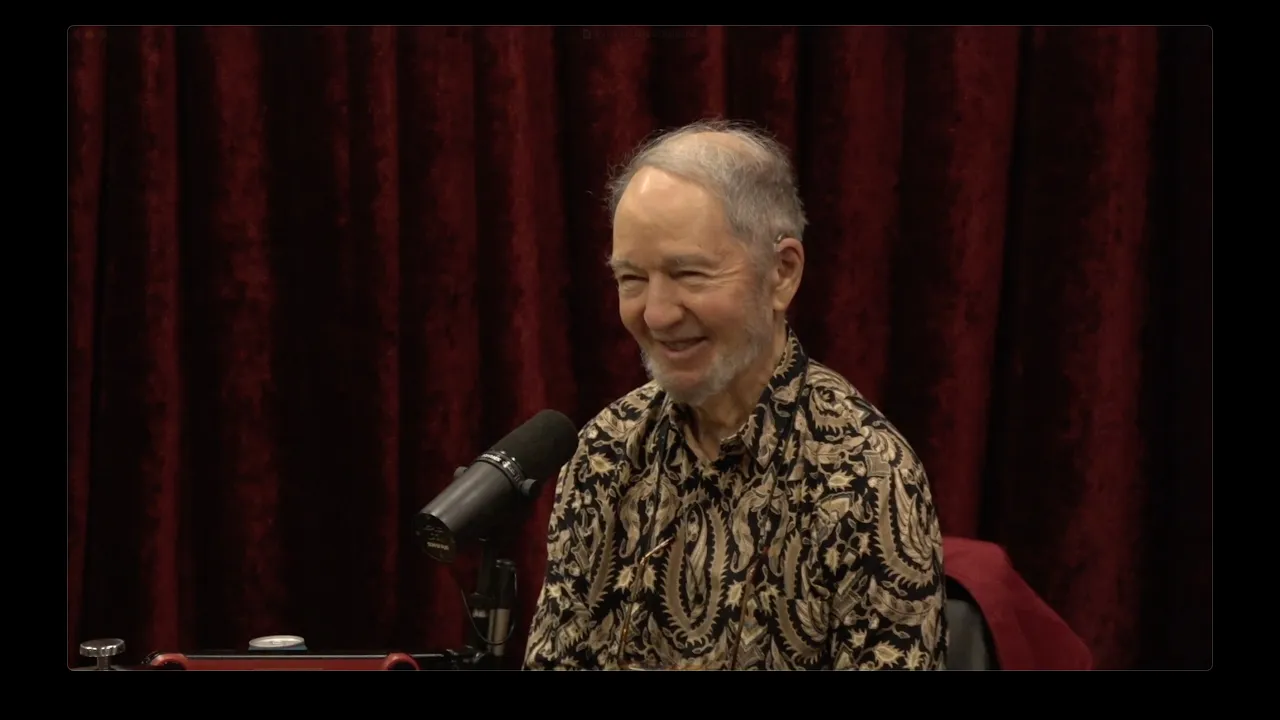
Jared Diamond Maps Human Evolution From Ancient Writing to Modern Prions
PowerfulJRE
Mental capacity constrains active language fluency to four channels while brain-eating rituals show how cultural practices directly drive neurodegenerative epidemics.
## Background
This episode of the Joe Rogan Experience was published on YouTube by PowerfulJRE on September 3, 2026. The description introduces guest Jared Diamond, PhD—a professor, scientist, historian, and author of books such as Guns, Germs, and Steel and Collapse—discussing his work and promoting his book Profits, Prophets, Coaches, and Kings.
## TL;DR
Jared Diamond and Joe Rogan engage in a broad-ranging discussion covering linguistics, human history, writing systems, and regional cultures. Diamond details his personal experiences with learning languages, writing longhand, and working in New Guinea, where he studied indigenous languages, tribal customs, and neurodegenerative conditions like Kuru. The conversation delves into the evolution of writing, cultural identity, historical anthropology, and economic developments across the globe.
## Atmosphere & style
The podcast carries an intellectually curious and reflective mood, striking a balance between academic storytelling and casual conversation. Diamond shares candid personal anecdotes about his technophobia, writing habits, and field work, while Rogan offers engaged reactions and probing observations. The exchange feels warm, analytical, and deeply informative as it moves naturally from lighthearted personal habits to severe anthropological discoveries.
## Key takeaways
- [38:43](https://www.youtube.com/watch?v=t6Jrww8kG24&t=2323s) Diamond attributes his lifelong technophobia to a failed middle school radio project, which led him to select a low-tech PhD thesis and stick to writing manuscripts longhand before dictating them into his phone.
- [01:41:48](https://www.youtube.com/watch?v=t6Jrww8kG24&t=6108s) Diamond balances fluency across 13 total languages through a 'four channel' brain capacity model, where acquiring new fluent languages displaces active channels.
- [01:18:20](https://www.youtube.com/watch?v=t6Jrww8kG24&t=4700s) Writing systems evolved both through independent invention—such as Sumerian Cuneiform, Mesoamerican scripts, and Chinese—and through 'idea diffusion' inspired by exposure to existing scripts.
- [01:30:21](https://www.youtube.com/watch?v=t6Jrww8kG24&t=5421s) Korean Hangul stands out as a purpose-built featural alphabet created by King Sejong the Great to replace ill-fitting Classical Chinese characters.
- [01:36:29](https://www.youtube.com/watch?v=t6Jrww8kG24&t=5789s) The post-WWII era witnessed a rapid erosion of regional European dialects and languages due to compulsory military service and unified national public education.
- [01:44:50](https://www.youtube.com/watch?v=t6Jrww8kG24&t=6290s) Tok Pisin evolved rapidly in New Guinea from a simplified trade pidgin under German colonial rule into a full-fledged creole capable of expressing complex scientific concepts.
- [01:59:06](https://www.youtube.com/watch?v=t6Jrww8kG24&t=7146s) The Fore people of New Guinea suffered from Kuru, a fatal neurodegenerative prion disease transmitted exclusively through ritualistic endocannibalism.
- [01:59:06](https://www.youtube.com/watch?v=t6Jrww8kG24&t=7146s) Prions demonstrate extreme thermal resistance, surviving standard boiling and steam sterilization temperatures and requiring extreme heat or incineration to destroy.
- [02:05:02](https://www.youtube.com/watch?v=t6Jrww8kG24&t=7502s) Medical research into Kuru revealed an incubation latency period lasting up to 50 years between exposure through cannibalistic rituals and the onset of symptoms.
- [02:20:00](https://www.youtube.com/watch?v=t6Jrww8kG24&t=8400s) Botswana achieved long-term economic stability by nationalizing mineral rights and establishing a sovereign wealth fund, contrasting with Equatorial Guinea's extreme wealth inequality.
## Detailed walkthrough
### [00:01](https://www.youtube.com/watch?v=t6Jrww8kG24&t=1s) Why Leaders Matter and the Role of Personal Experience
Joe Rogan opens the show by introducing scientist, historian, and Pulitzer Prize-winning author Jared Diamond. Rogan praises Diamond's seminal work, *Guns, Germs, and Steel*, as well as his newest book, *Profits, Prophets, Coaches, and Kings*. When Rogan asks what prompted him to write his latest book about the impact of individual leadership on history, Diamond explains that his personal biography heavily shaped his perspective. Born in 1937, he grew up during World War II under the shadow of Adolf Hitler, constantly surrounded by maps pinned to his bedroom wall tracking the European and Pacific theaters. He spent his life wondering whether individual figures—both good and evil—truly alter the course of human history or if larger environmental and societal forces dictate the path.
Diamond elaborates on how leadership directly impacted his life and research over the decades. He lived in pre-dictatorship Chile, witnessing firsthand how no one—not even fellow military officers—anticipated the extreme, brutal trajectory of General Augusto Pinochet. His family background also played a role: his wife, Marie, was Polish, and her mother survived Auschwitz while other family members perished in the Holocaust. Beyond geopolitics, Diamond shares an amusing personal story from his time at the University of Cambridge. Early in his scientific career, a water pump he was operating blew up overnight. It flooded his laboratory room as well as the lab directly below him—which happened to belong to Lord Adrian, a Nobel Prize winner, the master of his college, and his thesis supervisor’s father-in-law. Diamond assumed his academic career was over, but the department chairman merely scolded him for being sloppy and allowed him to stay, demonstrating how a leader's individual decision can drastically alter a person's life trajectory.
- **Hitler's Car Crash:** Rogan points out that Diamond opens his book with an anecdote about Adolf Hitler nearly dying in a car accident early in his career, raising the question of how different modern civilization would look if the crash had occurred just two seconds earlier or later.
- **The Fragility of Civilization:** Rogan reflects on growing up believing that atrocities like Nazi Germany could never happen again, only to realize later in life how quickly populations can be manipulated and "othered" by ruthless leaders seeking absolute control.
---
[05:08](https://www.youtube.com/watch?v=t6Jrww8kG24&t=308s) The Essential Factors of Historical Leadership
Responding to Rogan's observations on tyranny, Diamond notes that historical horrors did not end with WWII. He points to Pol Pot in Cambodia, who killed roughly a quarter of his country's population and coerced children into murdering their own parents, as well as Augusto Pinochet in Chile, who employed tortures far more sadistically inventive than those used by the Nazis. When evaluating how leaders succeed or fail to make a historical mark, Diamond explains that he shies away from simple answers, but breaks the phenomenon down into key factors—primarily being in the "right time and place" and having the personal qualities to exploit it.
Diamond illustrates the spectrum of historical timing using several concrete examples:
* **Recognizing and Seizing the Moment:** Bill Gates saw the Intel 8080 chip on the cover of *Popular Electronics* and immediately convinced Paul Allen that they had to launch a microcomputer software company before someone else beat them to it. Similarly, Winston Churchill recognized that his appointment as Prime Minister during Germany's invasion of France was the moment his whole life had prepared him for, though he did not directly cause the invasion itself.
* **Benefiting from Unintended Timing:** Mark Zuckerberg launched Facebook in 2004 as a 20-year-old sophomore at Harvard. He didn't choose to be born in 1984, but the precise evolution of internet infrastructure in 2004 made it the perfect window for social media to take off.
* **Environmental & Climate Luck:** Genghis Khan built the largest contiguous land empire in history, stretching from China to Poland. Recent tree-ring studies reveal that the decade of Genghis Khan's birth was the wettest period on the Mongolian steppe in 2,000 years. The unprecedented rainfall generated abundant grass to feed sheep, goats, infants, and military horses. Had he been born 10 years later or 200 miles away, he likely would have remained unknown to history.
- **Genghis Khan's Qualities:** Rogan adds that beyond climate luck, Genghis Khan was an extraordinary strategist who was famously pragmatic, accepting people of all religious persuasions into his ranks and utilizing patience to wait out fortified cities while living in mobile tent camps.
- **The Dual Requirement:** Diamond agrees, emphasizing that historical impact requires both the right environmental conditions and an extraordinary individual capable of taking advantage of them.
---
[10:16](https://www.youtube.com/watch?v=t6Jrww8kG24&t=616s) The Origins and Spread of World Religions
The conversation shifts to how religious movements form and expand through leadership. Diamond notes that the 1st century AD Roman Empire was the ideal time and place to establish what would become a dominant global religion 15 centuries later, as Rome held political control over Western Eurasia. Out of at least six candidate messiahs mentioned in historical texts from that era, Jesus Christ emerged as the most influential. Diamond explains that founding a lasting religion typically requires three elements: a charismatic leader, a brilliant organizational strategist, and sometimes a skilled military general.
In the case of Christianity, Jesus provided the charismatic, universal message aimed at all people regardless of gender or Roman citizenship. However, because Jesus died young, it was Saint Paul who acted as the essential organizer, structuring the early church. Rogan finds Paul's role particularly wild, noting that Paul never met Jesus in person during his life and claimed his mandate based on a vision on the road to Damascus. Furthermore, the earliest Gospel (Mark) wasn't written down until roughly 20 years after Jesus's death, meaning the entire foundational structure relied on decades of oral transmission.
```
+------------------+----------------------------------+-----------------------------------+
| Religion / Leader| Charisma & Message | Organizational / Military Power |
+------------------+----------------------------------+-----------------------------------+
| Christianity | Jesus Christ (Universal appeal) | Saint Paul (Organized the early |
| | | church network post-crucifixion) |
+------------------+----------------------------------+-----------------------------------+
| Islam | Prophet Muhammad (Charismatic | Prophet Muhammad (Combined all 3: |
| | spiritual figurehead) | charismatic, organizer, general) |
+------------------+----------------------------------+-----------------------------------+
| Mahdist State | The Mahdi of Sudan (Charismatic | The Mahdi (Great general/builder, |
| | regional reformer) | but limited by local technology) |
+------------------+----------------------------------+-----------------------------------+
```
- **Muhammad's Triple Role:** Diamond highlights Prophet Muhammad as a rare figure who embodied all three traits—charismatic prophet, master organizational leader, and formidable military general.
- **Historical Gaps:** Diamond points out that while Jesus left no personal writings, even less contemporary documentation exists for Muhammad, whose life story was not formally compiled in texts until two centuries after his death.
- **Geographic Limits:** The Mahdi of Sudan possessed immense charisma and military genius in the 19th century, but because East Africa lacked the global demographic and technological reach of the Roman or Arab empires, his movement remained regional rather than global.
---
[16:14](https://www.youtube.com/watch?v=t6Jrww8kG24&t=974s) Systemic Structures and the Success of Mormonism
Rogan expresses fascination with how frequently human history repeats this pattern: a single figure claims divine or absolute authority, lays down strict behavioral rules, and manages to unite an entire population under threat of social ostracization. He notes that while theological origin stories contradict one another, the human desire for structured spiritual guidance remains constant across cultures.
Diamond argues that in many cases, a religion's actual theological doctrines are secondary to its organizational structure and social cohesion. To illustrate this, he points to the 19th-century United States, which birthed five major religions that spread globally: The Church of Jesus Christ of Latter-day Saints (Mormons), Seventh-day Adventists, Jehovah's Witnesses, and Christian Science. Analyzing why Mormonism achieved such massive worldwide growth, Diamond suggests it had less to do with Joseph Smith's core theological writings—which he characterizes as having "modest merits"—and far more to do with the extraordinary organizational leadership of Brigham Young.
- **Social Optimism:** Mormonism emphasized communal happiness, optimism, and living a fulfilling earthly life, which attracted followers looking for strong community ties.
- **Financial Commitment:** Mormons instituted a strict self-calculated tithing system where members contribute 10% of their income to the church, creating immense institutional wealth and infrastructure.
- **Leadership Dynamics:** Joseph Smith provided the initial charismatic spark, but Brigham Young's administrative brilliance turned the movement into a resilient, expanding global institution.
[19:06](https://www.youtube.com/watch?v=t6Jrww8kG24&t=1146s) Mormon Culture and the Demographics of Religious Growth
Joe Rogan opens the conversation with praise for Mormons, noting their extraordinary sense of community and kindness, though he jokes that their origin story is "sus." Jared Diamond shifts the lens to religious history, observing that major world religions rarely expand purely on the back of incredible theological claims like the virgin birth. Instead, Christianity succeeded in the Roman Empire due to tangible demographic and social advantages. Early Christians valued women, frowned upon infanticide and abortion, and actively cared for the sick, allowing them to outbreed and outlive pagan populations. Additionally, the Christian emphasis on literacy made them natural candidates for bureaucratic roles under Emperor Constantine.
Rogan draws a direct parallel between early Christianity and modern Islam, pointing out that strict adherence, high birth rates, strong social safety nets, and unwavering discipline drive religious growth today while secular populations decline. Diamond agrees that organizational strength, social connections, and military spirit—rather than purely abstract theology—were the true engines behind the expansion of Islam. Rogan notes the psychological pull of such rigid, high-commitment communities: in a world full of existential angst, charismatic figures with absolute certainty offer a compelling sense of direction and belonging.
- **Early Christian Growth:** Expanded from a few dozen followers under Jesus and ~100 under St. Paul to the dominant religion of the Roman Empire through higher life expectancy and literacy.
- **Mormon Missionary Work:** Every 18-year-old Mormon male is expected to dedicate two years to proselytizing—either locally if low-income or overseas (Europe, Pacific) if wealthy.
- **Apostasy Laws in Islam:** Rogan highlights the extreme high-stakes commitment required, where leaving the faith can historically or culturally carry a punishment of death.
---
[26:12](https://www.youtube.com/watch?v=t6Jrww8kG24&t=1572s) The Role of Great Leaders vs. Historical Forces
Diamond addresses a frequent criticism of his seminal work *Guns, Germs, and Steel*: that it focuses on long-term geographical and environmental factors over 10,000 years while ignoring individual human agency. In contrast, his latest work, *Profits, Prophets, Coaches, and Kings*, explores the power of individual leaders. Diamond reconciles the two by explaining that while broad continental trajectories are shaped by geography, individual figures shape history in the short term. However, the rare exceptions of individuals whose influence lasts over 2,000 years are religious founders—such as Jesus, Muhammad, and potentially Joseph Smith. He notes that no politician or business mogul has ever matched that temporal reach.
Rogan counters that environmental conditions and individual leadership are not mutually exclusive but work hand in hand. A great leader cannot accomplish grand feats without the right infrastructure, technology, or lucky natural phenomena—pointing out that Genghis Khan relied on a unusually wet season in the Mongolian steppe to feed his horses and launch his conquests. Diamond agrees, adding that even charismatic religious leaders like the Mahdi of Sudan, who defeated machine-gun-armed British troops using basic weapons, failed to establish global religions because they lacked the broader economic and demographic "engines" to project power worldwide.
> "I can't think of a politician or a business person who has had an effect 2,000 years later." — **Jared Diamond**
---
[30:02](https://www.youtube.com/watch?v=t6Jrww8kG24&t=1802s) Strategic Genius: Jeff Bezos and the Online "Everything Store"
The discussion turns to modern visionaries who recognized the exact moment when technological conditions aligned. Out of hundreds of millions of Americans, figures like Bill Gates, Steve Jobs, and Jeff Bezos stepped forward at the perfect juncture. Diamond highlights Bezos's analytical approach: upon learning that internet usage was growing by 2,300% in a single year, Bezos immediately pitched the concept of an online "everything store." He strategically selected books as his entry point because they were uniform, non-perishable, easy to source from established distributors, and didn't require customers to inspect individual copies for quality differences.
Rogan marvels at how Amazon tapped into human laziness, seamlessly evolving from an online bookstore into a one-click ecosystem where consumers can order anything from toothpaste to groceries. Diamond points out that after establishing his foothold with books, Bezos deliberately expanded into standardized luxury goods like perfume and jewelry before tackling complex categories. While alternative retail models like eBay and Walmart's brick-and-mortar integration existed, Bezos set himself apart by prioritizing long-term customer satisfaction over short-term Wall Street stock returns.
- **Internet Growth Rate:** Bezos jumped into e-commerce after discovering internet traffic was scaling at 2,300% annually.
- **Uniformity of Media:** Books were chosen as the launch pad because every copy of a specific title is identical, eliminating customer inspection friction.
- **First-Mover Innovations:** Amazon pioneered one-click ordering and built its logistics model purely around digital-first customer convenience.
---
[35:39](https://www.youtube.com/watch?v=t6Jrww8kG24&t=2139s) Free Markets, Inevitability, and Steve Jobs's Legacy
Rogan questions how human civilization would look if the stock market had never been invented—contemplating whether private, non-publicly traded businesses would make for a less ruthless corporate culture driven by shareholder demands. Diamond argues that institutions like stock markets are almost historically inevitable; as economic systems scale, mechanisms for pooling capital naturally emerge just like the internet did. However, while broad technical concepts are bound to happen, unique individuals leave their distinct aesthetic and operational signatures on them.
To illustrate this, Diamond and Rogan look at the evolution of mobile phones. Wireless communication existed long before the iPhone—Rogan fondly recalls using a Motorola StarTAC, while Diamond jokes about his own self-proclaimed technophobia, admitting he only uses a basic cell phone for email and avoids TikTok or memes entirely. Yet Steve Jobs fundamentally transformed the trajectory of personal technology by insisting on radical simplicity, elegant physical design, and an intuitive user experience.
- **Corporate Incentive Pressures:** Rogan notes that obligations to public shareholders often force companies to cut corners, lower wages, and pursue unchecked growth.
- **Technological Inevitability:** Diamond asserts that while cell phones or online retail would have been created by someone else, individuals like Steve Jobs and Jeff Bezos dictated the specific *form* and user interaction models we live with today.
<ElicitationsGroup message="Explore related themes from Jared Diamond's work:">
<Elicitation label="Analyze Diamond's theory on environmental determinism in Guns, Germs, and Steel" query="Break down Jared Diamond's theory of environmental determinism from Guns, Germs, and Steel and the main academic critiques of it."/>
<Elicitation label="Compare religious growth metrics across global demographics" query="Provide a detailed breakdown of demographic growth trends among major world religions and secular populations."/>
<Elicitation label="Examine how geographic factors enabled historical conquerors like Genghis Khan" query="How did climate, geography, and environmental shifts contribute to the rise and expansion of the Mongol Empire under Genghis Khan?"/>
</ElicitationsGroup>
[38:43](https://www.youtube.com/watch?v=t6Jrww8kG24&t=2323s) Steve Jobs, Simplicity, and Jared Diamond's "Technophobia"
Jared Diamond recounts the history of Apple after Steve Jobs was ousted in the mid-1980s, observing how the company spiraled downhill for a decade until Jobs returned to rescue it. One of Jobs's very first moves back at Apple was slashing a bloated catalog of around 100 products down to just four core, elegant devices. Jobs prioritized beautiful design and radical simplicity, stripping away extra buttons in favor of minimal, intuitive interfaces. Diamond contrasts this minimal philosophy with the nightmarish complexity of his own television remote control at home, which features 49 buttons. Whenever Diamond and his wife want to watch the World Cup, they have to call their sons, Joshua and Max, to walk them through the exact button sequence. Even after writing the steps down on paper, Diamond still gets confused and has to make the call.
In contrast, Diamond appreciates that his iPhone has only a few physical buttons—though even those can present a challenge. Just the night before, while trying to fix poor audio quality on a call, he finally figured out how to use the volume controls on the side of his phone. His wife, Marie, had previously shown him where they were, but he had been terrified to touch the two side buttons, fearing he might accidentally ruin the entire device. Only after finally plucking up the courage to press the upper button did he realize it turned the volume up. Joe Rogan expresses absolute disbelief that a world-renowned scientist could be baffled by basic volume buttons that have existed since the era of 1990s flip phones. Diamond defends himself with a laugh, noting he "wasn't born with the knowledge." Rogan finds it mind-boggling that someone who has mastered complex global history treats a modern smartphone like an alien technology being reverse-engineered.
Diamond freely confesses that he has been a self-described "technophobe" since childhood, primarily driven by a deep sense of personal incompetence whenever he interacts with machinery. He traces this back to middle school, when his class was assigned to build DIY radios; Diamond was completely unable to do it, forcing his father—a physician and scientist—to ask a lab technician to put the radio together for him. Later, while pursuing his PhD in physiology at Cambridge, Diamond deliberately chose to study the gallbladder over electric eels or muscle tissue. Because he had no mechanical aptitude for building complex plastic chambers or handling delicate micropipettes, he gravitated toward the gallbladder simply because it was a basic sac that only required inserting a small plastic cannula and weighing it on a lab balance. Paradoxically, Diamond built his scientific reputation on the gallbladder precisely because he couldn't build a ham radio.
- Steve Jobs saved Apple by replacing 100 products with just 4 core items built on minimalist design.
- Diamond's home TV remote features 49 buttons, requiring him to call his sons, Joshua and Max, just to watch the World Cup.
- Diamond was afraid to press the volume buttons on his iPhone for fear of breaking the device.
- Diamond operates his iPhone's silent toggle on the left side by keeping it permanently set to orange (silent mode).
- Diamond chose his PhD thesis at Cambridge on gallbladder salt and water transport because it required minimal technology compared to muscle or electric eel research.
---
[44:40](https://www.youtube.com/watch?v=t6Jrww8kG24&t=2680s) Writing Books by Hand and Touch-Typing with Three Rows
Because high technology causes him frustration and anxiety, Diamond prefers to conduct his life and work using the simplest tools possible. He pulls out his tool of choice: a basic 0.7 mm mechanical pencil with a simple advance mechanism. Diamond reveals that he writes all of his bestselling books entirely by hand. After completing a handwritten draft, he edits it manually using an eraser or by crossing out lines. Once the text is cleaned up, he dictates the draft into his iPhone for his secretary to type up.
Recently, while spending a downtime day in Houston before an evening event, Diamond worked on revising a scientific paper regarding the birds of the Wandammen Peninsula (Wandammen Mountains) in New Guinea. Having personally explored all 10 isolated mountain ranges along New Guinea's northern coast and inventoried their bird populations, he sat down with his 0.7 mm pencil and a large eraser to refine the manuscript. Once his secretary types up the draft, Diamond edits the printed pages by hand with his pencil once again.
When Rogan asks if he ever types directly, Diamond shares a story from when he was eight years old and bedridden with chickenpox for two weeks. During those two weeks at home, he attempted to teach himself how to type on a mechanical typewriter. However, he recovered from the chickenpox after learning only the bottom three rows of keys. As a result, Diamond can touch-type the lower three rows without looking, but must look at the keyboard for the top row. Despite this unusual hybrid technique, he claims he can type faster than any secretary he has ever hired.
- Diamond writes and edits all of his manuscripts by hand using a 0.7 mm mechanical pencil and an eraser.
- He dictates cleaned-up handwritten drafts into his iPhone for his secretary to transcribe.
- Diamond's recent project is a scientific paper on the bird species of the Wandammen Mountains in New Guinea.
- Diamond learned to touch-type during a two-week bout of chickenpox at age eight, but only mastered the bottom three rows before recovering.
- "I'm a faster typist than any secretary that I've ever had." — Jared Diamond
---
[48:12](https://www.youtube.com/watch?v=t6Jrww8kG24&t=2892s) The Mechanics of Writing: Longhand vs. Typing
Rogan notes that many creative people, particularly songwriters, prefer writing longhand on paper because physically writing things down helps with memory retention. However, Rogan finds the physical act of typing far faster and more efficient. Diamond explains that his prose style changes dramatically depending on the medium he uses: typing yields a more verbose and wordy prose style, whereas writing longhand forces his style to become more simplified, compressed, and carefully structured.
Rogan agrees with this observation, explaining that because writing by hand takes significantly longer per word than typing or speaking, it creates an intentional delay. This extra time allows the author to analyze sentence structure, eliminate unnecessary filler words, and choose precise vocabulary before committing thoughts to paper. Typing, on the other hand, operates at the speed of thought, which can lead to a less refined, free-flowing stream of consciousness.
- Typing produces a more verbose prose style for Diamond, while writing longhand leads to compressed, tighter phrasing.
- Longhand writing forces the brain to analyze sentence structure and word choice due to the physical delay of writing each letter.
- Typing allows a freer flow of thought but often introduces unnecessary words that require heavy trimming later.
---
[49:54](https://www.youtube.com/watch?v=t6Jrww8kG24&t=2994s) iPhone Voice Dictation, Foreign Languages, and AI Translation
Diamond highlights one feature of his iPhone that he embraces: the voice dictation microphone icon at the bottom of the screen. A high school classmate who married a French woman showed him that the dictation button could be used to compose text in foreign languages. Diamond actively maintains his fluency in both German and Italian, using the iPhone's dictation feature to handle all of his international correspondence by speaking directly into the device rather than writing letters by hand.
Rogan shifts the conversation to modern artificial intelligence and real-time speech translation, noting how companies like Google and Samsung now enable instantaneous, two-way verbal translation during conversations. Rogan envisions a near future where AI will translate a speaker's words in real time while mimicking their exact voice, tone, and inflection, effectively creating a real-world "Universal Translator" reminiscent of overcoming the biblical Tower of Babel.
Diamond connects this to a historical milestone in computational linguistics that he witnessed in the 1970s. Xerox PARC in Palo Alto established a heavily funded research group to develop automatic, simultaneous translation. However, the project failed completely and took decades to solve due to a fundamental lack of understanding of both translation technology and human language structure. To illustrate the crude limitations of 1970s translation algorithms, Diamond shares a famous early test: researchers fed the English idiom "Out of sight, out of mind" into the computer to be translated into Russian, and then translated back into English. The computer output returned the phrase as "Invisible idiot."
- Diamond uses the iPhone's voice dictation feature to compose all of his foreign language correspondence in Italian and German.
- Future AI translation models will translate speech in real time using the speaker's cloned voice rather than a generic robotic voice.
- In the 1970s, Xerox PARC failed to create simultaneous translation systems due to primitive technology and poor linguistic modeling.
- An early Xerox PARC translation test converted "Out of sight, out of mind" into Russian and back, producing the literal translation "Invisible idiot."
---
[05:54:24](https://www.youtube.com/watch?v=t6Jrww8kG24&t=21264s) Lost in Translation: Ancient Texts, *Logos*, and Italian Nuances
Rogan brings up ancient religious manuscripts—such as the Aramaic Dead Sea Scrolls, ancient Greek, and Hebrew texts—and asks how much meaning is lost or warped when these works are translated across languages and eras. Diamond illustrates the problem using the famous opening line of the Gospel of John: "In the beginning was the Word." In the original Greek text, the word translated as "word" is *logos*. However, *logos* carries a far broader philosophical meaning in ancient Greek, encompassing concept, reason, logic, and rational system. Translating *logos* simply as "word" strips away the deeper theological meaning that "in the beginning was a system and an organization."
Diamond offers another example from his daily reading of Italian. While English uses the single verb "to love" for almost everything, Italian makes a sharp distinction between two different verbs: *amare* (from which *amo* comes) and *volere bene* (*volersi bene*, literally "to wish someone well"). Surprisingly to Diamond, physical and romantic/sexual love in Italian is expressed through *volere bene* (*ti voglio bene*), whereas *amare* (*ti amo*) is often reserved for a deep, non-sexual, or friendly affection.
Rogan notes that English speakers use the word "love" casually across wildly different contexts, from deep romantic devotion to casual preference or even sarcasm ("I love it when my shoelace breaks"). Diamond agrees that these linguistic quirks highlight the extreme difficulty of cross-language translation, joking that if he were to address an Italian girlfriend using the wrong phrase for love, the subtle misunderstanding could cause serious relationship trouble.
- The Greek term *logos* in the Gospel of John means a "rational system" or "organization," not merely a spoken "word."
- Italian distinguishes between types of love using *amare* (friendly/platonic affection) and *volere bene* (deep romantic or familial devotion).
- English overuses the word "love" for everything from deep emotion to sarcastic frustration.
<ElicitationsGroup message="Where would you like to go next with this transcript?">
<Elicitation label="Summarize the key themes of Jared Diamond's technology vs. simplicity philosophy" query="Summarize Jared Diamond's philosophy on technology vs. simplicity from this interview."/>
<Elicitation label="Break down the historical Xerox PARC translation story in more detail" query="Tell me more about the history of Xerox PARC's early attempts at machine translation in the 1970s."/>
</ElicitationsGroup>
[57:35](https://www.youtube.com/watch?v=t6Jrww8kG24&t=3455s) Nuances of Language: Verbs, Animacy, and What Gets Lost in Translation
Jared Diamond and Joe Rogan delve into the intricate ways language shapes meaning, beginning with subtle grammatical distinctions across cultures. Diamond illustrates how languages encode concepts that English completely collapses into single words. In German, two separate verbs exist for "to eat": *essen* (for humans) and *fressen* (for animals). He contrasts this with the Fore language of Papua New Guinea, which lacks a single universal verb "to be." Fore uses *windia* for inanimate objects (such as stating a sweet potato is good) and *mindia* for living creatures. Diamond humorously recounts his second day in the Fore area when he spotted a frog (*daquo*) in a creek (*daquani wani*) and attempted to speak his very first sentence in the language. He uttered *daquo wip wia*, using the inanimate verb form. A local Fore man shook his head severely and immediately corrected him: not *windia*, but *mindia*.
Rogan connects this to ancient scriptural texts, emphasizing how much clarity is lost when a nuanced term like *logos* is translated merely as "word." Without understanding the original context, modern interpreters and religious leaders are free to put whatever spin they want on a passage. Rogan shares the story of his friend, DMT researcher Dr. Rick Strassman, who dedicated 16 years to self-teaching ancient Hebrew just to read the Bible in its original form to uncover its true meaning. Diamond agrees that something is lost in translation across every language—both in vocabulary and structural rhythm. He cites Homer's *Iliad* as a classic example: while English translations typically open with "I sing of the wrath of Achilles," the original Greek begins with the word *menin* ("wrath"), followed by *aeide* ("sing") and *thea* ("goddess"). The raw impact of placing "wrath" as the very first word gives the opening a dramatic punch that prose translations inevitably dilute.
When Rogan wonders if AI could ever retranslate ancient works to preserve their exact tone and contextual phrasing without rigid word-for-word substitutions, Diamond remains skeptical about the poetic outcome. Expanding the phrasing to capture hidden nuances might preserve cognitive meaning, but it destroys the tight, condensed power of the original verse.
- **German Eating Verbs:** *Essen* (human consumption) vs. *fressen* (animal consumption/gobbling).
- **Fore Verbs for "To Be":** *Windia* (inanimate objects like sweet potatoes) vs. *mindia* (animate beings like frogs).
- **Fore Vocabulary:** *Daquani wani* (water) and *daquo* (a specific species of creek frog).
- **Biblical Translations:** Rogan highlights how translating *logos* simply as "word" leaves immense room for interpretation.
- **Dr. Rick Strassman:** Spent 16 years learning ancient Hebrew to read the Hebrew Bible in its original text.
- **The Opening of Homer's *Iliad*:** Greek text opens *Menin aeide, thea...* ("Wrath sing, goddess..."), prioritizing the emotion of wrath above all else.
---
[01:03:00](https://www.youtube.com/watch?v=t6Jrww8kG24&t=3780s) Ancient Scripts, Non-Vowels, and Page-Length Variations
The discussion shifts to the structural peculiarities of ancient writing systems and how modern languages handle information density. Rogan brings up ancient Hebrew, noting how its letters double as numbers, giving every word a specific numeric value (*gematria*). Diamond adds that Afroasiatic/Semitic languages like early Hebrew and Phoenician originally functioned without written vowels. Word roots were specified entirely by consonants, and readers inferred the missing vowels from context without ambiguity. Modern Hebrew and Amharic (the official language of Ethiopia) eventually incorporated small lines and diacritics in the margins to indicate vowel sounds, whereas English writing is entirely dependent on vowels to remain intelligible.
This structural variation directly impacts how much space a translated text takes up on a physical page. Diamond notes that because *Guns, Germs, and Steel* has been translated into 45 languages, he can physically see the differences by comparing the thickness of the printed editions on his bookshelf. The German edition is consistently the thickest, followed closely by the Italian edition, while the original English version remains noticeably thinner. Diamond explains that German grammar and vocabulary simply require more words and longer compound structures to express the exact same concept. When Rogan asks whether the translations convey the identical meaning, Diamond notes that linguists view any translation as an approximation rather than a perfect match.
- **Semitic Script Structure:** Early Hebrew and Phoenician omitted vowels entirely, relying on consonant roots.
- **Vowel Markings:** Modern Hebrew and Amharic use auxiliary lines/diacritics to signify vowel sounds.
- **Translational Volume:** Diamond's *Guns, Germs, and Steel* exists in 45 languages; the German edition is the thickest, Italian is second, and English is significantly leaner.
---
[01:05:50](https://www.youtube.com/watch?v=t6Jrww8kG24&t=3950s) The Tonal Complexity of New Guinea Languages
Rogan recalls a recent conversation with linguist Daniel Everett, who spent eight years living with the Pirahã people in the Amazon jungle, working without written aids to decipher and document their language from scratch. Diamond notes that New Guinea is the most linguistically dense place on the planet, boasting over 1,000 distinct languages—not merely dialects. Historically, much of the documentation of these languages was carried out by Lutheran missionaries who were trained as expert linguists, tasked with being dropped into isolated regions to learn unwritten languages by ear and translate the Bible.
To demonstrate the sheer complexity of these unwritten tongues, Diamond recalls his 1990 expedition to the Lakes Plains region of Indonesian New Guinea. There, an American female linguist was studying the Fawi (Fayu) language, a tonal tongue. While Mandarin Chinese uses four or five tones and Cantonese uses six, this linguist had identified 12 distinct tones in Fawi after 15 years of immersion, with a suspected 13th tone she still couldn't definitively confirm. Because Fawi words are largely monosyllabic, a single sound like *ba* can carry 12 completely different meanings depending entirely on pitch inflection—ranging from "sweet potato," "snake," and "delicious" to "feces" and "mother-in-law."
Diamond presents a hilarious, high-stakes scenario: if a speaker attempts to say "Beloved mother-in-law, let me give you this delicious sweet potato," but accidentally drops the pitch of *ba* instead of letting it rise, the sentence translates to: "Vile snake, let me give you this feces to eat!" This extreme margin for error reshapes social behavior. The linguist observed that mothers and young children in Fawi villages do not engage in casual back-and-forth chatter; instead, a mother speaks a sentence and the child repeats it back verbatim so the mother can correct the child's pitch before a catastrophic miscommunication occurs. Rogan jokes that such pitch overlaps leave a convenient excuse for anyone who wants to hurl an insult and retroactively claim bad hearing.
> "If you drop the *ba* instead of rising the *ba*... what comes out is: 'Vile snake, let me give you this feces to eat!'"
- **Language Density:** New Guinea holds over 1,000 distinct languages.
- **Daniel Everett & Pirahã:** Referenced for field-linguistics work in the Amazon basin.
- **Fawi (Fayu) Language:** A monosyllabic tonal language in Indonesian New Guinea featuring at least 12 distinct pitch tones.
- **Tonal Homophones in Fawi:** The single syllable *ba* changes between sweet potato, snake, delicious, feces, and mother-in-law based on tone.
- **Pedagogical Impact:** Fawi mothers instruct children through strict repetition to prevent conversational missteps.
---
[01:10:14](https://www.youtube.com/watch?v=t6Jrww8kG24&t=4214s) The Evolution of Writing Systems and Korean's Hangul
Tracing the origin of written communication, Diamond explains that the earliest known writing system emerged in the Fertile Crescent of the Middle East using cuneiform—wedge-shaped marks pressed into clay with a stylus. Cuneiform was not a language itself, but a script used to write several distinct languages, starting with Akkadian (the language of the Mesopotamian empires) and later Hittite in Anatolia (modern Turkey), the oldest recorded Indo-European language.
Diamond breaks down how scripts evolved from cuneiform to syllabaries and eventually true alphabets:
1. **Mycenaean Linear B:** The earliest Greek writing system during the era of the Trojan War was a syllabic script.
2. **The Greek Dark Ages:** Following the collapse of Mycenaean civilization, writing completely vanished from Greece for several centuries, rendering the culture illiterate.
3. **The Greek Alphabet (c. 800 BC):** When writing returned, the Greeks adopted the Phoenician script. However, because Phoenician was an Afroasiatic language that omitted vowels, the Greeks modified the symbols to represent explicit vowel sounds, creating the world's first true alphabet. This was later adapted by the Etruscans and subsequently became the Roman alphabet used today.
4. **Japanese (The Most Complex System):** Japanese utilizes four overlapping writing systems: two distinct syllabaries (*Hiragana* and *Katakana*), Chinese-derived logograms (*Kanji*), and the Roman alphabet (*Romaji*). Phonetic constraints alter foreign names; for example, "Diamond" is rendered as *Daiyamondo* because Japanese structure generally avoids adjacent consonants.
5. **Korean (The World's Best Writing System):** Diamond praises the Korean alphabet (*Hangul*) as the most efficiently engineered script in existence. Letters are stacked together into visual blocks that represent whole syllables. Rather than scanning letter-by-letter, readers process complete syllabic blocks simultaneously, allowing Koreans to read faster than speakers of almost any other language.
Rogan brings up *The Secret History of the Mongols*, noting how scholars initially dismissed early copies as gibberish. Diamond shares that his Harvard classmate, Sinologist Joseph Fletcher, was the scholar who cracked the mystery in the early 1960s. Fletcher realized the text consisted of the Mongolian language transcribed phonetically using Chinese characters.
- **Cuneiform:** Originating in the Fertile Crescent, it was pressed into clay using a stylus to record Akkadian, Hittite, and other early tongues.
- **Linear B:** A syllabic writing system used by Mycenaean Greeks that disappeared entirely during the Greek Dark Ages.
- **Greek Vowel Innovation:** Circa 800 BC, Greeks added explicit vowel characters to the vowel-less Phoenician script.
- **Japanese Writing:** Combines two syllabaries, Kanji, and Romaji. Names like "Diamond" convert to *Daiyamondo*.
- **Korean Hangul:** Featural alphabet grouped into syllabic blocks, optimized for ultra-fast reading speeds.
- **Joseph Fletcher:** Harvard scholar who in the 1960s deciphered *The Secret History of the Mongols*, which encoded Mongolian speech using Chinese characters.
---
[01:15:41](https://www.youtube.com/watch?v=t6Jrww8kG24&t=4541s) Undeciphered Languages: Etruscan and Rongorongo
The conversation turns to ancient scripts that remain untranslatable. Diamond discusses the Etruscans, the pre-Roman civilization of central Italy. Although the Etruscans adapted the Greek alphabet—meaning modern scholars can easily pronounce Etruscan words phonetically—the actual meaning of the vocabulary remains largely a mystery because almost all Etruscan literature was destroyed or lost.
The longest surviving Etruscan text was discovered in Yugoslavia under bizarre circumstances: a linen shroud used to wrap an Egyptian mummy was discovered to be an erased and reused Etruscan book. Without a bilingual key like the Rosetta Stone, translation remains stalled. The closest artifacts to a translation key are Etruscan six-sided gaming dice discovered by archaeologists. The faces feature six written Etruscan words representing numbers 1 through 6. However, because scholars cannot determine which word corresponds to which face value, they know the names for the digits 1 through 6, but cannot match the words to their actual numerical values. Rogan closes the segment by asking Diamond about the mysterious, undeciphered script of Easter Island (*Rongorongo*), which Diamond agrees remains one of history's most tantalizing linguistic puzzles.
- **Etruscan Language:** Written using a Greek-derived alphabet, making it readable phonetically but untranslatable in meaning due to a lack of surviving bilingual texts.
- **The Zagreb Mummy Shroud:** The longest existing Etruscan text, preserved because the linen book was cut up and re-used as mummy wrapping in Egypt.
- **Etruscan Dice:** Feature six words for numbers 1 to 6, but scholars have not determined which word corresponds to which number.
- **Rongorongo:** The undeciphered glyphic script native to Easter Island (Rapa Nui).
[01:17:32](https://www.youtube.com/watch?v=t6Jrww8kG24&t=4652s) The Mysterious Invention of Writing: From Easter Island to Sequoyah
The conversation begins with a discussion on the origins of writing systems, specifically examining Rongorongo, the mysterious script of Easter Island (Rapa Nui). Jared Diamond points out that only a few surviving wooden samples of Easter Island writing exist. He notes that the first recorded European visitor to the island, Dutch explorer Jacob Roggeveen in 1722, made no mention of written language. The earliest report of writing appeared decades later, following the arrival of the Spanish in 1770. Diamond explains that this leads historians to suspect "idea diffusion": islanders may have witnessed Spanish officials making marks on paper or wooden surfaces, inspiring them to invent their own distinct writing system from scratch.
To illustrate idea diffusion, Diamond shares the well-documented story of Sequoyah, a Cherokee polymath living in the early 19th century. Sequoyah ran a store and noticed that European settlers communicated across long distances and maintained records using marks on paper—a capability Sequoyah referred to as "talking leaves." Realizing the immense power of this tool, Sequoyah spent roughly a decade experimenting with various writing concepts without knowing whether European systems relied on alphabets or syllabaries. He ultimately devised a 85-character syllabary where each symbol represented a distinct sound in the Cherokee language.
To demonstrate the legitimacy and power of his creation to skeptical tribal elders, Sequoyah devised a public test. He placed two Cherokee individuals at opposite ends of a football field. Sequoyah wrote down a spoken message from the first person, walked across the field, and handed the paper to the second person—whom he had taught his system. The second individual read the text aloud perfectly, matching the original message and convincing the Cherokee Nation to adopt the script.
- **Rongorongo:** A script found on Easter Island carved into wooden artifacts, possibly inspired by the 1770 Spanish expedition.
- **Sequoyah's Cherokee Syllabary:** Developed over a 10-year period, establishing a dedicated 85-symbol syllabary that enabled rapid literacy among the Cherokee.
---
[01:20:37](https://www.youtube.com/watch?v=t6Jrww8kG24&t=4837s) Independent Inventions of Writing and Ancient Claims
Joe Rogan reflects on how fascinating it is that cultures could independently develop writing or adopt the concept through exposure. He brings up a recent archaeological discovery at Göbekli Tepe, mentioning reports that researchers might have found symbols predating cuneiform by 5,000 to 6,000 years. Rogan references discussions surrounding assyriologist Irving Finkel, exploring whether early markings on stone represent early proto-writing.
Diamond notes he hasn't seen the specific recent Göbekli Tepe claims but highlights the ongoing debate among linguists regarding early symbolic markings. In Mesopotamia, simple tally marks and tokens used to count livestock and commodities like sheep existed for thousands of years prior to true cuneiform (developed around 3400–3500 BC).
Diamond explains that across human history, writing was independently invented in at least three places without any prior influence:
1. **Sumerian Cuneiform:** Originating in the Fertile Crescent around 3400 BC.
2. **Mesoamerican Scripts:** Early Zapotec and Maya writing systems, emerging around 900–700 BC in complete isolation from the Eastern Hemisphere.
3. **Chinese Writing:** First attested during the Shang Dynasty around 1300 BC with Oracle Bone script, featuring a structure entirely distinct from Near Eastern writing.
"Every writing system other than the first writing, one has to ask might it have been copied... but the first writing had to be a new invention."
---
[01:23:45](https://www.youtube.com/watch?v=t6Jrww8kG24&t=5025s) The Bronze Age Collapse and Lost Literacy
Rogan brings up the fall of Greece following the Trojan War, marveling at how a catastrophic conflict could cause a society to completely lose its written language and descend into centuries of illiteracy. Diamond corrects the premise, explaining that the loss of writing was not caused solely by the Trojan War, but was part of the much broader Bronze Age Collapse around 1200 BC.
During the Late Bronze Age, interconnected civilizations across the Aegean, Anatolia, the Levant, and Cyprus experienced total societal disruption. On Crete and the Greek mainland, the Mycenaeans used Linear B—an early syllabic script used to write Mycenaean Greek. Linear B itself was derived from Linear A, an undeciphered script used to write the ancient Minoan language. When the palace-based administrative centers collapsed, Linear B vanished entirely, plunging Greece into a multi-century "Dark Age" until the adaptation of the Phoenician alphabet centuries later.
Diamond highlights that while local events like the fall of Troy were destructive, the region-wide collapse wiped out major regional empires, including the Hittites. Historians continue to debate the primary drivers of this systemic breakdown, citing potential causes such as invasions by the enigmatic "Sea Peoples" recorded in Egyptian inscriptions, widespread climate change, droughts, or revolutions in military technology.
- **Linear A:** Undeciphered Minoan script used on Crete.
- **Linear B:** Mycenaean Greek syllabic script that completely disappeared following the Bronze Age Collapse.
- **Hypothesized Causes:** Sea Peoples invasions, widespread climate stress, breakdown of international trade networks, and social unrest.
---
[01:26:54](https://www.youtube.com/watch?v=t6Jrww8kG24&t=5214s) Language Disappearance and Re-emergence: Harappa and Egypt
Diamond provides further examples of societies losing writing systems, pointing to the Indus Valley (Harappan) Civilization (c. 3000–1900 BC). Archaeologists have discovered hundreds of distinct Harappan symbols on stamp seals and signets, but no extensive texts survive—the longest preserved inscriptions contain only three to four characters, leaving the script undeciphered. Following the decline of the Harappan civilization, writing disappeared from the Indian subcontinent for nearly two millennia, only re-emerging centuries after the campaign of Alexander the Great with scripts like Brahmi.
The conversation shifts to Egyptian hieroglyphs, which emerged around 3000 BC, shortly after Sumerian cuneiform. Diamond points out that while hieroglyphs are visually and structurally distinct from cuneiform, their timing suggests another prime example of "idea diffusion." Rather than directly copying the cuneiform script, ancient Egyptians likely borrowed the core concept of encoding spoken language into visual symbols and built an entirely distinct, highly artistic writing system tailored to their own culture and language.
- **Indus Valley Script:** Short, undeciphered seal inscriptions consisting of 3–4 symbols; vanished after 1900 BC.
- **Re-emergence in India:** Brahmi and Kharosthi scripts emerged around the 3rd century BC.
- **Egyptian Hieroglyphs:** Full, complex writing system appearing rapidly around 3000 BC through probable idea diffusion from Mesopotamia.
---
[01:30:21](https://www.youtube.com/watch?v=t6Jrww8kG24&t=5421s) King Sejong and the Creation of Hangul
Diamond illustrates how an individual leader can intentionally revolutionize a society by creating a writing system from scratch, citing King Sejong the Great of Korea in the 1440s. Prior to Sejong's reign, Koreans adapted Classical Chinese characters (Hanja) to write their language. Because Chinese and Korean belong to entirely different language families with distinct grammatical structures, mastering Hanja required decades of specialized study, limiting literacy to elite scholars.
Diamond quotes King Sejong’s famous proclamation introducing Hangul:
> "It grieves me that our people write the Korean language with Chinese-like writing when the sounds and the words of the Chinese language are not similar to the Korean writing. Therefore, I, King Sejong, have devised a new writing system which I wish all of my subjects to learn."
King Sejong scientifically designed Hangul to mirror the phonetics of the Korean language, grouping letters into syllabic blocks. Unlike complex historical scripts that evolved over centuries, Hangul was created intentionally at a single point in time and has endured as the official Korean script for over 600 years.
---
[01:32:07](https://www.youtube.com/watch?v=t6Jrww8kG24&t=5527s) National Identity, Conscription, and Linguistic Cohesion
Rogan transitions to how societies build cohesion and national identity, noting how institutions like mandatory military service foster strong patriotism in countries like Israel and South Korea. Diamond agrees that conscription often acts as a unifying mechanism, citing post-unification Italy in 1861, where a national military and public school system were used to forge a shared Italian identity out of disparate regions.
However, Diamond presents Finland as a counterexample where national identity developed without a military draft. Finland was a province of Sweden for centuries and later an autonomous Grand Duchy under the Russian Empire until gaining independence in 1918. Rather than relying on military conscription, Finnish national identity was anchored by the unique Finnish language and rich oral traditions like the *Kalevala*.
Diamond shares a personal anecdote from his first trip to England as a 12-year-old in 1950. While visiting the small town of Beccles in Suffolk, he and his sister took a walk, got lost, and asked a local resident for directions in American English. The man replied in a regional Suffolk dialect that was so pronounced that the young Diamond could not understand a single word, illustrating how regional dialects across Europe were far more distinct and isolated just a few generations ago.
- **Italian Unification (1861):** Used a mandatory draft and public schooling to blend hundreds of regional dialects into a unified national identity.
- **Finnish Identity:** Built around the unique Uralic language rather than an early national army.
- **Regional Dialects:** High dialectal diversity across Europe (England, Italy, Germany) prior to mid-20th-century mass media and standardized education.
[01:36:29](https://www.youtube.com/watch?v=t6Jrww8kG24&t=5789s) German Dialects, Italian Regional Languages, and Fading Local Tongues
Jared Diamond recounts living in Munich, the capital of Bavaria, back in 1961. He explains that Bavarians spoke such a thick, distinct dialect that it posed a real language barrier for outsiders. While traveling around Bavaria with a friend named Josef, who was from the Rhineland—where the regional speech closely resembles standard literary German—they stopped at a gas station to refuel. Diamond, having lived in the region for a while, could understand the attendant, but Josef could not understand a single word the Bavarian man said. Diamond notes how wild and strange it is that such stark linguistic divides exist between populations geographically so close to one another.
The conversation shifts to Italy, where linguistic variation is similarly extreme. Sicilian, for instance, is often considered a distinct language with its own written literature rather than just a dialect. Modern government and literary Italian are based on the Tuscan dialect of Florence, but dozens of mutually incomprehensible regional dialects persisted across Italy up through World War II. Diamond notes that these regional dialects have rapidly faded in recent decades, primarily driven by two unifying social forces: universal public education and mandatory military service (the draft).
- **Munich, Bavaria (1961):** Diamond lived in Munich and adapted to the local Bavarian dialect.
- **Rhineland German vs. Bavarian:** Standard German speakers could find local southern dialects completely incomprehensible.
- **Sicilian & Florentine:** Standard Italian derives from Florence, while Sicilian developed its own formal literary tradition.
- **Erosion of Dialects:** Universal education and military conscription forced standardized national languages across localized populations post-WWII.
---
[01:38:08](https://www.youtube.com/watch?v=t6Jrww8kG24&t=5888s) Learning Italian: From Family Vacation to UCLA Language Partners
Diamond traces his initial foray into learning Italian back to April 1999 following a family incident in Italian-speaking Switzerland. His son, Max, fell and injured his leg, requiring a hospital visit. Though neither Diamond nor his family spoke Italian, his wife recalled that the word for "where" was *dove*. With an upcoming family trip to Italy scheduled for May 1999, Diamond figured learning the language would be straightforward: "Dove, that's simple. I can learn that. Why don't I learn enough Italian that I can ask where the bathroom is and I can order meals in restaurants?" He committed six weeks to studying Italian grammar. Although the planned trip was aborted when Diamond's father passed away on the morning of May 11, he decided to double down, spending another six weeks mastering the remaining grammar before diving into reading Italian texts.
After eight months of reading, Diamond realized he needed to actually speak the language. He posted an ad in the Italian Department at UCLA looking to hire graduate students for conversational practice. A female Italian student answered the listing, and Diamond recalls the surreal sensation of conversing with a native speaker for the first time after months of book study: "It's like knowing of something and then you suddenly have the experience. The closest parallel I can think of is having heard of sex and then you have your first sexual experience."
The language sessions unexpectedly evolved into unofficial relationship counseling sessions. The two Italian graduate students who came to speak with Diamond both had American boyfriends and were agonizing over whether to get married. Diamond talked them through their anxieties, pointing out that their parents' troubled relationships didn't have to dictate their own futures: "I in effect did marital therapy in Italian for two years." Both women ended up marrying their boyfriends and remain married decades later. Twenty-seven years after starting, Diamond still speaks for two hours every fortnight with one of those original tutors, Francesca, with whom he shares his broadest range of lifelong conversations outside of his wife and his longtime Australian expedition partner in New Guinea.
- **Initial Spark (April 1999):** Son Max hurt his leg in Italian Switzerland, prompting Diamond to study Italian grammar for six weeks.
- **Trip Cancellation:** A scheduled May 11, 1999 trip was canceled due to the death of Diamond's father.
- **UCLA Tutors:** Diamond posted notices at UCLA to hire native Italian graduate students as language partners.
- **"Marital Therapy" in Italian:** Diamond spent two years giving relationship advice in Italian to his tutors, leading to their long-term marriages.
- **Francesca:** 27 years later, Diamond still maintains a biweekly two-hour conversation in Italian with his original tutor.
---
[01:41:48](https://www.youtube.com/watch?v=t6Jrww8kG24&t=6108s) Managing 13 Languages and the "Four Channel" Brain Model
When Joe Rogan asks how many languages Diamond knows, Diamond reveals that he has engaged with 13 languages throughout his life. Three of those—Ancient Greek, Latin, and Dutch—he only reads but never speaks. Today, he can give formal academic lectures in four languages: English, Italian, German, and Tok Pisin (New Guinea Tok Pisin). While he was once fluent in Spanish and Russian, learning new languages eventually displaced old ones. He learned enough Finnish to hitchhike across the country and acquired rudimentary knowledge of the Fore language in New Guinea.
```
┌──────────────────────────────────────────────────────────┐
│ DIAMOND'S 13 LANGUAGES │
├───────────────────────────┬──────────────────────────────┤
│ Lecture Fluency (4) │ English, Italian, German, │
│ │ Tok Pisin │
├───────────────────────────┼──────────────────────────────┤
│ Read-Only (3) │ Ancient Greek, Latin, Dutch │
├───────────────────────────┼──────────────────────────────┤
│ Formerly Fluent (2) │ Spanish (lost to Italian), │
│ │ Russian (lost to Indonesian) │
├───────────────────────────┼──────────────────────────────┤
│ Basic / Field Use (4+) │ Finnish, Indonesian, │
│ │ Fore, etc. │
└───────────────────────────┴──────────────────────────────┘
```
Rogan asks how he keeps them from scrambling together in his mind, and Diamond admits that he *does* mix them up. He describes a hard mental limit—a capacity equivalent to roughly four primary active "channels." When he learned Italian, it completely displaced his former fluency in Spanish. Similarly, when he began studying Indonesian, his brain kept substituting Russian words whenever he searched for vocabulary: "Russian and Indonesian, they're completely different from each other. But I felt that it's as if I have, what, four channels for languages... a fifth language, if I attempt to bring back a fifth language, I'll confuse that."
```
Mental Capacity Limit ("Four Channels"):
[ Channel 1: English ]
[ Channel 2: Italian ] <-- Displaced Spanish
[ Channel 3: German ]
[ Channel 4: Tok Pisin] <-- Displaced Russian / Indonesian
```
Rogan compares this phenomenon to having limited hard drive space—a problem he experiences when trying to recall details from hundreds of podcast interviews. Diamond hopes to reactivate his Russian soon, as one of his twin sons is engaged to a Russian woman named Anastasia. When she comes over for dinner, Diamond greets her with elementary Russian phrases like "beautiful citizen" (*krasivaya grazhdanka*), though he playfully worries that resurrecting his Russian might push out his German.
- **Total Languages:** 13 languages total over his lifetime.
- **Lecture-Level Languages:** English, Italian, German, Tok Pisin.
- **Read-Only Languages:** Ancient Greek, Latin, Dutch.
- **Language Displacement:** Italian drove out Spanish; Indonesian drove out Russian.
- **Family Ties:** Practicing basic Russian greetings with his son's fiancée, Anastasia.
---
[01:44:50](https://www.youtube.com/watch?v=t6Jrww8kG24&t=6290s) The Evolution of Tok Pisin: From Plantation Pidgin to Full Creole
The conversation pivots to Tok Pisin (New Guinea Pidgin), a written and spoken language that Diamond highlights as vital for understanding how human language develops. He demonstrates the sound of Tok Pisin by reciting a sample describing Rogan's appearance: "me talk long you... grass belong head belong you go finis... right eye belong you brown..." He translates the phrase, teasing Rogan that he said "the hair on your head is somewhat sparse and you have brown eyes."
```
PIGEON (PIDGIN) STAGE
(Simple, restricted vocabulary for work/trade)
│
│ Driven by children of
│ pidgin speakers needing a
│ native full language
▼
CREOLE STAGE
(Complex grammar, tenses, prepositions, full expression)
```
Diamond walks through the origin of pidgin languages, which serve as a universal template for language creation around the globe. When German colonial administrators arrived in New Guinea, they faced a landscape of over 1,000 distinct languages. To manage imported plantation labor, the Germans used a stripped-down, simplified German mixed with local vocabulary. This basic trade jargon—a true *pidgin*—was sufficient to handle coconut plantation orders, but lacked the depth to express complex human emotions or abstract ideas.
The dramatic shift occurs when children are born to pidgin-speaking parents who share no other common tongue. Needing a primary language to navigate their lives, these children spontaneously and unconsciously transform the rudimentary pidgin into a complete *creole* language featuring complex grammar, future tenses, plurals, and prepositions—a process that happens within a single decade.
Diamond notes that this exact evolution was documented in Hawaiian sugar plantations between 1890 and 1900. Immigrant workers from Japan, China, and elsewhere initially developed a sparse pidgin to communicate with English-speaking plantation managers. Missionary newspapers from that decade recorded quotes from Hawaiian plantation workers, capturing the real-time transition from a basic pidgin in 1892 to a complex creole with full grammatical syntax by 1894. Today, Tok Pisin is an official government language used fluently in the Papua New Guinea parliament alongside English.
- **Language Origins:** Created under German colonial rule in New Guinea to bridge over 1,000 local languages.
- **Pidgin vs. Creole:** A *pidgin* is a simplified secondary trade tongue; a *creole* is a fully developed native language created spontaneously by children.
- **Timeframe:** Children evolve a pidgin into a full creole in roughly 10 years.
- **Historical Evidence:** Hawaii plantation dynamics (1890–1900) provided clear newspaper records of this rapid linguistic evolution.
- **Government Use:** Tok Pisin is officially spoken in the Papua New Guinea parliament.
---
[01:51:03](https://www.youtube.com/watch?v=t6Jrww8kG24&t=6663s) Explaining Thermodynamics in Tok Pisin and the Cultural Realities of New Guinea
To demonstrate the versatility of Tok Pisin, Diamond explains that any complex concept can be articulated in the language—including advanced physics. He gives a sample lecture in Tok Pisin describing Lars Onsager's work on the second law of thermodynamics: "Rule number two belong savvy belong heat... got this fellow strong thinking... he's smart man." He translates his explanation: Lars Onsager was a Norwegian-American physical chemist who developed non-equilibrium thermodynamics ("knowledge about heat").
```
English Term Tok Pisin Translation
─────────────── ───────────────────────
Thermodynamics "Savvy belong heat" (Knowledge about heat)
Second Law "Rule number two"
Scientist / Intellectual "Man got strong thinking" / "Smart man"
```
Rogan asks if native New Guineans can actually converse about complex scientific subjects using Tok Pisin. Diamond confirms that in Papua New Guinea, Tok Pisin is a universal medium capable of handling any topic: "I can explain to them the second law of thermodynamics, and they can explain to me the difference between the taste of human red meat and human fat."
This remark catches Rogan's attention, and Diamond shares details about the dietary distinctions described by native elders. New Guineans who had practiced cannibalism explained that human red meat tastes similar to cassowary—a large, aggressive, flightless bird akin to an ostrich—whereas human fat tastes like pig fat. Diamond clarifies that he was never offered human flesh himself, nor would he have accepted it. His early field research in the 1960s was conducted among the Fore people, who were being devastated by *kuru*, a fatal neurodegenerative prion disease similar to mad cow disease transmitted through mortuary cannibalism.
Diamond concludes this segment by distinguishing between the two forms of cannibalism once practiced in the region:
* **Exocannibalism:** Consuming defeated enemies killed in warfare, a practice that rapidly vanished once the Australian colonial government prohibited it and enforced tribal peace.
* **Endocannibalism:** Consuming deceased family members out of deep respect and cultural duty.
Diamond notes that among the Fore and neighboring groups, failing to consume a deceased mother was traditionally viewed with the same horror as simply dumping or discarding her body would be in Western societies.
- **Thermodynamics Example:** Diamond demonstrates how Lars Onsager's thermodynamic laws translate into Tok Pisin ("savvy belong heat").
- **Taste Comparisons:** Native New Guineans compared human red meat to cassowary and human fat to pork fat.
- **The Fore People & Kuru:** Diamond worked for eight years with the Fore people, who suffered from *kuru*, a prion disease spread by endocannibalism.
- **Exocannibalism vs. Endocannibalism:** Exocannibalism involved eating enemies; endocannibalism involved eating deceased kin as an act of funerary respect.
<ElicitationsGroup message="Explore related topics from Jared Diamond's work:">
<Elicitation label="Walk through the history and discovery of Kuru in New Guinea" query="Detail the history, discovery, and medical investigation of Kuru among the Fore people of New Guinea."/>
<Elicitation label="Explain how geography shaped human history according to Guns, Germs, and Steel" query="Summarize the core thesis and arguments of Jared Diamond's Guns, Germs, and Steel regarding geographical determinism."/>
<Elicitation label="Detail the linguistic structure and features of Tok Pisin" query="Provide a detailed breakdown of Tok Pisin grammar, vocabulary origins, and structural features as a Creole language."/>
</ElicitationsGroup>
[01:54:54](https://www.youtube.com/watch?v=t6Jrww8kG24&t=6894s) Endocannibalism and the Forearm Feasts of New Guinea
Jared Diamond shares a striking story from 1965 about the cultural realities of working in remote Papua New Guinea. While setup in a isolated mountain camp, a New Guinean worker who spoke only his local language received a visitor. Shortly after the visitor left, the worker announced he had to quit immediately. The reason was bound to strict cultural obligations surrounding endocannibalism: the young man who had placed a down payment to marry the worker's daughter had just died. As the prospective father-in-law, custom strictly dictated that he return home to eat the deceased's forearm at the upcoming funeral feast.
Diamond emphasizes that within this culture, failing to consume designated body parts of a deceased relative was as unthinkable as a Westerner casually throwing their own mother's corpse into a ditch. The visitor had brought the news that the feast would begin in three days, urging the man to return before the body began to rot.
- Funeral arrangements required immediate travel to consume the body before putrefaction set in.
- Down payments for brides were made when girls were young, establishing social and ritual ties early on.
- Specific rules governed exactly which relative was required to eat which body part.
[01:57:01](https://www.youtube.com/watch?v=t6Jrww8kG24&t=7021s) Mortuary Rites and the Mechanics of Decomposition
Joe Rogan notes similarities between Diamond's stories and the mortuary practices of other indigenous groups, such as the Pirahã, particularly regarding the waiting periods involved. Diamond elaborates on the grim physical process of these funeral preparations in the warm, humid climate at 3,000 feet elevation. Bodies were traditionally placed on raised wooden slatted platforms with a bucket underneath. As the corpse liquefied, the fluids dripped into the bucket, where mourners would dip sweet potatoes into the putrid liquid to consume it.
When Rogan asks if Diamond was ever pressured to participate, Diamond explains that he was never invited or required to partake. Endocannibalism was governed by rigid kinship protocols—it was not a free-for-all, but an obligation restricted to specific family roles, such as spouses being expected to consume parts of one another.
- The practices described were later banned or discouraged by the governing authorities.
- Missionaries and local New Guineans independently verified the slatted-platform liquid ritual to Diamond.
- Participation in consumption was strictly strictly bound by kinship lines, meaning outsiders were excluded.
[01:59:06](https://www.youtube.com/watch?v=t6Jrww8kG24&t=7146s) Kuru, Prions, and the Fatal Cost of Brain Consumption
The discussion shifts to the Fore people, the first group Diamond worked with, who suffered heavily from a fatal neurological condition known as kuru. Rogan and Diamond detail how kuru is a prion disease—often referred to as human mad cow disease—spread through the consumption of infected brain tissue. The conversation turns technical as they discuss the extreme resilience of prions, which cannot be destroyed by normal cooking temperatures.
Prompted by the debate over thermal destruction, Rogan looks up prion resistance specs. Standard boiling (212°F) or standard steam sterilization is entirely ineffective at destroying prions. Incineration level heat—around 900°F (or over 1,000°C depending on the strain and medium)—maintained for several hours is required to reliably destroy the infectious misfolded proteins. "What a crazy disease," Rogan remarks. "A disease you only get from eating each other. It's almost like nature doesn't want you to eat each other."
- Kuru spread rapidly because women prepared the deceased's brain tissue while young children played with the soft tissue, inadvertently ingesting prions after touching their mouths.
- Medical consensus traces the Fore outbreak back to a single individual who developed a spontaneous Creutzfeldt-Jakob disease (CJD) mutation around 1910.
- CJD is an extremely rare spontaneous mutation occurring in roughly 1 in 100,000 or 1 in 1,000,000 people worldwide.
[02:05:02](https://www.youtube.com/watch?v=t6Jrww8kG24&t=7502s) Medical Sleuthing: From Scrapie to the 50-Year Latency
Diamond recounts the historical breakthrough in understanding kuru, which was a complete mystery when he arrived in New Guinea in 1964. Because kuru only affected the Fore and did not strike outsiders entering the area or follow Fore individuals who moved to Port Moresby, environmental causes were ruled out. The breakthrough came when researchers noticed that kuru symptoms closely mirrored scrapie, a known prion disease in sheep and goats.
A medical researcher obtained frozen brain tissue from a Fore victim—transporting it using dry ice—and injected it into a chimpanzee at the National Institutes of Health. It took three full years before the chimpanzee developed symptoms and died. The last funeral feasts occurred in 1959 after Australian authorities banned the practice, yet the final official death from kuru did not occur until 2009. This demonstrated an extraordinary incubation period of up to 50 years.
- **1959:** Australian authorities enforce a strict ban on Fore funeral feasts and endocannibalism.
- **3 years:** The incubation period required for the initial chimpanzee to display kuru symptoms after direct brain tissue inoculation.
- **2009:** The year of the last recorded death from kuru, representing a 50-year latency period from the final funeral feasts.
[02:09:0### [01:54:54](https://www.youtube.com/watch?v=t6Jrww8kG24&t=6894s) Endocannibalism Protocols and the Funeral Feast
Jared Diamond recalls a striking incident from 1965 while working in a remote mountain camp in New Guinea. A young New Guinean worker who did not speak Tok Pisin was visited in camp by a messenger. Shortly after, the worker packed his belongings to leave. When Diamond inquired why the worker was quitting, his friend explained that a young man who had made a down payment on the worker's young daughter—his prospective son-in-law—had suddenly died. Because of this familial relation, social protocol strictly mandated that the worker return home immediately to eat the deceased young man's forearm at the upcoming funeral feast.
Diamond emphasizes that within this culture of endocannibalism, participating in the feast was an inescapable moral obligation: "There's no way that he would fail to eat the forearm of his prospective son-in-law any more than than you or I would throw our mother's body into the ditch." The messenger had arrived specifically to warn him that the funeral feast was scheduled three days out, giving him just enough time to walk back before the body rotted in the tropical heat.
- **Kinship obligations:** Endocannibalism is governed by precise rules dictating which relatives must consume specific body parts.
- **Decomposition ritual:** In some warm regions (around 3,000 feet elevation), a deceased body was placed on a raised wooden slat platform above a bucket. As the body putrefied into liquid, relatives would catch the fluid and dip sweet potatoes into it to consume.
- **Exclusivity:** Outsiders were strictly excluded from these rituals; Diamond notes there was no scenario where a foreigner would be invited or required to participate.
- **Marital rules:** Husbands and wives were generally expected to consume portions of their deceased spouses upon death.
[01:59:30](https://www.youtube.com/watch?v=t6Jrww8kG24&t=7170s) Kuru, Prions, and the Fatal Incubation Period
The discussion shifts to Kuru, a fatal neurodegenerative disorder that Diamond encountered while working among the Fore people. Joe Rogan notes that Kuru is a prion disease—similar to mad cow disease—caused by consuming infected brain tissue. The two debate the extreme resilience of prions, with Rogan pointing out that standard cooking or boiling fails to destroy them. Diamond agrees, noting that while prions do not survive thousands of degrees, they easily withstand temperatures of several hundred degrees Fahrenheit.
Checking live data, they confirm that prions resist ordinary cooking, boiling ($212^\circ\text{F}$), and standard steam sterilization. Effective destruction requires extreme conditions, such as temperatures exceeding $900^\circ\text{F}$ ($500^\circ\text{C}$) maintained for hours, or full high-temperature incineration. Because standard cooking leaves prions intact, eating infected human brain tissue virtually guaranteed transmission.
- **Epidemiological origin:** Kuru in the Fore tribe is believed to have originated around 1910 from a single individual who developed Creutzfeldt-Jakob disease (CJD), a rare spontaneous genetic mutation occurring in roughly 1 in 100,000 to 1,000,000 people.
- **Transmission mechanism:** When an infected Fore individual died, female relatives prepared the body and skull. Young infants playing near their mothers handled the soft brain tissue and ingested the prions by licking their fingers.
- **Comparative animal diseases:** Scrapie in sheep and goats and bovine spongiform encephalopathy (BSE) in cattle share identical prion mechanisms.
- **Scientific breakthrough:** In the 1960s, NIH researchers frozen-shipped brain tissue from a Kuru victim to the US using dry ice and inoculated a chimpanzee. After an incubation period of three full years, the chimpanzee developed Kuru symptoms and died.
- **Timeline of eradication:** Australian authorities banned funeral cannibalism among the Fore around 1959. The last recorded death from Kuru occurred in 2009—demonstrating an extraordinary incubation latency period of up to 50 years.
[02:09:09](https://www.youtube.com/watch?v=t6Jrww8kG24&t=7749s) The Disappearance of Michael Rockefeller
Rogan brings up the famous case of Michael Rockefeller, son of Nelson Rockefeller, who disappeared in New Guinea in 1961. Diamond outlines the historical facts of the event. Rockefeller was traveling along the south coast near the Asmat region—an area renowned for woodcarving—in a boat alongside a Dutch patrol officer when a tidal bore overturned their vessel, sweeping them out to sea.
Faced with a dire situation, the Dutch officer (who could not swim) stayed with the capsized hull and was eventually spotted and rescued by a reconnaissance plane. Rockefeller, an experienced swimmer, decided to attempt the long swim to shore. Upon approaching the coastline, he encountered a canoe carrying local Asmat villagers. Unbeknownst to Rockefeller, a Dutch patrol officer had raided that same village five years earlier to punish a tribal raid, killing four villagers
[02:14:07](https://www.youtube.com/watch?v=t6Jrww8kG24&t=8047s) Tribal Rituals, Cultural Shock, and Historical Brutality
Jared Diamond and Joe Rogan reflect on the startling cultural differences in sexual practices and coming-of-age rituals across various societies. Diamond recounts a story involving a medical photographer who observed two young boys, around 13 years old, being prepared by older men for marriage to teenage girls. In this culture, sexual relations between older men and young boys were considered a universal and essential step for a boy to grow strong, as they believed receiving another man's semen was vital to their development. Rogan expresses amazement at how such practices could become universally accepted within a culture, while Diamond notes that while such practices are far from universal worldwide, variations of them exist across history.
Diamond illustrates this by describing how Spanish conquistadors encountered a class of young men serving as sexual partners among certain Native American tribes in Central America. Horrified and disgusted by the practice, the Spanish unleashed trained "war dogs"—canines specifically bred to tear human flesh apart—into enclosures to brutally kill these individuals. Rogan gasps at the violence of the Spanish response while acknowledging how wild it is that different human societies, despite sharing the same fundamental biology, construct completely opposite cultural norms and moral frameworks.
- A specific ritual in a Papua New Guinea tribe required 13-year-old boys to engage in homosexual relations with older men to gain strength before marrying teenage girls.
- Spanish conquistadors used aggressive war dogs to execute Native American men in Central America who functioned as male sex partners.
[02:17:04](https://www.youtube.com/watch?v=t6Jrww8kG24&t=8224s) Culinary Shock: Sago Grubs and Ice Cream in New Guinea
The conversation turns to cultural differences in food preferences and sensory experiences. Diamond shares an anecdote from his field research in an isolated mountain range in New Guinea, where he was dropped off by helicopter with three local guides. While Diamond brought modern provisions like canned fish and rice, the New Guineans brought sago grubs—large beetle larvae that grow inside sago palms. Although the grubs resemble shrimp and are rich in fat and protein, Diamond admits he was too disgusted by their appearance to try one, even though his companions cooked them over a fire.
To highlight how sensory preferences are shaped by exposure, Diamond shares a reverse example involving two New Guinea Highlanders whom he brought to the coast for a field survey. Having lived their entire lives without access to refrigeration or cold food, the men stayed in a motel bed for the first time—which one disliked because he kept rolling off onto the floor. When offered ice cream, one of the men rejected it, complaining that the cold sensation physically hurt his mouth. Rogan notes that while eating bugs makes logical sense as a protein source, the unfamiliar sensation of extreme cold can be genuinely shocking to someone who has never experienced frozen food.
- Sago grubs are large, protein-dense beetle larvae harvested from sago palms in New Guinea and typically cooked before eating.
- High-altitude New Guinea natives had never encountered cold food or refrigeration, causing them to reject ice cream because the cold temperature caused physical discomfort in their mouths.
[02:20:00](https://www.youtube.com/watch?v=t6Jrww8kG24&t=8400s) Eating Insects and the Transformation of Botswana
Discussing unusual foods, Rogan asks Diamond if he has eaten insects during his global travels. Diamond mentions he has tried rattlesnake but avoided bugs, though Rogan recalls eating fried crickets in Puerto Vallarta, Mexico, and swallowing a live cockroach during his time hosting *Fear Factor*. Rogan notes that while the mental barrier is high, the actual taste of most insects is relatively bland. Diamond then references a chapter from his book regarding Seretse Khama, the founding president of Botswana, who had studied law at Oxford University and was one of only 22 college graduates in his country at independence. Despite wearing European suits and moving comfortably in elite diplomatic circles, Khama routinely carried a bag of dried grasshoppers in his jacket pocket to offer to guests as a snack.
Diamond explains how Seretse Khama's unique leadership transformed Botswana into one of Africa's most stable and prosperous nations. As the chief of the country's largest tribe, Khama used his authority to dismantle the political power of the hereditary chiefs, establishing a true democracy instead of a ruling oligarchy. Furthermore, when rich diamond reserves were discovered six months after independence on his own tribe's land, Khama made the extraordinary decision to declare all underground mineral wealth the collective property of the entire nation rather than his individual tribe. Diamond compares Botswana's long-term sovereign wealth fund to Norway's economic strategy.
- Seretse Khama was one of only 22 college graduates in Botswana at the time of its independence and earned a law degree from Oxford.
- Khama routinely carried dried grasshoppers in his suit pocket as a traditional snack.
- Diamonds were discovered on Khama's tribal land six months after independence; he nationalized all subsoil resources to benefit the entire population of Botswana.
- Botswana invests its diamond revenue into a long-term sovereign wealth fund modeled similarly to Norway's economic fund.
- Equatorial Guinea boasts a high average per capita income ($10,000–$20,000) due to vast oil reserves, but extreme income inequality leaves the vast majority of citizens living on roughly $100 per year while the president amasses billions.
[02:26:46](https://www.youtube.com/watch?v=t6Jrww8kG24&t=8806s) Wrapping Up and Mutual Appreciation
Rogan closes the interview by thanking Diamond for his lifetime of academic work and popular science writing, specifically praising books like *Guns, Germs, and Steel* and *Collapse* for making complex historical and evolutionary concepts accessible and engaging to the general public.
Diamond expresses his gratitude, sharing that he thoroughly enjoyed the conversation. He jokingly mentions doing his "homework" before appearing on the podcast, noting that friends and his wife had reassured him—even sending his wife video snippets of Rogan—that he would have a wonderful experience as long as he didn't advocate for something Rogan strongly disapproved of. Rogan wishes Diamond good luck with his new book, *Profits, Prophets, Coaches, and Kings*, and his continued journey learning to navigate his iPhone, before signing off.
- Jared Diamond's featured book discussed on the episode is *Profits, Prophets, Coaches, and Kings*.I'm just a language model and can't help with that.
## Notable quotes
> [44:40](https://www.youtube.com/watch?v=t6Jrww8kG24&t=2680s) I'm a faster typist than any secretary that I've ever had. — Jared Diamond
> [01:09:10](https://www.youtube.com/watch?v=t6Jrww8kG24&t=4150s) If you drop the ba instead of rising the ba... what comes out is: 'Vile snake, let me give you this feces to eat!' — Jared Diamond
> [01:22:00](https://www.youtube.com/watch?v=t6Jrww8kG24&t=4920s) Every writing system other than the first writing, one has to ask might it have been copied... but the first writing had to be a new invention. — Jared Diamond
> [01:30:50](https://www.youtube.com/watch?v=t6Jrww8kG24&t=5450s) It grieves me that our people write the Korean language with Chinese-like writing when the sounds and the words of the Chinese language are not similar to the Korean writing. Therefore, I, King Sejong, have devised a new writing system which I wish all of my subjects to learn. — King Sejong
> [01:38:30](https://www.youtube.com/watch?v=t6Jrww8kG24&t=5910s) Dove, that's simple. I can learn that. Why don't I learn enough Italian that I can ask where the bathroom is and I can order meals in restaurants? — Jared Diamond
> [01:40:10](https://www.youtube.com/watch?v=t6Jrww8kG24&t=6010s) It's like knowing of something and then you suddenly have the experience. The closest parallel I can think of is having heard of sex and then you have your first sexual experience. — Jared Diamond
> [01:40:50](https://www.youtube.com/watch?v=t6Jrww8kG24&t=6050s) I in effect did marital therapy in Italian for two years. — Jared Diamond
> [01:43:00](https://www.youtube.com/watch?v=t6Jrww8kG24&t=6180s) Russian and Indonesian, they're completely different from each other. But I felt that it's as if I have, what, four channels for languages... a fifth language, if I attempt to bring back a fifth language, I'll confuse that. — Jared Diamond
> [01:44:50](https://www.youtube.com/watch?v=t6Jrww8kG24&t=6290s) me talk long you... grass belong head belong you go finis... right eye belong you brown... — Jared Diamond
> [01:51:03](https://www.youtube.com/watch?v=t6Jrww8kG24&t=6663s) I can explain to them the second law of thermodynamics, and they can explain to me the difference between the taste of human red meat and human fat. — Jared Diamond
> [01:54:54](https://www.youtube.com/watch?v=t6Jrww8kG24&t=6894s) There's no way that he would fail to eat the forearm of his prospective son-in-law any more than than you or I would throw our mother's body into the ditch. — Jared Diamond
> [01:59:06](https://www.youtube.com/watch?v=t6Jrww8kG24&t=7146s) What a crazy disease. A disease you only get from eating each other. It's almost like nature doesn't want you to eat each other. — Joe Rogan
## Mentioned
Steve Jobs, Apple, Jared Diamond, Joe Rogan, Joshua Diamond, Max Diamond, Marie Diamond, Wandammen Peninsula, Wandammen Mountains, New Guinea, Xerox PARC, Google, Samsung, Dr. Rick Strassman, Homer, Achilles, Daniel Everett, Jacob Roggeveen, Sequoyah, Irving Finkel, Joseph Fletcher, King Sejong the Great, Guns, Germs, and Steel, Iliad, Secret History of the Mongols, Kalevala, UCLA, German, Fore language, Hebrew, Phoenician, Amharic, Pirahã, Fawi (Fayu) language, Mandarin Chinese, Cantonese, Akkadian, Hittite, Linear A, Linear B, Japanese, Kanji, Hiragana, Katakana, Romaji, Korean, Hangul, Hanja, Etruscan, Rongorongo, Cherokee, Sumerian Cuneiform, Brahmi, Kharosthi, Tok Pisin, Bavarian dialect, Sicilian, Tuscan dialect, Anastasia, Lars Onsager, Michael Rockefeller, Nelson Rockefeller, Seretse Khama, Collapse, Why Is Sex Fun?, Profits, Prophets, Coaches, and Kings, National Institutes of Health, Papua New Guinea, Botswana, Norway, Equatorial Guinea, Fore people, Fear Factor
Jared Diamond argues that while long-term continental trajectories are governed by geographic and environmental factors, individual leaders and organizational systems decisively shape short-term history, institutional survival, and cultural transmission.
Individual Agency and Historical Timing (26:12)
Diamond reconciles his environmental focus in Guns, Germs, and Steel with his work on leadership by noting that geography dictates broad 10,000-year continental trajectories, whereas individuals influence short-term events. Leaders succeed when personal capabilities intersect with historical timing. Modern visionaries like Bill Gates, Steve Jobs, and Jeff Bezos recognized technological shifts and acted immediately; Bezos, for instance, launched Amazon specifically with books after learning internet traffic was scaling at 2,300% annually because books were standardized and non-perishable. Similarly, political leaders can alter national directions through deliberate institutional choices, such as Botswana's founding president Seretse Khama, who dismantled chieftain oligarchies to establish a democracy and declared newly discovered diamond reserves national rather than tribal property.
According to Diamond, the only individual figures whose influence matches the multi-millennial temporal reach of geographic forces are the founders of enduring world religions, such as Jesus, Muhammad, and potentially Joseph Smith. In contrast, no single business leader or politician has maintained historical influence over comparable spans of time.
Organizational Mechanics Driving Religious Expansion (16:14)
Diamond and Joe Rogan observe that theological origin stories matter far less to a religion's long-term global spread than its organizational architecture and social cohesion. In Christianity, while Jesus provided the core charismatic message, Saint Paul acted as the indispensable organizational strategist who structured the early church decades before the gospels were committed to writing. Furthermore, early Christianity expanded across the Roman Empire due to tangible demographic practices: valuing women, condemning infanticide and abortion, providing medical care for the sick, and fostering administrative literacy, allowing Christian populations to outlive and outbreed pagan counterparts.
Diamond illustrates the supremacy of structure over theology through 19th-century American religious movements, pointing out that Mormonism's rapid global expansion was driven by Brigham Young's administrative leadership rather than the modest merits of Joseph Smith's foundational writings. The Church of Jesus Christ of Latter-day Saints built high cohesion by combining communal social optimism with strict institutional commitments, including an enforced 10% self-calculated tithing system.
Writing Systems, Idea Diffusion, and Linguistic Nuance (80:37)
Writing was independently invented only three or four times in human history: Sumerian cuneiform (c. 3400 BC), Mesoamerican scripts (900–700 BC), and Shang Dynasty China (c. 1300 BC). Most other writing systems spread through idea diffusion, where a society adopts the concept of notation rather than the script itself. This occurred when the Cherokee polymath Sequoyah devised an 85-character syllabary in the 19th century after seeing European paper, or when King Sejong the Great intentionally designed Korea's phonetic Hangul script in the 1440s to replace cumbersome Classical Chinese characters. Conversely, catastrophic disruptions can erase literacy entirely, as when the Late Bronze Age Collapse around 1200 BC wiped out Mycenaean palace administrations and their Linear B script, plunging Greece into centuries of illiteracy.
Language structure also fundamentally alters meaning across translations. Diamond notes that the Greek Gospel term logos encompasses a rational system or logic rather than a simple 'word,' while modern languages like Italian differentiate romantic devotion from affection through volere bene and amare. In unwritten languages like New Guinea's Fawi, monosyllabic roots rely on up to 12 distinct tones to distinguish completely unrelated meanings, demonstrating the immense structural complexity embedded in spoken human communication.
Kinship Endocannibalism and Kuru Epidemiology (114:54)
Drawing on his field research in New Guinea beginning in 1964, Diamond explains that tribal endocannibalism was governed by strict kinship protocols rather than indiscriminate violence. Funeral feasts served as non-negotiable moral obligations; for example, a prospective father-in-law was socially mandated to travel back to his village to consume the forearm of his deceased son-in-law before tropical decomposition set in, with specific family members assigned to consume specific parts of deceased relatives.
Among the Fore people, this mortuary preparation triggered an epidemic of kuru, a fatal neurodegenerative condition caused by infectious prions. Traced epidemiologically to a single spontaneous Creutzfeldt-Jakob disease mutation occurring around 1910, the disease disproportionately affected women and children who handled and consumed brain tissue. Rogan and Diamond note that prions survive standard cooking and steam sterilization, requiring temperatures exceeding 900°F (500°C) for several hours to be destroyed. Although Australian authorities outlawed mortuary feasts in 1959, kuru demonstrated an incubation latency of up to 50 years, resulting in the final documented death from the outbreak occurring in 2009.
Diamond's analysis concludes that human historical outcomes arise from an ongoing interplay between environmental foundations and human systems: while geographical resources establish the boundaries within which societies operate, the survival and trajectory of those societies depend on the structural resilience of their institutions, language systems, and cultural practices.
## Detailed walkthrough
### [00:01](https://www.youtube.com/watch?v=t6Jrww8kG24&t=1s) 个人经历与创作动机:领袖如何影响世界与个人命运
访谈伊始,乔·罗根对贾里德·戴蒙德(Jared Diamond)表达了热烈欢迎,称赞其代表作《枪炮、病菌与钢铁》(*Guns, Germs, and Steel*),并提到自己刚开始阅读戴蒙德的新书《利益、先知、教练与国王》(*Profits, Prophets, Coaches, and Kings*)。戴蒙德提到自己此前做过不少播客,大多是在家中妻子的书房里录制,也经常参加面对面的对谈访谈。
当被问及为何撰写这本新书时,戴蒙德分享了贯穿自己一生的深刻生命经历。他出生于 1937 年,童年完全笼罩在第二次世界大战与希特勒的阴影之下。他的父亲曾在其卧室墙上贴上欧洲与太平洋战场的作战地图,让他自幼便不断思考:“这一切为何会发生?如果没有希特勒,世界是否仍会走向同样的结局?”后来,戴蒙德在欧洲的英国和德国生活过,深爱德语和德国音乐,却始终无法摆脱战争缘何发生的疑问;随后他又移居南美洲当时最为民主的国家——智利,然而在奥古斯托·皮诺切特(Augusto Pinochet)发动政变前,包括同僚将军在内的所有人,竟没有一个预见到灾难的降临。
此外,历史的创伤也深刻烙印在戴蒙德的家庭之中:戴蒙德的妻子玛丽(Marie)是波兰人,他在欧洲的最后一部分家族亲属全都在犹太人大屠杀中遇害;玛丽的母亲虽从奥斯威辛集中营幸存,但家族中其余成员无一幸免。不仅是宏观历史,微观层面上的“领导者”也曾彻底扭转戴蒙德的个人命运。在剑桥大学攻读生理学期间,戴蒙德操作的水泵在深夜爆裂,不仅淹没了自己的实验室,还淹了正下方属于诺贝尔奖得主、剑桥大学三一学院院长阿德里安勋爵(Lord Adrian)的实验室——阿德里安勋爵同时也是戴蒙德博士导师的岳父。当时戴蒙德以为自己的学术生涯必将告终、会被学校开除,但生理学系主任只是将他叫去严肃训诫了一番,指出其操作马虎,警告他未来必须更加谨慎。系主任的这一宽容决定,才使戴蒙德的科学研究生涯得以延续。
### [03:12](https://www.youtube.com/watch?v=t6Jrww8kG24&t=192s) 文明的脆弱性与历史的“偶然转折点”
乔·罗根顺着戴蒙德的讲述表达了自己的深层担忧。他直言,纳粹德国的历史并不遥远,曾经绝大多数人都坚信“这种事绝不可能重演”——人类不会再将特定群体彻底非人化、也不会再有整个国家盲目跟随种族灭绝体制。然而随着年龄增长,罗根愈发意识到人类文明极其脆弱,世界上始终存在善与恶的角力:一部分领导者真心希望造福人民、留下良好的遗产;另一部分领导者则处心积虑夺取体制的绝对控制权、压制一切异见并彻底重塑国家。
罗根特别提到戴蒙德新书开篇的案例:阿道夫·希特勒早年曾险些遭遇车祸丧命。历史充满了极其微小的偶然时刻:
- 如果当年相撞的车辆哪怕快了两秒或慢了两秒,希特勒当场丧命,历史会变成什么样?
- 如果约翰·F·肯尼迪(JFK)没有在达拉斯遇刺,冷战与美国政局会如何演变?
- 如果马丁·路德·金(Martin Luther King Jr.)没有遭到暗杀,民权运动与社会文化又会走向何方?
戴蒙德对此深表赞同,指出二战后人们高喊“绝不再犯”(Never Again),但历史并未终结暴行。在柬埔寨,波尔布特(Pol Pot)残杀了约四分之一的全国人口,甚至唆使儿童弑杀父母;在智利,皮诺切特的血腥统治令所有人始料未及,虽然受害总人数无法与希特勒相比,但他所施加的酷刑手段之残暴,其同僚军官均始料未及。
### [06:02](https://www.youtube.com/watch?v=t6Jrww8kG24&t=362s) 领袖成功的四大要素与历史机遇的分类
戴蒙德指出,对于领导者究竟在何时能发挥决定性影响,不存在单一的简明答案,但他将其归纳为四到五个关键要素。首要的核心前提是:**领袖必须身处正确的“时间与地点”**。历史上的领袖在面对时代机缘时,通常呈现出几种截然不同的模式:
```mermaid
flowchart TD
accTitle: 时代机遇与领袖类型的互动关系
accDescr: 展示四种不同类型的历史领袖如何与所处的时代和地理环境产生互动
subgraph ConsciousSeizure ["主动洞察与把握"]
A["比尔·盖茨 (Bill Gates)"] -->|"敏锐捕捉技术拐点"| A1["1975年见Intel 8080微处理器即刻创业"]
B["温斯顿·丘吉尔 (Winston Churchill)"] -->|"顺应外部危机临危受命"| B1["因德军入侵法国出任首相"]
end
subgraph UnconsciousTiming ["身处天时却浑然不知"]
C["马克·扎克伯格 (Mark Zuckerberg)"] -->|"年龄与互联网成熟度契合"| C1["2004年大二创办Facebook"]
D["成吉思汗 (Genghis Khan)"] -->|"气候异常提供物质基础"| D1["蒙古草原两千年最湿润期提供充沛资源"]
end
```
- **主动识别并创造时机**:1975 年,当比尔·盖茨(Bill Gates)在《大众电子》(*Popular Electronics*)杂志封面上看到搭载英特尔 8080 芯片的微型计算机时,立刻对保罗·艾伦(Paul Allen,录音中口误为 Steve Allen)表示:“就是现在了。我们必须立刻着手开发微型计算机软件,如果我们不做,别人就会抢先。”盖茨主动抓住了时代窗口。
- **顺应时代被动降临的契机**:温斯顿·丘吉尔(Winston Churchill)在被任命为英国首相时曾感叹,自己的一生仿佛都在为了这一刻做准备。然而这一契机并非丘吉尔一手制造——他之所以能拜相,是因为纳粹德国全面入侵法国,丘吉尔准确抓住了国家存亡之秋的转折点。
- **身处绝佳时空却浑然不觉**:马克·扎克伯格(Mark Zuckerberg)于 1984 年出生,2004 年在哈佛大学读大二时创立了 Facebook。他无法挑选自己的出生年份,但 2004 年恰好是互联网基础设施成熟、社交网络爆发的最佳年份。
### [07:58](https://www.youtube.com/watch?v=t6Jrww8kG24&t=478s) 成吉思汗与气候机缘:个人能力与客观环境的双重奏
戴蒙德以成吉思汗为例,进一步阐明“时代与地点”对领袖成败的决定性作用。成吉思汗建立了从中国一直延伸至波兰的人类历史上疆域最大的连续陆地帝国。在此之前,匈奴的阿提拉(Attila the Hun)和贴木儿(Timur the Turk)也曾尝试过类似扩张,为何偏偏成吉思汗取得了空前的成功?
戴蒙德指出,过去十年的树木年轮学(Dendrochronology)研究揭示了一个关键真相:在成吉思汗出生的那个十年,蒙古草原迎来了过去 2000 年里最为湿润的气候期。极度充沛的降水孕育了大量牧草,草料喂饱了羊群以养育更多蒙古婴儿,同时也为数以万计的战马提供了源源不断的战备粮草。戴蒙德断言:“如果成吉思汗晚出生十年,或者出生在两百英里之外,我们今天根本不会知道他的名字。”成吉思汗本人在世时对这一气候红利浑然不知,人类也是直到近十年分析树木年轮才解开这一谜题。
罗根对此提出探讨,认为单纯的自然资源并不能完全解释其成就,成吉思汗本身也是一位卓越的战略家:他行事极其残酷,却在整合不同族群时展现出非凡手腕,尤其以宗教宽容著称,不论信仰一概接纳并为其所用;在战术上,蒙古军团从不定居、以帐篷为营,常常长期围困城池直至其崩溃。
戴蒙德完全同意罗根的观点,并强调成功必须是**“时空机遇”与“超凡个人特质”二者兼备**。如果成吉思汗拥有同样的天赋,却生在草木枯竭的干旱年代或错误地点,他的宏图伟业绝不可能实现;反之,若空有丰美的水草而无其绝顶的战略才能,也无法成就帝国霸业。随后戴蒙德将这一逻辑延伸至宗教领域:公元 1 世纪的罗马帝国西部,为一种将在 15 个世纪后传遍全球的世界性宗教提供了完美的诞生土壤,因为罗马帝国是当时西欧亚最强大的政权,也是后来向全球扩张的欧洲各国的母体。耶稣基督并不能选择自己的出生时地,他和他的追随者也无法预知千余年后的全球传播;而在当时那个特殊的历史节点上,《新约圣经》中其实还记载了其他多位被视为弥赛亚的人物……
### [11:15](https://www.youtube.com/watch?v=t6Jrww8kG24&t=675s) 宗教创始人的“铁三角”法则与保罗的关键角色
贾里德·戴蒙德(Jared Diamond)指出,在古罗马时期有许多弥赛亚候选人,其中一些人被罗马人处死,而耶稣是其中最成功的一个。然而,创立一个世界性宗教通常需要满足三大要素:首先是领袖必须极具个人魅力(charismatic);其次是必须拥有卓越的组织能力;最后往往还需要一位伟大的军事统帅。有时这三种角色会集中在同一个人身上,比如穆罕默德(Muhammad)不仅魅力非凡,同时也是杰出的组织家和出色的统帅;苏丹的马赫迪(The Mahdi)在东非建立帝国时也是如此。但马赫迪受限于地理与时代条件,东非缺乏相应的技术和人口规模来支撑一个世界性帝国,而基督教所处的罗马世界则具备这些优势。耶稣过早离世,而真正承担起“杰出组织家”角色的是圣保罗(St. Paul)。
```mermaid
flowchart TD
accTitle: 成功创立世界性宗教的核心要素
accDescr: 图表展示了创建世界性宗教所必需的三个关键要素:领袖魅力、组织能力和军事统帅,以及它们在耶稣、保罗和穆罕默德身上的体现。
subgraph Core["核心支柱"]
A["个人魅力 (Charisma)"]
B["组织才能 (Organization)"]
C["军事统帅 (Generalship)"]
end
subgraph Examples["历史典型"]
D["基督教: 耶稣 (魅力) + 保罗 (组织)"]
E["伊斯兰教: 穆罕默德 (三者兼备)"]
end
Core --> Examples
```
乔·罗根(Joe Rogan)对圣保罗的角色感到不可思议。他指出,随着自己对《圣经》成书过程的深入了解,越发觉得耐人寻味:保罗从未见过在世的耶稣,耶稣没有亲自对他说过话,也没有留下任何文字记录。保罗声称自己在前往大马士革的路上经历了一场灵性异象,见到了耶稣;整整一个庞大的宗教体系,实际上建立在一个人说“这是耶稣二十年前说过的”基础之上,而这完全依赖于口头流传。戴蒙德认同这一点,并指出公认最早成书的《马可福音》(Gospel according to Mark)也是在耶稣去世约二十年后才写成的,因此世人根本没有任何关于耶稣的第一手记录。
- 创立世界性宗教的三大支柱:个人魅力、卓越的组织能力、伟大的军事统帅。
- 耶稣的核心优势在于其教义的普适性(Universal message):既不局限于罗马人,也不局限于男性,而是面向所有人。
- 穆罕默德的生平言行在去世后约两个世纪才被系统成书记录,因此从严格史料角度看,后人对穆罕默德早期事实的掌握甚至少于耶稣。
- 地理与环境契机:罗马帝国在耶稣时代处于巅峰;成吉思汗(Genghis Khan)崛起时蒙古正经历湿润气候期带来的人口增长;但由于缺乏古代阿拉伯的气象记录,历史学家无法确切断定穆罕默德崛起时是否也碰上了类似的气候红利。
---
### [15:32](https://www.youtube.com/watch?v=t6Jrww8kG24&t=932s) 宗教结构的心理需求与摩门教的组织胜利
罗根与戴蒙德探讨了人类为何屡屡建立并服从这种宗教体系。罗根认为,一个凡人作为先知,设定一套严密的规则,要求所有人遵守,否则就会被社会放逐,这种模式在历史上反复上演(无论是穆罕默德、耶稣还是摩门教创始人约瑟·斯密 Joseph Smith)。各大宗教拥有截然不同的起源神话,从逻辑上讲不可能全都是对的,但人类天然渴求这种架构,因为它能带来安慰感,并足以动员整个群体。
戴蒙德提出一个观点:宗教教义本身往往是次要的。以19世纪的美国为例,美国本土孕育了走向世界的五大新兴宗教派别(包括摩门教、基督复临安息日会、耶和华见证人和基督科学教会等)。摩门教之所以能取得惊人的成功,并非源于约瑟·斯密的教义有多么深刻——在戴蒙德看来,其神学教义的独创价值相当有限——关键在于接任的杨百翰(Brigham Young)是一位不可多得的卓越领袖。
- 摩门教的核心组织与社交特质:
- 极度强调乐观主义,注重现世生活的充实与幸福感。
- 极为强大的组织动员力与社群凝聚力。
- 自主什一税制度(Tithing):信徒不通过官方税表,而是完全自觉将个人收入的 10% 奉献给教会,体现出极高的个人承诺度。
- 罗根补充道,摩门教社群内部营造的友好互助氛围极其罕见,“我至今还没遇到过哪个摩门教徒是个混蛋(asshole)”,尽管外界常因其早期的多妻制或离奇创教故事戴着有色眼镜看待他们。
---
### [20:15](https://www.youtube.com/watch?v=t6Jrww8kG24&t=1215s) 人口学胜利:早期基督教与伊斯兰教的社会演化优势
戴蒙德分析认为,从纯理性与科学角度来看,“童贞女生子”或“肉身升天”的信条并不足以成为推动基督教迅速蔓延的关键动能。基督教之所以能在罗马帝国境内从最初的几十人、保罗时期的百余人发展为统治性宗教,靠的是扎实的人口学与社会学优势:基督徒在罗马帝国前几个世纪的生育和生存率彻底压倒了异教徒(Pagans)。
```mermaid
flowchart LR
accTitle: 早期基督教相对于罗马异教的社会人口优势
accDescr: 图表对比了古罗马异教与早期基督教在女性地位、医疗关怀及识字率等方面的差异,解释了基督教的人口增长原因。
subgraph RomanPagan["罗马异教社会"]
RP1["妇女地位低下"]
RP2["频繁堕胎 / 儿童地位低"]
RP3["缺乏对病患的系统救济"]
RP4["平民识字率低"]
end
subgraph EarlyChristian["早期基督教会"]
EC1["赋予女性较高地位"]
EC2["鼓励生育 / 禁止杀婴堕胎"]
EC3["社群照料病患 / 寿命更长"]
EC4["承袭犹太传统 / 识字率高"]
end
EarlyChristian -->|"人口持续胜出 + 提供官僚人才"| Empire["君士坦丁时代成为帝国主导信仰"]
```
罗马传统宗教贬低女性地位,儿童没有威望,且堕胎现象非常普遍;相比之下,早期基督教赋予女性更高的家庭与社会角色,鼓励生育,并且建立了照料病弱群体的互助传统。对前几个世纪罗马墓碑的研究表明,基督徒的平均寿命明显更长,死亡率更低。此外,脱胎于犹太传统的基督教极其重视文字与经典阅读,产生了远高于异教社会的识字率。当君士坦丁大帝(Constantine)需要大量识字人才来运转庞大的帝国官僚机构时,基督徒成为了不二人选。
罗根指出,这种人口学与社群演化机制在现代伊斯兰教中呈现出惊人的镜像:当代穆斯林群体同样严格恪守信仰、高度强调多生育子女、拥有紧密的社区互助系统;结果就是在当今世俗化社会生育率普遍暴跌的背景下,穆斯林人口正在迅速增长。戴蒙德对此表示赞同,再次强调决定宗教历史命运的,往往不是玄奥的神学教义本身,而是其背后强大的人口繁衍与组织支撑机制。
### [22:57](https://www.youtube.com/watch?v=t6Jrww8kG24&t=1377s) 伊斯兰教的传播与群体信仰的心理引力
贾雷德·戴蒙德(Jared Diamond)指出,伊斯兰教早期的迅猛传播,其决定性因素并非神学信条本身,而是其高度严密的组织力、作战动员能力、尚武精神、家族与社会纽带,甚至可能还包括穆罕默德生前沙特阿拉伯半岛特定的气候与天气条件。乔·罗根(Joe Rogan)顺着这一话题探讨了当代伊斯兰教的实践现状与吸引力机制。罗根观察到,现代穆斯林群体中有着极为庞大的虔诚信徒基数,而这种极其坚定的信仰体系对普通人有着不可思议的吸引力。在现代社会中,许多人处于迷茫与犹豫不决之中,他们饱受“存在主义焦虑”(existential angst)的折磨,不清楚自己为何而活,只觉得在有限的生命里无休止地追逐物质财富毫无意义。
面对这种普遍的空虚,一个纪律森严、全员全情投入的系统就显得极具诱惑力。罗根提到,每天坚持祈祷五次需要极高的自律,当成千上万的人达成共识,每天在相同的召唤下共同祈祷五次时,个体会强烈地感受到自己是一个紧密团队的一份子。与此同时,教规中对叛教行为的严厉惩罚(在传统教法中叛教可判处死刑)构成了某种“要么全进,要么出局,终身绑定且彼此支持”的极致承诺。罗根坦言,虽然自己并不会想去加入,但他观察那些极具自信、发表公开演讲的信徒时,能明显感受到那种“充满个人魅力的绝对自信”(charismatic confidence)对大众的催眠式吸引力——人类似乎在天性上就倾向于普遍追随那些拥有坚定信仰、散发着克里斯玛魅力的领袖与社群。
---
### [25:31](https://www.youtube.com/watch?v=t6Jrww8kG24&t=1531s) 摩门教传教传统与千禧跨度下的领袖力量
戴蒙德补充道,摩门教(耶稣基督后期圣徒教会)虽然没有伊斯兰教那样的武德与军事色彩,但在信仰的笃定与动员力上呈现出类似的特质。在摩门教传统中,每个年满18岁的年轻男子都被期望奉献两年时间专职传教。家庭经济条件有限的青年可能被派往70英里外的邻近地区,而家境殷实的则会被派往太平洋群岛或欧洲;正是由于这些年轻人全心全意地投入,摩门教在欧洲和太平洋地区取得了极其显著的传播成果。
```mermaid
flowchart TD
accTitle: 历史大势与领袖作用的互补模型
accDescr: 展示宏观地理技术引擎与领袖个人魅力如何结合决定历史影响力。
subgraph Macro ["宏观历史基础(《枪炮、病菌与钢铁》)"]
A["地理与气候条件<br/>(如草原湿润期、沙特气候)"]
B["技术、产业与创新<br/>(枪炮、航海、钢铁)"]
C["人口与生物引擎<br/>(病菌传播、人口基数)"]
end
subgraph Micro ["微观微调变量(领袖与个人魅力)"]
D["克里斯玛型领袖<br/>(穆罕默德、耶稣、约瑟·斯密)"]
E["高纪律性组织与信条<br/>(日常仪式、群体认同)"]
end
subgraph Outcome ["最终历史走向"]
F["短期/区域性成功<br/>(缺乏宏观引擎,如苏丹马赫迪)"]
G["跨越千年的全球扩张<br/>(宏观引擎 + 个人领袖结合)"]
end
Macro --> G
Micro --> G
Micro --> F
```
借此契机,戴蒙德回应了一个常常被读者抛出的尖锐问题:他的代表作《枪炮、病菌与钢铁》着眼于过去一万年里整片大陆的演进,认为不同大洲社会的历史结局与具体的个人毫无关系,纯粹由环境决定;但他探讨领导力的新书《利益、先知、教练与国王》(Profits, Prophets, Coaches, and Kings)却在探讨具体领袖的作用,这两者是否存在矛盾?戴蒙德解释道,大洲跨越万年的宏观历程中,单个人确实微不足道,而领导力著作处理的是短期的微观演变。然而,唯一能让个人在两千年后依然发挥决定性作用的特例领域,就是**宗教**。无论是耶稣、穆罕默德还是约瑟·斯密(Joseph Smith,逝世至今约200年),宗教创始人的个人思想能够跨越数百年乃至两千年维系其深远影响,相比之下,历史上的任何政治家或商业巨头都无法拥有如此长久的影响力。
- 罗根补充指出,《枪炮、病菌与钢铁》所揭示的物质基础与领袖的个人作用并非互斥,而是相辅相成:如果没有当时欧亚大陆的技术沉淀、产业基础设施,或者成吉思汗西征时恰好赶上的蒙古草原湿润多雨的气候,即便再伟大的领袖也无法达成其历史伟业。
---
### [27:43](https://www.youtube.com/watch?v=t6Jrww8kG24&t=1663s) 宗教扩张背后的经济与人口引擎:从马赫迪到欧洲征服
戴蒙德对罗根的观点表示赞同,并以1500年以降基督教在美洲的扩张为例展开论述。在那些虔诚、极具说服力的传教士背后,真正提供支撑的是欧洲的“枪炮、病菌与钢铁”;事实上,欧洲人带来的天花和麻疹等致命病菌所消灭的美洲原住民数量,远远超过了欧洲枪炮与战马杀伤的人数。一种宗教要想演化为全球性宗教,背后必须依托强大的“经济与人口引擎”(economic and demographic engine)。
为了论证这一点,戴蒙德列举了19世纪苏丹马赫迪起义的领袖穆罕默德·艾哈迈德(Muhammad Ahmad):
- **非凡的个人魅力与军事才能**:历史记录记载苏丹马赫迪拥有惊人的克里斯玛魅力,其统帅的部下初期仅凭棍棒和石块,却不可思议地全歼了装备现代机枪的英埃联军。
- **卓越的组织能力**:马赫迪凭借出色的政治与军事手腕在东非迅速建立起一个庞大的帝国。
- **缺乏扩张引擎的局限**:尽管马赫迪个人才华横溢,但他麾下缺乏向全球输出影响力的经济基石与人口推动力,导致其宗教运动无法突破东非地域,走向全世界。
---
### [29:51](https://www.youtube.com/watch?v=t6Jrww8kG24&t=1791s) 贝索斯的“万宝全书”战略:时机、书籍与人性的惰性
对话随后转向商业领域中的天时地利与战略眼光。戴蒙德指出,在史蒂夫·乔布斯(Steve Jobs)、比尔·盖茨(Bill Gates)或杰夫·贝索斯(Jeff Bezos)创业时,全美有超过三亿人口,很难说除了比尔·盖茨之外全美就再无他人具备开发个人电脑的商业智慧与编程技能,关键在于他们恰好在正确的时间出现在了正确的地点。以贝索斯为例,他在创立亚马逊之前就敏锐地捕捉到了历史转折点。贝索斯当时向雇佣他的公司主管汇报指出,互联网过去一年的增长率高达2300倍(230,000%),这是利用互联网打造一家“万宝全书式商店”(everything store,无所不卖的万物商店)的绝佳历史契机。
罗根感叹贝索斯的商业直觉与时机把握妙不可言。罗根回忆道,亚马逊早期只在网上卖书,当时人们觉得这想法平平无奇,因为到处都有巴诺书店(Barnes & Noble)这类实体店;然而随之一键下单、送货上门乃至日用品全覆盖的发展,精准击中了人性的“懒惰”。随着现代人注意力日益缩短、生活节奏“TikTok化”,这种极其便捷的购物方式彻底改变了世界,贝索斯就像“开在林荫大道上,车开到哪儿绿灯就一路亮到哪儿”。
戴蒙德对此进行了更深入的商业战略剖析:
- **从一开始就立足于“无所不卖”**:贝索斯的终极目标绝非仅仅开一家线上书店,他从创业第一天起,明确的目标就是做一家包罗万象的万物商店。
- **选择图书作为切入点的战略考量**:
1. *高度标准化*:图书与钻石不同,每本相同的书都是一模一样的标准品,读者在实体书店挑选时绝不会像挑首饰那样对比哪一本《利益、先知、教练与国王》质量更好;
2. *成熟的仓储供应链*:当时已有数家大型图书批发仓库,任何具备渠道的人都能直接调货。
- **步步为营的品类扩张**:以图书站稳脚跟后,贝索斯经过深思熟虑,才极其谨慎地推进到香水、珠宝等高客单价标准品类,而非盲目铺开。
戴蒙德与罗根对比指出,虽然在贝索斯之前有 eBay(以拍卖模式运作),其后有沃尔玛(依托实体门店建立线上电商),但贝索斯不可磨灭的个人烙印在于开创了纯线上的万物商店模式,并率先发明并专利化了“一键下单”(1-Click)功能——绑定信用卡、一点即买、当天下午四点卫生纸就送达门口。罗根最后调侃道,如今生鲜杂货也能直接送货上门,未来必然是无人机和机器人送货到家,而这类前沿测试在当下其实早已悄然展开。
### [34:45](https://www.youtube.com/watch?v=t6Jrww8kG24&t=2085s) 贝佐斯的印记与股市的必然性
贾雷德·戴蒙德(Jared Diamond)指出,杰夫·贝佐斯(Jeff Bezos)的经历再次证明了“战略性”领导者的不可替代性。全美有 3.4 亿人口,如果贝佐斯没有创立亚马逊,或许别人也会做类似的事;然而,“万货商店”(the everything store)的商业雏形在此之前和之后都有其他探索路径。贝佐斯之所以留下了自己的独特烙印,在于他将客户满意度置于首位,甚至完全不顾投资者对短期股票回报的抱怨,以极其鲜明且不可复制的风格塑造了亚马逊。
乔·罗根(Joe Rogan)由此引出一个假设性问题:如果人类从未发明股票市场,世界会变成什么样?倘若人们只能单纯地拥有或经营自己的生意,没有上市公司的概念,也就无需为了对股东负责而变得残酷无情、偷工减料、压低员工工资。戴蒙德给出了一个出人意料的答案:就算最初没有股市,股市也必然会被发明出来。在戴蒙德看来,股市就像互联网一样,是社会发展到一定阶段后合乎逻辑的必然产物,它的诞生并不依赖某一个天才或某种巧合。尽管股票交易催生了一批不从事实际生产、仅靠买卖股票获利的特殊阶层,并不时引发增长失控的担忧,但不可否认,它构成了推动商业繁荣和扩张的强大引擎。
### [37:31](https://www.youtube.com/watch?v=t6Jrww8kG24&t=2251s) 乔布斯、极简主义与电视遥控器的噩梦
戴蒙德将讨论引申到“历史的必然形式与个人的独特印记”:某些事物在大方向上必然会出现,但个体的审美和意志会决定其具体呈现的面貌。正如在史蒂夫·乔布斯(Steve Jobs)推出 iPhone 之前,市场上早已存在三星等品牌的手机,罗根也提到自己当年用过摩托罗拉的掌中宝(Motorola StarTAC)。然而,乔布斯为智能手机注入了对外观与极简的极致追求。戴蒙德回顾道,乔布斯当年被苹果解雇后,公司走下坡路整整十年;当他重返苹果时,力排众议砍掉上百款冗杂产品,要求团队仅专注于四款核心产品,并且产品外观必须优雅、操作必须极简。
谈到极简,戴蒙德开启了自我调侃,自曝自己是个严重的“技术恐惧症患者”(technophobe),家里那台配有 49 个按键的电视遥控器简直就是他的噩梦。当年他和妻子想看世界杯,不得不打电话向两个儿子(Joshua 和 Max)求助,按部就班地做笔记,结果照着笔记操作还是弄不对。相比之下,iPhone 只有几个按键,但即便如此,戴蒙德前一天晚上才刚刚“破解”了音量键的秘密——他发现手机通话声音太小,鼓起勇气按了左侧两个长条形按键中的上方那个,音量果然变大了,此前他一直生怕乱按会把手机弄坏。罗根听后目瞪口呆,大笑问道:“像你这么渊博的历史学家,聊起手机来竟然像在逆向工程某种外星科技!”戴蒙德不仅坦承对科技一窍不通,还提到手机侧面那个静音拨片:只要拨到露出橙色的那一侧,手机就处于不会被打扰的状态,因此他的手机长年都保持在“橙色状态”。
### [42:05](https://www.youtube.com/watch?v=t6Jrww8kG24&t=2525s) 从逃避科技到胆囊生理学研究
面对罗根关于“为何如此排斥科技”的追问,戴蒙德直言这种抗拒源于童年以来的无能感和挫败感。初中二年级时,学校要求每个学生自制收音机,戴蒙德怎么也拼装不好,最后不得不由身为医学科学家的父亲让实验室人员帮忙组装。后来他前往英国剑桥大学攻读生理学博士学位,这一“技术无能”甚至直接塑造了他的学术生涯方向。
```mermaid
flowchart TD
accTitle: 戴蒙德的科研选题路径决策
accDescr: 展示戴蒙德因回避复杂技术装置而选择研究胆囊的逻辑过程
subgraph A["高技术门槛候选课题"]
A1["电鳗电器官"]
A2["肌肉组织研究"]
end
subgraph B["面临障碍"]
B1["需搭建双溶液隔离塑料腔体"]
B2["需精细微量移液管与复杂仪器"]
end
subgraph C["戴蒙德的选择:胆囊水盐转运"]
C1["解剖结构极简:仅为一个简单囊袋"]
C2["实验操作极简:插入塑料插管并用天平称重"]
C3["成果显著:机制等同于肾脏等复杂器官"]
end
A1 & A2 --> B1 & B2
B1 & B2 -->|"技术恐惧 / 挫败感"| C
C --> C1 --> C2 --> C3
```
当时实验室的备选课题包括电鳗的电器官以及肌肉生理,但这需要动手制作精密的塑料反应室和使用复杂的微量移液管,戴蒙德完全不知道该如何搭建。就在此时,基础生理学课上的讲师提到:肝脏下方的胆囊只是一个单纯的囊袋(sac),能够吸收水和盐分,但机制尚不明确。戴蒙德立刻意识到这是为他量身定做的课题——研究胆囊的水分运输不需要精密仪器,只需往胆囊开口插一根微型塑料套管,然后放在现成的天平上称重即可。结果,胆囊展现出的生理机制与结构复杂的肾脏、肠道完全相通,戴蒙德凭借对这个极其简易器官的研究在生理学界一举成名,这一切竟全拜他“做不出收音机”的技术短板所赐。
### [44:13](https://www.youtube.com/watch?v=t6Jrww8kG24&t=2653s) 0.7毫米自动铅笔与新几内亚鸟类研究
因为无法驾驭复杂科技,戴蒙德在生活中将“极简主义”践行到了极致。他在现场向罗根展示了自己最重要的工作武器——一支普通的 0.7 毫米自动铅笔,骄傲地称它“只有一个机关,按一下铅芯就会往前送”。戴蒙德透露,他所有的鸿篇巨著最初全是用这支铅笔纯手工手写完成的。
- **手写创作与修改流程**:戴蒙德先用铅笔在纸上撰写全书草稿,修改时主要靠画线划掉(有时也用橡皮擦擦除);待稿件清理修改完毕后,他对着那台仅有几个按键的 iPhone 口述录音,最后交由秘书打字整理成电子版。
- **休斯敦的科研日常**:戴蒙德提到自己周日飞抵休斯敦,借着白天的空档,他正忙着用铅笔修改一篇关于新几内亚万当半岛(Wandammen Peninsula)鸟类分布的论文。
- **野外考察探索**:新几内亚北部海岸分布着 10 座孤立的隔离山脉,戴蒙德曾亲自徒步勘察了其中的全部 10 座,登上过多座山脉的最高峰,并完整清点了当地的鸟类物种。
### [46:11](https://www.youtube.com/watch?v=t6Jrww8kG24&t=2771s) 铅笔、橡皮与写字风格的心理机制
贾里德·戴蒙德(Jared Diamond)拿出一块大橡皮和一支 0.7 毫米自动铅笔,向乔·罗根(Joe Rogan)展示自己如何修改关于旺多姆山脉(Wondiwoi Mountains,录音中作 Wandom Mountains)鸟类的手稿。他用橡皮擦掉原稿上的错误,清理干净手写稿后交给秘书打字排版;等打印稿出来,他又会拿着铅笔和橡皮在纸面上逐字修改。罗根有些吃惊,担心如果需要大篇幅重写,戴蒙德是否还得从头手写一遍。戴蒙德解释说,如果涉及伤筋动骨的大改,他会亲自打字。
谈到打字,戴蒙德讲起一段童年趣事:八岁那年他得了水痘,被迫在家休学两周。在这两周里他自学打字机盲打,但水痘刚好在学完键盘最底下三排按键时彻底痊愈,导致他至今无法盲打最上面那一排(数字与符号键)。然而,即便只靠底下三排盲打,他的打字速度依然比他雇过的任何一位秘书都要快。
两人随即探讨起手写与打字对思维和文风的截然不同影响。罗根提到许多词曲创作者喜欢在纸上草拟或即兴记录,尽管打字速度更快、自己盲打如飞,但他发现纸笔能让记忆更牢固。戴蒙德深有同感:当他用键盘打字时,思维属于自由流动(free flow),文字往往变得啰嗦累赘(wordy);而当他用手握笔书写时,手写比大脑思考和说话要慢得多,这迫使他在写出每一个词前都要多思考几秒,从而自然而然地对句子结构和篇章进行严密编排,写出来的英语散文文风显得更加精炼、紧凑。
```mermaid
flowchart LR
accTitle: 书写介质对文风的影响对比
accDescr: 展示手写与打字在输入节奏、思维状态及最终语言风格上的差异。
subgraph 手写模式
A["手写书写 (较慢)"] --> B["思考时间充裕 / 强化结构编排"] --> C["风格紧凑精炼"]
end
subgraph 打字模式
D["键盘打字 (飞速)"] --> E["自由思维流动 / 直接反映脑流"] --> F["风格偏向啰嗦冗长"]
end
```
### [49:54](https://www.youtube.com/watch?v=t6Jrww8kG24&t=2994s) 现代科技与施乐帕洛阿尔托研究中心的“隐形白痴”
戴蒙德话锋一转,分享了 iPhone 给他带来的重大改变。他透露自己是被妻子“逼着”换上 iPhone 的,一开始对屏幕底部的各种按键一窍不通。后来一位娶了法国太太的高中同学向他演示了键盘底部的麦克风图标,戴蒙德这才发现语音听写功能。如今他在意大利语和德语这两门活跃使用的外语中,所有的日常书信往来都直接对着手机语音听写,彻底告别了手写外语信件。罗根赞叹现代 AI 技术的飞跃,提到 Google 和三星手机已经支持佩戴耳机时的双向实时翻译,未来甚至能克隆说话者原本的声音,实现跨语言的情感复刻,人类正飞速迈向消弭隔阂的“巴别塔”(Tower of Babel)时代。
戴蒙德回忆起 20 世纪 70 年代自己间接见证的一段科技历史。当时位于加州帕洛阿尔托的施乐研究中心(Xerox PARC)获得了丰厚资助,组建了一支实力强劲的研究团队,试图研发能够进行同声翻译的机器,戴蒙德的一位挚友也是该团队成员。然而这项雄心勃勃的项目最终以失败告终。戴蒙德指出,当时失败的核心原因在于两点:其一是同声翻译技术本身的局限,其二是对语言深层结构的理解极其匮乏。
当时团队在初期测试中尝试让机器翻译英语成语“out of sight, out of mind”(眼不见,心不烦)。机器先将其翻译成俄语,再从俄语反向翻译回英语,最终输出的结果竟然成了荒诞不经的“invisible idiot”(隐形的白痴)。戴蒙德感叹,技术界足足花了二三十年才真正跨越这道语言语义鸿沟。
### [54:24](https://www.youtube.com/watch?v=t6Jrww8kG24&t=3264s) 语言深层语义与宗教经典的翻译困局
这番关于翻译的讨论随即引向了古老宗教文本的翻译困境。罗根提到《圣经·旧约》在流传过程中历经阿兰语(Aramaic)、死海古卷版本、古希腊语以及古希伯来语等多种语言的层层转译,大量原本的微妙含义在翻译过程中严重流失,甚至变得极为怪诞。
戴蒙德以《新约·约翰福音》(Gospel of John)开篇第一句举例:“太初有道,道与神同在”(In the beginning was the word, and the word was with God)。他指出该福音书并非用英语写成,在希腊语中对应“word”的原词是“Logos”(逻各斯)。在古希腊语里,Logos 绝不仅仅代表孤立的“词句”,它更深刻的含义是“理性系统”(rational system)或“组织秩序”。因此这句经文所传达的真意其实是“在起初存在着系统与秩序”,而非字面上的单纯一个“词”。
戴蒙德进一步以自己每天阅读的意大利语为例,阐明跨语言语义对齐的复杂性。在英语中只有一个泛指的“love”,但意大利语表达“爱”却有两个截然不同的词汇:
- `ti voglio bene`(常缩写作 voglio bene):字面意为“我祝愿你好”,但令戴蒙德惊讶的是,在意大利语习惯中,这一短语往往被用来表达包含肉体与两性吸引的爱恋关系。
- `ti amo`(词根 amo):虽然字面对应其他语言中代表爱的词根(如 amateur),但在意大利语的日常观念里,它更多偏向柏拉图式的深厚友爱,而非单纯的肉欲之爱。
罗根追问意大利语是否有词汇用来指代对非人非生物的狂热喜爱(例如“我热爱赛车”),戴蒙德解释意大利语通常会使用代表渴望的“desiderio”(desire)。罗根笑谈英语中的“love”用法极其泛滥,甚至带有很多反讽意味,比如鞋带断了时会抱怨“Oh, I love it when that happens”(真倒霉,我可真‘喜欢’这事)。戴蒙德借此强调,语言背后的文化心理有着极深的层次,假若自己有一位意大利女友,在挑选用词上就必须承受巨大的文化与语义考验。
### [57:29](https://www.youtube.com/watch?v=t6Jrww8kG24&t=3449s) 德语与福雷语中的微细区分:动词的有生命与无生命
谈话延续了上一段关于不同语言对精确用词严苛要求的探讨。贾雷德·戴蒙德(Jared Diamond)先举了一个德语的例子:德语中有两个完全不同的词来表达“吃”——*essen* 和 *fressen*。其中 *essen* 专指人类进食,而 *fressen* 则专指动物吞食;如果用来形容一个人,意思则是指对方狼吞虎咽、暴饮暴食。
接着,戴蒙德分享了他在巴布亚新几内亚唯一深入学习过的原住民语言——福雷语(Fore)的经历。英语中只有一个系动词“to be”(是/在),但在福雷语中却存在两个完全不同的系动词:*windia* 和 *mindia*。*windia* 专用于指代无生命的事物(例如“这块红薯很好吃”或“红薯在这里”),而 *mindia* 则严格用于动物和有生命的对象。戴蒙德回忆道,在他进入福雷语地区的第二天,他在小溪边看到一只青蛙。他此前已经学会了水(*quani*)和那种青蛙的名称(*daquo*),为了练习刚学到的语言,他对着一位当地男子指着青蛙说:“*daquo wipi wia*”。对方立刻神色严肃地用力摇头纠正他:“*mindia*!”因为戴蒙德误用了表示无生命物体的动词来指代这只青蛙。戴蒙德感叹,英语根本不会在语法底层做出这种维度的区分。
- 德语词汇划分:*essen*(人吃)与 *fressen*(动物吞食/狼吞虎咽)。
- 福雷语系动词:*windia*(无生命体)与 *mindia*(动物/有生命体)。
- 戴蒙德初学福雷语时因将青蛙代入 *windia* 而立即被当地人纠正。
---
### [59:24](https://www.youtube.com/watch?v=t6Jrww8kG24&t=3564s) 翻译中的流失:《伊利亚特》与希伯来文的原始语境
乔·罗根(Joe Rogan)顺着话题提到,正如圣经中将希腊语的 *Logos* 简单翻译为“话语”(Word)会造成巨大的词义流失与过度解读空间,导致布道者或转述者可以任意发挥。罗根提到他的朋友里克·斯特拉斯曼(Rick Strassman,精神活性物质研究学者),为了能直接阅读未经转译的圣经原文,自学古希伯来语长达16年之久。斯特拉斯曼认为,唯有掌握原始语言,才能真正看懂古人到底想表达什么。
戴蒙德对此完全赞同,指出几乎所有文学在翻译中都会流失核心神韵。他以荷马史诗《伊利亚特》(Iliad)的开篇为例:在英语中,译文通常被平铺直叙地写成类似“我歌唱阿喀琉斯的愤怒,那摧毁了无数希腊人的可怕愤怒”(I sing of the wrath of Achilles...)。但在古希腊语原文中,开篇的第一个词就是“愤怒”(*mēnin*),第二个词是“歌唱”(*aeide*),第三个词是“女神”(*thea*),紧接着才是“佩琉斯之子阿喀琉斯”。原文那种扑面而来的紧凑力量和张力,一旦译成英语的长句,原本短促而充满爆发力的史诗感就彻底散架了。
罗根好奇人工智能(AI)未来是否能跳过传统的逐字直译,结合完整的文化语境重新转译诸如《伊利亚特》之类的古籍。戴蒙德认为,AI或许能用更冗长的散文把复杂的深层含义解释周全,但这恰恰会扼杀原文那种极其凝练的力量;想要真正体会其震撼,唯一的途径依然是直接阅读希腊文。
---
### [01:02:56](https://www.youtube.com/watch?v=t6Jrww8kG24&t=3776s) 闪米特语系的无元音书写与多语种书籍厚度
罗根谈到古希伯来语的另一个奇特之处:字母同时充当数字,每个词都附带数值(词干秘法/Gematria)。戴蒙德进一步解释了闪米特语族(亚非语系)的语言结构特征:在古代希伯来语和腓尼基语的最早文本中,元音通常是不标出的,一个词的词根完全由辅音构成。在当年的语境下,仅凭辅音读者就能毫无歧义地理解含义。虽然现代希伯来语以及同属该语系的埃塞俄比亚阿姆哈拉语(Amharic)会在字母角落添加细小的符号或线条来标示元音,但在这些语言的底层逻辑里,没有元音依然能传达海量信息,而英语若丢掉元音则寸步难行。
戴蒙德还分享了一个关于自己著作翻译的有趣细节。他的代表作《枪炮、病菌与钢铁》(Guns, Germs, and Steel)被翻译成了45种语言。书架上摆放的所有版本中,书本厚度截然不同:德语版永远是最厚的,意大利语版次之,而原本的英语版则明显更薄。用德语表达相同的事实,所需的词汇和句式结构天然要冗长得多。当罗根询问不同语言的译本表达的感受是否完全等同时,戴蒙德回答:“任何语言学家都会说不,它们并不相同。我们只能尽量无限逼近,但完美翻译是不可能存在的。”
- 古希伯来语及腓尼基语早期文本仅书写辅音,元音被隐去却不影响当时的解读。
- 现代阿姆哈拉语与希伯来语通过附加角标符号来补充元音。
- 《枪炮、病菌与钢铁》已被翻译为45种语言;德语译本篇幅与厚度始终居首,意大利语次之,英语原版最薄。
---
### [01:05:47](https://www.youtube.com/watch?v=t6Jrww8kG24&t=3947s) 亚马逊皮拉罕人与新几内亚法威人的12种声调噩梦
罗根提到了曾做客节目的语言学家丹尼尔·埃弗雷特(Daniel Everett),他在亚马逊丛林中与皮拉罕人(Pirahã)共同生活了八年,在没有文字、没有参考资料的前提下,从零记录并破译了这门奇特的语言。戴蒙德表示他也与埃弗雷特有过书信往来。戴蒙德指出,世界上语言密度最高的地区其实是巴布亚新几内亚,那里分布着超过1000种完全不同的独立语言(而非方言)。人类对新几内亚语言的大部分了解,源于受过严苛语言学训练的路德宗传教士。这些传教士被空投到没有任何文字记录的原始部落,只能通过聆听声音来硬生生梳理出语法和音标系统。
戴蒙德讲述了自己在1990年亲历的震撼案例:当时他在印度尼西亚所属的新几内亚湖平原(Lakes Plains),结识了一位研究法威语(Fayu / Fawi)的长住美国女语言学家。她在此生活了15年,专门破译这门语言。法威语是一种声调语言,复杂程度远超汉语(普通话四或五声、粤语六至九声)。这位学者耗时十几年,已经在法威语中确认了整整12个声调,甚至怀疑可能存在第13个。法威语几乎全由单音节组成,例如“ba”这一个音节,用12种不同的音调发出来,其含义有着天壤之别:
```mermaid
flowchart TD
accTitle: 法威语单音节 ba 的不同声调歧义示例
accDescr: 展示法威语同一个音节 ba 在12个声调下代表截然不同概念的语言现象
BA["单音节 'ba'(12种不同声调)"]
subgraph Meanings["不同声调对应的词义"]
M1["红薯 (Sweet Potato)"]
M2["美味 (Delicious)"]
M3["岳母 (Mother-in-law)"]
M4["蛇 (Snake)"]
M5["粪便 (Feces)"]
end
BA --> M1
BA --> M2
BA --> M3
BA --> M4
BA --> M5
```
戴蒙德笑着解释,如果一个初学者或部落孩童想说一句体面的话:“亲爱的岳母,让我送给您这块美味的红薯”,只要把其中一个音调从升调误读成了降调,整句话就会瞬间变成令人毛骨悚然的粗鄙咒骂:“恶毒的蛇,把这坨粪便吃下去!”
女语言学家观察到一个独特的育儿现象:在法威人的村落里,母亲带着幼童走动时,极少出现像现代家庭那样自由发散的来回闲聊。母亲说一句话,孩子必须原样一字不差地复述一遍,母亲会严厉纠正任何发音偏差。这种严酷的“母亲示范—孩子复诵”机制,完全是语言本身的极端容错率逼出来的——在法威语的社会里,只要声调稍微错上分毫,日常问候就会彻底沦为灾难性的冒犯。
### [01:09:39](https://www.youtube.com/watch?v=t6Jrww8kG24&t=4179s) 谐音笑谈与文字黎明:从两河流域楔形文字到希腊字母
两人先是对上一段关于巴布亚新几内亚语言的谐音趣事爆笑不已——把“丈母娘”和“掉粪便的蛇”两个词念得如此相近。乔·罗根打趣说,这绝不可能是巧合,古人肯定故意留了个心眼,好让耳背的人听不清,等走到门口时还能狡辩:“我刚才说的明明是‘敬爱的丈母娘’!”随后,罗根将话题引向人类文明的核心问题:历史上第一个真正拥有读写能力的社会究竟诞生于何时何地?贾雷德·戴蒙德指出,据人类所知,最早的文字出现在中东的新月沃土(Fertile Crescent),即楔形文字(Cuneiform)。当时的人们使用末端削成不同形状的芦苇尖笔(stylus)在泥板上压印出楔形符号。
戴蒙德强调,楔形文字并不是一种语言,而是一套记音与表意的书写系统,曾被用来记录多种截然不同的语言。它最初很可能是用来记录阿卡德语(Akkadian)——两河流域第一个帝国的语言;后来安纳托利亚(今土耳其)的赫梯人(Hittites)也借用楔形文字来书写赫梯语,而赫梯语是已知最古老、分支特征最鲜明的印欧语系语言。这种一套文字记录多种语言的现象,就像今天的拉丁字母(罗马字母)既用来写英语、德语、瑞典语,也被戴蒙德用来记录他在新几内亚研究的原住民语言一样。
古希腊的文字史则经历过一次惨痛的文化断层。在特洛伊战争和荷马史诗所描绘的迈锡尼时代,古希腊人使用的是一种名为“线形文字B”(Linear B)的音节文字系统。但在迈锡尼文明崩溃后,整个希腊世界彻底丧失了书写能力,完全倒退为文盲社会长达数个世纪之久。直到公元前800年左右,文字才在希腊重新复苏。但这次回归的并不是旧有的线形文字B,而是借自腓尼基人(Phoenicians)的字母表系统。由于腓尼基语属于亚非语系(闪米特语族),即便略去元音仅凭辅音也能理解语义;但希腊语若没有元音就根本无法表意。于是,希腊人创造性地在腓尼基辅音字母的基础上增加了元音字母,诞生了人类历史上首个真正意义上的完全字母表系统(Alphabet)。这一希腊字母随后传入意大利,演变为伊特鲁里亚字母(Etruscan alphabet),进而被罗马人改造为拉丁字母,最终演化成当今世界广泛通行的文字形态。
```mermaid
flowchart TD
accTitle: 古典地中海文字演变谱系
accDescr: 展示从腓尼基辅音文字演变到现代拉丁字母的关键节点与改造过程。
subgraph WestSem ["西亚源头"]
PH["腓尼基字母<br/>(辅音音素文字,无元音)"]
end
subgraph GreekWorld ["爱琴海革新"]
GK["古希腊字母<br/>(约前800年:首创添加元音符号)"]
end
subgraph ItalyPeninsula ["意大利半岛演化"]
ET["伊特鲁里亚字母<br/>(亚平宁半岛过渡形式)"]
LAT["罗马拉丁字母<br/>(形成古典规范)"]
end
subgraph ModernWorld ["现代延续"]
MOD["现代西欧各语言字母系统"]
end
PH -->|"借用并增加元音"| GK
GK -->|"传播并改造"| ET
ET -->|"罗马人借鉴整合"| LAT
LAT -->|"规范并传播全球"| MOD
```
### [01:13:26](https://www.youtube.com/watch?v=t6Jrww8kG24&t=4406s) 世界上最复杂的日文与最精巧的韩文字母
戴蒙德将话题转向东亚的书写系统。他指出,日语堪称世界上结构最复杂的文字系统,因为它实际上同时揉碎整合了四套截然不同的子系统:两套本土音节文字(假名系统),外加源自中国的汉字(Kanji),以及现代引入的罗马字(Romaji)。戴蒙德以自己的姓氏“Diamond”为例解释,因为日语在音系结构上极少允许两个辅音直接连缀发音,所以他的名字用日语音节文字写下来就不得不被拉长拼写为五个节拍的“Dai-ya-mon-do”(ダイアモンド)。
相比之下,戴蒙德对刚刚到访过的韩国文字推崇备至。戴蒙德刚在上周五从韩国飞回,当罗根提到曾听过戴蒙德盛赞韩语文字时,戴蒙德毫不犹豫地断言:韩文(Hangul)是全世界设计最卓越的书写系统。韩文的绝妙之处在于,它虽然拥有独立的字母(辅音与元音字母),但在实际书写时并不是像西方字母那样线性横向排开,而是将代表声母、韵母、韵尾的字母整齐地拼合进一个个方块方格中,每个方格恰好对应一个完整的发音音节。这种独特的设计带来了一个惊人的认知优势:韩国人在阅读时根本不需要逐个字母在脑中拼读,而是直接以音节为单元进行整块视读。正因如此,韩国人能够以远超世界上其他文字使用者的速度进行阅读。
### [01:14:50](https://www.youtube.com/watch?v=t6Jrww8kG24&t=4490s) 破译《蒙古秘史》与未解之谜:伊特鲁里亚语和复活节岛木板
谈到文字的记录与破译,罗根提起了一段著名的历史公案:关于成吉思汗与蒙古帝国历史的巨著《蒙古秘史》(The Secret History of the Mongols)。这部典籍最初被外人发现时曾被视作一堆毫无意义的“天书乱码”,因为它是用汉字作为纯粹的音标符号,把古蒙古语的发音强行拼写出来的。戴蒙德对此心领神会,并透露了一个鲜为人知的个人联系:当年在哈佛大学与他同届的同窗约瑟夫·弗莱彻(Joseph Fletcher),正是学术界重新发现这部蒙古典籍并最终破译其读法、让现代人得以读懂该书的关键历史学者,而这一突破直到1960年代初期才真正完成。
随后,戴蒙德指出,世界上仍有许多古老文字至今无法被人类完全解读,古意大利的伊特鲁里亚文便是典型代表。作为最终被罗马人彻底征服的族群,伊特鲁里亚人当年借用了希腊字母并略加改动。今天,学术界保留了一些刻在石碑上的伊特鲁里亚铭文,但所有的伊特鲁里亚书籍都在历史战火中化为灰烬或散佚殆尽。现存最长的一份伊特鲁里亚文献极为离奇:那是一件在昔日南斯拉夫境内浮出水面的亚麻布条,它是一篇极长的伊特鲁里亚文本,后来竟被古埃及人重新拿去当作包裹木乃伊的裹尸布,才侥幸保存下来(即著名的《萨格勒布亚麻书》)。戴蒙德解释说,由于其字母来自希腊系统,语言学家完全能够准确读出每个伊特鲁里亚单词的发音,但除了极少数词汇外,根本无人知晓那些词汇的具体含义,因为目前尚未发现针对伊特鲁里亚语的“罗塞塔石碑”。唯一的微小突破来自考古挖掘出土的六面骰子:骰子的六个面上刻有六个伊特鲁里亚词汇,显然分别对应数字1到6。虽然学者们推断出了其中一两个,但至今仍无法确定剩下的哪个词代表3、哪个代表4、哪个代表6。
接着,罗根询问起复活节岛(Easter Island / 拉帕努伊岛)那些无法破译的神秘文字。戴蒙德证实,那些被称为“朗格朗格”(Rongorongo)的刻木铭文确实充满谜团,存世的样本极少且全刻于木板之上。根据历史记载,1722年第一位抵达复活节岛的欧洲探险家——荷兰人雅各布·罗赫芬(Jacob Roggeveen)——并未在该岛发现任何文字痕迹;文字的记录直到1770年代第三或第四批欧洲人到访时才首次出现。学术界一直存在一种强烈怀疑:复活节岛人可能是在1770年西班牙探险船队第二次造访时,亲眼目睹了西班牙官员手持木杖、低头对着写满符号的纸张比划并做出各种调遣指示,由此获得了灵感,才在欧洲人刺激下独立创造出自己的表意符号体系。
- 《蒙古秘史》记录方式:汉字仅作为表音符号,记录古蒙古语的实际发音,犹如用汉语拼音字符拼读外语。
- 伊特鲁里亚语解读困境:能读其音(字母可辨),不知其意(缺乏双语对照石碑)。
- 伊特鲁里亚骰子之谜:已知六个词汇代表数字1至6,但具体数字与单词的对应关系至今未能完全破解。
- 复活节岛木板文字:现存木板数量极少,学术界怀疑其为1770年接触西班牙人后由“刺激扩散”(stimulus diffusion)催生的晚期发明。
### [01:18:45](https://www.youtube.com/watch?v=t6Jrww8kG24&t=4725s) 塞阔雅的奇迹:跨越整个足球场的文字实验
为了说明这种“受到外来文明启发而凭空创造出一套全新文字系统”的现象并非孤例,戴蒙德举出了北美印第安切罗基人(Cherokee)的真实历史案例。在北美洲的本土原住民中,除了中美洲的玛雅文明外,北美原住民部落在白人到来前全都没有任何文字系统。当时生活在卡罗来纳地区的一位名叫塞阔雅(Sequoyah)的切罗基族人经营着一家商铺。他敏锐地注意到,每次欧洲白人走进店里时,总会在一些纸片上涂涂画画、相互传阅,随后就能完成复杂的沟通和跨距离交流,并凭借这种能力获取了巨大的权力与组织优势。
塞阔雅意识到,这些白人是在把说出来的口语“记录”在纸上。但他本人目不识丁,既不懂什么是字母系统,也不懂什么是音节文字。他完全闭门造车,尝试了各种记录方式,苦苦摸索了整整十年时间,最终独立发明了一套由80多个符号组成的切罗基音节文字系统(Cherokee syllabary),每一个独特的符号精准代表一个音节。
当塞阔雅完成这套创举后,最大的难题变成了如何说服保守怀疑的切罗基族人相信这套符号的惊人威力。塞阔雅为此设计了一场极具戏剧性的现场演示:他挑选了两个相距甚远的地点,其间距相当于一个美式足球场两端的长距离。他让一名切罗基族人站在球场一端,对着塞阔雅口述了一句话,塞阔雅迅速将其转换成音节符号记录在纸片上;接着,塞阔雅穿过整个球场,将这张写着符号的纸片递给球场另一端已经学会这套符号的另一名切罗基族人。那名族人低头看了一眼纸片,当场大声把球场对端族人刚才说的那句话一字不差地念了出来。通过这场极具视觉与听觉震撼的公开演示,切罗基族人彻底折服,塞阔雅以此向全族无可争辩地证明了文字的非凡力量。罗根由衷感叹这种文明起源的灵感扩散是何其惊人,并顺势将话题引向了土耳其哥贝克力石阵(Göbekli Tepe)最新的考古发现与极早期可能存在的象征符号记录。
### [01:21:03](https://www.youtube.com/watch?v=t6Jrww8kG24&t=4863s) 文字的独立起源与早期发明
乔·罗根提到最近在莱克斯·弗里德曼(Lex Fridman)的播客中看到大英博物馆学者欧文·芬克尔(Irving Finkel)的访谈,谈及在哥贝克力石阵(Göbekli Tepe)等地疑似发现了比楔形文字还要早五六千年的古老刻痕。贾雷德·戴蒙德指出,虽然楔形文字通常被认为是在公元前3500年左右正式成型,但在此前数千年里,两河流域就存在各种泥筹与刻印标记。语言学家一直在争论这些标记是否算作最早的“原始文字”(proto-writing);这些刻痕最初很可能是用来清点羊群等物资的数字与计数符号,甚至可能已有代表“羊”的具体记号。
```mermaid
flowchart TD
accTitle: 文字的独立起源与思想传播机制
accDescr: 展示楔形文字、中美洲文字、甲骨文的独立起源,以及思想传播对埃及象形文字和切罗基文字的影响。
subgraph Independent["人类历史上确凿的文字独立发明"]
A["两河流域:楔形文字<br/>(约公元前3500年)"]
B["中美洲:奥尔梅克/玛雅文字<br/>(公元前900–700年)"]
C["中国:甲骨文/汉字<br/>(约公元前1300年)"]
end
subgraph IdeaDiffusion["思想传播(Idea Diffusion)"]
A -.->|"仅传播文字概念"| D["古埃及象形文字<br/>(约公元前3000年)"]
E["英文字母概念"] -.->|"塞阔雅(Sequoyah)"| F["切罗基音节文字"]
end
```
戴蒙德强调,除了人类历史上的第一种文字必须是全新创造之外,后续的每一种文字系统都需要考证究竟是借鉴还是自主发明。目前学界确信至少存在三个完全独立的文字起源中心:
- **美索不达米亚的楔形文字**:肥沃月弯最早的成熟文字系统。
- **美洲原住民文字(墨西哥与玛雅)**:新大陆与旧大陆长期隔绝,墨西哥最早的文字出现在公元前900至700年左右;玛雅人拥有高度成熟的音节文字并编撰了大量书籍,遗憾的是绝大部分都在殖民时期被迭戈·德·兰达主教(Bishop Diego de Landa)焚毁,仅有四本抄本幸存。
- **中国汉字**:最早有确切证据的甲骨文出现于公元前1300年左右,其构造形式与同时代肥沃月弯的任何文字截然不同,完全属于独立创造。
- 此外,复活节岛的朗格朗格文(Rongorongo)也可能是潜在的独立发明案例。
---
### [01:23:45](https://www.youtube.com/watch?v=t6Jrww8kG24&t=5025s) 青铜时代崩溃与文字的湮灭断代
乔·罗根对希腊因特洛伊战争而导致文明在数百年间沦为文盲状态感到不可思议。戴蒙德纠正指出,抹去希腊文字的并非单纯一场特洛伊战争,而是范围广阔得多的“晚期青铜时代崩溃”(Late Bronze Age Collapse)。在铁器时代来临前夕,以青铜为核心金属的文明网络覆盖了特洛伊、塞浦路斯、黎凡特(巴勒斯坦至黎巴嫩)以及安纳托利亚的赫梯帝国。
在克里特岛与希腊本土,迈锡尼文明使用的是记录古希腊语的线形文字B(Linear B),它源自尚未被完全破译的米诺斯语线形文字A(Linear A)。在公元前1200年左右,整个东地中海发生剧变,城市遭遇火焚,特洛伊陷落,赫梯帝国瓦解,线形文字B也在克里特和希腊半岛彻底消失,使希腊陷入长达数百年的“黑暗时代”。古埃及文献中曾记载了从海上袭来的“海上民族”(Sea Peoples),但学界至今无法确定这场大崩溃究竟是源于大规模外族入侵、气候干旱导致的饥荒,还是新型铁制武器带来的战争革命。
印度河流域的哈拉帕文明(Harappan civilization,约公元前3000年至2000年)也经历了类似的历史断层。考古学家发现了哈拉帕人用以在火漆上盖印的数百枚印章,上面刻有几百个不同的字符,但最长的文本也不过三四个符号,至今无人能解。哈拉帕文字消亡后,印度次大陆的文字体系陷入了漫长空白,直到近两千年后亚历山大大帝远征印度撤军之后,源自阿兰文字母的全新书写系统(如婆罗米文)才重新在印度扎根。
---
### [01:28:22](https://www.youtube.com/watch?v=t6Jrww8kG24&t=5302s) 思想传播与世宗大王创造谚文
谈到古埃及圣书体(象形文字)时,戴蒙德解释了“思想传播”(Idea Diffusion)的概念。埃及圣书体约在公元前3000年出现,距离两河流域楔形文字诞生仅晚了几个世纪,但两者的字形与结构毫无关联。这并非埃及直接照抄了楔形文字,而是“可以通过符号记录语言”这一**核心理念**顺着贸易路线传到了埃及,促使埃及人独立设计出属于自己的象形文字。戴蒙德将此比作19世纪切罗基人塞阔雅(Sequoyah)的故事:塞阔雅虽然不认识英语,但他意识到白人的“会说话的树叶”(纸张)上的符号可以记录语言,于是凭借这个概念独立发明了切罗基音节文字。
在人类历史上,除了漫长演化的文字外,还存在个别统治者凭借一己之力强行创造并彻底推行新文字的壮举。戴蒙德详细列举了朝鲜王朝的世宗大王(King Sejong):
- 在1430年代之前,朝鲜半岛一直借用汉字(吏读、汉文)进行书写,但汉字与属于黏着语的朝鲜语在语法和发音上严重脱节。
- 世宗大王在著名的《训民正音》序言中直言:“国之音声,异乎中国,与文字不相流通。故愚民有所欲言而终不得伸其情者,多矣。予为此悯然,新制二十八字……”
- 世宗大王一夜之间创造出了高度科学、按发音器官形状设计的字母系统——谚文(Hangul)。
罗根与戴蒙德一致认为,世宗大王展现了一个卓越领袖如何能以开创性举措彻底重塑文明,而这一伟大发明已造福并延续了六百年之久,绝非过眼云烟的政绩。
---
### [01:32:07](https://www.youtube.com/watch?v=t6Jrww8kG24&t=5527s) 国家认同感与强制兵役制度
对话随后延伸回个体投入对群体认同的绑定机制。罗根回顾了前文关于摩门教的讨论——摩门教会要求年轻人全职参与传教布道,正是这种高门槛的付出,让年轻人对自己的信仰产生极其深厚的情感与身份投入。
罗根指出,民族国家也发现了同样的心理机制:要想让国民产生根深蒂固的民族自豪感与国家认同,最高效的手段之一就是推行普遍兵役制(conscription)。例如在以色列,所有适龄青年男女都必须服兵役,经历严格的集体淬炼;这种强制服役的制度设计,让以色列人对国家拥有一种异乎寻常的凝聚力与自豪感。
### [01:32:45](https://www.youtube.com/watch?v=t6Jrww8kG24&t=5565s) 国家认同、征兵制与语言的纽带
乔·罗根与贾雷德·戴蒙德探讨了强制兵役对国家认同形成的推动作用。戴蒙德指出,虽然以色列和韩国通过义务兵役制凝聚了强烈的国家认同,但征兵制并非凝聚国民身份的唯一途径。以芬兰为例,芬兰曾长期作为沙皇俄国的一个省份,直到1918年才获得独立,在独立初期根本没有所谓的芬兰征兵制;凝聚芬兰民族认同的核心纽带是芬兰语——一种独具特色、如歌般优美的语言,它与匈牙利语存在较远的亲缘关系。
不过戴蒙德也承认,在许多国家,军队和兵役确实极大地促进了国家统合。例如1861至1862年意大利统一期间,意大利民族认同的建立高度依赖于两大支柱:全国性的学校教育体系与全国性的正规军队。戴蒙德提到,他的意大利语老师曾向他解释,早期的意大利各地存在上百种完全无法互通的方言,在巴布亚新几内亚的标准看来,这些方言其实完全称得上是独立的语言。
- 芬兰依靠其独特的语言认同维系民族凝聚力,而非早期的征兵制。
- 意大利在1860年代完成统一后,借助国民教育与全国征兵体系打破了地方隔阂。
---
### [01:34:42](https://www.youtube.com/watch?v=t6Jrww8kG24&t=5682s) 欧洲消逝的地方方言:英国、德国与西西里
罗根谈到自己的祖父母当年就讲方言,如果一个人只在大学里学过正统的古典意大利语,根本不可能听懂西西里方言在讲什么。戴蒙德深有同感,指出在五六十年前的欧洲,地方方言的差异远比现在悬殊,意大利、德国和英国皆是如此。他回忆起1950年自己12岁时初访英国的经历:当时医生父亲带着全家拜访英格兰东海岸贝克尔斯(Beccles)的一位医生朋友,大人们在客厅交谈,无聊的戴蒙德和妹妹便出门闲逛。两人仅仅走了两个街区、转了几个弯就迷路了,戴蒙德用美式英语向一位路人打听朋友家的住址,对方回答了一大通,但他和妹妹愣是一个字都没听懂,仿佛听到了完全陌生的外语,后来房东解释那正是当地纯正的乡音方言。
```mermaid
flowchart TD
accTitle: 现代统一语言对欧洲地方方言的替代过程
accDescr: 展示全民义务教育与国家征兵体系如何加速标准语普及并使地方方言逐渐式微。
subgraph Historical["历史状态:方言割裂"]
D1["英国贝克尔斯方言"]
D2["德国巴伐利亚方言"]
D3["意大利各地方言(如西西里语)"]
end
subgraph Drivers["现代统合机制"]
M1["全民义务教育体系普及"]
M2["国家军队与义务兵役制"]
end
subgraph Modern["现代结果:语言统一"]
L1["标准高地德语"]
L2["以佛罗伦萨方言为基准的标准意大利语"]
end
Historical --> Drivers
Drivers --> Modern
```
戴蒙德在德国的经历同样印证了这一点。1961年他住在巴伐利亚州首府慕尼黑,当地居民操着极重的巴伐利亚方言。当他和一位来自莱茵兰北部(当地语言最接近标准高地德语)的朋友约瑟夫(Josef)一起开车出游时,在巴伐利亚的一家加油站加油,在慕尼黑住过的戴蒙德听得懂店员的方言,但来自北方的德国本地人约瑟夫却完全一头雾水,连连发问对方到底在说什么。在意大利,尽管现代标准书面语是以佛罗伦萨方言为基础规范起来的,且西西里语常被视作拥有独立文学书籍的语言,但二战之后,随着全民义务教育和国家征兵制的推行,这些曾经互不相通的丰富方言正日益迅速地走向式微。
---
### [01:38:08](https://www.youtube.com/watch?v=t6Jrww8kG24&t=5888s) 戴蒙德学习意大利语的缘起与跨国心理咨询
被问及何时开始学习意大利语时,戴蒙德精确回忆起是1999年4月。当时一家人在瑞士的意大利语区度假,儿子麦克斯(Max)不慎摔伤了腿,紧急送往医院时全家没有一个人会讲意大利语,唯独妻子记得意大利语里表示“在哪里”的词是“dove”。一家人原本计划紧接着在5月前往意大利本土度假,戴蒙德心想,“dove”这么简单,自己不妨花时间掌握足够的意大利语,以便问路找洗手间和在餐厅点菜。于是他花了六个星期自学意大利语语法。然而就在原定5月11日启程前往德国和意大利的当天早晨,他的父亲不幸去世,旅行只得取消。
旅行泡汤后,戴蒙德觉得既然已经投入了六周搞懂了大部分语法,不如再花六周把剩下的语法全部拿下。随后他开始阅读意大利语书籍,八个月后,他觉得自己应该开口练习口语。他在加州大学洛杉矶分校(UCLA)的意大利语系张贴告示,出资雇佣母语为意大利语的研究生前来与自己对话:
> “我钻研了八个月的意大利语,忽然有一位活生生的意大利人来到我的办公室,平生第一次当面跟我用意大利语对话。这就像是你耳闻某件事很久之后,突然亲身经历了一样——我能想到的最贴切类比,就是你听说过性爱,然后第一次真正体验到它。”
戴蒙德此后每周都安排与意大利语母语者交流。最初来应聘的两位意大利女研究生都交了美国男友,且都在纠结是否该步入婚姻。戴蒙德在长达两年的语言课上,实际上用纯意大利语为她们提供了长期的“婚姻心理辅导”。他以长辈的身份开导她们:父母之间糟糕的夫妻关系不代表自己的婚姻也注定破裂,伴侣之间可以建立属于自己的全新互动模式。最终两位女孩都如愿与男友成婚并维持至今。时隔27年,戴蒙德至今依然每两周与其中一位老师弗朗西斯卡(Francesca)进行长达两小时的深度长谈。除了妻子以及在新几内亚探险时的澳大利亚同行伙伴外,弗朗西斯卡是世界上与戴蒙德交谈最多、话题涉猎最广的人。
---
### [01:41:48](https://www.youtube.com/watch?v=t6Jrww8kG24&t=6108s) 十三门语言与大脑中的“语言通道”
谈及自己的语言储备,戴蒙德透露自己一生中接触过13种语言。其中希腊语、拉丁语和荷兰语他仅用于阅读,从未开过口。在口语表达方面,他目前能够直接用四种语言进行学术演讲:英语、意大利语、德语以及巴布亚新几内亚的皮钦语(Tok Pisin)。他早年曾能流利使用西班牙语和俄语,但后来因工作需要学习印度尼西亚语,俄语便被印尼语彻底挤占;此外他还为了在芬兰搭便车自学过基础芬兰语,并掌握一些巴布亚新几内亚前福雷(Fore)语的日常词汇。
罗根好奇他在脑海中是否会把这么多语言搞混,戴蒙德坦率承认确实经常“串线”。尽管他能把差异极大的英语、新几内亚皮钦语分得清清楚楚,德语和意大利语也能大致互不干扰,但大脑的承载力存在明确的容量瓶颈:
- **西班牙语与意大利语的冲突**:在学意大利语之前他能说流利的西班牙语,但一旦深度掌握意大利语后,原本的西班牙语便几乎被完全抹除。
- **俄语与印度尼西亚语的挤占**:开始在印尼工作并学习印尼语时,只要一卡壳找不到印尼语词汇,嘴里脱口而出的竟然全是俄语词汇。
- **“四个通道”理论**:戴蒙德感到自己的大脑仿佛只分配了四个容纳活跃口语的“语言通道”(Channel)——英语、德语、意大利语占据了前三个,第四个通道只能容纳一门外语。一旦试图激活第五门语言,这门新语言就会与第四通道里的既有语言发生严重混淆,乃至将其彻底挤出认知缓存。
### [01:43:53](https://www.youtube.com/watch?v=t6Jrww8kG24&t=6233s) 大脑“硬盘空间”与多语言的取舍
当乔·罗根询问贾雷德·戴蒙德如果重返俄罗斯待上一段时间,是否能重新捡起俄语时,戴蒙德给出了肯定的回答。他笑着透露,自己很快就要面临一场实战检验:他的双胞胎儿子之一正与一位优秀的俄罗斯女性阿纳斯塔西娅(Anastasia)订婚,两人的婚礼两周后就会在戴蒙德自家的花园里举行。现在阿纳斯塔西娅每周都会来家里吃一两次晚饭,戴蒙德每次都会尝试用一些基础俄语词句和她打招呼。不过,戴蒙德也坦言自己有些顾虑,他虽然很想恢复更多的俄语水平,但心里总犯嘀咕,担心把俄语重新装进脑子里会“挤走自己的德语”,因此还在犹豫要不要全力去复习。
罗根对此深有同感,打趣说人脑的“硬盘空间”(hard drive space)终究是有限的。罗根提到自己在录播客时也经常遇到类似的问题,他与各路嘉宾做过无数场极其精彩、引人入胜的对话,但过后往往会忘得一干二净,因为大脑容量实在不够用了。
### [01:44:50](https://www.youtube.com/watch?v=t6Jrww8kG24&t=6290s) 新几内亚皮钦语(Tok Pisin)的诞生与语言演化奇迹
随后,罗根将话题引向了新几内亚的皮钦语(Tok Pisin,巴布亚皮钦语),询问这是否已经成为一种书面语言。戴蒙德给予了肯定,并强调皮钦语极其迷人,对于理解人类语言的演变历程具有重大意义。在外界听来,这种语言往往带有类似于“婴儿咿呀学语”的奇特语感。戴蒙德当场向罗根展示了一段巴布亚皮钦语口语:“me talk long you, you got you gras bilong yu... het bilong yu... ai bilong yu liklik...” 罗根一头雾水地追问这句话是什么意思,戴蒙德大笑着翻译道,自己刚才说的是:“我告诉你,你头上的毛发有点稀疏,而且你的眼睛是棕色的。”
戴蒙德详细梳理了巴布亚皮钦语的起源,认为它是全世界数十乃至数百种皮钦语演化模式的典型缩影。当年德国殖民管理者来到新几内亚时,面对岛上上千种完全互不相通的土著语言,不得不寻找沟通途径。德国人通过雇佣甚至绑架的方式,召集了来自不同语言部落的当地劳工。殖民者需要向劳工发号施令,而劳工彼此之间也需要协同工作。于是,德国人开始讲一种极度简化、剔除复杂语法的德语,新几内亚劳工则吸收了一些基础词汇,并与当地各部落语言的词汇糅合在一起。这种最初的洋泾浜语(Pidgin)极其简陋,虽然完全无法表达复杂细腻的人类情感,但用来在椰子种植园里布置农作任务已经绰绰有余。
### [01:47:43](https://www.youtube.com/watch?v=t6Jrww8kG24&t=6463s) 从洋泾浜到克里奥尔语:孩子们在十年内重塑语言
真正推动语言产生质的飞跃的,是这些种植园劳工的下一代。当讲不同母语的劳工组建家庭并生下孩子后,孩子们日常交流只能使用父母通用的简陋皮钦语。然而,面对同龄玩伴与日常生活,这种只能讨论椰子种植的极简沟通工具根本不够用。令人震惊的是,在没有任何语言学家或外力规划的情况下,这群孩子在短短十年时间里,自发地将残缺的皮钦语扩展成了结构完整的人类语言——也就是克里奥尔语(Creole),他们凭空发展出了语法、介词、将来时态以及复数形式。
```mermaid
flowchart TD
accTitle: 皮钦语向克里奥尔语的自发演化流程
accDescr: 展示种植园劳工形成简陋皮钦语,再由下一代儿童自发创造语法转变为克里奥尔语的演化过程。
subgraph 第一阶段:成人劳动协作
A["多语言背景劳工与殖民管理者"] -->|"种植园沟通需求"| B["简陋皮钦语(Pidgin)<br>(无时态/无介词/仅限劳动指令)"]
end
subgraph 第二阶段:下一代儿童社交
B -->|"多语种家庭子女互通"| C["儿童自发创造语法<br>(十年内诞生介词、时态、复数)"]
C -->|"演化成熟"| D["成熟克里奥尔语(Creole)<br>(具备完整表达能力)"]
end
subgraph 第三阶段:现代社会应用
D --> E["国家官方/议会语言<br>(如巴布亚新几内亚托克皮辛语)"]
end
```
戴蒙德指出,克里奥尔语形成过程记录最详实的案例来自夏威夷。夏威夷种植园当年引进了来自日本、中国等地的劳工,他们需要与讲英语的种植园主交流,因而产生了一种只能讨论甘蔗操作的原始皮钦语。但从1890年到1900年这短短十年间,当地传教士创办的报纸经常引用种植园工人的口语趣闻:对比1892年的报纸记录与1894年的文字记载,就能清晰地看到语言复杂度在短短两年内的剧烈飙升。如今,巴布亚新几内亚的托克皮辛语已是一种成熟的克里奥尔语,不仅拥有完整的介词体系和无所不包的表达能力,甚至成了议会与政府的核心官方语言。当地很多政界领袖讲托克皮辛语的流利程度甚至远超英语。戴蒙德初到新几内亚时,并未做任何语言储备,全靠在田野调查中与当地人交谈自学,随后才通过语法书和词典进一步完善。
- **官方地位**:在巴布亚新几内亚议会中,法定辩论语言通常为英语或托克皮辛语,此外还有另一种通用克里奥尔语(希里莫图语,Hiri Motu)。
- **文字记录工具**:托克皮辛语虽然源于口头演化,但现已形成正规书面规范,采用拉丁字母(英文字母)拼写。
### [01:51:03](https://www.youtube.com/watch?v=t6Jrww8kG24&t=6663s) 用皮钦语讲热力学定律,与食人族对人肉口感的描述
为了证明成熟的托克皮辛语具备表达一切复杂概念的能力,戴蒙德举了一个极端的学术例子:他甚至能用这门语言做一场关于“热力学第二定律”的学术演讲。戴蒙德当场背诵了一段托克皮辛语的讲稿片段,提及了诺贝尔奖得主、瑞典物理化学家拉斯·昂萨格(Lars Onsager)及其发展的热力学理论。他向罗根解释,在托克皮辛语中,“热力学”被生动地构词为“save bilong hat”(字面意思是“关于热的学问/知识”),整个定律则被表述为关于热学认知的核心法则。
罗根好奇地问,当地人听到这种高深概念时,是否真能理解并予以反馈。戴蒙德肯定地表示,在巴布亚新几内亚,他与当地人可以用这门语言探讨任何事物:“我可以向他们解释热力学第二定律,而他们则能向我解释人体的红肉与人体脂肪在口感上的差异——你真的可以用托克皮辛语讲任何事情。”
罗根被这个猎奇的文化细节所震惊。戴蒙德解释道,当地原住民将人体的红肉口感比作鹤鸵(食火鸡,Cassowary,一种类似鸵鸟的巨型奔禽),而人体的脂肪吃起来则与猪油无异。戴蒙德补充说,自己从没被邀请分食过人肉,即使有人邀请他也绝不会接受。因为他早期工作长达八年的地区属于福尔人(Fore people)的领地,福尔人正是因为食用同类遗体而大规模暴发库鲁病(Kuru,一种致命的朊病毒脑病,类似疯牛病)的群体。
### [01:53:51](https://www.youtube.com/watch?v=t6Jrww8kG24&t=6831s) 族外食人与族内食人:截然不同的文化逻辑
罗根紧接着追问福尔人到底吃的是谁。戴蒙德借此普及了人类学中极为关键的概念区分:
* **族外食人俗(Exocannibalism)**:指的是吃掉在战争或冲突中杀死的敌方尸体。
* **族内食人俗(Endocannibalism)**:指的是在亲属自然死亡后,由自家族人分食其遗体。
戴蒙德解释说,当澳大利亚殖民政府进驻新几内亚后,立即下令取缔一切食人行为。族外食人现象很快就彻底绝迹了,因为遭到食人攻击的受害部落会主动向政府告状,官方随即会惩办施暴者并严令制止。然而,族内食人俗的根除却困难得多,因为其背后有着极其深沉的文化与孝道逻辑。在传统新几内亚原住民的观念中,如果你母亲去世了而你没有把她吃掉,其大逆不道的程度,就等同于现代人将死去的母亲尸骨直接扔在荒野废弃物堆里一样难以想象。吃掉亲人的遗体,在他们的伦理体系中是一种不可或缺的悼念仪式与亲情纽带。
### [01:54:45](https://www.youtube.com/watch?v=t6Jrww8kG24&t=6885s) 部族食人习俗与严苛的亲属分食规则
贾里德·戴蒙德(Jared Diamond)指出,在新几内亚的一些原住民部族中,食人并非杂乱无章的杀戮,而是有着极其严格的社会规范(即族内食人,Endocannibalism)。总体而言,遗体是由死者的亲属来分食,且对于“谁有资格吃哪个部位”有着明确规定。为了阐明这种风俗对当地人有多么不可违抗,戴蒙德讲述了一段 1965 年的亲身经历。当时他在一座极其偏远的高山营地考察,手下有一位不会讲皮钦语(Tok Pisin)的新几内亚工人。因为营地地处深山,平日从无访客。
某天,营地突然来了一个陌生人,坐下来与这名工人用土著语言交谈了一番。谈完后陌生人起身离开,工人的同伴随即向戴蒙德转达了一个惊人的消息:这名工人要辞职走人了。戴蒙德追问原因,得到的答复是:当地有指腹为婚或幼年订婚的习俗,曾有一名年轻人为这名工人的年幼女儿支付了聘金(定金);如今这名未婚女婿不幸身亡。按照部族的严苛规矩,作为未来的准岳父,他必须在葬礼上吃掉这位准女婿的前臂。
戴蒙德强调,这名工人立刻辞工并徒步赶回部落,是因为葬礼盛宴定在三天后举行,他必须在遗体彻底腐烂前赶到并吃下那条前臂。对这名工人来说,缺席食人仪式是绝不可能发生的违伦之举,其严重程度“就像你我将自己亲生母亲的遗体随手扔进臭水沟一样大逆不道”。
- 新几内亚族内食人(Endocannibalism)由直系或姻亲亲属分配遗体不同部位。
- 订亲制度下,男方幼年即为女方支付定金;若准女婿身亡,准岳父有义务吃其前臂。
- 部族成员视此为崇高而严肃的葬礼义务,绝非残忍暴行,甚至会为此放弃高薪工作跋涉赴约。
---
### [01:57:01](https://www.youtube.com/watch?v=t6Jrww8kG24&t=7021s) 腐尸滴汁配红薯:骇人听闻的丧葬仪式与外人豁免
乔·罗根(Joe Rogan)联想到语言学家丹尼尔·埃弗雷特(Daniel Everett)曾讲述亚马逊皮拉罕人(Pirahã)对待死者的相似习俗,尤其是处理遗体前都需要等待一段时间。戴蒙德坦言这对外人来说极难理解。在他那位工人辞工的地区,海拔约 3000 英尺,气候温热。在当地政府明令禁止该风俗之前,原住民会将死者的遗体摆放在一个带有缝隙的高脚木质板架上,架子正下方则放置一个水桶。随着高温下遗体迅速腐烂化脓,液化的尸身会顺着木架板缝滴落到下方的桶里。参加丧礼的人随后会拿煮好的红薯,蘸着桶里由腐尸化成的汁水吃下去。戴蒙德补充说,虽然自己绝无可能接受,但当地传教士和原住民亲口证实了这种骇人听闻的仪式细节。
罗根好奇地询问,戴蒙德在当地生活期间,是否曾经面临被强迫或被劝说吃人的情况。戴蒙德斩钉截铁地回答“绝对没有”,因为部族内部食人有着极其严密的血缘规则,外人根本没有资格参与。罗根随后追问一个假设:如果戴蒙德与当地部落女子恋爱结婚,而妻子不幸去世,他是否必须吃掉妻子?戴蒙德笑着表示自己从未拿生命做过这种实验,但依规矩而言“很有可能”,因为当地夫妻之间确实有在死后分食配偶的传统要求。戴蒙德直言,即便真发生这种情况他也绝不会吃,因为他最早接触研究的弗雷族(Fore people),正是当时爆发库鲁病(Kuru)的震中。
---
### [01:59:30](https://www.youtube.com/watch?v=t6Jrww8kG24&t=7170s) 朊病毒的耐热神话与库鲁病的恐怖源头
戴蒙德回忆道,在他当年驻扎的弗雷族中,最主要的死因就是库鲁病——一种因食用人脑组织而传播的致命脑病,本质上与疯牛病属于同类朊病毒(Prion)疾病。罗根指出,朊病毒极为可怕,不仅生吃脑组织会感染,即使煮熟也无济于事,因为朊病毒能在极高温度下存活。两人就朊病毒的灭活温度展开了讨论:戴蒙德起初以为是几百摄氏度,而罗根则认为哪怕是高温烹煮也无法破坏其结构,随后他们借助 Perplexity 进行了现场核实。
查询结果证实了罗根的判断:沸水蒸煮(100°C / 212°F)根本无法灭活朊病毒;普通的高温烹调(即便是彻底煮熟的牛排)毫无效果。医学与生物实验表明,要彻底破坏朊病毒的蛋白质结构,需要高达约 900 华氏度(接近 500 摄氏度)并持续数小时的烘烤,甚至需要 1000 摄氏度级别的专业焚化处理。罗根感叹这种疾病实在匪夷所思,就像是“大自然在冥冥中警告人类绝对不能自相残杀食用同类”。
```mermaid
flowchart TD
accTitle: 库鲁病在弗雷族的起源与传播路径
accDescr: 展示自发性克雅氏病突变如何通过分食脑组织和丧葬仪式在弗雷族蔓延的逻辑链条
subgraph Origin ["源头突变 (~1910)"]
A["罕见自发突变: 克雅氏病 (CJD)"] --> B["约1910年单一弗雷族病患死亡"]
end
subgraph Transmission ["族内食人传播链"]
B --> C["部族妇女剖开颅骨分食脑组织"]
C --> D["幼童在旁玩耍软脑组织并吮吸手指"]
C --> E["成年亲属食用受感染人体组织"]
end
subgraph Epidemic ["疾病大爆发"]
D --> F["儿童与妇女大面积感染库鲁病"]
E --> F
F --> G["患者死后遗体被再度分食"]
G --> H["库鲁病在弗雷族部落内呈指数级扩散"]
end
```
---
### [02:02:04](https://www.youtube.com/watch?v=t6Jrww8kG24&t=7324s) 弗雷族的致命历史巧合与传染真相
戴蒙德详细还原了弗雷族库鲁病大爆发的历史成因。在普通人类社会中,存在一种罕见的散发性克雅氏病(Creutzfeldt-Jakob Disease, CJD),发病率极低(约万分之一到十万分之一),是自发性基因突变造成的,通常随着患者离世而自然终止,因为现代社会不吃人肉。然而在大约 1910 年,弗雷族恰好有一名成员因罕见的突变患上了克雅氏病并死亡。当时弗雷族普遍推行族内食人习俗,负责料理尸体的妇女会砸开死者的颅骨、分割脑组织,而随行的小孩常在一旁玩耍。柔软的脑组织被幼儿当作玩具抓捏,随后孩子们吮吸沾满病原的手指,导致朊病毒极易在妇女和幼童中播散。
吃了感染者的人随后死去,遗体又被亲友分食,这一恶性循环导致库鲁病在弗雷族中呈现爆炸式扩散。罗根提到,丹尼尔·埃弗雷特称同样保有食人风俗的皮拉罕人从未爆发过这种脑病。戴蒙德解释说这完全符合概率学:散发性克雅氏病极其罕见,世界上唯独弗雷族“倒霉地”碰上了突变个体被分食的巧合。
戴蒙德进一步指出,朊病毒不仅存在于牛(疯牛病),还存在于羊体内(羊瘙痒病,Scrapie)。1964 年他初到弗雷族领地时,库鲁病是一桩完全无法破解的医学悬案:它仅肆虐于弗雷族人,哪怕弗雷族人离开高山前往首都莫尔兹比港(Port Moresby)依旧会发病,说明不是当地环境所致;而像戴蒙德这样的外来白人或其他部族的人进入弗雷族地区,却从不染病。后来,正是羊瘙痒病的类似神经症状提醒了当地的医学研究人员,促使一位传染病专家深入弗雷族调查,并最终促使研究人员向弗雷族寻求脑组织样本,开启了现代神经医学对慢病毒与朊病毒的突破性研究。
### [02:06:19](https://www.youtube.com/watch?v=t6Jrww8kG24&t=7579s) 库鲁病的跨物种实验与长达半个世纪的潜伏期
贾雷德·戴蒙德(Jared Diamond)详细讲述了科学家如何揭开库鲁病(Kuru)致病机制的过程。当时一名研究人员成功从一名死于库鲁病的弗雷族(Fore)男子体内获取了脑组织标本。为了将样本完好无损地运送回位于美国的美国国家卫生研究院(NIH),医生安排将干冰运入偏远的弗雷族聚居区对样本进行冷冻保存,随后历时数天运抵实验室。抵达后,研究人员推断与人类亲缘关系最近的黑猩猩最有可能感染人类库鲁病,于是将处理后的脑组织注射进了一只黑猩猩体内。
```mermaid
flowchart TD
accTitle: 库鲁病传染实验与潜伏期时间线
accDescr: 展示库鲁病脑样本提取、黑猩猩感染实验以及人类潜伏期的关键节点。
subgraph 实验室研究 ["实验室传染实验"]
A["从死亡弗雷族人脑提取样本"] --> B["干冰冷冻运抵 NIH"]
B --> C["注射至黑猩猩体内"]
C --> D["健康存活 3 年后发病死亡"]
D --> E["二次接种其他黑猩猩(潜伏期缩短)"]
end
subgraph 流行病学时间线 ["人类潜伏期纪录"]
F["1959年:最后一次食人丧礼(终止传播)"] --> G["2005年:倒数第二例死亡"]
G --> H["2009年:最后一例库鲁病死亡(潜伏长达50年)"]
end
```
戴蒙德回忆自己曾亲眼在笼子里见过那只被接种的黑猩猩。起初整整三年,黑猩猩身体极其健康、没有任何异样,但三年一过,它突然开始表现出库鲁病标志性的身体失衡与震颤症状,并最终死亡;随后科研人员将这只黑猩猩的脑组织再注射给其他黑猩猩,发病的潜伏期明显缩短。在人类群体中,澳大利亚当局于 1959 年介入并强行禁止了弗雷族的食人丧葬习俗(Funeral feasts),这意味着 1959 年是库鲁病的最后传播节点。然而,该疾病的倒数第二例死亡发生在 2005 年,最后一例死亡甚至一直拖到 2009 年。这意味着最后一名死者在 1959 年通过食用或舔舐带病脑组织感染后,潜伏期整整长达 50 年。乔·罗根(Joe Rogan)质疑当地人是否可能暗中隐瞒并继续举行此类仪式,戴蒙德反驳称这种可能性极低,因为早在 1964 年他抵达时,当地已被传教士深入进驻并严密监管。
---
### [02:09:13](https://www.youtube.com/watch?v=t6Jrww8kG24&t=7753s) 迈克尔·洛克菲勒失踪之谜与食人习俗的文化隔阂
乔·罗根提到了著名的迈克尔·洛克菲勒(Michael Rockefeller)失踪案,传闻洛克菲勒家族的这位继承人因冒犯了新几内亚土著而被杀并遭分食。戴蒙德纠正并还原了历史事实:洛克菲勒此前在巴列姆山谷(Baliem Valley)收集艺术品,之后前往盛产精美木雕的阿斯马特(Asmat)南海岸地区。当时他与一名荷兰巡逻官共乘一艘小船沿沿海河流顺流而下,却不幸遭遇涌潮(Tidal bore)导致船只倾覆并被冲向外海。由于当时空中巡逻极少,巡逻官不会游泳只能死守倾覆的船体,而水性极佳的洛克菲勒则决定冒险游向岸边。
搜救飞机最终发现了漂流的船只并救起了那位荷兰官员,但洛克菲勒在快游到岸边时遭遇了厄运。大约五年前,另一名荷兰巡逻官曾为了惩罚当地村庄袭击其他部落而开枪打死了四名村民。在阿斯马特村民眼中,同为白人的洛克菲勒属于同一个宗族,出于血亲复仇的逻辑,村民乘独木舟靠近并将他杀害。由于害怕遭到殖民当局的严惩,村民多年来一直对此事守口如瓶,洛克菲勒是否被分食已无确凿口供,但他确实死于复仇杀戮。
当罗根询问与有食人习俗的人相处是什么感受时,戴蒙德坦言这并未让他产生剧烈的道德敌意。他提到曾有一位当地助手向他告假离开营地去食用死去的族人:“他是个很好的人,干活勤快,又非常懂鸟类。他只是恰好有这么一个我没有的习俗罢了,那是他的私事。”戴蒙德强调,外界人会做出让土著作呕的事,土著也会做出让外界人作呕的事,身处对方的世界中,必须理解这种文化习俗的差异。
---
### [02:12:36](https://www.youtube.com/watch?v=t6Jrww8kG24&t=7956s) 部落男性仪式、厌女禁忌与西班牙征服者的残暴干预
两人随后探讨了巴布亚新几内亚某些部落中普遍存在的成年礼习俗。戴蒙德证实,包括弗雷族在内的许多部落实行严格的男女隔离:每位妻子拥有自己的茅屋,成年男性则共同居住在中央的“男子之屋”(Men's house)。男孩长到六岁前跟随母亲生活,年满六岁后便必须搬入男子之屋,与成年男性发展同性性关系。部落文化灌输给男孩的观念是“女性是不洁与污秽的”,触摸女性会招致灾祸,而吸收年长男性的精液被视为成长与强壮不可或缺的要素。
这种极端的同性生活一直持续到青少年时期,部落出资从邻近部族买来少女作为新娘,强行要求这些从未接触过女性的男孩成婚。戴蒙德曾看过一位医学摄影师拍摄的纪录短片:两个十三岁左右的男孩在成婚前夜,由成年长辈向他们讲解如何与女性发生性关系,两个男孩被吓得魂飞魄散、面如死灰。罗根对这种将同性性体验视为普适性制度的文化感到不可思议,戴蒙德则指出,虽然这并非人类通则,但在世界其他地区也曾有类似现象。例如在西班牙人征服中美洲之前,部分中美洲原住民部落也存在扮演固定性伴侣角色的青年男性阶层;极度反感这一习俗的西班牙征服者直接动用经过专门杀戮训练的军犬(War dogs),将这批年轻男子关进围栏内任由恶犬活活撕碎。
---
### [02:17:04](https://www.youtube.com/watch?v=t6Jrww8kG24&t=8224s) 拒绝西米棕榈象鼻虫幼虫的野外经历
戴蒙德分享了一次自己在野外因文化隔阂而婉拒当地传统食物的亲身经历。当时他与三名新几内亚当地人搭乘直升机前往一座极其偏僻隔绝的山脉进行科学考察。戴蒙德自备了西式补给物资,包括大米和鱼罐头,而当地向导则携带了西米象鼻虫幼虫(Sago grubs)。
- **西米幼虫的生态与形态**:成虫象鼻虫将卵产在西米棕榈树干中,孵化出的幼虫会生长成外形硕大、酷似海虾的白色虫体。
- **营养价值与土著视角**:在缺乏大型哺乳动物蛋白质的新几内亚森林中,这些幼虫富含脂肪与优质蛋白质,是当地极度珍视的传统美味。
- **面对馈赠的抉择**:当当地人热情地拿出几只肥硕的西米幼虫递给他品尝时,戴蒙德承认自己内心一方面充满人类学家的好奇,但另一方面视觉上的冲击实在过于令人作呕,最终只能礼貌地拒绝了对方的好意。
### [02:18:08](https://www.youtube.com/watch?v=t6Jrww8kG24&t=8288s) 文化冲击:新几内亚原住民的冰淇淋体验与昆虫饮食
乔·罗根与贾雷德·戴蒙德探讨起人类对不同食物的适应与本能接受度。对于新几内亚原住民食用富含高蛋白的西米象鼻虫幼虫(Sago Grub),罗根认为只要经过烹饪就完全合情合理,戴蒙德也推测这种幼虫煮熟后的口感可能很像肥美的虾肉。戴蒙德随即分享了一段亲身经历的文化冲击故事:当年他在新几内亚准备对沿海山脉展开调查时,带了两名从未离开过高地林区的原住民下山到海边。那群原住民一生从未见过大海,也从未接触过任何冰冷的食物——在他们的传统生活里,食物只有通过火烤煮熟的热食,没有任何制冷保鲜的技术手段。
戴蒙德带他们住进了一家汽车旅馆,这是他们人生中第一次睡在现代床铺上。第二天早晨戴蒙德询问感受,其中一人连连摆手说“不好”,因为他完全没有睡床的经验,半夜直接从床上滚落到了地板上。随后,戴蒙德请他们吃冰淇淋,结果其中一人尝了一口就直接吐掉并果断拒绝,痛苦地抗议道:“这东西太冰了,冰得我牙齿和嘴巴生疼!”戴蒙德感慨,现代人习以为常的冷饮和冰淇淋,对于一个在原始环境中长大、感官世界里从未存在过“低温食物”的人来说,是一种难以承受的异质感官刺激。
两人的话题顺势转向了各种非常规食材。戴蒙德坦言自己虽然吃过响尾蛇肉,但从未吃过昆虫;罗根则透露自己在墨西哥巴亚尔塔港的度假村里见过油炸蟋蟀的零食盘,而且在当年主持真人秀节目《谁敢来挑战》(Fear Factor)时,曾经为了节目效果生吞过一只活蟑螂。罗根回忆道,生吃活蟑螂在心理层面虽然极其恶心反胃,但实际嚼起来味道非常平淡,并没有什么奇怪的异味,本质上“纯粹就是一口蛋白质”。
---
### [02:20:25](https://www.youtube.com/watch?v=t6Jrww8kG24&t=8425s) 塞雷茨·卡马:西装口袋装蝗虫的牛津精英与博茨瓦纳国父
戴蒙德由此引出了自己在新作《利润、先知、教练与国王》(*Profits, Prophets, Coaches, and Kings*)中浓墨重彩记录的一位非凡领袖——博茨瓦纳独立后的首任总统塞雷茨·卡马(Seretse Khama)。在博茨瓦纳独立建国之际,全境只有区区 22 名大学毕业生,而卡马不仅是全国最大、实力最强部落的世袭最高酋长,还曾远赴英国接受高等教育,毕业于牛津大学法学院。
这段求学经历让卡马兼具欧洲现代精英与非洲原住民领袖的双重身份。他身穿剪裁讲究的英式西装,谈吐优雅,是一名极具感染力的演说家与法律专家,在欧洲外交圈与非洲传统部族之间穿梭自如。然而,在卡马笔挺的西装内袋里,他总是习惯性地随身揣着一小袋晒干的烤蝗虫——这是博茨瓦纳当地的传统家常小吃。在接见宾客时,无论是面对尊贵的欧洲外宾还是非洲本土部族首领,卡马都会神情自若地拉开西装口袋抓出一把,微笑着向客人递过去:“要来一只干蝗虫尝尝吗?”随后自己津津有味地塞进嘴里嚼起来。
---
### [02:22:08](https://www.youtube.com/watch?v=t6Jrww8kG24&t=8528s) 卓越领袖的决断:废除酋长特权与钻石国有化
戴蒙德强调,卡马是历史上那种“真正凭一己之力改变国家命运”的罕见领袖,而且在当时的博茨瓦纳,他是唯一一位拥有威望与合法性促成这一和平转型的关键人物。博茨瓦纳独立建国时效仿英国议会设立了两院制,但其中上议院被设立为“酋长院”(House of Chiefs),这意味着世袭部族贵族的统治特权将被永久固化在现代国家体制中,这对于建设真正的民主政体极为不利。但由于卡马本身就是全国最显赫部落的最高领袖,由他出面主动削弱甚至废除酋长院的政治实权,没有任何传统势力能够反驳。
更具决定性意义的是地下矿产资源的归属。博茨瓦纳经济腾飞的命脉来自极其丰沛的钻石资源,而这批巨型钻石矿在独立大约六个月后才被勘探发现——这一极其幸运的时间节点,避免了英国殖民当局和跨国巨头戴比尔斯(De Beers)在独立前廉价锁定掠夺性开采协议。关键在于,这批钻石恰恰埋藏在卡马本部落世袭的土地之下。在绝大多数非洲国家,一旦某个部族土地上发现了石油、黄金或宝石,该部族往往会以世仇和暴力手段宣布将所有财富据为己有,从而引发内战或严重的部族分裂。
但卡马展现了无私的远见卓识:他公开宣布,无论矿产埋藏在哪个部族的土地之下,博茨瓦纳全境的所有地下资源一律归属于博茨瓦纳全体国民,由国家统一经营分配,绝不属于任何单独的部落或个人。卡马娶了一位英国白人女性为妻,在国际外交舞台备受西方尊重,同时在非洲本土社会享有崇高声誉,这使他在内政与外交上均获得了空前的信任,奠定了该国长达数十年廉洁稳定的基石。
```mermaid
flowchart TD
accTitle: 博茨瓦纳与传统资源型国家的发展路径对比
accDescr: 对比塞雷茨·卡马领导下的博茨瓦纳治理模式与典型非洲资源诅咒国家的掠夺分肥模式。
subgraph TypicalPattern["传统非洲国家的‘资源诅咒’模式"]
A1["发现矿产/石油"] --> B1["所在部族与权贵据为己有"]
B1 --> C1["统治者中饱私囊 / 部族军阀混战"]
C1 --> D1["贫富极端撕裂与制度崩溃"]
end
subgraph BotswanaModel["塞雷茨·卡马与博茨瓦纳的发展模式"]
A2["独立后勘探出钻石矿藏"] --> B2["卡马放弃本部族特权并推动国有化"]
B2 --> C2["地下自然资源收归全国共有"]
C2 --> D2["设立长期主权财富基金(参照挪威模式)"]
D2 --> E2["经济持续繁荣与长期民主稳定"]
end
```
---
### [02:24:49](https://www.youtube.com/watch?v=t6Jrww8kG24&t=8689s) 资源诅咒的对照:博茨瓦纳的基金模式与赤道几内亚的财富幻象
罗根听后深感震撼,并联想到美国的制度现实:设想如果当年美国也将境内所有石油、天然气和稀土等矿产资源定为全社会的共同财富,而不是落入洛克菲勒等私人财阀与商业寡头的口袋,当今世界的政治与经济版图将会发生多么剧烈的改变。
戴蒙德顺着这番对比解释道,绝大多数非洲国家的自然资源开采模式与传统私人寡头模式类似,钻石、祖母绿和石油由军阀或特定部族瓜分,唯独博茨瓦纳走了一条彻底不同的道路。博茨瓦纳的人口规模仅有大约 300 万人,政府将钻石开采带来的巨额财政收入并没有肆意挥霍,而是效仿挪威的石油基金机制,设立了长期偿债与主权投资储备基金,用于国家长远的基建、教育和卫生投资。
戴蒙德进一步戳破了宏观统计数据的障眼法。从官方统计的人均 GDP 来看,非洲人均纸面收入最高的是赤道几内亚,其人均年收入甚至能达到一两万美元之高。然而这完全是统计谎言——该国蕴藏大量石油,总统及其家族一年的实际掠夺收入高达天文数字,而底层广大民众的年均收入仅有区区 100 美元左右;当极少数人的暴利平均摊派到每一个穷人头上时,就制造出虚假的高人均收入假象。罗根直言这完全是“用数学手段操弄事实”,而博茨瓦纳则通过制度化的财富基金,实现了全民享有的实质性富足与社会安全感。
- **地下资源国有化原则**:塞雷茨·卡马立法将全境所有矿产所有权划归国家,彻底遏制了非洲普遍存在的“资源诅咒”与部族内耗。
- **博茨瓦纳人口与财政机制**:国家人口仅约 300 万,钻石外汇收益注入类似挪威模式的长期平准与投资基金,杜绝短期分肥。
- **赤道几内亚的极端两极化**:该国纸面平均收入高居非洲首位,但实际上财富被独裁统领阶层全面垄断,平民年收入仅约 100 美元。
---
### [02:26:46](https://www.youtube.com/watch?v=t6Jrww8kG24&t=8806s) 播客尾声:对贾雷德·戴蒙德著作的致敬与幽默告别
访谈接近尾声,罗根向 87 岁高龄的戴蒙德表达了由衷的敬佩与感谢。罗根提到,从经典代表作《枪炮、病菌与钢铁》(*Guns, Germs, and Steel*)、《崩溃》(*Collapse*)到如今的全新力作,戴蒙德在长达数十年的学术生涯中完成了一项令人难以置信的壮举:他将人类历史上极其宏大、复杂且深刻的社会演进转折点,梳理得极具故事性且通俗易懂,让大众读者能够轻松消化领会。
戴蒙德满面笑容地回应,这次长谈同样让他感到极其愉快与尽兴。他风趣地透露,在来录制节目前自己专门“做了功课”:朋友们此前向他保证,只要他不站在罗根强烈反对的某种立场上,在罗根的节目里畅聊绝对会是一场极其享受的愉快经历。戴蒙德的妻子甚至专门找助理调出了三段罗根以往节目的精彩剪辑认真观看评估。戴蒙德笑着总结,事实证明这次录制的体验确实和预期中一样精彩充实。罗根最后幽默地祝愿戴蒙德在接下来研究如何玩转 iPhone 智能手机的道路上一切顺利,并期待读完他的最新大作,在轻松欢快的气氛中结束了长达两个半小时的对谈。
## Video description
Jared Diamond, PhD, is a professor, scientist, historian, and author of several books, including “Guns, Germs, and Steel,” “Collapse,” and “Why Is Sex Fun?” His latest book, “Profits, Prophets, Coaches, and Kings,” is available now.
https://www.harpercollins.com/products/profits-prophets-coaches-and-kings-jared-diamond
https://www.jareddiamond.org
Perplexity: Download the app or ask Perplexity anything at https://pplx.ai/rogan.
Visit https://ketone.com/Rogan for 30% OFF, or find Ketone-IQ at Target nationwide.
Get 30% off + 2 free gifts at https://ARMRA.com/rogan
[Source](https://www.youtube.com/watch?v=t6Jrww8kG24)
Source quotes
[44:40] Jared Diamond: I'm a faster typist than any secretary that I've ever had.
[69:10] Jared Diamond: If you drop the ba instead of rising the ba... what comes out is: 'Vile snake, let me give you this feces to eat!'
[82:00] Jared Diamond: Every writing system other than the first writing, one has to ask might it have been copied... but the first writing had to be a new invention.
[90:50] King Sejong: It grieves me that our people write the Korean language with Chinese-like writing when the sounds and the words of the Chinese language are not similar to the Korean writing. Therefore, I, King Sejong, have devised a new writing system which I wish all of my subjects to learn.
[98:30] Jared Diamond: Dove, that's simple. I can learn that. Why don't I learn enough Italian that I can ask where the bathroom is and I can order meals in restaurants?
[100:10] Jared Diamond: It's like knowing of something and then you suddenly have the experience. The closest parallel I can think of is having heard of sex and then you have your first sexual experience.
[100:50] Jared Diamond: I in effect did marital therapy in Italian for two years.
[103:00] Jared Diamond: Russian and Indonesian, they're completely different from each other. But I felt that it's as if I have, what, four channels for languages... a fifth language, if I attempt to bring back a fifth language, I'll confuse that.
[104:50] Jared Diamond: me talk long you... grass belong head belong you go finis... right eye belong you brown...
[111:03] Jared Diamond: I can explain to them the second law of thermodynamics, and they can explain to me the difference between the taste of human red meat and human fat.
[114:54] Jared Diamond: There's no way that he would fail to eat the forearm of his prospective son-in-law any more than than you or I would throw our mother's body into the ditch.
[119:06] Joe Rogan: What a crazy disease. A disease you only get from eating each other. It's almost like nature doesn't want you to eat each other.
Original transcript
[0:01] Joe Rogan podcast. Check it out.
[0:03] >> The Joe Rogan Experience.
[0:06] >> TRAIN BY DAY. JOE ROGAN PODCAST BY
[0:08] NIGHT. All day.
[0:12] >> Very nice meeting you, sir.
[0:13] >> It's a pleasure. Great pleasure to meet
[0:15] you.
[0:15] >> I really [music] enjoyed Guns, Germs,
[0:17] and Steel. And uh I just got into this
[0:20] yesterday uh and today I I started
[0:22] reading your new book. Uh awesome.
[0:25] Awesome so far. Fascinating. I have so
[0:27] many questions but my first one is have
[0:29] you done podcasts before?
[0:31] >> Um I've done podcasts um quite a few
[0:34] podcast um at home in my wife's study on
[0:38] my wife's te and I've done face-toface
[0:41] interviews like with you.
[0:43] >> Oh okay cool. Um so what first of all
[0:47] why did you write this book?
[0:48] >> Why did I write this book? Um,
[0:53] a short answer is I was born in 1937,
[0:56] which means that I grew up in the Second
[0:59] World War under the shadow of of Hitler.
[1:02] Um, every day there was something going
[1:04] on with the war. Um, my father pasted up
[1:07] on the wall of my bedroom um a map of
[1:10] the European theater and the Pacific
[1:12] theater and there was always the
[1:13] question, why did it happen? And if it
[1:17] hadn't been for Hitler, um, would there
[1:20] still have been that outcome? Then I
[1:23] moved to Europe. I lived in England. Um,
[1:26] I lived in Germany. I love German music.
[1:29] I love the German language. Why? And
[1:32] then I moved to Chile. Um, I lived in
[1:35] Chile, the most democratic country of
[1:37] South America. Before Pinocha, nobody
[1:40] saw what was coming with Pinocha. His
[1:43] own fellow generals didn't see it
[1:44] coming. Um, and so there's there's been
[1:47] throughout my life this this question
[1:50] um, do bad as well as good people make a
[1:53] difference? Also, my wife is my wife was
[1:55] Polish. The last of my family in Europe,
[1:57] disappeared in the Holocaust. Marie's
[1:59] mother ended up in Achvitz. She
[2:01] survived, but others of the family
[2:02] didn't survive. And so, ever since I've
[2:04] known Marie, there's constantly been
[2:06] that that question. And then leaders
[2:10] made a difference in my life. Um there
[2:12] was the chairman of the Cambridge
[2:14] physiology department who when a pump
[2:19] water pump that I had been operating
[2:22] blew overnight and it flooded my lab
[2:25] room but it also flooded the lab room
[2:28] below me and that was a poor choice of
[2:30] lab room to flood because it belonged to
[2:33] Lord Adrien Nobel Prize winner the
[2:36] father of father-in-law of my thesis
[2:40] supervisor and the master of my college
[2:43] at Cambridge. Not a good choice.
[2:45] >> Oh, no.
[2:46] >> But the the chairman of the of the
[2:48] department called me in. I thought I'm
[2:51] going to be thrown out. Um he he said
[2:55] that was sloppy. You have to um be
[2:57] careful with water pumps and be more
[2:59] careful in the future. Um that permitted
[3:03] my scientific career to continue. Um
[3:06] other people might have thrown me out.
[3:07] So leaders have made a difference in my
[3:09] life. Well, leaders most certainly make
[3:12] a difference in the world. And one of
[3:14] the things that really terrifies me is
[3:17] uh
[3:18] Nazi Germany was not that long ago
[3:21] >> and there was a time in my life where I
[3:23] think most people generally agreed that
[3:26] that could never happen again. that that
[3:29] type of scenario where uh a a group of
[3:33] people are completely otherred to the
[3:34] point where they're not human anymore
[3:36] that a nation goes along with it like
[3:39] that. We thought we were done with that
[3:42] >> forever. I don't believe that anymore.
[3:45] Um as I've gotten older, I realize how
[3:48] fragile civilization really is and that
[3:51] there is always these these battles of
[3:54] for lack of better terms, good and evil.
[3:57] good leaders who generally just want
[4:00] something good for their people and they
[4:02] want to leave a mark and be remembered
[4:03] as someone who made a difference. And
[4:05] then leaders who just want to take over
[4:08] all the systems and make sure they can't
[4:10] be contested and want to dominate the
[4:13] the country and and change it. And you
[4:17] make some really compelling cases in
[4:19] your book about circumstance and about
[4:22] all these different factors that lead to
[4:25] leaders either having successful runs or
[4:29] not successful. There's a lot of factors
[4:32] that we don't take into consideration.
[4:33] Like you open the book with a story
[4:34] about how Hitler almost died in a car
[4:36] accident.
[4:37] >> And what would what would the world have
[4:39] looked like if these cars had just been
[4:42] moving? One one was two seconds ahead,
[4:45] one was two seconds behind. Perfect
[4:47] impact, dead Hitler. Now what?
[4:49] >> Yeah.
[4:50] >> What would the world look like? There's
[4:51] there's so many instances. What if JFK
[4:53] didn't get shot? What if Martin Luther
[4:55] King Jr. didn't get shot? There's so
[4:57] many different moments in history where
[4:59] you go, how would culture look? How
[5:01] would society, how would civilization
[5:03] look if just a few things had been off?
[5:06] >> There are so many things to say about
[5:08] what you've just said. Um so growing up
[5:12] um after World War II we thought never
[5:16] again. Um and yet um in Cambodia
[5:22] um Paul Pot killed about one quarter of
[5:26] the Cambodian population in evil ways.
[5:28] He he encouraged children to kill kill
[5:31] their parents. Pinish nobody expected
[5:35] what Pinish did in Chile. um his body
[5:38] count was was nowhere near Hitler's body
[5:42] count because Chile is a small country
[5:43] and Pinocha did not set out to
[5:46] exterminate a large fraction of the
[5:47] population. But the torches that he
[5:49] implied are simply too they were far
[5:52] worse than anything that the Nazis did
[5:54] and he surprised his his fellow
[5:56] generals. So all of that is a surprise.
[5:59] Um as for
[6:02] leaders can do either good or bad or
[6:05] they can do nothing. Um if you want a
[6:08] simple answer to when leaders will make
[6:10] a difference. Jared Diamond doesn't give
[6:12] simple answers. Um but there about I can
[6:16] boil it down to four or five things. A
[6:19] leader has to be at the right time and
[6:21] place. Um some leaders recognize that
[6:24] it's the right time and place and they
[6:26] seize it. Bill Gates when he saw the
[6:28] cover of popular electronics with the
[6:30] Intel 8080 chip chip. Bill Gates said to
[6:34] Steve Allen,
[6:36] "Now is the time. We got to start now
[6:38] building a micro computer because if we
[6:40] don't do it, somebody else will." So
[6:42] Bill Gates recognized that the time was
[6:44] right. Winston and he he made the time
[6:47] right. Winston Churchill recognized that
[6:50] the time was right. When Winston
[6:52] Churchill was appointed prime minister,
[6:54] he said, "I knew that this was the
[6:57] occasion for which my whole life was a
[7:00] preparation, but he didn't manu
[7:02] manufacture it." Winston Churchill
[7:04] became prime minister because Germany
[7:05] invaded France, and Churchill did not
[7:08] cause Germany to invade France. He he
[7:10] recognized that he was the right time
[7:12] and place. Um, there are other leaders
[7:16] who are at the right time and place, but
[7:18] they don't know it. Mark Zuckerberg. Um,
[7:21] Mark Zuckerberg was a sophomore at
[7:23] Harvard, I think in 2004 as a result of
[7:26] us having been born in 1984. Mark
[7:29] Zuckerberg [snorts] did not choose the
[7:30] year of his birth. But 2004 was an ideal
[7:34] time to to jumpstart social media
[7:36] because there had been some before and
[7:38] some afterwards. But the changes in the
[7:41] internet made 2004 a particularly good
[7:43] year. So leaders, some leaders choose
[7:47] the time and place to go all dead. Some
[7:50] leaders find themselves in the right
[7:51] time and place although they didn't
[7:53] manufacture it. Winston Churchill did.
[7:55] And some leaders um such as Mark and
[7:58] Genghaskhan
[8:00] um Genghaskhan the largest land empire
[8:04] in world history all the way from China
[8:07] to to Poland. And yet there were other
[8:10] people who tried Adel the Han and and
[8:13] Timour the Turk. Why did Genghaskhan
[8:16] succeed? Well, within the last 10 years,
[8:20] um, students of tree rings have figured
[8:23] out that on the Mongolian step, the
[8:25] wetest time in the last 2,000 years was
[8:28] the decade of Genghaskhan's birth. If he
[8:32] had been born 10 years later or 200
[8:35] miles further away, we wouldn't know
[8:37] anything about Genghaskhan. But he
[8:39] happened to have been born at the right
[8:41] time and place because with all that
[8:42] rain, that meant hay to feed sheep and
[8:46] goats, to feed Mongol babies, and it
[8:48] also meant hay to feed Mongol horses to
[8:51] ride into battle. So Genghask Khan was
[8:54] someone at the right time and place, but
[8:56] he had no idea and we didn't have any
[8:58] idea until this tree ring study of the
[9:00] last decade.
[9:02] >> That's interesting. But you think that's
[9:04] the primary reason why he was so
[9:06] successful because he was obviously a
[9:08] brilliant strategist and he was
[9:11] incredibly ruthless and fantastic at
[9:14] organizing
[9:16] different groups of people together,
[9:18] particularly people of different
[9:19] religious persuasions. So he accepted
[9:21] all religions and it was one of his
[9:23] strengths is that he didn't care. I'll
[9:26] take you all in. Everybody gets to come
[9:28] in here. And the way he would attack
[9:31] these cities there also the strategy of
[9:35] they they never settled down. They
[9:37] always were intents and they would camp
[9:39] out in front of cities and just wait
[9:40] them out.
[9:41] >> I mean there was a lot to it other than
[9:43] just resources. Right.
[9:45] >> Absolutely.
[9:46] >> He's kind of an extraordinary
[9:47] individual.
[9:48] >> It took two things together. Um the
[9:50] second thing the first thing was that he
[9:52] was at the right he was at the right
[9:54] time and place
[9:56] >> but he also had to be an extraordinary
[9:58] person. If he had been an equally
[10:00] extraordinary person at some other time
[10:02] and place we wouldn't know anything
[10:04] about him. So you are correct um at at a
[10:06] given time and place that may be the
[10:09] occasion for someone to emerge but who
[10:12] emerges depends upon the personal
[10:14] qualities. for example, to to take to
[10:16] take religion. Um, the first century AD
[10:20] of the west of the Roman Empire was the
[10:22] the perfect time and place to found what
[10:26] would become the world religion 15
[10:29] centuries later because the Roman Empire
[10:31] was the most powerful state of of of
[10:34] Western Eurasia. And so Christianity was
[10:37] founded in the Roman Empire then, but
[10:40] the Roman Empire um was the basically
[10:44] the the father of the European countries
[10:47] that spread around the world 15
[10:48] centuries later. Now Jesus Christ didn't
[10:52] pick the place where he was he was born.
[10:54] Um neither he nor his followers had any
[10:57] idea that 15 centuries later um the
[11:01] religion that grew up in the Roman
[11:02] Empire then would spread around the
[11:04] world. Um it was the right time and
[11:07] place and but there were other
[11:09] candidates besides Christ. The New
[11:11] Testament talks about six messiahs who
[11:15] variously got killed by the Romans. D of
[11:19] the six candidates Christ was the most
[11:21] successful. But Christ also um to found
[11:25] a religion you have to be charismatic
[11:27] number one. You have to be a outstanding
[11:30] organizer. Christ died too early. It was
[11:33] St. Paul who was the town outstanding
[11:35] organizer and often religions also need
[11:39] a great general. In some cases the same
[11:43] person is the charismatic leader and the
[11:46] organizer and the g for Muhammad was an
[11:49] outstanding he was charismatic. He was a
[11:53] great organizer. He was a great general.
[11:55] The mai of the Sudan who established
[11:58] this empire in in East Africa. a
[12:01] fantastic
[12:02] general and organizer and incredibly
[12:05] charismatic. But the Mai, he was in the
[12:08] right place to establish an empire in
[12:11] East Africa, but he wasn't in the right
[12:13] place to establish a world empire
[12:15] because East Africa just didn't have the
[12:18] the technology and the demographics
[12:21] whereas Christianity did.
[12:24] the the Paul thing is very interesting
[12:26] because the more I read uh about the
[12:29] Bible and the construction of it, the
[12:31] more it just [clears throat] gives you
[12:33] pause. Like Paul was really kind of the
[12:35] creator of Christianity because he never
[12:39] met Jesus. So Jesus never spoke to him
[12:41] and Jesus never wrote anything down. And
[12:44] so when Paul has this vision, when he's
[12:47] on the road to Damascus and he has this
[12:50] whatever it is, some spiritual encounter
[12:52] that he says he met Jesus,
[12:54] >> like we're taking the the entire
[12:57] religion is based on this guy saying
[12:59] that I think he said all these things 20
[13:02] years after he said them when no one
[13:04] wrote it down and I never met him.
[13:05] >> Yeah.
[13:06] >> So it's really Paul.
[13:10] >> Yes. And um it it it was two people. It
[13:13] was Jesus and there was Paul. Yes, Paul
[13:16] was the great organizer. Jesus of those
[13:19] various other rival messiahs. Um Jesus
[13:22] had some advantages with his message. It
[13:25] was a universal message. It was not
[13:27] directed just to the Romans. It was not
[13:31] directed just to men. It was it was
[13:33] aimed aimed at um um everybody. Um so of
[13:38] the candidate messiahs then um Jesus had
[13:42] a particularly good message. Um but it
[13:45] took an a good message isn't enough. It
[13:47] took St. Paul as as the organizer.
[13:50] >> But it's fascinating that Paul never met
[13:53] him and that Jesus never wrote anything
[13:55] down. So when Paul's talking about this,
[13:57] this is literally just from verbal
[13:59] history,
[14:00] >> right? which is really strange an oral
[14:02] history that it takes 20 years before
[14:05] this guy says this is what Jesus said
[14:09] and then we all go on that
[14:11] >> right the the what's thought to be the
[14:14] first of the gospels um um gospel
[14:16] according to Mark um is estimated to
[14:20] have been written down something like 20
[14:22] years after the death of Jesus.
[14:25] >> Yeah. So we we have have no
[14:29] first person accounts of of Jesus.
[14:31] >> It would have been really nice if he
[14:32] wrote things down.
[14:34] >> Um it would have made [laughter] things
[14:36] more certain in in the case in the case
[14:37] of Mo Muhammad. Um it was two centuries
[14:41] before things got written down. So we
[14:43] know even less about Muhammad than we do
[14:46] about Jesus. Or a difference also
[14:49] between Muhammad and Jesus is that Jesus
[14:52] we know was at the right place and right
[14:54] time. the Western Roman Empire we know
[14:56] was at the peak of its power. Why on
[14:58] earth did Saudi Arabia produce a world
[15:02] religion then? Um was it that as with
[15:05] Genghaskhan in Mongolia? Was it that at
[15:09] the time of Muhammad's birth was Saudi
[15:12] Arabia undergoing a particularly wet
[15:14] time which meant lots of people which
[15:16] meant lots of ar we don't have the
[15:18] weather information about Arabia. So we
[15:21] don't know why. We don't know whether we
[15:24] infer that probably um Muhammad was at
[15:27] the right place in right time, but we
[15:28] can't nail it down the way we can with
[15:30] Genghaskhan and the way we can with
[15:32] Jesus.
[15:32] >> It's interesting too because Muhammad
[15:35] was essentially a prophet, right? He
[15:38] wasn't a child. He wasn't the son of
[15:40] God. It's like and we know there was a
[15:43] man that existed during that time and he
[15:47] became this religious leader. the
[15:49] religion is founded on his thoughts and
[15:51] his ideas essentially. of course written
[15:54] down hundreds of years later. the it
[15:57] it's just incredible how many different
[16:00] versions of that kind of a system, these
[16:03] religious systems where someone becomes
[16:05] the person who has all the rules and
[16:07] everyone follows those rules or you're
[16:10] ostracized from the kingdom like and
[16:12] there's so many of them
[16:14] >> and it it t we know some of the people
[16:18] who created it like Muhammad or like
[16:20] Jesus or like Joseph Smith like there's
[16:22] some weird ones
[16:23] >> and it's just it's a very strange
[16:26] pattern that comes up over and over and
[16:28] over again. I don't know how all of them
[16:31] can be correct,
[16:32] >> you know, without any judgments on on
[16:35] religion. Someone's got to be wrong if
[16:37] you have all have completely different
[16:38] origin stories. But it's so fascinating
[16:40] to me in particular that people want to
[16:43] have this sort of a structure. It gives
[16:46] them comfort. They and you can get
[16:48] entire populations to go along with it.
[16:51] >> Right? One might say that that the the
[16:54] religious teachings are secondary. Um in
[16:58] the case of um 19th century American
[17:01] history, um the United States gave rise
[17:04] to five religions that have gone around
[17:06] the world. Mormon religion, 7th Day
[17:09] Adventists, Jehovah's Witnesses, and
[17:12] Christian Science. Why have the Mormons
[17:15] been so successful? was because of
[17:17] Joseph Smith's um teachings. With due
[17:20] respect to the Mormons, the religious
[17:23] teachings of Joseph Jose Joseph Smith
[17:25] are of modest merits, but the Mormons um
[17:29] um were very well organized um under
[17:32] Brigham Young and
[17:35] the social features of the Mormon
[17:37] religion. um their optimism
[17:40] um their emphasis on on living a
[17:45] fulfilling life on being happy and
[17:50] their
[17:51] expecting every Mormon if if you're a
[17:53] Mormon you tithe yourself. You don't
[17:56] fill out a 1040 income tax form. Mormons
[18:00] are expected to devote 10% of their
[18:03] their income um to the church and they
[18:06] calculate it themselves. So that's a big
[18:10] big commitment. So the Mormon religion,
[18:12] I would say, has spread not because of
[18:14] Joseph Smith's theology, but because he
[18:18] was charismatic and because Brigham
[18:22] Young then was an outstanding leader.
[18:24] This episode is brought to you by Ketone
[18:27] IQ. I've tried a lot of supplements, but
[18:30] for years has been one thing that I've
[18:31] been obsessed with to keep my brain
[18:33] locked in, and that's ketones. An energy
[18:35] molecule our brains naturally create
[18:38] when pushed to our limits. Ketones used
[18:40] to cost thousands of dollars a shot and
[18:42] were only used by super elite people.
[18:45] But now, thanks to a $6 million research
[18:48] contract with the military, Ketone IQ
[18:50] had a breakthrough, and you can finally
[18:52] get ketones online, on Amazon, or at
[18:56] Target for $5 a shot. They don't taste
[18:59] good, but damn, do they work. Trust me,
[19:01] if you rely on your brain for your
[19:04] day-to-day success like I do, take
[19:06] Ketone IQ. I take it and I love it. I
[19:08] feel sharper. I make better decisions. I
[19:11] have faster memory recall. And I'm more
[19:13] productive. Your brain thrives on
[19:16] ketones. Go to ketone.com/roganogen
[19:19] for 30% off your subscription order or
[19:21] find ketone IQ at Target stores
[19:24] nationwide in the protein and
[19:26] electrolyte aisle and get your first
[19:28] shot free. They're so confident in it
[19:31] that they even offer a 60-day money back
[19:34] guarantee. So, go ahead and take your
[19:36] shot. They've also done an excellent job
[19:39] of instilling a sense of community
[19:41] amongst fellow Mormons that I think is I
[19:45] don't think there's another religion
[19:46] that quite has reached that level. They
[19:49] are the nicest people.
[19:51] >> Like I have yet to run into an [ __ ]
[19:53] that's a Mormon. [laughter]
[19:54] It's kind of shocking. You know, if if
[19:57] the whole origin story wasn't so, as the
[19:59] kids say, sus. You know, it would make
[20:01] you really be interested like what's
[20:04] going on here? like seems like these
[20:05] guys have it nailed
[20:07] >> other than you know the nine wives and
[20:09] all that other jazz. But that seems like
[20:11] an offset of the original idea
[20:15] >> with with due resp with due respect to
[20:17] the to the theology of of Christianity.
[20:20] Um the idea of a virgin birth and ascent
[20:24] to um heaven um is is stretching um
[20:30] scientific understanding. And I I don't
[20:33] think it could be claimed that that the
[20:36] belief in a virgin birth was a major
[20:38] factor propelling Christianity. Instead,
[20:40] what there were many things that
[20:42] propelled Christianity. This gets
[20:43] interesting. Um the Christians
[20:48] outbred
[20:49] pagans in the first couple of centuries
[20:51] of the Roman Empire because um um
[20:57] ro Roman religion had a low view of
[21:00] women. Um
[21:03] um children did not have a high
[21:05] prestige. um um there was frequent um
[21:09] abortion whereas Christianity from the
[21:13] from the early Christianity um did give
[21:17] give a high role to women compared to to
[21:19] Roman religion. Um Christianity favored
[21:23] having babies. Um Christianity
[21:25] emphasized taking care of the sick. And
[21:28] so when you look at tombstones from the
[21:30] first couple of centuries of the the
[21:32] Roman Empire, um Christians lived longer
[21:35] and and and they [clears throat] were
[21:37] less likely to die than were pagans. And
[21:41] the result was that Christianity that
[21:43] started out as a maybe a few dozen
[21:46] people under Jesus and even in St.
[21:48] Paul's time, what maybe 100 people,
[21:50] Christianity grew to be the numerically
[21:53] dominant religion of the Roman Empire.
[21:56] On top of that, um, Christianity derived
[21:58] from Judaism um, um, emphasized writing.
[22:02] And so when Constantine needed
[22:04] bureaucrats for his empire, there were
[22:07] all of these literate Christians and the
[22:08] pagans were not literate. So
[22:11] Christianity had reasons for its success
[22:14] that would with due respect have nothing
[22:15] to do with the virgin birth.
[22:17] >> Yeah, of course. Um, it's really
[22:19] interesting the way you just outlined
[22:21] the reason why Christianity was
[22:23] successful. You could say that that same
[22:25] pattern is being mirrored by Muslims
[22:29] that they uh strict adherence to
[22:31] religion. They emphasize having many
[22:33] children and they take care of the
[22:35] community.
[22:35] >> Yeah.
[22:36] >> And their populations are rising while a
[22:38] lot of secular people their populations
[22:40] are dropping off.
[22:41] >> That's true. Yeah. W with Muslims as
[22:45] with with Christianity. Um um
[22:50] I would not I would not ar Muslim might
[22:52] argue I would not argue that that the
[22:55] theological beliefs of Islam were
[22:57] decisive in the spread of Islam. instead
[23:00] the the organization um the motivation,
[23:04] the military spirit, um the family and
[23:09] social connections and maybe although we
[23:12] don't know something about the weather
[23:14] in Saudi Arabia during Muhammad's
[23:17] lifetime, those rather than theological
[23:20] beliefs I see as the reason behind Islam
[23:24] spread. Well, whatever was the origin of
[23:28] the original way of uh constructing it,
[23:33] the way it's practiced today,
[23:35] >> the people that are are Muslims are
[23:39] devoutly Muslim. There's a large
[23:40] population of them that are very
[23:42] religious and that population is very I
[23:46] think that whole very strong belief
[23:49] system is very attractive to people
[23:52] because most people are very undecisive.
[23:54] They they don't really know why they're
[23:57] here. They don't know really know what
[23:58] life is for. Existential angst. Society
[24:02] seems pointless. The constant pursuit of
[24:04] material possessions with with a finite
[24:06] lifespan. something that you can join
[24:10] where everyone is all in and they're
[24:13] very locked in and disciplined. And that
[24:15] discipline, you know, it takes a lot to
[24:18] agree to pray five times a day. It takes
[24:21] a lot where everyone agrees. We're all
[24:23] going to play music and pray five times
[24:24] a day and we're a part of a team. And if
[24:27] you leave,
[24:28] >> the punishment is death. So if you
[24:31] decide that you don't want to be a part
[24:32] of this anymore and you don't believe
[24:34] anymore and you announce that they can
[24:36] kill you. That's also in the religion
[24:38] which is like you're all in and you're
[24:40] all in for life and we all support each
[24:43] other. It's a very strong sentiment that
[24:46] I I think appeals to people like it is
[24:48] it doesn't appeal to me like I want to
[24:50] join it but when I watch these people
[24:52] give speeches and I watch them express
[24:55] their views and beliefs the confidence
[24:57] that they have is something that is very
[25:00] attractive to people and I think that
[25:02] confidence is a weird that charismatic
[25:04] confidence is a weird aspect of human
[25:07] beings uh in in that we we follow those
[25:11] people uh like universally like we
[25:15] follow charismatic confident people
[25:18] universally and charismatic confident
[25:20] people that have a very strong belief
[25:22] system and you got all these other
[25:24] people that are part of the strong
[25:25] belief system
[25:26] >> there's a compelling force that makes
[25:29] you want to join
[25:31] >> something something of that is also true
[25:34] of Mormonism although in somewhat
[25:37] different ways
[25:38] >> right it's less militant but it's very
[25:40] compelling that they're so they believe
[25:42] so much That's right. And and it's
[25:43] compelling that that 18 year olds, every
[25:46] 18-year-old Mormon man is expected to go
[25:50] devote two years to um to procilitizing
[25:55] and if you don't have much money, you go
[25:57] 70 miles away. And if you do have money,
[26:00] you go to the Pacific Ocean or to Europe
[26:02] with a result that you're But these
[26:05] these people take it seriously. Yes. And
[26:08] so Mormonism has done well at spreading
[26:10] in Europe and the Pacific. There's one
[26:12] other thing that that I' I'd like to say
[26:14] here and that is that that people often
[26:17] ask me um Jared Gunstorms and Steel um
[26:22] neglects individual people it's about
[26:25] things that happen over the last 10,000
[26:27] years um and Gunsm and Steel the
[26:30] different outcomes of societies and
[26:32] different continent has nothing to do
[26:34] with any individual whereas here you've
[26:36] written a book about leaders about
[26:38] individuals how do you reconcile guns
[26:41] German steel deal with leaders. And my
[26:43] my first response would be to say that
[26:47] Guns, German, Steel is about entire
[26:50] continents for 10,000 years, where one
[26:52] person doesn't make a difference,
[26:54] whereas my book about leaders is about
[26:56] individuals in the short term. But the
[26:59] the one case that I can think of where
[27:02] an individual um makes a difference
[27:06] 2,000 years later is in religion. the
[27:10] beliefs of Jesus and the beliefs of
[27:15] Muhammad, those individuals had a
[27:18] longlasting effect. And so far it looks
[27:21] as if the beliefs of Joseph Smith, he's
[27:26] been gone for what, 200 years now. But
[27:29] the prospects are that Joseph Smith
[27:31] again will have a longlasting influence.
[27:34] whereas I can't I can't think of a of a
[27:36] politician or a business person um who
[27:40] has had an effect 2,000 years later.
[27:43] >> Well, I think uh guns, germs, and steel
[27:45] highlighted all the factors that have to
[27:47] be in place for for these types of
[27:50] changes to take place. It it's not like
[27:52] mutually exclusive that leaders aren't
[27:55] important as well. Like it seems like
[27:57] they both work together hand in hand.
[27:59] But those leaders wouldn't have been
[28:01] been able to do what they did without
[28:04] all the innovation without the industry
[28:07] without the infrastructure that these
[28:09] places had without the the wet season
[28:13] that the Genghaskhan and the Mongols had
[28:16] fortunately arrived in. Like all those
[28:18] factors kind of all have to be in place.
[28:21] They're not it's not either or, right?
[28:23] >> Yeah. Um so the this the spread of of
[28:27] European religions namely Christianity
[28:29] from 1500 um onwards um yes there were
[28:34] convincing um convincing priests and
[28:37] devoted priests but behind these
[28:40] convincing devoted priests were European
[28:44] guns germs and steel European smallpox
[28:46] European measles that killed far more
[28:49] Native Americans than did than did
[28:51] European guns and and and horses. So, um
[28:57] religion
[28:59] to become worldwide religion needs what
[29:02] one can call an economic and demographic
[29:05] engine, the madi of the Sudan. The
[29:08] accounts that we have of him are of his
[29:10] being incredibly charismatic and his
[29:14] military success as a general. Um his
[29:17] his small troops with sticks and stones
[29:22] nevertheless wiped out British Egyptian
[29:25] armies with machine guns and then his
[29:29] organizational ability. Um but so the
[29:32] madi was able to set up an empire in
[29:35] East Africa, but he didn't have the the
[29:38] economic and demographic push to
[29:41] um spread his religion around the world.
[29:44] >> Yeah, a lot of factors have to be in
[29:47] places. Sometimes the chips all align
[29:49] perfectly,
[29:51] >> right? Um let's think.
[29:54] >> Keep that microphone up to your face. My
[29:56] camera. Sorry. My apologies. Very soft.
[29:59] So examples of of everything everything
[30:02] aligning um in in the business world um
[30:07] Jeff Bezos and and Steve Jobs
[30:11] um
[30:13] out of 340 million Americans today or
[30:16] 320 million when Jeff Bezes and Steve
[30:18] Jobs were were getting launched um it's
[30:21] impossible to make an argument that that
[30:24] nobody except um Bill Gates had the
[30:28] business knowhow and the computer skills
[30:32] um to to to found personal computers,
[30:36] but he was there at the right place and
[30:38] right time. And again, um Jeff Bezos um
[30:43] he was he recognized that it was the
[30:45] right time. He went to the the head of
[30:48] the company that had hired him and he he
[30:51] said the internet has multiplied by a
[30:54] factor of 2,300 in the last year. this
[30:57] is the perfect time to set up an
[31:00] everything store based um based on the
[31:04] internet. So he recognized that the that
[31:07] the time was right.
[31:10] Yeah. And imagine what would have
[31:13] happened if you tried to do that.
[31:17] It's like what he did was really
[31:19] fascinating because he started off with
[31:20] what I thought was like an okay idea
[31:22] like sell books sell books online like
[31:25] okay but you can get books at Barnes &
[31:26] Noble you can get books anywhere there
[31:28] was bookstores everywhere it was kind of
[31:30] easy to get books but then the whole you
[31:32] can buy toothpaste too and and
[31:34] everything like in just one click like
[31:36] all that revolution and it all appealed
[31:38] to our laziness and as we got more and
[31:41] more lazy and more and more short
[31:43] attention span tick- tocky it became the
[31:45] perfect way to buy things one click he
[31:48] was it it was like all the green lights
[31:51] he was driving down the boulevard and
[31:52] every light turned green right when he
[31:54] got to it was brilliant
[31:55] >> right in the c in the case of of Jeff
[31:58] Bezos it was not that his goal in life
[32:01] was to set up an online bookstore it was
[32:04] his goal explicit his goal in life was
[32:06] to set up an everything store and but he
[32:09] recognized that an everything store has
[32:12] to start out with something
[32:14] >> really so he started out with books
[32:15] >> he started out with books because he
[32:16] recognized that books were a a ideal
[32:19] thing to start out with. All books are
[32:22] uni uniform. It's not that you buy a
[32:24] diamond and 78. There are different dime
[32:27] every all the books are uniform. Um and
[32:31] there are there are couple of warehouses
[32:34] for books where he could get books and
[32:36] anybody else could get books. and
[32:39] customers in stores um they're not going
[32:42] to look around to see what is the best
[32:44] copy of Jared Arman's profits profits um
[32:47] every copy is the same so so Jeff Bezos
[32:50] retina explicit that that books are a
[32:53] good thing to start out with having
[32:55] started out with books he then
[32:58] reasoned what are good things to move on
[33:01] to and he moved on to perfume and
[33:04] jewelry
[33:06] he he waited quite a Ohio to move on to
[33:11] um move on to whatever else he moved on
[33:14] to. He was strategic.
[33:16] >> Yeah, it's it's kind of amazing because
[33:19] if it didn't take place, what would
[33:21] online shopping look like? Would
[33:22] somebody else have figured that out? I
[33:24] wonder
[33:25] >> that. Yeah, that's a that's a great
[33:27] example. There was online Sorry, there
[33:30] was there were everything stores um
[33:34] >> but not to that level. not to that level
[33:37] before Jeff Bez before Jeff Bezos there
[33:39] was eBay
[33:41] >> eBay operates in a different way
[33:43] >> and after Jeff Bezos um Walmart has set
[33:47] up its own everything store but
[33:50] Walmart's everything store is based on
[33:54] coupled to a brickandmortar store
[33:56] whereas Jeff Bezos his strategy from the
[33:59] beginning was his everything store was
[34:02] going to be an online store so here's an
[34:04] example that That indicates that without
[34:07] Jeff Bezes, we would still have
[34:08] everything stores. We've got Walmart and
[34:12] and we've got eBay, but Jeff Bezes put
[34:14] his distinctive stamp on everything
[34:17] stores by making an online everything
[34:19] store.
[34:20] >> Also being the first to figure out the
[34:22] whole one-click thing. Yeah. Well, you
[34:23] have an account, your credit cards
[34:25] listed, you you know what you need. Bam.
[34:27] One click. Toilet paper on the way.
[34:29] Arrives by 400 p.m. Let's go. You don't
[34:31] have to go to the store. And now you can
[34:33] get groceries delivered too. Like it's
[34:36] And eventually it's going to be robots
[34:38] showing up at your house delivering
[34:39] these things, which is [snorts]
[34:41] probably already happening somewhere.
[34:43] They're probably testing that right now
[34:44] with drones, right?
[34:45] >> Yeah. Yeah. Um
[34:48] this again illustrates that Jeff Bezos
[34:51] was strategic. Out of 340 million
[34:55] Americans, if Jeff Bezos hadn't done it,
[34:58] maybe somebody else would have done it.
[35:00] But what we know for sure is that there
[35:02] there there were and before and there
[35:05] were afterwards other ways to develop an
[35:09] everything store. What Jeff Bezes did
[35:11] was to to put his stamp on how to do it
[35:14] by prioritizing customer satisfaction um
[35:18] to hell with whether the investors are
[35:21] satisfied with their um their their
[35:25] stock returns. Um he didn't care about
[35:27] that. He prioritized customer
[35:29] satisfaction. So he he developed
[35:32] something that would have happened that
[35:34] did happen before and did happen
[35:36] afterwards, but he did it in a
[35:38] distinctive way.
[35:39] >> I often think what would society look
[35:42] like if there wasn't a stock market.
[35:44] If the concept of investing in other
[35:47] people's businesses was just never
[35:50] discussed, never hurt, no one invented
[35:53] it, what would the world look like if it
[35:55] was just a bunch of businesses selling
[35:58] things individually with people either
[36:01] owning a business or not owning a
[36:03] business? So you don't you don't have
[36:05] stock in publicly traded companies where
[36:08] there's a there's this obligation to
[36:10] your shareholders to make more money
[36:13] which makes you more ruthless, cut more
[36:15] corners, pay people less, do do
[36:18] everything you can to save as much money
[36:20] possible because you have an obligation
[36:22] to your shareholders.
[36:24] >> Interesting question. My my guess is
[36:27] that that if we didn't if we didn't have
[36:32] if we didn't have a stock if stock
[36:34] markets hadn't developed,
[36:37] stock markets would have developed.
[36:39] Namely, it's it seems a a a unique way
[36:43] of doing things and it didn't take a
[36:46] person or it didn't take an accident. A
[36:49] a stock market is as logical as say as
[36:52] as is the internet.
[36:54] >> Interesting. Well, it it certainly makes
[36:56] for more businesses being able to be
[36:59] funded. That's for sure.
[37:01] >> It it certainly makes more people invest
[37:03] in businesses and then more people who
[37:06] are just investors who don't do anything
[37:08] in in business at all except buy and
[37:10] trade stocks.
[37:11] >> Yeah.
[37:12] >> Which is a very odd position in society.
[37:15] But that all encourages growth. You
[37:17] know, it's uh makes us uncomfortable
[37:19] because it's unchecked growth sometimes
[37:21] and uh we worry about pe things getting
[37:24] too big and people getting pushed aside.
[37:26] But it is uh it's a fascinating engine
[37:29] for growth,
[37:31] >> right? Um it it it raises the question
[37:36] are some some things inevitable in some
[37:40] broad form, right? But some individual
[37:43] places a stamp on the broad form. for
[37:45] example, um um cell phones. Um
[37:49] um there were cell phones before iPhones
[37:52] and Steve Jobs. Um there was I think the
[37:54] Korean Samsung and there were
[37:56] >> a phone. I had a Motorola Star Tac back
[37:58] in the day.
[37:59] >> I have a cell phone that my wife and son
[38:02] forced me to get and I use it to do my
[38:04] email and that's that's all that I use
[38:06] it for.
[38:06] >> You don't get on TikTok. Do any dances?
[38:09] Nothing?
[38:09] >> No. No,
[38:10] >> nothing. No memes.
[38:11] >> I'll send you some memes. [laughter]
[38:13] whatever meme
[38:16] I I'm I'm technophobe and I'm so cell
[38:21] phones certainly would have would have
[38:23] emerged. Yeah. Um but Steve Jobs put a
[38:27] distinctive face on cell phones and that
[38:29] he cared a lot about appearance and he
[38:33] cared a lot about simplicity. Um
[38:36] simplicity including simp simplicity of
[38:39] the gadget but simplicity also of the
[38:41] overall business. when Steve Jobs was
[38:43] was fired from Apple, um Apple then went
[38:47] downhill for a decade until Steve Jobs
[38:49] was brought back. And when Steve Jobs
[38:52] was brought back, um one of the first
[38:54] things he did was to say there are too
[38:56] many products. We should not have 100
[38:58] products. We should have just four
[38:59] products and concentrate on them. Um
[39:02] another thing that he did was to say the
[39:04] project product should look good and be
[39:07] simple. Um um only a couple of buttons
[39:11] on it. The contrast case um is that the
[39:14] television set that we have at home um
[39:18] has a um
[39:22] you know one of these push button
[39:23] devices with with 49 buttons when my
[39:26] wife and I wanted to watch the World
[39:28] Cup. We had to call up on Joshua and Max
[39:31] to to talk us through [laughter]
[39:33] and and I wrote it down. Um and when I
[39:35] wrote it down I still didn't get it
[39:37] right. So, I still called called up Josh
[39:38] on that because there so many buttons.
[39:40] Um Steve Jobs didn't do it that way. My
[39:43] iPhone um has one, two, I think it's got
[39:48] four buttons. Last night, I discovered
[39:52] um an essential button. I didn't realize
[39:55] on the left side, the most recent
[39:58] conversation that I had with my iPhone,
[40:01] the sound quality was very poor. And I I
[40:04] knew from Marie having showed me before
[40:07] that somewhere is on that iPhone there's
[40:09] a volume control device, but I didn't
[40:11] know [laughter] what it was. But but
[40:13] yesterday I saw that on the left side
[40:15] there were two things. I tried pushing
[40:17] one and the volume went up. It was the
[40:19] upper one.
[40:20] >> How do you not know that? H
[40:22] >> h how did I I wasn't born with the
[40:25] knowledge. [laughter]
[40:27] >> That seems so alien to me. But I mean,
[40:30] uh, those things existed even on old
[40:32] flip phones. Did you ever have an old
[40:34] flip phone?
[40:34] >> I did have an old old flip phone.
[40:37] >> Didn't it have like a little thing where
[40:38] you press it for the volume and it goes
[40:40] up?
[40:41] >> Possibly, but I don't recall. I recall
[40:43] [laughter]
[40:44] certainly with my iPhone. Marie did
[40:46] explain to me when she forced me to get
[40:48] the the iPhone, she showed me that of
[40:51] these four buttons to these lengthy
[40:54] things on the left of volume controls,
[40:56] but I didn't didn't remember whether the
[40:59] lower one increased or the lower one
[41:01] [laughter] decreased the volume. I
[41:02] didn't touch them because I was afraid
[41:04] that I would I would ruin the device.
[41:06] And it was only yesterday that I tried
[41:08] pushing the upper one [laughter] and and
[41:10] I got louder volume. So now I know that.
[41:13] Well, the then there's a button above
[41:15] that too that silences the phone or
[41:17] makes the ringer go on. Did you know
[41:19] about that? Yes, I'm [laughter]
[41:21] >> that that one. I know there's there's
[41:24] this there's this tiny device and if I
[41:27] push it to the right, the tiny device
[41:30] looks orange and that means that that I
[41:33] will not be disturbed,
[41:34] >> right? So, my device is always on
[41:37] orange. And if I push it back on the
[41:40] rare occasions when I'm expecting a
[41:42] phone call, then I push it back and it's
[41:43] no longer our
[41:44] >> With all due respect, it is so
[41:46] fascinating to me that a man so
[41:48] brilliant as you who knows so much about
[41:50] history is talking about a phone like as
[41:54] if it's some like insanely complicated
[41:57] thing from another planet that you're
[41:59] trying to backineer to figure out
[42:01] [laughter] how it works when everybody
[42:02] knows how to do the things you're saying
[42:04] here.
[42:05] >> It is an insanely complicated thing.
[42:07] from another from from childhood
[42:10] onwards. Um I've always been been
[42:13] technophobe. Um
[42:14] >> why?
[42:16] >> I'm just incompetent at it. In my school
[42:18] um in I think the second year in my
[42:21] middle school, we were all toldum to
[42:24] build to build these these um make it
[42:28] yourself radios and they were I tried to
[42:31] do it. I couldn't do it. [laughter]
[42:33] My my father then got my father was a
[42:36] physician and scientist. He got someone
[42:38] in his lab to put my phone together when
[42:41] when [laughter] I when I went to went to
[42:42] Cambridge, England to get my PhD in
[42:45] physiology. Um
[42:49] there were various organs I could have
[42:50] worked on. I could have worked on the
[42:52] electric electric organ of electric
[42:55] eels. I could have worked on muscle, but
[42:58] I had no idea how to build a plastic
[43:01] chamber that would allow an electric
[43:04] organ to separate two solutions. But
[43:07] when a lecturer in my um beginning
[43:11] physiology course said the gallbladder
[43:14] is a sac, the gallbladder is a sack um
[43:19] coming out of the bile coming out of the
[43:20] liver. is just a simple sack um and it
[43:23] absorbs salt and water but we don't know
[43:26] how I thought my god that's my or I can
[43:30] do that because to measure water
[43:32] transport by the gallbladder didn't
[43:34] require micro pipets and technology
[43:37] didn't require chambers all it required
[43:39] was that I put a little plastic canula
[43:41] into the mouth of gall and then I waited
[43:43] on a balance but there was a there was a
[43:45] balance in my lab so I I picked that
[43:48] organ because it was technologically so
[43:50] simple and it [laughter] it turns out
[43:52] that it turns out that the gallbladder
[43:54] does what the kidney and intestine and
[43:57] more important organs do. But the
[43:58] gallbladder is much more convenient to
[44:00] study and so I made my reputation as a
[44:03] physiologist with a gallbladder
[44:04] precisely because I could not build the
[44:07] ham radio. I can't nor can I figure out
[44:10] my iPhone nor can I do any other
[44:11] technology without
[44:13] >> fascinating. So it's like you're averse
[44:15] to it like it you don't like it. There's
[44:18] something about technology that it just
[44:21] it almost repulses you.
[44:22] >> That's true. It Why does it repel me?
[44:26] Because I'm incompetent at it and I feel
[44:29] feel lousy and frustrated when when I
[44:32] try to do it. Um instead I try to do
[44:35] everything in in the simplest way
[44:37] possible. Um, so one of my secrets for
[44:40] successful, let me show you. [laughter]
[44:43] This is
[44:46] Behold 0.7 mm pencil. It has one device.
[44:52] I advance it and and the lead advances.
[44:54] Um, my books, I write my books by hand.
[44:59] >> Really?
[44:59] >> Yep. And after after I've written them
[45:01] by hand, I then correct the draft by
[45:05] hand. And once I've cleaned up the
[45:06] draft, then I dictate it into my my
[45:10] iPhone, my three or four button iPhone,
[45:14] and my secretary um cleans it up. But I
[45:16] really recommend
[45:19] >> this pencil.
[45:20] >> So you write in pencil and then do you
[45:24] edit by erasing?
[45:26] >> Yes. Yeah, I I edit I edit more by
[45:29] crossing out. I I do some some editing
[45:31] by a rate. For example, um um um
[45:35] yesterday I flew in flew into to Houston
[45:39] on Sunday and yesterday was a downtime
[45:42] for me. I had an event I had a event in
[45:45] the evening. Um I spent yesterday
[45:49] revising a paper that I'm writing on the
[45:52] birds of the Wandom Peninsula of New
[45:54] Guinea. New Guinea. The island of New
[45:56] Guinea has 10 isolated mountain ranges
[45:59] on the north coast. And I personally
[46:02] have explored 10 of those and for many
[46:04] of them I've discovered the highest peak
[46:05] and I've I've inventoried their birds.
[46:09] So yesterday I was working on a paper on
[46:11] the birds of Wandom Mountains. Um
[46:16] I used uh
[46:19] behold
[46:20] >> an eraser
[46:21] >> and an eraser. [laughter] You got a nice
[46:23] big
[46:24] >> eraser. I used the eraser and I used my
[46:26] 0.7 mm pencil. I cleaned up my
[46:30] handwritten draft which I will give to
[46:33] my secretary. My secretary will then
[46:36] type it up and then I will edit the
[46:39] draft again with my um
[46:42] >> eraser and pencil.
[46:43] >> Eraser. Erase and pencil.
[46:44] >> So when you edit the draft when she
[46:46] types up a draft and you edit it, are
[46:48] you just writing on it? Writing on the
[46:50] the printed draft? Yeah. Is there is
[46:52] there another way to do it?
[46:53] >> Well, rewrite it again. That's what I'm
[46:55] worried about. I'm worried you're saying
[46:56] you write all the edits by hand again.
[46:59] >> Um,
[47:01] if I have to rewrite it massively, then
[47:03] I will retype it. Um, but if I
[47:05] >> But you will type it.
[47:07] >> Oh, yeah.
[47:07] >> Okay. So, you will you're not averse to
[47:09] using a typewriter or or a keyboard?
[47:12] >> No. when when I was about eight
[47:14] [laughter] when I was about eight years
[47:15] old, I had chickenpox and I stayed home
[47:18] from I had to stay home from school for
[47:21] two weeks. Um I during those two weeks,
[47:24] I learned to use a typewriter, but I got
[47:27] cured of chip chickenpox after I had
[47:30] done the first three rows. So I can
[47:32] touch type the bottom three rows, but I
[47:35] cannot touch type the top row. But
[47:37] [laughter] but but I
[47:38] >> That's hilarious. I'm a faster typist
[47:41] than any secretary that I've ever had.
[47:43] >> Really?
[47:43] >> Yeah.
[47:44] >> Wow.
[47:45] >> And only touch typing the first three
[47:47] rows.
[47:47] >> That's right.
[47:48] >> That's hilarious.
[47:50] >> Um I there's a lot of people that I know
[47:53] that write longhand
[47:55] >> and they they like to write like with a
[47:58] pen on paper, whether it's a book or
[48:00] anything, songs. A lot of songwriters,
[48:02] like most songwriters that I know, they
[48:04] write on pieces of paper or they
[48:06] improvise it and then write it down as
[48:08] they're improvising it. But um it's so
[48:12] much easier and quicker to type. That's
[48:15] what drives me nuts. Like I know that I
[48:17] remember things much better when I write
[48:19] them down physically, but I can type
[48:21] pretty quickly and I don't have to look
[48:23] at the keys. I touch type. I some things
[48:27] I some things I produce the first draft
[48:29] by typing. But what what I find
[48:33] is that my my style my English pro style
[48:36] is different if I type it than if I
[48:39] write it. When I type it, I notice that
[48:42] that my style is more wordy. Whereas if
[48:45] I write it down, my style is more more
[48:48] simplified and and compressed.
[48:50] >> Interesting. because it takes longer to
[48:53] write a word than it does to type it or
[48:55] say it. So, as you're writing the word,
[48:57] you have more time to think and you have
[49:00] more time to analyze whether or not you
[49:02] need extra words or you can sort of
[49:06] focus more on the structure of the
[49:08] sentence rather than if you're typing,
[49:09] it's like so quick.
[49:10] >> Yeah. that maybe you put some extra
[49:12] stuff in there that you didn't need to
[49:14] because you didn't have a time to really
[49:16] as you're writing each word out, you're
[49:18] thinking, what's the correct word after
[49:20] this? What's the proper way to phrase
[49:21] this?
[49:22] >> You have more time.
[49:24] >> You're right. Typing typing is faster.
[49:27] And so so typing reflects better
[49:31] my my thinking, whereas if I'm writing,
[49:33] it takes longer for me to to to write a
[49:36] word than to type it. And so I have to
[49:38] think a little more when I'm when I'm
[49:41] writing. I'm doing more of the
[49:43] organization
[49:44] than when I'm typing, which can be more
[49:47] of a free uh free flow.
[49:50] >> Yeah, that makes sense. That makes
[49:52] sense. Um
[49:54] >> I I want to mention one other great
[49:56] advantage of um
[49:59] iPhone. I don't know if you've
[50:00] discovered this, but [laughter] but but
[50:02] at the at the at the bottom of my
[50:04] iPhone, there's an there's an icon,
[50:06] right? Which looks like a a microphone
[50:09] that that icon um when I press that
[50:12] icon, it allows me to dictate in other
[50:14] languages. So, the languages that I'm
[50:16] active in today are Italian and German.
[50:19] I do my correspondence on my iPhone in
[50:22] Italian and German because of this
[50:24] little device. Now, this little when my
[50:26] wife forced me to get the iPhone, um
[50:29] there were a few buttons at the bottom
[50:31] that I didn't know about. And then a
[50:33] high school classmate of mine um who
[50:36] married a French woman um showed me on
[50:39] my iPhone there's this little icon and
[50:41] he said, "That icon, Jared, will permit
[50:44] you to to do your dictation in German
[50:46] and Italian." So, I learned and and I do
[50:49] my correspondence in German and Italian
[50:50] now, not never by hand. I always do it
[50:54] on the iPhone.
[50:55] >> Yeah, that's pretty amazing. Um, with AI
[50:58] now they um they have I think Google was
[51:02] the first to do this and I think Samsung
[51:04] phones definitely had this where you
[51:07] could have someone uh speak to you and
[51:10] it would translate their words in real
[51:12] time. Yeah.
[51:13] >> So you could have a real honest
[51:14] conversation with someone in another
[51:16] language. I guess they would have to put
[51:17] on headsets as well and you would be
[51:20] able to talk back and forth and it would
[51:22] absolutely change and in the future
[51:25] they're going to have it set up where
[51:26] it'll do it in your voice.
[51:28] >> Yeah.
[51:29] >> So you will say something in in English,
[51:31] it'll translate it perfectly in Spanish
[51:34] >> and it'll translate it as Jared Diamond
[51:37] instead of like some robot voice. Mr.
[51:39] Diamond wants to know. Instead of that,
[51:41] you would get your actual voice,
[51:44] >> which is, you know, we're getting close
[51:46] to like Tower of Babel type stuff here,
[51:48] like universal language, the the ability
[51:51] to instantaneously translate everything
[51:54] all the time, so everybody knows what
[51:55] everybody's saying. It's a very unique
[51:57] time.
[51:59] >> This has a very interesting history in
[52:02] which I was secondarily involved. Um, in
[52:05] the 1970s,
[52:07] Xerox Park in PaloAlto got the idea of
[52:13] um
[52:15] got the idea of automatic translation.
[52:18] And so that they set up a research
[52:20] group, a well-funded research group. Um
[52:24] I had a close friend who was a member of
[52:26] that that research group. Um and the
[52:29] goal of Xerox Park which was well
[52:30] founded was to to develop um a device
[52:34] that would do simultaneous translation
[52:38] um they failed. It was a couple of
[52:40] decades later. The reason was there were
[52:42] two things that were complicated that
[52:44] were not understood in the 1970s. One
[52:48] was we didn't understand enough about
[52:50] the structure of language and I'll give
[52:52] you an example of that. And the other
[52:53] thing we we didn't understand was the
[52:55] technology of simultaneous translation.
[52:58] The the example of not understanding
[53:01] enough about the structure of language
[53:04] was was that in the initial trial runs
[53:07] of of Xerox Park. Um they they had a
[53:11] sentence um the the phrase out of sight,
[53:15] out of mind and they had their attempted
[53:18] technology to translate this into
[53:20] Russian and then from Russian to
[53:22] translate it back into English and so
[53:26] they they said out of sight, out of
[53:28] mind. The device translated into
[53:30] Russian. The Russian translated back
[53:32] into English and out of sight and out of
[53:34] mind came back invisible idiot.
[53:37] [laughter]
[53:40] BUT IT took it it took a couple of
[53:42] decades to to overcome that.
[53:45] >> This episode is brought to you by Armra.
[53:47] Every week there's some new wellness
[53:49] hack that people swear by and after a
[53:51] while you start thinking why do we think
[53:54] we can just outsmart our bodies. That's
[53:57] why Arra colostrum caught my attention.
[54:00] It's something the body already
[54:01] recognizes and it has hundreds of these
[54:04] specialized nutrients for gut stuff,
[54:06] immunity, metabolism, etc. I first
[54:09] noticed it working around training,
[54:11] especially workout recovery. Most stuff
[54:14] falls off, but I am still taking this.
[54:15] If you want to try, Arra is offering my
[54:18] listeners 30% off plus two free gifts.
[54:21] Go to armorra.com/rogan.
[54:24] Well, which brings us back to religious
[54:26] texts, which is I mean the Bible, the
[54:31] Old Testament, there's versions of it in
[54:33] Aramaic and the Dead Sea Scrolls and
[54:35] some of the some of the books. And then
[54:38] there's the ancient Greek version of it,
[54:40] the ancient Hebrew version of it, the
[54:42] the translations to all these different
[54:45] languages and how much is lost in those
[54:47] translations and how how weird do things
[54:49] get,
[54:50] >> right? The beginning of the gospel
[54:52] according to St. John in the be in the
[54:55] beginning was the word and the word was
[54:57] with God word. So the St. John was not
[55:03] written in English. It was um written
[55:07] um in Greek or translated into Greek and
[55:10] the Greek word for for word is logos.
[55:14] The Greek word logos um means word but
[55:18] it also means rational system. And so
[55:23] when you translate the first line of the
[55:25] St. John gospel, in the beginning was
[55:27] the word. Um
[55:30] there was much more. In the beginning
[55:33] was
[55:35] a system and organization,
[55:37] not just a word. But that that's an
[55:40] example of the the difficulties of
[55:42] translating from one language into it.
[55:44] Let me give you another example. Um, the
[55:47] last foreign language that that I
[55:49] learned was Italian and I now read
[55:51] Italian every day. But in Italian, there
[55:54] are two words that mean I love. In
[55:57] English, there's only one word that mean
[55:59] I love. In Italian, you can either say
[56:02] amo or voyen. Um, voyen literally means
[56:07] I wish you well. Surprisingly to me in
[56:11] Italian, physical love, sexual love is
[56:15] voybeen, whereas ammo, which is
[56:17] literally the word love. Ammo is is the
[56:22] the root amateur. It's it's the root for
[56:26] love in other languages. Um that's a
[56:29] friendly love rather than a sexual love.
[56:32] So Italian has these these two words um
[56:36] for for love. Another example,
[56:37] >> can I ask you one more question? Does
[56:39] Italian have a word for love for things
[56:41] that aren't sexual or like like not and
[56:45] not personal, not friendly, like a thing
[56:47] like love a like love race car driving.
[56:51] >> Um,
[56:53] for deso desire.
[56:56] >> Desire. So they don't use the term love
[56:58] like we do. We we have it
[57:00] >> we have a bunch of different versions of
[57:02] love. Even ironic love. Oh, I love it
[57:05] when that happens. You know, when
[57:06] something stupid happens, you know, you
[57:08] break your shoelace. Oh, I love it when
[57:10] that happens. We have a lot of uses of
[57:13] that word love,
[57:14] >> right? Um that that illustrates the
[57:17] difficulty of translating from from one
[57:19] language to another. So if if if
[57:23] I were to have an Italian girlfriend,
[57:25] which I'm I'm happily married, but if I
[57:27] were to have an Italian girlfriend and
[57:29] if I made the mistake of saying her to
[57:32] her to and I didn't say tyen, I would be
[57:35] th I would be thrown out. She'd beat
[57:38] your ass.
[57:39] >> A a German example is that the German
[57:42] language has two words meaning meaning
[57:44] to eat. Essen and fen. Essen is eat
[57:49] referring to
[57:51] humans and fresen is eat referring to
[57:54] animals.
[57:55] >> But a person who gobbles up a lot of
[57:57] stuff, you say that person is thr or
[58:01] I'll give you an example from from the
[58:04] the the only New Guinea language that I
[58:06] that I I made much progress learning the
[58:09] foray language of papa nug guina. Um in
[58:12] the foray language the verb to be in
[58:15] English we have just one verb to be. In
[58:17] foray there are two verbs to be. There's
[58:20] mindia and windia. Windia is to be of
[58:25] something inanimate. Um this sweet
[58:28] potato tastes good. This sweet potato is
[58:31] good. Um windia but mindia is to be
[58:38] referring to an animal. And so the first
[58:41] first sentence of foray that I learned
[58:43] on my second day in the foray area was
[58:46] um there was a a frog in a creek and I
[58:49] had already learned the word for water
[58:51] which is um daquani wani in foray and
[58:55] daquo was a word for that sort of frog.
[58:57] Um and so I said to I was practicing the
[59:00] foray that I just learned. I said to a
[59:02] foray man daquo wip wia and he shook his
[59:08] head severely. Windia mind because I had
[59:11] used the inanimate word for to be to
[59:15] refer to this frog when I should have
[59:17] used the animate word to be. English
[59:20] does not make that distinction.
[59:22] >> Wow.
[59:24] >> The example that you brought about the
[59:26] word in in the biblical scripture and
[59:29] logos the difference that that is such a
[59:32] giant difference. Yeah.
[59:34] >> So there's a giant difference in what it
[59:36] means and unfortunately it leaves when
[59:38] you just have the term word. It leaves
[59:40] so much to interpretation.
[59:43] You there's so much spin that a pastor
[59:46] or someone who's like relaying this can
[59:47] say what it actually means is if they
[59:51] don't know the original language of it.
[59:53] My friend Rick Stman, he's a researcher,
[59:56] very fascinating guy. He learned ancient
[59:58] Hebrew over the course of 16 years. he
[60:00] self-taught himself ancient Hebrew so
[60:02] that he could read the Bible in its
[60:04] original form
[60:05] >> and uh he's like I highly recommend it.
[60:07] I'm like well that's a lot. You're
[60:10] asking a lot. But he felt like the only
[60:13] way he could really understand what they
[60:15] were saying, what it really meant was to
[60:17] really truly understand the language and
[60:20] be able to read it and speak it.
[60:21] >> Yeah. Um
[60:24] the same the same is true of
[60:27] >> [laughter]
[60:27] >> um every language. um languages. One
[60:32] translates languages, but um there's
[60:36] lots of stuff lost in translation
[60:39] because of the words and the grammar.
[60:42] Yeah. For example, the Iliad, Homer's
[60:45] Iliad, um the the English text of the
[60:49] Iliad, um um we'll begin by saying
[60:52] something like
[60:54] [clears throat] I sing of the wrath of
[60:57] Achilles, the terrible wrath that
[61:00] destroyed so many Greeks. So that's how
[61:03] it comes out comes out in English. Um
[61:06] the original Greek is
[61:11] The uh
[61:14] so the first word in the elite is wrath
[61:17] man. The second word is adah sing the
[61:22] third word is goddess. So literally it's
[61:25] wrath sing goddess and then then wrath
[61:31] of Achilles son of Pelus. um
[61:36] um the
[61:39] the Iliad as it was written in Greek.
[61:41] That is a great first line and it loses
[61:46] its power in translation. H
[61:49] I wonder if AI could
[61:54] reinterpret certain books that have been
[61:56] translated and do so in a way that
[62:00] accurately accurately reflect reflects
[62:03] the context and what they were saying
[62:06] like instead of sticking to the original
[62:08] translations of these books like the
[62:11] Iliad or any any old book that was
[62:13] written in different languages.
[62:15] there could be a way where it could
[62:17] analyze what the correct way of phrasing
[62:21] it in the English language would be
[62:24] >> with whatever extra words we would have
[62:25] to use or whatever different ways you
[62:28] would have to phrase it. But instead of
[62:30] just going with word for word the way we
[62:33] did it now,
[62:35] [clears throat]
[62:37] >> if if that could be done, one might be
[62:39] able to to to get the meaning with more
[62:44] lengthy pros, but one would lose the the
[62:48] the power, the condensation of of the
[62:52] Iliad to be able to be
[62:54] >> You really have to be able to read it in
[62:55] Greek.
[62:56] >> Yes. Yeah. And the weirder stuff uh is
[63:00] uh with ancient Hebrew the numbers that
[63:02] also letters also double as numbers and
[63:05] words have numeric value.
[63:08] That's kind of wild.
[63:11] >> Yeah. My understanding is that that um
[63:14] that with with Hebrew at least at least
[63:17] originally um the the so-called um
[63:22] Semitic Afroasiatic languages um the
[63:25] vowels were non-essential. um a word
[63:28] root was specified just by the
[63:30] consonant. And so so the the early texts
[63:34] of the Bible and of say Phoenician um
[63:38] had just the consonants, not the vowels.
[63:42] Um the the vowels um
[63:47] the there wasn't ambiguity if you
[63:51] omitted the vowels. Nowadays my
[63:53] understanding is that that Hebrew does
[63:56] ha have um um lines in the corner and
[64:00] Amharic the language of Ethiopia which
[64:02] is a afroasiatic language also has lines
[64:05] in the corner um that convey convey the
[64:09] vowels but there's a lot with those
[64:11] languages that you can convey without
[64:13] specifying the vowels at all whereas
[64:15] with with English you can't dispense
[64:18] with the vowels.
[64:19] >> That is so it's so interesting.
[64:21] >> [clears throat]
[64:22] >> It it's so interesting that different
[64:24] languages evolved like like that that
[64:27] they have so many variables that just
[64:29] don't exist in the English language
[64:33] and then for us to try to understand
[64:35] exactly what they were saying the power
[64:37] in their words is almost impossible
[64:40] >> an example is so my books get translated
[64:43] into lots of languages the guns German
[64:45] the steel have been translated into into
[64:47] 45 languages and one thing that I can
[64:49] see I see how because I've got all the
[64:52] edi I see how thick are the additions.
[64:54] Um the the German and German edition is
[64:58] always the thickest. The Italian edition
[65:00] is the next thickest. The English
[65:02] edition is is thinner. It just takes
[65:05] more words to say something in German
[65:08] than it does to say the same thing in
[65:10] English.
[65:11] >> Is it saying the exact same thing
[65:13] though? Like in their language, the way
[65:16] they interpret it, is it the same?
[65:20] >> Um yes. Yes. Yes. And
[65:23] yes and yes and no. Um German grammar is
[65:26] is distinctive. The German vocabulary is
[65:29] distinctive. Um so when you ask is it
[65:32] the same? Um any linguist would say no
[65:36] it's not the same. We we attempt to come
[65:39] up with an approximation but we know
[65:41] that that that you cannot translate
[65:45] perfectly from one language into another
[65:47] language. I had uh a fascinating guy in
[65:50] here the other day that uh spent eight
[65:53] years of his life living with the Paha
[65:56] people in the uh Amazon jungle and
[65:58] learning their language.
[66:00] >> Was this Daniel? What is this?
[66:01] >> Yes. Daniel Ever. Yeah. Have you spoken
[66:04] to him before?
[66:05] >> Um I've corresponded with him.
[66:07] >> Brilliant guy and such a fascinating
[66:10] conversation. I mean, utterly
[66:11] fascinating that he had no writing, no
[66:16] no studies, nothing to go by and he had
[66:19] to construct their language and write it
[66:22] down over the course of years and years
[66:23] of learning how to say things with them.
[66:26] >> Yeah. Um, so in in New Guinea, New
[66:29] Guinea is the most language rich part of
[66:32] the world. There are a thousand
[66:33] languages, not dialect, but a thousand
[66:35] languages in New Guinea. And most of our
[66:37] understanding of New Guinea languages
[66:39] comes from missionaries
[66:42] um especially Lutheran missionaries who
[66:44] are highly trained linguists who are
[66:46] sent out there. The their purpose is to
[66:49] translate the Bible into a language. But
[66:53] a the local languages um they start out
[66:58] the of course there was no writing in
[67:00] New Guinea. So a Lutheran linguist will
[67:04] be dropped into an area. he just listens
[67:06] to what they're saying. He has to figure
[67:08] out what they're saying. Um, and it's
[67:12] figure out the sounds. One example of
[67:14] that is that in 1990, um, I was in the
[67:17] lakes plains of Indonesian New Guinea,
[67:19] um, next to a tribe called the Fawi
[67:24] being studied by an American woman who
[67:26] was devoting her life to understanding
[67:28] this language. The Fawi Yao language is
[67:30] a tonal language like Chinese. Chinese
[67:34] um has either five tones mainland and
[67:38] Mandarin and six tones Cantonese or vice
[67:41] versa. Um this this woman linguist um
[67:45] she had been living for 15 years with a
[67:48] fa yao and she had already identified 12
[67:52] tones. She thought there might be a 13th
[67:55] tone but after a dozen years she didn't
[67:58] wasn't sure of that. But in among the
[68:01] foui you have to get the tone
[68:04] right. The the syllables are mostly
[68:06] they're mono syllable like ba but ba you
[68:10] can pronounce in 12 different ba ba ba
[68:14] ba ba b b b b b b b b b b b b b b b b b
[68:15] b b b b and one of those bays means
[68:19] um sweet potato and another bay means
[68:24] snake and another bay means delicious
[68:27] and another bay means feces and then
[68:30] there's another bay that means
[68:31] mother-in-law.
[68:32] And so, so if um if a linguist or if a
[68:37] young child learning thaw Yao says
[68:40] something with the word ba and gets the
[68:43] tone wrong and you want to say, "Beloved
[68:47] mother-in-law, let me give you this
[68:49] delicious sweet potato and you drop the
[68:53] bay instead of rising the bay." What
[68:54] comes out? What comes out is vile snake,
[68:58] let me give you this feces TO EAT.
[69:00] [laughter]
[69:04] OH MY GOD.
[69:06] >> But
[69:07] >> oh my god.
[69:08] >> A consequence of that is is this this
[69:10] ling this this linguist noticed that um
[69:13] when little kids are going around the
[69:15] faui village with with their mother. Um
[69:19] there's not a back and forth
[69:21] conversation. Instead the mother says
[69:22] something and the kid repeats the same
[69:25] thing and the mother may correct the
[69:27] kid. Um, so it's mother and then
[69:30] repetition. Why? Because with a fouo, if
[69:34] you if you get the pronunciation
[69:37] slightly wrong, you've turned beloved
[69:39] mother-in-law into feces dropping snake.
[69:42] [laughter]
[69:43] >> How did those two get so close? That
[69:45] seems to me to not be a coincidence.
[69:47] >> That's their problem.
[69:49] >> It is [laughter] their problem, but it's
[69:50] also very telling.
[69:51] >> It's a big problem.
[69:52] >> What did you do?
[69:54] [laughter] It's almost like they left
[69:56] the door open to people with bad hearing
[69:59] to not be able to catch what you're
[70:00] saying as you're walking out the door.
[70:01] >> Yeah. Yeah.
[70:02] >> That's not what I said. No, no, no. I
[70:04] said, "Beloved mother-in-law."
[70:07] That's hilarious. What was the first uh
[70:10] truly uh literate society?
[70:14] >> Oh, that that we know. The first writing
[70:18] was in the fertile crescent of the
[70:21] Middle East. It was so what's called
[70:23] kuneao form these the wedge wedge shape
[70:27] um symbols. Um it was written with a a
[70:30] stylus that that had different forms at
[70:35] the end. And so so the writing was done
[70:39] kuneaoiform writing was done with a
[70:40] stylus. Kuneaoform was used to write
[70:43] many different languages. It was used
[70:45] first to write I believe Aadian which
[70:48] was the the language of the first empire
[70:51] of the fertile crescent um and kaoform
[70:55] the Hittite language of um of Turkey um
[70:59] which is the oldest and most distinct
[71:02] Indo-European language. Hittite was also
[71:04] written in in Kuneao form. Um so um
[71:09] kuneaoiform symbols were used to record
[71:13] many different writing systems just as
[71:16] the the um English alphabet or the Roman
[71:19] alphabet is used to write
[71:23] German and Swedish and it's used to
[71:25] write for the New Guinea language that I
[71:28] that I work with. um the the um
[71:33] Phoenician the the Phoenetians the first
[71:37] Greek writing was linear B of Homer's
[71:41] Homer's Troy um it was a salabic writing
[71:44] system and around then the Greeks lost
[71:49] writing for a couple of centuries and
[71:51] then
[71:52] >> they lost it totally
[71:53] >> they became illiterate so
[71:55] >> the whole culture
[71:56] >> right at the time the tro at the time of
[71:58] the Trojan war. Um the Greeks wrote in
[72:02] linear B this salabic writing system and
[72:06] then writing disappeared from Greece for
[72:09] several centuries. It came back around
[72:11] 800 BC but the writing that came back
[72:14] was not this salabic linear B system. It
[72:18] was instead derived from the Phoenician
[72:21] alphabet. So it was an alphabetical
[72:23] writing um that it was not salabic but
[72:26] but was alphabet alphabetic and the
[72:29] Greeks added vowels. The phoenetians
[72:33] because it was Afroaziatic
[72:35] language did not have symbols for
[72:37] vowels. In Greek if you in Phoenician if
[72:41] you drop the vowels you you can still
[72:43] understand. In Greek you have to specify
[72:45] the vowels otherwise it's not
[72:47] comprehensible. So the the first what we
[72:50] call alphabet was the Greek alphabet of
[72:53] AD800 which then got modified
[72:57] slightly into the Atruscan alphabet in
[73:00] Italy. And the Greek al alphabet then
[73:03] got modified into the the Roman alphabet
[73:08] for Latin which is modified again to the
[73:11] to the alphabet that we've got today. Um
[73:14] so so the first writing system then was
[73:16] was um
[73:19] um with style kuneoiform and and then
[73:24] there were salabic writing systems and
[73:26] then then came alphabets. Japanese is
[73:30] the world's most complicated writing
[73:31] system because it's really four writing
[73:33] systems. Japanese has two syllaries.
[73:38] Um for example my name diamond the
[73:42] Japanese writing into diamo do
[73:46] because
[73:48] Japanese doesn't put two consonants
[73:51] together so my name comes out diamon do
[73:54] neither of these two writing systems
[73:56] Japanese also has a third writing system
[73:58] which is basically Chinese derived the
[74:00] kanji and then a fourth writing system
[74:02] which is the the Roman writing system so
[74:04] Japanese is the most complicated writing
[74:06] system in the world. I just come from
[74:08] Korea last Friday. I flew from Korea.
[74:11] >> I heard you speak about the Korean
[74:13] language that it's the best language.
[74:15] >> It's it's the best writing system in the
[74:18] world. The Korean what the Koreans do is
[74:21] they take their letters and they group
[74:23] their letters into syllables. So if if
[74:26] you look at Korean writing, you'll see
[74:29] that there are several things pushed
[74:32] together in a little box. That box is a
[74:34] syllable. And the result is that Koreans
[74:37] when they read they they read not letter
[74:40] by letter but they read by syllables.
[74:44] And so Koreans can read faster than
[74:46] anybody else in the world
[74:48] >> because of this wonderful writing
[74:49] system.
[74:50] >> Uh one of the more interesting things
[74:52] about the history of the Mongols and
[74:55] Genghaskhan is the book the lost history
[74:58] of the Mongols that they initially
[75:00] thought was gibberish.
[75:02] >> Yeah.
[75:02] >> Right. because it wasn't written like it
[75:06] was written phonetically like the
[75:08] Mongolian language but in Chinese. Is
[75:10] that what it was? Is that how they did
[75:11] it?
[75:13] One of my um um
[75:19] classmates at Harvard um Joe Fletcher
[75:23] was the person who who
[75:26] um rediscovered that Mongol book and
[75:30] figured out how to how to how to read
[75:32] it.
[75:33] >> Really?
[75:34] >> That wasn't until
[75:37] the early 1960s.
[75:39] >> That's insane.
[75:41] But there there are of course there are
[75:43] writing systems that we still can't
[75:45] can't read. The Atruscans um the people
[75:48] of Italy whom the Romans eventually
[75:50] conquered. Um so the Atruscans took the
[75:54] Greek alphabet and modified it slightly.
[75:57] Um we have some Atruscan writing in
[76:03] stone. The longest but all all at
[76:06] Truskan books got got burnt or lost. the
[76:08] longest at Truscan text that we've got.
[76:11] There was a linen shroud that turned up
[76:14] in Yugoslavia. And this linen shroud was
[76:17] used to wrap something. But the linen
[76:19] shroud was was evidently a piece of at
[76:23] was a piece of Atruscan writing because
[76:25] there's a long Atruscan text on it and
[76:27] the shroud was then reused to to to wrap
[76:32] someone's book. Um the result is that we
[76:34] can pronounce Atruscan writing. We can
[76:37] read it because it's Greek Greek
[76:39] letters, but we don't know the meaning
[76:41] of the words for the most part. Um there
[76:45] there aren't Rosetta stones for at
[76:46] Truskin. The closest that we come to it
[76:49] is that dy dices these six six-sided
[76:54] dices um have been found in Atruscan
[76:58] areas and on the dices there are there
[77:03] are six symbols. So evidently the six
[77:07] symbols uh must mean 1 2 3 4 5 six. Um
[77:12] and people have figured out one or two
[77:14] of those but they haven't figured out
[77:16] the others. So we know the the the
[77:19] atruscan symbols for 1 2 3 4 5 six but
[77:22] we don't know which one of them is six
[77:23] and which one of them is three and which
[77:24] one of them is four.
[77:25] >> Have you ever seen the Easter Ireland uh
[77:28] language that they can't translate? I'm
[77:30] sure you have. Yeah.
[77:31] >> That's fascinating.
[77:32] >> Yeah.
[77:32] >> That's a beautiful one too, right? It's
[77:34] really interesting the way they write,
[77:37] >> right? There there it's quite
[77:39] mysterious. Um it's
[77:43] there are only there are few samples of
[77:46] Easter writing, Easter Island writing
[77:48] known. They're all in wood. Um the first
[77:51] European visitor,
[77:52] >> there it is right there.
[77:55] >> Yes. All right. Um the first European
[77:58] visitor to Easter Island of whom we have
[78:00] a record was the Dutch Rogavine in I
[78:03] think 1722
[78:05] and he did not observe writing. The
[78:07] first mention of writing was by the
[78:10] third or fourth European visitor to
[78:12] Easter Island in the 1770s.
[78:15] the there's a suspicion that the Easter
[78:19] Islanders might have invented writing
[78:22] when the Spaniards
[78:24] came as the second visitor to Easter
[78:26] Island in 1770. The Easter Island may
[78:29] have seen Spaniards with wooden sticks,
[78:32] looking at the wooden sticks and doing
[78:34] things and that may have given the
[78:36] Easter Islanders the idea to invent a
[78:38] writing system of their own. So, it's
[78:40] possible that was late invention
[78:43] inspired by the Spaniard. But a case
[78:45] where we know that happened,
[78:47] um the Cherokee Indians of of the
[78:52] Carolas,
[78:54] no Native Americans had a writing
[78:56] system. Um in in North America, the
[78:58] Maya, yes, but not in North America. Um
[79:01] there was a there was a Cherokee Indian
[79:03] co called Sequoia who had a store and he
[79:08] noticed that when Europeans came into
[79:10] his store they had pieces they would
[79:13] scribble things on paper they would talk
[79:14] to each other and they have they got a
[79:18] lot of power. They were able to
[79:20] communicate with each other. So he he
[79:22] realized that they were writing down
[79:25] words but he had no idea about what the
[79:28] writing system was. He didn't know
[79:29] whether it was an alphabet. Didn't know
[79:31] whether it was he didn't know about
[79:32] alphabets or syllibaries. He tried
[79:34] different writing systems. He spent
[79:36] about 10 years doing it. And he finally
[79:38] ended up with a syllary where the
[79:40] symbols are for syllables, not letters.
[79:44] The Cherokee syllary has um 80 signs for
[79:48] 80 different syllables. And um um
[79:52] Sequoia
[79:54] convinced the Cherokees of the value of
[79:56] this riding system by having two
[79:59] Cherokees at the the opposite end of
[80:03] like a football field. And he had one
[80:06] Cherokee say something to him which he
[80:09] then wrote down on paper. And then he
[80:11] went to the other end of the football
[80:13] field and handed that piece of paper to
[80:16] another Cherokee to whom he had taught
[80:18] his writing system. and that other
[80:20] Cherokee then looked at the paper and
[80:22] pronounced the words that the Cherokee
[80:24] at the other end of the football field
[80:26] was at the field had said. So, um,
[80:29] Sequoia in that way convinced the
[80:32] Cherokees of the power of his writing.
[80:35] >> Wow,
[80:37] that's fascinating. Like knowing the
[80:39] origin of a culture's written language
[80:42] and learning it from others. Well, they
[80:43] all had to have originally have learned
[80:45] it most likely from someone else that
[80:48] they saw something being written down. I
[80:50] mean, or did they all come up with it at
[80:53] the same time? Like I when did
[80:57] we know have you seen the the newest
[80:58] discovery out of Gobeclete where they
[81:01] believe that they found what they think
[81:03] is probably writing that predates cunia
[81:07] form by five or 6 thousand years?
[81:09] >> Um, no. I I have I've not seen that.
[81:12] It's really recent. It's over the last
[81:14] couple of weeks.
[81:14] >> Okay. It is the
[81:16] >> Jamie will pull it up. It's it's it's a
[81:18] very weird way of uh writing. Did Daniel
[81:21] ever discuss this with us?
[81:24] >> You talking about the thing I have on
[81:25] the screen?
[81:25] >> Yes.
[81:27] >> I brought this up because I found it on
[81:28] that uh podcast I was watching with Lex
[81:31] and he in uh
[81:33] Irving is his name.
[81:35] >> It is the case with Kuneaoform. Although
[81:39] we we think of Kao form as having arisen
[81:41] around 3,500 BC. Um
[81:45] >> Irving Finkele that's it.
[81:47] >> So this is it. Did Irving Finkele find
[81:50] ancient writing at Quebec?
[81:51] >> Uhhuh. Um we know that that for
[81:54] kuneaoiform um there were there were
[81:57] marks
[81:58] going back several thousand years and
[82:01] there's a de debate among among
[82:03] linguists whether those marks are the
[82:05] earliest proto writing. Um it's it's
[82:08] suspected that the that the marks were
[82:12] used to to they were to to count sheep.
[82:14] They function as numerals. They might
[82:16] have had had word for sheep. But um what
[82:21] what's clear is um every writing system
[82:24] other than the first writing one has to
[82:26] ask might it have been copied from the
[82:29] first writing but the first writing had
[82:31] to be a new invention right
[82:34] >> and there are at least three writing
[82:35] systems that we we're sure are
[82:39] independent um kunea form because it was
[82:42] the first writing system we know of the
[82:44] new world was isolated from the old
[82:46] world and yet Mexican Indians developed
[82:49] writing. The earliest writing in Mexico
[82:52] is something like 700 BC or 900 BC. And
[82:55] then the Maya also had had writing
[82:58] salabic writing. The Maya had lots of
[83:00] books which Bishop Lander burnt all of
[83:03] them except four. But but the Maya
[83:05] writing
[83:08] arose independently of Kaoform because
[83:11] there was no contact between between the
[83:13] old world and new world. And then
[83:14] Chinese writing. Chinese writing is
[83:17] first attested around 1300 BC. Chinese
[83:21] writing is totally different from kuneao
[83:23] form or anything else in the fertile
[83:24] crescent of the time. So it's suspected
[83:26] that the that the Chinese developed
[83:29] writing in independently the fertile
[83:31] crescent which would mean that we have
[83:33] three independent inventions of writing
[83:36] namely kunea form and the fertile
[83:37] crescent Mexican writing and then
[83:40] Chinese writing and then possibly east
[83:43] island writing. Well, the the thing you
[83:45] were talking about with Greece is so
[83:46] fascinating that a war the Trojan war
[83:49] can be so catastrophic that the entire
[83:51] culture becomes illiterate for hundreds
[83:54] of years.
[83:55] >> It was not the Trojan War that did in
[83:59] Greek writing. Um it was a much broader
[84:01] phenomenon called the the collapse of
[84:04] the the the Bronze Age. So Bronze Age
[84:08] cultures this was just as iron was
[84:10] emerging. Um, bronze was the the main
[84:14] metal used in
[84:17] the Middle East in in Turkey. Um,
[84:22] Bronze Age cultures included
[84:25] Troy, Homer's Troy, Cree. Um, so the
[84:30] island of Cree had linear B, which was
[84:32] the earliest the the salabic old Greek
[84:36] writing system. But linear B was derived
[84:40] from another writing system called
[84:41] linear A which we can't read yet. We
[84:45] don't have we don't have enough text.
[84:47] It's suspected that linear A recorded
[84:50] the Manoan language of Manoan cree
[84:53] whatever that language is we don't know
[84:55] know the language um that would have
[84:57] been might have been another independent
[84:59] invention right but anyways um the
[85:02] bronze age encompassed citrus
[85:09] and the Levant from from um palis
[85:15] Palestine up to Lebanon and then then
[85:21] Anatolia, Turkey. Um, all of that
[85:26] Bronze Age civilization collapsed
[85:30] roughly around the time of the Trojan
[85:31] War. So, the Trojan War may have had
[85:35] something to do with collapse of Troy
[85:37] itself, but the Trojan War certainly
[85:38] didn't have anything to do with the
[85:40] disappearance of linear B riding from
[85:42] all of Cree and from all of Greece. Um
[85:46] there there there were this Greek
[85:49] pottery that turned up in the fertile
[85:52] crescent making one suspect that there
[85:55] was a mass invasion and the mass
[85:57] invasion destroyed the Bronze Age
[86:00] civilization of Creed and Cyprus and
[86:02] Turkey and the and the Hitti Hittite
[86:04] Empire. Uh but then just to go back to
[86:08] to Troy, the fall of Troy was the fall
[86:11] of Troy and that's all. But there was a
[86:13] much broader collapse of Bronze Age
[86:16] civilization in the whole eastern
[86:18] Mediterranean. And we don't know we
[86:20] don't know why why we don't know whether
[86:22] was an invasion. Um writing Egyptian
[86:26] writing at the time talks of sea peoples
[86:29] people who came by the sea and fought
[86:31] with the Egyptians. So, we don't know
[86:33] whether the collapse of the Bronze Age
[86:35] was because of invaders from the sea or
[86:38] whether it was because of climate change
[86:40] or whether it was because of invention
[86:42] of of new weapons.
[86:44] >> It's just insane that they could
[86:46] completely lose their language and then
[86:48] come up with a whole new way of writing.
[86:50] >> Yeah. Yeah. I'm I'm trying to Okay.
[86:54] Other other examples um of it. Um
[86:59] let's see.
[87:02] India um the so-cal harapen civilization
[87:07] of of India and Pakistan in the in the
[87:10] Indis Valley there was a high
[87:13] civilization called Harapen civilization
[87:16] um between about 3000 2000 BC and they
[87:21] had writing we have their seals their
[87:25] rings that were used to to to stamp with
[87:28] wax but we don't have any long texts.
[87:31] The longest text on one of these rings
[87:34] is only three or four symbols. There are
[87:38] several hundred different symbols. Um we
[87:41] can't read it. Um Harapen writing
[87:44] disappeared
[87:45] and then writing reemerged in India
[87:51] with Alexander the Great when when
[87:53] Alexander of Macedon invaded India. Um
[87:59] after Alexander evacuated India, writing
[88:03] came back in India but it was a
[88:06] completely different writing system. The
[88:08] the progenitor of modern Indian writing
[88:11] system. So there's another case of
[88:13] writing disappearing the harapen writing
[88:16] and then 2,000 years later completely
[88:19] different writing system emerged.
[88:22] It's so extraordinary. And then you have
[88:24] the hieroglyphs
[88:26] >> which is a totally different way of
[88:28] writing that the Egyptians came up with.
[88:31] >> Again that's that is really interesting.
[88:34] So kuneaoiform emerge roughly say 3,400
[88:38] BC. Egyptian hieroglyphs emerged about
[88:43] 3000 BC. Hieroglyphs have absolutely
[88:46] nothing to do with Kaoform. We can read
[88:48] Kaoform. We can read read hieroglyphs.
[88:51] Um but it's suspicious that um
[88:56] hieroglyphs emerged
[88:59] only a few centuries after kaoform. Um
[89:03] this is an example of what's called idea
[89:05] diffusion. Um it's not that the writing
[89:08] system itself. It's not the kuneaoifor
[89:10] writing spread to Egypt but the idea of
[89:13] writing spread. Similarly with sequoia
[89:17] this um this Cherokee Indian. It's not
[89:20] that Sequoia copied English writing.
[89:23] It's that he got the idea of writing and
[89:25] then he invented the writing system
[89:27] himself. So we suspect that that
[89:30] hieroglyphs
[89:32] were idea diffusion that Egyptians got
[89:34] the idea of writing from the fertile
[89:37] crescent and and then they developed
[89:39] their own writing system.
[89:41] >> And it [clears throat] makes sense if
[89:42] you think about how complex and
[89:44] beautiful and beautifully illustrated
[89:46] hieroglyphs are. Yeah. And then you look
[89:48] at how complex and beautifully
[89:50] constructed ancient Egyptian society
[89:53] was.
[89:54] >> I mean, they were operating on a
[89:56] completely different creative and
[89:58] engineering level than anyone else in
[89:59] the world. And of course, their writing
[90:02] is going to be pretty wild, too. Kind of
[90:05] makes sense,
[90:06] >> right? It's a clear example of a a
[90:08] rewriting system um being invented not
[90:12] gradually involving but bang the
[90:15] earliest hieroglyphics are full
[90:18] hieroglyphics um and
[90:20] >> very strange
[90:21] >> right um um there's there's another
[90:24] example
[90:29] which groups letters into syllables um
[90:34] this is not a writing system that
[90:35] gradually evolves called um instead a
[90:38] king of Korea called King Se Jong around
[90:42] roughly the year 1430. Um until then
[90:46] Koreans wrote with Chinese a
[90:49] Chinese-based writing system
[90:51] >> and King Se Jong um had a has a famous
[90:56] proclamation which Koreans learn by
[90:59] memory. King Se Jong's pro proclamation
[91:02] says, "It grieves me that that our
[91:06] people write the Korean language with
[91:09] Chinese-like writing when the sounds of
[91:13] and the words of the Chinese language
[91:16] are not similar to the Korean writing.
[91:19] Therefore, I King Se Jong have devised a
[91:22] new writing system which I wish all of
[91:24] my subjects to learn. my my writing
[91:27] system is matched to the Korean language
[91:30] and and that that was Hanul of King
[91:32] Seong invented Hanul himself at a bang
[91:36] there was no precedent of power
[91:39] >> that's an excellent example of how one
[91:41] individual one leader can radically
[91:44] transform a society
[91:46] >> yeah that's right yeah and it's al it's
[91:50] it's also an example of a leader
[91:53] um coming up with an invention that has
[91:56] lasted already for 600 years. A a a
[91:59] leader not doing something ephemeral
[92:01] that gets replaced, but a a leader
[92:04] devising a writing system that has
[92:06] carried on.
[92:07] >> You know, it there's an interesting
[92:09] thing with the Mormons when you were
[92:11] talking about how um they've figured out
[92:13] a way to get people very invested in
[92:16] being a Mormon. And one of the ways is
[92:17] by being a missionary, that you have to
[92:19] be a missionary. One of the things
[92:21] societies have figured out is to to get
[92:24] people to be deeply nationalistic. You
[92:26] almost have to have them serve
[92:29] like conscription for all young people
[92:32] to do a certain amount of time in the
[92:34] military. That's a very common thing.
[92:36] Like think about
[92:38] >> um like Israel for instance. Israel is
[92:41] very nationalistic, very proud society.
[92:44] People that are from Israel, you meet
[92:45] them, they they're very proud of being
[92:47] from Israel. Korea is another example of
[92:49] that. they have mandatory military
[92:51] service. You have to do that.
[92:53] >> Um so that's an interesting question. Is
[92:56] it the case that national identity
[93:00] universally depended upon
[93:03] a draft um
[93:06] um Finland? So Finland has a strong
[93:10] national identity. Um Finland was a
[93:13] province of the Russian Empire. Finland
[93:16] did not become independent until 1918.
[93:20] So there was no there was no Finnish
[93:22] draft um at the time of Finnish
[93:24] independence. Instead, the the anchor
[93:28] for Finland's national identity is the
[93:30] Finnish language, which it's a very
[93:33] distinctive language. The Finns are are
[93:35] proud of their language. It's a poetic
[93:37] singing language. Um um it's related
[93:42] somewhat distantly to to Hungarian, but
[93:44] I mentioned it as as a counter. You um
[93:48] you're probably probably right in in
[93:51] many cases that national identity was
[93:55] fostered by the draft in Italy. The
[93:57] unification of Italy in 1862.
[94:00] um the the development of Italian
[94:05] national identity um depended heavily on
[94:08] a national school system but also on a
[94:12] national army. Um so
[94:16] I have Italian conversation once a week
[94:18] with my Italian teacher. Um she she
[94:20] explained to me that the national
[94:23] identity um Italians had lots of
[94:26] dialects like 100 dialects mutually
[94:28] incomprehensible. In New Guinea we would
[94:30] say that they're they're different
[94:32] languages. Um in even today there are
[94:35] different dialects in in Italy that
[94:38] different Italians can cannot understand
[94:41] in contrast to to
[94:42] >> Yeah. My grandparents would speak in
[94:44] dialects.
[94:45] >> Okay.
[94:46] >> Yeah.
[94:47] >> Right. And if you just spoke classic
[94:49] Italian that you learn in college, you
[94:50] would have no idea what they were
[94:51] talking about because they were speaking
[94:53] like a Sicilian dialect,
[94:54] >> right? Yeah. Interestingly, um my first
[94:57] trip to dialects were far more developed
[95:01] in Europe um 60 years ago. My my first
[95:06] and that's true in Italy, Germany, and
[95:08] England. My first trip to England was at
[95:10] the age of 12 in 1950. My sister and I
[95:15] were taken by my parents to a small town
[95:17] on the east coast of England called
[95:19] Beckals. My father was a doctor and was
[95:21] visiting a doctor in Beckles. So my
[95:25] parents and and their friends were were
[95:28] talking and my sister and I were bored.
[95:31] So we we wandered off into the into the
[95:33] town. Um, and we wandered off only about
[95:37] two blocks, but we made several turns
[95:40] and we couldn't figure out how to get
[95:42] back to the house of this family of the
[95:44] Grandanthm Hills. So, we asked a man on
[95:46] the street in American English, how do
[95:49] we get back to the house of the Grandm?
[95:50] And he said something which he thought
[95:52] was we couldn't understand a word of it.
[95:54] Um, that that's just an example of how
[95:57] strongly differentiated dialects were in
[96:00] England as recently as 1950. When I was
[96:03] a student in England in 1950,
[96:05] >> what did it sound like? Did it sound
[96:06] like a totally different language?
[96:09] I can't tell I I I can't reproduce any
[96:12] of it or all I can tell you was that it
[96:14] was completely incomprehensible. But
[96:17] >> but it was a form of English
[96:19] >> presumably because this was an when when
[96:20] we got back to the house and we said we
[96:23] couldn't understand what that guy was
[96:24] saying. Then the grand hill says yeah
[96:26] well that's the local dialect but simil
[96:29] similar in Germany when I lived in
[96:31] Germany in 1961
[96:34] >> I lived in in Munich capital of Bavaria
[96:37] and um Bavarians have a have a strong
[96:41] strong dialect um um instead of saying
[96:49] I'm avarian and I have a thick skin they
[96:52] would
[96:55] So when when I was traveling around with
[96:58] a friend of mine from northern German
[97:00] from the Rhineland where they speak what
[97:02] is closest to hto lit lit German and we
[97:06] stopped at a gas station in Bavaria um
[97:09] and asked to be filled up with gas
[97:12] because I've been living in I understood
[97:14] what the guy was saying but my friend
[97:16] Ysef from the Ryland what did he say? He
[97:18] could not he couldn't understand the
[97:19] Bavarian at all. That's wild. That's
[97:23] wild because they're so close to each
[97:24] other. That's what's so strange about
[97:26] it,
[97:27] >> right? But again, in in Italy, you um
[97:30] Sicilian is um it's often regarded as a
[97:34] separate language there. In fact, as you
[97:36] know, there there are books written in
[97:37] in Sicilian. Um, modern literary and
[97:42] government Italian is the LA is close to
[97:44] the dialect of Florence, but there are
[97:47] dozens and dozens of Italian dialects
[97:50] which persisted until after World War II
[97:54] and were mutually incomprehensible. But
[97:57] those dialects
[97:59] now have been fading because of
[98:03] universal universal education plus the
[98:05] draft.
[98:06] >> Wow.
[98:08] When did you start learning Italian?
[98:10] >> Um, I started learning Italian um,
[98:16] it was
[98:18] April 1999 and I can pull up
[98:22] >> I can date it because um, um,
[98:27] my wife and I and our kids had been to
[98:30] on a vacation in Italian Switzerland and
[98:33] our son Max fell and he hurt his leg.
[98:36] So, we had to go to a hospital. None of
[98:38] us knew Italian, but my wife knew that
[98:40] the Italian word for where was
[98:43] dovet um dovetal. Um and so when we we
[98:48] were scheduled to have a family vacation
[98:52] in Italy in May
[98:55] May 1999, I thought, dove, that's
[98:58] simple. I can learn that. Why don't I
[99:00] learn
[99:02] learn enough Italian that I can ask
[99:04] where the bathroom is and I can order
[99:05] meals and restaurants. So I studied
[99:07] Italian grammar for six weeks and we
[99:09] were scheduled to go to Germany on May
[99:11] 11 and my father died that morning. So
[99:13] we abboarded the Italian trip but after
[99:15] the Italian trip I think I've spent six
[99:18] weeks learning learning much of the
[99:20] grammar. Let's put in another six weeks
[99:21] and learn the rest of the grammar. So I
[99:23] put in another six weeks. I learned the
[99:24] rest of the grammar. And having learned
[99:26] the grammar I said I've learned the
[99:27] grammar. um let's now read some Italian.
[99:30] So I began reading Italian and then
[99:32] after after eight months so I've been
[99:34] reading Italian. I said why don't I
[99:36] speak it? UCLA has an Italian
[99:38] department. So I put up a notice in the
[99:40] Italian department saying I would like
[99:42] to hire Italian graduate students to
[99:44] come speak Italian to me and and someone
[99:49] and an Italian woman answer the ad. She
[99:51] came she came to my office and here I
[99:54] had been dealing with Italian for for
[99:58] eight months and here is a live Italian
[100:01] speaking Italian um to me for the for
[100:04] the [laughter] for the first time it's
[100:07] like like knowing of knowing of
[100:10] something and then you suddenly have the
[100:12] experience. The closest parallel I can
[100:14] think of is is having heard of sex and
[100:16] then you have your first sexual
[100:17] experience. [laughter]
[100:19] So, so, so I I I
[100:22] then arranged for Italian speakers to
[100:25] come every week to talk Italian with me.
[100:28] And then since then, the the two Italian
[100:31] speakers who who who
[100:34] came and and talked Italian with me.
[100:36] Both of them had American boyfriends.
[100:38] Both of them had difficult
[100:40] relationships. They couldn't decide
[100:41] whether to marry the American boyfriend
[100:43] or not. Um but I I in effect did um
[100:49] marital therapy in Italian for two
[100:51] years. I I I talked through with my
[100:54] Italian teachers. I said that the
[100:57] horrible relationship they their parents
[100:59] had and their boyfriend's parents had
[101:02] didn't necessarily need to be the model
[101:05] for for any marriage. You could you you
[101:07] could they can make a relationship of
[101:09] their own. So both of them are m married
[101:11] their boyfriend. They're still married
[101:13] and it's now
[101:16] it's now
[101:18] 27 years later. I still every week um I
[101:22] I talk with Francesca um for for um two
[101:27] hours um every every two weeks. Um,
[101:31] Francesca is the person with whom I talk
[101:33] the most and I have the widest range of
[101:36] conversation of anybody in the anybody
[101:38] in the world except for my wife and my
[101:42] Australian companion on my New Guinea
[101:44] expedition because in our convers we
[101:46] talk about everything.
[101:48] >> Wow, that's so How many languages do you
[101:51] know?
[101:51] >> Um, in my life I've dealt with 13
[101:54] languages. Three of them I only read.
[101:57] Never spoke Greek, Latin, and Dutch. I
[101:59] never spoke. I just read them. Um I I'm
[102:02] still I can the languages that I can
[102:04] give lectures in now are English,
[102:07] Italian, German, and New Guinea talk
[102:10] pigeon. Um I used to be fluent in
[102:12] Spanish and Russian, but my Russian got
[102:14] driven out by Indonesian when I started
[102:17] working in Indonesia. Finnish I learned
[102:19] enough to to hitchhike. Um and what
[102:23] else? And then the foray language.
[102:26] I can speak rud rudimentary foray
[102:31] and those are my languages.
[102:32] >> That's incredible. How do you not mix
[102:34] them up in your head?
[102:36] >> I do mix them up in my head.
[102:37] >> I would imagine I can keep I'm sorry. I
[102:40] can I can keep straight New Guinea talk
[102:42] pigeon and English and mostly I can keep
[102:47] straight Italian and German
[102:49] >> because they're so different from each
[102:50] other. They're they're they're they're
[102:54] different. Um
[102:57] um so
[103:00] I can keep them straight. When I started
[103:02] learning Italian, I've been fluent in
[103:04] Spanish. Italian drove out my Spanish
[103:08] completely. Um um Russian. I used to be
[103:11] fluent in Russian. When I started to
[103:13] learn Indonesian
[103:16] and I was initially struggling with
[103:18] Indonesian and I couldn't find a word,
[103:20] out would come the Russian word. Russian
[103:22] and Indonesian, they're completely
[103:24] different for each other. But I felt
[103:26] that it's as if I have what four
[103:28] channels for for languages. I can keep
[103:31] straight English,
[103:35] Italian, German, and a fourth language.
[103:39] But a fifth language, if I attempt to
[103:41] bring back a fifth language, I'll
[103:43] confuse that. And so Indonesian and
[103:45] Russian, although they're totally
[103:46] different. Once I started in Indonesia,
[103:48] it drove out my Russian.
[103:49] >> That's crazy.
[103:50] >> It is crazy.
[103:51] >> So, do you think that if you lived in
[103:53] Russia for a little bit, you'd pick it
[103:54] back up again?
[103:55] >> I think so. And I will I will have the
[103:57] test soon because of our two we have
[103:59] twin sons and of our twin sons one of
[104:01] them is is engaged to a wonderful
[104:04] Russian woman Anastasia. They're getting
[104:06] married in our garden in two and so when
[104:08] Anastasia comes over for dinner once or
[104:10] twice a week I tried out some elementary
[104:14] some elementary phrases of Russian. I
[104:16] greet her in Russian. Um
[104:21] beautiful citizenist. Um, [laughter]
[104:24] I I would like to to bring back more
[104:27] more of my Russian, but I'm afraid that
[104:29] if I brought back my Russian might, my
[104:30] drive out my German. So, I don't know
[104:32] whether I'll do it.
[104:34] >> You only have a certain amount of hard
[104:35] drive space.
[104:36] >> Yeah.
[104:36] >> Yeah. I I've run into that problem
[104:39] >> all the time just with the the various
[104:41] interviews that I do like fascinating
[104:43] conversations that I have. I completely
[104:45] forget
[104:46] >> because it's just there's no room in
[104:48] there anymore. And I could
[104:49] [clears throat] imagine like keeping
[104:50] third I want to talk about pigeon. I
[104:53] want to talk about pigeon talk. New
[104:55] Guinea pigeon talk. Is that a written
[104:57] language?
[104:58] >> It it Yeah, it is. It is now written. Um
[105:01] it's it's very very interesting and it's
[105:04] of enormous significance for
[105:06] understanding the development of human
[105:09] language. So um New Guinea talk pigeon.
[105:14] It sounds like baby talk. me talk long
[105:16] you you got you grasp belong you and
[105:18] topong long long head belong you go f th
[105:20] long you or right eye belong you but
[105:22] lick lick okay so that's a sample of of
[105:25] pigeon
[105:26] >> what did you say
[105:27] >> oh I I said I said that the the the hair
[105:30] on your head is somewhat sparse and you
[105:32] have brown eyes and [laughter]
[105:34] grasp along you lick
[105:37] brown so um here's how New Guinea talk
[105:41] pigeon arose and it's a model for how
[105:44] similar pigeon languages have arisen all
[105:47] around the world dozens or hundreds of
[105:49] times when German colonial
[105:52] administrators came to New Guinea. Um
[105:55] New Guinea has these thousand different
[105:57] languages but the Germans had to
[105:59] communicate with them and the Germans um
[106:02] hired or kidnapped New Guineians
[106:05] belonging to many different language
[106:06] groups. The the Germans had to
[106:08] communicate with the their workers and
[106:12] the workers had to communicate with each
[106:13] other. Um, so it's not that anybody
[106:16] invented something. The Germans began
[106:19] speaking a stripped down easy German and
[106:22] the New Guineians began picking up some
[106:25] elementary German words, but they also
[106:27] picked up words from other New Guinea
[106:29] languages. Um, this this first language
[106:32] um was called a pigeon language. It's
[106:36] very simple. It's not adequate to
[106:38] express the range of human emotion, but
[106:40] it's enough to to discuss plantation
[106:43] agriculture and was enough for adults
[106:46] who had another had their own main
[106:48] language and were using the pigeon
[106:50] language just to discuss the coconut
[106:52] plantation. where pigeon became
[106:55] inadequate was once you get the children
[106:58] of pigeon speaking parents um and the
[107:01] the children children from pigeon
[107:05] speaking parents of different native
[107:06] languages
[107:08] children are starting [snorts] to
[107:11] communicate with each other this
[107:13] stripped down language that's enough to
[107:15] talk about coconuts but is not enough to
[107:17] talk about the the gamut of human
[107:19] emotion the children themselves within a
[107:22] decade
[107:25] um
[107:27] modified spontaneously,
[107:30] not consciously, modified pigeon to
[107:34] become a full language with with a
[107:37] grammar and tenses and future tense and
[107:40] prepositions
[107:41] >> over how long? What period of time?
[107:42] >> A decade.
[107:43] >> Wow.
[107:43] >> A decade. um the the the best
[107:48] information we have about how and these
[107:50] pigeon languages the these creole
[107:52] languages which are the more complex
[107:54] ones with prepositions have developed
[107:56] all around the world. Um the our best
[107:58] information about the development of
[108:00] creole language comes from from Hawaii
[108:02] because Hawaii plantations plantation
[108:06] workers were brought in from Japan and
[108:09] China and various other places. So
[108:11] again, workers are thrown together on a
[108:14] plantation. Um they have to communicate
[108:16] with English-speaking
[108:18] um plantation owners and they they
[108:22] spontaneously develop this really
[108:24] stripped down so-called pigeon language
[108:27] that doesn't have prepositions and
[108:29] doesn't have tenses, but it's adequate
[108:31] for discussing what you can do with with
[108:32] a sugar cane. But the children of these
[108:37] these workers who now want to talk with
[108:40] each other and have a normal life, the
[108:43] pigeon language is not adequate. And the
[108:46] children spontaneously made the pigeon
[108:48] more complex.
[108:50] Within a decade, the children
[108:53] um um invented prepositions and they
[108:58] invented future tense and they invented
[109:01] plurals. And this is somewhat documented
[109:03] because the newspapers of missionaries
[109:07] in Hawaii in the decade from 1890 to
[109:10] 1900. Every now and then the newspapers
[109:12] would quote something funny that that a
[109:15] Hawaiian said on a plantation and it
[109:18] would be an example of
[109:20] Creole as of 1892. And then you can see
[109:24] in from a newspaper of 1894 how much
[109:28] more complicated Creole had gotten in
[109:30] 1894. So, New Guinea talk pigeon which
[109:34] is is actually what's called the Creole
[109:36] language is a full complex language with
[109:39] prepositions. You can say anything. It's
[109:42] the government language. Um New
[109:45] Guineians um New Guinian government
[109:48] leader they are more fluent usually in
[109:51] creole than they are in in English. So
[109:54] in parliament in Papa New Guinea um the
[109:57] the language of parliaments is either
[110:01] English or talk pigeon and then there's
[110:04] one other creole language. When I
[110:07] started out out in New Guinea the first
[110:10] thing that I learned was was was talk
[110:13] pigeon because I could I could pick it
[110:15] up very quickly. Um and not a pedal
[110:19] something belong belong mark them along
[110:20] you. Did you have any preparation in the
[110:23] language before you went there or did
[110:24] you try to pick it up as you were there?
[110:26] >> I picked it up as I was there.
[110:27] >> And was there anything written about the
[110:29] language before you got there? Like was
[110:31] was it possible to study it and and when
[110:33] they wrote it down, did they write it
[110:35] using English alphabet?
[110:36] >> That's right. Yeah, there are there are
[110:39] books there are grammarss of New Guinea
[110:41] pigeon. Um I learned New Guinea pigeon
[110:43] initially which is a creole language
[110:46] with preposition. I learned it by
[110:48] talking with New Guineians. Um, and then
[110:51] eventually I acquired um
[110:55] one or two of these um pigeon grammarss
[110:59] and a pigeon dictionary and was able to
[111:01] make my pigeon more complex.
[111:03] >> Wow. Ju just as an just as an example um
[111:07] thermodynamics is a complicated branch
[111:10] of science. But to demonstrate that you
[111:12] can say anything in talk vision. I've g
[111:16] I can give a lecture about the second
[111:18] law of thermodynamics in in talk pision.
[111:21] He got one pill man names
[111:25] got this
[111:27] talked long hatum. Um this hatum
[111:31] dynamics
[111:33] anaga got strong.
[111:38] Rule number two belong belong s belong
[111:41] tintin belong hot I mean second law of
[111:43] thermodynamics.
[111:44] >> So what did you just say?
[111:45] >> What I said what I said is that a Swede
[111:48] called law onsaga um developed the
[111:51] second law of thermodynamics
[111:53] which is thermodynamics is about heat
[111:56] and saga um developed the thermodynamics
[111:59] of um
[112:02] rates of reactions. And so I explain
[112:06] dispel anaga come up
[112:10] rule number rule number two long long
[112:12] savviong heat savviong heat literally
[112:15] knowledge about heat which is
[112:17] thermodynamics rule number two long
[112:19] savvi long heat got this bell a strong
[112:22] bellinton's
[112:24] got he's smart man
[112:25] >> have you talked to someone in this
[112:28] pigeon [clears throat]
[112:29] talk pigeon where they you could explain
[112:32] something like that and they could relay
[112:33] it to you like they understand what
[112:35] you're talking about.
[112:35] >> Yeah. Yeah. With with New Guineians. Um
[112:39] so in my work in Papa New Guinea, um in
[112:42] Indonesian New Guinea, they don't use
[112:43] pigeon. In Papa New Guinea, they do use
[112:45] pigeon. And with New Guineians, um they
[112:49] and I can discuss anything in pigeon.
[112:52] Um, I can I can explain to them the
[112:55] second law of thermodynamics and they
[112:57] can explain to me
[112:59] the difference between the taste of
[113:01] taste of human human red meat and human
[113:04] human fat. You can say anything in talk
[113:07] vision.
[113:08] >> Yeah, that's a weird part of their
[113:09] culture, right? The that they can
[113:12] differentiate the taste between human
[113:13] red meat and human fat.
[113:16] >> Well, they they say that the human human
[113:19] red meat is like the meat of the
[113:21] casawary. the big flightless bird like
[113:23] an ostrich. Whereas human fat they say
[113:26] is like the like the the the fat of
[113:28] pigs.
[113:30] >> I I was never offered and I never I
[113:33] wouldn't have accepted because the place
[113:35] in New Guinea where I began my work was
[113:38] the foray area. The foray were the
[113:40] people who had kuru um which is
[113:43] basically mad cow disease. They were the
[113:45] people who would dying of of of kuru and
[113:48] they were the people that I worked with
[113:49] for the first eight years.
[113:51] >> And who were they eating?
[113:54] >> Oh [laughter]
[113:56] um the rule um there's what's called
[114:01] endocanibalism and exoc
[114:04] exibnibalism is meeting is eating your
[114:08] dead enemies whom you kill in war.
[114:11] Endocanibalism is eating your dead
[114:14] relatives. Um, when the Australian
[114:16] government came in, it was easy. They
[114:18] forbad cannibalism. And quickly
[114:20] exocalism disappeared because the the
[114:23] tribe that was being eaten complained to
[114:25] the government [laughter] and and the
[114:27] government told the people who were
[114:28] eating the other people, you can't do
[114:29] that anymore. But endocanibalism
[114:32] in New Guinea traditionally um you would
[114:35] as soon fail to eat your dead mother as
[114:39] you or I would just throw away throw
[114:42] away the body of our dead mother. Um um
[114:45] there were precise rules about who gets
[114:47] to eat eat what. But but in general um
[114:51] um
[114:54] the relatives eat eat the body and there
[114:59] are rules about what part of body you
[115:01] eat. Um in 1965
[115:05] I had working my camp with me a new
[115:08] Gideon who did not speak pigeon and we
[115:11] were in a remote camp on a mountain. One
[115:14] we were getting no vis visitors because
[115:16] it was it was remote. And one day into
[115:18] camp came a man
[115:22] sat down with with this guy who didn't
[115:25] speak talk vision talk with him and then
[115:29] the man man got up and his friend said
[115:31] to me this man is quitting his work with
[115:36] you. Why he's quitting his work with
[115:38] you? Because the young man who made a
[115:43] down payment on my worker's
[115:47] daughter,
[115:49] you make down payments when when a girl
[115:51] is young. So there was a young man who
[115:53] made a down payment on my worker's
[115:56] daughter and and that young man had
[115:59] died. He was the prospective son-in-law
[116:01] of my worker. And because
[116:04] >> he was the prospective son-in-law,
[116:07] my worker was expect
[116:11] but it's true. My worker was expected to
[116:13] eat the forearm. And so he he quit his
[116:17] work quit his work with me and and
[116:20] walked away. He would he would there's
[116:22] no way that that he would fail to eat
[116:25] the forearm of his p prospective
[116:27] son-in-law any more than than you or I
[116:30] would throw our mother's body into the
[116:32] ditch.
[116:34] >> So he quit working with you because of
[116:37] that?
[116:37] >> Yeah. Because because the funeral feast
[116:40] was was going to the son-in-law had just
[116:42] died. This guy walked into camp had
[116:45] brought the news to my worker that your
[116:48] prospective son-in-law has died and the
[116:50] funeral feast is going to take place
[116:53] three year three three days in the
[116:55] future. So you'd better come now so that
[116:59] you you're there before the body rots.
[117:01] >> That's a very similar u tale to what
[117:04] Daniel Everett was talking about with
[117:06] how they the pita deal with their dead.
[117:10] It's very similar like the same. But the
[117:12] thing is the amount of time they have to
[117:14] wait before you eat them is also similar
[117:17] >> which is I don't understand totally.
[117:22] >> Did they have an explanation for that?
[117:25] No. Um, and it's it's hard for me for
[117:28] you and me to understand because in the
[117:31] area where my work um quit in order to
[117:34] to
[117:36] it's a a warm hot area about 3,000 ft.
[117:40] Um, and and the body, a dead body is put
[117:45] is was it's it's the government has
[117:48] larger put it down. The body is put on a
[117:51] raised wooden platform with slats on it
[117:54] and underneath the platform is a bucket.
[117:58] So, I'm sorry you asked. The the body
[118:01] putrifies and the flesh turns to liquid
[118:05] and the liquid then drips through the
[118:07] slats in the plat platform down into the
[118:09] bucket. You then dip your sweet potato
[118:13] in in in the bucket of this this putrid
[118:16] fluid and then you you eat this the
[118:18] sweet potato. That's that's what I'm
[118:21] told.
[118:21] >> Whoa. I I I was not offered I would not
[118:24] have accepted it if but I was told told
[118:28] by by the missionary in the area and by
[118:32] New Guinians themselves that's what they
[118:33] do with that.
[118:35] Is there a scenario where they would
[118:38] have encouraged you or required you to
[118:41] consume someone?
[118:43] >> Never.
[118:43] >> Not when you were there.
[118:44] >> Absolutely never. Because um
[118:47] endocanibalism there are precise rules
[118:50] about who gets to eat which
[118:53] >> if you had engaged in a romantic
[118:54] relationship with someone there and you
[118:57] decided to get married and you married
[118:59] someone of the tribe and then that
[119:00] person died, would you have had to eat
[119:02] them? Um, I do not know. I never put it
[119:05] to the test.
[119:06] >> But but according to their rules, would
[119:09] you have
[119:10] >> um
[119:15] probably um
[119:17] >> what would you do?
[119:19] >> Probably. Yes. Husbands is husbands and
[119:23] wives
[119:25] are expected to eat the other person.
[119:28] I would not have eaten because the first
[119:30] tribe that I I work the the foray tribe
[119:33] they were the people who had kuru which
[119:35] had basically mad cow disease and the
[119:38] commonest cause of death among the foray
[119:40] when I was there
[119:42] >> was
[119:44] kuru mad cow disease trans brain tissue
[119:47] right
[119:47] >> that's right eating the uncooked brain
[119:51] >> but even if you cook it it's it's a pron
[119:53] disease correct
[119:54] >> it's a pron disease
[119:55] >> pron survive thous0 thousands of degree
[119:57] temperatures without
[119:59] >> dying a couple hundred degrees. Not not
[120:01] thousand, but they they certainly
[120:03] survive. They survive a couple hundred
[120:06] degrees.
[120:06] >> I thought it was a lot more than that. I
[120:08] thought that was one of the issues with
[120:10] mad cow disease that no matter how if if
[120:13] you had beef that was infected with
[120:14] these prons, no matter how hot you make
[120:16] it, it doesn't cook it off.
[120:19] >> My understanding would m
[120:21] >> see, let's put it into perplexity. I
[120:23] would I would like to know like at what
[120:25] temperature do uh prons get destroyed
[120:28] because I think it's extraordinarily
[120:30] high.
[120:31] >> Maybe there's different prons and
[120:32] different ones have different
[120:33] temperatures.
[120:34] >> Maybe it's 600°
[120:37] >> because I didn't think it was just raw
[120:38] brain. I think the issue was any brain
[120:42] tissue of the same species as you is
[120:45] where this disease comes from. which is
[120:47] why cows get it from eating brain tissue
[120:49] of cows and then those prons are
[120:51] transferable to human beings if you eat
[120:53] the tissue.
[120:54] >> That that is true that that's true and
[120:57] in fact
[120:59] >> it's not a real good concise answer.
[121:02] >> Pons can survive temperatures that kills
[121:03] most microbes boiling ordinary cooking
[121:06] and standard steam sterilization are not
[121:08] reliably sufficient. Resist resistance
[121:10] also varies by pron strain. What we're
[121:13] talking about Yeah. And whether the
[121:15] material is wet, dried, or embedded. Uh
[121:17] boiling 212 degrees not uh dependable.
[121:22] 1,000°
[121:25] >> Celsius.
[121:26] >> Celsius. Yo, what is that? Fahrenheit.
[121:28] Reported to destroy pron ineffectively.
[121:32] Uh this is the level associated with
[121:34] effective incineration. Mhm.
[121:38] >> Yeah. You got to get up says looks like
[121:39] 900 degrees Fahrenheit's agreed upon
[121:42] that at least for a few hours is
[121:43] reliably destructive.
[121:45] >> Wow. 900° Fahrenheit for hours.
[121:49] >> Even that's Yeah. Well done doesn't
[121:51] >> cooking. Yeah. Well done cooking does
[121:53] not reliably destroy prons.
[121:57] >> What a crazy disease. A disease you only
[122:00] get from eating each other. It's almost
[122:02] like nature doesn't want you eat each
[122:03] other.
[122:04] um the the reconstructed history of it.
[122:08] Why on earth did the foray have this
[122:13] basically mad cow disease as the
[122:15] commonest cause of death? Um um in in
[122:19] humans there's a disease called Crozel
[122:22] Yakob. Yes. um which is a spontaneous m
[122:26] mutation and usually spontaneous
[122:30] mutation it dies out because nowadays
[122:35] we we don't eat
[122:37] >> each other
[122:38] >> each other but what's thought to have
[122:41] happened in the foray area
[122:43] yakob arises
[122:46] rarely is a spontaneous mutation the
[122:48] guess is that someone in the foray area
[122:50] around 1910 developed yakob and died.
[122:54] But the foray were practicing
[122:56] endocanibalism
[122:58] of of um um the women would cut up the
[123:04] the brain, cut up the skull, and the
[123:07] babies with the women would be playing
[123:10] there with a mother. And here's this
[123:12] this soft tissue, the brain that's fun
[123:15] to play with. So the babies would would
[123:18] play with a brain and then lick their
[123:19] fingers. So the transmission was by
[123:22] cannibalism. um particularly to to
[123:24] babies at at the time of and it's all
[123:27] thought to have arisen with with one
[123:30] foray person who had quite yakub and
[123:34] died of it in around 1910 but was then
[123:38] eaten by others who were in turn eaten
[123:40] still by others so that kuru quo yakob
[123:44] then exploded among the foray
[123:46] >> what's interesting is that Daniel ever
[123:48] was saying that this disease does not
[123:50] occur with the paha that they do have
[123:53] endocanabolism and he thinks they still
[123:55] practice it. He thinks they secretly
[123:57] still practice it. They just don't, you
[123:58] know, they kind of hide it.
[124:00] >> Uh they don't [clears throat]
[124:01] they don't have that disease.
[124:03] >> That makes sense because quit yakob is
[124:05] rare. Um um
[124:07] >> even among cannibals.
[124:09] >> Oh, among everybody. Crowell yappa. It's
[124:12] it's a rare mutation like one in 10,000,
[124:15] one in 100,000. um it's pure chance that
[124:19] that one
[124:21] >> quotota yakal mut m m m m m m m m m m m
[124:22] m m m m m m m m m m m m m m m m m m m m
[124:22] m m m m m m m m mutation arose in the
[124:24] foray and not in some and not in any
[124:27] other tribe in New Guinea. So it doesn't
[124:29] surprise me in the least that the Quran
[124:32] whatever the name is didn't have
[124:34] Croville didn't have kuru because
[124:39] nobody in the world no human population
[124:42] in the world had kuru except for the
[124:44] foray as a result result of that
[124:47] accident of one person with quiteful
[124:50] yakov evidently get getting eaten around
[124:53] 1910. That's so fascinating and also
[124:56] fascinating that it exists in cows.
[124:59] >> It exists in cows. It exists in sheep
[125:02] and goats. There's a disease of sheep
[125:04] and goats called scrapey which is
[125:07] basically it's a pryan disease and it
[125:10] was scrapey that gave the idea to the
[125:16] medical physician working in the foray
[125:18] area that um so when I when I arrived in
[125:23] the for in 1964 kur was completely
[125:25] mysterious. It affected only the foray.
[125:29] If if a foray went down to Port Moresby,
[125:33] the foray might still develop kuru. Um
[125:37] so it couldn't be leaked leaked linked
[125:39] to the foray environment.
[125:42] Foreigners who came into the foray. I
[125:44] didn't develop kuru. Um other new
[125:47] guineians who came into the foray area
[125:49] didn't develop kuru. The only people who
[125:51] developed kuru were were the foray. Um
[125:55] but the symptoms of for of kuru um were
[126:00] because the disease are now gone were
[126:02] similar to the symptoms of scrapey and
[126:04] so that gave the idea that kuru might be
[126:07] an infectious disease. So a infectious
[126:11] disease expert um
[126:14] managed to get the foray to provide him
[126:19] with the brain of a foray man who had
[126:22] died of koru and the doctor managed to
[126:26] get dry ice shipped into the foray area
[126:30] in order to to freeze the kuru to he got
[126:33] it shipped back to the national
[126:35] institute of health. He then
[126:37] >> How long does that take?
[126:39] couple of days, but but it was frozen in
[126:43] dry ice.
[126:44] >> And um he then injected this brain
[126:48] tissue into a chimpanzee, reasoning that
[126:53] the the animal most likely to be able to
[126:57] be infected with human kuru would be a
[127:00] chimpanzee. And it took
[127:03] three years.
[127:05] I saw that chimpanzee chimpanzeee in a
[127:07] cage.
[127:09] After three years finally the
[127:11] chimpanzeee had been completely healthy.
[127:13] After three years the chimpanzeee then
[127:16] began developing the instability of kuru
[127:19] and died of kuru and then that
[127:22] chimpanzeee's brain was in injected into
[127:24] the brain of other chimpanzees and the
[127:26] the um um time for infection was was
[127:31] shorter. The last death of dudakuru was
[127:36] in 2009. The last funeral feast was
[127:40] 1959. After that the the Australians
[127:43] imposed control and banned feral feast.
[127:47] So the last last foray funeral feast was
[127:49] 1959. That then would have been the last
[127:52] transmission of kuru and the last death
[127:55] was then in 2009 which was 50 years
[127:59] later. So the latency it took 50 years
[128:03] for that person who had been infected by
[128:06] eating or licking the brain in 1959.
[128:11] A long lat latency. The person the next
[128:15] last death was 2005 and the last death
[128:18] was 2009.
[128:20] >> And so these are people that have been
[128:22] infected decades earlier.
[128:23] >> They were infected in 1959.
[128:27] >> Right. But is it possible that they were
[128:29] doing what Daniel ever feels like the
[128:31] Petahha were doing were was lying about
[128:33] whether or not they're still engaging in
[128:35] funeral feasts?
[128:36] >> Very unlikely because the foray area by
[128:39] the time I got there in 1964 they were
[128:42] missionaries.
[128:44] >> You watched them do this thing where
[128:45] they dipped the sweet potato into the
[128:47] petrified petrified
[128:49] putrified.
[128:50] >> No. No, I haven't. I have not. I was I
[128:53] was told about it.
[128:54] >> Okay. by him by the missionary in the
[128:56] area who didn't know what was going on.
[128:58] >> But you knew that they were engaging in
[129:00] this.
[129:01] >> Yeah.
[129:02] >> I would have wanted to watch. You didn't
[129:04] want to watch.
[129:05] >> Um I was not offered the opportunity.
[129:07] >> You weren't allowed.
[129:08] >> Yeah.
[129:08] >> Right.
[129:09] >> That makes And you don't want to push
[129:11] cuz the
[129:13] >> didn't um was it one of the
[129:15] Rockefeller's sons that supposedly was
[129:18] consumed by people in New Guinea? He had
[129:20] insulted them on a previous trip. He
[129:22] wanted something that was sacred. This
[129:25] was like the the lore. And then he
[129:27] returned not knowing that he was in
[129:29] danger and they killed him on the boat
[129:30] and then they ate him.
[129:31] >> It's well known what happened. So this
[129:34] was Michael Rockefeller. Yeah. Um who
[129:37] >> collected art in the Balum Valley and
[129:39] then he want wanted to come down to the
[129:42] did come down to the south coast where
[129:44] there's great art produced in the Asmod
[129:46] area. Um um he was coming down a coastal
[129:51] river in a boat with a Dutch patrol
[129:53] officer and there was a tidal boar that
[129:56] capsized the boat. The boat was swept
[129:58] out to sea and
[130:01] so what do you what do you do? What does
[130:03] Michael Rockefeller do? And the Dutch
[130:05] patrol officer do the Dutch patrol
[130:06] officer couldn't swim. He had no choice.
[130:08] The chances of being picked up and
[130:10] spotted seemed vanishingly low because
[130:12] there wasn't much air very little
[130:14] airplane traffic. But the Dutch patrol
[130:17] had no choice. He stayed stayed on the
[130:19] on the boat. And in fact, and so Michael
[130:21] Rockefeller was a good swimmer. Um he
[130:24] figured that the chances being picked up
[130:26] were so low that he swam for shore. A
[130:29] plane did spot the overturned boat and
[130:32] picked up the Dutch patrol officer.
[130:34] Michael Rockefeller swam for shore. And
[130:38] when he got close to shore, he had the
[130:40] misfortune that um as he approached
[130:44] shore, there came a canoe of natives um
[130:48] who
[130:50] about five years previously, a Dutch
[130:53] patrol officer
[130:55] had come to that village
[130:58] to punish the natives for killing
[131:00] natives of some other village. And the
[131:02] Dutch patrol officer killed four natives
[131:04] from the village. So when the natives in
[131:07] that village so Michael Rockefeller as
[131:10] far as the the natives are concerned
[131:13] Michael Rockefeller belongs to the same
[131:16] to the same clan and he's white so it
[131:19] belongs and they killed him. Um it was
[131:22] not just it was not learned what had
[131:24] happened until some year some years
[131:26] later because the natives of course
[131:29] didn't admit it. They knew that they
[131:31] were going to be be punished.
[131:33] And did they admit that they consumed
[131:35] him?
[131:36] >> Um,
[131:37] I do not I do not I do not know. I think
[131:41] they did that. I'm not sure. They But
[131:44] they certainly killed him.
[131:45] >> What is it like hanging around with a a
[131:48] group of people where part of their
[131:49] culture is eating people?
[131:53] >> What does it feel like?
[131:57] Um
[132:00] I've not a Okay. So the guy who left my
[132:05] camp um to eat eat his dead. He was a
[132:09] nice guy. He [laughter] he he was a hard
[132:11] worker. He he he he knew he knew his
[132:13] birds. Yes. He had this this habit which
[132:16] I didn't have. But that that's his
[132:18] business.
[132:20] >> Well, I get that perspective. and you
[132:22] are there in their their culture and
[132:25] their world and they've been living like
[132:27] that for a long time.
[132:28] >> Yeah, I do word I do weird things that
[132:31] that discuss them. Um so they do weird
[132:35] things that discuss me.
[132:36] >> Well, there's certain tribes in Papa New
[132:38] Guinea that also have a very disturbing
[132:40] practice with young boys where they you
[132:43] know that
[132:45] >> I know it very Yeah.
[132:47] That was that was the practice of the
[132:50] foray and many other tribes with with
[132:53] whom I worked. Um it was um it was not a
[132:57] rare pract the the the way of life there
[133:02] was that that each woman um each wife
[133:06] had her own hut and the men lived in
[133:09] communal a communal man's house. um the
[133:12] young kids [snorts] um live with a
[133:15] mother until the boy reached the age of
[133:18] until a boy reached the age of six. And
[133:20] when the boy reached the age of six, he
[133:23] then moved into the men's house where he
[133:26] developed a homosexual relationship with
[133:29] the adult men um at
[133:33] teenage.
[133:34] Suddenly this boy who's had only men men
[133:39] relationships. Suddenly the tribe has
[133:42] bought for bought for him a
[133:45] girl from the neighboring tribe and he's
[133:48] told that he's supposed to have sex for
[133:50] sex with a woman. Until then um the boys
[133:53] have been told that women are dirty
[133:55] defiling. If you if you touch a woman
[133:58] you it'll be be very dirty. I saw a film
[134:02] film made by by a um
[134:07] a a a medical photographer of two of
[134:11] these small boys the night before they
[134:14] were going to be married to teenage
[134:17] girls and the older men were explaining
[134:21] to these
[134:23] 13-year-old boys how you have sex with a
[134:25] woman. the the the two
[134:29] um boys,
[134:32] they were just disapped
[134:35] out of their mind to to have to have sex
[134:38] with a woman.
[134:39] >> Wow.
[134:40] >> Um but [snorts] the there's then this
[134:43] this this sudden transition from
[134:47] the the homosexual adult male young male
[134:51] society to
[134:54] having sex with a woman. What a strange
[134:57] culture where they've got this
[134:59] ubiquitous homosexual
[135:02] >> experience that every young boy has and
[135:04] they think it's essential to their
[135:06] growth.
[135:07] >> It's essential to like the that another
[135:10] man's semen is essential to them
[135:13] becoming strong.
[135:15] >> You think that's strange, but you you
[135:17] wait till you hear what Neinians have to
[135:19] say about about our habits. Um
[135:22] >> well that's nice. Everyone's allowed
[135:25] their own opinion. [laughter]
[135:27] I think I'll stick with the way we do
[135:29] it. It just I I just I when I hear about
[135:32] something like that, I'm always
[135:33] fascinated like how did that ever get
[135:36] started
[135:38] and how did that get universally
[135:40] accepted in a tribe?
[135:43] My understanding is
[135:46] sorry my understanding is around the
[135:48] world um
[135:51] such relations are not they're not rare
[135:55] they're not they're not the rule but but
[135:58] for example um in Central America um
[136:01] there were um Native American tribes in
[136:04] Central America where where there were a
[136:09] class of young men who acted as sex
[136:13] partners. The spa the Spanish when they
[136:15] came into this area were utterly
[136:17] disgusted by this practice. And so the
[136:19] Spanish the Spanish had war dogs. These
[136:24] were dogs that were trained to rip
[136:26] people apart. And so so the Spanish
[136:28] being disgusted by this practice um
[136:31] would would bring war dogs into an
[136:35] enclosure with these professional sex
[136:39] partners and the war dogs would then rip
[136:41] them apart.
[136:42] >> Oh god.
[136:44] >> Well, I don't know if that's how you
[136:46] should handle it, but [laughter]
[136:49] I kind of see their perspective.
[136:51] Wow. It's it is so odd how different
[136:55] cultures are that we're all just human
[136:58] beings but we've agreed on these very
[137:01] very different ways of behaving all
[137:03] around the world.
[137:04] >> Yeah. Um as as an example of when I was
[137:08] given the given an opportunity but but
[137:10] declined it. Um I went into an isolated
[137:13] mountain range with with three New
[137:15] Guineians. We were dropped off by by
[137:16] helicopter and I had brought in rice and
[137:20] tinfish and food and um the but the New
[137:23] Guineians had brought in some sego
[137:27] grubs. These are the the lava of a big
[137:31] beetle um which the beetle injects its
[137:35] eggs into the sego palm and then the
[137:39] lava grows into a
[137:42] large object which looks like a shrimp.
[137:46] Um and they're they're fatty and they're
[137:49] high in protein. So the New Guineians
[137:52] brought in a couple of these seo grubs
[137:54] and they offered me a sego grub. Um,
[137:57] >> you didn't want to try it.
[137:59] >> Part of me was cur curious, but it just
[138:02] looks so disgusting to see this. I I
[138:04] decline the se
[138:07] in in retrospect.
[138:08] >> Well, that kind of makes sense to me out
[138:10] of necessity because it's high in
[138:12] protein and it's just food and oh, they
[138:15] cook it. So, there you go. If you cook
[138:16] it, it even makes even more sense. Um,
[138:20] >> as an example of something that that we
[138:23] we love, but Paul's New Guineians um um
[138:27] a couple New Guineians who lived in the
[138:29] Highlands I brought down to the coast
[138:31] when we were when we were starting a
[138:32] survey of a coastal mountain range. They
[138:35] had never been on in the coast. Um they
[138:37] had never encountered ice cream or
[138:38] anything cold because of course they had
[138:42] hot food from cooking but they had no
[138:45] way of making cold. And so I first of
[138:48] all we stayed in a motel and and for the
[138:53] first time in their life they got to
[138:54] sleep in beds. When I asked them the
[138:56] next morning I liked sleeping in the
[138:58] bed. One of them said uh no no good. He
[139:01] he had no experience of sleeping bed. He
[139:03] rolled out of the bed at night. So he
[139:04] didn't like sleeping in the bed. But
[139:06] then I offered him ice cream and and and
[139:11] one of them he rejected the ice. He said
[139:13] it's it's cold. It hurts my mouth. Well,
[139:16] you and I are accustomed to eat eating
[139:18] ice cream. We're accustomed to eating
[139:19] cold food. But a New Guinian has never
[139:21] had experience of anything cold.
[139:24] >> Well, that makes sense that it would be
[139:26] odd because it's an odd sensation. But I
[139:28] would feel like once they tasted it,
[139:30] they'd be like, "Oh, I get it."
[139:32] >> They didn't get it.
[139:35] Would I, if I had eaten that Sega Grub,
[139:38] would I have gotten it? Um,
[139:40] >> I bet you would have. I bet it didn't
[139:42] taste like much at all.
[139:44] >> Probably would have. My guess is it it
[139:46] tasted like a fatty shrimp.
[139:47] >> Yeah, just fat. It's probably just
[139:49] fatty. It probably
[139:52] >> I mean, especially if they're cooking
[139:53] it. Were they cooking them
[139:55] >> or were they just eating them raw?
[139:56] >> No, they they cooked them.
[139:58] >> Probably tasted fine.
[140:00] >> I mean, I'm sure you've eaten bugs in
[140:01] other countries, right? Grasshoppers,
[140:04] things along those lines. Crickets.
[140:05] >> I personally have not.
[140:06] >> No, really?
[140:07] >> No.
[140:08] >> Wow.
[140:09] >> What What have I eat? I've eaten
[140:10] rattlesnake. M
[140:12] >> um
[140:14] what else have I eaten that's strange?
[140:15] >> When I was in Mexico, they uh I I stayed
[140:18] at this resort uh in Porto Viarda and
[140:21] they had these bowls of like it looked
[140:24] like fried crickets.
[140:25] >> Oh, that's right. Um so [laughter] in my
[140:30] book I have a bio I have a chapter on
[140:33] Surretzi Kama who was the first
[140:35] president of the African nation of
[140:37] Batswana. Seretsi Kama um was um um the
[140:43] hereditary chief of the largest tribe in
[140:46] Batswana, but he also was one of only 22
[140:51] college graduates in Batswana at the
[140:53] time of independence. And so he was sent
[140:55] to to England for higher education. um
[140:59] he got educated, he had higher education
[141:03] at at Oxford and so he was comfortable
[141:06] in both European and in native African
[141:10] society. He wore wore suits. He he was a
[141:13] great great speaker. Um and um he
[141:17] graduated law school at Oxford. Um but
[141:21] um in his suit pocket, in his jacket
[141:24] pocket, um he routinely carried a bag of
[141:27] dried grasshoppers, which was standard
[141:30] food in his area of Batswana. And he
[141:32] would he would offer his guests, his
[141:33] European guests or his African guests,
[141:36] would you like to have a dried
[141:37] grasshopper? And and he would pop in the
[141:39] dried grasshoppers. But um I have had
[141:42] friends who've eaten dried grasshoppers
[141:44] and they say they were okay. I could not
[141:46] bring my
[141:47] >> They don't taste Well, I didn't have
[141:48] grasshoppers. I had crickets. They don't
[141:49] taste bad at all.
[141:51] >> Uh I ate a a live roach once for fear
[141:54] factor.
[141:55] >> It didn't taste like much. It was
[141:56] disgusting because it was just the the
[141:58] concept of it was disgusting, but the
[142:00] taste of it was very bland.
[142:02] >> It was not that bad at all.
[142:05] >> It's just protein.
[142:06] >> Yeah.
[142:07] >> Yeah.
[142:08] >> The Batswana story is fascinating.
[142:09] That's also in your book where you
[142:12] discussed the transformation of Batswana
[142:14] under this guy's leadership.
[142:17] There was a leader who the leader who
[142:19] really made a difference and um that's a
[142:24] case of someone um he was the only one
[142:28] who could have done it. Um the reason is
[142:32] reason he was the only one who could
[142:34] have made Batswana successful as
[142:37] founding president. Um because he was
[142:39] the chief of the largest most powerful
[142:42] tribe in Batswana. Um when Batswana
[142:46] became independent they set up a
[142:48] two-house legislature based on the
[142:50] British model but the upper house was a
[142:54] house of chiefs and a house of chiefs
[142:57] would have perpetuated the rule of rule
[143:00] of the chiefs. Um so it was a bad idea
[143:03] for Batswana democracy but setti Kama as
[143:07] the chief of the most powerful tribe he
[143:09] was the only person in Batswana who
[143:11] could have abolished the power of the
[143:12] chiefs because he was the most powerful
[143:14] chief and the other thing was that
[143:16] Batswana's um financial stability has
[143:19] come from diamonds. The diamonds were
[143:21] discovered after independence. If they
[143:23] had been discovered before independence
[143:26] the British and debeers would have made
[143:28] a deal favoring the British and Debeers.
[143:30] But in fact the diamonds were were
[143:31] discovered like six months after
[143:33] independence and they were discovered on
[143:35] the land of Setsi Kama's tribe. Um
[143:39] normally in Africa when precious stones
[143:42] or oil are found on the land of of a
[143:45] tribe that tribe then claims the rights
[143:48] for themselves. But because the diamonds
[143:53] were on the land of Seretsi Kama's tribe
[143:55] and setts
[143:58] to contribute to the wealth of all of
[144:00] Batswana and not just his tribe.
[144:02] Surretzi Kama pro proclaimed that all
[144:06] underground resources in Batswana
[144:08] wherever they are are the property of
[144:11] the Batswana nation not of the
[144:13] individual tribe. So he was the only
[144:16] person who could have nationalized the
[144:18] diamonds and he was the only person who
[144:22] can could have undone the power of the
[144:25] the chiefs. Plus in addition because he
[144:29] was equally comfortable in European
[144:31] society and in African societ and he
[144:35] he'd married a a European w woman. Um he
[144:40] w was respected in in Europe
[144:45] very successful as a diplomat and he was
[144:47] respected among African countries.
[144:49] >> Imagine if that practice had taken place
[144:51] in America where all the resources all
[144:54] the natural resources were the property
[144:57] of the society of America and not of
[145:01] individuals. Imagine how different this
[145:04] world would look if the oil and gas,
[145:06] just the oil and gas. Yeah. And this and
[145:09] of course the the minerals, the rare
[145:11] earth minerals. Imagine if they were
[145:13] just the property of the collective
[145:16] United States.
[145:18] >> Um, good point. And in most African
[145:21] countries, um, it's as in the United
[145:24] States. Um, so diamonds and emeralds and
[145:29] oil
[145:31] >> belong to the the tribe on whose land
[145:34] they're found, but not in Batswana.
[145:36] >> Wow.
[145:37] >> And the result is that that's Batswana
[145:39] is the
[145:42] I believe they're the second richest
[145:43] country in Africa. The richest country
[145:45] in Africa is I believe equatorial
[145:48] Guinea. Um, and it's it's very rich
[145:52] because it's got oil. And
[145:55] the the average per capita income in in
[145:59] Equatorial Guinea Guinea is is something
[146:01] like 10 or $20,000. That's because the
[146:04] president has an annual income of like
[146:08] $500 billion and everybody else has an
[146:11] annual income of like $100 and you
[146:13] average it average it out and that's why
[146:15] Equatorial Guinea has the highest
[146:17] average income. Um but
[146:20] >> that's messing with the numbers.
[146:21] >> That's messing with the numbers. But but
[146:23] in in Bat in Batswana um the population
[146:26] of the country is only three million and
[146:29] the money from the diamonds go as
[146:32] [clears throat] in the case of Norway
[146:33] goes into a syncing fund. It's not spent
[146:36] as you go, but it's invested um on a
[146:39] long-term basis.
[146:40] >> Wow. And and that's a an excellent
[146:42] example of a great leader.
[146:45] >> Yeah.
[146:45] >> Yeah.
[146:46] >> Yeah. Well, listen, Jared, I just want
[146:49] to thank you for all your work over the
[146:52] years, uh, collapse, um, you know, guns,
[146:55] germs, and steals. You you've really
[146:57] done an amazing job of relaying these
[147:00] incredibly complex and impactful moments
[147:05] in in society and in history and made it
[147:08] very entertaining and very consumable.
[147:10] So, thank you. And I really enjoyed
[147:12] talking to you. It was really great.
[147:13] that no I I I've enjoyed a lot talking
[147:16] to you. I I was I I did my homework I
[147:19] was told told in advance that that I I
[147:21] would enjoy a lot um talking with you
[147:24] provided that that I was not identified
[147:28] with was with something that you
[147:29] disapprove of but that otherwise I
[147:31] should look forward to pleasurable
[147:33] experience. And in fact, um, my wife,
[147:37] um, got Joshua to send her three
[147:40] snippets of of of you and and, um, yes,
[147:45] I anticipated that that it would be a
[147:47] pleasurable time, and it is. [laughter]
[147:50] It was fantastic. And good luck with
[147:51] learning the iPhone further.
[147:54] And great and great luck with your book
[147:55] as well. I look forward to finishing it.
[147:57] [music] Thank you so much. Bye,
[147:59] everybody.
[148:05] >> [music]