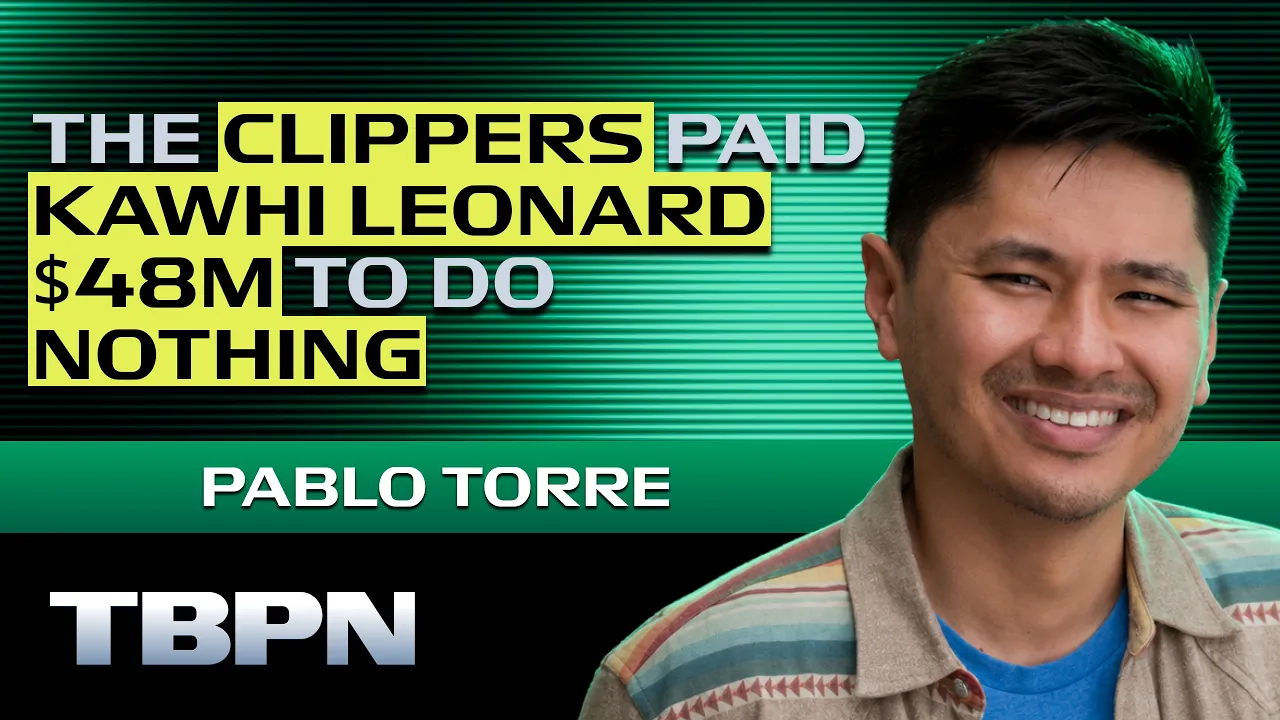
NBA Penalizes Clippers' Ballmer Over $48 Million Cap Evasion Scheme
TBPN
Steve Ballmer faces severe operational bans and the loss of five draft picks after illegally funneling $48 million to Kawhi Leonard through four corporate entities.
## Background
Published on YouTube by TBPN on September 3, 2026, this page features an interview with investigative journalist Pablo Torre. According to the page description, the episode explores how Torre uncovered an alleged scheme to funnel $48 million to Kawhi Leonard, Steve Ballmer's motives for circumventing the NBA salary cap, and the historic punishments and legal fallout facing the Los Angeles Clippers owner.
## TL;DR
Investigative reporter Pablo Torre details how Los Angeles Clippers owner Steve Ballmer orchestrated a $48 million off-the-books payment scheme to sign Kawhi Leonard by routing money through four separate corporate entities, including the bankrupt startup Aspiration. The paper trail and Leonard's refusal to perform any promotional work triggered an SEC investigation, civil lawsuits, and unprecedented NBA sanctions, including $30 million in fines, multi-year executive suspensions, and the loss of five first-round draft picks. The scandal has left the Clippers franchise in a severe organizational crisis while forcing Ballmer to decide whether to battle the league in court or consider selling the team.
## Atmosphere & style
The conversation is conversational, fast-paced, and intellectually engaging, blending sharp investigative journalism with accessible, high-stakes business and sports commentary. Torre and the hosts approach the unraveling scandal with a mix of humor, disbelief, and analytical fascination, treating the scheme's sloppy execution as a high-finance 'comedy of errors.' The mood ranges from lighthearted banter about billionaire hubris to a serious exploration of the chaotic, career-altering fallout for everyone involved.
## Key takeaways
- [00:00](https://www.youtube.com/watch?v=bq2LqEoi4q8&t=0s) Investigation originating from Aspiration's bankruptcy revealed a $48M cap circumvention scheme for Kawhi Leonard.
- [03:30](https://www.youtube.com/watch?v=bq2LqEoi4q8&t=210s) Kawhi Leonard received $48M ($20M stock / $28M cash) through KL2 Aspire LLC for no actual endorsement work.
- [07:08](https://www.youtube.com/watch?v=bq2LqEoi4q8&t=428s) The off-the-books funds were routed across four separate entities: Aspiration, a scoreboard manufacturer, Lockton Insurance, and Boingo Wireless.
- [11:41](https://www.youtube.com/watch?v=bq2LqEoi4q8&t=701s) The NBA issued historic sanctions including a $30M fine, $50M legal cost coverage, loss of five first-round picks, and a one-year ban for Ballmer.
- [11:41](https://www.youtube.com/watch?v=bq2LqEoi4q8&t=701s) Kawhi Leonard accepted a $700K fine settlement, which strategically eliminated Ballmer's binding arbitration path against the league.
- [14:48](https://www.youtube.com/watch?v=bq2LqEoi4q8&t=888s) The structural penalty strips the Clippers of first-round draft assets for nearly a decade, severely crippling their future core.
- [16:19](https://www.youtube.com/watch?v=bq2LqEoi4q8&t=979s) Adam Silver's actions reflect unanimous pressure from the other 29 NBA owners, putting Ballmer's ownership status into question.
- [18:45](https://www.youtube.com/watch?v=bq2LqEoi4q8&t=1125s) The scheme created external legal fallout, including an SEC investigation into Daktronics and a civil fraud lawsuit against Ballmer by Aspiration investors.
- [21:04](https://www.youtube.com/watch?v=bq2LqEoi4q8&t=1264s) Fighting the league endangers Ballmer's long-term personal ambition of bringing an NBA franchise back to Seattle, as it requires approval from 29 rival owners.
## Detailed walkthrough
Here is the detailed walkthrough covering Part 1 of the transcript.
[00:00](https://www.youtube.com/watch?v=bq2LqEoi4q8&t=0s) Breaking down Pablo Torre's investigation into Steve Ballmer and Kawhi Leonard
The interview opens with host praise for Pablo Torre, investigative journalist and host of *Pablo Torre Finds Out*, with one host admitting that while he is not typically a massive sports fan, he regularly seeks out Torre's content because of its high depth and quality. Torre humorously deflects the compliment by attributing his success to being "so good at yapping," before highlighting the core philosophy of his show: making sports stories entertaining and accessible even to people who do not care about sports at all. He points out that this particular story sits squarely in the wheelhouse of tech and business followers, as it dives deep into securities law, off-the-books money funneling, and the actions of billionaires—specifically former Microsoft CEO and current Los Angeles Clippers owner Steve Ballmer.
The hosts recall seeing Torre's initial reporting roughly a year prior and ask how the investigation originally came together before re-emerging in the news. Torre explains that the entire story originated from a tip regarding a strange Los Angeles-based startup named Aspiration. Founded as a tree-planting and carbon credits company, Aspiration capitalized heavily on the pandemic-era ESG (Environmental, Social, and Governance) investment trend. The company raised its public profile by signing a slate of high-profile A-list celebrity endorsers—including Leonardo DiCaprio, Robert Downey Jr., Drake, Cindy Crawford, and Orlando Bloom—to market its "good guy" image.
- **Initial Red Flag:** Aspiration signed a massive $300 million deal to become the jersey patch sponsor for the Los Angeles Clippers.
- **The SPAC Era:** Aspiration intended to go public via a Special Purpose Acquisition Company (SPAC), a trend that attracted immense capital during the pandemic with minimal initial scrutiny.
- **Key Figures:** The company was co-founded by two major Democratic donors with Harvard backgrounds, including Joe Sandberg (who is currently serving a 14-year federal prison sentence for fraud).
---
[03:30](https://www.youtube.com/watch?v=bq2LqEoi4q8&t=210s) Following the paper trail of KL2 Aspire LLC and $48 million in hidden payments
When Aspiration eventually collapsed and entered bankruptcy proceedings, public bankruptcy filings revealed a list of major creditors. Among them was an entity named **KL2 Aspire LLC**, which was owed $7 million in outstanding payments. For basketball fans, the name immediately raised red flags: "KL" matched Kawhi Leonard's initials, and "2" was his jersey number with the Clippers. The entity was clearly designed as a custom vehicle to receive money directly from Aspiration, despite Leonard having zero public association or official endorsement deals with the tree-planting company.
Torre spent seven months digging into public records and interviewing former employees of the bankrupt startup. What he uncovered was an elaborate, off-the-books agreement designed to funnel money to Leonard outside of the NBA salary cap. Under this contract, Leonard was slated to receive $48 million—composed of $20 million in stock and $28 million in cash—for an endorsement deal that was never publicly announced, and for which Leonard performed no actual promotional work.
- **Total Scheme Value:** $48 million ($20M stock / $28M cash) funneled through Aspiration.
- **Primary Goal:** Circumvent the NBA salary cap so Steve Ballmer could lure Kawhi Leonard away from competing suitors like the Los Angeles Lakers and Toronto Raptors.
- **Scope of Salary Cap Rules:** Unlike tech talent wars where companies can bid un-capped billions for top AI researchers, sports leagues enforce strict salary caps to preserve competitive balance between big and small markets.
---
[07:08](https://www.youtube.com/watch?v=bq2LqEoi4q8&t=428s) The four companies involved and how Ballmer blew past plausible deniability
Addressing skeptics who argued that a billionaire of Ballmer's stature would never be foolish enough to risk his reputation and sports franchise on such a scheme, Torre explains that high-profile individuals often take reckless risks when trying to secure outcomes they cannot simply buy legally. Ballmer did not just use one company to bypass the cap; according to both Torre's reporting and the subsequent NBA investigation, money was routed through **four separate companies** tied to the Clippers and their new arena, the Intuit Dome:
1. **Aspiration:** The carbon credits startup ($48 million deal for zero public endorsement work).
2. **The Scoreboard Manufacturer:** A multi-million dollar agreement for Leonard to perform no actual services.
3. **Lockton Insurance:** The official insurance provider for the construction of the Intuit Dome, which signed Leonard to a no-show agreement.
4. **Boingo Wireless:** The official wireless internet provider for the Clippers and the Intuit Dome.
The team attempted to create "separation" by setting up fake consulting fees, shell entities, and ghost jobs for Leonard. However, the scheme unraveled because the conspirators left an extensive paper trail, and Leonard himself flatly refused to do any promotional labor. Leonard openly insisted on receiving off-the-books payments without performing a single endorsement action. Because no public promotional campaign ever launched, the payments could not be defended as legitimate endorsement deals, turning the operation into what Torre describes as a "comedy of errors."
---
[11:41](https://www.youtube.com/watch?v=bq2LqEoi4q8&t=701s) Historic NBA sanctions, Steve Ballmer's ban, and the legal trap
When the NBA rendered its final verdict, it issued the harshest punishment ever levied against a team owner in American professional sports history. While $30 million in fines and $50 million in legal fees paid to outside counsel Wachtell, Lipton, Rosen & Katz represent mere "rounding errors" for Ballmer's massive fortune, the operational penalties hit him directly where it hurts:
- **Loss of Draft Capital:** The Clippers were stripped of **five first-round draft picks**, crippling their long-term team building.
- **Executive Bans:** Ballmer was banned from entering his own self-funded $2 billion Intuit Dome for one year. His President of Business received a one-year ban, and his General Manager / President of Basketball Operations received a six-month suspension.
- **Kawhi Leonard's Penalty:** Leonard received a relatively minor $700,000 fine with no game suspensions and no contract voiding.
Torre details the tactical legal strategy behind Leonard's lenient penalty. By offering Leonard a favorable settlement, the NBA induced him to accept the penalty immediately. In sports law, arbitration is a tripartite agreement between the league, the players' union, and the player. Once Leonard settled, the option for Ballmer to seek binding arbitration was legally eliminated, effectively boxing Ballmer in. Ballmer's only remaining recourse is to launch direct civil litigation against NBA Commissioner Adam Silver and the league. However, suing the league forces full legal discovery, exposing even more internal documents and financial details that Ballmer desperately wants to keep private.
---
[14:48](https://www.youtube.com/watch?v=bq2LqEoi4q8&t=888s) The severe organizational fallout for the Clippers franchise
The hosts and Torre reflect on the long-term damage inflicted on the Los Angeles Clippers franchise. By attempting to cheat the salary cap to accelerate the team's championship timeline, Ballmer ultimately pushed the organization into a "nuclear winter." Having lost five first-round draft picks on top of previous trade commitments, the Clippers will not be able to select their own first-round pick for roughly a decade, severely undermining their ability to rebuild or attract future marquee free agents.
With his legal team issuing formal letters naming Adam Silver directly, Ballmer has signaled that he is willing to go to war with the league. However, historical precedents in professional sports show that team owners who attempt to fight the commissioner and fellow owners rarely win, leaving the Clippers' short-term and long-term future in extreme jeopardy.
<FollowUp label="Want me to break down Part 2 of the transcript when it becomes available?" query="Yes, break down Part 2 of the transcript covering the rest of Pablo Torre's interview about Steve Ballmer and the NBA."/>
[16:19](https://www.youtube.com/watch?v=bq2LqEoi4q8&t=979s) Franchise Valuations and the Backstage Politics of NBA Ownership
Adam Silver’s actions are not driven by a personal crusade, but rather by reading the room of the other 29 NBA team owners. Going to war with the rest of the league, its commissioner, and the press usually takes the fun out of owning a sports franchise. This dynamic leaves Steve Ballmer in a position where he must consider whether to sell the Los Angeles Clippers or face a humiliating punishment. When looking at recent precedent, such as the Los Angeles Lakers selling for $12.5 billion, Ballmer faces a unique calculation if he decides to cash out.
The Clippers could not realistically command a valuation within 10% of the Lakers or reach ten figures in value, but the sports market operates on extreme scarcity where team valuations have become detached from actual revenue. Ballmer sits on immense personal wealth, so his decision comes down to a trade-off between fighting the league, surrendering, or attempting to exit with his dignity and ego intact. Although early signals suggest Ballmer intends to fight, going to war against the NBA remains a daunting path.
* The Los Angeles Lakers recently fetched a $12.5 billion valuation.
* Sports team valuations are increasingly divorced from standard business revenue models due to market scarcity.
* Pablo Torre notes that while the Clippers will not match top-tier franchise prices, sports asset scarcity ensures higher returns than their tragic franchise history might suggest.
---
[18:45](https://www.youtube.com/watch?v=bq2LqEoi4q8&t=1125s) The Unmatched Scale of the Kawhi Leonard Scheme
While circumvention of the NBA salary cap occurs across the league in varying degrees, the scheme surrounding Kawhi Leonard stands out for its sheer scale, ambition, and paper trail. Leonard, a player with virtually no discernable endorsement appeal, held immense leverage over the richest owner in sports. Ballmer spared no expense, funneling money through four separate companies to complete the $48 million arrangement.
The consequences of this paper trail have spilled into public corporate filings and civil court proceedings. Daktronics, a publicly traded company involved in the arrangement, disclosed during an earnings call that its CFO is dealing with an SEC investigation. Simultaneously, Ballmer faces a civil fraud lawsuit in Los Angeles court filed by 11 Aspiration investors. The NBA handed down a historic punishment because the evidence revealed a singular web of deceit unlike standard cap circumvention attempts.
* The scheme funneled $48 million through four distinct corporate entities, including publicly traded Daktronics.
* Daktronics' CFO is currently facing an SEC investigation tied to the funneling arrangement.
* Steve Ballmer is named in an LA civil fraud lawsuit brought by 11 investors of Aspiration.
---
[21:04](https://www.youtube.com/watch?v=bq2LqEoi4q8&t=1264s) Ballmer’s Revenge Scenario and Future Outlook
The person with the strongest incentive to expose other salary cap circumvention deals across the league is now Steve Ballmer himself. With his back against the wall, leaking details about rival teams could be his primary leverage to rehabilitate his standing. The hosts joke that Ballmer might become Torre's top anonymous tipster or launch his own podcast to air his grievances, fitting a broader trend of billionaires turning to media hosting.
Looking at potential future moves, Ballmer’s original desire was always to bring an NBA franchise back to Seattle due to his ties with Microsoft and the Pacific Northwest. However, if Ballmer wants the other 29 owners to approve a future team purchase or relocation, going to full-scale war with the league over the Clippers scandal will make that approval nearly impossible. While Lakers fans view the entire ordeal as hilarious, long-suffering Clippers fans are left enduring yet another tragic ownership saga.
* Ballmer’s long-term NBA interest has historically centered on bringing a team back to Seattle.
* Buying or relocating a future franchise requires approval from the 29 other NBA ownership groups, limiting Ballmer's options if he chooses to fight the league.
## Notable quotes
> [00:00](https://www.youtube.com/watch?v=bq2LqEoi4q8&t=0s) so good at yapping — Pablo Torre
> [07:08](https://www.youtube.com/watch?v=bq2LqEoi4q8&t=428s) comedy of errors — Pablo Torre
> [11:41](https://www.youtube.com/watch?v=bq2LqEoi4q8&t=701s) rounding errors — Pablo Torre
Investigative journalist Pablo Torre reported that Los Angeles Clippers owner Steve Ballmer orchestrated a multi-company scheme to funnel $48 million to star forward Kawhi Leonard outside the NBA salary cap, triggering historic league sanctions and widening civil and federal scrutiny.
The Anatomy of the $48 Million Funneling Scheme (3:30)
The investigation began when bankrupt carbon credits startup Aspiration—which had signed a $300 million jersey patch sponsorship with the Clippers—listed an unfamiliar creditor named KL2 Aspire LLC, owed $7 million. Torre uncovered that the entity was an off-the-books vehicle designed to pay Leonard $48 million ($28 million in cash and $20 million in stock) to lure him to the Clippers over suitors like the Lakers and Raptors without counting against the league's salary cap.
According to Torre's reporting and the league's findings, Ballmer bypassed plausible deniability by routing additional no-show payments through three other arena-related partners: scoreboard manufacturer Daktronics, Intuit Dome insurance broker Lockton Insurance, and Wi-Fi vendor Boingo Wireless. Because Leonard refused to execute any public marketing appearances or endorsement labor, the shell entities and fake consulting fees left an unmistakable paper trail that could not be defended as legitimate commercial endorsements.
Unprecedented League Sanctions and the Arbitration Trap (11:41)
The NBA imposed the most severe penalties against an owner in North American sports history. The league stripped the Clippers of five first-round draft picks, levied $30 million in fines against Ballmer alongside roughly $50 million paid to outside counsel Wachtell, Lipton, Rosen & Katz, and banned Ballmer from entering his own $2 billion Intuit Dome for one year. The Clippers' President of Business received a one-year suspension, while their General Manager and President of Basketball Operations received a six-month ban.
In contrast, Leonard received a comparatively minor $700,000 fine with no suspension or contract voiding. Torre explained that this settlement served a tactical legal purpose: by securing Leonard's agreement, the NBA eliminated the possibility of tripartite league arbitration. This maneuver left Ballmer with no administrative recourse except filing a direct civil lawsuit against Commissioner Adam Silver, a route that would subject Ballmer and his organizations to invasive legal discovery.
Escalating SEC Probes and Civil Fraud Lawsuits (18:45)
The illicit financial arrangements quickly breached sports governance, spilling into federal and corporate oversight. Daktronics, a publicly traded company involved in the payments, revealed during an earnings call that its Chief Financial Officer is under formal investigation by the Securities and Exchange Commission (SEC) in connection with the funneling arrangement.
Simultaneously, Ballmer faces a civil fraud lawsuit filed in Los Angeles court by 11 Aspiration investors. With Aspiration co-founder Joe Sandberg already serving a 14-year federal prison sentence for fraud, the paper trail connecting corporate sponsors directly to Leonard's no-show agreements has exposed both Ballmer and participating vendors to severe legal liability beyond NBA boundaries.
Ownership Politics and Long-Term Organizational Damage (16:19)
Torre noted that Commissioner Silver's harsh ruling reflects consensus among the NBA's other 29 owners, who view aggressive cap circumvention as an existential threat to competitive parity. Stripped of five first-round picks on top of previous trade commitments, the Clippers enter an operational nuclear winter, unable to select their own first-round pick for roughly a decade.
While sports team valuations remain high due to extreme asset scarcity—highlighted by the Lakers' recent $12.5 billion benchmark—Ballmer's leverage is constrained. If he pursues all-out litigation against the league, he risks alienating the ownership bloc whose approval he would ultimately need to realize his long-term ambition of acquiring or relocating a franchise back to Seattle.
Ballmer must now choose between submitting to humiliating operational penalties or mounting an aggressive legal challenge against the NBA, a path that threatens deeper public disclosures and jeopardizes his future standing with the league's governors.
[0:00] Pablo Torre: so good at yapping
[7:08] Pablo Torre: comedy of errors
[11:41] Pablo Torre: rounding errors
[14:48] nuclear winter
Original transcript
[0:00] waiting room. Let's bring in Pablo Toré
[0:02] from Pablo Tore founds finds out. He's a
[0:05] host, investigative journalist and he's
[0:07] on an absolute terror. What are you
[0:08] doing? How you doing,
[0:08] >> Pablo? It's an honor to have you. I was
[0:10] telling John before the show started, we
[0:12] podcast for a living. I'm not a big uh I
[0:15] don't I don't follow very many sports
[0:16] very much, but every time there's a
[0:18] sports story, I go find your content.
[0:21] And when I watch your content, you make
[0:23] me feel like an amateur because you're
[0:24] just so good
[0:26] >> at what you do. So good at yapping. Then
[0:28] you're also also an elite investigative
[0:30] journalist and we wanted to take victory
[0:33] lap with you. A feels like a
[0:36] >> my show is designed Thank you. A B my
[0:39] show is designed for people who don't
[0:41] care about sports at all to find it even
[0:43] mildly entertaining and interesting. And
[0:45] this is a story that has immersed me in
[0:48] the world of securities law and the
[0:51] funneling of money and billionaires and
[0:54] especially one particular billionaire
[0:55] who used to run a certain company called
[0:57] Microsoft. And so all of this I think is
[1:00] actually in your guys' wheelhouse. So
[1:01] happy to be on with you.
[1:02] >> Yeah. And I remember I remember I
[1:04] watched some of your content around a
[1:06] year ago when you were originally
[1:08] breaking this story
[1:10] >> and I'm surprised that the story like at
[1:12] least went away out of the out of the
[1:15] public eye for some time. I'm sure you
[1:16] were still following it, but take us
[1:18] maybe from back a little bit to first
[1:22] kind of uncovering this and then we'll
[1:23] get all the way to the present.
[1:25] >> Yeah. So, this was an investigation that
[1:27] started with a tip. And the tip was
[1:30] there's a weird company out in LA called
[1:32] Aspiration. It was a tree planting
[1:34] startup, aka a carbon credits company.
[1:37] The ESG thing, as you guys may recall,
[1:39] during the pandemic, was a real thing.
[1:41] We're going to be good guys, right?
[1:43] Everyone's going to be a good guy now.
[1:45] And uh endorsing.
[1:51] >> Hey, hey, hey. I love I love trees. I
[1:53] love planting trees, too. I love what
[1:55] they do to carbon and oxygen reportedly.
[1:58] Um, so Aspiration has all these
[2:00] endorsers that are public. There's
[2:02] Robert Downey Jr., there's Leonardo
[2:03] DiCaprio, there's Drake,
[2:05] >> there's Cindy Crawford, people who grew
[2:07] up in the 90s. That's a good deal.
[2:10] >> Toronto figures into the story in lots
[2:12] of ways, it turns out. But the point is
[2:14] that there are all these A-list stars,
[2:17] Orlando Bloom, I didn't even mention,
[2:18] all these A-list stars that this good
[2:20] guy is paying to
[2:22] >> tell everybody about what they are.
[2:25] >> Yeah.
[2:25] >> And what I get a tip on is, hey, you
[2:27] should look into this company. It's kind
[2:28] of weird. Um, they just signed a deal,
[2:31] $300 million to be the Jersey Patch
[2:33] sponsor of Los Angeles Clippers,
[2:36] >> and uh, you know, they have another
[2:38] endorser that you'd be interested in.
[2:40] >> Yeah. And when I look into this, it's
[2:42] not immediately obvious like what
[2:43] they're talking about, but when this
[2:45] company goes bankrupt because, and this
[2:47] is going to be in your wheelhouse again,
[2:48] they were going to go public via spa.
[2:51] >> What a time, right? What a time. Spaxs,
[2:55] ESG, we're all going to get rich being
[2:57] good guys and no one really needs to ask
[2:59] many questions. Just trust us, it's
[3:01] going to be fine. And what turns out is
[3:04] uh this company is co-founded by two
[3:06] people, two big dem donors, plastic good
[3:09] guys went to Harvard. I mean I resemble
[3:11] the remark I want to say that like this
[3:13] has been also awkward for me. Steve
[3:15] Balmer, Harvard, all these guys, all of
[3:17] this, right? Pedigree,
[3:19] >> all of it. Mhm.
[3:20] >> The thing that's interesting is that
[3:22] when you dig in to how this company fell
[3:25] apart and they go into bankruptcy, you
[3:27] of course get to examine some public
[3:29] filings.
[3:30] >> And one of their big creditors was a
[3:32] company called KL2 Aspire LLC.
[3:35] >> Mhm.
[3:35] >> And if you're a basketball fan who's
[3:37] aware of the Clippers, you may realize
[3:39] that KL
[3:40] >> Yeah.
[3:41] >> sounds like Kawhi Leonard 2 sounds like
[3:43] his jersey number. KL2 Aspire sounds
[3:46] like a vehicle you've invented to accept
[3:48] money from Aspiration.
[3:50] >> Yeah.
[3:51] >> And he was owed $7 million outstanding.
[3:54] And the weird part was that this dude
[3:57] had no public record of being associated
[3:59] with Aspiration personally at all.
[4:02] >> Mhm.
[4:02] >> And so when you dig in and you begin to
[4:04] ask questions of people who used to work
[4:05] at a company that has now gone into
[4:07] bankruptcy, in which the co-founder Joe
[4:09] Sandberg is now, by the way, serving 14
[4:11] years in federal prison for fraud. You
[4:14] get people who are interested in
[4:15] explaining how crazy their life has
[4:17] been.
[4:18] >> Yeah.
[4:18] >> And what they say and what they provide
[4:20] in the tonnage of all the reporting I
[4:21] did for months, seven months before we
[4:23] came out with part one of the series one
[4:25] year ago today was documentation that
[4:28] attested to the fact that Kawhi Leonard
[4:30] was paid according to this agreement a
[4:32] total of $48 million. 20 in stock, 28 in
[4:36] cash to do nothing.
[4:38] >> Yeah.
[4:38] >> For a deal that never got announced. And
[4:40] the question was why?
[4:42] >> Yeah. And so you follow the threads and
[4:44] you get to, oh wait, there's a massive
[4:45] salary caps or convention scheme in
[4:47] which the richest owner in American
[4:48] sports, Steve Balmer, is trying to use
[4:50] all of his wealth in ways he's not
[4:52] allowed to to get money to a guy that he
[4:55] he needed to take away from the Lakers
[4:57] and the Toronto Raptors in order to make
[5:00] his dream of owning a professional
[5:01] basketball team exactly the dream that
[5:03] he imagined.
[5:04] >> So how
[5:07] strict are these rules? because I can
[5:10] imagine that's a funny way.
[5:12] >> Yeah, we we so we covered we covered the
[5:14] whole like the AI talent wars last
[5:16] summer every single day. It was crazy
[5:18] and we kept coming back to this idea.
[5:20] Part of why the talent wars worked in in
[5:23] many ways and why is there's no salary
[5:25] cap, right? So Zach could just spend
[5:28] exactly as much money as as the players
[5:30] or the talent would accept. But in this
[5:32] case, rules are there's actual laws.
[5:34] >> Yeah. I I I guess I just mean like if
[5:36] I'm a if I'm a player and I know that
[5:38] the owner runs a hedge fund and I see
[5:41] the benefit of putting some of the money
[5:43] that I earn directly with their hedge
[5:46] fund, it gets me access or oh I know
[5:47] that the owner of the team is friends
[5:49] with the CEO of Nike and I might be able
[5:50] to get a shoe deal. Like there's some
[5:52] level of just like doing business above
[5:54] board that's probably acceptable but is
[5:57] this a blurry line? Like how how defined
[5:59] is this? Like how clear is it to you?
[6:02] >> So two things to know. One is that this
[6:04] is a cardinal rule of sports in which
[6:06] you raise a very astute point.
[6:08] >> If you are LeBron James, it's kind of
[6:10] insane. No disrespect intended to the
[6:13] latest person who got bidded up between,
[6:16] you know, Meta and OpenAI and Anthropic
[6:19] or whatever. No disrespect. LeBron James
[6:21] is probably thinking to himself, why
[6:22] can't I make $100 million a year?
[6:24] >> Yeah,
[6:25] >> this salary is capped.
[6:26] >> And if you have problems with that, I
[6:28] get it. Sports is a fun mix of socialism
[6:31] and capitalism that is convenient.
[6:33] typically for the owners of these teams
[6:35] who are wealthier every time you check
[6:37] the news.
[6:38] >> Yeah.
[6:38] >> So, point A, well taken. Point B though
[6:41] is that it's a cardinal rule of sports.
[6:44] Meaning that sports is one of the few
[6:45] places where your spending power is not
[6:48] automatically
[6:50] >> supposed to let you just buy whatever
[6:52] you want.
[6:53] >> Right? This is how big markets and small
[6:55] markets ostensibly
[6:56] >> get to some level of par. This is how,
[6:58] and this is debatable, of course. We're
[7:00] getting into more philosophy than I
[7:01] expected, but it's a fair point. It gets
[7:03] into the question of like what's
[7:05] actually moral and not.
[7:07] >> What Steve Balmer did, given that
[7:09] blurriness around the ethics of it, was
[7:12] violate and really um I would say blow
[7:16] past any semblance
[7:18] >> of plausible deniability that hold on, I
[7:21] thought this was something that we could
[7:22] do here. And I say that because
[7:24] according to the NBA's investigation and
[7:26] my own, this was not merely a scheme
[7:28] that he ran to funnel money with one
[7:30] company, Aspiration. He did it with
[7:33] four.
[7:33] >> He did it with the scoreboard
[7:35] manufacturer, multi-million dollar deal
[7:38] for Kawhi Leonard to do nothing. He did
[7:39] it with the insurance company, Locked in
[7:42] Insurance, which was the insurance
[7:43] company on the buildout of the Intuit.
[7:46] >> Mhm.
[7:46] >> He apparently did nothing for that. And
[7:48] he did it with, and this is a fun one,
[7:51] Boingo Wireless. Oh yeah,
[7:53] >> which you may know as the wireless
[7:55] provider
[7:56] >> of Los Angeles Clippers. And the thing
[7:58] you say to yourself, do I really need to
[7:59] pay for Bo?
[8:00] >> Yeah. I'm like, oh,
[8:02] >> is my personal review of the product.
[8:06] >> So when when your original story when
[8:07] your original story broke, you got a
[8:10] bunch of push back, even from
[8:13] bunch of people that that are pretty
[8:15] tapped in and knowledgeable. And some of
[8:17] that push back was just that there's no
[8:19] way that Balmer would be this dumb,
[8:21] right? So this like like this story
[8:24] couldn't possibly be true because who
[8:26] would ever do who would ever like risk
[8:28] it all
[8:28] >> in this way? Is that is that somewhat
[8:30] accurate? I
[8:32] >> I think that's even the most generous
[8:34] defense. I think there are a lot of
[8:36] people who are just being told by the
[8:37] Clippers and Balmer's crisis PR
[8:39] handlers, this weird podcaster is clout
[8:42] chasing. None of this makes sense. Steve
[8:44] would never do this. He's Steve Bong.
[8:46] >> Yeah. The less um I think uh surprising
[8:50] version though which you just
[8:52] articulated is a common one which is you
[8:55] can't be this dumb.
[8:56] >> Yeah.
[8:57] >> And and I dare say that one of the
[9:00] things you learn when you investigate
[9:03] financial impropriety in our great
[9:05] country is that that is something that
[9:08] you should never assume.
[9:09] >> Sure. Um there are many phenomenally
[9:12] successful people who because they are
[9:14] desperate to get the thing they can't
[9:16] just buy do things that they think will
[9:20] never get found out.
[9:22] >> And the problem in this case across
[9:24] these four companies and across these
[9:26] employees and across my reporting is
[9:28] that he trusted people that he should
[9:30] not have trusted and also he maybe
[9:32] shouldn't have tried to do it in the
[9:33] first place.
[9:35] Isn't there one weird trick that would
[9:37] have made this all work? Which is just
[9:39] Balmer goes to Boingo Wireless and says,
[9:43] "Yeah, we got this deal. Uh, it's
[9:46] expensive, but you you will get some
[9:50] Instagram posts." And then Leonard
[9:51] actually follows through on some of the
[9:54] promotions and would have been enough
[9:57] market for CPM like it could work.
[9:59] >> Yeah. If he if he had actually carried
[10:01] out the endorsements, would that have
[10:02] been enough or was that is that still
[10:04] crossing the line?
[10:05] >> There's an So, I've debated on my show
[10:07] literally Mark Cuban about this whole
[10:09] story before it became obvious what this
[10:10] was. And I appreciate the apology he
[10:12] gave me on Twitter yesterday
[10:13] >> genuinely.
[10:14] >> Cool.
[10:14] >> But there's a Shark Tank episode we
[10:16] could do just like pitching ideas for
[10:18] how to circumvent the salary cap that
[10:20] would have worked.
[10:20] >> Yeah.
[10:21] >> And and I think one of them, by the way,
[10:23] just to play that game briefly, it's
[10:25] like
[10:26] >> telling Kawhi Leonard about crypto.
[10:28] >> Yeah. Right? There are untraceable flows
[10:30] of money that I am told are reliable at
[10:32] this point in the calendar that you
[10:34] could use. Right? That's just one
[10:36] example. But what they did was actually
[10:38] almost
[10:40] too clever by half. What they really did
[10:42] was they created fake jobs for Kawhi
[10:44] Leonard and fake consulting agreements,
[10:46] consulting fees for the companies. So
[10:48] they were trying to create separation.
[10:50] >> Okay,
[10:51] >> a familiar term in the investigation of
[10:52] financial propriety. But they're trying
[10:54] to separate where the money was going
[10:56] from A to B to C. The problem was that
[10:59] everybody in the course of doing it,
[11:00] people they trusted, left a trail of
[11:02] paper, as well as testimony, as well as
[11:05] a lack of rational explanation as to why
[11:07] this existed if you never were to
[11:09] announce the deals. And Kawawaii, and
[11:11] this is the great comedy that is sports,
[11:14] in which salaries are capped, but egos
[11:16] are not. Kawi Leonard,
[11:18] >> Kawhi Leonard said to everybody, "I'm
[11:20] not doing a single thing for these off
[11:21] the books payments. I am not doing work
[11:25] for them, but I want them." And Steve
[11:27] Balmer said, "Got you. We'll make that
[11:30] work." And because these deals could not
[11:33] be explained as endorsements because he
[11:35] literally never endorsed them.
[11:37] >> Yeah.
[11:38] >> It became this comedy of errors.
[11:40] >> That's very, very odd.
[11:41] >> All right, let's get to the punishment.
[11:44] What What's been your reaction to Kawhi
[11:46] got a $700,000 fine? doesn't feel very
[11:50] significant, at least, you know,
[11:52] compared to the the actual payments and
[11:55] what was received. And then, uh, you
[11:58] have a one-year ban, uh, for for Balmer.
[12:01] And then, but but what was your reaction
[12:04] to the to the to the verdict from the
[12:06] NBA?
[12:08] >> Yeah. Um, this was the biggest
[12:10] punishment for an owner in the history
[12:12] of, I think, American professional
[12:13] sports. And the NBA took five first
[12:17] round picks, which is the most you could
[12:20] imagine. They took $30 million, which is
[12:23] a rounding error, of course, for Balmer.
[12:25] They made him pay the $50 million legal
[12:27] fee to walk to Lipton, the NBA's outside
[12:29] council, which is also a rounding error,
[12:32] but still
[12:33] >> pretty annoying, I would imagine. Um,
[12:35] but the real thing that I thought was
[12:37] meaningful was that they banned Steve
[12:40] Balmer from his own building for a year.
[12:44] He loves basketball. He sits courtside.
[12:46] He measured literally the toilets at the
[12:48] Intuit dome when he was designing the
[12:49] whole building. He was a micromanager
[12:51] who knew everything about every piece of
[12:53] the building. And they banned him from
[12:56] being inside his own building which he
[12:58] funded for $2 billion privately to his
[13:01] credit. And they also banned his
[13:03] president of business for a year. And
[13:05] they banned his GM, his president of
[13:06] basketball for 6 months. And so Kawaii
[13:09] got effectively a slap on the wrist. And
[13:11] that is wild on the merits.
[13:14] >> The reason they did it briefly is
[13:16] because when Balmer now is rattling his
[13:18] saber because he is the former CEO of
[13:21] Microsoft who when presented with
[13:23] antitrust findings by the literal
[13:24] federal government also bought right
[13:28] this is unsurprising if you know the
[13:30] trajectory of his life. What he has
[13:33] threatened is litigation and what he has
[13:37] not been able to pursue is arbitration
[13:40] which is interesting because arbitration
[13:42] briefly in the world of sports court
[13:44] which is another TV show we should pilot
[13:46] together. In sports court in sports
[13:50] court you have an arbitrator assistant
[13:51] arbitrator but that is an arrangement
[13:53] between the player Kawhi Leonard and his
[13:55] union as well as the league. Mhm.
[13:57] >> And when Kawhi Leonard got a slap on the
[13:59] wrist, only $700,000, no suspension, no
[14:02] voiding of the contract, no nothing, he
[14:05] agreed to a settlement that was quite
[14:06] favorable. And the question was why?
[14:09] >> Well, Kawhi Leonard's settlement meant
[14:11] that the arbitration option was legally
[14:14] removed.
[14:15] >> So
[14:16] >> now they boxed in Balmer,
[14:18] >> which is again no small thing. My
[14:20] reaction was, it's no small thing to be
[14:23] at war with a guy with $145 billion
[14:25] depending on Microsoft stock
[14:27] >> and to say you got one move
[14:29] >> and it's to enter yet more discovery
[14:32] when you know
[14:33] >> he doesn't want to It sounds like Yeah,
[14:35] it sounds like a nightmare situation for
[14:38] Balmer at this point to
[14:40] >> get more of the details out like he kind
[14:43] of I I
[14:44] >> there's more
[14:46] >> there's more. So, so your your read on
[14:48] it is he just has to basically accept
[14:50] the consequences and and you know get to
[14:53] watch as a fan for the next year. Um but
[14:56] how much does this set back the the
[14:59] Clippers?
[15:00] uh like how impactful, you know, in many
[15:03] ways like he tried to cheat his way, you
[15:06] know, a couple steps forward, but in the
[15:09] process of that set the team back like
[15:11] basically took the team out of probably
[15:13] contention for
[15:15] >> I want to say a decade. Like what what
[15:17] what player would want to go to this
[15:20] organization now knowing that they're
[15:23] not going to get any first round picks
[15:25] for the next five years? Like it just
[15:26] feels like a really tough situation. the
[15:29] next Clippers first rounder that they
[15:32] will be able to select
[15:35] hasn't even sniffed puberty yet. Like
[15:38] we're just in a timeline that is a
[15:41] nuclear
[15:42] winter kind of feeling if you're a
[15:44] Clipper fan. But I want to say that at a
[15:46] certain point perhaps things get so bad
[15:50] that sort of things almost need to
[15:53] reset. And so actually the thing I'm
[15:55] wondering aloud with you guys is as we
[15:58] contemplate what is Balmer going to do
[15:59] next, he has now threatened personally
[16:02] with litigation Adam Silver by name in a
[16:04] letter through his lawyers. He is
[16:07] signaling it is war time. And we just
[16:09] gave you some of the stakes around what
[16:10] that would entail practically. But
[16:14] historically, if you're going to go to
[16:16] war with your sport and with the
[16:17] commissioner and with other owners, by
[16:19] the way, that's the sort of backstage
[16:21] >> politics of this. Adam doesn't do this
[16:23] as a crusade. He does this because he's
[16:25] read the room of other billionaires who
[16:28] own these 29 other teams. If you're
[16:31] going to go to war with the other 29
[16:33] ownership groups and a commissioner and
[16:34] the league and journalism and
[16:36] everything, typically it stops being as
[16:40] fun for you.
[16:41] >> Yeah.
[16:41] >> Typically. Yeah.
[16:42] >> And so does Steve Balmer even want to
[16:44] consider perhaps selling and taking a
[16:47] punishment that is a humiliation on one
[16:50] level, but also you know what the Lakers
[16:53] just went for 12.5 billion dollars. What
[16:57] could you make on the back end if money
[16:59] was a thing you cared about?
[17:00] >> Yeah.
[17:01] >> So
[17:01] >> yeah, how
[17:03] what does this do to the value? Like
[17:05] there's no way you could value the the
[17:07] Clippers
[17:09] at least within 10% of the Lakers,
[17:13] right?
[17:14] >> No. Doing back of the envelope math,
[17:16] they're not they're not getting
[17:18] doubledigit. They're not getting eight
[17:19] figures. Um, you know, one of Sorry,
[17:22] excuse me. They're not getting 10
[17:23] figures. Um, what I think is interesting
[17:26] though is
[17:29] they're going to make more than people I
[17:33] think are prepared to intuit it based on
[17:36] the fact that into it is a pun not even
[17:38] intended based on how horrific this
[17:41] franchise has been. We're just at a
[17:43] place in sports where the scarcity is so
[17:46] clear that these are detached valuations
[17:50] from revenue. You know, again, there are
[17:52] a couple places in this world where that
[17:54] is true. You guys cover a lot of them.
[17:57] Uh, sports though is on its own crazy
[18:01] ride that is getting divorced from the
[18:04] reality of things.
[18:04] >> I don't know. I think sports sports and
[18:06] the private markets are pretty nei
[18:12] but uh I take your point.
[18:14] >> No. And by and by the way, that's the
[18:16] story of the Lakers and Mark Walter,
[18:17] which we were also investigating. My
[18:19] point being that they're not going to
[18:20] get 12 and a half, they're not going to
[18:22] get 10. But for Balmer, it's a trade-off
[18:25] between what do you really want? You
[18:26] have all of the money.
[18:28] >> What do you want? Do you want to fight?
[18:30] Do you want to surrender? Do you want to
[18:32] walk away with something like your, you
[18:35] know, ego or dignity? Whatever. I don't
[18:36] want to be too over the top here, but
[18:38] like he has a calculation that is not a
[18:39] normal calculation to make because right
[18:41] now it's signaling that he's going to
[18:43] fight.
[18:43] >> Yeah.
[18:45] >> Yeah. Fighting fighting seems like a
[18:48] rough going to war with the with with
[18:50] you seems seems pretty rough. Um what uh
[18:54] do do you feel like do you feel like
[18:56] this has probably been happening? Do you
[18:58] think it's possible that that Balmer
[19:00] knew like felt confident in doing
[19:03] something like this because it was
[19:04] happening at a larger scale? And if you
[19:06] actually look at a bunch of other teams,
[19:08] it's it's really much more widespread
[19:10] and and if you start looking at a bunch
[19:12] of these endorsement deals,
[19:14] >> there's there's definitely a a better
[19:16] way to go about, you know,
[19:19] >> you you said you could have a whole show
[19:21] about getting around the salary cap, and
[19:23] I and I I just have to imagine there's
[19:25] so much money involved. there's so much
[19:27] ego. If you own a team, you want to you
[19:30] want to compete, you want to win. Uh and
[19:33] I I would I would guess that there's a
[19:34] bunch of other owners and GMs and things
[19:37] like that that are kind of a little bit
[19:39] nervous now uh because they may have
[19:42] done something similar or even at a
[19:44] smaller scale.
[19:45] >> I think two things are true. One is by
[19:48] degree lots of other examples of salary
[19:51] cap circumvention funneling money to
[19:53] players have happened will happen are
[19:56] happening. Mhm.
[19:57] >> But the other thing that's true is that
[19:59] in terms of the scale and ambition and
[20:01] the paper trail and the sort of almost
[20:04] just like subplots,
[20:07] nothing is quite like a story in which a
[20:10] guy who doesn't want to do anything, who
[20:12] has zero discernable endorsement value,
[20:14] even when he does something, has
[20:16] leverage over the richest owner in
[20:17] sports, who is willing to spare no
[20:19] expense almost literally to funnel money
[20:21] through four different companies, one of
[20:23] whom, by the way, is a public company,
[20:24] Dtactronics, that is now acknowledged in
[20:26] yesterday's earnings call that their CFO
[20:28] according to him is now dealing with an
[20:31] SEC investigation. So there there's also
[20:34] a civil suit happening in LA court
[20:36] against E. Balmer personally by 11
[20:38] aspiration investors about fraud. My
[20:40] point is there are lots of other
[20:42] examples about how to circumvent the cap
[20:45] that are I'm sure getting no attention
[20:47] and maybe we'll get to some of them. But
[20:49] in terms of what this one is, the reason
[20:51] it's the biggest punishment is because
[20:54] they found stuff that is singular in
[20:58] terms of all of the webs that it
[21:00] entails. And that is
[21:02] >> well, I just going,
[21:04] >> but now the the the people that the
[21:08] person that is most incentivized to
[21:10] uncover all these other salary cap
[21:12] circumvention, you know, potential deals
[21:14] that have been happening is actually
[21:16] Steve Balmer. cuz you imagine in his war
[21:19] the only thing that he he's he's like
[21:21] he's got his back against the wall. He's
[21:23] sitting there thinking the only thing
[21:24] that I could possibly do to kind of
[21:26] clear my reputation is make it come out
[21:28] that
[21:28] >> you think you think he's going to start
[21:30] speeding Pablo tips.
[21:31] >> Yeah.
[21:32] >> Be your number one tipster.
[21:34] >> I I I would gladly welcome
[21:37] >> back checkable information from any
[21:39] source. I also welcome the idea that
[21:42] maybe the biggest consequence of my
[21:44] reporting is that Steve Balmer becomes
[21:46] himself a podcaster
[21:48] >> and that would be something that I
[21:49] welcome as well.
[21:50] >> That'd be fantastic.
[21:51] >> Final job once you have everything.
[21:53] >> Well, he's got a lot to learn.
[21:54] >> It's only you and the mic.
[21:56] >> I will say based on what I've learned
[21:58] from your show, that trajectory is also
[22:00] an increasingly common thing for a
[22:02] billionaire to do. So perhaps we're not
[22:04] so different, you and I.
[22:05] >> Yeah.
[22:06] >> Well, thank you so much for coming on
[22:07] the show. This was fantastic. honor to
[22:08] have you and congratulations I'm guess
[22:13] congrat I mean it's it's a it's it's a
[22:15] strange thing to say congratulations for
[22:17] a story that is ultimately
[22:19] >> quite sad and and unfortunate but um
[22:22] yeah credit credit is on display here
[22:26] >> look as always um comedy is when bad
[22:30] things happen to other people um so
[22:32] there are Laker fans who think this is
[22:34] the funniest story in the world I do
[22:35] shed a tear
[22:36] >> for the Clippers fans who are like,
[22:39] >> "Yeah,
[22:40] >> really
[22:41] >> again.
[22:42] >> This again,
[22:44] >> another owner. Another owner that we
[22:46] might not." Anyway,
[22:47] >> yeah.
[22:47] >> Uh, last question. Is it possible that
[22:50] he sells the Clippers and overpays for
[22:52] another team
[22:53] >> just to get right back in the game?
[22:56] >> Look, what he wanted from the beginning,
[22:57] what he was interested in, of course,
[22:59] because of Microsoft and geography, was
[23:01] a Seattle team back again. Now, I will
[23:05] advise this just as a podcaster to a
[23:08] potential future podcaster. Um, I am
[23:10] told that one way to be approved to buy
[23:12] a new team is to not go to war with the
[23:14] 29 other ownership groups that will need
[23:16] to approve that.
[23:17] >> So, just a consideration as he continues
[23:20] to examine contingencies.
[23:22] >> That makes sense. Well, thank you so
[23:23] much for coming on the show.
[23:24] >> Yeah, thank you so much. This was a
[23:26] week. We really appreciate
[23:27] >> and congratulations on on your overall
[23:30] run
[23:30] >> everything. It's fantastic.
[23:31] >> We'll talk to you soon. anytime. Thank
[23:33] you. Have a good one.