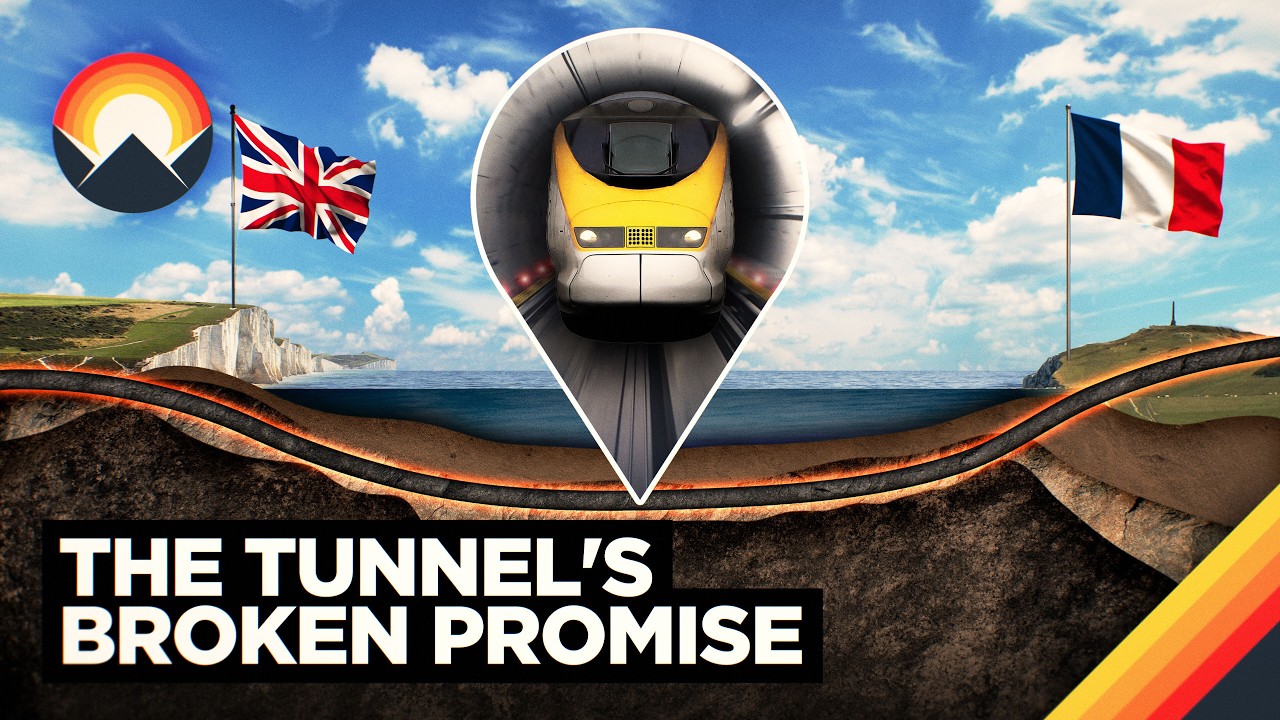
Thatcher-Mitterrand Channel Tunnel Compromise Hobbles British High-Speed Rail
Wendover Productions
Private financing mandates and British rail fragmentation turned the $11 billion Channel Tunnel from a unified trans-European network into an isolated, underutilized regional shuttle.
## Background
Published by Wendover Productions on YouTube on September 4, 2026, this video examines how the Channel Tunnel functions alongside its history and operational challenges. The page description offers an annual subscription discount for Nebula and highlights creator-driven series available on the platform, while providing writing, editing, animation, and sound production credits.
## TL;DR
The Channel Tunnel stands as a landmark civil engineering achievement that physically connected Great Britain to continental Europe, yet its operational success has been severely constrained by political compromises and structural flaws. Resulting from an ideological pact between Margaret Thatcher's requirement for 100% private financing and François Mitterrand's desire for public works, the project incurred massive debt that ruined its regional ambitions. Canceled regional Eurostar and Nightstar services, strict loading gauge limitations, intermediate station closures, and security crises crippled direct rail freight and regional passenger growth. Today, with HS2 disconnected from HS1 and market entry heavily restricted, the tunnel remains a vital but fragmented transit corridor, though emerging open-access competition from operators like Virgin Trains offers a potential shift for the future.
## Atmosphere & style
The presentation carries an analytical, authoritative, and mildly critical tone characteristic of high-production educational video essays. Through clear voiceover narration, strategic data visualizations, and structured diagrams, the host breaks down complex policy, economic, and engineering concepts with sober clarity. The narrative arc moves from the initial grandeur and optimistic fanfare of the 1994 royal opening to a grounded, sobering examination of missed opportunities, regulatory barriers, and systemic planning failures.
## Key takeaways
- [00:00](https://www.youtube.com/watch?v=gLkbK8h_9fc&t=0s) May 1994, Queen Elizabeth II and President François Mitterrand inaugurated the Channel Tunnel, bridging the English Channel with Eurostar passenger trains and car-carrying shuttle services.
- [00:00](https://www.youtube.com/watch?v=gLkbK8h_9fc&t=0s) The Channel Tunnel became the longest undersea tunnel in the world and the most expensive privately financed infrastructure megaproject in history.
- [01:33](https://www.youtube.com/watch?v=gLkbK8h_9fc&t=93s) Early 20th-century tunnel proposals were repeatedly rejected by British military planners over invasion fears during the World Wars.
- [01:33](https://www.youtube.com/watch?v=gLkbK8h_9fc&t=93s) In the 1980s, British Prime Minister Margaret Thatcher and French President François Mitterrand reached a compromise: building the tunnel on the strict condition of 100% private funding.
- [03:48](https://www.youtube.com/watch?v=gLkbK8h_9fc&t=228s) To secure parliamentary approval from MPs representing Kent, planners promised regional infrastructure upgrades, competitive protections for ferries, and direct international rail links north of London.
- [05:54](https://www.youtube.com/watch?v=gLkbK8h_9fc&t=354s) Over $500 million was spent on specialized Regional Eurostar trainsets and Nightstar sleeper fleets, but both projects were completely abandoned after British Rail privatization without ever carrying a paying passenger.
- [10:19](https://www.youtube.com/watch?v=gLkbK8h_9fc&t=619s) Cross-Channel direct rail freight collapsed from ~40 trains per day to ~6 per day due to expired toll subsidies, UK loading gauge incompatibilities, and security disruptions surrounding the Sangatte migrant camp.
- [14:29](https://www.youtube.com/watch?v=gLkbK8h_9fc&t=869s) UK intermediate Eurostar stops at Ashford and Ebbsfleet were suspended during COVID-19 and never reopened, leaving London St Pancras as the country's only active international station.
- [14:29](https://www.youtube.com/watch?v=gLkbK8h_9fc&t=869s) Stratford International station was fully built for the 2012 London Olympics with complete border control facilities, yet no Eurostar train has ever made a commercial stop there.
- [17:04](https://www.youtube.com/watch?v=gLkbK8h_9fc&t=1024s) Strict safety regulations requiring 400-meter-long trains and exclusive access to Eurostar's Temple Mills Depot created massive barriers to entry for potential open-access competitors.
- [17:04](https://www.youtube.com/watch?v=gLkbK8h_9fc&t=1024s) The UK Office of Rail and Road mandated Eurostar to share access to Temple Mills Depot with Virgin Trains, clearing a path for Virgin to launch competing cross-Channel services by 2030.
- [18:57](https://www.youtube.com/watch?v=gLkbK8h_9fc&t=1137s) The cancellation of a 1.2-mile connection track between HS1 and High Speed 2 (HS2) leaves over $100 billion in rail infrastructure isolated, preventing direct international services from cities north of London.
## Detailed walkthrough
### [00:00](https://www.youtube.com/watch?v=gLkbK8h_9fc&t=0s) A Royal Opening and the Promise of the Channel Tunnel
On a rainy May day in 1994, Queen Elizabeth II boarded a brand-new Eurostar train at London Waterloo station, inaugurating one of the most ambitious engineering feats of the modern era. Traversed by a 75-minute run through the Kent countryside, her train entered the Channel Tunnel, emerging 25 minutes later near Calais, France. There, the train positioned itself nose-to-nose with a matching set carrying French President François Mitterrand. After stepping onto a red carpet for an opening ceremony, both heads of state loaded into the Queen's Rolls-Royce, which was then driven aboard a vehicle-carrying shuttle train—a service designed to directly challenge the traditional cross-Channel ferry industry. A second ceremony followed on British soil, setting the stage for freight operations weeks later and passenger Eurostar revenue services shortly thereafter.
The Channel Tunnel was an undeniable triumph of civil engineering: the longest undersea tunnel ever constructed and the most expensive privately financed infrastructure project in history. It physically linked the world's third most populous island to mainland Europe, uniting two highly integrated economic powers. However, behind the technological success lay an operational and structural framework plagued by political compromises, flawed forecasts, and shortsighted planning.
- **Opening Ceremonies:** May 1994, featuring Queen Elizabeth II and President François Mitterrand.
- **Key Infrastructure Milestones:** Connected London Waterloo to Calais, later expanding to regular freight and Eurostar passenger traffic.
- **Physical Scale:** The longest undersea tunnel in the world, built to bridge the English Channel.
---
[01:33](https://www.youtube.com/watch?v=gLkbK8h_9fc&t=93s) From Cold War Fear to Political Compromise
Proposals to construct a physical link across the English Channel date back to the early 19th century, though early schemes were viewed as science fiction. As engineering capabilities improved over the decades, the idea transitioned from preposterous to technically viable. However, throughout the first half of the 20th century, British military planners consistently rejected proposals on national security grounds, fearing a tunnel could serve as an invasion corridor during the World Wars. By the 1970s, after decades of study, designs were finalized and tunnel boring machines were deployed—only for the project to be abruptly canceled by a new Labour government over skyrocketing cost estimates.
```
+-----------------------------------------------------------------------------+
| POLITICAL COMPROMISE |
+----------------------------------------------+------------------------------+
| MARGARET THATCHER (UK) | FRANÇOIS MITTERRAND (FRANCE) |
| • Free-market conservative | • Socialist president |
| • Championed privatization & deregulation | • Focused on nationalization |
| • Required 100% PRIVATE FINANCING | • Desired LARGE STATE WORKS |
+----------------------------------------------+------------------------------+
│
▼
100% Privately Financed Megaproject
($11 Billion Raised via Loan Market)
```
The political landscape shifted dramatically with the 1979 election of British Prime Minister Margaret Thatcher and the 1981 election of French President François Mitterrand. Although Thatcher was an avowed Eurosceptic who favored road transport over railways, her core ideology centered on private enterprise and market deregulation. Conversely, Mitterrand sought massive public infrastructure projects to create jobs and stimulate industrial output. The two leaders reached an unlikely compromise: France would get the tunnel, provided Thatcher's strict requirement was met—that the project be built without a single penny of public money.
- **Historical Hurdles:** Rebuffed for decades due to fears of military invasion via an undersea route.
- **1975 Project Cancellation:** Abandoned by the UK government after cost estimates doubled.
- **1980s Ideological Pact:** Blended Thatcher’s free-market privatization model with Mitterrand’s appetite for large-scale infrastructure.
---
[03:48](https://www.youtube.com/watch?v=gLkbK8h_9fc&t=228s) Political Assurances and Financial Backing
While Mitterrand secured easy approval from the French legislature, Thatcher faced fierce opposition in the UK Parliament. Members of Parliament (MPs) representing Kent expressed intense concern over localized job losses. The regional economy had already suffered from the decline of domestic seaside tourism and the closure of unprofitable coal mines; its primary economic engine was the Port of Dover, supporting tens of thousands of ferry-related jobs. To secure parliamentary approval, project planners extended major concessions to regional constituencies:
* **Kent Infrastructure Package:** Roadway upgrades, fair-competition regulations for ferries, and the construction of Ashford International Station so residents could access Eurostar without traveling through London.
* **Regional Rail Promises:** Direct international passenger services originating north of London, alongside guarantees that most rail freight would bypass the capital.
* **Bank Commitments:** Exclusivity guarantees preventing a competing tunnel before 2020, total price-setting freedom, and minimum usage commitments from national rail operators.
Backed by these guarantees, international banking syndicates raised approximately $11 billion in private capital, creating the largest privately financed infrastructure undertaking in history.
---
[05:54](https://www.youtube.com/watch?v=gLkbK8h_9fc&t=354s) The Failure of Regional Eurostar and Nightstar
The project’s duel mandate—satisfying political promises made to regional MPs while generating immediate revenues to repay banking loans—quickly created severe friction. To fulfill the pledge of services "beyond London," British Rail ordered seven specialized Class 373 trainsets in a shortened 14-coach, 550-seat configuration (alongside the standard 18-coach models). These trains were designed to run directly from cities like Glasgow and Manchester to Paris and Brussels via the East Coast Main Line and West London bypass tracks. A dedicated maintenance depot was even constructed at Manchester Piccadilly.
Glasgow / Manchester / Plymouth / Swansea
│
▼
[West London Bypass / Kensington Olympia]
│
▼
Channel Tunnel
│
┌────────────────────┴────────────────────┐
▼ ▼
Paris Gare du Nord Brussels-Midi
```
Simultaneously, an ambitious sleeper service brand called **Nightstar** was devised. Orders were placed for 18 trainsets intended to connect London, Glasgow, Plymouth, and Swansea with European destinations including Amsterdam, Aachen, Dortmund, and Frankfurt. However, during the mid-1990s, the UK government privatized British Rail, breaking it into separate corporate entities. The British stake in Eurostar was transferred to London and Continental Railways (LCR). While LCR assumed control of the regional train fleets and infrastructure, it inherited no legal obligation to actually run the unprofitable routes.
Dismal actual ridership—only 2.9 million passengers in 1995 compared to the projected 15.9 million—combined with price wars from low-cost airlines and extended travel times, meant Eurostar was bleeding money. Facing mounting debts to build High Speed 1 into London, LCR quietly abandoned the regional and sleeper projects. Despite more than $500 million spent on specialized rolling stock, depots, and track electrification, neither Regional Eurostar nor Nightstar ever carried a single paying passenger.
- **Regional Eurostar Concept:** Shortened 14-coach Class 373 trainsets tailored for lines north of London.
- **Nightstar Sleeper Trains:** Designed to link UK regional hubs to Paris, Brussels, Amsterdam, and Frankfurt via nighttime shunting at Kensington Olympia.
- **Outcome:** Over $500 million in wasted capital; both programs were canceled due to financial shortfalls and privatization loopholes.
---
[10:19](https://www.youtube.com/watch?v=gLkbK8h_9fc&t=619s) Freight Failures, Border Crises, and Operational Tolls
Cross-Channel rail freight initially showed promise, scaling up to roughly 40 trains per day by 1998. However, this volume was largely artificial, sustained by minimum usage charges that required national rail operators to pay fixed fees regardless of actual cargo throughput. When those initial contracts expired, operators were forced to pay a realistic toll of approximately $6,000 per train, causing commercial freight volumes to plummet.
| Operational Factor | Impact on Cross-Channel Rail Freight |
|:--- |:--- |
| **Sangatte Migrant Camp (1999)** | Set up near Calais freight yards; caused security shutdowns, train searches, and steep fines. |
| **UK Loading Gauge (GB+ vs UIC)** | Restrictive British tunnel/platform dimensions prevented standard European High-Cube containers from passing without costly low-deck wagons. |
| **Expiration of Usage Contracts** | Imposed a ~$6,000 toll per train, removing artificial subsidies and crashing traffic down to ~6 trains per day. |
Security disruptions further damaged the viability of rail freight. In 1999, the opening of a Red Cross facility at Sangatte—housed in a former tunnel construction plant near the Calais freight rail yard—led to thousands of migrants attempting to board slow-moving UK-bound trains. Nightly intrusions resulted in severe service delays, extensive physical searches, and heavy financial penalties imposed by British authorities. Freight traffic halved almost overnight.
Beyond security issues, fundamental engineering incompatibilities crippled direct rail freight. The UK rail network relies on a smaller loading gauge than continental Europe. Standard European high-cube intermodal containers cannot travel on British tracks without specialized, expensive low-deck wagons. Consequently, direct freight rail throughput collapsed to an average of just six trains per day—a level that persists today. Instead, cross-Channel freight is overwhelmingly dominated by heavy road vehicles loaded onto tunnel shuttle trains or traditional ferries, where drivers can use the 90-minute sea crossing to satisfy mandatory 45-minute rest breaks.
- **Freight Throughput:** Stagnated at ~6 trains per day compared to early projections of continuous intermodal transport.
- **Infrastructure Barrier:** Smaller British tunnel profiles and platform clearances block standard European freight cars.
- **Ferry Survival:** Maritime routes retained dominance by aligning with European truck driver rest-time regulations.
<ElicitationsGroup message="Explore related details about the Channel Tunnel:">
<Elicitation label="Examine the engineering of the Tunnel Boring Machines" query="How did the Tunnel Boring Machines construct the Channel Tunnel under the seabed?"/>
<Elicitation label="Review the construction of High Speed 1 and St Pancras" query="How was High Speed 1 built to connect St Pancras International to the Channel Tunnel?"/>
<ElicitationsGroup/>
Here is a detailed, faithful walkthrough of the provided transcript segment:
[14:29](https://www.youtube.com/watch?v=gLkbK8h_9fc&t=869s) Intermediate Stations and Cross-Border Border Logistics
The intermediate stations designed to serve the Eurostar network inside the UK have largely fallen into disuse. After passenger numbers dropped, service was wound down at Ashford International and Ebbsfleet International during the COVID-19 pandemic. Since then, operations have never restarted; Eurostar trains simply speed past, preventing local Kent residents from accessing the services running right through their backyards. Eurostar argues these intermediate stops were unprofitable, and because the British government sold off its financial stake in the company, it lacks the legal power to compel a service restoration. Even stranger is Stratford International in East London. Opened in 2009 in preparation for the 2012 London Olympics, the station was fully fitted with border control areas, waiting lounges, and dedicated international infrastructure, yet not a single Eurostar train has ever stopped there. Today, London St Pancras stands as the sole operational Eurostar station in the entire United Kingdom.
On the European mainland, service coverage has similarly contracted over time. While Paris and Brussels remain the core termini, Eurostar previously ran direct services further south into France, reaching as far as Marseille. However, this route was strangely a one-directional direct service. On the outbound leg from London, passengers completed both UK exit checks and EU entry immigration before boarding at St Pancras. Because intermediate French stations lacked the necessary security and border control infrastructure, the return train to London was forced to make a 75-minute operational stop in Lille. Passengers had to disembark with all their luggage, pass through security and passport checks, and reload onto the train before continuing through the Channel Tunnel. Building out full immigration facilities across European stations remains a massive hurdle due to space constraints; stations require large secure waiting areas once passengers cross border control, whereas standard European rail hubs were designed for the borderless Schengen Zone. These space limitations were evident during Eurostar's expansion to Amsterdam: when launching in 2018, outbound trains required a Brussels stop for checks. Even after Amsterdam opened passport facilities in 2020, space constraints restricted the 900-seat train to taking on only 250 passengers at that station. It was not until 2025—seven years after route launch—that a expanded facility in Amsterdam opened, allowing up to 600 passengers per train.
- Ashford International and Ebbsfleet International services were suspended during the COVID-19 pandemic and have not resumed.
- Stratford International station was built for the 2012 Olympics with complete border facilities, yet zero Eurostar trains have ever serviced it.
- London St Pancras remains the only operational Eurostar station in the entire UK.
- The return journey on the former Marseille service required a 75-minute layover in Lille for luggage screening and border control.
- Initial Amsterdam facilities in 2020 capped passenger boarding at 250 people on a 900-seat train, expanding to 600 capacity by 2025.
[17:04](https://www.youtube.com/watch?v=gLkbK8h_9fc&t=1024s) Competition Hurdles and the Entry of Virgin Trains
While Eurostar services remain bare-bones and ticket prices remain "sky-high," market conditions seem prime for competition. However, entering the cross-Channel market presents extreme operational and regulatory barriers. Open-access operators such as Deutsche Bahn, Renfe, and Air France have previously attempted to launch competing passenger services through the tunnel, but none have succeeded. The technical requirements are severe: the Siemens-built British Rail Class 374 (Velaro e320) is currently the only train set in production that meets the Channel Tunnel's strict safety regulations. These trains use a continental loading gauge—meaning they cannot run on standard British track networks and are limited to High Speed 1 (HS1). Additionally, the trains measure roughly 400 meters (1,300 feet) long to ensure that no matter where a train stops inside the tunnel, an emergency exit door aligns with the tunnel's safety cross-passages.
The physical footprint of these trains creates a major maintenance hurdle. The only facility near London along the HS1 corridor capable of handling 400-meter continental gauge trains is Temple Mills Depot, which is owned and operated by Eurostar itself. Having access to a depot near London is vital for any commercial rail operator to stable and service trains overnight prior to morning departures, yet land adjacent to HS1 near London is practically non-existent. Despite these barriers, recent regulatory decisions have cracked open the market. Following a lengthy legal battle, the UK Office of Rail and Road (ORR) mandated that Eurostar grant Virgin Trains access to its Temple Mills Depot. The regulator subsequently granted Virgin access rights on the HS1 line, advancing their proposal further than any previous potential competitor. If remaining approval stages go according to plan, Virgin Trains could launch competing cross-Channel services as early as October 1, 2030—exactly 36 years, 21 weeks, and 1 day after Queen Elizabeth II officially opened the tunnel.
- The Siemens British Rail Class 374 is the only train currently in production that satisfies Channel Tunnel safety rules.
- Trains operating through the tunnel are approximately 400 meters (1,300 feet) long to span the distance between emergency tunnel exits.
- Eurostar's Temple Mills Depot near London was long the only facility capable of servicing these 400-meter-long, continental-gauge trains.
- The UK Office of Rail and Road legally required Eurostar to share depot access with Virgin Trains and granted Virgin track rights on HS1.
- Virgin Trains' projected start date for cross-Channel operations is October 1, 2030.
[18:57](https://www.youtube.com/watch?v=gLkbK8h_9fc&t=1137s) Systemic Flaws, High Speed 2, and the Legacy of Privatization
Reflecting on the broader project, the Channel Tunnel stands as one of the most logically necessary infrastructure feats on Earth, connecting Britain—the world's second wealthiest island nation by GDP—with mainland Europe, separated by just 20 miles of water. Yet, critics argue that the reliance on private financing championed by Margaret Thatcher's government fundamentally compromised the tunnel's potential. Rather than creating a unified trans-European rail network, the line essentially connects London to a handful of select Western European cities. Vehicle shuttles offer only a slightly faster alternative to cross-Channel ferries, while freight rail has captured an "embarrassing sliver" of its potential market share.
This systemic disconnect was reinforced recently during the construction of High Speed 2 (HS2), Britain's new rail line linking London to Birmingham. HS2 is constructed to continental gauge standards, making it physically compatible with Eurostar train sets. A short 1.2-mile (2 km) track link connecting HS2 to HS1 could have enabled direct international train services from northern English cities to continental Europe at travel times highly competitive with air travel. However, the connection link was cancelled toward the end of HS2's planning phase. As a result, Britain is left with two isolated high-speed rail lines separated by barely a mile of track, failing to leverage over $100 billion in infrastructure spending to expand tunnel usage. "Systems thinking is dead in Britain because its rail infrastructure is no longer operated as a system," fragmented instead into hundreds of private entities competing for individual profits while public investment to support a privately funded tunnel remains politically unpalatable.
- Britain is the second wealthiest island in the world by GDP, behind Japan's main island of Honshu.
- London and Paris rank among the top 10 most visited cities globally, separated by 20 miles of sea.
- HS2 is built to continental gauge, but a crucial 1.2-mile (2 km) track connecting HS2 to HS1 was cancelled during planning.
- Over $100 billion spent on HS2 will not enable direct international passenger services from regions north of London.
[21:29](https://www.youtube.com/watch?v=gLkbK8h_9fc&t=1289s) Sponsor Segment: Nebula and Creator-Driven Content
The video concludes with a showcase of streaming content available on Nebula. For travelers visiting London who want to avoid high expenses, the host highlights *10 Pound Traveler*, hosted by historian and tour guide Jay Draper, which explores London attractions costing under £10. The platform features several other original creator-driven shows, including Wendover's *The Logistics of X*, FD Signifier's *Goonworld*, Michael Downey's travel series *Downey Express*, the comedy debate show *Abolish Everything*, and *Jet Lag: The Game* (which offers early episode access, exclusive companion podcasts, and deleted scenes on Nebula).
Nebula operates on an ad-free, sponsor-free model owned and operated by creators, with a strict ban on "AI slop." Viewers can subscribe at a 50% discount on an annual plan, bringing the cost down to $30 per year by signing up at `nebula.tv/wendover`.
- *10 Pound Traveler* highlights London activities that cost under £10.
- Featured Nebula originals include *The Logistics of X*, *Goonworld*, *Downey Express*, *Abolish Everything*, and *Jet Lag: The Game*.
- Subscriptions on Nebula are ad-free, banned from hosting AI-generated content, and directly support independent creators.
- An annual subscription is available for $30 per year (50% off) using the promotional URL.
## Notable quotes
> [18:57](https://www.youtube.com/watch?v=gLkbK8h_9fc&t=1137s) Systems thinking is dead in Britain because its rail infrastructure is no longer operated as a system — Sam Denby
> [18:57](https://www.youtube.com/watch?v=gLkbK8h_9fc&t=1137s) embarrassing sliver — Sam Denby
## Mentioned
Queen Elizabeth II, François Mitterrand, Margaret Thatcher, Sam Denby, Tristan Purdy, Christine Benedetti, Alexander Williard, Sara Stoltman, Gabriel Ferreras, Austin Glass, Kate Ermolenkko, Manni Simon, Dony Bullen, Simon Buckmaster, Jay Draper, Eurostar, Channel Tunnel, Nightstar, Regional Eurostar, British Rail, London and Continental Railways, Red Cross, Siemens, Virgin Trains, Office of Rail and Road, Air France, Renfe, Deutsche Bahn, Wendover Productions, Nebula, London Waterloo, London St Pancras, Ashford International, Ebbsfleet International, Stratford International, Gare du Nord, Brussels-Midi, Kensington Olympia, Temple Mills Depot, High Speed 1, High Speed 2, Class 373, Class 374, 10 Pound Traveler, The Logistics of X, Goonworld, Downey Express, Abolish Everything, Jet Lag: The Game
Although the Channel Tunnel is a landmark civil engineering achievement linking Britain and mainland Europe, its potential has been severely compromised by ideological mandates for private financing, fragmented planning, and operational bottlenecks. What was envisioned as a comprehensive trans-European network has instead remained an isolated link serving London and a handful of continental destinations.
Private Financing and the Initial Political Compromise (1:33)
British Prime Minister Margaret Thatcher and French President François Mitterrand reached an unlikely compromise in the 1980s: France secured an ambitious public works project, provided it was completed without public funds to satisfy Thatcher's free-market ideology. International banking syndicates subsequently raised $11 billion in private debt, establishing the Channel Tunnel as the most expensive privately financed infrastructure undertaking in history.
To secure approval in the UK Parliament over opposition from Kent MPs concerned about ferry-related job losses, project planners extended major concessions. These included roadway upgrades, the construction of Ashford International Station, protections against competing tunnels before 2020, and pledges of direct international passenger services running from regions north of London.
The Demise of Regional and Domestic Passenger Routes (5:54)
To honor pledges of service beyond London, British Rail ordered shortened 14-coach Class 373 trainsets and 18 specialized Nightstar sleeper trains to connect cities like Glasgow, Manchester, Plymouth, and Swansea directly to Paris, Brussels, Amsterdam, and Frankfurt. However, the mid-1990s privatization of British Rail transferred Eurostar operations to London and Continental Railways (LCR), which carried no legal obligation to operate unprofitable regional routes.
Facing low ridership—only 2.9 million passengers in 1995 against a projected 15.9 million—alongside competition from low-cost airlines, LCR abandoned both the regional and sleeper initiatives, stranding over $500 million in specialized rolling stock, depots, and electrification without ever carrying a paying passenger. Domestic infrastructure suffered similar retrenchment: Ashford and Ebbsfleet international stations were suspended during the COVID-19 pandemic and never reopened, while East London's Stratford International never hosted a Eurostar stop, leaving London St Pancras as Britain's sole operational Eurostar station.
Technical Bottlenecks and the Stagnation of Rail Freight (10:19)
Direct rail freight through the tunnel rapidly declined from approximately 40 trains per day in 1998 to a persistent average of just six. Early freight traffic was artificially sustained by minimum usage contracts; once these lapsed, operators faced tolls of roughly $6,000 per train. Disruptions at the Sangatte migrant facility near Calais in 1999 led to heavy British fines and security searches, halving freight traffic almost overnight.
An enduring technical barrier is Britain's smaller railway loading gauge compared to continental Europe. Standard European high-cube intermodal containers cannot navigate British tracks without specialized, expensive low-deck wagons. Consequently, cross-Channel freight remains dominated by truck shuttles and maritime ferries, the latter of which allow truck drivers to satisfy mandatory 45-minute rest breaks during the 90-minute crossing.
Cross-Border Infrastructure Constraints and Emerging Rail Competition (14:29)
Expanding continental routes has faced severe border control constraints, because European stations designed for the borderless Schengen Zone lack space for secure UK exit and entry facilities. Outbound trains to Amsterdam initially restricted boarding to 250 passengers on 900-seat trains before expanding to 600 in 2025, while return services from Marseille required a 75-minute operational stop in Lille for security and passport checks.
Market competition has also been hindered by strict safety standards. The Siemens-built Class 374 is the only train in production meeting the tunnel's 400-meter safety requirements, and maintenance was long bottlenecked at Eurostar's Temple Mills Depot. This barrier shifted after the UK Office of Rail and Road legally required Eurostar to share depot access and granted Virgin Trains track access on High Speed 1, advancing a competing service projected to launch by October 2030.
The broader failure to integrate the Channel Tunnel into a national network is attributed to the fragmentation of British rail under privatization. Despite more than $100 billion spent on the new High Speed 2 line, the cancellation of a 1.2-mile connection between HS1 and HS2 leaves the two high-speed routes disconnected, preventing northern British cities from accessing direct high-speed rail travel to mainland Europe.
精炼阅读摘要
Wendover Productions 指出,英法海底隧道(Channel Tunnel)虽在土木工程上实现了连接英国与欧洲大陆的历史性突破,但其发展深受全额私人融资模式、政治妥协以及缺乏系统性交通规划的长期制约,导致客货运潜能未能完全释放。
意识形态妥协与全私有化融资的初始约束 (1:33)
跨越英吉利海峡的工程构想早在19世纪初便已出现,但因英国军方长期担忧隧道沦为军事入侵走廊而在20世纪前半叶屡遭否决;1970年代该计划一度启动,又因成本翻倍被英国工党政府叫停。1980年代,崇尚自由市场与私有化的英国首相 Margaret Thatcher 与偏好国家主导大型工程的法国总统 François Mitterrand 达成跨党派妥协:法国推进隧道工程,但条件是项目不得动用任何公共财政资金。为换取英国议会中担忧 Dover 港渡轮就业受到冲击的肯特郡(Kent)议员支持,项目方承诺了包括公路升级、修建 Ashford International 车站以及伦敦以北区域直达国际列车等一揽子方案。最终,国际银行财团提供了约110亿美元的私人信贷,使该工程成为历史上规模最大的全私人融资基础设施项目,但也因此背负了沉重的债务与即刻盈利压力。
区域拓展落空与夜行星号的数亿美元损失 (5:54)
为兑现向英国地方议员许下的直通服务承诺,英国铁路(British Rail)订购了7列经由西伦敦联络线运行至 Glasgow 和 Manchester 等地的14节编组 Class 373 动车组,并在 Manchester Piccadilly 设立了专属检修基地;同时,项目方筹划了名为 Nightstar 的卧铺列车品牌,订购18列列车以连接英国多座城市与阿姆斯特丹、法兰克福等欧洲内陆枢纽。然而,1995年 Eurostar 实际客运量仅为290万人次,远低于预测的1590万人次,加之廉价航空的价格竞争与漫长旅途时间,营运严重亏损。随着英国铁路私有化,承接相关资产的伦敦及大陆铁路公司(LCR)因无承担亏损线路的法定营运义务,并在 High Speed 1(HS1)建设债务压力下彻底放弃了这些项目。超过5亿美元的专用车辆、基地与电气化投资随之化为泡影,区域列车与 Nightstar 均未曾搭载过一名付费乘客。
轨距与边防瓶颈下的货运及中途站萎缩 (10:19)
跨海峡铁路货运最初在1998年依靠国家铁路运营商保底付费机制勉强达到每日约40列,但在该补贴协议到期、运营商须支付每列约6,000美元的隧道通行费后,直通货运量骤降至每日约6列。除高昂过桥费外,英国铁路限界(GB+)显著小于欧洲大陆标准(UIC),普通欧洲高箱集装箱必须依赖昂贵的低地板特种平车才能驶入英国网络;加之1999年 Calais 附近设立 Sangatte 难民营引发的安全搜查与罚款,货运量长期低迷。与此同时,公路卡车穿梭列车和传统渡轮主导了跨境物流,因为90分钟的海运恰好能满足司机强制休息45分钟的法规。在客运站点方面,英国境内的 Ashford 与 Ebbsfleet 站在疫情后无限期停摆,投资巨大且具备完整边检的 Stratford International 站更是从未有 Eurostar 列车停靠;而在欧洲大陆,因申根区车站缺乏隔离与安检空间,昔日的马赛直达车返程需在 Lille 滞留75分钟清关,阿姆斯特丹站在扩建完成前亦曾长期受限于边检场地容量。
运营垄断壁垒与高铁路网的系统性断裂 (17:04)
Eurostar 长期垄断隧道客运并维持高票价,其他欧洲铁路公司均未能攻克极高的准入技术壁垒。目前仅有西门子制造的 Class 374 动车组符合隧道的严苛安全标准,且列车全长必须达到约400米以确保车门与隧道逃生横通道对接;由于列车采用大陆轨距,伦敦附近唯一具备维护能力的场地是 Eurostar 自有的 Temple Mills 检修基地。经长期法律诉讼,英国铁路与公路办公室(ORR)最终裁定 Eurostar 必须向 Virgin Trains 开放该基地,并授予其 HS1 线路运行权,Virgin Trains 计划最快于2030年10月1日开行竞争班次。然而,英国耗资逾1,000亿美元修建的新干线 High Speed 2(HS2)虽同样采用大陆轨距,却在规划后期取消了连接 HS1 仅约1.2英里(2公里)的关键联络线,导致两条高速铁路完全割裂。Wendover 评论指出,这种分割体现了英国铁路系统思维的丧失,基础设施因私有化而碎裂为不同商业实体,无法形成整合的跨国铁路网络。
英法海底隧道的历程表明,尖端工程技术若缺乏统筹性的跨国制度设计与系统性网络规划,其社会与经济效益将被严重削弱。尽管监管机构促成了 Virgin Trains 的潜在准入以期打破价格垄断,但由于英国关键高铁路网之间联络线的取消与基础设施碎片化,该隧道在可预见的未来仍将局限于服务少数枢纽,而难以实现全欧互联互通的最初宏图。
[18:57] Sam Denby: Systems thinking is dead in Britain because its rail infrastructure is no longer operated as a system
[18:57] Sam Denby: embarrassing sliver
Original transcript
[0:00] On a gray rainy May day in 1994, Queen
[0:03] Elizabeth boarded a brand new Euroar
[0:06] train at its brand new London Waterlue
[0:08] terminal, kicking off a series of
[0:09] elaborate celebrations of the end of
[0:11] Britain's island isolation and the start
[0:14] of service for perhaps the most
[0:15] influential tunnel ever built. 75
[0:18] minutes later, after meandering through
[0:20] the Kent countryside, her train entered
[0:22] the Channel Tunnel, making her one of
[0:23] the very first of half a billion people
[0:26] to have now traveled between Britain and
[0:28] France via this critical piece of
[0:30] infrastructure. 25 minutes later, the
[0:32] train emerged into daylight and found
[0:34] itself on the outskirts of Cala, where
[0:36] it delicately positioned itself nose
[0:38] with that of French President Francois.
[0:41] The two heads of state stepped out onto
[0:42] a red carpet, conducted an opening
[0:44] ceremony, then loaded into one of the
[0:46] Queen's Rolls-Royces, which itself
[0:47] loaded onto one of the vehicle carrying
[0:49] train carriages that would seek to
[0:51] replace fairies. The pair then traveled
[0:53] back to England and conducted another
[0:55] ceremony on the other side of the
[0:56] tunnel. Weeks later, the first freight
[0:58] trains were allowed access. Then months
[1:00] later, the first revenue passenger
[1:01] carrying Euro Stars. This tunnel was
[1:04] undoubtedly a triumph of engineering. It
[1:06] was the longest undersea tunnel ever
[1:08] built, the most expensive privately
[1:10] financed infrastructure project in
[1:11] history. It connected the third most
[1:13] populous island in the world with the
[1:15] mainland with which it was already so
[1:16] culturally and economically integrated.
[1:18] But what the tunnel was not was a
[1:21] triumph of planning or preparation or
[1:23] foresight. From the project's inception,
[1:26] its operating structure was set up to
[1:28] fail, condemning it to capture but a
[1:31] fraction of its full potential. The idea
[1:34] of building a tunnel to the continent
[1:35] was nothing new. It first came up in the
[1:38] early 1800s as more a conception of
[1:40] science fiction than a serious proposal.
[1:42] But as the decades passed by and
[1:44] technology advanced, it slowly teetered
[1:46] towards preposterous but possible. For
[1:49] much of the first half of the 20th
[1:50] century, proposals were rebuffed by
[1:51] Britain on national security grounds.
[1:53] Through the first and second world wars
[1:55] and the tensions that surrounded them,
[1:57] it was believed that a tunnel could be
[1:58] used by opposing forces as an invasion
[2:00] route. Once stable piece was found
[2:02] though, momentum started to build and
[2:04] after two decades of study and planning,
[2:06] funding was secured, designs were made,
[2:09] tunnel boring machines stood ready until
[2:11] the project was cancelled by the British
[2:12] government. Cost estimates had
[2:14] effectively doubled since their initial
[2:16] approval and the incoming Labor
[2:17] government considered it unjustified.
[2:20] But the French remained interested. The
[2:22] 1979 election of Conservative leader
[2:24] Margaret Thatcher might have on the
[2:26] surface appeared as a further hurdle to
[2:28] progress down below. After all, she was
[2:30] a euroskeepic. She famously favored cars
[2:32] to trains. And more than anything,
[2:34] conservative politicians tend to be wary
[2:36] of large transport infrastructure
[2:38] spending. But perhaps the key tenant of
[2:40] Thatcher's worldview, the one that made
[2:42] her such a polarizing figure, was the
[2:44] belief that the free market could
[2:46] achieve societal goals better than the
[2:48] government could. It was for this reason
[2:50] that she privatized almost anything she
[2:52] could. British Airways, British
[2:54] Petroleum, Rolls-Royce, British Steel,
[2:56] Water Utilities, Power Companies,
[2:58] airports. She believed that the forces
[3:00] of supply and demand would guide these
[3:02] companies towards serving the public
[3:03] interest better than the government
[3:05] could. Under the same capitalist ethos,
[3:07] Thatcher made a series of bank
[3:09] deregulation efforts in her opening
[3:10] years. And so, she was looking for ways
[3:12] to prove that they had been effective.
[3:14] Meanwhile, socialist France Miteran was
[3:16] elected president of France in 1981. He
[3:19] had an almost diametrically opposed
[3:21] worldview to that of Thatcher. In fact,
[3:23] just as she was privatizing key
[3:25] industries, he was nationalizing. So, he
[3:28] was looking for large infrastructure
[3:29] projects that could create jobs. This
[3:31] led to a counterintuitive compromise
[3:33] between the two leaders. Mitron would
[3:35] get the tunnel so long as he agreed to
[3:37] Thatcher's key condition that it be
[3:39] entirely privately financed. This way,
[3:42] Thatcher could prove that the private
[3:44] market could fulfill even the largest
[3:47] public needs. But the project still
[3:49] needed the consent of the two countries'
[3:51] legislators. In France, this was
[3:53] trivial. There was overwhelming support.
[3:55] When the UK Parliament, despite private
[3:57] financing, it was far from a done deal.
[4:00] You see, members of parliament from Kent
[4:02] were worried about job losses. The
[4:04] region had fallen on tough times as it
[4:06] seaside tourism industry had collapsed
[4:07] in face of the growing package holiday
[4:09] industry, while its coal industry was in
[4:11] the process of collapsing as the
[4:12] government closed down its unprofitable
[4:14] mines. One of Kent's few remaining
[4:16] economic bright spots was the port of
[4:18] Dover, home to a massive ferry industry
[4:20] connecting the UK to Europe, supporting
[4:22] tens of thousands of jobs. It was
[4:25] thought that even if the tunnel might
[4:26] temporarily boost the regional economy
[4:28] through construction jobs, the long-term
[4:30] consequence would be an almost complete
[4:32] collapse of the ferry industry. Similar
[4:34] economic decline was happening across
[4:36] the UK as the country de-industrialized.
[4:38] So MPs from areas outside of London were
[4:40] fearful that the tunnel would perpetuate
[4:42] the trend of economic concentration
[4:44] towards the capital. More specifically,
[4:46] they thought that British Rail would
[4:47] prioritize investment directly related
[4:49] to the tunnel rather than supporting the
[4:50] economically pressured regions further a
[4:52] field. But to dissuade these concerns,
[4:54] project planners made a number of
[4:56] promises. Kent got a whole package
[4:59] including roadway infrastructure
[5:00] investment, fair competition rules for
[5:02] the ferry industry, and the guarantee of
[5:03] the construction of Ashford
[5:04] International Station, allowing the
[5:06] region access to Euroar services without
[5:08] backtracking to London. For the rest of
[5:10] the country, there were going to be
[5:12] passenger train services via the tunnel
[5:13] from areas beyond London, in addition to
[5:15] guarantees that the majority of rail
[5:17] freights would begin or end their
[5:18] journeys beyond London, too. This was
[5:20] positioned as a tunnel for Britain, not
[5:23] just London. So with these promises,
[5:25] Parliament agreed. Now they just needed
[5:28] the money. The banks that would finance
[5:30] the project also demanded a series of
[5:32] guarantees to reduce their risk. So the
[5:34] government made another series of
[5:35] promises. The most significant being no
[5:37] competition from a second tunnel before
[5:39] 2020, freedom to set prices without
[5:41] government intervention, and minimum
[5:42] usage guarantees from their national
[5:44] rail operators. With this, the project
[5:46] was able to gather about $11 billion,
[5:49] immediately making it the largest
[5:51] privately financed infrastructure
[5:53] project in history. But this meant the
[5:55] project now had promises to keep to two
[5:57] separate constituencies. The public
[6:00] whose members of parliament had approved
[6:01] the project contingent on certain
[6:03] guarantees and the banks who were
[6:05] promised consistent payments on loans
[6:07] via the revenues that operations would
[6:08] generate. This caused friction. The
[6:12] promise of trains beyond London felt
[6:14] entirely unambiguous to the British
[6:15] lawmakers on its receiving end. When the
[6:17] initial order for the British Rail Class
[6:19] 373 train sets that Euroar would operate
[6:21] was placed, it was primarily for 31 18
[6:24] coach 750 seat configured models, but
[6:26] they also added on seven smaller
[6:28] variants with 14 coaches and 550 8
[6:31] seats. These were slated to operate
[6:33] those north of London services. The
[6:35] smaller sizes believed to be better
[6:37] suited for the likely lower demand. As
[6:39] the tunnel opened up and London
[6:40] originating trains began service, the
[6:42] others were perpetually positioned as
[6:44] just over the horizon. They even got to
[6:47] the point of appearing on published
[6:48] train timets. That's how we know that
[6:50] one service would have left Glasgow
[6:51] Central Station each morning at 7:30
[6:53] a.m. traversed over to Edinburgh, then
[6:55] taken the East Coast mainline down to
[6:57] the tunnel and arrived in Paris at 5:53
[7:00] p.m. local time. Two would leave from
[7:02] Manchester each day, stopping at various
[7:04] collections of stations. Then the three
[7:05] services would make the return trips
[7:07] each day as well. To maintain the trains
[7:09] that would operate these services, a
[7:10] maintenance depot was built just outside
[7:12] of Manchester Picadelli station. Similar
[7:15] efforts were made to set up overnight
[7:16] services as well. 18 train sets worth of
[7:19] cars and engines were ordered for the
[7:20] Nightstar brand. They were slated to
[7:22] operate two services from London, one to
[7:24] Amsterdam, the other to Germany,
[7:26] splitting in two at Aen to terminate at
[7:28] Dortmund and Frankfurt. Meanwhile, three
[7:30] trains would originate from Glasgow,
[7:32] Swansea, and Plymouth to meet in the
[7:33] middle of the night at Kensington
[7:34] Olympia station, where their cars would
[7:36] get shuffled into two Europebound
[7:38] trains, one to Brussels and one to
[7:39] Paris. To allow for both regional Euroar
[7:42] and Nightstar services, infrastructure
[7:44] work was conducted to give the trains a
[7:46] bypass route around London. For example,
[7:48] the West London line was electrified
[7:50] primarily for this reason. But as the
[7:52] Channel Tunnel opened for operations,
[7:54] British Rail was simultaneously going
[7:56] through the process of privatization.
[7:58] Rail was one of the last public sector
[8:00] industries not privatized by Thatcher as
[8:02] even she reportedly characterized it as
[8:05] quote a privatization too far. Her
[8:07] successor didn't agree. Prime Minister
[8:09] John Major considered it prudent for the
[8:11] government to offload what he believed
[8:13] was an industry in decline. Therefore,
[8:15] British Rail was being divided into
[8:17] parts and spun off into private
[8:18] companies. And as part of that, their
[8:20] stake in Euroar was formed into the
[8:22] private company London and Continental
[8:24] Railways. In exchange for building a
[8:25] high-speed line from the tunnel to
[8:27] London to cut travel times from three
[8:28] hours to two, London and Continental
[8:30] Railways would get the British portion
[8:32] of profits from Euroar services. But
[8:34] they also inherited the entirety of the
[8:36] regional Euroar project, their trains,
[8:38] depots, and staff. As unlike London
[8:40] originating Euro Stars, this was not
[8:42] structured as a joint venture with the
[8:44] French and Belgian national rail
[8:45] operators, but rather as an entirely
[8:48] British rail endeavor. But what London
[8:50] and Continental Railways didn't inherit
[8:52] was any sort of legal obligation to
[8:54] operate these services. In fact, no such
[8:57] legal obligation ever existed. British
[9:00] Rail was under the control of the
[9:01] government, so the government hadn't
[9:03] considered it necessary to legally bind
[9:05] them to operate the services they were
[9:07] promised.
[9:08] Meanwhile, Euroar was massively missing
[9:11] expectations when the Tunnel Project was
[9:13] being formed in the late 1980s. Their
[9:15] opening year writership projections sat
[9:17] at 15.9 million. In reality, across
[9:21] 1995, their first full year of
[9:23] operations, 2.9 million people took the
[9:26] train. The cause of this, more than
[9:28] anything, was entirely unrealistic
[9:31] estimates that appeared to be more
[9:32] focused on justifying the financials of
[9:34] the project than legitimately
[9:35] forecasting demand. But there was also
[9:37] some mismatch between expectations and
[9:39] reality on the train service itself. New
[9:41] budget airlines were undercutting their
[9:43] prices for cross-ch traffic. Security
[9:45] and immigration procedures were more
[9:46] ownorous than originally expected and
[9:48] travel times were longer too. Euroar was
[9:51] just capturing less of the demand than
[9:52] planners hoped. So with Euroar itself
[9:55] losing money, London and Continental
[9:57] Railways wasn't making money while also
[9:59] being obligated to spend money to build
[10:01] the highspeed line to London.
[10:02] Inevitably, this meant they were hardly
[10:04] interested in operating additional
[10:06] trains to lower demand regions beyond
[10:08] London. So, despite more than half a
[10:10] billion dollar spent preparing regional
[10:12] Euroar and Nightstar for operation, both
[10:15] were cancelled without ever having
[10:16] operated a single train. Freight rail
[10:20] story at least started differently. At
[10:22] first, demand was decent. By 1998,
[10:25] traffic was up to about 40 trains a day.
[10:27] Not quite what the tunnels planners had
[10:29] envisioned, but not far off either.
[10:31] However, these numbers did not reflect
[10:34] real demand. The reasoning goes back to
[10:36] the promises the national rail operators
[10:38] made in the planning phase, the minimum
[10:40] usage charges. Effectively, they had
[10:42] guaranteed a certain quantity of traffic
[10:44] through the tunnel. So, up until that
[10:46] limit, there was effectively no
[10:47] additional cost for them to operate
[10:49] freight trains through it. The money was
[10:51] already spent, so they might as well
[10:52] take advantage of it. In 1999, however,
[10:55] the French government tasked the Red
[10:56] Cross with opening a facility to house
[10:58] the growing number of migrants
[10:59] congregating around Cala. The location
[11:02] they chose was a building that formerly
[11:04] housed the factory building concrete
[11:05] casings for the tunnel. That meant it
[11:07] was an easy walk to the freight yard
[11:09] where trains would stop or slow prior to
[11:11] running through the tunnel. This made
[11:12] them a prime target for the migrants
[11:14] hoping to enter the UK. The
[11:16] unintentional consequence of the migrant
[11:18] camp was that it concentrated hundreds
[11:20] and eventually thousands of people in a
[11:21] spot that made it easy for them to
[11:23] attempt to board a UK-bound train each
[11:25] and every night. This led to long
[11:28] searches, occasional closure of traffic
[11:30] overnight, steep fines from the British
[11:32] when migrants were found on the other
[11:33] end. And the consequence of these
[11:35] measures was a near having in freight
[11:37] traffic. In time, the camp was closed,
[11:40] the yard was fenced in, security was
[11:41] bolstered, and the crisis subsided at
[11:43] least for a few years. But traffic
[11:45] hardly recovered. That's because soon
[11:48] after the 12-year lifespan of the
[11:50] original minimum usage charge expired,
[11:52] and each freight train through the
[11:53] tunnel was now subject to a $6,000 toll.
[11:58] With profitability now decided on a per
[12:00] train basis, traffic massively
[12:02] collapsed, bottoming out at just six
[12:04] trains a day. The thing was, without the
[12:07] subsidies, freight rail through the
[12:09] tunnel just wasn't competitive. While it
[12:11] physically connected the British and
[12:12] European rails, they were two separate
[12:14] networks that had evolved separately.
[12:16] Most notably, the UK as the world's
[12:18] oldest rail network has a smaller
[12:20] loading gauge than that of Europe.
[12:22] That's the maximum height and width of a
[12:24] train dictated by platform and bridge
[12:26] dimensions. The UK's restrictive gauge
[12:28] means that increasingly popular high
[12:30] cube intermoal freight containers can't
[12:32] move through the network without the use
[12:34] of specialty low deck wagons that are
[12:36] more expensive to buy, more
[12:37] time-consuming to load, more ownorous to
[12:39] maintain. This and other small but
[12:41] compounding incompatibilities between
[12:43] the networks mean there are significant
[12:45] practical restrictions on cross channel
[12:47] free rail services. Players hoped the
[12:49] tunnel would allow for seamless
[12:51] connection of the two networks, cutting
[12:52] out the logistics hurdles of multimmoal
[12:54] shipping. But the reality has been that
[12:56] cross-ch freight rail is now a rare
[12:59] specialty service. These days, freight
[13:02] train throughput still averages at just
[13:04] six a day. Instead, the vast majority of
[13:07] the tunnel's freight traffic comes via
[13:09] trucks on its shuttle trains. After all,
[13:11] with the trivial exception of switching
[13:13] driving directions, trucking is
[13:15] genuinely compatible between the UK and
[13:16] the continent, allowing for seamless
[13:18] door-to-door delivery. But even then,
[13:20] the majority of cross-ch traffic still
[13:23] routes via fairies. The 90-minute
[13:25] transit time is hardly much worse than
[13:27] the 30 minutes to the train. And
[13:28] actually, in some circumstances, it's
[13:30] better. That's because truck drivers in
[13:32] the region are required to take a
[13:34] 45minute break after 4 and 1/2 hours of
[13:36] driving. So, the train journey isn't
[13:38] long enough to fulfill that requirement.
[13:40] rather they have to drive off and find a
[13:42] place to park to complete their rest. On
[13:44] the ferry, this requirement can be fully
[13:46] fulfilled. So, assuming drivers plan
[13:47] their day around taking advantage of it,
[13:49] the excess transit time on the ferry
[13:51] hardly changes their day and progress.
[13:53] Despite the predictions, the cross
[13:55] channel ferry industry is still very
[13:57] much alive, while the promise of a truly
[13:59] interconnected cross-ch freight rail
[14:01] network is not. With freight rails
[14:04] failure, passenger service has become
[14:06] increasingly central to justifying the
[14:08] tunnel's existence. But still to this
[14:10] day, no form of trains beyond London has
[14:13] ever taken shape. Not only that, but
[14:16] even more of the foundational promises
[14:18] have been broken recently. Ashford
[14:20] International Station, part of the
[14:22] package of commitments to assuage Kent
[14:23] MPs's fears of economic decline, saw its
[14:26] last Euro Star stop in March 2020 as the
[14:29] service wound down for the CO pandemic.
[14:31] Ever since, it's never restarted. trains
[14:34] just speed right through, meaning Kent
[14:36] residents are prevented from accessing
[14:38] the service barreling through their
[14:40] backyard. Euroar says the stop was
[14:42] unprofitable and having sold off their
[14:44] stake in the company, there's nothing
[14:45] the British government can do to force
[14:47] them to reverse course. It's the same
[14:49] story at Eswle International, another
[14:51] intermediate stop sitting closer to
[14:53] London. Then yet closer, there's an even
[14:55] stranger case, Stratford International.
[14:57] The stop was opened in 2009 to service
[14:59] the area that would become the 2012
[15:01] Olympic Village and it included all the
[15:03] room for border control, waiting areas,
[15:05] and other facilities needed for a Euroar
[15:07] service and was named accordingly.
[15:09] Despite that, not a single Euroar has
[15:12] ever serviced the station. They all
[15:14] speed right through on the way to or
[15:16] from the tunnel. So today, the only
[15:19] station serviced by Euroar in the entire
[15:21] UK is London St. Pancress. On the
[15:24] European side, the network has also
[15:26] largely regressed. While Paris and
[15:28] Brussels have always been the
[15:30] predominant terminuses, there have been
[15:32] services beyond. For a while, Eurar
[15:34] operated a service stretching to the
[15:35] south of France, at its furthest extent,
[15:37] going all the way to Marseilles. But
[15:39] this was bizarrely a onedirectional
[15:42] direct service. On the outbound,
[15:44] travelers conducted both exit
[15:45] immigration from the UK and entry
[15:47] immigration to the EU at London St.
[15:50] Pancress. But Eurar didn't have
[15:52] immigration facilities at the stations
[15:53] the service would pick up from. So the
[15:55] return train would stop in Leil for 75
[15:57] minutes, require passengers to unload
[15:59] with all their luggage, go through
[16:01] security and immigration, and reload
[16:02] before progressing to the tunnel. After
[16:05] all, expanding the number of stations
[16:06] with the necessary security and
[16:08] immigration facilities has proved
[16:09] challenging. Considerable space is
[16:11] needed as passengers require waiting
[16:13] areas for after they've passed through
[16:15] formalities and European train stations
[16:17] generally weren't built with such
[16:18] considerations in mind as only the
[16:20] Euroar requires immigration checks. All
[16:23] other international services in Western
[16:24] Europe pass through the open border
[16:26] Shenhen area. So a huge constraint on
[16:29] further Euroar service development has
[16:31] been physical space in train stations.
[16:33] Their latest major expansion, for
[16:35] example, was to Amsterdam, initially
[16:36] launching in 2018 with direct inbound
[16:38] service from London, but outbound
[16:40] service with a long stop in Brussels for
[16:42] border controls. In 2020, immigration
[16:45] facilities opened at the station, but
[16:46] capacity constraints meant the 900 seat
[16:49] train could only accept 250 passengers
[16:51] from the station. In 2024, they went
[16:54] back to stopping in Brussels while a new
[16:55] facility was under construction in
[16:57] Amsterdam, finally opening in 2025, 7
[17:00] years after service started with the
[17:02] capacity for 600 passengers per train.
[17:04] So, Yurar's service is about as
[17:06] barebones as it's ever been, and their
[17:09] prices are as sky-high as ever. But some
[17:12] see this as an opportunity. Despite
[17:14] countless efforts through the years from
[17:16] operators such as Deutschbon, Renfe, and
[17:18] even Air France to launch their own
[17:20] trains through the tunnel, none have
[17:21] ever materialized. There are just
[17:23] enormous constraints to doing so. For
[17:26] one, the only train set that is
[17:28] currently in production that complies
[17:29] with tunnel safety requirements is the
[17:31] British Rail Class 374 made by Seammens.
[17:34] But these are continental gauge trains
[17:36] that can only operate on highspeed 1
[17:38] given the smaller loading gauge of all
[17:40] other British tracks. They're also
[17:42] exceptionally long at about 400 m or,300
[17:45] ft, slightly longer than the distance
[17:47] between emergency exits in the tunnel,
[17:49] so that regardless of where a train were
[17:50] to stop, an exit could always be
[17:52] reached. The only depot along the HS1
[17:55] route near London capable of accepting
[17:57] trains of such length and width is
[17:58] Euroar's own facility, Temple Mills
[18:01] Depot. Operators need a London depot to
[18:04] be commercially viable, as they need a
[18:06] place for trains to sit overnight before
[18:07] operating morning departures. An HS1
[18:10] adjacent space near London for new depot
[18:12] development is nearly non-existent. With
[18:14] this and other hurdles, every attempt to
[18:16] start competing services so far has
[18:18] failed. But finally, for the first time
[18:21] in forever, there's been real tangible
[18:24] progress in gaining a competitor. After
[18:26] a lengthy legal process, the UK Office
[18:28] of Rail and Road forced Euroar to allow
[18:31] access to its own depot to Virgin
[18:33] trains. Shortly after, they also granted
[18:35] Virgin track rights on HS1, meaning the
[18:37] company has now made it further than any
[18:39] before in pursuing service through the
[18:41] tunnel. Many steps still remain, but if
[18:43] all goes well, they'll be allowed to
[18:45] start service as soon as October 1st,
[18:47] 2030, 36 years, 21 weeks, and 1 day
[18:52] after Queen Elizabeth rode through on
[18:54] that very first train. Perhaps the
[18:57] Channel Tunnel would have never happened
[18:58] without private financing. Perhaps
[19:00] British politics would have never
[19:01] allowed it and a flawed tunnel was
[19:03] better than no tunnel, but that's really
[19:05] a bit hard to believe. There's really no
[19:08] more logical long-distance tunnel on
[19:10] Earth than this one. Britain's the
[19:13] second wealthiest island in the world by
[19:15] GDP, and the first, Japan's main island
[19:17] of Honshu, doesn't have a larger
[19:19] neighbor within tunnelable distance.
[19:21] London and Paris are each among the top
[19:24] 10 most visited cities in the world and
[19:27] all that sits between them is 20 m of
[19:30] water. To not have built this tunnel
[19:32] would have been a dereliction of duty by
[19:34] the British government. So, one really
[19:36] would want to believe that they would
[19:37] have done so eventually. But the reality
[19:39] today is that the tunnel has not
[19:41] connected Britain to Europe. It's
[19:43] connected London to a select few
[19:45] European cities. And among its other
[19:47] duties, the tunnel has hardly
[19:49] transformed cross-ch travel for
[19:51] vehicles. It's created a slightly faster
[19:54] and more reliable alternative to
[19:55] fairies, whereas freight rail has
[19:57] captured an embarrassing sliver of
[19:59] what's possible. Recently, the British
[20:01] government had the opportunity to write
[20:03] one of its wrongs. The UK is currently
[20:06] building its second highspeed rail line
[20:08] from London to Birmingham. As with HS1,
[20:10] this is being built to continental gauge
[20:12] standards, meaning it's entirely
[20:14] compatible with existing Euro Star
[20:16] trains. This could have allowed for
[20:18] expanded cross-ch passenger train
[20:20] service with times plenty competitive
[20:22] versus flying. All that was needed was a
[20:24] 1.2 m or 2 km long track to connect HS2
[20:29] with HS1. But towards the end of HS2's
[20:32] planning phase, the link was cancelled.
[20:34] Now Britain will have two entirely
[20:36] isolated highspeed lines with just 1.2 2
[20:39] miles sitting between them, leaving no
[20:40] way to take advantage of the more than
[20:42] hundred billion dollars of
[20:44] infrastructure spending on the new line
[20:45] to help expand tunnel usage. Systems
[20:48] thinking is dead in Britain because its
[20:51] rail infrastructure is no longer
[20:52] operated as a system. Rather, it's
[20:55] composed of hundreds of individually
[20:57] operated private entities who often
[20:59] compete with each other for the spoils.
[21:01] The consequence of Thatcher's insistence
[21:03] on private financing is that Britain has
[21:05] done almost nothing to enable the tunnel
[21:07] success. And from the perspective of
[21:09] politics, this makes sense. Why spend
[21:12] public money to support a private
[21:14] company? But there's no realistic
[21:16] opportunity to try again at the Channel
[21:18] Tunnel. The link is built, the promises
[21:20] are broken, and there's little one can
[21:22] do but lament what could have been from
[21:24] the world's most influential tunnel.
[21:29] If you were to find yourself in London
[21:30] after having paid way too much money for
[21:32] a Euroar ticket, then you're probably
[21:34] looking for things to do without
[21:35] spending too much. Well, I've got the
[21:38] perfect show for you. It's called 10 lb
[21:41] Traveler made by historian, tour guide,
[21:43] and creator Jay Draper. In this, she
[21:45] shows you the greatest fun you can have
[21:47] in London for under £10. And as useful
[21:49] as it is for planning a trip, it's
[21:51] really just a great travel show about
[21:52] underappreciated attractions. This is
[21:55] just one of countless unique, fantastic
[21:57] shows available exclusively on our
[21:59] sponsor Nebula. I'm going to quickly
[22:01] list five more. The logistics of X made
[22:03] by us at Wendover about the logistics
[22:05] behind things like ski resorts, search
[22:06] and rescue, coal mining, etc. Goonworld
[22:09] by FD Signifier. Sort of
[22:11] self-explanatory. It's about gooning,
[22:12] but in a smart video essay way. Downey
[22:15] Express, where Michael Downey undertakes
[22:17] some ridiculous train adventure from
[22:18] Bangkok to Bali or the Arctic to Africa
[22:21] or something like that. Abolish
[22:23] Everything, the comedy debate show where
[22:24] comedians make their best attempt to
[22:26] convince us on why we should abolish
[22:27] some societal ill. And of course, Jetlag
[22:30] the game, my other show that you
[22:31] hopefully already watch and enjoy and
[22:33] could watch and enjoy one week earlier.
[22:34] and with the exclusive companion podcast
[22:36] and deleted scenes channel on Nebula. Of
[22:39] course, in addition to all that and
[22:40] plenty more exclusive content,
[22:42] subscribing to Nebula gets you access to
[22:44] all its creators' regular videos free of
[22:46] ads and sponsorships, but with the
[22:48] knowledge that your subscription helps
[22:49] support them financially far better than
[22:51] ads or sponsorships would. Also, for
[22:53] what it's worth, there's zero AI slop.
[22:55] It's banned on Nebula. Nebula is owned
[22:57] and run by creators, and we're trying to
[22:59] create the best ecosystem for what we
[23:01] make so that we can make the best stuff
[23:03] we can. So, we really appreciate it when
[23:05] you subscribe. If you'd like to join,
[23:07] you can do so for 50% off an annual
[23:09] plan, bringing it down to just $30 a
[23:12] year when you go to nebula.tv/wendover.
[23:15] I think that's a very reasonable price
[23:16] for all it gets you, and hopefully you
[23:18] also consider it worthwhile for how it
[23:19] helps independent creators like us. So,
[23:21] thanks in advance if you subscribe.