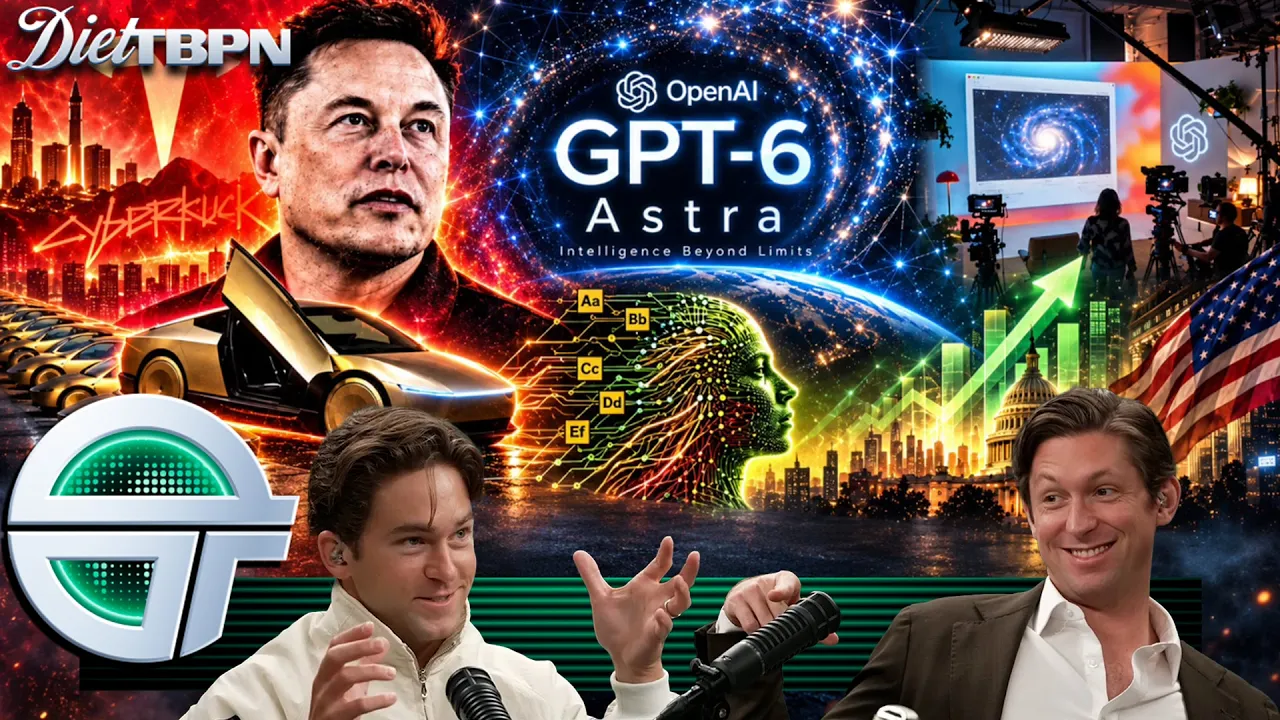
Astra GPT-6 Launches With 3D Blender Modeling, Smashes ARC-AGI V3
TBPN
Generative AI lowers 3D rendering costs so drastically that demand for architectural scenes will surge, while task efficiency renders simple per-token pricing metrics obsolete.
## Background
Published by TBPN on YouTube on September 5, 2026, this episode of Diet TBPN delivers a condensed 30-minute recap of the daily live tech talk show hosted by John Coogan and Jordi Hays. According to the page description, the show highlights key tech news and Silicon Valley trends, featuring discussions on major AI breakthroughs, economic reports, tech hardware, and market dynamics.
## TL;DR
The episode opens with an in-depth discussion on the launch of Astra GPT-6 and its impressive ability to model complex 3D worlds end-to-end in Blender and Unreal Engine 5, signaling a shift toward cost-per-task efficiency over raw token metrics. The hosts then analyze the surprising August US jobs report, which crushed Wall Street expectations with 162,000 jobs added and held unemployment at 4.1%. Additionally, they debate the merits of Dyson's overengineered product design and explore Tesla's Cybercab ambitions, complete with a friendly head-shaving bet regarding MKBHD's timeline predictions.
## Atmosphere & style
The episode carries a high-energy, casual, and techno-optimistic tone, characteristic of a lively Silicon Valley morning show. Hosts John Coogan and Jordi Hays maintain a fast-paced, humorous dialogue packed with playful banter, sharp industry insider jokes, and vivid analogies. The emotional arc transitions seamlessly from intellectual awe over rapid AI progress to upbeat economic analysis and lighthearted banter about consumer tech before winding down into a relaxed, warm long-weekend sendoff.
## Key takeaways
- [00:02](https://www.youtube.com/watch?v=k2kMtCXhVYc&t=2s) Astra GPT-6 introduced major AI benchmark advancements and early access demos showcasing full 3D world-building inside Blender.
- [00:02](https://www.youtube.com/watch?v=k2kMtCXhVYc&t=2s) Achieving top-tier outputs with Astra GPT-6 requires structured multi-agent workflows rather than single-shot prompts.
- [00:02](https://www.youtube.com/watch?v=k2kMtCXhVYc&t=2s) AI models are leveraging open-source repositories like Sketchfab and reference blueprints to ground spatial understanding for 3D modeling.
- [00:02](https://www.youtube.com/watch?v=k2kMtCXhVYc&t=2s) Low-cost AI 3D scene generation enables real estate applications like Zillow interior restyling and virtual fly-throughs, demonstrating Jevons paradox.
- [04:00](https://www.youtube.com/watch?v=k2kMtCXhVYc&t=240s) Astra models can convert 3D Blender scenes directly into interactive, walkable Unreal Engine 5 environments.
- [04:00](https://www.youtube.com/watch?v=k2kMtCXhVYc&t=240s) Automated 3D media generation creates a stronger feeling of AGI for everyday creators than abstract numerical benchmarks like FrontierMath.
- [09:09](https://www.youtube.com/watch?v=k2kMtCXhVYc&t=549s) OpenAI reportedly scaled RL hardware infrastructure with tens of thousands of Mac Minis and Mac Studios for computer-use agent training.
- [09:09](https://www.youtube.com/watch?v=k2kMtCXhVYc&t=549s) Slack holds an advantage for autonomous AI agents because frontier labs heavily train their models on its interface.
- [13:44](https://www.youtube.com/watch?v=k2kMtCXhVYc&t=824s) Rapid benchmark saturation is causing an evaluation shift toward custom 'vibe checks' and domain-specific Gell-Mann testing.
- [13:44](https://www.youtube.com/watch?v=k2kMtCXhVYc&t=824s) AI model cost evaluation is moving from raw token pricing to 'cost per task' efficiency metrics.
- [16:02](https://www.youtube.com/watch?v=k2kMtCXhVYc&t=962s) Hyper-efficient next-generation AI models could flatten overall token growth while increasing the actual economic value delivered.
- [17:04](https://www.youtube.com/watch?v=k2kMtCXhVYc&t=1024s) The August US jobs report beat expectations with 162,000 jobs added, easing immediate recession and AI job displacement fears.
- [17:04](https://www.youtube.com/watch?v=k2kMtCXhVYc&t=1024s) Strong job growth figures present a key counterargument against aggressive Federal Reserve interest rate cuts.
- [21:09](https://www.youtube.com/watch?v=k2kMtCXhVYc&t=1269s) Dyson products divide consumers between high price/build complaints and praise for eliminating core design friction in household appliances.
- [24:32](https://www.youtube.com/watch?v=k2kMtCXhVYc&t=1472s) MKBHD pledged to shave his head if Tesla delivers a sub-$30K autonomous Cybercab by the end of 2026.
- [24:32](https://www.youtube.com/watch?v=k2kMtCXhVYc&t=1472s) Proposed Tesla features like 'Banish Mode' would allow vehicles to independently drop off passengers and navigate to parking spaces.
## Detailed walkthrough
Here is a detailed, faithful walkthrough of the provided transcript section:
[00:02](https://www.youtube.com/watch?v=k2kMtCXhVYc&t=2s) Astra GPT-6 Launch and 3D Scene Modeling in Blender
The AI world experienced a major milestone with the launch of Astra GPT-6. While the official blog post dropped mid-show bringing impressive benchmark results—including the saturation of ARC-AGI V3, forcing the community to move the goalposts once again—the real highlight was watching early access demos of users building full 3D scenes in Blender using Astra. Demonstrations showed that the model can fire up Blender from a single prompt (or a few prompts) and model an entire world end-to-end. However, power users like Matt Schumer emphasized that the "art of prompting" has returned. Achieving truly top-tier outputs requires a structured multi-agent workflow—deploying a manager agent alongside sub-agents—rather than relying strictly on one-shot prompts.
Highlighting community showcases, a creator named Share demonstrated GPT-6 Astra recreating San Francisco's Palace of Fine Arts inside Blender. The building holds historic significance as the site of the 1914 World's Fair, where breakthroughs like the steam locomotive and telephone were showcased to foster deep technological optimism. To execute such complex 3D recreations, the model can ground its spatial understanding by pulling reference diagrams, architectural blueprints, or existing 3D models from open repositories like Sketchfab. Beyond historical monuments, GPT-6 Astra is being tested as a "Pelican bench" standard for real estate fly-through videos. This capability mirrors features on Zillow that allow buyers to restyle listing interiors using back-end AI image generation into modern, contemporary, or colonial designs. By dramatically lowering the rendering cost for spec homes and architectural scenes, this shift exemplifies Jevons paradox—where cheaper production yields a massive explosion in total demand.
- **San Francisco Landmark**: Palace of Fine Arts recreated in Blender via Astra.
- **Historical Context**: The 1914 World's Fair showcased the steam locomotive and telephone.
- **3D Asset Sourcing**: Grounding techniques involve pulling blueprints, AI-generated image references, and models from Sketchfab.
- **Real Estate Applications**: Low-cost 3D fly-through renderings and Zillow-style interior restyling (modern, contemporary, colonial).
---
[04:00](https://www.youtube.com/watch?v=k2kMtCXhVYc&t=240s) Translating 3D Scenes into Walkable Engine Experiences
Creator Thomas demonstrated that Astra excels at ray tracing, realistic lighting, and thoughtful scene composition, taking Blender models and seamlessly translating them into walkable Unreal Engine 5 experiences. This level of cross-format translation implies a future where content effortlessly converts across mediums—turning tweets into blog posts, videos, and full interactive Steam-style video games. The hosts joke that if venture capitalists insist on publishing AI-generated essays or market maps, they should be required to release a playable game or a "Fortnite map" alongside it so readers can physically explore the startup landscape.
Reflecting on what creates a true "feeling of AGI," high-level benchmark scores often fall flat emotionally. Scoring 99% on FrontierMath Tier 4 or dominating TerminalBench Science 0.1 provides abstract numbers that lack visceral meaning to the average person. By contrast, automated 3D modeling hits home for anyone who has spent hundreds or thousands of hours navigating software like Cinema 4D, Houdini, or After Effects. In traditional motion graphics workflows, creating a single 3D scene requires sitting at a 2D screen, watching endless YouTube tutorials, tweaking 4D parameters across time and space, and waiting for heavy render caches—such as baking smoke simulations or object destruction—just to preview low-resolution drafts.
- **Unreal Engine 5 Integration**: Conversion of Blender scenes directly into interactive, walkable Unreal Engine environments.
- **The "VC Game Requirement" Joke**: Substituting traditional VC market maps with playable Fortnite-style maps.
- **Abstract Benchmarks vs. Reality**: 99% on FrontierMath Tier 4 and high scores on TerminalBench Science 0.1 lack emotional resonance compared to tangible media generation.
- **Historical Workflow Pain Points**: Cinema 4D licenses historically cost over $1,000 per year before shifting to subscriptions, creating high barriers to entry compared to open-source Blender.
- **Production Timeline**: Illustrating a US-China military analysis with a 3D Battleship board previously tied up a video editor for an entire week.
---
[09:09](https://www.youtube.com/watch?v=k2kMtCXhVYc&t=549s) Is This AGI? Computer Use, Blender, and the Slack Effect
The broader media ecosystem is declaring the arrival of AGI, with *The Wall Street Journal* proclaiming that humanity is entering the Artificial General Intelligence era. This follows earlier aggressive declarations, such as Stripe calling AGI on January 1st or Tyler Cowen declaring GPT-4 or Claude 01 as AGI years prior. The debate has shifted from whether the models are artificial or intelligent to "how general" they actually are. To train models on real-world computer use, lab infrastructure has scaled massively; OpenAI reportedly purchased tens of thousands of Mac Minis and Mac Studios to run reinforcement learning environments.
Because open-source tools like Blender can be duplicated infinitely across training environments, models become exceptionally proficient at them. This creates a distinct software dynamic similar to Slack's recent momentum. When Alexandr Wang moved Meta teams off internal tools to Slack, he specifically noted that Slack is superior for interacting with AI agents. Because frontier AI labs internally run on Slack, their models are heavily RL-trained on Slack's interface, turning it into the default environment for autonomous agents. This raises the question of whether closed-source or subscription-based software like Cinema 4D and Adobe Premiere will fall behind, or if agentic capability will generalize across all user interfaces regardless of training bias.
- **Media AGI Declarations**: *The Wall Street Journal*, Stripe, and Tyler Cowen declaring the dawn of AGI.
- **Hardware Scale for Computer Use**: OpenAI acquired "tens of thousands of Mac Minis and Mac Studios" to train computer-use agents.
- **The "Slack Advantage"**: Alexandr Wang moved Meta to Slack due to its optimized environment for AI agents trained in frontier labs.
- **Generalization vs. Niche Software**: Questioning whether RL training in Blender translates to closed-source software like Cinema 4D, Houdini, or Adobe Premiere.
---
[13:44](https://www.youtube.com/watch?v=k2kMtCXhVYc&t=824s) The Death of Benchmarks, Vibe Checks, and Cost-Per-Task Metrics
As AI models rapidly saturate traditional benchmarks within days of their release, the industry is reaching the end of the benchmark era. Eye-glazing performance charts are being replaced by the "vibe check"—testing a new model directly against a domain you intimately understand to see if it triggers "Gell-Mann amnesia" (revealing flaws only when applied to your area of expertise). The hosts jokingly suggest reviving specialized stress tests like the "Horse Bench," "Comedy Bench," or "Shrimp Fried Rice Bench" to evaluate nuance and humor.
Reactions across X (formerly Twitter) highlight how the standard evaluation metrics are changing. Responding to Joe Weisenthal's post about one-prompt 3D browser games, the hosts emphasize that true gaming requires native performance on Steam, PC, PS5, or Xbox rather than lightweight browser tabs. Furthermore, raw token pricing has become an outdated metric. Citing analysis from Stephen Heidari, while a model like Gemini 3.8 Flash may appear 13 times cheaper on a per-token basis, Astra proves significantly cheaper "per task" because its heightened efficiency accomplishes the end goal in far fewer steps.
- **Gell-Mann Amnesia Test**: Evaluating AI by prompting it in fields where the user possesses expert domain knowledge.
- **Custom Vibe Benchmarks**: Humorously referencing the "Horse Bench," "Comedy Bench," and "Shrimp Fried Rice Bench".
- **True Gaming Standard**: Real interactive testing must move beyond Chrome tabs into native Steam, PS5, or Xbox environments.
- **Token Pricing Shift**: Stephen Heidari's breakdown showing Gemini 3.8 Flash is 13x cheaper per token, but Astra is cheaper per task due to task efficiency.
[16:02](https://www.youtube.com/watch?v=k2kMtCXhVYc&t=962s) AI Benchmarks and the "Cost Per Task" Shift
The conversation opens with a discussion on how AI efficiency will reshape tech metrics. The hosts emphasize evaluating models by "cost per task" rather than simple token counts. While Alphabet CEO Sundar Pichai frequently highlights the exponential surge in token volumes across Google's platforms, the hosts hypothesize that hyper-efficient future models (such as Gemini 3.8 or Flash variants) could trigger a structural deceleration in token growth. Even if overall token volume growth stalls or kinks, the underlying work delivered by AI will be drastically more valuable, forcing the industry to adapt its expectations. On a humorous note, the hosts bring up Jack Altman’s reaction to recent AI benchmark wins, quoting his playful jab to his brother: "Sam, exclamation point. I guess even a blind squirrel can find a nut sometimes. Congrats."
- **Cost Per Task vs. Token Volume:** Shift in emphasis from raw usage to efficiency and economic output.
- **Potential Token Volume Deceleration:** Next-generation models with 100x efficiency gains could flatten the exponential token growth charts while increasing overall value delivered.
- **Quote:** Jack Altman to Sam Altman: "Sam, exclamation point. I guess even a blind squirrel can find a nut sometimes."
---
[17:04](https://www.youtube.com/watch?v=k2kMtCXhVYc&t=1024s) August Jobs Report Crushes Expectations
Transitioning from AI metrics to macroeconomic data, the hosts examine the surprising August US employment figures. Wall Street Journal economists had broadly projected a sluggish, seasonally adjusted addition of 53,000 jobs, even publishing op-eds urging the public to accept "meh" job growth. Instead, the economy printed a blowout figure of 162,000 jobs—more than triple predictions—alongside upward revisions to prior months (June to 31,000 and July to 21,000). The unemployment rate held steady at a historically low 4.1%, delivering a strong narrative violation to recession fears and temporarily hitting the pause button on the anticipated "AI jobs apocalypse."
- **Job Creation:** +162,000 jobs added in August versus the forecasted +53,000.
- **Upward Revisions:** June revised up to +31,000 and July up to +21,000.
- **Unemployment Rate:** Unchanged at 4.1%.
- **Economic Sectors:** Food services and drinking places led the charge (+59,000 jobs), easing fears of a post-World Cup slump. Local government education added +42,000 jobs, while manufacturing and healthcare also posted strong gains. Information and finance sectors shed jobs.
- **Interest Rates:** The robust numbers present a strong counterargument against aggressive Federal Reserve rate cuts in September.
- **Outlier Tech vs. Main Street:** The hosts contrast tech unicorn efficiency (e.g., Hugging Face building a $12B outcome with a couple hundred employees) against Main Street small businesses, which drive the vast majority of physical economy employment.
---
[21:09](https://www.youtube.com/watch?v=k2kMtCXhVYc&t=1269s) The Great Dyson Debate: Halo Weapons and Nostalgia
A viral social media post by TJ Parker sparks a lively debate on whether premium Dyson household products are actually overengineered status symbols or essential household innovations. While some online commenters complain that Dyson vacuums ruin rugs or feel cheap and plasticky, the hosts express admiration for Dyson’s design philosophy of turning everyday appliances into futuristic gadgets that "look like *Halo* weapons." They joke about needing to style an entire home—complete with a *Halo* Banshee parked outside—to complement the sci-fi aesthetic.
Recalling the era before James Dyson's vacuum revolution, the hosts share formative childhood memories of dragging noisy, heavy, bagged vacuums around the house. They frame the transition to cordless, battery-powered, bagless vacuums as solving a complex "traveling salesperson problem" of household chores.
- **The Criticisms:** High price tags, creaky plastic builds, and claims from rug makers that excessive suction causes carpet shedding.
- **The Praise:** James Dyson "one-shotted" massive category friction by eliminating power cords, dirty vacuum bags, and heavy metallic frames.
- **Quote:** "I appreciate the overengineering... Somebody needs to make a $500 toothbrush."
---
[24:32](https://www.youtube.com/watch?v=k2kMtCXhVYc&t=1472s) Tesla Cybercab, MKBHD's Bald Bet, and the "Banish" Mode
The discussion shifts to the Tesla Cybercab and Elon Musk's aggressive production goals. Reviewer Marquez Brownlee (MKBHD) previously voiced skepticism that Tesla could deliver a fully autonomous, steering-wheel-less Cybercab for under $30,000 by the end of 2026, famously pledging to shave his head if Musk pulls it off on schedule. In response, the hosts engage in a playful side-bet, offering to shave producer Tyler’s head if Tesla fails to hit the target.
Discussing real-world testing of Tesla’s latest Full Self-Driving (FSD) software, the hosts argue the technology is already close to solving autonomous transit. They point out that in ride-hailing scenarios, edge cases like tricky residential driveways or valet stands are far less frequent. They also highlight a proposed feature concept coined by team member Brandon: **"Banish Mode"**—the inverse of Tesla's Smart Summon—where a driver can step out at a curb destination and command the car to drive off independently to find and pay for parking.
- **Cybercab Pricing & Specs:** Target price under $30,000, operating costs estimated at $0.20/mile ($0.30–$0.40/mile including taxes and fees) compared to city buses averaging ~$1.00/mile.
- **Roadster vs. Cybercab:** The hosts express higher confidence in Cybercab shipping ahead of the long-delayed Tesla Roadster, noting the massive Total Addressable Market (TAM) difference between daily autonomous taxis and niche $250,000 sports cars.
- **Malibu Surf Forecast:** The segment wraps up with a local shoutout to the National Weather Service forecasting a heavy hurricane swell along the Malibu coastline, urging SoCal viewers to enjoy the "dangerously good" weekend surf.
[31:56](https://www.youtube.com/watch?v=k2kMtCXhVYc&t=1916s) Lake Weekend Plans, Malibu Pontoons, and Sign-off
The hosts wrap up the episode as they prepare to head off into a long three-day weekend. John jokes about how he might spend his time tinkering with OpenAI's Astra model, prompting warm wishes for a "happy Lake" weekend. The relaxed, cheerful banter continues as they interact with audience comments, including a note from a viewer named Dee who suggests taking a pontoon boat out off the coast of Malibu. The hosts laugh at the absurd image, noting that taking a pontoon into the ocean surf in Malibu "would be insane" and that a pontoon boat "might flip" in those waves.
Closing out the show on a high note, the hosts urge their community to support the show across platforms before taking off until the following week. They remind viewers to leave five-star ratings on Apple Podcasts and Spotify, and to sign up for their daily newsletter at tbpn.com. Expressing their affection for the audience with a hearty "We love you guys," they promise to be back live on Tuesday.
- **Holiday Weekend:** The hosts wish everyone a "wonderful three day weekend" and urge viewers to enjoy their time off.
- **Audience Banter:** In response to a commenter recommending a pontoon ride in Malibu, the hosts highlight the ocean risk, joking that the boat would likely flip.
- **Call to Action:** Viewers are reminded to rate the show five stars on Apple Podcasts and Spotify, and subscribe to the newsletter at tbpn.com.
- **Schedule:** The show returns live on Tuesday following the long weekend.
## Notable quotes
> [16:02](https://www.youtube.com/watch?v=k2kMtCXhVYc&t=962s) Sam, exclamation point. I guess even a blind squirrel can find a nut sometimes. Congrats. — Jack Altman
> [21:09](https://www.youtube.com/watch?v=k2kMtCXhVYc&t=1269s) I appreciate the overengineering... Somebody needs to make a $500 toothbrush.
> [32:32](https://www.youtube.com/watch?v=k2kMtCXhVYc&t=1952s) We love you guys
## Mentioned
Adobe Premiere, Alexandr Wang, Alphabet, Astra, Astra GPT-6, Cisco, Console, CrowdStrike, Dyson, Figma, FSD, Gemini 3.8 Flash, GPT-4, Hugging Face, Jack Altman, James Dyson, Jevons paradox, Joe Weisenthal, John Coogan, Jordi Hays, Mark Cuban, Mark Zuckerberg, Marquez Brownlee (MKBHD), Matt Schumer, Meta, MongoDB, NYSE, OpenAI, Palace of Fine Arts, Public, Railway, Ramp, Sam Altman, Satya Nadella, Share, Shopify, Sketchfab, Slack, Stephen Heidari, Stripe, TBPN, Tesla Cybercab, Tesla Roadster, TJ Parker, Tyler Cowen, Unreal Engine 5, Zillow
Astra GPT-6 发布:支持 Blender 3D 建模并刷新 ARC-AGI V3 纪录
生成式 AI 极大降低了 3D 渲染成本,将推动建筑场景需求激增,而任务执行效率也让单纯按 token 计费的模式逐渐过时。
本期节目首先深入探讨了 Astra GPT-6 的发布及其在 Blender 和 Unreal Engine 5 中端到端构建复杂 3D 世界的惊人能力,标志着行业重心正从原始 token 指标转向单任务成本效益。随后,主持人分析了出人意料的美国 8 月就业报告——该数据新增 162,000 个就业岗位,远超华尔街预期,并将失业率维持在 4.1%。此外,他们还探讨了 Dyson 过度工程化产品设计的优劣,并讨论了 Tesla 对 Cybercab 的布局,期间还围绕 MKBHD 对时间线的预测立下了一个友好的剃头赌局。
Astra GPT-6 发布并在基准测试中取得突破,早期演示展现出直接在 Blender 中端到端构建 3D 场景的能力;资深用户指出要获得顶级效果,需要采用多 Agent 协作架构而非单纯的单次提示词。 (0:02)
创作者演示了将 Astra 在 Blender 中生成的 3D 模型无缝转换为虚幻引擎 5(Unreal Engine 5)可探索环境,相较于抽象的 FrontierMath 测试,这种自动化 3D 创作给大众带来了更强烈的 AGI 实感。 (4:00)
为训练具备电脑操作能力的 Agent,OpenAI 据悉采购了数万台 Mac Mini 和 Mac Studio;由于开源工具 Blender 和 Slack 在前沿实验室中被广泛用作训练环境,它们正逐渐成为 AI Agent 的默认操作平台。 (9:09)
随着模型迅速饱和基准测试,评估重心正转向“单任务成本”与直观体验测试(Vibe Check);分析指出 Astra 虽每 Token 价格未必最低,但凭借极高效率在单任务成本上更具优势。 (13:44)
美国 8 月非农就业激增 16.2 万人远超预期的 5.3 万人,暂时缓解了市场对 AI 引发就业崩溃的担忧;此外科技博主 MKBHD 就特斯拉能否在 2026 年底前推出低于 3 万美元的 Cybercab 发起剃头赌注。 (17:04)
Reading summary
TBPN explores how frontier AI models like Astra GPT-6 are shifting technological benchmarks from abstract evaluation metrics to agentic computer workflows and cost-per-task economics, while broader US employment and autonomous transit data highlight the contrast between digital efficiencies and the physical economy.
Astra GPT-6 and Agentic 3D Generation (0:02)
The debut of Astra GPT-6 highlighted the model's ability to automate complex 3D environments in Blender from natural language prompts, demonstrated by creator showcases recreating San Francisco's Palace of Fine Arts using blueprints and Sketchfab references. Power users such as Matt Schumer noted that reaching high-quality results currently requires structured multi-agent workflows rather than simple one-shot prompting. Early experiments also translated Blender scenes directly into walkable Unreal Engine 5 spaces, pointing toward real estate applications like low-cost fly-through tours and interior restyling that reflect Jevons paradox, where lower production friction sparks expanded demand.
This workflow shift reflects broader industry efforts to train models on real-world computer use. OpenAI reportedly acquired tens of thousands of Mac Minis and Mac Studios to run reinforcement learning environments. Because open-source tools like Blender can be reproduced at scale in training clusters, models develop deep proficiency with them—mirroring how Meta transitioned teams to Slack because frontier AI labs optimize their agents on Slack's interface. It remains unresolved whether these capabilities will generalize seamlessly to closed, subscription-based creative suites like Cinema 4D, Houdini, or Adobe Premiere.
Rethinking Evaluation: From Token Volume to Task Cost (13:44)
With modern models rapidly saturating benchmarks such as ARC-AGI V3, TerminalBench Science 0.1, and FrontierMath Tier 4 within days of release, the industry is transitioning toward practical vibe checks and expert testing designed to detect Gell-Mann amnesia. The hosts argue that abstract performance scores lack emotional resonance compared to tangible media generation that replaces historically painful motion graphics and rendering workflows.
At the same time, standard economic evaluations are shifting from per-token pricing to cost per completed task. Citing analysis from Stephen Heidari, the hosts note that although models like Gemini 3.8 Flash may appear 13 times cheaper on a raw token basis, a more capable model like Astra can be cheaper overall by completing objectives in far fewer operational steps. The hosts hypothesize that this compounding efficiency could eventually flatten or slow aggregate token volume growth across cloud platforms, even as the ultimate economic value produced by AI systems increases.
August Jobs Growth Contrasts AI Displacement Fears (17:04)
Macroeconomic data disrupted concerns regarding immediate AI-driven labor contraction as the US economy added 162,000 jobs in August, substantially exceeding Wall Street Journal economist projections of 53,000. Upward revisions also raised June figures to 31,000 and July to 21,000, while the national unemployment rate held steady at 4.1%. The resilient report presented a strong counterargument against aggressive interest rate cuts by the Federal Reserve in September.
Job gains were concentrated heavily in in-person service and public sectors, led by food services and drinking places (+59,000) and local government education (+42,000), alongside manufacturing and healthcare, whereas the information and finance sectors experienced net reductions. The hosts contrasted the physical economy's enduring labor demands with outlier software businesses, such as Hugging Face reaching a $12 billion valuation with only a few hundred employees, emphasizing that Main Street enterprises continue to sustain aggregate employment.
Cybercab Targets and Autonomous Fleet Unit Economics (24:32)
Tesla's planned Cybercab introduces aggressive economic targets, including a vehicle purchase price below $30,000 without a steering wheel by the end of 2026. Reviewer Marques Brownlee publicly doubted Tesla will meet this production deadline, placing a high-profile bet on the timeline. Evaluating commercial viability, the hosts cited estimated operating costs of $0.20 per mile—or $0.30 to $0.40 per mile including taxes and fees—which significantly undercuts municipal bus transit costs averaging roughly $1.00 per mile.
The hosts argued that autonomous ride-hailing networks encounter fewer unpredictable edge cases than complex residential driveways, suggesting fleet services may scale faster than consumer niche vehicles like the long-delayed Tesla Roadster. They also highlighted user-experience concepts like a proposed "Banish Mode"—the reverse of Smart Summon—which would allow passengers to exit at curbs while the vehicle independently searches and pays for parking.
While AI agents and autonomous vehicles show rapid technical advances in software navigation and target operating costs, their broader real-world integration remains bounded by unresolved software generalization, strict production schedules, and a resilient physical economy that continues to drive broad-based employment.
精炼阅读摘要
本期节目探讨了技术与经济交汇的核心议题:Astra GPT-6 在 3D 建模与跨引擎生成中展现出突破性的工程效能,推动 AI 评价标准从抽象基准转向“单任务成本”;与此同时,大幅超预期的美国非农就业数据与特斯拉无人出租车的激进商业目标,共同对短期内的“AI 失业论”及自动化落地路径提出了现实检验。
Astra 与 3D 端到端空间建模突破 (0:02)
Astra GPT-6 的发布在 AI 领域引发震动,其基准成绩迅速使 ARC-AGI V3 达到饱和。然而,更具标志性的是其在开源建模软件 Blender 中的端到端世界构建能力。演示显示,模型仅需少量提示词即可完成复杂 3D 场景的搭建与渲染。创作者 Matt Schumer 指出,当前顶级效果依赖于由“主管智能体”协调“子智能体”的结构化多智能体工作流,而非单纯的单次提示词。例如,创作者 Share 利用蓝图与 Sketchfab 开放资源,在 Blender 中完整复刻了旧金山艺术宫;该能力不仅被用于房产漫游视频测试与类似 Zillow 的风格重绘,还展现出显著的杰文斯悖论——渲染成本的大幅下降将直接刺激 3D 资产的整体需求激增。
创作者 Thomas 进一步展示了模型在光线追踪、拟真照明和场景构图上的表现,能够将 Blender 模型无缝转译为 Unreal Engine 5 中可实时行走的交互式环境。节目评论认为,相比于 FrontierMath Tier 4 取得 99% 分数或 TerminalBench Science 0.1 等抽象跑分,这种将文本直接转化为可交互体验的能力给从业者带来了更强烈的通用人工智能(AGI)体感。在此之前,制作复杂的 3D 动画往往需要操作者承受每年超过 1000 美元的 Cinema 4D 许可费,并花费数天乃至数周时间进行动力学解算与分层渲染缓存。
计算机使用训练与开源工具的生态偏好 (9:09)
随着《华尔街日报》等多方媒体频繁宣告 AGI 时代的到来,行业讨论正逐渐聚焦于模型通用性的深度。据称 OpenAI 购置了数以万计的 Mac Mini 与 Mac Studio 构建强化学习环境,以专门训练模型操作真实计算机界面的能力。这种训练机制直接影响了工具生态的适应性:由于 Blender 等开源工具可以在虚拟环境中被无限次低成本复制,AI 在这些软件上的熟练度提升尤为迅速。
这一趋势催生了类似于 Slack 的软件偏好现象。此前 Alexandr Wang 将 Meta 团队迁移至 Slack 时曾明确表示,由于前沿实验室内部深度依赖 Slack,其核心模型均在 Slack 界面上接受了高强度的强化学习,使其成为 AI 智能体的默认交互环境。节目由此提出关键疑问:随着 AI 实验室资源向易于虚拟化和大规模部署的软件倾斜,Cinema 4D 或 Adobe Premiere 等专有及订阅制闭源软件是否会在智能体生态中面临落后风险,仍取决于模型界面操作能力的泛化水平。
模型评估转型:从基准跑分到单任务成本 (13:44)
传统基准测试由于屡屡在模型发布数日内即被攻破,其参考价值正急剧衰退。行业评估正在转向基于专家直觉的“氛围检验”(Vibe Check)与盖尔曼健忘症测试,即直接让模型在评估者拥有深厚专业背景的领域执行任务以暴露细节瑕疵。与此同时,业界对交互式内容的评测标准也在提高,认为真正的游戏交互检验必须脱离轻量级网页环境,在 Steam、PS5 等原生平台中展开。
商业层面上,原始的 Token 计费标准正在失效。分析师 Stephen Heidari 的测算表明,尽管 Gemini 3.8 Flash 在单 Token 价格上较 Astra 便宜达 13 倍,但在完成复杂工程目标时,Astra 因执行步骤少、效率高,在“单任务成本”上反而更具经济性。这表明,即便未来高效率模型使 Token 消耗总量增速出现结构性放缓,AI 实际交付的经济价值仍将持续增长。
非农就业爆表与“AI失业论”的现实检验 (17:04)
宏观经济数据为 AI 驱动的失业恐慌提供了强有力的反向证据。美国 8 月非农就业新增 16.2 万人,远高于《华尔街日报》等机构共识预测的 5.3 万人,且 6 月和 7 月数据分别上修至 3.1 万人和 2.1 万人,失业率稳健维持在 4.1% 的历史低位。这一强劲增长显著缓解了衰退担忧,同时也削弱了市场对美联储在 9 月大幅降息的预期。
从就业结构来看,餐饮与饮品场所(+5.9 万人)和地方政府教育部门(+4.2 万人)领涨,制造业与医疗保健业同步走强,而信息与金融行业则出现岗位减少。节目指出,以 Hugging Face 凭借数百名员工实现 120 亿美元估值为代表的科技初创企业极致人效,与驱动实体经济庞大劳动力就业的传统商业体系存在深刻脱节,短期内技术替代尚未对实体就业基本盘造成系统性冲击。
特斯拉 Cybercab 成本架构与落地前景 (24:32)
在自动驾驶与硬件落地环节,讨论聚焦于特斯拉 Cybercab 的规划预期。特斯拉设定的目标是交付无方向盘、售价低于 30,000 美元的专用无人出租车,并将运营成本控制在每英里 0.20 美元(含税费约 0.30 至 0.40 美元),大幅低于城市公共汽车约每英里 1.00 美元的运营水平。测评人 Marques Brownlee(MKBHD)此前对此表达强烈质疑,并立下若特斯拉能在 2026 年底前如期交付便剃光头的赌约。
节目分析认为,特斯拉最新 FSD 系统的实际表现已高度接近商业客运要求,且出行场景往往规避了复杂的私人车道等罕见边缘路况。团队还探讨了潜在的“放逐模式”(Banish Mode)——允许乘客在目的地路边下车后,车辆自主离去寻找并支付车位。考虑到无人驾驶出行覆盖的庞大潜在市场规模,节目预计 Cybercab 的交付优先级将显著高于长期搁置的 25 万美元高端跑车 Roadster。
本期内容反映出 AI 领域由纯算法竞争向系统工程、界面控制与单位经济学转型的现实。然而,开源软件强化学习所建立的能力优势能否平滑跨越至专有软件平台,以及超高效推理在抑制 Token 消费量增长的同时如何重塑软件商业模式,仍是产业端尚未解决的核心问题。
Detailed notes — zh
## Background
本期节目由科技脱口秀频道 TBPN(由 John Coogan 和 Jordi Hays 主持)于 2026 年 9 月 5 日发布在 YouTube 平台。页面简介显示,该视频属于《Diet TBPN》系列(将原本数小时的直播精粹浓缩为 30 分钟),被《纽约时报》誉为“硅谷的新宠”,本集主要聚焦 Astra GPT-6 的发布实测、8 月非农就业数据打破 AI 失业论、戴森产品引发的舆论大辩论以及特斯拉 Cybercab 的交付时间线与剃头赌局。
## TL;DR
节目首先深入分析了最新发布的 Astra GPT-6,主播将其利用多 Agent 驱动 Blender 与虚幻引擎完成 3D 建模的表现视为真正的“AGI 时刻”,并剖析了开源生态的“靶心效应”与从 Token 计价向“每任务成本”转变的评测新范式。随后,针对刚刚出炉且大超预期的 8 月非农就业数据(新增 16.2 万人),节目指出主街实体经济的韧性有力反驳了科技圈宣扬的“AI 就业末日论”。中段讨论了戴森吸尘器到底是“过度工程化的塑料制品”还是终结有线吸尘历史的革命性产品。最后,节目深度探讨了特斯拉 Cybercab 预期的低运营成本、对标公共交通的巨大潜在市场规模(TAM)以及科技圈围绕其交付时间立下的剃头赌约,并在马里布冲浪警报与劳工节长周末的轻松互侃中收官。
## Atmosphere & style
整场节目充斥着快节奏、高信息密度且幽默风趣的硅谷极客闲聊(tech banter)风格,两位主持人配合极为默契。他们擅长将硬核的技术演进与痛点(如 3D 渲染关键帧烘焙的血泪史、强化学习在 Mac 集群上的部署)跟无厘头的爆笑调侃(如给吸尘器路线算“旅行商问题”、AI 提效让打工人周一到周四都在吃漫长午餐、互立剃头赌约)无缝杂糅。听感既有对技术爆发式跃迁的纯粹乐观与惊叹,又带着对资本造神与极端末日叙事的清醒解构,在长周末来临前营造出一种既硬核又松弛的独特谈话场域。
## Bulletin
- [00:02](https://www.youtube.com/watch?v=k2kMtCXhVYc&t=2s) Astra GPT-6 发布展现出惊人的 3D 生成能力,用户仅需几条 Prompt 即可协同驱动 Blender 自动建模并在虚幻引擎 5 中生成可漫游场景,刷新了大众对 AGI 与动效设计的认知阈值。
- [13:44](https://www.youtube.com/watch?v=k2kMtCXhVYc&t=824s) 大模型计费与评测逻辑发生重大转变:传统基准测试因被刷爆而面临信任崩塌,评估重心正转向实际垂直领域的直觉检验(Vibe Check)及以单任务为核算的“每任务成本(Cost Per Task)”。
- [17:04](https://www.youtube.com/watch?v=k2kMtCXhVYc&t=1024s) 美国 8 月非农就业新增 16.2 万人远超预期的 5.3 万人,餐饮服务业大幅扩招与低至 4.1% 的失业率表明实体主街经济极具韧性,有力反驳了 AI 即将消灭所有工作的短期末日论。
- [24:32](https://www.youtube.com/watch?v=k2kMtCXhVYc&t=1472s) 特斯拉 Cybercab 预估每英里综合运营成本低至 30 至 40 美分且单车售价预期低于 3 万美元,引发博主 MKBHD 立下“若按期交付便剃光头”的赌约,其万亿级 TAM 驱动特斯拉在交付优先级上显著高于 Roadster 2。
## Key takeaways
- [00:02](https://www.youtube.com/watch?v=k2kMtCXhVYc&t=2s) Astra GPT-6 在 ARC-AGI V3 饱和后进一步推动基准标准升级,但最震撼业界的实则是通过 Manager Agent 与 Sub-agents 协同直接在 Blender 中凭空构建 3D 世界。
- [01:23](https://www.youtube.com/watch?v=k2kMtCXhVYc&t=83s) 模型展现出通过网络蓝图检索、概念图校准与 Sketchfab 资产调取快速复刻复杂现实地标(如旧金山艺术宫)的能力,为低成本样板房 3D 漫游开辟了全新商业化落地路径。
- [03:58](https://www.youtube.com/watch?v=k2kMtCXhVYc&t=238s) 内容媒介正在经历降维打通,自然语言推文不仅能自动扩展为深度文章和宣传片,未来更有可能直接一键编译为 Steam 或虚幻引擎 5 上的可交互 3D 游戏。
- [05:06](https://www.youtube.com/watch?v=k2kMtCXhVYc&t=306s) 对比枯燥的数学基准测试,3D 建模与动态图形设计极高的四维调试门槛与漫长等待周期,使 Blender 的自动化生成被业内人士视为真正的“AGI 时刻”。
- [05:06](https://www.youtube.com/watch?v=k2kMtCXhVYc&t=306s) 动效设计领域将迎来杰文斯悖论:当渲染与建模成本断崖式下跌,全社会的 3D 渲染需求将呈爆发式增长,普通人尝试后留下的最后 10% 瓶颈依然需要顶尖人类专家接管。
- [09:45](https://www.youtube.com/watch?v=k2kMtCXhVYc&t=585s) Blender 凭借开源免费的属性成为前沿 AI 实验室搭建大规模强化学习(RL)与 Computer Use 训练环境的天选平台,享有极强的“靶心红利”。
- [12:05](https://www.youtube.com/watch?v=k2kMtCXhVYc&t=725s) 前沿实验室的工具偏好(如 Slack 和 Blender)正在倒逼行业生态向其靠拢,但闭源工业软件(如 Adobe Premiere)的授权壁垒与人类主观品味依然制约着跨场景通用化。
- [13:44](https://www.youtube.com/watch?v=k2kMtCXhVYc&t=824s) 评测 AI 正在回归直觉体验并需警惕“盖尔曼失忆症”;同时单纯对比每 Token 单价已失去意义,推理更精准的“每任务成本(Cost Per Task)”成为现代商业评估核心。
- [17:04](https://www.youtube.com/watch?v=k2kMtCXhVYc&t=1024s) 美国 8 月非农就业新增 16.2 万人且失业率稳在 4.1%,餐饮服务业激增 5.9 万人,证明不能用轻资产极高估值的“科技幂律神话”去代表劳动密集型的主街实体经济。
- [19:29](https://www.youtube.com/watch?v=k2kMtCXhVYc&t=1169s) 强劲的就业报告极大削弱了美联储在 9 月激进降息的理由,尽管信息与金融行业在技术冲击下持续承压,但整体“AI 引发就业崩溃”的论调再度被推迟。
- [21:09](https://www.youtube.com/watch?v=k2kMtCXhVYc&t=1269s) 关于戴森产品的争论揭示了科幻外观、高昂品牌溢价与塑料手感之间的反差,但其无绳手持电芯设计对传统笨重电线吸尘器的颠覆具有不可磨灭的历史意义。
- [24:32](https://www.youtube.com/watch?v=k2kMtCXhVYc&t=1472s) Cybercab 的低售价(低于 3 万美元)与激进交付时间表引发数码圈赌局,主播认为其 95% 里程已可交由 FSD 应对,用户最迫切期待的是人下车后车辆自行泊车的“驱逐模式(Banish Mode)”。
- [28:55](https://www.youtube.com/watch?v=k2kMtCXhVYc&t=1735s) Cybercab 宣称的全包运营成本仅为每英里 30-40 美分,甚至低于受财政补贴的城市公交车实际营运成本(约 1 美元/英里),构成了“个性化公共交通”的商业护城河。
- [30:36](https://www.youtube.com/watch?v=k2kMtCXhVYc&t=1836s) 相比售价 25 万美元且受众狭窄的纯电超跑 Roadster,瞄准万亿出行替代市场的 Cybercab 在商业逻辑与 TAM 空间上对特斯拉而言具备绝对优先性。
## Detailed walkthrough
### [00:02](https://www.youtube.com/watch?v=k2kMtCXhVYc&t=2s) Astra GPT-6 震撼发布与 Blender 3D 建模演示
AI 领域迎来重磅新闻:Astra GPT-6 正式发布。前一天的节目录制进行到一半时,官方博客文章便已上线,团队匆匆过了一遍内容。新模型刷爆了各类基准测试,尤其是 ARC-AGI:由于 ARC-AGI V3 已经被彻底攻破饱和,行业甚至不得不再次“移动球门柱”,这在那些细节复杂的测试题目面前显得尤为惊人。
然而,最令主持人感到震撼的不是抽象的基准数字,而是各种流出的实测演示——不少用户提前拿到了 GPT-6 Astra 的内测权限,仅凭一条或少数几条 Prompt,就能直接驱动 Blender 完整执行任务,凭空建模出一整个 3D 世界。Matt Shumer 展示了几个最为惊艳的案例,并指出“Prompt 的艺术已经回归”;他的实现流程非常讲究,利用“Manager Agent(管理 Agent)”搭配“Sub-agents(子 Agent)”协同分工。虽然模型单次直接生成(one-shot)的下限已经很高,但要想达到令人叹为观止的成片级效果,依然需要这套精细的提示词与架构打磨。
```mermaid
flowchart TD
accTitle: Astra GPT-6 3D Scene Generation Flow
accDescr: Pipeline from user prompt to multi-agent management, Blender asset sourcing, and engine rendering.
subgraph Prompting ["提示词与 Agent 层"]
A["用户自然语言 Prompt"] --> B["Manager Agent (主管)"]
B --> C["Sub-agents (子 Agent 协同)"]
end
subgraph DataSourcing ["资产与参考数据检索"]
C --> D["网上参考图 / 建筑蓝图"]
C --> E["AI 图像生成三角校准"]
C --> F["Sketchfab 3D 资产库"]
end
subgraph Production ["3D 场景与引擎输出"]
D & E & F --> G["Blender 自动构建 3D 场景"]
G --> H["光照与光线追踪优化"]
H --> I["Unreal Engine 5 可交互漫游 / 视频漫游"]
end
```
### [01:23](https://www.youtube.com/watch?v=k2kMtCXhVYc&t=83s) 真实场景重建与房产漫游:技术乐观主义的回归
网络上涌现出大量令人印象深刻的试用实录。其中一位叫 Share 的用户展示了 GPT-6 Astra 在 Blender 中精准复刻旧金山艺术宫(Palace of Fine Arts)的案例。艺术宫是 1914 年为巴拿马太平洋万国博览会而建的标志性建筑,当年正是为了展示蒸汽机车和电话等划时代发明。那是一个科技让全人类对未来抱有纯粹乐观主义的年代;尽管这种乐观情绪在后来有所褪色,但像 Astra 这样的模型正重新唤起大家对未来的憧憬。
要完成如此复杂的 3D 建模,模型可以在背后使用多种手段进行三角校准与定位:
- 直接从互联网检索现场照片、参考线稿乃至免费公开的建筑蓝图。
- 借助 AI 图像生成器内部对“艺术宫”视觉特征的理解先出概念图。
- 自动化抓取如 Sketchfab 等平台上的免费 3D 资产作为基础模型并在此之上搭建场景。
另一项广泛展示的落地应用是房地产领域的“漫游视频(fly-through video)”。这几乎成了新的测试标准(“Pelican Bench”)。虽然 Zillow 目前已在少数房源上线了基于后端的 AI 重绘功能(允许买家一键将室内照片切换成现代风、当代风或殖民风格),但覆盖面极窄。GPT-6 Astra 展现出的能力意味着,只要给它一个房源链接,它就能直接重建出完整的 3D 房屋模型。对于那些没有充裕预算去聘请专业团队渲染的样板房(spec homes)销售商而言,制作成本将被无限压低。
### [03:58](https://www.youtube.com/watch?v=k2kMtCXhVYc&t=238s) 从一条推文到 Steam 游戏:内容媒介的降维打通
另一位测试者 Thomas 展示了更具视觉冲击力的成果:模型在 Blender 中搭建的场景呈现出极高水准的布光与光线追踪质感,随后直接无缝接入虚幻引擎 5(Unreal Engine 5),成为一段可供玩家自由走动漫游的交互体验。
两位主持人感叹,未来的内容媒介将迎来前所未有的自由转换:
- 用户的一条 Tweet 可以自动扩展成深度博客文章,进而生成宣传视频。
- 博客内容甚至可以直接转化为 Steam 风格的独立 3D 视频游戏。
- 两人打趣称,未来风投机构(VC)如果再想发表由 AI 代笔的宏篇大论,监管应当强制要求他们“附赠一款玩法呼应的同主题游戏”。不要再发枯燥的行业市场版图(Market Map),直接做成一张《堡垒之夜》(Fortnite)的对战地图,让各家热门 AI 初创公司化身为地图上的不同城镇据点供玩家空降。
### [05:06](https://www.youtube.com/watch?v=k2kMtCXhVYc&t=306s) 亲历 3D 动效制作的血泪史:为什么 Blender 演示才是“AGI 时刻”
在评判 AI 模型时,每个人的“AGI 感知阈值”完全不同。像 FrontierMath Tier 4 测出的 99% 高分,或者各类终端科学基准测试,对于外行来说仅仅是一串毫无感情波动的冰冷数字——毕竟普通人本能地就觉得计算机本来就该擅长数学。主持人甚至打趣自己当年连代数都没完全搞懂,全靠代数一(Algebra 1)打天下,因此顶尖数学测试根本打动不了他。
真正让人感受到“这就是 AGI”的,恰恰是 3D 建模与动态图形设计(Motion Design)。主持人分享了自己以往投入数百乃至上千小时使用 Cinema 4D 和 Houdini 的切身体会:
- **四维层面的枯燥调试**:制作 3D 渲染和动态图形虽然极具乐趣,但哪怕搭一个简单场景,也得先翻遍 YouTube 教程,搞懂各类复杂参数。不仅要在空间三维上调节,还要在时间维度上精准操控摄像机轨迹、物体运动和关键帧序列。
- **高昂的算力与等待成本**:为了在低分辨率下预览一个烟雾模拟或物体破碎动画,必须反复进行预烘焙(pre-bake)、缓存加载。一旦发现效果不对,又得推倒重来调整参数,在 2D 屏幕上去雕琢 3D 空间极其繁琐耗时。
- **软件生态的变迁**:以往好莱坞级别的专业软件如 Cinema 4D 采用闭源授权,年费动辄超过 1000 美元,后来转为订阅制,门槛极高;而 Blender 凭借开源和强大的社区驱动生态逐渐崛起。
在 2021 年前后经营 YouTube 频道期间,即便团队雇佣了精通 After Effects 和 Blender 的全职后期剪辑师,要想为每周一更的视频做一段高质量 3D 动效依然是一件重资产任务。例如当年制作一段关于“中美军事竞争分析”的 3D 战舰棋盘动效,整整占用了剪辑师整整一周的时间。如今 Astra 的出现将这长达一周的流程瞬间压缩。
这也再次引发了关于“动效设计师是否要被 AI 取代失业”的讨论。然而,如同软件工程领域一样,行业最终会陷入**杰文斯悖论(Jevons paradox)**——当渲染成本断崖式下跌,全社会的渲染需求将呈爆发式增长,“凡是能被渲染的,未来都将被渲染”。海量普通人会尝试自己动手生成,但当他们发现模型只能完成前 90%、卡在最后 10% 的瓶颈时,依然必须回过头来求助于顶尖的人类专家。
### [09:09](https://www.youtube.com/watch?v=k2kMtCXhVYc&t=549s) 华尔街日报宣布进入 AGI 时代
话题重新绕回了那个核心争议:“这到底算不算 AGI?”
《华尔街日报》(The Wall Street Journal)近期发文断言,人类正在正式跨入通用人工智能(AGI)的时代。主持人调侃道,这话说得就好像“AGI 是一栋大房子,而我们正一只脚跨在门槛上”。实际上,各界对 AGI 到来的定义争论已久:Stripe 团队此前在内部或者公开层面就曾把某个节点(如 1 月 1 日)视作 AGI 起点,而经济学家 Tyler Cowen 甚至早在三年前发布 GPT-4 时,就已经高呼“AGI 已经就位,准备起飞”。
### [09:45](https://www.youtube.com/watch?v=k2kMtCXhVYc&t=585s) AGI 定义之辩:Blender 为何成为强化学习天选之地与“靶心效应”
关于某个模型(如 OpenAI o1 或 Astra)发布时引发的轰动,主持人调侃起科技圈对“AGI 降临”的夸张反应:在很多人的叙事里,时间仿佛是一条光谱,但大家总爱想象 Stripe 的 Collison 兄弟那样,在午夜钟声敲响后开着香槟、点燃烟花,激动地宣布“这就是 AGI!”。但冷静下来看,核心命题早已不再是“它是否人工(Artificial)”或“它是否有智能(Intelligent)”——显而易见这两点早已成立——真正的争论焦点在于“它到底有多通用(General)”。
以 3D 建模领域为例,Blender 之所以成为这一轮 AI 浪潮的先锋,是因为它是开源软件,AI 实验室可以将其无成本、无限制地复制数百万份,丢进强化学习(RL)环境中昼夜训练。此前业内就传出 OpenAI 豪购数万台 Mac mini 和 Mac Studio,专门用来搭建大规模的“计算机操作(Computer Use)”训练环境。这就引出了一个巨大悬念:模型究竟只是把 Blender 摸透了,还是能触类旁通到 Cinema 4D、Houdini,乃至那些早已被历史遗忘的冷门 3D 软件?
```mermaid
flowchart TD
accTitle: AI 软件生态的靶心效应机制
accDescr: 展示开源软件与前沿实验室工作流如何被 RL 选中,进而迫使整个行业生态向其靠拢的循环过程。
subgraph RL_Env["强化学习环境适配"]
A["开源 / 广泛使用的软件<br/>(Blender, Slack)"] --> B["前沿实验室百万次无摩擦复制部署"]
B --> C["投入数万台硬件集群<br/>进行 Computer Use 训练"]
end
subgraph Flywheel["行业生态飞轮"]
C --> D["模型在该软件中技能拉满"]
D --> E["企业与用户因 AI 适配度倒戈迁徙"]
E --> A
end
```
这种机制在软件行业引发了耐人寻味的“前沿实验室靶心效应(Frontier Labs Bullseye)”:只要被 AI 巨头选为训练靶心,这款软件就会获得恐怖的生存红利。主持人分享了自己的亲身体验:即便早知道 Blender 是未来的大势所趋,但由于自己在 Cinema 4D 中积累了大量插件、材质和渲染预设,面对陡峭的学习曲线一直不愿迁移;然而当 AI 代理在某款软件上表现出绝对统治力时,迁移成本的天平就彻底倾斜了。就像 Meta 的 Alexandr Wang 最近把团队从内部工具或 Teams 全面切到 Slack,其核心理由正是“Slack 与 AI 代理的协作体验好得多”。归根结底,是因为前沿实验室自身全都在用 Slack,并将其作为主力强化学习环境反复操练。
- **硬件规模**:传闻 OpenAI 采购了数以万计的 Mac mini 与 Mac Studio,用于专门训练大模型的计算机图形界面操作(Computer Use)。
- **靶心红利**:被前沿实验室选为默认工作流(如 Slack、Blender)的软件,在 AI 时代直接获得了远超竞品的环境适配壁垒。
- **生态反向拉动**:即使市场上存在可一键生成的开源替代品,大厂也会优先倒向模型最熟悉的成熟软件平台。
### [12:05](https://www.youtube.com/watch?v=k2kMtCXhVYc&t=725s) 模型的泛化边界:从 3D 建模到视频剪辑与品味门槛
模型是否真能实现跨软件的真正通用?在 3D 制作领域,各类工业软件术业有专攻:有的擅长复杂的烟雾动力学仿真,有的在流体与水体模拟上独树一帜(如 Houdini),这些差异并非简单的界面换皮。如果模型无法真正理解底层逻辑,而只是记住了 Blender 的界面坐标与操作链,那么泛化就只是空中楼阁。
这种隐忧在视频剪辑领域同样凸显。有早期报告指出模型在视频剪辑任务上表现不俗,但现实是全球主流工业管线依旧被闭源的 Adobe Premiere 等套件牢牢把控。Adobe 有着严苛的授权壁垒与商业防御,绝不可能对前沿实验室大方表态:“随便拿去开 1 万个许可证,每个月只收你们 10 美元。”商业软件厂商更倾向于孵化内部专有 AI Agent,构筑自己的围墙花园。尽管开源剪辑软件能够作为替代训练集,但其功能与生态往往大幅落后。
更深层的门槛在于“品味(taste)”。与严格按照指令执行拼接不同,剪辑艺术的核心是讲故事的节奏、调动情绪的直觉以及对细节的克制把控。无论最终是人类亲自动手,还是驾驭 AI 智能体协同创作,决定成品是优质作品还是粗制滥造的“工业垃圾(slop)”的,永远是人类背后那套无法被简单参数化的品味。
### [13:44](https://www.youtube.com/watch?v=k2kMtCXhVYc&t=824s) 基准测试终结、盖尔曼失忆症与“每任务成本”新思维
伴随模型密集迭代,评测体系正在遭遇前所未有的信任崩塌——所谓“基准测试时代已经终结”。如今每当一个新的 Benchmark 确立,各大实验室便通过针对性爬坡迅速将准确率刷到 99% 或 100%,冰冷的数据让大众彻底审美疲劳。人们正在回归纯粹的“直觉体验(Vibe Check)”。
主播强调,检验新模型最有效的方法,就是直接把它扔进你自己极度精通的专业领域,以此验证是否会触发著名的“盖尔曼失忆症(Gell-Mann Amnesia)”效应——当你看报纸上自己不懂的版块时深信不疑,翻到自己从事的专业报道却发现漏洞百出,转过头来又继续对其他版块深信不疑。评测 AI 也是如此:用你熟知的领域“照妖镜”照一下,看它到底是有真才实学,还是在用似是而非的幻觉糊弄外行。席间两人甚至打趣说要重启“赛马基准(horse bench)”、小品幽默跑分,甚至是“扬州炒饭基准”。
针对 Astra 的实际反馈,市场反应呈现出一种滑稽的“预期通胀”。知名财经观察者 Joe Weisenthal 发帖讽刺称:“你绝不敢相信,居然有人直接 Prompt 一下就让新模型生成了一款全新且沉浸的 3D 游戏。”但观众的胃口已被无限喂大:单纯在 MacBook 的 Chrome 标签页里跑个网页小游戏已经不算真正意义的游戏开发了,大家的要求变成了“这玩意儿得能直接在 Steam、PS5 或 Xbox 上发售才算数”。
与此同时,模型计费方式的逻辑也迎来了重大范式转移。单纯对比“每 Token 单价”已毫无实际指导价值,真正的核心指标变成了“每任务成本(Cost Per Task)”:
| 评估维度 | 传统 Token 计费视角 | 现代 Task 效能视角 |
|:--- |:--- |:--- |
| **参考标杆** | 如 3.8 Flash 等轻量模型 | 如 Astra 等高阶高效模型 |
| **计费假象** | 单纯按 Token 计算看似便宜 13 倍 | 单 Token 报价偏高,但总任务花费可能更低 |
| **推理路径** | 往往需要大量冗长上下文与重复 Prompt | 推理路径更精准直接,消耗极少 Token 即可交付 |
| **宏观影响** | 过去依赖指数级暴增的 Token 吞吐量支撑叙事 | 模型高效率可能导致 Token 增速放缓,但单位价值暴增 |
针对这场发布狂欢,Jack Altman(Sam Altman 的弟弟)在看到跑分后发推特幽默调侃:“Sam!我猜哪怕是只瞎眼松鼠,偶尔也能刨着一颗坚果。恭喜啦!”
### [17:04](https://www.youtube.com/watch?v=k2kMtCXhVYc&t=1024s) 8月非农就业报告爆表:打破 AI 就业末日论与主街经济真相
就在硅谷热议 AI 即将全盘接管人类劳动的末日叙事时,现实中的美国实体经济却给出了截然相反的数据反馈。刚刚出炉的美国 8 月非农就业数据彻底击碎了悲观预期:全美新增非农就业人数达到惊人的 16.2 万人,而此前接受《华尔街日报》调查的经济学家一致预测仅为 5.3 万人——实际表现整整翻了三倍。
更具讽刺意味的是,《华尔街日报》刚刚在头条刊发了一篇题为《为什么我们必须习惯平庸的就业数据》的分析专栏,煞有介事地阐述劳动力市场低增长将如何成为新常态,结果文章刚印出来就被硬数据狠狠打脸。主播对此无情吐槽:“那些经济学家到底在干嘛?在方向盘前睡着了,还是集体跑去休暑假了?”
```mermaid
flowchart LR
accTitle: 实体经济与科技二八定律对比
accDescr: 对比科技行业轻资产高市值模式与主街实体经济劳动密集型运转模式的差异。
subgraph Tech["科技业:幂律与极端离群值"]
T1["极小团队规模<br/>(如 Hugging Face 几百人)"] --> T2["120 亿美元天文估值"]
T2 --> T3["误导大众产生<br/>『AI 消灭所有工作』恐慌"]
end
subgraph MainStreet["主街实体经济:真正的经济底盘"]
M1["小镇企业家与蓝领工商业"] --> M2["广泛吸纳多元劳动力就业"]
M2 --> M3["非农爆表 16.2 万人<br/>击碎 AI 失业末日幻觉"]
end
```
这种强烈反差揭示了科技舆论场与真实经济之间的认知断层:
- **历史数据全面上修**:不仅 8 月数据大超预期,此前令人担忧的 6 月和 7 月就业数据也分别向上修正了 3.1 万和 2.1 万(7 月最初统计为非正常净减少 2.3 万,修正后实际为正增长)。
- **破除“幂律神话”的误区**:科技圈习惯了 Hugging Face 那种仅凭几百名员工就能撬动 120 亿美元估值的“幂律奇迹(Power Law)”,并由此推导未来将不需要任何人类岗位;但这一套极少数的离群值法则根本无法代表广泛的实体经济。
- **“主街经济”的坚韧底盘**:《华尔街日报》深入报道的“主街百万富翁”和小镇创业者,才构成了庞大劳动力市场的真正根基;实体经济对人力的需求依然极其强劲,所谓的“AI 导致的就业大溃败”至少在现阶段仍未发生。
### [19:29](https://www.youtube.com/watch?v=k2kMtCXhVYc&t=1169s) 就业报告超预期与被推迟的“AI就业末日”
主播们深入分析了最新的美国非农就业报告。失业率维持在 4.1% 的历史低位,表明劳动力市场整体依然非常健康。根据《华尔街日报》的报道,新增就业岗位分布相当广泛,其中餐饮与饮品场所(Food services and drinking places)表现尤为亮眼,大幅增加了 59,000 个岗位。此前市场普遍担忧在世界杯等大型活动后会出现一轮消费低迷,但数据显示无论经历怎样的经济波动,人们依然在频繁外出就餐、聚会喝酒,带动了服务业的招工潮。主持人打趣称,这甚至可能是因为最近 AI 模型的重大突破让大家效率倍增,从而有了更多时间享用漫长的工作午餐——以前可能只有周五才会这么干,现在周一到周四全都可以让 Astra 等 AI 助理在下午一点后“接管工作”。
在其他行业方面,地方政府教育部门新增了 42,000 个就业岗位,扭转了前几个月流失 58,000 人的局面;制造业和一直处于繁荣态势的医疗保健行业也继续录得就业增长。相比之下,信息与金融行业则在持续裁员。虽然经济学家对于人工智能将如何重构市场仍有分歧,但信息和金融通常被视为受技术替代冲击最直接的领域。整体来看,这份强劲的就业报告至少在很大程度上削弱了美联储在 9 月降息的理由——此前市场甚至对加息预期还存有一半的分歧。无论如何,唱衰 AI 导致就业末日的论调至少又要往后推迟一个月了。
- 关键失业率数据维持在 4.1% 的低谷,印证劳动力市场韧性
- 餐饮及饮品场所单月激增 59,000 个就业岗位,粉碎消费衰退预期
- 地方政府教育岗位净增 42,000,制造业与医疗保健业稳定增长
- 信息与金融行业逆势裁员,直接承受技术演进与自动化带来的冲击
- 强劲就业数据直接影响利率预期,削弱了 9 月美联储降息的理由
### [21:09](https://www.youtube.com/watch?v=k2kMtCXhVYc&t=1269s) 戴森大辩论:科技感溢价还是过度工程化的塑料制品?
话题转向了社交媒体上由 TJ Parker 发起的一场关于戴森(Dyson)产品的火热论战。TJ Parker 提出了一个备受争议的观点:“戴森的产品普遍不太好用。” 这一说法引来了两极分化的讨论,Bryce Roberts 留言表示自家姑娘极度热爱戴森的 Airwrap 卷发棒,但也有不少网友附和吐槽,说自己妻子买的戴森吸尘器简直糟透了,感觉就是一场精心策划的心理收割(psyop)。智能吸尘机器人 Matic 的创始人甚至加入论战指出,戴森吸尘器过强的吸力其实容易损伤地毯,甚至加速地毯纤维的脱落。
主持人们由衷赞赏戴森的商业模式和品牌故事,将其设计风格戏称为“把日常家居用品做成《光环》(Halo)里的科幻武器”,甚至开玩笑说这个世界确实需要有人去造一把卖 500 美元的电动牙膏刷。但具体到使用体验,他们也坦言有同感:拿起戴森吸尘器时,往往会觉得塑料感十足(creaky/plasticky),手感略显廉价,而且那种未来武器般的造型放进温馨的居家装潢里显得格格不入——除非你住在《光环》里的“神圣之都”(Citadel),门外还得停一艘 Banshee 飞行器才搭调。不过话锋一转,主持人们也回忆起戴森出现之前的可怕时代:以前的吸尘器笨重、异响不断,还得换脏兮兮的尘袋;最痛苦的是必须拖着一根长电线,小孩子做家务时为了少拔几次插头,不得不把吸尘路线算成复杂的“旅行商问题”(TSP),戴森凭借无绳手持和强劲电芯彻底终结了这一痛点,这种产品层面的飞跃理应获得足够的尊重。
### [24:32](https://www.youtube.com/watch?v=k2kMtCXhVYc&t=1472s) 特斯拉 Cybercab 交付赌约:MKBHD 剃头挑战与反向赌局
节目聊到了特斯拉自动驾驶出租车 Cybercab 的最新动向,包括网络上流传的内饰探秘视频。当看到标志性的蝴蝶门向上展开时,主播们惊呼“这完全可以彻底取代 Uber”。围绕 Cybercab 的落地时间,知名科技博主 Marques Brownlee(MKBHD)曾公开表示怀疑:马斯克此前画下的饼是在 2026 年底前以低于 3 万美元的售价公开发售并交付完全无方向盘的 Cybercab,使车主可以放它出去跑全自动营运赚钱。MKBHD 认为这个时间线过于激进,并立下赌约:如果马斯克真能在原定时间表前达成目标,他就直播剃光头。从那以后,只要 Cybercab 项目有一点进展,网友就会蜂拥发去用 AI 生成的“光头版 MKBHD”图片。
现场的主播们也兴致勃勃地想要设立惩罚赌约,提出“反向 MKBHD”挑战:如果马斯克未能在年底前以 3 万美元以下的价格真正交付可带来经济回报且无方向盘的 Cybercab,他就亲自把搭档的头剃光;若交付了则免于剃头。在谈及留寸头的记忆时,主播回忆起高中橄榄球赛季前剃头、随后留一头飘逸长发(flowing hair)的荒诞经历。抛开玩笑,主播们表达了对 Cybercab 的极度看好,提到团队成员日常开特斯拉有 95% 的里程都已经完全依靠全自动驾驶(FSD),剩下 5% 的复杂边缘场景完全可以通过远程接管(tele-operation)解决。针对目前还有点卡顿的手动“召唤模式”(Summon),他们更是脑洞大开地提出了反向需求——“驱逐模式”(Banish Mode,即人下车后车子自己找地方泊车消失),认为这极具马斯克式的命名风格,是自动驾驶体验的下一个巨大爆点。
### [28:55](https://www.youtube.com/watch?v=k2kMtCXhVYc&t=1735s) Cybercab 的颠覆性成本与 MKBHD 剃头赌约
完全自动驾驶(FSD)真正打动普通用户的场景极其朴实:驶达目的地后直接下车甩上一句“去吧,想交停车费就自己去交,或者沿路绕圈找空位,我一小时后出来,你自己搞定”。正如主持人调侃的,"这才是所有人真正想要的东西——让 AI 自己去对付停车难题"。话题随之转向 Elon Musk 对 Tesla Cybercab 的核心宣称:运营成本仅为每英里 20 美分,算上税费等综合成本约为每英里 30 至 40 美分,且整车售价预计低于 30,000 美元。如此激进的价格和落地时间引发了科技圈的豪赌,以至于主持人起哄喊话数码博主 MKBHD 和 Tyler:“准备好剃光头吧,不管是 Tyler 还是 MKBHD,总有人得剃头。”
Musk 将这种低成本自主交通定义为“个性化的大众公共交通”。相比之下,美国城市公交车每英里的平均实际运营成本(除去票价补贴后)高达 1 美元左右,而 Cybercab 即使计入税费与损耗,每英里 30 到 40 美分的成本也具备碾压性优势。但荒诞之处在于,大家居然普遍开始相信 Cybercab 会先于第二代 Roadster 交付。要知道 Roadster 概念车早在将近十年前就已公布,尽管 Musk 曾向 Joe Rogan 透露很快会带来一场“震撼所有人”的惊艳演示,但明眼人都清楚,即便立刻拿出 Demo,距离首批量产交付起码还有一年以上的时间。
- **Cybercab 运营成本**:每英里净运营成本约 20 美分,包含税费与杂费后预计为 30 至 40 美分。
- **公共交通成本对比**:城市公交车平均实际运营成本约 1 美元/英里(票价受财政补贴因此显得便宜)。
- **整车购置门槛**:预计单车售价低于 30,000 美元。
- **Roadster 的长跑**:发布近十年仍未交付,市场传言的突破性 Demo 即使亮相,实质交付也至少还需一年以上。
### [30:36](https://www.youtube.com/watch?v=k2kMtCXhVYc&t=1836s) Cybercab 与 Roadster:商业逻辑、TAM 与交付时间线博弈
从财务和商业视角来看,优先落地 Cybercab 对特斯拉而言远比 Roadster 合理得多。Roadster 定位为售价高达 250,000 美元的极致超跑,但这个价位段的买家群体极为有限,许多愿意掏 25 万美元买跑车的人更倾向于追求传统机械感、手动挡驾驶乐趣以及周末休闲体验,而非一台纯电加速怪兽。即便年销量能达到 10,000 辆左右,Roadster 也不可能成为大众日常通勤的载具。反观 Cybercab,它对标的是整个出行服务与出租车生态,潜在市场规模(TAM)与前者有着云泥之别。
面对这两款车究竟谁能先交付的争议,主持人幽默地提出了折中赌注:“如果 Cybercab 先出我就剃左半边头,如果 Roadster 先出我就剃右半边头——不过我敢说,未来一年多我这头秀发都绝对安然无恙。”这番自嘲不仅道出了两款车型交付日程的不可预测性,也道出了外界对特斯拉交付承诺一贯的“特斯拉时间”(Elon Time)既期待又戒备的复杂心态。
- **潜在市场规模(TAM)差异**:Roadster 属于小众超跑市场(年销预期约 10,000 辆级别),Cybercab 则瞄准万亿美元级的日常交通与出租车替代市场。
- **高价超跑受众偏好**:25 万美元预算的跑车买家通常更偏爱手动挡驾驶乐趣或品牌情怀,纯电超跑在该细分赛道并无绝对优势。
### [31:23](https://www.youtube.com/watch?v=k2kMtCXhVYc&t=1883s) 冲浪警报、长周末与节目收尾
节目接近尾声,话题轻松转向加州南部的周末生活。美国国家气象局(National Weather Service)刚刚对马里布(Malibu)海岸发布了危险海况预警。两位主持人随即开启打趣模式:“这危险是对新手而言,还是对你这种高手也算危险?”答案显然是后者嘴里的“绝佳冲浪窗口”——受飓风涌浪(hurricane swell)影响,本周末太平洋沿岸将迎来连续数天极其罕见的“极品电浪”(dangerously electric surf conditions),主持人热烈号召南加州的 TBPN 听众走出家门享受大浪。
面对热情的冲浪邀约,另一位主持人则笑着表示自己长周末可能更想窝在家里研究新出的 Astra 模型。在观众留言调侃“这周末正适合开着平底趸船(pontoon)去马里布浪里晃悠”的爆笑弹幕中,两位主播提醒大家千万别把船搞翻,并祝所有观众度过一个愉快的劳工节三天小长假。节目在常规的求五星好评(Apple Podcasts / Spotify)以及订阅 TBPN.com 每日简报的致谢中正式下线,约定下周二同一时间再见。
## Notable quotes
> [00:02](https://www.youtube.com/watch?v=k2kMtCXhVYc&t=2s) Prompt 的艺术已经回归 — Matt Shumer
> [03:58](https://www.youtube.com/watch?v=k2kMtCXhVYc&t=238s) 附赠一款玩法呼应的同主题游戏
> [05:06](https://www.youtube.com/watch?v=k2kMtCXhVYc&t=306s) 凡是能被渲染的,未来都将被渲染
> [09:09](https://www.youtube.com/watch?v=k2kMtCXhVYc&t=549s) AGI 是一栋大房子,而我们正一只脚跨在门槛上
> [09:09](https://www.youtube.com/watch?v=k2kMtCXhVYc&t=549s) AGI 已经就位,准备起飞 — Tyler Cowen
> [13:44](https://www.youtube.com/watch?v=k2kMtCXhVYc&t=824s) 你绝不敢相信,居然有人直接 Prompt 一下就让新模型生成了一款全新且沉浸的 3D 游戏 — Joe Weisenthal
> [13:44](https://www.youtube.com/watch?v=k2kMtCXhVYc&t=824s) Sam!我猜哪怕是只瞎眼松鼠,偶尔也能刨着一颗坚果。恭喜啦! — Jack Altman
> [17:04](https://www.youtube.com/watch?v=k2kMtCXhVYc&t=1024s) 那些经济学家到底在干嘛?在方向盘前睡着了,还是集体跑去休暑假了?
> [21:09](https://www.youtube.com/watch?v=k2kMtCXhVYc&t=1269s) 戴森的产品普遍不太好用。 — TJ Parker
> [24:32](https://www.youtube.com/watch?v=k2kMtCXhVYc&t=1472s) 这完全可以彻底取代 Uber
> [28:55](https://www.youtube.com/watch?v=k2kMtCXhVYc&t=1735s) 这才是所有人真正想要的东西——让 AI 自己去对付停车难题
> [28:55](https://www.youtube.com/watch?v=k2kMtCXhVYc&t=1735s) 准备好剃光头吧,不管是 Tyler 还是 MKBHD,总有人得剃头。
> [30:36](https://www.youtube.com/watch?v=k2kMtCXhVYc&t=1836s) 如果 Cybercab 先出我就剃左半边头,如果 Roadster 先出我就剃右半边头——不过我敢说,未来一年多我这头秀发都绝对安然无恙。
## Mentioned
Astra, GPT-6, OpenAI, Blender, ARC-AGI, Matt Shumer, Unreal Engine 5, Zillow, Cinema 4D, Houdini, After Effects, The Wall Street Journal, Stripe, Tyler Cowen, Slack, Alexandr Wang, Adobe Premiere, Joe Weisenthal, Sam Altman, Jack Altman, Hugging Face, Dyson, TJ Parker, Matic, Tesla, Cybercab, Roadster, Marques Brownlee (MKBHD), Elon Musk, Joe Rogan, John Coogan, Jordi Hays
## Video description
Sign up for TBPN’s daily newsletter at TBPN.com
Diet TBPN delivers the best of today’s TBPN episode in 30 minutes. TBPN is a live tech talk show hosted by John Coogan and Jordi Hays, streaming weekdays 11–2 PT on X and YouTube, with each episode posted to podcast platforms right after.
Described by The New York Times as “Silicon Valley’s newest obsession,” the show has recently featured Mark Zuckerberg, Sam Altman, Mark Cuban, and Satya Nadella.
TBPN is made possible by:
Ramp - https://ramp.com
Public - https://public.com
Cisco - https://www.cisco.com
Console - https://www.console.com
CrowdStrike - https://www.crowdstrike.com
Figma - https://www.figma.com
MongoDB - https://www.mongodb.com
NYSE - https://www.nyse.com
Railway - https://railway.com
Shopify - https://www.shopify.com/
Follow TBPN:
https://TBPN.com
https://x.com/tbpn
https://open.spotify.com/show/2L6WMqY3GUPCGBD0dX6p00?si=674252d53acf4231
https://podcasts.apple.com/us/podcast/technology-brothers/id1772360235
https://www.youtube.com/@TBPNLive
Chapters:
00:00 Astra GPT-6 Launch + 3D World-Building in Blender
05:06 Is This AGI? 3D Modeling + The Future of Motion Design
09:09 The AGI Era, Computer Use + Why AI Loves Blender & Slack
13:44 Are Benchmarks Dead? Vibe Checks + Cost Per Task
17:04 Jobs Report Crushes Expectations + AI Jobs Apocalypse Delayed
21:09 The Great Dyson Debate: Are the Products Actually Good?
24:32 Tesla Cybercab, the $30K Bet + MKBHD’s Head-Shaving Challenge
[Source](https://www.youtube.com/watch?v=k2kMtCXhVYc)
[16:02] Jack Altman: Sam, exclamation point. I guess even a blind squirrel can find a nut sometimes. Congrats.
[21:09] I appreciate the overengineering... Somebody needs to make a $500 toothbrush.
[32:32] We love you guys
Original transcript
[0:02] Big news in the AI world obviously.
[0:05] Astra GPT6 launched yesterday. Uh we
[0:09] went through the blog post briefly. It
[0:11] went up mid show. Uh bunch of impressive
[0:14] benchmarks. We talked about Arc AGI. We
[0:16] moved the goalposts because uh Arc AGI
[0:19] V3 is now saturated, which is uh
[0:22] particularly crazy because of how
[0:25] detailed those games are when you play
[0:27] them. The thing that stuck out to me
[0:29] though was watching the demos of people
[0:33] build 3D scenes in Blender using Astra.
[0:37] Clearly, a bunch of people got access to
[0:39] the model before and were able to fire
[0:42] off one prompt, maybe a few prompts. It
[0:45] it feels like it's very very capable to
[0:48] just fire up Blender and do a full task
[0:51] and model a whole world basically. That
[0:53] said, Matt Schumer, who had a couple of
[0:56] the most impressive examples, he has
[0:59] been talking about how uh the art of
[1:01] prompting is back and he has
[1:05] >> uh he had a very specific process where
[1:07] you have like
[1:08] >> manager agent and sub agents and it's
[1:11] and it's not
[1:12] >> still not as simple as just like
[1:15] >> you can get a good output.
[1:16] >> Yeah.
[1:16] >> Doing you know in one shot. Uh but to
[1:19] get some of these really incredible
[1:20] outputs does take a little bit of
[1:22] refinement.
[1:23] >> Yeah. And I'm sure a lot of that
[1:24] information will propagate across the
[1:26] internet as it already has. Uh I'd love
[1:29] to pull up some of the images from or
[1:32] the videos uh from the launch from folks
[1:36] who are actually uh test driving GPT6
[1:39] Astra. First uh Share said GPT6 Astra
[1:43] recreated the Palace of Fine Arts in
[1:45] Blender. This is my favorite building in
[1:47] San Francisco because it was built for
[1:49] the World's Fair in 1914. I didn't know
[1:51] that. Uh where the steam locomotive and
[1:55] telephone were showed off. Wow. Uh it
[1:58] was a time when technology gave us all a
[1:59] deep sense of optimism for the future. I
[2:01] feel like like some of that sense has
[2:04] been lost since certainly. But I hope
[2:06] models like Astra can help restore it
[2:07] and push us towards a more hopeful
[2:09] future. So if we can play that actual
[2:11] video, you can see. So, I I imagine that
[2:13] it pulls images from the from the
[2:15] internet. There's a whole bunch of
[2:16] obviously reference diagrams. There's a
[2:18] whole bunch of different ways that you
[2:19] could ground uh a 3D modeling uh
[2:22] exercise. You could even pull the
[2:23] blueprints. There might be free
[2:25] architectural plans
[2:26] >> and and yeah, it it's this odd thing
[2:28] where you could use an AI image
[2:30] generator because the AI image
[2:32] generators are knowledgeable about what
[2:34] the Palace of Fine Arts is. It could
[2:35] generate a bunch of images there. So,
[2:37] there's all these different ways to
[2:38] triangulate it. Then you can also just
[2:39] go on, I think SketchFab is one of the
[2:41] big uh free 3D model uh purveyors online
[2:45] and so you could potentially go grab an
[2:48] actual 3D model, build off of that for
[2:50] your scene. So there's all these
[2:52] different ways to solve a problem and
[2:54] Astra seems to be good at actually going
[2:56] and doing it. There's a few more that we
[2:58] should look through. Uh there's one
[2:59] comparison since this is the new Pelican
[3:01] bench apparently. same prompt, same goal
[3:05] of creating this flyth through video for
[3:08] uh a real estate scene. And this feels
[3:11] like something that could be useful.
[3:13] I've already seen on Zillow, there is
[3:16] the ability to restyle images. So, if
[3:20] you're looking at a house on Zillow, you
[3:22] can see the interior photos and then you
[3:24] can say, "I'd like to redecorate this in
[3:28] a modern style or in a contemporary
[3:30] style or in a a colonial style." And it
[3:34] will go and use AI image generation on
[3:36] the back end to do that. It's only
[3:38] available on a fraction of Zillow
[3:40] listings. It's clearly some sort of
[3:41] feature that they need to turn on. But
[3:43] you could imagine this being something
[3:46] especially for spec homes that are
[3:47] selling that maybe haven't been uh that
[3:50] they don't have the budget to actually
[3:52] go do proper rendering. Just be being
[3:55] lowering the cost, you get sort of a
[3:56] Jebans paradox moment. There's another
[3:58] one from Thomas. He says, "Astra is very
[4:01] good at 3D modeling and the lighting is
[4:02] way better than this one." Uh this is
[4:05] this is what this actually looks
[4:06] properly ray traced, properly lit,
[4:08] really thoughtfully uh designed. Maybe
[4:10] that's in the prompt. Maybe that's just
[4:12] the way this one turned out based on the
[4:14] photos from a Blender scene uh to then
[4:16] an Unreal Engine 5 walkable experience.
[4:18] So everything becomes translatable.
[4:20] You'll be able to take your tweets, turn
[4:22] them into blog posts, turn them into
[4:23] videos, turn them into 3D games on Steam
[4:26] style video games
[4:28] >> basically. Basically so there's a little
[4:30] bit of a prompt and uh Thomas reveals a
[4:33] little bit about his process here. like
[4:34] to see uh VCs if you're going to put out
[4:37] an AI blog post, you know, a blog post
[4:41] an essay. No, if you're going to put out
[4:42] an essay that was clearly written by AI,
[4:44] >> you should be required to put out a
[4:46] video game that accompanies it. Yeah.
[4:48] >> That's sort of playable that gets the
[4:50] same concept.
[4:50] >> I'm thinking like instead of a instead
[4:52] of a market map, make it a Fortnite map.
[4:54] I want to be able to play in the
[4:55] different, you know, town is a popular
[4:58] AI startup. Might land on a market map,
[4:59] should land on the virtual Fortnite map.
[5:02] There's some debate over this last one,
[5:04] uh, whether there was like a different
[5:05] harness involved, but same thing. Give
[5:07] it a Zillow listing, it can three 3D
[5:08] model the house. So, uh, this
[5:12] it's it's always with these new
[5:14] releases, it's interesting what makes
[5:16] you feel the AGI or not. Uh,
[5:18] realistically, Frontier Math tier 4, I
[5:22] think they scored 99% on that. Uh,
[5:24] terminal bench science 0.1, they're just
[5:27] numbers to me. like they they they don't
[5:29] do anything for me emotionally because I
[5:31] don't have any grounding in how hard
[5:33] those particular things are and also I
[5:36] sort of I sort of assume the computers
[5:38] are good at math
[5:39] >> and you didn't get past algebra and like
[5:42] look how successful you are. Right.
[5:43] >> Exactly. Exactly. So, uh so those those
[5:47] are
[5:47] >> rare accomplished all of this off of
[5:49] algebra 1.
[5:50] >> Yeah. Yeah.
[5:51] >> Freshman level math olympiate.
[5:54] >> Yeah. Exactly. So, uh, those are never
[5:57] really feel the AGI moments for me, but
[5:59] this, uh, but I I've actually spent
[6:01] hundreds, if not thousands of hours in
[6:03] 3D modeling software, uh, mostly in
[6:06] Cinema 4D and Houdini, and it was really
[6:10] fun. I really enjoy making uh, uh, 3D
[6:13] renders and motion graphics. Uh, and it
[6:15] was also useful when I was making
[6:16] YouTube videos. Uh, but every step in
[6:19] building a scene uh requires you got to
[6:21] watch a YouTube tutorial. Then you got
[6:24] to look up how all the different
[6:25] functions work. And then ultimately
[6:27] you're tweaking settings in literally
[6:29] four dimensions because it's a 3D scene.
[6:32] But then over time you have to map where
[6:34] the camera goes, where the different
[6:35] objects are moving, how things progress
[6:37] over time. And it can also be very
[6:39] compute intensive. So there's there's a
[6:41] whole bunch of times where just to
[6:42] preview the scene in low res, you might
[6:45] have to cache and load and and pre-bake
[6:49] certain animations so that you can just
[6:51] see what it looks like and then you're
[6:52] like, "Ah, it's not there. I got to go
[6:54] back and change some setting uh for some
[6:56] sort of smoke simulation or some sort of
[6:58] fracturing that's going on." And so it's
[7:00] fun, but it is uh extremely cumbersome
[7:03] and ultimately you're doing this on a
[7:04] two-dimensional screen. Uh and it can be
[7:07] very timeconuming and frustrating. And
[7:09] so by the time I stopped spending time
[7:11] on motion graphics, which is around
[7:12] 2021, I'd been building the YouTube
[7:15] channel and I hired a few uh uh a few
[7:18] editors. Some of them were good at After
[7:20] Effects, some of them learned Blender.
[7:21] Blender was Ascendant at that time. So
[7:24] uh Blender is the open-source
[7:26] community-led effort. Cinema 4D is a
[7:28] closed source piece of software, very
[7:30] expensive, was very expensive, was like
[7:32] over $1,000 to get a license that would
[7:34] be good for like a year. Then they
[7:36] eventually went subscription. And so
[7:38] there were pieces of software that were
[7:40] used by Hollywood but were very
[7:42] expensive, very high barrier to entry.
[7:43] So you didn't have as much of a
[7:44] flourishing ecosystem. Blender at in
[7:47] 2021 was clearly on this trajectory
[7:49] where it was going to build this
[7:50] ecosystem and become very very popular.
[7:53] Um and and it did, but by 2021 I was
[7:56] able to uh hire uh video editors who
[7:59] were able to go do scenes in Blender.
[8:01] But still it was a huge ask if I was
[8:03] like for this YouTube video I was
[8:04] posting every single week. I'd like a
[8:06] motion graphic to illustrate something.
[8:08] And uh I did this one where we built a
[8:11] 3D battleship board for this US China
[8:14] military competition uh competitive
[8:16] analysis. And uh I mean it's like it
[8:19] sort of ties up an editor for a week
[8:22] while they're working on this. And uh
[8:24] and this just speeds all of that up. So
[8:26] you're going to get back to like the is
[8:28] it over for motion designers that worry
[8:32] about job displacement. I think we've
[8:34] been through enough of these cycles that
[8:36] hopefully we're Jevans paradox pill at
[8:39] this point. We imagine
[8:41] >> just competitive software engineering.
[8:42] >> Yeah, exactly.
[8:43] >> There's a lot more 3D renders. It seems
[8:47] like everything that anything that can
[8:50] be rendered will be rendered.
[8:51] >> Yep. And uh and it's just and and more
[8:54] people are going to try to make
[8:57] something themselves and then hit the
[8:58] point where they're like, "Okay, there's
[9:00] this
[9:01] >> sort of area where where the models
[9:03] can't can't get it to 100%. Now I need
[9:06] to actually go find, you know, find
[9:07] somebody who's an expert, work with
[9:09] them."
[9:09] >> Yeah. Yeah. Totally. And so we're back
[9:11] on the is this AGI question. The Wall
[9:13] Street Journal said yes. We are entering
[9:16] the era of artificial general
[9:18] intelligence. It's in the journal.
[9:20] They've declared it although entering
[9:22] the era like the door the house is AGI
[9:26] the door and we are entering we're like
[9:28] almost in the AGI era according to the
[9:31] Wall Street Journal I don't know stripe
[9:32] called it AGI didn't they call it AGI
[9:35] Jan 1 something like that and there's
[9:38] been various calls Tyler Cen called it
[9:39] AGI like three years ago
[9:41] >> he was ready to rock
[9:42] >> I think that was GBT4
[9:44] >> something like that no it might have
[9:45] been 01 I think 01 he was like this is a
[9:48] this is AGI but it's clearly artificial
[9:50] clearly
[9:50] and don't don't you think he'll end up
[9:52] looking like pretty good in the fullness
[9:54] of time on that call because it clearly
[9:56] is this like you know timeline of
[9:58] spectrum. I do like to imagine the the
[10:00] the stripe uh the colins just like at at
[10:03] like just after midnight you know
[10:05] there's champagne maybe some sparklers
[10:08] and fireworks and they just go that's
[10:09] it.
[10:10] >> It's AGI.
[10:12] But the question is no longer is it
[10:14] artificial? We know it is. The question
[10:16] is no longer is it intelligent. We know
[10:18] it is at a lot of different tasks. The
[10:20] question is how general is it? Because
[10:22] Blender is open source, can be
[10:25] downloaded and copied a million times
[10:27] into reinforcement learning
[10:28] environments. We know that OpenAI bought
[10:30] quote tens of thousands of Mac minis and
[10:33] Mac studios to do computer use training
[10:35] on. And so the question is, is it only
[10:38] good at Blender? Will it work in Cinema
[10:40] 4D? Will it work in Houdini? Will it
[10:42] work in a small piece of software that
[10:45] does 3D modeling that has been fall has
[10:48] fallen by the wayside? Now, there's an
[10:49] interesting dynamic here where I was in
[10:52] the boat of I could see that Blender was
[10:54] going to be the new hot thing, the best
[10:56] tool that I should have moved, but I
[10:58] already had so many plugins and textures
[11:00] and rendering and I knew the layout that
[11:02] I downloaded Blender, I opened it up,
[11:03] and I was like, "Ah, I don't really
[11:05] don't want to have to get over this
[11:06] learning curve." Even though I know in 5
[11:09] years Blender is going to be way better
[11:10] than Cinema 4D, there's this uh
[11:13] switching cost. Now you're in this weird
[11:14] world where it's pretty good if you're a
[11:17] software company where the Frontier Labs
[11:21] bullseye lands on you. And I'm I'm
[11:23] thinking about Slack like Alex Wang at
[11:25] Meta just moved them to Slack off of
[11:28] Teams or they had like an internal
[11:30] workspace thing and specifically he said
[11:32] >> for Beni off
[11:33] >> give it up for Beni off truly. Uh and
[11:36] specifically he said Slack is better for
[11:38] work with AI agents. And why is that?
[11:40] Well, it's because the Frontier Labs all
[11:42] use Slack and so they have Slack as a
[11:45] reinforcement learning environment and
[11:47] so it got really good at Slack and I
[11:48] think that even though there are open
[11:50] source Slacks and you can vibe code a
[11:52] Slack competitor as we have tested um
[11:55] Slack was the logical tool to pull off
[11:58] the shelf for the AI companies for the
[12:00] AI agents for the models and Blender
[12:03] seems to be that. So the interesting
[12:05] thing is that I I do wonder if people
[12:08] will wind up shifting from Cinema 4D to
[12:12] Blender because the models are better at
[12:14] Blender or will the models generalize
[12:16] and say, "Yeah, this looks a little bit
[12:19] different because it's a slightly
[12:19] different piece of software, but I've
[12:20] trained so many hours in Blender that I
[12:23] can also do Cinema 4D or also do
[12:25] Houdini." Because some of those other
[12:26] softwares are better at certain things.
[12:28] Some of them are better at smoke
[12:29] simulations, some of them are better at
[12:30] water simulations. There are advantages
[12:32] to each piece. I don't want to degrade
[12:34] any particular piece of 3D software. I
[12:36] love them all equally. I think
[12:37] >> there are some reports that it's that
[12:38] it's uh quite effective at at video
[12:41] editing.
[12:41] >> Cool.
[12:42] >> So,
[12:43] >> I'd be interested to to to take it for a
[12:45] spin. I wonder that the interesting
[12:47] thing is that most video is still edited
[12:50] in Adobe Premiere. It's a closed source
[12:54] Adobe. You know, they have their guard
[12:56] rails. They probably they might not want
[12:58] to, you know, say, "Oh, yeah, sure. Take
[13:00] 10,000 licenses. No problem. pay us $10
[13:02] a month for that. They might they might
[13:04] have a different opinion. They might
[13:05] want an AI agent that's internal. There
[13:07] there might be all sorts of different
[13:08] things. But then again, there are pro I
[13:10] mean I know that there are open-source
[13:12] video editing suites out there. I think
[13:16] that they lag a little bit, but there
[13:18] are some that are free or or or open
[13:20] source at least. The other interesting
[13:22] thing I mean video editing with like all
[13:23] these things like taste is so important
[13:25] in these it's it's it's often less about
[13:28] the the the exact uh the exact
[13:30] instructions and more about telling the
[13:32] right story using the right tools uh not
[13:35] creating slop whether you're doing it
[13:37] yourself or with an AI agent. But I I
[13:40] think that gets to the core question of
[13:42] like how do you evaluate these model
[13:43] launches? We were discussing the idea
[13:45] that like the benchmark era might be
[13:47] coming to a close in some in some way
[13:50] because as soon as the benchmarks
[13:52] created, it's hill climbed very very
[13:54] quickly and then it's at 99 or 100%
[13:57] pretty quickly and everyone sort of
[14:00] their eyes start glazing over in
[14:02] benchmark discussions and it just goes
[14:04] back to like the vibe check. I think the
[14:06] the best thing to do when a model comes
[14:07] out is just take it for a spin and
[14:09] mostly point it at something that you
[14:12] know really well because you don't want
[14:13] to be in the you you want to expose the
[14:16] model's um uh what uh what's the uh
[14:22] what's the galman amnesia? That's the
[14:24] one I'm thinking of. You basically want
[14:25] to test if galman amnesia is triggered
[14:30] uh by you using the model. So point it
[14:33] at something that you intimately
[14:34] understand and see if you're impressed
[14:36] and then because if you point it at
[14:38] something
[14:38] >> be horses.
[14:39] >> What? Yes. Exactly. Horses.
[14:41] >> Yeah. Yeah. We got to do the horse bench
[14:42] again. We have a couple couple more
[14:44] benches. Let's see comedy. I want to I
[14:46] want to see some new jokes. Shrimp
[14:48] shrimp fried rice bench. And oh, there
[14:49] are other reactions to Astro we should
[14:51] go through in the timeline. The big one
[14:53] comes from Joe Wisenthal. He says,
[14:56] "You're never going to believe it, but
[14:58] someone one prompted the new model to
[15:00] make a completely new and immersive 3D
[15:03] game." Uh, yes, the bar has already been
[15:05] raised. The goalposts have been moved.
[15:07] Uh, it's not enough to make a game. It
[15:09] has to be funny, entertaining, and I
[15:12] don't know. I I know how I I feel like a
[15:15] lot of people are taking the easy way
[15:16] out with these web- based games. Playing
[15:19] a game on a MacBook Pro in a Chrome tab,
[15:22] that's not real gaming. It's got to be
[15:24] it's got to be running
[15:26] >> in steam on a PC on Steam or on a PS5 or
[15:30] on an Xbox. Uh it's gota it's got to
[15:33] have more to it than just uh some fun
[15:36] game that you can play around with in
[15:37] the browser. Uh there's also some
[15:38] updates. Token pricing is effectively
[15:40] meaningless now. The benchmarks are
[15:42] meaningless. The token pricing charts
[15:44] are meaningless. Everything's
[15:45] meaningless. Uh no. Uh so Stephen H
[15:48] highell is sharing the cost efficiency.
[15:51] how you should think about cost
[15:52] efficiency in the modern era. So 3.8
[15:54] flash looks 13 times cheaper when
[15:57] measured per token, but Astra is cheaper
[16:00] per task since it's far more efficient.
[16:02] Measure your cost per tasks, not per
[16:05] token. So uh interesting. I will we see
[16:08] a decline in I if models get more token
[16:13] efficient, will we see a decline? I mean
[16:15] we probably won't see an actual decline
[16:16] in in token volumes but you know we've
[16:19] seen uh Sundar Pachai from Google and
[16:22] Alphabet stand on stage and talk about
[16:25] the exponential increases in token
[16:27] volumes but you might see a kink in that
[16:30] graph or like a deceleration to some
[16:33] extent if models just get way more token
[16:36] efficiency like like if the next version
[16:38] of Gemini or 3.8 and they flash uh is
[16:42] 100x more token efficient. You might see
[16:44] a little bit less growth in token
[16:47] volumes, but they might be doing more
[16:49] valuable work than ever. So, sort of an
[16:51] interesting nuance. You got to adapt to
[16:53] the modern times, I suppose.
[16:55] >> Jack Alman saw the benchmarks and said,
[16:57] "Sam, exclamation point. I guess even a
[17:00] blind squirrel can find a nut
[17:02] sometimes." Congrats.
[17:04] >> That's good. That's good. We should move
[17:06] on to the jobs report because even
[17:09] though AI is getting better, so is the
[17:11] US employment picture. The US added
[17:15] 162,000 jobs in August. Sheesh. That is
[17:19] a lot of jobs. Also, what's interesting
[17:20] is that the the Wall Street Journal had
[17:23] an oped
[17:24] >> violation.
[17:24] >> Had an op-ed just I mean it just printed
[17:27] today. It it went to it went to print uh
[17:30] online yesterday, but saying why we'll
[17:33] have to get used to meh job reports. The
[17:36] economy doesn't need to generate all
[17:38] that many jobs to keep the labor market
[17:40] steady, but that won't keep low job
[17:42] growth from feeling dissatisfying. So,
[17:45] economists think or they thought that
[17:47] Friday's jobs report will show the US
[17:50] added seasonally adjusted 53,000 jobs in
[17:53] August. The number came back 162,000.
[17:57] three times what these what these
[17:59] economists what were the economists
[18:00] doing asleep at the wheel they're on
[18:02] summer vacation maybe who knows uh that
[18:04] would be a step up from July's
[18:06] unexpected loss of 23,000 jobs which of
[18:09] course was now revised upwards so we
[18:11] actually did add jobs in
[18:13] >> oh we got an upwards revision
[18:15] >> upwards revision
[18:16] >> you don't see that much usually
[18:18] >> narrative violation
[18:19] >> usually
[18:21] >> that's a narrative violation
[18:22] >> there's a whole bunch of interesting uh
[18:24] dynamics going on in the economy the the
[18:26] the Wall Street Journal has been doing a
[18:27] great job highlighting the the the main
[18:30] street millionaire, the small town
[18:32] entrepreneur, what's happening in the
[18:34] broader real economy, not too focused on
[18:36] what's happening in tech and tech jobs.
[18:39] Uh where obviously uh a very small
[18:42] employee base can create a really
[18:44] outsized outcome. Nothing shows that
[18:46] better than hugging face. Couple hundred
[18:47] employees, 12 billion outcome. That's
[18:50] not the nature of the US economy. That
[18:52] is the power law. That is the the
[18:54] outlier. But it's easy to track and say,
[18:56] "Oh, well, like if if you're making a 12
[18:59] billion dollar business with just a
[19:00] couple hundred people, there's not going
[19:01] to be any more jobs." But that's not the
[19:03] way the actual US economy works. So,
[19:05] what is going on with the US economy?
[19:07] The August jobs report is out and it is
[19:10] good. It blew past expectations with the
[19:14] US adding 162,000 jobs. Economists
[19:17] pulled by the Wall Street Journal said
[19:18] that the US would add 53,000. That comes
[19:20] after both the Jul J June and July jobs
[19:24] reports were revised up to 31,000 and
[19:27] 21,000 respectively. So the unemployment
[19:29] rate remained at 4.1% which is
[19:32] historically low which indicates that we
[19:34] generally have a healthy labor market.
[19:36] The jobs added were fairly broad-based
[19:38] from the Wall Street Journal. Food
[19:40] services and drinking places were a
[19:43] standout. Let's go. uh with an increase
[19:46] of 59,000 jobs and people were worried
[19:48] about this post World Cup slump. You
[19:51] remember this?
[19:51] >> Yeah.
[19:52] >> Yeah. And so it seems like whatever
[19:55] happened there, whatever girrations
[19:57] happened, uh people are still dining
[19:59] out, people are still going to bars and
[20:02] so they're hiring.
[20:03] >> I think it's quite possible that, you
[20:05] know, recent model advances are allowing
[20:07] people to, you know, have more power
[20:09] lunches. It might have historically been
[20:11] a Friday thing. Yeah. Maybe now they're
[20:13] adding Monday, Tuesday, Wednesday,
[20:15] Thursday.
[20:16] >> Let Astra take the wheel scenario. Yeah.
[20:18] After 1 p.m. in many offices across the
[20:21] country. Could be a could be a thing.
[20:23] >> Could be that.
[20:24] >> Uh similarly, local government education
[20:26] gained 42,000 jobs after losing 58,000
[20:30] jobs in the prior months. Manufacturing
[20:32] was among the se uh was among the
[20:34] sectors registering job gains as was
[20:36] healthcare. As has always been the case.
[20:38] Healthcare continues to boom. The
[20:39] information and finance sectors shed
[20:41] jobs while economists are divided over
[20:43] how artificial intelligence will divide
[20:45] the market. Those sectors are generally
[20:47] viewed as among the most exposed to
[20:49] technology. At a minimum, the report is
[20:52] an argument against the Fed lowering
[20:54] rates in September.
[20:57] Before the report, markets have been
[20:58] roughly divided on the prospect of a
[21:00] hike. It also seems that the AI jobs
[21:02] apocalypse is still on hold, at least
[21:04] for another month. And of course, we'll
[21:07] discuss this on the show. The great
[21:09] Dyson.
[21:09] >> The great Dyson debate. TJ Parker kicked
[21:12] it off. He said, "Apparently unpopular."
[21:15] Opinion. Dyson products are generally
[21:17] not very good. Strongly agree though. My
[21:21] girls love their air wraps, says Bryce
[21:23] Roberts. A couple other people saying,
[21:25] "Yep, my wife got a vacuum. It was
[21:27] terrible. Felt like a total scop. A lot
[21:29] of people are upset." The Madic founders
[21:31] chiming in. I I got I got an alternative
[21:34] for you. Oh, he's saying that it's
[21:35] likely ruining your rug/carpet.
[21:38] >> Oh, interesting. Dyson rug shed and
[21:41] Dyson suction is very adept at making it
[21:44] shed faster than necessary. Interesting.
[21:47] >> Uh, okay. I'll start with what I I I
[21:49] think the Dyson business is incredible.
[21:52] The story is incredible. I think that
[21:54] the making things that look like Halo
[21:57] weapons for stuff around the home is a
[22:00] very cool way to differentiate. And I
[22:03] appreciate the overengineering like
[22:05] everyday objects. I I'm I'm not saying
[22:08] I'm buying into it, but I'm but I
[22:10] appreciate that that someone's doing it.
[22:12] Somebody needs to make a $500
[22:14] toothbrush.
[22:15] >> Okay. Um, but that being said, I I saw
[22:17] this and I was like, you know what, that
[22:19] kind of I that does resonate because
[22:21] every time I have a Dyson vacuum uh at
[22:25] home, and I've had various Dyson
[22:26] products over the year, vacuum in
[22:28] particular, it just feels like a little
[22:30] bit like like it's like creaky. It feels
[22:32] a little bit It feels a little bit
[22:34] cheap.
[22:34] >> Yeah. And I always want to put it away
[22:37] because I don't like this like Halo
[22:40] weapon, you know, home cleaning device
[22:42] doesn't exactly fit in to the overall
[22:45] design.
[22:45] >> Say you don't live at the Citadel.
[22:47] >> Just say your house doesn't look like it
[22:49] would be welcoming to the flood.
[22:51] >> Come on. You got you got to design your
[22:53] whole house to fit the aesthetic.
[22:55] >> Yeah.
[22:55] >> You got to have a banshee out front.
[22:57] >> A a banshee out front
[22:58] >> would be
[22:59] >> would fix me.
[23:00] >> I think you forget how bad it was before
[23:02] Dyson.
[23:02] >> It was so bad. vacuums were so rattly
[23:07] and clanky and like they used to have
[23:09] bags on the back that you would have to
[23:11] like take out and they'd have this felt
[23:13] inside and the stuff would be going
[23:15] everywhere. Like this is such a step
[23:17] forward. Maybe you could say that like
[23:20] it's plasticky and and it doesn't feel
[23:23] like super rockolidly built now, but it
[23:27] moved the whole category so far forward
[23:30] and so far into the future. Just the
[23:33] fact that you don't have to plug it in,
[23:35] it has a battery. That was an
[23:37] innovation. Like there most most most
[23:40] vacuums you would have to take it out
[23:42] and then you would unwind this long
[23:43] cable. And they I think they still make
[23:45] some of these, but you would have to
[23:46] find the lo the the nearest plug, plug
[23:49] the vacuum in, and then you could only
[23:52] vacuum as far as the cable would go, and
[23:55] then you'd want to move to another room.
[23:57] So, one of my early like chores, I think
[23:58] I I don't know why I have so many
[24:00] memories of this, but I guess I I I
[24:01] vacuum.
[24:02] >> I have I have formative memories of like
[24:04] >> vacuuming
[24:05] >> trying to get to a spot
[24:06] >> and you're like, "Oh." And you're trying
[24:07] to extend it and then you have to like
[24:08] >> And as a kid, you're trying to be you're
[24:10] trying to be as efficient as possible.
[24:12] >> You don't want to move the two seconds.
[24:13] >> There's four plugs in the house that I
[24:15] need to hit to vacuum the whole house.
[24:17] >> And so, you got to you got to optimally,
[24:18] it's a traveling sales problem. All of a
[24:20] sudden, it's NPR. Like, you got to plug
[24:22] in over here, reach under there, get
[24:24] under the couch, go over there. Then you
[24:26] got to move the cord over the couch so
[24:28] you can get to the other side. Then you
[24:29] got to move the cable all the way to the
[24:30] other side of the room so you can get
[24:31] the other side of the room. Huge
[24:33] problem. Completely solved. One-shotted
[24:35] by James Dyson. One of the greatest to
[24:37] ever do it and put some respect on his
[24:39] name. What is going on with the cyber
[24:41] cab is uh there's an interior tour here
[24:44] with whole catalog and IB says
[24:48] >> the doors go up. John,
[24:49] >> the doors go up.
[24:50] >> Did you know the doors go up?
[24:51] >> Yes, I saw that. Uh this will completely
[24:53] replace Uber for me. Holy mackerel. I
[24:57] like this. There's a couple other data
[24:59] points about the Cyber Cab roll out. So,
[25:01] famously, YouTuber and electronics
[25:04] reviewer Marquez Brownley attended the
[25:07] previous Cyber Cab event and came away
[25:11] impressed and optimistic about the
[25:12] future of self-driving, but skeptical of
[25:14] the timeline. and he said that if Elon
[25:18] could make good on his forecast, which
[25:20] was for sale by the end of 2026 for
[25:24] under $30,000, no steering wheel, full
[25:27] self-driving, you can just put it out in
[25:28] the world and it will go do tasks and
[25:30] earn you money. That was the pitch. And
[25:33] Marquez said, "I think that's too
[25:35] aggressive."
[25:36] >> Does for sale mean they're being
[25:38] delivered?
[25:39] >> Yes.
[25:39] >> Okay.
[25:40] >> For sale.
[25:40] >> Because they did throw up they did throw
[25:42] up like a
[25:43] >> pre-order doesn't count. You got to pay
[25:44] the 30,000. You got to get the cyber cab
[25:46] by December 31st. And so if you get that
[25:49] >> Elon took that personally.
[25:50] >> Elon took that personally. Yeah. He has
[25:52] a pre-order where you can buy a whole
[25:54] stack of them for for a million dollars
[25:57] and run a fleet. But uh I think Marquez
[26:01] is looking good. The the stakes were
[26:03] high. Marquez Brownley said that he
[26:04] would have to he would shave his head if
[26:07] this happened on Elon's original
[26:09] schedule. And of course, every time
[26:11] there was a cyber cab that was spotted,
[26:13] I actually saw one here in LA. Uh, every
[26:16] time there was an update about the
[26:17] progress of the cyber cab program,
[26:19] people would respond with a AI image of
[26:22] bald Marquez, which is very funny. But
[26:24] the
[26:25] >> should we be making predictions with
[26:27] with head shaving as the as a
[26:30] consequence?
[26:30] >> Yeah, if Elon doesn't ship this by the
[26:32] end of the year, I'll shave Tyler's
[26:33] head.
[26:36] I'm willing to do that
[26:38] >> if he doesn't doesn't
[26:40] >> Okay. Is that Do we have a deal?
[26:42] >> Yeah.
[26:43] >> Wait. If he doesn't ship it,
[26:44] >> if he doesn't ship the Cyber Cab for
[26:46] under $30,000 by the end of the year,
[26:49] >> actual deliveries,
[26:50] >> no steering wheel and it drives
[26:51] >> vehicles that can do economically viable
[26:53] stuff.
[26:54] >> I'm inverse Marquez Brownley.
[26:55] >> No.
[26:56] >> No.
[26:56] >> Yeah. Yeah. Yeah. Yeah.
[26:57] >> Oh,
[26:58] >> no. No. No. Yeah. Yeah. Yeah. If he
[27:00] doesn't do it, yeah. You're the opposite
[27:02] of
[27:04] of of uh of Marquez. If he doesn't do
[27:07] it, you shave. If in the in the in the
[27:10] world where he does do it, then you
[27:12] don't have to shave your head. I do like
[27:14] the head shaving as a as a bat. I don't
[27:17] know exactly.
[27:18] >> When's the last time you had a buzz cut?
[27:19] >> High school. Football season. I would
[27:21] shave it before the season started.
[27:23] Easier to put on the helmet and then I
[27:24] would grow it out all year. And I had
[27:26] long flowing hair.
[27:28] >> I
[27:29] >> electric. We'll pay a lot of money for
[27:31] pictures of of John.
[27:32] >> I'll find an old one. It was It was a
[27:34] good It was It was a wild luck. It was a
[27:36] lot of fun. It was also just like
[27:37] easier. Lazy bones. I'm actually really
[27:39] bullish on the Cyber Cab. I've tested a
[27:42] Model S recently and I ordered a Model Y
[27:45] L and uh the self-driving capability is
[27:49] 100% ready to rock. like it it is uh you
[27:53] know Brandon on our team was saying that
[27:54] he's at 95% of the miles that he's
[27:57] driven in the car have been in full
[27:59] self-driving mode. You add a little bit
[28:00] of tea op for that 5% that's not there
[28:03] and with a cab you don't have to
[28:05] negotiate uh driveways and uh drop off
[28:08] points and valets as much.
[28:10] >> Yeah,
[28:10] >> it's solved. Like truly the only time
[28:13] you're driving a Tesla if you have the
[28:16] full self-driving on the latest hardware
[28:18] is you pulling into your garage or
[28:22] negotiating a parking lot, something
[28:24] like that. Interestingly, Tesla has a
[28:26] feature smart summon can pull out of a
[28:29] uh of a parking space and come and pick
[28:32] you up. Uh it's a little janky right
[28:35] now, not quite there. you have to sort
[28:36] of uh puppeteer it yourself, but uh they
[28:39] don't have a banish mode and there's
[28:40] huge demand for banish which is the
[28:42] inverse of summon. And Brandon just
[28:44] coined this and I was like that's
[28:45] actually great. I and he was like yeah
[28:47] that's probably what they'll call it and
[28:48] I was like yeah I guess but I wouldn't
[28:49] have thought of that. I don't know.
[28:50] >> Seems like a very Elon uh yeah word.
[28:54] >> So I love the idea of being able to take
[28:55] the full self-driving vehicle, get out
[28:57] of it just on the curb actually at your
[28:59] destination and say banish go pay for
[29:01] parking if you want to pay for parking.
[29:03] Go find a spot on the road. go drive
[29:06] around until you find something. Uh I
[29:08] I'm going to be here for an hour. Deal
[29:10] with it. Fuel with it, AI. You know,
[29:12] like that's what that's what everyone
[29:13] wants. Yeah, for sure. For sure. Um
[29:16] anyway, uh what did Elon actually say
[29:19] about Cyber Cab? He said, uh 20 cents a
[29:22] mile to run, 30 or 40 with taxes, and
[29:26] yes, you can buy one for under $30,000.
[29:29] Get ready to shave your head. MKBHD,
[29:32] somebody's shaving their head.
[29:34] It's either Tyler or MKBHD. We'll see.
[29:37] Uh I think the cost of autonomous
[29:40] transport will be so low that you can
[29:42] think of it like individualized mass
[29:43] transit. The average cost of a city bus
[29:45] per mile, not the ticket price because
[29:47] that is subsidized is about a dollar a
[29:49] mile. The operating cost of a cyber cab
[29:51] will be around 20 cents a mile including
[29:53] taxes and everything else. Probably 30
[29:54] or 40 cents a mile. Yes, you'll be able
[29:56] to buy one. We expect the cost below
[29:58] 30,000. Um, it is crazy that I'm in a
[30:02] world where I think they're going to
[30:03] ship Cybercap before Roadster because
[30:07] they announced Roadster a decade ago.
[30:09] >> I know, but we were expecting something
[30:10] around the Roadster in August,
[30:11] >> right? Yeah. Flying he and he told Rogan
[30:13] he was he was going to show a demo that
[30:15] was going to blow everyone's mind.
[30:16] >> Yeah. So, I would expect that hopefully
[30:17] this month.
[30:18] >> So, you think you think you'll be able
[30:19] to buy a Roadster and get it delivered
[30:21] before you'll be able to buy a cyber cab
[30:23] and get it delivered?
[30:24] >> I never said I thought you could ever
[30:25] get a Roadster delivered.
[30:27] >> You just think it's never going to come?
[30:28] >> No. No. So, uh, but but I would assume
[30:31] if they're going to do a demo Yeah. then
[30:32] we're still over a year out. Yeah. From
[30:35] delivery at least.
[30:36] >> I mean, just from a financial position,
[30:38] CyberCap makes so much more sense as a
[30:40] business than Roadster. Roadster. I
[30:42] mean, even at $250,000 for the crazy
[30:44] specs, like it's still like there aren't
[30:46] that many buyers that want that. A lot
[30:48] of people that are spending $250,000,
[30:49] they want a manual, they want an
[30:51] experience, they want a weekender, they
[30:52] don't necessarily want so many buyers
[30:54] for the Roadster, at least in at least
[30:56] where we are. There will be, but we're
[30:58] talking about so many buyers. Oh, 10,000
[31:01] cars a year or something. It's not the
[31:03] way people get around. Yeah. Every day
[31:05] like taxis, you know, like it's just
[31:08] completely different TAM. Completely
[31:10] different uh situation in general. So,
[31:13] um I don't know. I I might go Well, I
[31:16] I'm shaving this side of the head if
[31:18] it's Cyber Cab first, this side of the
[31:20] head if it's Roadster first, and I think
[31:21] I'll have a head here for over a year.
[31:23] The National Weather Service forecasts
[31:25] dangerous beach conditions for the
[31:27] Malibu coast.
[31:28] >> Dangerous.
[31:28] >> Starting today.
[31:29] >> Dangerous for novices or dangerous for
[31:31] someone at your level? That's
[31:32] impossible.
[31:33] >> Dangerously good surf condition.
[31:34] Dangerously absolutely electric surf
[31:37] conditions heading into this weekend.
[31:39] >> Hope to see the TBPN nation in SoCal
[31:43] taking advantage of this hurricane
[31:45] swell. Uh we're going to have backtoback
[31:47] days of, you know, phenomenal
[31:50] >> uh activity in here on the Pacific. So,
[31:53] I'm thrilled. I'm excited. Uh hope to
[31:56] get you out there, John. I would love to
[31:58] see you.
[31:58] >> I might be tinkering with Astra. Who
[32:00] knows? Have a happy Lake.
[32:01] >> Have a wonderful three day weekend.
[32:05] >> And we will see.
[32:06] >> Dee says, "Great weekend to get out on
[32:08] the pontoon in Malibu."
[32:11] >> Pontoon would be insane. Yeah,
[32:14] >> pontoon might flip it. We love you guys.
[32:17] We'll see you Tuesday.
[32:18] >> Leave us five stars on Apple Podcast and
[32:19] Spotify. Sign up for newsletter tbp.com
[32:22] and
[32:22] >> we will see you on Tuesday.
[32:25] >> We love you.