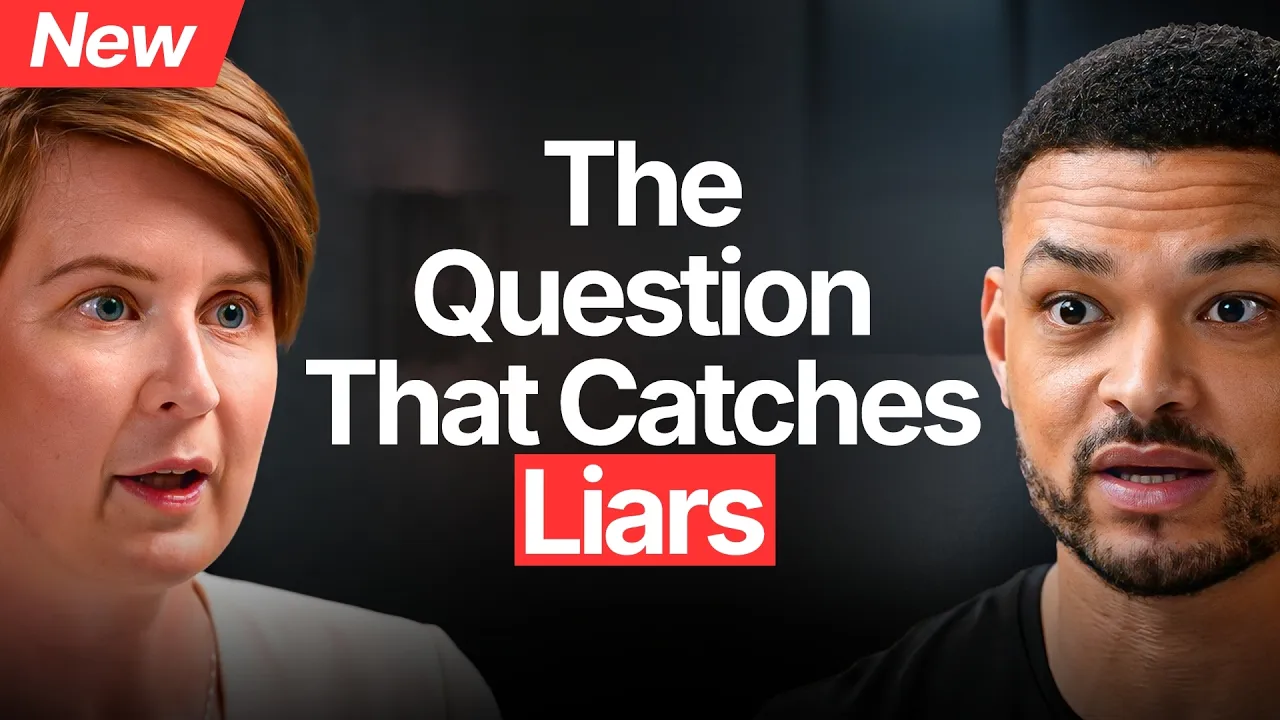
Dr. Leanne ten Brinke Exposes Science Behind Dark Personalities
The Diary Of A CEO
Effective deception detection relies on asking strategic open-ended questions rather than observing body language, while managing toxic individuals requires enforcing strict boundaries and leverage rather than relying on empathy.
## Background
This episode of The Diary Of A CEO, hosted by Steven Bartlett and published on YouTube on September 7, 2026, features Dr. Leanne ten Brinke, an Associate Professor of Psychology and director of the Truth and Trust Lab at the University of British Columbia. The show notes outline a deep dive into the science of deception, dark personality traits (psychopathy, narcissism, Machiavellianism, and sadism), common manipulation tactics like gaslighting, and evidence-based strategies for setting boundaries and protecting mental well-being.
## TL;DR
Dr. Leanne ten Brinke debunks popular myths surrounding lie detection, explaining that common body language cues like eye contact avoidance are unreliable compared to assessing detail density and using open-ended questions. She breaks down the Dark Tetrad traits, highlighting how psychopathy, narcissism, Machiavellianism, and sadism manifest in daily interactions, workplace dynamics, and dating profiles. Research reveals that dark traits are influenced by both genetics and environment, and contrary to the 'successful psychopath' myth, individuals scoring high in these traits often underperform long-term. The discussion offers practical defense strategies, including setting strict boundaries, utilizing written negotiations to neutralize charm, leveraging group wisdom, and avoiding attempts to reform toxic personalities.
## Atmosphere & style
The conversation is intellectually rigorous yet accessible, blending academic research with engaging, real-world examples. Dr. ten Brinke delivers her insights with an empathetic and reassuring tone, aiming to empower listeners rather than foster cynicism about human nature. Host Steven Bartlett guides the dialogue through candid exchanges and practical scenarios—such as analyzing job applicant voice notes and dating profile prompts—creating a collaborative, inquisitive atmosphere that transitions smoothly from deep psychological analysis to actionable life advice.
## Key takeaways
- [00:00](https://www.youtube.com/watch?v=AcK_zgJjnoo&t=0s) Brief 5-second video clips allow untrained observers to capture a 'kernel of truth' about psychopathic traits like callousness and manipulativeness, which strongly correlates with expert clinical evaluations.
- [14:06](https://www.youtube.com/watch?v=AcK_zgJjnoo&t=846s) Common body language indicators like eye contact avoidance are unreliable for lie detection, whereas effective lie detection relies on asking unanticipated, open-ended questions.
- [15:56](https://www.youtube.com/watch?v=AcK_zgJjnoo&t=956s) Focusing on the verifiability heuristic—asking for verifiable details—forces liars to fabricate information on the fly under high cognitive load.
- [22:13](https://www.youtube.com/watch?v=AcK_zgJjnoo&t=1333s) The Dark Tetrad comprises four distinct personalities with a shared core of callousness, hostility, and manipulativeness: Psychopathy, Machiavellianism, Narcissism, and Sadism.
- [36:48](https://www.youtube.com/watch?v=AcK_zgJjnoo&t=2208s) Approximately 10% of the general population scores high on dark personality traits, with variance driven roughly 50% by genetics and 50% by environmental factors.
- [41:33](https://www.youtube.com/watch?v=AcK_zgJjnoo&t=2493s) Children with callous-unemotional traits are insensitive to punishment but highly responsive to rewards, requiring specialized parenting focused on warmth and positive reinforcement.
- [01:00:17](https://www.youtube.com/watch?v=AcK_zgJjnoo&t=3617s) Contrary to the 'successful psychopath' myth, empirical evidence shows psychopathic hedge fund managers return lower financial performance and psychopathic politicians hold less power.
- [01:09:26](https://www.youtube.com/watch?v=AcK_zgJjnoo&t=4166s) Relationships with dark personalities can be identified early through red flags such as double-standard interrupting, continuous boundary violations, and lack of guilt.
- [01:24:10](https://www.youtube.com/watch?v=AcK_zgJjnoo&t=5050s) Gaslighting is a systematic pattern of invalidating another person's subjective internal reality, emotional experience, or memory to gain control.
- [01:38:32](https://www.youtube.com/watch?v=AcK_zgJjnoo&t=5912s) Text-based or written negotiations neutralize the superficial charm and physical presence of psychopathic individuals while creating a verifiable paper trail.
- [01:42:56](https://www.youtube.com/watch?v=AcK_zgJjnoo&t=6176s) Major mistakes when dealing with dark personalities include expecting them to share standard human morals, attempting to reform them, or assuming total helplessness.
- [01:44:39](https://www.youtube.com/watch?v=AcK_zgJjnoo&t=6279s) While 90% of people are prosocial and kind, the remaining 10% high in dark traits cause a vast majority of systemic harm, though ruthlessness is not required for real success.
## Detailed walkthrough
### [00:00](https://www.youtube.com/watch?v=AcK_zgJjnoo&t=0s) Intro & The 5-Second Psychopath Test
Can you spot a psychopath or a liar in just a matter of seconds? Dr. Leanne ten Brinke, Associate Professor of Psychology and Director of the Truth and Trust Lab at the University of British Columbia, introduces the shocking realities and persistent myths surrounding deception and toxic behavior. She notes that while most people picture a movie villain when thinking of a psychopath, research shows observers can actually capture a "kernel of truth" about someone's psychopathic traits in as little as five seconds.
By analyzing brief video clips of criminal offender interviews, researchers found a strong correlation between five-second assessments made by untrained college students and the clinical evaluations conducted by experts after hours of comprehensive testing. When Dr. ten Brinke's lab examined the specific facial expressions and behaviors present in those five-second windows, they discovered distinct non-verbal signals—specifically incongruent expressions and hand movements—that observers pick up on almost instantly.
- **Duchenne Smiles:** People high in psychopathic traits frequently exhibit "Duchenne smiles"—genuine-looking smiles that pull up the corners of the mouth and crinkle the eyes into crow's feet—while simultaneously making hostile, aggressive, or callous statements.
- **Hand Gestures (Illustrators):** High-trait individuals heavily utilize hand gestures during conversation, which observers sub-consciously process to make rapid character assessments.
- **Personality Data Over Time:** Although quick five-second reads offer surprisingly accurate initial impressions, Dr. ten Brinke emphasizes that personality spans time and context; accurate long-term evaluation requires collecting data across multiple situations.
---
[02:41](https://www.youtube.com/watch?v=AcK_zgJjnoo&t=161s) Why This Research Into Psychopathy Matters
Asked about what drives her academic career, Dr. ten Brinke shares a seemingly paradoxical motivation: she wants to make people less cynical about human nature. Studying dark personality traits, lying, and dominance might sound like a recipe for cynicism, but she contends that understanding these darker dynamics empowers individuals to navigate complex social situations effectively, protect themselves, and hold a more accurate, balanced view of the world.
> "I want to make people less cynical about human nature, which I think might seem kind of paradoxical given what I study... But I think when you understand those topics and also that there's something you can do about it... it's incredibly powerful."
---
[03:18](https://www.youtube.com/watch?v=AcK_zgJjnoo&t=198s) Why Psychopathy Is Getting More Attention
The public fascination with psychopathy and dark traits stems from how fundamentally alien these behaviors are to the average person. Most people move through life guided by empathy, compassion, and a desire to play by the rules. Confronting someone who lacks those fundamental moral frameworks triggers an intense desire to comprehend what makes them tick.
Dr. ten Brinke points to research on the massive popularity of the true crime genre—which garners a predominantly female audience—showing that viewers are often driven by a self-preservation instinct: they want to understand dangerous personalities so they can spot the warning signs and avoid becoming victims themselves.
---
[04:26](https://www.youtube.com/watch?v=AcK_zgJjnoo&t=266s) Can You Spot a Psychopath in 5 Seconds?
Dr. ten Brinke dives deeper into the seminal experiment by the late Dr. Scott Lilienfeld and his colleagues. In the study, researchers edited interview footage of criminal offenders—who had been rigorously scored on psychopathy scales by clinical psychologists—into 5-second, 10-second, and 20-second bursts. Untrained undergraduate psychology students watched these micro-clips and rated the subjects on traits like callousness and manipulativeness.
The results were astonishing: the students' 5-second snapshot ratings correlated significantly with the clinical evaluations derived from hours of expert interviews and official records. Dr. ten Brinke's lab partnered with Lilienfeld's team to break down the exact verbal and non-verbal mechanics behind this phenomenon, proving that specific micro-behaviors drive our rapid intuition.
---
[05:50](https://www.youtube.com/watch?v=AcK_zgJjnoo&t=350s) How Facial Expressions Reveal What People Really Feel
Facial mechanics provide direct insight into emotional authenticity. A genuine smile requires the involuntary contraction of the *orbicularis oculi* muscles around the eye sockets, producing subtle crow's feet. In contrast, a non-Duchenne or fake smile only engages the mouth muscles (*zygomaticus major*), upturning the lips without activating the eye area.
The hallmark of a psychopathic presentation in these micro-interactions is an unsettling emotional mismatch: displaying warm, happy facial expressions with eye involvement while speaking words of intense hostility or malice. This bizarre emotional disharmony serves as a major behavioral red flag.
---
[09:17](https://www.youtube.com/watch?v=AcK_zgJjnoo&t=557s) Can You Predict If Someone Is Guilty?
During her Ph.D. research in forensic psychology, Dr. ten Brinke conducted groundbreaking studies analyzing high-stakes emotional deception. She evaluated media appeals where individuals went on television pleading for help in finding a missing spouse or family member. In half of the analyzed cases, the pleader was genuinely distraught; in the other half, the speaker was actually guilty of murdering the missing relative and was staging a false public plea.
To demonstrate the subtle facial mechanics of fake sorrow, Dr. ten Brinke guides host Steven Bartlett through an exercise on genuine sadness versus simulated grief:
```
[Genuine Sadness] --> Lip corners drop + Inner eyebrows pull UP and TOGETHER
[Simulated / False] --> Lip corners drop + Entire eyebrows pull UP (Surprise expression)
```
By tracking two non-verbal facial cues (eyebrow movement and lip alignment) and two verbal cues, Dr. ten Brinke’s original research model predicted whether a speaker was lying or telling the truth with roughly 90% accuracy.
- **Verbal Precision vs. Vagueness:** Innocent, grieving family members used direct, high-conviction language (*"When you see this, call me"*). Guilty pleaders used tentative, ambiguous phrasing (*"If you see this, come home"*) and added gray area (*"It wasn't an argument per se..."*).
- **Replication Nuance:** Subsequent replication attempts revealed more modest overall statistical effects, but the distinction in verbal structure remained a remarkably consistent indicator of deception.
---
[10:19](https://www.youtube.com/watch?v=AcK_zgJjnoo&t=619s) Three Signs Someone Might Be Lying
The single most consistent verbal differentiator between truth-tellers and liars across scientific literature is the **density of detail**. Counter to the popular belief that liars construct elaborate, overly detailed stories to cover their tracks, research proves that liars typically provide far fewer concrete details—especially when put on the spot without preparation.
Truth-tellers simply retrieve genuine memories from experience and can easily expand on the story when prompted. Liars face an intense **cognitive load**: they must fabricate plausible details instantly, avoid self-contradiction, remember their lies for future retelling, and gauge what the interrogator already knows. This mental strain forces them to keep their narrative sparse.
```
┌──────────────────────────────────────────┐
│ COGNITIVE LOAD OF A LIAR │
└────────────────────┬─────────────────────┘
│
┌──────────────────────────────┼──────────────────────────────┐
▼ ▼ ▼
Fabricating plausible Avoiding self- Monitoring interviewer's
details on the spot contradictions existing knowledge
```
- **Cortisol Spike:** Dr. ten Brinke's lab demonstrated that individuals actively telling lies exhibit a marked increase in cortisol reactivity (stress response) compared to truth-tellers.
- **Embedded Lies:** When liars *do* use extensive detail, they engage in "embedded lies"—flooding the narrative with true, mundane details surrounding the event (e.g., actor Jussie Smollett describing his travel itinerary or the specific tuna wrap he bought at Subway) while remaining vague about the actual moment the alleged crime occurred.
- **Baseline Deviations:** Detecting deception relies on watching for sudden shifts from a person's baseline behavior, such as a normally descriptive speaker suddenly becoming vague and brief about a specific segment of time.
---
[14:06](https://www.youtube.com/watch?v=AcK_zgJjnoo&t=846s) Can Anyone Learn to Spot a Liar?
Despite what television shows suggest, the average human is notoriously bad at detecting lies. In controlled laboratory experiments—such as paying subjects a $100 cash incentive ("a Benjamin") if they can successfully steal a bill and convince an interrogator of their innocence—unbiased observers reading or watching the interactions score near chance.
Across thousands of scientific trials, human lie detection accuracy sits at roughly **54%**—barely better than a coin flip. Even professional training only slightly improves a person's ability to spot visual body language cues. True skill in lie detection comes not from staring at someone's posture, but from changing how you ask questions.
> "Good lie detectors ask for more information. Or they ask unanticipated questions where people haven't prepared for them... Learning how to ask good questions is actually a really essential tool."
- **Unanticipated Questions:** Asking surprising or non-linear questions forces a liar out of their prepared script, dramatically spiking their cognitive load and exposing sparse details and heavy hesitation.
- **Probing for Detail:** Simply asking *"Can you tell me more about that specific moment?"* pushes truth-tellers to easily pull up more sensory memories, while liars struggle to generate consistent new information on the fly.
<FollowUp label="Want to go into Part 2 of the transcript?" query="Summarize Part 2 of the transcript."/>
[15:56](https://www.youtube.com/watch?v=AcK_zgJjnoo&t=956s) Role-Playing Deception: Open-Ended Questions and the Verifiability Heuristic
When asked how to determine if a partner is lying about cheating, Dr. Leanne ten Brinke explains that asking a simple, closed-ended question ("Are you cheating on me?") is the first major mistake because it gives the liar an easy way out without placing any cognitive demand on them. To demonstrate effective interrogation techniques, Steven Bartlett and Dr. ten Brinke engage in a role-play scenario where Steven plays a partner making up a story about staying late at work until 3:00 a.m. to finalize an investment deck for "Google."
Dr. ten Brinke demonstrates how asking open-ended questions like "Tell me about work on Friday night" or the simple back-pocket phrase "Tell me more about that" forces a liar to fabricate details on the fly. Truth-tellers naturally supply granular, mundane, and authentic details (such as struggling with slide deck formatting), whereas liars tend to offer vague statements or cite unverifiable details (such as claiming they were working with a "new guy at work" whom the partner doesn't know). Rather than trying to calculate a complex behavioral algorithm based on unreliable body language cues like fidgeting or eye contact, focusing on a single, reliable heuristic—**how verifiable is the statement?**—yields far better accuracy in detecting deception.
- **The "Tell Me More" Strategy:** Open-ended prompts overload a liar's cognitive processing because generating plausible details sequentially is far harder than recalling a real memory.
- **Verifiable Details:** Research demonstrates that focusing on the *verifiability* of an individual's claims is one of the most effective ways to spot lies, as liars naturally reduce verifiable facts to avoid getting caught.
- **Visible Cognitive Effort:** Signs such as speaking unusually slowly, excessive pauses, using filler words ("ums and a's"), or furrowing the brow indicate intense mental load. While these signs are associated with deception, Dr. ten Brinke cautions that they are not a definitive "Pinocchio's nose" since people pause or strain for many non-deceptive reasons.
---
[20:49](https://www.youtube.com/watch?v=AcK_zgJjnoo&t=1249s) Busting the Eye Contact Myth and Cultural Biases
Addressing the popular belief in body language analysis, Steven asks about gaze aversion. Dr. ten Brinke reveals that across global surveys, people consistently rate "sketchy eye contact" as the number one indicator that someone is lying, yet psychological research shows zero empirical support for this belief. Because the stereotype is so pervasive, liars deliberately overcompensate by maintaining direct, controlled eye contact to appear believable.
Furthermore, misinterpreting eye contact as a lie detector leads to severe bias against specific populations. Neurodivergent individuals, particularly those on the autism spectrum, frequently struggle with eye contact and are consequently misperceived as lying when telling the truth. Similarly, in many cultures, avoiding direct eye contact is a sign of respect rather than dishonesty, causing observers relying on flawed body language rules to make systematic errors in judgment.
---
[22:13](https://www.youtube.com/watch?v=AcK_zgJjnoo&t=1333s) The Dark Tetrad: Psychopathy and Machiavellianism
Dr. ten Brinke breaks down the concept of the "Dark Tetrad"—a collection of four distinct yet overlapping malicious personality traits: Psychopathy, Machiavellianism, Narcissism, and Sadism. Beginning with **Psychopathy**, she describes it as a constellation of features including superficial charm, grandiosity, manipulative behavior, shallow emotional depth, a complete lack of guilt or remorse, an inability to take responsibility, impulsivity, and a chronic pattern of breaking social or legal rules.
Moving to **Machiavellianism**—named after Niccolò Machiavelli and his political manual *The Prince*—she highlights that individuals with this trait view the world through a deeply cynical lens. Unlike the impulsive psychopath, Machiavellians play "three-dimensional chess." They meticulously gather information, store personal secrets or tidbits about others in their back pocket, and patiently wait for the opportunistic moment to use that leverage for manipulation, blackmail, or personal gain.
---
[24:32](https://www.youtube.com/watch?v=AcK_zgJjnoo&t=1472s) Deconstructing Narcissism: Grandiose vs. Vulnerable Types
Turning to **Narcissism**, Dr. ten Brinke notes how frequently the term is tossed around in modern culture and emphasizes that all dark traits exist on a continuous spectrum rather than as a simple binary (narcissist vs. non-narcissist). While Narcissistic Personality Disorder exists at the extreme end of the Diagnostic and Statistical Manual (DSM), everyday individuals land everywhere along the continuum. She clarifies that it is more scientifically accurate to say someone exhibits "relatively high levels of narcissism" rather than labeling them entirely by the diagnosis.
She outlines the two distinct manifestations of narcissism currently identified by personality psychologists:
- **Grandiose Narcissism:** Characterized by an inflated, impenetrable ego, an unshakable sense of entitlement, and a dominant desire to be in charge. Their primary trigger for intense anger is an ego threat stemming from a *failure to achieve* (e.g., being passed over for a work promotion).
- **Vulnerable Narcissism:** Characterized by a remarkably fragile ego that crumbles at the slightest criticism. They rely on constant external validation and admiration ("always needing a gold star") to sustain their self-worth. Their primary trigger for explosive or combative anger is *social rejection* or negative personal feedback.
---
[28:17](https://www.youtube.com/watch?v=AcK_zgJjnoo&t=1697s) Narcissism vs. Insecurity and the Fundamental Attribution Error
Steven shares a personal anecdote from an interview process where a job candidate repeatedly claimed credit for company successes, boasted about being "amazing" at specific apps, and constantly sought praise. While Steven initially interpreted this behavior as deep-seated insecurity stemming from a lifetime of being overlooked, he notes that others might instantly label the person a narcissist. Dr. ten Brinke explains that for true vulnerable narcissism, deep insecurity must be coupled with entitlement and a willingness to exploit others to get what they feel they deserve.
She points out that high-stakes environments like job interviews naturally induce self-promotional behavior because candidates are incentivized to present themselves in the best possible light. Jumping immediately to a dark trait diagnosis overlooks situational factors. This cognitive bias is known as the **Fundamental Attribution Error**—our tendency to attribute other people's actions to their underlying personality traits (e.g., "they are a narcissist") while excusing our own identical behaviors as simple reactions to the situation (e.g., "I was just trying to show what I could do").
[32:03](https://www.youtube.com/watch?v=AcK_zgJjnoo&t=1923s) Situational Influences vs. Personality and Gender Differences
Dr. Leanne ten Brinke emphasizes that we must be cautious not to jump to a personality attribution when a situational explanation is more appropriate. Personality is defined as a consistent pattern of thinking, feeling, and behaving over time and across different contexts. If you only interact with someone once, you get an initial impression, but seeing them in a different setting—such as around friends or family—might reveal they aren't nearly as boastful. In those cases, the situation is driving the behavior rather than an underlying dark trait.
When discussing gender differences across dark personality traits, men consistently score somewhat higher on average than women across the board. However, Dr. ten Brinke notes there is considerable overlap, and women can certainly score very high on these traits as well.
- **Definition of Personality:** A consistent pattern of thinking, feeling, and behaving over time and across contexts.
- **Gender Disparity:** Men score higher on average than women on dark traits, though overlap exists.
---
[33:27](https://www.youtube.com/watch?v=AcK_zgJjnoo&t=2007s) The Fourth Trait: Sadism and the Shared Core of Dark Personalities
The conversation moves to sadism, the newest addition that forms the "Dark Tetrad." While the term often evokes extreme images like the devil or severe violent crime, Dr. ten Brinke shares how her initial research into sadism involved analyzing criminal records of sexual homicides for horrific details. However, everyday forms of sadism exist as well, such as online trolling, where individuals derive pleasure from causing distress or pushing people's buttons on the internet.
Despite their differences, all four dark personality traits share a common foundation. They are all marked by a "mask of sanity"—an ability to appear completely normal on the surface while functioning under a fundamentally different psychological operating system underneath.
- **Everyday Sadism Example:** Online trolling to intentionally provoke and upset others for pleasure.
- **The Core Triad of Dark Traits:**
- **Callousness:** Lack of care for others' feelings or outcomes.
- **Manipulativeness:** Willingness to lie and cheat to achieve goals.
- **Hostility:** Undercurrent of hostility toward other people.
- **The "Mask of Sanity":** High-scoring individuals excel at hiding their true nature behind a normal facade.
---
[35:10](https://www.youtube.com/watch?v=AcK_zgJjnoo&t=2110s) Debunking Psychopathy Myths and Misconceptions
Steven Bartlett asks about common myths, such as the idea that psychopaths cannot maintain eye contact. Dr. ten Brinke highlights the biggest myth of all: that all people with high levels of psychopathy are violent. While psychopathy includes rule-breaking behavior—which can manifest as criminal or violent acts—it functions as a risk factor rather than a guarantee of violence. Many individuals score high on psychopathy without ever engaging in physical violence, choosing to break rules in non-violent ways instead.
Pop culture leads people to picture serial killers like Ted Bundy when hearing the word "psychopath." Bundy reportedly scored 39 out of 40 on the Psychopathy Checklist-Revised (PCL-R), making him a extreme poster boy for the condition, but he is far from representative of everyone with high psychopathy scores.
- **Major Misconception:** That high psychopathy equals guaranteed physical violence or serial murder.
- **Assessment Tool:** Psychopathy Checklist-Revised (PCL-R), scored out of 40.
- **Case Example:** Ted Bundy scored approximately 39/40 on the PCL-R.
---
[36:48](https://www.youtube.com/watch?v=AcK_zgJjnoo&t=2208s) How Common Are Dark Personality Traits?
Determining the exact prevalence of dark personality traits is tricky because these characteristics exist on a continuum, making the percentage dependent on where researchers draw the cutoff line. Clinical levels of psychopathy (scoring 30 or higher on the PCL-R) account for about 1% of the general population. Diagnosable Narcissistic Personality Disorder (NPD) is estimated at 2% to 5%.
Because clinical cutoffs do not exist for sadism and Machiavellianism, researchers look at large-scale self-report surveys. By measuring the percentage of people who consistently agree with survey items such as "I am a born leader" (narcissism) or "I like to see other people get hurt" (sadism), data reveals that approximately 10% of the population scores high on dark personality traits.
- **Clinical Psychopathy (Score $\ge$ 30/40 on PCL-R):** ~1% of the population.
- **Narcissistic Personality Disorder (NPD):** 2% to 5% of the population.
- **High Dark Traits in Self-Report Surveys:** ~10% of the population.
---
[38:25](https://www.youtube.com/watch?v=AcK_zgJjnoo&t=2305s) Nature vs. Nurture: Genetic and Environmental Causes
Addressing whether dark traits stem from childhood trauma or genetics, Dr. ten Brinke explains that both play equal roles. Research indicates that individual variation in psychopathy and narcissism is roughly 50% genetic and 50% environmental. This realization offers a layer of empathy, as individuals do not choose their genetic makeup or early upbringing. Environmental factors like childhood abuse or a cold, uncaring parenting style significantly increase the likelihood of developing dark traits later in life.
For narcissism specifically, child "overvaluation" is a key environmental risk factor. Citing a longitudinal study, Dr. ten Brinke explains that when parents repeatedly tell their children "you are special" or "you are better than other kids," those children are far more likely to develop narcissistic traits, believing they are entitled to special treatment. This differs fundamentally from healthy self-esteem, which stems from warm, responsive parenting that makes a child feel loved and valued.
- **Trait Variance Breakdown:** ~50% Genetics, ~50% Environmental factors.
- **Key Environmental Drivers:** Abuse, cold/uncaring parenting, and child overvaluation.
- **Overvaluation vs. Self-Esteem:**
- *Overvaluation:* Telling kids they are superior to others $\rightarrow$ Narcissism and entitlement.
- *Self-Esteem:* Warm, responsive parenting $\rightarrow$ Feeling cared for and worthy.
- **Genetics-Environment Intersection:** Parents with high dark traits pass on genetic risks while simultaneously creating unstable, cold, or abusive home environments.
---
[41:33](https://www.youtube.com/watch?v=AcK_zgJjnoo&t=2493s) Parenting Strategies and Early Interventions
When asked how to cultivate healthy behavior and raise good children, Dr. ten Brinke highlights warm and responsive parenting as the primary key. A silver lining in deception and personality research is that early intervention with children showing "callous-unemotional" (CU) traits can prevent full-blown psychopathic behavior in adulthood. Effective therapy focuses on training parents how to react rather than sending the child to a weekly therapy session alone.
Children with callous-unemotional traits are notoriously unresponsive to punishment, but highly responsive to rewards. When parents engage in dominance contests or escalate arguments during temper tantrums, giving in eventually teaches the child that escalating aggressive behavior works. Instead, parent-child interaction training emphasizes modeling warmth, ignoring power struggles, and immediately praising positive behavior by repeating back kind actions to reinforce them.
- **Parent-Child Interaction Training:** Focuses on teaching parents conflict de-escalation and positive reinforcement.
- **Behavioral Dynamics in CU Kids:** Low sensitivity to punishment, high sensitivity to rewards.
- **The Tantrum Trait Trap:** Giving in after escalating a conflict teaches children to use dominance and aggression to win.
- **Reinforcement Technique:** Explicitly repeating and praising kind acts ("That was a very kind thing to say") to build prosocial habits.
---
[44:44](https://www.youtube.com/watch?v=AcK_zgJjnoo&t=2684s) Brain Structure and Neurological Differences
Holding up a model of the human brain, Dr. ten Brinke points out structural and functional differences found in individuals with high levels of psychopathy. Functional MRI (fMRI) studies show that psychopathic individuals exhibit reduced neural activity and weaker connectivity in the prefrontal cortex during moral reasoning and impulse control tasks.
<Image alt="Brain diagram highlighting the prefrontal cortex in the frontal lobe" caption="Prefrontal cortex region involved in impulse control" src="image_agent_tag_17377910365050744059"/>
---
Additionally, key structures like the amygdala show distinct neurological variations. The amygdala, located deep within the brain, governs emotional responses, particularly fear conditioning. In psychopaths, the amygdala tends to be smaller and less active, explaining their low experience of fear and inability to learn from aversive punishment.
<Image alt="Brain diagram highlighting the amygdala and fear response pathway" caption="Amygdala region responsible for processing fear" src="image_agent_tag_17377910365050742080"/>
---
- **Prefrontal Cortex Anomalies:** Reduced activation and connectivity $\rightarrow$ Impaired impulse control and moral reasoning.
- **Amygdala Differences:** Smaller volume and lower activity $\rightarrow$ Deficits in fear processing and aversive conditioning (learning from punishment).
---
[46:26](https://www.youtube.com/watch?v=AcK_zgJjnoo&t=2786s) Can Dark Personality Traits Be Changed or Cured?
Addressing whether dark personality traits can be cured, Dr. ten Brinke notes with a chuckle that "some" change is possible, but the operative word is *some*. Most clinical research on psychopathy comes from incarcerated offenders required to complete treatment programs. A fundamental hurdle is motivation: because dark traits primarily cause suffering for *other* people rather than the individual, dark personalities view their behavior as "a you problem, not a me problem" and lack the desire to change.
However, when incarcerated individuals consistently engage in Cognitive Behavioral Therapy (CBT), studies show a reduction in recidivism rates. For non-clinical populations, researcher Nathan Hudson conducted compelling studies using "agreeableness challenges." Participants received daily smartphone prompts encouraging small acts of kindness—such as complimenting a friend, sending an encouraging message, or paying for someone's coffee. Those who followed through reported measurable decreases in dark traits after four months.
- **The Motivation Barrier:** Dark personalities rarely feel distress over their behavior, viewing negative consequences as someone else's problem.
- **Recidivism Reduction:** Cognitive Behavioral Therapy (CBT) lowers re-offending rates among incarcerated psychopaths.
- **Nathan Hudson's 4-Month Agreeableness Study:** Daily prompts to perform small acts of kindness successfully lowered self-reported dark traits over time.
- **Hard Truths from 'Poisonous People':** Personality traits are enduring by definition; while natural age-related softening occurs over decades, "waiting it out" is rarely a viable strategy for victims of dark personalities.
[49:01](https://www.youtube.com/watch?v=AcK_zgJjnoo&t=2941s) Why Psychopaths Rarely Change as They Age
Can a psychopath change their ways over time? The scientific data suggests this is rarely the case. Dr. Leanne ten Brinke cites a striking study of over 1,000 individuals who had known a psychopathic person over a long period. When asked whether the person's behavior improved after turning 50, an overwhelming **93% of respondents** reported that the behavior remained "just as bad or worse" than it was previously.
Steven Bartlett compares trying to rehabilitate a psychopath to "asking a tiger to change their stripes." Because individuals with dark traits lack the internal motivation or self-awareness to change, fundamental behavioral shifts are extremely unlikely unless they are faced with an extraordinary personal incentive.
- **Study Findings:** 93% of respondents reported that psychopathic behavior was just as bad or worse after age 50.
- **Root Cause:** A fundamental lack of motivation to alter their behavior prevents long-term reform.
---
[51:52](https://www.youtube.com/watch?v=AcK_zgJjnoo&t=3112s) How Deception Creates Unseen Social Distance
Moving beyond standard laboratory setups where participants are explicitly told to spot liars, Dr. ten Brinke's lab examines how deception affects natural, everyday interactions. When two people converse and one lies without the other’s conscious awareness, the unware partner consistently reports feeling less connected and less socially close to the liar by the end of the conversation.
Surprisingly, this emotional rift occurs even with "pro-social" lies—the white lies people tell to spare someone's feelings. Rather than protecting the relationship, telling lies creates a subtle barrier. Furthermore, research reveals a reciprocal pattern: people who self-report telling frequent lies in their daily lives also experience significantly higher levels of loneliness.
- **Perception of Liars:** Deceptive individuals are unconsciously perceived as less warm, less competent, and less moral.
- **Reciprocal Information Exchange:** Liars offer fewer authentic details about themselves, disrupting the mutual sharing required to build interpersonal trust.
- **The Loneliness Link:** Higher frequencies of daily lie-telling directly correlate with increased self-reported loneliness.
---
[55:40](https://www.youtube.com/watch?v=AcK_zgJjnoo&t=3340s) The Subconscious Intuition for Genuineness
Even when people cannot consciously identify a liar, their gut instincts often react to subtle emotional cues. In a study analyzing media appeals by "pleaders"—individuals publicly begging for the return of a missing loved one—researchers evaluated viewer reactions to genuine victims versus deceptive murderers who were secretly responsible for the crime.
Participants who were unaware of who was lying consistently felt more genuine sympathy and compassion for the innocent pleaders. When asked how much money they would donate to a theoretical GoFundMe campaign to help find the missing person, viewers allocated significantly higher amounts to the truthful individuals. While humans struggle with binary "liar or truth-teller" judgments, subconscious emotional cues still shape our willingness to trust and help others.
- **Pleader Study:** Unaware viewers showed higher empathy and financial generosity toward genuine pleaders than toward deceptive murderers.
- **Subconscious Nuance:** Humans pick up on non-verbal distress cues that influence gut feelings, even when they cannot explicitly identify deception.
---
[57:34](https://www.youtube.com/watch?v=AcK_zgJjnoo&t=3454s) Balancing Warmth and Competence to Build Trust
Trust relies heavily on the dual dimensions of warmth and competence. As Dr. ten Brinke explains, warmth reflects benevolent intentions—whether someone is kind, honest, and means well toward you—while competence reflects their actual ability to execute on those intentions. High ratings in both areas are essential for earning long-term trust.
Displaying warmth relies on key non-verbal behaviors, including genuine smiling, consistent eye contact, and leaning in during conversation. Conversely, unconscious facial expressions like a heavy "resting face" or focus-induced scowl can easily be misread as anger, instantly lowering perceived warmth and diminishing overall trustworthiness.
- **The Trust Equation:** High Warmth + High Competence = High Trustworthiness.
- **Warmth Signals:** Smiling, engaged eye contact, and leaning forward signal benevolent intent.
- **Resting Scowl Effect:** Unintentional facial tension is often misidentified as anger, reducing perceived warmth.
---
[01:00:17](https://www.youtube.com/watch?v=AcK_zgJjnoo&t=3617s) Do Dark Traits Actually Help You Get Ahead?
It is a common myth that psychopathic traits—such as cold ruthlessness, backstabbing, or extreme risk-taking—help individuals reach the top of competitive fields. To test this, Dr. ten Brinke collaborated with Dr. Dacher Keltner to evaluate the impact of psychopathy in high-stakes environments, specifically looking at legislative influence among politicians and financial returns among hedge fund managers.
The findings directly challenged the "successful psychopath" myth: higher levels of psychopathy were consistently linked to *less* political influence in government and *lower* financial returns for hedge fund managers. While psychopathic managers often boast about their strategic brilliance, their subordinates report high stress, frequent bullying, and overall lower team performance.
Similarly, narcissists often make strong first impressions due to their supreme confidence, which people frequently mistake for competence. However, longitudinal studies by Dr. Delroy Paulhus show that over time, group members realize the narcissist is hostile, unreliable, and unproductive, causing their initial popularity to collapse.
- **Hedge Fund Performance:** Psychopathic hedge fund managers generated lower financial returns than their peers.
- **Government Influence:** Higher psychopathy scores correlated with fewer co-sponsored bills and less political power.
- **The Narcissism Curve:** Narcissists initially appear like high-potential leaders, but their standing rapidly declines as their hostility and lack of actual delivery become apparent.
[01:05:07](https://www.youtube.com/watch?v=AcK_zgJjnoo&t=3907s) What a Real Job Applicant's Voice Note Revealed
Steven plays a pitch voice note from a real job applicant (with her voice modified to preserve anonymity) to see if Dr. Leanne ten Brinke can spot any dark personality traits. In the clip, the candidate emphasizes her love of working with people, her early background in childhood theater, and her writing skills. She explains how she transitioned from being "just a creative" to mastering data, process, and AI analytics, ultimately sharing her grandiose aspirations to become a global public speaker, present at Cannes Lions, and win prestigious awards while continuing as a creative artist.
Dr. ten Brinke points out minor warning signs—or "amber flags"—such as subtle put-downs of other creatives and a strong tendency to speak almost exclusively about herself and her grand achievements. However, she cautions against jumping straight to a diagnosis of narcissism, emphasizing that a job interview creates a specific situational context where self-promotion is expected. Rather than making an immediate judgment, she advises mental note-taking to see if these patterns persist in future interactions. For example, in a follow-up interview, asking direct questions about teamwork can reveal whether the applicant credits their team or consistently disparages colleagues and claims all the glory.
When Steven asks whether individuals with theater backgrounds or performing art roles inherently possess higher levels of dark traits, Dr. ten Brinke notes there is no scientific evidence supporting that link. The only relevant overlap involves acting methods like the Stanislavski technique, where actors intentionally evoke genuine personal memories to recreate real emotion. While such emotional training might help someone mimic feelings effectively, it does not mean actors possess higher baseline levels of dark personality traits.
- The applicant's pitch highlighted a shift from childhood theater to writing films, integrating data analytics via AI, and targeting high-profile milestones like speaking at Cannes Lions.
- Dr. ten Brinke recommends using follow-up interview questions regarding past team experiences to distinguish between standard self-marketing and genuine narcissistic ego inflation.
---
[01:09:26](https://www.youtube.com/watch?v=AcK_zgJjnoo&t=4166s) How to Spot Red Flags in Dating Profiles and Relationships
Moving from professional settings to romantic contexts, Steven presents a series of sample dating profiles to evaluate how dark personality traits surface in written bios.
- **Ryan (Chief of Staff, Washington D.C.):** His profile boasts that he is "professionally trained to argue my point," guaranteeing he will win debates over dinner choices, and describes himself as "savvy, strategic, and persuasive." Dr. ten Brinke identifies these traits as classic signs of Machiavellianism—a calculated, strategic social style focused on controlling others like a game of three-dimensional chess rather than acting impulsively.
- **Haley (Lawyer):** Describing herself as "equal parts chaos and good company," Haley mentions enjoying "plotting a harmless prank" on friends and asks if a suitor is "tough enough" to handle her. Dr. ten Brinke highlights "chaos" and "toughness" as indicators of psychopathic impulsivity and volatile emotional dynamics, while taking pleasure in pranks targeting others serves as a potential red flag for sadism.
- **David (Brain Surgeon):** Promising he is "confident enough to pick the restaurant" and "self-assured to admit when I'm wrong occasionally," David jokes that he can find time for a date in his busy life. Dr. ten Brinke highlights the distinct narcissistic cues here, noting his focus on supreme self-importance, high need for admiration, and potential unwillingness to prioritize a partner's needs.
- **Chad (Law Enforcement, Texas):** Pictured barbecuing and seeking a "genuine" partner with "no debt and no kids," Chad presents a straightforward and grounded demeanor without obvious dark behavioral cues.
To evaluate potential partners beyond written bios, Dr. ten Brinke outlines key behavioral cues to look for during a date or within a relationship. These warning signs include:
- **Interrupting Dynamics:** Frequently interrupting you during conversations while reacting with intense anger or frustration if you interrupt them.
- **Boundary Violations:** Continually pushing personal or professional boundaries after you explicitly ask them not to discuss a specific topic.
- **Shallow Affect:** Remaining unnaturally or "weirdly calm" in situations where fear, sadness, or concern for others would be expected.
- **Intellectual Arrogance:** Acting like an absolute authority on every subject while dismissing your knowledge.
- **Impulsivity & Aggression:** Giving off-the-cuff, unconsidered responses, or exhibiting tough, combative, and cruel behavior.
- **Intense Eye Contact:** Making uncomfortably piercing eye contact that clinical literature frequently links to psychopathy.
- **Deficit in Self-Conscious Emotions:** Showing a complete lack of shame, embarrassment, remorse, or guilt.
- **Self-Centered Conversation & Sadism:** Dominating discussions entirely about themselves while showing indifference, annoyance, or amusement when others are struggling.
---
[01:18:55](https://www.youtube.com/watch?v=AcK_zgJjnoo&t=4735s) Why Setting Boundaries Matters More Than You Think
Steven pauses the discussion to share a message about *The 1% Diary*, explaining that daunting goals become manageable when broken down into daily micro-steps. He notes that the previous edition sold out quickly, prompting his team to restock the updated journal at `thediary.com`. He also asks viewers who regularly watch the podcast to subscribe to the channel to support the show's growth.
Returning to the topic of dark personalities, Steven highlights two uncomfortable realities: dark traits are surprisingly common relative to the destruction they inflict, and psychological research demonstrates that these individuals rarely change. With statistical estimates indicating that up to one in five people display some level of antisocial behavioral tendencies, avoiding toxic personalities entirely in work, family, or social circles is impossible.
Dr. ten Brinke emphasizes that standard interpersonal strategies—such as expressing hurt to elicit empathy, or applying social punishment to curb bad behavior—completely fail when dealing with individuals high in psychopathy. Because toxic individuals lack the emotional capacity for genuine guilt or remorse, ordinary conflict resolution tools leave victims feeling powerless. Effective self-defense requires switching strategies: establishing strict, non-negotiable personal boundaries and adopting clear rules tailored to managing high-conflict, toxic personalities.
- Traditional reconciliation methods fail with psychopaths because emotional appeals do not evoke guilt or trigger behavioral change.
- Effective management of toxic individuals relies on protective boundary enforcement rather than attempting to reform or appeal to their empathy.
<FollowUp label="Want to explore the 7 rules for dealing with dark personalities?" query="What are the 7 rules for dealing with dark personalities and toxic individuals according to Dr. Leanne ten Brinke?"/>
[01:20:17](https://www.youtube.com/watch?v=AcK_zgJjnoo&t=4817s) 7 Rules for Dealing With Dark Personalities: Boundaries and Power
Dr. Leanne ten Brinke details actionable strategies for handling toxic individuals, beginning with the critical necessity of establishing clear boundaries. She notes that while setting explicit rules does not guarantee a psychopath or narcissist will not break them—rule-breaking being a core defining trait of psychopathy—research proves that explicit boundaries significantly decrease selfish behavior compared to an environment with no rules. In professional settings, a written "respectful workplace policy" serves two key purposes: it clearly communicates behavioral expectations to keep moderate dark personalities in check, and it provides an objective benchmark for disciplinary action when violations occur. In personal relationships, boundaries must be explicitly communicated rather than kept in one's head, and sharing those personal boundaries with a trusted "buddy" or friend provides accountability when standards begin to slip.
```
┌─────────────────────────────────────┐
│ 7 RULES FOR DARK PERSONALITIES │
└──────────────────┬──────────────────┘
│
┌───────────────────────────┼───────────────────────────┐
▼ ▼ ▼
┌─────────────────┐ ┌─────────────────┐ ┌─────────────────┐
│ 1. BOUNDARIES │ │ 2. DENY POWER │ │ 3. ALIGN MOTIVES│
│ Explicit rules │ │ Never give team │ │ Leverage money, │
│ reduce harm │ │ authority │ │ status, bonuses │
└─────────────────┘ └─────────────────┘ └─────────────────┘
```
Addressing the question of target selection, Dr. ten Brinke explains how dark personalities choose who to exploit. Research shows that non-assertive individuals are far more likely to be targeted, operating similarly to predators selecting the "weakest of the herd." Asserting firm boundaries acts as a deterrent by signaling that an individual is not an easy target. Furthermore, individuals possessing dark traits are heavily motivated by power over others; granting them supervisory authority over employees consistently leads to severe workplace dysfunction, heightened staff stress, home-life conflict, high turnover, and team division.
- **Explicit Boundary Impact**: Defining explicit workplace rules reduces selfish and exploitative behavior among individuals with elevated dark traits compared to unstructured environments.
- **Predatory Selection**: Individuals low in assertiveness are statistically more likely to be targeted and preyed upon by those with psychopathic tendencies.
- **Workplace Outcomes under Dark Bosses**: Subordinates working under bosses high in psychopathic traits experience higher stress levels, spillover conflict at home, and increased employee turnover.
---
[01:24:10](https://www.youtube.com/watch?v=AcK_zgJjnoo&t=5050s) How to Spot Gaslighting and Coercive Control
The discussion transitions into the mechanics of domestic abuse, coercive control, and gaslighting. Dr. ten Brinke explores how abusers systematically erode a victim's confidence and boundaries through tactics like love bombing, followed by severe isolation. By cutting off access to family or forcing scripted communications, perpetrators create absolute dependence. Gaslighting is defined strictly as a systematic pattern of denying someone else's reality, forcing them to doubt their own perceptions, feelings, and memory. Because human beings rely on social validation to calibrate their understanding of reality, isolating a victim leaves them viewing the world entirely through the abuser's manipulated lens.
```
┌─────────────────────────────────────────────────────────────────┐
│ THE GASLIGHTING CYCLE │
├─────────────────────────────────────────────────────────────────┤
│ 1. SYSTEMATIC DENIAL ──► "You are misremembering events" │
│ 2. EMOTIONAL INVALIDATION ──► "You are being overly sensitive" │
│ 3. ISOLATION ──────────► Cut off friends & reality checks │
│ 4. DEPENDENCE ─────────► Victim relies entirely on abuser │
└─────────────────────────────────────────────────────────────────┘
```
To clarify common misunderstandings of the term, Dr. ten Brinke distinguishes between simple factual disagreements and true psychological gaslighting. While arguing about objective facts—such as what time someone left the office—is standard conflict, gaslighting occurs when a person invalidates another's subjective internal experience (e.g., claiming "you don't actually feel threatened" or "you're making that emotion up"). Psychological research confirms that individuals scoring high in Dark Tetrad traits explicitly endorse gaslighting tactics and see nothing wrong with using them against romantic partners.
- **Definition of Gaslighting**: A deliberate, persistent pattern of denying a person's version of reality, emotional state, or memory to induce self-doubt and establish control.
- **Fact vs. Experience Distinction**: Factual disputes do not constitute gaslighting; invalidating another person's subjective psychological or emotional experience crosses into gaslighting behavior.
- **Endorsement of Tactics**: Research demonstrates that individuals high in psychopathy and narcissism freely endorse coercive control and gaslighting tactics in intimate relationships.
---
[01:28:32](https://www.youtube.com/watch?v=AcK_zgJjnoo&t=5312s) Managing Dark Personalities: Carrots, Motivations, and Common Identity
Continuing through the tactical rules, Dr. ten Brinke emphasizes negotiating with dark personalities by understanding their specific motivational drives. Appealing to empathy or compassion—such as asking an abusive manager to stop bullying staff because employees are crying at home—fails completely because dark traits inherently lack empathy. Instead, successful management requires framing desired outcomes around the individual's self-interest, such as highlighting how team burnout will cause them to miss their financial performance bonus. Additionally, because psychopathic individuals are highly reward-sensitive but functionally insensitive to punishment, using positive reinforcement ("the carrot") for good behavior yields significantly better behavioral adjustments than punitive measures ("the stick").
Addressing the common impulse to simply terminate or cut off anyone exhibiting toxic traits, Dr. ten Brinke points out that because a significant minority of the population possesses elevated dark traits, total avoidance is impractical. Individuals with these traits often possess high-value technical skills in the workplace, or may be non-negotiable family members like siblings or brothers-in-law. Finally, she presents the strategy of emphasizing common identity: narcissists show markedly lower hostility toward negative feedback when they believe they share a commonality with the speaker—even arbitrary shared details like a birthday or fingerprint type.
- **Reward Sensitivity**: Psychopathic individuals exhibit high reward sensitivity but low punishment sensitivity due to distinct neurological processing of fear and consequence.
- **Effective Workplace Rewards**: Granting public status, elevated job titles, or financial bonuses for prosocial behavior reinforces positive habits without conceding operational power over people.
- **Narcissism & Common Identity**: Studies demonstrate that establishing perceived shared traits (such as identical birthdays) significantly reduces defensive aggression and rage in high-narcissism individuals receiving criticism.
---
<FollowUp label="Want to go through the remaining rules for communicating with dark personalities?" query="What are the final rules for communicating and negotiating with dark personalities from Dr. Leanne ten Brinke's interview?"/>
[01:35:14](https://www.youtube.com/watch?v=AcK_zgJjnoo&t=5714s) Strategic Communication and Managing Disagreement
To effectively persuade someone or deliver tough feedback—especially to individuals with high narcissism—it is critical to first establish a shared identity. Starting a conversation by emphasizing common ground ("We went to the same university" or "We root for the same football team") creates a foundation of unity before addressing sensitive issues. Steven Bartlett highlights research from neuroscientist Tali Sharot showing how the brain fundamentally shifts when someone expresses disagreement. He shares a personal anecdote from a business call where a colleague opened a rebuttal with "I completely disagree." After researching the tactic, Steven found extensive literature across social psychology, behavioral economics, and linguistics demonstrating that explicit, adversarial phrasing actively hinders persuasion by triggering immediate defensive mechanisms in the listener's brain.
Dr. Leanne ten Brinke notes that coming in "hot" or declaring something "stupid" creates an ego threat that causes domineering bosses or narcissistic individuals to shut down immediately. A far more effective approach is to phrase criticism or proposed changes as a collaborative question—for instance, asking "What do you think if we turn these three forms into one form?" Softening the delivery avoids triggering immediate resistance and allows the other person to feel like they are co-creating the solution.
- Starting rebuttals with "I disagree" triggers psychological resistance and damages persuasive impact across psychological and linguistic studies.
- Reframing criticism into questions reduces ego threats and keeps conversations receptive.
---
[01:38:32](https://www.youtube.com/watch?v=AcK_zgJjnoo&t=5912s) Spotting Deception Cues and Avoiding Face-to-Face Negotiations
Because manipulative individuals rely heavily on lying, becoming a "detective" of subtle deception cues is essential. Dr. ten Brinke reiterates that instead of relying on debunked myths like gaze aversion or fidgeting, one should look for a lack of verifiable details, overly sparse accounts, and indicators of high cognitive strain.
When it comes to high-stakes interactions or negotiations with dark personalities, Dr. ten Brinke strongly advises avoiding face-to-face settings whenever possible. Citing research from the University of British Columbia involving negotiations over concert tickets, she explains that individuals high in psychopathy or other dark traits consistently secured superior financial deals during in-person interactions due to their superficial charm and domineering presence. When negotiations were moved to text-based mediums, that advantage disappeared.
- Text-based negotiation neutralizes superficial charm, charisma, and aggressive body language.
- Written communications create a permanent record that prevents post-hoc gaslighting or revisionist memory claims.
- Text exchanges afford crucial time to pause, evaluate responses, check facts, or consult external perspectives before replying.
- In severe situations involving potential domestic abuse or physical violence, negotiating via text provides necessary physical safety and distance.
---
[01:41:45](https://www.youtube.com/watch?v=AcK_zgJjnoo&t=6105s) Group Wisdom and the Truth About Gossip
Involving third parties or consulting a group significantly improves judgment accuracy. Dr. ten Brinke notes that research consistently shows groups make better truth-versus-lie evaluations and personality assessments than isolated individuals. She references a study by Dacher Keltner on sorority dynamics, which revealed that the individuals who were discussed most frequently in organizational gossip ("whisper networks") were consistently those scoring highest on Machiavellianism. While cautioning against blindly trusting every rumor, she emphasizes that pay-attention to collective experiences can help individuals avoid toxic people before personal damage occurs.
- Group discussions measurably enhance accuracy when evaluating whether someone is lying or assessing their core personality.
- Dacher Keltner's sorority study demonstrated that Machiavellian individuals are overwhelmingly the primary targets of social gossip.
- Informal "whisper networks" often serve as valuable early warnings regarding toxic or exploitative individuals.
---
[01:42:56](https://www.youtube.com/watch?v=AcK_zgJjnoo&t=6176s) Three Major Mistakes When Dealing With Dark Personalities
Dr. ten Brinke outlines three common errors people make when interacting with individuals who possess dark personality traits:
1. **Believing you are completely helpless:** While instinctual reactions like trying to make a toxic person feel guilty or demanding a sincere apology usually fail, actionable mitigation strategies exist.
2. **Assuming they share your inner experience:** People often project their own moral frameworks onto others. To effectively navigate an interaction or negotiate with a dark personality, one must understand *their* specific incentives and motivations rather than expecting them to react to guilt or appeals to fairness.
3. **Believing you can change them:** Hoping a dark personality will suddenly wake up kind, honest, and conscientious is unrealistic; daily strategies must focus on damage control and boundaried management rather than transformation.
---
[01:44:39](https://www.youtube.com/watch?v=AcK_zgJjnoo&t=6279s) The Impact of the 10% and Debunking the Myth of Success
Addressing the prevalence of these traits, Dr. ten Brinke clarifies that roughly 10% of the general population agree with items measuring dark personality traits, meaning 90% of people are fundamentally kind, honest, and prosocial. However, that 10% inflicts an extraordinarily outsized amount of damage. At the extreme end, individuals with clinical psychopathy represent roughly 1% of the general population, yet offenders meeting clinical psychopathic criteria account for approximately 50% of all serious crime. This outsized disruption also manifests in daily life through abusive partners or toxic, disruptive colleagues.
Addressing the podcast's tradition of answering a question left by the previous guest ("What is one great lie we've all been told?"), Dr. ten Brinke tackles the myth that one must be ruthless, self-serving, or psychopathic to achieve high-level success. Her own research on hedge fund managers set out to test if callousness and fearlessness conferred a financial advantage; instead, the data proved the exact opposite. True long-term success stems from building trust, taking others along, and earning genuine respect and care.
- Approximately 90% of people do not possess dark personality traits; however, the remaining 10% generate disproportionate societal and workplace harm.
- Individuals with clinical psychopathy comprise 1% of the population but commit roughly 50% of serious crimes.
- Empirical research disproves the belief that psychopathic or callous traits drive superior business or financial outcomes.
---
[01:47:32](https://www.youtube.com/watch?v=AcK_zgJjnoo&t=6452s) Closing Remarks and Resources
Steven Bartlett concludes the conversation by praising Dr. ten Brinke’s book, *Poisonous People: Psychopathy, Narcissism, Manipulation, Sadism: How to Resist Them and Improve Your Life*, highlighting how grounded empirical research can foster greater optimism and empathy regarding human nature. Dr. ten Brinke invites listeners to find her work in bookstores and across social platforms including Instagram (@leannetenbrinke), TikTok, and YouTube.
## Notable quotes
> [02:41](https://www.youtube.com/watch?v=AcK_zgJjnoo&t=161s) I want to make people less cynical about human nature, which I think might seem kind of paradoxical given what I study... But I think when you understand those topics and also that there's something you can do about it... it's incredibly powerful. — Dr. Leanne ten Brinke
> [14:06](https://www.youtube.com/watch?v=AcK_zgJjnoo&t=846s) Good lie detectors ask for more information. Or they ask unanticipated questions where people haven't prepared for them... Learning how to ask good questions is actually a really essential tool. — Dr. Leanne ten Brinke
> [01:09:26](https://www.youtube.com/watch?v=AcK_zgJjnoo&t=4166s) professionally trained to argue my point
> [01:09:26](https://www.youtube.com/watch?v=AcK_zgJjnoo&t=4166s) equal parts chaos and good company
> [01:35:14](https://www.youtube.com/watch?v=AcK_zgJjnoo&t=5714s) I completely disagree — Steven Bartlett
> [01:44:39](https://www.youtube.com/watch?v=AcK_zgJjnoo&t=6279s) What is one great lie we've all been told?
## Mentioned
Cannes Lions, Dacher Keltner, Dark Tetrad, Delroy Paulhus, Diagnostic and Statistical Manual (DSM), Dr. Leanne ten Brinke, GoFundMe, Jussie Smollett, Nathan Hudson, Niccolò Machiavelli, Poisonous People, Poisonous People: Psychopathy, Narcissism, Manipulation, Sadism: How to Resist Them and Improve Your Life, Psychopathy Checklist-Revised (PCL-R), Scott Lilienfeld, Stanislavski technique, Steven Bartlett, Tali Sharot, Ted Bundy, The 1% Diary, The Diary Of A CEO, The Prince, Truth and Trust Lab, University of British Columbia
Leanne ten Brinke 博士揭秘黑暗人格背后的科学
有效识别谎言取决于提出策略性的开放式问题,而非观察肢体语言;而应对有毒个体则需要设立严格界限并借助筹码,而非依赖同理心。
Leanne ten Brinke 博士破除了关于测谎的常见误区,指出与评估细节密度及使用开放式提问相比,回避目光接触等常见肢体语言线索并不可靠。她深入剖析了“黑暗四体”(Dark Tetrad)特质,阐明精神病态、自恋、马基雅维利主义和施虐倾向如何在日常交往、职场动态及交友资料中显现。研究表明,黑暗特质同时受基因和环境影响;且与“成功的精神病态者”这一迷思相反,此类特质得分较高者长期的表现往往更差。讨论还提出了实用的应对策略,包括划定严格界限、利用书面沟通抵消个人魅力干扰、借助群体智慧,以及切忌试图感化或改变有毒人格。
研究表明,未经专业训练的观察者仅通过5秒微视频片段就能捕捉到精神病态特质(如冷酷与操控性)的“真实核心”,其判断与专家的临床评估高度吻合。 (4:26)
眼神回避等肢体语言并不能可靠测谎;有效的甄别方式是提出未预设的开放式问题,并利用“可核实性启发式”让说谎者在高认知负荷下暴露破绽。 (15:56)
“暗黑四分体”涵盖精神病态、马基雅维利主义、自恋和施虐倾向,其共同核心为冷酷、敌意与操控性,且这类个体往往善于用看似正常的社交面具掩盖内在特质。 (22:13)
约10%的人口在暗黑人格特质上得分偏高,成因由基因和环境各占约50%;具有冷酷无情特质的儿童对惩罚迟钝但对奖励极具反应,需要以温暖和正向强化为主的教养方式。 (36:48)
暗黑特质通常难以随年龄自然转变,调查显示93%的人在50岁后行为依旧糟糕或更甚;此外,即便是善意谎言也会削弱人际亲近感并加剧说谎者的孤独。 (49:01)
Detailed notes — zh
## Background
本期内容由知名播客频道 The Diary Of A CEO 于 2026 年 9 月 7 日发布于 YouTube 平台。页面简介显示,本期节目邀请了不列颠哥伦比亚大学心理学副教授兼“真相与信任实验室”主任丽安·滕·布林克博士(Dr. Leanne ten Brinke),基于其同行评审研究及著作《Poisonous People》,系统剖析欺骗的科学机制与“黑暗四分质”(精神病态、自恋、马基雅维利主义和施虐狂)的预警信号,破除依靠眼神与小动作测谎的误区,并提供识别煤气灯效应与设立心理防线的实用策略。
## TL;DR
节目深入探讨了谎言识别的科学真相与黑暗人格的心理机制。布林克博士指出,眼神闪躲和肢体小动作并非可靠的测谎指标,真正关键的线索在于陈述细节的可核实性、试探性词汇以及认知负荷,而通过开放式追问(如“关于那个再多讲讲”)能有效识破编造的谎言。对话系统拆解了“黑暗四分质”各维度的成因与行为表征,破除了“冷酷无情者更容易在职场与金融投资中成功”的流行迷思,证实高度精神病态特质反而与低政治影响力和更差的投资回报相关。最后,针对无法彻底切割的有毒人际关系,布林克博士给出了设立明文界限、绝不赋予支配权力、利用利益胡萝卜而非道德说教、文字沟通留证等七大具体防御法则,并强调全社会约 90% 的人依然善良守序,认清极少数人的破坏机制能帮助大众在保持同理心的同时有效自保。
## Atmosphere & style
整场对谈氛围严谨沉稳却极具引人入胜的张力,将前沿实证心理学与真实刑侦悬疑、职场痛点及情感博弈巧妙交融。主持人史蒂文·巴特利特善于以尖锐的个人观察和沉浸式的现场角色扮演抛出难题,布林克博士则以清醒、温和且不失犀利的学者姿态逐层抽丝剥茧。节目从剖析微表情与犯罪心理的惊悚好奇开场,中段深入脑神经病理与童年成因的冷酷剖析,最终升华到化解犬儒心态、重建人际信任与坚固边界的赋能救赎,带给听众一种既被揭开残酷现实所震慑、又因获得科学防御武器而释怀平静的深层心理体验。
## Bulletin
- [18:46](https://www.youtube.com/watch?v=AcK_zgJjnoo&t=1126s) 科学测谎破除大众迷思:大众普遍深信的“眼神飘忽即撒谎”纯属伪科学,真正具有高预测性的核心特征是未经准备时言语中“可核实细节的极度稀疏”以及即兴编造带来的沉重认知负荷。
- [01:44:40](https://www.youtube.com/watch?v=AcK_zgJjnoo&t=6280s) 黑暗人格具有显著的失衡破坏力(90/10法则):全社会约90%的人本质善良守序,仅约10%具有亚临床黑暗特质;但临床级精神病态者虽仅占总人口约1%,却制造了全社会约50%的严重刑事罪案与不成比例的职场家庭创伤。
- [01:00:20](https://www.youtube.com/watch?v=AcK_zgJjnoo&t=3620s) “成功精神病态”的世俗神话被实证数据推翻:对冲基金与政府机构的追踪研究证实,高精神病态特质不仅未能助人爬上顶峰,反而直接与更低的投资收益和更弱的政治影响力显著挂钩。
- [01:29:52](https://www.youtube.com/watch?v=AcK_zgJjnoo&t=5392s) 应对有毒人格的有效机制:由于精神病态者前额叶与杏仁核病理导致其对惩罚与内疚完全迟钝,任何道德感化均告无效;必须采取设立白纸黑字的清晰边界、转为纯文字谈判以剥离表面魅力,并以利益“胡萝卜”(头衔与金钱)驱动合作。
## Key takeaways
- [04:26](https://www.youtube.com/watch?v=AcK_zgJjnoo&t=266s) “薄片提取”实验表明,未经受训的普通人在观看犯罪嫌疑人仅5秒的简短视频后,对其冷酷与操纵特质的直觉评估与临床心理学家耗时数小时的专业评估展现出惊人的一致性。
- [07:28](https://www.youtube.com/watch?v=AcK_zgJjnoo&t=448s) 识别高风险伪装悲痛的关键在于面部肌肉:真诚悲伤仅伴随内侧眉头向上扬起聚拢,而虚假伪装者因无法自主控制该肌肉群,常连带外侧眉毛整体抬起,在下意识中流露出“惊讶”或隐藏的得意。
- [09:28](https://www.youtube.com/watch?v=AcK_zgJjnoo&t=568s) 说谎者在缺乏预先准备的现场质问中往往细节极其稀疏模糊,这是由于其大脑需同时应对即兴编造、防止前后矛盾及猜测提问者底牌的沉重认知负荷。
- [15:58](https://www.youtube.com/watch?v=AcK_zgJjnoo&t=958s) 高效测谎应采用开放式提问而非封闭式指控,通过平静追加一句“关于那个,再多跟我讲讲吧”,迫使说谎者暴露其无法现场构建的可核实细节漏洞。
- [20:49](https://www.youtube.com/watch?v=AcK_zgJjnoo&t=1249s) “眼神回避判断谎言”缺乏严谨科学支撑;鉴于该刻板印象人尽皆知,欺骗者会特意主动维系坚定目光,盲信眼神线索极易对自闭症谱系或特定文化人群造成严重误判。
- [32:48](https://www.youtube.com/watch?v=AcK_zgJjnoo&t=1968s) 黑暗四分质(精神病态、马基雅维利主义、自恋与施虐倾向)虽各具侧重,但底层均共享冷酷无情、长于欺骗操纵与深层人际敌意三大核心底色。
- [24:32](https://www.youtube.com/watch?v=AcK_zgJjnoo&t=1472s) 自恋特质属于谱系分布,临床主要区分为自我高度膨胀坚韧的“自大显性自恋”,以及自我极度脆弱敏感、对任何拒绝或批评都会爆发剧烈情绪崩溃的“脆弱隐性自恋”。
- [38:38](https://www.youtube.com/watch?v=AcK_zgJjnoo&t=2318s) 黑暗人格的成因约50%源于基因遗传,50%源于早期环境;除童年虐待与冷漠忽视外,父母过度向儿童灌输“你比别人都优秀特别”的过度拔高是诱发病态自恋特权感的核心根源。
- [44:44](https://www.youtube.com/watch?v=AcK_zgJjnoo&t=2684s) 神经脑成像证实精神病态者存在器质性异常:其前额叶皮层连接减弱导致冲动失控与共情缺失,而杏仁核萎缩与活性低下导致其几乎无法建立“基于恐惧与惩罚的回避学习”。
- [48:55](https://www.youtube.com/watch?v=AcK_zgJjnoo&t=2935s) 指望黑暗人格者幡然醒悟并被彻底感化是不切实际的空想;针对1,000多名长期接触者的调查显示,高达93%的精神病态者在年过50岁后恶劣行为依然如故甚至更糟。
- [51:52](https://www.youtube.com/watch?v=AcK_zgJjnoo&t=3112s) 说谎行为会切断正常的“自我暴露”与信息互惠,使听者在潜意识中产生冷漠与疏离感;实证显示日常撒谎越多的人,内在体验到的社交孤独感反而越强烈。
- [01:03:55](https://www.youtube.com/watch?v=AcK_zgJjnoo&t=3835s) 人们极易在社交与面试中混淆“自信”与“能力”:自恋型求职者在团队初期常因过度自信而获得虚高评价,但随后其敌意与不协作会迅速导致团队整体产出全面滑坡。
- [01:24:10](https://www.youtube.com/watch?v=AcK_zgJjnoo&t=5050s) 煤气灯效应(Gaslighting)并非寻常的事实争论,其核心在于操控者持续、系统性地否定受害者的“主观感知与现实体验”,直至受害者彻底丧失对自身记忆与神智的信任。
- [01:28:32](https://www.youtube.com/watch?v=AcK_zgJjnoo&t=5312s) 绝不要赋予黑暗特质者凌驾他人的管理权力;与这类人打交道需抛弃道德共情,转而运用其极度敏感的功利杠杆(如个人奖金与权威头衔等“胡萝卜”)来诱导合作行为。
- [01:35:09](https://www.youtube.com/watch?v=AcK_zgJjnoo&t=5709s) 面对无法回避的自恋者,预先唤起微小的共同身份认同(如校友或相同爱好)可大幅降低其防卫戒心;以温和提问的方式提出建议能赋予其掌控感,化解直接对抗带来的自尊威胁。
- [01:39:05](https://www.youtube.com/watch?v=AcK_zgJjnoo&t=5945s) 在面对高冲突与黑暗人格者时,尽量将面对面谈判转为纯文字沟通,可有效剥离其压迫感与表面魅力,白纸黑字阻断煤气灯反扑,并为自己争取寻求第三方审视的冷静期。
## Detailed walkthrough
### [00:00](https://www.youtube.com/watch?v=AcK_zgJjnoo&t=0s) 预告片与黑暗人格引言
识别一个心理变态(Psychopath)需要多长时间?答案可能出人意料——仅需大约 5 秒。大众通常以为心理变态就像电影里阴险危险的反派,但现实生活中的伪装往往截然不同。许多人误以为“眼神闪躲、不敢直视对方”是说谎的首要标志,然而科学研究从未证实过这一点。在对“黑暗人格四重奏”(Dark Tetrad,包括心理变态、马基雅维利主义、自恋和施虐狂)的系统研究中,研究人员发现具有这些高特质的人群往往会表现出“杜氏微笑”(Duchenne smile,即伴随眼角肌肉收缩与鱼尾纹的微笑)以及频繁的手势动作。
童年早期的创伤、冷漠忽视的教养方式,抑或是父母过度吹捧抬高孩子,都可能是成年后自恋或黑暗人格滋生的土壤。实验室深入探索了心理变态特质对政府权力的渗透、人们应对有毒人格时的三大常见致命误区,乃至仅凭约会软件个人资料便能捕捉到的红旗迹象。这一切都在追问一个根本问题:这些具有黑暗人格特质的人,是否还有治愈的可能?
### [01:47](https://www.youtube.com/watch?v=AcK_zgJjnoo&t=107s) 主持人致辞与订阅呼吁
在节目正式开始前,主持人史蒂文·巴特利特(Steven Bartlett)向观众分享了一组后台数据:团队提供的数据报告显示,有相当大比例的长期观众会在不知情的情况下被系统随机取消订阅。当前频道正处于迈向重要订阅里程碑的关键节点,史蒂文恳请观众花一秒钟检查自己是否已点击订阅按钮。他强调,保持免费收听与每周持续提升节目质量,离不开观众的支持,并郑重承诺只要大家支持订阅,他和团队将竭尽全力邀请观众最想听到的重磅嘉宾与深刻对谈。
### [02:41](https://www.youtube.com/watch?v=AcK_zgJjnoo&t=161s) 为什么研究欺骗与“黑暗人格”?
在探讨具体研究前,史蒂文询问了不列颠哥伦比亚大学副教授兼“真相与信任实验室”主任丽安·滕·布林克博士(Dr. Leanne ten Brinke)的核心动力。布林克博士给出了一个看似矛盾的答案:“我想让大家对人性少一些犬儒主义(Cynical)。”尽管她毕生都在研究谎言、欺骗、支配欲和黑暗人格,但她深信,一旦人们真正搞清这些黑暗机制并掌握应对之道,不仅能改善人际互动,还能赋予人们直面世界的准确视角。
公众之所以对心理变态和黑暗人格如此痴迷,主要是因为这种人格与绝大多数人的生存体验截然相反。多数普通人在生活中富有同情心、遵守社会规则,虽然偶有撒谎,但大体坦诚善良;而心理变态者则完全处于对立面。此外,正如犯罪纪实类节目(True Crime)主要吸引女性受众一样,人们探究黑暗人性的深层动机之一,是渴望通过看透这些机制,避免自己沦为受害者。
### [04:26](https://www.youtube.com/watch?v=AcK_zgJjnoo&t=266s) 5秒看破心理变态:莉连菲尔德研究与微表情线索
科学界著名的“薄片提取”(Thin-slicing)研究证实,人们在短短 5 秒钟内就能捕捉到一个人心理变态特质的核心真实面貌。该项开创性实验由心理学家斯科特·莉连菲尔德(Scott Lilienfeld)及其团队完成:他们截取了犯罪嫌疑人接受专业心理学家评估的 5 秒、10 秒和 20 秒视频片段,让毫无专业背景的普通心理学系学生志愿者观看并为其无情度(Callousness)与操纵性(Manipulativeness)打分。结果令人震惊,这些仅看 5 秒的非专业人士的直觉判断,与临床心理学家耗费数小时深度访谈并调阅所有背景档案所作出的诊断评估,展现出了高度的正相关。
```mermaid
flowchart TD
accTitle: 5秒识破心理变态机制流程图
accDescr: 展示心理学家与普通观察者在短视频片段中对犯罪嫌疑人心理变态特质的判断与微表情分析流程
subgraph 实验对比
A["犯罪嫌疑人访谈视频 (5-20秒)"] --> B["受训临床心理学家\n(数小时深度评估与档案审查)"]
A --> C["普通学生志愿者\n(仅看5秒简短片段)"]
B -. 高度一致性相关.-> C
end
subgraph 关键识别线索
C --> D["非言语/言语行为解码"]
D --> E["杜氏微笑与敌对言论并存\n(眼角产生鱼尾纹的笑搭配冷血言辞)"]
D --> F["高频手势动作\n(Illustrators 表情图解手势)"]
end
```
布林克博士随后与莉连菲尔德合作,对这些影像中的言语及肢体行为进行了逐帧编码,揭示出普通人下意识捕捉到的关键微线索:
- **情感表达错位**:高心理变态特质者展现出标志性的“杜氏微笑”(眼轮匝肌收缩、外眼角堆起鱼尾纹的正向微笑),但在微笑的同时,口中却在吐露极具敌意和残忍的内容,产生极其诡异的“情感脱节”。
- **手势图解动作(Illustrators)**:他们在谈话中会高频使用描绘性手势来辅助表达与操纵气场。
- **时间与语境限制**:虽然 5 秒足以获得初步印象,但人格是在不同时间与多维语境中持续存在的,获取跨时间、跨情境的信息越多,评估准确度才越高。
### [07:28](https://www.youtube.com/watch?v=AcK_zgJjnoo&t=448s) 辨识虚假悲伤:失踪亲属案件中的真伪微表情
布林克博士分享了自己攻读心理学博士期间的标志性研究:在高风险真实情境(High-stakes Deception)下识破致命谎言。她收集并对比了大量轰动公众的电视求助录像——一边是亲人下落不明、陷入绝望呼吁公众搜救的真诚家属;另一边则是亲手杀害了伴侣或亲人,却在电视镜头前面不改色地虚伪哭泣、恳求“让我的妻子回家”的凶手。
现场,布林克博士邀请史蒂文一同进行面部肌肉模拟,以拆解真假悲伤的生理学差异:
| 表情特征 | 真正悲伤(Genuine Grief) | 虚假伪装(Fake Sadness / Surprise) |
|:--- |:--- |:--- |
| **嘴角肌肉** | 降口角肌拉动,嘴角自然向下沉,呈明显下垂弧度 | 能够主动受控下拉嘴角 |
| **眉毛与额头** | 仅内侧眉头向上扬并往中间紧缩(额肌内侧束与皱眉肌协同),极难通过意志伪装 | 往往连带外侧眉毛整体抬起,不向中间靠拢,实际呈现出的是“惊讶”而非悲痛 |
| **表情冲突** | 悲伤与痛苦微表情一致 | 常常在悲伤的伪装下混入惊讶、甚至闪现掩饰不住的得意或解脱 |
在极其复杂的高危刑侦语境中,布林克博士的研究团队成功提炼出四种核心判别线索(包括两项言语线索与两项非言语面部肌肉线索),使得研究人员仅凭镜头画面的微表情就能建立极具预测性的概率模型,从而准确区分真假求助者。
### [09:28](https://www.youtube.com/watch?v=AcK_zgJjnoo&t=568s) 识别谎言的言语线索:模棱两可与稀疏的细节
Dr. Leanne ten Brinke 提到,在她早期的研究中,研究人员曾仅凭借非语言线索就以约 90% 的准确率预测谁在说谎、谁在说真话。但她补充了一个重要前提:近期团队尝试复现这项研究时,发现效果要温和谦逊得多(modest effects)。尽管如此,言语特征(verbal cues)始终保持着高度的一致性——尤其是发言者使用的字词总量以及**试探性/犹豫不决的词汇**(tentative words)。说谎者倾向于给出模糊、充满灰色地带的表述,例如“如果你看到这个,就回家或者打电话或者随便怎样吧”或“我们之间发生的并不算真正意义上的争吵”;而说实话的人则表现得坚定且精准,往往直截了当地说:“当你看到这个时,打给我。”
识别欺骗最一致、最可靠的线索,在于信息的稀疏性与模糊性(sparse or ambiguous information)。与大众常识中“撒谎者喜欢滔滔不绝”的刻板印象恰恰相反,实证研究发现,说谎者往往提供更少的细节,尤其是当他们**没有时间提前准备**的时候。如果给予充分的准备时间,说谎者提供的信息量可能伪装得和诚实者差不多;但若让他们当场作答,诚实的人只需回忆脑海中的真实经历并脱口而出,哪怕被追问也能不断补充细节,因为他们亲历了现场。
相比之下,说谎者则背负着沉重的**认知负荷**(cognitive load):
- **临场编造**:必须当场捏造合理的虚假细节。
- **避免自相矛盾**:谨防露出破绽或推翻前面的陈述,并要牢牢记住这些谎言以备日后再次复述。
- **揣摩对方已知信息**:时刻猜测提问者到底知道了多少,避免踩雷踩空。
- **生理应激反应**:Dr. Leanne ten Brinke 的实验室研究证实,与诚实的人相比,说谎者在撒谎时皮质醇反应(cortisol reactivity)显著升高,伴随着更高的生理压力与心率负荷。
```mermaid
flowchart TD
accTitle: 诚实者与说谎者的认知负荷对比
accDescr: 对比诚实回答与临场说谎时的大脑负担及细节丰富度差异
subgraph Truth["诚实者 (Truth Teller)"]
T1["检索真实记忆"] --> T2["轻松复述事实"]
T2 --> T3["追问时能无限展开微小细节"]
end
subgraph Liar["说谎者 (Liar)"]
L1["现场编造细节"] --> L2["严防前后矛盾 & 记住谎言"]
L2 --> L3["猜测对方掌握的底牌"]
L3 --> L4["认知负荷过载 / 细节稀疏模糊"]
end
```
---
### [12:14](https://www.youtube.com/watch?v=AcK_zgJjnoo&t=734s) 嵌入式谎言与“匹诺曹的鼻子”谬误
主持人分享了自己作为重度“真实犯罪”(True Crime)爱好者的观察体验:在审讯录像中,很多有罪嫌疑人似乎会针对某些无关紧要的环节讲述海量细节。例如在 Jussie Smollett 的电视采访中,他事无巨细地描述自己落地后如何给远在澳大利亚巡演的经纪人打电话,甚至精确提到去赛百味(Subway)买了一个金枪鱼卷饼;然而一触及疑似虚构的核心事件本身,叙述就变得极为模糊。
Dr. Leanne ten Brinke 解释说,这在心理学上被称为**嵌入式谎言**(embedded lies):说谎者在真实发生的部分倾注巨量细节,而在虚构的核心部分提供极少的信息,随后再切回充满细节的真实部分。因此,识破谎言的核心在于观察对方的“基线”(baseline)——对比其平时的表达习惯或故事其他部分的信息密度;如果一个充斥着丰富细节的冗长叙述中,唯独某个关键片段的信息变得极度稀疏、含糊其辞,这就是一个值得警惕的危险信号(red flag)。
Dr. Leanne ten Brinke 强调,现实中根本不存在“匹诺曹的鼻子”(即一撒谎就会显现的单一特异性指征)。任何微妙的线索都不能直接给人定罪,它们的作用是作为红旗警示,提醒你深入追问、挖掘真相。
---
### [14:06](https://www.youtube.com/watch?v=AcK_zgJjnoo&t=846s) 普通人识别谎言的局限与提问的艺术
在谎言识别的实验中,研究人员测试过普通人是否能在短时间内肉眼识破谎言。Dr. Leanne ten Brinke 实验室曾设计过一个经典实验:让参与者从房间里偷拿一张 100 美元钞票,随后接受审讯人员的质询,所有人(无论是真拿了还是没拿)都必须否认偷窃;只要能成功骗过审讯者,参与者就能把那张 100 美元带回家。然而,当把这些审讯录像播放给普通大众评估时,测试结果证明人类非常不擅长识别谎言:
- 大众判断的平均准确率仅有约 **54%**,几乎等同于随机掷硬币。
- 如果看 12 段视频(6 个真话、6 个谎言),普通人通常只能猜中 6 到 7 个。
- 即便接受过一定训练,识别率也仅能微弱提升。
真正能拉开差距的不是“看视频识破”,而是**学会如何提出更好的问题**。与其被动观察,高明的测谎者会主动索取更多信息,或是提出未被预料到的问题(unanticipated questions)。在毫无准备的情况下,说谎者稀疏的信息和高速运转的认知负担就会彻底暴露。
---
### [15:58](https://www.youtube.com/watch?v=AcK_zgJjnoo&t=958s) 伴侣出轨场景模拟:开放式提问与“多讲讲那个”
主持人与 Dr. Leanne ten Brinke 现场进行了一场即兴角色扮演,模拟怀疑伴侣出轨时的质问场景:
- **典型错误提问**:“亲爱的,你出轨了吗?”——这是一个封闭式问题,对方只需轻松回答一句“没有,绝对没有”,不需要承担任何认知负荷来编造复杂故事。
- **进阶追问策略**:将问题转向具体的怀疑情境,并采用**开放式提问**(open-ended questions)。例如针对“周五晚上加班”这一疑点,提问“跟我聊聊周五晚上的工作吧”。
在现场模拟中,主持人扮演涉嫌出轨的伴侣,随口编造自己在做一份给 Google 的重大投资报告,加班到凌晨 3 点甚至睡在桌子上,随后立刻转移话题:“今天晚餐吃什么?”Dr. Leanne ten Brinke 指出转移话题就是危险信号,并示范了致命的追问技巧:
- **杀手锏提问**:根本不需要绞尽脑汁去设陷阱,只需平静地说一句:“**关于那个,再多跟我讲讲吧**”("Tell me more about that.")。
- **心理差异**:诚实者亲历了事件,哪怕起初没讲,追问之下也能自然回忆起各种琐碎烦人的细节(比如幻灯片字体排版错乱等日常琐事);而编造谎言的人很难临场凭空构建这些毫无破绽的细节,他们的描述不仅会维持模糊,而且给出的少量细节通常极难被核实(difficult to verify)。
### [18:46](https://www.youtube.com/watch?v=AcK_zgJjnoo&t=1126s) 识别谎言的最佳策略:可核实细节与认知负荷
在日常交谈中,说谎者往往倾向于提供更少可核实的细节。Dr. Leanne ten Brinke 指出,人们常常听到类似的说辞:“哦,那是我新来的同事,你肯定不认识他。”这种模糊处理的目的正是为了避免留下破绽。许多人在试图识破谎言时,会像做复杂的心理运算一样,把对方的一举一动放在显微镜下拆解——看对方是否坐立不安、是否有眼神游移,试图在大脑中构建一个“疯狂的算法”,将所有细微行为相加来判定真伪。然而研究表明,肢体小动作和眼神接触根本不是可靠的线索。相反,最有效且准确的策略其实极度直接:只需自问一句——“对方给出的这番陈述或借口,究竟有多大的可核实性(How verifiable is that statement)?”专注于这一个真正管用的关键线索,远比把一堆毫无用处的小信号强行拼凑在一起要可靠得多。
与此同时,第三个可靠但常被误读的线索是“外在可见的认知负荷”(visible cognitive effort)。撒谎是一项高难度的心理工程,编造连贯细节需要耗费大量脑力。因此,说谎者在即兴编造时,语速可能会骤然变慢,言语中充满大量的“嗯……”、“啊……”,甚至紧锁眉头。不过 Dr. ten Brinke 强调,没有任何单一迹象是绝对的“匹诺曹之鼻”(Pinocchio's nose)。一个人说话停顿或皱眉,可能只是在努力回忆真实往事,或者单纯是因为额头发痒。这些表象虽然与欺骗存在统计学上的可靠关联,但绝不能机械地单凭某一个动作就断定他人有罪。
```mermaid
flowchart TD
accTitle: 识破谎言的有效策略与无效误区对比
accDescr: 对比传统无效的微表情观察与科学证实的可核实性线索
subgraph Ineffective["低效/误导性线索 (容易引发误判)"]
A1["坐立不安 / 身体小动作"]
A2["眼神接触游移 / 闪躲"]
A3["脑内复杂拼凑多项肢体语言"]
end
subgraph Effective["高可靠性线索 (科学验证)"]
B1["线索可核实性评估<br/>'这个借口/细节能被验证吗?'"]
B2["异常的认知负荷表征<br/>(极度迟疑、语速骤降、过多语气词)"]
end
Ineffective -.->|"替代为单一核心指标"| B1
```
---
### [20:49](https://www.youtube.com/watch?v=AcK_zgJjnoo&t=1249s) 破除身体语言神话:为什么“不敢看眼睛”是错的?
对于大众极度迷信的身体语言——尤其是“眼神回避”(gaze aversion),Dr. ten Brinke 予以了彻底的科学反驳。如果在全球范围内做调查,询问人们“一个人说谎的第一特征是什么”,绝大多数人都会回答是“飘忽不定的眼神”。但事实上,没有任何严谨的科学研究支持这一结论。稍微深究其逻辑就会发现:既然人人都知道“说谎者不敢正视别人”这一刻板印象,那么任何企图骗过你的人,在开口时必然会特意克制自己,强行保持完美且坚定的眼神接触。眼神完全属于人类自主意识高度可控的范畴。
依靠眼神判断真伪还会带来危险的偏见与误判。首先是神经多样性(Neurodiversity)群体,例如自闭症谱系障碍(Autism Spectrum)人士,他们在社交中往往本能地回避眼神交流,这导致他们在吐露真言时更容易被误判为说谎。其次是文化差异:在许多文化传统中,直视对方的眼睛反而是不尊重、具有挑衅意味的表现,低头回避目光才是敬意的体现。盲目将“眼神飘忽”视作欺骗信号,只会导致对无辜者的严重误判。
- **眼神神话的漏洞**:由于该刻板印象人尽皆知,欺骗者会在撒谎时主动进行眼神管理,使其失去诊断价值。
- **神经多样性误区**:自闭症谱系人士因天然的眼神接触障碍,常在诚实表达时蒙受被怀疑的冤枉。
- **跨文化礼仪差异**:部分文化视直视为不敬,强制要求眼神接触会引发文化误读。
---
### [22:13](https://www.youtube.com/watch?v=AcK_zgJjnoo&t=1333s) 黑暗四分体:精神病态与马基雅维利主义的本质
谈话随后转向人格心理学前沿的“黑暗四分体”(Dark Tetrad,由早期的“黑暗三联征”演变而来)。Dr. Leanne ten Brinke 逐一拆解了这四种兼具破坏力与迷惑性的人格特质:
首先是**精神病态(Psychopathy)**。它并非单一特质,而是一组人格特征的复合星座(constellation)。典型特征包括:
1. **表层魅力与极度自大**:外表具有高度迷惑性的肤浅魅力,善于操纵他人,同时自我评价极度膨胀(Grandiose)。
2. **情感体验浅薄**:缺乏内疚感、悔恨心,对伤害他人毫无共情,且拒绝为自身行为承担任何责任。
3. **冲动与缺乏长远规划**:行为全凭一时兴起、过一天算一天(living life by the seat of their pants),常常长期寄生、榨取家人或伴侣的经济资源。
4. **蔑视规则**:无视社交规范与职场制度,且由于该特质大量在罪犯群体中被研究,他们同样极易突破法律底线。
其次是**马基雅维利主义(Machiavellianism)**,其名称源自写下权力操控指南《君主论》的尼科洛·马基雅维利(Niccolò Machiavelli)。具有高马基雅维利主义倾向的人,对人性抱持极度犬儒、冷酷的态度。与精神病态者的冲动行事不同,他们的操纵行为更像是一场深谋远虑的“三维立体国际象棋”(three-dimensional chess)。Dr. ten Brinke 打趣地向主持人 Steven 举例:这类人若偶然得知了你的一点隐秘琐事,他们绝不会当场宣扬,而是会默默将它“放进后口袋”,冷酷地盘算着有朝一日在需要敲诈、操控或制约你时,再掏出这枚筹码精准打击。他们所有的行动,核心动机都牢牢围绕着权力的攫取与运用。
---
### [24:32](https://www.youtube.com/watch?v=AcK_zgJjnoo&t=1472s) 自恋的谱系分布与两大面孔:自大狂与脆弱者
在谈及**自恋(Narcissism)**时,主持人 Steven Bartlett 感慨这个词在当下的流行文化中已经被泛滥滥用。Dr. ten Brinke 明确指出,自恋与其它黑暗特质一样,本质上是一个连续谱(Continuum),而非非黑即白的二元分类。每个人在心理量表上的得分都可以从极低到极高自然分布。虽然在谱系的最极端存在《精神疾病诊断与统计手册》(DSM)所定义的“自恋型人格障碍”(NPD),需由精神科医生进行临床评估,但大众动辄给某人贴上“他是自恋狂”、“他是精神病态”的二元标签在科学上并不严谨;更准确的表述应是“某人具有相对较高水平的自恋特质”。
自恋者的核心特征在于极度膨胀的权利感(Entitlement),为了得到自认为应得的东西,他们会不择手段地剥削利用他人,并将注意力死死锁定在自我身上。随着研究深入,人格心理学家将高自恋群体细分为截然不同的两类面貌:
| 自恋类型 | 核心心理结构 | 核心触发雷区(Ego 威胁) | 典型行为反应 |
|:--- |:--- |:--- |:--- |
| **自大脆弱型 / 显性自恋 (Grandiose Narcissism)** | 拥有极度膨胀、坚不可摧的“巨大气球”自我;抗拒任何外部负面评价,坚信自己必须掌控全局。 | **成就失败**(例如在职场竞聘或晋升中落选,未能达成野心)。 | 暴怒、具有强对抗性,因能力被质疑而发动反击。 |
| **脆弱隐蔽型 / 隐性自恋 (Vulnerable Narcissism)** | 自我极其脆弱敏感,像薄皮气球一样一戳即破(fragile ego)。 | **社交拒绝与人际排斥**(例如遭受负面批评、约会后被对方拒绝第二次见面)。 | 剧烈的情绪崩溃、愤怒与反击,难以承受哪怕丝毫的人际挫折。 |
随后,Steven Bartlett 联想到自身经历印证了这一现象。他分享道,前几天他在面试一位求职者时,对方表现得极其反常:不仅飞速将原公司所有的成功业绩全部揽在自己一人身上,还吹嘘自己在各项技能上都出类拔萃。甚至在面试结束步出房间、Steven 随口询问能否通过某款软件联系时,对方竟毫不犹豫地夸口:“我对那个软件精通得不可思议(I'm amazing at that app)!”这种迫不及待认领一切功劳、宣称自己无所不能的过度自大,给面试过数千人的 Steven 留下了极其怪异且深刻的印象。
### [28:51](https://www.youtube.com/watch?v=AcK_zgJjnoo&t=1731s) 自卑、脆弱型自恋与基本归因谬误
Steven Bartlett 分享了一个具体经历:他曾遇到一个人,表面看起来非常友善客气,但言行间明显源于内心深处的不安全感(insecurity)。回顾对方的人生经历,是一连串被忽视、被剥夺机会的过程,导致他带着一种耿耿于怀的心态(a chip on his shoulder),急于证明自己。另一位观察者可能会直接把这种模式贴上“自恋者”的标签。Steven 还提到,在向该候选人的前雇主做背景调查(reference check)时,对方给出的评价竟是“他永远都需要一颗小红花(he always needs a gold star)”。这引发了讨论:深层的自卑不安全感与真正的自恋,界限究竟在哪里?
Leanne ten Brinke 博士解释道,自恋分为夸大型自恋(grandiose narcissism)和脆弱型自恋(vulnerable narcissism)。脆弱型自恋之所以对拒绝或批评反应极度激烈,是因为他们需要外界源源不断的崇拜和积极反馈来维持脆弱的自我。但单纯的不安全感与自恋之间存在决定性分水岭:真正的脆弱型自恋必须伴随特权感/应得感(entitlement)和对自我的隐秘夸大感——他们深信自己极其出众,认定自己理应享受最高赞誉,甚至不惜剥削利用他人来获取利益;当未能获得自认应得的荣誉时,他们便倾向于将自己塑造成受害者。
社会大众常常在看到某人过度自我推销(self-promotional)时,便轻率地判定对方是自恋狂。Ten Brinke 强调,行为是个性(personality)与特定情境(situation)交织的产物。在求职面试这种典型场景中,展示能力、塑造最佳形象是情境所迫。人们在评判他人时,极易陷入心理学上的“基本归因谬误”(fundamental attribution error)——将他人的自我推销归咎于其内在的自恋人格特质,而一旦换作自己,就会辩解为“我只是在向面试官展示能力,是情境逼我这么做的”。人格是在跨时间、跨情境中表现出的一贯思维、感受与行为模式(a consistent pattern of thinking, feeling, and behaving over time and across contexts)。仅凭单次互动中的张扬,根本无法断定其真实人格,对方在亲友面前可能完全是另一副内敛谦虚的模样。
### [32:48](https://www.youtube.com/watch?v=AcK_zgJjnoo&t=1968s) 黑暗四分质:性别差异与日常施虐狂
在讨论自恋及黑暗特质的人群分布时,性别差异是一个备受关注的话题。Ten Brinke 指出,多项实证研究一致表明,在黑暗人格特质的各项维度上,男性的平均得分普遍略高于女性。尽管存在相当程度的个体重叠(高特质女性同样存在),但整体统计均值上男性占更高比例。
随后,对话转向了“黑暗四分质”(Dark Tetrad)中最新加入的第四个维度:施虐狂(sadism)。大众谈及施虐狂,往往会立即联想到极端凶残的电影反派或恶魔形象。Ten Brinke 透露,她最初涉足施虐行为研究是在调查连环性侵谋杀案件(sexual homicides)的刑侦记录,从中寻找凶手残酷虐待受害者的痕迹。然而在现实生活中,施虐倾向更多以“日常施虐”(everyday sadism)的形式存在,最典型的例子就是网络喷子(online trolling)——他们从他人的痛苦和困扰中获取快感,在网络上故意激怒别人以观其反应。
```mermaid
flowchart TD
accTitle: 黑暗四分质的核心共有特征
accDescr: 解释暗黑人格共有的冷酷、操控与敌意三大核心底色
subgraph CORE["黑暗人格核心底色 (Core Traits)"]
C1["冷酷无情 (Callous)<br>漠视他人感受与利益"]
C2["操控心术 (Manipulative)<br>甘愿撒谎欺骗以达目的"]
C3["人际敌意 (Hostile)<br>对外部世界怀有恶意"]
end
subgraph TETRAD["黑暗四分质 (Dark Tetrad)"]
T1["精神病态 (Psychopathy)"]
T2["自恋 (Narcissism)"]
T3["马基雅维利主义 (Machiavellianism)"]
T4["日常施虐 (Sadism)"]
end
CORE --> TETRAD
```
尽管黑暗四分质各有侧重,但它们共享一个底层内核:
- **冷酷无情(Callous)**:对他人感受漠不关心,缺乏共情能力。
- **擅长操纵(Manipulative)**:为了个人利益不择手段,习惯撒谎与欺瞒。
- **人际敌意(Hostile)**:对外界保持内在敌意,攻击性强。
这种危险性格往往被一层精心伪装的“清醒面具”(mask of sanity)所包裹。早期心理学对精神病态的经典描述便指出,这类个体表面上举止得体、风度翩翩,极具欺骗性;只有掀开表象深入观察其思维底层逻辑,才会发觉他们的“操作系统”与常人截然不同。
### [35:10](https://www.youtube.com/watch?v=AcK_zgJjnoo&t=2110s) 破除迷思与黑暗特质在人群中的真实占比
长期以来,公众对精神病态者充斥着刻板印象,最普遍的误解莫过于认为“所有高水平精神病态者都极具暴力倾向”,或者误以为他们无法保持眼神接触。Ten Brinke 坚决破除了这一迷思:现实中的精神病态者绝不都长着一张写满危险的“反派脸”。尽管反社会与打破常规(rulebreaking)是其特征之一,且精神病态确实属于暴力犯罪的重大风险因素,但现实中绝大多数高特质者从未实施过肉体暴力,他们往往选择以非暴力形式破坏规则(如商业欺诈、背叛与职场暗算)。公众常把泰德·邦迪(Ted Bundy)视作精神病态的典型代表——他在《精神病态核查表修订版》(PCL-R)上据称斩获了接近满分的 39 分(满分 40 分),但不能因为这个杀人狂的极端案例,就将所有高分者一概打上连环杀手的标签。
关于这些黑暗特质在整个人群中的实际占比,Ten Brinke 强调这完全取决于测量界限与切分点(cut point):
| 诊断/特质分类 | 评定基准与工具 | 人群占比 |
|:--- |:--- |:--- |
| **临床精神病态 (Clinical Psychopathy)** | PCL-R(精神病态核查表)得分达到 30/40 分及以上 | 约 **1%** |
| **自恋型人格障碍 (NPD)** | 符合临床精神医学诊断标准的极高严重程度 | 约 **2% - 5%** |
| **亚临床黑暗特质人群 (Dark Traits)** | 自评量表普遍认同题项(如“我是天生的领导者”、“我喜欢看别人受挫受伤”) | 约 **10%** |
对于马基雅维利主义和施虐狂,心理学界虽然没有明确的临床病理截断值,但大量的自评问卷数据勾勒出了真实图景。当受测者在自评题目中持续选择赞同那些剥削、冷酷或伤害他人的选项时,这一高特质亚临床群体的比例大约占到普通人群的 10%。正是这十分之一的人,在社会各个角落造成了不成比例的破坏与精神损耗。对话随后深入探讨了这些黑暗特质的根源——究竟是源于先天基因遗传,还是童年创伤与家庭教养的产物。
### [38:38](https://www.youtube.com/watch?v=AcK_zgJjnoo&t=2318s) 黑暗人格的成因:先天遗传与后天环境的交织
黑暗人格特质(如精神病态和自恋)的形成究竟源于童年经历还是遗传基因?研究显示,这二者的作用几乎平分秋色:在这类人格特质的分数差异中,约有 50% 可归因于遗传基因,另外 50% 则来自后天的环境经历。这一发现从某种角度提示人们,具备这些特质的人并非主动选择成为这样,因为没有人能挑选自己的父母或决定先天的基因构成。
后天的环境因素往往集中在早期的成长体验,且大多是负面经历。长期的虐待以及冷漠、缺乏关爱的养育方式,会显著增加个体在成年后表现出高水平黑暗人格的几率。针对自恋特质,心理学研究还指出了另一个独特的诱发因素——父母在童年期对孩子的“过度高估(Overvaluation)”。
一项纵向追踪研究专门调查了父母在多大程度上向孩子灌输“你很特别”、“你比其他孩子都要优秀”这类观念。结果表明,越是频繁接收到这种评价的孩子,成年后展现出病态自恋的倾向越强:他们坚信自己卓尔不群,理所应当地享有他人不配拥有的特权与优待。
这种病态的特权感与健康的自尊心(Self-esteem)有着本质区别:
- **自尊心**:源于父母温暖且积极回应的关怀,让孩子深刻体会到自己被爱、被重视,具有内在价值。
- **自恋特权感**:源于过度的特殊化拔高,让孩子产生凌驾于他人之上的优越心态。
```mermaid
flowchart TD
accTitle: 黑暗特质形成的先天与后天交互机制
accDescr: 图表展示基因与环境共同作用形成精神病态与自恋人格的过程
subgraph Causes ["成因构成(各占约 50%)"]
G["基因遗传风险<br/>(冷酷/冲动/缺乏同理心)"]
E["早期不良环境<br/>(虐待/冷漠养育/过度高估)"]
end
subgraph Synergy ["完美风暴效应(双重打击)"]
P["高特质父母的行为模式"]
H["动荡不安的家庭环境"]
end
subgraph Outcomes ["发展结局"]
DarkTraits["高水平精神病态 / 自恋特质<br/>(特权感、道德感低下、高冲动)"]
end
G --> P
P --> H
H --> E
G --> DarkTraits
E --> DarkTraits
```
对话中提出了一种关于因果关系的思考:父母对孩子过度吹捧,是否本身就是父母自身自恋基因的外在表现?这种现象在精神病态的发展中往往会形成一种“完美风暴(Perfect storm)”——即高特质父母不仅将遗传风险传递给下一代,同时其冷酷、善于操纵和冲动的行事风格也极难维持一个稳定的家庭环境,从而让孩子在承受基因风险的同时,还饱受虐待与情感忽视的环境折磨,遭遇遗传与环境的“双重打击”。
### [41:33](https://www.youtube.com/watch?v=AcK_zgJjnoo&t=2493s) 应对冷酷无情特质:温和回应与正向强化训练
对于表现出早期冷酷无情特质(Callous-Unemotional Traits,简称 CU 特质)的儿童,早期的行为干预能够切实降低其成年后演变为严重精神病态的概率。这种干预并非让孩子每周单独接受一次心理治疗,而是对父母展开深度培训,重构亲子互动模式。
CU 特质儿童在神经心理上展现出一个鲜明特点:他们对惩罚几乎不敏感,却对即时奖励反应强烈。常规的严厉惩罚往往收效甚微,反而会促使行为对抗升级。在“亲子互动训练(Parent-Child Interaction Training)”中,父母需要掌握以下核心原则:
- **捕捉善意并即时镜像**:当孩子做出友善、乐于助人的举动时,父母应立刻复述其言行并给予确认(例如:“你刚才说的那句话真体贴”),用高度的注意力和情感反馈进行正向强化。
- **切断权力对抗与升级循环**:面对孩子的发脾气或反抗,许多父母会陷入“拒绝—对抗升级—最终妥协”的怪圈。这种模式向孩子传递了极其危险的信号:只要不断升级对抗强度、在权力竞争中压制父母,最终就能得逞。
- **摒弃冷漠与身体暴力**:愤怒宣泄、冷暴力以及肢体虐待,是促使反社会与精神病态特质固化的核心温床。
### [44:44](https://www.youtube.com/watch?v=AcK_zgJjnoo&t=2684s) 精神病态者的大脑异常:前额叶皮层与杏仁核病理
功能性磁共振成像(fMRI)扫描显示,精神病态者的大脑结构与神经回路存在客观的生物学异常,主要集中在前额叶皮层与杏仁核两个核心脑区:
| 受影响脑区 | 神经生理特征 | 行为与心理后果 |
|:--- |:--- |:--- |
| **前额叶皮层 (Prefrontal Cortex)** | 脑区激活度降低,神经连接显著减弱 | 冲动控制能力差、道德推理缺失、难以设身处地产生同理心 |
| **杏仁核 (Amygdala)** | 体积更小,在特定刺激下活性明显低下 | 恐惧感知微弱、对惩罚与危险缺乏警惕、厌恶性条件反射迟钝 |
普通人在经历严厉惩罚或负面结果后,杏仁核会建立稳固的条件反射,促使个体在未来面对类似情境时主动规避危险。然而,精神病态者由于杏仁核活性与体积异常,几乎无法建立起有效的“回避学习”,这解释了为何他们屡遭规劝与惩罚却依然我行我素、屡教不改。
### [46:26](https://www.youtube.com/watch?v=AcK_zgJjnoo&t=2786s) 黑暗人格能够被治愈吗?
面对精神病态与其他黑暗特质,医学与心理学界必须承认现实:“改变是可能的,但极其有限(Some change is possible, but some is an operative word here)”。
关于精神病态的临床数据主要源自服刑人员群体。矫治面临的首要障碍是其极度匮乏的“改变动机”。由于这类人群缺乏同理心与道德负罪感,其伤害性行为痛苦的承受者通常是外界而非其自身,他们内心普遍抱持一种“这是你的问题,不是我的问题(This is a you problem, not a me problem)”的冷漠态度。如果能促使其长期坚持认知行为疗法(CBT),服刑人员刑满释放后的再犯率(Recidivism)可以在一定程度上得到降低。
针对非临床人群中较轻微的黑暗倾向,心理学家内森·哈德森(Nathan Hudson)的研究展示了一种行为干预路径:
- 研究设计了为期 4 个月的“宜人性挑战(Agreeableness challenges)”,通过智能手机每天向参与者推送微型利他任务。
- 任务内容包括主动夸奖朋友、向他人表达鼓励、在咖啡店为身后排队的陌生人买单,以及尝试换位思考。
- 数据显示,那些真正持续践行这些利他行为的人,4 个月后其黑暗人格特质的自评得分较基线水平出现了显著下降。
但正如书中所写的冷酷事实:“有毒之人很难发生根本性的转变”。人格特质在定义上就具备极高的稳定性与持久性;个性的自然成熟与微调往往需要数十年时间。尽管随着岁月流逝,人类整体倾向于变得稍加随和温和,但指望具有临床级精神病态特质的人脱胎换骨,在科学和现实层面上都极不现实。
### [48:55](https://www.youtube.com/watch?v=AcK_zgJjnoo&t=2935s) 精神病态特质能随年龄增长而改善吗?
年长者的再犯率通常更低,但若是将希望完全寄托于“随时间自然好转”,往往会变成一种极其痛苦的折磨。一项针对 1,000 多名长期与精神病态者相处的研究调查了这群人在 50 岁之后行为是否有所改善。结果令人震惊:高达 93% 的受访者表示,其行为在 50 岁后“和以前一样糟糕甚至更糟”。
正如 Leanne 解释的那样,这本质上是根深蒂固的底层人格,就像“让老虎改变身上的斑纹”一样困难。这类特质人群通常极度缺乏改变自我的内在动机。只要没有遇到让他们不得不变的外在强制理由,绝大多数人(即那 90% 多的人群)绝不会主动做出实质性改变。
- **50岁后改善情况**:93% 的人反映精神病态者的恶劣行为“和以前一样糟糕或更恶劣”。
- **改变阻碍**:缺乏自我反省与改变的内在动机(“Tiger changing their stripes”)。
---
### [49:51](https://www.youtube.com/watch?v=AcK_zgJjnoo&t=2991s) 播客赞助:Fiverr Pro 与 Whisper Flow
节目的赞助段落中,主持人 Steven Bartlett 分享了快速扩张与高效管理的两大商业利器:
1. **Fiverr Pro**:企业想以轻量化架构迅速扩展业务,无需全职招聘即可借助该平台寻找经过严格审核(vetted)的顶尖专家,涵盖 AI 原生策略(AI-native strategy)、无代码构建(no-code builds)与产品工作流等前沿领域。
2. **Whisper Flow Notetaker**:针对每周多达四五十场跨部门会议和长播客录制,该 AI 笔记工具能捕捉全周的完整语境,精确标记“谁说了什么”,并自动追踪待办事项与遗漏承诺,极大释放了专注沟通的生产力。
---
### [51:52](https://www.youtube.com/watch?v=AcK_zgJjnoo&t=3112s) 谎言带来的隐形疏离感与孤独
转入实验室的最新研究,Leanne 探讨了我们在**完全未起疑心**时,面对谎言所产生的深层潜意识反应。传统研究往往是在受控环境下向被试播放视频,直接要求其判断对方是否撒谎,但这完全脱离了真实的社交场景。真实生活中,没有人会提前预警“注意判断对方说话的真伪”,大家只是在自然交流。
```mermaid
flowchart TD
accTitle: 谎言对人际关系与心理的双向破坏机制
accDescr: 展示当一人说谎时,如何通过减少自我暴露导致疏离感,并加剧说谎者自身的孤独感。
subgraph Interaction ["日常互动模式"]
A["正常对话:信息对等与互惠分享"]
B["说谎情境:掩饰真相,减少细节暴露"]
end
subgraph Perception ["接收方的潜意识反应"]
C["难以了解对方真实一面"]
D["潜意识感知到冷漠、低能力与低道德"]
E["体验到社交疏离感(Less Connected)"]
end
subgraph Consequences ["双向心理后果"]
F["彼此产生情感距离(Social Distance)"]
G["说谎者日常产生更强烈的孤独感"]
end
B --> C
B --> D
C --> E
D --> E
E --> F
F --> G
```
实验室进行了一项对照实验:让两个陌生人坐下来自由交谈,其中一方被秘密要求全程撒谎,另一方对此毫不知情。实验结束后,存在说谎者的对话组(dyad)中,被蒙在鼓里的受试者普遍反馈**与对方感觉不够亲近、缺乏连接感**。
更为讽刺的是,普通人日常撒谎大多属于“亲社会谎言”(pro-social lies),例如为了顾及他人感受或避免伤害而撒善意谎言。然而数据表明,日常生活中自述撒谎越多的人,内在体验到的孤独感反而越深;撒谎不但没有拉近关系,反而在无形中筑起了一道社交壁垒。
- **疏离感知**:即便未起疑心,面对说谎者时个体仍会潜意识感到连接感减弱。
- **自我暴露断裂**:正常交流依赖信息互惠(reciprocal exchange),说谎者为了圆谎通常会极力减少关于自己的细节披露,导致对方觉得“未曾真正了解你”或“你不想和我交谈”。
- **负面感知标签**:实验显示,说谎者在潜意识中更容易被对方评估为更缺乏温度(less warm)、更缺乏能力(less competent)以及更缺乏道德(less moral)。
---
### [55:40](https://www.youtube.com/watch?v=AcK_zgJjnoo&t=3340s) 公众对真假悲伤的潜意识辨识
Leanne 在实验室中探索了另一个耐人寻味的话题:人们能否对“虚假悲痛”与“真实悲痛”产生不同的同理心?研究团队利用此前研究过的电视寻人求助者(Pleaders)录像进行测试——这些人在镜头前哭诉恳求公众寻找失踪亲人,然而其中半数人实际上正是杀害亲人的凶手。
在受试者完全不知道有人说谎或犯罪的前提下,实验向他们播放这些录像,并询问他们对该人产生了多少同情心,以及愿意为一个虚拟的 GoFundMe 寻人众筹项目捐赠多少钱。结果发现,人们对真实求助者的同情和怜悯明显更高,也更愿意为其捐款。
虽然这种直觉效应在统计上并非压倒性的巨大,但它证明了人类在社会互动中绝非“彻底盲目”。如果仅仅把测谎简化为非黑即白的二元判断(“他在撒谎还是在说真话?”),就会忽略大量微妙的人际关系动态——我们往往正是通过“这个人让我感觉温暖/疏离”或“我愿意帮助他/对他保持防备”,在潜意识中对谎言做出防御反应。
- **同理心差异**:面对真诚的求助者,公众产生的情感共鸣与捐款意愿显著高于虚假的凶手求助者。
- **直觉维度**:对欺骗的探测往往不是理性的二元推理,而是转化为人际亲近度、可信赖感与同情心的变化。
---
### [57:34](https://www.youtube.com/watch?v=AcK_zgJjnoo&t=3454s) 温暖(Warmth)与能力(Competence)的定义
谈及人际交往,Steven 引入了此前与行为专家 Vanessa Van Edwards 探讨过的人格模型:有些人过度展现亲和力(warmth)可能牺牲权威感与能力(competence),而过度展现能力又会显得冷漠无情。Steven 由此向 Leanne 提问:在这两个特质之间是否存在必然的妥协?在科学层面上,究竟该如何定义一个人的“温暖”?
Leanne 指出,所谓“温暖”,在本质上是指**让他人感受到你具备善良、诚实和值得信赖的特质,代表着你对他人抱有善意(benevolent intentions)**。人际信任的建立正是由“温暖”与“能力”两大支柱共同支撑的——人们只有在确信对方对自己怀有善意,并且有能力兑现承诺时,才会产生真正的信任。
### [58:35](https://www.youtube.com/watch?v=AcK_zgJjnoo&t=3515s) 热情与能力的结合:构建真正信任的基石
在人际互动和职场环境中,我们评估一个人是否值得信任,往往依赖于两个维度的综合判断:热情(Warmth)与能力(Competence)。仅仅展现出友善或想对他人好是不够的,如果缺乏实际执行、兑现承诺或在职场中促成合作的能力,人们反而会对这类人降低信任感;相反,“高热情与高能力”的组合才是高可信度的核心体现。当主持人询问高热情通常伴随哪些具体行为时,嘉宾解释称,微笑、目光接触以及哈佛商学院教授艾莉森·伍德·布鲁克斯(Alison Wood Brooks)曾探讨过的高参与度沟通至关重要——比如倾听时身体微微前倾、眼神专注聚焦、展现即时互动线索(Immediacy cues)。
```mermaid
flowchart TD
accTitle: 信任度评估的双维度模型
accDescr: 展示热情与能力如何结合形成信任度评估,以及微表情带来的反作用。
subgraph Evaluation["信任评估维度"]
W["高热情 (微笑/前倾/专注)"]
C["高能力 (执行力/专业度)"]
end
subgraph Signal["非语言线索干扰"]
RF["紧绷专注 / 皱眉 (Resting Face)"]
Neg["传递愤怒/排斥误导"]
end
W & C --> Trust["产生高信任度 (Trustworthiness)"]
RF --> Neg --> LowTrust["降低他人感知的可信度"]
```
关于人们在专心时常出现的面无表情或冷漠脸(Resting face),嘉宾以自身为例幽默地指出,自己在高度专注时也会不自觉地流露出严肃的神情。但在信息极其有限的情境下,外界会极度依赖仅有的非语言线索进行快速判断。如果你脸上带着一丝不悦或类似皱眉的凝视,对方的大脑会下意识将其解读为“愤怒”,而愤怒不仅与热情背道而驰,还会直接破坏他人对你的信任评估。
---
### [01:00:20](https://www.youtube.com/watch?v=AcK_zgJjnoo&t=3620s) 破除“成功精神病态”的迷思:职场与金融界的真实数据
完成博士学位后,嘉宾因厌倦长期研究谋杀案带来的心理阴影,决定将研究转向商学与领导力领域。当时恰逢伯尼·麦道夫(Bernie Madoff)庞氏骗局破产引发全球轰动,学界与大众长期存在一种假设:所谓的“成功精神病态者”(Successful Psychopathy)凭借冷酷无情、敢于冒险和精于算计,是否能在竞争激烈的现实世界中更容易爬上顶端?许多人甚至抱着“虽然为人恶劣,但这些特质有时管用”的世俗偏见。为了验证这一假设,嘉宾与加州大学伯克利分校教授达契尔·凯尔特纳(Dacher Keltner)展开合作,选取了两个极端强调竞争的严苛环境进行深入研究:政府机构与对冲基金行业。
研究假设原本认为,精神病态特质可能有助于通过幕后交易获得法案联署,或在金融对冲交易中敢于公开打压对手、承受极高风险以赚取暴利。然而,实证研究的结果与世俗直觉截然相反:
- **政府影响力下降**:拥有高度精神病态特质的官员,其在政府内部的实际政治影响力反而明显偏低。
- **对冲基金收益受损**:在对冲基金经理中,高精神病态水平不仅没有带来超额回报,反而与更低的投资收益直接挂钩。
虽然部分研究表明自恋(Narcissism)和马基雅维利主义(Machiavellianism)有时能帮助某些个体在职级晋升或初始薪酬谈判中占到便宜,但这种“成功”往往以牺牲团队为代价。高精神病态者虽然极擅长纸上谈兵、用精美的言辞营造出“战略家”和“沟通高手”的假象,但一旦对其真实管理水平进行追踪,就会发现他们往往是糟糕的管理者:热衷于霸凌下属、在团队内部制造巨大的精神内耗,最终导致整个团队的产出全面下滑。
---
### [01:03:55](https://www.youtube.com/watch?v=AcK_zgJjnoo&t=3835s) 混淆自信与能力:面试录音中的自恋与暗黑线索
在团队合作初期,自恋者极具迷惑性。心理学家戴尔·鲍尔豪斯(Del Paulhus)的一项经典研究清晰地展现了这一轨迹:在学生合作小组的首次会议中,自恋倾向较高的个体普遍赢得了极高的初始评价,他们展现出强烈的领导欲望、显得既聪明又充满魄力;然而随着学期的推进,其缺乏合作精神、敌意重重、不干实事且难以相处的真面目彻底暴露,最终沦为整个团队的负担。人们之所以容易在最初落入自恋者的陷阱,本质上是因为大脑在直觉上容易“将自信误认为能力”(Confusion of confidence and competence)。
为了在现实中检验这些行为线索,主持人播放了一段求职者的模拟音频。该求职者在录音中热情洋溢地强调自己热爱与人合作、从小接受专业演员训练,并宣称自己打破了“搞创意的人不懂数据”的偏见,能够利用人工智能和数据讲故事,甚至憧憬未来能站上全球顶尖舞台(如戛纳国际创意节 Cannes Lions)发表演讲并横扫各大奖项。嘉宾在听完后冷静地剖析道:
- **贬低他人以抬高自己**:言语中隐约流露出对其他创意人员无法驾驭数据的轻视。
- **极端自我中心与全能感**:通篇都在密集地谈论自己,声称自己无所不能。
- **注意情境效应与警惕信号**:求职面试本就是需要展示自我的特殊场景,不应急于将其草率地定性为自恋狂。正确的应对策略是将这些表现视为“余烬信号”(Ember flags)暗暗记录在案,并在后续面试中有意设置考察团队协作的追问,观察其是否会持续把功劳据为己有或习惯性地贬低同侪。
### [01:08:06](https://www.youtube.com/watch?v=AcK_zgJjnoo&t=4086s) 戏剧表演与暗黑人格的迷思
在招聘与职场面试中,如果求职者表现出过度膨胀的自我,面试官可以通过更加尖锐和具体的问题进行探究,例如核实对方是否将整个团队的功劳全算在自己头上。这有助于分清对方只是想在有限的面试时间内建立良好的第一印象、展示个人能力,还是其自我认知确实已经高度膨胀。
针对此前有求职者提及自己上过戏剧学院,现场引发了关于“演员或舞台表演者是否具有更高暗黑人格特质”的讨论。Leanne ten Brinke 博士指出,目前并没有科学研究证实演员会表现出更高的暗黑特质。两者唯一可能产生交集的地方在于专业表演训练本身,例如斯坦尼斯拉夫斯基体系(Stanislavski technique):演员为了在场景中展现真实的悲伤,往往会回忆自己经历过的痛苦时刻来调动真实情绪,而不是生硬地假装。这种训练确实能让人更逼真地模仿或呈现情绪,但这与暗黑人格并不存在必然的因果关联。
---
### [01:09:26](https://www.youtube.com/watch?v=AcK_zgJjnoo&t=4166s) 约会软件个人档案中的暗黑人格红旗
通过分析几份真实的约会软件个人档案,暗黑四元德(Dark Tetrad)中的各种特质往往会以巧妙的委婉词或潜台词形式显露出来。
```mermaid
flowchart TD
accTitle: 约会档案与暗黑特质对应关系
accDescr: 展示四位约会候选人档案特征及其反映的潜在暗黑心理特质
subgraph Profiles["档案画像分析"]
Ryan["Ryan(华盛顿幕僚长)<br/>善辩、精明、具说服力"]
Haley["Haley(律师)<br/>混沌混乱、热衷恶作剧、强硬"]
David["David(脑外科医生)<br/>派对焦点、从不认错、时间恩赐"]
Chad["Chad(得州执法人员)<br/>户外打猎、烧烤聚会、踏实真诚"]
end
subgraph Traits["对应暗黑倾向"]
Mach["马基雅维利主义<br/>(精于算计与操控)"]
PsychSad["精神病态与施虐倾向<br/>(情绪冲动波动与乐于伤人)"]
Narc["自恋型人格<br/>(极度渴望关注与唯我独尊)"]
Normal["正常基准<br/>(无明显暗黑特质红旗)"]
end
Ryan --> Mach
Haley --> PsychSad
David --> Narc
Chad --> Normal
```
- **Ryan(华盛顿特区幕僚长)**:档案写着“受过专业辩论训练,所以在今晚吃什么的问题上我大概率会赢”,自称“精明、具战略眼光且富有说服力(savvy, strategic, and persuasive)”。Ten Brinke 博士直言这充满了马基雅维利主义的味道。与精神病态者的冲动行事不同,马基雅维利主义者善于像下三维国际象棋一样步步为营,利用信息操控他人以达成自己的目标。而档案末尾那句“寻找能逗我笑的人”,也被指出带有相当自私、以自我为中心的索取意味。
- **Haley(律师)**:朋友称其为“飓风”,自我定位是“一半混乱、一半良伴”,周末喜欢“谋划对朋友无伤大雅的恶作剧”,并挑衅地发问“你觉得自己应付得来我吗”。这里的“混乱”暗示着情绪大起大落的冲动性,特别是女性精神病态者常常今天与你极为亲近、明天却暴跳如雷;而热衷于恶作剧、从他人的难堪或痛苦中取乐,则是非常明确的日常施虐倾向(Sadism)红旗;其标榜的“强硬(tough)”也是精神病态的典型特征。
- **David(脑外科医生)**:自封为“白天的外科医生,夜晚的戏剧爱好者与鸡尾酒鉴赏家”,自信能决定去哪家餐厅,且“足够自信去承认自己偶尔会犯错”,自诩为“派对焦点”,文末还附带调侃式的眨眼表情:“别担心,我肯定能在日程里给你挤出一点时间”。这种唯我独尊、极度渴望成为瞩目焦点、甚至将陪伴视为对对方恩赐的说辞,散发着扑面而来的自恋型人格(Narcissism)气息。
- **Chad(得州执法人员)**:照片是在户外烤肉,文案朴实直白,寻找愿携手一生的妻子,无债务、无小孩,业余时间喜欢打猎、烧烤和找哥们切磋,希望找个真诚的人共度人生冒险。他的档案表现得脚踏实地,没有暗黑人格特有的操纵或自夸红旗。
---
### [01:14:44](https://www.youtube.com/watch?v=AcK_zgJjnoo&t=4484s) 约会与相处中识别暗黑人格的警示信号
档案只是一个人对外展示的广告看板,在实际约会或亲密关系相处中,需要通过观察一系列具体的言语与非言语线索,捕捉暗黑人格的早期警示信号:
- **习惯性打断他人,却绝不容忍自己被打断**:虽然兴奋时抢话在常人中也很常见,但暗黑人格者(尤其是精神病态倾向)不仅表现出难以自控的冲动,更有着强烈的权力支配欲。一旦你打断他们,他们往往会瞬间勃然大怒。
- **屡屡践踏明确设立的边界**:无论在职场还是约会中,当你明确表示“我现在不想谈论我的家庭”,他们会充耳不闻,反而变本加厉地步步紧逼:“好吧,那你跟我说说你哥哥,以及你们那段糟糕的关系是怎么回事”。
- **异乎寻常的冷漠与平静**:表现为浅薄的情感反应(shallow emotional affect),在常人理应感到悲伤、恐惧或为他人担忧的情境中,他们内心毫无波澜,显得冷血怪异。
- **自封为所有领域的绝对权威**:典型的自恋特征,仿佛无所不知,并且必须牢牢确立自己在任何话题上的绝对优越感。
- **不假思索、脱口而出的冲动回应**:回答问题时从不过脑子,想到什么就随口吐出,反映出精神病态所特有的冲动性。
- **侵略性与极具穿透力的凝视**:临床观察发现,高度精神病态的人往往会维持极具压迫感的强烈眼神接触,仿佛要“直接看穿你的灵魂”。
- **缺乏高级自我意识情绪(Self-conscious emotions)**:完全看不到尴尬、害羞、悔恨或内疚等需要自我审视的情绪表现。
- **对话极度以自我为中心**:自恋者会花费大量时间炫耀自己的精彩生活,对你的经历和想法毫无兴趣,从未主动发问。
- **面对他人的痛苦与挣扎表现异常**:当看到别人陷入困境时,施虐倾向者不仅缺乏同理心,反而会感到愉悦、无聊或莫名烦躁。
### [01:17:29](https://www.youtube.com/watch?v=AcK_zgJjnoo&t=4649s) 中场插播:“1%日记”与订阅呼吁
在探讨严肃的心理学话题之余,主持人史蒂芬·巴特利特(Steven Bartlett)向观众介绍了一款专门为追求目标者打造的工具——“1%日记”(1% Diary)。他坦言,无论是追求商业成功还是身体健康,当人们站在宏大目标面前时,往往会产生极大的心理不适,这种感受“就像站在珠穆朗玛峰脚下仰望峰顶一样”。团队取得成功的核心哲学正是将巨大目标拆解为微小的行动步骤,即所谓的“1%法则”。鉴于去年推出的首批日记迅速售罄,团队在重新调整细节并增加新配色后再度上线。随后,史蒂芬诚恳地呼吁那些经常观看节目却尚未关注的观众点击订阅按钮,帮助频道持续成长。
### [01:18:55](https://www.youtube.com/watch?v=AcK_zgJjnoo&t=4735s) 无法逃避的现实:为什么常规的应对手段对黑暗人格完全失效?
回到对谈,史蒂芬指出了两个冷酷的现实依据:第一,黑暗人格特征的普遍程度远超人们的想象,甚至有统计数据显示大约每五个人中就有一人存在某种程度的反社会行为;第二,科学研究表明这类人群极难发生改变。这意味着普通人无论在家庭、职场还是社交圈中,根本不可能彻底避开他们。
李安妮·滕·布林克(Leanne ten Brinke)博士对此深表赞同,并指出许多受害者之所以感到极度无力,是因为我们对待正常人的沟通机制在黑暗人格面前彻底失灵了:
> “当别人伤害我们时,我们通常会向对方表达‘这真的伤害到了我’,正常人会因此感到内疚并道歉;或者我们通过某种惩罚促使他们未来不再犯。但对于精神变态等黑暗人格而言,这些手段完全起不到作用。”
面对这种常规工具箱失灵的困境,人们往往不知所措。为了帮助大众重新夺回主动权,布林克博士总结出了应对黑暗人格的“七大生存法则”。
### [01:20:13](https://www.youtube.com/watch?v=AcK_zgJjnoo&t=4813s) 应对黑暗人格的法则一:设立清晰明确的界限与“外部盟友”
布林克博士提出的第一条法则便是**确立明确的界限(Establish Clear Boundaries)**。她坦言,设立规则并不能百分之百保证规则不被践踏,毕竟“漠视与打破规则”本身就是精神变态人格的核心特征之一;但行为科学研究明确证实,拥有明确规则的环境能够显著降低自私和掠夺性行为的发生率。
* **制度化约束的力量**:以工作场所为例,许多机构推行的“文明职场守则”(Respectful Workplace Policy)看似是在重复显而易见的常识,但它至关重要。它公开明确了人际对待的底线,既能约束那些带有中度黑暗特质者的越界倾向,又能在违规发生时提供白纸黑字的问责凭据。
* **亲密关系中的边界明文化**:在恋爱或家庭关系中,界限绝不能只停留在自己的脑海中,必须向对方明确说出“什么是可以接受的,什么是绝对不可逾越的红线”。
* **引入“外部监督盟友”(Buddy System)**:布林克博士特别建议向值得信赖的好友明确报备自己的择偶底线与红线清单。当陷入感情漩涡导致自身界限开始滑坡、妥协退让时,清醒的局外好友能够及时发出预警,制止防线的崩溃。
### [01:22:07](https://www.youtube.com/watch?v=AcK_zgJjnoo&t=4927s) 为什么黑暗人格倾向于挑选“无界限者”作为猎物?
史蒂芬分享了一个真实的匿名家庭案例:某家庭共有五名成年子女,其中一位父亲具有明显的黑暗人格特质。多年来,只有其中一位女儿始终对父亲保持着坚决且明确的个人界限,结果父亲几乎完全放弃了对她的骚扰,转而将控制与伤害变本加厉地倾泻在其余四个没有设立边界的子女身上。
布林克博士证实了这一现象背后的心理学机制:
* **职场资源分配实验**:研究显示,在存在明晰公平准则的团队中,高黑暗特质的领导者独吞奖金、剥削团队的倾向会受到明显抑制;一旦规则缺位,他们便会肆无忌惮地侵占资源。
* **捕食弱者的本能**:关于精神变态特质的研究表明,这类人在挑选猎物时具有极强的针对性,他们倾向于物色那些“不够坚定、缺乏魄力(Low Assertiveness)”的目标,“这就像肉食动物在本能地挑选群体中最虚弱的一头猎物”。敢于主动立下规矩并亮出底线的人,往往能摘掉自己背上的“猎物靶心”。
### [01:24:10](https://www.youtube.com/watch?v=AcK_zgJjnoo&t=5050s) 瓦解自信与煤气灯效应:情感操控的深层机制
史蒂芬进一步回忆起此前采访过的一位家暴幸存者。受害者讲述了施暴者如何通过早期的“热烈轰炸”(Love Bombing)逐步蚕食她的自信与边界,随后切断她与外界的联系——禁止她联系母亲,甚至在母亲来电时强迫她照着写好的脚本说话。这种通过一步步摧毁受害者自信从而实现全盘掌控的手段极其普遍。
布林克博士指出,这正是家庭暴力与亲密关系操控中极其典型的**煤气灯效应(Gaslighting)**与强制控制(Coercive Control):
```mermaid
flowchart TD
accTitle: 煤气灯效应与心理控制的发展路径
accDescr: 展示黑暗人格如何通过持续否定现实与孤立受害者,逐步建立心理依赖并实施全面控制。
subgraph Phase1 ["第一阶段:边界侵蚀与现实否定"]
A["热烈轰炸与确立依赖"] --> B["持续否定对方感知<br/>'你太敏感了 / 记错了'"]
end
subgraph Phase2 ["第二阶段:信任瓦解与社会隔离"]
B --> C["自我怀疑:不再相信自身记忆与判断"]
C --> D["切断外部社交圈<br/>隔绝能够验证现实的亲友"]
end
subgraph Phase3 ["第三阶段:建立绝对控制"]
D --> E["被迫完全依赖操纵者的现实版本"]
E --> F["深层控制与心理失衡"]
end
```
针对大众对该词的泛化使用,布林克博士澄清了煤气灯效应的严谨定义:
* **并非单纯的撒谎**:人们往往在对方一说谎时就指责其“煤气灯”,但真正的煤气灯效应是一种**持续、系统性否定他人现实感**的心理虐待模式。
* **内在机制**:操控者不断灌输“你不应该有这种感受”、“事情根本不是你记的那样”、“你看到的不是真相”,导致受害者逐渐丧失对自身感官、记忆与理智的信任。
* **隔离的致命危害**:人类在本质上需要依靠群体互动来校准自我对现实的认知。当受害者被切断外部社交后,便彻底失去了验证真相的镜像,只能依附于操纵者的叙事体系,陷入极具破坏性且难以逃脱的心理控制陷阱。
### [01:26:27](https://www.youtube.com/watch?v=AcK_zgJjnoo&t=5187s) 煤气灯效应的核心:争论事实还是否定主观感知
控制型人格通常高度推崇并热衷于使用控制手段,在亲密关系中他们甚至不认为这类行为有什么道德问题。Steven Bartlett 顺着这个话题提出了一个常见的现实困惑:许多情侣争吵听起来都像是在互相“煤气灯”(Gaslighting)。他虚构了一个出轨疑云的场景——伴侣怀疑 Steven 上周五晚上在做见不得人的事,质问他:“你不可能在办公室待到凌晨三点!”Steven 则反驳:“我确实在办公室,你根本不知道自己在说什么,Leanne,这全是你脑子里凭空捏造出来的。”Steven 追问,既然双方都在否定对方嘴里的“事实”,那么到底是谁在对谁实施煤气灯操纵?
Dr. Leanne ten Brinke 澄清了这一概念的关键分界线。她指出,争论客观事实(比如凌晨两点自己究竟是在办公桌前睡着了,还是在别的地方)在理论上属于正常的事实辩论。然而,当一方开始全盘否定另一方的“主观真实体验”时,争执就正式滑向了煤气灯效应的深渊。例如,当伴侣表达“你周五的举动让我感到极度不安和受威胁”时,操纵者会冷血地回应:“你根本没有这种感觉,你也不应该这么想,你完全是大惊小怪、不可理喻、脑子疯了。”哪怕当事人对事实推断有误,那种“感到受威胁”的内在心理体验是真实存在的。正如前面嘉宾分享的极端案例,伴侣甚至会把车钥匙偷偷藏进冰箱,蓄意制造记忆错乱,逼迫受害者彻底怀疑自己的神智与清醒度。
```mermaid
flowchart TD
accTitle: 正常争论与煤气灯操纵的区别
accDescr: 区分客观事实争议与侵蚀主观现实感知的煤气灯操纵模式
subgraph Normal["正常事实辩论"]
A["客观事实分歧"] --> B["核实证据与时间线"]
B --> C["探讨事件本身真实性"]
end
subgraph Gaslighting["煤气灯操纵模式"]
D["受害者表达情感与感知"] --> E["操纵者否定其主观体验"]
E --> F["指责对方失常/大惊小怪"]
F --> G["受害者丧失对自我的信任"]
end
```
### [01:28:32](https://www.youtube.com/watch?v=AcK_zgJjnoo&t=5312s) 应对黑暗人格法则:绝不赋予其凌驾他人的权力
谈到与黑暗特质者设立边界,Dr. Leanne ten Brinke 指出,虽然这些人本能地会试图踩踏和侵蚀你的边界,但确立清晰的底线依然远胜于毫无防线。紧接着,她提出了应对黑暗人格的又一条核心法则:“绝不要赋予他们凌驾于他人的权力”(Don't give them power over others)。马基雅维利主义的本质就是追逐权谋,精神病态特质天然渴望支配与控制,而自恋者则坚信“我比你们都强,我天生就是领袖”。他们对权力有着病态的痴迷,但大量组织心理学研究表明,把管理权交给这类人对下属而言无异于一场灾难。
在职场环境中,在具有明显精神病态特质的领导手下工作,员工的心理压力会急剧飙升。这种毒性不会局限在办公室,员工往往会将沉重的焦虑带回家中,引发家庭内部冲突,导致伤害不断扩散。这类管理者热衷于在团队内部制造分裂与派系斗争,随之而来的必然是极高的人才流失率和紧张的团队氛围,甚至导致团队陷入“不得不逃跑”的恶性人员流动。
- **权力欲望的同质性**:无论是精神病态者的支配欲、自恋者的特权感,还是马基雅维利主义者的算计,核心诉求都高度集中在“掌控他人”。
- **管理破坏力**:精神病态型管理者的存在直接导致团队倦怠、家庭冲突泛滥以及员工离职率激增。
### [01:29:52](https://www.youtube.com/watch?v=AcK_zgJjnoo&t=5392s) 谈判与胡萝卜策略:用利益诱导而非指望道德良知
既然不能给他们支配他人的权力,又必须与其打交道,管理者就必须掌握谈判的基本法则——寻找双赢方案。然而,普通人常常犯下一个致命错误:试图用对待常人的共情心去感化黑暗人格。假设一名下属长期霸凌团队成员,如果管理者试图说教:“你必须对团队好一点,大家压力大到回家痛哭,甚至都被你逼出病来了”,这种同情心呼吁在他们身上完全起不到任何激励效果。黑暗人格者极其冷酷无情,他们对别人的痛苦毫无感觉。
正确的做法是找到真正能驱动他们的杠杆:金钱、权力与地位。管理者应当换一套利益导向的说辞:“你很快就要评定销售奖金了,但你的团队现在被你折腾得濒临崩溃,照这样下去指标肯定无法达成,你的高额奖金也会泡汤。为了拿到奖金,你必须改变对待他们的方式。”他们不是不能做出友善或有建设性的行为,只是他们做出这些行为的底层动机完全不同。
在此基础上,Dr. Leanne ten Brinke 强调了“多用胡萝卜,少用大棒”(Use the carrot, not the stick)的原则。精神病态倾向高的人在神经机制上对奖励极度敏感,而对惩罚则极其迟钝。他们的大脑无法建立起“不良行为会导致恐惧惩罚”的心理联结,因此惩罚往往无法阻止其重蹈覆辙。令人遗憾的是,许多人因为认定对方是“坏人”,便拒绝给予任何正面肯定,白白浪费了胡萝卜的巨大威力。一旦这些人在工作中做出了诚实、友善或支持团队的行为,应当立即给予他们极度渴望的奖赏——例如更高的职业头衔(满足其地位感)或奖金,以此在未来强化并诱导更多符合组织利益的积极行为。
### [01:32:54](https://www.youtube.com/watch?v=AcK_zgJjnoo&t=5574s) 无法彻底切割的现实与“寻找共同身份”法则
针对将这群人全盘开除或断绝关系的疑问,Dr. Leanne ten Brinke 直言现实远比非黑即白的切割复杂得多。首先,具备中高程度黑暗人格特质的人在总人口中占据了不容忽视的比例,如果一味采取驱逐策略,生活中需要踢开的人将不计其数;其次,这些人往往拥有公司不可替代的极强专业技能,组织需要学会的是如何管理其特质;最后,在个人生活中,许多关系根本无法切断——比如一个令人头疼的姐夫,如果直接与其决裂,就意味着可能再也无法见到自己深爱的姐姐。
面对无法回避的相处场景,另一项极具实操价值的策略是“强调共同身份”(Emphasize your common identity)。自恋型人格虽然缺乏同情心且对人际公平毫无兴趣,但他们极其看重“忠诚”与“内部圈子”。心理学研究发现了一个极具戏剧性的现象:研究人员仅向受试者暗示一些微不足道的相似点——例如双方具有同一天生日,甚至是伪造的“同一种指纹类型”——只要自恋者相信双方拥有某种共同联结,他们在接受来自对方的负面反馈或批评时,所产生的愤怒和攻击性就会显著下降。在不得不提出严厉建议或反馈前,通过寻找或强调彼此的共同点开局,能够极大缓冲自恋者的防御与暴怒。
### [01:35:09](https://www.youtube.com/watch?v=AcK_zgJjnoo&t=5709s) 建立共同身份与避免对抗式反驳
面对具有自恋或好胜倾向的人,如果一上来就进行纠正或指责,往往会直接激起对方的防御机制。例如在感恩节聚会上,遇到总是争强好胜且滔滔不绝谈论自己的亲戚,明智的做法是先从双方的共同点切入——“我们上的是同一所大学”或者“我们支持同一支橄榄球队”。通过唤起“我们是一体的”这种共同身份认同,能有效降低对方的戒备心理;此时再提出实际要求(例如希望对方多分担照顾祖母的责任),对方接受的意愿会大幅提升。高自恋特质的人极其抗拒负面反馈,而强调共同身份正是一种化解敌意的有效缓冲。
```mermaid
flowchart TD
accTitle: 应对自恋与专横个体的沟通策略
accDescr: 对比直接对抗与建立共同身份/提问引导两种不同沟通路径的结果
subgraph 对抗路径["直接对抗方式"]
A1["直截了当反驳或批评<br/>(如'我完全不同意'、'这太蠢了')"] --> B1["触发大脑防御机制<br/>自我威胁(Ego Threat)"]
B1 --> C1["沟通全面关闭<br/>对方拒绝倾听并升级冲突"]
end
subgraph 引导路径["有效策略方式"]
A2["寻找共同基础 / 以提问形式建议<br/>(共同经历、'你觉得这样如何?')"] --> B2["软化冲突与防御<br/>创造'共创方案'的心理空间"]
B2 --> C2["提升接受意愿<br/>推进实际事务的解决"]
end
```
神经科学家塔利·沙罗特(Tali Sharot)曾通过脑成像扫描实验研究人际分歧,发现当他人明确表示反对时,个体大脑的神经活动模式会发生剧烈变化。史蒂文·巴特利特(Steven Bartlett)对此深有感触,他提到近期在一场涉及约十人的商务谈判电话会议中,有人习惯用“我完全不同意”作为反驳的开场白。会后查阅社会心理学、行为经济学与语言学的大量研究表明,使用诸如此类明确且具有对抗性的措辞,会在对方大脑中瞬间触发排斥机制,从而严重削弱自身的说服力与沟通效率。
---
### [01:37:13](https://www.youtube.com/watch?v=AcK_zgJjnoo&t=5833s) 柔化反馈:以提问方式与专横人格共创方案
当必须向下属、同事尤其是专横的上司提出负面意见时,沟通方式决定了事情的走向。以职场中繁琐低效的流程为例——原本三份冗余的表格完全可以合并为一份,如果你气势汹汹地冲进办公室说“这套流程太蠢了,你必须立刻改掉”,具有高自恋特质的人会立刻将这视为对其权威与自尊的严重挑衅(Ego Threat)。这种直接的批评会导致对方彻底关闭沟通渠道,甚至连提议的具体内容都拒绝听取。
相反,如果将建议包装成开放式的探讨,例如:“您觉得如果我们把这三份表格合并成一份怎么样?”这种提问形式不仅在语调上更加温和,还能给予专横型管理者足够的掌控感与尊重。提问的方式引导对方参与到思考过程中,营造出一种双方“共同创造解决方案”的氛围。即使最终方案未被全盘采纳,对话也得以在没有引发剧烈抵触的情况下实质性地向前推进。
---
### [01:38:31](https://www.youtube.com/watch?v=AcK_zgJjnoo&t=5911s) 化身侦探捕捉谎言线索
黑暗人格特质(精神病态、自恋、马基雅维利主义和施虐倾向)的核心共性之一就是频繁撒谎与操纵他人,欺骗是他们的日常行为模式(Modus Operandi)。要想在人际互动中保护自己,就需要像侦探一样敏锐地识别欺骗线索,同时抛弃那些广为流传的通俗心理学误区:
- **破除错误迷思**:不要依赖“眼神闪躲(Gaze Aversion)”或“身体坐立不安、小动作多(Fidgeting)”来判断谎言,这些并不是科学可靠的撒谎指标。
- **关注内容实质**:仔细审视对方陈述中是否极度缺乏可核实的关键细节(Lack of Verifiable Details),整体叙述是否过于空泛概括。
- **观察认知负荷**:留意对方在编造谎言或维持虚假叙事时所流露出的认知负荷迹象(Cognitive Strain),并在发现漏洞时有针对性地追加提问以印证疑点。
---
### [01:39:05](https://www.youtube.com/watch?v=AcK_zgJjnoo&t=5945s) 远离面对面谈判:文字媒介的防御优势
不列颠哥伦比亚大学(UBC)的一项经典行为实验探讨了黑暗人格特质在不同媒介谈判中的表现。实验让不同程度具备黑暗特质的受试者就音乐会门票价格展开博弈,结果显示:在面对面谈判中,高精神病态或黑暗特质个体凭借强大的压迫感与表面魅力(Superficial Charm),往往能强势拿下极为优渥的条件;然而,一旦将谈判转移到纯文字沟通(Text-based),这一绝对优势便荡然无存。
面对黑暗人格者,尽可能避免面对面谈判具有多重至关重要的防御价值:
- **削弱即时魅力与威压**:文字剥离了对方的肢体语言、气场压制与虚假魅力,将其真实意图还原为纸面上的客观文字,防止受害者在感官冲击下放松警惕。
- **建立留证防范煤气灯效应**:所有协议和对话白纸黑字留底,直接封死了对方日后通过“你记错了”、“我从没这么说过”来实施煤气灯操纵(Gaslighting)的退路。
- **争取思考缓冲与外部求助**:文字交流提供了充裕的冷静期,接收方有时间深思熟虑、核实事实真伪,或向伴侣、朋友乃至 AI 寻求第三方视角的客观评估。
- **规避现实人身危险**:在家暴或高冲突离婚谈判等极端场景中,隔绝实体接触能直接拉开物理安全距离,有效防范暴力升级。
达彻尔·凯尔特纳(Dacher Keltner)在大学女生联谊会的研究中发现,八卦网络中被负面议论最多的正是那些马基雅维利主义特质极高的个体。这类职场或社交圈内的“低语网络(Whisper Networks)”虽然难免掺杂传闻,但往往凝聚了他人的切身教训。在自己付出代价之前,多倾听群体的交叉验证与客观评估,能显著提升识别危险人格的准确率。
---
### [01:42:56](https://www.youtube.com/watch?v=AcK_zgJjnoo&t=6176s) 应对黑暗人格时的三大常见误区
面对具有黑暗人格特质的操控者,普通人在认知与应对上常常陷入几个致命误区:
1. **误区一:陷入习得性无助,认为自己无能为力**
许多人在受到伤害后,本能地试图通过惩罚对方、让对方感到内疚或强求一句道歉来解决问题,而在发现这些手段完全失效后便陷入绝望。事实上,尽管改变对方是不可能的,但建立边界、调整沟通介质以及识别谎言等策略能给予受害者强有力的保护,绝无需自暴自弃。
2. **误区二:投射自身心理,假定对方拥有相同的内在体验**
这是最容易犯的共情陷阱。普通人往往习惯用自己的道德框架去推测他人,认为“换作是我会感到愧疚,所以他也应该收手”。然而黑暗人格者的动机结构完全不同,他们缺乏良知与内疚感。要想影响其行为,必须站在对方冷酷自私的利益目标出发,用能够切实触动其个人得失的逻辑进行框架重构,而不是徒劳地诉诸道德感召。
3. **误区三:自视过高,认为自己能够感化或改变对方**
试图凭借一己之力、爱或耐心去“拯救”或重塑黑暗人格者,往往是走向严重心理创伤的开端。
### [01:44:06](https://www.youtube.com/watch?v=AcK_zgJjnoo&t=6246s) 戒除改变他人的幻想:清醒面对现实与应对策略
在深入讨论如何应对有毒人格时,利安·腾·布林克博士(Dr. Leanne ten Brinke)指出人们最常陷入的一个执念:妄图通过自己的坚持去感化或彻底改变对方。许多人总抱着一丝幻想,认为只要自己足够包容、长久陪伴,对方终有一天会幡然醒悟,变成一个善良、诚实、高度负责且处处乐于助人的好人,从此再也不违背规则。然而,腾·布林克博士直言不讳地提醒,我们必须对这种转变发生的实际概率保持“极其清醒的认知”(cleareyed)。
面对具有黑暗人格特质的人,指望他们“某天醒来就彻底换了人格”是不切实际的空想。更成熟且有效的做法,是收起这种不切实际的救赎情结,转而主动部署一系列边界策略与应对技巧,使彼此之间的日常互动尽可能减少摩擦、变得更加积极可控。与其耗尽心力去改造不可改造之人,不如把主动权握在自己手中,保护好当下的生活现实。
### [01:44:40](https://www.youtube.com/watch?v=AcK_zgJjnoo&t=6280s) 90/10 法则与失衡的破坏力:认清黑暗人格的真实比例
当被主持人史蒂芬·巴特利特(Steven Bartlett)问及这项研究中最值得被大众牢记的核心观点时,腾·布林克博士用一组对比鲜明的数据重塑了听众的认知视角。在评估黑暗人格的心理学测验中,只有大约 10% 的人会对那些剥削性、冷酷的表述持认同态度,这意味着高达 90% 的绝大多数人本质上依然是善良、诚实、体贴且遵守规则的。这一视角极为关键,它提醒我们切莫因少数恶劣行为而对整个人性产生全盘的愤世嫉俗。
然而,这 10% 的人群所造成的破坏力却呈现出惊人的失衡与放大效应(outsized harm)。以精神变态(psychopathy)为例,达到临床诊断标准的个体在总人口中仅占约 1%,但这 1% 的严重精神变态犯罪者,却制造了全社会约 50% 的严重罪案。在日常生活中,这种极度不均衡的杀伤力同样随处可见——职场中往往仅凭一个心机深沉、蓄意挑拨的主管或同事,就能让整个团队陷入长期的内耗与压抑;在家庭关系中,某一个施虐者的存在便足以彻底摧毁家人的安全感与幸福。腾·布林克博士强调,只要我们学会如何识别并化解这极少数群体带来的侵害,就能成倍甚至呈指数级地改善我们的工作环境、人际关系与整体生活质量。
```mermaid
flowchart TD
accTitle: 黑暗人格人群分布与危害对比图
accDescr: 展示绝大多数善良人群与极少数具有黑暗特质人群在人口比例与破坏力上的极端失衡对比
subgraph Society ["人口全貌与影响分布"]
A["90% 大众人群<br>善良、诚实、守序、互助"]
B["10% 黑暗特质人群<br>造成极度不成比例的破坏"]
end
subgraph Impact ["破坏力失衡放大效应"]
C["约 1% 临床精神变态者"]
D["制造约 50% 的严重刑事罪案"]
E["日常生活领域:<br>个别毒性个体引发职场内耗与家庭虐待"]
end
B --> C
C --> D
B --> E
```
- **90% 善良基石**:全社会绝大多数人均不赞同冷血操纵与剥削行为,构成了社会秩序与互信的基本盘。
- **10% 破坏源头**:少数具有明显黑暗特质的个体,引发了不成比例的高额人际冲突与伤害。
- **1% 对应 50% 罪行**:临床精神变态者占人口的 1% 左右,却背负了近半数的严重暴力与恶性犯罪纪录。
### [01:46:13](https://www.youtube.com/watch?v=AcK_zgJjnoo&t=6373s) 终极拷问:成功必须自私冷酷?对冲基金研究打破的谎言
节目迎来了标志性的压轴传统:由上一位未曾谋面的神秘嘉宾为腾·布林克博士留下一道深层拷问——“我们每个人都被灌输过的最大谎言是什么?”(What is one great lie we've all been told?)听到这个问题,博士会心一笑,指出流行文化与商业社会中最普遍、危害最深的弥天大谎,莫过于坚信“要获得世俗的成功,你就必须成为一个唯我独尊、自私透顶的人”(you have to be in it for number one)。大众普遍默认,要想在名利场上拿到晋升、赢得加薪、统领估值数百万乃至数十亿美元的商业帝国,就必须具备冷血算计、残酷无情、践踏他人情感的“狼性”特质。
腾·布林克博士透露,自己在职业生涯早期甚至也抱着这一假设去寻找现实依据,她曾专门针对对冲基金经理群体展开深入研究,试图验证那些冷酷无情、深谙权谋、缺乏恐惧感的精神变态倾向者是否能在高风险的金融博弈中赚到更多钱。然而,严谨的实证数据却给出了完全相反的结论:精神变态特质非但没有带来超额回报,反而在长周期中表现垫底。即使在最推崇狼性法则的商业金融领域,黑暗人格最终也会因为团队瓦解、信任崩塌而走向溃败。真正的成功绝非通过自私掠夺建立的空中楼阁,它本质上源于他人发自内心的尊重与认可(prestige and respect),以及人与人之间真挚互助、携手并进的社会联结。
### [01:47:32](https://www.youtube.com/watch?v=AcK_zgJjnoo&t=6452s) 对话尾声:打破投射心理与重获同理心
史蒂芬对腾·布林克博士的最新力作《有毒的人:精神变态、自恋、操纵与虐待倾向:如何抵御他们并改善你的生活》(*Poisonous People: Psychopathy, Narcissism, Manipulation, Sadism: How to Resist Them and Improve Your Life*)给予了极高评价。他感慨道,人在与外界相处时往往存在一种下意识的认知偏差——我们习惯性地认为所有人的内心活动都是自身意识的镜像反射。一旦遭遇不可理喻的冷酷操纵或无端恶意,受害者极易陷入自我怀疑与自责,误以为是自己做错了什么或是自身能力存在缺陷。
腾·布林克博士的科学实证研究有力地驱散了这种迷雾,她不仅教会人们看清那些异常心理机制的客观存在,更在深层次上赋予了大众同理心与清晰的心理防御边界,使人免于陷入普遍的悲观与虚无。在节目的尾声,腾·布林克博士表示听众可以在各大图书渠道获取她的新书,也可以通过 Instagram(@leannetenbrinke)、TikTok 及 YouTube 等社交平台关注她持续分享的心理学前沿成果与趣味研究。在轻松融洽的气氛中,两人互相致谢告别,为整场关于谎言、信任与人性的深度剖析画上了圆满句点。
## Notable quotes
> [02:41](https://www.youtube.com/watch?v=AcK_zgJjnoo&t=161s) 我想让大家对人性少一些犬儒主义。 — 丽安·滕·布林克博士
> [15:58](https://www.youtube.com/watch?v=AcK_zgJjnoo&t=958s) 关于那个,再多跟我讲讲吧。 — 丽安·滕·布林克博士
> [18:46](https://www.youtube.com/watch?v=AcK_zgJjnoo&t=1126s) 对方给出的这番陈述或借口,究竟有多大的可核实性? — 丽安·滕·布林克博士
> [46:26](https://www.youtube.com/watch?v=AcK_zgJjnoo&t=2786s) 改变是可能的,但极其有限。 — 丽安·滕·布林克博士
> [46:26](https://www.youtube.com/watch?v=AcK_zgJjnoo&t=2786s) 这是你的问题,不是我的问题。 — 丽安·滕·布林克博士
> [01:18:55](https://www.youtube.com/watch?v=AcK_zgJjnoo&t=4735s) 当别人伤害我们时,我们通常会向对方表达‘这真的伤害到了我’,正常人会因此感到内疚并道歉;或者我们通过某种惩罚促使他们未来不再犯。但对于精神变态等黑暗人格而言,这些手段完全起不到作用。 — 丽安·滕·布林克博士
> [01:28:32](https://www.youtube.com/watch?v=AcK_zgJjnoo&t=5312s) 绝不要赋予他们凌驾于他人的权力。 — 丽安·滕·布林克博士
> [01:29:52](https://www.youtube.com/watch?v=AcK_zgJjnoo&t=5392s) 多用胡萝卜,少用大棒。 — 丽安·滕·布林克博士
> [01:46:13](https://www.youtube.com/watch?v=AcK_zgJjnoo&t=6373s) 我们每个人都被灌输过的最大谎言是什么? — 史蒂芬·巴特利特
> [01:46:13](https://www.youtube.com/watch?v=AcK_zgJjnoo&t=6373s) 要获得世俗的成功,你就必须成为一个唯我独尊、自私透顶的人。 — 丽安·滕·布林克博士
## Mentioned
Dr. Leanne ten Brinke, Steven Bartlett, Scott Lilienfeld, Jussie Smollett, Niccolò Machiavelli, Ted Bundy, Nathan Hudson, Fiverr Pro, Whisper Flow Notetaker, Vanessa Van Edwards, Alison Wood Brooks, Bernie Madoff, Dacher Keltner, Del Paulhus, Tali Sharot, Poisonous People, The Diary Of A CEO, Truth and Trust Lab, University of British Columbia, Google, PCL-R, DSM
## Video description
Are you dealing with a master manipulator? Learn how to identify the hidden red flags of liars, psychopaths and narcissists before they cause lasting damage.
Dr. Leanne ten Brinke, Ph.D., an Associate Professor of Psychology and director of the Truth and Trust Lab at the University of British Columbia, breaks down the science of deception and toxic behavior. Drawing from her extensive peer reviewed research and her eye opening book, Poisonous People, she shares practical, evidence based strategies to help you recognize dark personality traits to protect your mental well being.
In this episode, she explains:
■ The Warning Signs: How to spot the early behavioral red flags of the "Dark Tetrad" (psychopathy, narcissism, Machiavellianism, and sadism) before you get hurt.
■ The Manipulation Playbook: The exact psychological tactics toxic individuals use to control and deceive others, including what gaslighting actually means.
■ The Lie-Detector Myth: Why relying on eye contact, fidgeting, and body language is actually a terrible way to catch a liar.
■ The Two Faces of Narcissism: How to identify the different types (including why one completely crumbles at the slightest criticism), and the devastating toll of working for a psychopathic boss.
■ Defense Strategies: Proven techniques to outsmart dangerous personalities, set ironclad boundaries, and dramatically improve your life.
00:00:00 Intro
00:02:41 Why This Research Into Psychopathy Matters
00:03:18 Why Psychopathy Is Getting More Attention
00:04:26 Can You Spot a Psychopath in 5 Seconds?
00:05:50 How Facial Expressions Reveal What People Really Feel
00:09:17 Can You Predict If Someone Is Guilty?
00:10:19 Three Signs Someone Might Be Lying
00:14:06 Can Anyone Learn to Spot a Liar?
00:20:49 Why the Eye Contact Myth Gets Body Language Wrong
00:22:13 Psychopathy, Narcissism, Machiavellianism and Sadism Explained
00:35:10 The Biggest Myths About Psychopaths Debunked
00:36:48 How Common Are Dark Personality Traits?
00:38:25 Are Dark Traits Caused by Genetics or Childhood?
00:41:33 How to Increase Your Chances of Becoming a Good Parent
00:44:44 What Happens Inside a Psychopath's Brain?
00:46:26 Can Dark Personality Traits Be Cured?
00:49:50 Ads
00:51:52 Why Being Lied to Makes You Feel Distant
00:57:34 Can You Be Warm and Competent at the Same Time?
01:00:17 Why Dark Personality Traits Don't Get You Ahead
01:05:03 What a Real Job Applicant's Voice Note Revealed
01:09:26 How to Spot Red Flags in Dating Profiles and Relationships
01:17:29 Ads
01:18:55 Why Setting Boundaries Matters More Than You Think
01:20:13 7 Rules for Dealing With Dark Personalities
01:24:10 How to Spot Gaslighting and Coercive Control
01:28:32 7 Rules for Dealing With Dark Personalities Continued
01:35:40 How to Communicate With Dark Personalities
01:38:31 How to Become a Better Detective of People's Cues
01:39:03 Why You Should Avoid Face to Face Negotiations
01:42:56 Three Mistakes People Make With Dark Personalities
01:44:39 How the 10% Do the Damage and the Biggest Lie About Success
01:46:13 What Is the Greatest Lie We've All Been Told?
Independent Fact Check: https://stevenbartlett.com/wp-content/uploads/2026/09/DOAC-Leanne-ten-Brinke-Independent-Research-Further-Reading-v1.pdf
Follow Leanne:
YouTube - https://link.thediaryofaceo.com/EkuzZ3K
Instagram - https://link.thediaryofaceo.com/2MRcXEs
TikTok - https://link.thediaryofaceo.com/EL537g7
You can purchase Leanne’s book, ‘Poisonous People: Psychopathy, Narcissism, Manipulation, Sadism: How to Resist Them and Improve Your Life’, here: https://link.thediaryofaceo.com/3lYxLjb
Learn more from the online resources, here:
Assess your own levels of (light and) dark traits - https://link.thediaryofaceo.com/1OsGuG0
Get support - https://link.thediaryofaceo.com/4F2i8Oj
The Diary Of A CEO:
◼ Join DOAC circle here - https://doaccircle.com/
◼ Buy The Diary Of A CEO book here - https://link.thediaryofaceo.com/BWjLTZK
◼ Shop The Diary Of A CEO collection: https://thediary.com/collections/shop
◼ Get email updates - https://link.thediaryofaceo.com/5IB1H6E
◼ Follow Steven - https://link.thediaryofaceo.com/AGU9QP4
Sponsors:
Fiverr - https://fiverr.com/diary and get 10% off your first order when you use code DIARY
Wispr - Get 14 days of Wispr Flow for free at https://wisprflow.ai/steven
[Source](https://www.youtube.com/watch?v=AcK_zgJjnoo)
[2:41] Dr. Leanne ten Brinke: I want to make people less cynical about human nature, which I think might seem kind of paradoxical given what I study... But I think when you understand those topics and also that there's something you can do about it... it's incredibly powerful.
[14:06] Dr. Leanne ten Brinke: Good lie detectors ask for more information. Or they ask unanticipated questions where people haven't prepared for them... Learning how to ask good questions is actually a really essential tool.
[69:26] professionally trained to argue my point
[69:26] equal parts chaos and good company
[95:14] Steven Bartlett: I completely disagree
[104:39] What is one great lie we've all been told?
Original transcript
[0:00] How long does it take someone to spot a
[0:02] psychopath?
[0:02] >> About 5 seconds. So, most people think a
[0:05] psychopath looks dangerous. [music] They
[0:06] picture the villain in a movie, but
[0:08] that's not how it works in real life.
[0:10] We've done some research in my lab and
[0:12] we found there are certainly some things
[0:13] that you can look for.
[0:14] >> Have they ever done that with lying
[0:16] [music] to figure out if people can spot
[0:17] liars
[0:18] >> thousands of times? If you ask people
[0:20] what's the number one cue that someone
[0:22] is lying to you, they will say they
[0:24] can't look you in the eye. But there's
[0:25] no research to suggest that that is
[0:27] true. However, there's an essential tool
[0:29] for detecting lies which is
[0:32] >> oh
[0:33] >> I know as I study dark personality
[0:34] [music]
[0:35] traits and I found that there's four
[0:36] different elements which are
[0:37] psychopathy, machavelianism, narcissism
[0:40] and sadism. And what we found is that
[0:42] people with higher levels of these
[0:44] traits engaged in duchen smiles which is
[0:46] the activation around the eyes and they
[0:48] also used a lot of hand gestures.
[0:50] >> Where does this come from? Well,
[0:51] research suggests that abuse, cold,
[0:54] uncaring parenting style, but also
[0:56] overvaluation of a child early in life
[0:59] may lead to more narcissistic views
[1:01] later.
[1:02] >> Is there any other fascinating questions
[1:03] you've pursued in your lab?
[1:04] >> Yes, we studied the extent to which
[1:06] [music] psychopathic personality traits
[1:08] could increase the amount of influence
[1:10] you have in government. [music] And
[1:11] also, there are three common mistakes
[1:14] people make when dealing with dark
[1:15] personalities. We'll get into this more
[1:17] later. And I'm wondering if you can spot
[1:18] any of these dark personality traits
[1:20] just by looking at dating profiles.
[1:22] >> All right. So, this is Ryan. This feels
[1:25] like a red flag. And then there's Haley.
[1:27] That would be associated with
[1:28] psychopathy. Okay. David is a brain
[1:31] surgeon. Very impressive. [music] But
[1:33] I'm seeing narcissism.
[1:35] >> So, I guess this begs the question that
[1:36] if someone has those traits you've
[1:38] described, can they be cured?
[1:40] >> So, in my lab, what we found is that
[1:47] This is super interesting to me. My team
[1:48] gave me this report to show me how many
[1:50] of you that watch the show subscribe.
[1:51] And some of you have told us according
[1:53] to this that you are unsubscribed from
[1:55] the channel randomly. So favor to ask
[1:57] all of you. Please could you check right
[1:59] now if you've hit the subscribe button.
[2:00] If you are a regular view of the show
[2:01] and you like what we do here, we're
[2:03] approaching quite a significant landmark
[2:04] on this show in terms of a subscriber
[2:06] number. So, if there was one simple free
[2:09] thing that you could do to help us, my
[2:10] team, everyone here, to keep this show
[2:12] free, to keep it improving year over
[2:14] year and week over week, it is just to
[2:16] hit that subscribe button and to double
[2:17] check if you've hit it. Only thing I'll
[2:19] ever ask of you. Do we have a deal? If
[2:21] you do it, I'll tell you what I'll do.
[2:22] I'll make sure every single week, every
[2:25] single month, we fight harder and harder
[2:26] and harder and harder to bring you the
[2:27] guests and conversations that you want
[2:29] to hear. I've stayed true to that
[2:30] promise since the very beginning of the
[2:31] D of Sio, and I will not let you down.
[2:34] Please help us. Really appreciate it.
[2:36] Let's get on with the show. [music]
[2:41] Professor Leanne Tenbrink,
[2:45] at the very heart of your motivations,
[2:47] why is it you do what you do? I want to
[2:51] make people less cynical about human
[2:53] nature, which I think might seem kind of
[2:55] paradoxical given what I study because I
[2:57] study deception and dominance and
[3:00] so-called dark personality traits. But I
[3:03] think when you understand those topics
[3:07] and also that there's something you can
[3:08] do about it to like make these
[3:10] interactions better, it's incredibly
[3:13] powerful and can give us a more accurate
[3:17] view of the world.
[3:18] >> And why are the population at large so
[3:21] interested in this these subjects? Cuz
[3:23] they are they're fascinated by it. But
[3:24] what is underneath all of the sort of
[3:26] fascination and the curiosity? What is
[3:28] what are they trying to figure out when
[3:29] people are interested in psychop
[3:31] psychopathy?
[3:32] >> Mhm. You know, I think one of the
[3:34] reasons why we are so interested in
[3:36] psychopathy is because it's quite
[3:38] foreign to us. So, most of us move
[3:40] through life caring about other people,
[3:42] having compassion for other people,
[3:44] telling a few lies here and there, but
[3:46] by and large being very truthful and
[3:48] honest and kind of playing by the rules.
[3:50] And that's like the opposite of
[3:53] psychopathy. And so I think when you are
[3:56] faced with this personality that is
[3:58] quite the opposite of your whole
[4:00] experience of being alive, you're like
[4:04] what's going on? And I want to
[4:05] understand that. I think there's also an
[4:07] element uh there actually is some
[4:09] research on like true crime specifically
[4:11] and why people are interested in true
[4:13] crime. It tends to be a largely uh
[4:15] female audience and some of the
[4:18] motivations that people report is like
[4:20] wanting to understand and wanting to
[4:23] avoid you know becoming victim of these
[4:25] people.
[4:26] >> Is it possible to spot someone who is a
[4:29] psychopath?
[4:30] >> Yes.
[4:32] >> How long according to the research does
[4:34] it take someone to spot a psychopath?
[4:37] >> Okay. You can get a kernel of truth
[4:39] about someone's personality, the extent
[4:41] to which they're psychopathic in about 5
[4:43] seconds.
[4:44] >> Yeah. Explain the research to me.
[4:46] >> Okay. So, this is research by Scott
[4:49] Lillenfeld and his colleagues. And
[4:51] basically what they did is they showed
[4:53] people
[4:55] 5-second, 10-second, and 20 second clips
[4:58] of these interviews where criminal
[5:01] offenders were being interviewed by a
[5:03] psychologist and rated on their
[5:06] psychopathic personality traits. And
[5:07] then you had random psychology student
[5:10] volunteer for research watching 5
[5:12] seconds of that interaction and making a
[5:16] rating of like you know how callous do
[5:19] they seem, how manipulative do they
[5:20] seem? And they found that there is
[5:23] actually a pretty reasonable correlation
[5:26] between the ratings of these like you
[5:28] know naive folks who watch 5 seconds and
[5:32] the trained clinical psychologists who
[5:33] did hours long interviews and gathered
[5:36] collateral information. And so we
[5:40] partnered with Scott and we uh got these
[5:42] videos and we coded the like verbal and
[5:44] non-verbal behavior like are these
[5:46] people behaving differently is and what
[5:48] are people paying attention to? And what
[5:51] we found is that people with higher
[5:53] levels of these traits engaged in these
[5:56] uh what we call duchen smiles. They're
[5:58] um a genuine looking smile but they
[6:03] Yeah, that's the one. Okay. So what
[6:06] distinguishes these two kinds of smiles
[6:08] is the activation around the eyes and
[6:10] it's the creation of like crows feet. So
[6:12] you kind of get you know lines in the
[6:14] corner.
[6:15] >> So a genuine person will have crows feet
[6:17] when they smile. Theoretically
[6:18] >> theoretically
[6:19] >> again they can botox and all kinds of
[6:20] things getting in the way of this but
[6:22] >> yeah.
[6:22] >> Okay. So it's in the eyes.
[6:24] >> Yes. It's totally in the eyes. Whereas a
[6:27] nondouch smile, you know, you have the
[6:30] same kind of upturned lips and maybe
[6:32] you're showing your teeth, you get a big
[6:33] grin, but no activation around the eyes.
[6:35] So, you don't get those crows feet.
[6:37] People who were high in these
[6:38] psychopathic personality traits, they
[6:40] were showing these kinds of like, you
[6:42] know, very happy looking smiles as they
[6:46] were saying really hostile things. So,
[6:48] they were using like happy expressions,
[6:51] hostile language at the same time. So
[6:53] you get this kind of like weird
[6:55] emotional presentation. Um they also
[6:58] used a lot of hand gestures. We called
[7:00] them illustrators. Those seem to be
[7:02] things that just, you know, random
[7:04] observers paid attention to and used to
[7:06] help guide their judgments, which of
[7:07] course is like such little information
[7:09] to go on, but it does suggest that, you
[7:12] know, you can get a sense of someone
[7:14] relatively quickly. But again,
[7:16] personality is something that exists
[7:18] across time and context. So, you're
[7:20] going to get better data the more data
[7:22] that you have across those different
[7:24] times and places.
[7:25] >> I've got two more facial expressions
[7:27] here.
[7:28] >> Mhm. So, this is sadness. So, some of
[7:31] the research that I have done has
[7:33] actually looked at people who've gone on
[7:34] TV and asked for help trying to find
[7:36] their missing loved one. And in some
[7:40] proportion of those cases, they were
[7:41] actually guilty of killing that person.
[7:43] [gasps]
[7:44] So they are like falsely pleading for
[7:47] help for someone they know is never
[7:49] coming back. And
[7:50] >> isn't this your wasn't this your PhD?
[7:52] >> This is my PhD. Yeah.
[7:53] >> What what was your PhD in
[7:55] >> in psychology? Uh but I was in a more
[7:57] like forensic context at that time. So I
[8:00] was uh studying behavioral cues to
[8:03] emotional highstakes deception.
[8:06] >> I trying to spot someone who was say in
[8:08] the media saying I can't find my wife
[8:11] please help me. a thousand%.
[8:12] >> But they had killed their own wife.
[8:14] >> Yes. Yeah. So I was comparing a bunch of
[8:17] those cases to a bunch of cases where
[8:19] people genuinely had no idea where their
[8:22] missing loved one had gone and they
[8:24] were, you know, desperately pleading to
[8:27] have them home. And this is one of the
[8:29] differences that we saw in that set of
[8:33] videos where like maybe you can try to
[8:34] do this with me, Stephen. Are you up for
[8:36] it?
[8:36] >> I'm up for it. [laughter] I'm always up
[8:37] for everything.
[8:38] >> Okay. So in genuine sadness you get the
[8:41] like downturn lip corners p. Okay. So
[8:44] you did that pretty easily.
[8:46] >> What tends to be more difficult is this
[8:48] combination in the eyebrows. So you're
[8:50] just your inner eyebrows comes upward
[8:53] and together.
[8:55] >> Oh, you're pretty good. Nicely done.
[8:57] >> It was [laughter] hard.
[8:59] >> So what we saw in the people who were
[9:01] lying was more like surprise. So, like
[9:04] they were able to kind of pull the lip
[9:06] corners down, but instead of like the
[9:08] inner eyebrows going upward and
[9:10] together, the whole inner and outer
[9:12] eyebrows would go up, but not together.
[9:15] So, it's kind of like,
[9:17] >> and you could predictably tell from
[9:19] footage if someone had done it or not.
[9:21] Like, was there correlation?
[9:23] >> Yeah. So, we were able to use four
[9:26] different cues. So too verbal and too
[9:28] non-verbal to predict with about 90%
[9:31] accuracy who was lying and who was
[9:33] telling the truth. Caveat to that. We
[9:36] tried to replicate that more recently
[9:38] and we found much more modest effects.
[9:41] But we did find consistencies especially
[9:44] with the verbal stuff and and there it
[9:46] was the number of words that people used
[9:49] as well as tentative words. So liars
[9:53] would tend to say things like if you see
[9:55] this come home or call or whatever. It
[9:58] was kind of like a little vague about
[10:01] what this person should do if they saw
[10:04] it. Saying things like it wasn't like an
[10:06] argument per se that we were having. So
[10:09] they kind of left a lot of like gray
[10:10] area in the things that they were
[10:12] saying. Whereas the truthful people were
[10:13] like when you see this call me.
[10:15] >> They were more sort of high conviction
[10:16] and precise.
[10:17] >> Yes. Exactly. Yeah. H I think down there
[10:20] we have some cards that say uh three
[10:22] signs someone is lying.
[10:24] >> So one cue to deception is sparse or
[10:28] ambiguous information. So the most
[10:31] consistent effect we have that
[10:33] differentiates people who are telling
[10:35] the truth from people who are lying is
[10:37] the amount of detail that they give. So
[10:40] people who are lying tend to give fewer
[10:43] details.
[10:45] >> Interesting. I thought it was the
[10:46] opposite.
[10:48] Yeah, I hear this a lot [laughter] where
[10:50] people are like, "No, but liars will
[10:52] like, you know, natter on and on and
[10:54] on." That's not what we find in the
[10:56] research whatsoever. Especially
[10:58] especially when people don't have time
[11:00] to prepare.
[11:03] So, whenever people have time to
[11:05] prepare, they can start to look pretty
[11:07] much like a truth teller on the amount
[11:09] of information they have. But if you get
[11:12] someone on the spot, the truth teller
[11:15] just has to like say remember what
[11:16] happened and like spit it out and tell
[11:18] you, right? And you can even ask for
[11:20] more information like tell me more about
[11:21] that and they can come up with more
[11:23] information about that because they were
[11:25] there, right? The person who is lying
[11:27] has a much harder task. We call this
[11:30] they have increased cognitive load which
[11:32] means that like they need to come up
[11:34] with details on the spot. They need to
[11:39] not contradict themselves. They need to
[11:41] make sure they remember it for the next
[11:42] time they need to tell this lie. They
[11:44] also need to try to imagine like what do
[11:46] you know already
[11:49] >> and how do I not contradict or
[11:51] essentially step in it right whenever
[11:53] I'm trying to explain what actually
[11:55] didn't happen.
[11:56] >> They must have higher like blood
[11:58] pressure anyway just from knowing that
[11:59] they're not telling the truth. And that
[12:01] must make it your cortisol spike to know
[12:03] that you're like
[12:04] >> Yeah. We actually we've done some
[12:05] research in my lab uh to show that
[12:07] people who are lying tend to have an
[12:10] increased cortisol reactivity relative
[12:12] to people who are telling the truth.
[12:14] Yeah. You know, on this one, the reason
[12:15] why the reason why I was surprised to
[12:17] hear it is because when I I w I'm a big
[12:18] true crime fan, like obsessed, and uh I
[12:21] often watch the interrogation videos,
[12:23] >> and I I think I thought I heard before
[12:25] that when they're interviewing someone
[12:26] who is guilty, they will give lots of
[12:28] like irrelevant detail on other parts of
[12:31] it.
[12:32] >> I was watching the Jesse Small interview
[12:35] he did on TV. Again, he had time to
[12:37] prepare, so maybe that's the caveat.
[12:39] >> And he really described a bunch of
[12:41] pointless stuff. He like des he was like
[12:42] talking to the journalist. He was like,
[12:44] "Uh, you know," and then I landed and I
[12:45] called my manager who was in Australia
[12:47] because my manager is on tour with
[12:48] someone else and I
[12:50] >> and then even when he talked about going
[12:51] to Subway and getting the Subway rap, he
[12:53] he mentioned that it was like a tuna
[12:55] rap.
[12:56] >> So like the the details he was sure on
[12:58] and that were probably true, he seemed
[13:00] to really expand out
[13:02] >> and then when it gets into the other
[13:03] stuff, which is where the the bulk of
[13:05] the lies took place allegedly, it was
[13:07] quite vague.
[13:08] >> Yeah. Yeah. So we call that embedded
[13:10] lies, right? So like he's giving lots of
[13:12] detail where it's truthful.
[13:14] >> Yeah.
[13:14] >> And then almost no detail where it's a
[13:17] lie, right? And then lots of detail
[13:20] where it's truthful. So you can you can
[13:22] also kind of like compare someone's like
[13:24] baseline like do they do they tend to
[13:26] give lots of detail? Do they tend to be
[13:28] sparse on information? You can look for
[13:30] kind of deviations. And so if you notice
[13:33] that like someone tells you a really
[13:35] long story, there's tons of detail about
[13:38] all these other things and then in this
[13:39] part of the story there's like very
[13:42] little information, very sparse or
[13:44] ambiguous information, right? That can
[13:46] be a red flag. And I think what's
[13:48] >> important to remember is that there is
[13:50] no Pinocchio's nose. There's no like one
[13:53] cue. And so what you're looking for is
[13:56] just like these um subtle cues that are
[14:00] like red flags and encourage you to
[14:02] follow up, ask more questions, dig in to
[14:05] that topic a little bit further.
[14:06] >> You know, in the same way they did the
[14:08] research to figure out if members of the
[14:09] public could just on the surface tell if
[14:11] someone was a psychopath in 5, 10 or 20
[14:13] seconds.
[14:14] >> Have they ever done that with lying to
[14:17] figure out if people can spot lies?
[14:19] >> Literally thousands of times. [laughter]
[14:20] >> Really?
[14:21] >> Yeah. So, in my lab, we've actually had
[14:24] them steal a $100 bill from a room and
[14:30] then we had someone come in and
[14:32] essentially interrogate them and
[14:33] everyone had to deny it, right? So, the
[14:36] people who took it were lying and the
[14:38] people who did not take it were telling
[14:39] the truth and we put 100 bucks on the
[14:42] line, right? So, like if you're able to
[14:44] convince this person that you didn't
[14:46] take it when you actually did, you can
[14:47] keep that at Benjamin. And then we
[14:49] showed these videos to other people,
[14:51] right? People are not very good
[14:52] [laughter]
[14:53] at detecting these these lies or really
[14:56] any kind of lies. On average, people
[14:59] perform at about 54% accuracy. Like if I
[15:02] gave you 12 videos, six are liars, six
[15:05] are truth tellers,
[15:07] you'll get like six or seven, right?
[15:09] >> What if someone is trained? Do the do
[15:11] the stats increase?
[15:13] >> So they can increase a little bit. Yes.
[15:17] What is better actually is learning how
[15:19] to ask better questions.
[15:20] >> Oh, really? Yeah. So, instead of just
[15:23] being like, "Here's a video of someone
[15:25] lying or telling the truth." Like,
[15:26] that's all you get and just like, "Look
[15:29] at that and tell me if they're lying or
[15:30] telling the truth." Good lie detectors
[15:33] ask for more information. Or they ask
[15:36] unanticipated questions uh where people
[15:40] haven't prepared for them. And then
[15:41] those cues of deception, that like
[15:43] sparse information, that like sense that
[15:46] they're thinking really hard is really
[15:49] going to kind of go off the charts. And
[15:51] so learning how to ask good questions is
[15:54] actually a really kind of essential tool
[15:56] for detecting lies.
[15:58] >> I mean, we're going to have to go into
[15:59] that rabbit hole. Um, [laughter]
[16:02] I got to be careful here because people
[16:03] are going to take this out of context.
[16:04] Say that I suspect my my partner is
[16:07] cheating on me.
[16:08] >> Uhhuh.
[16:08] >> And I sit them down and I go, "Babe,
[16:10] listen. are you cheating on me? And they
[16:11] go, "No, absolutely not." What would be
[16:14] a good question to ask to ascertain if
[16:17] they are actually cheating on me?
[16:19] >> So, I think where where you first made a
[16:22] mistake is you asked a closedended
[16:24] question. You're like, "Are
[16:25] [clears throat] you cheating on me?"
[16:26] >> No.
[16:27] >> You didn't even give them an opportunity
[16:29] to like have to come up with something
[16:31] more difficult, right?
[16:32] >> If you were like, "Okay, well, I think
[16:35] last Friday night you said you had to
[16:37] work late, but I don't really believe
[16:38] that. I think you were out with someone
[16:40] else. You would say, "Tell me about, you
[16:42] know, work on Friday night." And so then
[16:46] you're you're asking an open-ended
[16:48] question.
[16:49] >> Let's role play.
[16:50] >> Okay.
[16:50] >> Okay. You're the [clears throat] one
[16:51] that suspects I'm cheating.
[16:52] >> Okay.
[16:53] >> And last Friday night, I was up to
[16:54] something. So, [laughter] that's the
[16:56] context. Let's Let's do this.
[16:58] >> Okay. I know you had to work late
[16:59] [sighs and gasps] on Friday night. Uh
[17:01] what were you working on?
[17:02] >> Yeah, big big investment deal that we're
[17:04] working on with uh couple of uh the
[17:07] colleagues. We had to get a deck
[17:08] together. So, I was Yeah, I stayed till
[17:09] what, 3:00 a.m. in the morning or
[17:11] something crazy like that and I ended up
[17:12] falling asleep on my desk and [gasps]
[17:14] Yeah, that's a long [sighs] one. Anyway,
[17:16] what's for what are we doing today?
[17:17] What's for dinner?
[17:20] [laughter]
[17:22] >> Okay, red flags flying up. So, I would
[17:25] ask more questions. I would be like,
[17:27] "Oh, like what what client were you
[17:29] working on this for? What's the what's
[17:30] the deck about?"
[17:31] >> Yeah, it's a we're doing an investment
[17:33] deal with um with Google. So, it's goo
[17:35] Google's Yeah, it's Google. Yeah,
[17:38] >> you I could ask you like, okay, tell me
[17:40] about um like what was in the deck,
[17:42] right? And you give me a little bit kind
[17:44] of sketchy information. A great question
[17:47] to have in your back pocket is just tell
[17:48] me more about that. Like you don't even
[17:50] have to like try very hard to figure out
[17:52] like where am I going to stump him,
[17:54] right?
[17:55] >> If you just ask, "Tell me more about
[17:57] that."
[17:58] >> At some point, the liar is going to have
[18:01] a lot more trouble coming up with
[18:04] additional details than the truth
[18:05] teller. who's the truth teller is going
[18:07] to be like oh well this is what the
[18:08] project was about like it was actually
[18:11] super annoying because I couldn't get
[18:12] the font on the you know on the slide
[18:14] deck to stay on the whatever like you as
[18:17] a trutht teller you were there and you
[18:20] know all those annoying little things
[18:21] that maybe you didn't include in the you
[18:23] know first version of the story but if
[18:25] you someone asks you for more detail you
[18:27] could go into more detail whereas the
[18:30] person who's lying who's making this up
[18:31] that's much more difficult for them to
[18:33] do because that didn't actually happen.
[18:35] Mhm. So, they're [clears throat] going
[18:36] to be somewhat vague.
[18:37] >> Yes. Vague. And the details are going to
[18:41] be really difficult to verify. So, if
[18:44] they do give you some details, it might
[18:46] be like the things that you you don't
[18:48] know the co-workers that you were
[18:51] working with, right? Oh, it's the new
[18:52] guy at work, like uh you don't know him.
[18:54] So, in general, liars tend to give fewer
[18:58] verifiable details. And there's this
[19:00] actually really fascinating study that
[19:03] you know sometimes we're like we're
[19:04] trying to like dissect right someone's
[19:08] behavior. We're trying we're paying
[19:11] attention their words. We're paying
[19:12] attention like oh are they fidgeting or
[19:13] something which is actually not a good
[19:15] cue to deception. We're looking at their
[19:17] eye contact. Also not a good deception.
[19:19] So, and we are trying to like create
[19:21] this crazy algorithm in our head like
[19:23] adding up all of these different
[19:24] behaviors to try to determine whether I
[19:27] think you're lying or telling the truth.
[19:29] Actually, research suggests that if you
[19:31] just ask how verifiable was that
[19:34] statement, that's a better strategy for
[19:37] trying to accurately detect lies than
[19:40] trying to use all of these other cues
[19:42] that actually don't work.
[19:43] >> I.e., If you ask yourself,
[19:45] >> yes,
[19:46] >> how verifiable is the excuse this person
[19:49] I think his line gave me?
[19:50] >> Yes. Exactly.
[19:51] >> Interesting.
[19:52] >> I think the broader finding is just that
[19:54] it is better to focus on one cue that
[19:58] works than to try to put together all of
[20:01] these like little cues that mostly don't
[20:03] work at all.
[20:04] >> Okay.
[20:05] >> Yeah.
[20:06] >> And the third one there,
[20:07] >> the third one, you know, we've kind of
[20:08] touched on, but it's just visible
[20:10] cognitive effort. So all of this stuff,
[20:12] you know, the details that people need
[20:14] to come up with is really hard to do,
[20:17] right? And they might be speaking really
[20:20] slowly. They might be using lots of ums
[20:22] and a's and they might be kind of like
[20:25] furrowing their brow trying to figure
[20:27] things out. Again, it's important to
[20:30] remember that like you could pause for a
[20:33] million different reasons that are not
[20:35] deception related, right? You could just
[20:38] be trying to remember something. Uh, you
[20:40] could be furrowing your brow because, I
[20:42] don't know, your forehead's itchy,
[20:43] whatever. So, none of these are
[20:44] Pinocchio's nose, but they are reliably
[20:47] associated with deception.
[20:49] >> What about body language? People always
[20:51] talk about body language.
[20:52] >> Mhm. People put a lot of stock into body
[20:54] language, particularly into like gaze
[20:57] aversion. So, if you go around the world
[20:59] and you ask people what's the number one
[21:01] cue that someone is lying to you, they
[21:04] will say sketchy eye contact. And
[21:07] there's no research to suggest that that
[21:10] is true. And if you think about it for
[21:12] like a hot second, it makes so much
[21:14] sense, right? Because I sometimes tell a
[21:17] lie. You sometimes tell a lie. We all
[21:20] know the stereotype that liars can't
[21:22] look you in the eye. So if I want you to
[21:24] believe me, I'm going to make sure I
[21:26] control my eye contact, right?
[21:28] >> Um, and that's something that's that's
[21:30] well under our control. And there's
[21:32] neurody divergence and things like that
[21:34] which means that some people who who
[21:35] have sort of certain neurodyiversities
[21:38] struggle with eye contact but it doesn't
[21:40] necessarily mean that they're lying.
[21:42] >> Exactly. So there's some emerging
[21:44] research to suggest that people who are
[21:46] on the autism spectrum are perceived as
[21:50] lying more uh when they're actually
[21:52] telling the truth. then that's because
[21:54] of this eye contact thing which people
[21:56] are using as a cue to deception but in
[21:58] fact is unrelated to deception. I mean
[22:02] there's also like cultural differences
[22:03] right in some cultures um it's more
[22:06] respectful like not to look at you in
[22:08] the eye and so that can also lead to
[22:11] kind of errors in our judgment
[22:13] >> and there's this sort of dark
[22:15] personality trait um thing I hear a lot
[22:20] is a triad
[22:21] >> it refers to it was a triad now we got a
[22:23] >> tetraad okay so is that what this is
[22:26] >> yes
[22:26] >> okay so if you want to reveal what each
[22:28] of those is one at a time
[22:30] >> psychopathy for example What is
[22:31] psychopathy?
[22:32] >> Psychopathy is a constellation that is a
[22:36] set of personality traits. So, it's not
[22:38] just one thing having kind of a
[22:40] superficial charm. They're quite
[22:42] manipulative and they tend to be pretty
[22:44] grandiose. So, they've got a pretty
[22:45] inflated view of themselves. There's
[22:48] also emotional components. So, they tend
[22:50] to have pretty shallow emotional
[22:53] experiences.
[22:54] A lack of remorse uh and guilt for
[22:57] harming other people. and they tend not
[23:00] to take responsibility for their own
[23:02] actions.
[23:04] In addition, they tend to be uh pretty
[23:06] impulsive. So, they are kind of living
[23:10] life by the seat of their pants and
[23:12] they're not really, you know, planning
[23:14] far out into the future. And so, they
[23:16] might, you know, kind of mooch off of a
[23:19] family members or a romantic partner.
[23:21] And then lastly, they tend to break a
[23:23] lot of rules. So this might be just like
[23:25] workplace rules or social norms, but
[23:28] psychopathy has largely been studied in
[23:30] criminal populations. So this could also
[23:32] be laws. The the other three of the
[23:37] so-called dark tetrad share some
[23:39] elements but also has some like unique
[23:41] flavors. Um so the next one we've got
[23:44] here is Machavevelianism
[23:46] and that is you know named after Nicolo
[23:50] Machaveli who wrote um the prince which
[23:52] is a kind of a how-to manual to like
[23:55] gain and wield power effectively.
[23:58] >> So as a personality trait they tend to
[24:00] be pretty cynical about other people.
[24:02] They tell a lot of lies and they try to
[24:06] like manipulate people, but it's more
[24:07] like three-dimensional chess, you know,
[24:10] like they might learn a little tidbit
[24:12] about you, Stephen. They'll be like,
[24:13] "You know what? I could use that against
[24:15] him later. I'm just going to like put
[24:16] that in my back pocket." And, you know,
[24:19] when I need to manipulate or like a
[24:21] blackmail you in the future, right?
[24:23] They'll have that available to them. So,
[24:25] this is they're very interested in
[24:27] power, which of course is where the name
[24:29] comes from. Next one is narcissism. You
[24:32] know, that's one that people know pretty
[24:34] well, right? So, these are people who
[24:36] tend to be very entitled and they're
[24:38] very willing to exploit other people in
[24:40] order to get what they think they
[24:42] deserve, right? So, it's like very
[24:44] relentless kind of self focus.
[24:47] >> This word has been used quite a lot in
[24:49] culture.
[24:50] >> Uhhuh.
[24:50] >> It's thrown around
[24:52] all the time,
[24:53] >> constantly. Yes.
[24:54] >> What's your view of that?
[24:55] >> I mean, narcissism, like all of these
[24:58] traits, exist on a continuum.
[25:00] >> Okay. [clears throat]
[25:00] >> Okay. So you or anyone else myself could
[25:03] take a measure, a self-report measure of
[25:05] the extent to which I have these traits,
[25:08] right? And you can land anywhere from
[25:10] very low to very high. Now some of these
[25:13] traits, narcissism being one of them,
[25:16] actually has a there's a personality
[25:18] disorder diagnosis at the incredibly
[25:21] high end, right? So this appears in the
[25:24] diagnostic and statistical manual which
[25:27] is basically like a list of different
[25:29] mental disorders. You could go to a
[25:32] psychologist or psychiatrist. They could
[25:34] assess you and diagnose you if you have
[25:36] like extreme levels of narcissism. But
[25:40] like people land everywhere, right? So I
[25:44] think part of the problem is that people
[25:46] say, "Oh, she's a narcissist, right?
[25:50] He's a narcissist." Are they a
[25:52] narcissist or a psychopath? And they
[25:55] make this kind of very binary
[25:58] distinction there, right? I guess I have
[26:02] qualms with those words for a couple of
[26:04] different reasons. You know, these exist
[26:06] on a continuum. There's no clear like
[26:10] >> moment where
[26:11] >> moment where it becomes you are a
[26:13] narcissist versus not a narcissist. And
[26:15] so, as with all of these other traits,
[26:17] it's a bit of a mouthful, but I think
[26:19] it's more accurate to say they they have
[26:22] relatively high levels of narcissism or
[26:25] psychopathy or or whatever the case is.
[26:28] >> And you said that there's two main types
[26:29] of narcissist.
[26:31] >> Yeah. So, increasingly, uh, personality
[26:33] psychologists are identifying this kind
[26:35] of vulnerable type and, uh, a grandiose
[26:38] type. So, Grandios is like one that we
[26:40] all know well where it's like they've
[26:42] got this ego in it's huge. It like
[26:46] cannot be popped, right? It's like
[26:48] [laughter] they get this negative
[26:49] feedback and it's like nothing gets
[26:51] through to them and they always think
[26:53] they should be the one in charge, etc.
[26:55] For those individuals, they tend to get
[26:57] very angry uh with a particular kind of
[27:01] threat to their ego and that is like a
[27:03] failure to achieve. Like they wanted
[27:05] this uh promotion at work, they didn't
[27:08] get it. Mhm. [clears throat]
[27:09] >> Vulnerable individuals actually have
[27:11] kind of um a very fragile ego.
[27:16] >> Interesting.
[27:17] >> So it can be popped very easily
[27:21] essentially. So if they get negative
[27:23] feedback from people maybe they get like
[27:26] socially rejected. That's when they
[27:29] become quite angry. That's more of a
[27:32] trigger for them. And is it you using
[27:34] the word angry as the outcome of both
[27:36] those types of narcissists,
[27:38] >> but I guess one would assume that maybe
[27:40] just from the wording that a vulnerable
[27:42] narcissist would get more upset or more
[27:45] self-critical or something like that. Uh
[27:47] the research at least was focused on on
[27:50] anger in response to these kinds of
[27:52] threats to their ego, but certainly
[27:55] emotional, you know, like combative, you
[27:57] know, this is when you're going to get
[27:59] like a really negative response. Like
[28:01] someone who uh is relatively low on
[28:05] narcissism of both kinds, you know,
[28:07] could take that kind of feedback that
[28:09] like, no, I don't think a second date is
[28:11] really for us, right? like someone with
[28:12] vulnerable narcissism is going to
[28:16] respond badly.
[28:17] >> Do you know why I asked the question?
[28:18] It's just a friend of mine because of a
[28:20] conversation I was having the other day
[28:21] where we were interviewing someone
[28:24] >> and during the interview process they
[28:26] were very quick to say to claim credit
[28:30] for like all of the things the company
[28:32] they worked at had done.
[28:34] >> And they were also very quick to say
[28:36] that they were like good at everything.
[28:37] Even as I walked out the room with them
[28:39] and I said, "Oh, can you can I message
[28:40] you on this particular app?" They said,
[28:41] "I'm amazing at that app." Again, I'm an
[28:43] anonymizing, so a lot of this is
[28:45] slightly changed. And I walked out of
[28:47] the room weirdly, having interviewed
[28:49] thousands and thousands of people over
[28:50] the years,
[28:51] >> thinking to myself, they were so lovely,
[28:53] but it felt to me like it was more
[28:55] coming from a place of insecurity.
[28:56] >> Mhm.
[28:57] >> And when you look at their story, it's a
[28:59] story of someone who has been
[29:00] continually
[29:02] counted out, overlooked for
[29:03] opportunities, and almost has this a bit
[29:05] of a chip on their shoulder to try and
[29:07] be
[29:09] >> prove themselves.
[29:10] >> Mhm. Now, when I another person I think
[29:12] would look at that same pattern of
[29:14] behavior and say, "Oh, that that
[29:15] person's a narcissist." So, when I heard
[29:17] vulnerable narcissist versus the sort of
[29:18] grandiose one, I was wondering if is at
[29:21] all linked to what I'm saying. Like,
[29:23] >> for vulnerable narcissism, the reason
[29:25] that they would respond so poorly to
[29:26] this kind of rejection is that they need
[29:28] kind of constant admiration and positive
[29:32] feedback from other people to keep their
[29:34] ego like going. I I called this person's
[29:38] former employer to get a reference and
[29:40] they said about him
[29:42] >> that
[29:44] one of the quotes was he always needs a
[29:45] gold star.
[29:47] >> What's the difference between deep
[29:48] insecurity and narcissism in this
[29:49] regard?
[29:50] >> The deep insecurity um it would need to
[29:52] be coupled with these like entitlement
[29:56] like there's still a grandio sense of
[29:58] self. It's just that it is quite
[29:59] fragile. So they're like they they think
[30:02] they're really good and they're willing
[30:03] to exploit other people to get what they
[30:06] think they deserve and they may feel
[30:08] like they've been victimized, right? And
[30:09] that's why they haven't gotten all of
[30:11] the accolades that they think they
[30:13] deserve. Now I think kind of regardless
[30:17] of where this person, you know, sits on
[30:21] this continuum, you know, they might
[30:23] still have like incredible skills. They
[30:25] might have the abilities that you're
[30:27] looking for. And so, is this something
[30:29] you can manage or is this going to
[30:32] create problems?
[30:33] >> I didn't get any sense that they were
[30:35] entitled or that they would use other
[30:37] people to their advantage. I I got the
[30:39] impression that people would generally
[30:41] like them
[30:42] >> and that they weren't entitled at all,
[30:43] but they still had these sort of sort of
[30:45] self-promotional traits. And I think in
[30:46] society, the minute someone's like
[30:48] overly self-promotional, we run to the
[30:50] sort of narcissist category versus it
[30:52] could be other things, I'm presuming.
[30:54] >> Yes. I mean, I think in that situation,
[30:56] right, you need to be quite mindful of
[30:58] the situation as well, right? So, like
[31:00] our behavior is kind of a combination of
[31:02] both our personality and the situation
[31:05] that we're in. And so, if you're at a
[31:07] job interview, like your whole goal is
[31:10] to show people like, I can do this job.
[31:13] I've got the skills that you need. And
[31:15] so in a job interview, we might kind of
[31:17] come across as like a more confident,
[31:20] more, you know, we're we're presenting
[31:22] ourselves in the best possible light,
[31:24] but I think we're very quick to rush to
[31:28] a personality assessment. This is called
[31:30] the um fundamental attribution error.
[31:33] So, it's like when I see someone behave
[31:35] in a particular way, like they're
[31:37] they're maybe being self-promoting,
[31:39] saying all the things that they can do
[31:41] really well, I could be like, "Oh,
[31:43] that's narcissistic." Right? That's a
[31:45] personality trait.
[31:47] >> And we tend to be more likely to do that
[31:50] to others. But if I was in their shoes,
[31:52] I would be like, I was just trying to
[31:54] show Stephen like what I could do. It's
[31:56] the situation that made me act kind of
[32:00] >> bigger than my britches, right? So we
[32:03] need to also be aware of like the
[32:06] situation can impact our behavior and so
[32:09] we want to be not too quick to make a
[32:13] personality attribution where the
[32:15] situation could explain that. And that's
[32:19] maybe a really important point to make
[32:21] here is that personality is a consistent
[32:24] pattern of thinking, feeling, and
[32:26] behaving
[32:27] >> over time and across context. So, if
[32:30] you've only got one interaction with
[32:31] this person, you've only got one
[32:33] interaction with this person, you
[32:34] probably get a sense of their
[32:35] personality, but you might see them, you
[32:37] know, out with their friends or with
[32:39] their family and they might be they
[32:41] might not be kind of so boastful, right?
[32:43] And [clears throat] that might suggest
[32:44] that this is really the situation
[32:46] talking, not the personality. And
[32:48] >> what are the gender differences in
[32:50] narcissism in terms of both different
[32:52] types of narcissism? You mentioned
[32:53] vulnerable narcissism and also grandiose
[32:55] narcissism. And then I guess there might
[32:58] be some other gender differences in our
[32:59] ability to like spot these behaviors.
[33:03] >> So when it comes to all of these traits
[33:05] that we're talking about, um, men tend
[33:08] to score somewhat higher than women. And
[33:10] that's a quite a consistent finding.
[33:14] That is not to say that women cannot
[33:16] score like very high on these traits.
[33:18] There are certainly cases and there's
[33:19] quite a bit of overlap, but on average,
[33:23] you know, the averages for men tend to
[33:25] be higher than the averages for women.
[33:27] >> And there's a fourth break.
[33:28] >> That's the the newest and latest one,
[33:31] which is sadism. When you hear sadism,
[33:33] you might jump to like pretty extreme.
[33:35] >> Yeah. [laughter] I was thinking of like
[33:36] the devil and stuff, huh?
[33:38] >> Yeah. I mean, I first started studying
[33:42] sadistic behavior in the context of like
[33:45] sexual homicides. Like I was reading
[33:48] through these descriptions of criminal
[33:51] behavior and I was looking for signs of
[33:53] sadistic treatment of the victim. So
[33:56] it's like it can get incredibly extreme,
[33:59] right? And that's probably where our
[34:00] mind goes. But there's also like kind of
[34:02] more everyday versions. One good example
[34:05] is like online trolling. So we know that
[34:08] people who are relatively high in sadism
[34:10] tend to they they take pleasure in other
[34:13] people's pain, right? And so you could
[34:15] do that in incredibly like gruesome,
[34:18] horrifying ways, or you could just be
[34:20] like pushing people's buttons online
[34:22] trying to get people upset. They all
[34:25] share kind of three things. They are
[34:28] callous, so they don't care about other
[34:30] people. They don't care about your your
[34:32] feelings or your outcomes. They're
[34:35] manipulative, so they're willing to lie
[34:37] and cheat to get what they want. And
[34:39] they're hostile toward other people. So
[34:42] that's kind of like the core of all of
[34:44] these traits. That's what they share.
[34:46] >> Facadesh.
[34:47] >> Mhm.
[34:48] >> Are they good at hiding it?
[34:50] >> Yes. In fact, some of the like earliest
[34:53] descriptions of psychopathy in
[34:55] particular described it as like a mask
[34:57] of sanity. And so it's like they can
[35:00] seem quite kind of normal on the
[35:02] surface, but if you kind of get a look
[35:04] underneath the hood, you see that
[35:06] they're not running the same kind of
[35:07] operating system that you are.
[35:10] >> What is the inverse of all this stuff?
[35:11] because we've pointed at the traits and
[35:14] a lot of those are things people
[35:15] understand but there's also some
[35:17] misconceptions. There's also the
[35:19] opposite which is like
[35:20] >> people think narcissists or psychopaths
[35:22] can't hold eye contact is one of the
[35:24] ones you hear all the time. What are
[35:25] some of these ones that through your
[35:27] research you've been able to debunk as
[35:28] not being true.
[35:29] >> So I think one of the biggest ones is
[35:31] that all people with high levels of
[35:33] psychopathy are violent and that's
[35:36] absolutely not the case.
[35:37] >> It kind of links to your your tweet
[35:39] here.
[35:39] >> Yeah. So most people think a psychopath
[35:42] looks dangerous. They picture the
[35:43] villain in a movie, but that's not how
[35:45] it works in real life. So you probably
[35:48] noticed that like in that description
[35:49] that I gave you, kind of a long-winded
[35:51] description of psychopathy with all
[35:53] those four different elements, I did say
[35:55] that there was rulebreaking, right?
[35:57] >> And sometimes that's criminal rule
[35:59] breaking. So that could be violent
[36:01] behavior, but it's not necessarily so.
[36:04] So psychopathy is like a risk factor for
[36:06] violent behavior, but there's plenty of
[36:08] people who would score relatively highly
[36:10] and and never engage in violent
[36:13] behavior. They might break rules in
[36:14] other ways, right? So I think whenever
[36:16] we hear the word psychopathy, what comes
[36:20] to mind is like a Ted Bundy, right? Ted
[36:22] Bundy type character. He reportedly
[36:25] scored, I think it's 39 out of 40 or
[36:29] something on the psychopathy checklist
[36:30] revised, which is a a measure that uh
[36:33] psychologists will use to assess how uh
[36:36] psychopathic someone is. So yeah, he's a
[36:39] bit of a poster boy uh for for those
[36:42] traits, but um certainly people can
[36:45] score highly without being, you know, a
[36:47] serial murderer.
[36:49] >> In terms of the the the amount of the
[36:51] population that have one of these dark
[36:54] personality traits,
[36:55] >> yeah,
[36:56] >> what is what are the numbers? How common
[36:57] is it?
[36:58] >> So this is a complicated question
[37:00] because as I told you, you know, all
[37:03] these traits exist on a continuum. So
[37:06] the proportion of people that we say are
[37:08] high on these traits depends on where
[37:10] you put that cut point. Right?
[37:12] >> If we're talking about psychopathy and
[37:14] clinical levels, that means um a score
[37:17] of 30 out of 40 on the psychopathy
[37:19] checklist revised or higher. That's
[37:21] about 1% of the population. Narcissistic
[37:25] personality disorder. So again, very
[37:27] extreme levels of those traits, enough
[37:29] to warrant a diagnosis. That would be
[37:32] two to five percent.
[37:34] >> We don't have clinical cut offs for
[37:37] sadism and machavelianism.
[37:40] What we do have is a ton of data of
[37:44] people who have completed self-report
[37:46] questionnaires. So like one way that you
[37:48] can kind of uh get a sense of how many
[37:50] people are high on these traits is by
[37:53] looking at the proportion of people who
[37:56] on average agree with the items. Like if
[37:59] I say I am a born leader,
[38:02] >> to what extent do you agree with that?
[38:04] That's a narcissism item.
[38:06] >> If you say yeah, I agree with that. To
[38:08] what extent do you say you like to see
[38:10] other people get hurt? Say trait. Yeah,
[38:12] I agree with that. Right? So if you just
[38:14] look at the people who on average agree
[38:17] with the items that we use to
[38:18] self-report assess uh these traits, it's
[38:22] about 10% of the population.
[38:25] >> And where where does this come from? Is
[38:27] this um is this does this come from
[38:29] childhood trauma? When you think about
[38:30] some of these, you know, these
[38:32] individuals you have on these photos in
[38:33] front of you here, where do you think
[38:35] their antisocial or dark triad or dark
[38:38] personality behavior stems from?
[38:40] >> Is it something that happened in their
[38:42] childhood? Is it genetics? Is it
[38:43] something else?
[38:45] >> The answer is both. So the research
[38:47] suggests that uh with respect to
[38:49] psychopathy, narcissism, quite similar,
[38:51] the variation in someone's score um on
[38:55] that personality trait is about 50%
[38:58] genetic and about 50% environmental
[39:02] experiences. And so, you know, it can in
[39:04] some ways make us realize that these
[39:07] people didn't ask to be this way because
[39:10] I mean, you don't get to choose your
[39:11] parents, so you're you don't get to
[39:12] choose your genetics. And then when it
[39:14] comes to those environmental experiences
[39:16] often they're like early life
[39:18] experiences and not good ones. So
[39:21] research suggests that you know abuse uh
[39:24] really kind of cold uncaring parenting
[39:27] style early in life can increase the
[39:30] likelihood that someone will have higher
[39:32] levels of these traits later in life.
[39:34] for narcissism. Um, another variable is
[39:37] like overvaluation
[39:39] of um, a child early in life may lead to
[39:44] more narcissistic abuse later.
[39:45] >> Overevaluation.
[39:46] >> So, there's one study, it was a
[39:49] longitudinal study and they asked
[39:50] parents like the extent to which they,
[39:53] you know, told their kids like you're
[39:55] special, you're like better than other
[39:57] kids. And the more the kids got that
[40:00] kind of feedback, the more likely they
[40:03] were to be more narcissistic later down
[40:06] the road. Like they thought they were
[40:07] exceptional. They thought they were
[40:08] entitled to things that other people
[40:10] were not entitled to. And that's
[40:12] different than self-esteem. We want our
[40:15] kids to have high self-esteem. We want
[40:16] them to know that they are, you know,
[40:19] cared for and worthy. That comes from
[40:21] something different. That comes from
[40:23] like a warm, responsive parenting style.
[40:26] In that study, I [clears throat] was I
[40:27] was thinking about causation and I was
[40:29] wondering if if the parents themselves
[40:31] had a genetic disposition to be
[40:32] narcissistic. Is it conceivable that
[40:34] they then
[40:36] >> spoke highly to their children? Yeah.
[40:38] >> And actually maybe it wasn't the the the
[40:40] nurturing part, it was their nature,
[40:42] i.e. that child also shared the genetics
[40:44] as the parent who had the proclivity to
[40:47] tell them that they were the most
[40:48] amazing thing ever. Does that make
[40:49] sense?
[40:50] >> Totally. I mean I mostly I I think about
[40:52] this in the context of psychopathy where
[40:54] like sometimes you've got like a perfect
[40:57] storm, right? So like you might have a
[40:58] parent who has really high levels of
[41:00] these traits. So they're passing on that
[41:02] potential genetic risk factor. But if
[41:05] you've got someone, you know, a parent
[41:07] in your household who is callous,
[41:10] manipulative, impulsive, it's going to
[41:12] be very difficult to maintain like a
[41:15] pretty stable home life for that child.
[41:18] And so they might end up experiencing,
[41:21] you know, some of those like abuse and
[41:23] and cold kind of parenting styles that
[41:25] are also environmental risk factors for
[41:28] developing psychopathy later in life. So
[41:30] they kind of get like a a double whammy.
[41:34] >> From all the research you've done and
[41:35] all the studying of these dark
[41:37] personality traits you've done and
[41:38] self-esteem and everything in between,
[41:40] is there any way to increase one's
[41:43] probability of being a good parent? like
[41:45] what like from everything you've seen
[41:47] what is the like right approach? I know
[41:49] that's a that it's a difficult thing to
[41:51] say because kids are all different but
[41:53] >> I mean warm and responsive parenting is
[41:55] it like when you look at treatment for
[41:58] kids who are showing early warning signs
[42:00] of these callous and unemotional traits.
[42:04] That's the treatment that seems to work.
[42:07] And actually that's kind of like the the
[42:08] silver lining in this whole, you know,
[42:11] kind of dark research area is that early
[42:14] intervention with kids really can help
[42:18] reduce the likelihood of them developing
[42:21] high levels of psychopathic traits as
[42:23] they grow older. And usually it's like
[42:26] it's training parents uh you know, it's
[42:28] not like a kid comes in and talks to a
[42:30] therapist like once a week and then
[42:31] we're good, right? It's it's more
[42:34] training parents about how to respond in
[42:37] ways that don't like escalate create
[42:40] these kind of like dominance contests
[42:41] when the kid acts out, but also to
[42:45] reinforce and kind of model this warm
[42:49] and responsiveness.
[42:51] But what's fascinating about uh
[42:54] psychopathy and and callous and
[42:56] unemotional traits uh in kids is that
[43:00] they tend to be not very responsive to
[43:02] punishment. They're very responsive to
[43:04] rewards. So if you see kids doing
[43:08] something kind or helpful,
[43:11] the like parent child interaction
[43:13] training teaches parents to repeat what
[43:16] they said. Say that was a very kind
[43:18] thing to say. just like repeating,
[43:21] showing, responding to them, paying
[43:23] attention to their behavior when they do
[43:26] something good or kind, reinforcing it,
[43:30] and giving that attention um to increase
[43:33] the likelihood that you see it in the
[43:35] future.
[43:35] >> And so the inverse of that in terms of a
[43:37] bad way to respond to a child that might
[43:39] lead to some of these dark personality
[43:41] traits in the future would be
[43:42] >> a cold and unresponsive parenting,
[43:45] getting angry, getting frustrated with
[43:47] them. I mean physically harming them
[43:50] that would be that's child abuse is
[43:52] associated with increased likelihood of
[43:55] developing these traits over time.
[43:57] >> You mentioned dominating in terms of
[43:58] dominating conversation trying to outdo
[44:00] them.
[44:02] >> Yeah. So, um I mean, and this is
[44:04] something that I think is not exclusive
[44:06] to, uh parenting kids with CU traits,
[44:09] but sometimes, you know, if a kid is
[44:11] having a tantrum, you'll like you'll see
[44:13] a parent saying like, "No, you can't
[44:15] have that." And then they'll like, you
[44:16] know, increase the the tantrum level
[44:19] like, "No, you can't have that." And but
[44:20] then once it gets to a certain point,
[44:22] you like give in, right? What that
[44:25] teaches is that you just need to
[44:27] escalate your behavior. you need to
[44:29] continue to like dominate your parent,
[44:32] like kick it up a notch, kick it up a
[44:33] notch, and then at some point you're
[44:34] going to win
[44:35] >> as a kid.
[44:36] >> So, that kind of parenting is is not um
[44:40] going to extinguish the negative
[44:42] behavior very effectively.
[44:44] >> And there's a brain scan there in front
[44:45] of you. What is that brain scan?
[44:48] >> This is a scan of functional MRI. So,
[44:52] what they're pointing out there is the
[44:55] prefrontal cortex. So the research
[44:58] suggests that people who have high
[45:00] levels of psychopathy tend to have less
[45:03] active and less connected uh prefrontal
[45:06] cortex. That's associated with impulse
[45:08] control. It's also associated with kind
[45:10] of moral reasoning, moral thinking. If
[45:12] they're, you know, brains are less
[45:14] active during the same moral or impulse
[45:17] control task in those regions, this
[45:20] might help us to explain why they're
[45:23] more likely to behave impulsively to,
[45:26] you know, not be empathetic to other
[45:27] people. There's also um the amygdala,
[45:30] which I don't think you can see on here,
[45:31] but and it's on the inside.
[45:33] >> You can open it up. [laughter]
[45:34] >> Okay, let's see. So other research on um
[45:39] psychopathy suggests that the amygdala
[45:42] which is deep within our brain is also
[45:44] associated with emotional response
[45:46] particularly fear. And so we know that
[45:48] people with high levels of psychopathy
[45:50] tend to have they experience pretty low
[45:52] fear. And they're not very good at like
[45:56] aversive conditioning, right? So like if
[45:58] we get punished for something,
[46:01] >> we learn that whenever we we, you know,
[46:04] come up against that stimuli again in
[46:06] the future, we're like, "Oh, that turned
[46:08] out really badly [laughter] last time.
[46:09] I'm going to avoid that." So amydalas in
[46:11] people with high levels of psychopathy
[46:13] tend to be both smaller and less active.
[46:17] So there there is like, you know, brain
[46:19] differences, neurological differences
[46:22] between people with high levels and low
[46:24] levels of psychopathy. So I guess this
[46:26] begs the question that if someone has
[46:28] those traits you've described or if
[46:29] they're any one of these four things in
[46:31] this dark triad, these dark personality
[46:33] traits, can they be cured? So some
[46:38] change is possible,
[46:41] but I mean [laughter]
[46:44] some
[46:46] some being an operative word there. So
[46:48] most of the research we have on on
[46:50] psychopathy in particular comes from
[46:53] criminal offenders. So, individuals who
[46:55] are incarcerated have to take part in
[46:57] some treatment uh while they're inside.
[47:01] And the research finds that they're not
[47:03] particularly motivated to change. So,
[47:06] that's a big problem with like all of
[47:07] these things because they don't
[47:09] particularly care about other people and
[47:12] it tends to be other people that they
[47:14] are hurting with their behavior and so
[47:16] it's like why would I change? This is
[47:17] like a you problem, not a me problem,
[47:20] right? So motivation uh can be difficult
[47:24] to come by with this population. But if
[47:27] they do consistently engage in cognitive
[47:30] behavioral therapies, you can reduce the
[47:33] likelihood of uh recidivism. So the
[47:36] likelihood that they will reaffend upon
[47:38] release. Again, we're talking about
[47:40] incarcerated individuals. When it comes
[47:42] to lower levels of these traits, this
[47:46] really interesting research by Nathan
[47:47] Hudson had people do these agreeableness
[47:50] challenges. And agreeableness is kind of
[47:52] like the opposite of [laughter] these
[47:54] traits. So you would just like ping them
[47:58] on their smartphone every day and would
[48:00] say like, "Oh, you should give a
[48:02] compliment to a friend. You should reach
[48:04] out to a friend and just offer them some
[48:06] encouragement. you should, you know, buy
[48:08] coffee for the person behind you in line
[48:10] at the cafe today. [gasps] These little
[48:13] things where people were encouraged to
[48:16] be kind, be helpful to other people, to
[48:19] see other people's perspectives.
[48:22] And people who actually followed through
[48:24] on those did report having lower levels
[48:27] of these traits after 4 months than at
[48:30] the start. And in your book, under the
[48:32] section that says hard truths, um, dark
[48:34] personalities persist, you write,
[48:36] "Poisonous people aren't likely to
[48:38] change very much. Personality traits are
[48:40] by definition enduring. Although some
[48:43] evolution of our character happens
[48:44] naturally, it takes decade. Data
[48:46] suggests that people become a bit more
[48:48] agreeable over time, and research with
[48:50] incarcerated men finds that even those
[48:53] with clinical levels of psychopathy are
[48:55] less likely to reaffend as they get
[48:57] older. Even so, waiting it out is likely
[49:01] to be a painful strategy. One study
[49:04] asked more than a thousand people who
[49:06] knew individual who were psychopathic
[49:08] for a long time whether their behavior
[49:10] had improved past the age of 50. Almost
[49:13] all respondents, 93%
[49:16] said that as researchers put it, quote,
[49:19] the behavior was just as bad or worse
[49:23] after age 50 than it had been
[49:25] previously. just as bad or worse.
[49:28] >> I mean, it's their personality, right?
[49:31] So, it's kind of like asking a tiger to
[49:33] change their stripes. So, if you're not
[49:35] motivated to do it, as we know, people
[49:38] with these traits tend not to be very
[49:39] motivated. That's where that, you know,
[49:41] 90ome% of folks come in. It's like
[49:44] they're not they're not dramatically
[49:45] changing unless they find some reason to
[49:49] do so.
[49:51] One of the smartest things a business
[49:52] can do is build like a bigger company
[49:55] without actually hiring like one. But
[49:58] the problem we all face is that most
[49:59] companies don't have every skill in
[50:01] house. So when I look at the businesses
[50:02] seeing real success today, the
[50:04] consistent pattern with all of them is
[50:06] how quickly they move. They bring in
[50:08] specialists with skills in emerging
[50:09] areas to keep themselves ahead. Even in
[50:11] our company, we've spent the last year
[50:13] pulling in talent across areas like AI
[50:15] native strategy, no code builds, and
[50:17] product workflows. And we find this
[50:19] talent through our longtime partner,
[50:20] Fiverr Pro. Their premium service only
[50:23] shows you vetted talent, so you've
[50:25] always got the safeguard that anyone you
[50:27] pull in to help you with a complex
[50:29] project has the skills that you're after
[50:31] and will deliver to the same high
[50:33] standards as your internal team. And
[50:35] most importantly, they'll keep up with
[50:36] the pace. It's a simple strategy, but it
[50:38] lets us stay agile without compromising
[50:40] on quality. So if you need these kind of
[50:41] skills in your business, head to
[50:42] pro.fr.com to find pioneering talent to
[50:45] fill your business's gaps. That's
[50:47] pro.fr.com. fiverr.com.
[50:49] Hello. I wasn't able to make that
[50:51] finance meeting. Can you tell me what I
[50:53] missed? What I have in front of me is
[50:55] Whisper Flow's new notetaker. And for
[50:57] me, it's been an absolute game changer.
[50:58] I spend most of my life sat in very,
[51:00] very long meetings with lots of
[51:01] different teams and lots of different
[51:02] departments. In any given week, I could
[51:04] have 40, 50 meetings and sometimes more.
[51:07] But also, I sit in podcasts where lots
[51:09] of very interesting things get said and
[51:11] I need to focus on the conversation.
[51:12] What whisper flows notetaker does for me
[51:15] is it captures the entire context of
[51:17] everything that's happened throughout my
[51:18] entire week. It labels who the people
[51:20] are that said what and I can ask it for
[51:23] things that I might have forgotten for
[51:25] actions things that I said I would do
[51:27] that I haven't yet done. It's building
[51:29] this sort of broader context of
[51:31] everything that's happening in my life.
[51:32] And it's an incredible incredible
[51:34] superpower. I love the fact that so many
[51:35] of you come up to me in the street
[51:36] because you know I'm an investor in
[51:37] Whisper Flow and tell me how much it's
[51:39] changed your life. It is the worstkept
[51:41] secret in productivity. If you want to
[51:43] give it a go, head to
[51:44] whisperflow.ai/stephven
[51:46] to download it right now and give it a
[51:48] try. And once you try it, I think you'll
[51:49] realize why we let them sponsor this
[51:50] podcast. It's amazing. Is there anything
[51:52] else in this bucket that you find
[51:54] interesting? Cuz I know you um you may
[51:55] or may not be working on a book that
[51:57] really focuses on deception, but is
[51:59] there anything else that we haven't
[52:00] covered here that you think is pertinent
[52:01] or any research that you uncovered that
[52:02] was fascinating?
[52:04] So, in my lab right now, I've become
[52:08] increasingly fascinated with how we
[52:10] respond to people who are lying to us
[52:12] when we're not suspicious at all. Cuz
[52:14] most of the research is like, I give you
[52:18] a bunch of videos and I tell you some of
[52:20] these people are lying, some are telling
[52:21] the truth, and you make judgments about
[52:23] them. But that's not how real life works
[52:25] like at all. Right? So, usually we're
[52:28] having some sort of interaction with
[52:29] people. No one comes in and says you
[52:31] need to judge the veracity of this
[52:33] person. We're just having a
[52:35] conversation. And so I've been really
[52:36] interested in how um conversations
[52:40] unfold, how interactions unfold when one
[52:43] person is lying and the other person is
[52:44] just like none the wiser. And so we keep
[52:48] finding these small but consistent
[52:51] effects that people feel less close to
[52:55] their interaction partner when someone
[52:57] is lying to them.
[52:58] >> Close. Yeah, it's like so we actually
[53:01] had this study where um we got people to
[53:04] just converse, right? Talk to a
[53:06] stranger. One person was told to lie in
[53:09] response to everything. The other person
[53:10] had no idea that was going on. And at
[53:13] the end of that study, the diads that
[53:16] had a liar in them said like, I feel,
[53:19] you know, less connected to this other
[53:21] person than diads where both people were
[53:24] telling the truth. And so we also found
[53:28] that the more lies that people tell,
[53:31] they just, you know, self-report on how
[53:33] much they lie in their everyday life,
[53:34] the more lonely they feel. And so we're
[53:39] finding this kind of birectional effect.
[53:41] And and I think often people lie to like
[53:45] spare the feelings of others. That's for
[53:49] the average person, not necessarily
[53:51] these traits here, but for the average
[53:53] person, most of the lies that we tell
[53:54] are pro-social in nature. Like, I tell
[53:56] you a lie because I don't want to hurt
[53:57] your feelings, but we are finding that
[53:59] that actually creates this like social
[54:02] distance between us as opposed to
[54:05] bringing us closer together. And so,
[54:06] I've been really interested in just kind
[54:08] of like the negative impacts of telling
[54:11] lies even when we do it for quote
[54:13] unquote good reasons. In that you talked
[54:16] about how when if we were both sat down
[54:17] and you were asked to lie to me, I would
[54:19] walk away feeling like I was less close
[54:22] i.e. slashconnected to you.
[54:24] >> What is it in your in your behavior
[54:27] or in my perception that you think is
[54:30] causing
[54:30] >> this feeling of disconnection?
[54:33] >> Mhm. So we are finding that people who
[54:38] are lying are perceived as less warm.
[54:42] They're perceived as less competent.
[54:45] They're perceived as less moral. Also,
[54:47] if we think about like some of the cues
[54:50] to deception that we talked about
[54:51] earlier, when people give relatively few
[54:54] details about themselves, conversations
[54:56] are based on this reciprocal exchange,
[54:58] right? Like I tell you something about
[55:00] myself, you tell me something about
[55:02] yourself. And like we start to know each
[55:05] other, right?
[55:06] >> And so if you've got someone who's lying
[55:08] to you, they're giving you less
[55:09] information about themselves, for
[55:11] example. And so I don't feel like I know
[55:13] you at the end of our conversation. Even
[55:15] though I'm not like actively suspicious
[55:17] that you're lying to me about your likes
[55:19] and your interests and what you did on
[55:21] Friday afternoon, it comes across
[55:24] because you gave me less information and
[55:26] maybe I think he didn't really want to
[55:29] talk to me.
[55:31] >> I mean, I'm so fascinated by this the
[55:32] fact that you have a lab that tests this
[55:34] stuff.
[55:35] >> What are some of the fascinating
[55:36] questions you've gone in search of
[55:37] answers for in your lab?
[55:40] One that I love is um how much sympathy
[55:44] people feel for
[55:47] individuals who are lying or telling the
[55:50] truth about how sad they are. So like
[55:52] think back to the pleaders, right, that
[55:53] we talked about. If you look at this
[55:57] face, right, versus this face, like how
[56:00] much empathy do you have for that
[56:01] person? How sad do you feel? How willing
[56:04] are you to donate money to whatever
[56:07] cause they're looking for? So like we
[56:10] studied this with
[56:12] the pleaders that we talked about. So
[56:14] people who went on TV and asked for help
[56:15] trying to find their missing loved one,
[56:17] half of whom were actually responsible
[56:19] for killing that person they pleaded to
[56:21] find. And we showed people again, they
[56:23] weren't aware that some of these folks
[56:25] were lying and some were telling the
[56:26] truth. But we showed them these videos
[56:28] and we said, "How much sympathy do you
[56:31] feel for this person who's asking for
[56:33] help trying to find the missing
[56:34] individual? And how much money would you
[56:36] donate to a theoretical GoFundMe that
[56:40] would like help support the search for
[56:42] this missing person?" And we find really
[56:44] consistently that people are more
[56:46] willing to donate money to the genuine
[56:50] pleaders relative to the deceptive ones.
[56:53] and they feel more kind of sympathy and
[56:55] compassion for them even though they're
[56:57] not, you know, they don't know that some
[57:00] of these folks are actually like
[57:01] deceptive murderers. And the effects are
[57:04] like, you know, not gigantic, but it
[57:06] does suggest that like we're not
[57:09] completely clueless moving through the
[57:11] world. But when we reduce it to a simple
[57:15] binary, is this person lying or telling
[57:17] the truth?
[57:18] >> We lose a lot of kind of like the nuance
[57:21] of how we move through our relationships
[57:25] and like, oh, I'm feeling kind of close
[57:26] to this person, closer to that person.
[57:29] I'm willing to help this person more
[57:30] than that person. Yeah. So, those are
[57:32] the kinds of things I've been interested
[57:34] in. One of the things I spoke to Vanessa
[57:36] Van Edwards on this podcast a few times
[57:37] and she she does a lot of stuff around
[57:38] like body language and how you show up
[57:41] and she talks about warmth and
[57:43] competence.
[57:43] >> Yeah.
[57:44] >> And how some people can overindex on
[57:46] warmth and maybe that brings them down
[57:47] on competence or they can overindex on
[57:49] competence but be less warm. Wanted to
[57:52] know if you had a perspective on this
[57:53] like how like through your research and
[57:56] through all the studies you've done
[57:59] can you be warm and competent at the
[58:01] same time or is is there a bit of a
[58:03] trade-off? And like what even you used
[58:05] the word warmth a second ago. What is it
[58:07] to be a warm person? Is it to be like
[58:08] how is it like you know like
[58:11] >> No, it's like it is the sense that
[58:14] someone is kind and honest and
[58:17] trustworthy. It is your benevolent
[58:20] intentions toward another person. Right?
[58:23] So, we trust people to the extent that
[58:26] they are both warm and competent in this
[58:28] in the sense that like
[58:30] >> I'm going to trust you if I think you
[58:32] have benevolent intentions for me that I
[58:35] think you you like want to be kind to me
[58:38] >> but also if I think you can actually
[58:40] execute on that thing like do you have
[58:42] the competence the ability to actually
[58:44] you know do that thing make that
[58:46] connection for me at work right it's
[58:48] like if you are just warm but like
[58:51] you've got no you don't have like the
[58:54] the ability to to back it up, then we
[58:57] tend to trust those individuals less. So
[59:00] this warmth, high warmth, high
[59:01] competence tends to be associated with
[59:03] high trustworthiness.
[59:05] >> And does high warmth come with certain
[59:08] behaviors?
[59:09] >> Yeah. I mean, one is just smiling.
[59:12] [laughter]
[59:12] >> Okay. Yeah.
[59:13] eye contact, you know, it it reminds me
[59:16] of the research by Allison Woodbrooks,
[59:19] who I know has been here before as well.
[59:21] And, you know, being engaged and
[59:23] interested in your
[59:26] conversation partner, right? Being these
[59:29] like immediacy cues like you're leaning
[59:31] in, you're paying attention, you are
[59:34] smiling, you're making eye contact.
[59:35] These things are associated with warmth.
[59:37] >> What about
[59:39] resting face? [laughter]
[59:42] uh I am occasionally guilty of this
[59:45] thing when I [laughter]
[59:47] concentrate. So
[59:50] when we have very little information
[59:52] about a person, we're just trying to
[59:54] pick up on anything right in their in
[59:56] their body language, their non-verbal
[59:58] behavior to try to make an assessment of
[60:01] them. If we've just got like a quick
[60:04] look at your face and there's a bit of a
[60:06] scowl on it, that signals to us anger.
[60:10] And anger is not a very trust that's not
[60:13] a warm thing, right? And so that tends
[60:15] to decrease our perceived
[60:17] trustworthiness of people.
[60:18] >> Any other fascinating questions you've
[60:19] pursued in your lab?
[60:20] >> So I've been really interested in
[60:24] psychopathy as it relates to like
[60:26] leadership outcomes.
[60:28] >> So whenever I finished my PhD,
[60:32] I was trying to figure out what I was
[60:34] going to do next. And I was kind of
[60:36] bummed out thinking about murder all the
[60:39] time. I was like, I really love these
[60:41] topics, but I got to I got to go
[60:43] somewhere else and like think about this
[60:44] in a different context. It was shortly
[60:47] after like the Bernie Maidoff Ponzi
[60:49] scheme kind of fell apart. And I was
[60:50] like, oh, maybe like business school,
[60:53] like I could go to a different context
[60:56] and study these same like personality
[60:58] traits just in a different area. And I
[61:01] was also interested in like this notion
[61:04] of uh successful psychopathy because
[61:06] like since really early descriptions of
[61:08] psychopathy, there's been this
[61:10] suggestion that these traits can
[61:12] actually help you to succeed, right? And
[61:14] I often hear that from people where
[61:16] they're like,
[61:18] "Yeah, like that's terrible behavior,
[61:20] but like you know, sometimes that helps,
[61:23] right?" And I'm like, "Does it like
[61:25] what's what does the data say on that?"
[61:27] And so I work with um Derer Kelner and
[61:30] >> Dak has been here as well.
[61:32] >> Has he?
[61:32] >> Yeah,
[61:33] >> I love him. He's so wonderful. I love
[61:35] him. And so we studied, you know, the
[61:38] extent to which psychopathic personality
[61:40] traits could increase the amount of
[61:42] influence you have in government and
[61:44] also the amount of money that you make
[61:46] as a hedge fund manager. Those are kind
[61:47] of the two cont because I was like these
[61:50] hyper competitive contexts, right,
[61:53] where maybe in government you can kind
[61:56] of like backstab and backroom deals and
[61:58] whatever. They might be able you might
[61:59] be able to get lots of co-sponsors on
[62:01] your bills if you're using kind of these
[62:03] backroom tactics. And then I thought
[62:05] with respect to money, maybe you're
[62:07] willing to take more risks, right?
[62:10] You're willing to cut people or
[62:12] companies down in public. you're not so
[62:14] worried about hurting other people. So
[62:19] I of course was like these are
[62:21] situations where people with high levels
[62:22] of psychopathy can shine. Derer was like
[62:26] no [laughter] it won't be. So we were
[62:28] kind of pitting these like good versus
[62:30] evil concepts against each other and
[62:33] consistently we found that high levels
[62:35] of psychopathy was associated with less
[62:37] influence in government. It was also
[62:40] associated with making less money as a
[62:43] hedge fund manager whereas it's very
[62:45] like counterintuitive
[62:47] I think to people.
[62:49] >> What about some of these other ones like
[62:51] narcissism and machavel? What about
[62:52] those ones?
[62:54] >> So it really depends on like how you
[62:56] define success. So there is some
[62:57] research to suggest that narcissism,
[63:00] machavelianism can be associated with
[63:02] kind of rising up in ranks, maybe having
[63:03] a higher salary level, but
[63:07] they're not associated with like teams
[63:10] doing great, right? And honestly, most
[63:13] of the research is is on um psychopathy.
[63:16] the the work that I'm interested in is
[63:19] that people with high levels of
[63:22] psychopathy, they talk a really good
[63:24] game and they make people think that
[63:26] they're a great like tactical
[63:27] communicator. They're very strategic
[63:30] thinkers. But if you actually ask them
[63:32] like how good are they at their job,
[63:34] they say they're they're a terrible
[63:35] manager. They tend to bully their
[63:38] subordinates. They create a huge amount
[63:40] of stress for other people on their
[63:42] team. Um and their teams have worse
[63:44] outcomes because of it. So, when you're
[63:46] talking about team performance, you're
[63:48] saying narcissists typically aren't good
[63:51] at leading teams over the long term,
[63:55] >> they tend to come across as like
[63:56] leadership material early on. And
[63:59] there's this one study by um Dell Paul
[64:01] House which shows this quite nicely is
[64:03] like they had these student groups and
[64:05] they would work together throughout the
[64:06] term. After the first meeting, they all
[64:08] made judgments about each other, how
[64:10] likable they were, etc., etc., whether
[64:12] they seemed, you know, confident and
[64:14] smart and, you know, agreeable. The
[64:17] people who were high in narcissism
[64:20] came across really well in that first
[64:23] interaction. Like they said they they
[64:25] knew what they were doing. They came
[64:26] across very confident. They seemed like
[64:29] they could lead. They wanted to lead,
[64:31] but then as the course of the the term
[64:34] went by, people were like, "This person
[64:36] is actually really hostile and like
[64:38] doesn't do their work and they're a pain
[64:40] in the butt." So
[64:43] certainly the you know the thing that
[64:45] can make narcissism look good at the
[64:48] outset is our confusion of confidence
[64:52] and competence. So when someone says
[64:54] they can do something and they say it
[64:56] very confidently, we're like, "Oh, they
[64:57] got this." Right? But that's not the
[65:00] same thing as actually being able to do
[65:02] it.
[65:02] >> So I wanted to play you something. This
[65:04] is a team member of ours that's um so
[65:06] it's just again we're going to we're
[65:07] going to change the voice and
[65:09] everything.
[65:09] >> Okay. But I want to know in this voice
[65:12] note, which is a person supposedly
[65:14] applying for a job,
[65:16] >> if you spot anything that might be
[65:17] linked to some of these traits we're
[65:19] talking about,
[65:20] >> is that okay?
[65:20] >> Yeah.
[65:21] >> I love being around people, working with
[65:25] people. I'm an extrovert. I trained as
[65:27] an actor from a from when I was a child.
[65:30] I was making plays, writing, connecting
[65:32] with people in that way. So being with
[65:35] around people is my number one thing.
[65:37] people connected with one mission. Um,
[65:40] you know, used to be a play and now it
[65:42] could hopefully be the mission of of
[65:43] building this platform.
[65:45] [sighs and gasps] A story is a story and
[65:46] I know what makes a story tick from my
[65:49] actor training and writing comedy,
[65:51] writing plays, writing films, um, and
[65:54] just, you know, writing. Um, and now in
[65:57] my role, what I've learned is I can do
[66:00] process. I never thought I thought, oh,
[66:01] I'm just a creative. I can't do data. I
[66:03] can't do process. And I really can. I
[66:05] absolutely love telling a story with
[66:08] data because
[66:10] when you tell a story, you can use data
[66:12] just like you can use words. And that's
[66:13] something I I get lost in. Um I use AI
[66:15] to do analytics. I'm I'm also, you know,
[66:18] I have been a performer. I create. So I
[66:21] think in the future I see melding those
[66:23] two worlds together, building my own
[66:25] thing. I want to be a public facing, be
[66:27] a public speaker. I want to speak on
[66:29] world stages. I'd love to speak at Can
[66:30] Lions. Um, I'd love to win awards for,
[66:35] you know, I still want to keep being a
[66:38] creator, a creative, and an artist. So,
[66:41] that was a script we sent her to read.
[66:42] >> Okay.
[66:43] >> Was there anything in there at all that
[66:44] was was flagged with any of these
[66:47] personality traits?
[66:48] >> I think one would be, you know, just
[66:52] kind of talking about other creatives
[66:55] not nailing like putting other people
[66:58] down. So, that would be that would be
[67:00] one thing. I mean, she also does talk
[67:02] about herself a lot and being able to do
[67:05] all of
[67:07] the things.
[67:08] >> I think those are like the biggest
[67:11] things that I noticed. You know, she
[67:13] comes across very like she just sound
[67:15] she does not sound timid, I would say.
[67:18] >> But again, I think we we need to
[67:20] recognize like if this is a job
[67:21] interview, that's kind of you're
[67:23] supposed to be talking about yourself,
[67:24] right? So, you've got some like
[67:26] situational effects. So, you wouldn't
[67:28] want to be like too quick to run to a
[67:30] kind of narcissism assessment there. Um,
[67:34] but those are just little things I think
[67:37] whenever,
[67:38] you know, I interact with someone or I
[67:40] see some of these little red flags
[67:42] coming up, just like talking about
[67:43] yourself a lot, putting other people
[67:45] down, they're like little red flags and
[67:47] just like I'm just going to
[67:48] >> Ember flags.
[67:49] >> Yeah, exactly. I'm just going to like
[67:51] store that back there and, you know,
[67:54] look for look for that pattern in the
[67:56] future. Like if there's a second
[67:58] interview, talk about teamwork. Tell me
[68:00] a time you worked on a team. And and
[68:02] they're constantly like putting the
[68:04] other team members down or taking credit
[68:06] for everything that that team did. like
[68:08] you can start to ask kind of more
[68:10] pointed questions that might help you
[68:12] get at the extent to which their ego is
[68:16] quite inflated or whether they're just
[68:18] trying to like make a you know a
[68:20] positive first impression and share
[68:22] their skills with you in a short amount
[68:24] of time in an interview. Do you find in
[68:26] that um message the person said that
[68:29] they went to theater school there's
[68:33] often like an assumption that people
[68:35] that are actors or have certain roles
[68:37] where they're on stage performing have
[68:40] higher levels of some of these things.
[68:42] Is that is there any truth to that at
[68:44] all?
[68:45] >> Not to my knowledge. Although,
[68:48] so I think where it would mostly
[68:51] intersect is like if you have any
[68:53] training in like the Stanislavski
[68:55] technique, which is like trying to
[68:58] experience an emotion. Like if I need to
[69:00] portray an emotion to you, I want to
[69:02] come across as genuinely sad in this
[69:04] scene or whatever. I might recall a time
[69:07] in which I genuinely felt sad to try to
[69:09] like bring that emotion up as opposed to
[69:12] like trying to fake it. I try to
[69:13] actually feel it. So that kind of
[69:16] training might help you to like you know
[69:18] mimic some emotions but to I don't know
[69:21] of any research that would suggest that
[69:22] actors would be higher in these traits
[69:25] or not.
[69:26] >> Uh equally we have some cards here which
[69:29] are people's dating profiles.
[69:31] >> Okay.
[69:32] >> And I'm wondering if you can spot any of
[69:33] these dark personality traits just by
[69:35] looking at dating profiles or any clues
[69:37] okay
[69:38] >> that might be associated with it.
[69:39] >> All right.
[69:41] So this is Ryan. He's a chief of staff
[69:44] in Washington DC. Professionally trained
[69:47] to argue my point. So yes, I'm probably
[69:49] going to win the debate about what to
[69:51] have for dinner. Okay, this feels like a
[69:53] red flag. [laughter] Um, savvy,
[69:55] strategic, and persuasive by trade. I
[69:58] mean, this feels very much like
[70:00] Machavelianism,
[70:02] right? Kind of like controlling the
[70:03] situation, being kind of a smooth
[70:07] talker. Savvy meaning like they're
[70:10] they're controlling you. They're kind
[70:12] maybe using information to get you to do
[70:15] what they want. Strategic, right? We
[70:17] talked about that very kind of strategic
[70:20] social style where like they're not kind
[70:22] of impulsively behaving like someone
[70:25] with psychopathy. They're more like
[70:27] three playing three-dimensional chess,
[70:29] right, to get what they want. So that's
[70:30] quite strategic behavior. Off the clock,
[70:33] you'll find me exploring the city,
[70:35] enjoying great food, traveling, and
[70:36] keeping life interesting, looking for
[70:38] someone who makes me laugh. So I think
[70:40] the words to me that are like might be
[70:44] used as like euphemisms essentially for
[70:47] some of the Machavelian traits would be
[70:49] savvy, strategic, persuasive, like I can
[70:52] get anybody to do anything cuz I'm just
[70:54] going to manipulate them into doing it.
[70:56] Now these these could be red flags. He
[71:00] could be a perfectly nice guy, but these
[71:03] are things that I would like go into
[71:05] that conversation thinking like, okay,
[71:07] does he seem very cynical of people? Is
[71:10] he quite power hungry? Is he willing to
[71:13] manipulate other people to his own ends
[71:15] and kind of step over other people for
[71:17] what he wants?
[71:18] >> What about that last line about makes me
[71:20] laugh? I I found that to be quite self-
[71:22] serving in a way cuz don't know, it's
[71:24] it's you're looking for something
[71:26] yourself there and that's obviously can
[71:28] be true. We're all looking for someone
[71:29] that can make us laugh, but whether
[71:30] you'd write that is
[71:32] >> I don't know.
[71:33] >> Yeah,
[71:33] >> just interesting
[71:34] >> potentially. All right, so this is Haley
[71:36] who is a lawyer. Uh, my friends call me
[71:38] hurricane, but you can call me Haley.
[71:40] Equal parts chaos and good company.
[71:42] Chaos is immediately bringing up uh
[71:45] potential psychopathy because that's
[71:48] like that impulsivity. Like you kind of
[71:50] don't really know where she's at. In
[71:52] women in particular, psychopathy can be
[71:55] associated with like pretty volatile
[71:57] emotions and like connecting with like
[72:00] we seem really close one day and then
[72:02] I'm really angry at you the next day.
[72:04] I'll happily spend the weekend trying to
[72:06] trying a new workout class or plotting a
[72:09] harmless prank on my friends. That's a
[72:12] sadism [laughter] red flag. So someone
[72:15] who is, you know, maybe delighting in
[72:18] someone else getting hurt, that could be
[72:21] concerning. Outspoken, tough enough to
[72:23] handle myself. Toughness is associated
[72:26] with psychopathy. Do you think you can
[72:28] handle me?
[72:30] [laughter]
[72:31] That's up to you.
[72:34] Okay. David is a brain surgeon. Very
[72:37] impressive. So, he's a surgeon by day,
[72:40] theater enthusiast, and cocktail
[72:41] appreciator by night. I'm confident
[72:43] enough to pick the restaurant, self
[72:45] assured to admit when I'm wrong
[72:47] occasionally.
[72:48] And my friends would describe me as the
[72:50] life of the party. So, this is giving
[72:53] like potential narcissism cues, right?
[72:56] So, loves a lot of attention, life of
[72:59] the party, confident enough to pick like
[73:02] he he won't be wrong about picking the
[73:04] restaurant. Self- assured enough to
[73:05] admit when I'm wrong occasionally, he
[73:08] put in brackets. So, you might not see a
[73:10] ton of that behavior. Don't worry, I'm
[73:13] sure I can find the time for you
[73:14] somewhere.
[73:16] >> Winky face. [laughter]
[73:19] So, you might not be a priority.
[73:21] >> Yeah,
[73:22] >> but you know, again, so I'm seeing
[73:25] narcissism vibes here. That's something
[73:27] I would, you know, pay attention to in
[73:29] our conversation would be like, does he
[73:31] ever ask anything about me or do we just
[73:34] talk about him and how fabulous and
[73:36] amazing his life is the whole time? M
[73:39] >> um so dating,
[73:42] you know, profiles are like an
[73:44] advertisement that you put out there. So
[73:47] this is not an entire person's
[73:49] personality. So we can gather more
[73:51] information over time, but some red
[73:52] flags there.
[73:55] This is Chad. He's in law enforcement in
[73:57] Texas. He's barbecuing in the picture,
[74:00] which feels on brand. Looking for my
[74:02] wife who will join me for life. No debt
[74:04] and no kids. Don't worry, ladies. I'm
[74:07] housetrained. When I'm off duty, I'm
[74:09] very independent. Y'all find me hunting
[74:12] outdoors, grilling, or challenging my
[74:14] buddies, looking for someone genuine to
[74:16] share life's adventures with.
[74:20] >> Nice guy.
[74:21] >> Seems okay. Yeah.
[74:23] >> Yeah.
[74:25] >> I wonder what he's growing.
[74:26] >> Yeah. Okay. If I was to go on a date
[74:29] with any of these people, Haley, Ryan,
[74:31] David, Chad, from these dating cards
[74:33] that we just read out, what are the type
[74:35] of verbal and non-verbal cues that I
[74:37] would be looking for, whether I was
[74:39] dating them or in a relationship with
[74:41] them to figure out if they had any of
[74:42] these dark personality traits?
[74:44] >> Again, these are kind of early warning
[74:45] signs that you can look for. Um, things
[74:47] like, do they interrupt you often but
[74:50] refuse to tolerate it when you
[74:52] interrupt? Right? And so this is kind of
[74:54] a indication of that impulsivity as well
[74:56] as potential dominance over other
[74:58] people. They want to dominate you. And I
[75:00] mean sometimes people get excited and
[75:02] they just want to like interject and
[75:03] share something. Here what we're really
[75:05] interested in is it's a cue to
[75:08] impulsivity but like refusing to
[75:10] tolerate it when you interrupt. That
[75:11] makes them quite angry. Do they
[75:14] consistently ignore personal or
[75:16] professional boundaries? So, you know,
[75:19] maybe you're at work or maybe you're
[75:21] you're on one of these dates, right? And
[75:23] you say, "I' I'd really rather not talk
[75:25] about my family right now and they
[75:28] continue to ask you about your family."
[75:29] And you're like, "I really don't want to
[75:31] talk about that right now." Okay. Yeah.
[75:32] Tell me about your brother and this
[75:34] terrible relationship you have with
[75:35] them. So, kind of always pushing on
[75:38] boundaries even when they're they're set
[75:40] explicitly. Do they seem weirdly calm?
[75:43] This is related to psychopathy and that
[75:45] kind of shallow emotional affect like
[75:48] they're not experiencing fear or sadness
[75:51] or concern for other people when you
[75:53] would expect they would in a
[75:55] conversation.
[75:57] Do they seem to be in authority on every
[75:59] subject? This is a narcissism vibe,
[76:02] right? Like they know everything about
[76:04] everything and and you you don't know
[76:06] anything, right? So they need to be the
[76:09] authority. Do they offer impulsive
[76:11] off-the-cuff responses to your question?
[76:13] So, they're not really thinking about
[76:15] things. They're just saying whatever
[76:16] comes to their mind immediately, a sign
[76:19] of potential impulsivity. That's
[76:21] associated with psychopathy. Do they
[76:23] seem to come across as tough, combative,
[76:25] or cruel, right? So, psychopathy
[76:28] associated with aggression, u wanting to
[76:31] dominate people, cruelty, of course,
[76:33] sadism. So,
[76:34] >> Haley here, she said about throwing
[76:36] pranks, she's called herself tough.
[76:38] >> Mhm. and asked if we could handle her.
[76:41] So maybe that's links.
[76:42] >> Yep. Exactly. Um this one's interesting.
[76:45] So do they make intense eye contact with
[76:47] you seeming to peer into your soul? One
[76:50] of the things that clinicians have noted
[76:52] with people with high levels of
[76:53] psychopathy is that they tend to make
[76:54] really intense eye contact.
[76:57] >> H okay.
[76:59] >> Uh do they seem to lack emotions related
[77:00] to self-awareness such as embarrassment,
[77:02] embarrassment or shame? These are the
[77:04] kind of broader self-conscious emotions
[77:07] um like remorse, like guilt that are
[77:10] associated with uh psychopathy, a
[77:12] deficit in those. Do they spend a lot of
[77:15] time talking about themselves and show
[77:16] much less interest in you? That's our
[77:19] old friend narcissism.
[77:20] >> Mhm.
[77:21] >> Mhm.
[77:21] >> And when others are struggling, do they
[77:23] find it enjoyable, annoying, or boring?
[77:26] And that would be associated with
[77:28] sadism.
[77:29] >> This is something that I've made for
[77:31] you. I realized that the divers here
[77:33] audience are strivvers. Whether it's in
[77:35] business or health, we all have big
[77:37] goals that we want to accomplish. And
[77:38] one of the things I've learned is that
[77:40] when you aim at the big big big goal, it
[77:43] can feel incredibly psychologically
[77:46] uncomfortable because it's kind of like
[77:48] being stood at the foot of Mount Everest
[77:49] and looking upwards. The way to
[77:51] accomplish your goals is by breaking
[77:53] them down into tiny small steps. And we
[77:56] call this in our team the 1%. And
[77:57] actually this philosophy is highly
[78:00] responsible for much of our success
[78:01] here. So what we've done so that you at
[78:04] home can accomplish any big goal that
[78:06] you have is we've made these 1% diaries
[78:09] and we released these last year and they
[78:11] all sold out. So I asked my team over
[78:13] and over again to bring the diaries back
[78:14] but also to introduce some new colors
[78:16] and to make some minor tweaks to the
[78:17] diary. So now we have a better range for
[78:22] you. So, if you have a big goal in mind
[78:24] and you need a framework and a process
[78:26] and some motivation, then I highly
[78:28] recommend you get one of these diaries
[78:30] before they all sell out once again. And
[78:32] you can get yours at the diary.com.
[78:35] And if you want the link, the link is in
[78:36] the description below. There should be a
[78:38] button just down below here. And if it
[78:40] says subscribed, you're already
[78:42] subscribed. If it says subscriber, that
[78:44] means you're not yet. And if you're not
[78:46] subscribed, please could you do us a
[78:47] favor and hit that button? It helps the
[78:48] show more than you know. And according
[78:50] to the algorithm, you're someone that
[78:52] watches our show, but you haven't yet
[78:53] hit that button. Thank you so much. With
[78:55] two things in mind,
[78:56] >> Mhm.
[78:57] >> The first thing is that these dark
[78:59] personality traits are very common
[79:01] relative to the impact that they can
[79:02] have on lives. I think they're extremely
[79:03] common. Uh and the second thing is that
[79:05] according to your book and some of the
[79:07] research, people don't tend to change.
[79:09] So this leads me to the conclusion that
[79:11] we might have to figure out how to deal
[79:12] with these people because if we work in
[79:14] a company or a team or even if we work
[79:16] in a family, if I look at some of those
[79:17] stats around antisocial personality
[79:19] behaviors,
[79:20] >> it would suggest roughly one in five
[79:22] people are going to be antisocial in
[79:24] some way.
[79:25] >> So we can't just hope to avoid them in
[79:28] our lives.
[79:29] >> No, you're I mean everyone's got a
[79:32] story, I think. And I think people feel
[79:34] relatively powerless like because the
[79:37] approaches that we tend to take with
[79:39] other people when they hurt us don't
[79:41] work very well for these individuals.
[79:43] Like when someone hurts us, we might be
[79:45] like we show them, we tell them that
[79:47] really hurt me and then they feel guilt
[79:49] and they might apologize, right? Or we
[79:52] might punish them in some way and then
[79:54] that leads them to avoid that behavior
[79:57] in the future. These are precisely
[79:59] things that people with psychopathy, for
[80:01] example, like doesn't really work,
[80:03] right? And so we're left being like, how
[80:05] do I deal with this? Like my tools are
[80:07] not working. But I think what's really
[80:10] kind of powerful to know is that there
[80:12] are things that you can do. So we've got
[80:15] seven rules for dealing with people with
[80:17] dark personalities. So the first one is
[80:21] to establish clear boundaries.
[80:24] And I want to kind of preface this by
[80:26] saying like setting out the rules is not
[80:29] like a guarantee that they won't be
[80:30] broken. Right? We've talked about with
[80:31] respect to psychopathy that they tend to
[80:33] break the rules. That's like a defining
[80:35] feature of that personality.
[80:38] But research suggests that establishing
[80:41] clear rules, making them explicit
[80:44] decreases the likelihood of kind of
[80:47] selfish behavior, for example,
[80:49] compared to if there's no rules
[80:51] whatsoever. Right?
[80:53] >> Okay. So sometimes like you know in my
[80:55] workplace we have a respectful workplace
[80:57] policy which when I read it was like why
[81:00] do people need a respectful like why do
[81:02] people need to be reminded of this this
[81:04] seems so obvious right but there's
[81:06] really good reasons to have a respectful
[81:08] workplace policy. One is that it makes
[81:10] very explicit how we expect people to be
[81:13] treated here. that is going to decrease
[81:16] the likelihood of people even with with
[81:18] you know kind of moderate levels of
[81:20] these traits let's say will violate
[81:22] those rules and more than that if they
[81:24] do violate the rules you've got you've
[81:27] got something written down that's like
[81:28] you're not supposed to do this otherwise
[81:30] it's very hard to kind of do anything
[81:32] about it right in a relationship you can
[81:34] make this really clear like what's okay
[81:36] what's not okay in this relationship and
[81:38] you got to tell the other person that it
[81:40] can't just be in your head right so you
[81:42] got to make these rules um explicit and
[81:45] it can also help to like read in a buddy
[81:48] like if you've got a friend and you're
[81:50] like okay these are the things that I
[81:52] want out of a relationship partner these
[81:54] are like no goes these are behaviors
[81:57] that cross the red line
[81:59] having you know a friend that knows what
[82:02] those are that can tell you when your
[82:04] boundaries are slipping can be really
[82:06] useful
[82:07] >> I was thinking of one particular context
[82:09] that I know and I'll keep it anonymous
[82:10] as well where there's five people that I
[82:13] know it There's a family that I know of
[82:14] and they have five five kids
[82:17] >> and one of the family members was
[82:19] telling me that they are the only one
[82:21] that has maintained a bar boundary
[82:23] against one of the um older parents
[82:26] who's got a track record of like some of
[82:28] these dark personality traits. And she
[82:29] was telling me that because she has
[82:31] always maintained a boundary against the
[82:33] father who is the person that has dark
[82:35] personality traits. the father has
[82:38] almost left her alone and has gone for
[82:39] the other four siblings more so
[82:41] >> and that the other four siblings are
[82:42] suffering because they don't have an
[82:44] established boundary whereas what I'm
[82:45] saying here is it's interesting that
[82:47] someone who has a boundary seems to be
[82:49] prayed on less
[82:51] >> by the narcissist or person with
[82:53] machavelian personality than those that
[82:56] haven't established one and and if that
[82:58] is true then what is it about the
[83:00] >> the the psychopathic or narcissistic
[83:02] person that is choosing easier targets
[83:06] or boundaryless targets.
[83:08] >> Is that does that hold as truth or or is
[83:10] that just anecdotal?
[83:11] >> So, we do know from research that this
[83:13] is mostly in workplaces that workplaces
[83:15] that have kind of codes of fairness,
[83:19] people with high levels of these traits
[83:20] are less likely to, you know, keep a
[83:23] bunch of the bonus money for themselves
[83:24] instead of share it among their team
[83:26] fairly. So, there's evidence of like
[83:28] having rules in place increases the
[83:30] likelihood that they will follow those
[83:32] rules relative to like a no holds bar
[83:34] kind of situation.
[83:36] There's also research on uh you know how
[83:39] people with high levels of psychopathic
[83:41] traits kind of choose who to
[83:46] who to prey upon essentially. And
[83:48] individuals who are not very assertive
[83:51] um tend to be more likely to you know
[83:55] kind of it's almost like they're like
[83:57] picking you know the weakest of the herd
[83:59] or something like that. So having
[84:02] asserting asserting some boundaries
[84:04] [clears throat] can help to you know not
[84:07] have that target on your back.
[84:10] >> I was thinking about a guest that I
[84:11] interviewed on this podcast that was
[84:12] telling me she had gone through domestic
[84:14] violence and she um was telling me about
[84:16] like the love bombing process as to how
[84:19] this individual had like broken down her
[84:21] boundaries and her confidence over time
[84:24] >> and then had isolated her from her
[84:26] friends and family wouldn't allow her to
[84:28] call her mom. would give her a script
[84:30] when her mom called and those kinds of
[84:32] things. And one of the the remarkable
[84:33] things I observed is how over time
[84:36] they'd sort of broken down their
[84:37] confidence in order to be able to
[84:39] seemingly control them.
[84:40] >> Mhm.
[84:41] >> Is this a is this common practice? Uh
[84:44] yeah, in a domestic
[84:47] violence situation, you know, it kind of
[84:50] reminds me of the the kind of emerging
[84:52] research on gaslighting where someone
[84:55] would,
[84:57] you know, make make their partner kind
[84:59] of doubt their sense of reality. Uh kind
[85:02] of, you know, correcting them all the
[85:04] time, like you're being too sensitive,
[85:06] you don't see the truth around you. And
[85:09] I think what's kind of so um insidious
[85:12] about that is that it makes you
[85:14] dependent on that other person. And then
[85:17] the isolation can really decrease the
[85:20] your ability to kind of like get out of
[85:22] it because you don't have someone else
[85:24] who can, you know, check your sense of
[85:26] reality that you really are seeing and
[85:28] feeling and remembering things that
[85:30] really did happen even though they're
[85:31] telling you that it didn't.
[85:33] >> What is gaslighting? Cuz we we throw
[85:35] around the term all the time. The minute
[85:37] someone lies, we say, "You're
[85:38] gaslighting me."
[85:39] >> Yeah. It's a a pattern of denying
[85:43] someone's version of reality. So, you
[85:45] might tell people that, you know, they
[85:48] shouldn't be feeling the way that
[85:49] they're feeling. Things didn't happen
[85:51] like they are remembering they happened,
[85:54] that they can't trust their own, you
[85:56] know, sense of, you know, perception of
[86:00] reality. And so, it can be incredibly
[86:03] kind of destabilizing and isolating. And
[86:05] what is worrisome about that is that we
[86:09] really need other people to help us see
[86:13] reality. And so if we we're only seeing
[86:15] it through like their lens of we can't
[86:19] be trusted, our own eyes, our own memory
[86:21] can't be trusted, we start to depend on
[86:24] their perception, which is essentially a
[86:27] a control tactic. And research does
[86:29] suggest that people with high levels of
[86:32] these traits endorse these tact. They
[86:35] like they don't see anything wrong with
[86:37] doing that to a romantic partner, which
[86:39] would probably follow um that they would
[86:41] be more likely to engage in it.
[86:43] >> A lot of romantic arguments would sound
[86:45] like gaslighting. I think within that
[86:46] definition of like, you know, let's go
[86:49] back to the cheating example. We said
[86:50] last Friday I was doing something dodgy.
[86:53] >> You suspect I'm lying. So you say to me,
[86:55] "No, you weren't, Steven. you weren't at
[86:56] the office till 3:00 a.m. And I go,
[86:58] "Yeah, yeah, I was. I was I was at the
[87:00] office. You don't know what you're
[87:01] talking about,
[87:02] >> Leanne. You weren't there. You're making
[87:04] this up in your head."
[87:05] >> Yeah.
[87:06] >> Who was gaslighting who there? Cuz you
[87:07] said you denied my reality and now I'm
[87:09] denying your reality.
[87:11] >> Wait, but were you actually at the
[87:12] office?
[87:13] >> Does it matter? Like, [laughter] do you
[87:14] know what I mean? I'm trying to figure
[87:15] out if the beh Which which one of us was
[87:18] gaslighting behavior there?
[87:19] >> Yeah. I think it would be like if if I
[87:22] say like, you know, I feel insecure. I
[87:24] feel threatened by like whatever you
[87:26] were doing on Friday. And you're like,
[87:30] "No, you don't. You don't like or you
[87:32] shouldn't feel that way. There's no
[87:34] reason for you to feel that way. You're
[87:36] blowing things out of proportion." It's
[87:38] essentially like denying someone's
[87:40] actual My experience is that I feel
[87:42] threatened. And so it's like even if I
[87:44] might be wrong about that, that is my
[87:47] experience. So, I could deny the facts
[87:49] theoretically. I can say, "No, at 2 a.m.
[87:52] I was,
[87:52] >> you know, falling asleep on my desk."
[87:54] >> I could maybe argue with the facts, but
[87:56] it's when you start arguing with someone
[87:58] else's perception of reality.
[87:59] >> Yes.
[88:00] >> Of their own subjective experience.
[88:01] That's when you stray into this
[88:03] gaslighting. Okay.
[88:05] >> In the example I gave earlier from my
[88:06] guest, that's exactly what happened to
[88:08] her. What he started to do is he started
[88:10] hiding her stuff in places. So, he put
[88:12] her car keys in the fridge
[88:14] >> to make her feel like she'd gone crazy.
[88:16] >> Yeah. Yeah. which is crazy. It's
[88:17] absolutely bonkers.
[88:18] >> Wild.
[88:19] >> Okay, that makes sense. So, that was
[88:20] establishing clear boundaries. Really,
[88:22] what I was getting at is do they try and
[88:23] erode those boundaries or do they leave
[88:25] you alone?
[88:26] >> So, they're likely to try to push on
[88:28] them, but less so than if you have no
[88:31] boundaries at all.
[88:31] >> Okay.
[88:32] >> Yep. So, the next one is don't give them
[88:34] power over others. We've talked about
[88:37] kind of all of these different traits
[88:39] and that they, you know, machavelionism
[88:41] is actually kind of named after the
[88:42] pursuit of power. Psychopathy is
[88:44] associated with doineering people.
[88:46] Narcissism, I'm better than you. I'm a
[88:48] born leader. All of these are kind of
[88:49] related to power.
[88:52] People with these traits tend to be very
[88:54] interested in having power over other
[88:57] people. But we know from research that
[89:00] this does not tend to go well for those
[89:02] individuals who are working underneath
[89:04] them. So at work, for example, we know
[89:07] that people who are working under a boss
[89:09] with more psychopathic traits report
[89:11] being more stressed out. They also tend
[89:14] to be more likely to bring that stress
[89:15] home and that creates more family
[89:18] conflict so it kind of spreads. It
[89:19] doesn't stay where it is. They tend to
[89:21] create uh division within teams. They
[89:25] also tend to increase the likelihood of
[89:28] turnover and tension. So, you know, if
[89:30] you're working for a boss with these
[89:32] traits, you're like, I got to get the
[89:33] hell out of here. So, you're you're
[89:35] churning through staff, right? So giving
[89:39] them power over others is not a great
[89:42] way [laughter] to to kind of yeah to
[89:46] deal with them. So you don't want to
[89:47] give them power over others even when
[89:50] they want it. But there's other things
[89:52] that you can give them that they do
[89:53] want. And this is essentially like
[89:55] negotiating 101, right? So like you can
[89:58] look for win-wins when you're
[90:00] negotiating with them. recognizing that
[90:04] what they consider motivation to get to
[90:07] this win-win might not be what you
[90:08] consider to be motivation to get to this
[90:11] win-win. So imagine that like you've got
[90:13] this um this employee who is bullying
[90:16] his subordinates and you're like you
[90:18] really need to treat your team better
[90:21] because they are so stressed out and
[90:24] they uh you know are going home from
[90:26] work and they're crying to their spouses
[90:28] and you know they're bringing it home
[90:29] and they're they're getting sick because
[90:31] of this.
[90:33] You're trying to make them feel
[90:35] compassion for other people to get them
[90:37] to behave better
[90:40] >> toward their team. That's not motivating
[90:42] to them, right? It might be motivating
[90:44] to other people, but people who with
[90:47] high levels of these traits, right, were
[90:49] callous, not concerned about other
[90:51] people. However,
[90:53] that doesn't mean that they can't do
[90:55] something kind or helpful, right? They
[90:57] might just do it for a different reason.
[90:59] So, if you know that the team is
[91:01] suffering under this person's current
[91:03] like bullying management style, you
[91:05] could say, you know, you've got this,
[91:07] you know, sales bonus that's coming up,
[91:09] but your team is so stressed out that
[91:11] you're not going to meet that target and
[91:12] you're not going to get your your bonus,
[91:15] right? You need to treat your your team
[91:18] differently. Money, they like money.
[91:21] They like power. They like status. And
[91:24] so, it's not that they can't behave
[91:26] better. is that they might do it for a
[91:28] different reason.
[91:29] >> So trying to [clears throat] understand
[91:30] what motivates them.
[91:31] >> Yeah.
[91:32] >> And trying to figure out how you can use
[91:34] that. The next one is use the carrot not
[91:36] the stick. So we've talked about this a
[91:38] little bit where people particularly
[91:40] with high levels of psychopathy very
[91:42] reward sensitive but not very punishment
[91:46] sensitive. So you can try to punish them
[91:49] but literally their brains don't process
[91:52] punishment in the same way. they don't
[91:53] develop that kind of link between if I
[91:56] do this behavior then fear of punishment
[91:58] again. So like they're more likely to
[92:00] repeat it than people with low levels of
[92:03] these traits. So punishment, you know,
[92:05] there there's a place for it, I suppose,
[92:07] but it's like it's not going to be as
[92:09] effective with these personalities in
[92:11] particular. And I think what's terrible,
[92:13] what we are losing a huge opportunity on
[92:16] is that we don't use the carrot instead
[92:19] when the carrot is so powerful. So
[92:21] sometimes people are like, "They're a
[92:23] bad person. I'm not going to reward
[92:25] anything that they do. Like I'm not
[92:26] going to give them any kind of positive
[92:28] feedback because I think they're
[92:30] terrible." Right? But if they do
[92:33] something kind or honest or helpful, oh
[92:37] my god, reward them. [laughter] Reward
[92:39] them not with power over others, but
[92:41] maybe with like a bonus at work, with
[92:43] like a job title, because they really
[92:45] care about status. That's a um a reward
[92:48] that they will really like. then you are
[92:50] going to increase the likelihood that
[92:52] you get more of that behavior in the
[92:54] future.
[92:54] >> I think there'll be some people
[92:55] listening right now that are thinking,
[92:57] shouldn't you just fire these people?
[92:58] Shouldn't you get all of these people
[92:59] out of your life if they've got sadism,
[93:01] narcissism, machavellianism,
[93:05] psychopathy,
[93:06] >> psychopathy? Yeah,
[93:07] >> psychopathy. Um, shouldn't you just
[93:08] throw them out your life?
[93:10] Yeah, I think given that there are, you
[93:13] know, a reasonable reasonably sized
[93:16] minority of the population has some
[93:19] elevated level of these traits, you're
[93:21] going to be chucking a you're going to
[93:22] be chucking a lot of people, right? And
[93:24] they also might genuinely have some like
[93:27] really useful skills that just, you
[93:31] know, you want in your company. You just
[93:32] need to learn how to manage these this
[93:35] personality trait. And so I think even
[93:38] if you know you have kind of a low
[93:40] tolerance for these personality traits,
[93:42] you're not going to be able to
[93:42] completely avoid them at all times, it
[93:45] might not be your decision to chuck them
[93:47] out of the company.
[93:48] >> A sibling or something.
[93:49] >> Yeah, exactly. It might be a person that
[93:52] you like you want to have a relationship
[93:54] with them even if that relationship is
[93:56] not perfect. You know, maybe it's a
[93:59] brother-in-law, right? and you're like,
[94:00] he's such a pain in the ass, but I see
[94:01] him like twice a year and I don't want
[94:03] to cut him out because that means I
[94:05] don't get to see my sister anymore and I
[94:07] love my sister and I want to support my
[94:08] sister. And so I think there's just like
[94:10] the the you know stay or go question is
[94:14] just so complicated and there's so many
[94:16] reasons why you might not be able to do
[94:18] that. And so we need to learn the skills
[94:20] to manage interactions with these people
[94:23] as well. Next one is emphasize your
[94:25] common identity. People with high levels
[94:28] of narcissism are not particularly
[94:30] interested in like kind of being fair to
[94:33] you or like you know being kind to you
[94:37] but they are interested in loyalty.
[94:40] There's these studies that are really
[94:42] fascinating where they just tell people
[94:44] like oh you guys have the same birthday
[94:47] or you have the same fingerprint type
[94:49] which I don't even think is a thing. Is
[94:51] that a [laughter] thing anyway? But
[94:52] people think we have some sort of
[94:54] commonality. Then people are people with
[94:57] high levels of narcissism
[94:59] get less angry when you give them
[95:01] negative feedback if they think you've
[95:03] got something in common with them. So if
[95:05] you start your conversation with, you
[95:08] know, maybe that that uncle at
[95:09] Thanksgiving who's like always combative
[95:11] and talks about himself all the time and
[95:13] you're like, "Oh, you know, we went to
[95:14] the same university. We root for the
[95:16] same football team." Whatever it is, you
[95:18] start with what you have in common.
[95:20] You're like, "Okay, we are one, right?"
[95:22] And then if you need to say, "You know
[95:24] what? you really need to pick up your
[95:26] game and help him with the care of
[95:28] grandma,
[95:29] >> then he might be more willing to listen
[95:31] to that as opposed to just like getting
[95:33] negative feedback. You know, people with
[95:35] high levels of narcissism don't like
[95:36] that. Um, so emphasizing your common
[95:38] identity can help to tamp that down. I'd
[95:41] sat here with Tally Sherro who's this
[95:42] neuroscientist and she'd looked at the
[95:44] subject of disagreement quite
[95:46] extensively and she' put people in these
[95:48] brain scanners and basically got them to
[95:50] disagree with each other at some point
[95:52] and looked at what happened in their
[95:53] brain. And what she told me she observed
[95:55] is essentially and I'm you know I'm
[95:58] generalizing wildly here so please do
[96:00] fact check me on the screen. She
[96:02] basically observed that the brain
[96:03] changed when someone disagreed with you.
[96:05] And I was on a um phone call the other
[96:08] day with about 10 different people from
[96:11] a company we're doing a deal with and I
[96:13] just observed that one person would
[96:16] often open up their rebuttal when they
[96:19] felt had a difference of opinion with
[96:21] the phrase I completely disagree
[96:23] >> and then they would make their point.
[96:25] And so, funnily enough, I got straight
[96:27] off the call, even though I'd written
[96:28] about this previously, I got straight
[96:29] off the call and like
[96:31] >> did did a bit of research as to whether
[96:33] I
[96:35] I just find that to be quite ineffective
[96:38] behavior or if there's research around
[96:41] it. And what I found is it says yes
[96:45] there is ex extensive research across
[96:47] social psychology and behavioral
[96:49] economics and linguistics showing that
[96:51] opening a counterargument or a rebuttal
[96:53] with explicit adversarial phrasing like
[96:55] I disagree actively will hinder your
[96:57] ability to persuade somebody. When you
[96:59] start a rebuttal with I disagree,
[97:00] several psychological mechanisms trigger
[97:02] in the other person's brain and it goes
[97:04] into the detail about what goes on in
[97:06] their brain. I just it seems so somewhat
[97:08] linked to what you're saying there about
[97:09] like how you keep the other person
[97:10] receptive. Mhm. Totally. Okay. So, this
[97:13] reminds me of another study on I think
[97:15] it's like really doineering bosses. If
[97:18] you need to give them negative feedback,
[97:21] like I don't know, say you you hate the
[97:23] way that we're running this particular
[97:25] process. You these three forms should be
[97:27] one form. Like why are we spending so
[97:29] much this is like you know the bane of
[97:31] office existence.
[97:33] If you say
[97:35] this is so stupid, you need to change
[97:38] the way that we're doing, you know, like
[97:39] kind of coming in hot. Particularly
[97:42] people with high levels of narcissistic
[97:44] traits are like, we don't like this kind
[97:46] of, you know, ego threat. You're threat,
[97:48] you're criticizing me. You're giving me
[97:50] negative feedback. I'm just like
[97:51] shutting it down, right? I'm not I don't
[97:53] even hear what you're saying. Whereas,
[97:55] if you phrase it as a question, like,
[97:57] what do you think if we turn these three
[97:58] forms into one form?
[98:01] phrasing it as a question just kind of
[98:03] like makes it softer and makes them more
[98:06] willing to just hear it. Like maybe you
[98:08] you ultimately won't get to that one
[98:10] form, but you'll at least get a little
[98:12] bit further in that conversation. I
[98:15] think that's true for you know it's true
[98:16] for everybody but especially when it
[98:19] comes to people um who are really
[98:21] doineering which these personalities
[98:23] tend to be.
[98:25] >> Okay. So like you kind of cocreate the
[98:28] solution really you know. Okay.
[98:30] Interesting. Yeah.
[98:31] >> Okay.
[98:32] >> Become a detective and notice their
[98:34] cues. So, we know that they tend to lie
[98:37] a lot. Being manipulative, telling lies
[98:39] is kind of part of their MMO. That's
[98:41] what all of these traits share. And so,
[98:43] being able to identify, know what those
[98:46] cues of deception are. Know that we're
[98:48] not looking for gaze aversion. We're not
[98:50] looking for fidgeting. We're looking for
[98:52] those lack of verifiable details. We're
[98:54] looking for relatively few details.
[98:56] We're looking for signs of cognitive
[98:58] strain. and maybe like following up,
[99:01] right? If we start to see some of those
[99:02] red flags and finally
[99:05] avoid face-toface negotiations. So, this
[99:08] is like a really simple move that can be
[99:10] really helpful. So, some research out of
[99:14] same university as me, University of
[99:15] British Columbia, um had people with
[99:18] various levels of these dark traits
[99:22] engage in a negotiation. It was just
[99:23] over like the price of concert tickets.
[99:25] >> Mhm. But what they found is that
[99:28] whenever those negotiations occurred
[99:31] face to face, the person with the high
[99:33] level of psychopathic traits or or any
[99:36] of these dark traits, they got a really
[99:39] good deal. Like they were able to
[99:40] command a whole bunch of money for these
[99:42] concert tickets. Whereas if they engage
[99:44] in this negotiation over text,
[99:48] that wasn't the case. So if you need to
[99:52] negotiate with someone,
[99:55] these dark traits can be like really
[99:57] doineering, really kind of, you know,
[99:59] superficially charming sometimes in
[100:01] person and then you can kind of like let
[100:03] your guard down and they're going to
[100:05] take advantage of you. If you reduce
[100:07] them to words on the page, they lose
[100:09] some of that like charisma, right? But
[100:12] there's also other like practical
[100:13] reasons like, you know, you've got a
[100:15] written version of what was agreed upon.
[100:17] like you can't gaslight me and tell me,
[100:19] you know, I'm misremembering what we
[100:21] agreed upon later. I've got a written
[100:22] version here. I've got some time
[100:25] >> to think about how I want to respond.
[100:28] Yeah. Exactly.
[100:29] >> And, you know, if if violence is a
[100:31] concern, say you're talking about this
[100:33] is [clears throat] a a domestic violence
[100:35] situation. You got to get out of the
[100:36] house. you got to
[100:38] >> maybe negotiate, you know, some sort of
[100:40] settlement um in a divorce or something
[100:44] like being face to face can be
[100:48] dangerous, right? It literally puts some
[100:51] physical distance between yourself and
[100:52] that other person if violence is a
[100:54] concern. So there's all kinds of
[100:56] potential upsides to like if you got to
[100:59] negotiate like pop it into text, put it
[101:03] into the chat as opposed to sitting down
[101:06] face to face.
[101:07] >> I was thinking about all the things that
[101:08] are linked to just having a bit more
[101:10] time but also like the medium of text.
[101:12] And one of the things that came to mind
[101:13] is if someone does have those dark
[101:15] personality traits,
[101:16] >> they are probably more cautious about
[101:18] what they say if it's permanent and it's
[101:20] written.
[101:21] So like if I was sending you an email, I
[101:23] might say something to you in person,
[101:24] but if would I write that same thing on
[101:26] an email?
[101:27] >> Uh and the other one is in written form,
[101:29] you you as the person that's receiving
[101:32] the being on the receiving end, you have
[101:35] time to show other people and get
[101:37] another perspective. Even if it's like
[101:38] putting it into AI or asking Google or
[101:41] >> checking if the facts are right or
[101:42] asking your like husband or partner if
[101:44] this is appropriate behavior.
[101:45] >> Totally. And like involving other people
[101:49] can be so helpful. So research suggests
[101:51] that whenever we discuss with other
[101:54] people before making a a truth lie
[101:56] judgment about someone else's
[101:58] statements, we tend to be more accurate.
[102:00] Whenever we're making judgments about
[102:02] someone's personality, if we're talking
[102:04] as a group, we tend to be more accurate.
[102:06] Another study that Dcker Kelner did, he
[102:09] talked to a bunch of girls in a sorority
[102:14] and asked them who gets talked about the
[102:16] most like in gossip and uh also had
[102:19] people rate their personality. It was
[102:22] the Machavevelian
[102:24] the more Machavelian girls who were
[102:26] talked about the most.
[102:28] >> Talked about positively or
[102:29] >> negatively. Okay. Yeah. And so, you
[102:31] know, people sometimes hear about like
[102:33] whisper networks too, like stay away
[102:35] from that guy at work or whatever. So, I
[102:39] would, you know, caution just believing
[102:41] everything you hear in the rumor mill.
[102:43] But sometimes people, you know, spread
[102:45] information about this was my experience
[102:46] with this person. And we can learn from
[102:49] other people's experience before having
[102:52] to go through it ourselves if we pay
[102:54] attention.
[102:56] And you've got three final cards down
[102:57] there which I think are
[102:59] >> these are three common mistakes people
[103:01] make when dealing with dark
[103:03] personalities.
[103:05] >> So the first one is it's just believing
[103:07] there's nothing you can do. So you know
[103:10] we've talked about how some of our our
[103:12] go-to responses when people hurt us like
[103:16] trying to make them feel badly trying to
[103:18] make them apologize to us like trying to
[103:20] punish them don't work so well. But
[103:23] we've also talked about all of the
[103:25] things you can do, right? So, we don't
[103:29] need to feel completely helpless.
[103:31] Another is assuming they have the same
[103:33] inner experience as you. You know, when
[103:36] we're trying to figure out what
[103:36] motivates people, again, we talked about
[103:38] this with respect to negotiation, right?
[103:41] Like what motivates you to do a thing
[103:42] might not be the same thing that
[103:43] motivates me to do a thing. I need to
[103:45] try to get into their head, figure out
[103:47] what their goals are, what would be
[103:49] motivating to change their behavior in
[103:51] this situation and try to, you know,
[103:52] frame our interaction in that way. Try
[103:54] to convince them to change their
[103:55] behavior for that reason, not because I
[103:57] think they should or not because I would
[104:00] feel guilty if I did what they did,
[104:02] [clears throat] right?
[104:04] But lastly, you know, is thinking you
[104:06] can change them. So, if your ultimate
[104:08] goal is like, I'm going to stick around
[104:10] and they're going to be kind and honest
[104:14] and they're going to be super
[104:15] conscientious and helpful all the time,
[104:17] they're never going to break any rules.
[104:19] Like, I think we also need to be kind of
[104:21] cleareyed about the likelihood of that
[104:24] happening. Mhm.
[104:25] >> Um, and so instead we need to kind of
[104:27] deploy some of these strategies for
[104:30] making our day-to-day interactions a
[104:32] little more positive as opposed to just
[104:35] hoping that someday they're going to
[104:37] wake up, you know, with a different
[104:39] personality.
[104:40] >> What is the the most important thing we
[104:43] haven't talked about that we should have
[104:44] talked about as it relates to your work?
[104:46] And again, zooming in on the people that
[104:47] are listening that might benefit them in
[104:49] their lives.
[104:50] >> I think it's like a matter of numbers.
[104:54] So, you know, we've talked about
[104:57] the, you know, 10% of people would
[104:59] generally agree with items that we use
[105:01] to measure these traits. That means that
[105:04] 90% of people would generally not agree,
[105:07] right? So, I want people to keep into
[105:09] perspective that like 90% of people,
[105:12] right, are good and kind and honest and
[105:15] not breaking the rules. We've got this
[105:17] 10%, right, that's not to say that 10%
[105:21] is causing little harm. In fact, they're
[105:22] causing hugely outsized harm. Right? So
[105:25] like with respect to psychopathy, that's
[105:28] about 1% of the population have clinical
[105:31] levels of it.
[105:33] Offenders with clinical levels of
[105:34] psychopathy account for about 50% of all
[105:37] serious crime. So these people are like
[105:39] doing incredibly outsized harm. And we
[105:41] also feel that in our lives too, right?
[105:44] not necessarily in criminal wrap sheets
[105:47] maybe, but we've got like one person
[105:49] who's like constantly making things hard
[105:51] because of these traits. They're they're
[105:53] causing strife at work. They're um
[105:56] abusing people at home. And so if we can
[105:59] learn to mitigate the damage from just
[106:01] this small relatively small group of
[106:05] people, then we can dramatically improve
[106:08] our lives, um our workplaces, our
[106:11] interactions dayto-day. We have a
[106:14] closing tradition on this podcast where
[106:15] the last guest leaves a question for the
[106:16] next guest not knowing who they're
[106:17] leaving it for.
[106:18] >> Okay.
[106:18] >> And the question that's been left for
[106:20] you is somewhat relevant. I like I like
[106:22] that you got this one is um what is one
[106:26] great lie we've all been told?
[106:32] >> I think one great lie we've all been
[106:34] told is that to be successful, you have
[106:37] to be in it for number one. and you need
[106:39] to, you know, exemplify some of these
[106:43] traits in order to get that promotion,
[106:46] to get that raise, to run that company
[106:49] that's worth millions of dollars. And,
[106:52] you know, even I went searching for
[106:54] evidence for that to show that people
[106:57] with high levels of psychopathy could
[106:59] use their kind of callous, cunning, you
[107:01] know, fearlessness in order to make more
[107:03] money as hedge fund managers. And I
[107:04] found the opposite. And so I think even
[107:07] in those areas where we think these
[107:10] traits lead to success, they fall short.
[107:14] And really
[107:17] taking other people with us and thinking
[107:19] about success as you know
[107:23] prestige and like respect from other
[107:26] people, care and concern about us from
[107:28] other people is a much truer version of
[107:31] success.
[107:32] >> Leanne, thank you so much. Thank you for
[107:34] writing a book that is incredibly
[107:36] illuminating in a way that is um
[107:38] researchbased whilst also being just
[107:41] unbelievably engaging. And I think these
[107:43] subjects are so pertinent to everybody
[107:45] listening. And I I know that they're
[107:47] going to love this conversation because
[107:49] much like you were when you started your
[107:51] career, we're all just trying to figure
[107:52] out the ultimate barrier and opportunity
[107:54] that all sits in front of us and that's
[107:56] just other people. Mhm.
[107:57] >> And again, as you said on one of the
[107:58] cards, but you articulated really nicely
[108:00] earlier on, we kind of go through the
[108:02] world thinking that everyone else's
[108:03] internal experience is a mirror of ours.
[108:05] >> Yeah.
[108:06] >> And it's very easy to get frustrated or
[108:08] to feel um like you're the problem or
[108:11] you're inadequate if that's the lens
[108:13] that you take to life. And I think
[108:14] through your research, you do exactly
[108:15] what you said, which is in a weird way,
[108:18] you do make us more empathetic and maybe
[108:20] more optimistic and less cynical about
[108:21] the nature of human experience. And so
[108:23] this is a wonderful, wonderful book for
[108:24] anyone that wants more information. I'm
[108:26] going to link it below. Poisonous
[108:27] people, how to resist them and improve
[108:29] your life. But also, it might be a good
[108:31] opportunity to buy this book for someone
[108:33] else who you know is dealing with a
[108:35] slightly poisonous person. Where do
[108:37] people go to to support your work and to
[108:39] find more from you?
[108:41] >> Um, they can find that book, you know,
[108:43] wherever books are sold. They can also
[108:45] find me on Instagram, Lean Tenbrank, on
[108:48] all the socials, Tik Tok, on YouTube.
[108:51] and uh I post little things about
[108:53] studies and findings that I think are
[108:55] interesting and hopefully they'll find
[108:57] it interesting too.
[108:58] >> Thank you so much.
[108:59] >> Thank you, Stephen. This has been so
[109:00] wonderful.
[109:01] >> YouTube have this new crazy algorithm
[109:03] where they know exactly what video you
[109:05] would like to watch next based on AI and
[109:08] all of your viewing behavior. And the
[109:09] algorithm says that this video is the
[109:13] perfect video for you. It's different
[109:14] for everybody looking right now. Check
[109:16] this video out and I bet you you might
[109:18] love it.