Rasa CTO Warns 50% of Enterprise AI Agent Code Expires Every 18 Months
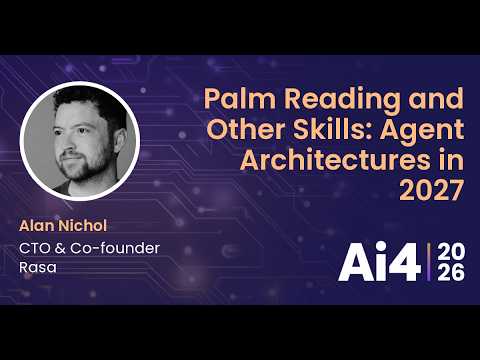
Ai4
Enterprises get trapped in perpetual rewrites because foundation models rapidly subsume runtime scaffolding, requiring organizations to shift focus to reusable velocity layers and federated authoring to scale production deployments.
AI-assisted summary of Palm Reading and Other Skills: Agent Architectures in 2027 With Rasa — original source. Check the original for full context.
Source published:
Detailed notes
## Background Published on YouTube by Ai4 on August 15, 2026, this presentation features Alan Nichol, CTO and co-founder of Rasa. According to the description, the session explores the architectural choices made during the first 90 days of building enterprise AI agents, breaking down which architectural bets pay off and what separates resilient production deployments from doomed initiatives in regulated industries.
## TL;DR Alan Nichol addresses the central tension in enterprise AI: engineering teams are proud of shipping complex scaffolding, while business stakeholders remain frustrated by slow delivery velocity. He explains that foundational models continuously 'eat the stack,' giving custom runtime code an 18-month half-life and rendering low-level scaffolding obsolete. To build durable systems, Nichol proposes a three-tier architecture that shifts focus away from ephemeral model wrappers and undifferentiated compliance toward a high-ROI 'Velocity Layer.' This layer empowers domain experts through federated development, composable skills, reasoning-level observability, and an autonomous flywheel that simulates fixes on real production conversation logs.
## Atmosphere & style Pragmatic, experienced, and wryly humorous, Nichol delivers a grounded reality check to enterprise AI hype, opening with fortune-teller anecdotes and the relatable metaphor of the messy 'first pancake.' The talk balances technical architectural critique with sharp organizational empathy, charting the evolution from single-token context windows to modern agent tool-calling. Listening feels like receiving candid, hard-won advice from an industry veteran who has seen chatbot and LLM paradigms come and go, offering a clear blueprint to escape the maintenance hamster wheel.
## Key takeaways - [00:04](https://www.youtube.com/watch?v=2hO01YhyWCo&t=4s) A central tension in enterprise AI exists between engineering teams proud of complex infrastructure and business leaders frustrated by slow use case delivery. - [01:46](https://www.youtube.com/watch?v=2hO01YhyWCo&t=106s) Foundational models consistently 'eat the stack' over time, natively subsuming custom code, state tracking, and dialogue management layers previously built by hand. - [01:46](https://www.youtube.com/watch?v=2hO01YhyWCo&t=106s) Much of today's custom agent scaffolding will be rendered obsolete by future model iterations, mirroring past architectural shifts like the waning indispensability of vector search. - [04:37](https://www.youtube.com/watch?v=2hO01YhyWCo&t=277s) Enterprise AI stacks operate with an 18-month half-life, meaning roughly half of custom runtime plumbing becomes redundant within a year and a half. - [04:37](https://www.youtube.com/watch?v=2hO01YhyWCo&t=277s) Focusing solely on low-level runtime capabilities traps engineering teams in a continuous cycle of rewriting scaffolding rather than driving business value. - [04:37](https://www.youtube.com/watch?v=2hO01YhyWCo&t=277s) An enterprise agent platform is structured across three tiers: the rapidly deprecated Capabilities Layer, the table-stakes Enterprise Readiness Layer, and the high-ROI Velocity Layer. - [06:52](https://www.youtube.com/watch?v=2hO01YhyWCo&t=412s) Sustainable engineering requires composable skill catalogs, permanent structural fixes over prompt-and-pray tweaks, and reasoning-level counterfactual observability. - [06:52](https://www.youtube.com/watch?v=2hO01YhyWCo&t=412s) Business stakeholders require data-driven roadmaps and bi-directional metric drilldowns without being blocked by Jira tickets for conversational adjustments. - [08:40](https://www.youtube.com/watch?v=2hO01YhyWCo&t=520s) A federated development model empowers non-coding domain experts to directly shape and refine agent behaviors. - [08:40](https://www.youtube.com/watch?v=2hO01YhyWCo&t=520s) A self-improving flywheel automatically detects production coverage gaps, suggests fixes, and verifies them via historical conversation simulations before human deployment. - [08:40](https://www.youtube.com/watch?v=2hO01YhyWCo&t=520s) True platform success is measured by the velocity of scaling beyond the messy 'first pancake' agent to making each subsequent use case exponentially faster and cheaper.
## Detailed walkthrough ### [00:04](https://www.youtube.com/watch?v=2hO01YhyWCo&t=4s) Mystic Mona, the Enterprise Dragon, and the Delivery Tension
Alan Nichol opens his talk with an anecdote about Mystic Mona, a fortune teller stationed at the Rasa booth. Mona shared two predictions with him earlier that morning: first, that every single person in the room is fighting the exact same dragon; second, that his presentation was destined to bomb. As the founder and CTO of Rasa, a platform used by some of the world's most demanding enterprises to build customer- and employee-facing AI agents, Nichol notes that Rasa has been building in this space "since well before ChatGPT" and doing chatbots "since before they were good."
Through his regular conversations with IT leadership—including CTOs, CIOs, and Chief AI Officers—Nichol observes that the industry has moved far beyond early proofs of concept and experimentation into establishing internal agent platforms. However, this progress has triggered a sharp structural tension within organizations:
- **The Engineering Perspective:** Technical teams are rightfully proud of the sophisticated architecture, tool-calling pipelines, and agents they have engineered and shipped. - **The Business Perspective:** Leadership and business stakeholders remain chronically dissatisfied, consistently complaining that use cases and new production agents are not going live fast enough.
```mermaid flowchart TD accTitle: The Enterprise AI Agent Organizational Tension subgraph S1["Engineering Reality"] A["Custom Agent Scaffolding"] --> B["Pride in Shipping Complex Infra"] end subgraph S2["Organizational Friction"] B -.->|"The Dragon"| C["Delivery Velocity Bottleneck"] end subgraph S3["Business Pressure"] D["Need for Fast Production Use Cases"] --> C C --> E["Tension: 'Why are we not in production faster?'"] end ```
---
[01:46](https://www.youtube.com/watch?v=2hO01YhyWCo&t=106s) How Models Eat the Stack: From Single Tokens to Tool Calling
To illustrate why this organizational friction exists, Nichol poses a seemingly absurd question: is it possible to build an AI agent with a one-token context window? When Rasa was founded a decade ago, that was the literal reality. Early language models could only inspect a single token at a time to predict a specific attribute. Everything required to make that model function as an interactive agent—handling multi-turn context, dealing with follow-up queries, tracking state, invoking backend APIs, and applying business logic—demanded massive amounts of custom, handwritten code. The model's sole responsibility was matching user utterances into one of a few hundred predefined buckets called "intents" (e.g., greetings, affirmatives, refund requests).
Over the subsequent years, foundational models did not merely grow in size; they aggressively began "eating the stack" around them. When BERT arrived—treated at the time as a large language model—it allowed systems to evaluate entire sentences in context, natively resolving complex linguistic structures like negation and instantly rendering large swaths of manual parsing code obsolete. Next, GPT-3 expanded context windows across entire transcripts, and subsequent generations introduced native tool-calling capabilities. One by one, components that developers spent years writing by hand—state tracking, dialogue management policies, and predefined response templates—were subsumed by the underlying models.
Despite modern agents appearing to be nothing more than an LLM invoking tools in a loop, production deployments today are still surrounded by fragile, handwritten scaffolding. Nichol warns that history will repeat itself: foundational models will inevitably consume these bespoke layers in upcoming iterations. A prime example is the frenzy around vector databases and vector search, once marketed as an indispensable pillar for RAG and agent architectures, only for teams to discover that conventional search methods perform just as well or better for most domains, including code search.
---
[04:37](https://www.youtube.com/watch?v=2hO01YhyWCo&t=277s) The 18-Month Half-Life and the Three-Tier Agent Platform
Because the pace of model innovation has accelerated from multi-year cycles to a matter of months, Nichol formulates an operating rule for engineering leaders: "Your AI stack has a half-life of 18 months." Roughly 50% of the custom runtime scaffolding built today will become completely unnecessary in a year and a half, yet engineering teams cannot predict which half will survive. Focusing solely on immediate runtime plumbing locks organizations into an exhausting "hamster wheel," forcing them to perpetually rewrite components just to stay aligned with newer model releases.
To break this cycle, Nichol conceptualizes an enterprise agent platform as a three-tiered cake:
```mermaid flowchart TD accTitle: Three-Tier Enterprise Agent Platform Architecture subgraph T3["Top: Velocity Layer (High ROI / Differentiator)"] V1["Reusable, Composable Skills"] V2["Autonomous Learning Flywheel"] V3["Domain Expert Authoring (No Jira)"] V4["Causal & Counterfactual Observability"] end subgraph T2["Middle: Enterprise Readiness Layer (Table Stakes)"] E1["Security, Compliance & Guardrails"] E2["Role-Based Access & Governance"] E3["Non-Functional Requirements"] end subgraph T1["Bottom: Capabilities Layer (Rapidly Deprecated)"] C1["Runtime Model Wrappers & Scaffolding"] C2["Handwritten State Tracking & Dialogue Logic"] C3["Prompt Engineering Workarounds"] end
T1 --> T2 --> T3 ```
- **Tier 1: The Capabilities Layer (Bottom):** Encompasses everything in the immediate vicinity of the model at runtime (prompt wrappers, state glue, tool orchestration). It provides short-term functionality but ages poorly and is repeatedly eaten by model updates. - **Tier 2: The Enterprise Readiness Layer (Middle):** Encompasses governance, compliance, security, and non-functional requirements. While essential for enterprise production, it is completely undifferentiated. - **Tier 3: The Velocity Layer (Top):** The critical layer that multiplies enterprise ROI, ensuring that building the 10th agent or use case is exponentially faster and cheaper than building the first.
---
[06:52](https://www.youtube.com/watch?v=2hO01YhyWCo&t=412s) Engineering and Business Requirements for a High-Velocity Layer
A well-architected velocity layer addresses the distinct day-to-day requirements of both engineering teams and business stakeholders, transforming how agents are maintained and diagnosed:
#### For Engineering Teams - **Composable, Reusable Skills:** Access to an enterprise-wide, pre-vetted catalog of capabilities (such as authentication, transactional workflows, or even palm reading) that can be plugged across multiple agents with guaranteed compatibility. - **Permanent Fixes vs. "Prompt and Pray":** Naive implementations tweak prompts to patch single edge cases, inadvertently creating regressions elsewhere. Robust architectures ensure that when a bug is fixed once, it stays fixed. - **Reasoning-Level Observability:** Standard low-level LLM tracing (inspecting raw input and output strings) provides excessive micro-detail without actionable insight. Teams need structural observability into *how* the agent reasoned—specifically understanding why a decision was made and what counterfactual condition would have altered the trajectory.
#### For Business Stakeholders - **Data-Driven Roadmaps:** Roadmaps grounded in real production conversations rather than speculation, complete with a continuous learning flywheel. - **Bi-Directional Metric Drilldowns:** The capacity to look top-down from high-level business KPIs into the exact interactions driving them, as well as bottom-up from an isolated anomalous conversation to determine if it represents a widespread pattern. - **Bypassing the Jira Bottleneck:** Transitioning away from legacy workflows where every minor conversational tweak or business logic adjustment requires filing an engineering ticket in Jira.
---
[08:40](https://www.youtube.com/watch?v=2hO01YhyWCo&t=520s) Federated Development, Self-Improving Workflows, and Long-Term ROI
To achieve true organizational velocity, enterprises must adopt a federated development model. Rather than forcing all agent requests through a centralized IT bottleneck, domain experts—who understand business processes intimately but do not write code—must be empowered to shape agent behaviors directly.
A modern velocity layer acts as an autonomous feedback loop that continuously processes live production logs through a three-stage lifecycle: 1. **Proactive Gap Detection:** Analyzing incoming enterprise conversations to automatically highlight unhandled user intents and failure points. 2. **Suggested Remediation:** Drafting concrete architectural or logic adjustments to address the identified gap without starting from scratch. 3. **Historical Simulation:** Running rigorous simulations against past conversation datasets to prove the change resolves the issue without introducing regressions, presenting a verified recommendation for human review.
```mermaid flowchart LR accTitle: Autonomous Learning and Simulation Flywheel A["Live Production Logs"] --> B["Detect Coverage Gaps"] B --> C["Generate Proposed Fix"] C --> D["Run Simulations on Historical Data"] D --> E["Domain Expert Review & One-Click Deploy"] E --> A ```
Nichol emphasizes that Rasa’s platform architecture was intentionally designed to respect the substantial investments enterprises have already made over recent years. Instead of demanding a destructive "rip and replace," the platform allows teams to "color outside the lines" and customize or override individual components.
He notes that the first enterprise agent is always like "the first pancake"—slow, messy, and experimental. Long-term success is measured by how quickly subsequent use cases reach production. When built on real customer data, vetted by business experts, and hardened from day one, stakeholder sentiment fundamentally flips from *"Why are you so slow?"* to *"We love this. Can we have more? How do we scale this out?"* Nichol concludes with a tongue-in-cheek nod to Mona, summarizing the audience's AI fortune in five words: *"Find me at the booth."*
## Notable quotes > [00:04](https://www.youtube.com/watch?v=2hO01YhyWCo&t=4s) since well before ChatGPT — Alan Nichol
> [00:04](https://www.youtube.com/watch?v=2hO01YhyWCo&t=4s) since before they were good. — Alan Nichol
> [01:46](https://www.youtube.com/watch?v=2hO01YhyWCo&t=106s) eating the stack — Alan Nichol
> [04:37](https://www.youtube.com/watch?v=2hO01YhyWCo&t=277s) Your AI stack has a half-life of 18 months. — Alan Nichol
> [04:37](https://www.youtube.com/watch?v=2hO01YhyWCo&t=277s) hamster wheel — Alan Nichol
> [06:52](https://www.youtube.com/watch?v=2hO01YhyWCo&t=412s) Prompt and Pray — Alan Nichol
> [08:40](https://www.youtube.com/watch?v=2hO01YhyWCo&t=520s) the first pancake — Alan Nichol
> [08:40](https://www.youtube.com/watch?v=2hO01YhyWCo&t=520s) color outside the lines — Alan Nichol
> [08:40](https://www.youtube.com/watch?v=2hO01YhyWCo&t=520s) Why are you so slow? — Alan Nichol
> [08:40](https://www.youtube.com/watch?v=2hO01YhyWCo&t=520s) We love this. Can we have more? How do we scale this out? — Alan Nichol
> [08:40](https://www.youtube.com/watch?v=2hO01YhyWCo&t=520s) Find me at the booth. — Alan Nichol
## Mentioned Alan Nichol, Rasa, Mystic Mona, Ai4, ChatGPT, BERT, GPT-3, Jira
## Video description Alan Nichol - CTO & Co-founder, Rasa
Most enterprise AI agents being built right now won't make it to durable production. Not because the models aren't good enough, but because the architectural choices made in the first 90 days quietly seal the project's fate.
Alan Nichol, founder of Rasa, has spent over a decade reading the leaves: watching enterprise agents get built through the chatbot era, the LLM shift, and now the agent era. In this session, he'll share the pattern recognition: which architectural bets pay off, which ones are cursed from the start, and what separates the agents running at the world's largest banks, telcos, and healthcare companies from those that never made it out of the cards.
If you're building or operating AI agents in a regulated enterprise, this talk will tell you with uncomfortable specificity what your agent's future holds — and how to change it.
[Source](https://www.youtube.com/watch?v=2hO01YhyWCo)