CreditAssociates Deploys Agentic AI to Boost Sales Conversion and Retention
Ai4
CreditAssociates links its AI strategy to a unified data foundation and explainable lead recommendations to capture millions in value from a single percentage point gain in client retention.
AI-assisted summary of Using Agentic AI to Drive Customer Acquisition & Retention With CreditAssociates — original source. Check the original for full context.
Source published:
Detailed notes
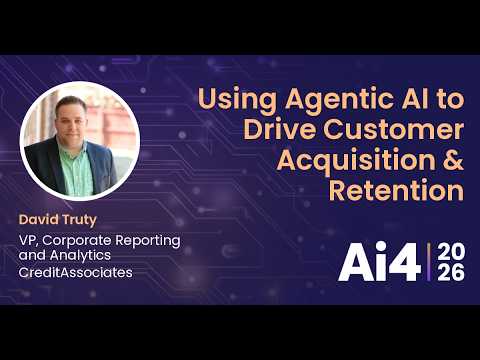
## Background Published by Ai4 on YouTube on August 15, 2026, this presentation featuring David Truty, VP of Corporate Reporting and Analytics at CreditAssociates, explores how Agentic AI drives customer acquisition and retention. The presentation details how CreditAssociates leverages advanced analytics and agentic AI while maintaining key operational constraints around trust, explainability, compliance, and consistency.
## TL;DR David Truty outlines CreditAssociates' strategy for solving sales queue inefficiency and optimizing customer acquisition and retention through Agentic AI. Built upon a solid, centralized data foundation, their Next-Best-Action agent ranks leads and delivers explainable recommendations to human sales reps. This advisory approach ensures regulatory compliance while significantly improving rep performance and conversion rates. Ultimately, targeting key high-impact metrics like a 1% boost in retention delivers multi-million dollar ROI and lays the groundwork for enterprise-wide AI expansion.
## Atmosphere & style The presentation carries an engaging, self-deprecating, and pragmatic tone, with the speaker balancing lighthearted humor—acknowledging he stands between the audience and lunch—with deep industry focus. It feels grounded and practical rather than overly hyped, framing complex AI integration around real-world human adoption, strict regulatory limits, and measurable business ROI. The narrative follows a logical journey from foundational data cleanup to production implementation and future enterprise scaling.
## Key takeaways - [00:04](https://www.youtube.com/watch?v=jrabW5hKrmQ&t=4s) CreditAssociates operates in the consumer debt resolution industry, helping clients navigate debt through personalized savings plans and settlement negotiations. - [01:19](https://www.youtube.com/watch?v=jrabW5hKrmQ&t=79s) The company views itself as being in the "trust business," making customer trust a primary design constraint for implementing AI. - [03:21](https://www.youtube.com/watch?v=jrabW5hKrmQ&t=201s) Acquisition and retention rely on finding prospects with sufficient debt, hardship, and high probabilities of both enrolling and graduating from the program. - [03:56](https://www.youtube.com/watch?v=jrabW5hKrmQ&t=236s) CreditAssociates tracks three interconnected KPIs—Marketing Efficiency Ratio (MER), Cost Per Opportunity (CPO), and Cost Per Graduate—to evaluate marketing spend. - [06:32](https://www.youtube.com/watch?v=jrabW5hKrmQ&t=392s) A single percentage point increase in client retention delivers millions of dollars in financial value to the company. - [06:52](https://www.youtube.com/watch?v=jrabW5hKrmQ&t=412s) CreditAssociates' AI strategy follows a three-phase roadmap: establishing a clean data foundation, deploying narrow-scope agents, and scaling across the enterprise. - [07:31](https://www.youtube.com/watch?v=jrabW5hKrmQ&t=451s) A centralized, sanitized data foundation provides the required "memory" for AI agents to answer complex dynamic state questions about prospects in real time. - [08:41](https://www.youtube.com/watch?v=jrabW5hKrmQ&t=521s) The Next-Best-Action agent integrates marketing attribution, behavioral data, trade line information, and credit scores to rank leads and guide sales reps. - [09:40](https://www.youtube.com/watch?v=jrabW5hKrmQ&t=580s) Intentional feedback loop design is required to keep predictive models from overfitting and to ensure continuous model learning without alienating sales leadership. - [10:21](https://www.youtube.com/watch?v=jrabW5hKrmQ&t=621s) Using AI in an advisory role with clear, explainable reason codes yields higher sales conversion rates than pulling blindly from a standard queue. - [11:40](https://www.youtube.com/watch?v=jrabW5hKrmQ&t=700s) AI systems in regulated financial industries must satisfy two distinct audiences: sales reps who need trust, and regulators who require auditability. - [13:40](https://www.youtube.com/watch?v=jrabW5hKrmQ&t=820s) The future vision for CreditAssociates includes expanding agentic AI into customer servicing, settlement tracking, financial governance, and outbound dialing. - [14:11](https://www.youtube.com/watch?v=jrabW5hKrmQ&t=851s) Building a solid data foundation represents the hardest and most essential portion of an AI deployment project. - [14:23](https://www.youtube.com/watch?v=jrabW5hKrmQ&t=863s) Explainability should be treated as a performance-enhancing feature rather than an administrative compliance tax. - [14:35](https://www.youtube.com/watch?v=jrabW5hKrmQ&t=875s) AI initiatives should be anchored to a specific core metric where a 1% improvement translates to massive business ROI.
## Detailed walkthrough ### [00:04](https://www.youtube.com/watch?v=jrabW5hKrmQ&t=4s) Introduction and the Queue Management Problem
David Truty, Vice President of Corporate Reporting and Analytics at CreditAssociates, opens his talk by introducing himself and his company. Based in Plano, Texas, CreditAssociates is a consumer debt resolution company. Truty shares that it is his first time attending the Ai4 conference and expresses how amazing it is to be surrounded by people who are "exponentially smarter than me" from whom he can learn. Acknowledging that he stands between the audience and lunch, he jokingly promises to get everyone out on time, if not a little early.
Truty frames the core operational challenge by describing the company's sales floor. Every day, sales representatives log in to a phone queue filled with hundreds of inbound and outbound calls, but they only have an eight-hour workday to navigate them. For most of CreditAssociates' history, reps simply grabbed whichever lead was sitting at the top of the queue. The underlying question driving his presentation—and the entire project—is determining who to call, when to call them, and what to say. He outlines four key stops for the presentation: an overview of CreditAssociates, what makes their problem difficult, their AI roadmap and first agentic deployment, and how they plan to scale agentic AI across the enterprise.
- **Company Location:** Plano, Texas. - **Core Sales Challenge:** Reps managing hundreds of calls in an 8-hour shift traditionally pulled sequentially from the top of the queue. - **Agenda:** Company background, industry-specific constraints, AI roadmap & agent setup, and future enterprise scaling.
---
[01:19](https://www.youtube.com/watch?v=jrabW5hKrmQ&t=79s) Debt Resolution and the Trust Business
Clients come to CreditAssociates overwhelmed by credit card debt, and the company works to help them regain control by creating personalized debt plans with structured savings and negotiating debt settlements on their behalf. Over its history, CreditAssociates has resolved over $1 billion in debt across hundreds of thousands of customer accounts. The company's mission is to instill financial confidence using financial literacy and compassion, guided by the belief that people live better debt-free.
Truty emphasizes that CreditAssociates does not view itself as being strictly in the "debt business," but rather in the "trust business." Customers reach out at the lowest point of their financial lives, entrusting the firm to guide them back to stability. If the company fails to earn and maintain that trust, nothing else it does matters. This focus on trust acts as a critical binding constraint on every decision regarding how AI is implemented across the company.
- **Track Record:** Resolved over $1,000,000,000 in debt across hundreds of thousands of accounts. - **Core Philosophy:** Guided by compassion and financial literacy, treating customer trust as a fundamental engineering constraint.
---
[03:21](https://www.youtube.com/watch?v=jrabW5hKrmQ&t=201s) Balancing Acquisition, Retention, and Financial KPIs
The primary goal of CreditAssociates' acquisition and retention strategy is to acquire and retain the right customers at an optimized spend level while personalizing the client journey throughout their lifecycle. Truty points out that acquisition and retention are essentially the same goal with different timing—retention does not start upon enrollment, but rather with choosing the right customer to enroll in the first place. A qualifying customer has a sufficient level of debt, faces genuine financial hardship, can fund the structured program, and shows a high probability of both enrolling and graduating.
Because every marketing dollar spent is a bet on a prospect the company has not yet met, CreditAssociates tracks three interconnected KPIs to evaluate those bets: 1. **Marketing Efficiency Ratio (MER):** Evaluates overall portfolio-level marketing allocation and efficiency. 2. **Cost Per Opportunity (CPO):** Derived from a Multi-Touch Attribution (MTA) model to measure the cost efficiency of getting a lead to talk to a debt consultant. 3. **Cost Per Graduate:** Measures the total cost required to shepherd a client through the entire length of the program.
Looking at these metrics in isolation can be misleading because optimizing one can harm another. For instance, the easiest way to boost MER is to purchase cheap leads, whereas the easiest way to maximize graduation rates is to be extremely selective about enrollments. Personalization bridges this gap by delivering the right message at the right time. Truty notes that a client suffering from job loss and maxed-out credit cards requires a completely different conversation than one struggling with unexpected medical debt. Prior to this project, sales metrics were missing targets, lack of personalization drove up serving costs and eroded margins, and retention improvements had hit a plateau after all traditional process changes, scripting, and training were exhausted. Because a single percentage point increase in retention is worth millions of dollars to the company, funding was secured for an AI-driven approach.
- **Key Metrics Tracked:** - **MER** (Marketing Efficiency Ratio) for portfolio allocation. - **CPO** (Cost Per Opportunity) via Multi-Touch Attribution modeling. - **Cost Per Graduate** for long-term program efficiency. - **Financial Impact:** A single 1% boost in client retention translates to millions of dollars in ROI.
---
[06:52](https://www.youtube.com/watch?v=jrabW5hKrmQ&t=412s) Three-Phase AI Roadmap and Data Foundation
Reflecting on a keynote speech from Dataiku earlier at the conference, Truty agrees that successful AI companies are not necessarily those that move the fastest, spend the most, or shout the loudest, but those that establish a solid foundation. CreditAssociates structured its AI strategy into three phases: - **Phase 1: Foundation (Data Sanitation & Single Source of Truth):** CreditAssociates spent most of the previous year building a centralized, sanitized data foundation with analytics layered on top, aligning marketing, sales, and operations on a single source of truth. - **Phase 2: Agent Production & Narrow Scope:** Deploying agentic AI specifically focused on acquisition and retention to prove out ROI before expanding. - **Phase 3: Enterprise Scale:** Expanding agents to customer servicing, settlements, and financial governance.
Truty explains that the data foundation serves as the "memory" of the agentic system. To make intelligent decisions, the agent must evaluate complex "state questions" for every prospect—such as how many times they have been emailed, whether they viewed a digital ad or received direct mail, how recently that occurred, if they responded, and whether they fall within state calling windows. Without a clean data foundation, answering these dynamic state questions accurately in real time would be impossible.
- **Phase 1 Focus:** Centralized and sanitized data truth across marketing, sales, and operations. - **Role of Foundation:** Provides the memory required for the agent to evaluate complex, multi-touch prospect states.
---
[08:41](https://www.youtube.com/watch?v=jrabW5hKrmQ&t=521s) Next-Best-Action Agent Architecture and Sales Integration
The Next-Best-Action agent integrates inputs from Media Mix Modeling (MMM), Multi-Touch Attribution (MTA) models, behavioral data, demographic data, trade line utilization, and credit scores (where compliantly allowed). The system scores and ranks leads, providing explicit reasons for the ranking, and instructs sales reps on the next best action to take to guide clients toward enrollment and eventual graduation.
``` +-----------------------------------------------------------------------+ | DATA INPUTS | | • Media Mix Model (MMM) • Multi-Touch Attribution (MTA) | | • Behavioral & Demographic Data • Credit Score & Trade Lines | +-----------------------------------------------------------------------+ │ ▼ +-----------------------------------------------------------------------+ | NEXT-BEST-ACTION AGENT | | • Evaluates state questions & compliance constraints | | • Ranks leads and generates explainable action reasons | +-----------------------------------------------------------------------+ │ ▼ +-----------------------------------------------------------------------+ | HUMAN-IN-THE-LOOP EXECUTION | | • Reps receive recommendations + reasoning | | • Reps execute personalized outreach → Enrollment → Graduation | +-----------------------------------------------------------------------+ ```
Truty details several practical insights gained while bringing this agent into production: 1. **Answering Complex Queue Dynamics:** While standard predictive models can rank lead quality, an agentic system dynamically evaluates competing queue factors (e.g., deciding whether to call a prospect who opened an email yesterday versus 400 other leads waiting in the queue). 2. **Managing Sales Feedback Loops:** As the model learned who actually enrolls, it narrowed down lead selection. However, to prevent model drift and ensure continuous learning, the team had to intentionally feed the model some leads it did not particularly like, leading to "fun, awkward conversations" with sales leadership. 3. **Advisory Role vs. Full Automation:** CreditAssociates deliberately chose an advisory setup where the agent advises and human reps make the final decision. Internal testing showed that sales reps who received explainable reason codes alongside recommendations closed at a significantly higher rate than reps pulling blindly from a traditional queue.
- **Input Signals:** MMM, MTA, behavioral indicators, credit score, and trade line utilization. - **Human-in-the-Loop Results:** Reps who understood the agent's explanation and trusted the recommendations achieved far higher closing rates.
---
[11:40](https://www.youtube.com/watch?v=jrabW5hKrmQ&t=700s) Trust, Compliance, and Consistency as Engineering Principles
Operating in a heavily regulated industry means that any deployed AI system must satisfy two distinct audiences: sales reps, who must trust the advice enough to act on it, and regulators, who may demand an audit of why a decision was made. Therefore, trust and explainability are treated as fundamental engineering principles rather than optional features.
``` ┌───────────────────────────┐ │ ENGINEERING PRINCIPLES │ └─────────────┬─────────────┘ │ ┌───────────────────────┴───────────────────────┐ ▼ ▼ ┌───────────────────────┐ ┌───────────────────────┐ │ SALES REPS │ │ REGULATORS │ │ • High trust & clear │ │ • Full explainability│ │ reason codes │ │ • Regulatory & policy│ │ • Prevents going │ │ compliance │ │ "rogue" │ │ │ └───────────────────────┘ └───────────────────────┘ ```
Truty notes that if a sales rep loses trust in the model, goes rogue, and happens to be right a few times, organizational trust in the system vanishes. To maintain alignment, the agent provides clear reason codes (such as high digital engagement or high enrollment likelihood) while strictly enforcing state, local, and internal policy regulations. Crucially, the agent brings consistency to the sales floor, ensuring that similar leads are handled with the same high standard every time.
While the models and agentic layer are actively running, Truty notes that the final impact number (left as "X" on his slides) is still being earned. Because graduation occurs months or years after initial enrollment, the team must play a patient game before publishing long-term ROI metrics, promising to present the final numbers at the following year's conference.
- **Two Key Audiences:** Sales representatives (trust/adoption) and regulators (auditability/explainability). - **Core Benefit:** Replaces inconsistent rep behavior with repeatable, policy-compliant execution.
---
[13:40](https://www.youtube.com/watch?v=jrabW5hKrmQ&t=820s) Enterprise Expansion and Key Takeaways
Looking forward, CreditAssociates plans to expand its agentic AI architecture from acquisition and retention into other business functions, including customer servicing, settlement tracking, financial spend governance, and AI-powered outbound dialers. The overarching goal remains delivering an elevated, personalized experience at every touchpoint along the client lifecycle.
Truty summarizes his presentation with three main takeaways, plus a partner shout-out: 1. **The Data Foundation is the Real Work:** "The boring data work really was the project for us." Establishing a clean data foundation was the necessary prerequisite for agentic AI. 2. **Explainability is a Feature, Not a Tax:** In a regulated environment, explainability drives user trust, compliance, and higher conversion performance. 3. **Target Your 1% Metric:** Identify the single metric in the business where a 1% shift translates to massive financial value (for CreditAssociates, a 1% gain in retention equals millions of dollars). This clear ROI provides the launchpad and funding for AI initiatives. 4. **Partner Acknowledgment:** Truty gives a "shameless plug" to their analytics partner, Kaizen Analytics (located at booth 500), thanking them for their multi-year collaboration and mentioning their golf tees before wishing the audience a great rest of the conference.
- **Future Scaling Areas:** Customer servicing, debt settlement, spend monitoring, and AI outbound dialers. - **Final Advice:** Build a solid data foundation, treat explainability as an asset, and anchor AI investments to high-ROI business metrics.
## Notable quotes > [00:04](https://www.youtube.com/watch?v=jrabW5hKrmQ&t=4s) exponentially smarter than me — David Truty
> [00:04](https://www.youtube.com/watch?v=jrabW5hKrmQ&t=4s) who to call, when to call them, and what to say — David Truty
> [01:19](https://www.youtube.com/watch?v=jrabW5hKrmQ&t=79s) debt business — David Truty
> [01:19](https://www.youtube.com/watch?v=jrabW5hKrmQ&t=79s) trust business — David Truty
> [06:52](https://www.youtube.com/watch?v=jrabW5hKrmQ&t=412s) State questions — David Truty
> [08:41](https://www.youtube.com/watch?v=jrabW5hKrmQ&t=521s) fun, awkward conversations — David Truty
> [11:40](https://www.youtube.com/watch?v=jrabW5hKrmQ&t=700s) X — David Truty
> [13:40](https://www.youtube.com/watch?v=jrabW5hKrmQ&t=820s) The boring data work really was the project for us. — David Truty
> [13:40](https://www.youtube.com/watch?v=jrabW5hKrmQ&t=820s) Explainability is a Feature, Not a Tax — David Truty
> [13:40](https://www.youtube.com/watch?v=jrabW5hKrmQ&t=820s) Target Your 1% Metric — David Truty
> [13:40](https://www.youtube.com/watch?v=jrabW5hKrmQ&t=820s) shameless plug — David Truty
## Mentioned David Truty, CreditAssociates, Ai4, Plano, Texas, Dataiku, Kaizen Analytics
## Video description David Truty - VP, Corporate Reporting and Analytics, CreditAssociates
It has always been critical to acquire the right customers, optimize customer-related spend, and personalize engagement at every stage of the customer lifecycle. Agentic AI creates a huge opportunity for companies to increase customer acquisition and retention.
This presentation will cover how Agentic AI is helping CreditAssociates take their customer acquisition and retention to the next level, building on their existing advanced analytics capabilities and factoring in key themes of trust, explainability, compliance, and consistency.
[Source](https://www.youtube.com/watch?v=jrabW5hKrmQ)