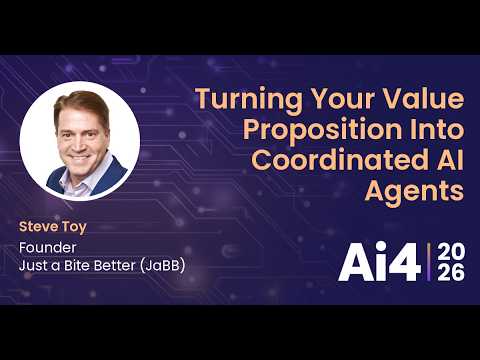
JaBB Founder Steve Toy Urges AI Builders to Focus on Moats Over Workflows
Ai4
Companies risk rapid failure when using AI unless they align specialized agents with proprietary data, compounding user assets, or a distinct domain methodology rather than easily replicable mechanics.
## Background
This session was presented by Steve Toy, Founder of Just a Bite Better (JaBB), and published on YouTube by the Ai4 channel on August 20, 2026. The presentation outlines a practical blueprint for leaders, product owners, and builders to translate domain expertise into focused, coordinated AI agents rather than relying on generic AI solutions.
## TL;DR
Steve Toy addresses four major mistakes companies make when attempting to leverage AI, emphasizing that businesses must focus strictly on what customers pay for rather than internal operational mechanics. He highlights that true moats stem from proprietary data, compounding assets, and a distinct point of view rather than complex prompts or single 'god models.' By sharing examples from EY, JaBB, dinemait, and Memrise, Toy demonstrates how to empower domain experts with engineering rails to build coordinated, specialized AI agents around a company's core value proposition.
## Atmosphere & style
The presentation carries a practical, candid, and instructional tone, blending high-level strategy with self-reflective personal anecdotes. Toy speaks with the pragmatic authority of an experienced founder and CEO who isn't afraid to highlight his own missteps alongside successful implementations. Watching the session feels like a focused, real-world masterclass in avoiding AI hype and prioritizing core customer value over seductive technological demos.
## Key takeaways
- [00:04](https://www.youtube.com/watch?v=TbxlW41miLg&t=4s) Delivering what customers actually pay for is the core of business success, whereas implementing AI without a clear value proposition is just "random AI."
- [00:04](https://www.youtube.com/watch?v=TbxlW41miLg&t=4s) Moving fast with AI in the wrong direction leads to rapid strategic failure, and impressive demos can mask poor strategic choices ("slop").
- [04:01](https://www.youtube.com/watch?v=TbxlW41miLg&t=241s) Mistake #1: Confusing internal operational mechanics or billable hours with a company's actual value proposition or moat.
- [04:01](https://www.youtube.com/watch?v=TbxlW41miLg&t=241s) The Single-Shot Test: If a good prompt can produce 80% of your outcome, that workflow is not your moat.
- [04:01](https://www.youtube.com/watch?v=TbxlW41miLg&t=241s) True moats exist in proprietary data, compounding user assets that increase retention over time, and a unique point of view or distinct methodology.
- [10:03](https://www.youtube.com/watch?v=TbxlW41miLg&t=603s) Mistake #2 & #3: Building the wrong secondary features before mastering the core value proposition, or over-engineering prompt instructions instead of using user context.
- [13:35](https://www.youtube.com/watch?v=TbxlW41miLg&t=815s) Mistake #4: Sidelining domain experts by relying solely on software engineers to define AI behavior and product vision.
- [13:35](https://www.youtube.com/watch?v=TbxlW41miLg&t=815s) To empower domain experts, engineers should build technical "rails" and environments that allow non-technical specialists to directly build AI features.
- [16:02](https://www.youtube.com/watch?v=TbxlW41miLg&t=962s) Frontier models collapse basic technical tasks into commodities, making a company's unique point of view the most critical surviving asset.
- [16:02](https://www.youtube.com/watch?v=TbxlW41miLg&t=962s) Break down unique domain methodologies into specialized, coordinated AI agents built around the core moat.
## Detailed walkthrough
### [00:04](https://www.youtube.com/watch?v=TbxlW41miLg&t=4s) Delivering Value Proposition vs. "Random AI"
Steve Toy introduces the core thesis of his talk: companies must prioritize defining their value proposition before attempting to coordinate AI agents. Drawing on his experience as a CEO who has overseen over 100 applications, Steve explains that delivering what customers pay for is the true core of business success—everything else is just "random AI."
<Image alt="A presenter explaining AI strategies on stage" caption="Steve Toy discussing AI value propositions" src="image_agent_tag_1"/>
---
To set the stage, Steve references Steve Jobs' classic principle on focus ("innovation is saying no to 1000 things"), offering a companion principle for the AI era: focus on what customers actually pay for.
- **AI Speed:** While AI speeds up development, moving fast in the wrong direction leads to rapid failure ("at AI speed, you could wind up in the wrong city real quickly").
- **Paradox of Choice:** The vast array of AI capabilities dilutes decision-making quality and satisfaction.
- **The Threat of "Slop":** Impressive demos can easily wrap bad strategic choices in seductive packages.
---
[04:01](https://www.youtube.com/watch?v=TbxlW41miLg&t=241s) Mistake #1: Confusing Your Mechanics for Your Moat
Steve outlines four major pitfalls leaders face when applying AI. The first major landmine is mistaking internal operational workflows or mechanics for the company’s actual value proposition or moat.
He shares an anecdote from 2017 when he was working with machine learning PhDs at EY. They successfully reduced hundreds of man-hours of accounting transaction classification down to a 15-minute compute run. However, the business owner panicked, believing they were destroying his business because he equated his value with billable hours. In reality, clients were not paying for billable hours—they were paying for certified results guaranteed by EY.
- **The Single-Shot Test:** Ask yourself, *"Can a good prompt get 80% of the outcome that you deliver?"* If yes, that workflow is not your moat.
- **Where Moats Truly Exist:**
1. **Proprietary Data:** Unique datasets unavailable to frontier models.
2. **Compounding Assets:** User retention features where value grows over time (e.g., the women's health app *Flo*, whose long-term cycle data creates ultra-low churn).
3. **Unique Point of View:** A distinct methodology or opinion on how an objective should be accomplished.
---
[10:03](https://www.youtube.com/watch?v=TbxlW41miLg&t=603s) Mistake #2 & #3: Building the Wrong Thing or Building the Wrong Way
Steve addresses the second and third landmines: focusing on the wrong feature or taking the wrong technical approach to a valid core objective.
Admitting to a mistake at his current company, **Just a Bite Better (JaBB)**, Steve explains how he got sidetracked building an elaborate recipe studio. The core value proposition of JaBB is providing friction-free, trustworthy voice logging for meals. By building a recipe database before ensuring a user could log a simple turkey sandwich with 100% trustworthy accuracy, he spent effort on the wrong thing.
Similarly, consulting for **dinemait**, Steve observed them trying to prompt a single "god model" to generate bespoke restaurant recommendations. However, bespoke recommendations do not stem from complex prompt engineering; they come from user context (knowing specific preferences for dates, family outings, or casual dinners) paired with an opinionated matching system.
The fourth landmine is unintentionally locking out domain experts while relying solely on software engineers to define AI behaviors.
Steve recounts his time running language-learning platform **Memrise**, where the core pedagogy follows a "Learn, Immerse, Communicate" loop. When early GPT models emerged, engineers began acting as proxy experts in language learning simple because they held the technical keys to the APIs. Meanwhile, world-class linguists—some fluent in 15 languages—were sidelined because they lacked technical access.
- **The Solution:** Engineers built the technical "rails" by setting up every linguist with a pre-configured Replit environment, GitHub access, and API integrations.
- **The Result:** The linguists generated 12 brand-new, fully functional features within just two weeks without needing infrastructure overhead.
---
[16:02](https://www.youtube.com/watch?v=TbxlW41miLg&t=962s) Building Coordinated Agents Around Your Core Moat
Steve wraps up by providing a blueprint for combining domain expertise with AI agents. Frontier models continuously collapse basic technical tasks into cheap or free commodities. The key is identifying what survives that collapse—your unique point of view—and breaking it down into specialized, coordinated agents.
At Memrise, this framework led to dedicated agents handling flashcards, video retrieval, conversation simulations, and real-time pronunciation feedback. This tight loop enabled a complete beginner to spend 30 minutes in a hotel room preparing to walk into a Madrid cafe and confidently order coffee in fluent Spanish.
> "Your domain experts have expertise that is worthwhile. Your engineering team also has expertise, but usually it's unlocking the domain experts and working together, that's how you can get the job done."
<FollowUp label="Want to explore how to implement the 'Single-Shot Test' for your own product?" query="How do I run the Single-Shot Test on my company's core offering to identify our true value proposition?"/>
## Notable quotes
> [00:04](https://www.youtube.com/watch?v=TbxlW41miLg&t=4s) at AI speed, you could wind up in the wrong city real quickly — Steve Toy
> [04:01](https://www.youtube.com/watch?v=TbxlW41miLg&t=241s) Can a good prompt get 80% of the outcome that you deliver? — Steve Toy
> [16:02](https://www.youtube.com/watch?v=TbxlW41miLg&t=962s) Your domain experts have expertise that is worthwhile. Your engineering team also has expertise, but usually it's unlocking the domain experts and working together, that's how you can get the job done. — Steve Toy
## Mentioned
Steve Toy, Steve Jobs, Just a Bite Better, JaBB, Memrise, dinemait, EY, Flo, Replit, GitHub
## Video description
Steve Toy - Founder, Just a Bite Better (JaBB)
Most companies do not need generic AI. They need AI that quickly and scalably delivers their unique value proposition to their customers. In this session, I will share a practical blueprint for leaders, product owners, and hands-on builders to turn domain expertise into focused, coordinated AI agents that customers love. Drawing on my experience leading Memrise, JaBB, and dinemait, I will show how to do this while also coaching your teams to adopt the process with confidence. You will have a blueprint and several actionable ideas for your own business as you walk out of the room.
JaBB创始人Steve Toy敦促AI开发者:专注护城河而非工作流
企业在应用AI时面临迅速失败的风险,除非将专业智能体与专有数据、复合型用户资产或独特的领域方法论相结合,而非依赖易于复制的运作机制。
Steve Toy剖析了企业在尝试利用AI时常犯的四大错误,强调企业必须严格聚焦于客户真正买单的价值,而非内部运营机制。他指出,真正的护城河源自专有数据、持续增值的复合资产以及独特的专业视角,而非复杂的提示词或单一的“全能模型”。通过安永(EY)、JaBB、dinemait和Memrise的案例,Toy展示了如何通过工程护栏赋能领域专家,围绕公司的核心价值主张构建协调运作的专业AI智能体。
企业在应用 AI 时必须聚焦于客户真正买单的核心价值主张,否则单凭炫酷的 Demo 很容易在错误的方向上快速失败,沦为无意义的“随机 AI”。 (0:04)
不要将内部运营流程或计费工时误当成竞争护城河;可通过“单次 Prompt 测试”自检:若一条 Prompt 能搞定 80% 的成果,该流程就不是护城河,真正的护城河来自专有数据、复合资产与独特的方法论。 (4:01)
在核心价值主张未做到极致前切忌过度开发次要功能,同时个性化推荐依赖的是深度的用户情境而非单一“全能模型”的复杂 Prompt 工程。 (10:03)
避免让软件工程师越俎代庖充当业务专家;工程师应搭建技术基础设施,赋能非技术领域的专业人士直接构建并协调贴合核心护城河的 AI Agent 特性。 (13:35)
Reading summary
Steve Toy argues that successful AI deployment requires anchoring systems to a company's core value proposition rather than operational mechanics, cautioning that coordinating agents without a distinct moat or domain expertise merely accelerates strategic failure.
Differentiating True Moats From Operational Mechanics (4:01)
Toy warns that businesses often mistake internal workflows for sustainable competitive advantages. He cites a 2017 initiative at EY where machine learning reduced hundreds of accounting hours to a 15-minute compute run, causing panic for a business leader who conflated billable hours with company value. Toy notes that clients paid for EY's certified guarantee, not the labor hours required to produce it.
To identify genuine defensibility, Toy proposes the "Single-Shot Test": if a direct AI prompt can replicate 80 percent of a workflow's outcome, that process is not a moat. He asserts that true defensibility stems from proprietary data inaccessible to frontier models, compounding assets like the historical tracking data in health app Flo, or a distinct methodology.
Aligning Technical Architecture With Core User Needs (10:03)
Organizations frequently fail by either constructing secondary features prematurely or using flawed technical architecture for valid objectives. Reflecting on his startup Just a Bite Better, Toy acknowledges misdirecting resources toward building an elaborate recipe database before validating that users could reliably log simple food items by voice with accurate results.
Toy observed a similar technical misstep while advising dinemait, where developers attempted to use a single "god model" prompt to generate custom restaurant recommendations. He contends that nuanced personalization cannot be engineered through complex single prompts, requiring instead structured user context—such as family, casual, or formal dining settings—evaluated through an opinionated matching framework.
Equipping Domain Experts With Technical Rails (13:35)
A recurring failure in AI execution is allowing software engineers to dictate product behavior while excluding subject-matter specialists. During Toy's leadership at language platform Memrise, engineers initially acted as proxy pedagogical experts simply because they controlled API keys, while professional linguists were sidelined.
To bridge this gap, engineering established technical infrastructure that gave non-technical staff direct access, outfitting linguists with pre-configured Replit environments, GitHub access, and API integrations. According to Toy, removing engineering bottlenecks enabled the linguists to build and deploy 12 functional features in two weeks.
Decomposing Proprietary Methods Into Coordinated Agents (16:02)
Because general frontier models routinely commoditize generic cognitive tasks, Toy maintains that companies must isolate their specific methodology and divide it into coordinated, modular agents. At Memrise, this involved mapping specialized agents directly to the company's core learning cycle.
The resulting architecture paired discrete agents for flashcard drills, video retrieval, simulated conversations, and real-time pronunciation feedback. Toy reports that this tightly coordinated loop allowed an entry-level student to prepare in a hotel room within 30 minutes to order food confidently in a Madrid cafe.
Toy concludes that building durable AI products requires identifying the core outcome customers pay for, providing domain experts with direct technical tooling, and decomposing unique operational viewpoints into specialized agents rather than relying on generic frontier model prompting.
精炼阅读摘要
Steve Toy指出,企业在协调人工智能(AI)智能体之前,必须首先确立自身的价值主张与客户付费的根本原因;脱离核心价值的技术探索只是“随机AI”,在缺乏明确战略时,AI的技术速度只会导致企业更快地走向失败。
用单次提示词测试区分运作机制与护城河 (4:01)
Steve Toy强调,企业常犯的首要错误是将内部操作流程或机制误判为公司的核心护城河。他以2017年在EY(安永)与机器学习博士合作的经历举例:团队成功将数百工时的会计交易分类流程缩短至15分钟的计算运行,但业务主管却因将自身价值等同于可计费工时而感到恐慌。事实上,客户买单的是EY提供背书与担保的审计结果,而非背后的消耗工时。为帮助企业厘清定位,Toy提出了“单次提示词测试”(Single-Shot Test):如果一条优秀的提示词能达成80%的交付成果,该工作流程就绝不是企业的护城河。
根据Toy的分类,真正的护城河主要存在于三个维度:一是前沿基础模型无法获取的专有数据;二是具备复利增长效应的留存资产(例如女性健康应用Flo依托长期的生理周期数据建立起极低的用户流失壁垒);三是针对特定目标达成路径所持有的独到见解与方法论(Unique Point of View)。
聚焦核心价值主张而非周边功能与全能模型 (10:03)
企业在AI落地过程中,还容易陷入开发错误功能或采用错误技术路径的陷阱。Toy以自身创立的Just a Bite Better(JaBB)为例指出,该产品的核心价值主张是为膳食记录提供顺畅且完全值得信赖的语音录入体验;然而他一度偏离重点去搭建复杂的食谱工作室,在尚未确保用户能以100%可信准确度记录一份简单火鸡三明治之前,将精力浪费在次要功能上。
在技术实现路径上,企业也常误入歧途。Toy在咨询餐饮推荐项目dinemait时发现,该团队试图仅依赖单一的“全能模型”(god model)和复杂提示词工程来生成定制化餐厅推荐。Toy分析认为,优质的定制推荐并非来自单体模型的提示词技巧,而是取决于系统是否掌握具体场景下的用户上下文(如约会、家庭聚餐或随性便餐的特定偏好),并结合具有明确规则与倾向的匹配系统协同运作。
打破技术垄断并为领域专家搭建开发轨道 (13:35)
许多组织在部署AI时无意中边缘化了业务领域的资深专家,完全由掌握API接口的软件工程师来定义AI的行为逻辑。Toy回顾其执掌语言学习平台Memrise时的经历说明,该产品的核心方法论建立在“学习、沉浸、交流”的循环闭环之上。然而当早期GPT模型推出时,工程师由于掌握技术接口权限,开始充当语言学习的代理专家;与此同时,精通十余门语言的世界级语言学家却因缺乏代码开发能力而被排除在核心构建之外。
为纠正这一偏差,工程团队转变职能,致力于为领域专家搭建底层技术“轨道”:他们为每位语言学家配置了预设好的Replit开发环境、GitHub权限和API接入支持。这一技术解耦措施取得显著成效,语言专家在无需技术架构额外支持的情况下,仅耗时两周便自主设计并上线了12项功能完备的全新产品特性。
围绕独特观点拆解并协同专业化智能体 (16:02)
随着前沿基础模型不断将通用的基础技术任务商品化和低成本化,企业必须提炼出在技术迭代中依然保值的核心见解,并将其拆解为分工明确、相互协同的专用智能体网络。在Memrise的具体实践中,团队围绕其教学理念,构建了分别专精于抽认卡生成、教学视频检索、拟真对话互动和实时发音纠正的独立智能体。
这种围绕核心观点高度协同的闭环体系,能够让零基础学习者仅在酒店房间内练习30分钟,便有信心走进马德里的咖啡馆并用流利的西班牙语完成点单。Toy总结强调,领域专家与工程团队各自拥有不可替代的专业能力,但企业取得成功的关键,在于通过工程手段释放领域专家的业务认知,使两者在专有体系中协同发挥作用。
Steve Toy强调,AI的高速迭代极易将战略决策失误包装成看似惊艳的演示原型,诱使企业误入歧途。企业若无法明确界定客户实际买单的核心价值与独特护城河,无论AI技术如何先进,都难以转化为持续的商业竞争壁垒。
Detailed notes — zh
## Background
本内容由频道 Ai4 于 2026 年 8 月 20 日发布在 YouTube 平台上。视频记录了 Just a Bite Better (JaBB) 创始人 Steve Toy 的主题演讲,介绍企业如何避免泛用型 AI 的误区,将自身的独特价值主张与领域专长转化为高效协同的 AI Agent 架构。
## TL;DR
演讲者结合在安永、Memrise、JaBB 和 dinemait 的实战管理经验,指出交付核心价值主张才是客户买单的根本原因,警惕速度过快、选项泛滥和华丽 Demo 等专注力陷阱。企业应通过单次 Prompt 检验法明确护城河,利用专有数据、复合资产与独特视角构建数据飞轮,而非盲目死磕 Prompt Engineering。最后,他强调必须由工程师铺设底层设施,深度赋能领域专家去打造和驱动协同 Agent,从而拒绝无意义的随机 AI 堆砌。
## Atmosphere & style
整场演讲风格务实老练、条理清晰且直击痛点,散发着资深连续创业者与前 CEO 的实战洞察力。主讲人通过剖析自身踩坑经历与真实业务转型的鲜活案例,打破了当下对通用大模型的盲目迷信,语言通俗幽默又极具启发性。现场节奏紧凑且干货满满,让听众在反思业务本质的同时,获得了一套清晰可落地的 Agent 架构与团队协作方法论。
## Key takeaways
- [00:04](https://www.youtube.com/watch?v=TbxlW41miLg&t=4s) 价值主张必须置于协同智能体之前:客户付费买单的是企业核心价值主张的交付,脱离价值主张的技术尝试只是随意的 AI 堆砌。
- [00:04](https://www.youtube.com/watch?v=TbxlW41miLg&t=4s) AI 时代保持专注面临三大陷阱:研发速度全面加快容易让错误方向加速恶化、选项泛滥削弱团队对方案的承诺、华丽的 Demo 容易掩盖不良的业务决策。
- [04:01](https://www.youtube.com/watch?v=TbxlW41miLg&t=241s) 切勿混淆业务流程与核心护城河:企业不可将操作流程或工时误当成商业模式,真正的价值在于客户认可的最终权威交付成果。
- [04:01](https://www.youtube.com/watch?v=TbxlW41miLg&t=241s) 通过“单次 Prompt 检验法”识别真正壁垒:如果一个优秀的单次 Prompt 能完成业务交付的 80%,则该业务极易被前沿基础模型淘汰,绝非真正护城河。
- [04:01](https://www.youtube.com/watch?v=TbxlW41miLg&t=241s) 企业真正的价值主张通常扎根于三个维度:基础模型无法获取的专有数据、随用户长期使用不可迁移的复合型资产,以及独特的业务视角与方法论。
- [10:03](https://www.youtube.com/watch?v=TbxlW41miLg&t=603s) 避免构建错误的事物:若产品的最底层核心体验与信任机制没有夯实,即便打造出再丰富的附加功能也无法留住用户。
- [10:03](https://www.youtube.com/watch?v=TbxlW41miLg&t=603s) 定制化体验源于上下文沉淀而非 Prompt:高度定制的生成效果依赖于持续积累的用户场景与偏好上下文(Context),而非死磕复杂的提示词工程。
- [12:47](https://www.youtube.com/watch?v=TbxlW41miLg&t=767s) 构建数据资产的飞轮效应:通过持续交互沉淀精细化的用户数据指纹,结合独到的业务观点,才能将专有数据转化为难以复制的产品壁垒。
- [13:35](https://www.youtube.com/watch?v=TbxlW41miLg&t=815s) 工程师铺设铁轨,领域专家建造列车:降低开发与基础设施门槛,让不擅长编码但精通业务规律的领域专家主导产品与 Agent 功能构建。
- [16:02](https://www.youtube.com/watch?v=TbxlW41miLg&t=962s) 将核心价值拆解为场景化协同 Agent:面对通用 AI 对平庸壁垒的冲击,将保留下来的核心专长拆解并赋予协同 Agent,打造小而精的高价值闭环体验。
- [18:12](https://www.youtube.com/watch?v=TbxlW41miLg&t=1092s) 坚决拒绝“随机 AI 行为”:工程力量必须与领域专家的深度洞察紧密协同,脱离专业认知与清晰主张的 AI 堆砌无法带来真实业务价值。
## Detailed walkthrough
### [00:04](https://www.youtube.com/watch?v=TbxlW41miLg&t=4s) 价值主张先于协同智能体:核心原则与 AI 带来的三大专注力陷阱
演讲者 Steve Toy 结合自己曾担任多家公司 CEO、管理过 100 多款应用的实战经验开宗明义:本次分享的核心在于如何将企业的“价值主张”(Value Proposition)转化为“协同智能体”(Coordinated Agents)。题目的先后顺序至关重要——必须先明确价值主张,再谈协同智能体。他借用史蒂夫·乔布斯(Steve Jobs)的名言“专注就是学会说不,创新就是对一千件事说不”引出自己的核心准则:“交付价值主张才是客户付费的原因,其他一切都只是随意的 AI 堆砌(random AI)。”
然而在当下,AI 的爆发非但没有让保持专注变得容易,反而大大增加了聚焦核心价值的难度。主要原因体现在三方面:
```mermaid
flowchart TD
accTitle: AI 时代保持价值主张专注的三大挑战
subgraph Challenges["AI 带来的三大专注力陷阱"]
A["1. 速度加速 (Speed)<br/>方向一旦偏差,AI 会加速走向错误"]
B["2. 选项泛滥 (Optionality)<br/>选择悖论导致对既定选择的承诺与满意度下降"]
C["3. 演示诱惑 (Slop / Good Demos)<br/>华丽的 Demo 掩盖错误的业务决策"]
end
Challenges --> Impact["导致企业偏离核心价值主张与护城河"]
```
- **全面加速**:AI 让一切研发与落地变快。当方向正确时极具价值,但若方向错误,步行的轻微偏差尚可修正,而在 AI 的超高速度下,团队会迅速冲进“完全错误的城市”。
- **选择悖论与选项泛滥**:AI 赋予了海量可能性,难以沙里淘金;更严重的是“选择悖论”会毒害团队的专注承诺——可选方案越多,对当前方案的满意度越低。
- **华而不实的 Demo 诱惑(Slop)**:不良决策往往被极具诱惑力、看起来非常完善的优秀 Demo 所包装,极易诱使团队偏离真正的价值主张。
---
### [04:01](https://www.youtube.com/watch?v=TbxlW41miLg&t=241s) 陷阱一:混淆业务流程与护城河(以安永 2017 年案例为例)
许多企业在引入 AI 时常犯的第一个致命错误,就是将“业务操作机制/工作流(Mechanics)”误当成“护城河或价值主张(Moat / Value Proposition)”。Steve 回顾了自己在 2017 年(远在 GPT 和疫情出现之前)将前一家公司卖给安永(EY)后的经历。当时他带领安永的机器学习博士团队,将需要消耗数百个人工工时的税务/交易分类工作,压缩成了仅需 15 分钟的计算任务。然而,该业务线的负责人得知后却彻底崩溃,认为这会毁掉整个业务,因为他误以为自己的商业模式就是“向客户收取会计师的计费工时(Billable hours)”。
实际上,客户根本不需要计费工时,客户真正买单的是“经由安永权威认证的交付成果”。看清这一点后,他们成功将原本利润率极低的按小时计费模式,转型为高利润率的项目制交付模式。
```mermaid
flowchart LR
accTitle: 单次 Prompt 检验法判断护城河
Q{"单次 Prompt 测试<br/>一个优秀的 Prompt 是否能达成 80% 的交付效果?"}
Q -- "是 (Yes)" --> NotMoat["非核心护城河 / 非真正价值主张<br/>(易被前沿模型直接替代)"]
Q -- "否 (No)" --> TrueMoat["真正的价值主张 / 护城河<br/>(在技术崩溃归零后依然留存)"]
```
要检验某项业务是否为真正的护城河,可以使用“单次 Prompt 检验法”(Single-shot test):**一个优秀的 Prompt 能否达成你交付结果的 80%?** 如果答案是肯定的,那这就绝不是你的护城河。你的真正价值主张,必须是当底层技术把一切工作流压缩归零时,依然能存活下来的东西。
企业的核心价值主张通常存在于以下三个维度:
- **专有数据(Proprietary Data)**:前沿基础模型无法获取的独有业务与行业数据。
- **复合型资产(Compounding Asset)**:随着用户持续使用而不断沉淀、不可迁移的数据资产。例如女性经期健康管理应用 Flo,用户长年累月记录的健康历史构成了极高的壁垒与极低的用户流失率,即便竞争对手功能再花哨也无法撬动。
- **独特的视角与方法论(Unique Point of View)**:关于如何达成某一目标的独特理念与认知,这是大多数企业最核心的立足点,也是后续利用协同智能体进行放大与加速的关键所在。
---
### [10:03](https://www.youtube.com/watch?v=TbxlW41miLg&t=603s) 陷阱二与三:构建错误的事物,以及用错误的方式做正确的事
第二个常见错误是“构建了错误的事物”。Steve 坦白自己在创立当前公司 Just a Bite Better(JaBB)时就踩了这个坑。JaBB 的核心价值主张是让用户“通过语音以零摩擦、可信赖的方式记录每餐饮食”。然而在推进过程中,他一头扎进了建立完整的食谱数据库和“食谱工作室”(Recipe Studio),以为食谱数据越丰富结果就越好。结果导致核心诉求被忽视——当用户用语音记录一个火鸡三明治却得不到可信的分析结果时,他们绝不会再记录下一餐。食谱库固然是个好点子,但如果最底层的“可信赖”核心体验没有夯实,附加功能便毫无意义。
```mermaid
flowchart TD
accTitle: Dinemate Bespoke 推荐的正确与错误实现路径
Goal["业务目标:提供极度定制化的餐厅推荐 (Bespoke Recommendations)"]
subgraph WrongWay["错误路径:Mechanics 视角"]
W1["死磕 Prompt Engineering 与复杂指令"]
W2["试图通过 LLM 单次生成得出定制感"]
end
subgraph RightWay["正确路径:Value Proposition 视角"]
R1["构建动态上下文记录 (User Context)"]
R2["沉淀场景化偏好(约会 / 带娃 / 朋友聚会)"]
end
Goal --> WrongWay
Goal --> RightWay
```
第三个错误则是“目标正确,但实现路径完全错误”。例如他担任顾问的餐厅推荐应用 Dinemate,团队明确知道自己的核心价值是提供“超定制化(Ultra bespoke)的餐厅推荐”。但最初团队走入了误区,认为定制化来自对大语言模型进行高难度的 Prompt 调试与指令微调。然而,“定制化”的本质并非来自 Prompt 的措辞,而是来自**用户上下文(Context)**——即持续积累用户在不同情境下的细分偏好(如情侣约会、带孩子家庭聚餐、朋友小聚等不同场景下的喜好与禁忌)。单靠 Prompt 无法凭空创造定制体验,深度的上下文沉淀才是支撑其价值主张的正确技术实现路径。
### [12:47](https://www.youtube.com/watch?v=TbxlW41miLg&t=767s) 构建专有数据与观点的飞轮效应:以 dinemait 为例
企业与其把精力浪费在为前沿模型厂商的“全能大模型”(God Model)编写更精巧的提示词上,不如将重心彻底转向内容与上下文(Context)的构建。一旦掌握了上下文,企业就必须具备清晰的观点与视角(Point of View),明确如何将用户的特定上下文与特定区域内的餐厅精准匹配。餐饮推荐应用 dinemait 正是这种业务形态的绝佳体现:它依托专有信息,由用户反复告知其真实偏好;随着用户持续使用产品,系统获得越来越精细的用户画像“指纹”(Fingerprint),这便构成了持续复合增值的资产(Compounding Asset)。拥有了这些沉淀信息,再辅以独特的专业观点,系统就能为用户给出令人惊艳的“魔法般答案”。
```mermaid
flowchart LR
accTitle: 数据飞轮与协同推荐流程
subgraph Context["上下文沉淀"]
A["用户反复输入偏好"] --> B["精细化用户指纹"]
end
subgraph Solution["业务观点与交付"]
B --> C["结合区域餐厅数据"]
C --> D["输出精准推荐方案"]
end
```
- **数据飞轮**:用户持续交互不断强化个性化数据指纹,使专有数据资产具备强大的复利效应。
- **三要素结合**:专有信息、复合资产与独特业务视角三者合一,才构成难以复制的产品壁垒。
---
### [13:35](https://www.youtube.com/watch?v=TbxlW41miLg&t=815s) 避开第四大误区:让工程师铺路、领域专家造车(Memrise 案例)
在应用 AI 过程中的第四个致命误区,就是没有让领域专家(Domain Experts)深度参与。在运营语言学习公司 Memrise 时,团队深知语言学习是一道复杂的难题,各家公司有着不同的切入视角。Memrise 的核心理念是“学习、沉浸、交流”(Learn, Immerse, Communicate)这只“三足鼎立的凳子”:用户必须先学习词汇含义,再通过大量浸润倾听以在真实环境中辨识,最后开口练习以实现与人交流;这一闭环必须周而复始地高频运转。
2021 至 2022 年 GPT 技术初露锋芒时,工程团队率先掌握了这项能模拟对话交流的强大工具,甚至开始在语言学习方案上“假装专业”。与此同时,公司里真正懂得语言学习规律、甚至精通 15 门语言的多语种语言学家们,却因技术门槛被完全关在门外。为了打破僵局,管理层推动工程师为每位语言学家配置好开箱即用的 Replit 开发环境,预先打通所有 API 和 GitHub 连接,让专家们无需理会复杂的底层基础设施,直接开始与 Agent 交互。结果,语言学家在短短两周内就构想并打造出 12 项全新功能,迅速并入实际产品线。
> “我们要让工程师去铺设铁轨,让真正的领域专家去建造在铁轨上疾驰的列车。”
- **Memrise 学习闭环**:
- **学习(Learn)**:掌握单词的核心含义与基础概念。
- **沉浸(Immerse)**:在真实语境中反复倾听以建立听觉辨识。
- **交流(Communicate)**:开口发音并参与模拟对话互动。
- **赋能成效**:通过降低开发基础设施门槛,非技术背景的语言专家在 2 周内产出了 12 项新功能。
---
### [16:02](https://www.youtube.com/watch?v=TbxlW41miLg&t=962s) 从护城河到协同 Agent:30 分钟在马德里点一杯咖啡
要想把核心价值主张转化为高效协同的 Agent,首先必须认清一个事实:通用 AI 并不了解你的护城河是什么,也不懂得如何为你打造护城河,但它通过将通用能力免费普及,正在迅速瓦解那些平庸的技术壁垒。在这场技术冲击中“幸存下来”的独特要素,才是企业真正的价值主张与核心护城河。清理掉所有不属于自身核心价值的冗余干扰后,企业应当聚焦于那个“自己最懂而其他人都不如你懂”的领域,将其拆解并交由各个协同 Agent 具体执行。
以 Memrise 为例,团队将“学习、沉浸、交流”拆解给专门的 Agent:有的负责生成针对性单词卡,有的负责寻找真实生活场景视频,有的负责模拟对话与纠错练习。在这套紧密协同机制下,他们推出了一项体验极佳的功能:一个完全不会西班牙语的用户降落马德里后,仅利用早晨起床到步入咖啡馆之间的半小时时间,系统就能教会他点咖啡所需的 15 到 20 个核心词汇,让他反复聆听真实场景下的点单音频,并针对发音不准的单词进行强化特训。半小时后,该用户就能自信地走进大堂点一杯咖啡。
> “如果有人在咖啡馆里问他对克尔凯郭尔哲学的看法,他肯定答不上来,但他确实把‘点咖啡’这件具体的事办成了。”
- **价值提炼法则**:识别通用 AI 冲击下依然存活的独特业务专长,剔除无关功能。
- **场景化交付**:30 分钟速成教学聚焦特定任务闭环(如马德里点咖啡),用专用 Agent 精准覆盖词汇、听力与发音纠偏。
---
### [18:12](https://www.youtube.com/watch?v=TbxlW41miLg&t=1092s) 拒绝“随机 AI 行为”:释放领域专家价值
将价值主张转化为协同 Agent 的核心关键,始终在于彻底释放领域专家的潜能。工程团队固然拥有深厚的技术专长,但只有当工程力量与领域专家的洞察紧密结合、协同作战时,才能真正达成业务目标。脱离了领域专业知识与清晰价值主张的 AI 尝试,充其量只是一堆毫无章法的“随机 AI 行为”(Random Acts of AI)。演讲最后,主讲人展示了获取演讲幻灯片与联系方式的二维码,并热情邀请现场听众提问交流。
## Notable quotes
> [00:04](https://www.youtube.com/watch?v=TbxlW41miLg&t=4s) 交付价值主张才是客户付费的原因,其他一切都只是随意的 AI 堆砌(random AI)。 — Steve Toy
> [00:04](https://www.youtube.com/watch?v=TbxlW41miLg&t=4s) 专注就是学会说不,创新就是对一千件事说不 — Steve Jobs
> [04:01](https://www.youtube.com/watch?v=TbxlW41miLg&t=241s) 一个优秀的 Prompt 能否达成你交付结果的 80%?如果答案是肯定的,那这就绝不是你的护城河。 — Steve Toy
> [04:01](https://www.youtube.com/watch?v=TbxlW41miLg&t=241s) 你的真正价值主张,必须是当底层技术把一切工作流压缩归零时,依然能存活下来的东西。 — Steve Toy
> [13:35](https://www.youtube.com/watch?v=TbxlW41miLg&t=815s) 我们要让工程师去铺设铁轨,让真正的领域专家去建造在铁轨上疾驰的列车。 — Steve Toy
> [16:02](https://www.youtube.com/watch?v=TbxlW41miLg&t=962s) 通用 AI 并不了解你的护城河是什么,也不懂得如何为你打造护城河,但它通过将通用能力免费普及,正在迅速瓦解那些平庸的技术壁垒。 — Steve Toy
> [16:02](https://www.youtube.com/watch?v=TbxlW41miLg&t=962s) 如果有人在咖啡馆里问他对克尔凯郭尔哲学的看法,他肯定答不上来,但他确实把‘点咖啡’这件具体的事办成了。 — Steve Toy
> [18:12](https://www.youtube.com/watch?v=TbxlW41miLg&t=1092s) 脱离了领域专业知识与清晰价值主张的 AI 尝试,充其量只是一堆毫无章法的“随机 AI 行为”(Random Acts of AI)。 — Steve Toy
## Mentioned
Steve Toy, Steve Jobs, Just a Bite Better (JaBB), Memrise, dinemait, 安永 (EY), Flo, GPT, Replit, GitHub
## Video description
Steve Toy - Founder, Just a Bite Better (JaBB)
Most companies do not need generic AI. They need AI that quickly and scalably delivers their unique value proposition to their customers. In this session, I will share a practical blueprint for leaders, product owners, and hands-on builders to turn domain expertise into focused, coordinated AI agents that customers love. Drawing on my experience leading Memrise, JaBB, and dinemait, I will show how to do this while also coaching your teams to adopt the process with confidence. You will have a blueprint and several actionable ideas for your own business as you walk out of the room.
[Source](https://www.youtube.com/watch?v=TbxlW41miLg)
Source quotes
[0:04] Steve Toy: 交付价值主张才是客户付费的原因,其他一切都只是随意的 AI 堆砌(random AI)。
[0:04] Steve Jobs: 专注就是学会说不,创新就是对一千件事说不
[4:01] Steve Toy: 一个优秀的 Prompt 能否达成你交付结果的 80%?如果答案是肯定的,那这就绝不是你的护城河。
[4:01] Steve Toy: 你的真正价值主张,必须是当底层技术把一切工作流压缩归零时,依然能存活下来的东西。
[13:35] Steve Toy: 我们要让工程师去铺设铁轨,让真正的领域专家去建造在铁轨上疾驰的列车。
[16:02] Steve Toy: 通用 AI 并不了解你的护城河是什么,也不懂得如何为你打造护城河,但它通过将通用能力免费普及,正在迅速瓦解那些平庸的技术壁垒。
[16:02] Steve Toy: 如果有人在咖啡馆里问他对克尔凯郭尔哲学的看法,他肯定答不上来,但他确实把‘点咖啡’这件具体的事办成了。
[18:12] Steve Toy: 脱离了领域专业知识与清晰价值主张的 AI 尝试,充其量只是一堆毫无章法的“随机 AI 行为”(Random Acts of AI)。
Source quotes
[0:04] Steve Toy: at AI speed, you could wind up in the wrong city real quickly
[4:01] Steve Toy: Can a good prompt get 80% of the outcome that you deliver?
[16:02] Steve Toy: Your domain experts have expertise that is worthwhile. Your engineering team also has expertise, but usually it's unlocking the domain experts and working together, that's how you can get the job done.
Original transcript
[0:04] So, as you know, we're here to talk about getting
your value proposition into coordinated agents.
[0:10] And the title of this talk is written that
way because the order matters. The value
[0:17] proposition needs to come before the coordinated
agents. So, we're going to talk a bit about that,
[0:24] and I'm going to draw upon my background
as a CEO of a number of different companies
[0:29] having run more than 100 apps over time
in order to give you some of the landmines
[0:36] that I've stepped on so that you don't have to.
So, as I was getting geared up to do this talk,
[0:44] I'm not usually given to using quotes from other
people, but there's just one quote that just kept
[0:51] coming to me while I was thinking about the things
that I can say, and it comes from Steve Jobs.
[0:58] And Steve Jobs has said that uh focus is
the art of saying no, and innovation is
[1:04] the art of saying no to a thousand
things. And I think that's true, for sure.
[1:10] And I know what is definitely true is you know
that Steve a lot better than you know this Steve.
[1:17] But I do have a sort of companion principle
that goes with it. And that companion principle
[1:25] can be defined as delivering your value
proposition is what people pay for.
[1:33] Everything else is just random AI. That is the
heart of the matter of what we're going to talk
[1:39] about here today, and I'm going to give you a
lot of the nuance that goes around that so that
[1:45] you don't, again, step on the landmines that I've
already stepped on. So, what we're going to talk
[1:51] about first is how we can get focused on the value
proposition. And AI, for all of its benefits,
[2:00] is actually making this focus a little bit
harder. In fact, it's making it a lot harder.
[2:06] And there's a lot of reasons for that, but there's
three most prominent ones that I'm going to name
[2:11] so that you can avoid them and push them aside.
And the first one is AI accelerates everything.
[2:18] Absolutely everything goes faster, which is
fantastic when you know what you're building
[2:23] and you know what you want to do. But,
if you're going in the wrong direction,
[2:28] AI's speed is just a a a dooming matter for
you. If you're walking speed, a little bit
[2:35] of misdirection is okay. If you're at AI speed,
you could wind up in the wrong city real quickly.
[2:40] So, that's step one that's a challenge. Step
two is optionality. The optionality that AI
[2:47] provides you is a a difficult thing cuz it's
hard to separate the wheat from the chaff.
[2:54] But, you know what is also difficult is dealing
with the poison that it makes to commitment
[3:01] to the actual choice. Many of you might have read
or heard of the paradox of choice, which is simply
[3:09] stated that your satisfaction with any given
choice goes down when your options go up. And that
[3:17] is a real thing in a world of AI. And that thing
is made even tougher when the other options that
[3:24] you have available to you are so impressive, which
brings us to the next thing that's distracting.
[3:31] The slop that is out there. The bad decisions can
get wrapped up in good demos. And so, you can see
[3:37] something that looks good, looks complete, looks
interesting, looks enticing, looks seductive,
[3:43] but it is not the right decision if you're
not thinking about it from a value proposition
[3:48] standpoint. So, these are the distractions that
are out there that are playing upon our ability
[3:55] to do a good job getting to our value proposition
that we can get into coordinated agents.
[4:01] Now, these distractions lead to four different
things that we do that cause a problem. And all
[4:10] four of these things, if seen, known, named, can
be avoided. So, that's what we're going to do,
[4:15] and I'm just going to give you some real-life
examples of where I've stepped on the landmine.
[4:20] The first one is confusing your mechanics,
right, with your moat, or your value
[4:26] proposition. I use value proposition and moat
interchangeably quite a bit. But, the mechanics
[4:32] are how you do your business, your workflows,
which is not necessarily your value proposition.
[4:40] Two, building the wrong thing. Right? You You
have a value proposition, you have lots of things
[4:47] you could build, but you build the wrong thing.
Or, you know your value proposition real well,
[4:53] and you are looking to build it, but you're
building it in the wrong way. And finally,
[4:59] you sideline, however unintentionally, your domain
experts. And I'm going to talk to you a little bit
[5:05] about this when we um get to the language learning
aspect of one of my experiences, but sidelining
[5:13] your experts is a death stroke, so you don't want
to do that. I will tell you all that um at the end
[5:20] of this, I'll have a QR code where you can grab my
contact info, and you'll be able to also download
[5:26] the deck when you do. So, um that's just available
to you. Um but, let's just jump right on in,
[5:34] and let's get to the mistake number one. Right?
This is confusing the mechanics for the moat.
[5:40] And this particular mistake happened to me
in the most profound way way back in 2017. Uh
[5:49] before any of us knew what GPT was, before we
knew what COVID was. And I was at EY because
[5:55] I had sold a business to them previously, and I
was working with the machine learning PhDs there,
[6:01] and we were able to turn hundreds and hundreds and
hundreds of man hours into a 15-minute compute run
[6:10] in order to classify tank transactions. And when
we brought this to the owner of the business,
[6:15] he freaked out. He freaked out big time because
he thought that we were destroying his business.
[6:23] He confused his business with billable hours.
That's what he thought his business was
[6:28] is billing out the hours of these accountants.
But his customers did not want billable hours.
[6:36] That's not what they were paying for. They
were paying for results certified by EY.
[6:42] So when we could figure that out, we
could take a lot of low low margin hours
[6:49] and turn them into high high margin project-based
business because we aren't confusing the workflow
[6:57] with the actual value proposition. So how do
you figure out what is what in your world?
[7:04] Well, one of the ways you can do it, this is
a simple single-shot test. It can work for
[7:10] big companies doing things. It can work for
individuals doing things. But the single-shot
[7:15] test includes a question, which is can a good
prompt get 80% of the outcome that you deliver?
[7:22] If the answer is yes, then that's not your
moat. That's not your value proposition.
[7:27] Now we've all felt this in real life. You
know that there are things that you do today
[7:35] with a prompt and a frontier model that you used
to pay for last year. Right? You're doing it now.
[7:44] And of course that means the inverse is there
might be things that you or your company deliver
[7:50] that people don't have to pay for cuz they
can get it with a single shot prompt or get
[7:55] close enough to it. So your value proposition
is what survives when everything collapses.
[8:03] Now, where do you find the value proposition in
your business? Where is it most often found if
[8:09] it's not this work flow, if it's not this service
that you're providing, if it's not 400 accountants
[8:14] doing transactions for you, where is it? Well,
it's usually in one of three places. One you
[8:21] know of and it's been said many times, proprietary
data. You have data that nobody else in the models
[8:26] don't have access to. So if you have proprietary
data, that is one of the areas where you have a
[8:31] value proposition and you know, an advantage.
The second is some sort of compounding asset
[8:38] that is available to you. So for example, there
is a app in the mobile app space called Flow.
[8:47] And it is an app that helps women track their
menstrual cycle for all sorts of reasons.
[8:52] And that app gets compounding data as people use
it day in and day out, month in and month out.
[8:59] And that app has a lock because people do not want
to shift to another platform no matter how fancy
[9:09] the features are because their data lives where
they've been recording it. This compounding asset
[9:14] that gives a long-term picture of their life in
in the health space in this case. So there is an
[9:21] example of a compounding asset and Flow has one
of the lowest attrition rates in all of the app
[9:27] space. So an example of compounding assets. And
then finally and probably most importantly and
[9:32] most relevant to most people is a unique point of
view about how you do something or what you do.
[9:39] Right? You have a a thought about the
right way to accomplish an objective,
[9:45] and that is quite possibly your value
proposition, your unique point of view
[9:52] that you can start to bolster and speed up
and make better with coordinated agents.
[9:57] So, these are where you find some of the
things that are your value proposition.
[10:03] Now, I'm going to move on to mistake two, which is
building the wrong thing. And I'm going to confess
[10:09] that with all of my time with apps, I made
this mistake this year with my current company.
[10:19] Personally, I did it individually. Right now, I'm
running a company called Just By Better or Jab,
[10:24] as we call it, and the value proposition,
the core asset, the core thing that we do,
[10:29] is help people record their meals with their
voice in a friction-free, trustworthy way.
[10:36] It has to be friction-free. It has to be
trustworthy. Now, the reasons why that's important
[10:41] don't matter to this talk, but just accept
that that is the core thing that we need to do.
[10:47] In order to try and do that core thing, I started
building a whole recipe database. I figured, well,
[10:54] more information about recipes gives you more
detail, gives you better results, that must be
[10:59] a good idea. And the next thing you know, I had
a whole recipe studio going. But you know what
[11:06] I didn't have yet? I didn't have a trustworthy
system. People could record a turkey sandwich
[11:12] and not get a result that they could trust. And if
they couldn't trust the result, they're not going
[11:18] to record the next meal. So, all this recipe data
does no good if I can't get to the core thing. So,
[11:25] know what your core thing is and focus on that.
The the recipe feature is a great feature. It's a
[11:33] great idea. It's It's really an awesome idea, but
only after I land the trustworthy part of things.
[11:40] So, make sure that you're you're dead
dead on the thing that you do and do well.
[11:47] Now, the third mistake is doing the right thing
but in the wrong way. So, I advise a company
[11:54] called Dinemate, and Dinemate knows exactly
what they're trying to provide. They know
[11:59] exactly what they're trying to do. They're trying
to give ultra bespoke restaurant recommendations.
[12:06] And with that clear-eyed thinking, they said,
"Wow, there's this this incredible AI technology.
[12:13] We're going to go out there and we're going to
work hard on prompting it and then instructing it
[12:17] and get bespoke answers." And that's fantastic.
Working that prompt and trying to figure it out,
[12:24] but that's not where bespoke comes from. Bespoke
comes from context. Bespoke comes from knowing
[12:31] the user and having an ever-growing record of the
user, what they like and what they don't like,
[12:37] what they like in certain situations when they're
on a date or when they're out with their kids or
[12:41] when they're out with their friends. That's
where it comes from, the context. And so,
[12:47] instead of working on a better instruction to a
god model from the frontier model manufacturers,
[12:54] needed to be working on the content side context
side of things. And once you have that context,
[13:00] you need to have an an opinion, a point of
view about what how that context marries to the
[13:05] restaurants that are in a given area. So, Dinemate
is a perfect encapsulation of a business where
[13:12] there's proprietary information, a user tells you
what they like. They tell you over and over again
[13:18] if they keep using their products, so you get a
better better better fingerprint, so that's the
[13:22] compounding asset to it. And then you have have
point of view about if you have this information,
[13:27] how can you give a magical answer. So, all three
of them come together in this particular case.
[13:35] Now, the fourth mistake, I not getting your
domain experts involved. This one happened when
[13:43] I was running a company called Memrise, which
is a language learning company. And language
[13:47] learning is a hard problem, and there's a lot of
companies out there that are tackling the problem
[13:53] with various different points of view. Memrise's
point of view was learn, immerse, communicate.
[13:59] That this is a simple encapsulation. You have
to learn the meaning of the word, you have to
[14:04] immerse yourself in hearing the word so you can
recognize it in the wild, and then you have to
[14:08] say the word well enough so you can communicate
to other humans. So, learn, immerse, communicate.
[14:13] And that three-legged stool needs to go happen in
a loop, and it has to happen over and over again.
[14:19] And there's lots of ways that you can practice
and exercise each of those legs of the stool.
[14:25] So, in 2021, 22, when GPT first landed, all of our
engineers now had access to this incredible tool
[14:35] that could even have a conversation, you know,
start to simulate the communicate part of the
[14:39] equation. So, our engineers who had access to
these tools actually became the ones that could
[14:47] start to feign expertise in how to make everything
work. And at the very same time, our linguists,
[14:54] who are the ones who know how to learn language,
we had some linguists that were polyglots that
[15:00] could speak 15 languages. And they were locked
out cuz they didn't know how to get to this
[15:06] technology. So, the way we solved the problem is
we got the engineers to set up every linguist with
[15:13] a Replit environment, all APIs plugged in, all
GitHub connections plugged in, and our linguists
[15:19] could just start talking to the agents without
dealing with the problems of infrastructure.
[15:25] And when they did that, we wound up with 12 new
features in 2 weeks that we had either always
[15:32] wanted to build or imagineered in that 2-week
period, all of which started working their way
[15:39] into the product. So, that was an example
of we got the engineer to build the rails
[15:46] and then we got the linguists, our domain experts,
to build the cars that ride on the rails. So, you
[15:53] really want to get the experts in for your point
of view, your expertise, your value proposition.
[16:02] So, to bring it all to a head, right? If
you want to turn your value proposition
[16:08] into coordinated agents, you have to start with
the fact that AI does not know what your moat is,
[16:16] does not how to know how to build your moat, but
it knows what it's not cuz it's collapsing that
[16:22] and providing it for free everywhere
you look. What survives the collapse
[16:28] is what makes you unique, what makes you valuable.
That's your value proposition. That is your moat.
[16:35] So, you got to find what survives it.
And once you do, you'll be able to
[16:41] to lay out and decompose that value proposition
and turn it into coordinated agents because you
[16:47] have cleared out all of the mess, all of the
things that aren't your value proposition, so
[16:53] you could look at the one thing that you know and
know well and nobody else knows as well as you do.
[16:59] And then you take each of the pieces of piece
of those and you start talking to agents.
[17:04] Right? When we're at Memrise, we start talking to
agents to say, "How do we get flashcards to help
[17:09] learn? How do we find videos to help you hear?
How do we simulate conversations to help you talk?
[17:15] How can we do it in a tight loop? And we did
that and pretty soon we had a feature where
[17:21] we could get somebody with no Spanish speaking
experience whatsoever to show up in Madrid
[17:29] and in the half hour before between when they
woke up and walked out of the coffee shop
[17:34] we can teach them the 15-20 words that they need
to know in order order coffee. We could let them
[17:41] listen to many many coffee ordering experiences
so that they can hear it in the real life
[17:47] and then we can get them to practice that and let
them and find out which words they don't pronounce
[17:52] well and get them to drill those words well. And
in a half an hour they could get down to the lobby
[17:58] and order a coffee. Now, if anybody asked
them what their opinion was about Kierkegaard
[18:05] in the coffee shop, they wouldn't be able
to answer, but they could get the job done.
[18:11] So, these are the things that you can do in order
to get your value proposition, but always remember
[18:18] to unlock your domain experts. [snorts] Your
domain experts have expertise that is worthwhile.
[18:25] Your engineering team also has expertise,
but usually it's unlocking the domain experts
[18:32] and working together, that's how you can get
the job done. Over and above this everything
[18:39] else is really random acts of AI. So, with that
I'm racing to try and leave the opportunity to
[18:46] get at least a question or two if you have
it. That QR code will get you my information
[18:52] as well as website where you can download this
whole deck. Thank you very much. I hope you
[18:57] found it valuable and if you have any questions,
shoot them my way. Thank you so much, Steve toy.