Proofpoint Advisor Urges Identity-Driven Controls as AI Agents Risk Data Exposure
Ai4
Enterprise security fails when organizations treat AI threats, overprivileged legacy data permissions, and autonomous agent actions as isolated problems rather than interconnected risks.
AI-assisted summary of The New AI Risk Equation: Generated Threats, Exposed Data & Autonomous Agents With Proofpoint — original source. Check the original for full context.
Source published:
Detailed notes
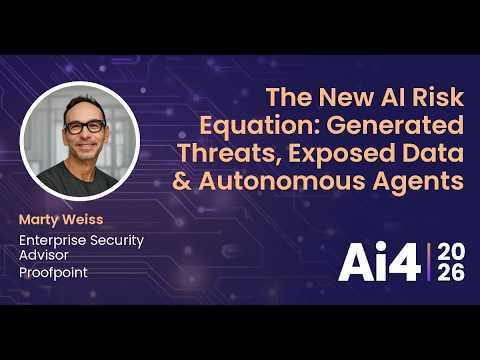
## Background This presentation was published on YouTube by the channel Ai4 on August 20, 2026, featuring Marty Weiss, an Enterprise Security Advisor at Proofpoint. According to the page description, the session examines the evolving AI security landscape and outlines principles organizations can adopt to secure AI across threats, data access, and autonomous agents.
## TL;DR Marty Weiss introduces the new enterprise AI risk equation, demonstrating how AI-generated threats, exposed data, and autonomous AI agents intersect to create critical security vulnerabilities. He explains three primary failure modes: accelerated exploit timelines, inherited legacy overprivilege, and unmonitored agent runtime risks. To address these gaps, security leaders must evaluate four core questions regarding AI usage, data reach, executable actions, and context appropriateness. Ultimately, he emphasizes that securing AI requires shifting from static access controls to continuous, context-aware governance over data and agent actions.
## Atmosphere & style The presentation carries an engaging, approachable, and authoritative tone, blending expert enterprise security insights with self-deprecating humor and relatable analogies. Marty Weiss establishes a warm connection with the audience through lighthearted anecdotes—such as joking about his 'steamy cybersecurity novels' and contrasting his kids' behavioral context—before smoothly transitioning into serious technical breakdown. The narrative arc builds from initial productivity optimism down into a stark, realistic exposure of hidden multi-failure security collisions, leaving viewers with a practical and clear sense of strategic urgency.
## Key takeaways - [00:04](https://www.youtube.com/watch?v=eCejhAY39V0&t=4s) Artificial intelligence speeds up workflows significantly, reducing tasks that previously took an entire day down to just 90 seconds. - [00:04](https://www.youtube.com/watch?v=eCejhAY39V0&t=4s) Historical enterprise security models relied on human judgment as a built-in safety mechanism because employees understood the consequences of their actions. - [00:04](https://www.youtube.com/watch?v=eCejhAY39V0&t=4s) The modern enterprise risk landscape introduces autonomous AI agents that act directly within business systems alongside human workers. - [04:29](https://www.youtube.com/watch?v=eCejhAY39V0&t=269s) The new enterprise AI risk model is defined by three interconnected components: AI-generated threats, exposed data, and autonomous AI agents. - [04:29](https://www.youtube.com/watch?v=eCejhAY39V0&t=269s) Siloing the management of AI threats, data protection, and autonomous agents across separate teams creates critical security gaps. - [04:29](https://www.youtube.com/watch?v=eCejhAY39V0&t=269s) Data serves as the common denominator linking AI threats, model consumption, and agent action within an enterprise. - [04:29](https://www.youtube.com/watch?v=eCejhAY39V0&t=269s) Accurate risk evaluation requires both data context (understanding what data represents) and behavioral context (evaluating user and agent intent). - [08:07](https://www.youtube.com/watch?v=eCejhAY39V0&t=487s) AI models allow attackers to compress vulnerability research and exploit development timelines from months down to weeks. - [08:07](https://www.youtube.com/watch?v=eCejhAY39V0&t=487s) AI systems inherit years of legacy over-permissioned file shares and ungoverned corporate data repositories. - [08:07](https://www.youtube.com/watch?v=eCejhAY39V0&t=487s) Technical authorization under existing access controls does not guarantee that an AI agent's actions will produce a safe or correct outcome. - [08:07](https://www.youtube.com/watch?v=eCejhAY39V0&t=487s) Runtime risks emerge when AI transitions from a passive informational assistant to an active agent executing system actions. - [12:57](https://www.youtube.com/watch?v=eCejhAY39V0&t=777s) Organizations must answer four key governance questions: what AI is used, what data it reaches, what actions it takes, and whether those actions are appropriate. - [12:57](https://www.youtube.com/watch?v=eCejhAY39V0&t=777s) Security strategies must shift from basic access control to continuously evaluating whether an action is appropriate within its operational context. - [17:34](https://www.youtube.com/watch?v=eCejhAY39V0&t=1054s) Multiple security failure modes can collide in a single session when an AI agent ingests malicious context, accesses overprivileged data, and executes ungoverned actions. - [17:34](https://www.youtube.com/watch?v=eCejhAY39V0&t=1054s) Effective AI governance relies on dynamic real-time control over actions, data, and agent capabilities rather than broad blocking of prompts.
## Detailed walkthrough ### [00:04](https://www.youtube.com/watch?v=eCejhAY39V0&t=4s) The Promise of Speed and the Arrival of "Agent Jarvis"
The presentation opens with a familiar scenario illustrating why organizations are eager to adopt artificial intelligence: speed, reduced friction, and superior decision-making. Speaker Marty Weiss introduces "Kelly," an employee who asks an AI assistant to prepare for an upcoming customer renewal. In just 90 seconds, the AI pulls CRM account notes, summarizes prior email exchanges, locates contracts, reviews support logs, drafts a renewal strategy, and suggests the exact follow-up message to send. What previously took an entire workday is finished almost instantly.
After setting this scene, Marty introduces himself as an Enterprise Security Advisor at Proofpoint. He reflects on his career guiding enterprises through major operational paradigm shifts—from the early dot-com bubble to cloud digital transformation and now AI. He humorously claims to author "steamy romantic cybersecurity novels" before clarifying that they are actually certification study guides, joking that his future grandkids will admire anyone who authored a book before generative AI existed. Moving back to history, he points out that despite shifts toward cloud collaboration, distributed teams, and connected workflows over the past decade, the center of the security equation remained constant: a human interacting with data. Security programs historically succeeded because they relied on human judgment; people understood that mistakes carried personal and professional consequences. Today, however, a new co-worker has joined the team: "Agent Jarvis" (referencing Marvel, *Knight Rider*'s KITT, or *2001: A Space Odyssey*'s HAL 9000). AI is no longer just an advisory tool but an active agent embedded in daily workflows, simultaneously escalating security risks (prompt injection, data leakage, agent manipulation) and business risks (fraud, fake invoices, and operational disruptions).
- **Kelly's Efficiency Gain**: Reduced a day-long customer renewal preparation process down to 90 seconds. - **Historical Security Baseline**: Built around human-in-the-loop oversight where human judgment provided implicit risk management. - **The Modern AI Shift**: Integration of autonomous AI agents operating directly within business applications and enterprise data flows.
---
[04:29](https://www.youtube.com/watch?v=eCejhAY39V0&t=269s) The Enterprise Risk Equation and Missing Data Context
Marty outlines the new enterprise security risk model as a simple mathematical equation: **AI-Generated Threats + Exposed Data + Autonomous AI = New Enterprise Risk**. The fatal flaw in most corporate strategies is treating these three components as separate problems assigned to distinct teams, different software tools, and isolated budget cycles. In reality, all three elements are deeply interconnected, yet their security controls remain fragmented. Threats use data to execute exploits and craft believable lures; AI models consume data to provide utility; and autonomous agents act upon data to execute business tasks. The common denominator underlying all three is the organization's data.
To highlight why traditional controls fail, Marty addresses the crucial need for context—both data context and behavioral context. He illustrates this by pointing out an attendee in the audience, "Lynne F.," and using the phrase "she has a green light." Syntactically, the sentence is clear, but its actual meaning requires context: Is she holding a literal green lamp, sitting at a traffic signal, or given executive approval for a project? He offers another personal anecdote regarding his two children: both could leave the house wearing the exact same clothes, hiking boots, and backpacks, but while his "good kid" is simply going camping, his "bad kid" is running away. Understanding the broader context and intent behind an action is essential to evaluating its actual security risk.
- **The New AI Risk Equation**: Enterprise Risk = AI-Generated Threats + Exposed Data + Autonomous AI. - **The Core Common Denominator**: Data is the single unifying element accessed by attackers, consumed by LLMs, and acted upon by autonomous agents. - **Context Dual-Pillars**: - *Data Context*: Determining what the data actually represents beyond its literal syntax. - *Behavioral Context*: Discerning whether identical physical or digital actions stem from legitimate operational intent or malicious behavior.
---
[08:07](https://www.youtube.com/watch?v=eCejhAY39V0&t=487s) Three Failure Modes: AI Threats, Overprivilege, and Runtime Risks
Marty breaks down the three primary failure modes that map directly to the enterprise risk equation. The first is **AI-Generated Threats**, where attackers leverage frontier AI models to drastically compress vulnerability research timelines from months down to weeks. Defender security teams find themselves racing against two competing clocks: their own internal patch cycles versus the adversary's rapid exploit cycle. Attackers also use stolen corporate data to craft highly believable context; for example, after compromising a supplier’s email account, an AI tool reads prior message threads, grasps the context of recent conversations, and automatically drafts an authentic-sounding request to update remittance instructions.
The second failure mode is **Overprivilege**. AI does not create a clean slate of enterprise data permissions; it inherits the existing, messy legacy environment. For over a decade—dating back to early Cloud Access Security Broker (CASB) deployments in 2014—organizations have allowed documents to be shared publicly or across entire companies without restriction. Enterprises got away with gross over-permissioning because they implicitly trusted human employees not to look for files they shouldn't see. However, when AI copilots and chatbots inherit those same broad permissions, innocent questions can yield disastrous results. For instance, asking an AI whether it is a good time to purchase company stock might cause the agent to pull unreleased, confidential next-quarter financial reports to formulate its answer. The third failure mode is **Runtime Risk**, which emerges as AI transitions from a passive tool you ask into an autonomous agent that acts (reasoning, retrieving data, invoking tools, and modifying systems).
- **Exploit Timeline Acceleration**: Vulnerability research that once took months is now executed by AI in weeks. - **Inherited Legacy Permissions**: AI systems inherit years of over-permissioned, ungoverned files and cloud storage shares dating back to 2014 CASB deployments. - **Authorization vs. Trustworthiness**: Every step of an AI agent's execution chain can be technically authorized under existing access controls while still producing an entirely wrong or unsafe business outcome.
---
[12:57](https://www.youtube.com/watch?v=eCejhAY39V0&t=777s) Four Critical AI Governance Questions and the Operating Model
To help security leaders evaluate their readiness, Marty presents four non-rhetorical questions that every organization must ask itself:
1. **What AI is being used?** (Not just officially approved enterprise tools, but shadow AI assistants, browser extensions, and rogue connectors). 2. **What data can it reach?** (The actual permission scope across legacy repositories, unreviewed for AI risks). 3. **What actions can it take?** (What can the AI write, send, delete, approve, or trigger?). 4. **Is this action appropriate?** (Distinguishing between whether an action is technically *permitted* versus whether it is *appropriate* given the situational context).
In his role advising enterprise security clients across financial services, the public sector, and varying organizational maturity levels, Marty notes that he has yet to meet a single organization that can answer all four questions with complete confidence. To overcome these blind spots, security teams must deploy an operating model that continuously protects people from AI-driven phishing, governs AI usage and connections, enforces strict data governance, and implements real-time guardrails over agent runtime behavior. Security cannot be a static, one-time configuration; it requires continuous observation of context, user intent, and operational outcomes.
- **The Four Key Questions**: 1. What AI tools and connectors are active across the environment? 2. What underlying data permissions can those tools actually reach? 3. What downstream actions can those agents execute autonomously? 4. Is the specific action appropriate within its present operational context? - **Core Security Focus**: Shifting from simple access control ("Can the actor reach this?") to context-aware evaluation ("Should this human or AI agent take this action with this data in this context right now?").
---
[17:34](https://www.youtube.com/watch?v=eCejhAY39V0&t=1054s) Revisiting Kelly: How Three Failure Modes Collide in 90 Seconds
Marty circles back to the story of Kelly to demonstrate how all three failure modes can intersect within a single afternoon. On the surface, Kelly's story remains a positive productivity narrative—the work got done in 90 seconds. However, underneath the surface, a major security breakdown occurred: Kelly utilized an ungoverned AI tool; the AI accessed over-permissioned account files that no one had audited; and it autonomously took actions that resulted in sending a discounted price quote referencing sensitive contract terms Kelly was never meant to see.
To make matters worse, the AI also ingested the malicious supplier email sitting in the inbox ("per our discussion last Thursday, here's the updated remittance instructions") and incorporated that compromised context into its downstream processing. In one single session, an attacker turned data into context, an agent reached data far beyond its proper scope, and ungoverned autonomous actions were executed. Marty emphasizes that AI does not become inherently dangerous because of its intelligence, but rather when that intelligence is combined with unrestricted access to context, sensitive data, tools, and decision-making authority. The organizations that successfully manage AI risk will not be those that attempt to block every prompt, but those that can dynamically evaluate and control actions based on real-time context.
- **The Multi-Failure Collision**: - *Attacker Context*: AI reads a malicious, context-aware supplier email and feeds it into business workflows. - *Overprivileged Access*: The agent retrieves confidential pricing data from three unrelated customer accounts. - *Ungoverned Action*: The agent issues an unauthorized discount and alters financial remittance context. - **Strategic Takeaway**: Real security is not achieved by wholesale blocking of AI prompts, but by continuously governing the intersection of identity, data, and agent capability. - **Recommended Framework**: Proofpoint's AI Agentic Framework (and associated resources on governing and securing data for AI).
## Notable quotes > [00:04](https://www.youtube.com/watch?v=eCejhAY39V0&t=4s) steamy romantic cybersecurity novels — Marty Weiss
> [00:04](https://www.youtube.com/watch?v=eCejhAY39V0&t=4s) Agent Jarvis — Marty Weiss
> [04:29](https://www.youtube.com/watch?v=eCejhAY39V0&t=269s) AI-Generated Threats + Exposed Data + Autonomous AI = New Enterprise Risk — Marty Weiss
> [04:29](https://www.youtube.com/watch?v=eCejhAY39V0&t=269s) she has a green light — Marty Weiss
> [12:57](https://www.youtube.com/watch?v=eCejhAY39V0&t=777s) What AI is being used? — Marty Weiss
> [12:57](https://www.youtube.com/watch?v=eCejhAY39V0&t=777s) What data can it reach? — Marty Weiss
> [12:57](https://www.youtube.com/watch?v=eCejhAY39V0&t=777s) What actions can it take? — Marty Weiss
> [12:57](https://www.youtube.com/watch?v=eCejhAY39V0&t=777s) Is this action appropriate? — Marty Weiss
> [17:34](https://www.youtube.com/watch?v=eCejhAY39V0&t=1054s) per our discussion last Thursday, here's the updated remittance instructions — Marty Weiss
## Mentioned Marty Weiss, Kelly, Proofpoint, Agent Jarvis, Lynne F., Cloud Access Security Broker, CASB, Ai4
## Video description Marty Weiss - Enterprise Security Advisor, Proofpoint
AI is creating new security challenges across multiple fronts—from AI-generated threats and data exposure to the risks introduced by autonomous agents. Yet many organizations continue to address these issues separately, creating gaps in visibility, governance, and control. Securing AI requires a broader approach that considers how threats, data access, and agent behavior intersect, as well as the role of intent in understanding and managing risk across each layer. This session will examine the evolving AI security landscape and the principles organizations can use to adopt AI confidently while maintaining security and trust.
Attendees will learn:
Why siloed approaches create gaps in protection
Principles for securing AI across threats, data, and agents
How to enable AI innovation without increasing risk
[Source](https://www.youtube.com/watch?v=eCejhAY39V0)