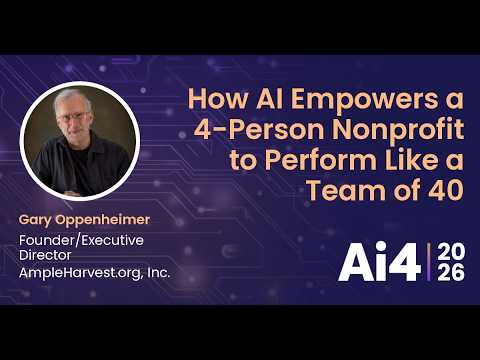
AmpleHarvest.org Scales Nationwide Food Pantry Network With AI Pipeline
Ai4
A four-person nonprofit expanded fresh food donations to 8,500 pantries by using automated data verification and historical record mining to overcome logistics barriers without scaling headcount.
## Background
This presentation was published on YouTube by Ai4 on August 21, 2026. According to the page description, speaker Gary Oppenheimer, Founder and Executive Director of AmpleHarvest.org, Inc., presents a practical solutions talk on how his four-person nonprofit uses over 30 AI applications to scale nationwide impact, fight hunger, and perform like an organization ten times its size without a dedicated data team or massive budget.
## TL;DR
Gary Oppenheimer outlines how AmpleHarvest.org addresses hunger and food waste by connecting 62 million American gardeners to over 8,500 food pantries across 5,700 communities. The organization leverages AI to solve information bottlenecks, automate database verification, streamline grant writing, and target underserved areas like Native American reservations. By combining partner datasets, automated web scraping with human-in-the-loop oversight, and generative tools, the team dramatically reduces operational overhead and scales its national reach efficiently.
## Atmosphere & style
Delivered right before lunch, the presentation carries an inspiring, pragmatic, and solution-focused tone grounded in real-world application rather than tech hype. Oppenheimer's delivery is personal and approachable, opening with a photo of fresh produce from his own garden to illustrate a nationwide problem. The talk strikes a balance between non-profit heart and modern technical efficiency, leaving the audience with an empowering sense of optimism about how small teams can tackle seemingly impossible operational challenges.
## Key takeaways
- [00:04](https://www.youtube.com/watch?v=IQ9zgt8MH7w&t=4s) America's 62 million gardeners produce roughly 240 million pounds of surplus produce each year, enough fresh food to feed 28 million people.
- [00:04](https://www.youtube.com/watch?v=IQ9zgt8MH7w&t=4s) The traditional food assistance pipeline relies on non-perishables in long supply chains, which excludes fresh produce and contributes to diet-related health conditions among food pantry clients.
- [02:34](https://www.youtube.com/watch?v=IQ9zgt8MH7w&t=154s) AmpleHarvest.org bridges an information gap by directly connecting local home gardeners with nearby food pantries, bypassing the need for expensive cold storage.
- [02:34](https://www.youtube.com/watch?v=IQ9zgt8MH7w&t=154s) With a core staff of just four people, AmpleHarvest.org operates a free national network spanning 8,500 food pantries across 5,700 U.S. communities.
- [05:32](https://www.youtube.com/watch?v=IQ9zgt8MH7w&t=332s) The organization uses AI to mine 17 years of internal data, streamlining grant writing, triage operations, and strategic planning toward a goal of reaching 10,000 communities.
- [05:32](https://www.youtube.com/watch?v=IQ9zgt8MH7w&t=332s) By mapping a 10-mile radius around nearly 30,000 garden centers using Bonnie Plants' dataset, AmpleHarvest.org targets outreach to food pantries in high-opportunity donation zones.
- [10:25](https://www.youtube.com/watch?v=IQ9zgt8MH7w&t=625s) An automated pipeline built with AWS, Protagona, and Google Vertex AI scrapes web data to update food pantry information monthly instead of annually.
- [10:25](https://www.youtube.com/watch?v=IQ9zgt8MH7w&t=625s) AmpleHarvest.org enforces a strict human-in-the-loop safety protocol to review all AI-generated database suggestions and prevent hallucinations.
- [10:25](https://www.youtube.com/watch?v=IQ9zgt8MH7w&t=625s) AI tools accelerate content generation, allowing the team to create tailored landing pages, update legacy material, and launch a self-service pantry toolkit in just two weeks.
- [13:43](https://www.youtube.com/watch?v=IQ9zgt8MH7w&t=823s) Tailored programs expand impact to under-resourced areas, including targeted outreach on Native American reservations and crop forecasting based on regional growing zones.
- [13:43](https://www.youtube.com/watch?v=IQ9zgt8MH7w&t=823s) AI efficiency gains reduced slide generation time from hours to four minutes, helping earn the organization a U.S. House of Representatives Congressional Certificate of Recognition.
## Detailed walkthrough
### [00:04](https://www.youtube.com/watch?v=IQ9zgt8MH7w&t=4s) Rethinking America's Food Safety Net
Taking the stage right before the lunch break, speaker Gary Oppenheimer reintroduces AmpleHarvest.org, a small nonprofit scaling a national solution to hunger and food waste. He sets the stage by revealing that 62 million Americans garden, and collectively grow 240 million pounds of surplus produce each year—enough to feed 28 million people. Holding up a picture of a single day's harvest from his own New Jersey garden, he highlights how much fresh food goes unused. The traditional food assistance network, anchored by Feeding America, regional food banks, and roughly 33,500 food pantries, relies on a supply chain where food sits in transit for days or weeks. Because standard food drives drum beat the mantra of "jars, cans, and boxes," fresh produce is virtually excluded. This lack of fresh, nutrient-dense food directly contributes to diet-related diseases such as diabetes, obesity, and hypertension among food pantry clients.
- **Gardener Population:** 62 million people in the U.S. garden (roughly 1 in 5 people).
- **Surplus Yield:** American gardeners grow 240 million pounds of surplus produce annually.
- **Traditional Food Network Structure:** Feeding America connects ~200 regional food banks, which supply ~33,500 local food pantries.
- **Root Cause of Malnourishment:** The prohibition on fresh produce in food drives forces reliance on non-perishables, worsening diet-related health issues.
[02:34](https://www.youtube.com/watch?v=IQ9zgt8MH7w&t=154s) An Information Solution to a Hyper-Local Problem
The bottleneck in getting fresh produce to families is time: non-perishables can endure weeks of transit, but fresh vegetables cannot. Realizing in 2009 that no laws prohibited fresh food donations, Oppenheimer identified the issue as a pure information gap—misinformation ("you can't donate fresh food") and missing information ("where and when to donate"). To solve this, he founded AmpleHarvest.org. The platform enables gardeners to locate a nearby food pantry once; from then on, surplus produce moves directly from garden to pantry to hungry families within hours. This bypasses the need for expensive cold storage and refrigeration that many pantries lack. Running with a core team of just four people, no local offices, and no volunteers, AmpleHarvest.org has expanded to connect 8,500 food pantries across 5,700 communities nationwide. Over the past three years, the team has leaned heavily into AI to scale their reach further.
- **Founding Date:** AmpleHarvest.org was launched in May 2009.
- **Core Network Size:** 8,500 food pantries across 5,700 U.S. communities, managed by a staff of 4.
- **U.S. Food Waste Facts:** 40% of all food and 50% of produce in America is wasted, excluding unharvested home gardens.
- **Frictionless Model:** The service is 100% free for both home gardeners and participating food pantries.
[05:32](https://www.youtube.com/watch?v=IQ9zgt8MH7w&t=332s) Leveraging 17 Years of Organizational Data with AI
For a small nonprofit, fundraising and relationship management are essential to survival. With 17 years of accumulated emails, files, and gigabytes of history, remembering past interactions and pulling specific metrics manually became an increasing challenge. Oppenheimer explains how AI tools allow his tiny team to mine their historical records instantly, streamlining grant writing and identifying strategic opportunities to double their network to 10,000 communities within three years. To target where new pantries should be added, AmpleHarvest.org partnered with Bonnie Plants, utilizing their dataset of nearly 30,000 garden centers nationwide. By mapping a 10-mile radius around garden centers—the maximum distance most gardeners are willing to drive—the organization pinpoints coverage gaps and reaches out to local food pantries in those areas.
- **Growth Target:** Reaching 10,000 communities in 3 years (doubling current coverage).
- **Key Data Partner:** Bonnie Plants provided data for nearly 30,000 garden centers across the U.S.
- **Target Radius:** A 10-mile or 20-minute drive radius around garden centers defines viable donation zones.
- **Data Triage:** AI manages daily operational overflow, triaging tasks, prioritizing deadlines, and extracting historical programmatic lessons.
[10:25](https://www.youtube.com/watch?v=IQ9zgt8MH7w&t=625s) Automated Database Maintenance and Human-in-the-Loop AI
Because the majority of food pantries are run by elderly volunteers or houses of worship, contact details go stale rapidly—often tied to personal email addresses like "sam@aol.com". Previously, verifying contact info required labor-intensive yearly phone outreach. To solve this, AmpleHarvest.org partnered with AWS, Protagona, and Studio Simpatico to build an automated data-verification pipeline using AWS and Google's Vertex AI. The pipeline scrapes public web data to verify addresses, phone numbers, and operating hours against existing records. Instead of annual updates, the data is now refreshed monthly. Crucially, a human user reviews all AI-suggested changes before updating the database to prevent hallucinations from sending gardeners to incorrect locations.
- **Tech Partners:** AWS, Protagona (integration), Google Vertex AI, and Studio Simpatico (web design/interface).
- **Verification Frequency:** Shifted from annual manual phone checks to monthly automated web verification.
- **Safety Protocol:** "Human-in-the-loop" review verifies every AI suggestion to eliminate hallucinations.
- **Content Creation:** NotebookLM and other generative AI tools are used to build custom videos, update legacy content, and generate event-specific landing pages (e.g., `ampleharvest.org/ai4`).
[13:43](https://www.youtube.com/watch?v=IQ9zgt8MH7w&t=823s) Specialized Programs and Practical AI Workflows
AI capabilities have enabled AmpleHarvest.org to launch tailored initiatives, such as targeted outreach to Native American reservations, where per-capita home gardening is among the highest in the country. They also developed a feature that alerts food pantries to upcoming crop harvests based on their specific agricultural growing zones. Through "AmpleHarvest.org Immediate Response," gardeners mobilize after major disasters (like oil spills or floods) once first responders leave. When an AI prompt suggested building a self-service toolkit so pantries wouldn't have to wait for annual emails, the team built and launched it in two weeks. Concluding his presentation, Oppenheimer displays a data visualization that previously took hours to build manually but took only four minutes using AI, and shares that AmpleHarvest.org recently received a Congressional Certificate of Recognition from the U.S. House of Representatives.
- **Specialized Outreach:** Native American reservation initiatives and mayor/county official toolkits (`ampleharvest.org/mayor`).
- **New Features:** Agricultural growing zone donation forecasting and a self-service pantry toolkit deployed in 2 weeks.
- **Efficiency Gains:** Slide generation time reduced from several hours to 4 minutes using AI.
- **Recent Recognition:** Awarded a U.S. House of Representatives Congressional Certificate of Recognition.
- **Actionable Advice:** "When you're facing the impossible, you can presume that it's not and you can proceed." Test problems with tools like ChatGPT or Copilot, keep a human in the loop, and iterate.
## Notable quotes
> [00:04](https://www.youtube.com/watch?v=IQ9zgt8MH7w&t=4s) jars, cans, and boxes — Gary Oppenheimer
> [02:34](https://www.youtube.com/watch?v=IQ9zgt8MH7w&t=154s) you can't donate fresh food — Gary Oppenheimer
> [02:34](https://www.youtube.com/watch?v=IQ9zgt8MH7w&t=154s) where and when to donate — Gary Oppenheimer
> [13:43](https://www.youtube.com/watch?v=IQ9zgt8MH7w&t=823s) When you're facing the impossible, you can presume that it's not and you can proceed. — Gary Oppenheimer
## Mentioned
Gary Oppenheimer, AmpleHarvest.org, Inc., Ai4, Feeding America, Bonnie Plants, AWS, Protagona, Google Vertex AI, Studio Simpatico, NotebookLM, U.S. House of Representatives, ChatGPT, Copilot
## Video description
Gary Oppenheimer - Founder/Executive Director, AmpleHarvest.org, Inc.
How can a team of four use AI to scale nationwide impact like an organization ten times its size?
For 17 years, I have led AmpleHarvest.org, an award-winning nonprofit fighting hunger and food waste by connecting America’s 62 million gardeners with more than 8,500 food pantries in 5,700 communities across all 50 states, with a staff of just four.
For our first 14 years, we operated in a world where today’s AI tools were not available to any of us yet in the past three years, AI has come to touch nearly every part of our work, from compressing weeks of grant writing into an hour and identifying overlooked food-insecure communities to mining tens of thousands of rejection emails for re-engagement opportunities, detecting fraud, preparing board meetings, and creating multilingual outreach.
I will share more than 30 practical AI applications we already use to help a small nonprofit perform like an organization ten times its size, with no data team, no large budget, and no hype. Attendees will leave with concrete ideas and a clear starting point they can put to work in their own organizations on Monday morning.
AmpleHarvest.org founder Gary Oppenheimer outlines how his four-person nonprofit utilizes generative AI and partner datasets to bridge the logistical and informational gaps connecting home gardeners directly to local food pantries.
Bypassing Traditional Supply Chains for Fresh Produce (0:04)
America's traditional food assistance infrastructure—anchored by Feeding America, roughly 200 regional food banks, and 33,500 food pantries—is optimized for non-perishable cans, jars, and boxes that endure weeks of transit. Because most community pantries lack cold storage, fresh produce is systematically excluded from standard food drives. According to Oppenheimer, this systemic shortage of nutrient-dense food fuels diet-related illnesses such as diabetes, obesity, and hypertension among clients, even as 40% of all food and 50% of produce in the United States goes to waste.
AmpleHarvest.org addresses this disparity by tapping into the estimated 62 million Americans who garden, who collectively produce 240 million pounds of surplus produce each year—enough to feed 28 million people. Launched in May 2009, the organization created a free digital registry enabling gardeners to deliver fresh surplus directly to local pantries within hours of harvest. By eliminating intermediary transit and refrigeration requirements, the model provides an information-based solution that currently links 8,500 pantries across 5,700 communities without requiring local offices or regional staff.
Targeting Expansion Using Geospatial and Institutional Data (5:32)
To pursue its target of doubling network reach to 10,000 communities within three years, AmpleHarvest.org uses AI to navigate its 17-year operational archive. Querying historical correspondence and programmatic records through AI tools allows the four-person team to triage incoming tasks, prioritize grant submissions, and extract institutional insights without manual record searching.
To identify where new pantries are most urgently needed, the nonprofit partnered with Bonnie Plants, accessing location data for nearly 30,000 retail garden centers nationwide. AmpleHarvest.org overlays a 10-mile or 20-minute driving radius around these centers—the maximum distance gardeners are typically willing to travel—to map service voids. The organization then initiates targeted outreach to pantries operating inside those unserved zones.
Automating Contact Verification with Human-in-the-Loop Safeguards (10:25)
Because community food pantries are frequently operated by houses of worship or elderly volunteers using personal email addresses, organizational contact records deteriorate quickly. Historical maintenance required time-consuming annual telephone verification campaigns. To resolve this administrative bottleneck, AmpleHarvest.org collaborated with AWS, Protagona, and Studio Simpatico to deploy a verification architecture powered by AWS and Google's Vertex AI.
The pipeline continuously scrapes public web data to cross-check pantry operating hours, street addresses, and phone numbers, shifting the verification cycle from an annual check to monthly updates. To guard against AI hallucinations that could direct gardeners with perishable goods to closed or non-existent sites, the system enforces a strict human-in-the-loop requirement where human staff review and approve all model-suggested directory modifications.
Accelerating Specialized Deployments and Program Development (13:43)
Generative AI tools have accelerated the rollout of AmpleHarvest.org's specialized community programs. These include dedicated initiatives for Native American reservations—identified as having among the highest per-capita home gardening rates in the nation—and an agricultural growing zone alert system that notifies pantries when local harvests are approaching. The team also created specialized civic toolkits for municipal leaders and launched AmpleHarvest.org Immediate Response, which directs surplus garden produce to disaster zones after emergency personnel withdraw.
Oppenheimer reports that operational speed across these initiatives has increased sharply: after an AI prompt suggested creating a self-service administrative toolkit for pantries, the organization built and deployed the feature in two weeks. Similarly, complex data visualizations that once demanded hours of manual assembly are now generated in four minutes, supporting work that recently earned the organization a Congressional Certificate of Recognition from the U.S. House of Representatives.
Oppenheimer advises resource-constrained organizations to test intractable operational problems with commercial AI models, emphasizing that while automation can drastically expand organizational capacity, human oversight remains mandatory to catch hallucinations and preserve database reliability.
## Background
该内容由频道 Ai4 于 2026 年 8 月 21 日发布在 YouTube 平台上。页面描述指出,AmpleHarvest.org, Inc. 的创始人兼执行董事 Gary Oppenheimer 介绍了该机构如何利用 AI 工具赋能仅有 4 名员工的团队,使其在不具备专业数据团队和大额预算的情况下,发挥出相当于 40 人团队的全国性影响力,消除食物浪费与饥饿。
## TL;DR
AmpleHarvest.org 创始人 Gary Oppenheimer 讲述了他如何创立该平台,利用高效的信息网络连接全美 6,200 万园艺爱好者与 8,500 多家社区食品发放站,解决新鲜蔬果难以进入救助体系的痛点。在过去三年中,这支 4 人团队深度集成了 AI 技术,应用于挖掘 17 年的历史遗产数据、基于 10 英里地理圈精准定位未覆盖社区,以及联合 AWS 和 Google Vertex AI 实现自动化数据库核验与动态更新。此外,AI 还助力了印第安保留地专项帮扶、作物捐赠预警系统以及各类宣传可视化,为小规模非营利组织的高效运营提供了可落地的实操范本。
## Atmosphere & style
演讲氛围幽默且充满激情,Gary 开场借“站在听众与午餐之间”的自我调侃轻松破冰,展现出极强的亲和力与现场掌控力。叙述风格务实且干货满满,没有夸张的技术炒作,而是通过自家菜园的鲜活例子和生动的数据对比,将复杂的社会痛点与技术解决方案讲得通俗易懂。整体情绪基调积极昂扬、富有感召力,不仅展现了科技向善的温度,也在结尾借由国会认可证书与真挚的倡议,传递出“敢于将不可能变为可能”的强大信念感。
## Key takeaways
- [00:04](https://www.youtube.com/watch?v=IQ9zgt8MH7w&t=4s) 全美 6,200 万园艺爱好者每年产生 2.8 亿磅剩余农作物,但传统食品救助体系由于物流瓶颈无法接收新鲜蔬果,导致困难群体缺乏新鲜食物。
- [00:04](https://www.youtube.com/watch?v=IQ9zgt8MH7w&t=4s) AmpleHarvest.org 成立于 2009 年,通过信息网络直接对接园艺爱好者与当地食品发放站,省去中间转运并实现了新鲜蔬果的当天送达。
- [00:04](https://www.youtube.com/watch?v=IQ9zgt8MH7w&t=4s) 机构仅靠 4 名全职员工运营,服务覆盖全美 50 个州的 5,700 个社区及超过 8,500 家食品发放站。
- [05:32](https://www.youtube.com/watch?v=IQ9zgt8MH7w&t=332s) 过去 3 年中引入 AI 工具,使 4 人小团队能够快速检索 17 年积累的历史遗产数据,大幅提升资助方拓展与运营决策效率。
- [05:32](https://www.youtube.com/watch?v=IQ9zgt8MH7w&t=332s) 结合 Bonnie Plants 提供的 30,000 个园艺中心地理数据,借助 AI 进行 10 英里辐射圈分析,精准识别未覆盖的食品捐赠潜力区。
- [10:25](https://www.youtube.com/watch?v=IQ9zgt8MH7w&t=625s) 联合 AWS、Google Vertex AI 与合作伙伴开发自动化核查工具,将原本需要每年人工电话抽查的 8,500 家发放站数据提升为每月全网动态刷新。
- [10:25](https://www.youtube.com/watch?v=IQ9zgt8MH7w&t=625s) 在数据库维护中严格遵守“人机协同(Human-in-the-Loop)”原则,利用 AI 搜集比对异常,由人类工作人员最终确认变更以防止幻觉。
- [13:43](https://www.youtube.com/watch?v=IQ9zgt8MH7w&t=823s) 利用 NotebookLM 等工具快速生成针对性视频与动态网页,并结合农业生长带数据开发物候预测系统,向发放站预报即将上市的捐赠作物。
- [13:43](https://www.youtube.com/watch?v=IQ9zgt8MH7w&t=823s) 针对美洲原住民种植率高的特点设立印第安保留地专项帮扶,并升级针对暴雨、石油泄漏等灾害的应急响应机制。
- [13:43](https://www.youtube.com/watch?v=IQ9zgt8MH7w&t=823s) AI 的应用让 4 人团队爆发出了 40 人规模的效能,获得了美国众议院的国会认可证书,并倡议机构放手尝试用 AI 解决实际业务难题。
## Detailed walkthrough
### [00:04](https://www.youtube.com/watch?v=IQ9zgt8MH7w&t=4s) 破冰与创立背景:从庭院余粮到消除饥饿的信息革命
演讲者 Gary Oppenheimer 带着幽默感开场,调侃自己刚好站在听众和午餐之间。这是他第三次在此活动发表演讲。他首先指出了美国传统食品救助体系的痛点:全美有 6,200 万园艺爱好者(相当于每 5 人中就有 1 人种植),他们每年产出约 2.8 亿磅的剩余农作物,足以养活 2,800 万人。演讲者展示了自己前一天在新泽西州自家花园里采摘的丰硕成果,并指出这些新鲜蔬果本可以帮助当地的困境家庭。然而,在传统的救助体系下,食物从捐赠者流向 Feeding America 旗下的 200 个区域食品银行,再分配给约 3.35 万个社区食品发放站(Food Pantry),往往需要花费数天甚至数周。这种时间瓶颈导致传统食品收集只接受罐头、瓶装和盒装干粮,绝无新鲜蔬果。这种限制直接引发了依赖食品救助人群中高发的糖尿病、肥胖和高血压等膳食相关疾病。
2009 年,Gary Oppenheimer 意识到这并非法律禁令,而是一个“信息失真与缺失”的问题——大众误以为不能捐赠新鲜食物,或者不知道该去哪里捐赠。信息问题需要信息方案来解决。于是他在 2009 年 5 月创办了全国性非营利组织 AmpleHarvest.org(他特别强调名称是 AmpleHarvest.org,即使米歇尔·奥巴马曾把它简称为 Ample Harvest,他也坚持正名)。该平台让园艺爱好者只需一次性查询当地的食品发放站,此后余生每当院子里蔬果过剩时,就能直接送去。从菜园到发放站再到困难家庭只需数小时,新鲜度甚至超过超市,且无需发放站配备昂贵的冷藏设备。
<Image alt="AmpleHarvest.org 庭院蔬菜捐赠解决食物浪费与饥饿的信息图" caption="AmpleHarvest 平台连接园艺爱好者与食品发放站的运行逻辑" src="image_agent_tag_3450727428141070664"/>
- 全美拥有 6,200 万园艺爱好者,年剩余农作物达 2.8 亿磅,可满足 2,800 万人饮食需求。
- 美国食物浪费严重,40% 的食物及 50% 的新鲜农产品被丢弃,且传统统计未涵盖家庭菜园的浪费。
- AmpleHarvest.org 目前覆盖全美 50 个州的 5,700 个社区,连接了超过 8,500 家食品发放站。
- 整个机构仅由 4 名全职员工运营,无地方办事处,也无需志愿者,完全依靠高效的信息网络运作。
---
### [05:32](https://www.youtube.com/watch?v=IQ9zgt8MH7w&t=332s) AI 如何赋能 4 人团队:从历史数据挖掘到地理智能匹配
在过去 3 年中,AmpleHarvest.org 深度引入人工智能,像 20 年前个人电脑普及一样重塑了工作流程。对于非营利组织而言,资金筹集是维持运营的命脉。面对机构 17 年来积累的庞大电子邮件、文件与海量数据,记忆与检索成为了挑战。利用 AI 智能体,团队能够迅速挖掘历史遗产数据,精准寻找资助方并拓展合作关系。机构设立了在 3 年内覆盖社区数量翻倍至 10,000 个的目标,而 AI 成为了实现这一跨越的核心引擎。
为了在未覆盖区域拓展食品发放站,AmpleHarvest.org 采用了一种基于地理智能的精准推演策略。园艺爱好者通常愿意行驶 10 英里或 20 分钟去捐赠蔬菜。除 Google 外,AmpleHarvest.org 的最大合作伙伴 Bonnie Plants 提供了全美近 30,000 个园艺中心的数据集。团队通过 AI 对这些园艺中心建立 10 英里半径的地理圈,如果圈内没有已连接的发放站,即判定该区域存在未被满足的捐赠潜力,进而精准开辟当地的发售网络。由于全美每个县都存在饥饿和发放站,这种数据驱动的方式让无缝对接成为可能。
```
[ Bonnie Plants 数据集 ]
│
▼ (30,000 个园艺中心位置)
[ AI 地理智能分析 ]
│
▼ (划定 10 英里辐射圈)
[ 匹配现有食品发放站 ]
├── 已覆盖 ──> 维持运作
└── 未覆盖 ──> 启动精准招募与对接
```
- **机构历史资产**:拥有 17 年历史沉淀的庞大数据与文件库,借助 AI 实现快速调阅与决策支持。
- **扩展目标**:计划在 3 年内覆盖社区数从 5,700 个提升至 10,000 个。
- **地理智能逻辑**:以 Bonnie Plants 的 30,000 个园艺中心为坐标,通过 10 英里半径圈识别服务空白区。
- **运营日常管理**:AI 帮助小团队进行任务优先级排序、拦截琐碎事务并精确管理截止日期。
---
### [10:25](https://www.youtube.com/watch?v=IQ9zgt8MH7w&t=625s) 突破数据维护瓶颈:AWS、Vertex AI 与人机协同净化数据库
AmpleHarvest.org 面临的最大运营挑战之一是食品发放站数据库的动态维护。由于全美大多数食品发放站由教堂等宗教场所的年长志愿者(如使用 sam@aol.com 邮箱的祖父母辈)运营,人员流动极大,联系方式和开放时间极易失效。过去,4 人团队需要每年通过电话逐一核实 8,500 家发放站的信息,不仅成本高昂、耗费人力,且极易出错。如果园艺爱好者送菜时遇到发放站搬迁或关门,就会破坏捐赠体验。
去年,Gary 在社交创新大会上与 AWS 达成合作,并通过 partner Protagonna 打造了一套自动化核查工具。该工具结合 AWS 与 Google Vertex AI,能自动检索互联网上的公开信息(如教堂、青基会 YMCA 的最新公告),交叉比对电话、地址和营业时间。最后,由 Web 设计公司 Studio Sympathico 开发的界面将变动呈现在人类审核员面前。Gary 强调“必须保持 Human-in-the-Loop(人机协同)”,绝不让产生幻觉的 AI 直接修改底层数据,确保信息的绝对准确。得益于 AI 自动化,原本每年一次的被动核查提升到了每月一次的动态刷新。
- **数据库挑战**:大多数发放站由志愿者运营,信息更新极为频繁且原始信息陈旧。
- **AI 架构技术栈**:集成了 AWS、Google Vertex AI 以及 Studio Sympathico 的前端核查界面。
- **核验效率飞跃**:信息核查频率从“每年电话抽查”提升至“每月全网自动刷新”。
- **人机协同原则**:AI 负责搜集与对比异常数据,最终修改权严格保留给人类工作人员,防止 AI 幻觉引发失误。
---
### [13:43](https://www.youtube.com/watch?v=IQ9zgt8MH7w&t=823s) 多元应用场景与行动倡议:从印第安保留地到国会认可
除了数据库清洗,AmpleHarvest.org 还将 AI 拓展到了内容生成与特定群体的精准服务中。Gary 个人非常推荐使用 NotebookLM 等工具来为特定赞助商或会议快速制作单发视频(One-off videos),并支持生成动态更新的网页(如专为本次大会打造的 ampleharvest.org/ai4)。在专项项目中,团队针对全美印第安保留地展开了针对性帮扶(印第安人的人均园艺种植率高于其他群体);利用农业生长带数据,首创了向食品发放站提前预警“附近园艺师即将捐赠何种作物”的预测系统;同时升级了针对 BP 石油泄漏、休斯顿洪水等灾害的应急响应机制(AmpleHarvest.org Response)。
AI 甚至开始反哺业务流程的创新。在准备本次演讲 PPT 时,AI 建议 AmpleHarvest.org 建立一个供食品发放站自主调取年报与宣传资料的“自助工具包”(Toolkit),团队随即在两周内将其开发上线。Gary 感叹,在前 14 年没有 AI 的日子里,AmpleHarvest.org 凭独特的“零接触食物”纯信息模式打下了基础;而在近 3 年,AI 让 4 人团队爆发出了 40 人团队的效能。在演讲最后,Gary 展示了刚获得美国众议院颁发的国会认可证书(Congressional Certificate of Recognition),并鼓励所有人:“面对看似不可能的难题时,假定它是可能的,然后放手去做。”
- **印第安保留地专项**:针对全美种植率最高的美洲原住民群体提供定制化捐赠对接服务。
- **物候预测系统**:结合农作物生长带数据,首次实现向发放站预报即将在当地上市的捐赠蔬果种类。
- **效率对比实例**:过去制作全国覆盖增长图表需要耗费数小时且样式粗糙,如今利用 AI 仅需 4 分钟即可完成相同数据的可视化呈现。
- **行动倡议**:呼吁与会者在下周一挑选一个实际问题,输入给 ChatGPT 或 Copilot 等 AI 工具,结合人类判断不断迭代尝试。
## Notable quotes
> [13:43](https://www.youtube.com/watch?v=IQ9zgt8MH7w&t=823s) 面对看似不可能的难题时,假定它是可能的,然后放手去做。 — Gary Oppenheimer
## Mentioned
Gary Oppenheimer, AmpleHarvest.org, Inc., Ai4, Feeding America, Bonnie Plants, AWS, Google Vertex AI, Studio Sympathico, Protagonna, NotebookLM, ChatGPT, Copilot, 美国众议院
## Video description
Gary Oppenheimer - Founder/Executive Director, AmpleHarvest.org, Inc.
How can a team of four use AI to scale nationwide impact like an organization ten times its size?
For 17 years, I have led AmpleHarvest.org, an award-winning nonprofit fighting hunger and food waste by connecting America’s 62 million gardeners with more than 8,500 food pantries in 5,700 communities across all 50 states, with a staff of just four.
For our first 14 years, we operated in a world where today’s AI tools were not available to any of us yet in the past three years, AI has come to touch nearly every part of our work, from compressing weeks of grant writing into an hour and identifying overlooked food-insecure communities to mining tens of thousands of rejection emails for re-engagement opportunities, detecting fraud, preparing board meetings, and creating multilingual outreach.
I will share more than 30 practical AI applications we already use to help a small nonprofit perform like an organization ten times its size, with no data team, no large budget, and no hype. Attendees will leave with concrete ideas and a clear starting point they can put to work in their own organizations on Monday morning.
This is not a tech talk; it is a solutions talk.
[Source](https://www.youtube.com/watch?v=IQ9zgt8MH7w)
Source quotes
[13:43] Gary Oppenheimer: 面对看似不可能的难题时,假定它是可能的,然后放手去做。
Source quotes
[0:04] Gary Oppenheimer: jars, cans, and boxes
[2:34] Gary Oppenheimer: you can't donate fresh food
[2:34] Gary Oppenheimer: where and when to donate
[13:43] Gary Oppenheimer: When you're facing the impossible, you can presume that it's not and you can proceed.
Original transcript
[0:04] Thank you. This is always the great
spot. I'm between you and lunch. But,
[0:08] we'll try to make it a good one. So, I'm delighted
to be back here. This is my third time speaking
[0:13] um at at this event. So, thank you
very, very much for having me back here.
[0:18] Um we're going to be talking Hold on. Can we
please get this into the notes mode, please?
[0:26] Um so, we're going to be talking about a program
ampleharvest.org, which I'm the founder of. And I
[0:31] want to go back a little bit here. So, this is a
program a small nonprofit I'll be talking about a
[0:37] small nonprofits and small businesses and and the
use of um of AI. A bit of background. We have in
[0:45] America 62 million people who garden. In theory,
one out of every five of you is a gardener. We
[0:52] also We We gardeners grow 240 lb of surplus every
year in our gardens. That's enough to feed 20
[1:01] uh 8 million people. And just to give you an idea,
this was my harvest from my garden in New Jersey
[1:08] yesterday. One day's harvest. Much of
it will be going to a local food pantry.
[1:13] I want to talk for a minute about America's
food safety net. Um all of you have heard of
[1:19] Feeding America. It's a big organization that
manages hunger programs in Connected to that
[1:25] are about 200 regional food banks. Connected to
that are about 33 uh 500 33,500 food pantries.
[1:35] Now, food comes into the system from government,
your generosity, corporate support, all sorts of
[1:44] sources. It gets to a regional food bank. It
sits there for days or weeks. Then, it gets to
[1:51] a local food pantry. Then, it gets to hungry
families. And And how the food system works.
[1:58] So this everybody whenever you've gone to a food
drive you hear the same thing jars, cans, boxes,
[2:03] no fresh food in it. In my personal opinion,
this one phrase is responsible for a huge
[2:10] amount of illness in America. Diet related diet
related diseases diabetes, obesity, hypertension,
[2:16] etc. Because people going to food pantries
typically don't have access to fresh food.
[2:22] Meanwhile, people like me and the lady on the
screen who would like to have donated food
[2:29] have been told you can't donate food because
of the jars, cans, boxes prohibition.
[2:34] The problem of this is the choke point. There's
a time choke point between the donation of food
[2:41] at a food drive and when it gets
to a food pantry for distribution.
[2:44] And for jars and cans and boxes days and weeks
are fine, but for fresh food it doesn't work.
[2:52] I realized in 2009 that this is a not a there's
no law prohibiting it. This is an information
[3:01] problem. It's misinformation. I can't donate
food. Missing information. I don't know where
[3:06] and when to donate the food. Information
problems call for information solutions. So
[3:15] in May of 2009 I launched a national nonprofit
called ampleharvest.org. Britney, the lady who
[3:25] introduced me, I advised her it's not called
ample harvest although Michelle Obama got away
[3:30] with saying that everybody else the actual name
is ampleharvest.org. The idea is that a gardener
[3:35] uses ampleharvest.org to find a food
pantry in their own community one time
[3:41] they find what which food pantry is
in their community they donate to
[3:45] and for the rest of their gardening life when
they've got too much food in their garden,
[3:49] they can now go directly to the food pantry and
donate the food. The food goes from the garden
[3:55] to the food pantry to the hungry family in hours.
The food is fresher at the pantry than you and I
[4:02] can buy in a supermarket. And because of that,
the pantry does not need costly refrigeration
[4:07] and storage, something that prohibited many
in the food system from accepting fresh food.
[4:12] This is a hyper local solution on an on a national
basis. But the more important thing is it's a one
[4:17] and done solution. I have solved the missing
information. You can't you don't know that you
[4:22] you didn't think you could donate food. And
the missing information, where and when.
[4:28] The answer for hunger in this country isn't more
food. We throw away 40% of the food and 50% of
[4:35] 50% of the produce in America. The problem
is we're not using the food that we have.
[4:40] And all the statistics you've heard on food waste
didn't include even what was growing in gardens.
[4:46] So, I mentioned we had 62 million gardeners
in America who are donating. Today,
[4:50] our network is 8,500 food pantries and we are
in 5,700 communities across America and growing.
[4:59] This is an information-based solution to hunger
and food waste. It's a hyper local program,
[5:05] but on a nationwide level. Four people, is the
entire organization. We have no volunteers, we
[5:13] have no local offices. This is what happens when
you use information the right way to solve a big
[5:19] problem. And we've started in 2009. For the past
3 years, we've leaned heavily into AI and this has
[5:26] accelerated both what we can do and how far we can
do it. I'm going to be talking about some of that.
[5:32] So, AI programs, AI agents are impactful in
helping to move things along, but it's very
[5:38] it's as this is as much of a change as the
introduction of personal computers was 20 years
[5:42] ago. It's a game changer for the world as as as we
know it. The most important thing for a nonprofit
[5:49] and I should also say for a business but in a
different way but for a nonprofit is fundraising.
[5:53] And the key thing is finding information
that's going to help you generate the money,
[5:57] generate the funds, generate the relationships
so you can bring in the money that you need to
[6:01] actually do the work that you're actually doing.
So, um 17 years old, I've got 17 years of data,
[6:10] emails, files, gigatons of information. And at
my tender age, remembering all of that becomes
[6:17] an increasing challenge. So, AI has been hugely
impactful enabling me and my organization to go
[6:23] in and get the information that we need for for
doing it. A key thing is working with funders in
[6:28] expanding our funding to expand the reach many
more communities. I should say we have a goal of
[6:34] reaching 10,000 communities in 3 years, doubling
our our reach. So, the most important thing is um
[6:43] before a gardener can donate food, there needs to
be a food pantry accessible to the gardener. So,
[6:47] those dots you saw on the map represent the food
pantries in our system. How do we get more food
[6:53] pantries? Well, I only want to put a food pantry
in a place where I know there are gardeners.
[6:57] How do I know where there are gardeners? One of
our biggest uh aside from Google, our biggest
[7:01] partner is a company called Bonnie Plants. And
they gave us their data set of nearly 30,000
[7:06] garden centers across America. If there's a garden
center, there are gardeners. So, now the next
[7:12] thing we're going to do is we're going to look at
where the garden centers located, draw a 10-mile
[7:16] radius circle around and say, do we have any food
pantries in 10 miles? Cuz a gardener will travel
[7:21] 20 minutes or 10 miles to donate food. If we don't
have a food pantry there, now we got to lean in,
[7:27] find local food pantries. And I should say by the
way, every county in America has hunger. Every
[7:32] county in America has food pantries. It's our job
to make those connections and to get them going.
[7:38] Um on the the intelligence side, it's
just looking at emails, looking at files,
[7:43] looking at all the other things that we've
collected over the years to help us actually
[7:47] move things along and identify different
things that need to be done. Um
[7:53] I wanted to get to a little bit about how we're
using AI. And it's it's an important thing there.
[7:59] The fundraising is by far the most important. It's
helping us find grants, helping us But now I'll
[8:03] get into a bit more into that. Building
partnerships with other organizations,
[8:07] growing them, etc. The communications,
coming up with the right communications,
[8:12] um and expanding of that's really, really vital to
the success of an organization. And the outreach,
[8:18] we want to maintain continual contact with the
food pantries that we are are working with.
[8:24] Um in our daily operation, it's an Any
organization, you're flooded with tasks,
[8:30] you're flooded with things that you need to
be doing, and using AI helps you manage it,
[8:35] triage what is being done, focus on what needs to
be done, get you the deadlines, um and etc. there.
[8:45] With 17 years of data, and this is the the
big thing, you have a real struggle under
[8:50] finding what you've learned in the past and and
relying on it. The program history, where did you
[8:55] make mistakes in the past? You don't want to
repeat those. The technology things you use,
[9:00] sometimes you're bringing in new technology, but
you need to look back at the old stuff to figure
[9:04] out what you had so you can improve on it, etc.,
etc., etc. Um We're also continually looking at
[9:10] where there are conflicts that we can resolve. How
do we make things work and make them work better?
[9:18] The geographic intelligence is hyper important to
us. We want to find the pantries we have yet to
[9:24] reach. And we know that we have 25% penetration in
America's food pantries. Turn that on its head. We
[9:31] have 75% of the way to go. We're It's great for a
small nonprofit, but there's a lot of communities
[9:37] we have yet to serve. Using the stories as the
proxies for where the gardeners are is a great
[9:42] way for us to know where we need to focus our
energies and then to move on from uh there.
[9:47] We now have a new effort that's underway. We're
out We're doing outreach to mayors and county
[9:53] officials. And by the way, for any of you, when
you go home, if you visit ampleharvest.org/mayor,
[10:01] it's going to give you guidance
on a help how to help your mayor
[10:06] cement ampleharvest.org in your own community. And
by the way, it's going to cost the community $0
[10:12] and it's going to cost zero legislation.
I should say ampleharvest.org costs the
[10:15] gardener and the food pantry absolutely
zero. There's zero cost to them. So,
[10:18] this is a frictionless solution
to hunger and and food waste.
[10:25] This is the biggest piece of what we do that
involves AI. Um our food pantry database, and by
[10:31] the way, it's populated by the food pantries
themselves. So, the the majority of people
[10:37] who run a food pantry are your grandparents,
volunteers in a house of worship typically.
[10:42] They run the food pantry. So, first of all, you
have an extraordinary number of food pantries
[10:46] that have, you know, sam@aol.com is the email
address. So, we have to deal with that older um
[10:53] thing there. But, the other piece of it is there's
a lot of turnover. This data uh gets stale really,
[10:58] really fast. In the past, what we needed to do
was we needed to reach out every year by phone
[11:05] to ask all the food pantries, "Is your information
current? Do we need to make any changes?" The last
[11:10] thing I want is a gardener going to a food pantry
to drop off food only to find out it's moved,
[11:15] the hours have changed, they don't want it,
whatever. So, you want to make the garden don't
[11:19] gardener donating experience good so that they'll
continue to do it year after year after year.
[11:25] Using the phone message pro- problem
is it was a problem because it's
[11:31] people make mistakes, that's one problem,
and it's very costly and and labor-intensive.
[11:36] Last year at a social innovation conference,
I connected with AWS, and they had a program
[11:41] perfect for ampleharvest.org, and AWS connected
us to one of their partners named Protagonna,
[11:48] and we built a tool that used both AWS
and Google's Vertex to take our database,
[11:57] go through the whole thing, go out on the public
internet, find that food pantry information if
[12:03] anything is out there. It might be part of a
church, it might be part of a YMCA, whatever,
[12:07] and to see is our phone number, our hours, the
address, does it match up with what's out there?
[12:13] And if it does, great. And if it doesn't,
capture the changes, bring it back,
[12:19] and then Studio Sympathico, which is our web host,
the web design firm, gave us a tool that takes
[12:25] that information, puts it into a human-readable
format, and this is the most important thing.
[12:30] A human decides as to the way whether the AI
got the correct information or not. The last
[12:35] thing I want is a hallucinating AI giving us
wrong information, we mess up a food pantry.
[12:40] So, there's always a human in the loop as that
last check to make sure that things are working um
[12:45] properly. And this has been a big part of the
way ampleharvest.org is now working and working
[12:50] really well. Much more By the way, instead of
doing it annually, we now can do this monthly.
[12:56] Um we're now using this for um one-off videos when
we need them. By the way, I have personally fallen
[13:03] in love with Notebook LM for doing this, but
there are many other wonderful products out there
[13:06] for making videos for a conference, for an event,
for a particular funder. Excuse me, I'm sorry.
[13:14] We also use it for tweaking uh content that we've
had in the past to help it bring it up to date.
[13:24] We've done on-demand web pages that are
continually updated based on what we're doing.
[13:30] So, there's a web page called ampleharvest.org/a4,
which is for all of you to come to when you go
[13:36] home, so you can learn more about ampleharvest.org
and how we're working in your communities.
[13:43] So, we're doing many different things here.
We are working with distinct communities. I'll
[13:47] give a program now that we built for Native
American reservations across the country,
[13:52] which is hugely important because Native
Americans do more gardening per capita than
[13:56] any other piece of the of the uh American
population there. We've done a new thing
[14:01] that allows us to tell food pantries based on
the agricultural growing zone that you're in
[14:06] what gardeners will be soon donating. That's
a first. No one's ever done that before. Um
[14:13] we are now helping um Well, we have a
program called ampleharvest.org response.
[14:19] So, when there's a major calamity, the BP oil
spill, the Houston flooding, fires, whatever,
[14:24] gardeners after the first responders leave
can step in and help to donate more food.
[14:29] We've been building on that particular tool
there. Um we also are looking at ways that we can
[14:36] continue to improve what ampleharvest.org does.
We built AI, which I obviously used for helping
[14:42] to build this presentation, came back and said,
"Why don't you have a toolkit that let the
[14:47] pantries get information that we normally
email them on an annual basis?" And I said,
[14:51] "I never thought about that." In 2 weeks, we're
going to have it live. So, this is the time when
[14:56] AI comes back to you and it helps you improve the
operations that you're actually are doing there.
[15:03] Um that was the toolkit there I talked about.
So, we made it 14 years without AI. We all did.
[15:12] And the past 3 years, we've been leaning
increasingly heavier into AI. AI didn't create
[15:18] the ampleharvest.org impact, a very one-of-a-kind
model that ampleharvest.org is. And by the way,
[15:24] it's the only program of its kind in the world.
That's not hyperbole. It's the only solution to
[15:29] hunger and food waste that where we never touch
the food. It's all being information-based.
[15:33] So, that model made things happen. The AI is now
just massively enhancing what four people can do
[15:41] when they're actually working with that
there. So, just to give you an example,
[15:47] the black thing is this is how I used to create
slide showing the growth of ampleharvest.org.
[15:52] It took several hours. It was laborious. It was
slow. It was kind of ugly. The one on the other
[15:59] side took me 4 minutes to put together with
AI. Same data. Much, much, much less time.
[16:08] Lastly, this is late-breaking news. And then
I've we'll have a few minutes for questions.
[16:13] Um if you read about this talk, you'll know
I'm a CNN Hero, World Food Prize nominee,
[16:19] uh Points of Light winner, lots of other
accolades. People think my head's too big. Um but
[16:25] this is late-breaking news cuz this past Friday,
um well, ampleharvest.org received from the House
[16:31] of Representative a congressional certificate
of recognition for the work ampleharvest.org is
[16:35] doing. So, that's not in the write-up that you saw
about it. So, this is what I wanted to share with
[16:41] you about ampleharvest.org and any other small
organization and AIs, don't be afraid of it.
[16:47] Lean into it. Figure out how to use it so
that well, when you're facing the impossible,
[16:53] you can presume that it's not and you can proceed.
So, Monday, when you get home, find a problem that
[16:59] you think needs to be solved. Give the AI of your
choice, ChatGPT, Copilot, whatever you want to do,
[17:06] talk to it, type to it, whatever works for you,
what your problem is, what you want to solve.
[17:10] See what it comes back with. Have humans
look at it. Decide if it's working.
[17:15] And then rinse and repeat. And with that,
I want to thank you. The QR code on the
[17:20] uh the left is will bring you to that special
page we put up and the one on the right if you
[17:24] do want to contact me. We've got 3 minutes
22 seconds for questions if anybody has any.