Siri Co-Founder Gruber Urges Builders to Target Unserved Global Needs
Ai4
Capital markets pour trillions into automating jobs, but humanistic AI can solve massive unaddressed global needs in mental health and education by building on existing foundation models.
AI-assisted summary of Humanistic AI with Tom Gruber, Co-creator of Siri, on How AI Can Augment Human Intelligence — original source. Check the original for full context.
Source published:
Detailed notes
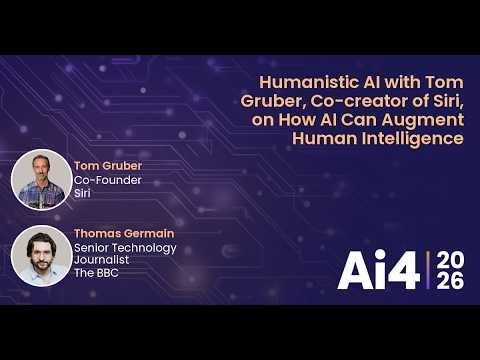
## Background Published on YouTube by the Ai4 channel on August 22, 2026, this video features a discussion between Tom Gruber, co-founder of Siri, and Thomas Germain, senior technology journalist at The BBC. The page description outlines an overview of modern generative AI and LLMs, highlighting how these systems are built, their capabilities and risks, and their potential to augment human intelligence across fields like education, software engineering, mental health care, and knowledge management.
## TL;DR In this conversation, Tom Gruber advocates for "humanistic AI"—technology designed specifically to serve, augment, and collaborate with humans rather than fully replace human labor. He addresses the massive financial incentives driving pure automation, warning that the rapid expansion of AI creates a critical ethical crossroads for power concentration and democratic integrity. Gruber proposes cognitive augmentation, specialized FDA-style regulatory agencies, and an API-driven economy, drawing parallels to optical lenses and Volvo's safety innovations. He concludes with a call to action for developers to build vertical applications that target unserved global human needs, such as mental health and personalized education.
## Atmosphere & style The dialogue carries a thoughtful, intellectually rigorous, and urgent tone, blending deep technical perspective with high-stakes societal critique. As a veteran AI pioneer, Gruber speaks with measured authority and practical optimism, balancing serious warnings about totalitarian surveillance and market concentration with genuine excitement for human empowerment. The interaction between Germain and Gruber feels like an engaging, high-level fireside chat, offering a grounded yet visionary reflection on the ethical and economic future of artificial intelligence.
## Key takeaways - [00:04](https://www.youtube.com/watch?v=LLigihQXf-8&t=4s) Pure automation focuses on replacing human labor based on benchmark metrics, whereas humanistic AI is designed specifically to serve, augment, and collaborate with humans. - [00:04](https://www.youtube.com/watch?v=LLigihQXf-8&t=4s) Over $1 trillion in capital is driving AI toward job automation, creating a massive incentive gap compared to the funding directed at humanistic augmentation. - [01:21](https://www.youtube.com/watch?v=LLigihQXf-8&t=81s) Massive public demand from a critical mass of users can shift market incentives and pressure governments to prioritize human-centric AI ethics. - [02:51](https://www.youtube.com/watch?v=LLigihQXf-8&t=171s) Concentrating advanced AI surveillance and ownership in a few corporate or autocratic hands poses an irreversible threat to citizens and democratic power. - [02:51](https://www.youtube.com/watch?v=LLigihQXf-8&t=171s) Unlike previous tools, AI is an omni-purpose inference technology comparable to electricity, capable of expanding collective human capability across all fields. - [05:20](https://www.youtube.com/watch?v=LLigihQXf-8&t=320s) Humanistic AI serves as 'eyeglasses for cognition,' expanding human intellectual capacity in the same way optical lenses extend human eyesight. - [05:20](https://www.youtube.com/watch?v=LLigihQXf-8&t=320s) Market competition can elevate AI safety and humanistic design into commercial standards, similar to how consumer demand made seatbelts standard in automobiles. - [07:28](https://www.youtube.com/watch?v=LLigihQXf-8&t=448s) AI is accelerating fundamental science, as shown by DeepMind's AlphaFold for protein folding and automated discoveries in material science. - [07:28](https://www.youtube.com/watch?v=LLigihQXf-8&t=448s) AI regulation should be managed by a specialized expert agency modeled on the FDA or FAA, alongside laws protecting information integrity against deepfakes and synthetic fraud. - [10:28](https://www.youtube.com/watch?v=LLigihQXf-8&t=628s) Natural language bypasses broken, complex graphical software interfaces, serving as a universal equalizer that connects non-technical and global populations to advanced intelligence. - [13:47](https://www.youtube.com/watch?v=LLigihQXf-8&t=827s) Personal AI agents will act as intermediaries across device ecosystems, directing complex real-world tasks to backend APIs and cloud-based AI models. - [13:47](https://www.youtube.com/watch?v=LLigihQXf-8&t=827s) Physical service platforms like ridesharing or food delivery will survive AI disruption by serving automated API requests, whereas ad-supported digital journalism faces existential risk. - [16:41](https://www.youtube.com/watch?v=LLigihQXf-8&t=1001s) Developers should build vertical applications addressing massive unserved human needs—such as mental healthcare for one billion people and universal personalized education—rather than competing in over-funded spaces.
## Detailed walkthrough Here is a detailed, faithful walkthrough of the transcript.
[00:04](https://www.youtube.com/watch?v=LLigihQXf-8&t=4s) Defining Humanistic AI vs. Pure Automation
The session opens with Thomas Germain asking Tom Gruber, co-creator of Siri, to explain "humanistic AI" and how it fundamentally differs from what most technology companies are building today. Gruber traces this distinction back several decades in AI history, noting that there are two core reasons to pursue artificial intelligence. The first is automation for its own sake—creating autonomous intelligence where success is measured purely by benchmark metrics, such as beating Garry Kasparov in chess or passing the bar exam. The second path is humanistic AI, where the system's entire intent, purpose, and design are explicitly targeted at serving human needs.
Gruber highlights that while this might sound like a simple philosophical distinction, the real-world implications are huge as capital concentrates around the technology. He notes that there is currently at least $1 trillion in financial incentives driving AI toward replacing and automating human labor, whereas the funding directed specifically toward humanistic AI remains far smaller.
- **Two Historical AI Approaches:** Pure automation (benchmarks, beating human champions, labor replacement) versus humanistic AI (designed to serve, augment, and collaborate with humans). - **Incentive Disparity:** At least $1 trillion of capital is currently pushing toward job automation over humanistic augmentation.
[01:21](https://www.youtube.com/watch?v=LLigihQXf-8&t=81s) Economic Incentives and the Ethical Crossroads
Germain and Gruber explore whether financial markets can ever support a more helpful, human-centered version of technology when so much capital rewards pure profit. Gruber points out that aligned incentives do exist when goals are universally acknowledged—such as curing cancer—but capital markets don't always naturally prioritize human benefit over the bottom line.
However, Gruber emphasizes that if a critical mass—even a billion people—demands technology that empowers humanity, that demand can shift market incentives and drive regulatory action. Because AI is on the verge of an extraordinarily rapid expansion with an uncertain endpoint, Gruber argues this moment represents humanity's last chance to make a definitive ethical choice to prioritize human benefit before optimizing for corporate balance sheets.
- **Market Pressure:** Public demand from a massive user base can reshape marketplace and government incentives. - **Critical Turning Point:** The immediate window during AI's rapid rollout is the final opportunity to prioritize human-centric ethics over pure capital efficiency.
[02:51](https://www.youtube.com/watch?v=LLigihQXf-8&t=171s) Societal Power Shifts and "Omni-Purpose" Technology
When asked why this turning point must be addressed immediately rather than fixed later, Gruber connects the technological shift to broader geopolitical and societal power dynamics. Citing historian Yuval Noah Harari, Gruber notes that once totalitarians or dictators acquire advanced AI surveillance systems, power shifts permanently away from labor and citizens toward capital and central authorities, making it nearly impossible to reclaim. Even if today's leading AI companies are run by well-meaning individuals, concentrating power over 8 billion people into a few corporate hands creates severe systemic risks.
Despite these warnings, Gruber remains optimistic. Reflecting on his time at Stanford during the dawn of the World Wide Web in 1994, he recalls how the web eliminated spatial and temporal barriers for human collaboration—acting as a massive leap forward in augmenting human intelligence. Gruber views current AI as the next, vastly larger step because it is an "omni-purpose" technology. Similar to electricity, AI can perform inference across nearly any field, creating a massive step-change in collective human capability.
- **Power Concentration:** AI surveillance and centralized ownership shift power from labor to capital and autocrats, making recovery extremely difficult once established. - **Omni-Purpose Tech:** Unlike the web (primarily communication), AI is omni-purpose inference technology, comparable in scope to electricity.
[05:20](https://www.youtube.com/watch?v=LLigihQXf-8&t=320s) Eyeglasses for Cognition and the Competition Model
Moving into practical applications, Gruber explains that humanistic AI operates through collaboration and augmentation, such as collaborative software agents that assist humans in completing tasks. To illustrate cognitive augmentation, he draws a parallel to eyeglasses. Glasses represent a perfected optical engineering solution that corrects vision, while specialized optics like microscopes and telescopes afford humans "superhuman vision."
Gruber suggests that modern AI will act as "eyeglasses for cognition," extending human mental capacity. To prevent monopoly control over these "cognitive lenses," competition and market choices are vital. He compares the situation to the automotive industry: when Detroit automakers initially resisted adding seatbelts in favor of larger muscle cars, Volvo entered the market to demonstrate that safety was a feature consumers would actively pay for. Over time, features like seatbelts and airbags transitioned from premium safety selling points to universal standards. Gruber predicts a similar path for AI safety and humanistic design.
- **Cognitive Augmentation:** AI acts as "eyeglasses for the mind," expanding human intellectual capacity much like optics expand eyesight. - **The Volvo Analogy:** Just as Volvo commercialized car safety features into industry standards, consumer demand will turn AI safety and human-centric design into viable, profitable products.
[07:28](https://www.youtube.com/watch?v=LLigihQXf-8&t=448s) Accelerating Scientific Discovery and Government Guardrails
Gruber points out that humanistic AI is already demonstrating immense value in scientific discovery. He highlights DeepMind’s Nobel Prize-winning AlphaFold system for protein structure prediction, as well as its work in material science, where AI discovered tens of thousands of novel materials. Because materials science laid the foundation for semiconductors, fiber optics, and lithium-ion batteries, using AI to accelerate scientific breakthroughs serves as a prime example of humanistic technology that yields massive economic and societal dividends.
Germain then asks how governments should intervene beyond blocking corporate mergers. Gruber outlines two immediate responsibilities for policymakers:
``` +-----------------------------------------------------------------+ | GOVERNMENT REGULATORY FRAMEWORK | +-----------------------------------------------------------------+ | | | 1. Specialized Expert Agency | | * Modeled on FDA (drugs) & FAA (aviation) | | * Establishes clear safety standards for models | | * Protects open-source innovation while stopping capture | | | | 2. Information Integrity & Truth Protection | | * Enforces laws against impersonation, fraud, & deepfakes | | * Prevents digital noise ("slop") from replacing facts | | * Safeguards democratic discourse | | | +-----------------------------------------------------------------+ ```
- **Scientific Breakthroughs:** DeepMind’s AlphaFold (protein folding) and material science discoveries prove AI can accelerate fundamental science. - **Specialized Regulation:** Regulatory responsibility should move away from individual politicians and into a dedicated expert agency, mirroring aviation or pharmaceutical governance. - **Democratic Preservation:** Protecting truth and preventing synthetic fraud are essential to maintaining a functioning democratic society.
[10:28](https://www.youtube.com/watch?v=LLigihQXf-8&t=628s) Language as the Universal Interface and Siri’s Legacy
Germain shifts the discussion to Gruber’s background as a co-creator of Siri, asking whether voice and conversational language represent the ultimate interface for computing. Gruber clarifies that voice is simply a modality, whereas human language itself is the true, underlying interface. Traditional graphical software interfaces remain overly complex and broken for most non-technical users, who routinely struggle with basic IT troubleshooting. Language bypasses this friction entirely, enabling anyone to simply state their intent to an agent.
Gruber highlights how language interfaces break down global access barriers. By pairing high-speed telecommunications with conversational AI, a villager in rural India who speaks neither English nor Hindi can converse naturally with the world's most advanced AI models in their local dialect. Reflecting on Siri's evolution, Gruber recalls that the original standalone Siri app featured multi-turn conversations for e-commerce tasks like ordering flowers or booking hotel rooms. When Steve Jobs acquired Siri for Apple, he presented the founders with a choice: build a standalone business, or join Apple to build a product everyone uses.
- **Language as Interface:** Natural language eliminates complex user interfaces, enabling non-technical users to control powerful systems effortlessly. - **Global Reach:** Combining global telecommunications with spoken AI allows rural populations to access advanced intelligence in native local languages. - **Steve Jobs’ Pitch:** Jobs convinced the Siri team to join Apple by offering them the chance to create a universal product used by everyone rather than a niche business.
[13:47](https://www.youtube.com/watch?v=LLigihQXf-8&t=827s) Intermediary Agents and the Future of Digital Services
As Apple rolls out deeper system integrations, Gruber foresees conversational assistants fulfilling their original vision: acting as a frictionless intermediary across a user's entire ecosystem of devices (phones, Macs, home speakers). These local agents will communicate with massive cloud-based models to solve complex computational or scientific problems seamlessly in the background.
Addressing concerns raised by journalists like The Verge's Nilay Patel regarding market concentration—where a single assistant acts as the sole layer between users and third-party services—Germain asks if assistants will displace companies like Spotify, Uber, or Grubhub. Gruber argues that real-world service platforms won't be erased because their underlying value lies in physical logistics (delivering food or providing rides), not just their app interface. While search engine business models and digital journalism face severe disruption from direct conversational answers, physical service providers will simply transition to servicing automated requests submitted via AI APIs.
- **Device Intermediary:** The long-term goal is a personal assistant that manages hardware ecosystems and routes complex requests to cloud AI. - **API-Driven Economy:** Services like Grubhub and Uber will survive because their core value lies in real-world physical operations, adapting to receive orders via AI APIs rather than manual app taps. - **Media Disruption:** Unlike physical services, ad-supported digital journalism faces existential disruption as AI shifts search away from web page traffic.
<ElicitationsGroup message="To explore these topics further:"> <Elicitation label="Analyze how humanistic AI impacts labor economics" query="Analyze how humanistic AI models contrast with full automation in terms of labor economics and job disruption."/> <Elicitation label="Examine the regulatory frameworks proposed for AI safety" query="What are the leading proposals for creating an FDA-style regulatory agency for artificial intelligence?"/> </ElicitationsGroup>
[16:41](https://www.youtube.com/watch?v=LLigihQXf-8&t=1001s) Building Humanistic AI: Focus on Unserved Human Needs at Scale
As their conversation draws to a close, moderator Thomas Germain transitions from broader market incentives and government regulations—factors outside an individual's direct control—to actionable advice for the audience. Directing his focus to the developers, founders, and engineers present in the room who are actively building AI tools, Germain asks Tom Gruber what specific actions they should take today to bring the vision of humanistic AI to light.
Gruber responds with a direct call to action, urging builders to focus on vertical applications that address massive, unserved human needs rather than competing in already crowded arenas. He explicitly advises against taking on over-resourced domains like "curing cancer," noting that plenty of well-funded teams are already tackling those problems. Instead, he highlights under-addressed global challenges where AI can act as a massive force multiplier:
* **Mental Healthcare:** Target mental healthcare for the **one billion people** worldwide who, according to the World Health Organization, can never be realistically served by human healthcare workers alone. * **Global Education:** Create a personalized AI tutor for every child on the planet to level the playing field of knowledge work globally.
Gruber emphasizes that solving these critical problems does not require "a trillion dollars." Developers can leverage the immensely expensive baseline engineering provided by foundation model companies and immediately build high-impact vertical applications on top of those existing platforms. He concludes with a sense of urgency, warning builders to solve these hard problems now, "cuz in three or four years you may not have the chance."
---
<ElicitationsGroup message="Explore related content and next steps:"> <Elicitation label="Watch Tom Gruber's full keynote on Humanistic AI" query="Search YouTube for Tom Gruber's full keynote talk on Humanistic AI and AI augmenting human intelligence."/> <Elicitation label="Find videos on AI in mental health and education" query="Search YouTube for videos on how AI is being used in mental healthcare and personalized education."/> </ElicitationsGroup>
## Notable quotes > [00:04](https://www.youtube.com/watch?v=LLigihQXf-8&t=4s) At least $1 trillion in financial incentives driving AI toward replacing and automating human labor, whereas the funding directed specifically toward humanistic AI remains far smaller. — Tom Gruber
> [01:21](https://www.youtube.com/watch?v=LLigihQXf-8&t=81s) This moment represents humanity's last chance to make a definitive ethical choice to prioritize human benefit before optimizing for corporate balance sheets. — Tom Gruber
> [02:51](https://www.youtube.com/watch?v=LLigihQXf-8&t=171s) Once totalitarians or dictators acquire advanced AI surveillance systems, power shifts permanently away from labor and citizens toward capital and central authorities, making it nearly impossible to reclaim. — Tom Gruber
> [05:20](https://www.youtube.com/watch?v=LLigihQXf-8&t=320s) Eyeglasses for cognition — Tom Gruber
> [10:28](https://www.youtube.com/watch?v=LLigihQXf-8&t=628s) Language bypasses this friction entirely, enabling anyone to simply state their intent to an agent. — Tom Gruber
> [13:47](https://www.youtube.com/watch?v=LLigihQXf-8&t=827s) Services like Grubhub and Uber will survive because their core value lies in real-world physical operations, adapting to receive orders via AI APIs rather than manual app taps. — Tom Gruber
> [16:41](https://www.youtube.com/watch?v=LLigihQXf-8&t=1001s) Target mental healthcare for the one billion people worldwide who, according to the World Health Organization, can never be realistically served by human healthcare workers alone. — Tom Gruber
> [16:41](https://www.youtube.com/watch?v=LLigihQXf-8&t=1001s) Cuz in three or four years you may not have the chance. — Tom Gruber
## Mentioned Tom Gruber, Thomas Germain, Siri, Ai4, BBC, Garry Kasparov, Yuval Noah Harari, World Wide Web, Stanford, Volvo, Detroit, DeepMind, AlphaFold, FDA, FAA, Apple, Steve Jobs, The Verge, Nilay Patel, Spotify, Uber, Grubhub, World Health Organization
## Video description Tom Gruber - Co-Founder, Siri Thomas Germain - Senior Technology Journalist, The BBC
Almost overnight, the world has come to see that the new technology of large language models and generative AI could change the nature of knowledge work. Trained on the cultural legacy of humanity, these systems can now do many tasks involving language, images, and information that are the expertise of educated professionals. In this overview of modern AI, which is updated with fresh insights every time it is given, Tom explains how these systems are created, what they are great at, what to be careful with, and the exciting applications that they enable. He brings to bear decades of experience in designing AI systems and advising AI companies. Applications include education, creative services, software engineering, knowledge management, mental health care, and augmented cognition. He offers insights into the potential risks to individuals and society from ungoverned applications, and a positive vision for the future of truly personal AI.
[Source](https://www.youtube.com/watch?v=LLigihQXf-8)