CVS Health Launches AI Platform to Unify Patient Data Across Systems
Ai4
CVS Health is deploying an open engagement platform to aggregate scattered health records and lower AI inference costs by routing tasks to specialized small models.
## Background
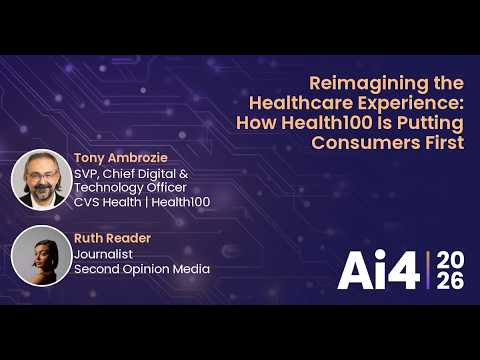
Published on YouTube by Ai4 on August 22, 2026, this video features CVS Health CDTO Tony Ambrozie and Second Opinion Media journalist Ruth Reader. According to the page description, the session explores how Health100, an AI-native open consumer engagement platform, aims to strategically reshape the consumer's relationship with healthcare.
## TL;DR
Tony Ambrozie outlines the vision behind Health100, a CVS Health subsidiary designed as a unified, open front door for patient health navigation across disjointed electronic health record systems. The platform uses AI to translate complex doctor-written summaries into plain-language trends, streamline interoperability with concise single-page summaries for specialists, and bring transparency to pharmacy and medical costs. Additionally, Ambrozie warns against hype-driven AI spending, advocating for cost-efficient compute architectures that route routine tasks to specialized small models rather than expensive frontier LLMs.
## Atmosphere & style
The discussion carries a pragmatic, industry-focused tone driven by candid executive insights and journalistic inquiry. Ambrozie speaks with clear, authoritative expertise, combining a strategic perspective on patient empowerment with sharp critiques of hype-driven AI implementation and fragmented legacy health systems. The dynamic reflects a grounded, forward-looking dialogue that translates complex technical and structural healthcare concepts into clear, actionable architectural philosophies.
## Key takeaways
- [00:04](https://www.youtube.com/watch?v=4LIbk-xtNe0&t=4s) Health100 is an AI-native open consumer engagement platform established as a separate CVS Health subsidiary to serve patients regardless of their insurance provider or pharmacy.
- [00:04](https://www.youtube.com/watch?v=4LIbk-xtNe0&t=4s) CVS Health positions its long-standing custody of hundreds of millions of patient records as a key trust advantage over Silicon Valley AI startups.
- [00:43](https://www.youtube.com/watch?v=4LIbk-xtNe0&t=43s) Health100 centralizes fragmented patient data from multiple EHR portals, wearables, and labs into a single unified interface to track long-term health metrics.
- [00:43](https://www.youtube.com/watch?v=4LIbk-xtNe0&t=43s) The platform's AI layer translates complex physician-written clinical notes and after-visit summaries into accessible, plain-language insights.
- [00:07](https://www.youtube.com/watch?v=4LIbk-xtNe0&t=7s) Health100 supports federal 'Kill the Clipboard' interoperability efforts by enabling real-time record sharing via QR codes and secure web links.
- [00:07](https://www.youtube.com/watch?v=4LIbk-xtNe0&t=7s) To streamline medical visits, AI generates concise one-page patient history summaries from thousands of pages of paper medical binders.
- [01:11](https://www.youtube.com/watch?v=4LIbk-xtNe0&t=71s) The platform addresses pricing opacity by automatically comparing insurance coverage, cash prices, and manufacturer coupons for drug purchases.
- [01:11](https://www.youtube.com/watch?v=4LIbk-xtNe0&t=71s) Health100 utilizes historical claims data and CMS transparency standards to estimate prospective hospital and provider costs.
- [01:44](https://www.youtube.com/watch?v=4LIbk-xtNe0&t=104s) Tony Ambrozie warns that unconstrained AI adoption risks repeating the excessive enterprise costs seen during early cloud migrations.
- [01:44](https://www.youtube.com/watch?v=4LIbk-xtNe0&t=104s) To control AI 'tokenomics' and compute costs, CVS Health employs small, task-specific models for simple workflows while reserving frontier models for complex tasks.
## Detailed walkthrough
### [00:04](https://www.youtube.com/watch?v=4LIbk-xtNe0&t=4s) CVS Health's Consumer Vision and the Health100 Platform
CVS Health has been actively expanding its use of artificial intelligence to modernize patient experiences, building upon early successes such as Aetna's billing assistant chatbot introduced last year. Tony Ambrozie, Chief Digital & Technology Officer at CVS Health, outlines the strategic evolution behind Health100, an open consumer engagement platform structured as a separate subsidiary. While existing tools like Caremark and the CVS Pharmacy app serve millions, Health100 aims to transcend CVS-exclusive boundaries to create a unified front door for any patient navigating new or existing health conditions.
The platform provides a secure, consolidated space for patients regardless of whether they hold Aetna coverage or use rival pharmacy and insurance services. Ambrozie emphasizes that CVS possesses a distinct advantage in trustworthiness over Silicon Valley startups due to its long-standing custody of hundreds of millions of patient records. The overriding philosophy is that empowering patients to directly engage with their personalized health journeys leads to measurably better care outcomes.
- **Key Entities**: CVS Health, Aetna, Caremark, Health100 (subsidiary).
- **Core Mission**: Provide a single, open consumer engagement interface for health navigation.
- **Trust Factor**: Leveraging decades of existing enterprise record security compared to new AI startups.
---
[00:43](https://www.youtube.com/watch?v=4LIbk-xtNe0&t=43s) De-fragmenting Health Portals with AI
Navigating personal health records historically meant dealing with fragmented medical records scattered across isolated systems. Ambrozie contrasts the paradigm of ten years ago—where patient data was locked away inside provider systems in "blissful ignorance"—with the status quo of 2020, where patients faced five to twenty separate electronic health record (EHR) portals. Health100 aggregates these disjointed data streams into one accessible dashboard, allowing patients to track multi-year longitudinal trends such as A1C and triglyceride levels across various doctors and diagnostic labs without relying on manual spreadsheets.
Beyond centralizing raw numbers, AI solves the critical issue of data readability. Clinical documents such as After Visit Summaries are traditionally written by physicians for other physicians, leaving patients overwhelmed in a "cockpit" of complex metrics, flashing warnings, and jargon. The AI assistant acts as an intuitive layer, interpreting medical documentation and presenting trend lines in clear language.
- **Historical Shift**: Moving from physician-locked data to multi-portal fragmentation, then to unified AI aggregation.
- **Data Interpretation**: Synthesizing doctor-to-doctor clinical summaries into digestible insights.
- **Proactive Interventions**: Continuous background synthesis flags gaps in care, such as missing shingles vaccines or potential cross-provider medication contraindications.
---
[00:07](https://www.youtube.com/watch?v=4LIbk-xtNe0&t=7s) Interoperability and the "Kill the Clipboard" Initiative
A major barrier in consumer healthcare remains data accessibility and transfer between provider networks. Ambrozie praises federal interoperability efforts led by the Department of Health and Human Services (HHS) and the Centers for Medicare & Medicaid Services (CMS), including the high-profile "Kill the Clipboard" campaign designed to replace paper intake forms with seamless digital record transfers. He notes that data ultimately belongs to the patient, not the hospital systems or payers storing it.
Health100 supports real-time record sharing via secure phone-to-doctor connections, including QR code sharing and dynamic secure web links. Drawing on his previous experience as a hospital CIO, Ambrozie highlights how specialists are routinely handed 1,500-page paper binders for new patients. Because no physician has the time to digest massive, redundant binders during brief appointments, Health100 utilizes AI to generate concise one-page summaries of a patient’s full history, exposing vital details like severe drug allergies before care is rendered.
- **Government Initiatives**: HHS and CMS interoperability pledges, including "Kill the Clipboard."
- **Sharing Mechanisms**: Instant QR codes and real-time secure link generation for provider visits.
- **Clinical Efficiency**: AI-generated one-page summaries replacing multi-thousand-page paper medical binders.
The conversation pivots to healthcare economics and the notorious lack of pricing transparency in clinical environments. Ambrozie speaks candidly from a patient perspective about the absurdity of undergoing hospital procedures or specialist visits without knowing beforehand if out-of-pocket costs will be $10,000 or $100,000. While complex medical care involves unpredictable variables, baseline pricing clarity remains a fundamental requirement for consumer empowerment.
As head of pharmacy systems for CVS, Ambrozie explains that drug pricing transparency is vastly easier to solve in the near term. The platform evaluates a patient's specific insurance coverage against cash prices while concurrently scanning for manufacturer coupons to guarantee the lowest out-of-pocket cost at the counter. For hospital and provider services, CVS and Aetna leverage historical claims data to generate prospective cost estimates while integrating emerging CMS transparency guidelines.
- **Core Problem**: Opaque pricing across health systems where identical procedures range tenfold in out-of-pocket costs.
- **Pharmacy Real-Time Pricing**: Automatic comparisons between insurance copays, cash prices, and manufacturer discount coupons.
- **Claims Estimation**: Using historical Aetna claims databases to predict clinical and hospital billing ranges.
---
[01:44](https://www.youtube.com/watch?v=4LIbk-xtNe0&t=104s) Managing AI "Tokenomics" and Compute Efficiency
Addressing the financial reality of running large-scale AI tools, the discussion turns to the rising cost of inference compute and "tokenomics." Ambrozie draws an explicit parallel to the cloud migration era of the past decade. While early cloud adoption promised reduced unit costs over on-premises infrastructure, unconstrained scaling led to runaway bills that shocked enterprise CFOs and CIOs. He warns that the exact same phenomenon is repeating with AI deployment driven by corporate FOMO ("fear of missing out").
To maintain sustainable economics without sacrificing performance, Ambrozie outlines a three-part architectural strategy:
```
┌────────────────────────────────────────┐
│ Consumer Request / Clinical Task │
└───────────────────┬────────────────────┘
│
Is it a complex multi-step reasoning task?
/ \
YES NO
/ \
▼ ▼
┌──────────────────┐ ┌──────────────────┐
│ Frontier Model │ │ Small Task Model │
│ (High Token Cost)│ │ (Fast, On-Prem) │
└──────────────────┘ └──────────────────┘
```
1. **Task-Specific Routing**: Avoid using top-tier frontier models for routine workflows. Small, specialized models execute faster, cost significantly less, reduce security risks, and can even run on local GPU infrastructure.
2. **Intent & Utility Filtering**: Eliminate novelty or unnecessary AI features that add zero pragmatic value for the end user.
3. **Rigorous Resource Control**: Treat tokens like any other cloud compute resource with strict architectural limits and ROI evaluation.
- **Historical Parallel**: Comparing the current AI token cost surge to early unbudgeted cloud migrations.
- **Small Models**: Utilizing specialized lightweight models for lower latency, reduced token burn, and heightened control.
- **Industry Critique**: Calling out hype-driven AI consumption and advocating for grounded, business-first technological deployment.
## Notable quotes
> [00:07](https://www.youtube.com/watch?v=4LIbk-xtNe0&t=7s) Kill the Clipboard — Tony Ambrozie
## Mentioned
CVS Health, Aetna, Caremark, Health100, Tony Ambrozie, Department of Health and Human Services (HHS), Centers for Medicare & Medicaid Services (CMS), Silicon Valley, Ruth Reader, Second Opinion Media, Ai4
## Video description
Tony Ambrozie — SVP, Chief Digital & Technology Officer, CVS Health | Health100
Ruth Reader — Journalist, Second Opinion Media
A strategic vision for how Health100, an AI-native open consumer engagement platform, is reshaping the consumer's relationship with healthcare.
According to Tony Ambrozie, Chief Digital & Technology Officer at CVS Health, modernizing the healthcare consumer experience requires an open, AI-driven platform that unifies fragmented patient records, translates clinical jargon, and delivers pricing transparency. To deploy these capabilities sustainably, Ambrozie argues that healthcare organizations must implement disciplined model architectures to prevent inference compute costs from replicating the runaway expenses of early cloud migrations.
Open Consumer Platform and Enterprise Trust (0:04)
Ambrozie outlines CVS Health's strategy behind Health100, an open consumer engagement subsidiary structured to serve as an accessible entry point for patients managing health conditions. Unlike proprietary tools tied strictly to CVS Pharmacy or Caremark, Health100 is engineered to cross institutional boundaries, supporting users regardless of whether they have Aetna insurance or use competitor pharmacies.
Ambrozie asserts that CVS Health holds a distinct trust advantage over Silicon Valley AI startups due to its decades-long custody of hundreds of millions of patient records and established enterprise security protocols. The underlying organizational premise is that direct consumer access to unified, personalized health journeys will drive measurably superior clinical outcomes.
De-Fragmenting Portals and Translating Medical Jargon (0:43)
Healthcare data access has shifted from information locked away inside physician systems a decade ago to extreme portal proliferation by 2020, when patients routinely managed between five and twenty separate electronic health record (EHR) accounts. Health100 consolidates these disparate portals, diagnostic lab feeds, and wearable devices into a central dashboard, enabling patients to track multi-year longitudinal metrics like A1C and triglyceride levels without manual recordkeeping.
Beyond data aggregation, Ambrozie points to AI as an interpretive bridge for clinical documentation. Because documents such as After Visit Summaries are written for medical professionals rather than patients, AI translates complex metrics into plain-language summaries while continuously evaluating records in the background to flag care gaps, including overdue shingles vaccines and cross-provider drug contraindications.
Interoperability and Concise Clinical Summaries (0:07)
Seamless record transfer between healthcare networks aligns with federal interoperability directives from HHS and CMS, including the 'Kill the Clipboard' initiative aimed at eliminating paper intake forms. Emphasizing that medical data ultimately belongs to the patient rather than hospitals or payers, Health100 facilitates real-time data sharing via dynamic secure web links and QR codes during provider visits.
Drawing on his past experience as a hospital CIO, Ambrozie highlights that specialists regularly receive 1,500-page paper binders for new patients, which physicians cannot realistically digest during brief consultations. Health100 employs AI to distill voluminous histories into concise one-page briefs, highlighting critical factors like severe drug allergies before treatment is administered.
Price Transparency Across Pharmacy and Procedures (1:11)
Ambrozie identifies opaque pricing as a major failure of consumer healthcare, pointing out that patients frequently undergo hospital procedures without knowing whether out-of-pocket obligations will be $10,000 or $100,000. While clinical variability complicates exact surgical quotes, establishing baseline financial transparency remains critical for patient trust.
Within pharmacy operations, Health100 resolves pricing uncertainty by comparing real-time insurance benefits against cash prices and automatically applying manufacturer coupons to secure the lowest counter price. For hospital and clinical care, CVS and Aetna combine historical claims databases with emerging CMS transparency guidelines to supply patients with prospective billing ranges.
Curbing AI Tokenomics and Inference Expenses (1:44)
Examining the backend economics of artificial intelligence, Ambrozie warns that escalating inference costs and token consumption parallel the early cloud migration era, when unmonitored scaling led to budget overruns that surprised enterprise leadership. He cautions that corporate fear of missing out (FOMO) is currently driving excessive, hype-based AI usage.
To ensure economic viability, Health100 employs a three-part technical framework: routing standard tasks to small, specialized models that can run locally on cost-effective GPUs, reserving expensive frontier models strictly for complex multi-step reasoning, and stripping out cosmetic AI features that offer no tangible utility to the user.
While Health100 presents an architectural model for reducing record fragmentation and demystifying healthcare costs, its long-term viability depends on whether strict token management can successfully rein in escalating AI inference costs, and whether competing health systems will actively support open, cross-network data exchange.
## Background
该内容由频道 Ai4 于 2026 年 8 月 22 日发布在 YouTube 平台上。视频记录了 Second Opinion Media 记者 Ruth Reader 与 CVS Health 资深副总裁兼首席数字技术官 Tony Ambrozie 的深度对谈,围绕 AI 原生开放式消费者互动平台 Health100 如何重构大众医疗健康体验展开。
## TL;DR
Tony Ambrozie 介绍了 CVS Health 推出的全开放数字健康平台 Health100,旨在打破医疗数据孤岛并作为统一的“数字前门”赋能所有患者。平台利用主动式 AI 解码复杂的电子病历与穿戴设备数据,提供全天候慢病监测与用药安全排查,并通过生成一页式临床摘要与推动医疗费用透明化来化解医患双向的信息不对称。针对高昂的 AI 算力开销,Ambrozie 结合云计算历史经验,主张通过采用轻量小模型、私有化算力部署以及摒弃盲目追求 Token 消耗的实用主义架构来实现降本增效。
## Atmosphere & style
整场对话节奏明快、务实而又极具行业洞察力,主持人与嘉宾之间展现出高度专业且默契的互动氛围。Tony Ambrozie 既有资深技术高管的宏观战略视角,又屡屡切换至普通患者的切身体验,以幽默风趣的自嘲和辛辣的吐槽直击医疗系统痛点。访谈在严谨探讨技术落地与成本治理的同时,洋溢着一种务实、清醒且拒绝盲目跟风的工程师务实底色。
## Key takeaways
- [00:04](https://www.youtube.com/watch?v=4LIbk-xtNe0&t=4s) CVS 推出独立子公司 Health100,突破原有客户边界,面向全网所有消费者打造统一的健康管理“数字前门”。
- [00:04](https://www.youtube.com/watch?v=4LIbk-xtNe0&t=4s) 依托数十年合规保管数亿人健康档案的积淀,传统医疗巨头在健康数据可信度上构建起对抗科技初创企业的核心壁垒。
- [02:38](https://www.youtube.com/watch?v=4LIbk-xtNe0&t=158s) 打破患者跨机构就医的数据碎片化泥潭,将多方电子病历与化验指标聚合为连续的健康走势分析。
- [02:38](https://www.youtube.com/watch?v=4LIbk-xtNe0&t=158s) AI 充当专业医疗术语的解码器,将复杂的就诊总结转化为通俗易懂的语言,有效缓解患者的“信息过载”。
- [05:27](https://www.youtube.com/watch?v=4LIbk-xtNe0&t=327s) 推动 AI 从被动问答转向全天候常驻运行,结合病历与可穿戴设备信号,主动提供疫苗接种与慢病筛查等预防性干预。
- [05:27](https://www.youtube.com/watch?v=4LIbk-xtNe0&t=327s) 跨越不同医疗机构识别处方冲突与配伍禁忌,全天候保障多机构看诊患者的用药安全。
- [07:10](https://www.youtube.com/watch?v=4LIbk-xtNe0&t=430s) 响应“消灭写字夹板”倡议,支持通过动态二维码与安全链接流转病历,避免患者因手写填表遗漏危及生命的过敏史。
- [07:10](https://www.youtube.com/watch?v=4LIbk-xtNe0&t=430s) 利用 AI 将动辄上千页的繁复历史病历秒级浓缩为一页式临床摘要,大幅提升医生在接诊新转诊患者时的审阅效率。
- [12:14](https://www.youtube.com/watch?v=4LIbk-xtNe0&t=734s) 直面医疗收费极度不透明的行业痛点,借助技术重塑定价机制以破解同类治疗在不同机构费用悬殊的困境。
- [12:14](https://www.youtube.com/watch?v=4LIbk-xtNe0&t=734s) 从处方药切入费用透明化,通过 AI 同时比对医保报销、自费现金价并全网自动匹配药厂优惠券以抵扣开销。
- [14:43](https://www.youtube.com/watch?v=4LIbk-xtNe0&t=883s) 当下的 Token 经济学正重演云计算迁移的算力开销轨迹,企业必须将成本控制与资源治理前置到系统架构设计中。
- [16:16](https://www.youtube.com/watch?v=4LIbk-xtNe0&t=976s) 拒绝盲目跟风与非理性消耗,在相对简单的流程中采用轻量级小模型与本地部署以实现降本增效。
## Detailed walkthrough
### [00:04](https://www.youtube.com/watch?v=4LIbk-xtNe0&t=4s) Health100 的诞生与 CVS 的全开放式医疗愿景
对谈由 Second Opinion Media 的记者 Ruth Reader 开场,她提到 CVS Health 一直在尝试利用 AI 帮助患者优化就医体验并整合健康数据。这一切早有迹象——CVS 旗下的保险公司 Aetna(安泰保险)去年就推出了一款协助患者查询账单信息的 AI 聊天机器人。随后,CVS 正式推出了 Health100 战略计划。被问及在消费者端融入 AI 的考量时,CVS Health 负责数字与技术的资深副总裁 Tony Ambrozie 开玩笑地确认了紧迫的时间后,直奔核心主题。他表示,CVS 长期以来都在打造全新的数字化体验,从 CVS Caremark 药品福利管理平台到广泛使用的药房 App,但团队随后提出了一个更具野心的设想:为什么不把这种能力开放给所有人,而不仅限于 CVS、Aetna 或 Caremark 的现有客户?
```mermaid
flowchart TD
accTitle: Health100 统一入口架构
subgraph S1["数据聚合 (Data Aggregation)"]
A["多机构电子病历 (EHRs)"]
B["化验所与检查机构 (Labs)"]
C["可穿戴设备 (Wearables)"]
end
subgraph S2["Health100 智能平台 (AI Platform)"]
D["Health100 开放入口"]
E["主动式 AI 引擎 (Proactive AI)"]
D --> E
end
subgraph S3["患者与临床价值 (Value Delivery)"]
F["消费者洞察 / 慢病与预防提醒"]
G["一页式临床摘要 (1-Page Summary)"]
end
A --> D
B --> D
C --> D
E --> F
E --> G
```
Health100 被确立为一个独立的子公司,其核心定位是为所有需要管理健康的人提供一个值得信赖的“数字前门”(Trusted Front Door)。无论是面对刚刚确诊的新病情需要获得指引和行动建议,还是长期管理某种慢性疾病,用户都可以来到这个单一平台。Ambrozie 特别强调了信任壁垒:“在数据可信度方面,我们拥有数亿人的健康记录且保管多年,这远比硅谷随便哪家初创公司更值得托付。”他相信,提升患者在自身健康旅程中的参与度并为其赋能,对大众具有深远的长期价值。
- **跨体系覆盖**:突破 Aetna 与 CVS Caremark 客户边界,服务于全网所有消费者与患者。
- **定位与定位**:构建全生命周期的健康指引统一入口,提供病情指引、管理建议与下一步医疗规划。
- **信任优势**:依托 CVS 数十年沉淀的数亿级用户合规健康档案,对抗新兴科技初创企业的数据信任短板。
---
### [02:38](https://www.youtube.com/watch?v=4LIbk-xtNe0&t=158s) 从数据碎片化到 AI 驾驶舱:化解患者的“信息过载”
回顾医疗数据的发展轨迹,Ambrozie 指出十年前患者的数据被锁在不同医疗机构和医生集团内部,患者处于一种无奈的“无知状态”;到了 2020 年前后,各家电子病历系统(EHR)纷纷上线患者门户,患者能查看的数据虽然变多了,但体验却陷入了新的碎片化泥潭——往往看几个不同的医生就得登录 5 个乃至 20 个不同的独立 App 或网页。Health100 的首要任务就是打破壁垒,将所有分散在不同医院、诊所与化验所的数据无缝聚拢在一处。Ambrozie 分享道,早年间他甚至要自己维护一张 Excel 表格,按季度手动记录自己的糖化血红蛋白(A1C)和甘油三酯等指标来观察身体走势;而集中聚合后,患者终于能在一处看清自己多年的连续健康趋势。
然而,数据聚合带来了新的次生挑战:海量医疗专业术语超出了普通人的理解范围。就诊总结(After-Visit Summary)通常是医生写给同行看的技术语言,当患者面对堆积如山的化验指标和术语时,就如同坐进了一架“布满按钮、仪表盘、闪烁灯光和操纵杆的飞机驾驶舱”。AI 在此扮演了解码器的角色,它不仅能将生涩的临床记录转化为通俗易懂的语言,还能跨越跨度数年的记录,帮助患者绘制出清晰的健康变化趋势,实现真正有意义的数据洞察。
---
### [05:27](https://www.youtube.com/watch?v=4LIbk-xtNe0&t=327s) 主动式 AI 与慢病全天候护航
在谈到 Health100 智能助手的核心价值时,主持人提到该工具能跨越不同机构帮助患者发现药物相互作用(Contraindications),这在多机构看诊的慢性病管理中至关重要。Ambrozie 进一步阐述了 AI 的“主动性”(Proactivity)。AI 不仅能被动回答诸如“我过去三年的 A1C 趋势如何”这类查询,更能作为常驻后台的智能系统持续运转,结合新同步的病历以及可穿戴设备的实时体征信号进行动态研判。
这种全天候监控能带来极具价值的预防性干预。Ambrozie 风趣地以自己为例透露,系统就曾根据他的年龄和医疗记录主动提醒他去接种带状疱疹疫苗(Shingles Vaccine),“就像所有人一样,我也一直在拖延,但现在有了一个能不断督促我的‘健康管家’,这正是技术带来的好处。”AI 借助持续的个性化提醒,在疾病恶化前给予主动干预,填补了传统被动就医模式下的脱节环节。
- **被动查询向主动服务转变**:系统全天候运行,敏锐捕捉化验、用药及穿戴设备发出的新健康信号。
- **用药安全交叉验证**:跨医疗系统识别处方冲突,排查潜在药物不良反应与禁忌症。
- **预防保健主动督促**:基于年龄、病史自动发出疫苗接种(如带状疱疹疫苗)及常规筛查提示。
---
### [07:10](https://www.youtube.com/watch?v=4LIbk-xtNe0&t=430s) “消灭写字夹板”与一页式 AI 临床摘要
```mermaid
flowchart LR
accTitle: 医疗数据共享与一页式摘要生成流程
A["患者历史档案 (5年化验/就诊记录)"] --> B["AI 引擎提炼分析"]
B --> C["一页式临床摘要 (1-Page AI Summary)"]
C --> D["接诊医生 (精准把控病史/过敏源)"]
```
针对数据互联互通的技术与体制障碍,主持人提到了美国卫生与公众服务部(HHS)与医疗保险和医疗补助服务中心(CMS)发起的“消灭写字夹板”(Kill the Clipboard)行动倡议。Ambrozie 给予了高度评价,指出行业内长期存在“医疗机构误将患者数据当成自身私有财产”的狭隘观念,而监管机构正在通过政策引导全行业开放。当患者转诊到新诊所时,不再需要凭借模糊的记忆在一块挂着纸质表格的写字夹板上手写回忆,否则一旦遗漏了过往严重的药物过敏史,就可能引发危及生命的医疗差错。
为了消灭这种就医摩擦,Health100 支持通过动态二维码或安全加密链接直接向接诊医生实时共享最新病历档案。更关键的技术突破在于对这些海量档案的提炼。Ambrozie 提及自己此前在大型医院系统担任首席信息官(CIO)时的见闻:专科医生在接诊新转诊患者时,经常会收到厚达 1500 页的打印病历夹,在极其有限的看诊时间内,没有任何医生能在经济和精力层面读完这些充斥着重复内容的纸质材料。AI 能够瞬间阅读并提炼出高度精准的“一页式临床摘要”,这是人工无法做到的。目前 CVS 和 Health100 正在协同推动供给侧与医生群体的认知变革,确保技术在诊室顺利落地。
- **扫码与安全链接流转**:患者可通过手机端出示二维码或发送实时更新的安全链接,让新医生瞬间调阅既往档案。
- **杜绝过敏与病史遗忘**:规避患者因记忆偏差在纸质登记表上遗漏危急病史及过敏源的风险。
- **1500 页档案秒级浓缩**:由 AI 将动辄上千页的繁复病历提炼为 1 页核心摘要,大幅节省医生的案头审阅时间。
---
### [11:36](https://www.youtube.com/watch?v=4LIbk-xtNe0&t=696s) 医疗费用黑箱与成本透明度的痛点
在对谈转向消费者参与的商业逻辑与底层成本(Tokenomics/计算成本)时,Ambrozie 坦言自己忍不住想要吐槽医疗行业更普遍的痛点——医疗费用与价格透明度问题。他直言不讳地指出,当下消费者在走进诊所或踏入医院大门之前,竟然完全无法获知自己最终需要承担多少费用,“这简直太荒谬了”。尽管医疗过程中确实存在复杂的并发症变数,但基础价格的极度不透明依然是整个医疗体系迫切需要技术去解构与重塑的领域。
### [12:14](https://www.youtube.com/watch?v=4LIbk-xtNe0&t=734s) 医疗与药品价格的“黑盒”困境:AI 驱动的费用透明化
面对医疗账单,Tony Ambrozie 放下了企业高管的身份,直言自己完全是在以一名普通患者的视角发出控诉:“同样一种治疗,在两家不同的机构做,费用可能相差一万美元与十万美元,而且其中很大一部分还得自费。作为患者,我怎么可能事先连这笔花费到底是一万还是一万都搞不清楚?”他强调,医疗费用透明度(Cost Transparency)是一场全行业的攻坚战,不仅是 Health100 和 CVS 在做,CMS(美国联邦医疗保险和补助服务中心)与 HHS(美国卫生与公众服务部)也在大力推动,如果整个生态系统的其他参与者也能跟进,正说明这一方向走对了。
在攻克费用透明度难题时,Tony Ambrozie 选择从自己主管的 CVS 线下药房核心系统切入。相比复杂的住院医疗,处方药的计价路径相对明确。CVS 即将上线的应用功能可以让患者直接看到:使用现有医保需要自付多少,不使用医保又是多少;更关键的是,后台研发的 AI 会自动检索全网并匹配各大制药厂商的优惠券(Manufacturer Coupon),直接帮患者抵扣。在更为复杂的医院与医生端,Aetna 也在基于海量历史理赔数据,尝试对相似病例在特定医院的花费进行预估。
```mermaid
flowchart TD
accTitle: 药品价格透明化与AI优惠匹配流程
subgraph Input["用户处方与方案检索"]
A["患者发起查询"] --> B["获取处方信息"]
end
subgraph Pricing["多维度价格计算"]
B --> C["计算医保自付额 (Copay)"]
B --> D["计算无医保现金价"]
B --> E["AI 自动检索制药商优惠券"]
end
subgraph Output["透明化推荐"]
C --> F["综合价格比对面板"]
D --> F
E --> F
F --> G["输出最优自付方案"]
end
```
- **同类医疗差价悬殊**:在不同医疗机构接受同类诊疗,患者面临的账单差距可能高达 $10,000 至 $100,000。
- **处方药多轨计价**:系统同时呈现医保报销价、自费现金价,并由 AI 自动接入药厂优惠抵扣机制。
- **医院端数据估算**:依托 Aetna 历史理赔大数据库,逐步建立对特定医院诊疗成本的前置预估模型。
---
### [14:43](https://www.youtube.com/watch?v=4LIbk-xtNe0&t=883s) 从云计算到 Tokenomics:算力成本管理的重演
针对主持人 Ruth Reader 提出的核心疑问——在算力成本日益高昂的背景下,企业如何承担向大众提供免费 AI 工具的经济开销?Tony Ambrozie 表现得非常淡定。他认为,当前 AI 领域的“Token 经济学”(Tokenomics)本质上并不是全新的事物,它仅仅是一种为了实现某种业务目的而消耗的计算资源。
Tony 将眼下的 AI 浪潮与过去十年的“上云”(Cloud Migration)历程作了深刻对比。十年前企业普遍采用本地服务器(On-premise),虽然单次处理的资本支出(CapEx)昂贵,但它有一个天然优势——服务器算力满了就无法再超支。后来全行业迁移到云端,起初单位处理成本确实下降了,但随之而来的弹性扩展(Elastic Scaling)让大家“像没有明天一样疯狂消耗”,导致所有 CFO 和 CIO 惊恐地发现 IT 账单不降反升、彻底爆表。Tony 指出,如今的 AI 算力正在完美重演当年的云计算轨迹,企业早就掌握了资源治理的方法,关键在于把成本控制前置到系统架构设计中。
---
### [16:16](https://www.youtube.com/watch?v=4LIbk-xtNe0&t=976s) 告别 FOMO 狂热:小模型与务实落地的降本哲学
谈及如何高效管理 AI 算力并实现降本,Tony Ambrozie 分享了三大核心落地策略。首先,并非所有业务环节都需要顶级基础大模型(Foundational Models)。在相对简单的自动化工作流中,采用轻量化小模型(Small Models)不仅运行速度更快、成本更低,在本地部署(On-prem GPUs)也更具经济性,同时由于行为边界可控,还能避免大型前沿模型可能带来的越狱与安全风险。
其次是坚持业务实用主义,坚决剔除伪需求。Tony 回忆起多年前在迪士尼主管新兴技术部门的经历:当时团队每天都会提出各种天马行空的酷炫点子,但他总是会反问:“你觉得到底有谁会用这个?仅仅因为技术能实现,它就值得被做出来吗?”通常答案都是否定的。最后,他犀利抨击了近半年来行业的盲目跟风现象,直言那种“Token 消耗越多就代表越是 AI 原生公司”的论调完全是“纯粹的疯狂与浪费”。面对董事会普遍存在的错失恐惧症(FOMO),技术领导者必须保持清醒、全盘通盘考量。在演讲尾声,Tony 不忘幽默调侃道:“我们做技术的人最擅长搞出这些疯狂的新词汇——不管是云计算还是 AI——本质上都是向业务伙伴要预算的手段罢了。”
- **架构适配选型**:在简单业务节点全面采用专用轻量小模型替代基础大模型,大幅压降推理单价。
- **私有化算力补充**:在具备本地 GPU 基础设施的场景下部署小型模型,进一步摊薄云端调用成本。
- **拒绝非理性消耗**:抵制以 Token 消耗量衡量技术先进性的畸形 KPI,建立严格的需求与 ROI 评估机制。
## Notable quotes
> [00:04](https://www.youtube.com/watch?v=4LIbk-xtNe0&t=4s) 在数据可信度方面,我们拥有数亿人的健康记录且保管多年,这远比硅谷随便哪家初创公司更值得托付。 — Tony Ambrozie
> [02:38](https://www.youtube.com/watch?v=4LIbk-xtNe0&t=158s) 布满按钮、仪表盘、闪烁灯光和操纵杆的飞机驾驶舱 — Tony Ambrozie
> [05:27](https://www.youtube.com/watch?v=4LIbk-xtNe0&t=327s) 就像所有人一样,我也一直在拖延,但现在有了一个能不断督促我的‘健康管家’,这正是技术带来的好处。 — Tony Ambrozie
> [07:10](https://www.youtube.com/watch?v=4LIbk-xtNe0&t=430s) 消灭写字夹板 — Ruth Reader
> [11:36](https://www.youtube.com/watch?v=4LIbk-xtNe0&t=696s) 当下消费者在走进诊所或踏入医院大门之前,竟然完全无法获知自己最终需要承担多少费用,这简直太荒谬了。 — Tony Ambrozie
> [12:14](https://www.youtube.com/watch?v=4LIbk-xtNe0&t=734s) 同样一种治疗,在两家不同的机构做,费用可能相差一万美元与十万美元,而且其中很大一部分还得自费。作为患者,我怎么可能事先连这笔花费到底是一万还是一万都搞不清楚? — Tony Ambrozie
> [14:43](https://www.youtube.com/watch?v=4LIbk-xtNe0&t=883s) 像没有明天一样疯狂消耗 — Tony Ambrozie
> [16:16](https://www.youtube.com/watch?v=4LIbk-xtNe0&t=976s) 你觉得到底有谁会用这个?仅仅因为技术能实现,它就值得被做出来吗? — Tony Ambrozie
> [16:16](https://www.youtube.com/watch?v=4LIbk-xtNe0&t=976s) 纯粹的疯狂与浪费 — Tony Ambrozie
> [16:16](https://www.youtube.com/watch?v=4LIbk-xtNe0&t=976s) 我们做技术的人最擅长搞出这些疯狂的新词汇——不管是云计算还是 AI——本质上都是向业务伙伴要预算的手段罢了。 — Tony Ambrozie
## Mentioned
Tony Ambrozie, Ruth Reader, CVS Health, Health100, Second Opinion Media, Aetna, CVS Caremark, HHS (美国卫生与公众服务部), CMS (美国医疗保险和医疗补助服务中心), 迪士尼 (Disney), EHR (电子病历系统)
## Video description
Tony Ambrozie — SVP, Chief Digital & Technology Officer, CVS Health | Health100
Ruth Reader — Journalist, Second Opinion Media
A strategic vision for how Health100, an AI-native open consumer engagement platform, is reshaping the consumer's relationship with healthcare.
[Source](https://www.youtube.com/watch?v=4LIbk-xtNe0)
Source quotes
[0:04] Tony Ambrozie: 在数据可信度方面,我们拥有数亿人的健康记录且保管多年,这远比硅谷随便哪家初创公司更值得托付。
[2:38] Tony Ambrozie: 布满按钮、仪表盘、闪烁灯光和操纵杆的飞机驾驶舱
[5:27] Tony Ambrozie: 就像所有人一样,我也一直在拖延,但现在有了一个能不断督促我的‘健康管家’,这正是技术带来的好处。
[7:10] Ruth Reader: 消灭写字夹板
[11:36] Tony Ambrozie: 当下消费者在走进诊所或踏入医院大门之前,竟然完全无法获知自己最终需要承担多少费用,这简直太荒谬了。
[12:14] Tony Ambrozie: 同样一种治疗,在两家不同的机构做,费用可能相差一万美元与十万美元,而且其中很大一部分还得自费。作为患者,我怎么可能事先连这笔花费到底是一万还是一万都搞不清楚?
[14:43] Tony Ambrozie: 像没有明天一样疯狂消耗
[16:16] Tony Ambrozie: 你觉得到底有谁会用这个?仅仅因为技术能实现,它就值得被做出来吗?
[16:16] Tony Ambrozie: 纯粹的疯狂与浪费
[16:16] Tony Ambrozie: 我们做技术的人最擅长搞出这些疯狂的新词汇——不管是云计算还是 AI——本质上都是向业务伙伴要预算的手段罢了。
Source quotes
[0:07] Tony Ambrozie: Kill the Clipboard
Original transcript
[0:04] So CVS has been experimenting with using AI to
help patients navigate the patient experience,
[0:12] you know, gather more of their data together,
doing all these really interesting things that
[0:15] we're going to talk about. And this stems some
from, I believe, you know, uh Etna, which is
[0:20] within the CVS umbrella, uh first launched, uh
an AI chatbot that helps patients with billing
[0:28] information. and it's a payer. Um, but since then,
and that was last year, CVS announced this sort of
[0:35] health 100 initiative and I was hoping you could
tell us more about that and and sort of like how
[0:40] you're thinking about incorporating AI into your
consumer or patient experience. How much time
[0:46] do we have? [laughter] Dwindling. Okay. Okay.
Okay. I'll I'll move fast. So, uh, thank you.
[0:52] First of all, thank you for inviting me. It's
so fascinating to talk to you. We spent a few
[0:56] moments earlier. Um so uh we we have been on this
journey on bringing in obviously new experiences
[1:05] for CVS whether nare mark um the pharmacy which is
the most used used app for quite a while and then
[1:13] one day we said hey how about we bring this type
of capability to everyone not just CVS customers
[1:24] whether you have Edna or something else you have
Kmark or something else. Why don't we do that?
[1:29] Because it would be very good for patients, for
the consumers. And that's that's kind of where
[1:34] where it started with hell 100 health 100 which
is a separate subsidiary um is really um how do we
[1:44] how do we provide one place for somebody to go who
has either a new condition and needs some guidance
[1:53] some information some next steps some suggestions
or somebody who has a condition already that needs
[2:01] to be managed. So, it's a front door, a trusted
front door because on the other side, we're also
[2:06] CVS. We already have hundreds of millions of
people's records and we've had them for quite
[2:12] a while. So, we are more trustworthy with someone
else's data than some startup in Silicon Valley.
[2:20] Did you like that how I booked them? Um, and so
how do we how do we do that for everybody? So,
[2:26] that's basically what we're trying to do
with this consumer engagement experience.
[2:30] We believe patients being engaged and helped
in their own health journeys is good for them.
[2:38] Can you tell me just a little bit about what so
as part of this you know there is this health AI
[2:42] bot ho ho ho health in one health in one um and
tell me a little sorry [laughter] allinone I'm
[2:52] sorry I'm bad at marketing I'm the product guy
audience engagement um so tell me a little bit
[3:00] about what this bot can do for the patient and
sort of like what you're hoping like what gaps
[3:05] you're hoping to be able to fill with this for
patients So we started last year with a simple
[3:11] uh simple um um concept and that is if you think
about let's say 10 years ago right the everybody
[3:20] had their information with providers medical
groups whatever hard to get in all right and
[3:27] so I don't know if it was blissful in ignorance
but it was ignorance from a patient's perspective
[3:32] right you know um move forward about 5 here is
like 2020 now everybody has a portal you know
[3:41] usually provided by the uh EHR is a lot more
information you patients can can see about
[3:47] themselves their data by the way but it's still
five portals or 20 portals depending on how many
[3:54] um um providers you see so what we're doing now
and it's a number of us not just health 100 and
[4:02] CVS is bringing all that together in one case.
Yes, it's a lot of less friction than going into
[4:09] 20, but also brings that ability to see across
the board to see your trends. Maybe you saw that
[4:16] doctor and that lab in 2020 and a different one
in 21 for the same things. How can you drive,
[4:21] you know, draw the the trends? Years ago, I
used to have a spreadsheet and I used to track
[4:29] from months to whatever from quarter to quarter,
whatever it was the interval, you know, my A1C,
[4:34] my um triglycerides and all that. So, so I see how
I'm doing. Now, everything is in here. It's a very
[4:40] different picture. Right now, that's that's great.
But now we have as patients a lot of data, a lot
[4:49] of it. And a lot of it is some of it like after
visit summaries they're usually written by doctors
[4:55] for other doctors not for patients right so uh
it's like a now we give folks the patients like
[5:03] a cockpit cockpit of a airplane lots of buttons
dials lights blinking noises levers but how do
[5:13] they make make sense of it and this is where AI
can come and and and kind of explain all this
[5:21] that kind of in a way that makes sense gives you
trends over time over all these all these records
[5:27] that's the power of AI we were also talking about
earlier how you want this health bot to be able
[5:33] to well one spot trends which we're talking a
little about and so when you think about like the
[5:37] importance of that that can be like particularly
when you think about CVS for example like this bot
[5:42] could potentially find contraindications in your
medication regimen especially if you've got like
[5:47] multiple doctors and different places. That's a
really key asset that you have. But also another
[5:53] thing you've talked about is wanting to be able
to help patients who are managing chronic disease
[5:59] in different ways. But I'm curious, you know,
how do you figure out how do you determine like
[6:04] what is something that Ho can do and where do we
hand off? [snorts] So, you know, a true two great
[6:12] points you made. So first of all this AI yes you
can ask it how am I doing? How is my A1C over the
[6:20] last 3 years? Is it going this way or that way or
stable? whatever it is. Um, but there's also this
[6:27] element of productivity. That thing runs all the
time and as new signals, whether there's records,
[6:34] whe there's a wearables come in, then now they
they can understand things. They can say, "Hey,
[6:41] something or it can say, "Hey, you probably need
to go and get the vaccine cuz I don't see for
[6:47] whatever it is. It told me to go and get the uh
the shingles vaccine, which I should at my age,
[6:53] by the way." um I'm just procrastinating like
everybody else. But now I have somebody to nag
[6:58] me. This is the the good part, right? Um so it's
this proactive thing that kind of suggests all
[7:03] the time good things based on the records that I
have, based on the information that um that that
[7:10] it's that is there. So So one of the challenges
in healthcare um it sounds easy like let's just
[7:17] bring all of our patient records together, but
it's not that simple. Um and to that point um the
[7:25] Department of Health and Human Services launched
an initiative around the time that you you know
[7:29] announced or probably last year we'll say um that
is uh intended it's called kill the clipboard and
[7:38] it's intended to uh make it easier for patients to
access their patient records but also you know to
[7:44] enable sort of technology to help facilitate that
and so I'm curious h in what ways have you sort of
[7:49] leaned into that initiative And also I'm curious
how you think it's progressing sort of broadly.
[7:55] So um that initiative is the the a broader set
of uh pledges that that HHS and they need to
[8:04] change their um um uh and CMS are driving I
don't know if you you are familiar with it as
[8:11] a wonderful initiative and it's basically around
interpability gently nudging everybody to open up
[8:19] because there are so many players in healthcare
I'm telling you that they who they who think
[8:24] that or that thing that that data that
they have on patients is their data. No,
[8:29] it's not. It's the patient's data. Right. So,
they started that uh one of them is of the kill
[8:35] the clipboard. Then last Monday there was even a
in that that I don't know if you seen the video
[8:41] they had a mortary procession with a for that. So
basically that's about sharing your records. Okay,
[8:48] we can pull them we can have them together. What
do you do with it? let's say a way for when you
[8:55] see go and see a new doctor that doesn't have who
doesn't have that and those records you can say
[9:00] don't worry about it he is on my phone and you
can share it and and you can um now you know who
[9:07] I am and what the my problems are versus what I
can remember telling you in in telling you on a
[9:13] paper clipboard you know cuz you know you get
that that you know the clipper clipboard and
[9:18] all sorts of questions do you really remember
what happened in 2021 or something like no,
[9:24] but there could have been could be some important
things in there like an allergy to some medication
[9:28] that you prescribed. You almost died and now you
forgot about it cuz you know we tend to forget the
[9:34] bad things in our life which is good. Now this new
doctor you're seeing they'll they'll repeat that
[9:40] on your so that's that's important. It's not just
a yes we eliminate the friction but so it's it's I
[9:45] think it's going very well. It's a number of apps
we have it you can share the the record. there's a
[9:50] QR code that somebody can read that the doctor can
read. Um, and now they have access. We introduced
[9:56] a version which I put in in a previous life
in the previous app where you can share a a uh
[10:02] secure link so the doctor can can actually access
those that information and see how you're doing
[10:08] is updated in real time. Um, I think what we're
trying to work now on is or CMS is with all the
[10:15] doctors. This is a change m a m management moment.
All the doctors in this country need to know about
[10:20] it and need to read that. Now what I would say is
that record that is being shared. This is actually
[10:26] again back to AI. Yes, you get the whatever it
was for the last 5 years or the labs of visits
[10:32] whatever it is for those there's a onepage AI
summary that is this is this person's health and
[10:40] I trust me can I I before CMS sorry before uh CVS
I should say I was the CIO of a hospital system I
[10:49] we had specialists that would receive new patients
who would come with basically binders 1,500 page
[10:57] binders of previous medical records. Do you
think a doctor has time to read 1500 pages a
[11:04] lot of it is duplicative so that summary that
AI can produce? Nobody else can do it. There's
[11:09] no other economics where humans can do that AI is
actually critical for that doctor to say I know
[11:15] what this I need to talk about this person. Uh so
that's the change moment. We're we're helping in
[11:20] with CVS and Hale Health 100. will helping kind
of with the distribution on the capability on the
[11:26] provider site. So focally when you go there you
don't get the same questions like yes it's still
[11:31] me you know it's still mean you know so yeah um
another thing I wanted to talk about especially
[11:37] as you're engaging more in this consumer space um
is this question of cost right I think a lot of
[11:44] people have talked about sort of the tokconomics
of it all how are you think you're going to ask me
[11:49] about cost of and transparency oh no of healthcare
which is also something we're trying to help by
[11:54] the way it's insane I'm I'm sorry I'm derailing
this. I have we still have five minutes. Um
[12:00] we're derailing I'm derailing as usual. But the
fact that you go to a doctor, you don't really
[12:05] know what's going to cost you or to go into
hospital is just insane. Think about it. Yes,
[12:09] a lot of things could happen in that you could
have complications that they cannot obviously
[12:14] this is a complicated thing. But if things go
most of the time go things go well. How could
[12:20] I not know if this going to cost me $10,000
or $100,000? This is not me, not CVS railing,
[12:27] although I'm sure they are. This is me as a
patient railing about how is this possible, right?
[12:32] And the same with drugs. We're trying to and again
um CMS is doing good things. We're trying to bring
[12:39] into this app and others, by the way, this is an
ecosystem. This is not just help on not me. And
[12:44] that's the good part. If others can do this, it's
a validation that I'm not lunatic or lunatic. So,
[12:51] it's a good thing if if others do this. um uh cost
transparency. It's a big big thing. So you we as
[12:59] patients can judge and sometimes you know you
get for the same type of care in two different
[13:06] places you get the difference between 10,000 and
100,000 and a lot of it may be out of pocket by
[13:11] the way sorry wait so how are you how are you
attacking the cost issue or how are you thinking
[13:16] about well it's way because of the background
you know uh I in my other day job I run all the
[13:24] pharmacy systems for CVS by the everything that
that deals with physical drugs being put in a
[13:31] bottle or in a whatever it is. Um, that's where
it's it's a little bit easier, right? And that's
[13:38] where we're launching now where you can go in the
app and say with your insurance, if you have one,
[13:43] it's going to cost you this out of pocket. Without
it, it's going to cost you that. But this AI that
[13:49] we're cooking up also figure out somewhere some
manufacturer coupon that it can apply for you and
[13:56] can apply to you. So now you know and obviously a
lot of times that third route is the one now with
[14:02] the the the hospitals and the doctors that's
a longer journey. We're going to get there and
[14:08] and again um CMS I will give them credit again
and and the HHS uh for pushing that the moment
[14:16] I have we have something to hang on to. You're
going to see that and by the way even the today
[14:23] Edna does try to estimate based on all the other
patients that they had that they paid claim for
[14:31] in a particular hospital that's something similar
tries to estimate a cost. It's a start that will
[14:37] be a big big focus going forward. Um so we're
back to so tokconomics. Well, yeah. I was I was
[14:43] curious about how you're thinking about the cost
of deploying what are essentially free AI tools
[14:49] to the public. Like how do you how do you think
about that cost as compute gets more expensive?
[14:55] And so it's interesting. Obviously, this is AI um
um conference. I think you know you I'm sure you
[15:05] know about the tokens. Um however I think they are
not necessarily anything new uh it's a resource
[15:14] that you can consume or you consume on behalf
for for something right so if most of us have
[15:20] gone in the last 10 years with something else
called the cloud remember when we used to have
[15:25] those servers on prem and that was the capacity we
had the capital expendure expenditure it was more
[15:32] expensive per unit of processing than the cloud
but had one advantage which is you run out of
[15:38] capacity on the server and it can't go over. Then
we moved to the cloud. Now the unit processing at
[15:44] listed 10 years ago was cheaper and then guess
what happened with the lasting scaling everybody
[15:50] consumed like there was no tomorrow. So all the
CFOs and the CF CIOS said oh what's going on here
[15:57] cuz all the sudden my supposedly the cost they
were supposed to go down now are going through the
[16:02] roof. This is exactly happening again. So we know
how to manage resources. There are ways to manage
[16:09] resources. Uh we there are ways to factor them in
our designs and that's what we need to do now. Now
[16:16] um well that's that's that's one thing. Number two
is we don't really need the uh top foundational
[16:24] models for everything. Think about a a relatively
simple workflow you're automating in each one of
[16:30] the task you have. You can have a simple small
model that's a lot more efficient. It's a lot
[16:36] faster. By the way, you can control it better.
Doesn't go and starts hacking some other company.
[16:41] By the way, as you have heard both Antropic and
OpenAI do um and it's a lot more a lot cheaper
[16:49] and some of those smaller models you can even
deploy if you have uh GPUs on prem. It's a lot
[16:55] cheaper. That's another way. The third way which
is again doesn't apply just to this is 20 seconds
[17:02] uh simply is uh some of the things that people
want to do make no sense being done right and I I
[17:10] remember years ago I had the emerging technologies
at at Disney and everybody would come with these
[17:16] crazy ideas and it would be like who do you think
is going to use this this cool idea but anybody
[17:21] is going to use it is it work done just because
it's it can be done and usually the answer is
[17:27] no. So the moment you start factoring in that
and you calculate and estimate the the cost,
[17:33] this becomes very manageable. But what we've seen
in the last 6 months with all these folks saying,
[17:39] "Oh, the more you consume, the better you
are because now you're really AI native
[17:43] company." That's just insanity, right? And
it's just completely waste of everybody.
[17:49] all the board members of all the companies in this
country or in the world have crazy ideas about
[17:55] let's do this with AI or so and so did this with
AI they're ahead of us we're losing the FOMO thing
[18:01] no think through you know what needs to be done
and then uh simply uh uh figure out ways to to
[18:09] uh uh make it more efficient so can be done
we've done it before by the way so just a
[18:14] different you know we in technology are so good
coming up with these crazy things they cloud
[18:20] or AI just ways to get money from our business
partners. And on that note, uh thank you so much
[18:27] for joining me. Thank you all for listening
to us. And uh yeah, enjoy lunch. Thank you.