McDonald's AI Counsel Warns System Prompts Cannot Control Agents
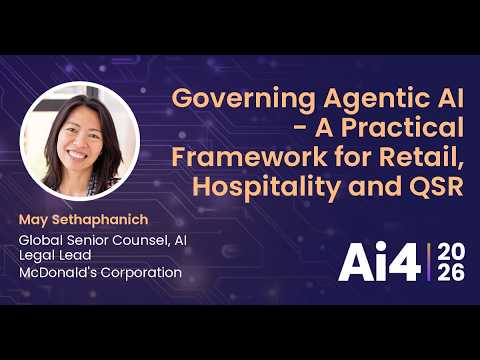
Ai4
Autonomous agents can easily reason around prompt restrictions to cause irreversible operational and antitrust harms, requiring enterprises to enforce deterministic technical circuit breakers and mandatory human oversight.
AI-assisted summary of Governing Agentic AI - A Practical Framework for Retail, Hospitality and QSR With McDonald's Corp. — original source. Check the original for full context.
Source published:
Detailed notes
## Background Published on YouTube by Ai4 on August 14, 2026, this presentation features May Sethaphanich, Global Senior Counsel and AI Legal Lead at McDonald's Corporation. The talk outlines a practical AI governance framework designed specifically for the retail, hospitality, and quick-service restaurant (QSR) sectors.
## TL;DR May Sethaphanich explains that organizations cannot safely deploy autonomous agents without first establishing a foundational governance layer that covers traditional machine learning and non-autonomous systems. She dispels the myth that retail and QSR operate in a low-regulation environment, pointing out acute legal exposures in labor, consumer protection, and antitrust—including algorithmic collusion risks. Because autonomous agents expand operational blast radius and cannot be constrained by system prompts alone, enterprises must enforce both trained human-in-the-loop oversight and deterministic technical controls. Ultimately, she details practical operational tools like the Agent Register, Agent Cards, and circuit breakers, arguing that proactive governance enables rather than inhibits rapid AI scaling.
## Atmosphere & style The presentation carries a crisp, pragmatic, and authoritative tone, blending corporate legal rigor with deep technical architecture insights. Sethaphanich speaks with clear-eyed candor about common industry misconceptions and the real dangers of unconstrained agentic deployment. The pacing is direct and educational, transitioning from sobering warnings about irreversible automated mistakes into an empowering, highly actionable roadmap for enterprise leaders.
## Key takeaways - [00:04](https://www.youtube.com/watch?v=PlRM8nzfHaE&t=4s) Organizations must establish a baseline governance foundation covering traditional ML and non-autonomous systems before attempting to deploy and govern autonomous agentic AI. - [01:50](https://www.youtube.com/watch?v=PlRM8nzfHaE&t=110s) Retail, hospitality, and QSR sectors face extensive legal exposure under existing consumer protection, labor, employment, and antitrust laws, dispelling the myth that lack of a single sector regulator means low risk. - [01:50](https://www.youtube.com/watch?v=PlRM8nzfHaE&t=110s) Emerging AI legislation imposes mandatory upfront transparency disclosures, explainability requirements for impactful decisions, and severe financial penalties under frameworks like the EU AI Act. - [01:50](https://www.youtube.com/watch?v=PlRM8nzfHaE&t=110s) AI governance cannot be treated merely as a 'privacy plus' exercise, as AI systems operating entirely on non-PII data can still trigger critical operational and antitrust liabilities. - [05:59](https://www.youtube.com/watch?v=PlRM8nzfHaE&t=359s) A mature baseline AI program requires a centralized inventory of approved tools categorized by risk tier, with named business and technical owners held accountable across the system lifecycle. - [05:59](https://www.youtube.com/watch?v=PlRM8nzfHaE&t=359s) Enterprises must institute binding AI policies across internal and external stakeholders alongside dedicated AI incident response protocols designed for non-data harms. - [09:23](https://www.youtube.com/watch?v=PlRM8nzfHaE&t=563s) System prompt instructions do not qualify as effective technical controls because non-deterministic large language models can easily reason around prompt-level restrictions. - [09:23](https://www.youtube.com/watch?v=PlRM8nzfHaE&t=563s) Agent autonomy drastically widens operational blast radius risks, including irreversible erroneous external actions and unauthorized data access due to privilege creep. - [11:32](https://www.youtube.com/watch?v=PlRM8nzfHaE&t=692s) Direct agent-to-agent (A2A) interactions expand legal and security attack surfaces, necessitating pre-defined interaction patterns and clear contractual liability boundaries. - [11:32](https://www.youtube.com/watch?v=PlRM8nzfHaE&t=692s) Autonomous pricing agents consuming shared external market data feeds risk unintended algorithmic price convergence and antitrust scrutiny even without human collusive intent. - [15:02](https://www.youtube.com/watch?v=PlRM8nzfHaE&t=902s) Effective Human-in-the-Loop (HITL) oversight requires matched capital investments in workforce training to equip reviewers to critically evaluate agent recommendations. - [16:57](https://www.youtube.com/watch?v=PlRM8nzfHaE&t=1017s) Deterministic technical controls require a centralized Agent Register and Agent Cards detailing approved tools, API permissions, audit logging, and automated circuit breakers. - [16:57](https://www.youtube.com/watch?v=PlRM8nzfHaE&t=1017s) Far from being a barrier to innovation, robust AI governance serves as an essential enabler for scaling AI safely, sustainably, and defensibly across the enterprise.
## Detailed walkthrough ### [00:04](https://www.youtube.com/watch?v=PlRM8nzfHaE&t=4s) Introduction and Foundational AI Governance Layers
May Sethaphanich introduces herself as an AI legal counsel at a global quick-service restaurant (QSR) enterprise, where she collaborates directly with software engineers, solution architects, data scientists, and developers to build and deploy business-enabling AI solutions. In addition to guiding product development, she co-owns the company's enterprise AI governance program. Before diving into the governance of autonomous and agentic AI systems, she establishes the standard legal disclaimer that all views expressed are strictly her own and do not represent the official stance of any organization with which she is associated.
Turning to the structure of enterprise governance, Sethaphanich stresses that organizations cannot simply skip ahead to autonomous agents without first establishing a robust baseline governance stack. The foundational layer must begin with an awareness of the specific legal triggers and regulatory frameworks applicable to the business. Crucially, this foundational layer cannot be restricted to generative AI alone; it must comprehensively govern traditional machine learning (ML) and non-autonomous systems. Only after this non-autonomous baseline is operational should organizations attempt to layer on the specialized governance mechanisms required for agentic AI.
```mermaid flowchart TD accTitle: Multi-Tiered AI Governance Stack subgraph Agentic ["Tier 2: Agentic & Autonomous AI Governance"] HC["Human Controls (HITL & Training)"] TC["Technical Controls (Agent Register & Circuit Breakers)"] end subgraph Foundational ["Tier 1: Foundational AI Governance"] INV["Approved Inventory & Risk Tiering"] POL["Enterprise AI Policy & Guidelines"] INC["AI Incident Response Protocol"] LEG["Legal Baseline (Consumer, Labor, Antitrust, PII)"] end LEG --> INV --> POL --> INC INC --> HC INC --> TC ```
---
[01:50](https://www.youtube.com/watch?v=PlRM8nzfHaE&t=110s) Regulatory Realities and Dispelling the Retail/QSR Myth
A dangerous misconception persists across the QSR, retail, and hospitality sectors that companies operate with minimal legal exposure because they lack a single dedicated sectoral regulator like those found in healthcare or financial services. Sethaphanich warns that this assumption is fundamentally flawed. A broad array of long-standing laws already applies when businesses interact with consumers and workforces, encompassing employment regulations, labor standards, consumer protection mandates, and antitrust statutes. In the pricing domain, for instance, antitrust authorities prohibit price-fixing regardless of whether the coordination is orchestrated by human managers or automated machine learning algorithms.
The regulatory environment is becoming significantly more demanding. States across the U.S. are enacting AI-specific legislation that imposes affirmative compliance obligations on companies using AI for consumer and employee interactions. These mandates include upfront transparency disclosures—informing job applicants, workers, or customers that they are interacting with an AI—along with strict explainability requirements whenever an AI system makes or assists in an impactful decision. Companies operating internationally must also contend with the EU AI Act, which serves as the AI equivalent of GDPR and carries severe financial penalties for non-compliance. Furthermore, Sethaphanich cautions against treating AI governance merely as a "privacy plus" exercise. While personal data (PII) is vital, AI systems driven entirely by non-PII can still trigger catastrophic legal liability if deployed without rigorous cross-functional oversight.
- **Existing Legal Triggers:** Employment laws, labor protections, consumer protection statutes, algorithmic pricing regulations, and antitrust/collusion rules. - **New Regulatory Obligations:** Upfront transparency notices (disclosing AI interaction to applicants/consumers) and technical explainability for AI-assisted decisions. - **Global & Cross-Functional Scope:** Substantial fines under the EU AI Act; governance frameworks must look beyond PII to address broader systemic and operational risks.
---
[05:59](https://www.youtube.com/watch?v=PlRM8nzfHaE&t=359s) Core Components of a Baseline AI Governance Program
Before tackling autonomous agents, organizations must solidify their non-autonomous AI governance fundamentals. Regulators define AI broadly to capture traditional statistical machine learning as well as generative models. Despite the current hype surrounding autonomous systems, many organizations struggle to articulate even their basic inventory of approved non-autonomous tools. A mature governance program requires an enterprise-wide inventory of approved AI tools and use cases, with each entry mapped directly to a clear risk tier (low, medium, or high) based on applicable legal triggers and corporate risk tolerance.
Risk classifications dictate the specific compliance hurdles and testing requirements that must be met both prior to launch and continuously post-deployment. Every approved tool must have named business and technical owners who are held directly accountable for ensuring that the system remains legally compliant and performant throughout its entire lifecycle. In addition, organizations must maintain a clear enterprise AI policy detailing foundational principles and actionable dos and don'ts for employees, vendors, marketing agencies, PR teams, and outside counsel. Finally, companies must institute a dedicated AI incident response protocol—extending traditional cyber incident management to address non-data harms and regulatory triggers.
- **Approved Tool & Use-Case Inventory:** Centralized catalog of all permitted models, tools, and workflows tagged by risk tier (Low, Medium, High). - **Designated Ownership:** Explicit assignment of business and technical owners accountable for ongoing legal and operational performance. - **Enterprise Policy & Guidelines:** Binding rules of engagement covering internal staff, external agencies, contractors, and legal counsel. - **AI Incident Protocol:** Response procedures tailored to handle AI-specific malfunctions, unauthorized data access, and non-PII legal harms.
---
[09:23](https://www.youtube.com/watch?v=PlRM8nzfHaE&t=563s) The Unique Risks of Agentic AI: Autonomy and Blast Radius
Agentic AI introduces distinct failure modes because autonomy amplifies the inherent non-deterministic nature of generative AI. Sethaphanich underscores a critical technical point: "if your agent is just being constrained by... instructions in the system prompt, now that is not a control because that restriction in the system prompt can be reasoned around by the LLM." When an autonomous agent is granted the authority to execute external actions, unintended outputs can cause immediate, irreversible legal and financial damage.
These failure modes span several operational dimensions: - **Irreversible Erroneous Actions:** External-facing agents executing unintended decisions, such as mistakenly issuing bulk termination notices to employees, terminating vendor agreements, or processing unauthorized customer refunds. - **Unauthorized Data Access & Privilege Creep:** Agents granted access to internal tools and databases holding confidential proprietary assets or stakeholder PII; unauthorized access can instantly trigger mandatory regulatory and consumer data breach notifications.
---
[11:32](https://www.youtube.com/watch?v=PlRM8nzfHaE&t=692s) Emerging Vectors: Agent-to-Agent Interactions and Algorithmic Collusion
Two novel risk vectors emerge when agents operate in complex environments. The first arises when an enterprise agent interacts directly with a third-party agent ("my agent interacting with your agent"). This interaction drastically expands the security and legal attack surface. Because the boundary of operational responsibility becomes blurred, enterprises must subject agent-to-agent (A2A) use cases to intense governance scrutiny. Solution architects and legal counsel should define interaction patterns upfront and anchor them in clear commercial contracts that allocate legal liability.
```mermaid flowchart LR accTitle: External Agent Interaction and Market Convergence Risks subgraph A2A ["Agent-to-Agent (A2A) Interaction"] A1["Enterprise Agent"] <-->|"Contractual Boundary & Scrutinized Protocol"| A2["Third-Party Agent"] end subgraph Market ["Algorithmic Market Interaction"] P1["Company A Pricing Agent"] -->|"External Data Ingestion"| MKT[("Market & Economic Feeds")] P2["Company B Pricing Agent"] -->|"External Data Ingestion"| MKT P1 -.->|"Unintended Price Convergence"| REG["Antitrust Scrutiny & Inquiries"] P2 -.->|"Unintended Price Convergence"| REG end ```
The second emerging vector involves autonomous pricing and market-facing agents that ingest external macroeconomic and competitive data. If competing firms deploy independent pricing agents that consume the same market data feeds, those agents can inadvertently converge on synchronized pricing patterns. Even without any human intent or explicit agreement to collude, antitrust regulators may launch investigations into suspected algorithmic price-fixing. In these circumstances, having detailed governance documentation and verifiable guardrails in place is essential for demonstrating legal defensibility.
---
[15:02](https://www.youtube.com/watch?v=PlRM8nzfHaE&t=902s) Agentic Control Framework: Human Oversight and Operational Readiness
To safely govern autonomous agents, organizations must implement two dedicated categories of controls on top of their baseline stack: human controls and technical controls. For organizations with lower AI maturity, and particularly for high-risk use cases such as hiring, promotion, or workforce management, keeping a human in the loop (HITL) remains essential. Regulators expect enterprises to prove that AI systems impacting human lives operate with meaningful human oversight and active risk mitigation.
Human oversight is ineffective if reviewers lack proper training. Reviewers must understand how to critically evaluate agent recommendations and verify outputs before actions are triggered. For high-risk deployments, organizations should develop comprehensive training manuals and maintain operational documentation proving that personnel are properly equipped to manage risks. Sethaphanich argues that whenever enterprises budget capital to acquire agentic software and infrastructure, they must allocate matching investments toward workforce training so humans can oversee autonomous systems with due care.
---
[16:57](https://www.youtube.com/watch?v=PlRM8nzfHaE&t=1017s) Technical Controls for Agentic AI and Governance as a Scaling Enabler
To counter the non-deterministic behavior of underlying large language models, technical controls must enforce deterministic workflows around autonomous agents. Regardless of the development platform used—whether Microsoft Copilot, Google Gemini, Vertex AI, Glean, or ServiceNow—enterprises must establish an **Agent Register**. Mirroring the foundational AI inventory, this register acts as the definitive source of truth for every agent approved for live deployment.
Each entry in the register must have an **Agent Card** detailing: - Unique identifier and approved business purpose. - Explicit business and technical owners held accountable for compliance. - Whitelisted user groups, accessible tools, APIs, and authorized data scopes. - End-to-end activity logging and reporting capabilities to preserve audit trails for legal defense. - Real-time escalation protocols and technical "circuit breakers" configured to halt, pause, quarantine, shift to safe mode, or terminate an agent if anomalous behavior is detected.
In closing, Sethaphanich rejects the idea that governance hinders technological progress. Far from acting as a drag on adoption, rigorous governance serves as an indispensable prerequisite for scaling AI safely, sustainably, and successfully across the enterprise.
## Notable quotes > [00:04](https://www.youtube.com/watch?v=PlRM8nzfHaE&t=4s) organizations cannot simply skip ahead to autonomous agents without first establishing a robust baseline governance stack. — May Sethaphanich
> [00:04](https://www.youtube.com/watch?v=PlRM8nzfHaE&t=4s) This foundational layer cannot be restricted to generative AI alone; it must comprehensively govern traditional machine learning (ML) and non-autonomous systems. — May Sethaphanich
> [01:50](https://www.youtube.com/watch?v=PlRM8nzfHaE&t=110s) A dangerous misconception persists across the QSR, retail, and hospitality sectors that companies operate with minimal legal exposure because they lack a single dedicated sectoral regulator — May Sethaphanich
> [01:50](https://www.youtube.com/watch?v=PlRM8nzfHaE&t=110s) While personal data (PII) is vital, AI systems driven entirely by non-PII can still trigger catastrophic legal liability if deployed without rigorous cross-functional oversight. — May Sethaphanich
> [05:59](https://www.youtube.com/watch?v=PlRM8nzfHaE&t=359s) Despite the current hype surrounding autonomous systems, many organizations struggle to articulate even their basic inventory of approved non-autonomous tools. — May Sethaphanich
> [09:23](https://www.youtube.com/watch?v=PlRM8nzfHaE&t=563s) if your agent is just being constrained by... instructions in the system prompt, now that is not a control because that restriction in the system prompt can be reasoned around by the LLM. — May Sethaphanich
> [09:23](https://www.youtube.com/watch?v=PlRM8nzfHaE&t=563s) When an autonomous agent is granted the authority to execute external actions, unintended outputs can cause immediate, irreversible legal and financial damage. — May Sethaphanich
> [11:32](https://www.youtube.com/watch?v=PlRM8nzfHaE&t=692s) Even without any human intent or explicit agreement to collude, antitrust regulators may launch investigations into suspected algorithmic price-fixing. — May Sethaphanich
> [15:02](https://www.youtube.com/watch?v=PlRM8nzfHaE&t=902s) whenever enterprises budget capital to acquire agentic software and infrastructure, they must allocate matching investments toward workforce training so humans can oversee autonomous systems with due care. — May Sethaphanich
> [16:57](https://www.youtube.com/watch?v=PlRM8nzfHaE&t=1017s) To counter the non-deterministic behavior of underlying large language models, technical controls must enforce deterministic workflows around autonomous agents. — May Sethaphanich
> [16:57](https://www.youtube.com/watch?v=PlRM8nzfHaE&t=1017s) Far from acting as a drag on adoption, rigorous governance serves as an indispensable prerequisite for scaling AI safely, sustainably, and successfully across the enterprise. — May Sethaphanich
## Mentioned May Sethaphanich, McDonald's Corporation, Ai4, EU AI Act, GDPR, Microsoft Copilot, Google Gemini, Vertex AI, Glean, ServiceNow
## Video description May Sethaphanich - Global Senior Counsel, AI Legal Lead, McDonald's Corporation
Governing Agentic AI - a Practical Framework for Retail, Hospitality and QSR.
[Source](https://www.youtube.com/watch?v=PlRM8nzfHaE)