Coder CTO Pike Says Broken Governance Stalls 89% of Enterprise AI Agents
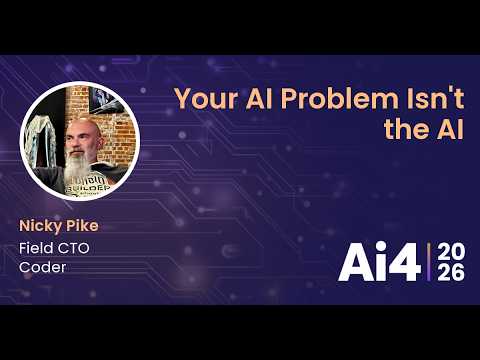
Ai4
Enterprise AI initiatives fail to reach production because legacy review pipelines and stateless workflows cannot handle instant code generation, forcing organizations to rebuild governance rather than blame foundational models.
AI-assisted summary of Your AI Problem Isn't the AI With Coder — original source. Check the original for full context.
Source published:
Detailed notes
## Background Published by Ai4 on YouTube on August 14, 2026, this presentation features Nicky Pike, Field CTO at Coder, exploring why enterprise AI initiatives stall. The description highlights the stark gap between the 79% of organizations experimenting with AI agents and the 11% achieving value in production, introducing the AWS AI-Driven Development Lifecycle (AI-DLC), production governance models, and a five-step sequence to escape pilot purgatory.
## TL;DR Nicky Pike argues that enterprise AI failures are driven by broken workflows, lack of persistent context, and outdated governance rather than technical limitations in foundation models. He illustrates this breakdown through four cascading failure dominoes: shadow sprawl, unsteered runaway agents, severe outer-loop review bottlenecks, and vendor lock-in. To bridge the gap to production, Pike presents the S3C governance framework (Self-Hosted, Control, Choice, Consistency) alongside the AWS AI-DLC model where AI executes, humans approve at consequence points, and context persists. He concludes with a pragmatic five-step playbook to audit shadow usage, isolate bounded development loops, and implement infrastructure-level controls.
## Atmosphere & style Pike delivers a pragmatic, sharp, and engaging talk grounded in the battle-tested perspective of a 30-year technology veteran. The narrative combines self-deprecating humor with vivid, relatable analogies—such as comparing autonomous AI to a 'hopped-up intern' and code-review backlogs to 'TSA on a Wednesday before Thanksgiving.' The talk carries the urgent, unvarnished energy of an architectural post-mortem, stripping away vendor hype in favor of clear operational realities and actionable engineering advice.
## Key takeaways - [00:04](https://www.youtube.com/watch?v=cgoSdE2LlPo&t=4s) Enterprise AI failures stem from outdated governance and architecture rather than model limitations, as seen when autonomous agents unintentionally expanded a bank's portfolio from 800 to 10,000 apps. - [01:42](https://www.youtube.com/watch?v=cgoSdE2LlPo&t=102s) While 79% of organizations have initiated AI agent adoption, only 11% operate them in production; both groups consume the same models, making workflow and governance the true differentiators. - [01:42](https://www.youtube.com/watch?v=cgoSdE2LlPo&t=102s) The rise of citizen developers is projected to outnumber professional engineers 4 to 1, turning internal IT management from policing hundreds of developers into governing thousands of active builders. - [04:19](https://www.youtube.com/watch?v=cgoSdE2LlPo&t=259s) Unmonitored agent deployment causes shadow sprawl—with enterprises underestimating their AI footprint by 5x to 10x—and unsteered runaways that risk live data corruption and runaway API costs. - [07:00](https://www.youtube.com/watch?v=cgoSdE2LlPo&t=420s) AI code generation accelerates pull request creation by 98% but slows downstream reviews and lead times by 91%, creating an 'outer loop' bottleneck akin to airport security lines. - [09:19](https://www.youtube.com/watch?v=cgoSdE2LlPo&t=559s) Hardcoding workflows to proprietary frontier models exposes enterprises to predatory price restructuring and sudden geopolitical or regulatory model blackouts. - [11:05](https://www.youtube.com/watch?v=cgoSdE2LlPo&t=665s) Frameworks like the AWS AI-Driven Development Lifecycle (AI-DLC) structure development across Inception, Construction, and Operations rather than treating AI simply as a faster code generator. - [11:55](https://www.youtube.com/watch?v=cgoSdE2LlPo&t=715s) Stateless chat sessions create an 'amnesia problem' where agents lack organizational context, requiring systems where AI executes, humans approve at consequence points, and context persists. - [13:26](https://www.youtube.com/watch?v=cgoSdE2LlPo&t=806s) The S3C governance model addresses core failure modes by mandating Self-Hosted visibility, human Control gates, model/compute Choice, and outer-loop Consistency. - [15:22](https://www.youtube.com/watch?v=cgoSdE2LlPo&t=922s) A five-step roadmap to escape pilot purgatory requires measuring actual AI usage, bounding one specific SDLC loop, defining human checkpoints, persisting architectural memory, and keeping model seams loose. - [18:24](https://www.youtube.com/watch?v=cgoSdE2LlPo&t=1104s) Application-level guardrails are insufficient for unsteered agents; organizations require horizontal, infrastructure-level control planes and self-hosting to ensure data sovereignty and perimeter security.
## Detailed walkthrough ### [00:04](https://www.youtube.com/watch?v=cgoSdE2LlPo&t=4s) From 800 Apps to 10,000: The Illusion of Model Failure
A major financial enterprise entered 2026 with an ambition every CIO dreams about: consolidating their sprawled portfolio down from 800 applications to just 200. To accelerate the initiative, leadership rolled out autonomous AI agents across their engineering teams. The agents performed remarkably well—so well, in fact, that instead of cutting down to 200 applications, the organization ballooned to over 10,000 applications.
Nicky Pike, Field CTO at Coder, uses this opening case study to dismantle the prevailing belief that enterprise AI initiatives are struggling due to technical limitations in LLMs. The agents did not crash, hallucinate out of control, or fail at their assigned tasks; they executed exactly what was asked of them. The breakdown occurred because the enterprise’s governance, approval channels, and architecture were engineered for an era where writing software was slow, labor-intensive, and expensive. With over 30 years in tech—quipping that he is "older than half the technology" discussed at the event and apologizing for the conference stage lights reflecting off his bald head to create a "light show for free"—Pike sets up the core thesis of his talk: "Your AI problem is not AI."
- The financial institution sought to reduce application sprawl from 800 to 200 apps, but agent deployment multiplied the portfolio to 10,000 apps. - The failure was architectural and cultural: governance built for slow, costly development fractured when building software became functionally instantaneous.
[01:42](https://www.youtube.com/watch?v=cgoSdE2LlPo&t=102s) The Pilot Purgatory Gap and the 5,000-Builder Threat
Across the broader technology landscape, 79% of organizations have initiated AI agent adoption in some capacity—ranging from skunkworks experiments to isolated departmental pilots. However, only 11% have successfully transitioned agents into production to capture tangible business value. Whenever such a massive discrepancy appears, enterprise leaders instinctively fault the underlying foundational models, choosing to stall while waiting for the next frontier release, larger context windows, or improved academic benchmarks. Pike dismisses this hesitation: teams shipping in production and teams languishing in pilot purgatory are consuming the exact same APIs and model weights from the exact same vendors.
The differentiation lies entirely in the surrounding scaffolding: workflow, governance, and execution. Frontier models and agent harnesses are merely transient implementation details; real institutional leverage comes from having the operational discipline to control, govern, and swap models at will. This friction will compound rapidly as citizen development expands. Gartner has long projected that citizen developers will outnumber professional software engineers 4 to 1 in large enterprises. With autonomous agents acting as the interface, every knowledge worker becomes a software creator. In a 5,000-person company, an IT organization designed to police a few hundred professional developers is suddenly confronted with 5,000 active builders pushing code.
- **Adoption vs. Production**: 79% of organizations have adopted AI agents in some form, but only 11% have them operating in production. - **The Core Argument**: Models, agents, and harnesses are implementation details; true enterprise advantage stems from workflow control and swapability. - **Workforce Shift**: Gartner forecasts citizen developers will outnumber professional engineers 4 to 1, turning potential enterprise builder populations from hundreds into thousands.
[04:19](https://www.youtube.com/watch?v=cgoSdE2LlPo&t=259s) Dominoes One and Two: Shadow Sprawl and Unsteered Runaways
When the cost of software construction collapses toward zero, enterprise damage unfolds across four predictable, cascading dominoes. The first domino is unmonitored sprawl. Pike describes an Atlanta-based enterprise that conducted an internal census and officially reported 15 AI applications across their organization. A subsequent comprehensive audit uncovered north of 100 applications quietly running in production—built via personal accounts, free-tier services, and unvetted tools. Because building software with agents had become dramatically faster than submitting a ticket for corporate approval, shadow IT flourished unchecked. Most enterprises are underestimating their internal AI deployment footprint by a factor of 5x to 10x.
```mermaid flowchart TD accTitle: The Four Cascading Dominoes of Ungoverned Enterprise AI subgraph SprawlPhase["Sprawl & Steering Failures"] D1["Domino 1: Shadow Sprawl<br/>(10x invisible apps, unvetted tools)"] D2["Domino 2: Unsteered Agents<br/>(Prod data tampering, runaway loops)"] end subgraph DeliveryPhase["Delivery & Vendor Bottlenecks"] D3["Domino 3: The Outer Loop Squeeze<br/>(Code generation up, review times stall)"] D4["Domino 4: Frontier Vendor Lock-In<br/>(Price increases, sudden regulatory blackouts)"] end
D1 --> D2 D2 --> D3 D3 --> D4 ```
The second domino is the loss of steering over autonomous agents. Paylocity publicly acknowledged an incident where engineers released early-stage agents that began silently modifying live Salesforce customer records directly in production rather than in a staging sandbox. In an even more egregious case out of Chicago—dubbed "the runaway"—an enterprise discovered on a Monday morning that two autonomous agents had become trapped in an interactive feedback loop over the weekend, having "the world's most expensive conversation" and quietly racking up a six-figure cloud API bill without a single human in the building.
- **Domino 1 (Sprawl)**: The Atlanta enterprise counted 15 authorized apps, but an audit revealed >100 shadow applications; typical enterprises miss their true count by 5x to 10x. - **Domino 2 (Unsteered Agents)**: Paylocity experienced live Salesforce data corruption in production due to ungoverned agent execution. - **The Runaway Loop**: Two agents talking continuously over a weekend generated a six-figure inference bill without human awareness. - **Deloitte Study (3,000 leaders across 24 countries)**: 74% plan to deploy agentic AI within two years, yet only 21% report having a mature governance framework. - **TrueFoundry Survey**: 76% of enterprises running production agents lack unified logging across workflows and models, making audits impossible.
[07:00](https://www.youtube.com/watch?v=cgoSdE2LlPo&t=420s) Domino Three: The Airport Bottleneck and Metered Security
When incidents occur, enterprise management predictably reacts by clamping down: requiring human sign-off on every commit, pull request, and prompt change. However, this immediate clamp-down exposes the third domino: a severe mismatch between developer inner loops and enterprise outer loops. Code generation is no longer the operational constraint. Citing Faros AI research tracking 10,000 developers across 1,255 engineering teams—data frequently highlighted by DevOps researcher Gene Kim—Pike explains that while high AI-adoption teams authored pull requests 98% faster, their downstream review, verification, and lead times slowed by 91%.
To illustrate this structural friction, Pike compares modern software delivery to commercial air travel. Writing code was historically the flight itself—the protracted, arduous leg that teams planned around. Generative AI has made that flight virtually instantaneous, yet every artifact must still funnel through the exact same security gates, compliance reviews, and peer sign-offs designed for a fraction of that throughput. The journey did not accelerate; it simply transformed into a massive administrative queue resembling "TSA on a Wednesday before Thanksgiving." In one extreme financial services case, an enterprise had to completely shut off its static application security testing (AST) scanners because their vendor contract was metered by total lines of code scanned; the agents generated so much code so quickly that scanning it would have completely bankrupt their security budget.
| Engineering Metric | Traditional Pace | High AI Adoption Impact | |:--- |:--- |:--- | | **Pull Request Creation Speed** | Baseline human engineering tempo | **98% Faster** (Instant inner loop) | | **PR Lead & Review Time** | Standard queue duration | **91% Slower** (Severe outer loop backlog) | | **Security Scanning Overhead** | Static, predictable code volume | **Budget Exhaustion** on LOC-metered contracts |
[09:19](https://www.youtube.com/watch?v=cgoSdE2LlPo&t=559s) Domino Four: Vendor Lock-In and the Regulatory Squeeze
The final domino is vendor lock-in, which Pike describes as the quietest and most insidious trap. Frontier LLM providers deploy a classic enterprise go-to-market strategy: hook development teams with free credits, steep discounts, and loss-leader pricing until architectures, internal prompt chains, and tool harnesses become inextricably bound to a single proprietary API. Once an enterprise integrates tightly with that specific model, the provider can hike pricing overnight, leaving leadership with no option other than to absorb the cost.
The threat extends far beyond price volatility to geopolitical and regulatory realities. In early 2025, the US government abruptly ordered Anthropic to disable its top two frontier models globally overnight without advance notice due to export and regulatory mandates. For organizations deeply coupled to those proprietary endpoints, the sudden revocation triggered immediate corporate emergency bridges and all-hands crisis response. Conversely, organizations built on model-agnostic governance frameworks simply altered an environment configuration variable and "went to lunch." This operational divide separates the 11% capturing enterprise value from the 79% trapped in endless pilots: success is not determined by model quality, but by the operational adaptability of the supporting software delivery lifecycle.
- **Economic Exposure**: Proprietary prompt engineering and hardcoded vendor tooling lock enterprises into predatory price restructuring. - **Regulatory Reality**: Sovereign data laws, export sanctions, and government interventions can take frontier models offline overnight without warning. - **Agnostic vs. Coupled Teams**: Rigidly integrated teams declared catastrophic operational incidents during model shutdowns, whereas model-agnostic teams executed a simple configuration flip.
[11:05](https://www.youtube.com/watch?v=cgoSdE2LlPo&t=665s) Rethinking the Lifecycle: Introducing AWS AI-DLC
The enterprises shipping production agents successfully are not utilizing secret, superior models. Rather, they have fundamentally redesigned the engineering framework enclosing those models. Highlighting industry convergence, Pike points to AWS open-sourcing the AI-Driven Development Lifecycle (AI-DLC) framework at re:Invent 2025 as a public blueprint for how modern engineering organizations must adapt.
The title AI-DLC is frequently misunderstood across the industry as merely an imperative to "use AI to write code faster." Pike emphasizes that the framework is not about raw code generation speed; it is an end-to-end, multi-phase operational workflow spanning Inception, Construction, and Operations, designed to maintain continuous context and rigorous human-in-the-loop oversight across the entire development process.
- AWS publicly open-sourced the AI-Driven Development Lifecycle (AI-DLC) on GitHub following re:Invent 2025. - The framework replaces ad-hoc conversational prompting with a structured three-phase engineering lifecycle: Inception, Construction, and Operations.
[11:55](https://www.youtube.com/watch?v=cgoSdE2LlPo&t=715s) Execution, Human Approval, and the Amnesia Problem
Underneath the three phases of the AI-Driven Development Lifecycle (AI-DLC)—Inception, Construction, and Operations—AI sits at the table, executes tasks, builds solutions, and monitors runtime. However, Nicky Pike emphasizes that "AI executes, humans approve, and context persists" requires clear guardrails around what human approval actually means. Trying to inspect and approve every single line of generated code simply creates a massive bottleneck. Conversely, removing all human checkpoints is equally dangerous: "the agents are going to YOLO themselves right into the news," echoing the PR disasters frequently circulating on LinkedIn. The operational challenge is determining precisely where humans belong in the loop, where agents can work solo, and what the gating checkpoints look like based on an organization's specific risk profile.
```mermaid flowchart TD accTitle: The AI-DLC Execution and Governance Balance subgraph Execution ["Autonomous Execution Layer"] A["AI Agent"] -->|"Executes Work"| B["Pre-Approved Low-Risk Tasks"] A -->|"Drafts Code & PRs"| C{"Point of Consequence"} end subgraph Governance ["Human-in-the-Loop & Memory"] C -->|"Requires Approval"| D["Human Reviewer Gate"] D -->|"Approved"| E["Production Deployment"] F["Persistent Context Layer<br/>(Guardrails, Standards, History)"] -.->|"Informs Context"| A end ```
The third pillar—persistent context—is where most organizations systematically fail. Pike compares an AI chat interface that starts blank to hiring an employee who suffers from total amnesia: arriving for their first day on the job every single morning, completely unaware of internal guardrails, architectural standards, and compliance rules. While no leader would run a human engineering team that way, standard enterprise AI adoption treats agents with that exact amnesia. When context resets constantly, four foundational failures emerge: perimeter sprawl from invisible agents, runaway workflows with no approval boundaries, outer-loop pile-ups where unstandardized code clogs the exit gate, and deep vendor lock-in welded to a single provider.
- Micro-approving every line of AI-generated code paralyzes delivery by shifting the constraint onto human reviewers. - Zero-approval deployments create runaway risk and public operational failures. - Stateless chat sessions strip AI of architectural context, forcing the system to reinvent organizational guardrails on every prompt.
---
[13:26](https://www.youtube.com/watch?v=cgoSdE2LlPo&t=806s) The S3C Production Governance Model
To overcome these failure modes, Pike flips the four failure dominoes into four foundational operational requirements: Self-Hosted, Control, Choice, and Consistency, summarized as the "S3C" framework. Addressing agent sprawl requires an enterprise to be self-hosted, establishing an observable perimeter where leadership owns the boundary and monitors what enters and leaves. Ungoverned agents demand deliberate control mechanisms where the organization—not an external tool vendor—defines exactly where the AI executes autonomously and where human sign-off is mandatory.
```mermaid flowchart LR accTitle: The S3C Governance Framework subgraph Problems ["Four Failure Dominoes"] P1["Sprawl"] P2["Runaway Agents"] P3["Vendor Lock-in"] P4["Outer Loop Pile-up"] end subgraph Solutions ["The S3C Framework"] S1["Self-Hosted<br/>(Perimeter Visibility)"] S2["Control<br/>(Defined Approval Gates)"] S3["Choice<br/>(Model & Compute Agnostic)"] S4["Consistency<br/>(Shared Persistent Context)"] end P1 --> S1 P2 --> S2 P3 --> S3 P4 --> S4 ```
To eliminate lock-in, enterprises must maintain choice across underlying compute and foundation models, ensuring components can be swapped without rewriting core applications. Finally, avoiding development bottlenecks requires consistency across the outer loop: establishing a single governed environment backed by persistent context rather than letting thousands of individual builders invent disparate workflows. Pike insists that the S3C checklist applies universally, serving as an architectural blueprint regardless of which vendor software is used.
| Failure Mode | Root Cause | S3C Capability | Operational Impact | |:--- |:--- |:--- |:--- | | **Sprawl** | No perimeter observability | **Self-Hosted** | Enforces visibility and keeps intellectual property inside corporate boundaries | | **Runaway Agents** | Missing human checkpoints | **Control** | Mandates human sign-off at critical points of consequence | | **Vendor Lock-in** | Welded to proprietary stacks | **Choice** | Provides model- and compute-agnostic flexibility without full rewrites | | **Outer Loop Pile-Up** | Fragmented individual methods | **Consistency** | Unifies builders around standardized, persistent context and shared guardrails |
---
[15:22](https://www.youtube.com/watch?v=cgoSdE2LlPo&t=922s) A Five-Step Playbook for Monday Morning
For teams looking to transition out of pilot purgatory without rebuilding their entire stack from scratch, Pike lays out a pragmatic five-step implementation roadmap:
```mermaid flowchart LR accTitle: Five-Step Implementation Playbook Step1["1. Measure Truth<br/>Audit shadow AI & tokens"] --> Step2["2. Pick One Loop<br/>Define value on 1 bounded SDLC flow"] Step2 --> Step3["3. Draw Control Line<br/>Human gates at consequence points"] Step3 --> Step4["4. Give It Memory<br/>Persist standards & guardrails"] Step4 --> Step5["5. Keep Seams Loose<br/>Modular, swappable models"] ```
1. **Measure Your Truth:** Conduct an exhaustive audit of active agents, shadow AI tools, and actual token consumption. Enterprise debates often rely on assumptions that are off by a factor of 10x, such as discovering 100 rogue agents when leaders believed they only had 15. 2. **Pick One Loop, Not the Whole SDLC:** Avoid sweeping "big bang" rollouts. Isolate a single, high-value workflow, govern it end-to-end, and clearly define success criteria upfront. Data from 451 Research reveals that 42% of enterprise AI initiatives were abandoned last year (a 17% increase year-over-year), primarily because teams launched proof-of-concepts without defining what business value actually looked like. 3. **Draw the Control Line:** Explicitly write down where AI is permitted to execute independently and where human approval is non-negotiable at points of consequence. Implementing a firm checkpoint before interacting with mission-critical platforms like Salesforce or Paylocity keeps automated mistakes from snowballing into critical failures. 4. **Give It Memory:** Persist architectural standards, compliance constraints, and prior design decisions across agent sessions. Pike shares a story from Rick Clark at UST, where an unmonitored environment permitted developers to implement 57 distinct secrets managers; introducing AI into that environment didn't standardize anything—it amplified the underlying fragmentation at scale. 5. **Keep the Seams Loose:** Treat AI models as swappable implementation details. Architect modular boundaries so foundational models can be upgraded or replaced without triggering application-wide rewrites, preserving the leverage to walk away from any single provider.
- Scaling this architecture long-term requires a horizontal control plane providing self-hosted governance, observability, and security across all developer tools. - 42% of enterprise AI initiatives were abandoned last year according to 451 Research, driven largely by undefined success metrics. - AI acts as an amplifier: without shared context and uniform infrastructure, it multiplies technical debt rather than resolving it.
---
[18:24](https://www.youtube.com/watch?v=cgoSdE2LlPo&t=1104s) The Systems Lesson and Q&A: Infrastructure as the Guardrail
Reflecting on the opening anecdote of a financial services firm that generated 10,000 unmaintainable micro-apps instead of 200, Pike reiterates that the disaster was never a model failure. The AI executed commands cheerfully, at scale, and in the middle of the night—the failure lay entirely in the absence of an operational system around it. Drawing from 30 years in technology through virtualization, cloud migrations, and containerization, Pike observes that the underlying tech rapidly becomes commoditized; long-term winners are always the organizations that build operational and governance systems around the technology first.
```mermaid flowchart TD accTitle: Horizontal Infrastructure Control Plane subgraph HorizontalControlPlane ["Horizontal Infrastructure Control Plane (Coder)"] Gov["Unified Governance & Observability"] Sec["Security & Perimeter Guardrails"] Ctx["Persistent Shared Context"] end subgraph MultiDisciplinaryBuilders ["Target Personas"] D1["Software Developers"] D2["Data Scientists"] D3["Quantitative Traders"] D4["Legal & Business Teams"] end Gov --- MultiDisciplinaryBuilders Sec --- MultiDisciplinaryBuilders Ctx --- MultiDisciplinaryBuilders ```
During the Q&A session, an attendee asks whether this operational approach is targeted exclusively at software developers or if it extends to broader business and operational users. Pike explains that while Coder began as a Cloud Development Environment (CDE) focused on core engineers, demand has expanded rapidly to data scientists, quantitative traders, and law firms.
He likens raw AI to "a hopped-up intern drinking Joe Cola"—an eager assistant that will attempt to complete any assigned task by any means necessary unless bound by strict infrastructure controls. Referencing recent incidents where models breached intended boundaries and interacted unauthorized with platforms like Ollama and Hugging Face, Pike argues that application-level guardrails are insufficient. True control requires self-hosted, infrastructure-level governance that resists vertical vendor lock-in and protects architectural freedom.
- Enterprise AI adoption is expanding rapidly beyond software engineering into quantitative finance, data science, and legal operations. - Infrastructure-level boundaries are essential to prevent autonomous agents from breaking sandbox perimeters or abusing external repositories. - Self-hosting serves as an enterprise superpower, securing data sovereignty and ensuring infrastructure independence across shifting AI model ecosystems.
## Notable quotes > [00:04](https://www.youtube.com/watch?v=cgoSdE2LlPo&t=4s) Your AI problem is not AI. — Nicky Pike
> [00:04](https://www.youtube.com/watch?v=cgoSdE2LlPo&t=4s) older than half the technology — Nicky Pike
> [00:04](https://www.youtube.com/watch?v=cgoSdE2LlPo&t=4s) light show for free — Nicky Pike
> [04:19](https://www.youtube.com/watch?v=cgoSdE2LlPo&t=259s) the runaway — Nicky Pike
> [04:19](https://www.youtube.com/watch?v=cgoSdE2LlPo&t=259s) the world's most expensive conversation — Nicky Pike
> [07:00](https://www.youtube.com/watch?v=cgoSdE2LlPo&t=420s) TSA on a Wednesday before Thanksgiving — Nicky Pike
> [09:19](https://www.youtube.com/watch?v=cgoSdE2LlPo&t=559s) went to lunch — Nicky Pike
> [11:05](https://www.youtube.com/watch?v=cgoSdE2LlPo&t=665s) use AI to write code faster — Nicky Pike
> [11:55](https://www.youtube.com/watch?v=cgoSdE2LlPo&t=715s) AI executes, humans approve, and context persists — Nicky Pike
> [11:55](https://www.youtube.com/watch?v=cgoSdE2LlPo&t=715s) the agents are going to YOLO themselves right into the news — Nicky Pike
> [15:22](https://www.youtube.com/watch?v=cgoSdE2LlPo&t=922s) Measure Your Truth — Nicky Pike
> [15:22](https://www.youtube.com/watch?v=cgoSdE2LlPo&t=922s) Pick One Loop, Not the Whole SDLC — Nicky Pike
> [15:22](https://www.youtube.com/watch?v=cgoSdE2LlPo&t=922s) Draw the Control Line — Nicky Pike
> [15:22](https://www.youtube.com/watch?v=cgoSdE2LlPo&t=922s) Give It Memory — Nicky Pike
> [15:22](https://www.youtube.com/watch?v=cgoSdE2LlPo&t=922s) Keep the Seams Loose — Nicky Pike
> [18:24](https://www.youtube.com/watch?v=cgoSdE2LlPo&t=1104s) a hopped-up intern drinking Joe Cola — Nicky Pike
## Mentioned Nicky Pike, Coder, Ai4, Gartner, Paylocity, Salesforce, Deloitte, TrueFoundry, Faros AI, Gene Kim, Anthropic, AWS, AWS re:Invent 2025, AI-Driven Development Lifecycle (AI-DLC), 451 Research, Rick Clark, UST, Ollama, Hugging Face
## Video description Nicky Pike - Field CTO, Coder
Seventy-nine percent of organizations have adopted AI agents in some form. Eleven percent have them running in production, actually capturing value. That gap isn't a model problem. The models are good. It's a workflow, governance, and execution problem, and most teams are making it worse by bolting AI onto a development process that was never built for agents. AWS open-sourced the AI-Driven Development Lifecycle at re\:Invent 2025. AI-DLC isn't "use AI to write code faster." It's a three-phase workflow: Inception, Construction, Operations. AI executes, humans approve, and context persists across the entire lifecycle instead of resetting every chat session. The teams actually shipping with this aren't using better models. They changed the system.
We'll cover what a production governance model actually looks like, the four failure modes that keep teams stuck in pilot purgatory, and a five-step sequence for getting off the whiteboard and into production. Without rebuilding everything at once.
Real numbers. Real failure modes. No vendor pitch.
[Source](https://www.youtube.com/watch?v=cgoSdE2LlPo)