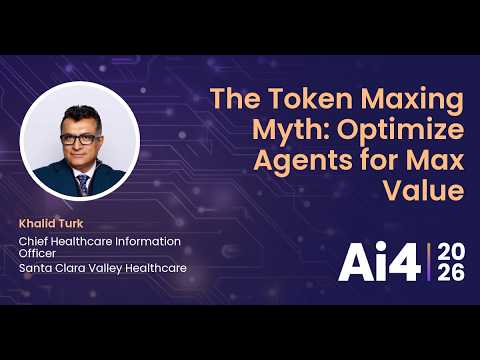
Santa Clara Valley Health Curbs AI Agents as Runaway Token Costs Mount
Ai4
Rewarding raw token consumption inflates enterprise bills without driving business value, forcing leaders to meter AI agent budgets strictly against measurable clinical outcomes.
## Background
Published on YouTube by Ai4 on August 16, 2026, this session features Khalid Turk, Chief Healthcare Information Officer at Santa Clara Valley Healthcare, delivering a presentation titled 'The Token Maxing Myth: Optimize Agents for Max Value.' The talk focuses on dismantling the vanity metrics of token consumption to build cost-effective, high-impact AI agent deployments in enterprise healthcare.
## TL;DR
Khalid Turk challenges the tech industry's obsession with 'token maxing,' illustrating how plummeting per-token pricing has paradoxically led to skyrocketing enterprise AI bills and massive project attrition. Drawing on real-world deployments within a $4.5 billion public health system, he exposes the 'iceberg paradox' of hidden expenses, such as system integration, monitoring, and clinician review time for ambient documentation. To combat budget blowouts like those experienced at Meta and Uber, Turk proposes a three-tier optimization framework spanning intelligent model routing, AI FinOps, and active risk governance. He concludes by urging leadership to audit their active agent footprint and transition to an outcome-based, risk-tiered budgeting strategy.
## Atmosphere & style
The presentation opens with disarming, self-aware banter about post-lunch conference fatigue before settling into a pragmatic, no-nonsense executive briefing. Turk contrasts Silicon Valley engineering vanity with the sober realities of public healthcare management, emphasizing the tangible stakes where wasted IT dollars directly compromise patient care. His delivery is steady, authoritative, and analytical, seamlessly pivoting from cautionary corporate anecdotes to structured formulas and actionable board-level advice.
## Key takeaways
- [00:04](https://www.youtube.com/watch?v=UTkPsQ7FrE0&t=4s) Despite raw token and compute costs dropping by 99% over three years, enterprise AI expenditures continue to rapidly escalate.
- [00:04](https://www.youtube.com/watch?v=UTkPsQ7FrE0&t=4s) In public health systems like Santa Clara Valley Healthcare, technology waste directly compromises clinical operations by siphoning funds away from patient care.
- [03:08](https://www.youtube.com/watch?v=UTkPsQ7FrE0&t=188s) Gartner projects 40% of enterprise generative AI projects will be canceled and over 80% of pilots never reach production due to a failure to deliver justified business value.
- [03:08](https://www.youtube.com/watch?v=UTkPsQ7FrE0&t=188s) Enterprise spending visibility is severely lacking, with only 26% of organizations maintaining clear tracking over their actual AI expenditures.
- [05:10](https://www.youtube.com/watch?v=UTkPsQ7FrE0&t=310s) The industry's 'token maxing' mindset and vanity metrics—such as Meta's internal 'token legends' leaderboards—distorted engineering incentives by rewarding compute volume over realized impact.
- [07:01](https://www.youtube.com/watch?v=UTkPsQ7FrE0&t=421s) Complex background agent workflows (planning, multiple tool calls, and automated retry loops) rapidly compound operational costs and led firms like Uber to exhaust annual AI budgets within months.
- [11:05](https://www.youtube.com/watch?v=UTkPsQ7FrE0&t=665s) Under the 'iceberg paradox' of enterprise AI, visible token invoices represent a fraction of total costs compared to submerged expenses like systems integration, observability, and human error correction.
- [16:55](https://www.youtube.com/watch?v=UTkPsQ7FrE0&t=1015s) To control runaway expenses, organizations should implement intelligent routing (directing mundane queries to smaller/open-weight models) and establish dedicated AI FinOps disciplines.
- [16:55](https://www.youtube.com/watch?v=UTkPsQ7FrE0&t=1015s) An estimated 75% of CIOs cannot accurately inventory all active AI agents currently running across their enterprise footprint.
- [21:28](https://www.youtube.com/watch?v=UTkPsQ7FrE0&t=1288s) Enterprises must transition to an outcome-based budgeting model, assigning compute budgets and model complexity based on workflow risk and verified business value.
Khalid Turk, Chief Healthcare Information Officer for Santa Clara Valley Healthcare—one of the largest public healthcare systems in the United States, managing multiple hospitals on an annual budget of roughly $4.5 billion—opens his address on scaling AI deployments. Opening with light banter about post-lunch drowsiness and comparing the small conference audience to a "pilot phase," he stresses that his perspective is rooted in real-world, lived experience running early AI implementations across large health systems rather than theoretical knowledge.
Turk tackles the industry buzzword "token maxing," pointing out the fundamental economic paradox currently facing organizations. While the baseline cost of raw intelligence has fallen dramatically—tokens now cost roughly 1% of what they did three years prior—enterprise AI bills continue to skyrocket. In healthcare, where financial waste directly impacts clinical operations, this disconnect is critical: "every dollar that we waste, whether with AI or any other technology, that is a dollar taken away from patient care." Consequently, IT leadership must guarantee that technology spending produces tangible, maximum value for clinicians and patients.
- Santa Clara Valley Healthcare operates on an approximate $4.5 billion budget as a major public healthcare provider.
- Raw token and AI compute pricing has decreased by 99% (costing 1% of prices from 3 years ago), yet enterprise AI expenditures continue to escalate.
---
[03:08](https://www.youtube.com/watch?v=UTkPsQ7FrE0&t=188s) The High Failure Rate of Generative AI and the Blind Spot in AI Spending
Enterprise generative AI initiatives are suffering severe attrition rates. Gartner projects that 40% of all enterprise generative AI projects will be canceled outright—not merely paused, modified, or realigned, but permanently terminated. This high failure rate compounds findings from an earlier study indicating that over 80% of AI pilot projects never reach production. These cancellations occur not because the underlying technology is broken, but because executive leadership realizes the resulting business value fails to justify the operational costs.
At the same time, organizations operate with massive visibility gaps regarding their AI expenditures. Research reveals that only 26% of companies maintain clear visibility into their actual AI costs. In an aggregate enterprise setting, roughly three out of four organizations cannot accurately identify or quantify how much money they are spending on AI technologies.
- 40% of generative AI enterprise projects are projected by Gartner to be canceled due to insufficient realized value.
- More than 80% of AI pilots fail to reach production deployments.
- Only 26% of companies have full visibility into their AI expenditures, leaving 74% without tracking mechanisms.
---
[05:10](https://www.youtube.com/watch?v=UTkPsQ7FrE0&t=310s) The Flawed Incentive of Token Maxing: From Nvidia to Meta's "Token Legends"
The industry's hyper-focus on token consumption originated largely from statements made by prominent tech leaders like Jensen Huang of Nvidia. The prevailing sentiment suggested that high-earning Silicon Valley engineers (making $500,000) should prove their worth and productivity by consuming up to half their salary ($250,000) in agent and token usage. This framing rapidly distorted engineering incentives across the tech sector.
```
FLAWED INCENTIVE LOOP: TOKEN MAXING VS. VALUE
+---------------------------------------------+
| Leadership Mandate: Burn tokens to prove |
| engineering value |
+---------------------------------------------+
|
v
+---------------------------------------------+
| Engineers write unchecked, multi-call agents|
| Internal leaderboards reward top consumers |
| ("Token Legends") |
+---------------------------------------------+
|
v
+---------------------------------------------+
| Budget Overruns & Zero Realized ROI |
| (e.g., Meta 73T tokens/mo, Uber runs dry) |
+---------------------------------------------+
```
Engineers began deploying complex, loop-heavy agents without verifying whether their output added value to the enterprise. Inside Meta, internal leaderboards celebrated employees who burned the largest volumes of compute, conferring the title of "token legends" to high consumers across an 80,000-person organization. This misaligned KPI prioritized vanity consumption over business outcomes.
- Jensen Huang popularized the concept that high-cost engineers should run AI agents consuming significant token budgets relative to their salaries.
- Meta established internal leaderboards honoring "token legends" purely based on raw token volume consumed across 80,000+ staff.
---
[07:01](https://www.youtube.com/watch?v=UTkPsQ7FrE0&t=421s) Anatomy of Agentic Consumption and Industry Budget Shocks
A single, seemingly straightforward user interaction triggers an extensive chain of hidden background operations. When a user interacts with a customer-facing interface via text, voice, or visual modalities, the underlying agent executes planning, context retrieval, multiple API and tool calls (such as validating account balances or looking up history), context formatting, and automated retry loops upon failure. Because every failed execution and retry burns billable tokens, background agent workflows compound operational costs quickly.
```
ANATOMY OF A SINGLE AGENTIC INTERACTION
[ User Interaction ] (Text / Voice / Visual Interface)
|
v
+---------------------------------------------------------+
| Agent Planning & Context Retrieval |
+---------------------------------------------------------+
|
v
+---------------------------------------------------------+
| Multi-Tool Execution (Database checks, APIs, history) |
+---------------------------------------------------------+
|
v
+---------------------------------------------------------+
| Verification & Retry Loops (Failures incur extra costs) |
+---------------------------------------------------------+
|
v
[ Final Committed Action / Clinical Record Update ]
```
This unchecked compounding led to severe budget collapses across top-tier tech firms:
- Meta consumed 73 trillion tokens within a single 30-day window.
- Uber exhausted its entire planned annual AI budget in just 4 months.
- Near-frontier models cost approximately $1.25 to $1.50 per million tokens, making runaway agent loops financially damaging at enterprise scale.
- Tesla established protective consumption guardrails, imposing an engineer quota capped around $200 per week.
Faced with massive budget overruns, organizations pivoted rapidly. Meta retracted its consumption-based metrics, acknowledging that "token usage alone is not the measure of impact of any kind," initiating an industry-wide realignment toward value-driven engineering.
---
[11:05](https://www.youtube.com/watch?v=UTkPsQ7FrE0&t=665s) The Iceberg Paradox: Real Costs of Enterprise AI and Ambient Tech
The AI landscape is transitioning from an early adoption phase—where organizations simply asked how to incorporate tools like ChatGPT—to an outcome-driven evaluation cycle asking: "what does each outcome cost and what is it worth?" Turk highlights this shift using ambient clinical documentation. In clinical practice, ambient listening tools record patient-physician dialogue, transcribe the conversation, and generate structured clinical notes directly into electronic health records (EHRs), allowing physicians to look at their patients rather than computer screens.
Santa Clara Valley Healthcare piloted an ambient documentation system across 250 clinicians, incurring an annual licensing cost of approximately $1 million. However, executive leadership and CFOs quickly raised critical questions: if patient throughput and insurance claim revenues remain unchanged, where is the net return on that $1 million outlay?
```
THE ENTERPRISE AI COST ICEBERG
Visible AI Vendor Bill
/ \
~~~~~~~~~~~~~~~[ Token & API Charges ]~~~~~~~~~~~~~~~ (Water Line)
[ (e.g., Epic +$500k) ]
\ /
---------------------------------------------------------
UNDERWATER HIDDEN COSTS:
* System & Database Integration Overhead
* AI Observability & Monitoring Infrastructure
* Human-in-the-Loop Review & Validation Time
* Error Correction Overhead (Physician note remediation)
* AI Governance, Compliance, & Risk Mitigation
```
Turk explains the "iceberg paradox" of AI budgeting: the direct software invoice (such as token markups on EHR platforms like Epic Systems, where a bill might rise from $7 million to $7.5 million) represents only the visible tip above water. The larger, hidden expenses lie submerged:
- Platform, local database, and systems integration.
- AI observability and monitoring infrastructure.
- Human-in-the-loop review overhead, where clinicians spend evening hours reviewing and correcting AI-generated clinical notes (leading some younger physicians to prefer typing notes directly rather than proofreading transcriptions).
- Downside risk exposure and clinical validation workflows.
---
[16:55](https://www.youtube.com/watch?v=UTkPsQ7FrE0&t=1015s) The Three-Tier Optimization Framework and Five Board-Level Moves
To control runaway expenditures while maximizing impact, Turk developed a three-tiered operational framework in collaboration with a practicing physician innovator:
```
THREE-TIER VALUE OPTIMIZATION FRAMEWORK
+---------------------------------------------------------+
| 1. SMART ARCHITECTURAL ROUTING |
| Route complex tasks to frontier models; route |
| routine/mundane queries to lower-cost/open-weight |
| models across cloud and on-premise infrastructure. |
+---------------------------------------------------------+
|
+---------------------------------------------------------+
| 2. AI FinOps DISCIPLINE |
| Adapted from cloud FinOps to establish strict cost |
| visibility, attribution, and consumption tracking. |
+---------------------------------------------------------+
|
+---------------------------------------------------------+
| 3. ACTIVE GOVERNANCE |
| Treat governance as cost avoidance/savings by |
| mitigating breach risks and calculating net value: |
| Realized Value = (Productivity Gains - Risk Costs) / |
| (Tokens + Governance + Integration) |
+---------------------------------------------------------+
```
1. **Architecture and Intelligent Routing**: Avoid defaulting all enterprise queries to top-tier frontier models (e.g., leading Claude models). Implement an intelligent router across hybrid on-premise and cloud infrastructure that directs high-complexity reasoning tasks to frontier models while routing standard, mundane tasks to lower-cost, open-weight models.
2. **AI FinOps**: Borrowing disciplines established during enterprise cloud migrations, AI FinOps provides organizations with direct tracking and granular attribution of AI expenses across departments.
3. **Active Governance**: Reframing governance from administrative overhead into a cost-saving mechanism. Turk models realized enterprise value using a comprehensive formula:
Turk concludes with immediate action items for leadership before their next board meeting: organizations must stop measuring token volume and immediately inventory every active agent across the enterprise. He highlights a recent industry survey where only 25% of Chief Information Officers (CIOs) could accurately list the AI agents currently running in their enterprise environments, leaving 75% of IT leadership blind to their active AI footprint.
[21:28](https://www.youtube.com/watch?v=UTkPsQ7FrE0&t=1288s) Agent Governance: Budgeting to Outcomes and Risk-Tiered Architecture
Addressing the problem where organizations often have no visibility into what AI systems are actually running, Khalid Turk emphasizes the necessity of maintaining a strict inventory of every agent and metering resources per use case. Rather than allocating open-ended compute, teams must adopt a "budget to outcomes" model: measure the tangible value and outcomes generated by an application first, and only then assign a corresponding operational budget for the engineering teams to work within.
Governance is operationalized through a risk-tiered framework. When an agent handles a high-risk workflow, spending more money on robust models, deeper reasoning loops, or more extensive token usage is entirely justified. Conversely, for low-risk tasks, organizations should enforce architectures optimized to spend significantly less. By ranking where different workflows fall along this spectrum—such as evaluating five distinct operational flows—organizations can systematically map each use case to the appropriate architectural tier. Concluding his presentation, Turk expresses his appreciation to the audience for attending the session right after lunch and invites attendees to connect on LinkedIn for any follow-up discussions.
- **Inventory and Metering**: Catalog every deployed agent and monitor token and compute consumption on a per-use-case basis.
- **Outcome-Based Budgeting**: Quantify the business and clinical value produced by an agent before determining the budget allotted to engineers.
- **Risk-Tiered Governance**: Allocate budget and model complexity according to risk—spend more on high-risk, mission-critical tasks and enforce leaner, cost-efficient architectures for low-risk workflows.
## Notable quotes
> [00:04](https://www.youtube.com/watch?v=UTkPsQ7FrE0&t=4s) every dollar that we waste, whether with AI or any other technology, that is a dollar taken away from patient care. — Khalid Turk
> [00:04](https://www.youtube.com/watch?v=UTkPsQ7FrE0&t=4s) token maxing — Khalid Turk
> [00:04](https://www.youtube.com/watch?v=UTkPsQ7FrE0&t=4s) pilot phase — Khalid Turk
> [05:10](https://www.youtube.com/watch?v=UTkPsQ7FrE0&t=310s) token legends — Khalid Turk
> [07:01](https://www.youtube.com/watch?v=UTkPsQ7FrE0&t=421s) token usage alone is not the measure of impact of any kind — Khalid Turk
> [11:05](https://www.youtube.com/watch?v=UTkPsQ7FrE0&t=665s) what does each outcome cost and what is it worth? — Khalid Turk
> [11:05](https://www.youtube.com/watch?v=UTkPsQ7FrE0&t=665s) iceberg paradox — Khalid Turk
> [21:28](https://www.youtube.com/watch?v=UTkPsQ7FrE0&t=1288s) budget to outcomes — Khalid Turk
## Mentioned
Ai4, ChatGPT, Claude, Epic Systems, Gartner, Jensen Huang, Khalid Turk, LinkedIn, Meta, Nvidia, Santa Clara Valley Healthcare, Tesla, Uber
## Video description
Khalid Turk - Chief Healthcare Information Officer, Santa Clara Valley Healthcare
The Token Maxing Myth: Optimize Agents for Max Value
Khalid Turk, Chief Healthcare Information Officer at Santa Clara Valley Healthcare, argues that enterprise AI deployments must abandon raw token consumption metrics in favor of outcome-based budgeting, intelligent architectural routing, and risk-tiered governance to prevent widespread project cancellations and runaway operational costs.
The Falling Compute Cost Paradox (0:04)
Although raw token pricing has fallen by approximately 99% over three years, enterprise AI expenditures continue to escalate rapidly. In public healthcare, where Santa Clara Valley Healthcare manages multiple hospitals on a $4.5 billion budget, Turk emphasizes that wasted technology spending directly detracts from patient care. This disconnect between declining baseline compute costs and ballooning invoices underpins an ongoing enterprise attrition crisis.
Gartner projects that 40% of enterprise generative AI projects will be canceled outright because their realized business value fails to justify ongoing operational expenses, compounding earlier research indicating that over 80% of AI pilots never reach production. Compounding the problem, an estimated 74% of enterprises lack tracking mechanisms to accurately quantify what they spend on AI technologies, with only 26% maintaining clear visibility into their AI costs.
Flawed Consumption Metrics and Agent Cost Compounding (5:10)
Enterprise cost spikes were exacerbated by industry messaging that equated high token consumption with engineering productivity. Internal incentives, such as Meta's recognition of high-volume spenders as "token legends" across an 80,000-person organization, rewarded engineers for running dense, multi-loop agents without verifying whether their output produced tangible business outcomes.
A single user query routinely triggers hidden background chains, including planning, context retrieval, multiple API tool executions, and automated retries. Because every failed execution step and retry loop burns billable compute, agent workflows quickly compounded financial outlays. Meta consumed 73 trillion tokens in 30 days before retracting consumption-based metrics, while Uber depleted its entire annual AI budget within four months. With near-frontier models running between $1.25 and $1.50 per million tokens, runaway loops prompted organizations such as Tesla to implement weekly engineer spending caps around $200.
Submerged Operational Costs in Enterprise Deployments (11:05)
Direct software invoices and API bills represent only the visible tip of an enterprise AI cost iceberg. Santa Clara Valley Healthcare observed this dynamic during a pilot of ambient clinical documentation technology across 250 clinicians, which carried an annual licensing expense of roughly $1 million. When the tool failed to alter patient throughput or claim revenues, executive leadership questioned its net financial return.
The larger portion of AI expenses lies in underwater operational requirements. These include platform and electronic health record integration, observability infrastructure, and clinical risk mitigation. Furthermore, human-in-the-loop review creates significant labor overhead: clinicians spent off-hours proofreading and remediating AI-generated notes, prompting some younger physicians to bypass the tool entirely and type records manually.
Outcome-Driven Routing and Risk-Tiered Governance (16:55)
To recapture financial control, Turk proposes a three-tier framework comprising architectural routing, AI FinOps, and active governance. Instead of defaulting every enterprise query to expensive frontier models, systems should route complex reasoning tasks to top-tier models while directing routine queries to lower-cost, open-weight models across hybrid cloud and on-premise environments. Granular FinOps attribution ensures organizations monitor and meter consumption on a per-use-case basis.
Under this model, governance functions as cost avoidance. Turk formulates realized value by subtracting risk and breach costs from operational savings, divided by the sum of token, governance, and integration expenses. Rather than granting open-ended compute, organizations must identify the tangible business outcome first and budget backwards. Budgets and architectural complexity are then assigned strictly by risk tier, justifying advanced models and deeper reasoning loops only for mission-critical, high-risk tasks.
Turk concludes that organizations must immediately inventory all running agents and enforce outcome-based budgeting rather than measuring token volume; however, establishing this baseline remains an operational hurdle given that 75% of CIOs cannot currently list the active AI agents operating within their enterprise environments.
精炼阅读摘要
圣克拉拉山谷医疗系统(Santa Clara Valley Healthcare)首席医疗信息官 Khalid Turk 指出,尽管基础模型推理成本在三年内骤降 99%,但盲目追求 Token 消耗量的风气正导致企业 AI 支出急剧失控。他主张企业必须摒弃“Token 极大化”(Token Maxing)这一虚荣指标,转而采用以临床与业务成果为导向的智能体分层治理与 AI FinOps 体系。
算力成本悖论与生成式AI高失败率 (0:04)
Turk 指出,企业当前正面临严重的经济学悖论:基础智能与算力单价虽然仅为三年前的 1%,企业整体的 AI 账单却在持续飙升。在年运营预算约 45 亿美元的圣克拉拉山谷医疗系统中,任何技术资金的浪费都会直接剥夺患者护理资源。然而,大多数组织的实际落地效果并不理想。Gartner 预测,高达 40% 的企业生成式 AI 项目将因无法产生足够商业价值而被永久终止,另有研究显示超过 80% 的 AI 试点项目根本无法进入生产环境。
更为严峻的是企业对自身 AI 支出的可见度严重缺失。相关研究表明,目前仅有 26% 的企业对其真实的 AI 成本具备清晰可见性,这意味着大约四分之三的机构在既无追踪机制也无法核算实际支出的情况下盲目推进项目,最终导致预算失控与项目流产。
智能体隐性消耗机制与虚荣考核危机 (5:10)
过度关注 Token 消耗源于硅谷科技领袖的误导性言论。英伟达 CEO 黄仁勋等人曾倡导高薪软件工程师应消耗相当于其薪资一半的算力预算来证明自身生产力。这种逻辑扭曲了研发激励,促使 Meta 等拥有超过 8 万名员工的巨头在内部设立排行榜并评选“Token 传奇”,鼓励工程师编写大量循环调用算力的复杂智能体,将单纯的资源消耗包装为绩效。
实际上,用户端一次简单的交互在后台会触发规划、上下文检索、多 API 与数据库调用以及重试循环等一系列连锁链条,而每一次失败和重试都会产生额外计费。在近前沿模型单价约为每百万 Token 1.25 至 1.50 美元的背景下,失控的智能体导致了严重的财务冲击:Meta 在 30 天内消耗了 73 万亿 Token,Uber 在短短 4 个月内耗尽了全年 AI 预算,而特斯拉则不得不强制设立每周约 200 美元的工程师消耗配额。这迫使科技界重新反思,并承认单纯的 Token 使用量不能代表任何实际影响。
企业AI的冰山悖论与临床实践阻力 (11:05)
企业 AI 的评估重心正从“如何引入技术”转变为“每个成果的成本与价值几何”。Turk 以其系统内 250 名临床医生试点的环境临床记录(Ambient Clinical Documentation)系统为例:该项目年授权成本约 100 万美元,虽然能将医患对话自动转化为电子病历(EHR)记录,但财务高管随之质询,在接诊量和医保报销未见增长的前提下,这笔百万元支出的净投资回报究竟体现在何处。
这一矛盾揭示了企业 AI 预算的“冰山悖论”:直接向供应商支付的软件授权或接口增量账单(例如 Epic Systems 平台账单从 700 万美元上涨至 750 万美元)只是水面之上的冰山一角。潜藏在水面之下的巨额隐性成本包括:本地数据库与系统集成开销、AI 可观测性与监控设施、以及临床医生的复核校对负担——许多医生必须在晚间花费大量时间纠正 AI 生成的病历,部分年轻医生甚至宁愿直接手动录入也不愿承担校对工作,加之潜在的医疗风险防范,使得实际总成本远超初期预算。
三层优化框架与成果导向分级治理 (16:55)
为实现成本与价值的动态平衡,Turk 提出了三层运营框架:第一层是智能架构路由,避免无差别使用最顶级的外部前沿模型,而是构建能在本地与云端基础设施间灵活调度的路由,将高难度推理任务分发给前沿模型,将常规任务交由低成本或开源模型处理;第二层是借鉴云计算经验建立 AI FinOps 规范,对各部门的 AI 资源消耗实施精细化归因与计量;第三层是将主动治理转化为合规避险的成本节约手段,其真实价值可通过公式计算:真实价值 =(运营节约 - 风险与违规损失)/(Token 成本 + 治理委员会开销 + 集成成本)。
针对当前多达 75% 的首席信息官(CIO)无法完整列出组织内部运行的智能体资产这一现状,Turk 建议管理层在召开董事会前彻底摸清内部部署清单,实行“按成果定预算”的策略。团队必须先量化智能体带来的具体临床或商业成效,再倒推 engineering 预算,并按照任务风险高低进行阶梯式配置——对高风险核心流程匹配充分预算和深度推理模型,对低风险环节则强制执行极简化、低成本的架构约束。
Turk 强调,企业级 AI 必须从消耗算力的虚荣指标彻底转向以业务结果为约束的严密治理。然而,在现有电子病历工作流深度绑定和医生工作习惯难以迅速扭转的现实下,如何客观量化减轻职业倦怠等软性收益,并在混合基础设施中持续维持智能路由的系统稳定性,仍是大型机构推进 AI 规模化时需要持续权衡的难题。
Detailed notes — zh
## Background
本内容由 Ai4 频道于 2026 年 8 月 16 日在 YouTube 平台发布。视频记录了圣克拉拉县医疗系统(Santa Clara Valley Healthcare)首席医疗信息技术官 Khalid Turk 的主题演讲,主要探讨如何打破“Token 最大化”迷思,优化 AI Agent 以实现真正的业务价值。
## TL;DR
演讲直击企业级 AI 落地中的财务悖论:尽管底层 Token 单价暴跌了 99%,但企业的总体 AI 账单却在持续暴涨,且全行业有 74% 的企业对自身 AI 支出处于完全盲区。Khalid 剖析了硅谷大厂片面将 Token 消耗当作效率指标的畸形现象,并指出单次简单交互背后复杂的 Agent 规划、检索、工具调用与重试链路正是成本失控的元凶。针对这一痛点,他提出企业应从“盲目采纳”转向“单次产出价值”(Value per Outcome),并推行包含模型分层路由、AI FinOps 财务运营和价值导向治理的“三层落地架构”。最后,他呼吁技术领袖在向董事会汇报前彻底盘点企业内运行的每一个 Agent,基于业务成效与风险等级来科学分配算力预算。
## Atmosphere & style
演讲整体呈现出一种幽默风趣却又极其务实、发人深省的现场氛围。主讲人以轻松诙谐的开场化解午后观众的倦意,随后迅速切入严肃的财务与临床现实,用“在技术上浪费的每一分钱都是从患者护理经费中剥离出来的”等深刻洞察直击要害。整场分享兼具一线掌舵者的切肤之痛与顶层架构师的冷静严谨,在揭露大厂“烧 Token 排行榜”荒诞现象的同时,给出了极具操作性的落地框架,令听众在轻松会心的笑声中感受到强烈的行业警醒与行动紧迫感。
## Key takeaways
- [00:04](https://www.youtube.com/watch?v=UTkPsQ7FrE0&t=4s) Token 单价在过去 3 年内暴跌了 99%,但企业的总体 AI 账单却在持续暴涨;在医疗等高严谨行业,技术开销的浪费直接侵蚀一线业务与患者护理资源。
- [03:08](https://www.youtube.com/watch?v=UTkPsQ7FrE0&t=188s) Gartner 预测 40% 的生成式 AI 正式项目最终将被直接取消,其核心死因并非技术故障,而是后续高昂的运行成本与微薄的业务产出严重脱节。
- [03:08](https://www.youtube.com/watch?v=UTkPsQ7FrE0&t=188s) 全行业仅有 26% 的企业对其 AI 实际支出具备清晰的可见度,多达 74% 的机构对底层系统的 API 调用花销处于完全盲区。
- [05:10](https://www.youtube.com/watch?v=UTkPsQ7FrE0&t=310s) 硅谷曾一度陷入“Token 最大化(Token Maxing)”的畸形激励导向,盲目以消耗 Token 的数量衡量员工价值与产出,催生了大量无实际业务增量的 Agent 脚本与后台死循环。
- [07:01](https://www.youtube.com/watch?v=UTkPsQ7FrE0&t=421s) 前端看似单次简单的交互,底层隐藏着规划、检索、工具调用、校验反思与自动重试等多层链路,一旦发生错误或幻觉,Token 消耗将呈指数级放大。
- [08:31](https://www.youtube.com/watch?v=UTkPsQ7FrE0&t=511s) 在遭遇预算失控的痛击后(如 Meta 30 天消耗 73 万亿 Token、Uber 4 个月烧光全年预算),科技大厂纷纷急转弯,建立严格的使用配额硬顶并叫停单纯看重消耗量的 KPI。
- [11:05](https://www.youtube.com/watch?v=UTkPsQ7FrE0&t=665s) 企业 AI 应用已从早期的“技术采纳周期(Adoption)”正式跨入“价值最大化周期(Value Maximizing)”,核心评估指标转变为冷酷测算“单位产出价值(Value per Outcome)”。
- [13:38](https://www.youtube.com/watch?v=UTkPsQ7FrE0&t=818s) AI 成本存在“冰山悖论”,直接 API 和 Token 发票仅是水面一角,水面下隐藏着高昂的系统集成、可观测性监控、数据合规治理以及人工在环审核纠偏的时间成本。
- [16:55](https://www.youtube.com/watch?v=UTkPsQ7FrE0&t=1015s) 三层优化架构之分层分流(Tiered Architecture):通过智能路由调度,仅将高难复杂推理交由前沿旗舰模型,中低复杂度常规任务全面分流至高性价比或开源权重模型。
- [16:55](https://www.youtube.com/watch?v=UTkPsQ7FrE0&t=1015s) 三层优化架构之 AI 财务运营(AI FinOps):打破账单黑盒,建立端到端 Token 追踪与业务级实时分摊预警机制,实现成本精细化管控。
- [16:55](https://www.youtube.com/watch?v=UTkPsQ7FrE0&t=1015s) 三层优化架构之主动治理(Governance):治理本质是最高效的避险节流手段,需将工时节省扣除合规风险损失后,按包括 Token、评审与集成的完全成本测算真实业务价值。
- [20:30](https://www.youtube.com/watch?v=UTkPsQ7FrE0&t=1230s) 行业调研显示仅 25% 的 CIO 清楚自家系统后台有哪些 Agent 在持续运行计费,企业重构 AI 战略的首要一步是彻底盘点全量 Agent 资产(Inventory Every Agent)。
- [21:28](https://www.youtube.com/watch?v=UTkPsQ7FrE0&t=1288s) 推行“按成效分配预算”与“按风险分级治理”:依据业务场景的实际价值分配 Token 资源,高风险场景配置高精度高预算架构,低风险场景强制采用轻量低成本架构。
## Detailed walkthrough
### [00:04](https://www.youtube.com/watch?v=UTkPsQ7FrE0&t=4s) 医疗系统一线视角:破除“Token 最大化”迷思
演讲者 Khalid Turk 以轻松幽默的开场打破午后沉闷的气氛,打趣道希望刚吃过午饭的听众不要睡着。他谈到,主办方最初邀请他时将该分论坛定为“大规模落地部署”(deployment at scale),但看着台下的上座率,现场更像处于“试点阶段”(pilot phase),不过一切伟大的事物都始于试点,最终会走向规模化。作为全美最大的公共医疗系统之一——圣克拉拉县医疗系统(Santa Clara Valley Healthcare)的首席医疗信息技术官(CHIO / Chief Healthcare Information Technology Officer),Khalid 管理着下辖多家医院、年预算高达 45 亿美元的庞大体系。由于他们很早就在多个业务领域探索并落地了人工智能,他的分享完全脱胎于医疗一线的“切肤之痛与亲身实践”,绝非流于表面地刷几段 YouTube 视频得来的二手理论。
他切入本次演讲的核心主题——“超越 Token 最大化”(Beyond Token Maxing)。“Token 最大化”(Token Maxing)在当年早些时候一度成为科技圈人尽皆知、挂在嘴边的热门词汇,许多顶尖科技巨头的管理者都在鼓吹这一概念。然而,如果仔细审视数据,会发现一个巨大的财务悖论:底层智能的成本确实在断崖式下跌,当前企业为 AI 用量或 Token 支付的单价已经降到了三年前的 1%(相当于暴跌了 99%);但如果你去问企业的首席财务官(CFO)或财务团队,他们会告诉你实际收到的 AI 账单反而在疯狂暴涨。Khalid 动情地强调,在医疗领域,资金的性质截然不同——**在 AI 或任何技术上浪费的每一分钱,都是从一线患者护理经费中硬生生剥离出来的**。医疗系统必须严苛精细地算好每一笔账,确保投入的每一美元都能为医护人员和患者带来实打实的真实回报,而不是被吞噬在单价骤降、总支出却高达数十亿美元的技术黑洞中。
- **机构体量**:圣克拉拉县医疗系统(Santa Clara Valley Healthcare),下辖多家综合性医院,年度预算约 45 亿美元。
- **成本倒挂**:过去 3 年间 AI 模型推理的 Token 单价降至原本的 1%(降幅达 99%),但企业总体 AI 账单与开支却呈现激增态势。
- **核心价值观**:医疗体系容不得技术资金的空转与浪费,技术投资的终极度量标准是患者护理质量与临床产出。
---
### [03:08](https://www.youtube.com/watch?v=UTkPsQ7FrE0&t=188s) 令人警醒的行业数据:40% 项目夭折与 74% 账单盲区
Khalid 援引权威咨询机构 Gartner 的重磅数据,向所有正在拥抱生成式 AI 的机构敲响了警钟:**高达 40% 的生成式 AI(GenAI)项目最终将被直接取消(canceled)**。他特别指出,这里的关键词是“取消”,而不是暂时搁置(paused)或战略重组(realigned)。这一惊人结论是在早先行业报告(即超过 80% 的 AI 试点项目根本无法活着走出试验期、进入实际生产环境)基础上的又一记重锤。而这 40% 已经立项的项目之所以被彻底腰斩,根本原因并非底层算法崩溃或技术支持缺失,而是企业管理层终于如梦初醒——项目后续消耗的巨额成本与它给业务带来的微薄价值完全不成正比。在医疗这种容错率极低的行业,盲目把预算砸向徒有其表的“创新技术”,实际上是在损害公共医疗资源的基础。
```mermaid
flowchart LR
accTitle: GenAI Projects and Cost Visibility
subgraph S1["项目落地现状"]
direction TB
A["80%+ 试点项目无法投产"] --> B["40% 正式项目最终被彻底取消<br/>(Gartner 预测)"]
B -.-> C["核心死因:产出价值远不及运行成本"]
end
subgraph S2["企业成本感知度"]
direction TB
D["仅 26% 企业具备<br/>AI 成本可见度"]
E["74% 企业对 AI 支出<br/>处于完全盲区"]
end
```
紧接着,Khalid 抛出了第二组令全场愕然的真实数据:尽管在座几乎每家企业都在日常业务中深入使用了超越单纯 ChatGPT 对话框的各类企业级 AI,但**全行业仅有 26% 的公司对自己究竟在 AI 上花了多少钱拥有清晰的可见度(visibility)**。这意味着把现场参会人员放在一起看,每四个参会者或其所在机构中,就有三个人对自家系统背后的 AI 实际花销一无所知。技术人员往往在完全缺乏成本监控的状态下疯狂调用接口,导致底层费用在暗处急剧失控。
---
### [05:10](https://www.youtube.com/watch?v=UTkPsQ7FrE0&t=310s) “Token 最大化”的泡沫:硅谷巨头的效率指标陷阱
谈到 Token Maxing 的泛滥,Khalid 将源头追溯到了英伟达 CEO 黄仁勋(Jensen Huang)此前广为人知的言论。黄仁勋当时宣称,在硅谷随处可见年薪 50 万美元的顶尖软件工程师,如果一名工程师没能在 AI Agent(智能体)调用上花掉相当于其薪水一半(即 25 万美元)的 Token,管理层就会感到失望。这番言论迅速在硅谷形成了一种畸形的内部激励导向:工程师为了向组织证明自己的专业价值与工作负荷,开始以“消耗 Token 的数量”来证明自己的工作效率与勤奋程度。
其直接后果是,各大公司的工程师开始疯狂编写各种自动调用智能体和工作流的脚本与 Agent,这些 Agent 在后台日夜不停地狂刷 Token。根本没有人退后一步去审查这些 Agent 究竟解决了什么具体的业务问题,也没有人衡量到底为公司创造了多少商业增量。所有人紧盯的唯一指标,变成了看板上冷冰冰的 Token 消耗数字。最典型的荒诞案例莫过于 Facebook(Meta):这家拥有超过 8 万名员工的科技巨头,内部甚至搭起了消耗排行榜,大张旗鼓地表彰那些烧 Token 最多的员工,并冠以所谓的“Token 传奇”(Token Legends)头衔。无论这些员工写的代码是否产生了垃圾数据或陷入死循环,只要消耗的 Token 登顶,他们的名字就会荣登内部榜首,享受到全公司的膜拜。
---
### [07:01](https://www.youtube.com/watch?v=UTkPsQ7FrE0&t=421s) 隐藏在单次交互背后的 Agent 消耗链路
很多人对 Token 暴增感到百思不解:普通用户在前端仅仅发起了一次简单的客服交互,无论是在网页端输入一句话、在手机 App 里点击一次查询,还是拨打电话与语音助手交谈,表面看起来都只是一次独立的事件。但 Khalid 剖析道,在这单次交互的表象背后,底层的 Agent 正在以指数级的计算链路疯狂运转。
```mermaid
flowchart TD
accTitle: Agent Workflow Execution Cycle
User["用户单次交互<br/>(前端文字/语音/视觉交互)"] --> Plan["规划层 (Planning)<br/>意图识别与任务拆解"]
Plan --> Retrieve["检索层 (Retrieval)<br/>抓取上下文历史/向量知识库"]
Retrieve --> ToolCall["工具调用层 (Tool Execution)<br/>查询余额/核对交互记录/调用 API"]
ToolCall --> Validate["验证与反思 (Validation)<br/>校对数据准确性与上下文一致性"]
Validate -->|遇到失败或幻觉| Retry["自动重试与重新规划<br/>(产生额外 Token 成本)"]
Retry --> ToolCall
Validate -->|验证成功| Commit["最终结果呈现 / 写入业务系统"]
```
一个成熟的企业级智能体在接到任务后,首先要调用模型进行规划(Planning),拆解任务;接着为了补齐背景,必须在向量库与数据库中执行海量上下文检索(Retrieval);然后智能体开始调取不同外部工具与微服务(如查询账户余额、读取历史病历、调用业务系统验证数据一致性);更致命的是,一旦在这个长链路的任意节点中模型解析出错、工具调用超时或数据校验失败,Agent 内部的自动修复与重试机制(Retry)就会立即被触发。每一次重试、每一次重新推理,都在默默消耗企业的真金白银。这整个生命周期中的所有内部往返,最终全都化作了企业账单上天文数字般的 Token。
---
### [08:31](https://www.youtube.com/watch?v=UTkPsQ7FrE0&t=511s) 科技巨头的反思与急转弯:从冲动烧钱到设置熔断硬顶
正是上述失控的 Agent 运转模式,让那些财大气粗的科技大厂在短短数月内付出了惨痛代价。Khalid 举例披露:Meta 在短短 30 天内就狂烧了令人咂舌的 **73 万亿(73 Trillion)个 Token**(他一开始口误说成“73 万亿美元”,随后立即笑着纠正为 73 万亿 Token);而网约车巨头 Uber 更是仅用了 4 个月就将原本规划全年的 AI 预算烧得一干二净。这些巨头起初沉浸在“我们账上有充裕的资金与算力额度,尽管放手去用”的粗放逻辑中。尽管在 AI 新范式摸索初期,行业普遍处于“边开飞机边造飞机”的探索阶段,但如此惊人的失血速度迫使各大巨头迅速掉头止损。
| 企业 / 组织 | 早期盲目扩张行为 | 遭遇的现实痛击 | 最终纠偏与管控机制 |
|:--- |:--- |:--- |:--- |
| **Meta (Facebook)** | 设立内部“Token 传奇”排行榜,按消耗量奖励员工 | 30 天内狂烧 73 万亿 Token,预算严重超支 | 彻底推翻单纯以用量为纲的 KPI,强调产出与商业影响匹配 |
| **Uber** | 鼓励业务广泛调用 AI,未设有效业务价值门槛 | 原定年度 AI 预算在短短 4 个月内彻底告罄 | 紧急重构内部预算监控与审批机制,收紧模型调用权限 |
| **Tesla** | 早期严密跟踪高算力与前沿模型调用 | 前沿模型高昂成本难以直接支撑全量任务 | 设立约每周 200 美元的严格硬顶(Cap),多采用高性价比模型 |
各大机构开始紧急设立预算配额与使用上限(Cap)。例如特斯拉(Tesla)采取了非常严格的限额控制,设定了约每周 200 美元的配额硬顶。Khalid 分析,当前除极少数顶尖前沿模型(Frontier Models)依然昂贵外,主流高水平模型的每百万 Token 单价大约在 1.25 美元至 1.50 美元之间浮动。在这样的单价水平下,每周 200 美元的硬顶已能支撑相当可观的智能体调用量。而 Facebook 也在短短几个月内完成战略转向,正式宣布“Token 使用量绝不能作为衡量业务影响力的指标”,整个行业终于从“盲目多烧 Token 等同于高效”的幻觉中清醒过来。
---
### [11:05](https://www.youtube.com/watch?v=UTkPsQ7FrE0&t=665s) 范式转移:从“追赶采纳率”到“单次产出价值”(Value per Outcome)
Khalid 梳理了过去三年企业在 AI 探索中的心智演进轨迹:行业已经从最初盲目追求普及的“技术采纳周期”(Adoption Cycle),正式跨入精打细算的“价值最大化周期”(Value Maximizing Cycle)。此前,包括黄仁勋在内的领袖大声疾呼高额调用,其初衷更多是为了推动技术普及,督促所有人不要掉队,甚至鼓励员工用 AI 来代写或回复日常电子邮件。但如今,企业的核心管理逻辑必须发生质变,转变为冷酷的商业质询:**每一次业务产出的实际成本究竟是多少?这一产出到底值多少钱?**
```mermaid
flowchart LR
accTitle: Mindset Shift from Adoption to Value
subgraph Old["过去 3 年:采纳驱动 (Adoption Driven)"]
direction TB
O1["核心提问:我们用了多少 AI?"]
O2["行为:为用而用,写邮件/改文案"]
O3["评估机制:Token 消耗越多越先进"]
end
subgraph New["当下及未来:价值驱动 (Value Driven)"]
direction TB
N1["核心提问:每个实际业务产出成本几何?"]
N2["行为:精准测算临床/业务真实 ROI"]
N3["评估机制:单位产出价值 (Value per Outcome)"]
end
Old ==>|范式转移| New
```
Khalid 结合自身的医疗实践分享了一个极为鲜活的案例:圣克拉拉县医疗系统在临床中率先引入了前沿的“环境临床录音/智能转录技术”(Ambient Technology)。这项技术旨在改善医患关系——过去 10 到 15 年间,医生在诊室里往往只能盯着电脑屏幕猛敲键盘,如今借助环境智能设备,医生在十多年来第一次能够脱离键盘、直视患者的双眼交流。环境录音设备会自动采集对话、实时转录并生成临床病历文本填入患者电子病历系统(EHR)。他们当时开展了一个规模庞大的试点项目,覆盖了约 250 名临床医生,但该项目的系统服务费年开支高达约 100 万美元。
此时,CFO 找上门来发出了灵魂拷问:“Khalid,我批给你 100 万美元,但医院门诊每天看的患者数量并没有增加,医保账单索赔带来的营收也完全没有变动,那这 100 万美元的真实价值到底体现在哪里?”这一质问直击要害。当狂热的技术炒作褪去,接踵而至的巨额账单让所有决策者重新审视现实。这就好比夏天全家兴致勃勃地去欧洲度假,等到秋天信用卡账单寄到眼前时,你才坐在桌前痛苦地反思:这趟欧洲之旅到底值不值?
---
### [13:38](https://www.youtube.com/watch?v=UTkPsQ7FrE0&t=818s) 冰山悖论:隐藏在 API 账单之下的真实成本
在深入分析企业 AI 成本结构时,Khalid 提出了形象的“冰山悖论”(Iceberg Paradox)。绝大多数企业管理者所能看见的,仅仅是浮在水面之上的冰山一角——即软件供应商寄来的月度发票,或是调用大模型所产生的 Token 费和 API 接口账单。在他们的医院系统中,核心业务运行在 Epic 系统(大型电子病历软件)上,Epic 接入 AI 功能后,原本 700 万美元的系统服务费微调上涨至 750 万美元。许多人便天真地以为,这增加的 50 万美元差额就是引入 AI 的全部增量成本。
```mermaid
flowchart TD
accTitle: AI Cost Iceberg Model
subgraph Visible["水面之上:可见的直接账单 (Top of the Iceberg)"]
V1["模型推理 Token 费用"]
V2["供应商基础 API 订阅与差价<br/>(例如 Epic 系统服务费增额)"]
end
subgraph Hidden["水面之下:巨大的隐藏运行成本 (Below the Waterline)"]
H1["系统与流程集成成本 (Integration)"]
H2["本地数据库读取与多源数据管道打通"]
H3["系统可观测性与监控成本 (Observability)"]
H4["人工介入审核成本 (Human-in-the-Loop)"]
H5["模型幻觉/转录错误带来的返工与纠错时间"]
H6["合规监管与数据防泄漏成本 (Governance)"]
end
Visible --- Hidden
```
然而,隐藏在水面之下的暗成本才是压垮财务预算的主因:
1. **集成与管网开销**:将模型能力无缝嵌入医院现有各个复杂子系统、频繁调取和打通本地数据库的高昂工程成本。
2. **端到端可观测性成本(Observability)**:监控 Agent 链路上各类调用、日志追踪与安全审查的技术基础开销。
3. **“人机协同”(Human-in-the-Loop)的时间成本**:在医疗高严谨度场景下,AI 产出的任何临床记录在最终写入档案前,必须经过执业医师的人工逐字审核。如果环境听诊 AI 发生了转录错误或逻辑幻觉,医生就必须在下班后的夜晚花费额外的时间去逐一纠偏。Khalid 直言不讳地指出,很多医院的环境智能落地并不顺利,尤其是年轻一代医生甚至认为“自己当场在电脑上打一遍字,也比先录音、晚上再坐在电脑前给 AI 擦屁股改错要省事得多”。
4. **治理与合规成本**:防范数据合规与隐私泄露的机制保障。如果在上报预算时只看到台面上的 100 万美元软件费,而漏掉了医生每天耗费数小时审核纠偏的人力成本,就完全曲解了整个技术方案的真实投入产出比。
---
### [16:55](https://www.youtube.com/watch?v=UTkPsQ7FrE0&t=1015s) 应对之道:最大化价值的三层降本架构(3-Tier Framework)
为了从根本上扭转被高昂成本裹挟的被动局面,Khalid 透露,他正与一位兼具临床医学经验与创新思维的知名医生好友联手,融合顶尖医疗实践与资深 IT 架构经验,共同打造一套**最小化成本、最大化业务价值的“三层落地架构”(3-Tier Framework)**。该架构由三大支柱构成:
```mermaid
flowchart TD
accTitle: Three-Tier Value Optimization Architecture
subgraph Pillar1["支柱一:分层分流架构 (Tiered Architecture)"]
direction TB
Req["业务请求入口"] --> Router["智能路由调度器 (Model Router)"]
Router -->|高难度/复杂临床推理| Frontier["昂贵的前沿旗舰模型<br/>(Claude 顶级模型等)"]
Router -->|中低复杂度/常规任务| LowCost["高性价比模型 / 开源权重模型<br/>(Open-Weight Models)"]
end
subgraph Pillar2["支柱二:AI 财务运营 (AI FinOps)"]
direction TB
F1["打破 74% 账单盲区"]
F2["建立全链路 Token 与 API 监控"]
F3["业务级实时分摊与预算预警"]
end
subgraph Pillar3["支柱三:价值导向的主动治理 (Value-Driven Governance)"]
direction TB
G1["拒绝形式主义:治理不是成本包袱,而是避险节流"]
G2["计算公式:真实价值 = (医生节约工时价值 - 风险规避敞口) / (Token + 治理 + 集成总成本)"]
end
```
- **第一层:动态分层路由架构(Tiered Architecture)**:企业不应不加区分地盲目采购最顶级的旗舰大模型(例如直接将所有用户请求都全量打给昂贵的 Claude 顶级版本)。正确的工程架构必须搭建智能路由器(Model Router),依据业务任务的复杂程度实施分流:极度复杂的逻辑推理与罕见病例分析才移交前沿大模型(Frontier Models);大量机械、重复的常规事务,则强制路由至廉价轻量化模型或本地托管的开源权重模型(Open-Weight Models)。
- **第二层:AI 财务运营(AI FinOps)**:FinOps 最初伴随云计算的普及而兴起——当年各家公司狂热上云,很快发现云端账单甚至超过了本地机房,因此倒逼出精细化管控云成本的 FinOps 学科。如今随着 AI 的爆发,AI FinOps 应运而生。它的首要目标是彻底粉碎“四分之三企业无法看清 AI 账单”的盲区,对每次调用、各业务部门的消耗提供纤毫毕现的追踪和动态预警。
- **第三层:价值导向的主动治理(Governance)**:传统观念往往将“治理”视作繁文缛节与额外负担,但作为医疗 IT 高管,Khalid 旗帜鲜明地指出:**良好的治理本质上是最高效的节流手段**。他现场分享了一个量化“真实实现价值”(Realized Value)的精妙数学模型:
$$\text{真实业务价值} = \frac{\text{医生节约时间折算价值} - \text{未治理引发的风险下行损失敞口}}{\text{Token直接成本} + \text{治理委员会时间成本} + \text{平台与系统集成总开销}}$$
如果 20 名门诊医生每天看诊消耗的人工工时因为 AI 得到了削减,算出的总结余必须在扣除合规风险损失(如患者隐私泄露或重大医疗差错的巨额惩罚)后,除以包括 Token、委员会 5 小时评审时间以及平台底层集成在内的“完全成本”。唯有经此严密公式测算得出的 ROI,才能作为向董事会交卷的真实价值指标。
---
### [20:30](https://www.youtube.com/watch?v=UTkPsQ7FrE0&t=1230s) 奔赴下一次董事会前的关键锦囊:从盘点智能体存量开始
在演讲接近尾声、倒计时临近归零之际,Khalid 留给了台下技术领袖们一句掷地有声的定调之语:**推进企业级 AI 落地,绝不能以“Token 最大化”为指挥棒,而必须以“单位产出的真实业务价值”(Value per Outcome)作为唯一衡量标准**。智能体是消耗 Token 的幕后巨兽,必须全面穿透其运行黑盒。
针对高管们即将面对的下一场董事会或经营分析会,Khalid 抛出了行动指南的核心首步——**彻底盘点企业内运行的每一个智能体(Inventory Every Agent)**。现实情况令人啼笑皆非:许多组织(甚至包括他自己在某些阶段)根本不清楚后台究竟跑了多少个由员工或各部门私下编写的 Agent。他援引一项针对企业首席信息官(CIO)的调研指出,当时有家软件开发商推出了一款免费扫描组织内部活跃任务的工具,扫描后的统计结果触目惊心:**全行业竟然只有 25% 的 CIO 能够准确说出自家企业内到底有哪些 Agent 正在后台持续运行并疯狂计费**,剩下的 75% CIO 对系统底层的私自调用处于完全失控的真空盲盒状态。必须在向董事会汇报前翻出全部底牌,阻断账单黑洞,方能在 AI 时代立于不败之地。
### [21:28](https://www.youtube.com/watch?v=UTkPsQ7FrE0&t=1288s) 基于成效与风险分级的 Agent 治理与预算优化
在许多组织中,管理层往往并不清楚内部到底运行着哪些 AI 系统。针对这一痛点,核心落地方案在于建立全面的资产清单与精细化的治理机制:“盘点每一个 Agent,按用例进行计量,并将预算与实际成效挂钩”("inventory every agent, meter per use case, budget to outcomes")。所谓“按成效分配预算”(budget to outcomes),是指首先衡量具体业务场景所能创造的实际结果与价值,进而以此为依据,为工程团队分配相应的 Token 与计算资源预算。
治理的核心切入点在于“按风险分级,按层级治理”("tier by risk, governed by tier")。在实际执行中,如果某个用例面临高风险,那么投入更多预算采用更高精度的模型与架构是完全合理的;反之,如果是低风险的场景,就必须采用低成本的轻量化架构,避免资源浪费。通过对组织内的各个工作流进行系统性梳理与排序(例如评估五种不同的业务工作流各自所属的风险层级),团队可以精确决定每个流程应采用何种架构与资源分配策略。
```mermaid
flowchart TD
accTitle: AI Agent 风险与预算治理流程
subgraph Inventory["资产与用例梳理"]
A["盘点所有运行中的 Agent"] --> B["按业务用例精细化计量"]
B --> C["评估业务成效与实际价值"]
end
subgraph RiskTiering["风险分级与资源配置"]
C --> D{"风险等级评估"}
D -- "高风险场景" --> E["高预算 / 高精度架构<br/>确保合规与准确性"]
D -- "低风险场景" --> F["低成本 / 轻量化架构<br/>节约 Token 与算力消耗"]
end
subgraph Execution["工作流落地"]
E --> G["各业务工作流排序与落地执行"]
F --> G
end
```
- **全量资产盘点(Inventory Every Agent)**:杜绝盲目部署,彻底摸清组织内部运行的所有 AI Agent。
- **用例级用量计量(Meter Per Use Case)**:精细追踪不同业务场景下的 Token 与资源消耗。
- **按成效定预算(Budget to Outcomes)**:以实际产生的商业/医疗价值为导向,动态赋予工程师开发预算。
- **按风险分级治理(Tier by Risk)**:高风险工作流优先保障安全与精度,允许更高支出;低风险工作流全面转向高性价比架构。
### [22:04](https://www.youtube.com/watch?v=UTkPsQ7FrE0&t=1324s) 总结致辞与问答交流
演讲在对 Agent 优化框架的系统回顾中进入尾声。演讲者向在场观众表达了感谢,特别提到大家在“午饭后容易犯困的时间段”("this afternoon right after lunch")依然全神贯注地参与讨论。他希望本次关于打破“过度堆砌 Token”(Token Maxing)迷思、优化 Agent 最大化实际价值的分享能为医疗与企业级 AI 落地带来实质启发,并欢迎参会者通过 LinkedIn 建立联系以继续探讨后续问题。
## Notable quotes
> [00:04](https://www.youtube.com/watch?v=UTkPsQ7FrE0&t=4s) 在 AI 或任何技术上浪费的每一分钱,都是从一线患者护理经费中硬生生剥离出来的 — Khalid Turk
> [03:08](https://www.youtube.com/watch?v=UTkPsQ7FrE0&t=188s) 高达 40% 的生成式 AI(GenAI)项目最终将被直接取消(canceled) — Khalid Turk
> [03:08](https://www.youtube.com/watch?v=UTkPsQ7FrE0&t=188s) 全行业仅有 26% 的公司对自己究竟在 AI 上花了多少钱拥有清晰的可见度(visibility) — Khalid Turk
> [08:31](https://www.youtube.com/watch?v=UTkPsQ7FrE0&t=511s) Token 使用量绝不能作为衡量业务影响力的指标 — Khalid Turk
> [11:05](https://www.youtube.com/watch?v=UTkPsQ7FrE0&t=665s) 每一次业务产出的实际成本究竟是多少?这一产出到底值多少钱? — Khalid Turk
> [11:05](https://www.youtube.com/watch?v=UTkPsQ7FrE0&t=665s) Khalid,我批给你 100 万美元,但医院门诊每天看的患者数量并没有增加,医保账单索赔带来的营收也完全没有变动,那这 100 万美元的真实价值到底体现在哪里? — CFO
> [13:38](https://www.youtube.com/watch?v=UTkPsQ7FrE0&t=818s) 自己当场在电脑上打一遍字,也比先录音、晚上再坐在电脑前给 AI 擦屁股改错要省事得多 — 临床医生
> [16:55](https://www.youtube.com/watch?v=UTkPsQ7FrE0&t=1015s) 良好的治理本质上是最高效的节流手段 — Khalid Turk
> [20:30](https://www.youtube.com/watch?v=UTkPsQ7FrE0&t=1230s) 推进企业级 AI 落地,绝不能以“Token 最大化”为指挥棒,而必须以“单位产出的真实业务价值”(Value per Outcome)作为唯一衡量标准 — Khalid Turk
> [20:30](https://www.youtube.com/watch?v=UTkPsQ7FrE0&t=1230s) 全行业竟然只有 25% 的 CIO 能够准确说出自家企业内到底有哪些 Agent 正在后台持续运行并疯狂计费 — Khalid Turk
> [21:28](https://www.youtube.com/watch?v=UTkPsQ7FrE0&t=1288s) inventory every agent, meter per use case, budget to outcomes — Khalid Turk
> [21:28](https://www.youtube.com/watch?v=UTkPsQ7FrE0&t=1288s) tier by risk, governed by tier — Khalid Turk
## Mentioned
Khalid Turk, Santa Clara Valley Healthcare, Ai4, Gartner, Jensen Huang, Nvidia, Meta, Facebook, Uber, Tesla, Epic, Claude, ChatGPT, LinkedIn
## Video description
Khalid Turk - Chief Healthcare Information Officer, Santa Clara Valley Healthcare
The Token Maxing Myth: Optimize Agents for Max Value
[Source](https://www.youtube.com/watch?v=UTkPsQ7FrE0)
Source quotes
[0:04] Khalid Turk: 在 AI 或任何技术上浪费的每一分钱,都是从一线患者护理经费中硬生生剥离出来的
[3:08] Khalid Turk: 高达 40% 的生成式 AI(GenAI)项目最终将被直接取消(canceled)
[3:08] Khalid Turk: 全行业仅有 26% 的公司对自己究竟在 AI 上花了多少钱拥有清晰的可见度(visibility)
[8:31] Khalid Turk: Token 使用量绝不能作为衡量业务影响力的指标
[11:05] Khalid Turk: 每一次业务产出的实际成本究竟是多少?这一产出到底值多少钱?
[11:05] CFO: Khalid,我批给你 100 万美元,但医院门诊每天看的患者数量并没有增加,医保账单索赔带来的营收也完全没有变动,那这 100 万美元的真实价值到底体现在哪里?
[13:38] 临床医生: 自己当场在电脑上打一遍字,也比先录音、晚上再坐在电脑前给 AI 擦屁股改错要省事得多
[16:55] Khalid Turk: 良好的治理本质上是最高效的节流手段
[20:30] Khalid Turk: 推进企业级 AI 落地,绝不能以“Token 最大化”为指挥棒,而必须以“单位产出的真实业务价值”(Value per Outcome)作为唯一衡量标准
[20:30] Khalid Turk: 全行业竟然只有 25% 的 CIO 能够准确说出自家企业内到底有哪些 Agent 正在后台持续运行并疯狂计费
[21:28] Khalid Turk: inventory every agent, meter per use case, budget to outcomes
[21:28] Khalid Turk: tier by risk, governed by tier
Source quotes
[0:04] Khalid Turk: every dollar that we waste, whether with AI or any other technology, that is a dollar taken away from patient care.
[0:04] Khalid Turk: token maxing
[0:04] Khalid Turk: pilot phase
[5:10] Khalid Turk: token legends
[7:01] Khalid Turk: token usage alone is not the measure of impact of any kind
[11:05] Khalid Turk: what does each outcome cost and what is it worth?
[11:05] Khalid Turk: iceberg paradox
[21:28] Khalid Turk: budget to outcomes
Original transcript
[0:04] Thank you everyone. Good afternoon.
Hope you all had a good lunch.
[0:08] And I request that you don't sleep.
That happens right after the lunch.
[0:12] So, when they were uh reserving me,
inviting me to speak at this conference,
[0:19] uh they said this track is going to be
deployment at a scale. So, scale was the topic.
[0:25] But, looking at the attendance, seems like we are
at the pilot phase. But, every good thing starts
[0:31] somewhere at the pilot, and hopefully we'll scale
by the end. What I'm going to talk about today
[0:38] is about maximizing value. And with that, I
will get into my presentation as I see others
[0:45] joining us. Uh my name is Khalid Turk. I'm the
Chief Health Care Information Technology Officer
[0:50] in the County of Santa Clara, one of the largest
public health care system in the country.
[0:55] We own multiple hospitals, about $4.5 billion
budget. So, it's a big system. And we were are
[1:02] are, rather, early adopters of AI in many areas.
So, most of the talk that I'm going to do today,
[1:11] it's about lived experience, rather
than watching bunch of YouTube videos.
[1:17] So, you will find some of the references about
the work that we have done inside and outside the
[1:23] organization. So, getting to the title, which
is beyond token maxing. Token maxing has been
[1:29] in the news of late, especially earlier this
year. That was talk of the town. Even the people
[1:36] who lead some of the uh most successful
organizations, they were utilizing this term.
[1:45] So, if you are paying attention to the numbers,
the cost of intelligence is dropping. In fact,
[1:53] uh what we pay for tokens are AI usage is 1% of
what we used to pay 3 years ago. So, that's a
[2:01] huge drop. But, if you are CFO or anyone close to
that, you'll realize that our bills are increasing
[2:09] for the AI. And in healthcare, where I come from,
every dollar that we waste uh whether with AI or
[2:16] any other technology, that is a dollar taken away
from patient care. So, we count better. We want
[2:23] to make sure that every dollar that we spend on
our organization actually returns maximum value
[2:29] to our providers and our patients. That's where
this talk is coming from. In some of the cases,
[2:36] uh organization have spent billions of dollars
even though the 99% of the cost were reduced from
[2:44] the technology itself. Why that is happening?
That's what we're going to look into today.
[2:53] Those who just joined, my name is Khalid
Turk, and I'll be walking you through
[2:58] uh this presentation, which is about maximizing
value using AI uh in the context of token maxing.
[3:08] This number should alarm anybody that
is paying attention and utilizing AI.
[3:14] This comes from Gartner, and it says that 40%
of the agenda AI projects will be canceled.
[3:21] The talk is canceled, not paused
uh realigned. They are canceled.
[3:28] Uh this is on top of the study that you many of
you have seen last year coming from AIT that 80
[3:35] plus uh pilots get uh rejected anyway. They
never see the day of light in production.
[3:40] But, this is in addition to that, which is 40% of
the projects will be canceled. Why? Not because
[3:46] technology failed or the support wind, because the
organizations finally realized that value coming
[3:53] out of those projects is not actually uh matching
the cost that is going on over there. With my
[4:00] earlier example, especially in the health care
where I come from, the value is the most important
[4:05] because if you continue to throw your dollars on
technology, uh no matter how innovative it is,
[4:11] that is taking away from the patient care.
While these 40% of the projects are being uh
[4:20] canceled, here's another alarming statistics. Uh I
believe most of you already use AI to some extent
[4:27] beyond like Jet GPT in your organizations. But
the number that really when I learned first time
[4:33] was al- also alarming to me that 26% of
the companies uh only 26 have a visibility
[4:42] in their AI cost. What does it mean that
if we take this aggregate of this room,
[4:47] three in four attendees or their companies do not
know how much money is being spent on their AI,
[4:55] which is really alarming number. And this is
not number that I throw on the slide. If you go
[4:59] and search uh the internet, you will find the
specific examples or I can share offline with you.
[5:10] Uh this was the talk of the town that where
Jensen Huang, you must have seen it. This is
[5:18] where the token maxing became very popular
that a token maxing became the message of
[5:26] productivity or efficiency, which was not really.
That's basically the uh gist of my talk today
[5:33] that Jensen was saying that if 500,000 engineer,
which are pretty common in Silicon Valley,
[5:39] uh if they are not spending 250,000, so
especially the incentive was that if you
[5:44] want to prove your worth, maximize the use of
your uh tokens up to the half of your salary,
[5:52] and pretty soon they realized there wasn't
really the right thing to do because what
[5:56] individuals were doing just to make sure that
they are giving their worth to the organization,
[6:02] they started writing processes or agents as we
may call them that that they consumed agents,
[6:09] and nobody was looking that what those agents are
doing, what kind of a value is being added to the
[6:14] organization. All they were interested in was
that the number of tokens that is being used,
[6:20] and that the famous story that is in the
news that you may have read from from
[6:28] Facebook where they used to run these leaderboards
and used to uh appreciate the people or make them
[6:38] famous who were burning the most of the tokens.
They came up with the terms like token legends,
[6:44] no matter what they were doing, if they're burning
the most of the tokens, their name was appearing
[6:51] on the top. And this was happening across
the organization of 80 plus thousand people.
[7:01] So, where this consumption is coming from?
In reality, there could be one activity
[7:07] that is happening. If you get any customer
service, you may be going to the website
[7:12] or calling an organization, and that is
one interaction. But behind the scenes,
[7:18] uh the agent that you are interacting with
whether through the text interface or voice
[7:23] interface or any other interface, even visual
one, there are multiple activities that are
[7:28] behind happening behind the scenes. Uh it plans,
it retrieves the data about your context. It
[7:37] makes calls to different tools like depending upon
your scenario, it'll be checking your balance,
[7:43] they'll be checking your past interactions,
and making sure the data is accurate based
[7:48] on your context. And if anything fails, they also
retry. So, let's understand that any failure that
[7:55] happens in that process, that also costs you as
an organization money. So, this is the whole life
[8:01] cycle. So, it's not just a number that on just one
interaction. So, as we move forward these slides,
[8:08] you will see that I propose a framework where
we re-architect. It's a three-tiered framework
[8:15] where we re-architect our agent workflows
or our business workflows in a way that we
[8:23] minimize these interactions. And what they are
going to be, we'll find in the upcoming slides.
[8:31] So, what was the outcome of that previous slide
that I showed you when the agents were running
[8:36] on that? Uh Meta spent 73 trillion dollars in
30 days. Uh sorry, tokens, not the dollars. The
[8:46] And the Uber burned their budget in 4 months.
Uh because they were not operating in the term
[8:53] of value. They were saying that, well, we have X
number of dollars and tokens, let's use them. And
[8:58] obviously, in their defense, we all are learning
this new paradigm of AI. And we are in some cases
[9:06] building the plane as we fly. Good thing is that
companies are learning rather quickly and fixing
[9:12] the issues. That's where this particular tasks
come come up. What people have learned and done,
[9:18] like Tesla, has a cap which to me seems like a
little bit lower, but like for million tokens,
[9:24] around uh depending upon near frontier models,
I'm not talking about the frontier models,
[9:29] they are really expensive. Uh million tokens
are about dollar 50 cents or dollar 25 cents,
[9:35] depending upon who you're working with. So, at
that level, even $200 per week cap is pretty good.
[9:50] So, this was a pivot that Facebook did. They
started that let's reward the person who burns the
[9:57] most of the tokens, and suddenly they pivoted. In
few months, they realized that they have overrun
[10:04] their budget, and they say that token usage
alone is not the measure of impact of any kind.
[10:09] Obviously, it seems like a common sense statement.
But, we did not come to realization until we have
[10:16] really been through that process. And in that
process, they learned that there should be some
[10:20] other measure rather having a typical KPI that
burn more tokens means you are doing efficiently.
[10:28] But, when you look at the outputs, they were not
comparing to the dollars. So, they pivoted, and so
[10:34] has the industry. What I'm going to talk about in
next of the slide slides based on our experience,
[10:41] my work in the industry, I'm active with
the one of the AI governance committee
[10:47] and few other organizations that we work together
with the CFOs and the providers like the doctors
[10:54] to make sure that how we can maximize the use
of AI to to rather drive the maximum value.
[11:05] So, where it start, it started looking
at the problem slightly differently.
[11:11] We have gone in the past 3 years from the
adoption cycle to the value maximizing cycle.
[11:18] So, originally, everybody, even Jensen Huang,
when he was saying that his 500,000 engineer
[11:24] if not spending half of his salary on the
half of salary equivalent on the agents,
[11:30] he will be disappointed. He was in his
defense probably talking about adoption.
[11:35] So where we were stuck before it was that we have
this technology. Do we have to adopt to that?
[11:40] So how much AI are we using? Everybody here you
have tools. Why you not using AI to even at the
[11:46] basic level write your emails or respond to your
emails or sending out the communications. But the
[11:54] transition has to happen and this is where the
value driven conversation starts that what does
[12:00] each outcome cost and what is it worth? So if you
are spending X number of dollars on any solution
[12:09] and the usage of that AI, what is the
outcome is companies getting? In our example,
[12:16] we use the ambient technology in health care
which is pretty common these days but relatively
[12:20] new which is that when you visit your doctor,
you are talking with them and doctor is not
[12:25] looking at computer the first time in 10 years or
15 years they are actually looking at patient why
[12:30] through the virtue of the ambient technology
because device is recording that conversation,
[12:35] transcribing it and then adding to the patient
chart. And that cost money, too. And in my case,
[12:43] our our implementation at the pilot stage was
causing us pilot was rather big about 250 people
[12:48] costing around million dollars a year. So the
CFO comes, you know, where is the value for me?
[12:54] I gave you million dollars. I'm still seeing the
rather organization is seeing the same patients.
[12:59] The revenue coming from the claims is still the
same. So why even we have a technology? Though
[13:04] that's a slightly different topic not part of that
but these questions are being asked. There was a
[13:09] huge hype and suddenly when people are start
receiving the bills, they are realizing that
[13:16] perhaps they are not getting the value
that they had originally anticipated.
[13:21] It's like you go on vacation since the summer
[13:24] and the credit card bills comes in and then you
realize was it really worth to go to Europe?
[13:36] So,
[13:38] what you see actually is your AI bill. Depending
upon your company, the product that you're using,
[13:45] the way you have deployed your AI, there are
companies who are just buying, some are building,
[13:51] some have hybrid. We are in a hybrid
at least organization that I work for.
[13:56] Part of that we buy, part of that we build because
some of the AI is coming in your products that you
[14:01] have even Microsoft you're utilizing it and
that adds to your value. So, you don't have
[14:06] uh not the value but cost. So, that you don't have
total control on that. But where you can exert the
[14:11] control, kind of a throttle that how much you can
use, then your visibility is limited to the uh
[14:21] bill that you get. But what you don't see, this
is like uh iceberg paradox, which is that what you
[14:28] see is what is above the water. The majority of
the expenses actually do happen under the water.
[14:35] Like in this case scenario that I illustrate,
uh you just say the token and API charges.
[14:40] In our case in health care, we use Epic systems
and Epic is using tokens and we'll say that's the
[14:46] here's the used to pay $7 million, now you'll pay
$7.5 million. So, that is only the uh delta that
[14:55] you see. But in reality, these are the cost on
this blue box that you see below the water line.
[15:00] These are also adding up which are not in the bill
that you receive from your vendor, in this case
[15:08] Epic that I was telling. Like it's a integration
cost that you have, all the local databases that
[15:14] you are uh accessing, and you have the observable
observability costs, and they're definitely we are
[15:23] in health care organization human in the
loop so there's always a human involved
[15:27] that observe the outcome of the agents. So we
have to make sure that their cost is included.
[15:33] And their failures happen or sometimes the ambient
example that I was giving you from health care
[15:39] even then when the AI transcribe it puts on the
patient chart before the data is committed a
[15:46] human actually reviews that so there's a cost on
that and if AI makes error it means that person
[15:51] is spending more time to get the corrections. So
some of the doctors it's slightly different topic
[15:57] but being in health care I realize that adoption
of ambient is not that great in some organizations
[16:02] for the reasons especially the younger generation
they find it to be better to type once rather than
[16:09] record first and then correct in the evening. So
that is definitely a cost that needs to be avoided
[16:15] and obviously the governance which to me is not
a cost actually governance is a saving but once
[16:19] I get there I'll speak about that one. But these
are all the components that you need to look into
[16:24] as a technologist if you're a technologist
or you're implementing don't just look
[16:29] at the top part like as I was saying in my case
I went to CFO and say give me million dollars
[16:34] I'll implement ambient but that was not the
million dollar is not the cost there's additional
[16:39] cost that is happening including the hours the
doctors are putting in just to make sure that the
[16:46] output of AI is validated before it
becomes part of the patient chart.
[16:55] So the three tier architecture three tier
framework that I propose I'm building this
[17:05] working with a friend he is a doctor a
renowned doctor like a medical doctor
[17:11] and based on his experience he's also innovator
and my IT experience we are coming with a T3 tier
[17:19] um mechanism of minimizing cost because
he was the one who reached out to me that
[17:26] how we can work together to make
sure that we can manage the cost.
[17:31] So, architecture is one. This is technology
topic. I'll just briefly talk about that as
[17:37] I realize that I'm running out of time. Uh is that
architecture is that when you are implementing buy
[17:43] versus build, how you are utilizing it. You don't
have to get to the top of the line model from
[17:49] Claude and start routing all the requests to you.
You need to have a tiered architecture with the
[17:56] whether it's on frame or it's in the
cloud or whether you will build or buy,
[18:01] build a router and based on the
type of request that is made,
[18:06] make sure that that's get routed. The most
complex should go to your frontier models. The
[18:11] mundane request should be going to the lower cost
models. Or even the open weight as they call them.
[18:20] And AI FinOps, which is relatively new uh
discipline based on the FinOps. That's a
[18:28] that that is a discipline that came with the cloud
computing. Everybody was gung-ho about clouds and
[18:34] sometime soon in the journey they realized that
cloud actually cost sometimes more than the on
[18:38] frame. So, they established this discipline called
FinOps. So, now the new learning is the AI FinOps.
[18:44] And AI FinOps is actually making sure that
you know you have visibility. Remember that
[18:49] the statistics that say that three in four
people don't know how their uh AI costs are
[18:55] where the AI's cost is going. So, just coming
back to this basic discipline to make sure that
[19:02] you have the visibility in the cost. And the last
one, the third uh pillar or third tier of this
[19:10] framework is the governance. So, governance
is just uh sometimes seen as an overhead.
[19:16] What we see, what I see as a senior executive in
healthcare IT, and my colleagues in this business,
[19:23] that governance actually reduces your cost over
time. That's why we came up with this formula,
[19:29] that what is the realized value of uh
how you calculate the realized value.
[19:34] We can talk about that offline, but generally
speaking, if your doctors are spending 8 hours
[19:39] and you're paying X number of dollars per hour
to them to see 20 patients. If you introduce AI
[19:45] at the cost of X number of dollars, then
you can say that what else you are saving
[19:50] uh on on that. So, you put over there, and you
put the risk edges as downside, which is that
[19:56] if you were not governing, and if some problem
happens, which happens a lot in healthcare,
[20:02] what will be the cost of that? For example,
breach of patient record. If that happens,
[20:05] there's a cost associated with that. And then you
can uh your your denominator is the token cost,
[20:12] governance cost. Governance cost will be like
maybe 5 hours of the governing committee.
[20:16] And platform and integration cost. This is
what gives you the true value of that. So,
[20:21] you measure your system by that value that is
generated, not by the invoice bill that came in.
[20:30] So, where I'm going to leave,
because I ran out of my time,
[20:34] is you message, if you want to take one
message today, that in implementing AI,
[20:42] always measure not by token maxing, but value
per outcome. Look at everything that is involved
[20:48] in implementing agents, which actually consume
tokens. That's why it started with token maxing.
[20:55] And these are the five moves
before your next board meeting,
[20:59] if you are interacting with them. Inventory
every agent. Many organizations, including
[21:05] myself, sometimes don't know what is running.
There was a survey done that about 25 CIOs
[21:14] 25% only could tell what was running because there
was this company which has a tool and they were
[21:22] giving those free away tool free just to measure
that what's running organizations. 75% of the CIOs
[21:28] did not know what AI was running. So inventory
every agent meter per use case budget to outcomes
[21:35] and this is actually budget outcomes is that
you measure the outcome, the value of that
[21:40] and then give the budget to the engineers to
use that. Tier by risk governed by tier. Tier by
[21:47] This is where the governance actually comes in
which is that if the risk is high, it's okay
[21:52] to spend money. If the risk is low, utilize the
architecture which is spends less of the money.
[21:58] And rank them where they fall. Like if there are
five different workflows, which of them needs to
[22:04] be utilized under. And with that, we come
to the end. I hope this was useful for you
[22:11] and I appreciate your attendance
this afternoon right after lunch.
[22:15] You can reach me on LinkedIn and if you had
any follow-up questions, I'll take it there.