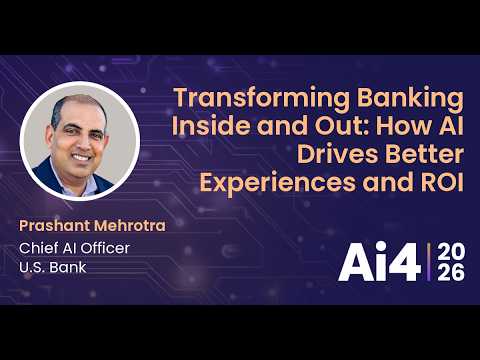
US Bank Shifts AI Push From Token Consumption to ROI Benchmarks
Ai4
US Bank's Chief AI Officer Prashant Mehrotra argues that enterprise AI yields measurable return on investment only when institutions transition from centralized pilots to federated, re-engineered end-to-end workflows that support both employees and customers.
## Background
Published on YouTube by Ai4 on August 18, 2026, this presentation features Prashant Mehrotra, Chief AI Officer at U.S. Bank. According to the page description, the session explores how AI drives return on investment, transforms customer and employee experiences, scales across the enterprise through workforce upskilling, and prepares for agentic AI.
## TL;DR
Prashant Mehrotra outlines U.S. Bank's strategic shift from initial AI experimentation to enterprise-wide ROI and value realization. He presents real-world case studies demonstrating cycle-time reductions in merchant payment sales, UI design, and software development, where over 9,000 engineers generate over a million lines of code per month. Additionally, Mehrotra details U.S. Bank's federated operating model, continuous workforce upskilling, and strict human-in-the-loop governance for responsible AI scaling.
## Atmosphere & style
The presentation carries a professional, pragmatic, and authoritative tone tailored for enterprise leaders and industry peers. Mehrotra delivers his insights with structured confidence, balancing technical depth with occasional light humor about organizational transformation. The narrative arc moves purposefully from reflective industry analysis to concrete operational case studies and strategic execution principles.
## Detailed walkthrough
### [00:04](https://www.youtube.com/watch?v=o52Fnp95UAI&t=4s) Introduction & U.S. Bank Overview
Prashant Mehrotra, Chief AI Officer at U.S. Bank, opens the session expressing gratitude for the opportunity to share the bank's AI transformation journey. Returning to the stage after presenting the prior year on U.S. Bank's initial adoption of generative AI, Mehrotra notes how much can change in just twelve months. Before diving into the technical and strategic details, he provides background on U.S. Bank to frame the scale at which they operate.
Headquartered in Minneapolis, U.S. Bank is the fifth-largest bank in the United States, managing nearly $700 billion in assets and deposits while serving over 15 million customers globally. Recognized for its top-rated digital assets and mobile application, the institution is well-diversified, offering checking, savings, wealth and investment services, institutional client solutions, and treasury products. Mehrotra expresses pride in working for an organization that balances structural diversity with a deep commitment to customer-centric delivery.
- **Headquarters:** Minneapolis, Minnesota
- **Scale & Rank:** 5th largest U.S. bank
- **Assets & Deposits:** ~ $700 billion
- **Customer Base:** 15 million+ globally
---
[01:48](https://www.youtube.com/watch?v=o52Fnp95UAI&t=108s) The Shift from Experimentation to Value Realization
Reflecting on the past year, Mehrotra highlights a fundamental shift in the conversation surrounding enterprise AI. Previously, organizations were focused on basic adoption—asking questions like "How are you using AI?" and launching isolated pilots across business units, procurement, and IT. Today, stakeholders, leadership, and investors are asking a sharper question: "What is that getting you?" While running 100 pilots and consuming tokens was an acceptable milestone in the early phase, the emphasis has aggressively pivoted toward return on investment (ROI) and concrete business value.
Several industry catalysts drove this shift: the rising cost of un-subsidized tokens, budget scrutiny, and widely cited research—such as an MIT report stating that roughly 95% of AI pilots fail to reach production. Mehrotra notes that while experimentation is not completely over, the window for novelty is past. U.S. Bank was fortunate to avoid prolonged experimentation traps, focusing early on how AI could deliver measurable value for both internal colleagues and external clients. Instead of viewing AI as a series of point solutions built by siloed teams, the institution approaches it holistically to re-engineer end-to-end customer experiences.
---
[05:20](https://www.youtube.com/watch?v=o52Fnp95UAI&t=320s) A 360-Degree Strategy for Customers and Staff
U.S. Bank’s strategy centers on a dual focus: delivering 360-degree support for both external clients and internal colleagues. Mehrotra emphasizes that self-service customer experiences cannot succeed in isolation if frontline staff lack equal capabilities. If internal teams do not have modern AI tools to back up client interactions, assisted service falls short. Therefore, internal productivity and external service design are built as connected journeys.
Rather than measuring productivity purely by raw time saved (such as saving an individual 20 minutes on a isolated task, which rarely trickles down to bottom-line ROI), U.S. Bank focuses on operational acceleration across product delivery and client engagement. When software developers write, test, and validate code faster, or when account reps understand customer needs in real time, acceleration translates directly into business velocity and revenue growth.
---
[07:31](https://www.youtube.com/watch?v=o52Fnp95UAI&t=451s) Case Study 1: Transforming Merchant Payment Sales
To demonstrate external customer impact, Mehrotra presents a case study from U.S. Bank’s merchant payment processing business, Elavon. Distinct among the top ten banks, U.S. Bank operates directly as a major payment processor. Small and medium-sized business (SMB) owners processed through merchant services often struggle to decipher complex fee structures and payment processing invoices, much like individuals struggling to read a detailed cell phone bill.
Historically, sales representatives had to conduct multiple back-and-forth meetings over several weeks with a merchant’s back-office team to analyze fee statements and formulate a competitive proposal. Using an AI-assisted analysis tool, sales representatives can now take a prospective merchant's current statements and immediately break down complex charges during the very first conversation.
The AI tool compares current merchant expenses against U.S. Bank's offerings, highlighting projected savings and service enhancements on the spot. What used to take weeks and multiple administrative touches is completed in minutes during an initial meeting. This improves transparency for small business owners and yields direct revenue growth by accelerating deal velocity and closing rates. "When you provide better experiences, you can actually get more revenue. Who knew, right?" Mehrotra quips.
- **Business Unit:** Elavon (Payment Processing)
- **Problem:** Complex merchant statement analysis previously required weeks and multiple meetings.
- **AI Solution:** Instant parsing and side-by-side cost comparison during the initial client meeting.
- **Impact:** Drastic cycle-time reduction (weeks to 15 minutes), higher sales conversion, and better client transparency.
---
[10:23](https://www.youtube.com/watch?v=o52Fnp95UAI&t=623s) Case Study 2: Accelerating UI Design to Engineering Workflows
Moving into internal workflows, Mehrotra highlights how digital design and user experience (UX) teams leverage AI. Maintaining consistent, standardized brand guidelines across websites and mobile apps requires significant design churn, manual auditing, and constant alignment between design teams and software engineers.
Instead of an central AI team forcing a tool onto designers, U.S. Bank educated the design organization on generative AI capabilities. The designers themselves co-created a workflow where AI inspects digital interface elements both visually and at the code level to check for standardization and brand compliance.
This capability drastically reduces friction between designers and developers. Tasks that previously took days or weeks of manual review and design revisions are now evaluated and resolved in 15 minutes to a couple of hours. Designers spend less time on routine compliance checks and more time innovating on user experience, while developers can pull standardized components into production without delay.
---
[12:40](https://www.youtube.com/watch?v=o52Fnp95UAI&t=760s) AI Across the Software Development Life Cycle (SDLC)
Turning to software engineering, Mehrotra outlines the enterprise-wide scaling of AI developer tools across the Software Development Life Cycle (SDLC). At U.S. Bank, AI capabilities are embedded across approximately 12 distinct stages of the product development pipeline, ranging from requirements gathering down to automated unit testing and test case generation.
Over 9,000 engineers actively utilize these AI developer platforms. The shift in output over the past year highlights the speed of internal adoption: the platform now generates over one million lines of code every month, compared to just thousands a year prior.
```
+-----------------------------------------------------------------+
| AI IN SOFTWARE DEVELOPMENT (SDLC) |
+-----------------------------------------------------------------+
| |
| [ Requirements ] -> [ Code Gen ] -> [ Test Cases ] -> [ Deploy ]
| | | | |
| v v v v |
| Validate Ideas >1M Lines/Mo Automate Scenarios Fast |
| Early (PRDs) Generated & Risk Checks Scale|
| |
+-----------------------------------------------------------------+
```
Beyond raw code generation, AI is heavily utilized for automated test case generation, enabling software teams to simulate complex edge cases and reduce technical debt. Moving upstream, U.S. Bank is deploying AI to validate product ideas before writing code—parsing 400-page Product Requirement Documents (PRDs) and converting abstract concepts into functional working prototypes in days rather than months.
- **Developer Adoption:** ~9,000 engineers using AI platforms enterprise-wide.
- **Code Output:** Over 1,000,000 lines of code generated per month (up from thousands a year ago).
- **Time Savings:** Over 100,000 engineering hours saved and reallocated to high-value product innovation.
- **Upstream Impact:** Rapid prototyping and instant validation of Product Requirement Documents (PRDs).
---
[15:27](https://www.youtube.com/watch?v=o52Fnp95UAI&t=927s) Scaling Strategy: Operating Model, Federation, and Enablement
Transitioning to how banks move from isolated pilots to scalable production, Mehrotra breaks down U.S. Bank's operational model and core execution principles. A foundational rule is to discard "tokenomics," activity leaderboards, and vanity metrics in favor of tangible value metrics: cycle-time reduction, risk mitigation, fraud reduction, faster deal closures, and capacity creation.
To scale effectively without creating central bottlenecks, U.S. Bank transitioned from a centralized AI Center of Excellence (AI CoE) model to a federated operating structure. Every business line has dedicated, accountable executive champions who own their business line's P&L, strategy, and AI outcomes. Central teams provide underlying platform capabilities and governance, while business units execute at speed. To prevent duplication, federated leads meet regularly to share learnings under the philosophy: *"As common as possible, as different as necessary."*
To drive genuine workforce adoption and mitigate employee friction, U.S. Bank established comprehensive upskilling programs combining self-paced coursework with hands-on, in-person and virtual workshops. The enablement team conducts structured follow-ups immediately after workshops, as well as several weeks later, ensuring continuous learning. As a result of this touchpoint-driven approach, 95% of employees who complete these programs incorporate AI tools into their daily workflows.
Looking toward the future of process redesign and Agentic AI, Mehrotra emphasizes that layering AI on top of legacy, inefficient workflows yields marginal gains (2–5%). True transformation requires end-to-end workflow re-engineering to "make the right way the easiest way." On Agentic AI, U.S. Bank operates under a strict principle: deployment of autonomous agents must maintain human-in-the-loop oversight to ensure safety, accuracy, and regulatory compliance.
```
+-----------------------------------------------------------------+
| FEDERATED GOVERNANCE & EXECUTION MODEL |
+-----------------------------------------------------------------+
| |
| +-----------------------+ |
| | CENTRAL AI PLATFORM | |
| | Governance & Guardrails| |
| +-----------+-----------+ |
| | |
| +------------------------+------------------------+ |
| | | | |
| v v v |
| +-----------+ +-----------+ +-----------+|
| | Business | | Business | | Business ||
| | Line A | | Line B | | Line C ||
| | Exec Lead | | Exec Lead | | Exec Lead ||
| +-----------+ +-----------+ +-----------+|
| ^ ^ ^ |
| +--- Shared Learnings & Reusable Archetypes ------+ |
| |
+-----------------------------------------------------------------+
```
Closing his presentation, Mehrotra synthesizes U.S. Bank’s AI strategy into a practical execution checklist for enterprise leaders:
1. **Pick the Right Work Upfront:** Avoid running hundreds of disconnected experiments that lack a path to ROI. Focus early on high-value business problems.
2. **Define and Assign Outcome Ownership:** Explicitly define target business outcomes and establish clear ownership—whether held by line-of-business leads, product owners, or tech executives.
3. **Drive to Scale and Maximize Reuse:** Move past proof-of-concepts ("do not let a thousand flowers bloom forever"). Take core solutions into production, scale them across the enterprise, and build reusable archetypes to avoid reinventing the wheel.
4. **Invest in Upskilling the Workforce:** Support employees through structured, continuous education. Friction and breakthrough ideas both originate from frontline staff.
5. **Scale Responsibly:** As a financial institution managing risk, safety and compliance are paramount. Maintain robust responsible AI frameworks to catch issues proactively before deployment rather than remediating errors after the fact.
6. **Prepare for Agentic AI:** Re-engineer core workflows to support agentic capabilities while maintaining a strict human-in-the-loop posture.
[24:21](https://www.youtube.com/watch?v=o52Fnp95UAI&t=1461s) Key Takeaways and Closing Remarks
Prashant Mehrotra wraps up the presentation by emphasizing the critical synergy between operational foundations and AI implementation. Success relies on ensuring that core systems and modern AI capabilities work hand-in-hand rather than in isolation. To drive real business value and sustainable transformation, organizations must focus on execution discipline across three core pillars.
He concludes with a final summary of actionable principles for leaders looking to maximize the return on investment from AI initiatives:
- **Measure the outcome:** Focus relentlessly on tangible results, ROI, and measurable business impact rather than vanity metrics or adoption alone.
- **Embed in workflows:** Ensure AI tools and capabilities are directly integrated into the daily operational routines and tools of employees and customers.
- **Scale responsible processes:** Establish repeatable, scalable frameworks that emphasize governance, safety, and responsible AI practices across the enterprise.
## Notable quotes
> [07:31](https://www.youtube.com/watch?v=o52Fnp95UAI&t=451s) When you provide better experiences, you can actually get more revenue. Who knew, right? — Prashant Mehrotra
> [15:27](https://www.youtube.com/watch?v=o52Fnp95UAI&t=927s) As common as possible, as different as necessary. — Prashant Mehrotra
> [15:27](https://www.youtube.com/watch?v=o52Fnp95UAI&t=927s) make the right way the easiest way — Prashant Mehrotra
> [22:04](https://www.youtube.com/watch?v=o52Fnp95UAI&t=1324s) do not let a thousand flowers bloom forever — Prashant Mehrotra
## Mentioned
Ai4, Elavon, MIT, Minneapolis, Prashant Mehrotra, U.S. Bank
## Video description
Prashant Mehrotra - Chief AI Officer, U.S. Bank
If 2025 was a time of exploring how to use AI, in 2026 it’s time to examine AI’s return on investment. Prashant Mehrotra, Chief AI Officer at U.S. Bank, shares not only how AI is transforming the way people bank and how banks serve them – but also the scalable, repeatable processes that form the backbone of every successful business. He will address the challenges of, and best practices for, enabling the entire enterprise – actively upskilling the entire workforce to build and leverage the power of AI – as well as where agentic AI is taking us next.
美国合众银行将AI推进重点从Token消耗转向投资回报率基准
美国合众银行首席人工智能官 Prashant Mehrotra 认为,只有当机构从集中式试点转向同时服务于员工和客户的联邦式、重塑端到端工作流程时,企业级 AI 才能产生可衡量的投资回报。
Prashant Mehrotra 概述了美国合众银行(U.S. Bank)从最初的 AI 试验向全企业投资回报率(ROI)及价值实现的战略转变。他介绍了多个实际案例研究,展示了商户支付销售、UI 设计和软件开发中周期时间的缩减,其中 9,000 多名工程师每月生成超过 100 万行代码。此外,Mehrotra 还详细说明了美国合众银行的联邦运营模式、员工持续技能提升以及用于负责任地扩展 AI 的严格“人在回路”治理流程。
美国合众银行正推动战略转型,从早期的 AI 试点过渡到注重全企业范围投资回报率与端到端工作流重塑的联邦式模式。
实际应用已在商户支付销售、UI 设计及软件开发中实现周期缩短,超过 9,000 名工程师每月生成代码逾百万行。
银行通过联邦运营架构、持续的员工技能培训以及严格的“人在回路”治理机制,保障 AI 的负责任规模化落地。
Reading summary
Prashant Mehrotra, Chief AI Officer at U.S. Bank, argues that enterprise AI has transitioned from experimental novelty to strict accountability for return on investment (ROI). Managing nearly $700 billion in assets and deposits for over 15 million global customers, the fifth-largest U.S. bank drives measurable value by connecting external client experiences with internal workflow tools under a federated operating model.
From Pilot Novelty to Measurable Business Velocity (1:48)
Mehrotra notes that rising un-subsidized token costs, budget scrutiny, and high failure rates—including an MIT report indicating that roughly 95% of AI pilots fail to reach production—have ended the era of open-ended experimentation. Stakeholders no longer reward running isolated pilots or tracking token consumption and activity leaderboards. Instead, U.S. Bank evaluates AI through concrete business metrics such as cycle-time reduction, fraud and risk mitigation, capacity creation, and deal velocity.
To capture these outcomes, the bank employs a 360-degree strategy that pairs external client self-service with internal colleague enablement. Mehrotra emphasizes that customer-facing digital portals fall short if frontline staff lack comparable AI tools to support assisted service. Rather than measuring productivity by isolated time savings—such as saving an individual 20 minutes on a standalone task, which rarely impacts the bottom line—the bank targets operational acceleration across end-to-end product delivery and client engagement.
Compressing Sales Cycles in Merchant Payment Processing (7:31)
This focus on business velocity is illustrated in Elavon, U.S. Bank's merchant payment processing business. Small and medium-sized business owners frequently struggle to decipher complex payment processing invoices and fee structures. Historically, Elavon sales representatives spent several weeks conducting back-and-forth meetings with a prospect's back-office team to audit statements and formulate a competitive proposal.
Using an AI-assisted analysis tool, sales representatives now parse a prospective merchant's existing statements and generate side-by-side cost comparisons during the very first conversation. Compressing the analysis cycle from weeks to roughly 15 minutes provides immediate fee transparency for business owners while accelerating deal velocity, conversion rates, and revenue growth.
Scaling AI Across Design and Software Engineering (10:23)
Internally, U.S. Bank applies similar cycle-time compression to digital design and software engineering. Rather than forcing a centralized tool onto user experience (UX) teams, the bank educated designers on generative AI capabilities, enabling them to co-create an automated inspection workflow. The tool audits digital interfaces both visually and at the code level for brand standardization, cutting design-to-engineering review churn from days or weeks down to between 15 minutes and a couple of hours.
Across the Software Development Life Cycle (SDLC), approximately 9,000 engineers use AI platforms embedded across 12 distinct development stages. Monthly AI-generated code output has scaled from thousands of lines a year prior to over one million lines, saving more than 100,000 engineering hours. Beyond writing code, teams use AI to automate edge-case testing to reduce technical debt, as well as upstream to parse 400-page Product Requirement Documents (PRDs) and convert concepts into working prototypes in days rather than months.
Federated Governance, Workforce Enablement, and Agentic Guardrails (15:27)
To scale solutions without central bottlenecks, U.S. Bank shifted from a centralized AI Center of Excellence to a federated structure. While a central team manages platform infrastructure and governance guardrails, accountable executive champions within each business line own their respective P&L, strategy, and AI outcomes. Federated leads meet regularly to share reusable archetypes under the philosophy of keeping tools "as common as possible, as different as necessary."
This operating model is backed by workforce upskilling that combines self-paced coursework, hands-on workshops, and structured follow-ups immediately and several weeks after training; Mehrotra reports that 95% of participants integrate AI tools into their daily workflows. Looking ahead, he cautions that layering AI onto legacy, inefficient processes yields marginal gains of only 2% to 5%. Achieving full transformation—particularly with Agentic AI—requires re-engineering workflows end-to-end while maintaining strict human-in-the-loop oversight for safety, accuracy, and regulatory compliance.
Mehrotra concludes that sustainable AI transformation depends on execution discipline established before deployment. Enterprise leaders must select high-value business problems upfront, assign explicit outcome ownership, and move past disconnected proof-of-concepts to scale reusable production tools. For regulated financial institutions, maximizing ROI ultimately requires embedding AI directly into re-engineered daily workflows while enforcing proactive risk governance to catch issues before they reach production.
精炼阅读摘要
U.S. Bank 首席人工智能官 Prashant Mehrotra 指出,企业级人工智能已从前期的概念验证转向严苛的投资回报率审查,必须通过贯通员工与客户的双向战略、联邦化运营架构以及端到端流程重构,将技术落地转化为可衡量的业务增长与工程提速。
摆脱试点陷阱:技术探索转向投资回报 (1:48)
Mehrotra 强调,整个行业关于人工智能的讨论已发生根本性转变,利益相关者不再满足于孤立的试点项目和模型调用量,而是严厉质询实际业务回报。推动这一转变的催化剂包括无补贴 Token 成本的上升、企业预算紧缩,以及麻省理工学院(MIT)引用的行业研究报告,该报告指出约 95% 的 AI 试点项目最终未能走向生产环境。U.S. Bank 早期即选择避开旷日持久的零散实验,将技术应用集中于端到端客户体验与内部效能提升。
该行明确弃用活跃度排行榜、Token 消耗量或孤立节省二十分钟等虚荣指标,转而将评估锚定于核心业务结果。衡量标准聚焦于交付周期压缩、交易促成速度、风险与反欺诈控制以及组织产能释放,旨在通过流程提速直接带动顶线收入与底线价值。
双向360度战略:赋能前线以加速业务闭环 (5:20)
U.S. Bank 确立了贯通外部客户与内部员工的双向 360 度战略。Mehrotra 认为,若一线员工缺乏先进的辅助工具,孤立的客户自助服务便无法顺畅运作,内部生产力工具与外部客户界面必须作为连贯链路一体化设计。
在商户支付业务 Elavon 的实践中,中小企业主通常难以解读复杂的费率账单与发票。以往销售代表需要与客户后台团队进行长达数周的反复沟通,才能完成账单拆解并形成竞标方案;引入 AI 分析工具后,销售代表能在首次面谈中实时解析费用结构并即时生成成本节约对比。整个周期从数周压缩至数分钟,在提升报价透明度的同时,直接提高了签单转化率并加快了营收增长步伐。
研发全流程提效:设计对齐与代码生成 (12:40)
在数字化设计与软件工程领域,AI 的接入大幅消除了跨职能协作摩擦。在数字设计与用户体验(UX)端,该行未采取中央团队强制推行的方式,而是由设计团队联合开发了校验流程,利用 AI 在视觉与代码双重层面自动审查品牌合规性,将原先需数天至数周的人工审核与反复修改压缩至 15 分钟到数小时内解决。
在软件开发生命周期(SDLC)中,AI 工具已嵌入从需求分析到自动化单元测试的约 12 个关键阶段。全行目前有约 9,000 名工程师接入该平台,月度代码生成量从一年前的数千行激增至超过 100 万行,累计节约超过 10 万小时工程时间并重新配置于产品创新。在前端需求阶段,AI 还能解析长达 400 页的产品需求文档(PRD),在数天内将其转化为可运行的原型以提前验证构想。
联邦运营与流程重构:规模采纳与合规底线 (15:27)
为了规避中心化瓶颈,U.S. Bank 的组织模式由集中的卓越中心(AI CoE)转为联邦制架构。各业务线设立了对自身损益(P&L)和战略目标直接负责的主管,中央团队则输出底层平台底座与治理规范,遵循“尽可能统一,必要时分化”的协作原则以复用技术资产。在员工赋能上,该行推行了融合自主课程与研讨会的体系,并通过训后多节点追踪支持,实现了 95% 的参训人员将 AI 工具常态化融入日常工作。
针对业务流程再造与自主智能体(Agentic AI)趋势,Mehrotra 警示称,若仅在低效的遗留流程上直接套用 AI,收益通常仅有 2% 到 5% 的边际改善,必须通过端到端流程重塑来“让正确路径成为最轻松的路径”。与此同时,鉴于银行业的风控与合规红线,部署智能体必须严格保持“人在回路”(human-in-the-loop)的监督机制,确保安全性与合规性优先于盲目自动化。
Mehrotra 总结指出,人工智能的规模化成效取决于底层核心系统与前沿算法的协同集成,而非零散技术堆砌。不过,随着技术向更具自主性的智能体架构演进,金融机构仍须在追求交付速度与满足严苛合规、控制模型风险之间维持平衡,如何在全流程重构中坚守“人在回路”的防线将是长期课题。
Detailed notes — zh
## Background
本视频由 Ai4 频道于 2026 年 8 月 18 日发布在 YouTube 平台上。内容为美国合众银行(U.S. Bank)首席人工智能官 Prashant Mehrotra 的主题演讲,主要探讨银行业在 2026 年如何从初期的 AI 探索转向深度考察投资回报率(ROI),并分享如何通过全员赋能、可复制的流程体系以及 Agentic AI 推动企业级规模化转型。
## TL;DR
演讲围绕美国合众银行的 AI 规模化落地战略展开,强调必须告别导致 95% 试点失败的零散实验,全面转向以量化 ROI 和端到端体验重塑为核心的价值体系。银行通过在商户支付分析、设计与前端研发审查、以及覆盖 9000 名工程师且月产百万行代码的 SDLC 链路中深度融入 AI,取得了显著的业务提效与营收转化。在运营与治理层面,全行依托业务线负责的联邦制架构、长效复训机制(实现 95% 日常高频使用率)及负责任 AI(Responsible AI)合规底线,为迈向 Agentic AI 时代奠定了坚实基础。
## Atmosphere & style
整场演讲风格沉稳务实、逻辑严密,展现出大型金融机构高管冷静克制又极具前瞻性的专业气场。演讲者摒弃了炫耀概念的行业浮躁,开篇直击‘95% 试点夭折’的现实痛点,随后以扎实的业务数据和具体落地案例层层递进,语言精炼且极具说服力。听众能清晰感受到一种从技术狂热回归商业本质的理性力量,以及‘让正确的方式成为最轻松的方式’这一深刻的组织治理智慧。
## Key takeaways
- [02:05](https://www.youtube.com/watch?v=o52Fnp95UAI&t=125s) 银行业 AI 关注焦点发生根本性转变:从初期的工具探索和概念验证(PoC),彻底转向以实际业务回报(ROI)与端到端价值交付为核心。
- [02:05](https://www.youtube.com/watch?v=o52Fnp95UAI&t=125s) 告别虚荣指标与边缘试点:MIT 数据显示高达 95% 的 AI 试点未能成功落地,企业必须摒弃单纯统计 Token 消耗量的模式,转向衡量业务周期缩短与风控成效。
- [05:20](https://www.youtube.com/watch?v=o52Fnp95UAI&t=320s) 坚持 360 度双轮驱动体验:必须兼顾外部客户旅程与内部员工体验,将后台业务人员智能化与前端自助服务无缝衔接,才能避免体验割裂。
- [07:31](https://www.youtube.com/watch?v=o52Fnp95UAI&t=451s) 商户支付分析智能化(Elavon):通过 AI 实时摄入并比对小微商户复杂的历史账单与费率,将原先耗时数周的多轮商务谈判压缩至单次会议完成。
- [10:17](https://www.youtube.com/watch?v=o52Fnp95UAI&t=617s) 设计与前端开发协同重塑:一线设计师与 AI 专家共创自动化比对工具,将界面视觉与代码合规核对周期从数周大幅压缩至 15 分钟到数小时。
- [12:40](https://www.youtube.com/watch?v=o52Fnp95UAI&t=760s) 研发全生命周期(SDLC)深度赋能:全行 9000 名工程师接入 AI 工具栈,每月生成代码超百万行,累计节省超 10 万工时,并重构上游需求验证流程。
- [15:27](https://www.youtube.com/watch?v=o52Fnp95UAI&t=927s) 联邦制组织运营架构:AI 中心扮演赋能角色,各业务线由高管级 Champion 牵头并对最终财务 P&L 与成效负责,践行‘尽可能共用,按需差异化’原则。
- [19:15](https://www.youtube.com/watch?v=o52Fnp95UAI&t=1155s) 系统化技能升级与长效跟进:通过实操工作坊结合后续持续复训机制,实现参训员工 95% 的日常高频使用率,推动端到端工作流重塑而非浅层叠加。
- [22:04](https://www.youtube.com/watch?v=o52Fnp95UAI&t=1324s) 迈向 Agentic AI 坚持人机协同(Human-in-the-loop):智能体执行复杂任务必须在人类监督下进行,并依托事前合规防控机制确保负责任规模化扩展。
- [24:21](https://www.youtube.com/watch?v=o52Fnp95UAI&t=1461s) 落地三大核心行动倡议:始终紧盯业务成效衡量、深度嵌入员工日常工作流,以及依托治理框架规模化推进负责任流程。
## Detailed walkthrough
### [00:04](https://www.youtube.com/watch?v=o52Fnp95UAI&t=4s) 美国合众银行(U.S. Bank)的业务概貌与 AI 演进背景
作为全美第五大银行,总部位于明尼阿波利斯的美国合众银行(U.S. Bank)管理着近 7000 亿美元的资产与存款规模,在全球范围内为超过 1500 万客户提供全方位的金融服务。其业务版图高度多元化,涵盖移动端数字化零售银行、财富管理与投资、小微企业与机构业务,以及规模庞大的财资管理和支付处理服务。Prashant Mehrotra 谈到,一年前他站在这里时,行业热议的还是“我们是否在做 AI”以及“我们该如何开始接触 GenAI”,而仅仅过去一年,整个金融行业对 AI 的认知与应用重心就发生了天翻地覆的转变。
```mermaid
flowchart TD
accTitle: U.S. Bank AI 转型战略架构
subgraph Foundation["业务基础与双轮驱动"]
USBank["U.S. Bank 业务底座<br/>7000亿美元资产 / 1500万+ 客户 / 全牌照服务"]
DualFocus["360度双向体验<br/>内部员工赋能 + 外部客户体验"]
end
subgraph Pillars["核心落地业务场景"]
Merchant["商户支付分析 (Elavon)<br/>账单比对从数周压缩至单次会议"]
Design["设计与前端研发标准<br/>自动化审查,周期缩短至数小时"]
SDLC["研发全流程 (SDLC)<br/>9000 名工程师 / 月产百万行代码"]
end
subgraph ScaleOps["运营与规模化机制"]
Federation["联邦制管理体系<br/>业务线高管担责 + 跨部门经验复用"]
Upskilling["持续分层培训<br/>95% 参训员工实现日常高频使用"]
RespAI["负责任 AI (Responsible AI)<br/>事前合规防控 + 人机协同 (Human-in-the-Loop)"]
end
USBank --> DualFocus
DualFocus --> Merchant
DualFocus --> Design
DualFocus --> SDLC
Merchant --> Federation
Design --> Upskilling
SDLC --> RespAI
```
- 资产与用户规模:管理约 7000 亿美元资产与存款,服务全球 1500 万以上客户。
- 业务生态:覆盖支票与储蓄账户、财富管理、机构客户、财资产品,并旗下拥有知名支付处理品牌 Elavon。
---
### [02:05](https://www.youtube.com/watch?v=o52Fnp95UAI&t=125s) 从盲目试验转向价值变现:95% 试点失败背后的 ROI 反思
过去一年中,管理层和业务端不再满足于“你在用什么 AI”或“开发团队跑了多少个 Demo”,提问的核心彻底转向了“这到底带来了什么实际商业回报?”。在探索初期,企业往往热衷于炫耀上线了上百个 Pilot 概念验证、开发人员在各个业务线大量消耗 Token。然而随着模型调用成本的真实显现、补贴减少,以及行业权威报告(如 MIT 调研指出的 95% AI 试点最终未能成功落地)的警示,盲目试验的时代已经成为过去。
银行正在全面转向以价值实现为导向的衡量体系。U.S. Bank 庆幸自己并未在孤立零散的边缘实验上浪费过多时间,而是迅速将注意力集中在能够端到端改善客户与员工体验的核心流程上。孤立团队各自为政搞小发明的模式被彻底抛弃,取而代之的是将 AI 视为全行级的基础能力,以量化的 ROI 为锚点推进落地。
- 行业趋势拐点:从关注 Token 消耗量、测试排行榜等虚荣指标,转向业务收益、处理周期与风控成效。
- 行业现实痛点:援引 MIT 数据,高达 95% 的 AI 试点项目在进入生产或创造价值环节时遭遇失败。
- 战略转变:告别分散的小规模试点,转向端到端(End-to-End)客户与员工一体化体验重构。
---
### [05:20](https://www.youtube.com/watch?v=o52Fnp95UAI&t=320s) 360 度双轮驱动:兼顾内部员工体验与外部客户旅程
在推动 AI 落地时,必须同时构建面向外部客户与面向内部员工的“360 度全景视角”。如果一家机构只把精力花在光鲜亮丽的外部自助服务上,而忽视了后台提供支持的业务人员,那么整体的客户交互体验注定会割裂。唯有为一线支持员工配备同等水平的智能化工具,才能实现自助服务(Self-service)与人工辅助体验(Assisted experiences)的无缝衔接。
在衡量生产力时,单纯宣称“AI 工具为某人每天节省了 20 分钟”往往很难直接折算为底线利润(Bottom-line ROI)。但如果将 AI 应用于产品构建与代码交付流程,能够以更快的速度交付更高质量的代码,更重要的是在开发早期就能精准验证“当前产品是否真正切中了客户的核心痛点”,这种端到端周期的压缩才是实打实的 ROI 跃迁。
---
### [07:31](https://www.youtube.com/watch?v=o52Fnp95UAI&t=451s) 商业落地案例一:赋能商户支付销售,将数周沟通缩短至单次会议
作为全美排名前十银行中极具特色的支付处理商(旗下拥有支付品牌 Elavon),U.S. Bank 深刻洞察到中小商户(SMB)在面对复杂刷卡手续费与支付账单时的无奈。普通人查看手机话费账单往往都理不清各类繁杂细项,而商户处理信用卡支付账单的复杂程度还要高出几个数量级。中小型商户店主将绝大部分精力投入在日常经营与业务增长上,根本没有专职的后台财务或精力去逐行拆解费率结构,往往不清楚自己是否被过度收费,也不确定能否换取更好的服务。
在过去,银行销售代表向商户推广支付方案时,需要与商户及其后台人员进行多次往返会议,费时数周收集历史账单并测算费用。如今,借助专门的 AI 分析工具,销售代表可以在首次面对面交流时,直接摄入商户当前的支出发票与明细,实时计算出在 U.S. Bank 体系下的费率对比与潜在节省空间。这一原本耗时数周的多轮谈判流程被直接压缩进单次对话,不仅让小微商户省去了繁重的沟通负担,更直接转化为极高的销售转化率与新增营收,生动诠释了“提供卓越客户体验能够直接带动收入增长”。
---
### [10:17](https://www.youtube.com/watch?v=o52Fnp95UAI&t=617s) 商业落地案例二:设计与前端研发协同,将周级迭代压缩至数小时
数字化资产(如官网、移动端 App)的设计一致性与标准化至关重要,但过去设计团队需要耗费大量时间人工审核每一个界面模块和组件,反复确认其是否符合设计规范并能被前端代码还原。这一协同环节通常充斥着设计师与开发人员之间漫长的来回拉扯与返工。
这个落地项目的独特之处在于,它完全由设计师团队与 AI 专家并肩共同定义,而非技术团队自上而下强行摊派的“AI 示范工程”。通过训练 AI 同时对界面视觉与底层代码进行双向比对审查,系统可以快速评估设计合规性与可用性。原本需要数天乃至数周的多轮跨部门校对,现在被缩减至 15 分钟到几小时之内。未来该功能还将进一步开放为开发者的自助服务工具,使设计师能够将高薪精力从机械重复的比对中抽离,专注于前沿标准制定与体验创新。
- 提效幅度:从数天到数周的设计与代码合规核对,直接缩减为 15 分钟至数小时。
- 协同范式转变:一线设计师主动发掘痛点并参与共创,推动设计标准向开发者自助式审查演进。
---
### [12:40](https://www.youtube.com/watch?v=o52Fnp95UAI&t=760s) 研发全生命周期(SDLC)赋能:9000 名工程师与月度百万行代码生成
在软件与产品开发生命周期(SDLC / PDLC)中,U.S. Bank 已经全面部署了近 12 种 AI 赋能能力。全行已有 9000 名工程师在日常工作中深度使用这些智能化开发工具,累计节省工时超过 10 万小时,每月由 AI 辅助生成的代码量突破 100 万行,相比一年前仅有数千行的规模实现了指数级爆发。
更深层次的变革不仅在于写代码的速度,更在于质量保障与需求上游的重塑。AI 被广泛用于自动化生成测试用例并执行更复杂的边界场景测试,大幅降低线上缺陷率。更关键的是,银行正将 AI 能力向上游推进至产品构思与需求验证阶段——彻底终结过去耗时数月、编写长达 400 页产品需求文档(PRD)却依然无法验证商业有效性的沉重流程,通过 AI 快速输出概念原型,在极短时间内验证产品设想的真实可行性。
```mermaid
flowchart LR
accTitle: 软件研发全生命周期 (SDLC) AI 赋能链路
A["概念与需求定义<br/>快速验证,替代400页PRD"] --> B["代码编写与重构<br/>月产百万行代码 / 9000工程师"]
B --> C["自动化测试与质检<br/>测试用例自动生成与全场景覆盖"]
C --> D["生产部署与监控<br/>极速上线 / 降低业务与合规风险"]
```
- 工程师覆盖规模:全行 9000 名软件工程师全员接入 AI 工具栈。
- 代码生成产出:每月由 AI 生成的代码超过 100 万行(一年前仅为千行级别)。
- 工时节省指标:累计节省软件工程工时超过 10 万小时。
- 流程向上游延伸:将传统撰写数百页 PRD 的繁琐调研流程,转变为极速构建可交互概念进行早期验证。
---
### [15:27](https://www.youtube.com/watch?v=o52Fnp95UAI&t=927s) 规模化运营机制:指标衡量、联邦制管理与业务线责任制
要从试点走向规模化生产,必须彻底推翻“只测活动量(Activity)”的伪指标。Token 消耗量、内部排行榜等看似好看的数字并不能带来真实的商业回报,真正关键的是周期时间(Cycle time)缩短了多少、代码是否更少出错、合规风险与欺诈率是否实质性下降,以及商户成交流程是否显著加快。此外,衡量价值时不仅要看削减了多少直接成本,更要看释放出的组织产能(Capacity)——是用同样的资源做成了更多业务,还是将节省的精力转化为新的价值增长极。
在运营组织架构上,U.S. Bank 采取了“先集中、后联邦化(Federated)”的演进路径。各个业务线必须为自己的 P&L 财务结果与 AI 实施成效承担最终责任,AI 中心或中央转型办公室的角色是赋能与支持,而非包办一切。全行在每个业务线都设立了对成效负责的高管级 Champion,并通过定期机制促进跨业务线的横向交流与经验共享,践行“尽可能共用,按需差异化(As common as possible, and as different as necessary)”的构建哲学,最大化减少重复造轮子。
---
### [19:15](https://www.youtube.com/watch?v=o52Fnp95UAI&t=1155s) 员工技能升级与工作流重塑:95% 的日均使用率突破
针对企业中普遍存在的“员工抗拒新技术”难题,不能仅仅把工具扔给员工并指望他们自发使用。U.S. Bank 构建了完善的教育体系,涵盖线上自主课程以及线上线下相结合的导师辅助型实操工作坊(Assisted workshops)。关键在于建立持续跟进机制:在工作坊结束后立即回访,数周后再进行周期性复训与能力进阶。数据表明,完成这一系统培训流程的员工中,有高达 95% 在日常工作中保持着对 AI 工具的高频使用。
如果只是在原有流程上机械地“叠加一层 AI”,收效往往与过去的 RPA 自动化无异,只能带来 2% 至 5% 的微小边际改善。真正的价值飞跃源于对业务流程、工作流乃至交互体验的端到端重塑。Prashant 强调其核心治理理念是“让正确的方式成为最轻松的方式(Making the right way the easiest way)”,当重构后的智能流程比旧流程更顺畅、更省力时,多倍级的商业效能跃升便水到渠成。
---
### [22:04](https://www.youtube.com/watch?v=o52Fnp95UAI&t=1324s) 迈向 Agentic AI 时代的六大核心落地法则与负责任 AI
在展望以智能体为核心的 Agentic AI 时,U.S. Bank 明确坚持“人机协同(Human-in-the-loop)”的指导原则,让 Agent 在执行复杂操作时始终处于人类监督与协助之下。Prashant 在总结全行 AI 规模化转型的实践心得时,梳理了六大核心落地法则:
1. **从一开始就选对场景(Pick the right work up front)**:盲目开展 100 个缺乏价值锚点的试验,最终注定颗粒无收。
2. **明确产出与业务归属(Define outcomes and ownership)**:清晰界定衡量的具体商业结果,并确保由业务线负责人而非技术团队承担最终主责。
3. **拒绝浅尝辄止,坚持复用(Scale to production and reuse)**:告别漫无目的的“百花齐放”,将资源集中于打通生产上线,并坚持“复用、复用、再复用”。
4. **全员赋能与技能重塑(Upskill workforce)**:绝不能脱离一线团队推动变革,因为最真实的痛点、阻碍与创新灵感永远来自业务现场。
5. **负责任地规模化(Scale responsibly)**:作为金融机构,必须严守合规底线,通过全行级的 Responsible AI 治理机制做到“事前防控”,而非在事故发生后被动补救。
6. **为 Agent 时代构建可复用能力原型(Prepare for agents & archetypes)**:沉淀通用的可复用架构,绝不能让底层技术基建拖慢前端业务价值的持续交付速度。
### [24:21](https://www.youtube.com/watch?v=o52Fnp95UAI&t=1461s) 总结与落地核心原则:衡量成效、融入工作流与规模化推进
Prashant Mehrotra 在演讲结尾强调,底层技术基础与具体业务应用必须紧密配合、协同推进。为了真正实现 AI 的投资回报率(ROI)并推动企业级规模化应用,他最后给出了三项核心行动建议:首先是“衡量成效”("measure the outcome"),时刻紧盯实际业务产出与价值验证;其次是“嵌入工作流”("embed in workflows"),让 AI 工具与员工的日常业务流程无缝结合,而非孤立存在;最后是“扩展负责任的流程”("scale responsible processes"),确保在负责任、合规与可信赖的前提下把 AI 体系化地推向整个组织。
在完成对整体落地战略的提炼后,Prashant 向与会者表达了由衷的感谢,并表示非常乐意回答大家的现场提问,开启随后的问答交流环节。
- **三大核心落地原则**:
- **衡量成效(Measure the outcome)**:建立清晰的价值评估机制,确保 AI 投资具备明确的 ROI 与业务收益。
- **深度融入工作流(Embed in workflows)**:将 AI 能力沉淀为日常操作的一部分,降低员工使用门槛,提升实际采用率。
- **规模化负责任流程(Scale responsible processes)**:依托稳健的治理框架与可复制的标准化流程,安全、负责地扩展 AI 应用。
## Notable quotes
> [00:04](https://www.youtube.com/watch?v=o52Fnp95UAI&t=4s) 我们是否在做 AI — Prashant Mehrotra
> [00:04](https://www.youtube.com/watch?v=o52Fnp95UAI&t=4s) 我们该如何开始接触 GenAI — Prashant Mehrotra
> [02:05](https://www.youtube.com/watch?v=o52Fnp95UAI&t=125s) 这到底带来了什么实际商业回报? — Prashant Mehrotra
> [15:27](https://www.youtube.com/watch?v=o52Fnp95UAI&t=927s) 尽可能共用,按需差异化(As common as possible, and as different as necessary) — Prashant Mehrotra
> [19:15](https://www.youtube.com/watch?v=o52Fnp95UAI&t=1155s) 让正确的方式成为最轻松的方式(Making the right way the easiest way) — Prashant Mehrotra
> [22:04](https://www.youtube.com/watch?v=o52Fnp95UAI&t=1324s) 从一开始就选对场景(Pick the right work up front) — Prashant Mehrotra
> [22:04](https://www.youtube.com/watch?v=o52Fnp95UAI&t=1324s) 明确产出与业务归属(Define outcomes and ownership) — Prashant Mehrotra
> [22:04](https://www.youtube.com/watch?v=o52Fnp95UAI&t=1324s) 拒绝浅尝辄止,坚持复用(Scale to production and reuse) — Prashant Mehrotra
> [22:04](https://www.youtube.com/watch?v=o52Fnp95UAI&t=1324s) 全员赋能与技能重塑(Upskill workforce) — Prashant Mehrotra
> [22:04](https://www.youtube.com/watch?v=o52Fnp95UAI&t=1324s) 负责任地规模化(Scale responsibly) — Prashant Mehrotra
> [22:04](https://www.youtube.com/watch?v=o52Fnp95UAI&t=1324s) 为 Agent 时代构建可复用能力原型(Prepare for agents & archetypes) — Prashant Mehrotra
> [24:21](https://www.youtube.com/watch?v=o52Fnp95UAI&t=1461s) 衡量成效(measure the outcome) — Prashant Mehrotra
> [24:21](https://www.youtube.com/watch?v=o52Fnp95UAI&t=1461s) 嵌入工作流(embed in workflows) — Prashant Mehrotra
> [24:21](https://www.youtube.com/watch?v=o52Fnp95UAI&t=1461s) 扩展负责任的流程(scale responsible processes) — Prashant Mehrotra
## Mentioned
Prashant Mehrotra, U.S. Bank(美国合众银行), Elavon, MIT, Ai4, GenAI, Agentic AI, Responsible AI, SDLC / PDLC, PRD
## Video description
Prashant Mehrotra - Chief AI Officer, U.S. Bank
If 2025 was a time of exploring how to use AI, in 2026 it’s time to examine AI’s return on investment. Prashant Mehrotra, Chief AI Officer at U.S. Bank, shares not only how AI is transforming the way people bank and how banks serve them – but also the scalable, repeatable processes that form the backbone of every successful business. He will address the challenges of, and best practices for, enabling the entire enterprise – actively upskilling the entire workforce to build and leverage the power of AI – as well as where agentic AI is taking us next.
[Source](https://www.youtube.com/watch?v=o52Fnp95UAI)
Source quotes
[0:04] Prashant Mehrotra: 我们是否在做 AI
[0:04] Prashant Mehrotra: 我们该如何开始接触 GenAI
[2:05] Prashant Mehrotra: 这到底带来了什么实际商业回报?
[15:27] Prashant Mehrotra: 尽可能共用,按需差异化(As common as possible, and as different as necessary)
[19:15] Prashant Mehrotra: 让正确的方式成为最轻松的方式(Making the right way the easiest way)
[22:04] Prashant Mehrotra: 从一开始就选对场景(Pick the right work up front)
[22:04] Prashant Mehrotra: 明确产出与业务归属(Define outcomes and ownership)
[22:04] Prashant Mehrotra: 拒绝浅尝辄止,坚持复用(Scale to production and reuse)
[22:04] Prashant Mehrotra: 全员赋能与技能重塑(Upskill workforce)
[22:04] Prashant Mehrotra: 负责任地规模化(Scale responsibly)
[22:04] Prashant Mehrotra: 为 Agent 时代构建可复用能力原型(Prepare for agents & archetypes)
[24:21] Prashant Mehrotra: 衡量成效(measure the outcome)
[24:21] Prashant Mehrotra: 嵌入工作流(embed in workflows)
[24:21] Prashant Mehrotra: 扩展负责任的流程(scale responsible processes)
Source quotes
[7:31] Prashant Mehrotra: When you provide better experiences, you can actually get more revenue. Who knew, right?
[15:27] Prashant Mehrotra: As common as possible, as different as necessary.
[15:27] Prashant Mehrotra: make the right way the easiest way
[22:04] Prashant Mehrotra: do not let a thousand flowers bloom forever
Original transcript
[0:04] Uh first of all thank you all uh you know for uh
uh you know giving me an opportunity to present
[0:12] uh our uh transformation journey and it's an
honor to be here today. I was here uh last
[0:18] year you know talking a little bit about
how we are starting to adopt Genai and uh
[0:24] a year makes a significant difference. So uh
[clears throat] I'm going to you know chat a
[0:30] little bit about that. But before I actually
you know go into uh you know the presentation
[0:35] let me tell you a little bit about uh US
Bank and I validated that the clicker works
[0:42] so I can operate that. Um the US Bank is uh
headquartered in Minneapolis. Uh it's the
[0:49] fifth largest bank in the in the US uh with almost
$700 billion in uh you know assets and deposits
[0:59] uh serving uh 15 million plus customers uh across
the globe. Uh we are uh we are recognized for our
[1:09] um you know the best uh one of the best you know
digital assets and mobile app and we are a well
[1:17] diversified bank offering customers small banks,
institutional clients uh and you know wealth
[1:23] services all the way from uh checkings and savings
to wealth and investment services and and treasury
[1:31] uh products. So um [clears throat] it's an uh
you know uh I always feel proud uh to work for
[1:40] um such a you know not just well diversified but
customer centric uh bank uh and so with that I'm
[1:48] going to talk a little bit about um should go
back so as I was saying last year I was here
[1:56] you know talking about uh are we doing AI how are
we doing you know AI Um [clears throat] and a year
[2:05] makes a huge difference. So we went from how are
you using AI um which everybody was getting you
[2:15] know questions around the you know in all our jobs
whether we are users of AI on the business side or
[2:22] you know developers and procurement and every
other uh supporting and enabling function. two,
[2:31] what is that getting you? Uh it's it's great to
see that you know we have 100 pilots running.
[2:40] Uh we are you know using tokens left right
and center. um our developers are you know
[2:46] feeling you know really confident but
what's that you know getting you and um
[2:53] there's been many factors that have you know
that have made the question pivot uh from
[3:02] you know the cost of tokens uh raising less uh you
know uh less subsidized tokens to also you know
[3:10] different studies and you know one of the ones
that I quote all the time is the MIT report about
[3:16] uh 95% of the pilots failing. So the time for
experimentation, the time for you know getting
[3:23] to know what AI can do um is I would say slightly
behind us. We are not completely over that.
[3:31] Uh depending on the size of the organization
and what you're doing in different parts
[3:35] uh it has uh you know moved from uh you know
value realization is is the way I actually do. So
[3:43] we were you know we feel fortunate and lucky that
um we did not spend a lot of time even when I was
[3:50] here last year we spend a lot of time you know
on doing some experiments but moving more towards
[3:59] how can we benefit both our internal uh you know
colleagues and clients. So we have been constantly
[4:05] measuring the ROI and one of the changes that
we are seeing is not thinking of AI as a set
[4:14] of singular isolated you know experiments that
small teams across the businesses are doing to
[4:24] how do we think about AI as an institution as
a company how do we think about an end-to-end
[4:31] client experiences So we'll uh you know we'll
we'll talk about you know how we are uh using AI
[4:39] what use cases are there what ROI we are seeing
or where we are seeing ROI uh but also talk about
[4:45] how we are making it possible in terms of an
operating model in terms of you know uh what
[4:50] we are doing with our colleagues in in making sure
that they are comfortable adopting it uh touch a
[4:56] little bit about uh you know the rise of I
can't you know have a talk without talk at
[5:01] least saying agent authentic AI. So, uh how
we are using agentic AI or we are starting to
[5:06] think about it. Uh what's materially difference
um and then um a big fan of uh checklist. So
[5:14] you know try to summarize that into what are
the things what are the learnings we have.
[5:20] So from experimentation to a measurable
value and if my clicker actually works. Um so
[5:32] one of the things that we want we we want to do uh
we did early on is we didn't just focus on either
[5:38] internal or external. Our strategy has always been
to think about a 360 view both for our clients
[5:48] our external facing customers but also for our
colleagues our internal facing customer who are
[5:54] delivering those experiences to our clients.
Because if we don't provide them um the same
[6:02] level of capabilities, same level of support, um
while the self-service experiences can be great,
[6:11] the you know the the assisted experiences aren't
going to you know look nearly as good. So,
[6:19] so we are we are building tools, we are you
know procuring different tools uh and uh
[6:26] you know we are making sure that the experiences
are collected uh and and connected uh across u
[6:34] you know across the journey and we are looking
at all different parts of the journey. So um
[6:43] you know we we talk a lot about you know
productivity where if I provide you an AI tool
[6:49] and it saves you 20 minutes does that actually you
know drop down to an ROI level? Probably not. But
[6:57] if you are developing you know code and producing
code developing products any acceleration that
[7:06] you can actually do you can produce ghost code
faster you can produce better quality code and
[7:15] this is my favorite is you can understand if the
product you are developing meets the need of the
[7:22] customer. So we'll we'll go through that journey
and and talk about how we are delivering ROI. So
[7:31] I'm going to see if the video turns it on. All
right. So this is uh I'm going to start from
[7:37] forward to backward. This is a you know client
centric experience. Um as I was talking about the
[7:43] well- diversified bank, one of the things we do
that's very unique in the top 10 is we we are also
[7:49] a payment processor. So if you can actually you
know go you probably go to some of the merchants
[7:54] and you'll see a sign say that says Alawan. So
we we actually process those payments and we
[8:00] take credit cards. If you are a merchant your
focus is on running and growing your business.
[8:08] Everyone in this room I don't need a show of hand
has a cell phone. And you have probably looked at
[8:14] your cell phone bill and you're like I don't know
what that means. It just looks generally right.
[8:19] Now take that and by order of magnitude think
about when a merchant is processing payment
[8:25] they are paying a lot of charges they don't
know if what they are paying is good enough
[8:31] can they do better so we have a sales force which
actually goes from merchants to merchant and um
[8:39] you know tries to uh you know sell
our products and services but they
[8:44] you know a small business owner small or medium
business owner owner does not have the capability,
[8:51] the time or the resources to look at their bill.
So in the past when we would actually sell it,
[9:00] you know, go to a merchant, it will take
us multiple meetings with the merchant
[9:06] their back office if they had a back
office uh to understand how much
[9:12] they are paying and what can we offer and spread
over a period of weeks. Now what you used to do
[9:18] in multiple meetings and period of weeks we
can actually do in the first conversation.
[9:24] We can take their you know current expenses
current invoices understand what they're paying
[9:31] how that compares to the services we are offering
how much they would end up paying with us
[9:36] and provide that and guess what um a it actually
helps them understand their uh uh their expenses.
[9:45] It helps them analyze if we can actually provide
better services and it's a greater experience. If
[9:52] you're a small business owner, you're not spending
hours and hours, you know, going to talk to us
[9:59] and as I said from the ROI and when you provide
better experiences, you can actually get more
[10:07] revenue. Who knew, right? So, um, this is, uh, you
know, it's it's a longer video, so I'm going to
[10:17] now I'll actually go from the all the way front-
end customer to a little bit in the middle.
[10:23] We all have digital assets, we have
website, we have apps and uh, you know,
[10:29] we spend a lot of time on making sure that the
design is standardized, is consistent and is good.
[10:37] And we have a lot of designers who will actually
do that uh you know uh you know provide this
[10:42] consistent design and they were spending a lot
of time you know you have churn you you have to
[10:48] understand what is standardized what is available
what's possible and they'll spend a lot of time
[10:56] in uh in in in looking at each and every part
of these digital assets and design elements
[11:04] and say is it the experience
experience we want to you know provide
[11:11] and this example I really like in the sense that
the designers actually designed this new journey
[11:20] with us so it wasn't some AI team trying to drum
up an AI you know project it was us educating them
[11:30] and then them coming up what if we could actually
do that they sat side by side now we can actually
[11:36] have AI, you know, look at that both visually and,
you know, in the code provide that experience and
[11:47] what would take a lot of back and forth
between them and developers. It can be done
[11:52] and it can it eventually we want to push this to
self-service to developers. So we can focus on
[11:58] standards, the designers can and the developers
can keep building without a back and forth.
[12:06] So this um this went from I would say couple days,
couple weeks to you know 15 minutes, couple hours.
[12:17] So that's you know designers aren't you know
uh uh they are well paid you know workforce
[12:25] and now we can actually focus on uh on on uh uh
you know productivity but also more importantly
[12:32] we can actually use design elements and
consistent across our you know properties
[12:40] and I'm not going to you know walk away from a um
AI presentation without talking about developers.
[12:47] So not only what product we actually develop and
and pro produce but also how we develop those
[12:54] products. So we actually have now um AI being
used across the software development life cycle
[13:04] and product development life cycle. So
we have um you know uh uh closer to uh 12
[13:12] you know capabilities across the product
development life cycle. I'm going to now go um
[13:22] 9,000 of our engineers are actually using
this product. We have over a 100,000 you know
[13:28] lines of code uh uh hours being saved
and you can actually you know see um
[13:37] you know acceleration over a million of million
lines of codes are being generated every month.
[13:44] that is up from thousand you know a year ago.
So we are not going to have a you know a 100,000
[13:53] or a thousand time increase you know every every
year but this is showing that not only we are
[14:02] you know uh we are pushing more AI to
the developers it's developers are more
[14:07] you know accepting of that it's good but this
is the time that the engineers are saving
[14:19] that then they can actually repurpose and
produce more products, better products faster.
[14:26] And you know, one of the things I want to call
out is it's not just we can develop more products.
[14:33] We are using AI for testing. We
using AI for test case generations.
[14:37] So we can actually test more scenarios.
We can push a better product faster.
[14:46] And now we are taking that.
So we we took that from
[14:50] u requirements all the way down. Now we are
using AI and make going upstream to think about
[14:59] how do we validate an idea is right and how can we
actually eliminate that whole process that takes
[15:05] weeks and months on what product do you
want to build? How much will it cost me?
[15:11] Do we have the requirements on a piece of you
know paper or a you know 400page uh PRD right
[15:19] we can actually get to a you know concept
and show a concept working faster so
[15:27] I'm going to be mindful of the time but how do
we move from pilot to production and how do we
[15:32] scale right that's the million-doll question
first of all I want to you know talk about
[15:39] what we measure we measure me activity.
Uh we don't measure activity. Sorry.
[15:45] A lot of people did tokconomics and you know
leaderboards and um all all the uh you know the
[15:52] nice sounding names that does don't get you
everything to how do we measure value you know
[15:59] what's the cycle time? Can we are we actually
producing course code codes faster? Is it more
[16:04] error-free? Are we reducing risk? Are we are we
actually seeing a drop in fraud? Are we closing
[16:12] a deal with a merchant faster? Those are
the things that we are actually looking at.
[16:20] One of the things on you know measuring outcomes
and not not just you know uh outputs but
[16:26] more importantly the last one is what capacity are
we creating? Not everything can be cost savings.
[16:33] Are we better off banking it to the bottom
line or are we better off doing more
[16:40] with the same amount? [sighs] So one of the things
is this is all good. We can actually do that
[16:48] but it's a how that's really important. So what's
the operating model? So we start with selecting
[16:57] you know uh as I said you know going from
pilots to uh isolated pilots to you know uh
[17:02] experiences at scale but we are
selecting the right work up front
[17:09] and sometimes we just don't know what we need to
you know work on in which case we are actually you
[17:14] know piloting experimenting things faster and
coming to a decision of what's worth pursuing
[17:20] and what's not worth pursuing. So shrinking
that timeline and then shrinking the timeline
[17:26] it takes to you know from a uh aligned
concept to a production you know uh scale
[17:35] and and making sure that we can sustain
those experiments right the other thing is is
[17:40] we centralize we start with centralization and
now we are federating things out so we want
[17:47] everyone in the enterprise to be accountable
for their outcome. It's not just one part of
[17:55] AICOE or technology team or you know some central
transformation team doing it. they need to be you
[18:02] know accountable for their own P&L own successes
and we are here to support them right so they own
[18:10] the outcome we are here to support them sorry
shouldn't be doing that uh so what we have done
[18:17] is is we have established um not AI center of
excellences that's a little bit you know uh too
[18:23] far but we have established accountable execs
champions in every single line of business
[18:32] and we are prioritizing you know
speed and and running at speed. That
[18:39] one of the things we are doing on there is while
we are federating it out we are also making sure
[18:44] that those federated champions and execs are
talking to each other. So they are learning
[18:49] from each other. They are not too far off. So
it's as as I like to say as common as possible
[18:56] and as different as necessary. So every business
line is different that's why we are federating
[19:02] but we are also making sure that they can actually
you know learn from each other and there is reuse
[19:10] this is one of my uh you know favorite slides uh
[19:15] we are making sure you know you hear a lot about
how employees don't like it so we are making sure
[19:20] we are not just providing them that tools and
say you know go and do AI we are educating them
[19:27] we have you know uh available courses but also
in-person and virtual you know assisted workshops
[19:34] and after every workshop we are making sure
that we touch base with them right after
[19:41] a little bit you know a few weeks after that
and then the few weeks after that so there is
[19:46] constant assisted learning and we are
elevating those courses as we go along
[19:53] again measuring and having tangible outcomes
So you what you see here 95% of the folks who
[20:01] actually you know went through courses and this
is over a period of time they're using AI daily.
[20:11] This is good. Now you can actually you know
uh uh you learn all of that but how do we
[20:18] actually you know uh uh uh deliver even more
outcome and using using that adoption right. So
[20:26] one of the things that's different as we uh mature
on Genai and Agentic AI is we are now looking at
[20:34] those workflows and transforming the processes and
workflow not just layering AI on top of you know
[20:42] existing workflow. We have had uh many many years
of RPA to do that and AI to do that uh before that
[20:49] and while it can produce some benefits there's
just little of it. So to do that we are actually
[20:58] looking at transformation at a process workflow
and experience level and we have actually seen
[21:05] many x benefits when we do those things
rather than a 2% 3% 5% benefit on things.
[21:16] I love the tagline, you know, making
the right way the easiest way.
[21:19] Not always possible, but that's
what we are driving towards.
[21:29] I'll spend I'm at red on there. So,
I talked a little bit about it. Um
[21:36] there's a lot of talk about you know agentic AI.
Our current principle is to think about agentic
[21:44] AI assisting making you know uh uh doing actions
but in a human assisted human in the loop fashion
[21:55] I'm going to bring us back into you know as
I promised in the beginning takeaways right
[22:04] pick the right work you don't do
this you you do a 100 experiments
[22:10] none of the ROI the value is possible right
so that's one secondly define your outcomes
[22:19] and not just define it who owns
that outcome is it your AICOE
[22:23] is it a transformation office is it your
technology team or is it the business owner
[22:29] be clear on what's the outcome
and who owns the outcome
[22:40] Don't stop. Don't Don't have a thousand
flowers bloom, which is a good strategy
[22:45] at the beginning of anything. Make
sure you are taking it to production.
[22:50] Make sure you are taking it not
just to production, but scaling it
[22:56] and you're not building everything new.
That's really important. reuse, reuse, reuse.
[23:06] We're not going to do it without the support
of our team members in our workforce.
[23:12] So, we need to be able to, you know,
we we want to upskill those folks
[23:16] because that's where the friction,
the problems, the ideas come from.
[23:26] Scale, but scale responsibly. We are a bank. We
are in the business of not just dollars but cents.
[23:36] So scale responsibly. Make sure you're not in
the business of catching the problem afterwards,
[23:42] right? You're catching them beforehand. And we
have a responsible AI program across the bank.
[23:48] Everybody who develops using that has to,
you know, go through that. And last one,
[23:56] we'll prepare for agents. You know, one of the
things I talk about, I I'll finish that is is
[24:05] we need to make sure that as we think about it,
we I talk a lot in the bank about archetypes
[24:11] like how we are developing reusable
capabilities. You don't want to have
[24:15] foundations slowing down value delivery, but
you want to make sure that the value delivery
[24:21] and foundations are working hand in hand. Um, I'll
close by saying, you know, measure the outcome,
[24:31] embed in workflows, and scale responsible
processes. With that, thank you very much
[24:37] for your time. Really appreciate it,
and I'm happy to take questions for you.