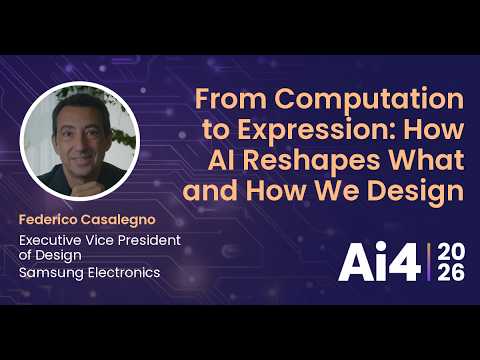
Samsung Abandons Bauhaus Minimalism for Expressive Memphis Hardware
Ai4
Samsung is pivoting from functional minimalism to expressive hardware because algorithmic design tools require human purpose and cultural meaning to avoid empty technological perfection.
## Background
Published on YouTube by the Ai4 channel on August 20, 2026, this video features a presentation by Federico Casalegno, Executive Vice President of Design at Samsung Electronics. The description notes that the talk, titled 'From Computation to Expression: How AI Reshapes What and How We Design,' explores how artificial intelligence is transforming both the tools and the artistic philosophy behind modern product creation.
## TL;DR
Federico Casalegno argues that technology must remain anchored in human-centered purpose rather than raw technical capability, asserting that 'technology without humanity is perfection without purpose.' He outlines Samsung's four-stage computational design framework for wearable devices, which combines AI training with multi-domain simulations across digital twins, robotic rigs, and human testing. Casalegno demonstrates how AI augments creative workflows through automation, product optimization, and accelerated modeling while keeping human judgment at the helm. Finally, he calls for a shift from sterile Bauhaus minimalism toward an expressive, Memphis-inspired design philosophy where form and function follow meaning, emotion, and human connection.
## Atmosphere & style
The presentation maintains a thoughtful, philosophically grounded tone that blends high-level corporate strategy with academic rigor and personal passion. Casalegno speaks with calm, articulate authority, shifting smoothly from technical diagrams of multi-domain robotic testing to evocative discussions of empathy and art. The experience feels both analytical and inspiring, elevating industrial design from a standard engineering exercise into an ethical imperative centered on human love and cultural diversity.
## Key takeaways
- [00:04](https://www.youtube.com/watch?v=GC4tzZlemJo&t=4s) Human-centered design must prioritize people's lifestyles, cultures, and daily struggles over raw technological capabilities.
- [00:04](https://www.youtube.com/watch?v=GC4tzZlemJo&t=4s) Technology without humanity represents perfection without purpose, shifting the critical design question from what technology can do to what it should do.
- [00:51](https://www.youtube.com/watch?v=GC4tzZlemJo&t=51s) Computational design utilizes AI, machine learning, and advanced computing as an engine to systematically design wearable products such as rings, smartwatches, and smart glasses.
- [00:51](https://www.youtube.com/watch?v=GC4tzZlemJo&t=51s) The computational design workflow operates as a cyclical framework moving through data collection, digital twin modeling, KPI definition, AI training, and multi-domain simulation.
- [00:51](https://www.youtube.com/watch?v=GC4tzZlemJo&t=51s) Product validation relies on continuous testing across three domains: digital twin simulations, robotic movement test benches, and physical human ergonomics trials.
- [08:32](https://www.youtube.com/watch?v=GC4tzZlemJo&t=512s) AI transforms the design process across four core dimensions: task automation, computational data access, parameter optimization, and rapid content generation.
- [08:32](https://www.youtube.com/watch?v=GC4tzZlemJo&t=512s) Because AI is opinion embedded into code, human designers must set project KPIs to guide automated generation toward genuine human utility.
- [11:52](https://www.youtube.com/watch?v=GC4tzZlemJo&t=712s) Consumer electronics has over-converged into monochromatic Bauhaus minimalism, failing to reflect the world's inherent diversity and multi-ethnic cultures.
- [11:52](https://www.youtube.com/watch?v=GC4tzZlemJo&t=712s) Samsung is adopting an expressive design philosophy inspired by the 1980s Memphis movement, integrating vibrant color, texture, empathy, and distinct form factors.
- [11:52](https://www.youtube.com/watch?v=GC4tzZlemJo&t=712s) Modern design must transcend the traditional form-versus-function debate to an approach where both form and function follow meaning and purpose.
- [19:13](https://www.youtube.com/watch?v=GC4tzZlemJo&t=1153s) Without human purpose and ethical direction, AI development risks devolving into self-production and hollow technological performance.
## Detailed walkthrough
### [00:04](https://www.youtube.com/watch?v=GC4tzZlemJo&t=4s) Human-Centered Mission and the Core Purpose of Design
Federico Casalegno opens his presentation by laying out the mission of Samsung's Design Innovation Center in San Francisco, where he has led efforts for nearly a decade. He emphasizes that design must remain strictly human-centered. Rather than starting with technological capability alone, the primary objective is to deeply understand human lifestyles, cultures, dreams, aspirations, and daily struggles. Cutting-edge technologies are then applied to craft meaningful experiences and products that assist people throughout their lives.
Casalegno balances technology's rapid advancement with an ethical and philosophical compass: "technology without humanity is perfection without purpose." Drawing on his 20-year background teaching and building research teams at MIT, he stresses that the critical question today is not merely what technology *can* do, but what it *should* do to serve end consumers.
- **Foundational Mission:** Human-centered design prioritizing lifestyle, culture, and human needs over raw technological capability.
- **Philosophical Compass:** "Technology without humanity is perfection without purpose."
- **Core Distinction:** Shifting focus from what technology *can* do to what it *should* do.
[00:51](https://www.youtube.com/watch?v=GC4tzZlemJo&t=51s) The Four-Step Computational Design Framework
Casalegno defines computational design as a method leveraging artificial intelligence, machine learning, and advanced computing to design products—especially wearables like rings, smartwatches, and smart glasses. The process is organized into a tight, cyclical four-stage framework driven by empirical data and user validation.
subgraph S1["Stage 1: Data & Modeling"]
A["3D/4D Data Collection"] --> B["Digital Twins Creation"]
end
subgraph S2["Stage 2 & 3: Goals & Training"]
C["Define KPIs"] --> D["Train AI Models"]
end
subgraph S3["Stage 4: Multi-Domain Simulation"]
E["Digital Twin Simulations"]
F["Robotic Movement Testing"]
G["Physical Human Testing"]
end
B --> C
D --> E
E <--> F
F <--> G
```
The design process cycles continuously across three core simulation domains:
- **Digital Twin Simulations:** Running millions of rapid digital product iterations against synthetic personas.
- **Robotic Simulations:** Translating human motion data (e.g., runners wearing earbuds or watches) into physical robotic test benches for repeatable stress testing.
- **Physical Human Testing:** Validating real-world fit, ergonomics, and sensor performance with real people.
Casalegno underscores that computational design acts as the "engine" of human-centered design—backed by science and validated by data, but always steered by human ethical judgment and clear KPIs (comfort, fit, and sensor accuracy).
[08:32](https://www.youtube.com/watch?v=GC4tzZlemJo&t=512s) How AI Tools Transform the Design Workflow
Addressing industry debates over whether AI empowers or replaces human creative roles, Casalegno outlines four key dimensions where AI tools enhance the design workflow:
1. **Task Automation:** Eliminating repetitive execution tasks, giving designers and engineers more freedom to focus on creative strategy.
2. **Computational Access:** Putting extensive scientific datasets and biomechanical insights directly at the designer's fingertips.
3. **Product Optimization:** Systematically optimizing product geometries and hardware parameters based on precise constraints.
4. **Rapid Content Generation:** Generating strategic reports, visual iterations, images, and digital personas at unprecedented speeds.
He notes that AI is essentially "opinion embedded into code," which makes human guidance essential. Designers must carefully define project KPIs to steer automated generation toward meaningful human utility.
[11:52](https://www.youtube.com/watch?v=GC4tzZlemJo&t=712s) From Bauhaus Minimalism to Expressive "Memphis" Design
Casalegno criticizes the consumer electronics industry's long-standing trend toward absolute minimalism and uniform form factors. While the world is inherently diverse and multi-ethnic, tech product aesthetics have converged into monochromatic, seamless shapes.
Samsung is shifting its design philosophy away from Bauhaus-inspired functional minimalism toward a more expressive design language inspired by the 1980s Italian **Memphis** movement. This approach embraces color, texture, empathy, and distinct form factors to better represent diverse global consumers.
- **Design Philosophy:** "Design is an act of love." Designers are encouraged not to fall in love with the product itself, but to love the people they are designing for.
- **Paradigm Shift:** Moving beyond the classic debate of "form follows function" vs. "function follows form" to a new paradigm where **form and function follow meaning and purpose** (quoting Chief Design Officer Mauro Porcini).
- **Showcase:** Highlights experimental expressive concepts across audio devices, ambient screens, robotic companions, avatars, and personal coaching wearables debuted at Milano Design Week 2026.
Casalegno concludes his talk by urging the audience at the conference in Las Vegas to keep human purpose at the center of technological progress. He cautions that AI development without clear purpose or empathy leads only to "self-production over technological performance." Ultimately, designers must supply the human heart and ethical direction to ensure technology serves genuine real-world needs.
## Notable quotes
> [00:04](https://www.youtube.com/watch?v=GC4tzZlemJo&t=4s) technology without humanity is perfection without purpose. — Federico Casalegno
> [08:32](https://www.youtube.com/watch?v=GC4tzZlemJo&t=512s) opinion embedded into code — Federico Casalegno
> [11:52](https://www.youtube.com/watch?v=GC4tzZlemJo&t=712s) Design is an act of love. — Federico Casalegno
> [11:52](https://www.youtube.com/watch?v=GC4tzZlemJo&t=712s) form and function follow meaning and purpose — Mauro Porcini
> [19:13](https://www.youtube.com/watch?v=GC4tzZlemJo&t=1153s) self-production over technological performance — Federico Casalegno
Federico Casalegno argues that technology must be directed by human-centered purpose rather than raw technical capability, positioning artificial intelligence and computational design as tools that must remain bounded by human ethics and empathy.
Aligning Technological Capability with Human Purpose (0:04)
Casalegno defines the core objective of design as understanding human lifestyles, cultures, and daily struggles before deploying technical capabilities. Drawing on his academic background at MIT and nearly a decade leading Samsung's Design Innovation Center in San Francisco, he argues that the industry's primary question must shift from what technology can do to what it should do, asserting that 'technology without humanity is perfection without purpose.'
Data-Driven Computational Design in Product Engineering (0:51)
To develop wearables like smartwatches, rings, and smart glasses, Casalegno outlines a cyclical four-stage computational design framework powered by AI and machine learning. The workflow transitions from 3D and 4D data collection and digital twin creation to establishing key performance indicators (KPIs) and training AI models.
Validation cycles continuously through three simulation domains: digital twin simulations executing millions of iterations against synthetic personas, robotic test benches translating human movement data (such as runners' biomechanics) into repeatable stress testing, and physical ergonomic and sensor validation with human testers.
Role of AI in Creative Workflow Governance (8:32)
Addressing whether AI displaces human designers, Casalegno categorizes AI's utility into four workflow dimensions: automating repetitive execution tasks, providing immediate access to biomechanical datasets, systematically optimizing hardware geometries, and accelerating visual and persona generation. Describing AI as 'opinion embedded into code,' he emphasizes that human designers must steer systems by defining strict project KPIs to ensure outputs deliver meaningful utility.
Moving from Bauhaus Minimalism to Expressive Design (11:52)
Casalegno criticizes consumer electronics for converging on monochromatic, uniform minimalism, which he views as incompatible with a diverse, multi-ethnic global market. Samsung is shifting toward an expressive visual language influenced by the 1980s Italian Memphis movement, utilizing color, texture, and distinct forms.
Referencing Chief Design Officer Mauro Porcini's principle that form and function follow meaning and purpose, Casalegno points to concept designs debuted at Milano Design Week 2026—including audio gear, ambient screens, robotic companions, avatars, and coaching wearables—as examples of designing for diverse human identities.
Casalegno cautions that developing AI without clear human empathy and purpose risks resulting in 'self-production over technological performance,' contending that human designers must supply the ethical direction necessary for technology to address real-world needs.
## Background
该视频由 Ai4 频道于 2026 年 8 月 20 日发布在 YouTube 平台。内容为三星电子设计执行副总裁 Federico Casalegno 的主题演讲,题为《从计算到表达:AI 如何重塑我们的设计内容与设计方式》,重点探讨了三星如何利用人工智能及前沿工具重构设计流程与产品形态。
## TL;DR
Federico Casalegno 阐述了三星以人为本的设计核心,强调技术必须服务于人类生活与真实需求。他详细拆解了由数据构建、KPI 定义、模型训练及三维模拟构成的“计算设计”工作流,指出 AI 是设计师的强大赋能工具而非替代者。同时,三星正在推动产品设计从单调的包豪斯极简主义转向充满情感与色彩的孟菲斯表达主义,并展示了在音频、屏显及机器人伴侣等领域的未来硬件探索。
## Atmosphere & style
演讲整体呈现出兼具科技前瞻性与深厚人文关怀的基调,既有严谨的工程思维,又充满感性的设计哲学。演讲者以沉稳、富有同理心的叙事风格娓娓道来,将 MIT 时期的学术积淀与工业界的一线探索自然融合。整场分享节奏流畅且富有启发性,在展示前沿硬件概念的同时,引发了听众对技术伦理与设计本质的深刻共鸣。
## Key takeaways
- [00:04](https://www.youtube.com/watch?v=GC4tzZlemJo&t=4s) 人本设计理念的核心在于关注技术“应该做什么”而非“能做什么”,强调没有人性关怀的技术只是没有目的的完美。
- [02:51](https://www.youtube.com/watch?v=GC4tzZlemJo&t=171s) 计算设计是融合人工智能与机器学习的设计方法,通过数据、科学与算法驱动产品体验与形态的创新。
- [02:51](https://www.youtube.com/watch?v=GC4tzZlemJo&t=171s) 计算设计涵盖四大核心步骤:跨维度构建 3D/4D 数字孪生数据集、明确舒适度与精度等 KPI、训练专用 AI 模型、以及开展多维模拟与迭代。
- [02:51](https://www.youtube.com/watch?v=GC4tzZlemJo&t=171s) 计算设计的三大验证支柱为数字孪生模拟、真人用户测试与机器人模拟仿真。
- [08:32](https://www.youtube.com/watch?v=GC4tzZlemJo&t=512s) AI 在设计团队中发挥着四大关键作用:任务自动化、计算与数据支持、产品参数优化以及内容快速生成。
- [08:32](https://www.youtube.com/watch?v=GC4tzZlemJo&t=512s) AI 的本质是“植入代码中的观点”,它无法取代人类设计师,需要设计师主动确立伦理标准与项目目的来引导模型。
- [11:52](https://www.youtube.com/watch?v=GC4tzZlemJo&t=712s) “设计是一种爱”,优秀的设计师不应盲目热爱自己设计的产品本身,而应热爱他们所服务的人群与生活需求。
- [11:52](https://www.youtube.com/watch?v=GC4tzZlemJo&t=712s) 三星设计语言正在从包豪斯功能主义与极简风格转向孟菲斯表达主义,以更丰富多元的色彩和形态打破硬件同质化。
- [11:52](https://www.youtube.com/watch?v=GC4tzZlemJo&t=712s) 现代产品设计理念超越了形式与功能的传统争论,转向践行“形式与功能皆追随意义与目的”。
- [16:10](https://www.youtube.com/watch?v=GC4tzZlemJo&t=970s) 未来硬件形态正向多样化音频设备、艺术化非传统屏幕、数字教练及机器人伴侣等多元智能生态演进。
- [19:13](https://www.youtube.com/watch?v=GC4tzZlemJo&t=1153s) AI 研发与硬件设计必须注入目的与人性温度,避免技术创新沦为对性能指标的盲目追求与自我炫耀。
## Detailed walkthrough
以下是根据演讲内容整理的详细中文逐段导读与记录:
### [00:04](https://www.youtube.com/watch?v=GC4tzZlemJo&t=4s) 人本设计与“无目的的完美”
演讲者、三星电子(Samsung Electronics)设计执行副总裁 Federico Casalegno 概述了本次演讲的核心主旨:展示三星如何运用人工智能及最新工具重新思考设计流程,以及正在开发何种形态的产品。Casalegno 回顾了自约九年前加入三星并主持位于旧金山的三星设计创新中心(Samsung Design Innovation Hub Center)以来的基本使命——深入理解人类的生活方式、文化、梦想与困境,进而利用前沿技术打造卓越的产品体验。
在探讨技术演进时,曾在麻省理工学院(MIT)任教并建立研究团队 20 年的 Casalegno 强调,工作室一直将“没有人性关怀的技术,只是没有目的的完美”(technology without humanity is perfection without purpose)视为指路明灯。他指出,与其关注技术“能做什么”,不如思考技术“应该做什么”以服务于终端消费者。
```mermaid
flowchart TD
accTitle: 三星人本设计理念框架
subgraph Core Mission
A["理解人类与文化"] --> B["发现需求与痛点"]
end
B --> C["运用前沿技术与 AI"]
C --> D["打造人本体验与产品"]
subgraph Ethical Compass
D --> E["赋能人类生活"]
end
```
- **核心使命**:以人本设计(Human-centered design)为中心,将人类情感与需求至于技术研发之前。
- **名言引用**:“没有人性关怀的技术,只是没有目的的完美。”("Technology without humanity is perfection without purpose.")
- **核心论点**:产品设计的重点在于将人性与目的注入技术和产品开发中。
---
### [02:51](https://www.youtube.com/watch?v=GC4tzZlemJo&t=171s) 计算设计的四步演进与三大支柱
Casalegno 深入探讨了“计算设计”(Computational design)的定义及其应用。计算设计是一种应用人工智能、机器学习与先进计算来设计产品与体验的方法,在智能戒指、手表、眼镜等可穿戴设备的研发中尤为关键。该设计流程分为四个主要步骤:数据构建、KPI 定义、模型训练以及模拟迭代。
在第一阶段,团队跨越人口统计学、年龄、性别与种族收集三维与四维(3D/4D)数据,为用户构建精细的数字孪生(Digital Twin)。接着明确项目 KPI(如提升佩戴舒适度、贴合度及传感器测量精准度),并以此训练专用 AI 模型。最终,通过数字孪生进行极速的计算机模拟迭代,并将其与真人用户测试及机器人模拟相结合。
```mermaid
flowchart LR
accTitle: 计算设计四步流程
subgraph Data & Definition
A["1. 构建数据集<br/>(3D/4D 数字孪生)"] --> B["2. 定义 KPI<br/>(舒适度/贴合度/精度)"]
end
subgraph Training & Testing
B --> C["3. 训练 AI 模型"]
C --> D["4. 模拟与迭代<br/>(数字/真人/机器人)"]
end
```
- **计算设计四大步骤**:
1. **数据集构建**:采集跨性别、年龄、种族及活动场景的 3D/4D 数据,生成“数字孪生”。
2. **KPI 明确化**:确立舒适度、贴合度、传感器精度等关键指标。
3. **模型训练**:根据定制化需求训练 AI 工具。
4. **模拟与迭代**:在数字孪生上快速验证数百万个数据点,随后在真人及机器人上进行物理世界测试。
- **计算设计三大支柱**:数字孪生模拟(Digital twin simulation)、真人模拟(Real people simulation)以及机器人模拟(Robotic simulation)。
- **计算设计的本质**:计算设计是 AI 驱动、数据与科学验证的“人本设计引擎”,但始终由设计师的道德指南针所引导。
---
### [08:32](https://www.youtube.com/watch?v=GC4tzZlemJo&t=512s) 人工智能在设计中的四大维度与设计师的主导权
针对 AI 工具是否会取代设计师的行业争议,Casalegno 总结了 AI 在三星设计团队中的四大应用维度:任务自动化、计算支持、产品优化以及内容极速生成。虽然 AI 能够以极快速度输出策略报告、图像、产品变体及数字人(Digital personas),但 Casalegno 强调,AI 的本质是“植入代码中的观点”(opinion embedded into code)。
因此,AI 无法取代人类设计师,设计师必须作为主导者为 AI 提供正确的方向与价值标准,严谨定义项目的 KPI 与目的。
- **AI 工具运用的四大维度**:
- **任务自动化(Task automation)**:自动化执行重复性任务,解放设计师和工程师去从事更具创意的工作。
- **计算支持(Computation)**:让海量科学与数据直达设计师指尖。
- **产品优化(Product optimization)**:根据设定参数自动化优化产品设计。
- **内容极速生成(Fast content production)**:快速生成文本、策略报告、图像、产品变体及数字人。
- **关于 AI 的核心洞察**:“AI 是植入代码中的观点”("AI is opinion embedded into code"),必须由具备明确目的与伦理观的行业设计师来掌控与引导。
---
### [11:52](https://www.youtube.com/watch?v=GC4tzZlemJo&t=712s) 从包豪斯极简主义转向表达主义与孟菲斯风格
Casalegno 指出,当今社会多元包容,但消费电子产品在过去几十年里却陷入了同质化——普遍走向极简主义与无缝化设计,导致消费者难以从形态上辨识差异。他提出“设计是一种爱”(Design is an act of love),强调设计师不应盲目“热爱自己设计的产品”,而应“热爱他们为其设计的人群”。
在设计语言上,三星正在发生重大转变:从受包豪斯(Bauhaus)启发、强调纯粹几何与功能主义的极简设计,转向借鉴 20 世纪 70 年代意大利孟菲斯运动(Memphis Group)的“表达性设计”(Expressive design)。表达性设计更加丰富多彩、具有同理心与多样性。此外,团队超越了经典的“形式追随功能”与“功能追随形式”之争,转而践行三星首席设计官 Mauro Porcini 的观点——“形式与功能皆追随意义与目的”(Forms and function follow the meaning and purpose)。
```mermaid
flowchart TD
accTitle: 设计演进路线图
A["传统设计: 包豪斯极简主义<br/>(功能主义 / 统一形态 / 几何纯粹)"] --> B["设计哲学转变: 设计是一种爱<br/>(以人为本 / 形式与功能追随意义)"]
B --> C["新设计语言: 孟菲斯表达主义<br/>(丰富色彩 / 多样化 / 具同理心)"]
```
- **设计哲学**:“设计是一种爱”(Design is an act of love),产品设计并非艺术家的个人宣泄,而是为赋能大众生活而提供的解决方案。
- **设计范式转移**:从包豪斯(Bauhaus)风格演进至孟菲斯(Memphis)风格,从单调的极简演进至多元、色彩丰富且富有情感共鸣的表达形态。
- **核心设计名言**:引用首席设计官 Mauro Porcini 的理念,强调形式与功能必须服务于产品背后的“意义与目的”(Meaning and purpose)。
---
### [16:10](https://www.youtube.com/watch?v=GC4tzZlemJo&t=970s) 未来产品形态演变:声音、屏显与机器人伙伴
Casalegno 展示了三星在 2026 年米兰设计周(Milano Design Week 2026)上展出的最新产品探索,直观呈现了表达性设计与 AI 技术的融合成果。通过现场视频演示,三星展示了如何重新构想日常生活的各类硬件形态:
在音频领域,AI 与新外形相结合,使音响设备自然融入家居与汽车环境;屏显与显示设备打破了传统方框限制,呈现出更富艺术感的形态;而在更长远的前沿探索中,虚拟化身(Avatars)、个人数字教练、新型可穿戴设备以及机器人伴侣(Robotic companions)正逐步走入现实生活。
- **米兰设计周 2026 展出重点**:
- **音频体验重构**:将 AI 算力与新颖形态结合,打造融合家居与移动场景的下一代听觉产品。
- **多样化屏幕**:超越传统显示屏限制,融入多种生活空间。
- **未来形态**:涵盖虚拟化身、数字教练、机器人伴侣及新型可穿戴设备的多元生态。
---
### [19:13](https://www.youtube.com/watch?v=GC4tzZlemJo&t=1153s) 总结:为 AI 赋予目的与人性
在演讲结语部分,Casalegno 在 Las Vegas 的活动现场(Ai4 展会)向全场观众与前沿 AI 创业团队发出呼吁。他提醒大家,如果 AI 的发展脱离了目的与人性关怀,那么技术突破将仅仅沦为对“技术性能”的自我炫耀(Self-production over technological performance)。设计与研发从业者的职责,就是为技术注入温度、人性与明确的目标。
- **核心呼吁**:AI 开发若缺乏目的与人性,只是对技术性能的盲目追求。
- **终极结语**:设计师与开发者必须将人性关怀与目的性融入产品创作中,使 AI 真正造福人类生活。
## Notable quotes
> [00:04](https://www.youtube.com/watch?v=GC4tzZlemJo&t=4s) 没有人性关怀的技术,只是没有目的的完美。(Technology without humanity is perfection without purpose.) — Federico Casalegno
> [00:04](https://www.youtube.com/watch?v=GC4tzZlemJo&t=4s) 与其关注技术‘能做什么’,不如思考技术‘应该做什么’以服务于终端消费者。 — Federico Casalegno
> [02:51](https://www.youtube.com/watch?v=GC4tzZlemJo&t=171s) 计算设计是 AI 驱动、数据与科学验证的‘人本设计引擎’,但始终由设计师的道德指南针所引导。 — Federico Casalegno
> [08:32](https://www.youtube.com/watch?v=GC4tzZlemJo&t=512s) AI 是植入代码中的观点。(AI is opinion embedded into code.) — Federico Casalegno
> [11:52](https://www.youtube.com/watch?v=GC4tzZlemJo&t=712s) 设计是一种爱。(Design is an act of love.) — Federico Casalegno
> [11:52](https://www.youtube.com/watch?v=GC4tzZlemJo&t=712s) 设计师不应盲目‘热爱自己设计的产品’,而应‘热爱他们为其设计的人群’。 — Federico Casalegno
> [11:52](https://www.youtube.com/watch?v=GC4tzZlemJo&t=712s) 形式与功能皆追随意义与目的。(Forms and function follow the meaning and purpose.) — Mauro Porcini
> [19:13](https://www.youtube.com/watch?v=GC4tzZlemJo&t=1153s) 如果 AI 的发展脱离了目的与人性关怀,那么技术突破将仅仅沦为对‘技术性能’的自我炫耀。 — Federico Casalegno
> [19:13](https://www.youtube.com/watch?v=GC4tzZlemJo&t=1153s) 设计师与开发者必须将人性关怀与目的性融入产品创作中,使 AI 真正造福人类生活。 — Federico Casalegno
## Mentioned
Federico Casalegno, Mauro Porcini, 三星电子 (Samsung Electronics), 三星设计创新中心 (Samsung Design Innovation Hub Center), 麻省理工学院 (MIT), 包豪斯 (Bauhaus), 孟菲斯集团 (Memphis Group), 米兰设计周 2026 (Milano Design Week 2026), Ai4, 旧金山 (San Francisco), 拉斯维加斯 (Las Vegas)
## Video description
Federico Casalegno - Executive Vice President of Design, Samsung Electronics
From Computation to Expression: How AI Reshapes What and How We Design
[Source](https://www.youtube.com/watch?v=GC4tzZlemJo)
Source quotes
[0:04] Federico Casalegno: 没有人性关怀的技术,只是没有目的的完美。(Technology without humanity is perfection without purpose.)
[0:04] Federico Casalegno: 与其关注技术‘能做什么’,不如思考技术‘应该做什么’以服务于终端消费者。
[2:51] Federico Casalegno: 计算设计是 AI 驱动、数据与科学验证的‘人本设计引擎’,但始终由设计师的道德指南针所引导。
[8:32] Federico Casalegno: AI 是植入代码中的观点。(AI is opinion embedded into code.)
[11:52] Federico Casalegno: 设计是一种爱。(Design is an act of love.)
[11:52] Federico Casalegno: 设计师不应盲目‘热爱自己设计的产品’,而应‘热爱他们为其设计的人群’。
[11:52] Mauro Porcini: 形式与功能皆追随意义与目的。(Forms and function follow the meaning and purpose.)
[19:13] Federico Casalegno: 如果 AI 的发展脱离了目的与人性关怀,那么技术突破将仅仅沦为对‘技术性能’的自我炫耀。
[19:13] Federico Casalegno: 设计师与开发者必须将人性关怀与目的性融入产品创作中,使 AI 真正造福人类生活。
Source quotes
[0:04] Federico Casalegno: technology without humanity is perfection without purpose.
[8:32] Federico Casalegno: opinion embedded into code
[11:52] Federico Casalegno: Design is an act of love.
[11:52] Mauro Porcini: form and function follow meaning and purpose
[19:13] Federico Casalegno: self-production over technological performance
Original transcript
[0:04] to share um our approach to um couple of things.
First, how we use AI and latest tool to design
[0:14] our products and secondly our products itself.
So, today um I will start with addressing these
[0:27] two points. Basically, today what I want to
share with you we have about 20 minutes and
[0:31] what I want to share with you is how we apply AI
or latest tools to rethink our process and design,
[0:38] but at the same time what are the type of products
that we are designing. So, I have these couple of
[0:43] topics I would like to share, but first I want
to start basically to communicate the fundamental
[0:49] of our mission. Which is in a nutshell is we
definitely bring forward human-centered design.
[0:57] So, our mission since I joined Samsung about nine
years ago and they defined the mission of our
[1:04] office of Samsung Design Innovation Hub Center in
San Francisco is basically how can we understand
[1:12] people, how we can understand lifestyle and
cultures, how we can understand people dreams,
[1:17] aspirations, problems. And then how you can
craft amazing experiences and design products
[1:26] using of course cutting-edge technologies to
deliver those product experiences that help people
[1:32] throughout their life. So, human-centered
design is definitely our uh mission.
[1:40] And we apply tools to um tools, technologies,
and everything in our hands to deliver those.
[1:48] Um before moving forward, one of the things that
we are always discussing and and using as a as a
[1:55] compass in our studio is this notion that
technology without humanity is perfection
[2:02] without purpose. Which basically means why we have
a team of uh talents that are extremely passionate
[2:11] about technologies and what technology can do. And
we monitor the evolution of technologies on level.
[2:17] I personally have spent 20 years at MIT uh
teaching and creating research teams. So,
[2:25] while technology is amazing, the point today
is more than thinking what technology can do,
[2:32] highest reaching what technology should do in
order to deliver what we need to deliver to the
[2:37] end consumer. So, it's really how do we bring
this humanity? How do we bring this purpose
[2:43] into technological and product development? Having
said that as a that's as a core of our missions,
[2:51] today I have two topics that I want to address.
The first one is computation design, what it
[2:56] is and what we do. And the second one is how are
we thinking expressive design and how do we move
[3:02] forward uh in our journey. So, computational
design. Computational design is basically
[3:11] a method, is a process that apply artificial
intelligence, machine learning, advanced computing
[3:18] to design products to um design products. So,
we really apply those new processes for product
[3:27] development to understand the products and the
experiences of our users. In particular, we design
[3:33] uh wearables, rings, watches, glasses, um and
all the future wearable, you you name it. And uh
[3:42] we have about four uh major uh steps in this
process. The first one is, of course, you need
[3:50] to have um great data. So, build the data set is
that number one. So, we have 3D data and 4D data
[4:02] really across a variety of demographics, gender,
age, ethnicities, across a variety of activities.
[4:11] And by collecting those data, we can create a
digital twin of users that we'll utilize in the
[4:18] next step of our process. So, we're building
we're carefully building a a great database
[4:28] um to create a digital twin of people that will
help us throughout the process. And uh is a very
[4:36] um intense activity, but we really curate the
way we collect data and uh use those data. So,
[4:43] that's step number one. Step number two, we want
to define the KPI. Like, what do you need to do
[4:51] uh with the data? What do you need to do in the
things that you need to do in the project? So,
[4:54] for example, when we design for our wearable,
you need to define uh the KPIs. Like,
[5:01] you know, how what what how do you want
to improve the comfort of the wearable?
[5:06] How do you improve the fit? How do you want
to improve the way our wearables measures
[5:14] and use the sensor and improve accuracy with
a sensor and so on. So, this need to be a very
[5:19] clear definition of the KPIs of the project
and what we need to do. Step number three,
[5:25] of course, we train the models in order to
make sure that we have the right uh tools,
[5:31] the right AIs that really fulfill the purpose of
what we need to do. And finally, the fourth stage
[5:39] is of course, we simulate and iterate. So,
we do lot of simulations in our digital twins
[5:48] in order to verify product variations.
And uh we do it actually very fast.
[5:54] The type of iterations and exploration that we can
do using uh million on data points is incredible
[6:02] today and is only going to improve. And uh
we really simulate on the digital twin first
[6:10] the product iteration that you want to explore or
bring to market. So, that's very important phase.
[6:15] But, also what we do of course, we explore
with real humans. Really trying to understand
[6:22] uh in a physical world how those products fit into
humans. So, we do we do a lot of user testing.
[6:29] And finally, we translate the information from
the digital world into the robots and we use
[6:37] robots as well to simulate. So, if we can record
someone running with the watch or with the buds,
[6:44] then we can see how the buds behave uh
digitally and we can simulate digitally
[6:52] the different different version of one product,
then we can take the movement and what we learn
[6:57] from this aspect and bring it to a robot
and keep iterating and testing, then we take
[7:02] we use it we test with humans and so. So, it's a
very um cyclical process, very highly intensive
[7:10] uh iterative process that refine our work as as
we go. So, I would say that's these four steps
[7:18] in a nutshell are really the the the steps
that define our work across computation design.
[7:24] And uh we do it across all type of products that
we have now and the products that we're thinking
[7:31] to bring to market in the future. So, in a way
um I would say today computation design is um
[7:39] is based on on these three pillars. Um digital
twin simulation, real people simulation, and
[7:46] uh robotic simulation. They work uh harmoniously
toward the same goal. And for me, as I said at
[7:53] the beginning, computational design is one of the
fundamental pillar of the human-centered design.
[7:59] It's really uh the engine. Computational design
is the engine of our human-centered design
[8:07] powered by artificial intelligence, validated by
data, validated by science, but always guided by
[8:14] humans, always guided by the the ethical compass
that our designers have during their their own
[8:23] product development. So, this is to give you a
high-level perspective on on computational design.
[8:32] And I want to spend just a few words about the
tools uh that we're using. Uh I've heard lot
[8:39] of conversation during the this event, and
also yesterday during the panel and about
[8:44] how AI tools can empower or replace designers, can
empower or replace uh work and so on. So, a quick
[8:55] very quick um run through. Uh AI tools are used
in our work at least in in four dimensions. The
[9:03] first one is really to auto um in in task
um automation. You can really automate task
[9:11] um to execute work faster and uh at the larger
scale, removing some of the work from the
[9:20] from the designer or an engineer involved in
the process, and providing more freedom from
[9:25] a different type of task, which is definitely a
little bit more creative or uh different than the
[9:33] simple task as execution. Number two,
computation. Um I've shared how much we um uh
[9:43] computational design is relevant, is
important today to design, especially
[9:47] all our categories of of wearable. And computation
bring at the fingertips fingertips of our designer
[9:55] an amazing amount of data that can be immediately
accessible, uh computationally available.
[10:02] And they can start to design or engineer
products by relying on science, relying on data,
[10:10] and bringing those information back into
the product development. Number three,
[10:15] this notion of product optimization. How do
you optimize uh products development based
[10:21] on parameters that you provide to the system,
that you provide to the machine? So, product
[10:27] optimi- optimization is also very, very important.
And finally, we can produce at the speed of light
[10:34] way more content that we were able to produce
before. You're producing a text, strategic
[10:40] history report on strategy, images, variation of
a products, uh digital personas to work across
[10:47] the design processes, and and so on. So, this
notion of um how much you could produce fast
[10:54] uh is definitely part of of what we uh see
um AI tools helping us moving forward. So,
[11:02] there are a couple of things that I would
like to to highlight. We all know that AI
[11:08] is as we say is opinion embedded into code. So, we
heavily rely on the uh the opinion in a way of our
[11:17] designer to be able to master and manage a AI and
making sure that they provide the right compass,
[11:22] the right direction to the product that we want to
develop. So, in our in our case, um that's why I
[11:30] insisted before in the importance of defining the
API and defining the very precise criteria of KPIs
[11:37] and what we need to design for, the purpose of
our design, what we need to measure and so on. So,
[11:44] that's particularly important and uh
fundamental in our work. Point number two.
[11:52] From computational design to expressive design.
[11:57] Um we're entering into a new phase of design.
And uh somehow we can all agree that there is a
[12:07] uh we live in a diverse world, multi-ethnicity, uh
multi- There there is a a diverse world under our
[12:16] eyes, but somehow consumer electronics
went to only one way, basically. Uh
[12:25] pure minimalism, uh seamless products where we
reached the point which is very hard to design
[12:33] for to to understand or see diversity of products
when we when we try to make our own choices.
[12:42] We see that the people we're designing for,
as I said, are definitely um diverse. [music]
[12:53] What's up, everybody? Welcome to my channel.
[13:03] So,
[13:11] [music]
[13:12] so in a way we've been spending a lot
of our past couple of decades, for sure,
[13:17] to see how progressively the semantic, the
language of the design and the products that we
[13:24] bring to the table is going to a convergence into
a more minimalist and and pure form factor. Um
[13:32] we see things slightly different. Design is an
act of love. We see design as an act of love uh
[13:38] because in a way is as I said before, our mission
is to understand people and design design products
[13:46] experiences for those people. When I started uh my
journey in Samsung for example, I used to say my
[13:52] teams, "Do not love the product you're designing
for. Love the people you're designing first."
[13:59] Of course, they need to design the to love the
product they're designing the experiences that
[14:02] they're designing. But the you know, product
design in our case is not an artistic expression
[14:09] of um an artist. It's really how do
you understand people and how do you
[14:15] come up with ideas and solutions that empower
people to go throughout their their own life. So,
[14:21] design is act of love is definitely our North Star
in a way. And uh we're today shifting into design
[14:30] language which is definitely shifting from the
language uh that was somehow inspired by Bauhaus,
[14:39] minimalist, pure form factor, um from colors
and shapes and really functional form factor,
[14:47] we're shifting into what we say a Memphis design
which is a a design movement started in Italy in
[14:53] the '70s which is basically way more expressive,
colorful, empathetic, diverse. Not the Bauhaus,
[15:00] nothing to say against the Bauhaus. The Bauhaus is
amazing. But what we're saying is that uh we need
[15:06] to provide a variety of options for a diverse uh
uh set of consumers and for a diverse population.
[15:16] So, basically we are no longer going into
the for those who are designers, those uh
[15:23] will recognize the the never-ending debate between
forms follow function versus function follow
[15:30] forms. But it's really how do you understand
forms and function that follow the meaning,
[15:36] the follow the purpose. That was In my
opinion, this is one of the quote from our
[15:41] chief design officer, Mauro Porcini. And
again, purpose is the compass and everything
[15:48] that is going to be embodied into products and
experiences need to provide, need to empower,
[15:55] or achieve the purpose we're designing for.
So, the form of the products and the function
[16:00] of the product need to definitely support the
meaning of it. By doing that, I will show first a
[16:10] a video very briefly about products that
we have presented in the Milano Design Week
[16:17] in April. We basically start to see the variety
of design and exploration that we are doing.
[16:25] And this was Milano Design Week 2026. [music]
[16:35] [music]
[16:43] [music]
[16:50] So, we see definitely we we started to bring
to life a variety of products that not only
[16:56] somehow utilize the AI in the process
of design and developing those products,
[17:00] but really start to think differently the the type
of products that we want to bring to the attention
[17:05] and into the hands of consumers. So, think only
the audio experience, for example. What can you
[17:12] think about the audio? The audio is changing
tremendously. da da [music] Da da da da da da
[17:19] [singing and music]
[17:27] [music]
[17:30] [singing]
[17:34] [music] [singing]
[17:41] So, there are incredible possibilities if
you want to reimagine the way audio function,
[17:46] the way audio products are waving to our everyday
life, into our homes, uh, cars, uh, and life,
[17:54] basically. So, by bringing together the power of
of artificial intelligence, advanced computing,
[18:00] and new form factor, there is a definitely a
wonderful playground for the creative talent
[18:06] that want to think uh, the next level of audio
experiences. The same we can see for screens. See.
[18:12] [music]
[18:19] [music]
[18:26] [music]
[18:33] So, variety of products that can
go into our everyday life. Um.
[18:40] Let me go, finally, um, a variety of products that
[music] we can think uh, even more futuristically,
[18:48] um, digital presence, avatar, uh, personal [music]
coaches, new forms of wearables, and so on, that
[18:54] can really be brought to market and [music] uh,
uh, be part of our everyday life. Um, including
[19:05] uh, robotic companions, and including everything.
So, I will uh, Uh, go towards my my conclusion,
[19:13] and I would say there are at least couple of
messages that I would love you to walk away with.
[19:18] Definitely is this notion of design is an act
of love. Designer are definitely designing for
[19:25] for the end consumers and we trying to embed our
passion and purpose into the products we design.
[19:35] And uh
[19:40] [music]
[19:41] And finally, um, the the the the the
message once again is technology without
[19:47] humanity is perfection without purpose and
I think is very relevant uh by being here
[19:53] uh in this amazing uh event in Las Vegas where we
are all seen emerging startups, emerging products,
[20:01] all focusing on AI, but AI development without
purpose, without humanity is always and only
[20:09] self- production over the technology technological
performance. So, it's up to us to bring this level
[20:15] of humanity uh and bring the purpose into
what we design. I think I will stop here.
[20:22] And I thank you for your attention. [applause]