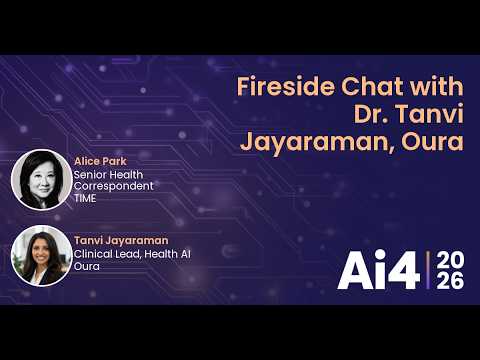
Oura Connects Health Records and Telehealth to Close Clinical Care Loop
Ai4
By combining continuous biometric tracking with electronic health records and in-app physician access, Oura is transforming passive wellness monitoring into an integrated system capable of guiding medical diagnoses and treatments.
## Background
Published on YouTube by Ai4 on August 22, 2026, this fireside chat features TIME Senior Health Correspondent Alice Park interviewing Dr. Tanvi Jayaraman, Clinical Lead for Health AI at Oura. The session explores how Oura develops clinically grounded, personalized AI experiences by combining continuous biometric data with longitudinal trends, specialized large language models, and robust clinical safety guardrails.
## TL;DR
Dr. Tanvi Jayaraman outlines Oura's technical and clinical roadmap, spotlighting the Oura Ring 5 hardware, GLP-1 tracking, and early detection tools under Health Radar. She explains how Oura Advisor acts as an LLM intelligence layer that synthesizes continuous biometrics, Electronic Health Records (EHRs), and uploaded lab reports while strictly enforcing wellness boundaries through synthetic testing and in-house clinician oversight. The discussion also highlights Oura's partnership with Counsel Health to enable closed-loop clinical care via in-app physician consultations, ultimately driving a paradigm shift from reactive sick care to proactive health management while maintaining strict user data ownership.
## Atmosphere & style
The conversation carries an engaging, intellectually rigorous, and professional tone, driven by Alice Park's sharp, inquisitive moderating and Dr. Jayaraman's poised clinical authority. The dialogue moves fluidly between complex technical validation—such as synthetic patient testing and PPV benchmarks—and accessible, human-centered analogies, like framing health data as a continuous movie rather than a single clinical snapshot. Watching the exchange feels like an intimate, pragmatic masterclass in bridging consumer wearable tech with serious medical responsibility.
## Key takeaways
- [00:04](https://www.youtube.com/watch?v=0eMRQc5hncg&t=4s) The Oura Ring 5 form factor was reduced by 40% to encourage continuous, seamless wear, launching alongside specialized GLP-1 insights for metabolic tracking.
- [02:18](https://www.youtube.com/watch?v=0eMRQc5hncg&t=138s) Oura's Health Radar acts as a non-diagnostic early warning system, using baseline physiological deviations to detect impending viral illness, blood pressure signals, and nighttime breathing changes.
- [04:19](https://www.youtube.com/watch?v=0eMRQc5hncg&t=259s) Algorithm rigor relies on over 40 PhDs and in-house clinicians evaluating data across 5 million rings, benchmarked by temperature sensors that achieve 99% accuracy against medical thermometers.
- [04:19](https://www.youtube.com/watch?v=0eMRQc5hncg&t=259s) Oura Advisor operates as an in-app LLM platform that synthesizes longitudinal biometric trends with member-logged context (such as medication side effects) to provide personalized health education.
- [08:10](https://www.youtube.com/watch?v=0eMRQc5hncg&t=490s) To enforce safe boundaries, active medical practitioners design decision trees that are tested against synthetic patient profiles to ensure the AI never diagnoses or prescribes.
- [10:29](https://www.youtube.com/watch?v=0eMRQc5hncg&t=629s) Continuous wearable data captures the ongoing 'movie' of daily life between infrequent clinical visits, providing essential context that isolated medical appointments miss.
- [10:29](https://www.youtube.com/watch?v=0eMRQc5hncg&t=629s) Through a partnership with Counsel Health in Oura Labs, licensed physicians can enter the chat, evaluate longitudinal wearable data, diagnose, and feed clinical outcomes back into the Oura profile.
- [14:59](https://www.youtube.com/watch?v=0eMRQc5hncg&t=899s) Hallucination prevention and AI safety are maintained by grounding responses in vetted medical literature and automatically triggering escalation recommendations for potential clinical conditions.
- [18:40](https://www.youtube.com/watch?v=0eMRQc5hncg&t=1120s) Oura integrates electronic health records (EHR) and uploaded PDF lab results with continuous sensor data, enabling the AI to identify trends and prepare users for informed doctor visits.
- [20:25](https://www.youtube.com/watch?v=0eMRQc5hncg&t=1225s) Members maintain full data ownership and agency, retaining the ability to revoke EHR access, customize granular sharing permissions, or delete their profile data at any time.
- [20:25](https://www.youtube.com/watch?v=0eMRQc5hncg&t=1225s) The ultimate objective of integrating continuous biometrics with clinically grounded AI is driving a transition from reactive 'sick care' to proactive, long-term health management.
## Detailed walkthrough
### [00:04](https://www.youtube.com/watch?v=0eMRQc5hncg&t=4s) Hardware Evolution and New Health Software: Introducing Oura Ring 5 and GLP-1 Insights
Alice Park opens the session by taking an informal poll of the audience to see who is wearing an Oura Ring, setting an engaging, conversational tone before turning to Dr. Tanvi Jayaraman, the Clinical Lead for Health AI at Oura. Dr. Jayaraman explains that her role centers on directing Oura's health AI strategy and shaping software features to deliver clinically grounded experiences. Hardware and software advancements go hand-in-hand; for clinicians, data is most actionable when it is uninterrupted and complete. In response to long-standing user requests for a more discreet form factor, Oura launched the Oura Ring 5 (O5), which is 40% smaller than previous iterations, making it substantially more seamless, comfortable, and "forgettable" on the finger.
Alongside the smaller hardware form factor, Oura introduced software features tailored to metabolic health. Driven directly by community feedback—including discussions on Reddit from members seeking to understand how their biometrics fluctuate when taking metabolic medications—Oura rolled out GLP-1 insights. This tool helps users track and interpret biometric shifts that coincide with GLP-1 therapy, bridging everyday user curiosity with actionable physiological data.
- The Oura Ring 5 hardware is 40% smaller than previous generations to maximize continuous wear and data completeness.
- GLP-1 insights feature launched on O5 to assist members diagnosed with metabolic health conditions in tracking biometrics alongside medication usage.
---
[02:18](https://www.youtube.com/watch?v=0eMRQc5hncg&t=138s) Health Radar and Early Detection: From TemPredict to Blood Pressure and Nighttime Breathing
Dr. Jayaraman details the evolution of Oura’s predictive software under the umbrella of "Health Radar," which builds on the earlier "Symptom Radar" capability. Symptom Radar was initially designed to alert members to major physiological signs two to three days prior to the noticeable onset of viral illnesses, such as upper respiratory infections. The foundation for this capability emerged during the COVID-19 pandemic through the TemPredict study conducted in collaboration with the University of California, San Francisco (UCSF), which demonstrated that biometric anomalies could reliably signal impending illness before individuals felt symptomatic.
With the release of O5, Oura broadened these early alert tools into a broader suite of Health Radar features. These include blood pressure signals and nighttime breathing analysis, which evaluates 30 days of continuous respiratory data to detect baseline deviations. Dr. Jayaraman emphasizes that all Health Radar features are strictly non-diagnostic wellness tools designed to function as an early warning system:
> "All of these are wellness features. They're not meant to diagnose. They're not meant to treat, but they are meant to kind of be that check engine light for our members to see if there's something that they should kind of be aware of or go speak to their doctor about."
- **TemPredict Study with UCSF:** Validated biometric detection of viral illness onset 2 to 3 days prior to clinical symptoms.
- **Nighttime Breathing Feature:** Assesses rolling 30-day baseline deviations in respiratory patterns during sleep.
- **Blood Pressure Signals:** Provides non-diagnostic wellness signals to alert members to cardiovascular pattern shifts.
---
[04:19](https://www.youtube.com/watch?v=0eMRQc5hncg&t=259s) Algorithm Rigor, Clinical Accuracy, and Oura Advisor as an LLM Platform
Addressing how AI detects subtle physiological signals across vast populations, Dr. Jayaraman highlights the scientific foundation supporting Oura’s features. With over 5 million rings sold, Oura's team of more than 40 PhD algorithm specialists and practicing clinicians continuously analyzes datasets to measure positive predictive value (PPV), false positive rates, and false negative rates before shipping any feature. For instance, the core temperature sensor achieves 99% accuracy when benchmarked against medical-grade thermometers, providing high-fidelity inputs alongside respiratory rate and resting heart rate.
Beyond baseline algorithmic tracking, Oura introduced Oura Advisor, an LLM-driven platform feature embedded directly within the app. Rather than a telehealth interface, Advisor acts as an intelligent conversational layer that synthesizes multidimensional biometric trends with user-provided context. For members managing GLP-1 therapies, Advisor can ingest logged side effect tags, correlate them with shifts in heart rate variability (HRV), and deliver targeted educational explanations while maintaining clear boundaries around medical advice.
```
+------------------------------------------------------------------+
| Oura Ring Hardware |
| (99% Accurate Temp Sensor, Resting Heart Rate, HRV, Breathing) |
+---------------------------------+--------------------------------+
|
v
+------------------------------------------------------------------+
| Algorithm & Signal Layer |
| (40+ PhDs Evaluating PPV, False Positives/Negatives) |
+---------------------------------+--------------------------------+
|
v
+------------------------------------------------------------------+
| Oura Advisor (LLM Engine) |
| * Pulls longitudinal biometric trends (HRV, Sleep, Temp) |
| * Integrates member-logged context (GLP-1 side effects) |
| * Synthesizes tailored health education and context |
| * Detects boundary violations -> Escalates to clinical care |
+------------------------------------------------------------------+
```
- Over 40 algorithm PhDs and in-house clinicians evaluate features continuously prior to launch.
- Over 5 million Oura rings sold worldwide provide the basis for longitudinal signal analysis.
- Oura temperature sensors maintain a 99% accuracy correlation with medical-grade thermometers.
- Oura Advisor operates as an in-app LLM that interprets complex metric correlations, such as dose adjustments relative to HRV fluctuations.
---
[08:10](https://www.youtube.com/watch?v=0eMRQc5hncg&t=490s) Clinical Guardrails, Synthetic User Testing, and the Role of In-House Practitioners
When Alice Park probes into how Oura determines when an AI interaction must transition from wellness guidance to clinical escalation, Dr. Jayaraman explains that clinical safety starts with active medical practitioners on staff. Oura’s clinical team includes nurse practitioners and an OB-GYN serving as the Clinical Director of Women's Health. Because these clinicians actively treat patients who bring wearable data into clinical visits, they possess firsthand understanding of how to establish safe medical boundaries, avoid untrusted "Dr. Google" or generic LLM misinterpretations, and provide trustworthy educational framing.
To operationalize these boundaries, Oura employs an "outside-in" clinical guardrail design paired with a "ground-up" synthetic testing pipeline:
1. Clinicians design formal decision trees determining which patient presentations fall strictly within education and which necessitate physician handoff.
2. The engineering team builds complex synthetic patient profiles representing diverse demographic traits, chronic conditions, and medication regimens.
3. Features are subjected to rigorous QA evaluation across these synthetic scenarios to verify that the LLM consistently refuses to diagnose, prescribe, or adjust medications, reliably triggering escalation when queries exceed wellness parameters.
---
[10:29](https://www.youtube.com/watch?v=0eMRQc5hncg&t=629s) Expanding Beyond Passive Data: Partnering with Counsel Health to Deliver Closed-Loop Care
Alice Park notes that health AI is shifting away from passive scribing or data collection toward active decision support. Dr. Jayaraman frames Oura’s philosophy around the scope of general practice: clinicians must understand foundational health while recognizing when specialized care is needed. She uses the metaphor of patient life as a film:
> "You think about your life... it's as a movie. The doctor's visit is maybe just a frame or a snapshot in time in that movie and there's so much of life that happens in between and so much data that we as wearables get to collect in that time."
To bridge the gap between continuous wearable insights and clinical intervention, Oura launched a partnership with Counsel Health within Oura Labs. When opted in, members can communicate directly with licensed physicians who enter the in-app AI chat. These physicians review the user's longitudinal Oura data, provide medical evaluations, and diagnose or prescribe treatments natively. With member consent, clinical decisions made during these interactions flow directly back into the Oura profile, establishing a closed-loop system where medical care and daily biometric tracking inform one another seamlessly.
- **Counsel Health in Oura Labs:** In-app integration enabling licensed physicians to enter the chat, evaluate continuous Oura data, diagnose, and prescribe.
- **Closed-Loop Data Integration:** Care decisions and clinical outcomes from Counsel Health interactions are consented to feed back into the member's native Oura profile.
---
[14:59](https://www.youtube.com/watch?v=0eMRQc5hncg&t=899s) AI Safety, Hallucination Prevention, and Individualized Insights with Health Records
Addressing industry-wide concerns regarding generative AI hallucinations and unconstrained autonomy in clinical settings, Dr. Jayaraman details Oura’s validation infrastructure. The clinical and AI teams test hundreds of potential member query categories against data-aware, closed-loop backends before shipping updates.
Taking nighttime breathing as a case study, Dr. Jayaraman explains how the system manages inquiries about conditions like insomnia or sleep apnea. When a member exhibits deviations from their 30-day baseline and asks about potential sleep disorders, Advisor must:
- Accurately pull 30-day longitudinal breathing, sleep, and cardiovascular metrics.
- Ground its conversational context in vetted medical literature.
- Maintain wellness boundaries by providing objective education while instantly triggering escalation alerts advising the user to consult their clinical team.
Park concludes the segment by asking about the integration of Electronic Health Records (EHRs). Dr. Jayaraman notes that incorporating EHR records alongside daily lifestyle variables—such as dietary habits or evening caffeine intake—allows Oura’s AI to deliver highly individualized contextual explanations for why specific disruptions occur (such as waking up at 3:00 a.m.), moving far beyond one-size-fits-all health advice.
[18:40](https://www.youtube.com/watch?v=0eMRQc5hncg&t=1120s) Integrating EHR Data, Lab Results, and Continuous Biometrics
Dr. Tanvi Jayaraman explains that delivering hyper-personalized health insights requires moving beyond the generic answers often found online by leveraging Oura's multi-layered data ecosystem. In addition to continuous biometric data collected by the ring, Oura now integrates members' electronic health records (EHR). This brings in crucial clinical context, such as past medical history, active chronic conditions, prescribed medications, and established treatment plans. Furthermore, Oura has expanded beyond its integrated Oura Health Panel partnership with Quest Diagnostics by allowing members to upload PDF lab reports directly from any provider or diagnostic center into the platform.
Connecting these diverse clinical and continuous lifestyle streams into a single intelligence platform creates immense complexity, making rigorous back-end testing and clinical evaluation essential before rolling out new capabilities. Dr. Jayaraman notes that while the AI must strictly remain "in the wellness lane," it leverages this broader context to act as an informed, proactive coach. For instance, if a user has a diagnosed condition like hypertension, takes specific medications, and experiences atypical sleep patterns over a 30-day window, the AI can synthesize those data points, spot meaningful correlations, and suggest relevant follow-up questions. This equips members with comprehensive summaries and actionable questions to share directly with their clinical care teams, transforming passive monitoring into higher-yield medical conversations.
- **Data Sources Synthesized**: Continuous Oura ring biometrics, electronic health records (past history, active conditions, medications, treatment plans), and uploaded PDF lab results from any diagnostic provider.
- **Role of the AI**: Acts as an intuitive health coach that identifies monthly trends and prompts members to ask informed questions during clinical appointments.
- **Safety Boundaries**: Rigid back-end clinical testing to ensure advice stays safely within the wellness realm rather than crossing into unauthorized diagnosis or treatment.
[20:25](https://www.youtube.com/watch?v=0eMRQc5hncg&t=1225s) Data Privacy, Consent Flows, and User Ownership
As the fireside chat draws to a close, Alice Park raises a critical question regarding privacy and data governance: once a member connects their electronic health record, does the AI automatically reference that medical data for every query, or can users toggle access on a prompt-by-prompt basis?
Dr. Jayaraman clarifies that once a member navigates the initial consent flows to enable EHR integration, that context is broadly accessible across the app's intelligence platform to maintain consistent understanding. However, selective data-sharing controls do exist in specific domains, such as specialized women’s health features where users can selectively toggle integrations on or off. Most importantly, Dr. Jayaraman underscores that Oura places full data ownership and agency in the hands of the member. Users retain complete control to revoke integration consent, modify permissions in their settings, or request full data deletion at any time.
Alice Park concludes the session by thanking Dr. Jayaraman, expressing optimism about the role AI-driven platforms like Oura play in empowering individuals and accelerating the paradigm shift from reactive "sick care" toward proactive prevention and long-term wellness.
- **Persistent vs. Selective Access**: EHR data remains consistently active across general AI interactions once consented to, while certain modules (e.g., select women's health tools) allow granular opt-ins.
- **User Ownership**: Members maintain the right to revoke consent, adjust integration settings, or delete profile data at will.
- **Core Vision**: Transitioning healthcare from reactive sick care toward proactive, prevention-focused personal health management.
## Notable quotes
> [02:18](https://www.youtube.com/watch?v=0eMRQc5hncg&t=138s) All of these are wellness features. They're not meant to diagnose. They're not meant to treat, but they are meant to kind of be that check engine light for our members to see if there's something that they should kind of be aware of or go speak to their doctor about. — Dr. Tanvi Jayaraman
> [10:29](https://www.youtube.com/watch?v=0eMRQc5hncg&t=629s) You think about your life... it's as a movie. The doctor's visit is maybe just a frame or a snapshot in time in that movie and there's so much of life that happens in between and so much data that we as wearables get to collect in that time. — Dr. Tanvi Jayaraman
## Mentioned
Dr. Tanvi Jayaraman, Alice Park, Oura, TIME, Ai4, Oura Ring 5, Oura Advisor, Health Radar, Symptom Radar, TemPredict, University of California, San Francisco (UCSF), Counsel Health, Oura Labs, Quest Diagnostics, Oura Health Panel, GLP-1, Reddit
## Video description
Alice Park - Senior Health Correspondent, TIME
Tanvi Jayaraman - Clinical Lead, Health AI, Oura
As health AI moves beyond one-size-fits-all systems, the opportunity is to build experiences that are more personalized, context-aware, and clinically grounded.
In this session, Dr. Tanvi Jayaraman will share how Oura is building clinically grounded AI experiences that combine continuous biometric data with a deeper understanding of physiology, life stages, and longitudinal trends to deliver more personalized guidance.
She’ll discuss how this work comes to life within Oura Advisor, including the development of a women-specific large language model, while also exploring how Oura is applying similar principles more broadly to make health AI more useful, trustworthy, and relevant across different health contexts.
Attendees will also get a closer look at the clinical and technical considerations behind building responsible health AI, including privacy, equity, and what it takes to create systems that are accurate, trustworthy, and useful in real-world care conversations.
Dr. Tanvi Jayaraman of Oura argues that combining miniaturized hardware, algorithmically validated biometrics, and generative AI can transform passive continuous monitoring into an actionable, non-diagnostic wellness guide. While maintaining strict boundaries against autonomous medical advice, Oura is bridging everyday wearable data with clinical care through electronic health record integration and closed-loop physician partnerships.
Hardware Miniaturization and Predictive Wellness Signals (0:04)
Clinical utility relies on uninterrupted biometric capture, prompting Oura to make the Oura Ring 5 hardware 40% smaller than previous generations to promote continuous wear. Building upon the UCSF TemPredict study, which demonstrated that biometric anomalies could signal viral illness onset two to three days before clinical symptoms emerge, Oura expanded its early detection software into the 'Health Radar' suite.
Health Radar incorporates non-diagnostic wellness metrics, such as blood pressure pattern indicators and nighttime breathing analysis evaluating 30-day rolling baseline deviations. Dr. Jayaraman emphasizes that these capabilities are not diagnostic or treatment tools, but rather function like a vehicle's 'check engine light' to alert members when they should consult a physician.
Algorithmic Verification and LLM Context Synthesis (4:19)
To analyze physiological patterns across more than 5 million rings sold, Oura relies on an in-house team of practicing clinicians and over 40 algorithm PhDs who evaluate positive predictive value, false positives, and false negatives before releasing features. As an example of baseline accuracy, Oura's temperature sensor correlates at 99% accuracy when benchmarked against medical-grade thermometers.
On top of this algorithmic foundation, Oura deployed Oura Advisor, an in-app LLM conversational layer that synthesizes multidimensional biometric trends with user-provided context. For members tracking metabolic health or GLP-1 therapies, Advisor correlates logged medication side effects with biometric shifts like heart rate variability (HRV), delivering educational context while maintaining boundaries around clinical prescribing or dosing advice.
Clinical Safety Guardrails and Synthetic Validation (8:10)
To prevent generative AI hallucinations and medical overreach, Oura relies on active medical practitioners on staff—including nurse practitioners and an OB-GYN clinical director—to design formal decision trees separating educational guidance from mandatory physician escalations. These practitioners use their direct clinical experience to establish boundary protocols that prevent users from receiving unvetted medical interpretations.
Engineering teams implement these boundaries through an 'outside-in' and 'ground-up' synthetic testing pipeline. The system evaluates the LLM against hundreds of query categories using synthetic patient profiles representing diverse demographic traits, chronic conditions, and medication regimens. This quality assurance process verifies that the AI consistently refuses to diagnose, prescribe, or alter medications, reliably directing users to clinical care when queries exceed wellness boundaries.
Closed-Loop Care Delivery and Multimodal Records (10:29)
Addressing the limitation of doctor visits as isolated snapshots in a patient's broader life, Oura introduced a partnership with Counsel Health in Oura Labs to establish closed-loop clinical care. Opted-in members can consult directly within the app with licensed physicians who review longitudinal Oura biometrics, diagnose conditions, and issue prescriptions, with care decisions consented to flow back into the member's profile.
To contextualize daily biometrics, Oura integrates electronic health records (EHR) covering medical histories, conditions, and treatment plans, alongside user-uploaded PDF lab results from any diagnostic provider. Combining clinical history with continuous 30-day biometric data and lifestyle inputs allows the AI to provide personalized explanations for disruptions and equip users with informed questions for their healthcare providers.
Oura positions its integrated platform as an accelerator for shifting healthcare from reactive treatment to proactive wellness, but notes that deeper EHR integration requires careful privacy governance. Dr. Jayaraman explains that while consented EHR data remains broadly active across the intelligence platform to preserve context, specific areas like women's health offer granular opt-ins, and users retain complete ownership to revoke consent, adjust permissions, or delete data at any time.
## Background
本内容由频道 Ai4 于 2026 年 8 月 22 日在 YouTube 平台发布,记录了《时代》周刊资深健康记者 Alice Park 与 Oura 健康 AI 临床负责人 Tanvi Jayaraman 博士展开的炉边谈话。视频简介指出,本次讨论聚焦于健康 AI 如何摆脱“一刀切”模式,通过融合连续生物体征数据、生理学理解与长期趋势,构建具有临床依据、高度个性化且负责任的健康 AI 体验与产品功能(如 Oura Advisor 等)。
## TL;DR
本次炉边对谈深入探讨了 Oura 如何从传统硬件追踪器演进为主动式健康与临床决策支持平台。Jayaraman 博士分享了硬件轻量化 40% 对长期体征采集的价值,并介绍了基于大规模临床研究(如 TemPredict)落地的健康雷达、GLP-1 药物洞察及夜间呼吸异常预警等功能。此外,对话重点拆解了原生大语言模型体验 Oura Advisor 的技术与安全架构,包括引入一线医生制定安全红线、合成数据压力测试、整合电子病历(EHR)与第三方化验单,以及与 Council Health 合作打造 App 内闭环诊疗体验,最终推动医疗健康体系从被动“治病”向主动“预防”转型。
## Atmosphere & style
整场炉边谈话节奏明快且极具专业深度,开场由主持人的幽默互动轻松破冰,随后迅速切入前沿医学工程与严谨算法的交汇点。Alice Park 以敏锐的媒体视角层层追问 AI 安全性、幻觉防范与隐私归属,而 Jayaraman 博士则以兼具临床医生与技术负责人的双重视角沉稳作答,大量运用“整部电影与单帧快照”、“发动机故障灯”等生动比喻。听感上既有严谨硬核的医学工程质感,又充满对以患者为中心、重塑预防医学未来的理性乐观与前瞻洞见。
## Key takeaways
- [00:04](https://www.youtube.com/watch?v=0eMRQc5hncg&t=4s) 新一代 Oura 戒指通过将硬件体积缩小 40% 实现无感佩戴,极大提升了长期佩戴率与连续体征数据的采集完整度。
- [00:04](https://www.youtube.com/watch?v=0eMRQc5hncg&t=4s) 针对代谢健康需求,Oura 推出 GLP-1 Insights 及健康雷达(Health Radar)功能矩阵,推动产品从被动记录向主动健康趋势洞察转型。
- [02:18](https://www.youtube.com/watch?v=0eMRQc5hncg&t=138s) 与加州大学旧金山分校(UCSF)合作的 TemPredict 研究证实,戒指能够在上呼吸道感染临床症状出现前 2 至 3 天发出体征异常预警。
- [02:18](https://www.youtube.com/watch?v=0eMRQc5hncg&t=138s) Oura 将监测功能严格定位于健康生活方式(Wellness)而非医学诊断,扮演类似汽车“发动机故障灯”的预防性警示角色。
- [04:53](https://www.youtube.com/watch?v=0eMRQc5hncg&t=293s) 依托 40 多位算法博士与在职临床医师,结合体温监测达到医用级 99% 的硬件精度,Oura 为算法模型提供了高可靠性的底层支撑。
- [04:53](https://www.youtube.com/watch?v=0eMRQc5hncg&t=293s) 基于大语言模型(LLM)的 Oura Advisor 能够原生连接客观时序生理数据与主观症状标签,用通俗语言提供高上下文的健康教育解答。
- [08:10](https://www.youtube.com/watch?v=0eMRQc5hncg&t=490s) 为划定安全红线,一线临床医生团队建立了严格的分诊决策树与合成用户数据压力测试集,严禁 AI 越界开药、改剂量或下达诊断。
- [08:10](https://www.youtube.com/watch?v=0eMRQc5hncg&t=490s) 健康 AI 正在经历行业范式转变,从最初的语音听写、数据记录与摘要生成,加速演进为深度介入的主动型临床决策支持(Decision Support)。
- [11:31](https://www.youtube.com/watch?v=0eMRQc5hncg&t=691s) 临床就医仅是人生的“单帧快照”,可穿戴设备则记录了连续生活的“整部电影”,其核心价值在于弥合两次看诊之间的漫长数据空白。
- [13:05](https://www.youtube.com/watch?v=0eMRQc5hncg&t=785s) Oura 与 Council Health 展开深度合作,支持用户在 App 内部直接与执业医生连线进行诊断与开方,形成数据回流的闭环原生体验。
- [15:00](https://www.youtube.com/watch?v=0eMRQc5hncg&t=900s) 系统在回答中精准结合历史趋势与医学文献,一旦用户提问触及疾病诊断等医疗红线,会立即触发拦截机制并建议咨询临床医生。
- [18:05](https://www.youtube.com/watch?v=0eMRQc5hncg&t=1085s) Oura 支持导入电子病历(EHR)和任意机构的化验单 PDF,使 AI 能够结合既往病史、用药清单与睡眠呼吸数据,扮演全方位的个性化健康教练。
- [20:25](https://www.youtube.com/watch?v=0eMRQc5hncg&t=1225s) 在数据隐私方面,Oura 将最终控制权交还给用户,支持随时撤销 EHR 授权、关闭数据整合以及彻底删除个人档案数据。
- [22:06](https://www.youtube.com/watch?v=0eMRQc5hncg&t=1326s) 健康 AI 的深远潜力在于打破传统只在患病后介入的“疾病治疗”(sick care)局限,全面迈向全生命周期主动预防的健康管理生态。
## Detailed walkthrough
### [00:04](https://www.youtube.com/watch?v=0eMRQc5hncg&t=4s) Oura 新一代硬件迭代与健康软件生态拓展
对谈在《时代》周刊资深健康记者 Alice Park 的幽默互动中开场。她首先询问现场有多少人正佩戴着 Oura 智能戒指,随后引出 Oura 最新发布的硬件迭代。Oura 健康 AI 临床负责人 Tanvi Jayaraman 博士介绍,她的核心职责是统筹推进 Oura 产品的 AI 健康战略及相关软件功能的落地。从临床医学的角度来看,最有价值的数据莫过于具备连续性与完整性的体征数据。过去数年间,用户对于每代硬件最普遍的诉求便是"能否做得更小巧一点"。新一代硬件将体积缩小了 40%,这种极致的轻量化带来了显著的无感佩戴体验,使用户几乎感受不到戒指的存在,从而极大提高了长期佩戴与连续数据采集的完成度。
伴随新硬件的推出,Oura 进一步向深水区的健康管理领域迈进,推出了多项针对性的软件功能。例如,针对患有代谢健康障碍的会员,团队注意到许多用户在 Reddit 等社群中迫切希望了解自身生物体征如何与用药情况相关联。为此,Oura 推出了备受期待的 "GLP-1 Insights"(GLP-1 药物洞察)功能。此外,Oura 还推出了一整套名为 "Health Radar"(健康雷达)的功能矩阵,标志着产品从单纯的数据记录跃升至主动式的健康趋势洞察。
- **硬件轻量化**:新一代戒指体积缩减 40%,实现全天候无感佩戴,保障生物体征数据的完整采集。
- **代谢健康功能**:基于社群反馈推出 GLP-1 洞察,帮助用户将生理指标与减重/降糖药物的服用建立联系。
- **产品战略转型**:由传统的被动睡眠与运动追踪,全面升级为主动式健康管理与预警平台。
---
### [02:18](https://www.youtube.com/watch?v=0eMRQc5hncg&t=138s) 病毒预警与健康雷达:从 TemPredict 研究到多维生理信号监测
Tanvi 博士深入阐述了健康雷达功能的发展脉络。该功能的雏形是早期的 "Symptom Radar"(症状雷达)。回顾六年前的新冠疫情初期,Oura 团队致力于探索如何帮助用户在身体感知到异样之前及早捕捉到潜在的感染征兆。Oura 联合加州大学旧金山分校(UCSF)开展了名为 TemPredict 的大规模临床研究。该研究证实,通过综合分析多维体征,症状雷达能够在用户实际感知到上呼吸道感染等病毒性疾病临床症状的 2 至 3 天前,就发出体征异常的主要迹象预警。
在新一代产品的健康雷达套件中,监测范围进一步拓展到更多生理维度,例如血压信号(Blood Pressure Signals)与夜间呼吸监测(Nighttime Breathing)。在呼吸监测中,算法会分析会员过去 30 天的夜间呼吸基线数据,一旦捕捉到潜在的异常偏离,系统便会主动向用户推送预警。Tanvi 博士特别强调,所有这些功能在定位上均属于"健康生活方式(Wellness)功能",绝非用于医学诊断或直接治疗,其本质是扮演类似汽车仪表盘上的 "发动机故障灯(check engine light)" 角色,旨在及时提示会员关注身体变化或适时前往医院就诊。
- **TemPredict 研究成果**:与 UCSF 合作证实,戒指可在用户产生临床症状前 2~3 天提前侦测到病毒性感染迹象。
- **血压与呼吸信号**:新增血压信号监测与基于 30 天滚动基线的夜间呼吸异常偏移分析。
- **健康指示灯定位**:明确将功能定位于预防性警示与科普,提供早期信号而非替代临床诊断。
---
### [04:53](https://www.youtube.com/watch?v=0eMRQc5hncg&t=293s) 算法严谨性、临床精度与 Oura Advisor 的大模型交互架构
针对 Alice Park 关于 AI 如何在庞大数据集中挖掘早期疾病信号的提问,Tanvi 博士指出,这依赖于极度严谨的基础科学研究与算法工程。目前 Oura 算法团队拥有超过 40 位博士,并有在职临床医师全程参与算法从设计到上线的全生命周期评估。依托全球超过 500 万只戒指的销售与佩戴积累,团队在正式立项前会进行严密的数据回溯与评估,严格把控阳性预测值(PPV)、假阳性率(FPR)及假阴性率(FNR)等临床统计指标。在硬件精度上,Oura 戒指的体温传感器监测精度已达到医用级体温计的 99%,为上层算法提供了可靠的底层输入。
在用户交互层面,Oura 推出了基于大语言模型(LLM)的平台级功能 "Oura Advisor"。Alice Park 追问这是否是一种远程医疗(Telehealth)连接,Tanvi 博士澄清 Advisor 是一套原生的大模型驱动体验。用户可以在 App 内与 Advisor 展开多轮对话,Advisor 能够将连续的生物指标趋势与用户的主观描述实时关联。以 GLP-1 用户为例,当用户在应用内记录药物副作用,或在调整剂量后发现心率变异性(HRV)发生改变时,Advisor 能够拉取其 HRV 变化曲线与副作用标签,用通俗易懂的语言解释机体内部可能正在发生的生理机制。
```mermaid
flowchart TD
accTitle: Oura Advisor 数据整合与临床安全交互架构
subgraph DataInput ["多模态数据输入层"]
A["高精度硬件体征<br/>(99% 医用级体温/HRV/呼吸)"]
B["用户主动标注<br/>(GLP-1 剂量/副作用标签)"]
C["用户自然语言提问<br/>(症状咨询/生理疑问)"]
end
subgraph LLMEngine ["Oura Advisor 核心引擎"]
D["临床算法过滤<br/>(40+ PhD 团队严研)"]
E["LLM 上下文整合引擎<br/>(趋势分析与生理机制关联)"]
end
subgraph GuardrailAndOutput ["安全护栏与分流输出"]
F{"是否超出 Wellness 范畴?"}
G["个性化健康教育<br/>(生理学机制科普与趋势解释)"]
H["临床升级分诊提示<br/>(建议联系主治医生/就医指引)"]
end
A --> D
B --> D
D --> E
C --> E
E --> F
F -- "日常健康咨询" --> G
F -- "触发高危/医疗级红线" --> H
```
- **研发团队配置**:超过 40 位算法 PhD 与临床医生协同,确保每个算法指标具备统计学与医学双重验证。
- **体温测量精度**:传感器精准度达到医用级温度计的 99%,涵盖静息心率、呼吸率与体温等核心指标。
- **Oura Advisor 定位**:通过 LLM 连接客观生理时序数据与主观症状标签,提供高上下文关联的健康科普问答。
---
### [08:10](https://www.youtube.com/watch?v=0eMRQc5hncg&t=490s) 临床安全边界划分、合成数据验证与决策支持演进
随着健康 AI 逐渐从被动的数据展示走向主动的决策辅助,如何划定 AI 的安全红线成为关键议题。Tanvi 博士指出,Oura 内部组建了包括妇产科临床主任(OB-GYN)、执业护士(NP)在内的现役一线临床医生团队。这些临床专家将真实的门诊经验引入系统设计,明确划分哪些属于健康教育与背景科普,哪些属于必须由持牌医生把控的诊疗领域。当用户面临复杂的体征波动时,系统内建了严格的决策树逻辑,确保 Advisor 绝不做出开药、更改剂量或下达临床诊断等越界行为,并在必要时刻明确向用户发出转诊建议:"是时候与你的主治医生沟通了。"
在安全验证机制上,Oura 采取了"自顶向下"与"自底向上"相结合的策略。除了由临床医生制定医疗护栏外,团队还构建了复杂的合成用户数据(Synthetic User Data)测试集。通过模拟不同病史背景、慢性病管理状态以及多重用药方案的合成用户画像,AI 团队在这些高拟真度的复杂场景下对功能进行反复的压力测试与质量评估。Alice Park 总结道,整个健康 AI 行业正经历深刻范式转变——从最初被动的语音听写、数据记录与摘要生成,加速演进为主动且深度介入的临床决策支持(Decision Support)。
- **一线临床把关**:由在职妇产科专家及资深护理团队亲自构建系统防护栏,界定科普与医疗的严格边界。
- **合成场景压力测试**:利用包含多样化合并症与多药治疗方案的合成患者档案,全天候验证 AI 响应的安全性。
- **行业范式跃迁**:健康 AI 从被动记录(Scribing/Tracking)正式迈入主动型决策支持(Decision Support)新阶段。
以下是根据该段 transcript 内容整理的详细且忠实于原文的文字记录与深度梳理:
### [11:31](https://www.youtube.com/watch?v=0eMRQc5hncg&t=691s) Oura 的定位:从基础日常监测到专业临床对接
Tanvi Jayaraman 博士首先以临床医生的视角阐述了 Oura 的定位。当她戴上医生的帽子时,会将 Oura 的用户视为自己的“患者”。在传统医学培训中,全科医生(Primary Care Physician)非常清楚自己的能力边界——了解患者的大量基础情况,但在超出专业范围时,必须及时转诊并引入专科医生(Specialist)。
类似地,Oura 将自己定位为一个汇集了极其丰富生物体征信号(Biometric Signals)的平台。Jayaraman 博士用了一个非常生动的比喻:如果将一个人的健康生活比作一部完整的电影,那么去医院看诊的短短几分钟仅仅是这部电影中的一个“单帧画面”或“快照”,而绝大多数生活细节和体征变化都发生在两次看诊之间的漫长时间里。可穿戴设备恰好填补了这一空白,能够持续收集这一期间的数据。
Oura 的核心理念是:如何赋予患者掌控自身健康的权力?如何帮助用户在发现身体异样前就了解内部变化?以及如何将这些繁杂的数据打包整理,让用户能够有备而来地与自己的临床医疗团队进行有深度的对话,从而同时为患者和医生赋能。
- Oura 将传统医疗看诊比作电影中的单一帧(Snapshot),而可穿戴设备则记录了整部“电影”的过程。
- 核心目标是帮助用户建立健康主体意识,并在寻求医疗帮助前提供有价值的体征洞察。
### [13:05](https://www.youtube.com/watch?v=0eMRQc5hncg&t=785s) 与 Council Health 合作:在 Oura App 内部打造闭环诊疗体验
为了在保持自身优势的同时解决超越“健康保健(Wellness)”范畴的临床需求,Oura 与 Council Health 展开了深度合作。这项合作体验目前已集成在 Oura Labs 中,并随着今年早些时候发布的 Oura Ring Gen3 / Oura Horizon(及相关 O5 更新)一同推出。
用户在 Oura App 内部主动选择开启 Council Health 服务后,可以直接在 AI 聊天界面中与真正的执业医生进行实时互动。这些医生能够调取并审查用户的 Oura 生物体征数据,帮助解答疑问,甚至可以针对特定病症进行诊断、开具处方和制定治疗方案。
主持人 Alice Park 提问这种合作是否构成了某种双向数据交互机制。Jayaraman 博士解释道,尽管该功能目前仍处于 Beta 测试阶段,但整体体验完全是按照“Oura 原生(Oura Native)”的理念来设计的。用户无需离开 Oura App;只要用户授权同意,医生在诊疗对话中做出的任何临床决策和记录,都会无缝反馈并同步回用户的 Oura 个人档案(Profile)中,形成一个完整的数据闭环(Closed Loop),让用户后续在 App 内部使用其他服务时也能持续获益。
- **合作方**:Council Health(集成于 Oura Labs 体验中)。
- **临床能力**:支持真实医生在线接入,结合 Oura 数据进行诊断(Diagnose)、开处方(Prescribe)及治疗(Treat)。
- **数据闭环**:在用户知情同意前提下,诊疗决策数据会回流至 Oura 账户,实现全应用统一。
### [15:00](https://www.youtube.com/watch?v=0eMRQc5hncg&t=900s) AI 安全防线与评估机制:如何防止幻觉并设定边界
面对近期业内关于大语言模型(LLM)“幻觉(Hallucinations)”以及生成式 AI 越发自主化所带来的担忧,Alice Park 询问在严谨的医疗健康领域,Oura 采取了哪些安全防护措施(Safeguards)来监控并确保 AI 输出的准确性。
Jayaraman 博士指出,这正是她和她的团队最核心的工作职责。他们建立了一套极其严谨的内部测试架构与软件系统,在任何新功能正式发布(Ship)之前,都会在后台通过大量的“合成场景(Synthetic Scenarios)”进行压力测试。
以 Oura 推出的“夜间呼吸异常/呼吸扰动(Nighttime Breathing Disturbances)”功能为例:该功能通过对用户连续 30 天的呼吸与睡眠数据进行基线分析,一旦发现偏离基线的情况,会向用户发出不同危险等级的提示。在研发阶段,团队预判了用户可能提出的数百种不同类型的问题(如“什么是夜间呼吸异常?”、“我是不是患有失眠或睡眠呼吸暂停?”等)。
团队针对这类场景的测试标准包括:
1. **数据准确调用**:AI 必须能够精准提取用户过去一个月的历史趋势,准确关联睡眠、呼吸乃至心血管健康(Cardiovascular Health)等跨维度数据。
2. **医学文献对齐**:必须结合最新的专业医学文献进行回答。
3. **安全触发器(Trigger)机制**:一旦用户的提问超出健康咨询(Wellness)边界,进入疾病诊断等医疗领域,系统必须**立即且无缝地触发安全机制**,明确告知用户“该问题已超出 Oura 的解答范围”,并引导用户咨询专业临床医生。
```mermaid
accTitle: Oura AI 响应与安全分流流程
flowchart TD
subgraph DataIngestion ["1. 数据集成"]
A["Oura 30天生物体征<br/>(睡眠/呼吸/心率)"]
B["EHR 电子病历 &<br/>Quest 化验单数据"]
end
subgraph AIProcessing ["2. 智能推理与检索"]
C["Oura Advisor / LLM"]
D["检索医学文献 &<br/>交叉比对多维数据"]
A --> C
B --> C
C --> D
end
subgraph Evaluation ["3. 边界判断与安全触发"]
E{"是否超出 Wellness 范畴?"}
D --> E
F["提供个性化健康指导与趋势分析<br/>('Coach Role')"]
G["触发安全拦截机制<br/>(Trigger Activated)"]
E -- "否 (健康咨询)" --> F
E -- "是 (涉及医疗诊断)" --> G
G --> H["建议咨询专业临床团队 /<br/>对接 Council Health 医生"]
end
```
### [18:05](https://www.youtube.com/watch?v=0eMRQc5hncg&t=1085s) 多维健康数据融合:电子病历(EHR)与实验室化验单集成
针对主持人提到 Oura 用户目前可以导入电子病历(EHR, Electronic Health Record)的功能,Jayaraman 博士详细介绍了这一功能如何让 AI 的回答变得更加极其个性化与具体化,而不是像通用线上搜索引擎那样给出泛泛而谈的建议。
现在,Oura 不仅拥有丰富的体征监测数据,还能深度整合用户导入的 EHR,包括:
- 过往病史(Past Medical History)
- 正在管理的慢性或急性病症(Current Conditions)
- 当前服用的药物清单(Current Medications)
- 现行的治疗方案(Treatment Plans)
此外,除了此前与 Quest Diagnostics 合作提供的 Oura 健康检测面板(Health Panel)外,用户现在还可以将**任何医疗机构**出具的实验室化验单(Labs)PDF 文件直接上传至 Oura 平台。
通过将睡眠趋势、呼吸状况、EHR 病史以及化验单指标等多源数据打通,AI 就像是一个了解你全方位健康背景的“教练(Coach)”。例如,当用户在夜间 3 点频繁醒来时,AI 能够结合“用户患有高血压、正在服用某类药物、且过去一个月的 Oura 睡眠数据存在特定波动”等具体上下文进行综合分析,引导用户思考可能的原因,提出针对性的后续追问,并生成一份详尽的报告,帮助用户在下一次看诊时与医生展开更有成效的沟通。
- **导入支持**:支持电子病历(EHR)集成以及任何来源的实验室化验单 PDF 上传。
- **上下文感知**:结合既往病史(如高血压)、用药情况与 Oura 实际监测到的体征变化进行综合归因。
- **应用场景**:帮助解答如“为什么我每晚凌晨 3 点都会醒来”等极其个性化的复杂健康疑问。
### [20:25](https://www.youtube.com/watch?v=0eMRQc5hncg&t=1225s) 数据隐私与用户自主控制权
在对谈的最后阶段,Alice Park 提出了一个关于数据隐私的关键问题:用户开启电子病历(EHR)整合后,数据调用是每次提问时自动全量进行,还是允许用户针对具体问题进行单次授权或选择性屏蔽?
Jayaraman 博士澄清道,通常情况下,一旦用户完成了知情同意(Consent)流程并开启了该功能,这种数据感知在整个应用内部是保持一致的(针对某些特殊模块,如女性健康 features,Oura 提供了更细粒度的单独开关)。
但她特别强调,Oura 始终将**数据的最终所有权与控制权交还给用户**:
- 用户可以随时在 App 的设置菜单中**撤销访问权限(Revoke Access)**。
- 用户可以随时关闭特定数据源的整合,甚至完全删除个人档案中的历史数据(Data Deletion)。
- 整个界面设计非常透明,用户可以清晰地决定希望 Oura 了解哪些信息以及移除哪些信息。
在对话结束时,Alice Park 感谢了 Jayaraman 博士的分享,并表示非常期待看到像 Oura 这样基于 AI 的健康策略如何进一步赋能患者,推动整个医疗体系向“以预防为中心(Prevention)”的方向迈进。
### [22:06](https://www.youtube.com/watch?v=0eMRQc5hncg&t=1326s) 从疾病治疗转向健康管理与圆桌结语
在对谈的尾声,话题聚焦于健康领域的核心范式转变——即从被动的“疾病治疗”(sick care)全面转向主动的“日常健康与预防管理”(wellness)。讲者强调,借助结合连续生物识别数据与临床医学背景的 AI 技术,未来的医疗健康体系能够更深入地渗透到日常生活中,帮助个体在未病阶段建立起个性化、长期的健康洞察,从而真正实现预防为主的健康生态。
随着这一核心理念的阐述,整场炉边谈话圆满结束。嘉宾与主持人向在场观众表达了由衷的感谢,在热烈的致谢声("Thank you very much. Thank you so much. Thank you all.")中为本场关于健康 AI、女性健康模型及负责任技术落地的深度讨论画上了句号。
- **核心范式转变**:强调健康 AI 的真正潜力在于打破传统医疗只聚焦于患病后干预(sick care)的局限,转型为全生命周期的主动健康管理与生活方式干预(wellness)。
- **致谢与闭幕**:嘉宾及主持人向现场与会者致谢,圆桌对话正式落下帷幕。
## Notable quotes
> [00:04](https://www.youtube.com/watch?v=0eMRQc5hncg&t=4s) 能否做得更小巧一点 — Tanvi Jayaraman
> [02:18](https://www.youtube.com/watch?v=0eMRQc5hncg&t=138s) 发动机故障灯(check engine light) — Tanvi Jayaraman
> [08:10](https://www.youtube.com/watch?v=0eMRQc5hncg&t=490s) 是时候与你的主治医生沟通了。 — Tanvi Jayaraman
> [11:31](https://www.youtube.com/watch?v=0eMRQc5hncg&t=691s) 如果将一个人的健康生活比作一部完整的电影,那么去医院看诊的短短几分钟仅仅是这部电影中的一个“单帧画面”或“快照”,而绝大多数生活细节和体征变化都发生在两次看诊之间的漫长时间里。 — Tanvi Jayaraman
> [15:00](https://www.youtube.com/watch?v=0eMRQc5hncg&t=900s) 该问题已超出 Oura 的解答范围 — Tanvi Jayaraman
> [18:05](https://www.youtube.com/watch?v=0eMRQc5hncg&t=1085s) 为什么我每晚凌晨 3 点都会醒来 — Tanvi Jayaraman
> [22:06](https://www.youtube.com/watch?v=0eMRQc5hncg&t=1326s) Thank you very much. Thank you so much. Thank you all. — Alice Park & Tanvi Jayaraman
## Mentioned
Alice Park, Tanvi Jayaraman, Oura, TIME, Ai4, Reddit, GLP-1 Insights, Health Radar, Symptom Radar, 加州大学旧金山分校(UCSF), TemPredict, Oura Advisor, Council Health, Oura Labs, Oura Ring Gen3, Oura Horizon, Quest Diagnostics
## Video description
Alice Park - Senior Health Correspondent, TIME
Tanvi Jayaraman - Clinical Lead, Health AI, Oura
As health AI moves beyond one-size-fits-all systems, the opportunity is to build experiences that are more personalized, context-aware, and clinically grounded.
In this session, Dr. Tanvi Jayaraman will share how Oura is building clinically grounded AI experiences that combine continuous biometric data with a deeper understanding of physiology, life stages, and longitudinal trends to deliver more personalized guidance.
She’ll discuss how this work comes to life within Oura Advisor, including the development of a women-specific large language model, while also exploring how Oura is applying similar principles more broadly to make health AI more useful, trustworthy, and relevant across different health contexts.
Attendees will also get a closer look at the clinical and technical considerations behind building responsible health AI, including privacy, equity, and what it takes to create systems that are accurate, trustworthy, and useful in real-world care conversations.
[Source](https://www.youtube.com/watch?v=0eMRQc5hncg)
Source quotes
[0:04] Tanvi Jayaraman: 能否做得更小巧一点
[2:18] Tanvi Jayaraman: 发动机故障灯(check engine light)
[8:10] Tanvi Jayaraman: 是时候与你的主治医生沟通了。
[11:31] Tanvi Jayaraman: 如果将一个人的健康生活比作一部完整的电影,那么去医院看诊的短短几分钟仅仅是这部电影中的一个“单帧画面”或“快照”,而绝大多数生活细节和体征变化都发生在两次看诊之间的漫长时间里。
[15:00] Tanvi Jayaraman: 该问题已超出 Oura 的解答范围
[18:05] Tanvi Jayaraman: 为什么我每晚凌晨 3 点都会醒来
[22:06] Alice Park & Tanvi Jayaraman: Thank you very much. Thank you so much. Thank you all.
Source quotes
[2:18] Dr. Tanvi Jayaraman: All of these are wellness features. They're not meant to diagnose. They're not meant to treat, but they are meant to kind of be that check engine light for our members to see if there's something that they should kind of be aware of or go speak to their doctor about.
[10:29] Dr. Tanvi Jayaraman: You think about your life... it's as a movie. The doctor's visit is maybe just a frame or a snapshot in time in that movie and there's so much of life that happens in between and so much data that we as wearables get to collect in that time.
Original transcript
[0:04] and welcome everyone. Um, I am really looking
forward to this conversation with you, Tanvi,
[0:10] because I know that there's a lot to share
with Aura. So, I know it's a small group here,
[0:14] but how many of you are wearing an Aura ring
now? All right, you know, good. [laughter] Um,
[0:22] so I know that you've got the Aura Ring 5 now,
which just came out. um tell us a little bit
[0:28] about the new features of this ring so that we
can just lay the groundwork and get started on
[0:34] a lot of them are um health related and and
represent I think a new uh new area for Aura
[0:41] right in in entering the health space so tell us
a little bit about some of the new features. Yeah,
[0:46] I would love to. Um hi everyone, thanks so much
for for joining. Um my name is Tommy Geraman.
[0:51] I'm the clinical lead for health AI at Aura and
part of my role is um really leading the AI health
[0:58] strategy for our product and the software features
that we build which is why O5 is so exciting. Um,
[1:06] we know as clinicians, you know, the best data
is data that is kind of complete. And one of
[1:13] the things that we heard a lot for, uh, many
years with each generation of the Aura ring was,
[1:18] can it just be a little bit smaller? Um, and so
with O5, which was released earlier this year,
[1:24] it's 40% smaller, which actually makes a
significant difference in wearability. You know,
[1:29] I feel it. Um, it's just that much more seamless,
that much more forgettable. And I hear that as
[1:36] feedback from a lot of folks who are wearing the
ring. Um, with their launch of this new hardware,
[1:42] we also had the launch of a lot of really
interesting health software features. Um,
[1:47] some examples are for members who are um
diagnosed with metabolic health conditions. Um,
[1:55] a lot of the the feedback that we would
get on Reddit was, "Hey, can you help me
[1:59] figure out how I can just understand how my
biometrics relate to taking, you know, uh,
[2:06] medications like GLP1s." And so, GLP1 insights is
a feature we're really excited about and we rolled
[2:12] out earlier this year with O5. Another thing is
a whole suite of features um, that kind of fall
[2:18] under this category of health radar. In previous
uh Aura Ring generations, we had a feature that is
[2:26] uh one of my favorites. It's called symptom radar.
With symptom radar, what you can understand as an
[2:32] Aura member is sometimes it can give you a major
signs alert two to three days before the onset of
[2:39] um some sort of viral illness. And we have
multiple studies that have kind of corroborated
[2:44] this. What are some of the viral infections that
were included in this? Yeah. So viral illness as
[2:50] a broad category. We think about things like upper
respiratory infection. Um the development of this
[2:55] feature really came out of COVID when we were
trying to figure out is there some way that we can
[3:00] help war members you know early detect uh signs
and symptoms of COVID. And so the temp predict
[3:07] uh study with UCSF actually helped show that with
the symptom radar alert um we were actually able
[3:14] to detect onset of viral illness 2 to three days
before you started to feel clinical symptoms.
[3:19] So that's where the story of these health radar
features really began is kind of you know six
[3:25] years ago around that co time realizing that
there's really something interesting about how
[3:30] your biometrics can potentially tell you that
something is off before you actually feel like
[3:35] they are off. So as a clinician this gets really
exciting. Um with O5 we have a set of features
[3:42] called health radar features. Some examples
are blood pressure signals. And so all of this,
[3:48] like all of these are wellness features. They're
not meant to diagnose. They're not meant to treat,
[3:52] but they are meant to kind of be that check engine
light for our members to see if there's something
[3:57] that they should kind of be aware of or go speak
to their doctor about. So blood pressure signals
[4:02] is one of them. Another one is um nighttime
breathing. So we look at 30 days of your
[4:07] breathing data. And if we start to see deviations
um that you know might be suspicious for something
[4:13] you need to talk to a clinician about uh we also
surface those insights to our members. So tell me
[4:19] about the way that you've been using AI to enhance
that symptom radar to to now be this health radar
[4:27] and what is the data set that you're working with
to understand what those early signals might be
[4:33] you know and what distinguishes those people
who go on to have you know a viral infection or
[4:39] perhaps you know um understand things like how a
GLP-1 might interact with their current metabolism
[4:47] like what kind of data are you looking at? How is
AI helping you to find those patterns and signals?
[4:53] Yeah, I mean that's a great question. I think
with a lot of our work, it comes down to really
[4:58] rigorous science and algorithm development. Um we
have over 40 PhDs kind of on the algorithm side
[5:06] and then clinicians on the team on the clinical
team um who are kind of evaluating uh features on
[5:12] a continuous basis before we ship. When it comes
to developing that algorithm, we look through a
[5:18] robust set of member data. You know, we've we have
over five million rings sold to date and there's
[5:24] a lot of really interesting information that we
can kind of pour over. But before we officially
[5:29] decide, hey, this is worth a feature, there's
a very rigorous kind of data analysis process.
[5:36] um you know evaluation of whether things are
you know where's the positive predictive value,
[5:41] false positive rate, false negative rate, things
like that that kind of go into our assessment of
[5:46] whether something is worth building a holistic
feature around. So symptom radar takes into
[5:51] account multiple signals from your body including
respiratory rate, resting heart rate, temperature.
[5:58] um our Aura ring temperature uh signal is 99% uh
accurate to you know a medical grade thermometer
[6:06] and so we really make sure that we are building
that kind of clinical accuracy into each one of
[6:11] these uh features um but then on the AI side
what's outside of the algorithm development
[6:17] when we're thinking about features that members
are interacting with we have a platform feature
[6:23] called Aura Advisor so with Aura Adviser members
can kind of proactively speak to advisor um about
[6:31] their aura data. They can ask health questions
and they get answers that connect that biometric
[6:37] data along with the context of what they're
asking. So it's like a teleaalth connection. No,
[6:42] Aura Advisor is an LLM driven feature. Um
and so you can access it across the Aura
[6:47] app. Um and you can dive in with advisor. So, for
example, with the GLP-1 feature, as you start to
[6:54] uh log your side effects and as you start to
notice changes in your biometrics, you might be
[7:00] curious as to why. Why is something happening? Why
when I, you know, changed my dose did my biometric
[7:06] signal or my heart rate variability change? And
then you can talk to advisor and it connects all
[7:12] the dots. It pulls in your trends of heart rate
variability. It understands the tags that you've
[7:17] put in of the side effects and then it kind of
p pulls all of that in the context of you know
[7:23] what are actually some education pieces that we
can give you on what might be happening in your
[7:28] body with all of our features though they are
purely wellness and so advisor is not diagnosing
[7:34] it's not treating it's not telling you to change
your medications and I think where as a clinician
[7:39] I work most heavily is really building in
the intelligence in our features to know
[7:44] when something is outside of wellness, when does
something really need clinical escalation and when
[7:50] should we indicate to our member that it's time
to hand off and speak to your your prescribing
[7:55] doctor about what's going on? And so building in
that intelligence and testing it and evaluating
[8:00] it rigorously as the clinical team and as the
folks who are kind of in charge of our health AI,
[8:05] we build a lot of that infrastructure um and kind
of quality test each of these features before we
[8:10] ship. I think that's a critical point you raised
about that uh interface, right? And and when does
[8:16] something become uh when does something escalate
to the point where it goes beyond what an AI based
[8:23] algorithm can do and where you you would advise
um someone seek um medical attention? Um how do
[8:31] you ensure where does that data come from? Are you
building really on user data from Aura Ring users
[8:38] um past users to look at when things escalated
and and needed medical care? What data are you
[8:44] looking at to make those decisions? Yeah, some
of this is really rooted in real world clinical
[8:50] practice. And so we know we have a team um uh at
Aura of clinicians who are currently in practice.
[8:58] We have an OBGYn. She's the clinical director
of women's health. Um, we have folks who are,
[9:04] you know, nurse practitioners and just clinicians
who are on the grounds speaking to speaking to
[9:09] real patients and patients who also bring in
their their wearable data. And so, a lot of this
[9:14] really starts with in real clinical practice,
what are the guard rails? What are the things
[9:19] that we know we as clinicians would be wanting to
review with our patients and what is advice that
[9:25] you know we feel is really education and context
building. And when patients come in and say, "Hey,
[9:31] like I was reviewing my data. I Googled this or I
got this response from this LLM," we really want
[9:38] to make sure that they're getting all of this
information from trusted resources. And so we
[9:42] want to be and build that trusted health platform
for our members when it comes to their education.
[9:48] But there really are things that doctors should
be in charge of. And so building in uh that kind
[9:54] of decision tree within our features is extremely
important. And so we do that first kind of from an
[10:00] outside in approach just kind of thinking through
as clinicians what should the guard rails be and
[10:04] then kind of ground up we also test with synthetic
user data um multiple profiles different types of
[10:12] users different types of you know past conditions
that they might be managing or medications that
[10:18] they might be on. kind of layering kind of
complexity into the synthetic scenarios that we
[10:22] build and then testing these new features across
those scenarios. Now, it seems like um Aura with
[10:29] with the health radar and and with advisors really
stepping into an area a new area evolving into
[10:36] uh getting getting more involved into managing
care and helping people make decisions right about
[10:42] their about their health um versus just providing
information. Um and I know that this is as we
[10:50] look at the landscape of AI and health, this is
increasingly where AI is going to decision support
[10:57] moving away from you know sort of passive uh
either summary scribing you know just collecting
[11:05] data. So when you consider that and look at that
what what did that require Aura to do? you know,
[11:11] bring in more clinicians, um, expand the database
that your algorithms are pulling from. What did
[11:18] that entail in order to make you comfortable
that, um, these decisions were ones that would
[11:24] really benefit people and and were safe? Sure.
I think that as a clinical team, we really are
[11:31] laser focused on trust and credibility with
our members who, you know, sometimes I will
[11:37] wear my doctor hat and I'll think of them as my
patients. So what's the best thing that we can
[11:41] do for our patients? And we know that in medicine
we're trained to think about what do we know and
[11:47] when do we know when we are kind of at our bounds
and we need to call in that specialist, right? Um
[11:52] so I'm kind of more of a general practice primary
care doc. And so I know a lot about the foundation
[11:58] of my patients, but I also need to know when I'm
out of my wheelhouse and I need to call in that
[12:02] that specialist for further care. So similarly
with Aura we think of ourselves as a platform of
[12:08] a lot of really rich biometric signal. You know
you think about your life um it's as a movie the
[12:15] doctor's visit is maybe just a frame or a snapshot
in time in that movie and there's so much of life
[12:21] that happens in between and so much data that
we as wearables get to collect in that time. So,
[12:26] how do we empower patients to really be in the
driver's seat of their health? And how do we teach
[12:31] them about what is going on in their bodies, maybe
even before they know something is happening? And
[12:37] then how do we package that information in a
way that they can go in and knowledgeably talk
[12:41] to their clinical team about it and equip not
just themselves with more information but also
[12:46] the clinician team. So that as a concept is what
we are trying to build as Aura as a healthcare
[12:52] company. Um and so one of the things that we built
uh in trying to understand where are we kind of in
[12:59] our lane and when do we need to think about you
know partnering uh with someone who can help us
[13:05] deliver care to our our members. We partnered
with a company called Council Health and that
[13:11] that experience is now in Aura Labs. Um it also
was launched along with uh O5 earlier this year.
[13:19] And so if you are an Aura member and you opt into
connecting to council health within the Aura app,
[13:25] you actually have access to real doctors who
enter the AI chat. Uh and they can actually
[13:31] help you review your Aura data, understand what's
going on, and even actually diagnose and prescribe
[13:37] and treat conditions that you might be managing.
So understanding that you know Aura as a company
[13:42] has you know certain things that certain data and
certain areas where we're really really strong
[13:47] and then there's sometimes a need to hand off to
clinical care. So sometimes partnering is the way
[13:51] that we build that experience into what we can
offer our members and what is that interchange
[13:56] like? Is there back and forth with like the
council health information and the decisions being
[14:01] made there? Yeah. Feeding back into the algorithm.
So is it all part of ultimately um you know the
[14:08] experience of Aura AI based experience? Sure it
well it's still in beta today. So we're definitely
[14:14] learning from you know how to optimize this
experience for members. How do we get feedback
[14:18] from members on what's working not but the entire
experience is built from the idea that this should
[14:23] be an aura native experience. You shouldn't have
to leave the Aura app. And if you're talking to a
[14:29] council physician within the Aura app, any sort
of decisions that are made in that conversation
[14:34] or members consent to that data being shared
back to Aura and being part of your profile.
[14:39] And so that's part of the experience is making
sure that we build that closed loop. Um, and if
[14:44] you're going through this experience, you're
taking all of the effort to speak to these to
[14:48] these physicians. We want to make sure it's really
seamless that that data is really transferred back
[14:54] into your Aura member experience throughout the
app services. So what kind of safeguards do you
[15:00] have in place? We've heard um obviously a lot
about uh lately hallucinations and increasingly
[15:08] um generative AI and and kind of the decisions
that it makes as as it becomes more autonomous
[15:13] and that seems to be the direction that a lot
of AI based um platforms are moving. when you
[15:19] consider that in the context of health um what
are some of the safeguards that you at a are
[15:26] looking at to kind of monitor that and ensure
that it doesn't happen. Sure. So that's kind of
[15:31] the premise of my role and my team is really doing
that rigorous evaluation that starts with building
[15:37] the right internal infrastructure and software
uh where we can really test these synthetic
[15:43] scenarios. So we can make sure that there is kind
of dataare closed loop backends that we can pull
[15:49] from before a feature is actually shipped and
we can start to test what are the hundreds of
[15:54] potential member questions or categories of
questions before we ship this feature that
[15:59] we need to test and be aware of how our AI
performs and we we measure that performance.
[16:04] Let's take the example of the the nighttime sleep
disturbances like using that as an example. How
[16:10] how did how did that become a feature? Sure.
So nighttime breathing is uh a feature where
[16:16] to just summarize one more time over 30 days
you have breathing and sleep data. And with
[16:23] this feature if there are any deviations from your
baseline then there are varying levels of you know
[16:29] um kind of concern that we might communicate to a
member who then understands that you know there's
[16:34] something that I need to speak to my clinical team
about. There are so many different questions that
[16:38] a member can ask from what is this feature? What
is nighttime breathing? Do I have a condition,
[16:45] a sleepreated condition? There are so many things
that we can think about in this category, right?
[16:49] Like insomnia or sleep apnea. They all kind of
fall into this nighttime breathing sleep category.
[16:56] And so when members might potentially ask our AI
these questions, we need to make sure that our
[17:02] AI is responding in a way that is still wellness,
but connects all of your data points. So correctly
[17:08] pulling in your trends from the last month. Um
reviewing specifically the medical literature
[17:14] around the the question that you are asking. Um
trying to kind of connect the dots between maybe
[17:20] your sleep data, your breathing data, and maybe
some of your other data like your cardiovascular
[17:25] health data. And making sure that we're accurately
pulling all of those things in. and accurately
[17:31] when the conversation is moving out of the scope
of wellness that we are immediately triggering
[17:36] uh this is out of our scope for us as a to answer
but we would encourage you to speak about this
[17:42] with your clinical team. So that trigger and
making sure that trigger is uh consistently and
[17:47] accurately being pulled into the conversation is
one of the things that we test. And so before the
[17:52] release of any of our features including this one
uh we rigorously QA tested it before launching.
[17:58] And correct me if I'm wrong, but um ARA members
can now fold in their um EHR, their electronic
[18:05] health record. And so therefore um it could look
at things like diet, whether you're, you know, you
[18:12] tend to drink caffeine at night, things like that.
Right. So tell us a little bit about how that
[18:17] experience is making the response, the AI based
responses a little more individualized. you know,
[18:23] if it's able to look at your health record and
understand you as an individual and what might be
[18:30] driving your particular like why you're waking up
at 3:00 a.m. every night. Sure. I think that's the
[18:35] difference between why someone should come to Aura
with their health questions versus something more
[18:40] generic um online. And I think part of that is
we have a rich data set in your Aura data. We now
[18:47] have the ability to pull in your electronic health
record, which might have things like your past
[18:53] medical history, current conditions that you're
managing, current medications that you're taking,
[18:58] um potential treatment plans that are kind of in
your health record. All of that data is pulled in.
[19:04] We also have the ability now for members to upload
their labs. And so, you know, we've always kind
[19:10] of had this experience where you can get an Aura
health panel um through Quest Diagnostics, but now
[19:16] wherever you get your labs, you can upload a PDF
of those labs into the Aura experience and then
[19:21] that's one of the data pieces that we pull in. So,
that's exactly right. I think what we really see
[19:26] is an end of experience when you now talk to our
intelligence platform of connecting all of those
[19:33] different dots. Of course, this gets very complex
very quickly and so that's where that evaluation
[19:38] and the testing that we do on the back end before
we ship a feature is that much more important. Uh
[19:44] making sure we still stay in the wellness lane. Um
but are kind of pulling in that data and saying,
[19:48] "Hey, we know about this. We know that you know
you have a diagnosis of hypertension. We know
[19:55] that your sleep has looked like this. We know
you're on these medications. let's look at your
[20:00] your Aura data trends over the last one month and
help you figure out what's going on. It's really
[20:04] kind of being that coach to a member and kind of
triggering questions for the Aura member and what
[20:10] they should kind of be aware of what might be
going on, asking follow-ups, and then you can
[20:15] take all of this really rich data um and you can
speak to your clinical team about it and hopefully
[20:20] have a much more meaningful conversation. This
is such a rich topic, but unfortunately we're at
[20:25] time so I have a very last quick question for you
which is a very important one too about um uh data
[20:31] privacy of course and you mentioned the ability of
Aura now to pull your electronic health record. Is
[20:36] that something that people uh that once they set
that will be automatic every time you ask the AI
[20:42] a question or does the user have the ability to
say pull from my health data for this question
[20:49] and and not for this one? That's an interesting
point. I think for many of our experiences, um,
[20:56] when you kind of consent for that feature to be
enabled, it is one of those things that is enabled
[21:02] across the app. Um, there might be certain parts
of the app, I think I can think of a few women's
[21:07] health features where you can selectively turn
on and turn off that data integration, but with
[21:12] this one in particular, um, I I think it's one of
those things where once you kind of go through all
[21:17] the consent flows and you've enabled it, Aura
becomes aware, um, kind of consistently across
[21:22] about about all that information. But it's on our
members kind of um, we always kind of give that
[21:28] onus and ownership back to our members. You can
always revoke access. Yes, you can always remove,
[21:33] you can always turn off, you can always, you know,
take back consent for these experiences. And there
[21:38] are places across the app where that's very clear
in your settings that it's up to you what you want
[21:43] Aura to know about and up to you about kind
of data deletion and things that you want to
[21:47] remove from your profile. Okay. Well, Tandre, we
could go on, but unfortunately, we're at time,
[21:53] but thank you very much. forward to seeing how,
you know, a a tool and AI based strategy um such
[22:00] as Aura is using can really help to empower
patients and move us more toward prevention
[22:06] um and wellness versus sick care. So, thank you
very much. Thank you so much. Thank you all.