NYPL Pauses AI Rollouts to Establish Governance, Launch Search Tool
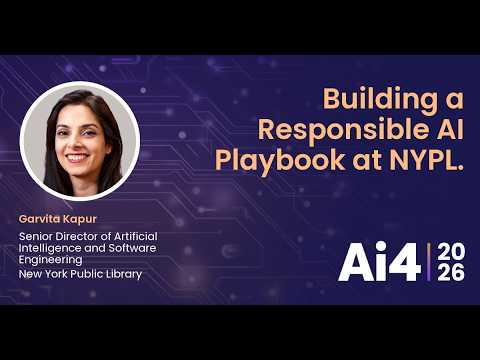
Building a Responsible AI Playbook at NYPL With New York Public Library — Ai4

Ai4

New York Public Library delayed AI software deployment for a year to establish governance policies and eliminate model hallucinations in its collection search tool.

AI-assisted summary of Building a Responsible AI Playbook at NYPL With New York Public Library — original source. Check the original for full context.

Source published:

Detailed notes

## Background Published on YouTube by Ai4 on August 15, 2026, this presentation features Garvita Kapur, Senior Director of Artificial Intelligence and Software Engineering at the New York Public Library (NYPL). The video covers NYPL's unconventional strategy of prioritizing governance, policy, and principles over initial use cases to establish a responsible AI framework for a public institution.

## TL;DR Garvita Kapur outlines how the New York Public Library developed a responsible AI strategy centered on public trust, veracity, privacy, and digital equity before deploying tools to staff. To combat potential AI hallucinations and protect institutional ethics, NYPL established parallel working groups, benchmarked policies against NIST standards, paused unauthorized 'shadow AI,' and surveyed staff to implement a tiered software rollout starting with Google Workspace tools. The institution successfully trained 92% of its workforce on AI guidelines in 2025 and is expanding into public literacy initiatives for 2026. Additionally, Kapur presents NYPL's in-house 'Enhanced Search' prototype—a retrieval-augmented system covering 1,000,000 public domain books that strictly avoids AI summarization to guarantee factual accuracy.

## Atmosphere & style The presentation carries a professional, grounded, and institutional tone that balances technological innovation with public responsibility. Kapur presents with an engaging, transparent, and thoughtful narrative style, using relatable anecdotes like the Reading Room hallucination incident to vividly illustrate high-stakes library ethics. Watching the talk feels like an insightful look into enterprise governance, characterized by structured pragmatic planning and a strong commitment to public service values.

## Key takeaways - [00:04](https://www.youtube.com/watch?v=L3MfbX3Uhiw&t=4s) An incident involving an AI-generated false citation highlighted the necessity for NYPL to approach artificial intelligence with caution to uphold institutional veracity. - [01:50](https://www.youtube.com/watch?v=L3MfbX3Uhiw&t=110s) NYPL spent 12 full months developing governance principles and guidelines before releasing any AI tools to staff members. - [01:50](https://www.youtube.com/watch?v=L3MfbX3Uhiw&t=110s) The library's AI strategy is anchored on three core institutional commitments: Veracity, Privacy, and Access and Equity. - [03:40](https://www.youtube.com/watch?v=L3MfbX3Uhiw&t=220s) Rather than starting with a low-risk use-case pilot, NYPL established governance, board-level accountability, and four parallel working groups first. - [05:12](https://www.youtube.com/watch?v=L3MfbX3Uhiw&t=312s) NYPL benchmarked 40 external policies and built a prescriptive framework around the NIST GovAI foundation, defined by 3 Core Objectives and 12 Principles. - [07:15](https://www.youtube.com/watch?v=L3MfbX3Uhiw&t=435s) Leadership temporarily paused all staff access and unvetted 'shadow AI' tools to implement a formal intake review process, which has vetted approximately 100 requests. - [08:44](https://www.youtube.com/watch?v=L3MfbX3Uhiw&t=524s) An internal survey of ~480 staff members generated nearly 100 use cases, showing that 30% could be met by Google Workspace AI tools like Gemini. - [08:44](https://www.youtube.com/watch?v=L3MfbX3Uhiw&t=524s) NYPL ran a controlled pilot with 250 employees to test training, guidelines, and support processes before rolling out tools broadly across the institution. - [10:35](https://www.youtube.com/watch?v=L3MfbX3Uhiw&t=635s) To address employee concerns regarding AI and job security, NYPL implemented a two-way engagement strategy including town halls, office hours, and policy updates. - [12:21](https://www.youtube.com/watch?v=L3MfbX3Uhiw&t=741s) During Phase 1 (2025), 92% of staff completed mandatory AI training, and over 2,000 active users adopted Google and Gemini tools within the first 3 months. - [12:21](https://www.youtube.com/watch?v=L3MfbX3Uhiw&t=741s) In Phase 2 (2026), NYPL plans to launch public AI literacy programs across New York City boroughs in partnership with Queens and Brooklyn public libraries. - [15:09](https://www.youtube.com/watch?v=L3MfbX3Uhiw&t=909s) NYPL developed an in-house 'Enhanced Search' prototype using a vector index and RAG over 1,000,000 public domain digitized books. - [15:09](https://www.youtube.com/watch?v=L3MfbX3Uhiw&t=909s) To prevent AI hallucinations, the 'Enhanced Search' system intentionally refrains from generating AI prose summaries and strictly outputs direct links to catalog sources. - [18:00](https://www.youtube.com/watch?v=L3MfbX3Uhiw&t=1080s) All internal AI initiatives are strictly prioritized based on alignment with NYPL's 5-year institutional strategic plan and its 3 core AI objectives. - [18:00](https://www.youtube.com/watch?v=L3MfbX3Uhiw&t=1080s) NYPL does not build or train custom foundation models, relying instead on classical vector retrieval, RAG, and third-party productivity tools.

## Detailed walkthrough ### [00:04](https://www.youtube.com/watch?v=L3MfbX3Uhiw&t=4s) The Rose Main Reading Room Hallucination Incident

Garvita Kapur, Head of Software Engineering and AI at the New York Public Library (NYPL), opens her talk with an iconic image of the Rose Main Reading Room on 42nd Street in New York City. She shares the fun fact that this vast hall spans the length of two New York City blocks or an entire football field. Every day, countless writers, scholars, and students gather in this space to consult NYPL’s vast research repository of roughly 57 million items.

She recounts a telling anecdote: a patron once walked up to the reference desk and requested a specific author and reference material. The librarian searched everywhere—catalog, databases, journals—and came up empty-handed. Given NYPL’s 130-year legacy of finding answers or directing researchers to the right source, the librarian pressed the patron on where they got the citation. As it turned out, the citation was entirely AI-generated; neither the author nor the work existed. This incident highlights why an institution rooted in trust and veracity must approach artificial intelligence with utmost caution.

- The NYPL research collection housed for patrons at the 42nd Street building contains roughly 57 million items. - NYPL has been serving the public for over 130 years.

---

[01:50](https://www.youtube.com/watch?v=L3MfbX3Uhiw&t=110s) Grounding AI Strategy in Public Trust and Institutional Values

Introducing herself as Senior Director of Artificial Intelligence and Software Engineering at NYPL, Kapur explains that the library spent 12 full months developing governance principles and guidelines before releasing a single AI tool to a single staff member. Rather than following conventional corporate advice, NYPL prioritized caution because "we are a public library and the stakes matter."

Across its 92 physical locations, NYPL receives about 16 million visits annually and hosts 55,000 free public programs. For many New Yorkers, the library serves as the last free public institution available to them. Consequently, NYPL anchored its AI strategy around three pre-existing institutional commitments:

1. **Veracity:** A absolute commitment to truth. Librarians must provide verifiable source material or explicitly admit when they do not know an answer. 2. **Privacy:** Treated not as a mere legal compliance checkbox, but as a core professional ethic—what patrons read remains strictly their own business. 3. **Access and Equity:** Historically, when groundbreaking technologies like the internet arrived, communities on the wrong side of the digital divide turned to libraries for access. AI presents a critical digital equity challenge, making public access and AI literacy essential.

- NYPL network size: 92 locations across New York City. - Annual foot traffic: Approximately 16 million visitors per year. - Annual programming: 55,000 free events and classes offered.

---

[03:40](https://www.youtube.com/watch?v=L3MfbX3Uhiw&t=220s) Establishing Governance Structure and Parallel Working Groups

Conventional technology wisdom dictates finding a high-value, low-risk use case, running a pilot, scaling it, and only then drafting governance policy. NYPL flipped this approach by establishing accountability and governance structure first.

Accountability sits with the Chief Digital Officer and the VP of IT, who report on AI strategy directly to the NYPL Board, the President, and executive chiefs. Under them, three Responsible AI working group leads were appointed: the Head of Infrastructure and Operations, the Director of Copyright and Information Policy, and the Head of Software Engineering and AI (Garvita Kapur).

Rather than running a slow sequential waterfall process, NYPL established four parallel working groups to involve staff cross-functionally from across the entire institution: - Policy and Guidelines - Vendor Evaluation - Staff Engagement - Use Case Development

---

[05:12](https://www.youtube.com/watch?v=L3MfbX3Uhiw&t=312s) Benchmarking Policies and Defining Core Objectives

To draft their internal policy, the team benchmarked 40 different policies across diverse sectors—including big tech firms, regulated industries, peer libraries, government bodies, and the public sector—to spot trends and gaps. Recognizing that general guidelines were too vague, NYPL built a highly granular and prescriptive framework anchored on the NIST GovAI structural foundation.

To ensure the policy remained closely tied to daily operations, NYPL grounded its framework in 3 Core Objectives and 12 Principles:

**Core Objectives:** 1. **Empower through Education:** Bridging the AI literacy gap for both library staff and patrons. 2. **Enhance and Not Replace:** Using AI strategically to support and augment staff capabilities rather than replace human workers. 3. **Advance Library-Centric Solutions:** Responsibly leveraging AI to unlock library collections and improve patron services.

**12 Core Principles:** Included foundational rules such as *Human-First*, *Accountability*, *Security*, *Privacy*, and *Transparency*. Kapur emphasizes that while technical rules and tools will change over time, these core principles remain constant across every iteration.

---

[07:15](https://www.youtube.com/watch?v=L3MfbX3Uhiw&t=435s) Pausing "Shadow AI" and Creating an Intake Vetting Path

As governance planning progressed, "shadow AI" emerged as staff began experimenting with unvetted tools or using software that silently integrated generative AI features. To maintain governance, leadership took the difficult step of pausing all staff access and tool rollouts.

NYPL built a meticulous, repeatable intake review process involving working group members, legal counsel, privacy experts, compliance officers, and cybersecurity teams. Every vendor's terms and conditions were examined with a fine-tooth comb to clarify exact data usage. Under this model, requests are evaluated case-by-case: tools aligning with strategic goals are approved, while non-compliant or unnecessary tools are denied.

- Since launch, the vetting committee has processed approximately 100 software requests.

---

[08:44](https://www.youtube.com/watch?v=L3MfbX3Uhiw&t=524s) Surveying Staff Use Cases and Launching the Google Workspace Pilot

To understand organizational demand before procuring software, NYPL distributed an institution-wide survey. Approximately 480 staff members responded, generating nearly 100 distinct use cases. Comparing these requests against vendor capabilities revealed that 30% of the identified use cases could be satisfied by Google's suite of AI tools, such as Gemini. Since NYPL was already a "Google shop," integrating Gemini offered lower friction, simpler rollouts, and built-in adherence to privacy, security, legal, and procurement requirements.

Before releasing AI tools across the entire system, NYPL conducted a controlled pilot with roughly 250 employees. The primary goal of the pilot was not testing vendor software stability, but validating institutional processes: testing whether training programs, guidelines, and support workflows were frictionless for staff.

Following the pilot, NYPL deployed a tiered toolset: - **General Staff Rollout:** Google Gemini, Gemini for Workspace, and NotebookLM. - **Specialized Workflows:** Target tools for technical teams, such as GitHub Copilot (software engineering), Figma AI (design), and Atlassian AI (product management).

---

[10:35](https://www.youtube.com/watch?v=L3MfbX3Uhiw&t=635s) Two-Way Communication Strategy and Policy Updates

To address widespread staff anxieties regarding AI technology and job security, NYPL instituted a multifaceted, two-way communication strategy. The engagement working group facilitated transparent dialogue and active feedback loops across the organization.

Engagement activities included: - 4 full-staff Town Halls - 10 targeted Information Sessions - Support sessions for senior leaders to equip them to lead their units - Live training sessions, recorded walkthroughs, live demos, and regular email updates - One-on-one office hours speaking directly with roughly 200 staff members

This continuous feedback loop directly informed policy refinements, leading to an updated set of staff guidelines released in May 2026.

---

[12:21](https://www.youtube.com/watch?v=L3MfbX3Uhiw&t=741s) Phase 1 Impact vs. Phase 2 Roadmap

NYPL structured its AI roadmap into two distinct calendar phases: - **Phase 1 (2025):** Establishing internal governance, training staff, and releasing approved tools internally. - **Phase 2 (2026):** Expanding AI literacy programs to patrons and deploying custom library-centric search tools.

**Phase 1 Achievements (2025):** - **Staff Training:** 92% of all NYPL staff successfully completed mandatory training on AI guidelines—a notable achievement given that many operational staff members lack dedicated daily computer access. - **Foundational Adoption:** Optional foundational AI literacy classes were delivered to enthusiastic staff responses. - **Active Usage:** Within the first 3 months of rollout, over 2,000 active staff users routinely utilized Google and Gemini tools, with specialized tools (GitHub Copilot, Figma AI, Atlassian AI) showing particularly high engagement for domain-specific tasks.

**Phase 2 Goals (2026):** - **Public AI Literacy:** Launching pilot public programming (hackathons, guest lectures, community classes). In Fall 2026, NYPL will launch a comprehensive tri-borough public AI literacy initiative in partnership with Queens Public Library and Brooklyn Public Library. - **Enhanced Search:** Releasing an in-house developed, AI-enabled search interface to help patrons explore physical collections.

---

[15:09](https://www.youtube.com/watch?v=L3MfbX3Uhiw&t=909s) Building "Enhanced Search": Eliminating Hallucinations by Design

Kapur detail NYPL's prototype project, **Enhanced Search**, built strictly in-house to fulfill the objective of advancing library-centric solutions. She lightheartedly catches herself after accidentally saying "copyright" instead of "public domain," calling it a major faux pas before confirming that the search corpus consists exclusively of public domain materials.

**System Design & Architecture:** - **Corpus:** Approximately 1,000,000 digitized public domain books from NYPL's collections. - **Vector Index & RAG:** Text from the corpus is vectorized. Queries utilize Retrieval-Augmented Generation (RAG) to locate matching text segments. - **LLM Role:** Large Language Models are used strictly for interpreting user query intent and structuring responses. - **No Summarization Policy:** By intentional design, the system **never generates text summaries**. Instead, search results are returned as a ranked list pointing directly to original source materials.

**Engineering Justification:** Refusing to generate AI summaries structurally eliminates hallucinations. From a verification standpoint, an automated system can easily test whether a returned link resolves to an existing book in the catalog, whereas verifying the factual accuracy of AI-generated prose summaries at scale is impossible. This design translates NYPL's core principles of *Veracity* and *Human-First* directly into product architecture. As Kapur summarizes, when the system has no matching source material in the catalog, "it says nothing. And for us, nothing is a legitimate answer."

- Enhanced Search is currently in prototype testing with research librarians and internal staff.

---

[18:00](https://www.youtube.com/watch?v=L3MfbX3Uhiw&t=1080s) Q&A: Prioritization Framework, Rare Books, and Tech Stack

Following her talk, Kapur addresses several questions from the audience:

**Prioritizing Initiatives:** An audience member asks how NYPL decides which projects to fund and build first. Kapur explains that every AI initiative must align directly with NYPL's 5-year institutional strategic plan and its 3 core AI objectives. Proposed projects failing to align are immediately rejected. Approved ideas are then prioritized per department based on available funding.

**Rare Book Digitization Practices:** An audience member asks if NYPL has a view on rumors that private AI companies purchase and destructively scan rare books. Kapur notes she cannot speak on corporate behaviors outside NYPL, but clarifies that NYPL strictly adheres to **non-destructive digitization** techniques for all archival materials in its care.

**In-House Technical Architecture & Staff Workflows:** A librarian from Bethpage Public Library on Long Island asks whether NYPL trains its own models and what specific daily use cases staff prefer. Kapur clarifies: - **No Custom Models:** NYPL does not train custom foundation models. They digitize books, generate vector embeddings, and perform vector retrieval (e.g., matching a search for "Brooklyn Bridge" to catalog vectors). She notes the underlying architecture relies more on classical machine learning and retrieval than generative AI. - **Staff Use Cases:** Daily adoption centers around productivity—summarizing meeting transcripts, drafting follow-ups, managing information retrieval, and testing upcoming AI features within digital asset management systems.

## Notable quotes > [01:50](https://www.youtube.com/watch?v=L3MfbX3Uhiw&t=110s) we are a public library and the stakes matter. — Garvita Kapur

> [15:09](https://www.youtube.com/watch?v=L3MfbX3Uhiw&t=909s) it says nothing. And for us, nothing is a legitimate answer. — Garvita Kapur

## Mentioned Garvita Kapur, New York Public Library, Ai4, Rose Main Reading Room, NIST, Google, Gemini, NotebookLM, GitHub Copilot, Figma AI, Atlassian AI, Queens Public Library, Brooklyn Public Library, Bethpage Public Library

## Video description Garvita Kapur - Senior Director of Artificial Intelligence and Software Engineering, New York Public Library

Most AI strategy advice tells you to start with use cases. We did the opposite. We started with governance, policy, and principles — before we let anyone touch a tool. It sounds backwards. I'll make the case for why it was exactly right for a public institution.

[Source](https://www.youtube.com/watch?v=L3MfbX3Uhiw)

中文简报

NYPL暂停AI推广以建立治理机制并推出搜索工具 纽约公共图书馆推迟了一年的AI软件部署,以确立治理政策并消除其馆藏搜索工具中的模型幻觉。 Garvita Kapur阐释了纽约公共图书馆(NYPL)如何在向员工部署工具之前,制定以公众信任、真实性、隐私和数字公平为核心的负责任AI战略。为应对潜在的AI幻觉并捍卫机构伦理,NYPL成立了并行工作组,参考NIST标准对标政策,暂停了未经授权的“影子AI”,并通过调查员工需求实施了以Google Workspace工具为起点的分层软件推广方案。该机构在2025年成功对92%的员工进行了AI准则培训,并正将其拓展至2026年的公众素养提升计划。此外,Kapur还展示了NYPL自主研发的“增强搜索”(Enhanced Search)原型——这是一个涵盖1,000,000本公有领域图书的检索增强系统,该系统严格避免AI摘要以确保事实的准确性。 一起涉及AI生成虚假引用的事件凸显了NYPL必须审慎对待人工智能,以维护机构的真实性。 (0:04) NYPL在向员工发布任何AI工具之前,整整花费了12个月来制定治理原则和指导方针。 (1:50) 该图书馆的AI战略立足于三项核心机构承诺:真实性、隐私以及获取与公平。 (1:50) NYPL并未从低风险用例试点入手,而是首先建立了治理结构、董事会层面的问责机制以及四个并行工作组。 (3:40) NYPL参考了40项外部政策进行基准对比,并围绕NIST GovAI基础构建了一个规范性框架,具体由3项核心目标和12条原则构成。 (5:12)

Reading summary

The New York Public Library established a governance-first artificial intelligence strategy to safeguard institutional trust, prioritizing veracity, privacy, and digital equity over rapid deployment. According to Garvita Kapur, Senior Director of Artificial Intelligence and Software Engineering, the institution paused unvetted adoption to construct formal vetting mechanisms, train staff, and design retrieval tools that structurally prevent hallucinations. Inverting the Corporate Deployment Playbook (1:50) Rather than launching low-risk pilots and drafting policy retrospectively, NYPL spent 12 months establishing governance before providing AI tools to any staff member. Kapur noted that this caution reflects the library's role as a trusted civic institution serving roughly 16 million annual visitors across 92 locations. The institutional AI strategy was grounded in three existing values: veracity (guaranteeing verifiable sources or admitting uncertainty), privacy (protecting patron reading records as a professional ethic), and access and equity (addressing digital divides through public education). Governance Architecture and Vendor Vetting (3:40) Executive oversight was assigned to the Chief Digital Officer and VP of IT, who report directly to the Board and President, while four cross-functional working groups addressed policy, vendor evaluation, staff engagement, and use cases in parallel. NYPL benchmarked 40 policies across tech firms, government bodies, and peer libraries to create a framework anchored in the NIST GovAI foundation, defined by three core objectives—empowering through education, enhancing rather than replacing staff, and building library-centric solutions—alongside 12 operational principles including Human-First and Transparency. To counter unvetted "shadow AI," leadership paused staff access to build a repeatable intake process involving legal, privacy, and cybersecurity teams. The vetting committee has evaluated roughly 100 software requests against data-usage terms and strategic priorities. A survey of 480 staff members surfaced nearly 100 use cases, 30% of which aligned with NYPL's existing Google Workspace infrastructure. Following a pilot with 250 employees to validate support workflows, NYPL rolled out Google Gemini and NotebookLM generally, while supplying specialized tools like GitHub Copilot and Figma AI to technical teams. Phased Implementation and Literacy Initiatives (12:21) NYPL structured its rollout into two calendar phases. Phase 1 in 2025 focused on internal operations: 92% of staff completed mandatory policy training, and more than 2,000 active staff users routinely adopted approved tools within the first three months. The rollout was supported by extensive two-way communication, including four town halls, 10 information sessions, and individual office hours with roughly 200 staff members to address anxieties regarding job security, culminating in updated staff guidelines in May 2026. Phase 2 in 2026 shifts focus toward public service. NYPL is launching community hackathons and educational classes, alongside a planned Fall 2026 tri-borough public AI literacy initiative conducted in partnership with the Queens Public Library and Brooklyn Public Library. Enhanced Search: Preventing Hallucinations by Design (15:09) To unlock institutional archives without compromising factual reliability, NYPL developed an in-house prototype called Enhanced Search. The tool utilizes vector embeddings and retrieval-augmented generation (RAG) across a corpus of approximately one million digitized public domain books. NYPL does not train custom foundation models, relying instead on classical vector retrieval to match patron intent. Crucially, the system architecture enforces a strict non-summarization policy: large language models interpret search intent and structure responses, but the system outputs only a ranked list of direct links to original physical catalog sources. Kapur explained that this design structurally eliminates generative hallucinations, as verifying link resolution against catalog records is verifiable, whereas monitoring the factual accuracy of AI-generated prose summaries at scale is impossible. NYPL requires all prospective AI initiatives to align strictly with its five-year strategic plan and available departmental funding. When addressing archival scanning, Kapur confirmed the library adheres strictly to non-destructive digitization for rare materials, contrasting with unverified reports of destructive private sector scanning practices.

精炼阅读摘要

纽约公共图书馆(NYPL)软件工程与人工智能高级总监 Garvita Kapur 阐明了该馆“以治理为先”的负责任人工智能战略:通过前置长达一年的伦理与政策规划,将技术落地紧密锚定在真实性、隐私和公共数字公平等核心信条上,拒绝以牺牲公众信任为代价盲目追赶技术潮流。 逆转传统路径:以公共信任奠定治理基础 (1:50) 针对读者携带完全虚构的 AI 引文前往咨询台寻求藏书、暴露出生成式技术潜在失真风险的事件,拥有 130 年历史、在纽约市设有 92 个分支网点并藏有约 5,700 万件研究资料的 NYPL 逆转了科技界“先做试点再补治理”的常规路径。在向任何员工开放 AI 工具前,该馆耗时 12 个月建立治理框架。Kapur 表示,图书馆是年接待量达 1,600 万人次且举办 5.5 万场免费活动的公共机构,必须守住三项既有价值承诺:绝对的真实性(必须提供可验证来源或直接承认不知)、将读者隐私视作职业道德底线,以及在技术鸿沟面前保障公众的数字公平与访问权。 在治理架构上,首席数字官与 IT 副总裁直接向董事会及总裁汇报,并由基础设施、版权政策以及软件工程与 AI 负责人牵头设立了四个跨职能工作组,分别覆盖政策指引、供应商评估、员工参与和用例开发。团队对横跨科技巨头、受监管行业及政府公共部门的 40 项政策进行了对标分析,基于 NIST GovAI 基础框架,确立了以“教育赋能”、“辅助而非取代人类”和“推进以图书馆为中心的解决方案”为三大目标、包含 12 项原则的内部治理体系。 叫停影子AI与分阶段分层工具部署 (7:15) 随着员工自发使用未报备软件或商业办公软件静默嵌入生成式功能,“影子 AI”的冒头促使 NYPL 暂停了未经审核的工具使用。随后,由法务、合规、隐私及网络安全专家组建的审查机制对供应商条款与数据流向展开严格评估,目前已处理约 100 项软件准入申请。一项覆盖 480 名员工的内部调查收集了近 100 个业务用例,分析显示其中 30% 可通过 Google Gemini 工具套件满足。由于该馆本就属于 Google 生态,此举大幅降低了部署摩擦并满足了安全合规要求。 在面向全馆推开前,NYPL 先行开展了约 250 名员工的对照试点,其首要目标在于检验培训流程与支持机制是否顺畅,而非单纯测试软件稳定性。随后,图书馆实施了分层推进:面向全员提供 Google Gemini 与 NotebookLM 以处理日常行政事务;针对专业团队则定向配备专用工具,包括面向软件工程的 GitHub Copilot、面向设计的 Figma AI 以及面向产品管理的 Atlassian AI。 员工双向沟通与两阶段路线图推进 (10:35) 为消解员工对 AI 冲击就业的焦虑,NYPL 建立了包含 4 场全员大会、10 场专题宣讲、定期演示以及对约 200 名员工进行一对一答疑的双向沟通机制,并将一线反馈沉淀为 2026 年 5 月发布的修订版员工指南。在整体路线上,NYPL 将推进工作划分为两大阶段:2025 年的第一阶段专注于内部治理与全员普及,全馆 92% 的员工完成了强制性 AI 规范培训,上线前 3 个月内活跃员工用户已超过 2,000 人。 据 Kapur 介绍,2026 年的第二阶段重点转向公众赋能与专用服务。在公共素养方面,NYPL 计划于 2026 年秋季携手皇后区公共图书馆和布鲁克林公共图书馆,联合启动面向纽约三大行政区的公众 AI 素养计划,通过黑客松和社区课程普及 AI 技能;在馆藏服务方面,则计划推出自研的 AI 检索接口以协助公众探索实体馆藏。 “增强检索”架构:以系统设计杜绝幻觉 (15:09) 作为“以图书馆为中心”的核心自研项目,NYPL 正在内部测试一款名为“增强检索”(Enhanced Search)的原型系统。该系统以馆藏中约 100 万本已完成数字化处理的公有领域图书为语料库,依托向量索引和检索增强生成(RAG)技术。在架构设计上,大语言模型仅被严格限制在解析读者查询意图和结构化输出两个环节,系统在工程层面彻底剔除了文本摘要功能,仅向用户返回指向原始物理或数字化馆藏的排序结果列表。 Kapur 解释了这一技术取向背后的工程逻辑:从验证角度来看,自动化系统可以轻易校验检索链接是否对应目录中的真实图书,但要在大规模应用中自动核验 AI 生成的描述性摘要是否真实准确在技术上极其困难。当系统在现有馆藏中找不到匹配材料时直接返回无结果,因为“保持沉默在图书馆体系中是一个合法的答案”。此外,针对外界关于数字化行为的关切,Kapur 重申 NYPL 对珍本档案严格执行非破坏性数字化标准,且机构本身不自行训练基础大模型,其自研体系主要依赖经典机器学习与向量匹配。 NYPL 的负责任 AI 实践表明,公共信任机构无需在追逐前沿创新与恪守传统伦理之间妥协,而能够通过系统架构限制(如只提供溯源链接而杜绝自动生成摘要)将真实性原则直接转化为工程约束。在后续拓展三区公众培训与深度馆藏检索的过程中,如何在依赖第三方商业底层模型的同时持续保障长久的数据自主与透明度,仍是该路线图持续演进的关键考量。

Detailed notes — zh

## Background 该内容由 YouTube 频道 Ai4 于 2026 年 8 月 15 日发布,主讲人为纽约公共图书馆(NYPL)人工智能与软件工程高级总监 Garvita Kapur。视频简介指出,与常规先探索用例的 AI 策略不同,NYPL 在允许任何人使用工具前优先构建了治理、政策和原则体系,深入阐释了为何这种“治理先行”的路径最契合公共机构的使命。 ## TL;DR 纽约公共图书馆(NYPL)针对生成式 AI 带来的文献幻觉与数据隐私挑战,颠覆商业机构“先试点后规范”的惯例,在全馆开放工具前耗时 12 个月建立了以真实性、隐私和公平接入为底线的跨部门治理框架与原则体系。通过全面排查“影子 AI”、开展全员需求调研与 250 人小规模流程试点,NYPL 安全部署了以 Google Gemini 为代表的企业级工具,并达成了 92% 的全员培训覆盖率。进入第二阶段后,图书馆联合纽约市多大公共图书馆系统向大众普及 AI 素养,并基于 100 万册公有领域文献自研“增强型检索”系统,以坚决不生成摘要的技术架构从源头杜绝幻觉。在问答环节,讲者进一步强调了 AI 项目必须严格契合五年战略规划、坚持非破坏性数字化的底线立场,以及立足内部工程实践赋能日常馆务的核心路线。 ## Atmosphere & style 整场演讲兼具深厚的人文底线关怀与扎实的工程理性风格,开篇以阅览室馆员遭遇 AI 凭空捏造虚构参考文献的真实插曲切入,极具现场代入感与警示意味。主讲人 Garvita Kapur 的表达沉稳清晰、自信且富有感染力,在谈及版权口误时幽默化解,在阐明守护读者隐私和数据安全时则展现出公共机构管理者绝不妥协的职业信仰。演讲与互动问答层层递进,既有果断叫停未审查工具的魄力,又展现出将抽象伦理原则转化为“无可奉告即正确答案”的具体系统设计智慧,给听众带来既理性克制又充满使命感的视听体验。 ## Key takeaways - [00:04](https://www.youtube.com/watch?v=L3MfbX3Uhiw&t=4s) 读者因 AI 幻觉索取虚构文献的事件,凸显了生成式 AI 对以真实与信任为生命线的公共机构带来的严峻冲击。 - [01:39](https://www.youtube.com/watch?v=L3MfbX3Uhiw&t=99s) 作为免费的公共文化机构,纽约公共图书馆将真实性(Veracity)、隐私保护(Privacy)和技术接入与公平(Access)视为远早于 AI 诞生的底线承诺。 - [01:39](https://www.youtube.com/watch?v=L3MfbX3Uhiw&t=99s) 颠覆常规商业试点逻辑,NYPL 在向员工开放任何 AI 工具之前,先行耗时整整 12 个月制定严密的治理架构与核心指南。 - [03:40](https://www.youtube.com/watch?v=L3MfbX3Uhiw&t=220s) 建立由首席数字官与 IT 副总裁统筹的顶层架构,并打破瀑布流模式,同步推进政策、厂商评估、员工参与和用例开发四大并行工作组。 - [05:47](https://www.youtube.com/watch?v=L3MfbX3Uhiw&t=347s) 将政策紧密锚定在“教育赋能”、“增强而非替代人工专业判断”以及“推进以图书馆为中心的解决方案”三大核心目标与十二条原则之上。 - [05:47](https://www.youtube.com/watch?v=L3MfbX3Uhiw&t=347s) 面对“影子 AI”及第三方办公软件擅自集成 AI 的风险,果断执行“全面暂停”决定,逐字审查服务协议以建立严控审查机制。 - [08:11](https://www.youtube.com/watch?v=L3MfbX3Uhiw&t=491s) 通过全员调研梳理出近百个业务用例,发现约 30% 可复用现有 Google Workspace 企业级 AI 生态解决,并开展 250 人小规模试点检验流程顺畅度。 - [10:35](https://www.youtube.com/watch?v=L3MfbX3Uhiw&t=635s) 依托全方位双向沟通与多层次培训,全馆员工 AI 指南培训完成率高达 92%,工具上线前三个月内活跃用户达约 2000 人。 - [13:53](https://www.youtube.com/watch?v=L3MfbX3Uhiw&t=833s) 实施两阶段落地路线图:第一阶段聚焦内部治理与员工赋能,第二阶段联合皇后区和布鲁克林图书馆向公众推行 AI 素养普及计划。 - [15:09](https://www.youtube.com/watch?v=L3MfbX3Uhiw&t=909s) 自研基于 100 万册公有领域图书的“增强型检索”(Enhanced Search)系统,坚持仅返回真实文献链接而绝不生成内容摘要,从工程架构上根除模型幻觉。 - [18:00](https://www.youtube.com/watch?v=L3MfbX3Uhiw&t=1080s) 建立严格的项目准入机制,所有 AI 评估与研发投资必须与图书馆五年战略规划完全对齐,与核心使命不符的项目一律否决。 - [19:02](https://www.youtube.com/watch?v=L3MfbX3Uhiw&t=1142s) 在数字化加工中恪守“非破坏性数字化”原则,坚决捍卫物理文献与文化遗产载体的完整性。 - [20:02](https://www.youtube.com/watch?v=L3MfbX3Uhiw&t=1202s) 内部技术团队侧重于文本向量化与信息检索等机器学习应用,而非从头训练基础大模型,务实赋能日常协作与数字资产管理。 ## Detailed walkthrough ### [00:04](https://www.youtube.com/watch?v=L3MfbX3Uhiw&t=4s) 虚构的参考文献:罗斯主阅览室的“幻觉”插曲 位于纽约第42街的纽约公共图书馆(NYPL)罗斯主阅览室(Rose Main Reading Room)气势恢宏,其空间足有两个纽约街区或一个标准足球场大小。这里面向公众开放了约5700万件馆藏资源,每天都有大量研究人员、作家、学者和学生步入其中查阅资料。然而不久前,这里发生了一件极不寻常的事:一位读者来到咨询台,向参考馆员询问一位特定作者及其相关参考资料。 馆员随即展开检索,翻遍了馆藏目录、学术期刊和专业数据库,却一无所获。对于一家拥有130年历史、信奉“只要有据可查,我们就能找到,或告诉你去哪里找到”的学术殿堂而言,查无此书几乎是不可能的,馆员甚至怀疑是自己遗漏了某些索引。直到最后,馆员再次向读者询问引文来源时才得知,这份参考资料完全是由 AI 生成的——所谓的作者与文献根本不存在,是一场彻底的“AI 幻觉”。这一事件直观地表明,对于一个将信任与真实性视为生命线的公共机构,生成式 AI 的涌现带来了前所未有的冲击与挑战。 ### [01:39](https://www.youtube.com/watch?v=L3MfbX3Uhiw&t=99s) 公共图书馆的底线:真实性、隐私与平等接入 演讲者 Garvita Kapur 是纽约公共图书馆软件工程与 AI 业务的负责人。她指出,与绝大多数商业机构的做法相反,NYPL 在向任何员工开放任何一款 AI 工具之前,整整花了12个月的时间专门建立治理架构、原则与指南。“这不是因为我们得到了更好或不同的建议,而是因为我们是一家公共图书馆,这里的赌注极其高昂(the stakes matter)。”作为许多纽约人生活中“最后一座完全免费的公共机构”,NYPL 拥有92个分馆,每年接待约1600万人次访问,并提供5.5万场免费公共活动。这种公共属性决定了图书馆必须坚守三项远早于 AI 诞生的核心承诺: - **真实性(Veracity)**:严格符合事实。当读者提问时,图书馆必须提供确凿的原始材料,如果查不到,就坦诚承认不知道,绝不提供虚假或缺乏依据的信息。 - **隐私保护(Privacy)**:对图书馆员而言,隐私绝非合规清单上的勾选框,而是一种神圣的职业道德——“你在图书馆读什么书,与任何人无关(What you read at the library is nobody's business)”。 - **技术接入与公平(Access)**:从互联网诞生至今,图书馆始终是大众获取和学习新技术的避风港。对于身处数字鸿沟另一侧的边缘群体而言,AI 时代的来临不仅意味着“AI 素养鸿沟”,更是一场严重的数字公平挑战,而图书馆有责任为所有人提供平等接触新技术的机会。 ### [03:40](https://www.youtube.com/watch?v=L3MfbX3Uhiw&t=220s) 反常规路径:治理先行与并行工作组架构 常规的数字化或 AI 战略通常建议:“寻找高价值、低风险的用例进行试点,逐步扩大规模,最后再补齐政策与治理框架。”但 NYPL 完全颠覆了这一逻辑,选择从确立责任与治理架构切入。机构首先明确了最终责任人,由首席数字官(Chief Digital Officer)与 IT 副总裁共同牵头,直接向董事会、总馆长(President)及其他高管汇报 AI 整体战略。 在其下设立了三个负责任 AI 工作组组长职位,分别由基础设施与运营负责人、版权与信息政策总监,以及 Garvita Kapur 本人(软件工程与 AI 负责人)担任。随后,图书馆同时启动了四个并行运作的工作组,打破了传统的瀑布流模式。工作组成员广泛吸收了来自全馆不同部门的一线人员,以确保吸纳多元视角: ```mermaid flowchart TD accTitle: NYPL AI Governance Structure subgraph Gov["治理与监督层"] A["董事会 / 馆长 / 高管团队"] B["首席数字官 (CDO) & IT 副总裁"] A --- B end subgraph Leads["负责任 AI 牵头人"] C["基础设施与运营负责人"] D["版权与信息政策总监"] E["软件工程与 AI 负责人 (Garvita Kapur)"] B --> C & D & E end subgraph Groups["四大并行工作组"] F["政策与指南<br/>(Policy & Guidelines)"] G["厂商评估<br/>(Vendor Evaluation)"] H["员工参与<br/>(Staff Engagement)"] I["用例开发<br/>(Use Case Development)"] C & D & E -.-> F & G & H & I end ``` 为了建立扎实的治理基础,团队调研了跨越大型科技企业、受强监管行业、图书档案界、公共部门以及政府机构的40余份成熟政策,梳理其中的趋势与盲区。他们很快发现,现有的宏观政策无法满足图书馆对隐私和真实性的苛刻标准,必须制定更具体、更具操作指引性的规定,最终选定以 GovAI 框架作为政策的底层结构基石。 ### [05:47](https://www.youtube.com/watch?v=L3MfbX3Uhiw&t=347s) 核心原则锚定与艰难的“全面暂停”决定 在起草具体政策时,团队意识到条文很容易与基层实际脱节,因此必须将政策牢牢锚定在图书馆的三大核心目标与十二条原则之上。这三大核心目标包括: 1. **通过教育赋能(Empower through education)**:致力于消除读者以及全体馆员的 AI 素养差距; 2. **增强而非替代(Enhance and not replace)**:将 AI 视为一种强大的使能工具,以负责任的策略辅助馆员,而非取代人工专业判断; 3. **推进以图书馆为中心的解决方案(Advance library-centric solutions)**:负责任地释放馆藏资源的潜能,并持续优化读者服务。 在这些目标之下,延伸出以人为本、问责机制、安全性、隐私保护、透明度等12项原则。Garvita Kapur 强调,技术和规则会不断演进迭代,但底层原则始终如一,它是让机构在规则更替中坚守核心价值的锚。然而,正当治理架构紧锣密鼓推进时,“影子 AI”(Shadow AI)的风险悄然降临:员工开始在私下使用未经审核的工具,市面上的现有办公软件也纷纷植入了未经审查的 AI 功能。面对失控风险,团队做出了“可以说最艰难的决定”——全面暂停所有 AI 工具的接入与使用。随后,工作组联合法务、隐私、合规与信息安全团队,逐字逐句审阅第三方工具的服务条款与数据使用协议,建立起一套可重复、可靠且可控的严格审查机制。 ### [08:11](https://www.youtube.com/watch?v=L3MfbX3Uhiw&t=491s) 需求盘点、厂商评估与小规模试点 在严密的审查流程建立后,NYPL 处理了约100项工具使用申请,明确只有完全契合机构战略目标且通过审查的用例才能获批。与此同时,用例开发工作组面向全馆员工发起调研,了解大家在日常生活与实际工作中有哪些真实的 AI 需求与构想。 - **员工调研基数**:收集到约480份有效问卷反馈,提炼出近100个清晰且独立的业务用例。 - **匹配现有技术生态**:评估显示,其中约30%的用例完全可以通过 Google 的企业级 AI 生态(如 Gemini)直接解决。由于 NYPL 本身即深度依赖 Google Workspace,这一方案不仅在安全、隐私、法务和采购合规上顺利过关,且极大降低了系统集成与全员推广的门槛。 - **250人小规模试点**:在全员铺开前,团队组织了250人的先期试点。Garvita Kapur 特别说明,试点的重点绝非测试 Gemini 工具本身好不好用,而是检验“我们的流程是否顺畅”——指南是否清晰、培训是否到位、技术支持模型是否能够及时响应。 经过验证后,NYPL 正式面向全馆员工开放了 Gemini、Gemini for Workspace 以及 NotebookLM 等通用工具;针对具备明确业务正当性的专业团队,则按需审批开放了 GitHub Copilot、Figma AI 与 Atlassian AI 等专业垂直生产力工具。 ### [10:35](https://www.youtube.com/watch?v=L3MfbX3Uhiw&t=635s) 双向沟通机制与分阶段落地成效 面对快速迭代的技术以及图书馆员群体对 AI 真实性、版权及伦理的天然疑虑,工作组将“员工沟通”确立为推进的核心支柱,采取了全方位的双向沟通策略。他们拒绝单向自上而下的通报,而是通过多层次的渠道持续倾听反馈: - **多元沟通覆盖**:举办了4场全员市政厅会议(Town Halls)、10场专题宣讲会,并在答疑咨询时间(Office Hours)与约200名员工开展了一对一的深入交流; - **领导力与技能赋能**:为资深管理人员开设专项辅导,协助他们指导下属团队;同时推出结合直播、录播、实际演示以及邮件跟进的梯队式培训; - **动态更新指南**:凭借密集的双向对话所收集到的基层实际反馈,团队在2026年5月迅速对最初制定的使用指南完成了修订优化。 这一整体战略分为两个清晰的年度阶段:2025年的第一阶段主攻“治理体系搭建与内部员工赋能”,2026年的第二阶段则迈入“全员工具部署并向公众读者拓展教育”。实际落地成效极其显著:全馆有高达92%的员工完整修完了 AI 使用指南培训——考虑到部分分馆的一线员工日常甚至没有专属的办公电脑,这一普及率远超预期;自选性质的 AI 通识基础培训也获得了极高的参与热度;工具正式上线后的前三个月内,活跃使用 AI 工具的员工便达到了约2000人,日常业务调用已逐渐形成良性常态。 ### [13:53](https://www.youtube.com/watch?v=L3MfbX3Uhiw&t=833s) 内部工具落地与第二阶段读者 AI 素养计划 纽约公共图书馆(NYPL)在内部推广了 Google 与 Gemini 套件,并推出了一系列针对特定场景的专用工具。相较于通用工具,这些专用工具由于精准解决了员工工作中的具体痛点,获得了更高的使用率与参与度。在需求审核机制(Intake Path)方面,团队自系统上线以来已成功处理并解决了大约 100 项员工申请。Garvita Kapur 强调,员工的权限开通与技能培训绝非“一劳永逸”的单次任务,而是一个持续推进的过程,并将在第二阶段继续深化。 ```mermaid flowchart TD accTitle: NYPL AI 战略两阶段推进图 subgraph Phase1["第一阶段:内部赋能与治理"] A["Google & Gemini 套件"] B["特定场景专用工具"] C["需求受理通道(已处理约 100 项申请)"] D["持续的员工培训与权限管理"] end subgraph Phase2["第二阶段:公众赋能与核心体验"] E["读者 AI 素养项目<br/>(联合 Queens 与 Brooklyn 图馆)"] F["增强型检索(Enhanced Search)<br/>(基于 100 万册公有领域藏书)"] end Phase1 --> Phase2 ``` 第二阶段的核心重心之一是面向读者的 AI 素养培训(Patron Training)。图书馆目前已开展了包括特邀嘉宾讲座、黑客松(Hackathons)以及面向读者的公开课等小范围项目。更重要的是,纽约公共图书馆正携手皇后区公共图书馆(Queens Public Library)和布鲁克林公共图书馆(Brooklyn Public Library),计划在当年秋季正式向全纽约公众推出全面的 AI 素养普及项目。 - **员工工具参与度**:针对具体业务问题的专用工具比通用套件获得了更多的日常使用和互动。 - **需求治理成果**:内部治理通道上线后平稳运行,已累计清空处理了约 100 项 AI 接入和使用请求。 - **三大图书馆系统联动**:NYPL 与 Queens、Brooklyn 两大公共图书馆系统深度合作,构建全市层面的读者 AI 普及网络。 --- ### [15:09](https://www.youtube.com/watch?v=L3MfbX3Uhiw&t=909s) 增强型检索与“杜绝幻觉”的架构决策 第二阶段的另一项重大举措是推进以图书馆为核心的技术工具研发——即“增强型检索”(Enhanced Search)。这是一个完全由内部团队自主研发的 AI 赋能检索系统,专门用于服务读者。Garvita Kapur 在现场口误提到版权内容时立刻幽默地纠正并引发全场欢笑:“是公有领域(Public Domain),不是有版权的内容,千万别误会,那可是一个大失误!”该系统完全基于约 100 万册经过数字化的公有领域图书构建,目前正作为原型系统在研究馆员和内部员工中进行严格测试。 ```mermaid flowchart LR accTitle: NYPL 增强型检索系统架构与防幻觉设计 subgraph Data["数据准备层"] A["100 万册公有领域图书"] --> B["文本向量化 (Vectorization)"] end subgraph Query["检索与交互层"] C["用户查询输入"] --> D["LLM 理解上下文"] D --> E["RAG 检索向量数据库"] end subgraph Response["输出与验证层"] E --> F["排序结果列表<br/>(直链指向原始馆藏)"] F -.-> G["严格拒绝生成摘要<br/>从机制上杜绝幻觉"] end B --> E ``` 在系统架构上,工程团队将整个公有领域语料库进行了向量化处理,并利用检索增强生成(RAG)模型执行召回。虽然系统使用大语言模型(LLM)来理解用户的输入上下文并组织响应,但其最终返回的结果仅为指向馆藏原始资料的排序链接列表。团队做出了一个坚定的产品设计抉择:**系统绝不生成任何内容摘要,只提供指向真实来源的链接**。 这一决策背后既有原则考量,也有严谨的工程逻辑:从工程角度来看,验证一个返回链接是否能精准打开一本书是完全可行且可度量的,但要在海量规模下逐一测试并验证系统生成的每一段摘要是否准确,在技术上几乎是不可能的。通过拒绝生成摘要,系统在架构层面上杜绝了模型幻觉。这使得“真实性”(Veracity)和“以人为本”(Human First)的原则不再只是幻灯片上的空洞口号,而是变成了具象的产品技术规范。 > “我们正在构建的工具绝不会凭空捏造一个作者。它只能向用户展示我们馆藏中真实拥有的内容。当它无话可说时,它就会保持沉默——对我们而言,‘无可奉告’(Nothing)是一个完全合法的答案。这就是我们忠于自身使命和价值观的方式。” --- ### [18:00](https://www.youtube.com/watch?v=L3MfbX3Uhiw&t=1080s) 现场问答:AI 项目优先级与战略对齐 在演讲结束后的问答环节中,现场观众询问 NYPL 在面对众多潜在的 AI 项目时,是如何确定研发与上线的优先顺序,以及如何决定哪些项目延后或搁置。 Garvita Kapur 解释说,图书馆的核心原则是**所有评估和投资的 AI 用例必须完全契合图书馆制定的五年战略目标**。由于图书馆近期刚完成了新一轮五年战略目标的规划,管理团队设定了严格的准入门槛:只有真正服务于战略目标以及核心原则的 AI 项目才会获得批准;任何与战略不符的构想都会被果断否决。而在符合战略的项目内部,团队再根据各业务部门的具体资金状况与预算现实来具体排定优先级。 --- ### [19:02](https://www.youtube.com/watch?v=L3MfbX3Uhiw&t=1142s) 现场问答:回应“破坏性数字化”传闻与保护立场 一位现场观众提到了行业内的传言:有 AI 公司正在扫描珍贵古籍善本后将其销毁,从而使自己成为该文本数字化资产的唯一拥有者,并询问 NYPL 对此种现象的看法及政策立场。 Garvita Kapur 表示自己确实在媒体报道中看到过相关文章,但无法对其他大型商业公司的具体行为发表评论。不过她明确阐述了纽约公共图书馆自身的底线立场:NYPL 在对馆藏文献进行数字化加工时,始终严格遵循“非破坏性数字化”(Non-destructive Digitization)的标准流程,绝不会采用破坏原始文献的数字化手段,图书馆的首要职责永远是保护人类文明的物理载体与文化遗产。 --- ### [20:02](https://www.youtube.com/watch?v=L3MfbX3Uhiw&t=1202s) 现场问答:馆内技术团队、模型研发与日常落地用例 来自长岛贝斯佩奇公共图书馆(Bethpage Public Library)的馆员向 Garvita Kapur 提问,想了解 NYPL 的技术团队规模与架构,以及员工在日常图书馆工作中最常用的具体 AI 工具和场景。 Garvita Kapur 澄清,NYPL 拥有一支内部工程团队,但团队并没有从头训练或构建底层基础模型。以增强型检索为例,工程团队的核心工作是对已数字化的图书文本进行向量化处理并实现高效检索。例如当读者检索“布鲁克林大桥”时,系统利用向量匹配快速找出相关的原始历史文献。因此在技术本质上,该方案更多依赖于机器学习(Machine Learning)和信息检索技术,而非单纯依赖生成式 AI。 在日常使用场景上,员工目前最广泛使用的包括: - **Google Gemini 套件**:在全馆日常协作中极受欢迎,广泛用于会议实时转录、会议纪要生成以及后续待办事项的跟进,有效提升了团队的执行效率。 - **信息检索与文献获取系统**:作为长期演进的大型技术项目,利用 AI 提升馆藏检索的精确度与读者查阅体验。 - **新一代数字资产管理系统(DAM)**:图书馆正在引入集成了 AI 能力的新一代数字资产管理系统,目前团队正在对这些自带的 AI 功能进行积极的测试与评估。 ## Notable quotes > [00:04](https://www.youtube.com/watch?v=L3MfbX3Uhiw&t=4s) 只要有据可查,我们就能找到,或告诉你去哪里找到 > [01:39](https://www.youtube.com/watch?v=L3MfbX3Uhiw&t=99s) 这不是因为我们得到了更好或不同的建议,而是因为我们是一家公共图书馆,这里的赌注极其高昂(the stakes matter)。 — Garvita Kapur > [01:39](https://www.youtube.com/watch?v=L3MfbX3Uhiw&t=99s) 你在图书馆读什么书,与任何人无关(What you read at the library is nobody's business) > [03:40](https://www.youtube.com/watch?v=L3MfbX3Uhiw&t=220s) 寻找高价值、低风险的用例进行试点,逐步扩大规模,最后再补齐政策与治理框架。 > [05:47](https://www.youtube.com/watch?v=L3MfbX3Uhiw&t=347s) 通过教育赋能(Empower through education) > [05:47](https://www.youtube.com/watch?v=L3MfbX3Uhiw&t=347s) 增强而非替代(Enhance and not replace) > [05:47](https://www.youtube.com/watch?v=L3MfbX3Uhiw&t=347s) 推进以图书馆为中心的解决方案(Advance library-centric solutions) > [08:11](https://www.youtube.com/watch?v=L3MfbX3Uhiw&t=491s) 我们的流程是否顺畅 — Garvita Kapur > [15:09](https://www.youtube.com/watch?v=L3MfbX3Uhiw&t=909s) 是公有领域(Public Domain),不是有版权的内容,千万别误会,那可是一个大失误! — Garvita Kapur > [15:09](https://www.youtube.com/watch?v=L3MfbX3Uhiw&t=909s) 系统绝不生成任何内容摘要,只提供指向真实来源的链接 > [15:09](https://www.youtube.com/watch?v=L3MfbX3Uhiw&t=909s) 我们正在构建的工具绝不会凭空捏造一个作者。它只能向用户展示我们馆藏中真实拥有的内容。当它无话可说时,它就会保持沉默——对我们而言,‘无可奉告’(Nothing)是一个完全合法的答案。这就是我们忠于自身使命和价值观的方式。 — Garvita Kapur > [18:00](https://www.youtube.com/watch?v=L3MfbX3Uhiw&t=1080s) 所有评估和投资的 AI 用例必须完全契合图书馆制定的五年战略目标 — Garvita Kapur ## Mentioned Garvita Kapur, 纽约公共图书馆 (New York Public Library / NYPL), 罗斯主阅览室 (Rose Main Reading Room), 皇后区公共图书馆 (Queens Public Library), 布鲁克林公共图书馆 (Brooklyn Public Library), 贝斯佩奇公共图书馆 (Bethpage Public Library), Google, Google Workspace, Gemini, Gemini for Workspace, NotebookLM, GitHub Copilot, Figma AI, Atlassian AI, GovAI 框架, 增强型检索 (Enhanced Search), Ai4 ## Video description Garvita Kapur - Senior Director of Artificial Intelligence and Software Engineering, New York Public Library Most AI strategy advice tells you to start with use cases. We did the opposite. We started with governance, policy, and principles — before we let anyone touch a tool. It sounds backwards. I'll make the case for why it was exactly right for a public institution. [Source](https://www.youtube.com/watch?v=L3MfbX3Uhiw)

Source quotes

[0:04] 只要有据可查,我们就能找到,或告诉你去哪里找到 [1:39] Garvita Kapur: 这不是因为我们得到了更好或不同的建议,而是因为我们是一家公共图书馆,这里的赌注极其高昂(the stakes matter)。 [1:39] 你在图书馆读什么书,与任何人无关(What you read at the library is nobody's business) [3:40] 寻找高价值、低风险的用例进行试点,逐步扩大规模,最后再补齐政策与治理框架。 [5:47] 通过教育赋能(Empower through education) [5:47] 增强而非替代(Enhance and not replace) [5:47] 推进以图书馆为中心的解决方案(Advance library-centric solutions) [8:11] Garvita Kapur: 我们的流程是否顺畅 [15:09] Garvita Kapur: 是公有领域(Public Domain),不是有版权的内容,千万别误会,那可是一个大失误! [15:09] 系统绝不生成任何内容摘要,只提供指向真实来源的链接 [15:09] Garvita Kapur: 我们正在构建的工具绝不会凭空捏造一个作者。它只能向用户展示我们馆藏中真实拥有的内容。当它无话可说时,它就会保持沉默——对我们而言,‘无可奉告’(Nothing)是一个完全合法的答案。这就是我们忠于自身使命和价值观的方式。 [18:00] Garvita Kapur: 所有评估和投资的 AI 用例必须完全契合图书馆制定的五年战略目标

Source quotes

[1:50] Garvita Kapur: we are a public library and the stakes matter. [15:09] Garvita Kapur: it says nothing. And for us, nothing is a legitimate answer.

Original transcript

[0:04] I'm going to start with this picture. This is the  Rose Main Reading Room on 42nd Street in New York [0:10] City. This room is the size of a football field  or two New York City blocks, just some fun fact. [0:19] A lot of researchers, writers, authors, students  go to New York Public Library, to this room to [0:28] do research. There is a collection of roughly  57 million items that's available to this room [0:35] for everybody who walks in the door to do  research. So, a few years ago, I'm going to say, [0:42] well, a while back, um a patron walked into this  room, walked to the reference desk, and asked our [0:50] librarian for an author and some reference  material. The The librarian went looking. [0:57] They looked at the catalog, the journals, the  database. Nothing. They couldn't find anything [1:02] at all. They continued to look because this  is something that doesn't normally happen. Um [1:08] you know, it's an institution that's been around  for 130 years, and if there is a reference, [1:14] uh then we will find it, or we  will tell you where to find it. So, [1:18] they thought maybe they missed something.  Eventually, the librarian went back [1:22] and asked the patron where they got this reference  from. And as it turns out, it was AI generated. [1:31] Yes, the author didn't exist. Nothing existed. Um  So, today I'll be sharing with you how we created [1:39] our AI framework and strategy for an organization  that takes trust and veracity very seriously. [1:50] I'm Garvita Kapoor. I am the head of software  engineering and AI at New York Public Library. [1:57] We spent 12 months on governance principles and  guidelines before we rolled out a single tool [2:05] to a single person at the library. Not because  we got better advice or different advice, [2:11] but because we are a public  library and the stakes matter. [2:16] So, some context on the institution and  on the stakes. We have 92 locations. [2:23] About 16 million people visit the library  every year. We have 55,000 free programs. [2:32] For a lot of New Yorkers, we are the last free  public institution they have. As a result of that, [2:39] we have a few commitments we have made,  three in particular which are older than AI. [2:45] First is veracity, conformity to  facts. When someone asks us a question, [2:51] we provide the source materials or we  acknowledge we don't know. We provide uh privacy. [2:59] For a librarian, this isn't just a compliance  checkbox. It's a It's a professional ethic. [3:07] What you read at the library is nobody's business.  And access. When a new technology arrives, [3:14] the library is where a lot of people  come to learn and access this technology. [3:20] This was true when the internet came along. This  is true today. Especially for communities that are [3:25] on side of the digital divide, this isn't  just an AI literacy gap. It is a critical [3:32] equity challenge and libraries are is where they  come to learn and access tools and knowledge. [3:40] So, the stakes were veracity, privacy,  and access. So, conventional wisdom says, [3:49] find a high-value, low-risk use case, pilot it,  scale it, write the policy, and release it, or [3:58] the governance, and release it. We did things  a little bit differently. We started with the [4:03] governance structure first. We started with  accountability. Who is our accountable leader? [4:08] So, for us, that is our Chief Digital  Officer and our VP of IT, who report uh [4:14] everything about our AI strategy and work to the  board, to the president, and to the other chiefs. [4:21] We have three responsible AI working group leads,  uh which include the head of infrastructure and [4:28] operations, Director of Copyright and Information  Policy, and the Head of Software Engineering and [4:34] AI. That's me. Uh next, we created four working  groups, policy and guidelines, vendor evaluation, [4:44] staff engagement, and use case development.  These working groups were run in parallel. [4:50] This wasn't a waterfall process. We started  everything all at the same time, uh and we [4:55] had people from all over the library join our uh  working uh groups, just to make sure that we have [5:04] the diverse perspectives from different  parts of the library as we think about AI. [5:12] So, we looked at 40 different policies from across  different sectors to get a good understanding of [5:18] the full landscape, big tech, regulated  industries, libraries, public sector, and [5:24] government agencies. We were looking for trends,  and we were looking for gaps. We realized very [5:31] quickly that our policy needs to be more granular  and more prescriptive to ensure we could support [5:37] our needs for privacy and veracity. We utilized  the GovAI framework as our structural foundation. [5:47] So, as we were building our policy, we felt  that there was a disconnect between our policy [5:51] and the reality on the ground for us. So, we  grounded our policy in our core objectives [5:57] and principles. For us, our we have three core  objectives. First is empower through education, [6:03] which is our commitment to address the AI  literacy gap, not only for our patrons, [6:08] but also for our staff. Enhance and not replace.  AI is a powerful tool which we want to use [6:16] strategically and responsibly to enable our staff.  And finally, advance library-centric solutions. [6:26] We want to responsibly harness the power of  AI to unlock the potential of our collections [6:32] and improve patron services. [6:36] Under these objectives, we also have 12  principles. I'm not going to read all 12 of those. [6:41] Uh they are human first, accountability, security,  privacy, transparency, to name a few. Uh that's [6:47] about half of them, not all of them. Uh so, we  started with the rules because uh the principle [6:52] Well, we started with the principles as we were  thinking about the rules. Uh that's because prin- [6:57] principles are what the rules are grounded in. It  keeps us honest to our core values. The rules will [7:03] change, but our principles are the same and they  will stay true for this iteration and the next and [7:09] the one after that. So, that's the approach we  took. Then, as we were working on this, people [7:15] started using AI or uh we saw tools that had AI  capability folded into it suddenly popping up. [7:24] Um so, that was becoming a bit of a problem  because as you were working on governance and [7:29] people are already using AI or quietly it's being  used, there's the shadow AI thing that happens [7:35] and you can't govern that. So, we did arguably  the most difficult thing, which was to pause. [7:43] We paused all access, we paused all tools, and we  created a meticulous vetting process involving the [7:49] working group, legal, privacy, compliance, and  security to understand how our data was being [7:55] used by these tools. And going to going through  the terms and conditions with a fine-tooth comb [8:02] to ensure that we are happy with the tools  that we are using. So, our goal was to create a [8:08] repeatable, reliable, and manageable process. [8:11] Which we did. Since we launched that,  we have processed roughly 100 requests. [8:20] And we basically end up granting  access to tools that have been [8:24] approved. If it's a new tool, it has to  go through a full review. If not, I mean, [8:29] we don't say yes to everything. We kind of have  to look at it on a use-case by use-case basis. [8:36] If the use case aligns with our strategic goals,  we will approve it. Otherwise, it gets denied. [8:44] So, as we were doing this vetting process, we were  also looking for use cases. How does the staff [8:49] want to use AI? How are they currently using it in  their day-to-day lives, and how do they envision [8:54] using it at at work? So, we sent out a survey.  Roughly 480 people responded. We got roughly 100 [9:03] distinct use cases. Um because we already had  the use-case inventory before we got any tools, [9:12] we evaluated vendors against real demand, against  our guidelines, and against our vetting process. [9:18] So, we ultimately found that 30% of those  use cases would be addressed by using [9:25] Google and Google's suite of AI tools like Gemini.  And we are already a Google shop, so that makes [9:34] life a lot easier, easier integration,  things roll out roll outs are simpler. [9:39] Uh additionally, it met our security,  privacy, uh legal, and procurement needs. [9:46] And then came the pilot. We before rolling it out  to the entire organization, we rolled it out to [9:52] about 250 people to make sure the tools work. And  when I say tools, I don't mean Gemini, I'm sure [9:59] like that was well tested by Google, I mean our  process. The does the guidelines work? Does the [10:06] training work? Does the support model work? And  working through all of those things to make sure [10:11] it's a frictionless process once it rolled out to  the entire organization. So, we rolled out Gemini, [10:17] Gemini for workspace and notebook LM as the tools  to everyone, and we rolled out specialized tools [10:24] for teams that um had the use case to justify it  like GitHub Copilot, Figma AI, and Atlassian AI. [10:35] So, that on all went well. One of the  key pillars in this was communication. [10:42] Um which was one of our working groups. We  took a very multifaceted approach to our [10:47] communication because with a technology  like AI, which is evolving so fast and [10:54] um changing so rapidly that like you have  to keep up the communication and see um [11:02] how things are going and keep the staff updated.  So, we did town halls, we did drop-in sessions, [11:09] we did one-on-one meetings, we did support  sessions for our senior leaders so they could go [11:15] support their teams. We did trainings, which  were live, recorded, demos, and lots of emails. [11:25] We had roughly four town  halls, 10 information sessions, [11:30] we spoke to roughly 200 people one-on-one in  our office hours. There's a lot of dialogue. [11:37] I mean, we are a library. There was a lot of  concern around using AI, so we had to make sure [11:42] staff understood how we are planning to use it and  make sure there's a dialogue back and forth. Um [11:49] I want to point out that almost every one of these  ways was a two-way conversation. And as a result [11:57] of that, we did get a lot of feedback. And we  updated our guidelines in May of 2026. And uh [12:08] and you know, that kind of principles  that we used and and their uh feedback [12:14] created that framework for us to then  go update our our guidelines quickly. [12:21] So, what is the impact of  all the work that we did? [12:28] By building the governance model, uh  which has been a two-year process, the [12:34] we had two phases. Phase one was the um  process of building the governance model, [12:41] and phase two is actually rolling out tools,  which is this year. So, phase one was 2025, [12:46] phase two is 2026. So, as part of phase one,  uh we were able to meet our objective of [12:54] empower through education for our staff. In  2026, we are addressing that for our patrons. [13:01] So, we provided training on our guidelines,  which 92% of our staff was able to um complete, [13:11] which is amazing because we never expected to hit  100%. Not all our staff has computers or access to [13:18] computers. So, 92% was a great number for us. Uh  we provided voluntary foundational AI training. Um [13:29] We had a good attendance, I would say. There was  a lot of people who were really excited about it, [13:35] and then there were people who were  not super excited about using AI. [13:40] Uh we rolled out tools to all staff, and in the  first 3 months we had about 2,000 users in the [13:47] um sort of using these tools, and we see  regular usage uh from staff on on our [13:53] uh Google and Gemini suite. We also rolled  out the specialized tools that I mentioned, [13:58] and that is seeing a lot more usage from  staff because they are for specific use cases, [14:03] and they address uh specific problems.  So, there's a lot more engagement there. [14:09] Then the intake path, as I mentioned earlier, we  cleared roughly 100 requests since launch, and uh [14:18] I would say access and training for staff  is rolled out. It's not one and done. [14:23] It's a continuous ongoing process. We will  continue to work on it in phase two as well. [14:29] So, our focus for phase two is patron training. Uh  we have launched limited AI literacy programming [14:39] with guest speakers, with hackathons, with  classes for our patrons. Um We are in the [14:45] process of rolling out a full AI literacy program  for our patrons in fall this year. That is in [14:53] conjunction with New York Well, New York Public  Library in conjunction with Queens Public Library [14:59] and Brooklyn Public Library. So, um I'm really  excited for that program to go live, and then um [15:09] our second part of the phase  two is enhanced search, which is [15:16] addressing a different uh core objective,  which is advancing a library-centric tools. [15:24] So, we are releasing what we call enhanced search.  It is an AI-enabled search for our patrons. [15:32] Uh it is built in-house. It is built on  our copyright in copy Sorry, public domain, [15:39] not copyright. Please. [laughter] That was a big  faux pas. It's public domain um content only. [15:48] And it is all built in-house. Um This is currently  a prototype. We are currently testing it with our [15:58] um research librarians and uh internal staff. [16:04] It's a corpus of about a million public domain  books public domain uh and the architecture is [16:12] we have vectorized the corpus. We execute  retrieval over this corpus using a rag model. [16:19] We use LLM for context on the user input and the  response, but the results come back as uh ranked [16:29] list that point back to the source material.  So, here's a design decision we made and [16:35] what matters to us is that it does not summarize.  It links you back to the source material. Um [16:43] it is grounded in the vetted corpus and refusing  and refusing to generate summaries basically [16:50] structurally eliminates hallucinations  uh or it makes it extremely difficult. [16:57] This is There's also an engineering argument. I  can verify that a return link actually resolves [17:03] to a book, but I can't at scale resolve and test  for every single summary the system provides. So, [17:10] that's been our approach. Our principles of  veracity and human first stop being words [17:17] on a slide and became an  actual product specification. [17:22] So, going back to the Rose Main Reading Room,  those conversations still sometimes happen. So, we [17:30] are building tools that cannot invent an author.  It can only show us what It can only show the user [17:39] what we actually hold in our collections. When it  has nothing to say, it says nothing. And for us, [17:46] nothing is a legitimate answer. This is how we are  being true to our mission and values. Thank you. [17:59] [applause] [18:00] Thank you, Garvita Hapur. Thank you. If there are  any questions, I'm happy to answer. I have like [18:07] a minute. Thank you so much for sharing.  Um you did so many fantastic initiatives, [18:14] and I'm wondering how you went about prioritizing  them over time and deciding which ones you're [18:20] going to do first and which ones later and  which ones to maybe table for the future. [18:25] So, uh one of the approaches that we took  was make sure we basically made sure that [18:31] anything that we invest with in terms of  AR use cases that we look at are aligned [18:37] with our five-year strategic goals. So, we  recently did our five-year strategic goals, [18:43] so we only approve things that are in service  to that and also to our core objectives and [18:48] principles. If things don't align with that,  we say no. And within that, then we prioritize [18:53] with each department based on funding and  things like that. Funding is always tricky. [19:02] Hi there. So, um there have been rumors that  there are AI companies uh that are ingesting [19:09] uh source material from rare books and then  destroying them, so they're the only source [19:13] of that material. Does the New York Public Library  and institutions like yourselves have a view on [19:21] I actually don't know if it's fully what's  happening. Um but given that you guys have [19:26] a huge um archive of rare books and things  like that, have you heard about this? Do [19:31] you have a viewpoint, or do you get involved  in policy when it comes to things like that? [19:35] I I couldn't comment on what these uh you know,  big companies are doing. I've seen some of those [19:42] articles. I would say this, that when we  digitize um materials within the library, [19:48] we do non-destructive digitization. We  don't do destructive digitization. That's [19:53] the approach we take. I can't comment  on what other companies are doing. [20:02] I um I'm curious uh I have two  questions. I'm curious about [20:06] um the specific use cases that your staff are  using in the library setting. Um I myself am [20:10] um from Bethpage Public Library on Long Island,  so I'm a neighbor, but uh much smaller than [20:15] NYPL. Um and also for the when you're creating  your own, and I apologize if this is the wrong [20:22] terminology, like models, like in-house,  um like you're talking about the search. [20:25] Do you have a engineering team that works  on that, or how does that work for you? [20:31] So we do have an engineer- engineering team  in-house that's working on it, and we are not uh [20:37] creating a model at all. What all we are doing is  ingesting uh digitized books and vectorizing them. [20:44] Uh so it's just easy to find, so we can just  sort of if when say somebody uh looks for [20:52] uh Brooklyn Bridge in our collections, it will  use the vectors to find the source material and [20:57] and raise that. So it's there's it's more machine  learning than generative AI in our case. And uh [21:06] the tools well, we have Gemini, which  kind of does a lot of things. Mostly, [21:11] you know, it's used it's very popular for meetings  and taking transcriptions and then following up on [21:16] on meetings and making sure we, you know, we  meet our goals there. So, that's one use case. [21:22] We are looking at how we can use AI for  better information retrieval and just make [21:28] access better, but that's an ongoing thing. That's  a much bigger project. We are also getting new [21:37] digital asset management systems with which come  with some AI features. So, we are looking at those [21:42] as well. We haven't implemented that, but we are  in the process of experimenting and testing those.