Sentiex Links Enterprise AI Margins to Agent Verification Controls
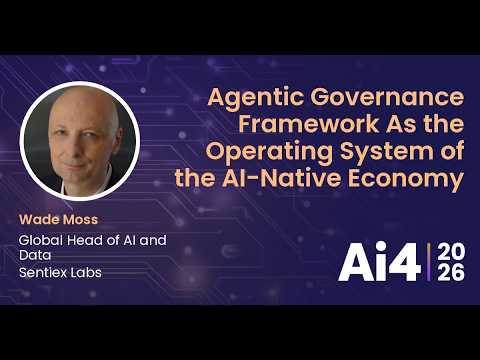
Ai4
Unmanaged AI agents degrade over time, making verification frameworks the core mechanism required to convert raw autonomous capacity into recognized balance-sheet revenue.
AI-assisted summary of Agentic Governance Framework As the Operating System of the AI-Native Economy With Sentiex Labs — original source. Check the original for full context.
Source published:
Detailed notes
## Background Published by Ai4 on YouTube on August 19, 2026, this presentation features Wade Moss, Global Head of AI and Data at Sentiex Labs. The session explores how enterprises can transition to AI-native operating models by leveraging the Agentic Governance Framework (AGF) to transform autonomous AI capabilities into measurable, revenue-generating economic assets.
## TL;DR Wade Moss presents a strategic framework for converting uncalibrated 'raw autonomy' into auditable, revenue-bearing 'agentic capital.' He breaks down the operational verification bottleneck and details the seven-layer architecture of the Agentic Governance Framework (AGF), which spans constitutional risk mandates, knowledge graph governance, and economic allocation. The presentation outlines the governance-to-revenue conversion loop, showing how active governance prevents capital decay and unlocks balance-sheet yield across five enterprise maturity tiers. Ultimately, Moss frames agentic governance not as a compliance bottleneck, but as the foundational production operating system of the modern AI enterprise.
## Atmosphere & style The presentation is delivered with the crisp, authoritative cadence of an executive strategy briefing, seamlessly blending macroeconomic theory with technical systems architecture. Moss speaks with deliberate, analytical precision, reframing traditional governance concepts into proactive industrial production rails. The tone is deeply strategic and forward-looking, evoking the feeling of a board-level masterclass designed to reorient enterprise leadership toward measurable AI yield.
## Key takeaways - [00:08](https://www.youtube.com/watch?v=1zJxivbnZ_g&t=8s) Agentic capital is the reusable economic stock of an enterprise's deployed agents, interfaces, evaluation assets, and knowledge management layers. - [00:08](https://www.youtube.com/watch?v=1zJxivbnZ_g&t=8s) Agentic governance acts as the foundational binding layer that converts raw, uncalibrated technical autonomy into trusted, verified autonomy. - [02:15](https://www.youtube.com/watch?v=1zJxivbnZ_g&t=135s) As execution capacity becomes abundant, verification capacity emerges as the primary operational bottleneck preventing safe enterprise agent deployment. - [02:15](https://www.youtube.com/watch?v=1zJxivbnZ_g&t=135s) The Funnel of Autonomy converts unverified technical capabilities into monetizable assets through four gates: raw, permissioned, evidenced, and revenue-bearing autonomy. - [05:20](https://www.youtube.com/watch?v=1zJxivbnZ_g&t=320s) The seven-layer Agentic Governance Framework separates risk mitigation from yield creation: lower layers establish boundaries and cap risk, while upper layers drive asset reuse and margin expansion. - [05:20](https://www.youtube.com/watch?v=1zJxivbnZ_g&t=320s) Layer 5 (Ontology & Knowledge Governance) differentiates the framework from standard compliance by actively monitoring semantic drift, action schemas, and knowledge graphs. - [08:24](https://www.youtube.com/watch?v=1zJxivbnZ_g&t=504s) Unmanaged autonomous agents suffer from agentic capital decay over time due to underlying model API updates, corporate policy shifts, and ontology drift. - [08:24](https://www.youtube.com/watch?v=1zJxivbnZ_g&t=504s) Governance generates enterprise revenue not as a passive compliance check, but as an industrial quality system and credit rail that renders autonomous execution contractable, repeatable, and auditable. - [10:01](https://www.youtube.com/watch?v=1zJxivbnZ_g&t=601s) The Agentic Governance Framework drives economic impact across five distinct revenue levers: efficiency, capacity, conversion, platform reuse, and trust premiums in regulated markets. - [10:01](https://www.youtube.com/watch?v=1zJxivbnZ_g&t=601s) Executive and board-level oversight must transition to five purpose-built pillars—Stock, Yield, Quality, Risk, and Learning—with yield maturity currently representing the largest strategic gap. - [11:30](https://www.youtube.com/watch?v=1zJxivbnZ_g&t=690s) Enterprises advance across five governance maturity tiers, scaling from isolated assisted pilots to full-scale trust premiums in regulated markets. - [11:30](https://www.youtube.com/watch?v=1zJxivbnZ_g&t=690s) Competitive dominance in the AI-native economy will be captured not by building the largest raw volume of agents, but by establishing robust constitutions, generating rigorous evidence, and compounding verified execution.
## Detailed walkthrough ### [00:08](https://www.youtube.com/watch?v=1zJxivbnZ_g&t=8s) Defining the Three Pillars: Operating Model, Agentic Capital, and Governance
Wade Moss introduces the session on behalf of Sentiex Labs, a frontier research organization dedicated to investigating agentic behaviors, identifying systemic anomalies, and building advanced control systems alongside enterprise design partners. To ground the discussion, Moss defines three foundational concepts essential for understanding the emerging AI economy: the AI-native operating model, agentic capital, and agentic governance.
An enterprise achieves an AI-native operating model when its core business processes are systematically redesigned around agentic workflows, reinforced with lifecycle controls and centered verification suites that establish an architecture capable of scaling autonomous execution. The tangible output of this structural transformation is "agentic capital"—the reusable economic stock of an enterprise's deployed agents, integration interfaces, evaluation assets, and knowledge management layers. Agentic governance serves as the vital binding layer connecting this organizational overhaul to bottom-line economic value. It dictates decision rights, operational permissions, evidence generation, and learning loops, transforming uncalibrated "raw autonomy into verified autonomy."
``` +-------------------------------------------------------------------+ | AI-Native Operating Model | | (Redesigned Agentic Workflows & Control Suites) | +---------------------------------+---------------------------------+ | v +---------------------------------+---------------------------------+ | Agentic Governance | | (Decision Rights, Evidence Generation, Lifecycle Controls) | +---------------------------------+---------------------------------+ | v +---------------------------------+---------------------------------+ | Agentic Capital | | (Reusable Stock of Agents, Knowledge, & Economic Assets) | +-------------------------------------------------------------------+ ```
[02:15](https://www.youtube.com/watch?v=1zJxivbnZ_g&t=135s) The Verification Bottleneck and the Funnel of Autonomy
Agentic governance operates across four primary levers to maximize enterprise value. By generating rigorous audit evidence across workflows, it systematically expands the verified share of output. This verifiable reliability directly minimizes necessary risk reserves, releasing balance sheet capital and expanding profit margins. However, scaling autonomy introduces a severe operational bottleneck: execution capacity quickly becomes abundant, leading organizations into an unproductive trap where they produce hundreds of agents that cannot be safely deployed.
Verification capacity does not organically scale alongside execution abundance; unrecognized technical execution does not equal realized production capacity. To prevent this decoupling, the Agentic Governance Framework (AGF) funnels raw technical capabilities through progressive operational gates to convert them into monetizable business assets.
``` +-------------------------------------------------------------------+ | Raw Autonomy: Total unverified technical agent capabilities | +---------------------------------+---------------------------------+ | v +---------------------------------+---------------------------------+ | Permissioned Autonomy: Assigned IDs, scopes, and tool contracts | +---------------------------------+---------------------------------+ | v +---------------------------------+---------------------------------+ | Evidenced Autonomy: Monitored with trace telemetry & test suites | +---------------------------------+---------------------------------+ | v +---------------------------------+---------------------------------+ | Revenue-Bearing Autonomy: Verified output linked to P&L & yields | +-------------------------------------------------------------------+ ```
- Raw autonomy consists of the baseline count of unverified agents constructed across the enterprise. - Permissioned autonomy assigns explicit agent IDs, defined operational boundaries, and rigid tool contracts. - Evidenced autonomy captures comprehensive execution traces, rollbacks, and telemetry data. - Revenue-bearing autonomy represents the refined subset of verified autonomous units that corporate finance can directly link to P&L line items, service delivery outcomes, and verified productivity gains.
[05:20](https://www.youtube.com/watch?v=1zJxivbnZ_g&t=320s) The Seven-Layer Architecture of the Agentic Governance Framework
The architecture of the Agentic Governance Framework is organized into seven distinct operational layers divided by function: "Lower layers cap risk. Upper layers release yield." The foundational bottom four layers establish safe delegation boundaries and increase the verifiable share of output, while the top three layers drive pattern reuse, asset turnover, and compounding margin expansion.
``` +-------------------------------------------------------------------+ | Layer 7: Continuous Learning & Capital Renewal | +-------------------------------------------------------------------+ | Layer 6: Economic Allocation & Revenue Realization | +-------------------------------------------------------------------+ | Layer 5: Ontology & Knowledge Governance | +-------------------------------------------------------------------+ | Layer 4: Verification, Evaluation & Evidence | +-------------------------------------------------------------------+ | Layer 3: Supervision & Human Accountability | +-------------------------------------------------------------------+ | Layer 2: Identity, Permissions & Tool Contracts | +-------------------------------------------------------------------+ | Layer 1: Constitutional Mandate & Risk Appetite | +-------------------------------------------------------------------+ ```
- **Layer 1: Constitutional Mandate & Risk Appetite** — Defines acceptable use cases, autonomy tiers, policy constraints, and enterprise risk budgets. - **Layer 2: Identity, Permissions & Tool Contracts** — Enforces least-privilege scoping, cryptographic identities, and strictly defined tool interaction contracts for every agent. - **Layer 3: Supervision Layer** — Assigns clear human ownership to every workflow, establishing deterministic escalation paths and human-in-the-loop fallback triggers. - **Layer 4: Verification, Evaluation & Evidence** — Implements end-to-end lifecycle controls, spanning pre-deployment benchmarks, runtime policy assertions, execution tracing, and automated rollback systems. - **Layer 5: Ontology & Knowledge Governance** — Differentiates AGF from conventional public compliance models by actively managing versioned knowledge graphs, embeddings, action schemas, and semantic drift detection. - **Layer 6: Economic Allocation & Revenue Realization** — Operates at the portfolio steering level to manage agent fleet pricing, compute loss reserves, and internal unit chargebacks. - **Layer 7: Continuous Learning & Capital Renewal** — Governs central skill libraries, feedback ingestion loops, model retirement schedules, and systemic drift mitigation.
[08:24](https://www.youtube.com/watch?v=1zJxivbnZ_g&t=504s) Agentic Capital Decay and the Governance-to-Revenue Conversion Loop
Autonomous software systems degrade continuously over time rather than maintaining a static performance baseline. An autonomous agent deployed in the first quarter will exhibit altered behaviors by the third quarter if left unmanaged, driven by underlying model API churn, corporate policy shifts, semantic mismatches, and ontology drift. Because of these persistent depreciation factors, "governed agentic capital renews and unmanaged capital decays."
To counter this natural entropy, the framework establishes the "governance-to-revenue conversion loop." Governance creates top-line value not by acting like a sales team, but by functioning like a credit rail or industrial quality system: it renders autonomous execution recognizable, contractable, repeatable, and economically auditable.
``` +----------------------------+ | Institutional Governance | | (AGF Control Rail) | +--------------+-------------+ | +------------------------+------------------------+ | | v v +---------------+----------------+ +---------------+---------------+ | Compresses Verification Costs | | Expands Deployable Autonomy | | Lowers Balance Sheet Reserves | | Unlocks Regulated Markets | +---------------+----------------+ +---------------+---------------+ | | +------------------------+------------------------+ | v +----------------------------+ | Recognizable, Repeatable | | Enterprise Revenue & Yield | +----------------------------+ ```
[10:01](https://www.youtube.com/watch?v=1zJxivbnZ_g&t=601s) Five Revenue Levers and Modern Board Reporting Pillars
The Agentic Governance Framework unlocks balance-sheet impact across five specific operational levers: - **Efficiency:** Lowers the baseline cost-to-serve across business units. - **Capacity:** Drives higher continuous throughput without linear headcount growth. - **Conversion:** Accelerates operational decision cycles through streamlined workflows. - **Platform:** Generates compounding returns via shared, reusable agentic patterns and tools. - **Trust Premium:** Unlocks high-barrier, heavily regulated markets by providing complete compliance auditability.
Because traditional software metrics fail to track these mechanisms, executive and board-level reporting must transition to five purpose-built pillars: - **Stock:** Quantifies the active production agent inventory and the ratio of reusable assets across teams. - **Yield:** Measures the verified autonomy ratio alongside realized governance yield. - **Quality:** Assesses deterministic policy adherence rates. - **Risk:** Evaluates rollback reliability and failure containment success. - **Learning:** Tracks ontology drift velocity and model adaptation health.
When evaluating enterprise AI transformations by KPI families, the single largest discrepancy between target and current state architectures is consistently found in "yield maturity"—representing the primary area where boards must direct capital and oversight.
[11:30](https://www.youtube.com/watch?v=1zJxivbnZ_g&t=690s) Governance Maturity Tiers and the AI-Native Revenue OS
Enterprise governance maturity advances through five defined stages, with economic value escalating as organizations link governance controls directly to capital allocation:
``` Level 1: Assisted Pilots --> Thin governance; purely anecdotal ROI. Level 2: Controlled Automation --> Bounded, reversible tasks with standardized evidence bundles. Level 3: Verified Autonomy --> Verification established as an industrial production discipline. Level 4: Portfolio Management --> FinOps integration tracking agent stock, yield, and active capital reserves. Level 5: Trust Premium --> Full-scale deployment into regulated markets with maximum margin capture. ```
As an organization climbs these maturity tiers, its verified autonomy ratio and governance yield improve simultaneously. Moss concludes by emphasizing that agentic governance cannot be treated as a passive compliance overlay. Instead, it operates as the core production system and revenue engine of the AI-native enterprise. Market dominance will not belong to the organizations that assemble the largest sheer quantity of agents, but to those that establish "better constitutions, generate stronger evidence and compound capabilities into trustworthy execution."
## Notable quotes > [00:08](https://www.youtube.com/watch?v=1zJxivbnZ_g&t=8s) raw autonomy into verified autonomy — Wade Moss
> [00:08](https://www.youtube.com/watch?v=1zJxivbnZ_g&t=8s) agentic capital — Wade Moss
> [05:20](https://www.youtube.com/watch?v=1zJxivbnZ_g&t=320s) Lower layers cap risk. Upper layers release yield. — Wade Moss
> [08:24](https://www.youtube.com/watch?v=1zJxivbnZ_g&t=504s) governed agentic capital renews and unmanaged capital decays — Wade Moss
> [08:24](https://www.youtube.com/watch?v=1zJxivbnZ_g&t=504s) governance-to-revenue conversion loop — Wade Moss
> [10:01](https://www.youtube.com/watch?v=1zJxivbnZ_g&t=601s) yield maturity — Wade Moss
> [11:30](https://www.youtube.com/watch?v=1zJxivbnZ_g&t=690s) better constitutions, generate stronger evidence and compound capabilities into trustworthy execution — Wade Moss
## Mentioned Wade Moss, Sentiex Labs, Ai4, Agentic Governance Framework (AGF), FinOps
## Video description Wade Moss - Global Head of AI and Data, Sentiex Labs
What if autonomy itself became a measurable, revenue-generating asset rather than an experimental capability? The talk will illustrate how agentic capital emerges when enterprises shift to AI-native operating models and treat agents, workflows, and knowledge systems as a reusable economic stock. I will explain why raw autonomy is not enough, and how verified autonomy becomes the true unit of value—enabled by the Agentic Governance Framework (AGF), which converts autonomous actions into trusted, auditable, and monetizable output . Attendees will learn how agentic governance acts as a production system and revenue engine, expanding safe delegation, increasing reuse, and creating trust premiums in regulated environments. The talk will also break down the governance-to-revenue conversion loop and show how to operationalize AGF to scale agentic capital across the enterprise. Join this session to understand how to turn autonomy into capital—and governance into your competitive advantage.
[Source](https://www.youtube.com/watch?v=1zJxivbnZ_g)