## Background
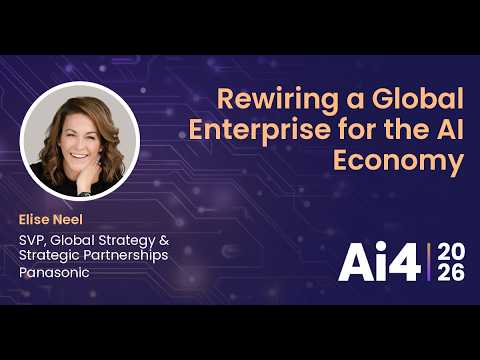
Published by the Ai4 channel on YouTube on August 19, 2026, this 20-minute presentation features Elise Neel, SVP of Global Strategy & Strategic Partnerships at Panasonic. The video description highlights Panasonic's journey to reinvent its structure, culture, and business models in an AI-powered world, sharing practical lessons learned along the way.
## TL;DR
Elise Neel delivers a candid breakdown of enterprise AI adoption, sharing research and personal lessons from leading global AI transformations at Panasonic and Verizon. She examines the contrast in regional mindsets toward AI, contrasts simple automation with true enterprise transformation, and details four major execution pitfalls, including governance lags and conflicting incentive structures. Ultimately, Neel presents a practical playbook emphasizing refactored architectures, realigned HR incentives, continuous employee AI literacy, and strong agent governance models.
## Atmosphere & style
The talk carries an authoritative yet highly transparent and approachable tone, grounded in real-world 'stories from the street' rather than dry corporate theory. Neel speaks with pragmatic honesty, openly admitting to past missteps and organizational friction while maintaining an energetic, action-oriented momentum. Listening to the presentation feels like receiving a candid, executive-level debrief that demystifies corporate AI chaos into structured, relatable lessons.
## Key takeaways
- [00:04](https://www.youtube.com/watch?v=I2ciD8xgnMA&t=4s) Empirical research shows a paradox in executive leadership: 100% of surveyed C-suite leaders agree AI will alter work, but under 41% have a 5-year strategy and less than one-third are aligned on vision.
- [03:02](https://www.youtube.com/watch?v=I2ciD8xgnMA&t=182s) Enterprise AI adoption lacks a standard playbook due to unique 'time compression' that impacts every functional unit across an organization simultaneously.
- [03:02](https://www.youtube.com/watch?v=I2ciD8xgnMA&t=182s) Regional and cultural perspectives shape AI adoption, with Europe focused on human sensemaking, APAC on human-machine coexistence via automation, and North America on governance and role replacement risks.
- [05:05](https://www.youtube.com/watch?v=I2ciD8xgnMA&t=305s) Enterprise leaders must distinguish between automating existing processes versus completely transforming the core business model.
- [05:05](https://www.youtube.com/watch?v=I2ciD8xgnMA&t=305s) The Diamond E Framework requires executive teams to continuously balance Market Demands, Strategic Intent, and Capabilities & Resources to prevent strategic failure.
- [09:24](https://www.youtube.com/watch?v=I2ciD8xgnMA&t=564s) Appointing an isolated Chief AI Officer often fails because AI execution requires cross-functional 'all in the box' alignment across every operational department.
- [09:24](https://www.youtube.com/watch?v=I2ciD8xgnMA&t=564s) Capital allocation in enterprise AI is threatened by model obsolescence, where multi-million-dollar internal builds risk being rendered obsolete by new foundation models.
- [09:24](https://www.youtube.com/watch?v=I2ciD8xgnMA&t=564s) Traditional enterprise compensation models based on 'span and layer' incentivize leaders to protect large team sizes, creating resistance against automated AI agents.
- [09:24](https://www.youtube.com/watch?v=I2ciD8xgnMA&t=564s) While grassroots shadow AI creates governance lag, it frequently acts as the fastest catalyst for driving practical organizational AI literacy.
- [12:42](https://www.youtube.com/watch?v=I2ciD8xgnMA&t=762s) To succeed, organizations must normalize chaos early, build architectures explicitly designed for refactoring, and establish central horizontal intelligence layers.
- [12:42](https://www.youtube.com/watch?v=I2ciD8xgnMA&t=762s) HR and corporate incentive systems must be realigned to reward employees for training and promoting AI agents rather than penalizing them for cost reductions.
- [16:06](https://www.youtube.com/watch?v=I2ciD8xgnMA&t=966s) AI readiness cannot be treated as a one-and-done project; AI literacy demands ongoing commitment to overcome employee emotional inertia and adapt to continuous change.
- [16:06](https://www.youtube.com/watch?v=I2ciD8xgnMA&t=966s) Effective transformation is fundamentally a change management and emotional challenge that relies on capturing employee hearts and minds rather than just upgrading technology.
- [17:48](https://www.youtube.com/watch?v=I2ciD8xgnMA&t=1068s) Durable identity systems, such as those linking AI agents to verifiable human identities, are critical for resolving enterprise agent governance, security, and auditing concerns.
## Detailed walkthrough
### [00:04](https://www.youtube.com/watch?v=I2ciD8xgnMA&t=4s) Introduction and the Current State of C-Suite Alignment
Elise Neel introduces herself as a business builder and enterprise architect specializing in large-scale AI transformations. Having led global AI transformation programs at Panasonic, established nine new business incubation platforms at Verizon, worked at AOL, and currently serving as an executive adviser at PwC, she draws on extensive experience across telecommunications, pharmaceuticals, and aerospace ("rocket ships"). Rather than presenting abstract frameworks, Neel promises "stories from the street"—a transparent breakdown of personal missteps and successes designed to help enterprise leaders navigate their own AI adoption journeys.
To set the stage, Neel references recent empirical research conducted in partnership with CGS Advisors. Surveying 200 global C-suite executives on the future of work, organizational structures, and leadership, the study reveals a striking paradox: while there is universal agreement that AI will fundamentally change the nature of work, there is virtually no consensus on *how* it will change or what it demands from executive leadership. Overwhelmingly, leaders agree work is evolving, yet fewer than 41% feel they have even a vague idea of what that means for their 5-year strategic leadership plan, and less than one-third report that their executive teams are aligned on the vision.
- **Elise Neel's Background**: Former leader of global AI transformation at Panasonic, former VP/head of new business incubation at Verizon (built 9 businesses), former AOL leader, and current Executive Adviser at PwC.
- **CGS Advisors Survey Data**:
- Sample size: 200 global C-suite executives.
- 100% agreement that AI will fundamentally alter work.
- **41%** of leaders have a vague concept of their 5-year strategic leadership plan under AI.
- **<33%** (less than one-third) feel their leadership team is aligned on their AI strategy and outlook.
---
[03:02](https://www.youtube.com/watch?v=I2ciD8xgnMA&t=182s) The Unprecedented Pace of AI and Regional Cultural Perspectives
Neel emphasizes that no off-the-shelf playbook exists for enterprise AI transformation. Attempting to replicate another company's digital transformation model fails to account for the unique "time compression" of artificial intelligence. Unlike previous technological shifts, AI impacts every single functional area of an organization simultaneously with intense pressure. Currently, no Fortune 1000 company—or even native AI company—has definitively established a North Star for AI transformation that demonstrates sustained, executable growth.
Furthermore, geographic and cultural backgrounds dramatically shape how executive teams approach AI adoption:
- **Europe**: Leaders adopt a pragmatic stance, believing work is changing but remaining uncertain about how human value—such as creativity, problem-solving, and sensemaking—will fit alongside automated systems.
- **Asia-Pacific**: Drawing on decades of mastery in robotics, industrial automation, and advanced manufacturing, APAC leaders demonstrate far higher confidence in humans coexisting with machines, viewing human value primarily through the lens of innovation and new ideation.
- **North America**: Operating within a western "guilt-innocence culture" centered on rules and accountability, North American leaders concentrate heavily on governance, identity frameworks, compliance, and individual role replacement risks.
---
[05:05](https://www.youtube.com/watch?v=I2ciD8xgnMA&t=305s) Corporate Realities and Fundamental Strategic Decisions
Reflecting on her tenure at Panasonic—a 106-year-old manufacturing giant comprising over 300 acquired or built operating companies—Neel illustrates how AI exposes structural friction. The pervasive functional, regional, and line-of-business silos across such conglomerates create massive organizational inertia. While fundamental shareholder goals (profit and revenue growth) remain unchanged, shareholders have grown increasingly impatient for fast, creative answers to market pressures.
To establish clarity, enterprise leaders must confront two foundational strategic decisions:
1. **Automating vs. Transforming**:
- *Automating* means performing existing processes faster and better using AI without changing the fundamental core of the business.
- *Transforming* means reinventing the business entirely—such as Verizon's strategic pivot from a traditional telecommunications carrier to a technology company.
2. **The Diamond E Framework Alignment**:
- Executive teams must continuously balance three forces: **Market Demands** (*what you MUST do*), **Strategic Intent** (*what you WANT to do*), and **Capabilities & Resources** (*what you CAN do*).
- Misalignment leads to severe failure modes: pursuing market demands without internal capabilities destroys strategy, while pushing internal desires without market demand results in building unsought product categories ahead of market readiness.
---
[09:24](https://www.youtube.com/watch?v=I2ciD8xgnMA&t=564s) Four Major Pitfalls in Enterprise AI Execution
Even when companies commit to transformation and align their strategic priorities, four pervasive execution pitfalls frequently derail progress:
- **Unclear Ownership**: Appointing a Chief AI Officer (CAIO) who is strictly technical often backfires because AI impacts every function—HR, legal, procurement, sales, product, and supply chain—simultaneously. Ownership cannot be isolated; it requires cross-functional "all in the box" alignment.
- **Unclear ROI & Model Obsolescence**: CFOs are demanding clear P&L impact rather than vague productivity metrics ("5 hours saved to play golf"). Furthermore, capital allocation is threatened when a $15 million in-house product build is rendered obsolete overnight by a new foundation model update from OpenAI, Anthropic, or open-source frameworks like LangChain.
- **Organizational Protectionism & Fear**: Traditional enterprise compensation models incentivize leaders based on "span and layer"—the number of direct reports managed. Because AI agents disrupt team sizes, leaders instinctively protect their organizational structures. Additionally, fear of employee displacement is felt far more acutely in the U.S. than in other global regions.
- **Governance Lag vs. Grassroots Shadow AI**: Employees adopt and experiment with AI tools much faster than corporate governance policies can respond. While this "agent sprawl" creates technical debt, Neel notes it is often the single fastest path to organizational AI literacy.
---
[12:42](https://www.youtube.com/watch?v=I2ciD8xgnMA&t=762s) Playbook for Success: Architectural Refactoring and Incentive Alignment
To overcome these execution bottlenecks, Neel outlines tactical operational strategies derived from her leadership at Panasonic and Verizon:
- **Normalize Chaos Early**: Executive leaders must candidly admit to their organizations that no exact playbook exists. Creating psychological safety around structured experimentation prevents the paralysis often caused by rigid "fail fast" mandates.
- **Build for Refactoring**: Technical architectures, workflows, and capital allocation models must be explicitly engineered for rapid iteration and replacement, accepting that today's implementation will soon be obsolete.
- **Realign HR & Incentive Systems**: In a telltale anecdote from Panasonic, the HR team successfully built and deployed AI agents that automated substantial workloads. However, after one month, employees stopped using them. When interrogated, HR staff admitted that reducing operational costs and editing the workforce actively conflicted with their personal Key Performance Indicators (KPIs) and career progression. Neel stresses that companies must create new incentive structures that reward employees for prompting, training, and promoting virtual AI agents rather than penalizing them.
- **Centralize Enterprise Skills & Intelligence Layers**: Rather than forcing a rigid shared-services hierarchy, enterprises should build a unified "horizontal intelligence layer" or central operating system to allow data and capabilities to flow seamlessly across legacy business units.
[016:06] The Continuous Reality of AI Literacy and Cultural Change
Elise Neel candidly reflects on a major initial misstep in Panasonic's transformation journey: treating AI readiness as a one-and-done project. The company initially checked all the boxes, spent a "boatload of cash" on global enterprise training, and confidently declared themselves ready—only to realize that adapting to AI is a continuous process. She emphasizes that "you cannot overdo AI literacy," because the pace of change never stops. Employees who undergo training often experience "emotional inertia" when returning to work environments that lack "fertile soil" for their newly learned AI agents or workflows.
The biggest early mistake in the transformation cycle was treating AI purely as a technology transformation rather than a change management and emotional challenge. She highlights that true enterprise transformation requires capturing "the hearts and minds of your employees" to empower everyone to redesign how they work. Organizations must actively bring along less technically adept teams, as building comfort, knowledge, and understanding across all departments creates a far smoother transition.
- **Continuous Adaptation:** AI readiness cannot be achieved through a single training campaign; literacy requires ongoing commitment as technology evolves.
- **Cultural & Emotional Focus:** True transformation depends on employee empowerment and change management rather than just platform upgrades.
---
[017:48] Key Tools and Partners for AI Implementation
To help organizations navigate these transformation hurdles, three specific resources and partner strategies are recommended:
1. **Insights Portal:** A free, valuable resource featuring seven to eight white papers full of intelligence and peer insights to help leaders learn faster together.
2. **Financial Workflows with PwC:** For organizations struggling with CFO alignment and AI financing, PwC has developed models that balance the value of a unit of work against incentive structures, aiding in expense rationalization across a global workforce.
3. **Agent Governance with Identity Digital:** For advanced organizations deploying AI agents, Identity Digital provides a durable identity system. Given that governance, accountability, and security represent 30% of enterprise concerns, this system attaches every AI agent or skill to a verifiable human identity, ensuring that agent-to-agent and B2B commerce interactions remain trusted, auditable, and secure.
---
[019:35] Closing Call to Action
In closing, an open invitation is extended to conference attendees to connect, debate ideas, share solutions, and exchange effective tools. Whether by scanning badges or reaching out on LinkedIn, the goal is for the industry to collaborate so that by next year, enterprises spend less time trying to figure things out and more time celebrating proven success stories.
- Connect via badge scanning or LinkedIn to share insights and best practices.
- Focus on collective industry learning to showcase tangible "what worked" results in the following year.
## Notable quotes
> [00:04](https://www.youtube.com/watch?v=I2ciD8xgnMA&t=4s) stories from the street — Elise Neel
> [03:02](https://www.youtube.com/watch?v=I2ciD8xgnMA&t=182s) time compression — Elise Neel
## Video description
Elise Neel - SVP, Global Strategy & Strategic Partnerships, Panasonic
With a legacy that spans industries and decades, Panasonic is undertaking a bold journey to reinvent how it operates, builds and competes in an AI-powered world. In this session, Elise will share how the company is rethinking structure, culture and execution... and her lessons learned along the way. From incubating digital innovation to standing up new business models, this is a conversation about how large enterprises can use emerging technology not just to optimize, but to truly reinvent from the inside out.
松下AI战略转型暴露全球业务部门高管认知脱节
松下战略主管 Elise Neel 透露,不协调的员工激励机制和企业惯性阻碍了企业采纳 AI,相比一次性技术投资,这更需要持续的素养培养和跨职能重构。
Elise Neel 坦诚剖析了企业落地 AI 的现状,分享了在松下和 Verizon 主导全球 AI 转型过程中的研究成果与亲身经验。她探讨了不同地区对 AI 的思维差异,对比了单纯自动化与真正的企业级转型,并详细列举了包括治理滞后和激励机制冲突在内的四大执行陷阱。最后,Neel 提出了一套实用的行动指南,强调重构架构、重新理顺人力资源激励机制、持续提升员工 AI 素养以及建立强有力的智能体治理模型。
实证研究揭示了高管领导层中的一个悖论:100%受访的最高管理层均认同 AI 将改变工作模式,但拥有5年战略规划的不足41%,且达成愿景一致的不到三分之一。 (0:04)
由于独特的“时间压缩”效应会同时冲击组织内的每一个职能部门,企业采纳 AI 目前仍缺乏标准可循的操作指南。 (3:02)
地域与文化视角深刻塑造着 AI 的采纳路径:欧洲关注人类意义建构,亚太地区聚焦通过自动化实现人机共存,而北美则着眼于治理以及岗位替代风险。 (3:02)
企业领导者必须将现有流程的自动化与核心业务模式的彻底转型明确区分开来。 (5:05)
Diamond-E 框架要求高管团队持续平衡市场需求、战略意图以及能力与资源,以防范战略失误。 (5:05)
Reading summary
Drawing on enterprise transformations at Panasonic and Verizon, former executive Elise Neel argues that generative AI adoption is primarily an organizational, cultural, and incentive challenge rather than a technical one. While corporate leaders universally acknowledge AI's disruptive potential, sustained implementation stalls without structural incentive alignment, cross-functional ownership, and architectures designed for rapid obsolescence.
The Executive Alignment Paradox and Regional Differences (0:04)
A CGS Advisors survey of 200 global C-suite executives highlights a sharp divide between strategic awareness and execution. While 100% of respondents agreed that AI will fundamentally alter work, only 41% had even a vague concept of their five-year leadership plan, and less than one-third reported leadership alignment on AI strategy. Neel notes that no Fortune 1000 company has yet established a verified benchmark for sustained, executable AI growth, largely because the technology compresses cycle times across all corporate functions simultaneously.
Adoption postures also vary significantly by geography. North American executives operate within rule-focused corporate cultures, concentrating heavily on compliance, governance frameworks, and employee displacement risks. Conversely, Asia-Pacific leaders draw on decades of industrial automation and robotics to embrace human-machine coexistence focused on innovation, while European leaders take a pragmatic approach, questioning where human value and creative problem-solving fit beside automated systems.
Strategic Choice: Automation Versus Business Transformation (5:05)
Reflecting on Panasonic's operational reality—a 106-year-old manufacturing conglomerate with more than 300 acquired or internal operating companies—Neel points out that corporate, regional, and functional silos produce intense organizational inertia. Under shareholder pressure for rapid growth, enterprises must clearly differentiate between automating existing workflows for efficiency and fundamentally transforming the enterprise, such as Verizon's shift from a telecommunications carrier into a technology company.
To prevent misallocation, executive teams must continually balance the Diamond E Framework's three dimensions: market demands (what a company must do), strategic intent (what it wants to do), and internal capabilities (what it can do). Pursuing market pressure without core capabilities collapses the strategy, while pushing internal ambition without proven market demand leads companies to construct product categories ahead of market readiness.
Four Systemic Execution Pitfalls (9:24)
Enterprise AI execution frequently breaks down across four systemic failure modes. First, appointing a purely technical Chief AI Officer often fails because AI spans HR, legal, sales, procurement, and supply chain, necessitating cross-functional leadership rather than isolated technical ownership. Second, return on investment is undermined by rapid model obsolescence; proprietary $15 million in-house builds risk being rendered instantly obsolete by model updates from OpenAI, Anthropic, or open-source frameworks like LangChain.
Third, corporate governance consistently lags behind employee usage. While grassroots shadow AI carries technical debt, it often drives organizational literacy faster than formal policies. Finally, organizational protectionism stalls adoption because enterprise compensation models reward leaders on 'span and layer'—the number of managed direct reports. Because AI agents compress team sizes, managers instinctively protect traditional organizational headcount.
Architectural Refactoring and KPI Realignment (12:42)
To counter these bottlenecks, Neel recommends engineering technical architectures and capital allocation for continuous refactoring, accepting that current deployments will soon be obsolete. More critically, corporate incentive models must adapt. At Panasonic, the human resources team built automated AI agents but abandoned them after a month because reducing operational headcount and costs directly conflicted with their personal Key Performance Indicators and promotion criteria. Neel asserts that organizations must actively reward employees for prompting, training, and deploying virtual agents.
Furthermore, enterprises must treat AI adoption as continuous change management rather than a one-time training rollout. Initial efforts at Panasonic revealed that expensive, one-off training initiatives created emotional inertia when employees returned to legacy workflows. Operational success requires ongoing literacy, financial workflow models like those developed by PwC to balance unit-of-work values against incentives, and identity frameworks such as Identity Digital to tether software agents to accountable human identities.
Neel concludes that technological capability alone cannot overcome structural inertia; corporate AI transformation ultimately hinges on whether leadership can realign employee incentives, embrace organizational ambiguity, and maintain continuous literacy before foundational model advances render their existing structures obsolete.
精炼阅读摘要
企业人工智能转型专家 Elise Neel 结合松下与 Verizon 的实践指出,当前全球高管面临“全面认同 AI 重要性却普遍缺乏落地共识”的治理脱节;真正的转型不仅是单一的技术导入,更取决于组织架构解耦、考核激励机制重塑与持续的情感变革管理。
高管共识断层与转型战略分水岭 (0:04)
Neel 引用其与 CGS Advisors 针对 200 位全球 C 级高管的联合调研显示,尽管 100% 的受访者一致认为 AI 将从根本上改变工作本质,但仅有不到 41% 的高管对其在 AI 背景下的 5 年领导力战略具有清晰设想,且不足 33% 的高管团队在战略愿景上达成了一致。在拥有 106 年历史、涵盖 300 多家运营公司的松下集团内部,跨职能、跨区域和跨业务线的深层壁垒带来了巨大的组织惯性,而股东对盈利与业务增长的迫切需求则进一步加剧了推进转型的阻力。
面对这种复杂局面,企业必须明确两项核心战略抉择。首先是界定“自动化”与“转型”的边界:自动化仅是利用 AI 加快并优化既有业务流程,而转型则要求重塑企业核心商业逻辑,如同 Verizon 从传统电信运营商向科技企业的全面跨越。其次,管理层须运用 Diamond E 框架,在“市场需求”(必须做)、“战略意图”(想要做)与“内部能力和资源”(能够做)之间维持动态平衡;脱离自身能力盲目响应市场会导致战略失调,而脱离市场需求强行研发则会陷入产品超前却缺乏需求的困境。
地缘文化认知差异与四大执行陷阱 (3:02)
不同地区的文化底色深刻影响着管理层推进 AI 的视角。欧洲高管持务实态度,但对人类独有的创造力与问题解决能力如何融入自动化体系存有顾虑;亚太地区依托在机器人、工业自动化和先进制造领域的长期积累,对人机共生持有最高信心,视人类价值为持续创新的来源;北美企业则受西方问责与规则文化驱动,将注意力高度集中于合规审计、身份体系以及个别岗位被替代的风险。
在执行落地过程中,企业普遍面临四大陷阱。一是权责界定不清:单纯任命技术型首席 AI 官(CAIO)难以推动全局,因为 AI 同时冲击人力、法务、供应链等全业务链,必须依靠跨职能深度协同。二是投资回报率模糊与技术过时风险:财务主管要求明确的损益表(P&L)回报,而耗资 1500 万美元自研的专有系统极可能因 OpenAI、Anthropic 推出新模型或 LangChain 等开源框架更新而迅速贬值。三是基于管理跨度与层级(span and layer)的传统考核体系催生了部门保护主义,导致管理层因担忧缩减团队编制而抵触 AI。四是公司治理节奏滞后于基层自发的“影子 AI”扩张,尽管工具泛滥带来了技术债务,但客观上也构成了培养组织 AI 素养的最快路径。
架构可重构设计与组织激励重组 (12:42)
为打破执行僵局,Neel 提出了一套聚焦敏捷应对的运营框架。企业领导层必须首先在组织内“接纳混乱的常态化”,承认目前尚无现成范式可循,建立心理安全感以鼓励结构化试错。在底层设计上,技术架构、业务流程与资本分配必须严格遵循“为重构而建”(Build for Refactoring)的原则,在立项之初就接受方案将在短期内被迭代替代的技术现实。
更为关键的突破在于人力资源与考核制度的重置。松下 HR 部门曾自主研发出显著提效的 AI 代理,但在上线一个月后便遭员工弃用,原因在于减少工作量与精简人力的成果直接违背了员工原有的 KPI 与晋升利益。对此,企业必须打破传统薪酬限制,转向奖励那些积极提示、训练并推广虚拟代理的员工。同时,大型企业应放弃僵化的集中式共享服务层级,转而搭建贯穿各独立业务部门的“水平智能层”或中央操作系统,保障数据资产与底层能力的高效复用。
持续组织素养培育与可信身份治理
松下前期的重大误区在于将 AI 就绪度当作一次性的 IT 部署任务。集团此前投入巨额资金开展全球培训并完成考核指标,但员工返回工作岗位后因缺乏应用场景而迅速陷入“情绪惯性”。Neel 强调,AI 转型绝非单纯的平台升级,本质是涉及全员变革管理与情绪疏导的系统工程,唯有通过长期的素养培育并赢得员工的情感认同,方能平稳带动技术基础薄弱的团队共同重塑工作模式。
在协同生态层面,企业可通过专业洞察平台汲取行业经验,并采用 PwC 开发的财务工作流模型,通过精确测算单位工作价值与激励机制的平衡关系,辅助财务部门在跨国团队中合理配置支出。此外,面对多智能体协作环境,引入 Identity Digital 等方案将 AI 代理绑定至可核验的人类真实身份,能够直接回应合规与安全领域的企业核心关切,为代理间交互与 B2B 商业合作提供可追溯、可审计的信任基石。
Neel 指出,目前全球尚无任何一家财富 1000 强或原生 AI 企业摸索出经受长期检验的标准化转型路径。企业高管必须正视战略模糊与技术折旧风险,摒弃一劳永逸的技术采购思维,通过业务意图、激励机制与可信治理的三维重构,在持续的跨行业交流中动态寻找人机协同的最佳形态。
Detailed notes — zh
## Background
该内容由 Ai4 频道于 2026 年 8 月 19 日在 YouTube 平台发布。视频记录了松下(Panasonic)全球战略与战略合作伙伴关系高级副总裁 Elise Neel 的主题演讲,分享了这家跨国巨头如何在 AI 时代从组织架构、企业文化与执行机制等维度自我重构,实现从内而外的全面转型。
## TL;DR
演讲指出全球高管在面对 AI 变革时普遍缺乏现成标准手册,企业必须首先厘清“局部自动化”与“彻底转型”的战略路径差异。Elise 深入剖析了企业落地 AI 面临的权责模糊、ROI 难以衡量、中层自我防卫及智能体治理滞后等核心阻碍,并结合松下的真实案例提出了架构为重构而设计、重塑绩效激励及建立中央操作系统等破局实践。她最终强调,AI 转型绝非单纯的技术升级,其本质在于赢得员工认同的情绪转型与深度变革管理。
## Atmosphere & style
整体基调务实、坦率且极具洞见,演讲者抛弃了浮夸的技术叙事,以犀利幽默的表达直击大型企业在变革中的体制沉疴与高管群体的普遍焦虑。从直面“无现成剧本”的迷茫,到坦诚复盘松下内部 HR 项目受阻与培训走弯路的实战教训,整场分享在冷静剖析痛点与真诚呼吁行业共建之间张弛有度,带给听众既清醒深刻又充满实操力量的沉浸式体验。
## Key takeaways
- [00:04](https://www.youtube.com/watch?v=I2ciD8xgnMA&t=4s) AI 时代企业转型没有现成的标准手册,其冲击呈现全方位、多维度与极度的时间压缩效应,即使是头部 AI 企业也仍在摸索可持续的增长范式。
- [00:04](https://www.youtube.com/watch?v=I2ciD8xgnMA&t=4s) 全球 200 位 C-suite 高管调研显示出深刻的认知脱节:虽然全员认同 AI 将重塑工作形态,但仅 41% 对未来 5 年领导力规划有模糊概念,不足 1/3 的管理层团队在 AI 战略上达成一致。
- [03:46](https://www.youtube.com/watch?v=I2ciD8xgnMA&t=226s) 底层技术普惠化让所有企业站在同一起跑线上,反而放大了大型传统企业(如松下百年财阀架构)因部门壁垒(Silos)带来的组织惰性与微利竞争痛点。
- [06:37](https://www.youtube.com/watch?v=I2ciD8xgnMA&t=397s) 企业在启动 AI 项目前必须厘清是选择“流程自动化”还是“业务模式彻底转型”,并运用 Diamond-E 框架对齐市场要求(Must)、组织意愿(Want)与落地能力(Can)。
- [09:32](https://www.youtube.com/watch?v=I2ciD8xgnMA&t=572s) 企业 AI 落地面临四重核心阻碍:全员权责归属不清、CFO 要求的损益表(P&L)真实 ROI 模糊、管理层为保住管理层级与管辖人数的防御心理,以及智能体扩散速度远超合规治理能力。
- [12:42](https://www.youtube.com/watch?v=I2ciD8xgnMA&t=762s) 系统架构必须“为重构而设计”(Build for Refactoring),清醒预留技术可替换性与资本重构空间,以应对自研功能随时被底层模型大版本更新淘汰的风险。
- [12:42](https://www.youtube.com/watch?v=I2ciD8xgnMA&t=762s) 松下真实案例表明,如果绩效体系仍与管辖团队规模挂钩,员工就没有动力通过智能体自动化削减成本;企业必须重塑激励机制,让“训练与培育智能体”直接转化为员工的晋升与回报。
- [16:06](https://www.youtube.com/watch?v=I2ciD8xgnMA&t=966s) AI 素养培训绝非一次性的“对账打勾”任务,技术迭代速度与跨部门协作的“情绪惯性”要求企业在 AI literacy 上的投入必须持续进行且永无止境。
- [16:48](https://www.youtube.com/watch?v=I2ciD8xgnMA&t=1008s) AI 转型的本质不是纯粹的技术升级,而是一场深刻的“变革管理”与“情绪转型”,关键在于赢得全员的心智认同并将非技术团队深度纳入核心工作流中。
- [17:48](https://www.youtube.com/watch?v=I2ciD8xgnMA&t=1068s) 在智能体规模化治理与商业互信层面,需要引入持久化身份体系(如 Identity Digital),将每个 Agent 及其技能与真实人类责任人绑定,确保跨企业商业往来的可审计性与合规安全。
## Detailed walkthrough
### [00:04](https://www.youtube.com/watch?v=I2ciD8xgnMA&t=4s) 企业转型背景与高管调研:AI 时代的普遍迷茫
演讲者 Elise Neel 拥有深厚的业务孵化与企业架构背景,曾长期在 Verizon 领导新业务孵化平台并打造了约 9 家新企业,随后在松下(Panasonic)建立并统筹全球 AI 转型项目,目前在普华永道(PwC)担任高管顾问,协助电信、制药及航天等领域的大型企业规划技术落地。她开门见山地指出,在当前 AI 转型浪潮中,没有人拥有一本现成的标准手册,甚至连头部 AI 公司也尚未完全摸索出一套可持续执行的增长范式。传统意义上的“数字化转型”在时间尺度上根本无法与如今的 AI 变革相提并论——这是一场全方位、多维度并伴随巨大时间压缩效应的冲击。
Elise 引用了 CGS Advisors 针对全球 200 位企业 C-suite 高管的调研数据,该调查围绕“工作未来”、“组织未来”以及“领导力未来”三大核心命题展开。调查结果揭示了一个深刻的悖论:虽然几乎所有高管都一致认同 AI 将从根本上重塑工作形态,但当被问及具体如何重塑、对人类角色有何影响时,全行业却陷入了巨大的认知分歧与迷茫。
- **41% 的高管**:表示自己对未来的 5 年战略领导力规划仅有“某种模糊的想法”。
- **不足 1/3 的高管**:认为自身的领导层团队在 AI 战略方向与核心信念上达成了真正的一致。
```mermaid
flowchart TD
accTitle: 高管对于 AI 转型的认知脱节
A["调研 200 位全球高管"] --> B["普遍共识:工作形态必然改变"]
B --> C["战略盲区:5 年领导力规划仅 41% 略有概念"]
B --> D["协同脱节:不足 1/3 的管理层达成方向一致"]
C --> E["结论:全球无现成剧本,唯有一同探索试错"]
D --> E
```
---
### [03:46](https://www.youtube.com/watch?v=I2ciD8xgnMA&t=226s) 全球不同文化语境下的认知差异与企业同质化困境
面对 AI 重塑,全球不同区域展现出了截然不同的文化心态。欧洲的务实派在探索人类在创造力、问题解决与意义构建(Sensemaking)方面的独特价值;亚太地区凭借数十年在制造业、机器人与自动化领域与机器并肩作业的深厚积累,对人机协作及人类在新想法构思中的角色更具信心;而北美等西方文化普遍受“非黑即白/有罪无罪”的归责框架主导,讨论重心高度聚焦于治理边界、问责归属、身份架构以及“谁会被替代”。
与此同时,底层技术的普惠化让所有企业站到了相同的起跑线上。各家企业及其竞争对手获取大模型、智能体构建工具以及通用商业情报的门槛极低且成本低廉。这种技术平权反而放大了企业内部的结构性痛点:如何通过微利与效率重构来驱动利润?尤其是在像松下这样拥有 106 年历史、历经百年并购与自建而形成的 300 多家分支企业组成的庞大财阀体系中,按职能、区域和业务线高度矩阵化的组织架构产生了顽固的部门壁垒(Silos),AI 的介入犹如一面放大镜,彻底暴露出这些部门孤岛带来的巨大组织惰性。
---
### [06:37](https://www.youtube.com/watch?v=I2ciD8xgnMA&t=397s) 企业必须厘清的两大战略决策
在推进 AI 战略时,绝大多数企业往往混淆了基础概念,导致试点项目频繁搁浅。企业在启动前必须如实面对两个最核心的决策框架:
1. **自动化(Automating)还是转型(Transforming)**:自动化意味着维持原有的业务模式与运营逻辑不变,仅通过引入 AI 将现有流程做得更快、更好;而转型则意味着要重塑为一家全然不同的企业,彻底改变价值交付与客户交互模式(例如 Verizon 从传统电信运营商向科技公司的战略跨越)。这两种路径不存在绝对的优劣,但对应的组织运作与资源配置策略截然不同。
2. **“必须-想要-能够”(Must-Want-Can)战略对齐(Diamond-E 框架)**:
- **Must(市场要求)**:企业立足行业的基本盘与外部迫切需求。
- **Want(组织意愿)**:企业的愿景、核心战略取向与 North Star。
- **Can(资源能力)**:企业内部现有的实际资源与技术落地能力。
如果企业仅看重市场需求与战略雄心,却缺乏可落地的能力支撑,战略就会彻底沦为空谈;反之,若脱离市场需求盲目投入资源,则会提前透支赛道,制造出无人问津的伪需求。
---
### [09:32](https://www.youtube.com/watch?v=I2ciD8xgnMA&t=572s) 企业落地 AI 面临的四大核心阻碍
即使企业在战略层面明确了方向,实际落地中依然会遭遇四重严峻挑战:
- **权责归属不清(Unclear Ownership)**:许多企业设立了首席人工智能官(CAIO),但若该角色过度偏向纯技术实现,往往难以与人力资源、绩效激励等业务环节协同。AI 对人力、营销、研发、工程、客服、供应链和销售的冲击是全方位的,“责任归属不是双人成行或三人小组,而是全员入局”。
- **投资回报率模糊(Unclear ROI)**:CFO 们不再满足于“员工每周省下 5 小时去打高尔夫或头脑风暴”这类虚泛的叙事,而是要求在损益表(P&L)上看到实打实的净利润与新增收入。此外,技术迭代带来的沉没成本极其高昂——企业耗资 1500 万美元自研的创新功能,可能一夜之间就被 OpenAI、Anthropic 或 LangChain 发布的底层更新完全覆盖淘汰。
- **组织结构与自我保护(Span & Layer Defense)**:现行企业晋升机制普遍与“管理跨度与层级”(管辖人数越多、薪酬越高)直接挂钩。智能体的引入威胁到了既有管理者的地盘,导致美国等注重个体利益的职场环境中产生了强烈的“被替代恐慌”。
- **智能体扩散快于治理步伐(Agent Sprawl vs. Governance)**:基层员工自发实验和调用智能体的速度远超合规与治理体系的反应周期。虽然适度的“智能体泛滥”与技术债务有助于提升全员 AI 素养,但它与滞后的治理工具之间形成了巨大张力。
---
### [12:42](https://www.youtube.com/watch?v=I2ciD8xgnMA&t=762s) 松下实战经验:破局的关键策略与 HR 真实故事
针对上述困境,Elise 分享了在松下推进变革时沉淀出的几大关键实践:
```mermaid
flowchart LR
accTitle: 松下 AI 转型核心落地实践
A["早期常态化混沌<br/>(Normalize Chaos)"] --> B["架构为重构而设计<br/>(Build for Refactoring)"]
B --> C["重塑绩效激励模型<br/>(Redesign Incentives)"]
C --> D["沉淀企业级中心技能<br/>(Central Operating Brain)"]
```
1. **早期常态化混沌(Normalize Chaos)**:管理层向全员坦诚“我们没有标准答案”,在企业上下营造包容实验的氛围,鼓励团队围绕具体项目展开敏捷攻坚(Swarm)。
2. **架构为重构而设计(Build for Refactoring)**:企业必须清醒认识到,今天构建的最前沿技术系统很可能是未来最简陋的版本。无论在技术微服务设计上,还是在资本分配与工作流编排上,都必须预留充足的可替换与重构空间。
3. **重塑员工激励模型(Incentive Models)**:松下 HR 部门曾发生过一个极具代表性的真实案例。HR 团队在接受转型培训后热情高涨地搭建了多款智能体,实现了大量工作自动化。然而仅一个月后,该项目便被 HR 团队自行搁置。深入访谈后发现,HR 员工直言:“通过自动化削减人力成本并不在我的 KPI 里,裁减我所支持的团队规模反而会降低我的权重,在现行考评体系下我缺乏持续推进的动力。”这凸显出企业必须及早重构人机协同模式下的绩效体系——员工“训练、微调与培育智能体”的贡献必须能直接转化为其个人晋升与财富回报。
4. **沉淀企业级中心技能(Centralize Enterprise Skills)**:打破部门孤岛不能简单等同于建立传统的共享服务中心,而是需要架构一套横跨各业务板块的“中央操作系统/中央大脑”,让智能与工作流在底层无缝流转。
5. **走出常规培训误区**:企业往往习惯于依赖传统的 L&D 课程、自学模块和设立“冠军代表(Champions)”,但单纯的宣讲并不足以支撑深度变革,真实的 AI 素养必须在实战业务场景中淬炼形成。
### [16:06](https://www.youtube.com/watch?v=I2ciD8xgnMA&t=966s) AI 素养培训绝非一次性任务:警惕“勾选任务”的幻觉
在推进全员 AI 普及的过程中,松下曾走过一段典型的弯路。伊利斯·尼尔(Elise Neel)坦言,团队最初采取了一种类似于“对账打勾”的方式来推进项目——自以为把所有该做的事项都列成清单并一一核对,投入了巨额资金面向全球企业员工开展培训,随后便自信满满地宣布大功告成:“看吧(Tada),我们现在已经准备好拥抱 AI 了!”然而现实却迅速泼了一盆冷水:“不,我们根本没有准备好。”
这种挫败感源于技术适应与变革的节奏实在太快。每当员工自以为掌握了所需技能时,随之而来的却是强烈的“情绪惯性”(emotional inertia)——大家心里会打鼓,觉得“这跟以前完全不一样了”。当员工尝试派遣自己的智能体(Agent)去与业务合作伙伴或跨部门对接时,却往往发现对方根本没有准备好配合的“肥沃土壤”。尼尔强调,企业在提升员工“AI 素养”(AI literacy)方面无论投入多少都不为过,这项工作永远不会迎来所谓的终点,在可预见的未来里都必须持续进行。
- **组织培训的误区**:花费巨资开展一次性全员培训并不能让企业真正具备 AI 就绪度(AI-ready),技术的迭代速度远超传统培训周期的覆盖能力。
- **业务协同中的脱节**:前端业务如果缺乏全员统一的理解与认知基础,单点部署的 AI 智能体在跨部门或对接外部伙伴时便会处处受阻。
- **核心结论**:“在我看来,你永远无法在 AI 素养上过度投入(You cannot overdo AI literacy in my mind),这项工作永远没有真正停下来的时候。”
---
### [16:48](https://www.youtube.com/watch?v=I2ciD8xgnMA&t=1008s) 核心转型并非技术,而是组织的情绪与变革管理
在总结自身经验教训时,尼尔毫不避讳地指出,自己在转型初期犯下的最大错误,就是误将 AI 视作一项单纯的“技术转型”,而忽视了它本质上是一场深刻的“变革管理”(Change Management)与“情绪转型”(Emotional Transformation)。她幽默地调侃道:“听着,作为一名女性,我向来很看重情绪这些东西。”但玩笑背后是极其严肃的企业管理逻辑——能否真正赢得员工的“心智与情感”(hearts and minds),恰恰决定了一家大型企业在转型中的生死成败。
AI 转型绝非换一套技术架构或上一个新平台那么简单,其核心命题在于如何重新设计工作方式,并让每一位员工在新的工作流中感受到被赋能(empowered),而不是被替代或产生被剥夺感。面对那些在技术上可能不够敏锐、平时很少参与此类前沿讨论的传统部门,管理层绝不能将其边缘化,反而应该主动把他们拉进对话的核心圈子。尼尔指出,企业给予这些非技术团队越多的心理舒适度、知识储备与理解支持,整个组织的转型根基就会越稳固。
```mermaid
flowchart LR
accTitle: AI转型核心动力模型
A["传统误区:单一技术/平台变革"] -.->|忽视情绪阻力| B["转型停滞与员工抵触"]
C["正确路径:变革管理与情绪转型"] --> D["重构业务工作流"]
D --> E["赋能全员并赢得心智认同"]
E --> F["非技术团队深度融入并获得安全感"]
F --> G["全球企业持续成功转型"]
```
---
### [17:48](https://www.youtube.com/watch?v=I2ciD8xgnMA&t=1068s) 推动规模化落地的三大实用工具与合作伙伴
为了帮助在场的企业管理者少走弯路,尼尔无私分享了三套可以直接拿来使用的工具与资源网络,分别针对认知补全、财务考量以及最前沿的智能体治理:
第一项资源是官方的“洞见门户”(Insights Portal)。该平台完全免费开放,内含 7 至 8 篇高价值白皮书,沉淀了大量前沿领导者的实战智慧。尼尔呼吁大家务必花时间深入阅读,在全行业探索 AI 的关键节点上,彼此共享认知才能跑得更快、更好。
第二项工具针对困扰许多管理者的“CFO 财务与激励机制设计”难题。尼尔建议寻求普华永道(PwC)的专业支持。普华永道目前正在开发极具创新性的财务模型,能够精确衡量并平衡“单位工作量所产生的价值”(value of a unit of work),并将其与企业的激励机制相挂钩。这种模型有助于跨国企业在全球劳动力范围内合理化成本支出,为 AI 时代的重构工作流提供坚实的财务核算逻辑。
第三项建议则面向已经步入深水区、正在大批量部署自主智能体(Agents)的企业。尼尔重点推荐了 Identity Digital 正在探索的方向。目前行业大会上约有 30% 的展区都在围绕治理、合规与安全性展开讨论,而核心难题在于:当智能体被派往外部商业环境或供应链流程时,如何让客户与合作伙伴确信它们是真实、可信、安全且可审计的?又该如何识别涌入企业自身采购通道的外部智能体流量是否合法?Identity Digital 构建了一套持久化身份系统(durable identity system),将每一个智能体及其具备的技能与真实具体的人类责任人进行绑定,从而在企业内部乃至商业生态中建立了坚实的问责机制。
- **洞见门户(Insights Portal)**:提供 7 到 8 篇深度行业白皮书,开放免费学习资源以加速全行业的共同进化。
- **普华永道(PwC)财务工作流模型**:解决 CFO 面临的预算与绩效考核痛点,平衡人机协作下单位工作量的产出价值与激励导向。
- **Identity Digital 身份绑定体系**:构建智能体时代的信任基石,将每个 Agent 及其 Skill 绑定至对应人类实体,确保跨企业商业往来与采购通道中的操作合规且可追溯。
---
### [19:35](https://www.youtube.com/watch?v=I2ciD8xgnMA&t=1175s) 携手共进:从“摸索试错”走向“验证成功”
在演讲行将结束之际,尼尔向台下的与会者发出真诚的合作与交流邀请。她表示,如果现场有人掌握了能够帮助她把工作做得更好的解法,或者对她提出的观点持有不同意见、想要展开深入且富有智识的探讨,抑或是拥有其他值得推荐的优秀工具,都欢迎随时与她建立联系。
无论是扫描胸牌还是在 LinkedIn 上添加好友,尼尔都渴望与同行们保持高频交流、共同成长。她动情地表示,希望经过这一整年的深耕与互助,到了明年的大会上,大家可以少一些盲目摸索的困惑(“figure it out”),多一些笃定自信的分享,彼此自豪地说上一句:“嘿,快来看看我们这套跑通的成功经验吧!”
## Notable quotes
> [09:32](https://www.youtube.com/watch?v=I2ciD8xgnMA&t=572s) 责任归属不是双人成行或三人小组,而是全员入局 — Elise Neel
> [12:42](https://www.youtube.com/watch?v=I2ciD8xgnMA&t=762s) 通过自动化削减人力成本并不在我的 KPI 里,裁减我所支持的团队规模反而会降低我的权重,在现行考评体系下我缺乏持续推进的动力 — HR 员工
> [16:06](https://www.youtube.com/watch?v=I2ciD8xgnMA&t=966s) 看吧(Tada),我们现在已经准备好拥抱 AI 了! — Elise Neel
> [16:06](https://www.youtube.com/watch?v=I2ciD8xgnMA&t=966s) 不,我们根本没有准备好 — Elise Neel
> [16:06](https://www.youtube.com/watch?v=I2ciD8xgnMA&t=966s) 这跟以前完全不一样了 — Elise Neel
> [16:06](https://www.youtube.com/watch?v=I2ciD8xgnMA&t=966s) 在我看来,你永远无法在 AI 素养上过度投入(You cannot overdo AI literacy in my mind),这项工作永远没有真正停下来的时候 — Elise Neel
> [16:48](https://www.youtube.com/watch?v=I2ciD8xgnMA&t=1008s) 听着,作为一名女性,我向来很看重情绪这些东西 — Elise Neel
> [19:35](https://www.youtube.com/watch?v=I2ciD8xgnMA&t=1175s) 嘿,快来看看我们这套跑通的成功经验吧! — Elise Neel
## Mentioned
Elise Neel, Panasonic (松下), Verizon, PwC (普华永道), CGS Advisors, Diamond-E 框架, OpenAI, Anthropic, LangChain, Identity Digital, Insights Portal
## Video description
Elise Neel - SVP, Global Strategy & Strategic Partnerships, Panasonic
With a legacy that spans industries and decades, Panasonic is undertaking a bold journey to reinvent how it operates, builds and competes in an AI-powered world. In this session, Elise will share how the company is rethinking structure, culture and execution... and her lessons learned along the way. From incubating digital innovation to standing up new business models, this is a conversation about how large enterprises can use emerging technology not just to optimize, but to truly reinvent from the inside out.
[Source](https://www.youtube.com/watch?v=I2ciD8xgnMA)
Source quotes
[9:32] Elise Neel: 责任归属不是双人成行或三人小组,而是全员入局
[12:42] HR 员工: 通过自动化削减人力成本并不在我的 KPI 里,裁减我所支持的团队规模反而会降低我的权重,在现行考评体系下我缺乏持续推进的动力
[16:06] Elise Neel: 看吧(Tada),我们现在已经准备好拥抱 AI 了!
[16:06] Elise Neel: 不,我们根本没有准备好
[16:06] Elise Neel: 这跟以前完全不一样了
[16:06] Elise Neel: 在我看来,你永远无法在 AI 素养上过度投入(You cannot overdo AI literacy in my mind),这项工作永远没有真正停下来的时候
[16:48] Elise Neel: 听着,作为一名女性,我向来很看重情绪这些东西
[19:35] Elise Neel: 嘿,快来看看我们这套跑通的成功经验吧!
Source quotes
[0:04] Elise Neel: stories from the street
[3:02] Elise Neel: time compression
[3:02] Elise Neel: guilt-innocence culture
[5:05] Elise Neel: what you MUST do
[5:05] Elise Neel: what you WANT to do
[5:05] Elise Neel: what you CAN do
[9:24] Elise Neel: all in the box
[9:24] Elise Neel: 5 hours saved to play golf
[9:24] Elise Neel: span and layer
[9:24] Elise Neel: agent sprawl
[12:42] Elise Neel: Normalize Chaos Early
[12:42] Elise Neel: horizontal intelligence layer
[16:06] Elise Neel: boatload of cash
[16:06] Elise Neel: you cannot overdo AI literacy
[16:06] Elise Neel: hearts and minds of your employees
Original transcript
[0:04] All right, here we go. What do you need to know?
Hey, I'm Ely and um I'm a business builder. I'm
[0:09] an enterprise architect um and I work with big
companies and at big companies to help them in
[0:14] their AI transformation. Most recently, I
did that at Panasonic kind of establishing
[0:19] and then running their global AI transformation
program. I was at Verizon for many, many years
[0:23] running their new business incubation platform,
uh building about nine different new businesses.
[0:28] Uh, I did the same thing at AOL and now I'm an
executive adviser at PWC helping big firms in
[0:34] pharmaceuticals and in telco and in rocket ships
try to figure out how in the world are we going
[0:39] to leverage this new technology in terms of you
know kind of making this uh helping to reinvent
[0:44] ourselves. So today I'm going to give you some
stories from the street. I'm going to tell you
[0:47] all the ways that I messed up and a couple of the
ways that I found some success and hopefully you
[0:50] can take that with you and uh and use that inside
of your companies and your enterprises. But before
[0:56] I do that, I wanted to set the stage a little bit
and just kind of ground us all in the reality of
[1:01] the moment. I had the privilege of working with
CGS advisers who are here at the summit. If you
[1:06] have an opportunity to meet with them and you can
see the research I'm referencing if you want to
[1:10] grab this QR code, it's free and it's a musthave.
So, thank you for all of you getting your cameras
[1:15] up there because you're going to want to get in
on it. Here's what they did. They surveyed 200
[1:20] global seuite executives about three things. One,
using AI What's the future of work? What's the
[1:27] future of your org? And what does that really
mean for leadership? And here's here's what
[1:31] they said here. Here's what the leaders of the
frontier technology, right? As we think about
[1:35] the global future in these global enterprises,
there is agreement pretty much universally that
[1:42] work is going to change, which is great because
getting 200 global sea leaders across the industry
[1:47] and across the globe to agree on anything is
a huge challenge. However, how it's going to
[1:52] change and what that means for leadership,
ain't nobody knows. So, going a step deeper,
[1:59] as I think about it, the biggest disagreement
is about us as humans. What is our role and what
[2:03] value do we offer? And so, overwhelmingly, again,
everyone agreed that AI will fundamentally change
[2:10] work. But then when you think about what does that
mean then for my 5-year strategic leadership plan,
[2:16] 41% of people said, "M, I I kind of have an idea."
And then less than onethird of them actually felt
[2:23] that their leadership was aligned. So we know
that work is changing. Everyone's agreed on that.
[2:28] How it's going to change. Unsure. What does that
mean for me over the next 5 years as I build and
[2:34] rearchitect my leadership team? Unsure. And then
in addition to that, are my leaders aligned also
[2:40] in that same belief? Not so much. So, if that
isn't super encouraging that you and I and all
[2:47] of us together have an opportunity to reshape what
is the future of leadership, there is nothing off
[2:52] the shelf that you can pull that says, "All right,
well, these guys over here, they crushed it. So,
[2:57] let me just go ahead and take their playbook and
do it." Because the reality is is that you don't
[3:02] know what you're doing cuz I don't know what
I'm doing. Nobody knows what we're doing. This
[3:05] is brand new. Nobody's ever done this before. And
anyone in my opinion who says hey this is similar
[3:11] to the you know to the digitization component
to me I think has missed the time compression
[3:17] opportunity. There has never been a new technology
like this that fundamentally changes every single
[3:23] aspect of the organization at the same time with
this amount of pressure. And so there isn't a
[3:29] global playbook of someone in the fortune 1000
and I would argue even in the AI companies who
[3:34] have figured out how to set a northstar around AI
transformation and has demonstrated sustained kind
[3:39] of exe executable growth. So in addition to that
we also have varying opinions based on where you
[3:46] sit around the globe and so our pragmatic folks
in Europe are like yes work is changing we're
[3:51] not really sure the value is about creativity and
problem solving and sensemaking unsure those of
[3:58] uh those that were interviewed in the Asia Pacific
region are using their mastery in uh manufacturing
[4:04] and in robotics and in automation those that
have been living side by side with machines for
[4:08] decades they feel a lot more confident about
the role of humans around kind of innovation
[4:13] and new ideiation. And then those of us in North
America who live in the western world in a guilt
[4:20] innocence culture, this is the culture that
we live in here. You're either right or you're
[4:24] wrong. You're, you know, innocent until proven
guilty. We care about the rules. We're like,
[4:28] who governs it? Who's in charge? Who gets in
trouble when? What is the identity framework? Um,
[4:33] and what does that mean for me as a human, right?
And so when you think about those concern bases
[4:38] and the approach differently across the globe,
again, all of these elements are important. How
[4:43] do we decide and how do we start to model kind
of how how we're all going to make this work? So,
[4:48] welcome to figure it out. This can't figure it
out. Um, which is great because you're already
[4:52] here. You're leaning in. You're trying to figure
it out. You're trying to help with your platforms
[4:56] and systems and and learning along the way. But
it also means that we're kind of navigating this
[5:01] world of kind of infinite chaos at the moment. And
so I just wanted to welcome you to the space that
[5:05] I'm in because I think you're here with me. All
right. So when I think about my time at Panasonic
[5:11] and when I think about my time at Verizon and
then working across a bunch of other enterprise
[5:14] customers today, the problem statements tend to
be fairly consistent. So in a world where everyone
[5:20] has access to the same amount of intelligence at
a really really low barrier to entry, me and my
[5:26] competitors have the same access to Intel in
general. We have the same access to models.
[5:32] uh we have you know the opportunity to build
agents in a fairly fairly relatively lowcost
[5:38] way. How in the world am I going to remain
competitive and what does that mean for how
[5:43] my products and services are showing up? How in
the world am I going to drive more profit? How do
[5:47] I think about redundancies in my organization? AI
put an incredible magnifying glass on our siloed
[5:53] structure at Panasonic in particular. It's a 106-y
old manufacturing company that is a conglomerate
[5:59] of over 300 companies that have been built or
bought over that time period. And so when you talk
[6:05] about silos and then you talk about highly matrix
based on function, based on region, based on line
[6:10] of business, those silos became uh incredibly
inert forces inside the organization. We'll talk
[6:17] about that a little bit more in a second. But
what is clear is that everyone wants the same
[6:20] thing. They want more profit and more revenue.
like shareholder value has not changed. It's about
[6:25] how can you flex and figure out how to overcome
these problem statements in the most creative
[6:30] and fastest way because shareholders are super
impatient. So the first two decisions that I think
[6:37] every enterprise needs to wrestle with and that we
struggled a lot with both on the Verizon side and
[6:43] at Panasonic and in the customers I'm working with
today on the enterprise side. And you're gonna say
[6:48] Elise, these are not clever questions. These are
like basic. These are 101. And I'm going be like
[6:51] mhm and also do you feel like you have clarity
inside your organization for these? So the first
[6:57] question is are we automating or transforming?
And you're like that's the same thing and I'm
[7:01] like mm- [clears throat] no it's not. If you are
automating you are answering a question of I am
[7:06] going to be the same company and work in the same
way but I'm going to do it faster better through
[7:12] the automation and application of AI. That is
automating a company. If you are transforming
[7:17] a company you are looking for an allgether new
company. you are saying we want to be different.
[7:22] We want to change the way that we work. We want to
influence new ways that we touch our customers. We
[7:27] want to we want to be different. We want to move
from a telecommunications company to a technology
[7:32] company. That was the charter at Verizon by
example. And while there isn't a right or a wrong
[7:37] answer, they do require two very very different
operational paths that you have to think,
[7:43] you know, think through from a strategic execution
standpoint. So that's the first question. are we
[7:47] automating or transforming and being really really
honest about those functions of the business and
[7:50] how you're going to get it done. The second
decision point is around uh the classic for
[7:56] the nerd alert in here on the strategy side. This
is the diamond E framework if you care about those
[8:00] things. But this is what is the market telling me
that I must do? What are the table stakes in order
[8:05] for me to show up well as an enterprise? What must
be true? Uh and what is the market demanding? Then
[8:12] you have an internal question which is like what
do we want to be when we grow up? What do we want
[8:15] to do? what's our strategy? What's our strategic
advantage? What's our approach? What's our north
[8:19] star? And then there's the reality of what we
can do. So those are your capabilities and your
[8:24] resources. So what we see often all the time is
that I I know what the market is telling me to
[8:31] do and we are going to go get it, but I don't
have any mechanism to do it. We don't have the
[8:35] resources and capabilities. There goes your
strategy. Or I know where we want to go and
[8:40] I think that we have the wherewithal that'll do
it and there's no market demand. You're ahead of
[8:44] your skis. you're ahead of the market. You're
going to try to build a category that no one's
[8:47] asking for and every kind of machination of those
things. Getting full alignment on those must want
[8:54] and can loops will create the clarity throughout
the organization from the board all the way down
[8:59] to the lowest levels of your organization because
if you don't have that and most enterprises do
[9:04] not today and that's okay because we're in
the process then it creates it creates a lot
[9:09] of churn and a lot of inertia and it just means
that this is where failed pilots come from. is un
[9:14] unmet expectations etc. So let's say you answer
those two questions. You're like we're going to
[9:20] transform and we know exactly what we're going to
do and the must want and can. We've checked those
[9:24] boxes. Then it's like easy peasy. Um nope. So uh
here are four major major issues that we struggled
[9:32] with and that I struggled with personally at
Panasonic. The first is that there's unclear
[9:37] ownership. So many organizations are like we've
got a new chief AI officer and this individual
[9:43] is going to set the path and maybe that path and
that individual is very very technology focused.
[9:49] That individual might not partner super super well
as you think about incentive plans for employees
[9:54] and how that's going to change in an agent and
human kind of construct. As we think about who
[9:59] owns the responsibility kind of end to end, it's
not two in the box. It's not three in the box.
[10:04] It's all in the box. Again, as you think about
AI fundamentally changing HR, marketing, product,
[10:11] engineering, customer service, client delivery,
logistics, supply chain, procurement, sales,
[10:18] all equally at the same time. Figuring out those
guardrails in terms of roles and responsibilities
[10:24] is going to be critically important. The second
piece is unclear ROI. So more and more often I'm
[10:30] hearing from CFOs, I am tickled to death that
we have spent millions and millions of dollars
[10:35] on these AI tools and that you have gained five
hours back in your week to play golf or to think
[10:40] strategically or like to do the whiteboarding
exercise that you've always wanted to do. Show me
[10:44] where it shows up on the P&L. I don't understand
how that's driving profit. I don't see it in new
[10:48] green money that's falling from the sky. I am
unclear. also help me rationalize the fact that
[10:54] we just spent $15 million on creating a new
product that we thought was pretty whisbang
[10:59] only to be met by a new model launch or a new
capability that OpenAI or Anthropic or Lang
[11:06] Chain or whoever has put out into the community
that negates and creates basically just a sunk
[11:11] cost for a huge portion of elements that we just
put through that rationalization on the finance
[11:16] side and thinking about how your enterprise AI
technology pedals back into the PN PNL is really
[11:22] really critical and is still an unanswered set of
questions for most enterprises today. All right,
[11:28] the third thing is we care about ourselves.
Leaders want to protect their org structures.
[11:33] We are incented for most people in the enterprise
on span and layer. The more people you manage, the
[11:38] more money that you make. When we start changing
that dynamic, it's threatening to a lot of people.
[11:44] And in addition to that, there's this whole fear
of replacement. Did you know that the fear of
[11:48] replacement is felt the greatest inside the United
States? Most other cultures don't have it nearly
[11:54] as bad as we have it because we really care about
ourselves. So, how are you going to overcome that
[11:59] as an enterprise? That's a big change management
emotional challenge and just something for us to
[12:03] think about as humans of in our humility, how do
we think about what might be the right thing? So,
[12:07] there's some interesting challenges around that.
And then the the last piece which is no surprise
[12:12] is that you know employees are experimenting
faster than the governance can react. And as
[12:16] you think about that, there is huge power
in actually allowing for an agent sprawl,
[12:22] I would argue, and a little bit of technical
debt or a lot of technical debt because that's
[12:25] the greatest path to AI literacy, which we'll talk
about in a second. Um, but as we think about that,
[12:30] these systems are adapting and creating
so much faster than the governance systems
[12:36] and our organizations have the tools and
systems to adapt along with them. Okay. So,
[12:42] um, what are some of the things that we did in
order to find success? The first was to try to
[12:46] normalize chaos early to say, I don't know what
I'm doing. I I I I have enough of a framework
[12:52] and I've done enough of these transformations to
have a guide book, but this is going to be chaotic
[12:56] because the pace of change is incredible. What
we're talking about is untapped before. And so,
[13:01] if you can do that for your employee base,
again, from the top all the way to the bottom,
[13:05] what it says is I have a little bit of room to
experiment. It's a little bit different than the
[13:10] fail fast kind of notion. It says, "Hey, we're all
trying to figure it out together. So can we come
[13:15] around and swarm this project? The second thing
is around building for refactoring. The systems
[13:21] that you build today even though they might be the
most incredible, the most uh technically advanced,
[13:27] it's probably going to be the worst version of
that technology that you've ever deployed. So
[13:31] how do you build for that? Um whether that's
a microservices build or really adaptable
[13:35] architectures, but think about beyond just the
technical architecture into the actual workflows.
[13:40] So how do we think about a world that is changing
and is so dynamic so that we're building for that
[13:45] refactoring and we're building like capital
allocation models that match right alongside
[13:50] those pieces at the same time. The third piece
is incentive models which I talked about a little
[13:55] bit before had a fascinating uh body of work with
the HR department inside of Panasonic. They were
[14:01] tickled to death. They built a whole bunch of
agents. We trained them um the transformation
[14:05] team trained them for a period of time and they
were like amazing we are going to automate so
[14:10] much work this is going to be great and look at
all these efficiencies that we have after about a
[14:14] month of the work uh all of a sudden the employees
on the HR team were like yeah we're going to put
[14:21] this away and so as I started interrogating them
of like talk to me about why you're not continuing
[14:25] this body of work they're like well it's not in
my KPIs like what I'm doing is I'm taking costs
[14:30] out of the business which means I'm editing some
of the workforce which actually disincents me to
[14:35] do the work. And I'm like, but you guys are the
HR team. Like, wait, what? Oh. And so when you
[14:41] think about what inspires us, we we get insp
and I'll speak for myself. I get inspired by
[14:46] what's in my bank account and as we think about
long-term wealth creation and how am I going to
[14:50] get promoted and how do I promote an agent that's
learning and growing and adapting faster than I
[14:54] am. What is what does that look like? Do I get do
I get credit for that? For teaching and prompting
[14:58] and training. There is whole slews of work
kind of uh that's happening on the psychology
[15:02] side around this. So working and thinking about
those incentive models early is something that
[15:07] we started working on at Panasonic and found some
good success around. The fourth piece is really
[15:12] around centralizing enterprise skills. I talked
to you a little bit about these siloed structures
[15:16] before. There is nothing that puts a bigger eye
on some of these problems when you're looking at
[15:21] convergence opportunities. you're looking for
synergies across your uh you know across your
[15:26] enterprise and you just can't you can't find a
way to make it work because you don't have any
[15:30] shared systems or any shared intelligence kind of
horizontal layer that cuts across that. What I'm
[15:35] not saying is that everybody should do a shared
services structure because that's likely not
[15:38] correct for most for for many enterprises.
However, thinking about what is the central
[15:43] operating system the central brain that we're
going to build some of the other speakers earlier
[15:46] today have kind of spoken about that as well. So
it's not a new concept but something that requires
[15:50] a lot of thought and architecture to think about
how does work and intelligence flow through your
[15:54] organization. And the last point that I'll share
is when we started on our AI journey at Panasonic,
[16:00] we were like we're going to put together some
training. We're going to do some L & D. We're
[16:03] going to do some self-learning. We're going to get
some champions. We're going to do we're going to
[16:06] tick and tie this thing. We got it and we checked
all the boxes and we spent a boatload of cash
[16:10] trying to educate our global enterprise. And then
we were like, tada. Like now we're AI ready. And
[16:18] um nope, we were not. Um because it it cannot
stop. The adapting change is happening so quickly.
[16:26] And just when you feel like you're trained, that
emotional inertia that comes from like this feels
[16:31] different. I I don't know. I'm not being met with
fertile soil on the other side for my agent to
[16:37] figure out the right connection with my partner
group, etc. You cannot overdo AI literacy in my
[16:42] mind. and it never really stops or I don't see
it stopping in the foreseeable future. All right.
[16:48] Okay. As I wrap up my time, I want to talk about
two more things. One is um as we think about this,
[16:54] the biggest mistake that I made early on in the
transformation cycle was thinking that AI was
[16:59] a technology transformation instead of thinking
it thinking of it like a change management or an
[17:04] emotional transformation. Um I you know, listen,
I'm a woman. I love emotions and things like that,
[17:10] but this is what drives an ability for some
enterprises to successfully transform is that
[17:17] you have to capture the hearts and minds of
your employees. And if you can't do that,
[17:20] it's not about a technology change. It's not about
a platform change. It's not about those pieces.
[17:25] It's about how can you redesign the way that you
work and get everybody to feel empowered by it.
[17:30] And so, there's a lot of learnings there. And
then recognizing that everybody's in that same
[17:33] boat. Um, and so those organizations that maybe
aren't as technically adept or used to having
[17:39] these conversations as the others, bring them in
because the more comfort that you apply there and
[17:44] knowledge and understanding, the better it's going
to be. All right, so we're all in this together.
[17:48] I'm going to give you three tools. Number
one, if you missed it on the first one, y'all,
[17:51] you need to go to this insights portal. You need
to download it. There's like seven to eight white
[17:54] papers. You need to spend the time. Um, it's got
some incredible intelligence in it. It's got a ton
[18:00] of opportunity for you to learn from other leaders
there. um and uh and it's free and so like why
[18:05] wouldn't we all just learn faster better together?
The second piece is if you're like hey that CFO
[18:10] thing and that financing that's a problem of mine
call my friends at PWC. They're working on some
[18:15] phenomenal models that basically balance the value
of a unit of work align to those incentive models.
[18:21] So as you take those financial approaches, how do
you really think about rationalizing the expense
[18:26] of the enterprise and thinking about the ways that
you model those workflows kind of for your global
[18:31] workforce? There's some really, really interesting
tools that they have. And if you're even further
[18:35] along and you're like, we we're in we're in it
to win it. We're bathing in this stuff. We're
[18:40] deploying agents. I wanted to call out my folks at
Identity Digital. And so what what they're doing
[18:46] is thinking about how are we going to attach that
accountability, the things that we care about in
[18:51] the research as as Americans, that governance,
accountability, security, it's 30% of the floor
[18:56] that's out there is kind of talking about those
components. How do we attach every agent to a
[19:02] human to create accountability that goes not just
inside my organization but outside as we then
[19:08] launch our agents kind of out into the commerce
area? How can I let my customers, my partner, it's
[19:14] my supply chain know that these agents are real,
they're trusted, they're auditable, and they're
[19:19] safe. And then how for all of the agent traffic
that is now coming into my procurement channel,
[19:24] how do I know if it's legit? And so the folks at
Identity Digital have built a durable identity
[19:28] system that attaches to every single agent
and skill that is worth its weight and gold,
[19:33] y'all should check it out. Okay? If you have the
answers that I need to help me do my job better,
[19:39] if you would like to debate me on any of these
things and have an intelligent conversation,
[19:43] if you have other tools that you would like,
once you reach out, come hang out with me. You
[19:47] can scan my badge. You can visit me on LinkedIn,
but I'd love to chat with you so that we can all
[19:51] learn and grow together so that next year we've
got a little bit less of figure it out and we
[19:55] got a little bit more of like, hey, check out what
worked. Thanks everybody. Have a great conference.