Daimler Truck CIO Scraps Point Solutions as AI Fails to Deliver Gains
Ai4
Lutz Beck says 81% of corporate AI deployments yield zero bottom-line impact because companies build isolated projects instead of a unified enterprise foundation.
AI-assisted summary of From Automation to Autonomy: Architecting the Agentic Enterprise With Daimler Truck North America — original source. Check the original for full context.
Source published:
Detailed notes
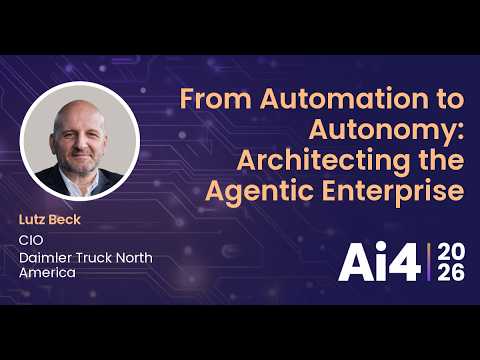
## Background This conference talk was published by the channel Ai4 on YouTube on August 20, 2026. The presentation features Lutz Beck, CIO of Daimler Truck North America, exploring the shift from automation to autonomy and discussing how IT and CIOs play a central role in architecting the agentic enterprise.
## TL;DR Lutz Beck details the industrial transition from isolated legacy automation to autonomous, AI-driven end-to-end business processes. He highlights how execution speed is replacing static domain knowledge as a key competitive driver, while exposing that 81% of companies see no bottom-line gains from their AI initiatives. To avoid the 'PoC graveyard,' Beck outlines five core architectural principles, including tighter governance, clean data foundations, process redesign, and business ownership. Ultimately, he presents a target architecture featuring a single unified orchestration layer to manage specialized digital agents across the enterprise.
## Atmosphere & style The presentation carries a pragmatic, authoritative, and realistic industrial tone. Beck speaks with the grounded perspective of an experienced enterprise executive, cutting through hyper-inflated AI hype with stark industry statistics. The narrative moves from a sobering reality check on failed enterprise implementations toward a structured, strategic call to action, offering clear leadership direction for navigating technological disruption.
## Key takeaways - [00:08](https://www.youtube.com/watch?v=dP5yDdMKNuQ&t=8s) Organizations are transitioning from legacy automation (scripts, RPA) to AI-enhanced agentic systems where humans and digital workers collaborate side by side. - [03:22](https://www.youtube.com/watch?v=dP5yDdMKNuQ&t=202s) Unlike early RPA implementations that aimed to eliminate jobs, agentic AI delegates specific tasks to digital workers rather than replacing entire human roles. - [04:02](https://www.youtube.com/watch?v=dP5yDdMKNuQ&t=242s) Adopting agentic models shifts operational focus from isolated tasks to outcomes, static code to adaptive systems, and manual approvals to exception handling. - [04:42](https://www.youtube.com/watch?v=dP5yDdMKNuQ&t=282s) Domain knowledge is rapidly commoditizing; competitive advantage in manufacturing and industrial sectors is now dictated by execution speed. - [06:20](https://www.youtube.com/watch?v=dP5yDdMKNuQ&t=380s) The role of IT and the CIO is shifting from a passive support function to acting as the enterprise's central platform foundation and transformation office. - [07:47](https://www.youtube.com/watch?v=dP5yDdMKNuQ&t=467s) Despite 88% of companies having AI in production, 81% see zero bottom-line gain, and only 6% qualify as true value creators. - [08:27](https://www.youtube.com/watch?v=dP5yDdMKNuQ&t=507s) Companies stall out in a 'PoC graveyard' when they pursue isolated, use-case-driven projects instead of building an overarching enterprise foundation. - [10:03](https://www.youtube.com/watch?v=dP5yDdMKNuQ&t=603s) Successful agentic architecture relies on five pillars: Operating Model & Governance, Data & Knowledge Foundation, AI as an Internal Product, Workflow Redesign, and Business Outcomes & Ownership. - [12:40](https://www.youtube.com/watch?v=dP5yDdMKNuQ&t=760s) Building AI as an internal product allows organizations to compound value and retain core technical intellectual property rather than relying entirely on vendors. - [13:35](https://www.youtube.com/watch?v=dP5yDdMKNuQ&t=815s) True business value requires redesigning end-to-end workflows from scratch rather than layering AI on top of flawed legacy processes. - [16:27](https://www.youtube.com/watch?v=dP5yDdMKNuQ&t=987s) While AI handles task execution, human intervention remains critical for critical thinking, ethical judgment, and relational trust. - [17:30](https://www.youtube.com/watch?v=dP5yDdMKNuQ&t=1050s) The target agentic architecture features a single, unified orchestration layer managing specialized digital agents across all enterprise domains. - [20:00](https://www.youtube.com/watch?v=dP5yDdMKNuQ&t=1200s) Market leaders will be defined not by their list of individual AI features, but by their ability to build an integrated, autonomous enterprise system.
## Detailed walkthrough Here is a detailed walkthrough of the transcript from the Ai4 conference presentation featuring Lutz Beck, CIO of Daimler Truck North America.
---
[00:08](https://www.youtube.com/watch?v=dP5yDdMKNuQ&t=8s) From Automation to Autonomy: The Old World vs. The New World
Lutz Beck opens his presentation by setting out to bring an industrial perspective to the conference regarding the transition from automation to autonomy. He contrasts the legacy "old world" with the emerging "new world." In the old world—despite significant progress in factory floor automation—administrative and business processes remain largely fragmented, relying on heavy individual effort, disconnected tools, and isolated silos.
The new world demands AI-enhanced end-to-end processes powered by intelligent systems where humans and digital workers collaborate side by side. Beck notes that organizations may soon employ more digital workers than human employees in certain domains. Crucially, every initiative in this shift must be strictly cost-driven and deliver tangible business value, as companies simply do not have the time or resources to "play around."
- **The Automation Spectrum:** The evolution has progressed across distinct technical phases—from basic scripts and Robotic Process Automation (RPA), to predictive Machine Learning (ML), then Generative AI, and now to agentic systems. - **RPA vs. Agentic AI:** Early RPA implementations functioned largely as "head-cutting exercises" attempting to eliminate jobs. In contrast, agentic AI delegates specific *tasks* to digital workers rather than replacing entire human roles.
---
[04:02](https://www.youtube.com/watch?v=dP5yDdMKNuQ&t=242s) Shifting Paradigms and the Power of Execution Speed
Moving to an agentic model fundamentally reshapes operations across several key dimensions: - **Tasks to Outcomes:** Shifting focus from executing individual isolated tasks to delivering broader business outcomes. - **Static Code to Adaptive Systems:** Transitioning from rigid, hard-coded rules to dynamic, learning architectures. - **Approvals to Exception Handling:** Moving away from manual micro-approvals toward autonomous decision-making where humans only step in for exceptions.
Beck addresses the reality that today, only around 15% of day-to-day industrial decisions are made autonomously. While 15% might seem small, achieving even this level across legacy-heavy enterprise operations provides a massive competitive advantage. Furthermore, AI models are rapidly commoditizing domain knowledge. In traditional manufacturing and trucking industries, professionals historically defined themselves by deep domain expertise, but competitive advantage is now dictated by execution speed over static domain knowledge.
- **Market Trend:** Research indicates that 33% of enterprise applications will soon embed agentic AI capabilities. - **Role of the CIO/IT:** Traditionally viewed as a mere support or supply function responsible for securing servers and executing project roadmaps, IT must now act as the enterprise's central platform foundation and transformation office.
---
[07:47](https://www.youtube.com/watch?v=dP5yDdMKNuQ&t=467s) The Industry Reality Check: Beyond Use Cases and the PoC Graveyard
Beck shares a stark reality check on the current state of enterprise AI adoption across the industry: - **88%** of companies have AI in production in at least one enterprise function. - **81%** of companies generate **zero bottom-line gain** and no measurable P&L impact. - Only **6%** of companies qualify as true value creators.
From an industrial standpoint, much of current enterprise AI operates like an academic research project rather than a business driver. This stems from companies remaining trapped in isolated, use-case-driven projects instead of building an overarching, easy-to-adopt enterprise foundation model. Without a cohesive architecture, organizations stall out in a "PoC (Proof of Concept) graveyard" characterized by low adoption, cultural resistance, unclear return on investment (ROI), lack of business ownership, and fragmented point solutions.
---
[10:03](https://www.youtube.com/watch?v=dP5yDdMKNuQ&t=603s) Five Key Principles to Architect the Agentic Enterprise
To avoid the PoC graveyard, Daimler Truck North America focuses on five foundational pillars:
1. **Operating Model & Governance:** Establishes tight alignment between business and IT using clear architecture guardrails and a plug-and-play architecture. Under this model, IT owns the underlying technology framework into which best-of-breed solutions are plugged, while the business owns and drives the AI initiatives. 2. **Enterprise Data & Knowledge Foundation:** Acknowledges that without clean data architecture, scaling AI is impossible. Merely migrating raw data into platforms like Snowflake or Databricks is insufficient, especially when legacy systems contain manipulated mainframe data that cannot feed reliable AI systems. 3. **AI as an Internal Product:** Treats AI capabilities as internal products to compound value and retain core technical intellectual property rather than outsourcing everything to external vendors. 4. **Workflow & Process Redesign:** Requires rethinking end-to-end value chains. High performers redesign core business processes from scratch rather than slapping AI on top of flawed legacy workflows. 5. **Business Outcomes & Ownership:** Mandates clear financial business cases based on actual bottom-line or top-line gains—rejecting soft metrics like "avoided costs." It also involves strictly tracking runtime consumption costs (such as compute overhead from enterprise initiatives like "Everyday AI").
---
[16:27](https://www.youtube.com/watch?v=dP5yDdMKNuQ&t=987s) Human-AI Boundaries and the Target Agentic Architecture
Beck clarifies the boundaries of what AI cannot replace, reinforcing why human intervention remains essential. While AI excels at task execution, humans are required for critical thinking, ethical judgment, and relational trust. Therefore, workforce upskilling is a vital requirement for the agentic journey.
He then presents his target architecture vision for the fully autonomous agentic enterprise:
``` +-----------------------------------------------------------------+ | Cross-Functional Business | | (Value Generation) | +-----------------------------------------------------------------+ | v +-----------------------------------------------------------------+ | Single Orchestration Layer | | (Manages & Runs Agents Across Domains) | +-----------------------------------------------------------------+ | v +-----------------------------------------------------------------+ | Enterprise Foundation Model | | & Data/Knowledge Backbone | +-----------------------------------------------------------------+ ```
In this target state, a **single unified orchestration layer** sits above the enterprise foundation model. Rather than deploying fragmented orchestrators per department, one central orchestration layer manages all specialized digital agents across every business process and functional area.
---
[20:00](https://www.youtube.com/watch?v=dP5yDdMKNuQ&t=1200s) Call to Action: Stepping Up to Avoid Disruption
In closing, Beck emphasizes that the ultimate winners in the market will not be the companies boasting the longest list of individual AI features, but those that successfully build an integrated, autonomous enterprise system.
Because domain knowledge is becoming commoditized, legacy incumbents who fail to transform their core processes risk having nimble competitors step in and strip away high-value operations. Building this integrated agentic foundation is hard work, but technology leaders must step up and lead the journey now to ensure their organizations remain competitive.
## Notable quotes > [00:08](https://www.youtube.com/watch?v=dP5yDdMKNuQ&t=8s) organizations may soon employ more digital workers than human employees in certain domains. — Lutz Beck
> [00:08](https://www.youtube.com/watch?v=dP5yDdMKNuQ&t=8s) companies simply do not have the time or resources to "play around." — Lutz Beck
> [04:02](https://www.youtube.com/watch?v=dP5yDdMKNuQ&t=242s) competitive advantage is now dictated by execution speed over static domain knowledge. — Lutz Beck
> [04:02](https://www.youtube.com/watch?v=dP5yDdMKNuQ&t=242s) 33% of enterprise applications will soon embed agentic AI capabilities. — Lutz Beck
> [07:47](https://www.youtube.com/watch?v=dP5yDdMKNuQ&t=467s) 88% of companies have AI in production in at least one enterprise function. — Lutz Beck
> [07:47](https://www.youtube.com/watch?v=dP5yDdMKNuQ&t=467s) 81% of companies generate zero bottom-line gain and no measurable P&L impact. — Lutz Beck
> [07:47](https://www.youtube.com/watch?v=dP5yDdMKNuQ&t=467s) Only 6% of companies qualify as true value creators. — Lutz Beck
> [07:47](https://www.youtube.com/watch?v=dP5yDdMKNuQ&t=467s) Without a cohesive architecture, organizations stall out in a "PoC (Proof of Concept) graveyard" — Lutz Beck
> [10:03](https://www.youtube.com/watch?v=dP5yDdMKNuQ&t=603s) IT owns the underlying technology framework into which best-of-breed solutions are plugged, while the business owns and drives the AI initiatives. — Lutz Beck
> [10:03](https://www.youtube.com/watch?v=dP5yDdMKNuQ&t=603s) High performers redesign core business processes from scratch rather than slapping AI on top of flawed legacy workflows. — Lutz Beck
> [16:27](https://www.youtube.com/watch?v=dP5yDdMKNuQ&t=987s) While AI excels at task execution, humans are required for critical thinking, ethical judgment, and relational trust. — Lutz Beck
> [20:00](https://www.youtube.com/watch?v=dP5yDdMKNuQ&t=1200s) the ultimate winners in the market will not be the companies boasting the longest list of individual AI features, but those that successfully build an integrated, autonomous enterprise system. — Lutz Beck
## Mentioned Lutz Beck, Daimler Truck North America, Ai4, Snowflake, Databricks
## Video description Lutz Beck - CIO, Daimler Truck North America
AI is advancing rapidly—from automation to autonomy. Agentic AI systems can plan, decide, and execute across entire business processes, fundamentally changing how companies operate, how processes are designed, and how work gets done. In this session, we’ll explore the central role IT and CIOs play in this shift, how to architect the agentic enterprise, and how to enable the business throughout this transformation.
[Source](https://www.youtube.com/watch?v=dP5yDdMKNuQ)