## Background
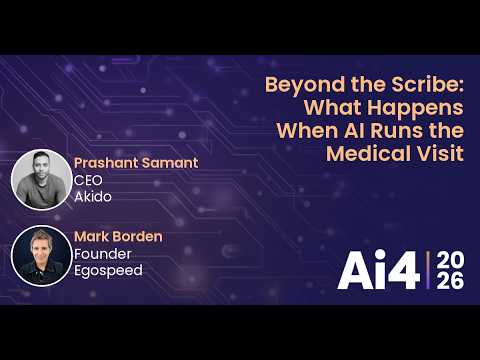
This YouTube video was published by Ai4 on August 21, 2026. It features a fireside chat between Mark Borden and Prashant Samant, CEO of Akido, discussing how AI goes beyond simple note-taking to run clinical encounters, how physician oversight works, and the future of healthcare.
## TL;DR
In this fireside chat, Akido CEO Prashant Samant and veteran journalist Mark Borden discuss how Akido's AI-native system and ScopeAI technology are transforming healthcare delivery, particularly in street medicine for vulnerable populations. The discussion highlights how AI empowers non-physician field workers to gather comprehensive diagnostic data directly at encampments and issue prescriptions via standing orders or virtual physician dispatches. Samant outlines Akido's scale across over a million patients, explains their use of 10.2 million real-world clinical cases for training, and addresses how human-in-the-loop oversight maintains safety while scaling clinical capacity.
## Atmosphere & style
The session feels candid, pragmatic, and insightful, driven by a conversational dialogue between a seasoned journalist and a vision-driven healthcare executive. Prashant Samant conveys an urgent yet optimistic dynamic, framing healthcare's core challenge as a structural capacity shortage rather than individual failure. The dialogue balances serious discussions about systemic reform and street medicine with personal human stories and lighthearted Q&A, creating an engaging and forward-looking atmosphere.
## Key takeaways
- [00:04](https://www.youtube.com/watch?v=DtQPvDe9ZRI&t=4s) American healthcare is severely broken due to a structural capacity problem, operating with only about 20% of the providers needed to manage current illness levels.
- [01:14](https://www.youtube.com/watch?v=DtQPvDe9ZRI&t=74s) Traditional legacy healthcare is built around scarcity, forcing patients to travel to centralized physical sites to access human medical intelligence.
- [01:14](https://www.youtube.com/watch?v=DtQPvDe9ZRI&t=74s) An AI-native health system inverts the traditional model by democratizing clinical intelligence and decoupling care from direct, continuous reliance on physical providers.
- [03:02](https://www.youtube.com/watch?v=DtQPvDe9ZRI&t=182s) ScopeAI equips non-physician field staff with an AI physician assistant that conducts targeted follow-ups in the field, surfacing up to eight potential diagnoses in a single intake session.
- [03:02](https://www.youtube.com/watch?v=DtQPvDe9ZRI&t=182s) Under standing medical orders, field workers using ScopeAI can distribute broad-spectrum antibiotics directly or dispatch physicians virtually for instant controlled substance prescriptions.
- [08:25](https://www.youtube.com/watch?v=DtQPvDe9ZRI&t=505s) Akido has scaled to manage care for over one million patients across more than 100 clinical touchpoints, including managing 40% of primary care in Rhode Island and major cardiology services in Southern California.
- [08:25](https://www.youtube.com/watch?v=DtQPvDe9ZRI&t=505s) AI care acts as an equalizer, delivering a concierge-level medical experience to vulnerable and underserved populations.
- [11:23](https://www.youtube.com/watch?v=DtQPvDe9ZRI&t=683s) ScopeAI's investigative reasoning is benchmarked against a proprietary repository of 10.2 million real-world longitudinal clinical case studies compiled over six years.
- [11:23](https://www.youtube.com/watch?v=DtQPvDe9ZRI&t=683s) Licensed physicians provide continuous human-in-the-loop oversight by reviewing and signing off on all medical orders generated through the system.
- [13:23](https://www.youtube.com/watch?v=DtQPvDe9ZRI&t=803s) Akido operates within existing insurance frameworks (Medicare, Medicaid, and commercial plans), placing no extra out-of-pocket costs on patients.
- [13:23](https://www.youtube.com/watch?v=DtQPvDe9ZRI&t=803s) Autonomous healthcare is ultimately necessary due to the mathematical impossibility of training enough human doctors to meet growing demand.
## Detailed walkthrough
Here is a detailed, faithful walkthrough based on the transcript provided:
[00:04](https://www.youtube.com/watch?v=DtQPvDe9ZRI&t=4s) Rethinking American Healthcare and the Broken Model
Journalist Mark Borden opens the session by outlining his background—having worked at *Fortune* and *Fast Company*, served as a speechwriter for the CEO of *The New York Times*, and focused extensively on healthcare. He introduces Prashant Samant, CEO of Akido and former director of the innovation lab at USC's health system.
The conversation begins with a blunt assessment: healthcare in America is severely broken. Borden notes that healthcare is consistently rated as the worst consumer product in America, ranking below the DMV experience. Samant emphasizes that this breakdown is not due to individual fault, bad actors, or malicious intent; rather, it is a structural capacity problem. America currently operates with, at best, only 20% of the healthcare providers required to manage the population's current levels of illness.
[01:14](https://www.youtube.com/watch?v=DtQPvDe9ZRI&t=74s) Defining an AI-Native Health System vs. Legacy Care
Borden references Akido’s recent announcement regarding the launch of an "AI-native health system" and asks Samant to clarify what this means. Samant explains that traditional, legacy healthcare systems are built around scarcity—specifically the scarce access to human medical intelligence. He compares legacy healthcare to a single oasis in a desert: patients must travel long distances to drink water, but there is not enough physical room at the oasis, and seeing another specialist requires traveling to a completely different oasis.
An AI-native health system inverts this model. Instead of forcing patients to travel to a centralized physical site, it brings "water to the people" by democratizing clinical intelligence and decoupling it from direct, continuous reliance on a physical human provider. Borden clarifies that this moves beyond simple automated AI scribes to an AI medical intelligence that works hand-in-hand with physicians during actual clinical encounters.
[03:02](https://www.youtube.com/watch?v=DtQPvDe9ZRI&t=182s) Case Study: Deploying ScopeAI in Street Medicine
Borden highlights a recent *TIME* magazine article by Dr. Deb Houry (former Chief Medical Officer for the CDC), which praised Akido alongside tech giants OpenAI and Anthropic, paying specific attention to Akido's street medicine program. Samant explains how AI transforms care delivery for people experiencing homelessness—a population facing extreme resource scarcity, food and water shortages, mental health challenges, addiction, and lack of communication tools.
In traditional settings, homeless individuals struggle to visit clinics, require care across multiple facilities, and often present complex medical histories that standard fee-for-service visits cannot easily accommodate. Consequently, their care is usually delayed until an issue becomes catastrophic, leading to frequent emergency room visits.
Under Akido’s model, non-physician field staff—such as case managers or care workers, many of whom have lived experience with homelessness—go directly to shelters, encampments, and tents armed with a backpack and Akido's technology, ScopeAI. ScopeAI acts as an advanced AI physician assistant on an iPad or phone. As the patient shares their symptoms, ScopeAI dynamically asks targeted follow-up questions across multiple medical specialties, operating much like "Dr. House." A single 60- to 90-minute intake conversation can surface up to eight distinct potential diagnoses directly in the field.
- ScopeAI allows care managers to gather comprehensive diagnostic data directly at a patient's shelter or tent.
- Standard protocol enables workers to distribute broad-spectrum antibiotics directly out of their backpack under standing medical orders established by a clinical governance council.
- For controlled substances requiring direct oversight (such as Suboxone for addiction treatment), ScopeAI acts as a dispatch system that instantly connects a physician virtually to conduct a point-of-care visit, issue the prescription, and initiate treatment within hours rather than weeks.
[08:25](https://www.youtube.com/watch?v=DtQPvDe9ZRI&t=505s) Scaling Operations and Delivering Inclusive AI Care
Borden points out that Akido’s outcomes demonstrate major reductions in ER visits, alongside higher treatment retention. Samant outlines Akido's rapid scale, expanding from a startup to managing care for over one million patients across more than 100 brick-and-mortar, virtual, and street-based clinical touchpoints. By comparison, Kaiser Permanente manages approximately 11 million lives.
Samant notes specific regional operational footprints:
- **Rhode Island:** Akido oversees approximately 40% of all primary care in the state.
- **Southern California:** Akido handles a major portion of cardiology services across the Pomona Valley.
Samant highlights that AI acts as an equalizer, delivering "concierge-level experience" to vulnerable populations who could never otherwise afford private care. He shares an emotional story about a former patient experiencing homelessness and addiction who was treated by Akido's team, recovered, trained to become a case worker, and now works on Akido's field team delivering care to others. Borden and Samant also touch on upcoming expansions into New York City and the San Francisco Bay Area.
[11:23](https://www.youtube.com/watch?v=DtQPvDe9ZRI&t=683s) Q&A: Clinical Accuracy, Verification, and Medical Datasets
An audience member (a physician) asks how Akido evaluates the diagnostic accuracy and safety of its AI tools, emphasizing that a human doctor must remain in the loop.
Samant breaks down Akido’s two-part approach to clinical accuracy:
1. **Proprietary Medical Textbook Data:** Over its first six years, Akido compiled a massive repository of 10.2 million real-world longitudinal clinical case studies. The system benchmarks ScopeAI's investigative reasoning against these real-world encounters. Samant observes that while reaching a final diagnosis is relatively straightforward when given full case data, navigating the complex investigative question-and-answer process—determining whether a subtle symptom is benign or life-threatening—is the primary challenge ScopeAI solves.
2. **Human-in-the-Loop Oversight:** Licensed physicians review and provide final sign-off on all submitted medical orders, providing continuous regulatory oversight, compliance checks, and training feedback loops for the AI models.
[13:23](https://www.youtube.com/watch?v=DtQPvDe9ZRI&t=803s) Business Model and the Future Role of Physicians
When asked who pays for the service, Samant explains that Akido operates entirely within existing insurance systems—including Medicare, Medicaid, and commercial health plans—so patients face no extra out-of-pocket financial burden.
Responding to a lighthearted question about whether the goal is to fully replace doctors, Samant clarifies that autonomous health care is inevitable because it is mathematically impossible to train enough doctors to meet growing demand. Rather than eliminating clinicians, the immediate goal is to multiply clinical capacity, automating routine diagnostic triage so human physicians can focus their limited time where high-level human decision-making matters most.
## Notable quotes
> [00:04](https://www.youtube.com/watch?v=DtQPvDe9ZRI&t=4s) healthcare in America is severely broken — Mark Borden
> [00:04](https://www.youtube.com/watch?v=DtQPvDe9ZRI&t=4s) worst consumer product in America, ranking below the DMV experience — Mark Borden
> [01:14](https://www.youtube.com/watch?v=DtQPvDe9ZRI&t=74s) water to the people — Prashant Samant
## Mentioned
Akido, Egospeed, Ai4, Prashant Samant, Mark Borden, ScopeAI, Fortune, Fast Company, The New York Times, USC, TIME, Deb Houry, CDC, OpenAI, Anthropic, Kaiser Permanente, Suboxone, Rhode Island, Southern California, Pomona Valley, New York City, San Francisco Bay Area, Medicare, Medicaid
## Video description
Prashant Samant - CEO, Akido
Mark Borden - Founder, Egospeed
A fireside chat with Prashant Samant (CEO), Akido, moderated by Mark Borden
AI note-taking is table stakes. What happens when AI runs the actual clinical encounter? Akido's CEO Prashant Samant joins veteran reporter Mark Borden to make the case. In this fireside chat, they'll walk through a ScopeAI visit, grounded in outcomes data from three years of deployment across underserved and high-need populations. Then tackle the question every health system and regulator is really asking: where does a physician step in and override the AI? It's the moment that separates AI-doctor hype from the human-in-the-loop reality of care delivered at scale. What does the future of healthcare look like? What is the role of humans? Finally, thoughts on bots.
Akido CEO Prashant Samant argues that the fundamental crisis in American healthcare is an acute structural shortage of provider capacity, operating at roughly 20% of needed levels. To address this gap, Akido has developed an AI-native healthcare model that pushes diagnostic capabilities directly to field workers while preserving licensed physician oversight.
Decentralizing Care to Address Provider Capacity Shortages (0:04)
According to journalist Mark Borden and Akido CEO Prashant Samant, American healthcare suffers from an acute structural capacity failure rather than bad actors, with the nation operating with only about 20% of the providers needed to manage population illness. Legacy healthcare systems centralize scarce medical talent in physical facilities, forcing patients to navigate fragmented specialist networks that function like distant oases in a desert.
Samant contrasts this with an 'AI-native health system' that decentralizes clinical intelligence away from continuous reliance on physical facilities. Rather than functioning merely as administrative scribes, Akido's tools embed clinical decision support directly into the encounter to bring medical expertise directly to patients.
Deploying Mobile AI Diagnostics in Street Medicine (3:02)
Akido deployed its ScopeAI application to treat homeless populations, who often face extreme resource deprivation and delayed interventions that culminate in emergency department visits. Non-physician field workers and case managers take mobile devices into shelters and encampments, using ScopeAI to conduct dynamic diagnostic intakes that can surface up to eight potential diagnoses across multiple specialties during a single 60- to 90-minute session.
Care workers distribute broad-spectrum antibiotics directly in the field under clinical governance council standing orders. For controlled substances such as Suboxone for opioid addiction, ScopeAI dispatches a remote physician for immediate virtual consultations, reducing treatment initiation from weeks to hours and lowering emergency room utilization.
Clinical Verification, Human Oversight, and Regional Scale (8:25)
Akido reports managing care for over one million patients across more than 100 physical, virtual, and street-level sites, including approximately 40% of primary care in Rhode Island and major cardiology volume in Southern California's Pomona Valley. The service operates within existing Medicare, Medicaid, and commercial reimbursement frameworks, avoiding out-of-pocket costs for patients.
Addressing safety and diagnostic reliability, Samant explained that ScopeAI's investigative reasoning is benchmarked against a proprietary repository of 10.2 million longitudinal clinical cases gathered over six years. To maintain clinical governance and regulatory compliance, licensed physicians retain final review and sign-off authority on all generated medical orders, creating feedback loops to refine the underlying AI models.
Reallocating Clinician Labor Toward Complex Care (13:23)
Addressing whether artificial intelligence will displace human doctors, Samant asserted that autonomous healthcare is mathematically inevitable because the clinician education pipeline cannot produce sufficient providers to meet national demand. However, he stated that Akido's immediate objective is capacity multiplication rather than labor elimination.
By automating routine diagnostic triage and data collection, the platform seeks to relieve clinicians of early-stage intake burdens. This workflow reallocation is intended to concentrate scarce physician hours on high-level medical decision-making where human judgment is most critical.
While Akido reports reductions in emergency room visits and rapid operational growth, the long-term sustainability of autonomous healthcare depends on maintaining rigorous physician-in-the-loop oversight as diagnostic responsibilities increasingly shift toward algorithmic triage.
[0:04] Mark Borden: healthcare in America is severely broken
[0:04] Mark Borden: worst consumer product in America, ranking below the DMV experience
[1:14] Prashant Samant: water to the people
[8:25] Prashant Samant: concierge-level experience
Original transcript
[0:04] So just kind of start with a little background.
Uh I'm a journalist. I worked at Fortune Fast
[0:08] Company. I was a speech writer for the CEO
of the New York Times. Lately I've been
[0:12] covering healthcare. I think it's one of the most
interesting um spaces in in journalism or in the
[0:17] cultural conversation. I think one of the most
interesting companies that are actually engaged
[0:22] in this space is Aikido. Pashant is the CEO of
Aikido. Um, prior to that, he was the director of
[0:28] the innovation lab at UC USC's, um, health system.
Um, I think we should just start by coming out
[0:35] and saying it. Uh, healthcare sucks in America.
Like, do you agree with me? Healthcare sucks. Um,
[0:42] healthcare is consistently rated as the worst
consumer product. America, it is worse rated than
[0:48] the DMV experience. Uh, and the fundamental issue
is that it's not any individual's fault. It's not
[0:54] a person's fault. It's not because of mal intent.
It's just that we do not have enough doctors to
[1:00] take care of the population. Most optimistically,
we have 20% of the providers that we need to take
[1:06] care of our current level of sickness in this
particular population right now. Right. Okay. So,
[1:14] earlier this month, you announced that you're
launching the world's first um let me get this
[1:21] right, AI native health systems, right? Um, so
what is an AI native health system and how is it
[1:28] going to make American healthcare suck less? Well,
let's start with what a legacy health system is.
[1:33] So, a legacy health care system is designed
around scarcity. Um, and the scarcity here,
[1:40] because we have an under supply of doctors,
is access to medical intelligence. So,
[1:45] when you're designing around that, it's kind of
like you're building an oasis that everybody has
[1:50] to come to to drink water. Um, and it's there
and people want to serve you water, but there's
[1:55] just not enough room around that oasis. And
then if you have to go to another specialist,
[2:00] it's like going to a whole another oasis. I think
everybody here has been to multiple employants to
[2:04] get an understanding of what's going on with them.
um a AI native health system is inverting that is
[2:11] uh making it instead of it being uh oasiscentric
where you get water you're bringing water to the
[2:16] people and you're doing that by tackling that
fundamental primitive issue by making clinical
[2:23] intelligence much more democratized by divorcing
its reliance on uh access to a human being. So
[2:30] beyond the scribe, you're talking about actually
this um AI medical intelligence actually working
[2:39] hand inand with the physicians in the appointment.
Correct. Um so I don't know how many people read
[2:45] today in Time magazine uh Dr. Deb Howry,
former um chief medical officer for the CDC,
[2:51] um wrote sort of a contrarian piece then that not
supporting the healthcare stocks, but what she's
[2:57] actually optimistic about uh for the American
health care system. Um three big companies were
[3:02] named uh OpenAI, Anthropic, and Aikido, your
company. And in particular, she pointed out the
[3:09] street medicine program. Um this is a vulnerable
population, very difficult to treat. Tell me,
[3:16] take us through what an encounter with a clinician
and somebody living in the street is like and how
[3:23] you've changed that that kind of engagement.
Well, first of all, I mean, really honored to
[3:29] be mentioned in that piece. Uh, I love Devi.
I think that, you know, Dr. Ary is an amazing
[3:36] public servant. She was the CMO of the CDC for
10 years. Uh, amazing infrastructure that she's
[3:41] helped build. Um, and I think that, uh, our street
medicine program focused on people experiencing
[3:47] homelessness is a really amazing example of what's
possible with an AI native healthcare system. So,
[3:53] um, I think it's helpful to understand it when
you justos it with what happens now versus what's
[3:56] possible in an AI native world. So, right now, um,
people experiencing homelessness are dealing with
[4:02] a lot of issues. They have very limited access to
health care, very limited access to basic human
[4:07] services in general. Right. I mean, it's like food
scarcity, water scarcity, mental health issues,
[4:11] addiction. Absolutely. And sometimes not even a
way to communicate, right? I mean, correct. And
[4:16] you know, so there are physicians and providers
that create availability for these individuals,
[4:22] but it's hard for them to come in to a facility.
Number one. Number two, because of all of these
[4:26] various challenges, they need a lot of different
kinds of medical support, which means they need
[4:31] to go to 10 different facilities to be able to
get access to what they need. Uh, and it just
[4:35] doesn't happen. And if they do show up, they're
challenging subjects to manage. And so they take
[4:39] a lot of time for a particular physician and the
physician can't really bill for it. So it's not a
[4:43] very sustainable way to provide care for this
population that needs it the most. What they
[4:48] do is they frequent emergency departments when
something becomes catastrophic. So in our world,
[4:54] in Aikido's world, we're able to send people into
the field. Uh these people are case workers or
[5:01] care managers, often times people that have lived
experience that may have been homeless themselves
[5:05] at some point in time. They're armed with a
backpack and they're armed with our technology,
[5:10] Scope AI, which is the world's most advanced
AI physician that is on their iPads or that
[5:15] is on their phone. And powered by Scope, they
can have a full dialogue with this individual,
[5:21] with this person experiencing homelessness.
And as that individual informs them what's
[5:25] going on with them, scope is asking the next best
question, just like a doctor might in a a visit,
[5:30] but instead of it being, you know, one area of
questioning, as that individual starts talking
[5:35] about a different area of concern, scope starts
investigating that area of concern. So what that
[5:39] uh case worker or that care manager is left
with is an abundance of diagnostic information
[5:44] about what's happening to that individual purses
allows them to kind of care for mult. It's almost
[5:50] multipety care in the field from a field worker.
Exactly. It's like Dr. House. Okay. Um and so you
[5:57] have, you know, eight different diagnoses
that might emerge just from that one hour,
[6:01] hour and a half long conversation that's happening
at a shelter or that's happening at a person's
[6:06] tent. So in a place where that individual
might be comfortable and be open to to having
[6:11] a conversation about what's going on with them. So
what if a diagnosis is raised that actually needs
[6:17] um a physician interaction? How does that work?
Yeah, great question. So, um, as a abundance of
[6:24] diagnoses are raised, some of them are going to
be needed to be dealt with immediately. Some,
[6:28] uh, might be able to be handled by that person
in the field. I think a great example would be,
[6:33] you know, uh, often times you're going to have a
person experiencing homelessness that might have
[6:37] a wound that has been dealt with and it's clear
that, uh, based on this diagnostic process that
[6:42] they need antibiotics immediately. Now we can have
a standing order put in place that's has oversight
[6:49] by a clinical governance council that says if
a person is is exhibiting XYZ symptoms they can
[6:55] get a broadspectctrum antibiotic immediately and
that person can hand that antibiotic out of their
[7:00] backpack to that individual but that individual
might also be suffering from a meth addiction and
[7:06] they might be ready at that moment in time to get
on a medication assisted treatment program enabled
[7:11] by say suboxone. Now, Suboxone is a controlled
substance. You can't have that handed out without
[7:16] having physician oversight. So, in that moment,
Scopes as a dispatch system orchestrates pulling
[7:22] in a doctor into the loop so that that individual
case worker can literally with a phone have a
[7:28] virtual visit done right there, the point of care,
have that physician provide the proper oversight
[7:33] and sign off on that Suboxone prescription and
then give that patient the suboxin they need.
[7:38] And this is really powerful because as you might
imagine uh when a person has a moment they're
[7:43] willing to get on a treatment program you have to
capture that immediately right without this point
[7:48] of care it takes like weeks to get somebody
a suboxone treatment program going now we
[7:53] can do it in a matter of hours. Yeah I think it's
remarkable I read the white paper the reduction in
[7:58] um emergency room visits the um increase in
treatment the retention of this population is just
[8:05] remarkable compared to what has happened before.
And this is a large population in Los Angeles. Um,
[8:11] so I imagine that if you can treat a vulnerable
population living in a very difficult environment,
[8:20] how that must translate into a clinic, how that
translates into a almost a national part of the
[8:25] health system. So Aikido is serving a million
lives. Yeah. Over a hundred clinics, right?
[8:32] So brick and mortar, also virtual care, street
program. we talked about what are you what are
[8:39] you most proud of that you're building and that
you built and maybe take me a little bit into what
[8:46] the plans are for the future of Aikido. So I am
proud of a lot of things. Our team has done some
[8:53] incredible work in an incredibly tough industry.
Um I think you know one thing you mentioned is
[8:59] that we have scaled Aikido to now take care of
over a million patients from startup right I
[9:04] mean from a startup and you know just to put that
in context Kaiser Permanente which is one of the
[9:08] biggest health systems in the country takes care
of about 11 million people now we're not Kaiser
[9:12] size yet but a million people uh is going from a
startup to being part of the American healthcare
[9:18] tapestry so for instance in Rhode Island we take
care of 40% of the primary care in that state in
[9:23] Southern California if you're living in Pomona
alley, there's a very very good chance you're
[9:28] coming to one of our cardiology services. So
being able to be uh vet heft and being this
[9:34] forward thinking is I think a true accomplishment.
I think the other thing that I'm very proud of is
[9:39] that who we bring care to. Um you know a lot
of technological innovation uh is reserved for
[9:46] people that have meats and we have been able to
build a truly inclusive program. We take care of,
[9:52] you know, more people experiencing homelessness
in California than I think anybody else in the
[9:55] country, uh, or anybody else in California rather.
And, you know, I think that that inclusiveness,
[10:02] uh, being able to bring this democratizing
technology, artificial intelligence, uh,
[10:07] to people, uh, to create a truly concierge level
experience for those that would never be able to
[10:13] afford it, I think is is is something that I'm
incredibly proud of. I think there's a story that
[10:18] comes to mind. Um it it's it's you know it's like
tear inducing. Uh one of our uh case workers as I
[10:26] described the case workers that go into the field
to take care of people experiencing homelessness
[10:29] um they actually were experiencing homelessness
themselves and uh our team met them uh got them
[10:37] well got them off of their addiction um and they
were so inspired that they went to become a case
[10:43] worker and then joined our team. So now they
are part of the Aikido journey themselves.
[10:48] And I think I don't know where else can you do
that, man. Yeah, that's remarkable. And I know
[10:52] that you're earlier when we were talking you were
teasing out some major stories and major um just
[10:58] news that you're going to be breaking and talking
about in the near future and it's very exciting to
[11:02] hear what's going on and what you're doing. So I
really appreciate the time to talk to you and No,
[11:07] thank you time to talk to you as well. Appreciate
you making the time and uh taking interest in what
[11:11] we're up to. There's a lot of news coming out.
Uh so, you know, that should be announced pretty
[11:15] shortly. Got some exciting new folks joining,
exciting new pay places we're launching in.
[11:19] We're operating in New York City. We're operating
in the the Bay Area as well. And so, we'll talk
[11:23] more about that soon. That's great. So, this is
exciting, you know. So, I'm a physician. I'm a
[11:29] great uh US population is getting older and older,
but we don't have enough geratrician specialists.
[11:35] Okay. So, my cousin is a geriatrician who lives
in Vegas actually. So, so my question is so how do
[11:41] you evaluate you know the uh accuracy relevant all
this stuff you know you you you know the AI sorry
[11:50] so AI is the tools right you know so humor must be
in the loop so I say in your company so how do you
[11:57] you know make sure the quality you know accuracy
all those you know recommendation great question
[12:03] so there's a few different dimensions to it um one
of the things we didn't get into is how we built
[12:08] uh for the first uh six years of the company's
history, we spent a lot of time compiling a
[12:13] massive collection of clinical case studies and
longitudinal information where we could see how
[12:18] patients were treated and the diagnosis that
emerged from different sorts of of investigative
[12:23] processes. So we have the largest medical
textbook assembled in the country uh I can say
[12:31] uh about 10.2 2 million case studies. And so we
evaluate our technologies accuracy against those
[12:38] real life visits and not just the diagnosis
accuracy but the investigation accuracy. It's
[12:44] a funny thing that diagnosis if you have a
full case study is actually pretty easy. The
[12:48] hard thing is what you do which is how do you go
through the investigative process to understand
[12:52] because the way that a disease manifests can
be in so many different ways, right? Is it
[12:57] something serious or is it something light? That
is a question and answer process you have to to
[13:01] navigate. So that's one. The second thing is uh
we have physicians in the loop for this purpose
[13:07] to provide a final set of oversight to any order
that gets submitted. Um and that provides us not
[13:13] only a learning opportunity if a physician is
going to be doing something different but also
[13:17] compliance oversight and regulatory coverage
around the diagnosis that are emerging from
[13:22] our technology. Does that answer your question?
Yes. Who pays for it? Insurance. [laughter] The
[13:30] goal of our system was let me start over.
Our perspective is that autonomous health
[13:38] is going to be an inevitable future. You cannot
train enough doctors to solve the problem that
[13:44] you're referring to. It's just not possible. We
also feel strongly that autonomous health needs
[13:48] to be brought into the world in today's payment
environment, in today's regulatory environment,
[13:54] not some extra burden that a patient has to
take on just to get access to something better.
[13:59] So we've designed this system so it works within
the existing insurance world. Medicare, Medicaid,
[14:05] commercial insurance pays for is the objective to
replace clinicians? Totally. [laughter] There's
[14:13] always the AI question, right? The objective is
to most effectively optimize where physicians,
[14:21] providers, and other workers that are handling
these really challenging jobs need to spend their
[14:26] time. Right now, we aren't able to do that. I
think that there's uh replacing we're far off
[14:32] from replacing because we just don't have enough
at the moment. So, we have to uh we you know we're
[14:38] trying to multiply that capacity and make sure
that you know all of the physicians that we have,
[14:44] all the other providers we have can uh spend
their time on where it matters the most.