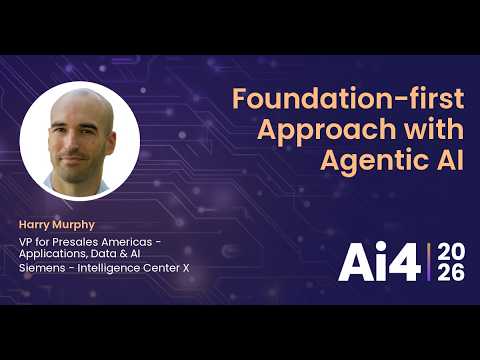
Siemens Pre-Sales VP Advocates Knowledge Graphs Over Perishable AI Agents
Ai4
Enterprise AI strategies fail when companies wrap fragile agents around disconnected data silos instead of building a governed semantic knowledge graph with frontline domain experts.
## Background
This video was published on YouTube by Ai4 on August 21, 2026. The presentation features Harry Murphy of Siemens discussing a foundation-first, open architecture approach with Siemens Intelligence Center X to build governed, contextualized data layers for AI adoption.
## TL;DR
Harry Murphy, VP for Pre-sales Americas at Siemens, presents a strategic case for prioritizing enterprise data foundations over short-lived AI agents. He highlights how organizations often misuse LLMs as makeshift mortar between siloed systems, leading to fragile integrations and inefficient workflows. By adopting knowledge graphs and shifting domain experts to the front of ontology creation, Siemens Intelligence Center X enables non-experts to build resilient, contextual semantic layers that accommodate changing technologies.
## Atmosphere & style
The presentation is pragmatic, technical, and strategic, balancing corporate AI mandates with grounded industry advice. Murphy uses relatable golfing metaphors and plainspoken terminology like 'machine whisperers' to explain complex data integration concepts. The delivery feels educational and direct, aiming to reframe how enterprises value frontline human expertise alongside modern AI toolsets.
## Key takeaways
- [00:04](https://www.youtube.com/watch?v=b9tm4x7YjVI&t=4s) Siemens is actively expanding its capabilities into enterprise AI alongside its traditional heavy industry reputation.
- [00:04](https://www.youtube.com/watch?v=b9tm4x7YjVI&t=4s) AI agents are a rapidly depreciating layer; the durable enterprise asset is a governed, contextualized data foundation.
- [00:31](https://www.youtube.com/watch?v=b9tm4x7YjVI&t=31s) Using agents as makeshift 'mortar' to connect isolated data silos creates fragile systems with regulatory vulnerabilities and data gaps.
- [00:31](https://www.youtube.com/watch?v=b9tm4x7YjVI&t=31s) Knowledge graph frameworks integrate with existing systems to build a unified semantic layer without requiring a total rip-and-replace.
- [00:52](https://www.youtube.com/watch?v=b9tm4x7YjVI&t=52s) The traditional 'human-in-the-loop' role as a passive compliance auditor or 'AI cop' underutilizes domain expertise.
- [00:52](https://www.youtube.com/watch?v=b9tm4x7YjVI&t=52s) Frontline domain experts ('machine whisperers') should be positioned at the front of the development cycle to embed tacit operational context into ontologies.
- [00:09](https://www.youtube.com/watch?v=b9tm4x7YjVI&t=9s) Siemens Intelligence Center X (ICX) uses generative AI (e.g., Claude) to translate natural language into SPARQL and formal graph ontologies.
- [00:09](https://www.youtube.com/watch?v=b9tm4x7YjVI&t=9s) Lowering technical entry barriers lets subject matter experts visually verify and audit enterprise knowledge logic directly.
- [01:21](https://www.youtube.com/watch?v=b9tm4x7YjVI&t=81s) Overlaying contextual graph layers across legacy infrastructure unlocks immediate value without forcing expensive data migrations.
- [01:21](https://www.youtube.com/watch?v=b9tm4x7YjVI&t=81s) Organizations should avoid over-engineering solutions by matching deterministic problems to simple algorithms or edge ML models rather than expensive LLM queries.
- [01:21](https://www.youtube.com/watch?v=b9tm4x7YjVI&t=81s) An open, architecture-first approach prevents vendor lock-in and protects AI investments against rapid technological obsolescence.
- [17:40](https://www.youtube.com/watch?v=b9tm4x7YjVI&t=1060s) Interactive demonstrations at Ai4 (Booth 831) highlight solutions built directly by non-data-scientist domain users.
## Detailed walkthrough
### [00:04](https://www.youtube.com/watch?v=b9tm4x7YjVI&t=4s) Driving for Dough: The Foundation-First Approach
Harry Murphy, VP for Pre-sales in the Americas at Siemens, opens his presentation with a quick acknowledgment of Siemens' public reputation. While most people associate Siemens with heavy industry like trains and windmills, Murphy emphasizes that Siemens is actively building enterprise AI capabilities. Everyone wants to deploy agentic AI right now because it feels productive and visually impressive—or as Murphy quips, quoting a piece of golfing advice from his father, *"You can drive for show, but you putt for dough."* Upgrading the underlying organizational architecture is the "dough" that actually delivers long-term enterprise value.
Organizations face a central dilemma: there is an urgent corporate mandate to adopt AI immediately, yet tech leaders dread committing to a single technology stack, vendor, or solution that might become obsolete or leave them asking *"What were they thinking?"* years down the road. Agents are merely a means to an end, not the final destination. Because agentic frameworks are rapidly evolving and quickly depreciated, companies must construct an agile, governed, and contextualized data layer that enables agents to be plugged in, swapped out, or retired without breaking the broader enterprise architecture.
- **Speaker Identity:** Harry Murphy, VP for Pre-sales Americas – Applications, Data & AI at Siemens.
- **Golfing Metaphor:** "Drive for show, putt for dough" illustrates the contrast between flashy AI deployments and foundational backend data engineering.
- **Strategic Core:** AI agents are perishable components; the durable asset is a contextualized data foundation.
---
[00:31](https://www.youtube.com/watch?v=b9tm4x7YjVI&t=31s) Why Enterprise Data Foundations Are Hard to Build
Building a concrete, unified data ecosystem sounds like common sense, yet most organizations struggle to execute it. The primary roadblock is complexity: structuring enterprise data, resolving siloed systems, and engineering a resilient contextual knowledge layer requires tremendous effort and clear long-term commitments. Because establishing this core is difficult, many companies default to wrapping individual AI agents around isolated data sources, using LLMs as makeshift mortar between disconnected enterprise "bricks."
This shortcut creates fragile systems riddled with data gaps, regulatory vulnerabilities, and communication barriers between agents. Siemens advocates replacing improvised integrations with a robust knowledge graph framework. Rather than forcing organizations into a complete rip-and-replace, graph technology integrates with existing infrastructure, preserving previous technology investments while establishing a unified semantic layer.
- **The "Mortar" Fallacy:** Using agents or raw LLM prompts to bridge disconnected data silos leads to regulatory risks and uncoordinated outputs.
- **Architectural Solution:** Knowledge graphs serve as the structural fabric connecting disparate enterprise systems.
---
[00:52](https://www.youtube.com/watch?v=b9tm4x7YjVI&t=52s) Empowering the Workforce and Redefining Human-in-the-Loop
A solid data foundation depends as much on an organization's frontline workforce as it does on data pipelines. Corporate tech strategies frequently fixate on software integration while overlooking the domain experts who keep the operations running daily. In traditional AI frameworks, the "human-in-the-loop" is relegated to a passive supervisory role—acting like an *"AI police officer"* whose sole task is checking outputs for compliance or policy violations. Murphy argues this is a wasteful misuse of human expertise.
Siemens redefines the human-in-the-loop by moving domain experts—such as factory floor engineers and equipment operators—to the front of the development cycle. These "machine whisperers" possess decades of unspoken operational context, such as knowing exactly what an unusual squeak on a machine portends. By incorporating domain experts directly into graph and ontology creation, organizations capture real-world operational intelligence that no standalone IT department or raw LLM could extract on its own.
- **Reimagined Role:** Human-in-the-loop transitions from a compliance auditor ("AI cop") to an active contributor during ontology design.
- **Frontline Intelligence:** Operational knowledge from shop-floor engineers ("machine whisperers") is captured directly into the enterprise graph.
---
[00:09](https://www.youtube.com/watch?v=b9tm4x7YjVI&t=9s) Creating a Positive Feedback Loop with Siemens Intelligence Center X
Siemens addresses these architectural hurdles through Siemens Intelligence Center X (ICX), which establishes a continuous feedback loop between domain experts, knowledge graphs, and AI agents. Historically, creating graph ontologies required rare technical skill sets in specialized languages like SPARQL. This high bar of entry kept subject matter experts from directly structuring knowledge graphs.
By leveraging modern generative tools (like Anthropic's Claude) to translate natural language domain knowledge into SPARQL and formal ontologies, the technical barrier drops significantly. Domain experts construct and verify visual representations of their operational domain without reading walls of code. This collaborative process ensures that when an AI agent retrieves contextual answers, users trust the results because they helped shape the underlying logic.
- **Tooling Breakthrough:** LLMs (such as Claude) handle complex graph queries like SPARQL, allowing domain experts to build and validate graph ontologies using natural language.
- **Visual Verification:** Subject matter experts audit visual mappings of enterprise logic rather than inspecting raw source code.
- **Siemens Intelligence Center X (ICX):** Provides governed, curated orchestration environments to construct, scale, and maintain enterprise AI foundations.
---
[01:21](https://www.youtube.com/watch?v=b9tm4x7YjVI&t=81s) Practical Strategies for Long-Term AI Investments
To build a sustainable AI roadmap, organizations should start small, iterate, and build on top of existing investments. Large enterprises rely heavily on legacy systems, mainframes, and custom codebases that cannot simply be scrapped. Overlaying a contextual graph layer across legacy infrastructure unlocks immediate value from past investments without demanding costly migrations.
Furthermore, companies should avoid over-engineering solutions by matching the right tool to the right problem. AI agents and LLM tokens are expensive and inefficient for tasks better suited to classic algorithms, simple calculators, or lightweight machine learning models deployed on edge devices. Building a resilient AI ecosystem requires an open, flexible strategic vision rather than relying on a single "one-size-fits-all" product.
- **Legacy Integration:** Augment existing mainframes, legacy codebases, and databases with a contextual layer rather than undertaking costly data migrations.
- **Right Tool for the Job:** Avoid wasting token costs on simple deterministic problems (e.g., using basic math algorithms or edge ML models instead of querying an LLM for "2 + 2").
- **Agile Value:** Incremental additions to the data foundation deliver immediate business outcomes instead of multi-year wait times.
- **Long-Term Agility:** Prioritizing data foundation over specific AI agents guards against rapid technology obsolescence and vendor lock-in.
[17:40](https://www.youtube.com/watch?v=b9tm4x7YjVI&t=1060s) Building a Future-Proof Strategic Foundation at Booth 831
Harry Murphy wraps up his presentation by emphasizing that the choices organizations make right now can still strongly influence their future direction while delivering immediate value today. He reassures the audience that current investments do not have to be rendered useless by rapid technological shifts; instead, an architecture-first approach allows companies to derive value from their existing tools right now while seamlessly adapting to whatever lies ahead.
As time runs out, Murphy invites attendees to visit the team at Booth 831 to explore deeper technical walkthroughs and real-world implementation stories. He points out that everything on display at the booth was created by domain users rather than specialized graph experts or data scientists. By enabling ordinary business users to leverage powerful graph and contextual data tools to their fullest extent, organizations can deliver on the true promise of these technologies. This approach forms a robust strategic foundation that supports current models and remains adaptable to whatever new technologies emerge down the road.
- **Booth Number:** 831
- **Key Takeaway:** Demonstrations at the booth showcase how non-experts and non-data scientists can leverage underlying graph and contextual tools to create long-term strategic value.
- **Closing Quote:** "That's how we build that strategic foundation for the rest of your models to run on now and whatever that technology is going to bring some time in the future, too."
## Notable quotes
> [00:04](https://www.youtube.com/watch?v=b9tm4x7YjVI&t=4s) You can drive for show, but you putt for dough. — Harry Murphy
> [00:04](https://www.youtube.com/watch?v=b9tm4x7YjVI&t=4s) What were they thinking?
> [00:52](https://www.youtube.com/watch?v=b9tm4x7YjVI&t=52s) AI police officer
> [17:40](https://www.youtube.com/watch?v=b9tm4x7YjVI&t=1060s) That's how we build that strategic foundation for the rest of your models to run on now and whatever that technology is going to bring some time in the future, too. — Harry Murphy
## Mentioned
Harry Murphy, Siemens, Intelligence Center X, Ai4, Claude, Anthropic, SPARQL
## Video description
Harry Murphy - VP for Presales Americas - Applications, Data & AI, Siemens - Intelligence Center X
Businesses have a mandate to incorporate AI and do it now - but no one wants to commit to a stack that's obsolete in three years. Agents are the headline, but they are a means, not an end. Agents are the fastest- depreciating layer in any stack and only one piece of a longer-term goal. What lasts is the foundation on which your agents are built — a governed, contextualized view of your data that every agent quietly depends on. Get your foundation right and agents become easy to add, swap, and retire. Using Siemens Intelligence Center X as the framework, we'll show how an open, architecture-first approach builds on what you already own and keeps every future path open.
西门子售前副总裁主张重知识图谱轻易逝AI智能体
企业若仅用脆弱的智能体拼凑互不连通的数据孤岛,而非与一线领域专家共同构建受治理的语义知识图谱,其企业AI战略往往会走向失败。
西门子美洲区售前副总裁 Harry Murphy 提出了一项战略见解,主张优先打造企业数据底座,而非押注生命周期短暂的 AI 智能体。他指出,许多机构往往将大语言模型误用为连接孤立系统的临时“砂浆”,导致集成脆弱且工作流低效。通过采用知识图谱并将领域专家推至本体构建的前沿,Siemens Intelligence Center X 使非专业人员也能够构建出适应技术变革、兼具韧性与语境能力的语义层。
西门子在保持其传统重工业声望的同时,正积极将其能力向企业级 AI 领域拓展。 (0:04)
AI 智能体是一个快速贬值的层级;真正持久的企业资产是经过治理、具备语境的数据底座。 (0:04)
利用智能体充当连接孤立数据孤岛的临时“砂浆”,会制造出带有监管漏洞和数据断层的脆弱系统。 (0:31)
知识图谱框架能与现有系统集成以构建统一语义层,而无需全盘推倒重来。 (0:31)
传统“人在回路”中充当被动合规审计员或“AI警察”的角色,未能充分发挥领域专家的价值。 (0:52)
Reading summary
Harry Murphy, VP for Pre-sales in the Americas at Siemens, argues that enterprises must prioritize a durable, contextualized data foundation over deploying standalone AI agents. Because agentic frameworks are rapidly evolving and prone to obsolescence, Murphy contends that a knowledge-graph-driven data layer protects existing technology investments and prevents vendor lock-in.
Data Architecture Over Ephemeral AI Agents (0:04)
Drawing on the golfing maxim that "you can drive for show, but you putt for dough," Murphy contrasts flashy agent deployments with backend data architecture, which he identifies as the true driver of long-term business value. Organizations face urgent mandates to adopt AI, yet technology leaders fear committing to single-vendor stacks that could quickly become obsolete. Murphy asserts that AI agents are perishable components rather than end destinations, requiring an agile architecture that allows agents to be swapped or retired without disrupting the enterprise.
To achieve this flexibility, organizations must avoid using LLMs as makeshift "mortar" between disconnected database "bricks." Improvising connections across siloed data sources introduces regulatory vulnerabilities, coverage gaps, and communication breakdowns between agents. Siemens advocates using knowledge graphs as a unified semantic layer that integrates directly with existing infrastructure, preserving previous capital investments while establishing consistent data governance.
Frontline Experts as Core Ontology Designers (0:52)
Murphy criticizes traditional enterprise AI strategies for treating the "human-in-the-loop" as an "AI police officer" whose duties are confined to checking outputs for policy or compliance violations. He argues that this setup wastes valuable operational expertise by placing domain specialists at the tail end of development rather than at the architectural core.
Siemens instead repositions frontline personnel—such as factory floor engineers and equipment operators whom Murphy terms "machine whisperers"—to the front of the design lifecycle. These operators possess decades of tacit operational knowledge, such as diagnosing mechanical issues from subtle machine noises, which IT teams and raw LLMs cannot independently surface. Incorporating domain experts directly into graph and ontology development ensures the enterprise data layer accurately reflects real-world operational realities.
Lowering Technical Barriers via Intelligence Center X (0:09)
A primary roadblock to scaling enterprise knowledge graphs has been the scarcity of specialized technical talent proficient in graph query languages like SPARQL. This steep technical barrier historically prevented non-technical operational specialists from contributing to or managing semantic data structures.
Siemens addresses this friction through Siemens Intelligence Center X (ICX), which uses generative tools such as Anthropic's Claude to translate natural language inputs directly into SPARQL queries and formal ontologies. This mechanism enables domain experts to construct, inspect, and validate visual representations of operational logic without writing code. Murphy notes that this collaborative workflow builds internal trust, as operational teams are more likely to rely on agentic outputs when they have directly audited the underlying knowledge framework.
Incremental Legacy Integration and Efficient Tool Selection (1:21)
To build a practical AI roadmap, Murphy cautions organizations against costly "rip-and-replace" overhauls of mainframes, legacy databases, or custom codebases. Instead, enterprises should incrementally overlay a contextual graph layer on top of legacy infrastructure, unlocking immediate operational value while avoiding multi-year infrastructure delays.
Furthermore, Murphy advises against over-engineering implementations by expending costly LLM tokens on deterministic tasks. Problems that can be solved with basic calculators, standard algorithms, or lightweight edge machine learning models should not be routed through generative models. Aligning the specific tool to the problem preserves computational resources and maintains an open architecture that can adapt as foundational models evolve.
Murphy concludes that prioritizing a domain-authored data foundation allows enterprises to derive immediate value from existing legacy systems while maintaining strategic flexibility as model architectures shift. However, this strategy relies heavily on an organization's ability to successfully engage frontline workers in ontology building and assumes that automated natural language translation can reliably handle complex, specialized industrial environments without persistent technical intervention.
精炼阅读摘要
西门子(Siemens)美洲区售前副总裁 Harry Murphy 认为,当前企业竞相部署的 AI 智能体更替迅速且易于过时,企业必须采取“底座优先”(Foundation-first)战略,以知识图谱和语境化数据层为核心,方能构建具有长期商业价值且抗技术淘汰的韧性架构。
智能体易逝性与底座优先架构 (0:04)
在当前企业对即时引入 AI 的迫切诉求下,许多技术领导者陷入既想抢先布局、又担忧技术过时被绑定的困境。Murphy 引用其父亲的高尔夫球谚语“开球赚眼球,推杆赚大钱”(Drive for show, putt for dough)指出,表层的智能体部署固然显眼,但唯有改造底层组织架构才是真正兑现商业价值的决定性动作。AI 智能体并非最终目的,而是快速演进且易贬值的消耗性组件;企业应当构建具备敏捷性、强治理与上下文能力的语境化数据层,使未来的智能体能够灵活插拔、替换或下线,而不致破坏整体企业架构。
知识图谱替代拼凑式泥浆集成 (0:31)
跨孤岛统一企业数据虽然符合常理,却因系统复杂性与长期承诺的缺乏而极难落地。许多企业因此采取权宜之计,仅在孤立数据源外包裹单体 AI 智能体,把大语言模型(LLM)当作连接离散“企业砖块”的临时“泥浆”,这直接导致了脆弱的系统断层、合规漏洞以及智能体间的协同屏障。西门子主张以知识图谱(Knowledge Graph)框架替代临时的拼凑式集成,通过在现有基础设施之上叠加统一语义层,既避免了代价高昂的推倒重建,又保留了历史技术资产的完整性。
重塑人机协同:从合规把关到知识建模 (0:52)
稳固的数据底座离不开一线领域专家,但多数企业的技术战略往往只聚焦软件集成,将一线业务人员边缘化为负责检查违规的“AI 警察”。Murphy 认为这种被动的“人机协同”(human-in-the-loop)模式严重浪费了工匠经验。西门子的策略是将车间工程师与设备操作员等“机器低语者”前置于开发生命周期的核心,将其掌握的隐性操作经验直接沉淀至本体模型中。借助 Siemens Intelligence Center X(ICX)与生成式工具(如 Claude),专家可用自然语言直接构建并可视校验复杂的本体逻辑,由大模型自动将其转化为 SPARQL 等底层图谱语言,降低了技术门槛并建立了结果的可信度。
兼容遗留系统与按需选型的理性投资 (1:21)
建立长效 AI 投资路线图应当从小切口起步,以渐进迭代的方式在现有投资上叠加价值。大型企业普遍依赖无法轻易淘汰的大型主机(mainframes)与定制代码库,直接在遗留系统之上铺设语境图谱层,无需经历漫长且昂贵的数据迁移即可释放既有系统价值。此外,企业应警惕过度工程化,坚持“按问题选工具”:对于基础算术或边缘端适用的传统算法与轻量模型,盲目调用昂贵低效的 LLM Token 属于资源浪费;以开放灵活的全局视野整合轻量技术与语境底座,才能避免“单一工具包打天下”的陷阱。
Harry Murphy 总结强调,技术迭代并不意味着当前的软硬件投资注定沦为沉没成本,通过让非数据科学专业的业务人员直接运用图谱与语境化数据工具,企业能够兼顾眼前的业务产出与面向未来的抗风险底座。但该模式如何在跨复杂系统的更广泛工业场景中平衡自然语言建模的准确性与企业级治理的一致性,仍有赖于各企业长期的实践检验。
Detailed notes — zh
## Background
本内容由频道 Ai4 于 2026 年 8 月 21 日发布在 YouTube 平台上,演讲者为西门子(Siemens - Intelligence Center X)美洲区售前副总裁 Harry Murphy。视频简介指出,企业面临立即引入 AI 的硬性要求,但 Agent 只是技术栈中折旧最快的一层,企业应当以 Intelligence Center X 为框架,通过构建受治理、具备上下文感知能力且开放的数据底座,从容应对未来技术演进。
## TL;DR
Harry Murphy 指出 Agent 只是光鲜的手段而非终点,企业不应盲目将 Agent 当作系统粘合剂,而应聚焦于构建稳固的知识图谱与上下文数据底座。他主张重塑“人机协同”,打破 IT 与业务隔阂,让一线的车间专家和工程师利用 LLM(如 Claude)自动生成 SPARQL 并反哺图谱建设。同时,企业应警惕技术过度工程化,立足现有大型机与遗留资产小步快跑,以解耦和开放的架构确保长效商业回报。
## Atmosphere & style
演讲整体务实幽默且直击痛点,Harry 巧妙借用打高尔夫球“开球好看,推杆赚钱”的生动比喻切入,迅速拉近了传统工业巨头与前沿 AI 议题的距离。现场互动风趣松弛,尤其在谈及 SPARQL 门槛和“用大模型算 2+2”的荒谬现象时引发了观众的强烈共鸣。整场分享节奏明快、观点犀利,既有对行业过度炒作的冷静反思,又充满了立足工程一线、赋能普通业务专家的实干底气。
## Key takeaways
- [00:04](https://www.youtube.com/watch?v=b9tm4x7YjVI&t=4s) Agent 只是表面光鲜的手段而非终点,企业真正获取长期商业回报的关键在于底层稳固的数据与治理基础。
- [01:15](https://www.youtube.com/watch?v=b9tm4x7YjVI&t=75s) Agent 是企业技术栈中折旧最快、生命周期最短的层级,企业不应将长期战略盲目绑定在单一 Agent 或厂商模型上。
- [01:15](https://www.youtube.com/watch?v=b9tm4x7YjVI&t=75s) 只要构建起可治理、具备上下文感知能力的底层架构,上层的各类业务 Agent 就可以像零件一样随需添加、轮换与淘汰。
- [03:23](https://www.youtube.com/watch?v=b9tm4x7YjVI&t=203s) 切勿将 Agent 或 LLM 误当成黏合数据孤岛的“砂浆”,而应采用知识图谱技术构建真正健壮的上下文感知层。
- [03:23](https://www.youtube.com/watch?v=b9tm4x7YjVI&t=203s) 企业底座不仅包含数据库和存储系统,更涵盖了长期沉淀在组织内部的业务专家与一线员工经验。
- [07:08](https://www.youtube.com/watch?v=b9tm4x7YjVI&t=428s) 应当打破将人当成“AI 巡逻警察”的事后监督误区,将人机协同大幅前移至知识本体设计与底层系统构建阶段。
- [07:08](https://www.youtube.com/watch?v=b9tm4x7YjVI&t=428s) 纯 IT 团队无法捕获制造业“机器听诊师”这类一线专家的隐性经验,必须通过可视化界面让领域专家共同参与底座共建。
- [09:17](https://www.youtube.com/watch?v=b9tm4x7YjVI&t=557s) 借助 Agent 自动生成晦涩的 SPARQL 查询代码,能有效消除知识图谱构建的技术门槛,形成由专家业务知识反哺底座的正向飞轮。
- [12:22](https://www.youtube.com/watch?v=b9tm4x7YjVI&t=742s) 警惕技术狂热与过度工程,切忌用昂贵的 LLM 去计算“2 + 2”等简单规则或轻量边缘算法就能解决的问题。
- [12:22](https://www.youtube.com/watch?v=b9tm4x7YjVI&t=742s) 员工对 AI 输出的信赖并非来自宣传,而是源于业务人员亲自参与了底层知识编排与模型规则的共建过程。
- [14:31](https://www.youtube.com/watch?v=b9tm4x7YjVI&t=871s) 数字化转型无需全盘废弃大型机等遗留资产,通过在既有资产之上叠加现代化图谱层,以小步快跑方式最大化激活投资。
- [14:31](https://www.youtube.com/watch?v=b9tm4x7YjVI&t=871s) 市场上不存在能解决所有问题的单一现成产品,唯有开放且解耦的架构才能在未来数年的技术更迭中免于被淘汰。
- [17:40](https://www.youtube.com/watch?v=b9tm4x7YjVI&t=1060s) 西门子 Intelligence Center X 的实践表明,普通工程人员无需成为数据科学家或图技术专家,即可直接操作并从 AI 底座中获益。
## Detailed walkthrough
### [00:04](https://www.youtube.com/watch?v=b9tm4x7YjVI&t=4s) 开球好看,推杆赚钱:西门子对 Agentic AI 的务实视角
西门子美洲区售前副总裁 Harry Murphy 在开场时幽默地调侃了观众对西门子的固有印象:“我知道大家在想什么——西门子不是造火车和风力发电机的吗?你们说得没错,但我们也和其他人一样,正在全面进军 AI。”他开门见山地指出,当前行业对 Agent(智能体)、Agentic AI 等热点话题充满了极高的热情,这些概念实施起来看起来非常酷炫,给人一种团队做了很多工作、正在产出巨大价值的感觉。然而在很多时候,这仅仅是一种表象,实际上真正落地的成果远没有看起来那么多。
为了说明这一点,Harry 引用了他父亲在打高尔夫球时常说的一句名言:“开球好看,推杆赚钱(You can drive for show, but you putt for dough)。”他笑着承认自己打球时开球确实往往比父亲远,但在企业级 AI 领域,今天必须把注意力集中在真正带来真金白银的“推杆”上——也就是企业内部的数据底座与基础架构。只有打牢坚实的基础,才能真正强化企业实力,让员工在实际业务环境中以全新方式高效运作。
- **核心观点**:Agent 只是表面光鲜的手段(开球),底层坚实的数据与治理基础才是决定企业实际收益与成败的关键(推杆)。
---
### [01:15](https://www.youtube.com/watch?v=b9tm4x7YjVI&t=75s) 转型指令与技术过时的两难:Agent 是手段而非终点
当前绝大多数企业都面临着一种强烈的张力:一方面,几乎所有企业都背负着“必须立刻拥抱 AI”的硬性指标;另一方面,没有任何技术负责人愿意盲目押注某一个技术栈、单一厂商或某项特定产品,生怕三五年后它就被彻底淘汰。许多团队都经历过这样的痛苦历程——当年倾注心血重金押注某家供应商或平台,最后却发现完全不符合实际需求;或者更糟糕的是,接手了前任留下的系统,看着十年前、二十年前的架构不禁感叹“当年他们到底在想什么”。即使某项技术在当年是个好主意,但随着时间推移,它不仅尾大不掉,而且根本无法融入当前以 AI 为核心的战略布局中。
面对这种两难,企业必须认识到:“Agent 只是达到目标的手段,而不是终点本身(Agents are a means to an end. They're not the destination themselves)。”在任何技术栈中,Agent 都是折旧最快、生命周期最短的一层。只要企业拥有稳固、可治理的底层架构,上层的 Agent 就可以像零件一样随时添加、替换、轮换或淘汰,从而赋予技术架构极高的敏捷度。
```mermaid
flowchart TD
accTitle: 基础架构优先的 Agentic AI 分层模型
subgraph S1["快速更替层 (易折旧)"]
A1["业务 Agent A"]
A2["业务 Agent B"]
A3["第三方外部 Agent"]
end
subgraph S2["核心底座层 (长期沉淀)"]
B["上下文感知层 (Contextual Layer)"]
C["统一企业知识图谱 (Knowledge Graph)"]
D["企业既有资产 (数据孤岛 / 产线专家 / 遗留系统)"]
end
A1 --> B
A2 --> B
A3 --> B
B --> C
C --> D
```
---
### [03:23](https://www.youtube.com/watch?v=b9tm4x7YjVI&t=203s) 砖块与砂浆的隐喻:为何不能把 Agent 当作系统粘合剂
大家都知道稳固的底层数据基础至关重要,但为什么很少有企业能够真正建好它?答案非常现实:因为太难了。构建一个坚固、健壮且具备上下文感知能力(Contextual Layer)的数据生态极其复杂。市面上有各种各样的方案和策略,而西门子基于 Intelligence Center X 提出了自己的核心路径。
Harry 形象地将企业既有的数据源、业务系统以及员工比作“砖块”。当前很多企业在尝试推进 AI 时,错误地把 Agent、大语言模型(LLM)等热门概念当作连接这些砖块的“砂浆”。然而,这种做法很快就会暴露出严重缺陷——模型之间缺乏协同、存在巨大沟通缝隙、合规与监管风险频发,导致整座建筑摇摇欲坠。西门子的策略是利用**知识图谱(Graph Technology)**作为真正的砂浆,在企业原有的数据孤岛与系统之上构建起统一的上下文感知层。
在这一认知中,“基础”绝不仅仅意味着数据源和存储库,它还包括企业内部经验丰富的**员工与业务专家**。企业在引入 Agent 之前,现有的团队就已经支撑着业务的长期运转。技术架构的核心任务应当是降低准入门槛,让这些一线业务专家能够无缝地从底层技术中获取价值,甚至反哺底座建设。
---
### [07:08](https://www.youtube.com/watch?v=b9tm4x7YjVI&t=428s) 重新定义“人机协同”:从“AI 警察”转变为底座共建者
在谈到“人机协同(Human-in-the-loop)”时,行业内普遍存在一个误区:往往把人当作 AI 的“巡逻警察”——让 Agent 跑在前台,人则坐在后面提心吊胆地盯着它,防止它调用未授权数据、违规操作或产生幻觉。Harry 直言反问:“这真的是对专业人才最好的利用方式吗?这是 Agent 应该扮演的角色吗?难道我们最终的目标就是把员工培养成经过认证的‘AI 纠察员’?”
西门子主张将“人机协同”大幅前移到整个系统的开发与构建阶段,打破 IT 团队、架构师、模型训练师与终端业务人员之间的层层壁垒。如果各部门像数据一样彼此孤立,企业就无法真正跑通 AI 业务。必须建立一个正向反馈闭环:
1. **业务专家介入开发**:让现场工程师和领域专家(Domain Experts)在最早期参与模型、本体论(Ontology)及底层知识库的构建。
2. **沉淀隐性经验**:例如在西门子的制造环境中,真正的核心是车间里那些被誉为“机器听诊师(Machine Whisperers)”的资深工程师——他们仅凭设备发出的一声轻微异响就能预判故障。这种沉淀了二三十年的领域经验,如果仅由纯 IT 团队搭建技术栈,任何模型都无法真正捕获。
3. **全流程可视化**:为业务专家提供直观的可视化界面与治理环境,而不是让他们面对冰冷的代码墙,从而建立对系统输出的天然信任。
---
### [09:17](https://www.youtube.com/watch?v=b9tm4x7YjVI&t=557s) 正向飞轮与 SPARQL 痛点破局:用 Agent 反哺知识图谱
在 Intelligence Center X 的框架下,西门子构建了一个由 Agent 和人类专家共同驱动的底层飞轮机制。过去阻碍知识图谱和本体论普及的最大瓶颈是极高的技术门槛——构建图谱本体需要掌握极其专业的查询语言 SPARQL。
```mermaid
flowchart LR
accTitle: 知识底座与领域专家正向飞轮
A["领域专家 / 车间工程师"] -->|"输入业务知识与上下文"| B["编程辅助 Agent (如 Claude)"]
B -->|"自动生成 SPARQL & 图谱节点"| C["企业知识图谱底座"]
C -->|"提供精准上下文"| D["业务执行 Agent"]
D -->|"释放业务价值"| A
```
在演讲现场,Harry 询问台下有谁懂得 SPARQL,举手者寥寥无几。“这就是过去的门槛:你要么得雇一个懂 SPARQL 的专家,要么就寸步难行。”但即便招到了 SPARQL 专家,他们也根本不懂生产线上海量节点、三元组(主语-谓语-宾语)背后的深层工业逻辑。然而,“我的朋友 Claude 非常精通 SPARQL”。
通过将 LLM/Agent 交给业务专家作为辅助工具,工程师只需提供他们熟悉的业务上下文,由 Agent 负责自动生成 SPARQL 并将知识映射到图谱中,再由工程师可视化校验图谱结构。这样一来,**企业实际上是在利用 Agent 来协助构建长效底座**,彻底降低了领域专家的参与门槛,实现了知识沉淀与技术落地的闭环。
- **传统模式痛点**:SPARQL 语法晦涩,图谱专家懂代码但不熟悉制造工艺与工业场景。
- **Agent 赋能新模式**:业务专家掌握业务逻辑,LLM/Agent 负责底层代码生成与图谱转化,专家负责验证与修正。
---
### [12:22](https://www.youtube.com/watch?v=b9tm4x7YjVI&t=742s) 警惕技术狂热:别用大语言模型去算“2 + 2”
Harry 强调,企业在投身 AI 浪潮时很容易只见树木、不见森林,为了追求技术的新奇而遗忘了最终的商业目标——交付切实的结果与价值。
他举了一个生动的例子:早晨与其他参会者交流时谈到计算“2 + 2”的成本。我们确实可以把“2 + 2 等于几”输入给任何先进的大语言模型,但这真的有必要吗?为什么不用一个简单的数学公式、算法甚至普通的计算器来解决?
- **拒绝过度工程**:如果一个简单的传统算法或规则就能完美解决问题,就坚决不要调用复杂的 Agent。
- **边缘部署与成本优化**:如果一个经过精简训练的机器学习模型能跑在边缘设备上,且完全不消耗任何云端 Token 就能给出更优结果,就应当果断选择该方案。
- **建立系统信任**:员工之所以不信任 AI 的输出,往往是因为他们从未参与过底层模型的开发和图谱的编排。只有让业务人员共同参与构建,才能建立真正的信赖。
---
### [14:31](https://www.youtube.com/watch?v=b9tm4x7YjVI&t=871s) 从既有资产中生长:小步快跑与开放生态
针对企业在面对技术演进时的犹豫不决,西门子给出的落地策略是:**立足现有资产,小步迭代启动**。
企业之所以难以重构底层数据,往往是因为系统迁移成本高昂。许多企业依然在运行大型机(Mainframe)、沉淀着大量无法直接并入现代架构但依然具备巨大业务价值的遗留代码和系统。企业绝不能因噎废食地全盘抛弃它们,而是应当在这些成熟资产之上叠加现代化图谱层,最大化激活既有投资。
- **拒绝一站式幻想**:市场上没有任何单一产品能包治百病,不要试图购买某一个现成产品来解决所有问题。
- **开放与解耦架构**:通过 Intelligence Center X(ICX)构建开放、敏捷、可治理的生态体系,为具体任务匹配最适用的工具,确保企业在未来的 5 年、10 年无论外部技术风向如何转变,都能从容应对而不必面临资产被淘汰的风险。
### [17:40](https://www.youtube.com/watch?v=b9tm4x7YjVI&t=1060s) 构建面向未来的战略基础与展位交流邀请
Harry Murphy 在演讲结尾总结道,企业当下所做的技术选型和架构决策,依然会深刻影响未来的演进方向,并且从现在开始就能持续释放业务价值。尽管演讲时间临近尾声,他热切邀请现场观众前往 831 号展位(Booth 831)进行更深入的技术交流与实际演示,亲自了解西门子在具体落地中是如何实践这一套方法论的。
他特别强调,大家在展位上看到的所有实际应用案例,其构建者和使用者“既不是图技术专家,也不是专业的数据科学家”("not graph experts. They're not data scientists")。这些业务与工程人员正在充分利用现有的工具与平台能力,以最高效的方式榨取工具应有的价值。通过这种方式,企业不仅能够为当前运行的各类 AI 模型构筑坚实、受治理的战略数据底座,还能从容应对未来技术演进所带来的各种全新挑战与机遇。
- **展位互动**:欢迎参会者前往 831 号展位交流,现场演示了非数据科学与图谱专家的普通业务人员如何操作并发挥工具价值。
- **核心价值主张**:打造开放且具备治理能力的底层数据基础,不仅服务于当下的模型与智能体,更能无缝承接未来技术路线的演变。
## Notable quotes
> [00:04](https://www.youtube.com/watch?v=b9tm4x7YjVI&t=4s) 我知道大家在想什么——西门子不是造火车和风力发电机的吗?你们说得没错,但我们也和其他人一样,正在全面进军 AI。 — Harry Murphy
> [00:04](https://www.youtube.com/watch?v=b9tm4x7YjVI&t=4s) 开球好看,推杆赚钱(You can drive for show, but you putt for dough) — Harry Murphy
> [01:15](https://www.youtube.com/watch?v=b9tm4x7YjVI&t=75s) Agent 只是达到目标的手段,而不是终点本身(Agents are a means to an end. They're not the destination themselves) — Harry Murphy
> [07:08](https://www.youtube.com/watch?v=b9tm4x7YjVI&t=428s) 这真的是对专业人才最好的利用方式吗?这是 Agent 应该扮演的角色吗?难道我们最终的目标就是把员工培养成经过认证的‘AI 纠察员’? — Harry Murphy
> [09:17](https://www.youtube.com/watch?v=b9tm4x7YjVI&t=557s) 这就是过去的门槛:你要么得雇一个懂 SPARQL 的专家,要么就寸步难行。 — Harry Murphy
> [09:17](https://www.youtube.com/watch?v=b9tm4x7YjVI&t=557s) 我的朋友 Claude 非常精通 SPARQL — Harry Murphy
> [17:40](https://www.youtube.com/watch?v=b9tm4x7YjVI&t=1060s) 既不是图技术专家,也不是专业的数据科学家(not graph experts. They're not data scientists) — Harry Murphy
> [00:04](https://www.youtube.com/watch?v=b9tm4x7YjVI&t=4s) Agent 只是表面光鲜的手段(开球),底层坚实的数据与治理基础才是决定企业实际收益与成败的关键(推杆)。 — Harry Murphy
## Mentioned
Harry Murphy, 西门子 (Siemens), Siemens Intelligence Center X (ICX), Ai4, Claude, SPARQL, 知识图谱 (Knowledge Graph), 本体论 (Ontology), 大型机 (Mainframe)
## Video description
Harry Murphy - VP for Presales Americas - Applications, Data & AI, Siemens - Intelligence Center X
Businesses have a mandate to incorporate AI and do it now - but no one wants to commit to a stack that's obsolete in three years. Agents are the headline, but they are a means, not an end. Agents are the fastest- depreciating layer in any stack and only one piece of a longer-term goal. What lasts is the foundation on which your agents are built — a governed, contextualized view of your data that every agent quietly depends on. Get your foundation right and agents become easy to add, swap, and retire. Using Siemens Intelligence Center X as the framework, we'll show how an open, architecture-first approach builds on what you already own and keeps every future path open.
[Source](https://www.youtube.com/watch?v=b9tm4x7YjVI)
Source quotes
[0:04] Harry Murphy: 我知道大家在想什么——西门子不是造火车和风力发电机的吗?你们说得没错,但我们也和其他人一样,正在全面进军 AI。
[0:04] Harry Murphy: 开球好看,推杆赚钱(You can drive for show, but you putt for dough)
[1:15] Harry Murphy: Agent 只是达到目标的手段,而不是终点本身(Agents are a means to an end. They're not the destination themselves)
[7:08] Harry Murphy: 这真的是对专业人才最好的利用方式吗?这是 Agent 应该扮演的角色吗?难道我们最终的目标就是把员工培养成经过认证的‘AI 纠察员’?
[9:17] Harry Murphy: 这就是过去的门槛:你要么得雇一个懂 SPARQL 的专家,要么就寸步难行。
[9:17] Harry Murphy: 我的朋友 Claude 非常精通 SPARQL
[17:40] Harry Murphy: 既不是图技术专家,也不是专业的数据科学家(not graph experts. They're not data scientists)
[0:04] Harry Murphy: Agent 只是表面光鲜的手段(开球),底层坚实的数据与治理基础才是决定企业实际收益与成败的关键(推杆)。
Source quotes
[0:04] Harry Murphy: You can drive for show, but you putt for dough.
[0:04] What were they thinking?
[0:52] AI police officer
[0:52] machine whisperers
[17:40] Harry Murphy: That's how we build that strategic foundation for the rest of your models to run on now and whatever that technology is going to bring some time in the future, too.
Original transcript
[0:04] Um, so thanks everyone. Uh, as Jessica
mentioned, my name is Harry. I'm our,
[0:07] uh, VP for pre-sales in the Americas here at
Seammens. And I know what you're thinking.
[0:11] Seamans, you guys make the trains and
the windmills. And you are correct. Um,
[0:14] but we're also getting into some AI just like
everyone else. Uh, what we wanted to share with
[0:18] you here today is really Sema's approach when it
comes to building your foundations with AI. Um,
[0:27] so the first thing we wanted to touch on is this
idea that everything we're talking about when
[0:32] it comes to agents, agentic AI, all these great
topics, they look really nice and they feel really
[0:39] nice to get implemented. It feels like you're
doing a lot of work. Feels like you're actually
[0:44] getting some some value done. Uh, but sometimes
it can be for show. Sometimes it feels like you're
[0:49] doing more than you're actually getting done. What
we want to focus on is that bank base to build the
[0:55] strength inside of your organization and enable
your workforce to operate differently in your
[1:00] environment. And we'll touch on that here today.
Um or succinctly put as my dad would say while
[1:05] we were golfing, you can drive for show, but you
putt for dough. And today we're going to really
[1:09] be talking about the dough. And you [snorts] can
tell that I out drove him most of the time. So
[1:15] the first thing we really want to touch on is
the tension between these two different forces.
[1:19] this idea that everyone wants to move to AI now.
Everyone has that mandate. I don't think that's
[1:25] controversial for for anyone to say is that it's
why everyone's here is everyone wants to move
[1:30] there. But it's tough to commit to one specific
area to one stack to one solution or technology
[1:39] or vendor or any of those things. It's tough to
to go in and say this is going to be our end- all
[1:44] beall solution. How many of us have gone through
that process of, you know, hanging our hat or or
[1:49] betting on a certain vendor or a platform only
to realize that it wasn't exactly what we needed
[1:54] or worse yet inheriting that from someone else
and going, "What were they thinking?" You know,
[2:00] 10 years ago, 20 years ago when they did this,
it was probably a good idea at the time, but now
[2:04] is probably overstate its welcome and doesn't
quite fit in to the rest of what we're trying
[2:09] to do from a strategic point of view when it comes
to AI. So, how do we balance those two things out?
[2:14] How do we move to AI now? How do we make it
actually work for us? How do we go ahead and
[2:18] and invest in a strategy without that lingering
thought in the back of our brains of going,
[2:23] is this really going to pay off in the next 5
years, 10 years? Are we going to be even having
[2:26] the same conversations then as we're having right
now? So, we hope to to be able to help you solve
[2:33] that here. Um, and the way that we want to do that
is by focusing on the base. So, the agents are a
[2:39] means to an end. They're not the destination
themselves. And we want to reinforce that that
[2:45] point as much as we can. They are replaceable.
You have the ability to swap them out. As long
[2:51] as you have a solid base and foundation to build
off of and as long as that is is working for you,
[2:57] it becomes a little bit more agile. Um it becomes
a little bit easier to go ahead and and adopt some
[3:02] of those new technologies. Um but it's hard to
get there and that's what we'll get on uh on the
[3:11] next slide here. So the idea is that we want to
have this be our solid foundation, the framework
[3:17] around where the agents actually get to. So the
foundation is crucial. And here's the the catch.
[3:23] I don't think I'm saying anything revolutionary up
here. I don't think anyone would look at this and
[3:28] go, "Oh, that's what's that's what was wrong with
my organization the entire way. I think everybody
[3:32] knows this." So why isn't everyone there? What's
stopping everyone from building that really solid
[3:39] concrete foundation in their data that ecosystem
to allow those agents to run on? It's hard. I
[3:46] think everyone would agree with that. That's
a pretty hard thing to go ahead and build out,
[3:49] especially based on the previous conversations
that were just up here talking about how do you
[3:54] make it robust? How do you harden it? How do you
make it, you know, we won't call it future proof
[3:57] because nothing really ever is, but how do you go
about doing that? How do you build that contextual
[4:04] layer? And that's very difficult and there
are lots of solutions and there are lots of
[4:08] different strategies and we're going to present
one of you uh one of them here today and it's
[4:12] the one that Seammens uh really buys into and
the one that that we'll be talking about here.
[4:18] So the foundation is the thing that we're going
to last but how do we actually end up getting
[4:22] there. So this is our strategy of how how we're
going about getting there. you already have that
[4:29] foundation or you have the bricks in order to
build that solid foundation around and a lot of
[4:37] times people are using agents AI LLM all of the
hot button topics as the mortar between those
[4:43] bricks and you're going to find out that it's not
a really great mortar because they're going to be
[4:49] issues there going to be gaps there's going to be
problems they're not going to talk to each other
[4:53] there's going to be you know uh regulatory issues
between So we need a better mortar between them,
[4:59] a better ecosystem that those agents can now
operate inside of and we do that through our
[5:05] our graph technology and this is just you know
one of those those different strategies that
[5:08] that are out there but it works in conjunction
with everything that you already have. Again
[5:15] this goes back to the original issue. You know
why is it hard to build that foundation? Because
[5:19] you have to commit to a certain strategy and it's
hard to do that because of all the things that we
[5:23] talked about just previously. you have to commit
either to a vendor or you commit to, you know,
[5:28] a different idea or you have to commit, you know,
into a a specific path that might change as the
[5:34] years go on and there are barriers of entry to
get there. So, it becomes easier to just implement
[5:41] agents and try to paper over a lot of those
different gaps and say, you know, maybe someone
[5:45] else will deal with this a little bit later on
when it becomes a little easier. And hopefully,
[5:48] we've made that a little bit easier as we get into
now. And when I mean you already have the bricks,
[5:53] you already have the foundation, I'm not just
talking about the data. I'm not talking about
[5:56] the data sources. That's a key component. Those
are the silos. That's everything you're building
[6:00] off of. But it's the people inside of your
organization that are also key as part of this
[6:05] as well. Again, when we talk about agents,
it's really, really easy to get hung up in
[6:09] talking about the technology and how we integrate
them. And and it's really easy to forget that you
[6:15] have a workforce that got along without agents
before that. So, how do we bring that technology
[6:23] to them? How do we lower the bar of entry so
that they can get value out of this technology
[6:28] that is solid and foundational, but agents have
now lowered that bar of entry for them to go
[6:34] ahead and get value out of. And that's a really
key important part of building that foundation
[6:39] of using agents to actually build a foundation
rather than just having the agents live inside
[6:44] of it instead. again making that process of
actually building the core that you're running
[6:49] your business off of significantly easier. So we
build that contextual layer inside of our graph,
[6:56] break down all those silos, but again that's
a a pretty high bar of entry from before
[7:04] and we know the process that we should take to get
there. You know, we want the foundation to build
[7:08] off of we want to build our applications on top of
that and then we want to have agent orchestration
[7:13] on top of that as well. But again, it's really
easy to put on a slide. It took me a few minutes
[7:19] to put on. Actually, doing it is difficult. And
the portion that I want to spend the most time
[7:24] focusing on here in this aspect is that bottom
piece, that human in the loop, because a lot of
[7:32] times we think of that, especially in context with
agents, especially when we're talking about AI,
[7:36] the human in the loop is almost like the AI's
police officer. Hey, go ahead and run your
[7:41] process. Integrate with an agent and have that
human in the loop just to make sure it's not
[7:45] doing anything to get you in trouble. Make sure
it's not out there pulling data that it shouldn't
[7:50] pull. Make sure that it's in compliance. Make sure
it's not doing anything that you didn't tell it to
[7:54] do because it will. But is that the best use of
that person's time? Is that the best use of the
[8:00] agent itself? Is that really what our end state
is for all of this stuff? is is to just be kind
[8:06] of verified AI police people to make sure that
that it's all, you know, above board. And our
[8:12] philosophy instead is is to have the human in
the loop much earlier during the development of
[8:18] all of this stuff. So we're not sequestered into
this is the group that built the architecture,
[8:22] this is the group that built the graph, this is
the group that built the models, and then here are
[8:26] the end users that are actually using it. Just
like your data is siloed, a lot of those other
[8:32] groups are going to be siloed, too. And that's
not a way to kind of run your business off of.
[8:37] So how do we bring all that stuff together? How
do we create this nice positive feedback loop
[8:43] that you can use agents to build the foundation
with human in the loop to then get value out of
[8:48] the agents to continue to build that foundation to
you know you can keep going and keep going and you
[8:52] can always integrate with more things later on and
adapt to the new technology. This is the way that
[8:58] we see about going and doing this. So we have a
number of different tools at our disposal inside
[9:06] of the intelligence center X in different aspects
that we can use in order to integrate them into
[9:11] really anyone's uh uh current stack here. And this
is a positive feedback loop that I talked about of
[9:17] how we go through and process all of this. So we
have that foundation that we want to build out
[9:23] that becomes very difficult. Fortunately, we can
use agents to help build out that process, which
[9:30] lower the bar of entry to have the subject matter
experts, the domain experts go in and build it,
[9:36] which then increases that that level of curated
foundation where you're pulling the the contextual
[9:42] layer on our knowledge graph off of, which then
makes it easier for agents to run inside of,
[9:47] which then makes it easier for the domain
experts to then interact with it. So,
[9:51] we have humans in the loop. some of the captains
are blocking it. We have humans in the loop not
[9:57] only interacting with it, not only verifying
the results, but actually in the development
[10:03] of this process. And again, when I say humans
in the loop, I'm not just talking about that IT
[10:08] group. I'm not talking about this the the experts
who know the technology. I'm talking about your
[10:13] domain experts for Seammens. I'm talking about
your floor engineers, your machine whisperers,
[10:18] the person who knows, hey, when that that
machine starts to make that kind of squeak,
[10:22] we know there's going to be a problem. I want
that person's input to add his context so that
[10:28] an agent can leverage what he knows about. And if
we keep it all with an IT group in an IT stack,
[10:34] it's very difficult for any model to leverage that
domain experts knowledge over the past 20, 30, 40,
[10:40] however many years that they've been around. So
the example that I give there in the in the very
[10:43] small text there is when we talk about that that
graph technology that we had previously you know
[10:49] where we build a lot of the core aspects of that
contextual layer in the past there was a very high
[10:56] bar of entry to get involved into that. Um and
I'll show you a little video here in a second
[11:02] when we put it all together. You needed a very
specialized person to build that ontology for
[11:08] you. They needed to know sparkle. Who here knows
Sparkle? Hey, we got a few. That's awesome. That
[11:16] was the bar of entry. Either you had someone who
knew Sparkle or you didn't. And even if you did,
[11:22] is the person who's building that graph ontology
going to know how all of those billions and
[11:27] billions of nodes and triplets and subject
subject object predicate, all of that stuff
[11:34] connects to each other? Do they know the same
amount that a domain expert knows? Absolutely
[11:38] not. But you know who knows Sparkle really really
well is my buddy Claude. I think you all know who
[11:45] he is. Claude knows that really well. So having
that ability to give that agent or give that LM
[11:53] to a domain expert the ability for them to give it
the context that they know and represent what they
[12:01] know onto a graph, verify what that graph looks
like and then point other agents at it. now means
[12:10] we're using agents to build the foundation and
using the domain experts as part of that process.
[12:14] And when we put it all together, we can end up
looking something like this. And it's not just
[12:22] the graph aspect that we talked about here because
when we get so hung up on the technology, the AI,
[12:29] the uh the agents and all of that, we start to
miss the forest of the trees. We start to miss
[12:34] some of the aspects that can help contribute to
our business. They lose sight of the entire end
[12:39] goal of what they're supposed to do. Bring value
to your business. Come out with an outcome. Why
[12:45] have an agent do a job that can be easily done
with a simple algorithm with a simple mathematic
[12:53] uh formation? Talking to some some people this
morning talking about what's the the the value
[12:57] of 2 plus 2. I think they're they're talking at
1220 which I found. Yeah, I can ask any LLM that I
[13:04] want. What's 2 plus2? Is it worth that or should I
just use a calculator to do it? But allowing those
[13:12] end users the power of all of these technologies
and the ability to leverage them, lowering that
[13:19] bar of entry, giving them a governed environment
that they can work inside of that's curated that
[13:26] is has the oversightes that they can get a visual
representation of what they know and not just
[13:32] a wall of code that they might have to trust or
verify or become that AI policeman, but as they're
[13:37] building it, get a visual representation of how
these things relate to each other. How does an
[13:41] agent go in and grab those things when you put it
into a deployment? When you ask it a question and
[13:46] it gives you a response, the fact that you were
part of that process of building that ontology,
[13:53] of building all that together is incredibly
important to the trust that you're establishing
[13:57] when an agent goes out and gets you an answer.
Again, it's that refinement process. If you are
[14:03] not part of that process of building developing
the models, building and developing the ontology,
[14:09] building the and developing the foundation that
your entire um workforce and your work is really
[14:15] operating off of. If you don't have buyin from
everyone who's using it, how do we expect them
[14:19] to actually trust the results that are coming from
it, which is why that foundation is so important?
[14:27] So, how do we actually get
started with some of these things?
[14:31] So layer on with what you already have, what
you're currently using, what's already working for
[14:36] you. Work with that momentum. Another one of those
big reasons why it's hard to build that foundation
[14:42] is it's expensive to migrate. It's difficult. How
do we work with legacy systems? How many people
[14:48] still here have like mainframes that they're
using? How many people have legacy code? How many
[14:52] people have legacy applications have legacy all of
these different things that don't quite fit into
[14:57] a modern architecture that still provide value
to you? You wouldn't want to get rid of them,
[15:03] but they may not be working as efficiently as
they could. So layer on top of that, get value
[15:08] out of them. Help us help you get some value out
of the the investments that you've already made
[15:14] in your tech stack and start small. You know, we
want to iterate off this process. That foundation
[15:24] wasn't built in a day. An entire foundation
wasn't built in a day. All of that, all those
[15:28] addages is true. Each step along that process,
you'll get value out of. This isn't one of
[15:33] those things where you have to wait five years to
actually get value out of it. And along the way,
[15:38] you might realize those shortcuts that you were
leveraging from before, whether it was agents,
[15:42] whether it was LLM, whether it was all of these
things were inefficient. They were expensive.
[15:49] and they didn't give you the best result.
Again, our philosophy, why why use an LLM
[15:55] if a simple algorithm can do? If we're building
a machine learning model that's going to give you
[15:58] better results that you could deploy on an edge
device, and you don't need to use any tokens,
[16:02] let's go ahead and use it. So, the right
tool for the right job, starting off small,
[16:07] expanding from there, and finding the uh the value
in each one of those, you'll start to discover
[16:12] more about your data than I think you knew about
from before through that foundational approach.
[16:17] A big part of that is working within your data,
working within your constraints, working within
[16:23] what you've already invested inside of and
building that solid strategic vision of what
[16:28] your data should look like and not just trying to
plug and play a product to solve all your problems
[16:33] because I got, you know, an answer for all of you
or or truth to share is I don't think there's one
[16:37] product out here that's going to solve all of
your issues. But if you can build a strategic
[16:44] vision around all of them together and create
this ecosystem that can be flexible and robust
[16:49] that allows those domain experts to change the way
they operate with these systems. So they're not
[16:54] just consumers, but they're part of the process
to go through with it. You know, that's Seaman's
[16:58] approach inside of the ICX is giving you the
right tools for the right job, lowering those
[17:02] bars of entry to get into um the AI space, but not
just selling a one-sizefits-all type of solution.
[17:13] So again, just to reiterate, we want to focus on
that foundation, not the agent itself. Because who
[17:22] knows what the conversation is going to be in the
next 5, 10 minutes, years, months, whatever. The
[17:30] conversations we were having at some of these
conferences years ago aren't relevant anymore.
[17:37] And if you bought into the hype then, you
might be having a little bit of buyer remorse
[17:40] right now. Those choices can still influence
the direction that you're going in now. You
[17:45] can still get value out of them. Um, and I'm not
sure if it's here, but I think time's almost up,
[17:51] but come see us at booth uh 831. We would
love to show you a little bit more when it
[17:56] comes to how we actually go about doing this.
What are some real types of use cases? And
[18:00] everything you're going to be seeing there
are by people who are not graph experts.
[18:06] They're not data scientists. They're not this,
but they're leveraging those tools to the best
[18:10] of their ability to get the value that those
tools are supposed to provide for you. And
[18:14] that's how we build that strategic foundation
for the rest of your models to run on now and
[18:18] whatever that technology is going to bring
some time in the future, too. Thank you.