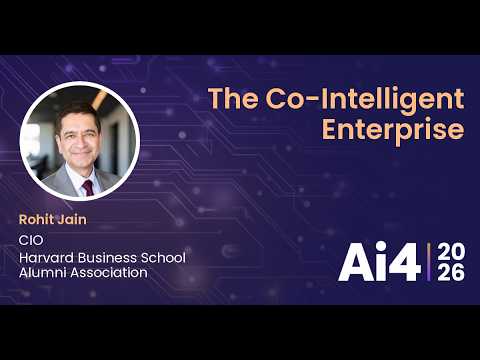
Harvard CIO Says AI Automation Hits Only 18% of Workforce Tasks
Ai4
Enterprise AI fails without human judgment and platform governance, meaning technology will reconfigure job roles rather than eliminate accountability or permanently erase human labor.
## Background
Published by Ai4 on YouTube on August 20, 2026, this page features Rohit Jain, CIO for the Harvard Business School Alumni Association. According to the page description, the session presents a practical playbook for technology leaders to transition AI from experimentation to enterprise infrastructure through a human-led co-intelligence model, unified platform governance, and a 90-day action plan.
## TL;DR
Rohit Jain argues that while AI models possess high-level intelligence across numerous tasks, they lack essential human judgment, professional accountability, and ethical nuance. Highlighting that only a small fraction of jobs face full automation, he illustrates how technology historically evolves roles rather than erasing workforce demand. He cautions against tool fragmentation and ungoverned agent deployment, using real-world studies and edge cases to show where autonomous systems fail without human oversight. Ultimately, Jain urges tech leaders to focus on platform consolidation, top-line growth, and a structured 90-day strategy that embeds AI as an un-opinionated teammate within business operations.
## Atmosphere & style
The presentation carries a pragmatic, authoritative, and reassuring tone tailored for executive decision-makers. Grounded in research and corporate experience, Jain's delivery balances strategic technical framing with grounded, real-world examples that de-escalate common workplace anxieties. The session feels like a focused masterclass, thoughtfully navigating the intersection of enterprise architecture, historical workforce patterns, and human-centered AI leadership.
## Key takeaways
- [00:08](https://www.youtube.com/watch?v=zoHfM1Bq03E&t=8s) AI models possess high task-execution capabilities across occupations, but they lack human judgment, requiring a co-intelligence model where humans own outcomes and set direction.
- [02:53](https://www.youtube.com/watch?v=zoHfM1Bq03E&t=173s) Only 18% of repeatable jobs can be fully automated by AI, while 46% of the workforce experiences virtually no impact.
- [02:53](https://www.youtube.com/watch?v=zoHfM1Bq03E&t=173s) High job exposure to AI does not equal a transfer of accountability, as licensed professionals, care providers, and relationship-driven roles cannot be replaced by autonomous agents.
- [07:08](https://www.youtube.com/watch?v=zoHfM1Bq03E&t=428s) There is a massive gap in enterprise AI, with 92% of implementations remaining at a theoretical or experimental stage without disrupting core workforce structures.
- [07:08](https://www.youtube.com/watch?v=zoHfM1Bq03E&t=428s) Historical research shows technology transforms job roles rather than permanently erasing labor, with only a single job title globally eliminated since WWI.
- [10:05](https://www.youtube.com/watch?v=zoHfM1Bq03E&t=605s) Organizations should shift their AI strategy away from mere cost-cutting and efficiency toward top-line growth and expanding business capacity.
- [10:05](https://www.youtube.com/watch?v=zoHfM1Bq03E&t=605s) Sector-specific efficiency gains from AI can reach up to ~47% in software engineering and ~41% in healthcare when deployed with structured planning.
- [11:53](https://www.youtube.com/watch?v=zoHfM1Bq03E&t=713s) Autonomous AI agents struggle when complex judgment, ethical trade-offs, or split-second decisions are required without human oversight.
- [11:53](https://www.youtube.com/watch?v=zoHfM1Bq03E&t=713s) Tool fragmentation and bad data severely undermine AI initiatives, creating governance issues and permanent error patterns across systems.
- [16:11](https://www.youtube.com/watch?v=zoHfM1Bq03E&t=971s) Technology continuously creates new job categories in a shift toward a 'skills commerce,' requiring CIOs to focus on 90-day execution plans and platform governance.
## Detailed walkthrough
### [00:08](https://www.youtube.com/watch?v=zoHfM1Bq03E&t=8s) The Distinction Between Technology and Human Judgment
Rohit Jain, CIO for the Harvard Business School Alumni Association and VP at a digital health company specializing in cardiac monitoring, frames the session as a human-centric discussion rather than a pure technology call. Contrasting his talk with previous sessions, he points out that AI models—such as ChatGPT—possess PhD-level intelligence and can perform over 1,300 tasks spanning 44 occupations, yet they lack human judgment.
He emphasizes that while current AI agents run tasks focused purely on efficiency, true "co-intelligence" requires embedding human judgment into workflows. Humans must train models and maintain ownership of outcomes while agents handle execution, ensuring that AI serves as an un-opinionated teammate rather than an autonomous decision-maker.
- Rohit Jain holds multiple roles: CIO of the Harvard Business School Alumni Association, VP at a cardiac monitoring MedTech company, and board member/investor at Harvard Alumni Angels.
- Reference to OpenAI research covering 1,300 tasks across 44 occupations demonstrating high task performance without inherent judgment.
---
[02:53](https://www.youtube.com/watch?v=zoHfM1Bq03E&t=173s) Dissecting Job Automation and Workforce Impact
Addressing common workplace anxieties, Jain highlights an OpenAI study revealing that only 18% of repeatable jobs can be fully automated using AI. A massive 46% of the workforce remains largely unimpacted, with the remaining percentages distributed across varying degrees of exposure. When leaders announce the deployment of AI agents, employees immediately fear job loss, but Jain reassures that high job exposure does not equate to a transfer of accountability.
He explains that accountability requires professional credentials, licensing, and human relationships that agents cannot replace. For instance, while AI can assist CPAs, attorneys, teachers, or surgeons, it cannot assume their legal liability or personal connections. Using his MedTech background as an example, he notes that while robotic surgery and cardiac monitors assist medical professionals, human doctors still lead the procedure.
- 18% of repeatable workforce tasks are susceptible to full automation.
- 46% of the workforce experiences virtually no impact from current AI tools.
- Key occupational categories shielded by accountability: licensed professionals (CPAs, attorneys), relationship workforce (teachers), and physical care providers (doctors, nurses).
---
[07:08](https://www.youtube.com/watch?v=zoHfM1Bq03E&t=428s) The Gap Between Theoretical AI and Real-World Redesign
Citing Wharton research, Jain addresses the massive gap between what AI can theoretically accomplish and its actual operational execution. Despite rampant enterprise AI adoption, 92% of implementation remains purely theoretical or experimental, leading to minimal changes on the frontline workforce.
To provide historical context on technology-driven workforce shifts, Jain shares a Harvard Business School study examining job elimination from WWI (1950s analysis) through the end of the COVID-19 pandemic. The study found that across every continent, only a single job title was permanently eliminated: the "knocker-up" (or upper knocker), individuals hired to knock on windows before alarm clocks existed. Other roles, like elevator operators or flag-bearers walking ahead of vehicles, simply evolved into new contexts (such as safety flaggers at retail hardware warehouses). Technology transforms job descriptions rather than permanently erasing human labor.
- Wharton research indicates 92% of enterprise AI remains at a theoretical or pilot stage without disrupting core workforce structures.
- Historical HBS study finding: Only 1 job title ("knocker-up") was fully eliminated globally between WWI and the post-pandemic era.
---
[10:05](https://www.youtube.com/watch?v=zoHfM1Bq03E&t=605s) Prioritizing Growth Over Efficiency and Industry Bottlenecks
Jain urges leaders to shift their AI strategy away from mere cost-cutting and efficiency toward top-line growth. For instance, combining enterprise productivity gains (e.g., $1.7 billion) with revenue expansion (e.g., $6 billion) demonstrates how AI should expand business capacity without discarding human talent.
Examining potential efficiency gains across sectors, Jain highlights that software engineering efficiency can increase by roughly 47%, while healthcare efficiency can rise by around 41%. However, realize these gains requires structured planning and clear business outcomes rather than rushed tool rollouts.
- Potential sector efficiency gains: ~47% in software development and ~41% in healthcare.
- Financial framing: Balancing $1.7 billion in efficiency gains with $6 billion in revenue growth to preserve workforce stability.
---
[11:53](https://www.youtube.com/watch?v=zoHfM1Bq03E&t=713s) Practical AI Deployments, Judgment Failure, and Bad Data
Illustrating the limits of autonomous agents, Jain references a joint Accenture and Wharton experiment involving a fully simulated AI-run manufacturing company powered by 60 agents (35 digital, 25 physical). While utility agents effectively handled routine operational tasks, the enterprise struggled whenever complex judgment calls were required.
To illustrate a real-world edge case in autonomous decision-making, he references a self-driving Tesla incident where the vehicle's algorithm had to make a split-second ethical choice at 70 mph between braking/swerving—which would jeopardize the human passengers—or hitting a dog crossing the street. The system chose to maintain trajectory to protect the human occupants. Jain stresses that AI must be carefully trained to navigate such complex trade-offs. Furthermore, he warns that bad data compounds these errors; feeding poor data into AI creates permanent "scar tissue," generating flawed interpretations across organizational dashboards.
- Accenture/Wharton experiment: 60 simulated AI agents (35 digital, 25 physical) running a manufacturing company.
- Pitfall of tool accumulation: Jain cites a mid-sized $500M publicly traded company using 175–185 disjointed AI tools instead of a unified platform, leading to fragmented governance and failed AI judgment.
---
[16:11](https://www.youtube.com/watch?v=zoHfM1Bq03E&t=971s) The Evolution of Roles and a 90-Day CIO Framework
Jain tracks how technological advancements continuously create new organizational roles. He notes that the "data analyst" title did not formally exist in US job market definitions until 2009, when accessible compute power catalyzed roles like data engineers and data scientists. Today, AI has birthed positions such as "forward-deployed engineers" and "forward-deployed CIOs." He argues that modern organizations operate in a "skills commerce" rather than a "titles commerce."
Concluding with advice for CIOs, CTOs, and CAIOs, Jain cautions against returning from conferences to blindly deploy hundreds of AI agents, which risks burning operational bridges. Instead, leaders must establish a structured 90-day execution plan centered on continuous learning, platform governance, and aligning AI capabilities with actual P&L priorities.
- Evolution of job taxonomies: "Data analyst" was formally introduced to US job classifications in 2009; modern equivalents include "forward-deployed engineer."
- Execution takeaway: Focus on platform consolidation, skills-based talent reinvention, and bounded 90-day adoption plans rather than ungoverned agent proliferation.
## Notable quotes
> CIOs will not win the AI era by buying more intelligence. They will win by designing the system that converts intelligence into trusted, governed and measurable enterprise value. — Rohit Jain
> [00:08](https://www.youtube.com/watch?v=zoHfM1Bq03E&t=8s) human-centric discussion rather than a pure technology call — Rohit Jain
> [00:08](https://www.youtube.com/watch?v=zoHfM1Bq03E&t=8s) un-opinionated teammate rather than an autonomous decision-maker — Rohit Jain
> [02:53](https://www.youtube.com/watch?v=zoHfM1Bq03E&t=173s) high job exposure does not equate to a transfer of accountability — Rohit Jain
> [07:08](https://www.youtube.com/watch?v=zoHfM1Bq03E&t=428s) Technology transforms job descriptions rather than permanently erasing human labor. — Rohit Jain
> [16:11](https://www.youtube.com/watch?v=zoHfM1Bq03E&t=971s) skills commerce rather than a titles commerce — Rohit Jain
## Mentioned
Rohit Jain, Harvard Business School Alumni Association, Ai4, Harvard Business School, OpenAI, ChatGPT, Wharton School of the University of Pennsylvania, Accenture, Tesla, Harvard Alumni Angels
## Video description
Rohit Jain - CIO, Harvard Business School Alumni Association
This 30-minute solo session gives technology leaders a practical playbook for moving from experimentation to execution. The session reframes AI as enterprise infrastructure: embedded in the flow of work, connected to core systems, governed at the platform level, and measured through business outcomes rather than activity metrics. It also introduces a human-led model of co-intelligence, where people set direction, guardrails, trade-offs and accountability while AI agents execute bounded work at speed.
Attendees will learn how to evaluate AI platform readiness, reduce tool fragmentation, govern agentic workflows, prioritize high-value use cases, and redesign work without defaulting to fear-based workforce narratives. The session connects enterprise architecture, responsible AI, workforce transition and ROI into one CIO-ready framework.
The key takeaway: CIOs will not win the AI era by buying more intelligence. They will win by designing the system that converts intelligence into trusted, governed and measurable enterprise value.
Audience takeaways
• A practical architecture for scaling AI beyond pilots
• A governance model that embeds control into the platform, not just training
• A workforce transition lens for automation, redesign and growth
• A 90-day action plan with scorecards for adoption, value, quality, risk and workforce impact
Rohit Jain argues that sustainable enterprise AI requires a 'co-intelligent' framework where autonomous tools execute discrete tasks while humans retain ultimate judgment and legal accountability. Rather than pursuing narrow head-count reductions, organizations must bridge the gap between experimental pilots and operational execution through governed platforms and revenue-focused strategies.
Judgment and Accountability as Automation Boundaries (0:08)
Jain points out that while modern models possess PhD-level intelligence across 1,300 tasks in 44 occupations, they lack human judgment. Referring to OpenAI research, he highlights that only 18% of repeatable workforce tasks are susceptible to full automation, leaving 46% of the workforce essentially unaffected. Consequently, organizational anxiety around widespread replacement misinterprets exposure as a complete handover of responsibility.
Accountability, Jain contends, fundamentally relies on professional licensing, legal liability, and human relationships that software agents cannot assume. Regulated professionals such as certified public accountants, attorneys, teachers, and surgeons remain protected from displacement because software cannot take on malpractice risk or build interpersonal trust. Drawing on his MedTech background, Jain notes that while robotic surgery and cardiac monitoring assist practitioners, the human clinician retains ultimate ownership of the outcome.
Historical Resilience and the Shift to Skills (7:08)
To contextualize fears of technological obsolescence, Jain cites a Harvard Business School study tracking job elimination from World War I through the post-COVID-19 era. Across all continents, the study found only a single occupational title permanently eliminated: the 'knocker-up,' who was hired to knock on windows prior to the invention of alarm clocks. Other historical positions, such as elevator operators or vehicle flag-bearers, evolved into modern safety and logistics roles, demonstrating that technological shifts redefine job descriptions rather than erasing labor entirely.
Technological progress also continually creates new job taxonomies. Jain notes that the title 'data analyst' did not officially exist in US labor classifications until 2009, when accessible compute catalyzed demand for data engineering and data science roles. Today, AI is creating positions like 'forward-deployed engineers' and 'forward-deployed CIOs.' Because roles transform rapidly, Jain argues that enterprises increasingly operate in a 'skills commerce' rather than a 'titles commerce.'
Operational Pilot Gaps and System Governance Pitfalls (11:53)
Despite aggressive enterprise experimentation, Wharton research indicates that 92% of corporate AI adoption remains theoretical or locked in pilot stages, generating minimal frontline operational redesign. Jain references a joint Accenture and Wharton experiment simulating a manufacturing firm operated by 60 agents (35 digital and 25 physical); while utility agents handled routine operational workflows, the system broke down whenever ambiguous, high-level judgment calls were necessary.
Navigating real-world edge cases presents similar challenges. Jain cites an autonomous Tesla scenario where an algorithm moving at 70 mph resolved an ethical conflict by choosing passenger safety over an animal crossing the road. Beyond edge cases, Jain cautions that unmanaged tool accumulation creates structural vulnerabilities, pointing to a $500 million publicly traded company using 175 to 185 disjointed AI tools. Fragmented adoption and poor data quality generate permanent organizational 'scar tissue,' distorting executive dashboards and undermining decision-making.
Aligning AI Strategy With Revenue and Governance (10:05)
Jain advises leaders to redirect AI investments away from defensive cost-cutting and toward top-line revenue expansion. For example, enterprises can pair $1.7 billion in internal productivity gains with $6 billion in revenue growth to preserve and redeploy human capital. While projected sector-specific efficiencies are substantial—reaching roughly 47% in software engineering and 41% in healthcare—realizing these gains requires methodical planning rather than disorganized tool rollouts.
For enterprise technology executives, Jain warns against returning from industry conferences to deploy uncoordinated agents across operational units. He advocates for a bounded 90-day implementation framework focused on employee learning, platform consolidation, and direct alignment with profit-and-loss priorities.
Jain concludes that enterprise AI success relies on consolidating disjointed tools into governed platforms and treating software as an un-opinionated teammate guided by human judgment. A persistent challenge remains ensuring that organizations maintain data integrity and clear ethical guardrails as autonomous systems handle increasingly complex trade-offs.
## Background
该视频由 Ai4 于 2026 年 8 月 20 日发布在 YouTube 平台上。视频内容为哈佛商学院校友会 CIO Rohit Jain 主讲的个人演讲,旨在为技术领袖提供从 AI 实验走向大规模执行的实操指南,并将 AI 重构为嵌入工作流、具备平台级治理与业务价值衡量的企业基础设施。
## TL;DR
Rohit Jain 阐述了企业如何构建“协同智能”(Co-Intelligence)模型,强调 AI 虽然具备博士级智力但缺乏判断力,因此人类必须掌控方向与治理边界。演讲引用研究数据指出 AI 完全替代工作的比例仅为 18%,提醒企业应从单纯的“效率提升”转向“业务增长”。此外,演讲通过虚构 AI 公司实验及特斯拉决策案例剖析了 AI 的道德判断困境,并为 CIO 等技术领袖提出了规避工具碎片化、聚焦损益表(P&L)优先级的 90 天落地行动指南。
## Atmosphere & style
整个演讲沉稳专业且极具启发性,充满领袖洞察力与务实干货。演讲者以冷静客观的数据和生动的现实案例打破了技术恐慌叙事,将原本抽象的技术治理转化为清晰的高管战略指南。听众能够切身感受到一种从盲目跟风理性回归业务本质的笃定感与使命感。
## Detailed walkthrough
以下是根据演讲录音整理的详细内容记录与分析:
### [00:08](https://www.youtube.com/watch?v=zoHfM1Bq03E&t=8s) 重新定义 AI 时代:智力与人类判断力的协同
哈佛商学院校友会 CIO、某心脏监测数字医疗公司副总裁 Rohit Jain 明确指出,这场演讲并非纯粹的技术研讨,而是关注 AI 如何深度影响人类与组织。相较于过往关于大语言模型(LLM)等技术细节的讨论,AI 与人类的交互模式呈现出截然不同的动态特征。目前,LLM 虽然拥有博士级别的知识与智力(Intelligence),但严重缺乏“判断力”(Judgment);人类固然拥有智力与判断力,但 AI 智能体(Agents)目前仅具备执行力而缺乏判断力。这种智力与判断力的分离,正是企业在部署 AI 时面临的核心课题。
在过去三天的会议中,“效率”是最常被提及的词汇,但企业绝不能仅仅停留在利用 ChatGPT 或 AI Agent 自动化执行任务的阶段。AI 智能体犹如没有判断力的团队成员,能够高效处理特定工作,但人类必须承担最终的责任与结果。未来发展的必然趋势是:LLM 将逐步被训练出更精准的判断力,而“协同智能”(Co-intelligence)的核心,正是如何在人类与 AI 之间建立正确的判断力框架与治理约束。
- **核心观点**:AI 拥有博士级智力但缺乏判断力,人类必须掌控最终业务结果并为其设定边界。
- **协同模型**:人类负责设定方向、护栏与评估取舍,AI 智能体在受限范围内高速执行具体任务。
---
### [00:53](https://www.youtube.com/watch?v=zoHfM1Bq03E&t=53s) 人力资源重塑与“18%自动化”真相
针对企业员工普遍担忧的“AI 会抢走我的工作”这一恐慌情绪,Jain 引用了 OpenAI 针对 44 个职业中的 1,300 多项具体任务展开的研究。研究数据表明,全社会仅有 **18%** 的重复性工作可以被 AI 完全自动化。高达 **46%** 的工作岗位几乎不受影响,其余岗位则处于 12% 至 24% 等不同程度的受影响区间内。这表明世界并非正在走向大规模失业,恐慌叙事与现实相去甚远。
管理者在向团队推广 AI 应用时,必须清楚区分“曝光度/自动化程度”(Exposure)与“法律与业务责任”(Accountability):
```
+----------------------------------------------------------------------+
| 工作岗位类型与 AI 协同模式 |
+----------------------------------------------------------------------+
| [高度责任/牌照类岗位] | CPA 注册会计师、律师 |
| | -> AI 提供辅助,但无法替代执业资格与法律责任|
+------------------------+---------------------------------------------+
| [情感与关系驱动类岗位]| 教师、教授 |
| | -> 疫情证实教学需人际引导,AI 仅作为教学工具 |
+------------------------+---------------------------------------------+
| [物理交互与临床类岗位]| 医生、心脏外科医生 |
| | -> 达芬奇机器人手术仍需医生操控,AI 无法替代 |
+----------------------------------------------------------------------+
```
- **数据支撑**:OpenAI 官方研究显示,完全可被自动化替代的重复性工作仅占总数的 18%。
- **历史视角**:哈佛团队研究了从一战(1950年代)到疫情结束期间的岗位变迁,发现历史上真正从地球上永久消失的职业仅有“敲窗人”(Knocker-up,过去缺乏闹钟时代人工敲窗催早起的人)。即便经历了工业革命与技术革命,大部分职业如电梯操作员、道路前导旗手等,均是以岗位职责转变的形式继续存在,而非被技术彻底抹杀。
---
### [07:08](https://www.youtube.com/watch?v=zoHfM1Bq03E&t=428s) 突破效率瓶颈,以“业务增长”为核心驱动
沃顿商学院(Wharton)的研究表明,AI 的理论潜在能力与企业实际落地应用之间存在巨大鸿沟。高达 92% 的应用仍停留在理论与试点阶段,而底层受影响最小的 46% 基础岗位在实际工作中几乎未发生本质变化。AI 的应用浪潮虽然凶猛,但由于缺乏合理的判断力护栏与深度业务整合,目前尚未真正深刻改变企业的人力结构。
企业 CIO 与决策者必须将对话焦点从单纯的“提效(Efficiency)”转向“业务增长(Growth)”。提效只是增长的衍生结果,而非终极目标。
- **业务收益**:领先的企业实践表明,AI 能够带来高达 **60 亿美元** 的年营业收入增长,以及 **17 亿美元** 的生产力提升。
- **行业提效空间**:将数据深度融入业务流后,软件开发效率可提升约 **47%**,医疗健康领域的综合效率可提升约 **41%**。
---
### [11:53](https://www.youtube.com/watch?v=zoHfM1Bq03E&t=713s) 虚构 AI 公司的实验与道德判断力困境
为了探索 AI 运行的极限,埃森哲(Accenture)与沃顿商学院共同进行了一项实验:他们建立了一家完全由 AI 运行的虚构制造企业。该公司的 CEO 及全体员工均为 AI,共部署了 60 个 AI Agent(其中 35 个数字 Agent,25 个物理 Agent)。实验表明,工具型 Agent 能够完美胜任所有日常例行事务,但一旦涉及需要进行“判断取舍”(Judgment Calls)的复杂决策时,系统便开始陷入混乱。
Jain 引用了现实中的案例来阐述判断力的复杂性:特斯拉在自动驾驶模式下行驶时,面对突发状况(如小狗穿过马路,且周围车道均有车辆高精度通行),系统在毫秒级时间内做出判断——若在时速 70 英里下紧急刹车,会导致车内整家乘客面临毁灭性车祸,最终系统做出了牺牲小狗、保护乘客的决策。这种在极端社会道德与安全约束下的决策逻辑,正是未来企业在训练 AI 模型与构建 Agent 时必须融入的“判断力框架”。
- **数据质量困境**:当前企业面临的最大瓶颈依旧是数据。“垃圾进,垃圾出(Garbage in, garbage out)”,错误的脏数据进入 AI 引擎后,只会在系统中不断放大错误结果。
- **避免工具碎片化**:Jain 举例某家年营收 5 亿美金的上市公司,内部竟然散乱堆叠了 175 至 185 种不同的 AI 工具。这种仅仅是“堆砌工具”而非“构建统一平台”的做法,必然导致 AI 判断力屡屡失效。
```
+----------------------------------------------------------------------+
| 企业 AI 进化路线:平台化 vs 工具堆砌 |
+----------------------------------------------------------------------+
| [堆砌工具依赖] 散乱引入 180+ 孤立 AI 工具 -> 数据割裂 -> 决策判断失效|
| |
| [统一平台架构] 构建底层数据与 AI 平台 -> 嵌入工作流 -> 可控判断与增长|
+----------------------------------------------------------------------+
```
---
### [16:11](https://www.youtube.com/watch?v=zoHfM1Bq03E&t=971s) 技能革命与 CIO 90天落地行动指南
技术变革正在迅速颠覆传统的岗位定义。在 2009 年以前,美国官方职业分类中甚至不存在“数据分析师”(Data Analyst)这一岗位,而后随着算力普及与数据爆发,才衍生出数据工程师、数据科学家等一系列岗位。如今在 AI 时代,企业中迅速涌现出“前置部署工程师”(Forward Deployed Engineer)乃至“前置部署 CIO”(Forward Deployed CIO)。这表明,传统的“职位头衔”正在失效,取而代之的是“技能交易”(Skills Commerce)。
对于 CIO、CTO 及 CAIO 等技术领袖,Jain 提出了落地 AI 战略的实用建议:
1. **明确损益表优先级**:AI 项目必须紧密贴合损益表(P&L)的战略重点,拒绝无意义的单纯技术实验。
2. **持续的人才重塑**:通过突破性的领导力(Breakthrough Leadership)与清晰的战略意图,推动团队进行持续学习与技能再造。
3. **避免盲目扩张**:切忌在参加完 AI 峰会后便盲目宣布要在公司内部部署数百个新的 Agent,这会烧毁现有的组织信任与业务桥梁。
演讲最后,Rohit Jain 呼吁各位技术领袖重构框架,以增长为导向,打造兼具信任、治理与可衡量价值的“协同智能企业”,并欢迎与会者通过 LinkedIn 继续深入交流。
## Notable quotes
> [00:08](https://www.youtube.com/watch?v=zoHfM1Bq03E&t=8s) 这场演讲并非纯粹的技术研讨,而是关注 AI 如何深度影响人类与组织。 — Rohit Jain
> [00:08](https://www.youtube.com/watch?v=zoHfM1Bq03E&t=8s) LLM 虽然拥有博士级别的知识与智力(Intelligence),但严重缺乏“判断力”(Judgment);人类固然拥有智力与判断力,但 AI 智能体(Agents)目前仅具备执行力而缺乏判断力。 — Rohit Jain
> [00:08](https://www.youtube.com/watch?v=zoHfM1Bq03E&t=8s) AI 智能体犹如没有判断力的团队成员,能够高效处理特定工作,但人类必须承担最终的责任与结果。 — Rohit Jain
> [00:08](https://www.youtube.com/watch?v=zoHfM1Bq03E&t=8s) “协同智能”(Co-intelligence)的核心,正是如何在人类与 AI 之间建立正确的判断力框架与治理约束。 — Rohit Jain
> [00:53](https://www.youtube.com/watch?v=zoHfM1Bq03E&t=53s) 全社会仅有 18% 的重复性工作可以被 AI 完全自动化。高达 46% 的工作岗位几乎不受影响。 — Rohit Jain
> [00:53](https://www.youtube.com/watch?v=zoHfM1Bq03E&t=53s) 历史上真正从地球上永久消失的职业仅有“敲窗人”(Knocker-up)。大部分职业均是以岗位职责转变的形式继续存在,而非被技术彻底抹杀。 — Rohit Jain
> [07:08](https://www.youtube.com/watch?v=zoHfM1Bq03E&t=428s) 企业 CIO 与决策者必须将对话焦点从单纯的“提效(Efficiency)”转向“业务增长(Growth)”。提效只是增长的衍生结果,而非终极目标。 — Rohit Jain
> [11:53](https://www.youtube.com/watch?v=zoHfM1Bq03E&t=713s) “垃圾进,垃圾出(Garbage in, garbage out)”,错误的脏数据进入 AI 引擎后,只会在系统中不断放大错误结果。 — Rohit Jain
> [11:53](https://www.youtube.com/watch?v=zoHfM1Bq03E&t=713s) 这种仅仅是“堆砌工具”而非“构建统一平台”的做法,必然导致 AI 判断力屡屡失效。 — Rohit Jain
> [16:11](https://www.youtube.com/watch?v=zoHfM1Bq03E&t=971s) 传统的“职位头衔”正在失效,取而代之的是“技能交易”(Skills Commerce)。 — Rohit Jain
> [16:11](https://www.youtube.com/watch?v=zoHfM1Bq03E&t=971s) 切忌在参加完 AI 峰会后便盲目宣布要在公司内部部署数百个新的 Agent,这会烧毁现有的组织信任与业务桥梁。 — Rohit Jain
## Mentioned
Rohit Jain, Harvard Business School Alumni Association, Ai4, OpenAI, Wharton School of the University of Pennsylvania, Accenture, Tesla, ChatGPT, LinkedIn
## Video description
Rohit Jain - CIO, Harvard Business School Alumni Association
This 30-minute solo session gives technology leaders a practical playbook for moving from experimentation to execution. The session reframes AI as enterprise infrastructure: embedded in the flow of work, connected to core systems, governed at the platform level, and measured through business outcomes rather than activity metrics. It also introduces a human-led model of co-intelligence, where people set direction, guardrails, trade-offs and accountability while AI agents execute bounded work at speed.
Attendees will learn how to evaluate AI platform readiness, reduce tool fragmentation, govern agentic workflows, prioritize high-value use cases, and redesign work without defaulting to fear-based workforce narratives. The session connects enterprise architecture, responsible AI, workforce transition and ROI into one CIO-ready framework.
The key takeaway: CIOs will not win the AI era by buying more intelligence. They will win by designing the system that converts intelligence into trusted, governed and measurable enterprise value.
Audience takeaways
• A practical architecture for scaling AI beyond pilots
• A governance model that embeds control into the platform, not just training
• A workforce transition lens for automation, redesign and growth
• A 90-day action plan with scorecards for adoption, value, quality, risk and workforce impact
[Source](https://www.youtube.com/watch?v=zoHfM1Bq03E)
Source quotes
[0:08] Rohit Jain: 这场演讲并非纯粹的技术研讨,而是关注 AI 如何深度影响人类与组织。
[0:08] Rohit Jain: LLM 虽然拥有博士级别的知识与智力(Intelligence),但严重缺乏“判断力”(Judgment);人类固然拥有智力与判断力,但 AI 智能体(Agents)目前仅具备执行力而缺乏判断力。
[0:08] Rohit Jain: AI 智能体犹如没有判断力的团队成员,能够高效处理特定工作,但人类必须承担最终的责任与结果。
[0:08] Rohit Jain: “协同智能”(Co-intelligence)的核心,正是如何在人类与 AI 之间建立正确的判断力框架与治理约束。
[0:53] Rohit Jain: 全社会仅有 18% 的重复性工作可以被 AI 完全自动化。高达 46% 的工作岗位几乎不受影响。
[0:53] Rohit Jain: 历史上真正从地球上永久消失的职业仅有“敲窗人”(Knocker-up)。大部分职业均是以岗位职责转变的形式继续存在,而非被技术彻底抹杀。
[7:08] Rohit Jain: 企业 CIO 与决策者必须将对话焦点从单纯的“提效(Efficiency)”转向“业务增长(Growth)”。提效只是增长的衍生结果,而非终极目标。
[11:53] Rohit Jain: “垃圾进,垃圾出(Garbage in, garbage out)”,错误的脏数据进入 AI 引擎后,只会在系统中不断放大错误结果。
[11:53] Rohit Jain: 这种仅仅是“堆砌工具”而非“构建统一平台”的做法,必然导致 AI 判断力屡屡失效。
[16:11] Rohit Jain: 传统的“职位头衔”正在失效,取而代之的是“技能交易”(Skills Commerce)。
[16:11] Rohit Jain: 切忌在参加完 AI 峰会后便盲目宣布要在公司内部部署数百个新的 Agent,这会烧毁现有的组织信任与业务桥梁。
Source quotes
Rohit Jain: CIOs will not win the AI era by buying more intelligence. They will win by designing the system that converts intelligence into trusted, governed and measurable enterprise value.
[0:08] Rohit Jain: human-centric discussion rather than a pure technology call
[0:08] Rohit Jain: un-opinionated teammate rather than an autonomous decision-maker
[2:53] Rohit Jain: high job exposure does not equate to a transfer of accountability
[7:08] Rohit Jain: Technology transforms job descriptions rather than permanently erasing human labor.
[16:11] Rohit Jain: skills commerce rather than a titles commerce
Original transcript
[0:08] This is not going to be a technology call.
[0:11] Let's be clear on that. This is more about how
does it impact humans. What Barry was talking
[0:17] about was all technology and this is something
very different because it interacts with humans.
[0:22] So, what My name is Rohit Jain. I am the CIO
for Harvard Business School Alumni Association.
[0:29] In addition to that role, I'm a VP at a digital
health company that does cardiac monitoring.
[0:35] I also sit on the board for the Alumni
Angels, the Harvard Alumni Angels,
[0:40] and I'm an investor there as well. And I am so
happy that you all are spending time here just as
[0:48] the conference is getting ready to close. And you
know, everyone's been talking about this forever
[0:55] that the LLMs, they have PhD level knowledge,
intelligence, but do they have that judgment?
[1:04] That's the question. What Barry was talking about
was all the intelligence part, but do humans have
[1:10] that intelligence? They do. Do humans have the
judgment? They do. But do agents have? They don't.
[1:17] And that's the whole dynamics here that we
are dealing with. That when you think of it,
[1:23] a chat GPT model can do tremendous amount of
work. And there was all this research done
[1:30] over 1,300 tasks spanning 44
occupations. And they could do well.
[1:38] But they could do it without judgment.
And that is the whole thesis of this talk.
[1:46] What's been happening till now? We've got
agents that keep running. They execute a
[1:51] task. We heard about efficiency. We've been
hearing about efficiency for the past 3 days.
[1:57] But where does the judgment part sit in?
The humans have to train the models to
[2:03] have the right judgment. And over a period of
time, what is really going to happen is this.
[2:11] LLMs will start having judgment as well.
And that's when the real things kick in.
[2:18] It's not only about efficiency
that we need to be thinking about.
[2:22] We need to be thinking about how the
judgment works. And that's core intelligence.
[2:28] We've got companies now that are thinking about
agents in that HR organization. You've got people,
[2:35] you've got agents. When you look at an HR
organization, you see them sitting there. But,
[2:41] it's a teammate without a judgment. Humans own the
outcomes. Agents do the work. And that's the goal.
[2:53] Look at these numbers.
[2:57] And I'll let that sit in for a second. Who
created the study? OpenAI. And what did they say?
[3:05] They said 18% of the jobs that are
repeatable can be automated using AI.
[3:13] It's not that the world is falling apart. It
is not. Here's a company that's doing this
[3:19] that we believe are the biggest
disruptors, and that's what they quote.
[3:25] So, when you think of the human layer working
with the agents, which jobs get automated first,
[3:33] which are repeatable? It's only 18%. You've
got this big huge chunk of 46% of the workforce
[3:41] that doesn't get impacted. And in between,
you've got the range between 24%, 12%, and so on.
[3:48] I've provided a link there. Have have at that. Uh
when you all get a chance, I don't know if these
[3:54] things are going to be online or not. So, but
this is one thing that I really want you all to
[3:59] take back to your workplaces. When you work with
people and you say, "I am deploying an AI agent."
[4:08] The first thing is, "Am I going to
lose my job?" And the answer is no.
[4:12] It's not true. That's not what really
happens in a regular workplace.
[4:19] And why is that?
[4:24] When a job is automated, you've got exposure.
We looked at that 18% number, right?
[4:31] So, if that 18% of the job and workforce
is automated, is there an accountability?
[4:40] The exposure is not equal to accountability. And
that's what we want to be thinking of as leaders
[4:46] or as technologists or people who
are working within the AI ecosystem.
[4:51] That's the key thing that we need to be thinking
of. Because when you think of accountability,
[4:59] the you need some licenses. For example,
you've got CPAs and so on. You need licenses.
[5:05] Can an agent help a CPA? Sure, an agent can help
a CPA. Can an agent help an attorney? Of course,
[5:11] it can. But it cannot replace an attorney,
at least in the foreseeable future.
[5:17] In the middle, you've got
the relationship workforce.
[5:22] All of those pieces, they
are relationships. Teachers.
[5:27] When the pandemic hit, what was the first
thing that really turned on its head? I come
[5:34] from an education background in the education
industry. Since the 15th century, 16th century,
[5:41] you had a teacher {slash} professor standing
teaching a classroom. And the pandemic hit,
[5:49] everything turned on its head. Whether it was an
elementary school or a grad school, everything was
[5:54] online. But still, you needed a professor or
a teacher to walk the classroom through that.
[6:02] That's that physical layer. Can agents help the
students and the teachers? Of course they can.
[6:07] And then you've got the physical
jobs, where you need doctors, nurses.
[6:15] The agents help them. Agents don't replace them.
Like I said, I'm the VP at a MedTech company.
[6:22] We make cardiac monitors, but we don't replace
cardiac surgeons. You have robotic surgery,
[6:29] but that robotic surgery is still being
driven by a human. When you think of agents
[6:34] and co-intelligence, that's the layer I want
everyone to think about when you go out from here.
[6:39] Don't focus only on that 18% which was there on
the previous slide. Please think across the board.
[6:54] There's a gap, really, when you think of it. And
I you know, the text that's coming on is really
[7:00] taking away the links, but all of these things are
backed by research. This research is from Wharton.
[7:08] There's a gap between what AI can really do
[7:12] and what it is actually doing. This is one slide
again. Just please take it back to your teams.
[7:21] And put this as an overarching model when you all
are working with your teams, with your customers,
[7:28] because if you are a service provider, you're
going and talking to a customer, and that's the
[7:32] biggest pushback that you get. What happens
to my workforce? And when you really see of
[7:38] look at this, organizations that have actually
adopted they still have room for growth.
[7:46] There's 92% of it is just theoretical
AI. That's the topmost row, right?
[7:54] And on the bottommost which goes back to that
46% anchor that I had there's hardly any change.
[8:03] Everyone really needs to think of this because
AI adoption it's tremendous. It's happening.
[8:11] It's real. It's an avalanche. It is coming. But it
is not impacting the workforce. It's not impacting
[8:19] humans. And it wouldn't because we need to get
into this mode where we have the judgment. We
[8:24] have the guardrails for AI. I want to digress
a bit from my presentation. After the pandemic
[8:33] we did a study at the school and we said from the
First World War in 1950 to the end of the pandemic
[8:42] how many jobs were eliminated as in that
job doesn't exist in the world anymore
[8:49] as a job description. Nothing
exists anywhere in any continent.
[8:53] Any guesses from this audience? How
many jobs were eliminated forever?
[9:01] One. Just one job. And that job is called
upper knocker. So before the First World War,
[9:11] people didn't have alarm clocks and so on.
They paid people to come in and knock on their
[9:16] window to be woken up at sunrise at 6:00 a.m. or
whatever. That's the only job that is eliminated.
[9:24] Imagine that. We've had the industrial
revolution. We've had the technology revolution.
[9:30] Everything else exists. Elevator
operators, they don't exist here,
[9:34] but they exist in other parts of the world.
When the cars were on the main roads,
[9:39] you had a person walk with a flag in front of
the car telling that there's a car coming behind.
[9:44] You still have that job description when
you go to the Home Depots of the world,
[9:48] you've got someone walking around with a flag
saying there's a truck coming behind. The point is
[9:55] technology comes, jobs get transformed.
They don't get eliminated forever.
[10:05] And this is the main thing that we want to think
about. Growth is what everyone's looking for,
[10:11] not efficiency. Efficiency is a factor of growth.
Most of the conversations that we have with AI is
[10:19] it is efficiency. No, we need to be
thinking about growth at this stage.
[10:24] How do we grow our companies? How do we grow our
enterprises? 6 billion in annual revenue growth
[10:31] plus 1.7 billion in productivity gains.
Okay. That's good. But how do you make it
[10:40] it without impacting humans? That's
the thing that we have to think about.
[10:44] It's not about more output.
It's not only about efficiency.
[10:54] We looked across industries.
Let me be more specific, right?
[10:59] Working across multiple industries and
specifically this one's focused on MedTech and
[11:03] the healthcare industry. If anyone from the life
sciences world here, this one is for you because
[11:07] that's my focus. That's where I invest as well.
Software efficiency can go up by around 47%.
[11:17] Healthcare uh efficiency can go up around 41% when
you marry all the data that I've been presenting
[11:24] all till now. That's the end state that we are
looking at. You are still left with a big chunk
[11:30] where humans have still got to play a role. And
this is why planning and AI rollout matters.
[11:38] It kind of goes back to the previous
presentation and the one before that as well.
[11:42] That it's not a question of just rolling out AI,
[11:45] it's the business impact that you're
trying to get and what's your end state.
[11:53] So, let's get practical. Accenture and
Wharton, they created a fictitious company
[12:02] using AI. The CEO is AI. It's got a complete
staff of AI. It's a manufacturing organization.
[12:11] Does business and they let it run. And it had
around 60 AI agents. 35 digital, 25 physical.
[12:23] And how did that organization run? Utility
agents, they're able to handle routine work.
[12:29] We all know that. But when the question
came, they had to make a judgment call.
[12:36] That's where the issues started. Actually, just
3 weeks ago, uh test and I don't know how many
[12:43] of you read this in the news. Tesla was uh on
a self-driving mode with a family in the car.
[12:53] There was one dog crossing
the [clears throat] street.
[12:57] And the car had to make a judgment call.
Kill the dog or because of the speed,
[13:04] something would happen to the passengers.
It did the right judgment. It killed the dog
[13:10] because if it would have braked at 70 mph, there
would have been problems for the passengers.
[13:17] That's the judgment that we have to think of
for AI. Is it sad for the dog? Of course, it is.
[13:24] But then, as a human, that's what we would
have done. Because you can't change your lanes,
[13:29] there's traffic all across, and there's a
dog right in the front. What would you do?
[13:35] And that's where AI needs to start moving into.
And that's how we train our models moving forward.
[13:46] I'll skip this slide. It's a lot more Medicare,
Medicaid, and the healthcare industry. But,
[13:52] think of the numbers that we're
spending in here. $570 billion is
[13:58] Is that something that we can change? Of course,
we can. But, why is there resistance to change?
[14:05] That's what we, as people dealing in the
AI world, need to think about and go solve.
[14:12] And yes, this was touched, I think, in almost
every presentation that I have sat through today.
[14:17] Data is the problem. Cannot repeat that
anymore. I think we've all got scar tissues
[14:25] uh with bad data for producing bad results, and
you push it into AI, it's producing bad results
[14:31] forever. You can't go clean that up. So, that's
something that we need to think this as we start
[14:38] walking through our journeys with AI. How do you
build judgment? How do you get clean data? And
[14:46] we talked of agents in the previous call, uh
previous session. And I'm sitting there and
[14:51] thinking that, okay, if a agent gave me the
right answer right at that time, I'm going to
[14:57] interpret it the way I want. However, if I've
got another teammate who got the same answer,
[15:02] but is dealing with a different set of parameters,
how would they interpret that answer? How does
[15:08] that judgment layer of an output coming out from
an agent with incorrect data, because there was
[15:15] a relationship to the dashboard, how does it work
out? It will not work out, and that's why getting
[15:21] these building blocks changing your organizations
the right way is very very critical for success.
[15:30] Are you building a platform where
your organizations are going to change
[15:35] or are you accumulating tools? I know of a
company it's a mid-size company around 500 million
[15:44] publicly traded. They've got 175 or
185 AI tools. And I'm sitting there
[15:53] and saying, "Seriously, you're not building
a platform. You're not collecting agents.
[15:57] You're just accumulating tools." And
therefore the AI judgments start failing.
[16:11] I skipped a couple of slides
in the interest of time.
[16:16] When you think of a data analyst role that did
not exist in the US job market definition at all
[16:24] till 2009. That was when it was created for the
first time. Why? Because compute became easier,
[16:32] data was readily available, a data analyst
role got created, data engineer and data
[16:38] scientist and so on and so forth. Come AI,
you suddenly see forward deployed engineer.
[16:45] That's a new role that suddenly has gotten
created. And now with a forward deployed
[16:49] engineer, you've got a forward deployed CIO
as well. I've seen those roles coming along.
[16:54] It's the not the titles that are mattering, it's
actually the skills that are more important now.
[17:00] And that's what we want to think. It's the
skills commerce, it's not the titles commerce.
[17:06] As new tools and new technologies roll out
those are the things that will matter most.
[17:17] Talent reinvention is a big huge deal and you
really want to encourage your teams and the
[17:25] people you work with, whether you're customers,
your teams, whoever you lead or you work with.
[17:32] You have to have breakthrough leadership
and that comes with clarity. What are
[17:36] you trying to achieve? It's a little bit of a
theoretical piece, but it's very very important
[17:42] for everyone to think about what are the most
critical factors for you to retain your talent.
[17:53] My last slide and then I can pause. I still have
further slides, but I'll just pause at this one.
[17:59] If there are CIOs, CTOs, CAIOs in
this room, this one is for you all.
[18:05] How do you put it all together?
[18:09] Jobs are not going. They are going
[18:11] to get transformed depending on
where you are in the hierarchy.
[18:17] Set X plus it P&L priorities. That is
very very critical. And most importantly,
[18:26] evaluate your talent and your team throughout. And
how do you do that? You have to embrace continuous
[18:32] learning. That is very very very critical for
every organization and every team to grow.
[18:41] Here's a plan for you all to use when you
go back. Don't just go and say, "All right,
[18:47] I came back from AI 4 conference. We
are going to have 600 new agents." No.
[18:54] You'll really burn every known bridge. And just
take these things when you leave from here.
[19:02] And with that, I'll pause. I've got a minute for
questions. I really ran through these slides.
[19:08] And if you want more information,
connect with me on LinkedIn.