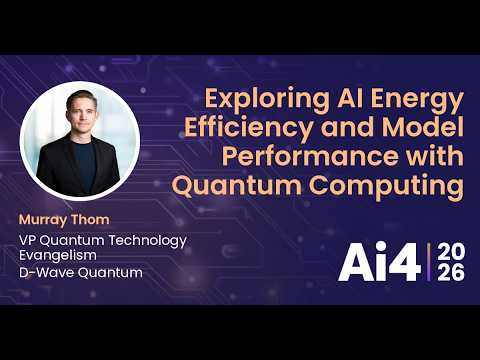
D-Wave Slashing AI and Enterprise Power Use With Quantum Chips
Ai4
Integrating quantum processors into artificial intelligence workflows cuts energy consumption while drastically boosting performance and optimization speeds.
## Background
This talk by Murray Thom, Vice President of Quantum Technology Evangelism at D-Wave Quantum, was published on YouTube by Ai4 on August 15, 2026. The presentation explores how quantum computing serves as a viable path for improving AI energy efficiency and model performance, highlighting real-world enterprise use cases across domains like drug discovery and supply chain optimization.
## TL;DR
Murray Thom presents D-Wave's Advantage 2 quantum hardware and demonstrates how quantum hybrid approaches outperform classical supercomputers in energy efficiency and computational speed. He explains the integration of quantum processors as discrete variational autoencoders within generative AI workflows, citing Japanese pharmaceutical company Shionogi's 10x increase in candidate drug molecule generation. Additionally, Thom highlights enterprise optimization success stories, showing how companies like Ford Otosan, NTT Docomo, grocery retailers, and BASF achieve massive speedups and efficiency gains across real-time scheduling and logistics.
## Atmosphere & style
The presentation carries an engaging, technical, and forward-looking tone as Murray Thom balances deep hardware physics with practical business applications. By grounding complex quantum mechanics in everyday analogies—such as comparing brain power consumption to classical hardware or filling shampoo bottles—Thom makes intimidating topics accessible and grounded. The narrative arc builds a sense of quiet excitement, shifting from theoretical computational barriers to real-world operational breakthroughs that transform how major global industries operate.
## Key takeaways
- [00:04](https://www.youtube.com/watch?v=YWgJG7oWJaA&t=4s) D-Wave's Advantage 2 hardware operates a thumbnail-sized processor housed in a cryogenic environment, made accessible globally through cloud-based access.
- [02:14](https://www.youtube.com/watch?v=YWgJG7oWJaA&t=134s) Data center power consumption is projected to double between 2024 and 2027, highlighting the need for energy-efficient architectures inspired by biological neural loops.
- [02:14](https://www.youtube.com/watch?v=YWgJG7oWJaA&t=134s) Classical hardware architectures are fundamentally restricted to sequential floating-point operations, whereas biological networks operate with highly efficient recurrent loops.
- [06:32](https://www.youtube.com/watch?v=YWgJG7oWJaA&t=392s) In a benchmark study with Oak Ridge National Laboratory, D-Wave's Advantage 2 processor solved a complex magnetic material simulation for under $1 of electricity, compared to the global annual electrical energy needed by classical supercomputers.
- [08:36](https://www.youtube.com/watch?v=YWgJG7oWJaA&t=516s) D-Wave integrates quantum processors into modern deep learning frameworks as discrete variational autoencoders (VAEs) to accelerate generative sampling in latent space.
- [08:36](https://www.youtube.com/watch?v=YWgJG7oWJaA&t=516s) A quantum-hybrid machine learning pipeline implemented at Shionogi resulted in a tenfold increase in valid candidate drug molecules.
- [12:41](https://www.youtube.com/watch?v=YWgJG7oWJaA&t=761s) Over 80% of surveyed business executives report hitting performance walls with classical computing when attempting to solve complex optimization problems.
- [12:41](https://www.youtube.com/watch?v=YWgJG7oWJaA&t=761s) Ford Otosan applied quantum hybrid solvers to vehicle assembly scheduling, reducing compute times from 30 minutes down to 5 minutes per 1,000 vehicles.
- [12:41](https://www.youtube.com/watch?v=YWgJG7oWJaA&t=761s) NTT Docomo utilizes D-Wave quantum hybrid optimization to manage signal paging across 250,000 mobile base stations in Japan.
- [01:00:00](https://www.youtube.com/watch?v=YWgJG7oWJaA&t=3600s) A major grocery retailer automated store employee scheduling using quantum optimization, saving 50,000 senior management hours per year.
- [01:00:54](https://www.youtube.com/watch?v=YWgJG7oWJaA&t=3654s) At BASF, quantum hybrid algorithms concurrently improved liquid filling line setup times, reduced product lateness, and optimized tanker unload durations.
- [01:02:23](https://www.youtube.com/watch?v=YWgJG7oWJaA&t=3743s) Quantum computing reduced BASF's scheduling calculation runtime from 10 hours to under 10 seconds, enabling dynamic, real-time re-optimization.
## Detailed walkthrough
### [00:04](https://www.youtube.com/watch?v=YWgJG7oWJaA&t=4s) Introduction to Quantum Computing and the Advantage 2 Hardware
Murray Thom, Vice President of Quantum Technology Evangelism at D-Wave, opens his presentation by polling the audience on their direct use and active development of artificial intelligence models. Setting the stage to explain quantum computing's role in AI, Thom emphasizes the importance of clear terminology before walking through the physical realities of D-Wave's hardware. He highlights the Advantage 2 quantum computer, describing a setup that spans about half the width of a conference stage. The bulk of the structure consists of shielding and standard 19-inch racks commonly found holding CPUs and GPUs in data centers. Inside stands a person-sized cryogenic refrigerator capable of cooling the system from room temperature to over a hundred times colder than interstellar space. At the center of this cooling apparatus sits a hand-sized gold plate, beneath which lies a single silicon processor roughly the size of a human thumbnail. Thom notes that end users do not purchase these large physical installations; instead, developers interact with the system remotely via cloud platforms by submitting code written in Python.
- **Physical Dimensions**: The room-sized shielding enclosure measures about half the length of an event stage, housing standard 19-inch data center racks.
- **Thermal Conditions**: The internal refrigerator cools the environment to more than 100 times colder than outer space.
- **Processor Scale**: The primary silicon processor chip is about the size of a thumbnail, housed under a hand-sized gold packaging plate.
- **System Availability**: D-Wave's cloud-accessible technology boasts a 99.9% uptime and availability across 45 countries.
[02:14](https://www.youtube.com/watch?v=YWgJG7oWJaA&t=134s) Commercial Scale, Energy Demands, and Brain-Inspired Computing
Transitioning away from theoretical physics, Thom frames the present moment as a pivotal commercial juncture where quantum computing delivers quantifiable return on investment for enterprise workflows. He shifts focus to the growing environmental and infrastructure challenges facing classical AI, citing World Economic Forum projections regarding data center power consumption. Rather than settling for marginal 10% efficiency improvements, Thom advocates for a radical shift in energy scaling by taking cues from biological brains. He points out that the human brain operates continuously on a mere 20 watts of power while executing complex pattern recognition tasks.
Thom contrasts classical machine learning architectures with biological neural loops. Standard neural networks on CPUs, GPUs, FPGAs, or ASICs are strictly constrained to simple, sequential floating-point addition and multiplication operations. Biological brains, however, rely on recurrent synaptic loops where excitatory and inhibitory connections form complex feedback cycles. Furthermore, brain scans demonstrate that biological networks do not assign dedicated individual neurons to specific concepts like a "cat" or "dog". Instead, the human brain distills sensory data through distinct, overlapping combinations of active neurons.
- **Data Center Power Projections**: World Economic Forum estimates indicate data center energy usage will double between 2024 and 2027, with some facilities already consuming more electricity than entire nations.
- **Biological Power Efficiency**: Human brains sustain high-level learning and pattern recognition on approximately 20 watts of power.
- **Hardware Limitations**: All classical architectures (CPUs, GPUs, FPGAs, ASICs) are fundamentally restricted to basic floating-point arithmetic steps.
[06:32](https://www.youtube.com/watch?v=YWgJG7oWJaA&t=392s) Quantum Advantage: Magnetic Material Simulation vs. Supercomputers
Introducing himself as a 23-year D-Wave veteran, Thom shares what he considers the most significant quantum computing milestone of the past two years. To prove quantum advantage over classical hardware, D-Wave collaborated with dozens of international researchers across 11 institutions specializing in high-performance computing acceleration. The research team evaluated a complex applied magnetic material simulation problem on Oak Ridge National Laboratory's supercomputer (Frontier)—at the time the world's most powerful classical system—utilizing over 100,000 hours of compute time.
The results demonstrated a vast gap in energy efficiency and computational capability. To solve the problem at its largest scale using classical supercomputers would require as much electricity as the entire planet consumes in an entire year. In contrast, D-Wave executed the same task on its Advantage 2 quantum processor chip using less than $1 worth of electricity. Thom highlights this dramatic discrepancy to show the potential of quantum hardware when matched with suitable problem domains.
- **D-Wave Pioneer**: Murray Thom has served at D-Wave for 23 years in quantum technology development and evangelism.
- **Research Collaboration**: The benchmark study involved dozens of researchers across 11 global institutions.
- **Supercomputer Time**: Oak Ridge National Laboratory allocated over 100,000 compute hours to run the classical baseline calculations.
- **Energy Comparison**:
- **Classical Supercomputer**: Would consume electricity equivalent to the global annual energy consumption.
- **Advantage 2 Processor**: Solved the problem using under $1 worth of electricity.
[08:36](https://www.youtube.com/watch?v=YWgJG7oWJaA&t=516s) Quantum Generative Models, Discrete VAEs, and Drug Discovery
Thom connects the physics behind magnetic material simulations to machine learning, noting that the underlying mathematics earned John Hopfield and Geoffrey Hinton the Nobel Prize in Physics. Hopfield introduced bidirectionally coupled neural networks, while Hinton defined their energy-based mathematical response—a framework inherently matched to quantum hardware mechanics. To harness quantum processors for machine learning without abandoning modern deep learning progress, D-Wave integrates quantum processors into existing transformer and large language model architectures using latent space compression.
Classical computers struggle to process fully interconnected recurrent loops, forcing developers to organize models into rigid layers. In contrast, quantum systems natively handle sparse, highly interconnected networks containing recurrent loops over discrete binary variables. Thom explains that while transformer models sample generation slowly and diffusion models require heavy multilayer post-conditioning, quantum generative models are both fast and trainable. Operating as a discrete variational autoencoder (VAE) or restricted Boltzmann machine via a PyTorch plugin, the quantum system acts as a "sidecar" that passes statistical distribution data to accelerate generative sampling.
Thom shares a real-world case study from Japanese pharmaceutical company Shionogi, which had been utilizing traditional transformer models for drug discovery. After integrating D-Wave's quantum-hybrid approach into their generative workflow, Shionogi achieved a tenfold increase in the generation of valid drug candidates.
- **Historical Foundations**: John Hopfield and Geoffrey Hinton's work on bidirectionally coupled energy-based networks laid the theoretical foundation for energy-based quantum machine learning.
- **Expressive Power**: A set of 300 independent binary bits yields only 300 distinct patterns, whereas 300 coupled binary variables can represent more unique combinations than there are particles in the known universe.
- **Shionogi Benchmark**: Hybridizing Shionogi's machine learning pipelines with quantum processors yielded a 10x increase in valid candidate drug molecules.
[12:41](https://www.youtube.com/watch?v=YWgJG7oWJaA&t=761s) Enterprise Optimization and Production Use Cases
Moving beyond integrated AI workflows, Thom discusses pure combinatorial optimization as a key complementary area for quantum systems. He cites a 2025 study by Wakefield Research indicating that 81% of business executives feel classical computing has reached its performance limit in solving complex optimization problems. Throwing additional classical compute hours at optimization yields diminishing returns because algorithms like integer programming do not parallelize cleanly across CPU and GPU cores.
Thom highlights several commercial enterprises currently running D-Wave quantum hybrid algorithms in daily operations:
- **Ford Otosan**: The Turkish automotive manufacturer optimizes vehicle assembly sequencing subject to complex production constraints. Implementing D-Wave's quantum solvers reduced their scheduling compute time from 30 minutes down to 5 minutes for every 1,000 vehicles, enabling rapid schedule adjustments during factory disruptions.
- **NTT Docomo**: The Japanese telecommunications provider utilizes quantum hybrid solvers to optimize signal paging between mobile subscribers and cell towers across 250,000 base stations, directly expanding network capacity.
- **Grocery Retailers**: Large grocery chains utilize quantum hybrid systems to handle complex employee scheduling and dispatch routing across multi-department store environments.
> "When I'm ordering groceries, when I order like, you know, a pound of peanut M&M's, the people who bring that to my door, quantum computing was involved in helping to create those schedules."
- **Executive Survey Data**: 81% of enterprise executives report hitting performance walls with classical optimization compute.
- **Ford Otosan Scheduling**: Reduced scheduling latency from 30 minutes to 5 minutes per 1,000 vehicles.
- **NTT Docomo Scale**: Deployed across a network infrastructure of 250,000 base stations in Japan.
Murray Thom shares a compelling example from the grocery retail sector, demonstrating how quantum optimization tackles intricate scheduling challenges. In grocery stores, creating employee schedules is far more complex than just repeating the previous week's template, because consumer demand fluctuates daily and seasonally throughout the year. Schedules must respect diverse employee constraints, including specific department assignments, varying levels of training, and strict rules regarding seniority and mandatory rest periods—such as prohibiting an employee who worked a night shift from working a morning shift the very next day.
Historically, senior store managers—the highest-value operational personnel—had to spend vast amounts of time manually generating and adjusting these shift schedules behind computer screens. By applying quantum computing techniques, the retailer was able to automate and streamline this process, freeing up 50,000 hours annually across their senior staff. Beyond the raw labor savings, Thom notes a major boost to employee morale and store productivity, as scheduling was rarely anyone's favorite task. With these administrative hours reclaimed, managers now spend their time on higher-value activities like assisting customers, training junior staff, and experiencing far more joy in their day-to-day work.
- **Constraints managed:** Department placements, employee training levels, union/seniority hierarchy, shift rest rules (e.g., no night-to-morning turnaround).
- **Time saved:** 50,000 senior employee hours saved per year.
- **Human impact:** Shifts senior store leadership away from backend administrative computer tasks toward front-of-house customer service and staff development.
[01:00:54](https://www.youtube.com/watch?v=YWgJG7oWJaA&t=3654s) Industrial Optimization at BASF: Chemical Filling and Supply Chain Coordination
Turning to the industrial chemical giant BASF, Thom illustrates how quantum hybrid applications solve complex, multi-variable manufacturing and supply chain problems. He candidly shares his own initial "naive thinking" regarding a liquid filling line—assuming the primary goal was simply maximizing total output volume. In reality, the true business objective is minimizing product lateness while simultaneously balancing setup time constraints and raw material logistics.
Order sequence directly governs setup time because machinery lines require extensive cleaning depending on the transition. To make this intuitive, Thom presents an everyday consumer analogy: filling scented shampoo followed by unscented shampoo requires a complete line wash to prevent cross-contamination, whereas reversing the order allows continuous production without line downtime. On top of factory-floor cleaning protocols, BASF faces external logistical constraints: incoming mobile tanker trucks deliver raw materials that feed silo storage tanks. The optimal strategy requires pulling raw materials directly into filling lines while tanks are actively being refilled to minimize overall unloading duration.
Normally, these three metrics—lateness, setup cleaning times, and tanker unload times—are in direct tension with one another, where improving one metric usually degrades another. Using D-Wave's quantum hybrid approach, BASF achieved simultaneous improvements across all three operational fronts:
- **Product lateness:** Reduced by 14%.
- **Setup time:** Reduced by 9%.
- **Tanker truck unload duration:** Reduced by 18%.
[01:02:23](https://www.youtube.com/watch?v=YWgJG7oWJaA&t=3743s) From Hours to Seconds: Transforming Real-Time Operations and Closing Remarks
Beyond improving output efficiency metrics, the most dramatic breakthrough achieved for BASF was in computational speed. The scheduling calculation previously required a 10-hour batch job on classical systems. Because of this extreme runtime, planners had to kick off the scheduling process days in advance, forcing the plant to operate using stale data and risking severe operational disruption if computers crashed mid-run.
With quantum computing, the computation time dropped from 10 hours to under 10 seconds (with core calculations resolving in as little as 5 seconds). Thom emphasizes "here's the kicker": reducing runtimes to mere seconds fundamentally changes how business operations function. Facilities can run real-time schedule re-optimizations based on up-to-the-minute data, adjusting instantly to supply disruptions, equipment hiccups, or urgent priority orders.
Thom concludes his talk by expressing his enthusiasm for quantum technology and inviting the audience to explore how quantum workflows can drive radical efficiencies and transform organizational processes.
- **Calculation runtime reduction:** Reduced from 10 hours down to under 10 seconds.
- **Operational impact:** Shifts scheduling from static, advance batch planning using days-old data to agile, real-time optimization using current factory status.
## Notable quotes
> [12:41](https://www.youtube.com/watch?v=YWgJG7oWJaA&t=761s) When I'm ordering groceries, when I order like, you know, a pound of peanut M&M's, the people who bring that to my door, quantum computing was involved in helping to create those schedules. — Murray Thom
## Mentioned
Murray Thom, D-Wave, Advantage 2, World Economic Forum, Oak Ridge National Laboratory, Frontier, John Hopfield, Geoffrey Hinton, Shionogi, Wakefield Research, Ford Otosan, NTT Docomo, BASF, Python, PyTorch
Quantum computing could be a viable path to improving AI energy efficiency and model performance.
Attend this talk to learn how quantum computers could enable you to continue advancing AI capabilities while managing cost, efficiency, and performance. Hear about real-world use cases and companies that are starting to integrate quantum and AI workflows today in areas such as drug discovery.
D-Wave's Murray Thom contends that quantum computing offers a practical escape from the looming energy and processing bottlenecks of classical computing, delivering substantial efficiency gains in generative AI and complex operational optimization.
Hardware Infrastructure and Biological Energy Scaling (0:04)
Thom details the physical reality of D-Wave's Advantage 2 system, where a thumbnail-sized silicon processor operates inside a cryogenic refrigerator cooled to over 100 times colder than outer space, accessed remotely by developers through cloud platforms. He contrasts this specialized architecture with the unsustainable energy trajectory of classical AI, citing World Economic Forum projections that data center electricity consumption will double between 2024 and 2027, with some facilities already matching entire nations in power usage.
To overcome these computational ceilings, Thom advocates emulating biological brains, which perform complex pattern recognition on roughly 20 watts of power via recurrent, feedback-driven synaptic loops. In contrast, standard classical architectures—including CPUs, GPUs, FPGAs, and ASICs—remain fundamentally constrained to rigid, sequential floating-point addition and multiplication, making biological-scale energy efficiency unattainable through standard hardware refinements alone.
Quantum Advantage in Complex Material Simulation (6:32)
To demonstrate quantum supremacy over classical high-performance computing, D-Wave collaborated with researchers across 11 institutions to simulate an applied magnetic material on Oak Ridge National Laboratory's Frontier supercomputer. While the classical benchmark required over 100,000 compute hours—with full-scale classical modeling theoretically demanding electricity equivalent to the world's total annual energy consumption—the Advantage 2 quantum processor completed the problem using less than $1 worth of electricity.
Thom emphasizes that this benchmark reflects a genuine computational inflection point rather than a theoretical projection. By mapping physics-based computational problems directly onto quantum hardware, the system solves complex domain-specific tasks that are computationally intractable on even the largest classical supercomputing clusters.
Enhancing Generative Machine Learning and Drug Discovery (8:36)
Connecting quantum mechanics to machine learning, Thom references the Nobel Prize–winning work of John Hopfield and Geoffrey Hinton on energy-based neural models. Because quantum processors natively support sparse, highly coupled networks with recurrent loops over discrete binary variables, they offer vast expressive capacity; 300 coupled variables can represent more unique configurations than there are particles in the known universe.
Rather than displacing existing deep learning infrastructure, D-Wave connects to frameworks like PyTorch as a discrete variational autoencoder (VAE) or restricted Boltzmann machine, acting as an acceleration 'sidecar' for generative sampling in transformers. In a production test case with Japanese pharmaceutical firm Shionogi, integrating D-Wave's quantum-hybrid workflow into their molecular design pipeline yielded a tenfold increase in the generation of valid drug candidates.
Operational Optimization from Supply Chains to Scheduling (12:41)
Citing a 2025 Wakefield Research survey indicating that 81% of business executives believe classical computing has hit a wall with complex optimization, Thom highlights production deployments across major commercial sectors. Ford Otosan reduced assembly line scheduling runtimes from 30 minutes to 5 minutes per 1,000 vehicles, NTT Docomo optimized mobile paging across 250,000 base stations, and a grocery chain reclaimed 50,000 hours of senior management time annually by automating shift scheduling under complex departmental and rest rules.
In industrial manufacturing, chemical producer BASF used quantum hybrid algorithms to resolve trade-offs among liquid filling line sequences, changeover cleanings, and raw material tanker unloads. The deployment lowered product lateness by 14%, setup time by 9%, and tanker unload times by 18%, while shrinking scheduling runtimes from a 10-hour classical batch process to under 10 seconds, allowing the plant to transition from stale weekly planning to real-time operational re-optimization.
Thom positions quantum hybrid computing as a commercially viable complement to classical AI and optimization, though its demonstrated advantages remain focused on specific combinatorial, physical simulation, and discrete sampling problems rather than generalized computing tasks.
[12:41] Murray Thom: When I'm ordering groceries, when I order like, you know, a pound of peanut M&M's, the people who bring that to my door, quantum computing was involved in helping to create those schedules.
Original transcript
[0:04] How many of you right now
in your organizations are
[0:07] using artificial intelligence directly yourselves?
[0:12] Okay, and how many of you are actually building
and trading machine learning models yourself?
[0:19] Okay, we've got a few folks. Okay, great. Yeah,
Kevin. Uh okay, great. So, um we're going to be
[0:24] talking about quantum computing specifically
in the context of artificial intelligence.
[0:28] And certainly, I don't know if you've had the
same experience as me. When I'm here talking
[0:33] with folks, um we're all coming from different
backgrounds. You know, it helps to define the
[0:37] terms that we're using. So, let's begin with the
foundation. You know, what is a quantum computer?
[0:43] So, this is a photograph of one of our Advantage
2 quantum computers. Uh these are about
[0:50] half the size of this stage. That's the size of
this room. If I was standing in this picture,
[0:54] I would be just a little bit taller uh than these
racks that are in front here. And for those of
[0:59] you who have worked with computer hardware,
you'll actually recognize the size of these
[1:02] racks. These are 19-in racks that are usually
used to house GPUs and CPUs in data centers.
[1:08] Now, uh this is mostly shielding. This is a room
that's large that allows us to build and tear
[1:13] down and rebuild quantum computers. Inside that
room is a refrigerator that's the size of us.
[1:19] You know, you could put your arms around it.
And that refrigerator uh basically allows us
[1:24] to cool things from room temperature to more
than 100 times colder than interstellar space.
[1:32] The thing that we're cooling is this
plate. This is the quantum computer
[1:36] like chip packaging itself, and it's the
size of my hand or the size of our hands.
[1:41] And underneath that gold plate in the very center
here is one processor and chip about the size of
[1:47] our thumbnails. So, that whole, you know, room
that's about the size of half of this stage is
[1:53] setting up the conditions for quantum processing
to happen on like a single silicon chip.
[1:59] Now, okay, so that's the quantum computer that
we're talking about. Most of you are not going
[2:03] to purchase a quantum computer yourselves. If
you're going to be programming quantum computers,
[2:06] you're actually going to be logging into them
through the cloud. You'll be writing code
[2:09] in like Python, sending instructions to the
quantum computers, and getting answers back.
[2:14] So, let's talk about this moment in time in
computing and in quantum computing and in history.
[2:20] This is a pivotal moment. And at D-Wave, we're
focused on production applications that use
[2:26] quantum computers. Our technology is mature, it's
at commercial scale, it's got 99.9% availability
[2:32] and uptime, it's available in 45 countries around
the world. So, I'm not going to pull you down into
[2:37] quantum mechanics. If for those of you who were
hoping to become a quantum physicist by the end of
[2:42] this short talk, I'm sorry to disappoint you. I'm
not going to try to teach you any quantum physics.
[2:47] We're talking about applications that are in
operational use, not experimentation. And I'm
[2:52] not talking about toy problems. I'm talking
about running applications that run at full
[2:56] enterprise scale. The other thing I find with the
quantum computing industry, you know, as a whole,
[3:02] we tend to make things more complicated than they
need to be. And one of the important things to
[3:06] to remember here is that a lot of the promise
of quantum computing was about its potential.
[3:13] Well, now we're talking about quantifiable
return on investment, the ability to do things
[3:17] and get value with them. It's no longer a research
project. This is actually a a part a critical part
[3:23] of your IT infrastructure. And, you know,
if I was going to think about, you know,
[3:27] at D-Wave, we build quantum computers, we build
products, we advise governments, we help people
[3:31] build centers of excellence. But, if I was
going to say what D-Wave's core business is,
[3:36] is that we help people to navigate the space of
quantum computing, find the places that it can
[3:41] give them value in their organizations,
and implement it to get that benefit.
[3:46] Okay, so let's talk really big picture for
a moment here. The World Economic Forum
[3:52] has estimated that some data centers use more
electricity than entire nations. Okay? That's the
[3:59] kind of thing that my kids hear about and they're
concerned. But the far more concerning factor,
[4:05] I mean, much more concerning than this is the fact
that they're estimating that it's doubling between
[4:11] 2024 and 2027. It's growing tremendously quickly.
Okay? So, this is a major contemporary problem of
[4:19] our time. And I want to talk to you about energy
efficiency, not let's get 10% more efficient.
[4:25] I want to shatter the energy consumption that
we're using with artificial intelligence and I
[4:29] want to tell you about a resource that I think can
help us with that. Now, we know from looking at
[4:35] learning systems that there are opportunities to
do tremendously powerful learning at low energies
[4:41] because that's what our brains do. Right? The
power consumption of our brains is about 20 watts.
[4:47] It's constantly consuming 20 watts of
power. So, let's take some inspiration here,
[4:52] which I think for those of you working in
artificial intelligence, you know that a lot of
[4:56] neural network structures are used in artificial
intelligence for learning and detecting patterns.
[5:01] And one of the key things that I just
want to identify is that every single
[5:05] machine learning model you've ever built or
ever used is restricted in a particular way
[5:10] so that it can break itself down into simple
floating point operations so that you can run
[5:14] it on a CPU, a GPU, an FPGA, or an ASIC. All
of the classical computers in our world are
[5:20] only adding numbers together and multiplying them
together. So, you can't use a machine learning
[5:24] model that doesn't break down into those steps
effectively because you won't be able to train it.
[5:29] And our brain doesn't have the kinds of structures
that we use in machine learning models today.
[5:34] One of the key features that brains
have is that you can actually have loops
[5:38] of synapses, synapses that connect to neurons
and actually close a loop, a loop of correlation,
[5:44] which basically determines as they're trying to
excite or inhibit one another. And the property
[5:48] that's really key here is that it's not the
situation where each neuron in our brains
[5:54] is associated with a particular pattern. You know,
this is a a brain scan to do with objects and
[5:59] images. It's not the case that like there's a cat
neuron in here and there's a dog neuron in here.
[6:04] What you actually see when you're looking
at these different scans is that there are
[6:08] neurons in common that are used here. So, how
is it that we're able to nonetheless distinguish
[6:12] these very visceral differences in these data
types when the same neurons are activated?
[6:17] It's because it's about the combination of
neurons that we're using. It's the fact that
[6:22] there's a particular pattern of neurons and
it's the pattern of neurons that our brain
[6:26] uses in order to be able to distill and detect
patterns that are occurring in natural data.
[6:32] Okay, so this is the context in which quantum
computing is entering the world today. And,
[6:38] you know, I just realized I made a mistake. I
didn't introduce myself and provide a little
[6:42] bit more detail. My name is Murray Thom. I'm the
Vice President of Quantum Technology Evangelism at
[6:46] D-Wave. My role is to help people and global
businesses and organizations to understand
[6:51] quantum computing and the transformational power
it can have for them today. And I've been working
[6:55] at D-Wave for 23 years. So, this is what an
old-timer in quantum computing looks like.
[7:01] So, this is, you know, I we've been I've
been working for decades in this space.
[7:05] This is the context in which it's entering the
commercial marketplace. This is probably the most
[7:10] exciting and most relevant result in the last
2 years that I want to highlight for you. So,
[7:15] a lot of folks have been talking about being able
to do calculations with quantum computers that
[7:19] can't be done with classical computers. That's
the promise that a lot of folks have been talking
[7:23] about for decades. Well, how do you actually prove
that that's the case? Well, at D-Wave, we worked
[7:28] with a set of talented researchers worldwide,
dozens of them, from 11 different institutions
[7:34] whose core expertise was accelerating classical
computing. And we studied an applied problem
[7:41] of magnetic material simulation to show how big
these differences could get. And then we went to
[7:48] the Oak Ridge National Lab, which was at the time
the site of the world's largest supercomputer,
[7:53] and they gave us over 100,000 hours of time
on that supercomputer to run these tests.
[7:58] And what we found was that for the problems
that we were working on at the largest scale,
[8:03] to do those with the supercomputer, still
one of the world's largest supercomputers,
[8:07] would have required as much electricity
as the entire world uses every year.
[8:14] And to outperform that, we use that single
chip in our Advantage 2 quantum computer,
[8:20] and we used less than $1 worth of electricity.
[8:24] That is the magnitude of the difference between
classical computing and quantum computing
[8:29] in real-world practice today for problems that
are well-suited to those quantum computers.
[8:36] Okay, now I mentioned that the application we were
studying there was magnetic material simulation.
[8:41] How many of you currently work in magnetic
material simulation? Raise your hands.
[8:47] You know, I'm an expert, but I'm going to give you
extra time for those of you who are a little slow.
[8:51] But nobody? Huh. Surprise. Quelle surprise. Um
right. But it turns out that the mathematics
[8:58] for those magnetic materials actually recently won
the Nobel Prize in physics in 2025. And the folks
[9:04] who won that prize were John Hopfield and Geoffrey
Hinton. John Hopfield proposed a structure of
[9:10] neural networks where neurons can actually be di-
bidirectionally coupled to one another. So, they
[9:16] don't just affect each other in one direction,
they they affect each other in both directions.
[9:20] And Geoffrey Hinton proposed the mathematical
response, the energy-based response of a system
[9:23] like that. Well, our quantum computers, our
quantum mechanical version of that structure.
[9:29] So, it turns out we've been able to show that you
can use that in machine learning. Now, if you're
[9:33] going to use quantum computers for machine
learning, do not reinvent machine learning.
[9:38] Right? Rule number one. So many talented people
have been like progressing with machine learning.
[9:43] So we've got incredibly powerful structures in
large language models and transformer models.
[9:48] So, what this tells us is, okay, we've got this
computer, its input data is relatively compact,
[9:53] it can solve incredibly challenging problems, um
but I'm working with data types which are Oops.
[9:59] Much, much larger than, you know, the digit floor.
So, we use encoders stages and those basically
[10:06] compress data down into a latent space. This is
a binary latent space. And the key thing here
[10:12] is that point I mentioned earlier, it's not about
mapping patterns to a single binary variable. It's
[10:17] using combinations of binary variables. If I use
the single binary variable for every pattern with
[10:22] 256 bits with 300 bits, I could only represent
300 patterns. But if I use combinations of binary
[10:28] variables and I had 300 bits, I could label every
single particle in the known universe. Now, those
[10:35] transformer models can't do that and you can't
do it with a set of binary variables like this
[10:39] that are independent from one another. To create
patterns, you actually have to have couplings.
[10:44] And when you create those couplings with classical
computers, you have to like create segments.
[10:48] You've got to create layers because otherwise
that classical computer struggle with them. But we
[10:52] don't need to do that with the quantum computers.
We can actually create sparse but highly
[10:56] interconnected networks that have these loops in
them that can learn uh strong representational um
[11:02] patterns and these variables are discrete. So,
these variables are either flipping on or they're
[11:08] flipping off. They're not like artificial
intelligence systems where there's kind of
[11:11] like a logarithmic response to it. That's a very
powerful mathematical model, but you can't back
[11:16] propagate through it. So, this structure of using
what is like a discrete variational autoencoder
[11:22] allows you to pull this discrete model in as a
sidecar and then pass statistical information
[11:27] so that you can train it and do a better job of
distinguishing the patterns in your data types.
[11:31] And then you can use that sidecar to start
generate new samples, which can then allow you to
[11:37] create new output data. So, this is the role of
our quantum computer. And if you think about it,
[11:41] a diffusion model is incredibly fast, but
the difficulty is you can't train it. So,
[11:45] you have to have many, many layers to kind of
post-condition the distribution. So, that's extra
[11:49] waste that's going to slow down your training. And
if you use a transformer model, you can train it,
[11:54] but it samples very, very slowly. So, now you're
having to wait a long time to get new generative
[11:57] samples. These quantum computing models are
extremely fast and they're trainable. And
[12:03] we have a PyTorch plugin that shows how to use
this so that folks who are used to training and
[12:07] building machine learning models would recognize
this as a restricted Boltzmann machine. Now,
[12:11] this isn't just theoretical. There's a company
in Japan named Shionogi who's investigating drug
[12:16] discovery with machine learning methods, and they
started with a transformer model, and what they
[12:20] found was it wasn't doing a particularly good job
of actually generating new valid drug candidates.
[12:25] So, they worked with us and we quantum hybridized
their method in the way that I just described,
[12:30] and now what they're seeing is a tenfold increase
in the number of valid drug candidates that are
[12:34] being produced by that that flow. And they're
still in the process of developing and learning
[12:38] how to how to do that further. Okay, so everything
I have told you up until now is along the path of
[12:46] combining artificial intelligence and quantum
computing together. Certainly at D-Wave,
[12:51] I use machine learning to help me with my work
day. That's AI helping quantum computing develop
[12:56] develop more quickly. This is machine learning and
quantum computing actually cooperating together
[13:00] for a single task. But there's also a form
of interaction in businesses where there's a
[13:07] portion of the workflow that a quantum computer
or a quantum hybrid system can be very good at,
[13:11] and an artificial intelligence system will
be good at a different portion of that. So,
[13:14] I wanted to also share with you some of the use
cases of quantum computers that are complementary
[13:18] to artificial intelligence. And the setup for
this is that Wakefield did a study in 2025,
[13:25] where they found that 81% of
executives felt that they had maxed out
[13:30] the benefits that classical computers
could provide in optimization. Now,
[13:36] if you're an executive in a business, what
causes you to feel like you've maxed out
[13:40] classical computing? Well, a common response
when you're struggling with a difficult problem
[13:44] is to apply more compute to it. And you you're
going to apply more compute and more compute,
[13:49] and what happens is that the benefits actually
don't continue to improve. You actually see
[13:53] diminishing returns. And then you conclude, "Hmm,
okay. Classical computers just aren't doing it."
[13:57] What's the reason for that? It's because
optimization problems don't parallelize well.
[14:02] CPUs and GPUs are moving towards like
running a set of independent calculations
[14:07] very quickly relative to one another,
and that doesn't work for optimization.
[14:12] So, what we found is this has a a hallmark
in a variety of different businesses,
[14:16] and it's really resonating with folks across
several different industries, whether it's,
[14:21] you know, um airlines or healthcare
companies or chemical companies, um um
[14:28] uh telecommunications companies. So, let me give
you some examples, and I'm not talking about,
[14:32] "Hey, you know, one day maybe we could do these."
Several of these applications are actually in
[14:36] production, and some of these customers have
more than one application in production.
[14:40] Uh the one in the top right, this is Ford Otosan.
It's an auto parts uh manufacturer in Turkey.
[14:47] And what they're trying to do is decide on the
sequence of the vehicles they're producing. So,
[14:51] they're, you know, it's a it's a very discrete.
You can't produce two vehicles at the same time.
[14:55] So, when you're choosing the order, it's either
one before the other or the other way around.
[15:00] And there are lots of constraints associated
with those orders, but the key objective is to
[15:04] even out the work that they're doing in their
business. And they weren't very happy with the
[15:09] results they had previously. We got them better
results, but the key improvement for them was
[15:12] that it used to take them 30 minutes to schedule
1,000 vehicles, and we got that down to 5 minutes.
[15:17] For folks who are in the automotive industry,
there's a lot of disruptions. So, being able
[15:21] to plan and replan quickly means that you
can start adapting to what your business
[15:25] is experiencing and and start to incorporate
that so you're producing just what you need.
[15:30] Uh NTT Docomo, this is on the bottom right here.
They're actually optimizing the way signals pass
[15:35] between users and cell phone towers. So, as cell
phone users move into a particular signal, there's
[15:40] paging signals that they register themselves and
then there's continuing paging signals that say,
[15:44] "Hey, are you still here? Am I still communicating
with you?" And what they found was that they were
[15:47] able to use our quantum hybrid solvers to
optimize both of those processes and it's
[15:52] actually increased the capacity of their network
and they have 250,000 base stations in Japan.
[15:58] Uh and the last example, I mean, grocery
retailers are using quantum computing. Okay? So,
[16:04] if you ever felt intimidated about the idea of
bringing quantum computing into your business,
[16:08] when I'm ordering groceries, when I order
like, you know, a pound of peanut M&M's,
[16:13] the people who bring that to my door, quantum
computing was involved in helping to create
[16:15] those those schedules. Part of the reason why
this is difficult, let's think about like in
[16:20] grocery stores, is that you got a couple hundred
employees who are working at a grocery store,
[16:24] but grocery stores have multiple departments.
Not everyone is trained to work in all of the
[16:29] departments, so you have to think about what
someone's training is and then also their
[16:32] seniority. You've got to make sure you fill
their work schedules by seniority and if they
[16:36] they just worked a night shift, they can't work a
morning shift the next day. That would all be fine
[16:42] if you just use the same schedule every week. But
demand changes every day of the week and every
[16:46] week of the year in grocery retail. So, being able
to rebuild schedules quickly is really important
[16:50] important to them. Their most senior employees
were the ones who had to build the schedules.
[16:56] And what they found was they were able to save
those senior employees 50,000 hours annually.
[17:02] And scheduling was not their favorite part
of their work day. So, now they're out from
[17:05] behind their computers, they're working with
customers, they're training junior employees,
[17:09] they're feeling more, you know, I think joy
from the work that they're actually doing. So,
[17:13] these are the kinds of benefits that people
can experience in their um for their people
[17:17] and processes. And the last example here I'm
going to use is BASF, a chemical company.
[17:20] I think this is really interesting because
this was a liquid product filling application.
[17:25] And my naive thinking about liquid product filling
is, well, let's just maximize the number of
[17:29] liquid products that we're filling every day. And
that's not the actual business constraint at all.
[17:34] What happens is that every single product
has a particular deadline. And the thing
[17:38] you're trying to do is minimize the lateness
of any given product when it gets produced.
[17:43] But the order you produce them determines
the setup time. So, these are chemicals,
[17:47] but let's imagine like a consumer product example
like shampoo. If you're producing scented shampoo,
[17:53] and then you want to fill unscented shampoo, you
have to clean all the lines to get the scent out.
[17:58] But if you do them in the other order, you don't
have to do that. So, the setup time for products
[18:03] is determined by the order in which you're
doing them. And there's another really key
[18:06] complicating step because everything I've
described to you so far is in the factory,
[18:11] but there's an influence from outside the factory,
which is that the raw materials are brought in on
[18:15] mobile trucks. And they want to draw those
raw materials out as quickly as possible.
[18:19] And the fastest way to do that is to produce
the products that are using the raw materials
[18:22] as you're refilling the silo tanks. So, they
want to coordinate all these things together.
[18:27] And they weren't really happy with the results.
These are normally metrics that are in contention
[18:30] with one another. You can improve one, but you
sacrifice another. We were able to help them
[18:35] in decrease the lateness by 14%.
They decreased the setup time by 9%.
[18:40] And they were able to decrease the time it
took them to unload the tanker trucks by 18%.
[18:45] That was the reason they came in to us to talk
about the application, but here's the kicker.
[18:50] It used to take them 10 hours to schedule
that, and we got it to under 10 seconds.
[18:57] So, you know, if something takes your business 10
hours, you got to start planning that like days
[19:01] in advance because you can't afford to have your
computers go down and then not have the schedule.
[19:06] Right? Which means your data is like days old.
But if you can do these calculations in 5 seconds,
[19:11] you can actually start doing them with much
more current data. So your actual business
[19:15] planning and processes are much better. Okay, so
this is a relatively short presentation. I hope
[19:21] I've given you a taste. I hope I've been able to
share my excitement about quantum computing and
[19:25] the kind of radical changes we can see in our
world as we adopt it. So thank you very much
[19:28] and I hope you know, check this out and I hope
you're ready to explore it yourself. [applause]