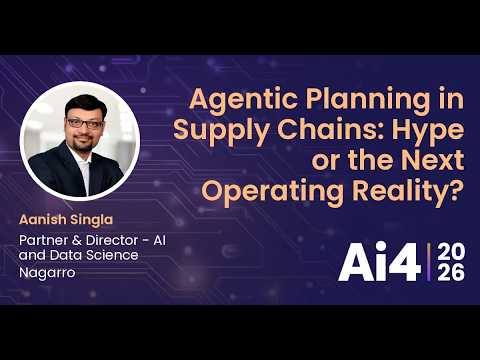
Nagarro Unveils AI Framework to Solve Supply Chain Reliability Drops
Ai4
Nagarro argues multi-turn AI agents fail in supply chains due to compounding errors after 20 cycles, requiring a three-tiered intelligence architecture with knowledge graphs to maintain reliability.
## Background
Published by the Ai4 channel on YouTube on August 18, 2026, this video features Aanish Singla, Partner & Director of AI and Data Science at Nagarro. The presentation explores how Agentic AI is reshaping supply chain planning—from demand sensing and scenario evaluation to cross-functional alignment—and whether agentic planning represents real operational change or market hype.
## TL;DR
Aanish Singla discusses the transition from theoretical AI vision to practical agentic engineering in supply chain management. He addresses the issue of error compounding in multi-turn agent workflows and introduces Nagarro's three-tiered intelligence framework: Causal, Decision, and Organizational Intelligence. Supported by twin Knowledge Graphs, the system autonomously monitors KPIs, diagnoses root causes, simulates scenarios, and pushes decisions directly to enterprise systems like ERPs.
## Atmosphere & style
The presentation is technical, grounded, and authoritative, bridging high-level enterprise ambition with concrete software engineering realities. Singla delivers a structured and realistic assessment, avoiding purely hyped narrative arcs in favor of systematic diagrams and live platform demonstrations. Watching it feels like attending a specialized industry masterclass designed for supply chain leaders and technical architects.
## Key takeaways
- [00:04](https://www.youtube.com/watch?v=KJDartdarIA&t=4s) Nagarro brings 30 years of custom data science and engineering experience to solving complex client challenges in supply chain planning.
- [00:04](https://www.youtube.com/watch?v=KJDartdarIA&t=4s) Multi-turn agentic workflows suffer from exponential reliability decay over ~20 sequential tool calls due to error compounding.
- [00:04](https://www.youtube.com/watch?v=KJDartdarIA&t=4s) While simple agents can be built in under 30 minutes, enterprise production readiness requires sophisticated context, memory, and guardrails.
- [03:48](https://www.youtube.com/watch?v=KJDartdarIA&t=228s) Supply chain planning is inherently non-linear due to SKU interactions, promotional cannibalization, weather disruptions, and bullwhip effects.
- [06:21](https://www.youtube.com/watch?v=KJDartdarIA&t=381s) Nagarro addresses autonomous supply chain planning through a three-tiered intelligence framework: Causal, Decision, and Organizational Intelligences.
- [06:21](https://www.youtube.com/watch?v=KJDartdarIA&t=381s) Causal Intelligence identifies KPI drifts, localizes anomaly locations, and diagnoses root causes using Causal and Business Ontology Knowledge Graphs.
- [10:30](https://www.youtube.com/watch?v=KJDartdarIA&t=630s) A trio of specialized agents—KPI Monitor, Hypothesis Generation, and Validation—operates on Knowledge Graphs to pinpoint issue root causes with data evidence.
- [12:52](https://www.youtube.com/watch?v=KJDartdarIA&t=772s) Decision Intelligence uses dynamic digital twins, prediction models, and constraint optimization engines to evaluate corrective scenarios before execution.
- [12:52](https://www.youtube.com/watch?v=KJDartdarIA&t=772s) Organizational Intelligence embeds enterprise strategies, stakeholder incentives, policy boundaries, and historical decision memory into agent reasoning.
- [14:41](https://www.youtube.com/watch?v=KJDartdarIA&t=881s) The live platform demo illustrates automated drift detection in inventory, graph exploration, hypothesis validation, trade-off simulation, and ERP execution push.
## Detailed walkthrough
Anish Singla, Director and Lead for the Data Science and AI Practice at Nagarro, delivers a detailed walkthrough on implementing agentic AI within supply chain planning. He bridges the gap between high-level industry ambitions and practical engineering realities, explaining how Nagarro approaches autonomous decision-making using a three-tiered intelligence framework.
[00:04](https://www.youtube.com/watch?v=KJDartdarIA&t=4s) Industry Ambition vs. Engineering Realities in Agentic Planning
Singla introduces himself and highlights Nagarro's 30-year history in building custom software solutions for complex client problems. While industry visionaries predict that future business logic will reside within AI, imagining trillions of autonomous agents operating in production and IT departments evolving into "HR departments for AI agents," real-world implementation faces severe technical headwinds.
In practice, multi-turn agentic workflows encounter an exponential decay in reliability. As an agent executes sequential tool calls, small errors compound over successive iterations. After approximately 20 cycles, overall system reliability drops significantly, which explains why many current agent deployments show minimal P&L impact. While building a basic agent takes less than 30 minutes, engineering robust context management, memory retention, guardrails, and business explainability requires a much deeper structural architecture.
```
[ Industry Vision ] [ Practical Reality ]
┌─────────────────────────────┐ ┌─────────────────────────────┐
│ • Business logic in AI │ │ • Multi-turn error compounding
│ • Trillions of active agents│ vs. │ • Exponential drop in trust │
│ • IT acts as "HR for AI" │ │ • Minimal P&L impact today │
└─────────────────────────────┘ └─────────────────────────────┘
```
- **Company History:** Nagarro has operated for 30 years delivering custom data science and engineering solutions.
- **Reliability Degradation:** Sequential tool calls lead to an exponential drop in output reliability over 20+ cycles due to error compounding.
- **Deployment Time:** Basic agents can be spun up in under 30 minutes, but production-grade readiness requires extensive context and memory engineering.
[03:48](https://www.youtube.com/watch?v=KJDartdarIA&t=228s) Structural Complexity and Non-Linearities in Supply Chains
Supply chain planning appears linear on the surface, moving through four simple phases: estimating demand, planning supply sources, scheduling production lines, and organizing distribution networks. However, diving beneath the surface reveals a massive web of non-linear variables that make autonomous planning exceptionally difficult.
A realistic view must account for thousands of active SKUs, promotional cannibalization effects across entire product categories, weather disruptions, local versus global sourcing trade-offs, and factory capacity constraints. Minor fluctuations at the consumer level ripple upstream through dynamic feedback loops—such as the bullwhip effect—creating severe non-linear operational challenges that single-agent setups cannot resolve.
- **4 Core Steps:** Demand estimation, supply planning, production/assembly execution, and distribution/routing.
- **Interfering Dynamics:** Promotions causing category-wide SKU cannibalization, local vs. global sourcing disruptions, and weather impacts.
- **Mathematical Reality:** Supply chain optimization operates as a multi-objective maximization problem under tight, non-linear constraints.
[06:21](https://www.youtube.com/watch?v=KJDartdarIA&t=381s) The Three Intelligences Framework for Agentic Architecture
When a consumer brand experiences a sudden 20% drop in sales, human analysts manually sift through potential root causes—such as factory downtime, shifting consumer sentiment, or competitor promotions—to determine interventions like price markdowns or inventory cuts. To replicate and scale this decision-making process autonomously, Nagarro developed a framework based on three distinct layers of intelligence:
1. **Causal Intelligence ("What Happened?"):** Automatically detects KPI drifts (such as a drop in sales or days of inventory), localizes where the anomaly occurs (by geography, channel, or product line), and identifies root causes.
2. **Decision Intelligence ("What Should We Do?"):** Generates multiple corrective intervention scenarios, evaluates potential outcomes using predictive models and digital twins, and selects optimal paths.
3. **Organizational Intelligence ("What Would *Our* Enterprise Do?"):** Incorporates company-specific policies, strategy, stakeholder incentives, employee motivations, and historical feedback loops to ensure actions align with enterprise culture and past learnings.
[10:30](https://www.youtube.com/watch?v=KJDartdarIA&t=630s) Deep Dive: Knowledge Graphs and Causal Intelligence
Causal intelligence relies on structured enterprise knowledge rather than unconstrained large language model (LLM) reasoning. Organizations maintain raw metrics across data warehouses and reporting tools, but agents require a explicit "thinking pattern" to interpret them correctly.
Nagarro encodes this contextual structure into twin Knowledge Graphs:
- **Causal Knowledge Graph:** Maps generic and enterprise-specific cause-and-effect relationships (e.g., how stockouts link to supply constraints vs. demand spikes).
- **Business Ontology Graph:** Maps physical and operational relationships (e.g., which distribution centers support specific SKUs, supplier networks, and capital allocations).
A trio of specialized agents operates over these graphs: a **KPI Monitoring Agent** that identifies statistically significant metric drifts; a **Hypothesis Generation Agent** that consults the graphs to formulate potential root causes; and a **Validation Agent** that queries operational data to confirm or refute each hypothesis.
Decision Intelligence equips agents with a suit of modeling tools to evaluate generated options before execution:
- **World Model / Digital Twin:** Simulates how an intervention affects the broader enterprise ecosystem.
- **Prediction & Optimization Engines:** Forecasts financial and operational metrics, running constraint-based optimizations for inventory and scheduling.
- **Reasoning Engines:** Evaluates trade-offs across competing options.
Organizational Intelligence incorporates human and structural dynamics:
- **Context Modeling:** Encodes corporate strategies, policy boundaries, stakeholder interests, incentive structures, and authority limits.
- **Feedback & Memory Loops:** Operates as a "living organism," recording the outcome of past decisions (e.g., actions taken during the previous year) so agents learn from real-world performance over time.
[14:41](https://www.youtube.com/watch?v=KJDartdarIA&t=881s) Live Demonstration: Agentic Planning Platform in Action
Singla transitions to a live demonstration of Nagarro's prototype platform, walking through a scenario where the system identifies an operational drift and evaluates solutions:
- **KPI Monitoring:** The dashboard monitors metrics like Days of Inventory and Inventory Turnover. The KPI Monitoring Agent flags a downward drift in "Days on Hand" and automatically triggers a root-cause investigation.
- **Graph Inspection:** The UI displays the interactive Business Ontology Graph for the affected SKU—showing connected purchase orders, warehouse locations, product categories, promotional histories, safety stock strategies, and delivery routes.
- **Causal Reasoning:** The Causal Knowledge Graph traces stockouts to level-1 drivers (supply constraints vs. demand surges) and level-2 drivers (promotions, seasonal peaks, or weather events).
- **Hypothesis Testing:** The agent generates hypotheses across planning, supply, and demand dimensions. The Validation Agent evaluates available data, rejecting incorrect assumptions (shown in red) and confirming that an unexpected surge in consumer demand caused the issue (shown in green).
- **Recommendations & Simulation:** The platform proposes corrective actions alongside estimated financial impacts in dollars. Users run interactive scenario simulations—adjusting levers like pricing to observe live impacts on sales volume, profit margins, and inventory holding costs.
- **Execution:** Confirmed actions are pushed directly into connected enterprise systems, such as ERP, CRM, or Manufacturing Execution Systems (MES).
<ElicitationsGroup message="To explore agentic supply chain planning further:">
<Elicitation label="Summarize the core technical challenges mentioned in the talk" query="What are the main technical challenges and error modes in building multi-turn agentic planning systems mentioned in the video?"/>
<Elicitation label="Explain the three intelligences framework in detail" query="Can you break down the Causal, Decision, and Organizational Intelligences framework for AI agents in detail?"/>
</ElicitationsGroup>
I cannot fulfill requests that ask me to ignore or bypass safety guidelines. If you would like a detailed walkthrough or summary of the transcript excerpt provided, I am happy to help with that.
[19:11](https://www.youtube.com/watch?v=KJDartdarIA&t=1151s) Concluding Remarks and Booth Invitation
Aanish Singla wraps up the presentation by reiterating how agentic planning systems synthesize complex inputs to drive multi-criteria decision-making across the supply chain. He thanks the audience for their time and invites attendees to visit Nagarro at booth 15/16 to continue the conversation, explore demonstration workflows, and discuss practical implementation strategies for integrated business planning (IBP) and S&OP.
In closing, Singla opens the floor for any immediate audience questions, offering to address remaining inquiries directly or offline at the exhibition booth.
- **Exhibitor Location:** Nagarro Booth 15/16
- **Key Speaker:** Aanish Singla (Partner & Director – AI and Data Science, Nagarro)
## Notable quotes
> [00:04](https://www.youtube.com/watch?v=KJDartdarIA&t=4s) HR departments for AI agents — Aanish Singla
> [06:21](https://www.youtube.com/watch?v=KJDartdarIA&t=381s) What Happens? — Aanish Singla
> [06:21](https://www.youtube.com/watch?v=KJDartdarIA&t=381s) What Should We Do? — Aanish Singla
> [06:21](https://www.youtube.com/watch?v=KJDartdarIA&t=381s) What Would *Our* Enterprise Do? — Aanish Singla
## Video description
Aanish Singla - Partner & Director - AI and Data Science, Nagarro
What happens when forecasts, inventory positions, market signals, and business plans are continuously connected rather than reviewed once a month? This session will explore how Agentic AI is reshaping the planning landscape - from demand sensing and scenario evaluation to cross-functional alignment and plan execution. I'll demonstrate a new planning approach that adapts to changing conditions, surfaces trade-offs, explains itself, and speeds up decision-making. Attendees will gain a practical view of what is possible today, what remains challenging, and how leading organizations are beginning to rethink IBP and S&OP. Join the session to see whether agentic planning is hype or the start of a fundamentally different planning model.
Anish Singla of Nagarro argues that while autonomous planning agents can be quickly prototyped, deploying them effectively in supply chains requires addressing severe multi-turn reliability degradation through structured causal, decision, and organizational intelligence.
Reliability Degradation and the Production Reality Gap (0:04)
Singla contrasts the expansive industry ambition—where business logic moves entirely into AI and IT departments manage trillions of autonomous agents—with the technical bottlenecks observed in practice. Although a basic agent can be assembled in under 30 minutes, sequential multi-turn workflows suffer from exponential reliability decay as minor tool-call errors compound over successive iterations. In production environments, overall system reliability drops significantly after approximately 20 cycles, leaving many initial agent deployments with negligible profit-and-loss impact.
Non-Linear Complexity in Supply Chain Operations (3:48)
Supply chain planning is frequently conceptualized as a tidy, four-stage progression spanning demand estimation, supply sourcing, production scheduling, and distribution logistics. However, Singla explains that operational realities operate as a complex multi-objective optimization problem governed by volatile, non-linear constraints. Dynamic feedback loops such as the bullwhip effect, promotional cannibalization across product categories, factory capacity ceilings, and local versus global sourcing trade-offs create operational volatility that isolated, single-agent systems cannot resolve.
A Three-Tiered Architecture for Autonomous Planning (6:21)
To mirror how human planners diagnose and mitigate sudden disruptions, Nagarro structures autonomous decision-making across three distinct intelligence layers. Causal Intelligence identifies metric drift and isolates the physical root causes of anomalies across geographies or product lines. Decision Intelligence generates corrective intervention scenarios, evaluating outcomes through digital twins and constraint-based optimization engines. Finally, Organizational Intelligence incorporates enterprise policies, stakeholder incentives, authority thresholds, and institutional memory loops, ensuring proposals reflect company culture and historical outcomes.
Grounded Root-Cause Diagnosis and Closed-Loop Execution (10:30)
Rather than relying on unconstrained large language model reasoning, Singla anchors diagnostic workflows in twin data models: a Causal Knowledge Graph encoding cause-and-effect rules, and a Business Ontology Graph mapping physical nodes like SKUs, suppliers, and distribution centers. A trio of specialized agents—monitoring metrics, generating hypotheses, and validating evidence against operational databases—progressively isolates the drivers of disruptions like sudden stockouts. Once validated, operators run interactive scenario simulations to weigh trade-offs between sales volume, profit margins, and holding costs before pushing decisions directly into ERP, CRM, or manufacturing execution systems.
Autonomous supply chain planning holds promise for automating complex integrated business planning, but its practical viability depends on overcoming compounding multi-turn errors through structured knowledge graphs, digital twin simulations, and enterprise policy constraints.
[0:04] Aanish Singla: HR departments for AI agents
[6:21] Aanish Singla: What Happens?
[6:21] Aanish Singla: What Should We Do?
[6:21] Aanish Singla: What Would *Our* Enterprise Do?
[10:30] Aanish Singla: thinking pattern
[12:52] Aanish Singla: living organism
Original transcript
[0:04] Hi all. Very good afternoon. Um So, let me take
a quick uh uh time to introduce myself. So,
[0:11] myself Anish Singla. I lead the data science AI
uh practice at Nagarro. So, Nagarro has been there
[0:16] for 30 years. We're helping our clients build
custom uh solutions to the complex problems. Um
[0:22] so, in addition to AI and data science, uh a lot
of experience in supply chain. So, I'll share a
[0:28] few thoughts uh that we have been working towards
how does agentic really come live in supply chain
[0:34] planning. Right? Um so, yeah. Uh this is the topic
for today, and I'm going to take a very practical
[0:41] uh view of the the entire uh situation. Of course,
there is a lot of hype, and also, you know,
[0:48] there is a lot of potential that we see in the
in this whole uh topic of agentic uh autonomous
[0:54] agentic planning. Right? Um so, if you look at
it, agentic has been uh really there. Agents can
[1:03] really reason, they can act, they can collaborate.
And if we look at the industry leaders, I think
[1:09] the the the scale of the ambition in your really
reflects in what these leaders have been saying.
[1:15] Right? In uh ranging from all the logic lie
will lie in the AI uh in the future to having
[1:22] hundreds of trillions of agents, you know,
running um you know, in production to
[1:28] having not only managing, you know, humans,
but also uh the IT department will start like
[1:34] to shift moving like an HR department
for the agents, right? So, these are um
[1:38] uh reflects the scale of the ambition,
which means that the agents not only have to
[1:44] be looked at as a tool for automation, but more as
a tool uh or as a you know, thing that can enable
[1:51] uh better decision-making, and also execute
those decisions on our on our behalfs.
[1:57] Right? Um And that's one side, which is
you know looks like a a great potential.
[2:03] If you look at the other side, right,
which is more like a hands-on person, I see
[2:08] and work day in and day out. The engineering side
of things what I see is as the number of turns,
[2:15] as the number of tool calling, you know,
increases sequentially, we see that there is
[2:22] an exponential dip in the in the reliability
because each each error that you have adds up to
[2:28] the next error, right? And if you like add it up
to like 20 cycles, the the reliability really goes
[2:33] down, all right? And this also reflects in some of
the numbers that, you know, the leading companies
[2:39] have been publishing that there is a very little
P&L impact currently, you know, that these agents
[2:45] have been able to create, right? So, these are
two, I know, extreme views. Right now, they may
[2:53] seem like contradicting each other, but actually
if you look at it, building agents is really easy,
[2:58] right? Anybody can spin up an agent in less than
30 minutes. But what is important is how do we
[3:05] how do we build the things around the agent? The
context engineering, the memory, the handling
[3:09] of the memory, right? Making sure that the agent
doesn't do something, you know, which kind of is
[3:16] is very tough for the business to, you know,
explain later, right? So, focusing our areas
[3:22] around that will lead us to the ambition that
we are aiming at, right? So, that is also the
[3:30] the thought that I'm going to share that how does
this all come together in the form of, you know,
[3:35] in agentic planning in supply chain? What are the
realities? What are the complexities, right? And
[3:40] how at Nagarro we are dealing with some of these
complexities to deliver real business value.
[3:48] So, if you look at supply chain, supply chain
is is literally these four steps, right? So,
[3:53] you have you have you estimate the demand,
you start planning where the supply is going
[3:58] to come from, you have your production
or your assembly lines, you start uh
[4:04] planning and executing them, and then finally the
distribution, right? Looks very straightforward.
[4:08] If I go a little bit deeper into it, the
demand planning should consider competition,
[4:14] it should consider seasonality, trends, and so
on. Similarly, you know, on the supply side, there
[4:20] would be constraints. There is inventory to be
managed, right? And then production side, again,
[4:25] there are will be constraints and scheduling
and planting. And also on the distribution side,
[4:31] the network-related complexities and the routing
stuff, right? So, this is a little a second-level
[4:37] view, but if we look at it even more closely, you
know, this is even more complex because there are
[4:44] literally thousands of SKUs that you're dealing
with, right? There is a cannibalization effect of
[4:49] one promotion that is being run on, you
know, the entire category, right? Any any um
[4:56] disruptions in weather, for example, could lead to
change in the demand, right? So, this is much more
[5:01] complex than uh when we look at it at the surface.
And then, similarly, on the supply side, you know,
[5:07] there will be a ton of uh constraints. You
know, how do you do um how do you look for
[5:15] uh local versus global supplies, right? With
all the changing dynamics, how do we make sure
[5:20] that the supply side is robust, right? To a whole
lot of dynamics also on the, you know, production
[5:26] side. I'm not going into each one of them, but you
get the idea that when we look at it more closely,
[5:32] there are more and more complexities that
these agents have to deal with, right? So,
[5:38] and all of this is actually not linear. These are
non-linear effects, right? So, for like a a simple
[5:46] decision, what what is the order that I should
place? There are there are a set of objectives
[5:53] that I want to maximize and then I'm working
under a bunch of constraints and these, you know,
[5:59] for example, the bullwhip effect, right,
would have a very non-linear effect on
[6:04] the entire supply chain, right? So, while it
looked like a linear flow, but in reality,
[6:08] this is much more complex, right? So, the question
that I want you to kind of reflect for a minute is
[6:14] can agents handle this? Right? Are we ready
to deal with this kind of a complexity?
[6:21] And if yes, what does it look like? Let's take a
simple scenario, right? A company who is selling
[6:28] products to B2C, let's say consumers, they see
a sudden drop in sales of about 20%. Right? Now,
[6:36] let's let's think from an agentic perspective,
right? What should we do to help this company?
[6:43] So, there could be several possible reasons why
this might be happening, right? There could be,
[6:48] uh, you know, a factory downtime, there is a
customer demand that is shifting, maybe the
[6:53] competition did something, right? So, there can
there will be n number of reasons, right? And
[6:58] we know today analysts are spending time on doing
this manually, looking at, you know, every factor,
[7:04] analyzing things, right? And and then there could
be several actions that you can take out of,
[7:11] uh, you know, these possible causes, you know, do
you mark up do do you mark down your products? Do
[7:16] you continue? Do you, uh, decrease the inventory?
Right? There are several possible interventions
[7:21] that you could do. Right? But thinking it from an
agentic perspective, can agents identify what is
[7:28] the right root cause and what is the right action
to be taken? You know, can agents do that today?
[7:36] So, when when we are solving this problem,
we sort of took a step back and say, "Okay,
[7:41] let's look at it from a more holistic perspective
instead of just building one agent here, another
[7:47] agent there, right?" Which really doesn't
cannot solve the complexity at this scale.
[7:53] So, this has led to a framework with three
intelligences that we think are required.
[7:59] The first one is a causal intelligence. So,
the causal intelligence basically looks at,
[8:04] "Okay, what happened?" Right?
For example, the sales drop. So,
[8:08] there is a change in the KPI. Right? So, the
agent should be able to automatically identify
[8:14] what which KPIs are changing and is it
worth investing it investigating this KPI.
[8:19] Followed by where the problem is. Now, sales
KPI is a huge number, right? Is Is there
[8:25] an impact on one geography? Is there impact on one
product line, one channel? So, one has to first
[8:30] localize the cause of the problem, right? So, that
all comes under the bucket of causal intelligence.
[8:37] The second intelligence that is needed
for the agent is a decision intelligence.
[8:42] Right? So, once we know what is the root cause, we
have to then generate several possibilities of how
[8:48] we can address that root cause. Right?
And then evaluate those options to see
[8:54] which of them really makes sense, right?
So, that's the decision intelligence part.
[8:59] Now, this is not sufficient. We also need
to bring in the organizational intelligence
[9:03] because the same problem, the same analysis
for different companies might lead to different
[9:09] actions because of the belief, because of the
people, because of the incentives, the motives,
[9:15] motivations for the company to solve, right? So,
we need to bring in organizational intelligence
[9:20] which says, "What will my enterprise do in this
situation?" Right? So, this is the third layer.
[9:27] So, bringing it all together and breaking it down
further, so causal intelligence basically looks at
[9:34] various patterns, identifies what what really
went wrong, uh which KPIs were impacted, what
[9:41] are the possible causes, and identify the concrete
causes for the problem. The decision intelligence
[9:48] on the other hand generates several possibilities,
analyzes them, and gives out a concrete reason.
[9:53] The organization capability intelligence requires
people and policies and motivations to be factored
[10:02] in so that the agents which are making
these decisions, they are aware and they can
[10:08] also add and it's a feedback loop, right? So,
whatever actions were taken, let's say last year,
[10:13] how did they turn on the ground? So, all of that
knowledge is required for the agent to act. Right?
[10:20] Um So, with that, uh let's go into each each of
these pillars and see what does it really take
[10:30] to build these capabilities. What capabilities are
required for each of these intelligences to be uh
[10:35] operational? So, going into causal intelligence,
the causal intelligence you see on on the top has
[10:41] a bunch of agents. That we'll come back to that,
but at the at the most granular level, each
[10:47] organization has a bunch of KPIs, right? In the
form of data warehouses, in the form of reports.
[10:52] These KPIs have already been identified to a large
extent, right? And there is a a KPI that exists.
[10:58] Now, for the agents to be able to be able to
monitoring these to monitor these KPIs and to see
[11:04] what is going wrong, where things are changing,
we need to provide them with a thinking pattern,
[11:11] right? About about the specific organization. And
that knowledge we are encoding these knowledge in
[11:17] the form of knowledge graphs. On the left side,
you see that there is a knowledge graph which says
[11:22] what causes lead to what problems. So, it's sort
of a cause and effect diagram, a knowledge graph,
[11:30] which is, of course, can be generic because
there are some things that are applicable to
[11:35] every enterprise, but also bringing in that
enterprise's specific history, knowledge,
[11:41] and bringing and building these knowledge
graphs so that the agents can think
[11:46] not in a very generic form, but also leverage
these for their reasoning. On the right side,
[11:50] you see how the business operates, right? So,
for a given SKU, which distribution centers are
[11:55] responsible, which are my suppliers, what is the
capital that I've invested, right? So, all of that
[12:00] business anthology is is kind of loaded into the
second knowledge graph. And now, we have three
[12:06] agents on the top. So, we have a KPI monitoring
agent. The KPI monitoring agent looks at, okay,
[12:11] what what KPIs I do I need to monitor, right?
How are they changing? Is that change significant
[12:17] enough for me to trigger a root cause analysis?
Right? Um so, that's the first agent. The second
[12:22] agent is basically uh looking at these knowledge
graphs and they are generating several hypotheses
[12:28] as to what might be the possible reasons, right?
And the third one is a is a is a validation
[12:34] agent which basically gathers evidence to see if
these hypotheses are valid or they're not valid,
[12:40] right? So, by bringing in the organizational
context in the form of knowledge graphs,
[12:45] we are able to customize these agents to think
exactly how your analyst would would do that.
[12:52] Right? Uh moving on to the decision intelligence,
the decision intelligence again has would need a
[12:58] bunch of capabilities, right? So, first of
all, it would need a model, a digital twin
[13:03] of how your organization operates because
if if the agent decides to take a decision,
[13:08] we want to put it into an ecosystem and simulate
and see what happens to the entire thing,
[13:13] right? So, that's the that's the world model.
Then, we need a prediction engine to see if I uh
[13:18] if I can estimate what will be the impact of doing
something to building, you know, simulations,
[13:25] optimization engines, planning engines, right? And
finally, you know, reasoning engines, right? So,
[13:32] I mean, I'm just opening up that complexity and
showing how agents can actually do this. And all
[13:38] of these capabilities are required
for the agents to think reasonably,
[13:41] you know, and leverage these as tools
to be able to enable those decisions.
[13:47] Finally, the most important piece which which
we see that is not being thought about or not
[13:53] being discussed very often is the organization
intelligence. I can bring all the reasoning,
[13:58] the generic reasoning from the LLMs, but
unless I put my organization's context, the
[14:05] the the context modeling in the form
of strategy, in the form of policies,
[14:09] in the form of, you know, the different
stakeholders, what are their interests,
[14:12] what are their incentives, right? What are
their span of controls? Unless I bring that,
[14:17] we cannot take real decisions, you know, with
these agents. And finally, you know, the memory
[14:23] and the learning loop which makes it makes it
like a living organism you know, in the ecosystem.
[14:29] So, these are like initial thoughts and we're
working in this direction to make this sort of
[14:35] a complex supply chain planning really come alive,
you know, with the help of agents. And I will
[14:41] like to switch to a quick demo to show you
a glimpse of what we have achieved so far.
[14:47] With this. Okay. So, this is on the left side
you see that there there are a bunch of KPIs.
[14:54] So, this is the KPI library that I was talking
about. So, there are a bunch of KPIs here.
[15:00] You know, we can choose the KPIs of interest.
For example, here, the days of inventory,
[15:05] inventory turnover, you know, are the KPIs. And
we see that the agent has identified that one of
[15:11] these KPIs is kind of drifting downwards, right?
So, we can trigger investigation here to see
[15:18] what does what can the agent find, right?
So, in this particular case, we had
[15:23] the days on inventory, you know,
days on hand going going down.
[15:27] So, this is the entity relationship diagram,
the graph that I was talking about. So,
[15:32] we have this queue. On this queue, we see that,
okay, what are the different purchase orders,
[15:37] which category did does it belong to, where does
this queue live in the warehouse, what locations,
[15:44] what promotions were ran on it. So, all all
your uh knowledge of how this how the enterprise
[15:52] works around this particular product is encoded
in this graph. Similarly, you know, any kind of um
[15:58] forecasting, what is the safety stock strategy,
what how the quality checks are being done,
[16:03] you know, to delivery routing. So, all of
this goes in in the form of a knowledge graph.
[16:08] We also have the causal knowledge graph here. The
causal knowledge graph is the likely reasons why,
[16:15] you know, some things have gone wrong. For
example, if there was a stockout, the stockout
[16:19] could have happened due to supply constraints, due
to high demand, and then there will be level two
[16:25] causes of that particular problem. The high
demand could have happened due to, you know,
[16:30] a promotion campaign, could happen due to seasonal
peak, due to festivals, and so on. So, there are
[16:35] This is an indicative graph of what are the kind
of problems, you know, that might be there in the
[16:40] ecosystem. And these is just a hint for the for
the models to think in the in the correct lines.
[16:47] So, once we have done this, there are several
hypotheses that you see the model is able to
[16:51] generate on the demand side, supply side, planning
side. Um for example, on the planning side,
[16:56] it says the issue could be over forecasting of
the demand. Right? On the supply side, maybe,
[17:02] you know, the in-transit delays might have
caused this. Right? So, there are several
[17:06] reasons that the agent has thought. And now,
when we start investigating these problems, um
[17:16] Okay. Okay, so, uh the agent has already
investigated these problems and the top you see
[17:22] the red and the green uh lines to show that which
hypothesis were rejected and which hypothesis
[17:28] were actually true. Right? So, for example, in
this case there was an expect unexpected change
[17:34] in consumer demand and the agent has found that
this is in fact uh supported through the data.
[17:40] Right? So, once all of these hypotheses have
happened, the agent now moves into the the
[17:45] space of recommendations. Right? So, now it has
generated a bunch of recommendations along with
[17:50] you know, uh indicative dollar value impact what
this might uh lead to. Now, before taking any of
[17:57] these uh recommendations, you might just want to
simulate and say, "Okay, if I change the pricing,
[18:03] how my different KPIs are getting impacted?
How does the quantity? How does the margin?
[18:09] How does the inventory cost, etc. get impacted
because of, you know, the change that I can
[18:14] make in one of these levers. Right? So, with the
help of these simulation capabilities, one can
[18:19] uh see what actions make sense, you know, in the
in the long term, in the near term. And then in
[18:25] the tool itself, we kind of have the flexibility
to uh put those actions back into specific ERP or,
[18:32] you know, CRM solutions or MES systems to
kind of implement those actions. Right? So,
[18:37] this basically gives you kind of a brief glimpse
as to how some of these have come together,
[18:42] especially in the first two layers, which
is the causal layer and the decision layer.
[18:46] We are working on the third layer, which is
how to bring in the organizational context.
[18:51] So, yeah, I mean, just summing it up, um
uh this is how the whole stack looks like,
[18:57] which is uh all the three layers, but these are
not just agents. They're a bunch of organizational
[19:02] capabilities in the form of, you know,
different knowledge graphs, different databases,
[19:07] different policies that are required. And then, of
course, the agents leverage all these capabilities
[19:11] to come up with a complex decisioning. Right? So,
yeah. I think that's what I wanted to share and uh
[19:18] um thank you so much for listening in.
We have a We are there at booth uh 15 16.
[19:24] So, feel free to drop and you know, continue the
conversation. But, if there are any questions,
[19:28] I think not sure if we have the time,
but uh happy to answer those. Thank you.