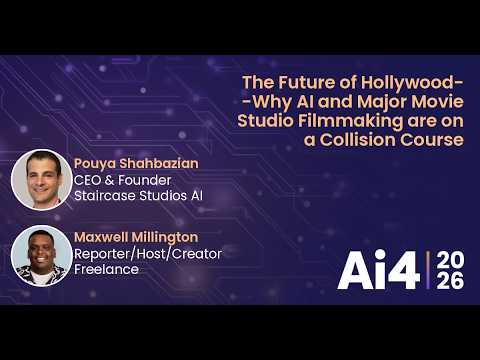
Staircase Studios Targets 30 AI Films to Bypass Legacy Bottlenecks
Ai4
Former Divergent producer Pouya Shahbazian argues generative AI is essential to overcome Hollywood's development delays by lowering production costs and anchoring distribution on YouTube.
## Background
This video was published on YouTube by the channel Ai4 on August 22, 2026. According to the page description, film and television producer turned Staircase Studios AI founder Pouya Shahbazian discusses why AI is forcing Hollywood to adapt, what breaks first, and how the next era of filmmaking is being built.
## TL;DR
Former traditional studio producer Pouya Shahbazian explains his shift toward generative AI filmmaking following studio development bottlenecks and the 2023 Hollywood strikes. He outlines Staircase Studios AI's strategy to produce 30 low-budget projects distributed primarily on YouTube while maintaining union standards and human creative control over key artistic elements. Addressing technical and creative challenges, Shahbazian highlights the use of advanced models like ByteDance's SeaDance to bypass the uncanny valley and emphasizes that high-quality storytelling and screenwriting remain the core foundation of successful film content.
## Atmosphere & style
The conversation carries an insightful, forward-looking, and pragmatic tone as a veteran insider reflects on legacy studio friction versus modern tech efficiency. Host Maxwell Millington guides the discussion with structured journalist queries, while Shahbazian delivers articulate, history-grounded, and industry-savvy perspectives. The overall vibe feels like an engaging, high-level industry briefing that balances respect for traditional cinematic craft with calculated enthusiasm for AI's disruptive potential.
## Key takeaways
- [00:04](https://www.youtube.com/watch?v=HhK3Yw4I1I4&t=4s) Guillermo del Toro high level warnings at Comic-Con framed AI as a threat to artistic lineage and craft mastery, while Pouya Shahbazian counters with historical parallels like the 1850s debate over photography.
- [00:04](https://www.youtube.com/watch?v=HhK3Yw4I1I4&t=4s) Shahbazian argues technology historically drives capital to increase labor efficiency, expanding overall creative output rather than destroying art.
- [01:50](https://www.youtube.com/watch?v=HhK3Yw4I1I4&t=110s) After 15 years as a manager and producer with 200 projects sold and 12 produced, studio development bottlenecks left over 180 of Shahbazian's scripts unmade.
- [01:50](https://www.youtube.com/watch?v=HhK3Yw4I1I4&t=110s) The 2023 Hollywood strikes combined with the rise of tools like ChatGPT, Character.AI, and Midjourney prompted Shahbazian's pivot to generative AI.
- [05:30](https://www.youtube.com/watch?v=HhK3Yw4I1I4&t=330s) Staircase Studios AI aims to produce 30 projects over four years with budgets under $500,000 each, formatted primarily as short-form episodic series.
- [05:30](https://www.youtube.com/watch?v=HhK3Yw4I1I4&t=330s) With major legacy distributors yet to acquire AI-first projects, Staircase Studios adopts a YouTube-first distribution strategy.
- [07:23](https://www.youtube.com/watch?v=HhK3Yw4I1I4&t=443s) Staircase Studios adheres to union guidelines by paying union minimums and contributing to health and pension plans while hiring human creators.
- [07:23](https://www.youtube.com/watch?v=HhK3Yw4I1I4&t=443s) A-list Hollywood talent and major agents are actively exploring deals and projects with AI-focused studios as tech adoption accelerates.
- [09:05](https://www.youtube.com/watch?v=HhK3Yw4I1I4&t=545s) To secure copyright protection, Staircase Studios uses human artists for non-fungible, unique artistic elements while delegating generic, fungible visual sequences to AI.
- [10:55](https://www.youtube.com/watch?v=HhK3Yw4I1I4&t=655s) Advancements in generative models like ByteDance's SeaDance, alongside custom platform orchestration layers, help overcome visual inconsistency and the uncanny valley.
- [12:17](https://www.youtube.com/watch?v=HhK3Yw4I1I4&t=737s) Emerging creators are advised that technological efficiency cannot replace strong writing and storytelling, which remain the foundation of great filmmaking.
## Detailed walkthrough
### [00:04](https://www.youtube.com/watch?v=HhK3Yw4I1I4&t=4s) Craft vs. Progress: Debating Guillermo del Toro’s AI Warnings
Freelance entertainment and sports reporter Maxwell Millington kicks off the session by citing director Guillermo del Toro’s recent remarks at San Diego Comic-Con. Del Toro warned that AI risks depriving future filmmakers of mastering their craft and severing the medium’s artistic lineage, asserting, "what we're protecting is the beauty and redeeming power of art." Responding with deep respect for the legendary filmmaker, Staircase Studios AI founder and CEO Pouya Shahbazian offers a historical counterperspective, pointing back to the 1850s when critics similarly declared that painting was dead due to the invention of the camera.
Shahbazian argues that every transformative technology—from the loom, the printing press, and the wheel to fire—spurs capital to make labor more efficient. Rather than destroying art, he believes AI is an inevitable evolution that will ultimately lead to more, higher-quality movies and broader creative opportunities.
- **Historical Parallel**: Art critics in the 1850s claimed photography would destroy painting.
- **core Thesis**: Technology historically makes labor more efficient while expanding creative possibilities rather than eliminating art.
---
[01:50](https://www.youtube.com/watch?v=HhK3Yw4I1I4&t=110s) The Breaking Point of Traditional Hollywood
Reflecting on his 15-year career in traditional studio filmmaking—where he produced major franchises like *Divergent*—Shahbazian details his path through Hollywood's conventional trajectory. Starting in the agency mailroom after reading David Rensin’s book *The Mailroom*, he experienced firsthand how agencies serve as the central information vortex of the industry. While well-connected children of major directors might secure entry-level jobs overnight, it took him a full year of relentless door-knocking to break in.
Over his 15 years as a manager and producer specializing in literary adaptations (books and articles), Shahbazian sold roughly 200 projects to major studios. Though he maintained a solid track record with 12 films actually produced, he reached a breaking point in 2023 when Hollywood went on strike. Realizing that over 180 of his developed scripts—including seven of his top eight best scripts by Oscar-winning or nominated writers—remained unmade due to studio bottlenecks, he pivoted toward generative AI following the releases of ChatGPT, Character.AI, and Midjourney.
- **Career Track Record**: Sold 200 projects to studios over 15 years; 12 were produced (including the *Divergent* franchise).
- **Development Ratio**: Out of his top 8 developed scripts, only 1 was greenlit in the studio system.
- **Catalyst Event**: The 2023 Hollywood strikes, alongside the 2022–2023 releases of ChatGPT, Character.AI, and Midjourney.
- **Collaborators**: Partnered with longtime writer friends Jay Sherick and David Ron to launch AI-driven projects.
---
[05:30](https://www.youtube.com/watch?v=HhK3Yw4I1I4&t=330s) Distribution Models and the Shift to YouTube
Staircase Studios AI has set an ambitious target of producing 30 films or major projects within four years, funded at budgets under $500,000 each. Rather than relying on traditional feature film formats, many projects are structured as episodic series consisting of 8 to 12-minute episodes. Addressing distribution, Shahbazian acknowledges that no major legacy distributor or streamer (like Netflix, Amazon, Apple, Warner Bros., or Paramount) has purchased an "AI-first" project yet, though movement is starting.
Consequently, Staircase Studios is prioritizing YouTube as its premier distribution platform, citing its recent animated show *Andre the Octopus*, which stars major YouTube influencers. Shahbazian notes that YouTube now dominates modern television viewing, forcing traditional platforms like Netflix to compete by introducing podcasts and unscripted content. He compares YouTube's power to breakout children's shows like *Cocomelon* or *Ms. Rachel*, predicting legacy streamers will eventually be forced to buy AI content originating from YouTube.
- **Production Goal**: 30 projects over 4 years at under $500,000 per project.
- **Format Structure**: 8 to 12-minute short-form episodic series.
- **Current Distribution Anchor**: YouTube-first model, leveraging influencer talent (e.g., *Andre the Octopus*).
---
[07:23](https://www.youtube.com/watch?v=HhK3Yw4I1I4&t=443s) Working with Hollywood Talent and Union Standards
Addressing industry skepticism, Shahbazian emphasizes that Staircase Studios collaborates closely with traditional Hollywood talent, including human writers, directors, animators, and voice actors. The studio adheres strictly to union guidelines, paying union minimum wages and contributing to health and pension plans. Unlike single-operator "basement" AI projects, Staircase Studios aims to bridge generative AI efficiency with top-tier industry creatives.
This hybrid approach has sparked growing interest among Hollywood's elite talent. Following high-profile industry moves—such as Ben Affleck selling his AI company to Netflix—A-list actors and musicians are increasingly directing their agents to set up meetings with Staircase Studios to explore prospective projects.
- **Labor Commitments**: Full compliance with union guidelines, union minimum pay, and health/pension contributions.
- **Talent Strategy**: Combining human screenwriting, direction, and voice acting with AI-assisted animation.
---
[09:05](https://www.youtube.com/watch?v=HhK3Yw4I1I4&t=545s) Copyright, Human Touch, and the "Pulp Fiction" Rule
To maintain strict copyright and trademark protection over its intellectual property, Staircase Studios enforces a distinction between "fungible" and "non-fungible" artistic moments. For projects like *First Corgi*, key characters and keyframes are drawn by hand to ensure complete legal ownership. Shahbazian explains that AI handles general or "fungible" animations—such as a generic scene of two teenagers dancing in a high school gymnasium during prom.
However, unique, highly stylized "non-fungible" moments require human creation. Using Quentin Tarantino’s iconic *Pulp Fiction* diner dance scene between John Travolta and Uma Thurman as an example, Shahbazian stresses that bespoke, auteur-driven moments must be hand-drawn rather than generated by AI.
- **Featured IP**: *First Corgi* (hand-drawn original characters and bespoke moments).
- **Fungible vs. Non-Fungible Content**: AI handles routine, generic visual tropes (prom dances, ambient movement); human artists hand-draw distinct, proprietary beats.
---
[10:55](https://www.youtube.com/watch?v=HhK3Yw4I1I4&t=655s) Overcoming the Uncanny Valley with New Models
When asked how the studio solves the "uncanny valley" effect across longer content, Shahbazian credits rapid technological advancements over recent months. He singles out ByteDance's SeaDance 2.0 and 2.5 models as major game-changers that have significantly lapped the field in visual fidelity and consistency.
In addition to using third-party foundational models, Staircase Studios operates its own proprietary platform orchestration layer built by its internal engineering team to maintain visual consistency and streamline the pipeline.
- **Key Technology**: ByteDance SeaDance 2.0 and 2.5 models.
- **Internal Infrastructure**: Custom platform orchestration layer built by Staircase Studios engineers.
---
[12:17](https://www.youtube.com/watch?v=HhK3Yw4I1I4&t=737s) Advice for Emerging Filmmakers and Closing Thoughts
Offering advice to aspiring independent creators utilizing generative tools, Shahbazian stresses that while technology makes production accessible, it does not automatically make stories better. Great storytelling stems from extensive reading and deep story curation. Drawing from his early days reading 10 to 15 scripts a week in agency mailrooms, he advises newcomers that a great project always starts on the page with top-tier writing.
Closing out the interview on a lighthearted note, Millington asks for Shahbazian's favorite film of the year. Shahbazian praises *Project Hail Mary*, highlighting directors Phil Lord and Christopher Miller for their consistently strong output.
- **Core Advice for Creators**: Prioritize script quality and deep reading over technical tools; "storytelling starts on the page."
- **Featured Project Highlight**: *First Corgi*, written by A-list Hollywood screenwriters.
- **Movie Recommendation**: *Project Hail Mary* (directed by Phil Lord and Christopher Miller).
## Notable quotes
> [00:04](https://www.youtube.com/watch?v=HhK3Yw4I1I4&t=4s) what we're protecting is the beauty and redeeming power of art. — Guillermo del Toro
> [01:50](https://www.youtube.com/watch?v=HhK3Yw4I1I4&t=110s) The Mailroom
> [05:30](https://www.youtube.com/watch?v=HhK3Yw4I1I4&t=330s) Andre the Octopus
> [09:05](https://www.youtube.com/watch?v=HhK3Yw4I1I4&t=545s) First Corgi
> [12:17](https://www.youtube.com/watch?v=HhK3Yw4I1I4&t=737s) storytelling starts on the page. — Pouya Shahbazian
## Mentioned
Pouya Shahbazian, Maxwell Millington, Staircase Studios AI, Guillermo del Toro, San Diego Comic-Con, Divergent, David Rensin, ChatGPT, Character.AI, Midjourney, Jay Sherick, David Ron, YouTube, Netflix, Amazon, Apple, Warner Bros., Paramount, Disney, Andre the Octopus, Cocomelon, Ms. Rachel, Ben Affleck, First Corgi, Pulp Fiction, Quentin Tarantino, John Travolta, Uma Thurman, ByteDance, SeaDance 2.0, SeaDance 2.5, Project Hail Mary, Phil Lord, Christopher Miller
## Video description
Pouya Shahbazian - CEO & Founder, Staircase Studios AI
Maxwell Millington - Reporter/Host/Creator, Freelance
Hollywood doesn’t get to opt out of AI.
With billions of people worldwide already using the latest tools and studios like Disney embracing them in real time and making deals with the hyperscalers, the question isn’t if movies change—but who adapts fast enough to survive it. Veteran film & television producer turned Staircase Studios AI founder & CEO Pouya Shahbazian breaks down why AI is forcing Hollywood’s hand, what breaks first, and how the next era of filmmaking is being built.
This is a conversation about understanding where Hollywood is heading—and how to stay ahead of it.
Staircase Studios AI founder Pouya Shahbazian contends that generative AI will resolve Hollywood's production bottlenecks and lower costs without displacing human artistry, drawing historical parallels to how photography transformed painting.
Studio Bottlenecks and the Pivot to Generative AI (1:50)
After 15 years in traditional Hollywood producing films such as the Divergent franchise, Shahbazian reached a turning point during the 2023 industry strikes. Despite selling roughly 200 projects to major studios, only 12 were ever produced, leaving over 180 developed scripts unmade—including seven of his top eight scripts penned by Oscar-winning or nominated screenwriters. This persistent development friction led him to partner with screenwriters Jay Sherick and David Ron to launch an AI-driven production model following the emergence of tools like ChatGPT, Character.AI, and Midjourney.
Shahbazian views AI not as a threat to artistic heritage—pushing back on concerns voiced by director Guillermo del Toro—but as an efficiency tool akin to historical breakthroughs like the printing press and the camera in the 1850s. In his assessment, technological automation frees capital and labor to produce higher volumes of quality work rather than destroying creative mediums.
Short-Form Production and YouTube-First Distribution (5:30)
Staircase Studios has set a target of producing 30 projects within four years at budgets capped under $500,000 each, primarily formatted as 8- to 12-minute episodic series. Because no legacy studio or major subscription streamer—including Netflix, Apple, or Warner Bros.—has purchased an AI-first production yet, the company is anchoring its release strategy on YouTube. Citing examples like its animated series Andre the Octopus featuring platform influencers, Shahbazian points to YouTube's growing share of living-room viewership, forecasting that mainstream streaming services will eventually acquire AI content originally incubated on open video platforms.
Hybrid Union Labor and Proprietary IP Protection (7:23)
To counter skepticism regarding artistic erosion and copyright vulnerabilities, Staircase Studios retains conventional creative roles and adheres to union standards, paying union minimum wages alongside health and pension contributions to human screenwriters, directors, animators, and voice talent. Shahbazian notes that high-profile deals, such as Ben Affleck selling his AI company to Netflix, have spurred A-list actors and musicians to pursue hybrid project meetings.
Legally, the studio protects its intellectual property by separating generic, 'fungible' animation tasks from bespoke, 'non-fungible' moments. For its project First Corgi, human artists hand-draw core characters, keyframes, and auteur-driven sequences—analogous to the iconic diner dance in Quentin Tarantino's Pulp Fiction—while AI generation is reserved for routine background actions, such as ambient dancing in a high school gymnasium.
Addressing the Uncanny Valley and Creative Fundamentals (10:55)
To overcome the uncanny valley and visual continuity issues in extended video formats, the studio utilizes ByteDance's SeaDance 2.0 and 2.5 foundation models, paired with an in-house platform orchestration layer engineered to maintain frame-to-frame fidelity. Shahbazian maintains that while advanced tooling resolves visual execution, it cannot compensate for flawed storytelling, advising emerging creators to ground their projects in rigorous reading and refined screenwriting fundamentals.
While Staircase Studios outlines an operational path balancing generative tools with union labor and copyright compliance, the model's commercial viability remains tied to whether major streaming platforms will eventually purchase AI-originated series, an acquisition shift that has not yet occurred.
精炼阅读摘要
好莱坞资深制片人兼 Staircase Studios AI 首席执行官 Pouya Shahbazian 认为,生成式 AI 并非艺术创作的终结者,而是破解传统片厂制度开发积压与高昂成本的历史性工具;通过坚持工会合规、锚定 YouTube 平台分发以及实行“非同质化”人工绘制保护版权,影视制作正迎来低预算、高产出的结构性转折。
传统制片瓶颈与AI变革的历史必然性 (0:04)
针对导演 Guillermo del Toro 在圣迭戈动漫展上提出的警示——即 AI 可能会剥夺未来创作者磨砺技艺的机会并割裂艺术传承,Shahbazian 提出了历史维度的反驳。他援引 1850 年代照相机问世时评论界“绘画已死”的论调,主张从织布机、印刷机到车轮与火,颠覆性技术历来都是资本提升劳动生产效率的催化剂;技术演进不会消灭艺术,反而会催生数量更多、品质更高的影视作品,并拓宽创意准入空间。
Shahbazian 结合自身 15 年的好莱坞传统从业经历指出体制内的结构性困境。他曾打造过《Divergent》系列等大型商业电影,职业生涯中累计向各大主流片厂售出约 200 个改编项目,最终仅有 12 部得以实际制作。更令其触动的是,在他开发的 8 部最优质剧本中(编剧均曾获奥斯卡奖或提名),只有 1 部成功获得绿灯立项。2023 年好莱坞大罢工的爆发,叠加 ChatGPT、Character.AI 与 Midjourney 等生成式技术的爆发,促使他决心打破片厂开发漏斗的瓶颈,携手编剧搭档 Jay Sherick 与 David Ron 全面转型 AI 影视开发。
低成本剧集与YouTube优先的分发路径 (5:30)
Staircase Studios AI 设定了极具规模效应的生产目标,计划在 4 年内完成 30 部电影或重点影视项目,单部预算严格控制在 50 万美元以内。在内容形态上,该工作室打破了传统院线长片的束缚,主要采用每集 8 至 12 分钟的短篇剧集制式。在发行端,Shahbazian 证实,截至目前包括 Netflix、Amazon、Apple、Warner Bros. 和 Paramount 在内的主流传统片厂与流媒体巨头均尚未出资购入“AI 原生”项目,但行业观望情绪已开始松动。
面对传统渠道的准入壁垒,工作室将战略重心转向以 YouTube 为核心的第一分发阵地,例如其推出的动画新作《Andre the Octopus》便深度整合了 YouTube 头部网红的影响力。Shahbazian 指出,YouTube 如今已在现代家庭电视大屏的收视时长中占据绝对主导,倒逼 Netflix 等传统平台不得不通过引入播客和无剧本节目进行防御。他类比《Cocomelon》与《Ms. Rachel》等少儿爆款的发展轨迹,预测主流流媒体平台未来终将被迫向源自 YouTube 的优质 AI 内容敞开采购大门。
工会合规与“低俗小说法则”版权机制 (7:23)
为消除行业内部的抵触情绪,Shahbazian 强调工作室拒绝闭门造车式的“地下室”技术生成,而是选择与好莱坞专业的人类编剧、导演、动画师及配音演员深度协同。工作室严格执行好莱坞工会标准,全额支付工会最低薪资保障,并缴纳健康与养老福利。随着 Ben Affleck 将旗下 AI 创业公司出售给 Netflix 等风向标事件出现,好莱坞一线演员与音乐人正频繁通过经纪团队主动接触工作室,寻求潜在的合作机会。
在法律与知识产权确权层面,工作室建立了区分“同质化”(fungible)与“非同质化”(non-fungible)视觉镜头的双轨原则。以正在开发的项目《First Corgi》为例,所有核心角色造型设计与关键帧均由人类艺术家手工绘制,以满足严格的商标与版权注册要求。Shahbazian 解释称,AI 仅用于处理常规或通用的同质化画面(例如高中毕业舞会的人群跳舞或环境空镜头);而诸如 Quentin Tarantino 在《Pulp Fiction》中为 John Travolta 与 Uma Thurman 设计的经典餐厅对舞等具有作者烙印的高光时刻,必须由人工手绘完成,确保核心资产的法律独立性。
跨越恐怖谷的技术底座与剧本为本法则 (10:55)
针对长篇 AI 视频生成普遍面临的“恐怖谷”与画面不连贯难题,Shahbazian 归功于近几个月底层基础模型的突破,并特别指出字节跳动旗下的 SeaDance 2.0 与 2.5 模型在视觉还原度与角色动作连贯性上大幅领先行业。除调用先进的外部第三方基础模型外,Staircase Studios 内部工程团队还自主搭建了专有的平台编排层(orchestration layer),用于维持全流程生产管线的视觉一致性与资产流转效率。
谈及给新一代独立创作者的建议时,Shahbazian 告诫称,AI 技术虽然普及了制作手段,但绝不能替代优质的叙事内核。优秀的讲故事能力来源于海量阅读与深刻的文本把控力。Shahbazian 回忆自己在经纪公司收发室起步时每周精读 10 至 15 部剧本的磨砺,坚称所有影视项目的核心始终在于扎实的文字剧本(“storytelling starts on the page”)。在访谈结尾,他表达了对由 Phil Lord 和 Christopher Miller 执导的电影《Project Hail Mary》的高度赞赏。
Pouya Shahbazian 勾勒出了一幅以生成式技术压缩成本、依托 YouTube 积累受众、同时遵守工会规则与版权防御的新型制片蓝图。然而,传统主流流媒体迄今尚未实质性下单采购 AI 原生内容,依靠 YouTube 突围并倒逼主流平台接盘的商业闭环是否能够顺利跑通,以及手工绘制关键帧对版权法庭防御的充分性,仍有待市场与时间的检验。
Detailed notes — zh
## Background
该视频由 Ai4 频道于 2026 年 8 月 22 日发布在 YouTube 平台上,时长约 15 分钟。视频简介指出,好莱坞无法避开 AI 的浪潮,从迪士尼等大制片厂与科技巨头的合作切入,由资深制片人兼 Staircase Studios AI 创始人 Pouya Shahbazian 深度解析 AI 给好莱坞带来的冲击、变革与未来发展方向。
## TL;DR
节目围绕 AI 技术对传统好莱坞制片体系的重塑展开讨论。资深制片人 Pouya Shahbazian 从自身 15 年的传统制片经验出发,对比了名导演对 AI 破坏艺术传承的担忧与历史技术革新的必然性。他阐述了传统制片管线效率低下、项目积压严重等弊端,并分享了创办 AI 工作室推动影视创作降本增效、赋能更多优质内容产出的行业前瞻。
## Atmosphere & style
对谈整体呈现出理性、专业且富有洞察力的行业研讨氛围。主持人 Millington 提问犀利且紧扣时下热点,而嘉宾 Shahbazian 则以务实成熟的姿态,结合自身从业经历进行深刻剖析。既有对传统电影艺术传承的敬重与反思,又充满了对技术变革带来的效率提升与未来可能性的笃定与热忱。
## Key takeaways
- [00:04](https://www.youtube.com/watch?v=HhK3Yw4I1I4&t=4s) 吉尔莫·德尔·托罗在圣迭戈动漫展上警告称,AI 的普及可能会阻断新一代电影人对传统创作技艺的掌握与艺术传承。
- [00:04](https://www.youtube.com/watch?v=HhK3Yw4I1I4&t=4s) 普亚·沙赫巴齐安(Pouya Shahbazian)以 19 世纪摄影术问世为例,认为技术革新提高劳动效率是历史发展的必然趋势。
- [01:50](https://www.youtube.com/watch?v=HhK3Yw4I1I4&t=110s) 沙赫巴齐安在好莱坞传统制片体系打拼 15 年,曾一手打造《分歧者》等知名项目,向各大制片厂售出过 200 个影视项目。
- [01:50](https://www.youtube.com/watch?v=HhK3Yw4I1I4&t=110s) 传统制片管线的低效促使沙赫巴齐安转型创办 Staircase Studios AI,旨在利用 AI 技术提升影视项目的开发与制作效率。
## Detailed walkthrough
### [00:04](https://www.youtube.com/watch?v=HhK3Yw4I1I4&t=4s) AI 赋能影视创作与传统艺术立场的碰撞
主持人 Maxwell Millington 开场提到了导演吉尔莫·德尔·托罗(Guillermo del Toro)近期在圣迭戈动漫展(San Diego Comic-Con)上发表的言论。德尔·托罗担心 AI 的普及可能会阻碍未来电影人掌握这项技艺,并强调艺术的传承与美感至关重要;如果断绝了一代人学习手艺的机会,电影这一媒介的后续历史也就断裂了。
对此,Staircase Studios AI 的创始人兼 CEO 普亚·沙赫巴齐安(Pouya Shahbazian)表达了对德尔·托罗的崇高敬意,但同时也提出了不同的历史视角。他指出,早在 1980 年代照相机问世时,艺术评论家们也曾宣称“绘画已死”,但事实证明资本与技术的结合向来是为了提高劳动的效率。从织布机、印刷术到轮子和火,新技术的涌现是不可阻挡的历史必然。沙赫巴齐安对 AI 在影视领域的应用抱有极大热忱,认为 AI 将带来更多、更优质的影视内容。
- 吉尔莫·德尔·托罗的核心观点:"What we're protecting is the beauty and redeeming power of art. We're protecting a lineage of art."
- 历史对照:沙赫巴齐安将当下对 AI 的担忧与 1850 年代摄影术诞生对比,指出技术创新历来都是提升劳动效率的必然趋势。
---
### [01:50](https://www.youtube.com/watch?v=HhK3Yw4I1I4&t=110s) 从传统制片管线到创办 AI 工作室的转折点
沙赫巴齐安分享了自己的从业经历:他在传统好莱坞制片体系中打拼了 15 年,曾一手打造了《分歧者》(Divergent)等知名系列电影。他回忆道,自己刚毕业时没有任何行业资源,花了整整一年时间挨家挨户敲门,才在好莱坞顶级经纪公司的邮件收发室(Mailroom)找到一份基层工作。在好莱坞,经纪公司的邮件收发室是信息和资源的交汇中心,一旦迈过这道门槛,人才才能进入相对凭实力说话的公平竞争平台。
后来他前往纽约创业,成为一名专注于挖掘图书和文章等文学版权并将其改编为电影的文学经理人和制片人。他在极早期就阅读了《分歧者》的手稿并成功将其推上大银幕。在 15 年间,他向好莱坞制片厂售出了 200 个项目,并成功制作了其中的 12 部作品。然而,沙赫巴齐安渐渐意识到,即使自己的成功率居于前列,依然有超过 180 个剧本(其中包括许多出自奥斯卡获奖### AI与电影传承之争:吉尔莫·德尔·托罗的警告与历史视角
主持人 Maxwell Millington 开场提到了导演吉尔莫·德尔·托罗(Guillermo del Toro)在圣迭戈动漫展(San Diego Comic-Con)上的发言。德尔托罗警示称,AI 可能会阻断新一代电影人对电影创作技艺的掌握,剥夺他们学习该媒介
## Notable quotes
> [00:04](https://www.youtube.com/watch?v=HhK3Yw4I1I4&t=4s) What we're protecting is the beauty and redeeming power of art. We're protecting a lineage of art. — Guillermo del Toro
## Mentioned
Ai4, Disney, Guillermo del Toro, Maxwell Millington, Pouya Shahbazian, San Diego Comic-Con, Staircase Studios AI, 《分歧者》
## Video description
Pouya Shahbazian - CEO & Founder, Staircase Studios AI
Maxwell Millington - Reporter/Host/Creator, Freelance
Hollywood doesn’t get to opt out of AI.
With billions of people worldwide already using the latest tools and studios like Disney embracing them in real time and making deals with the hyperscalers, the question isn’t if movies change—but who adapts fast enough to survive it. Veteran film & television producer turned Staircase Studios AI founder & CEO Pouya Shahbazian breaks down why AI is forcing Hollywood’s hand, what breaks first, and how the next era of filmmaking is being built.
This is a conversation about understanding where Hollywood is heading—and how to stay ahead of it.
[Source](https://www.youtube.com/watch?v=HhK3Yw4I1I4)
Source quotes
[0:04] Guillermo del Toro: What we're protecting is the beauty and redeeming power of art. We're protecting a lineage of art.
Source quotes
[0:04] Guillermo del Toro: what we're protecting is the beauty and redeeming power of art.
[1:50] The Mailroom
[5:30] Andre the Octopus
[9:05] First Corgi
[12:17] Pouya Shahbazian: storytelling starts on the page.
Original transcript
[0:04] Welcome everybody again. My name is Maxwell
Millington. I'm a freelance entertainment
[0:08] and sports reporter and super excited for
this conversation. I want to start off with
[0:13] comments that were recently made at San Diego
Comic-Con by director Guillermo del Toro.
[0:19] And he essentially was just saying that
AI could prevent future filmmakers from
[0:24] mastering the craft. His quote was what we're
protecting is the beauty and redeeming power of
[0:30] art. We're protecting a lineage of art. If we cut
a generation of people from learning their craft,
[0:35] you're cutting the rest of the history
of that medium away from away from them.
[0:39] And so I want to actually start the conversation
there and just get your thoughts on what
[0:43] Guillermo had to say. Yeah, look, Guillermo
del Toro is an absolute master of the craft,
[0:50] so nothing but love and respect for him.
I would point him though to the 1850s when
[0:58] the art critics proclaimed painting is dead
because there was this invention called
[1:07] the camera. And pushing a button created a
perfect photograph. So this has happened with
[1:16] the loom, the printing press, the wheel,
fire. I mean every new technol- technology
[1:22] is is created capital creates technology
that makes labor more efficient. So I
[1:30] we are we're incredibly excited to be in the
space. We think it's inevitable. We think that
[1:35] there's going to be more movies, better movies,
better content all the way around because of
[1:43] the opportunities that AI provides. You did
spend 15 years in the traditional studio.
[1:50] You produced things like that Divergent franchise.
And so you've you've you've you know, gotten that
[1:57] experience. And so, what specific breaking
point uh in the traditional production pipeline
[2:03] made you decide that generative AI was the only
path forward? Yeah, so my background is very much
[2:10] the tradition, follow the traditional Hollywood
trajectory. Get out of school, move to LA,
[2:16] uh spent a year running around LA trying to get
one of the entry-level jobs. Everyone said read
[2:22] a book called Mailroom by David Rensin. Read
the book, uh literally knocks on every door.
[2:29] I hounded people. I did whatever I had to do to
get a job at one of those major agencies. And for
[2:35] it took a year, but finally got one of those
gigs. And what the agencies in Hollywood provide
[2:41] is the central vortex of information into the
industry. And once you get into that door,
[2:48] you are on an equal playing field and really it
becomes somewhat of a meritocracy of who rises.
[2:55] So, I mean, the the difference really is that
for someone like myself who didn't know anybody,
[2:59] it takes me a year to get that job. If you're the
child of uh major director, you know somebody,
[3:06] you may get that job in one day, right? So, once
you get in the door though, um the traditional
[3:11] industry has has had this foothold where you
work through production companies and studios.
[3:19] And there is a a green lighting process for all
movies. So, there's very little um that makes
[3:26] a mark that doesn't go through that system at
least at some point. Even the independent movies,
[3:31] a lot of them started as scripts that were paid
for by the traditional system. Um so, I ended up
[3:37] working a couple of years in the mailroom,
moved to New York, started my own company.
[3:41] And as I was a manager producer specializing
in finding literary material. So, books,
[3:48] mostly books and articles that I could turn into
movies. Um I was fortunate to be one of the first
[3:53] few people on the planet to read the manuscript
for Divergent. Um, I read it, immediately thought
[3:59] this is amazing, this should be a movie. Um,
we put the movies together, I produced those.
[4:05] Over the course of 15 years, I put 200 projects
together that I sold into the major studio system,
[4:11] and my track record was pretty good. 12 of those
got made. But, what I realized was, a couple years
[4:17] ago, I looked around and said, "Look, we have a
good track record, we've done a lot, we're making
[4:21] a movie almost every single year. And the problem
is, that leaves 180-plus scripts that didn't get
[4:29] made. Um, and I would tell you that of the scripts
I I worked on and I developed as a producer,
[4:35] of the best eight scripts, only one of those
got made. I mean, really it's happenstance, and
[4:41] and um, I'm those scripts are still amazing, and
they're still sitting there from Oscar-winning
[4:45] writers, uh, and from from nominated amazing
writers. So, that 2023 was the breaking point
[4:51] for me where Hollywood went on strike.
Um, I looked around and said, you know,
[4:55] there's got to be a better way of doing this.
Uh, ChatGPT had come out in November 2022. Um,
[5:01] Character AI and Midjourney had launched a little
bit before that, and I just started studying,
[5:06] uh, and I started figuring out if there's a
better path forward for all of the stuff that
[5:11] I had worked on, and also for other new original
content. So, these guys, Jay Sherick and David
[5:17] Ron, friends of mine who I've known for many,
many years, um, always wanted to work with them,
[5:22] never had the opportunity until we started
an AI company, and then I could hire them,
[5:26] and we could make something that we're
really excited and proud of like that.
[5:30] And you said your target is 30 films in the in
four years, is that still That's right. That's
[5:35] we feel really good about. And it may not be
all films, it might be like something like this
[5:40] would have traditionally probably been a film,
um, but now we're making it as a series. So,
[5:45] it should be eight to eight to 10, 12 minute
episodes. And so, those projects for under 500
[5:52] thousand each. Uh, what does the distribution
strategy look like for um, micro budget features?
[5:59] Yeah, so right now there has been no major
purchases by um, the traditional distributors. So,
[6:05] streamers, the Netflixes, the Amazons, the Apples,
the traditional buyers, the Warner Brothers,
[6:09] the Paramounts. None of None of those companies
have purchased an AI first project. Um, Amazon's
[6:17] announced a few series uh, and there is there
does seem to be more movement towards AI projects
[6:24] in the system. Um, but no one's purchased an
actual project. So, our strategy right now,
[6:30] we love YouTube. We are geared up towards YouTube.
We announced a show uh, two months ago that is
[6:36] uh, called Andre the Octopus that has a
number of major YouTube influencers. So,
[6:41] we're embracing the YouTube model, but we do
believe that at some point in the near future it
[6:45] is inevitable that AI content will find its way to
the majors. And the same way that I would I would
[6:52] look at something like uh, Cocomelon or Miss
Rachel, shows that started on YouTube and were
[6:59] wildly successful. Netflix came along and said,
"We need that type of content because we have to
[7:05] compete in the grander sphere." And YouTube has
become television. YouTube dominates everything.
[7:11] So, Netflix is actually now in this race to try to
become uh, try to catch up with what YouTube is.
[7:18] Um, and that's why you can you can see
on Netflix they have podcasts these days.
[7:23] And Staircase Studios is using human writers,
directors, and actors, and voice actors uh,
[7:30] for the animated projects. Uh, so what's
what's the pitch to um, you know, these uh,
[7:37] people who may have not have worked on an
AI project before? What do you tell them?
[7:42] Yeah, our our pitch is really simple that we are
following union guidelines in Hollywood. We are
[7:47] paying union wages, mostly union minimums, but
we are um definitely contributing towards health
[7:53] and pension, and we're trying to We're trying
to play the game the right way to embrace the
[7:58] talent in Hollywood and get more talented people
working. There is There are going to be movies,
[8:04] and there are movies now you can see that are
one or two guys in in a basement making a movie.
[8:10] Um that's not what we do. We want to work
with the most talented creatives there are in
[8:14] and the the proof is in the pudding in that, you
know, the calls I get from agents in Hollywood
[8:20] as in I just got one of these calls a month ago
where major star who is also a huge musician
[8:27] uh started thinking about Ben Affleck's big
AI deal um that he sold his company to Netflix
[8:35] uh and called his agent and said, "I want to learn
more about AI." So, that agent called me and said,
[8:41] "Look, you guys are the ones that are doing this
the right way. Would you sit down with this star?"
[8:45] So, I was very excited to to sit down with
that star and um and have a meeting and have
[8:51] a coffee and figure out if we can work together
on something. So, we are we are embracing the
[8:57] Hollywood ecosystem. We we are members of the
Hollywood ecosystem, so we'd like to work with
[9:02] the most high-level talent possible. And on that
same note, there's also kind of discussion over
[9:08] uh you know, what are what should the guardrails
be? Um we're talking about likeness rights,
[9:14] training data. Um you mentioned union. Uh can you
speak to like just how you ensure you're kind of
[9:20] staying on the right track when it comes to
those things? Yeah, so for our projects of
[9:25] something like First Corgi, those characters are
all drawn by hand. We create everything. We create
[9:32] all bespoke moments, all the non-fungible moments.
We create by hand. So, we have a record of
[9:41] the actual characters and we can copyright
and trademark them. That's something where
[9:47] we're we're taking the precautions that AI
shouldn't create everything. AI can do a lot
[9:53] of the animating, it can do a lot of the the kind
of the fungible movements. I I always talk about
[9:58] if you think about a scene created by AI, right?
And let's say you have two characters dancing.
[10:05] Now, you can have two characters dancing
um in a high school gymnasium during prom.
[10:11] Now, think about how many movies you've seen
where there's a scene where there's prom in
[10:15] a high school gym and two people are dancing,
right? Countless movies. But, if you think about
[10:21] two people dancing in a diner during a
dance contest that look like John Travolta
[10:25] and Uma Thurman and are doing crazy moves, that's
specifically that's a non-fungible moment from the
[10:32] mind of Quentin Tarantino in Pulp Fiction. So, if
we have a moment like that in one of our projects,
[10:38] we're going to hand draw that. We want to own
that, we want to create that. We're not going
[10:42] to let AI create that. If it's something like two
people dancing in a prom high school gymnasium,
[10:49] we're going to be a little bit less stringent
on what we create and what we draw by hand.
[10:55] One of the things one of the other criticisms
over generative video is also just like the
[11:02] uncanny valley effect the and some of the
kind of emotional nuance and getting things
[11:08] was especially when we were talking about you
know, human drawn things that the features have
[11:14] to be right. Um and people can sort of tell when
it's looks a little weird. Um how are you solving
[11:21] this issue across a 90-minute feature? Yeah, this
is this has been sort of self-corrected in the
[11:28] last few months. Um the ByteDance put out the C
now 2.0 model, now they're they're out with 2.5.
[11:34] Uh that's been a game-changer and they genuinely
lapped the field. Uh I I don't know what's in
[11:41] the water at ByteDance, but they're very good at
what they do. Um those models have really improved
[11:46] and there's so much less of the concern about
Uncanny Valley. Um we we certainly are doing our
[11:54] we have our own platform orchestration layer that
we've built internally with our engineering team.
[11:59] So, we we do our own process, um but I think that
for anyone out there wants to play with the tools,
[12:06] the C dance 2.0 model by ByteDance,
um it's it's very special and
[12:10] it it creates less of the friction that that
people are talking about with Uncanny Valley.
[12:17] What is uh some of the other things in terms
of you mentioned like there's the you guys are
[12:24] a fleshed-out studio. Uh you know, there's
people that are kind of like trying to do
[12:28] it in their basement. I uh as you said earlier,
uh if I'm somebody that's All right, no offense.
[12:34] But if I'm if I'm one of those guys and I'm like,
"Hey, I think I want to start making movies and
[12:38] and that you know, AI." I think to your you
what what's really cool about what you mentioned
[12:43] earlier is about um accessibility and the ability
to say yes to more scripts and say yes to more
[12:48] ideas and there's people that uh I'm sure want to
do those things independently. What advice would
[12:54] you give to somebody that's uh trying to make
their own movies now with the technology that
[12:59] um maybe I'm maybe not I'm not your technology,
but just say AI technology that's available.
[13:04] Yeah, look, I I I would encourage everyone to
go out and play with the tools. Ultimately,
[13:09] um storytelling is is going to be become
more accessible because of the tools,
[13:15] but that doesn't mean the stories will
necessarily be better. Um there is a a level of
[13:22] I I always think of it as just pure reading that
goes into being a storyteller and being able to
[13:28] decipher what a great story is. So, the the first
thing anyone anyone who wants a job in Hollywood
[13:36] and and they're in school, I always usually tell
them be as well-read as you possibly can because
[13:42] the story starts on the page. This this First
Corgi is the best thing we've ever made and
[13:47] it's because we got the best screenwriters. We got
A-list screenwriters who are who've written great
[13:53] scripts for this series. Who doesn't love a corgi?
It's such a Exactly. Such a great dog. Exactly.
[14:01] No, I think Yeah, but I I I That's the advice I
would give you is that to to play you can play
[14:06] with the tools. You can have a lot of fun with
the tools, but ultimately storytelling it requires
[14:12] a curation of ideas. It It requires a curation of
stories. So, that's that's where it all starts. It
[14:19] starts on the page. It starts with reading. And
that Look, that's that's the benefit of having
[14:24] started in the mailroom in Hollywood. When
you're in the mailroom in Hollywood, you read
[14:29] 10 15 scripts a week. Every week for years. So,
you have a encyclopedic knowledge of what's out
[14:37] there and that's that's what gives an advantage
to the storytellers who start in the system.
[14:43] We're going to close out on a fun question.
What's your the best movie you've seen this year?
[14:49] Ooh, best movie I've seen. I love Project
Hail Mary. I thought it was incredible.
[14:55] I love Lord and Miller. Those guys
don't really miss very much. So,
[15:01] I recommend that one. Thanks so much
for doing Appreciate it. Thank you all.