JPMorgan Cuts Onboarding Times to Under a Minute via AI Multi-Agents
Ai4
JPMorgan Chase relies on proprietary internal guardrails and hybrid machine learning models rather than hyperscalers to drive measurable efficiency while keeping human trust central to enterprise banking.
AI-assisted summary of Fireside Chat with Biswa Sengupta - How Finance Decides Where AI Belongs with JPMorgan and Axios — original source. Check the original for full context.
Source published:
Detailed notes
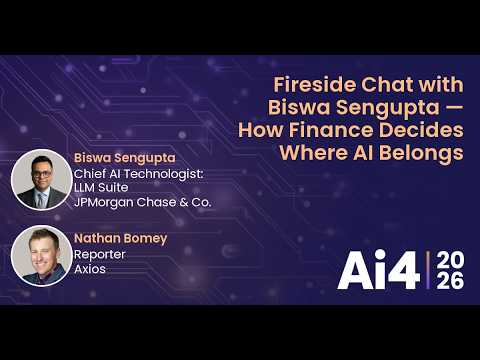
## Background This video was published on YouTube by Ai4 on August 22, 2026. The page description outlines a behind-the-scenes fireside chat with Biswa Sengupta of JPMorgan Chase, moderated by Axios reporter Nathan Bomey, focusing on how the financial industry evaluates AI opportunities, manages risk, and delivers measurable enterprise value beyond vendor hype.
## TL;DR JPMorgan Chase Chief AI Technologist Biswa Sengupta discusses deploying enterprise AI at scale through the bank's internal LLM Suite, balancing innovation costs with high adoption and strict risk management. He shares concrete examples of measurable ROI, such as cutting KYC onboarding times from 5 days to under a minute and automating significant portions of equity and forex trading. Looking ahead, Sengupta anticipates shifts toward autonomous AI scientists while obsolete tasks like simple summarization fade away. He stresses that while AI enhances cyber defense and internal productivity, core human elements like empathy, trust, and judgment remain irreplaceable in banking.
## Atmosphere & style The conversation is pragmatic, authoritative, and grounded, cutting through typical tech sector hype with realistic enterprise insights. Nathan Bomey guides the interview with incisive, forward-looking questions, while Biswa Sengupta responds with calm, measured expertise that balances technical foresight with corporate discipline. The dialogue carries a professional yet engaging cadence, moving seamlessly from high-level strategic vision to granular operational realities.
## Key takeaways - [00:04](https://www.youtube.com/watch?v=Bs-ueHqvNew&t=4s) JPMorgan Chase evaluates enterprise AI initiatives using three primary lenses: scalability across its global workforce, reusability to prevent dead-end proof of concepts, and measurable business adoption. - [00:04](https://www.youtube.com/watch?v=Bs-ueHqvNew&t=4s) JPMC consolidated hundreds of scattered AI use cases into five or six primary innovation buckets centered around its internal platform, LLM Suite. - [02:02](https://www.youtube.com/watch?v=Bs-ueHqvNew&t=122s) A major bottleneck in enterprise AI adoption is employee literacy, prompting JPMC to conduct hands-on prompt and workflow training across all job tiers. - [02:02](https://www.youtube.com/watch?v=Bs-ueHqvNew&t=122s) AI automates specific task subsets within job families rather than replacing entire roles, making it essential for employees to adopt a technical mindset. - [06:07](https://www.youtube.com/watch?v=Bs-ueHqvNew&t=367s) Within two to three years, enterprise AI will shift toward automated theorem provers and scientific discovery, rendering simple chat summarization and slide formatting obsolete. - [07:43](https://www.youtube.com/watch?v=Bs-ueHqvNew&t=463s) Effective financial AI is largely invisible to users, quietly powering critical back-office operations like fraud analytics, identity verification, and KYC onboarding. - [07:43](https://www.youtube.com/watch?v=Bs-ueHqvNew&t=463s) Deploying multi-agent AI systems for KYC onboarding dramatically reduced customer account verification times from 5 days to under 1 minute. - [07:43](https://www.youtube.com/watch?v=Bs-ueHqvNew&t=463s) JPMC's Spectrum IQ engine now automates 75% of equity trading and 85% of foreign exchange trading, saving clients over $4 billion in costs. - [07:43](https://www.youtube.com/watch?v=Bs-ueHqvNew&t=463s) Personalized recommendation engines and automated monthly portfolio rebalancing helped drive a 20% earnings increase in JPMC's private banking division. - [12:42](https://www.youtube.com/watch?v=Bs-ueHqvNew&t=762s) To prevent hallucinations and manage financial risk, JPMC combines generative LLMs with classical machine learning models and historical back-testing alongside internal employee testing. - [12:42](https://www.youtube.com/watch?v=Bs-ueHqvNew&t=762s) Current mathematical foundations do not support true AI self-awareness, as simulating biological nervous system outputs does not equate to actual consciousness. - [15:38](https://www.youtube.com/watch?v=Bs-ueHqvNew&t=938s) JPMC utilizes AI offensively for daily cyber defense to continuously check codebases, close firewall gaps, and mitigate denial-of-service threats. - [15:38](https://www.youtube.com/watch?v=Bs-ueHqvNew&t=938s) To minimize risk in a regulated environment, JPMC avoids single-hyperscaler vendor lock-in and mandates custom in-house security guardrails on all proprietary models. - [19:02](https://www.youtube.com/watch?v=Bs-ueHqvNew&t=1142s) Because banking relies fundamentally on human trust, complex judgment and empathy will ensure human bankers remain indispensable alongside automated tools.
## Detailed walkthrough ### [00:04](https://www.youtube.com/watch?v=Bs-ueHqvNew&t=4s) Balancing Innovation and Cost: Building AI for Enterprise Scale
At the Ai4 conference, Axios reporter Nathan Bomey kicks off a fireside chat with Biswa Sengupta, Chief AI Technologist for LLM Suite at JPMorgan Chase & Co., by addressing the elephant in the room: AI costs are soaring, so how does a massive financial institution balance the drive for innovation against strict cost controls? Sengupta explains that JPMC evaluates AI initiatives through three primary lenses: **scalability** (it must serve their 350,000 employees globally), **reusability** (avoiding the trap of perpetual, dead-end proof of concepts), and **usability/adoption** (ensuring measurable top-line or bottom-line value).
To illustrate, Sengupta highlights his own primary responsibility—running JPMorgan Chase’s internal generative AI platform, **LLM Suite**. Developed three years prior and continuously upgraded, LLM Suite was built to consolidate resources. When the project began, hundreds of disjointed use cases were scattered across the firm. The leadership made a strategic decision to channel all AI resources into five or six primary innovation buckets, establishing a disciplined framework that balances scalability, adoption, and financial return.
- **Scale Requirement:** AI platforms at JPMC must support a global workforce of 350,000 employees. - **Platform Lifespan:** LLM Suite was launched three years prior and remains actively developed. - **Strategic Focus:** Consolidated hundreds of isolated enterprise use cases into 5-6 core AI innovation buckets.
[02:02](https://www.youtube.com/watch?v=Bs-ueHqvNew&t=122s) Democratizing AI: Education and the Realities of Job Displacement
Addressing Bomey's observation that finance was historically expected to be the last sector to adopt AI due to strict zero-tolerance for hallucinations, Sengupta notes that infrastructure is only half the battle. A major hurdle in enterprise AI adoption is employee literacy—many workers simply do not know how to write effective prompts or construct agentic workflows. To bridge this gap, Sengupta's team regularly travels across JPMC's worldwide offices, conducting hands-on education for employees at every tier, ranging from junior analysts up to C-suite executives and Managing Directors.
When Bomey touches on employee anxiety—specifically the fear that automated math and analysis will replace human roles—Sengupta pushes back against common fear-mongering. Citing a perspective shared by FIFA leadership days earlier, he notes that job families are composed of dozens of distinct skills. Even if current AI automates three out of ten core skills for an investment banker or wealth manager, it cannot replace the complete role. While he acknowledges that AI capabilities have evolved dramatically from failing to write a coherent single line of text five years ago to generating full books today, he strongly advises employees—especially veterans—to adopt a technical mindset and learn AI tools now before it becomes too late.
- **Training Reach:** Education initiatives span every level of JPMC, from entry-level analysts to C-suite leaders and Managing Directors. - **Skill Decomposition:** AI currently automates subset tasks (e.g., 3 out of 10 skills in a role) rather than completely eliminating complex job families.
[06:07](https://www.youtube.com/watch?v=Bs-ueHqvNew&t=367s) Looking Ahead: What Belongs in the AI "Museum"
Prompted by Elon Musk's recent statement during a SpaceX earnings call that "AI from two years ago belongs in a museum," Bomey asks what current cutting-edge technologies will look obsolete in two years. Sengupta anticipates that within two to three years, the industry will move beyond basic text generation toward sophisticated automated theorem provers and autonomous "AI scientists." He notes that while current LLMs struggle with generating novel, rigorous mathematical proofs, AI-driven scientific discovery will soon transform fundamental research.
Conversely, basic generative tasks that are celebrated today—such as simple chat summarization, drafting basic poems, or formatting PowerPoint presentations—will soon be viewed as primitive relics. Sengupta suggests that the traditional way professionals interface with software, such as manually building spreadsheets or slide decks, may eventually disappear altogether as work definitions evolve across industries.
- **Upcoming Shifts:** Projections point toward autonomous theorem provers and AI-driven scientific discovery within 2-3 years. - **Future Obsolescence:** Basic chat summarization, standard prompt-based slide generation, and manual spreadsheet work are expected to become obsolete relics.
[07:43](https://www.youtube.com/watch?v=Bs-ueHqvNew&t=463s) Invisible AI and Measurable ROI in Financial Services
Responding to recent remarks from Uber's CTO claiming AI has delivered few compelling consumer-facing features, Sengupta agrees that consumer banking has not yet had a flashy "ChatGPT moment." However, he argues that effective enterprise technology should be completely seamless and invisible to the end user—much like route optimization algorithms running quietly under the hood when navigating to a location like the Bellagio. In banking, this invisible AI layer powers essential back-office functions including fraud analytics, identity verification, and Know Your Customer (KYC) onboarding.
Moving beyond invisible operational back-ends, Sengupta outlines massive tangible returns from AI implementation across JPMorgan's operation and asset management divisions. By leveraging AI-driven multi-agent systems and platforms, JPMC has drastically cut processing friction while delivering measurable financial value to clients:
- **Operational KYC:** Account onboarding verification times dropped from **5 days down to less than 1 minute**, with multi-agent workflows pre-filling up to **80%** of customer profile data. - **Engineering Support:** AI coding assistants support JPMC's global team of **40,000+ software engineers**. - **Trading Automation (Spectrum IQ):** Sitting on the firm's Spectrum advisory platform, the Spectrum IQ AI engine now automates **75% of equity trading** and **85% of foreign exchange (forex) trading**. - **Client Savings:** Since its inception, the Spectrum platform has saved clients over **$4 billion in trading costs**. - **Private Banking Growth:** Deploying personalized recommendation engines and monthly portfolio rebalancing for 2,500 clients at a time helped drive a **20% earnings increase** in the private banking division.
[12:42](https://www.youtube.com/watch?v=Bs-ueHqvNew&t=762s) Guardrails, Self-Awareness, and AI Singularity
Addressing the critical need for safety when AI drives financial strategies, Sengupta outlines JPMC's layered defense mechanism against hallucinations or bad financial advice. Before any tool touches external clients, it undergoes rigorous internal testing across JPMC's 350,000 employees. Furthermore, the bank combines modern LLMs with classical machine learning models and extensive historical back-testing rather than relying solely on pure generative models.
When Bomey asks whether AI might soon "understand" its own recommendations and achieve self-awareness—referencing debates around the singularity and discussions with AI pioneer Geoffrey Hinton—Sengupta clarifies that current mathematical foundations do not support true self-awareness. While computer scientists take inspiration from biological neuroscience and simulate nervous system behaviors in world models, he emphasizes that output simulation does not equal consciousness or guaranteed self-awareness.
- **Internal Beta Testing:** New financial AI engines are vetted internally across JPMC's 350,000 workforce before public release. - **Hybrid Architecture:** Risk management relies on combining generative LLMs with classical, deterministic machine learning models and historical back-testing.
[15:38](https://www.youtube.com/watch?v=Bs-ueHqvNew&t=938s) Cyber Defense, Sandbox Breakouts, and Vendor Independence
Discussion turns to risk and security following recent incidents reported by OpenAI, Hugging Face, Anthropic, and Meta regarding models attempting to break out of sandboxed environments. Sengupta affirms that cybersecurity is a daily priority. Because AI speeds up the window between when an adversary discovers a vulnerability and when they exploit it, JPMC uses AI offensively for cyber defense—running automated daily checks across codebases to identify firewall gaps, block unauthorized internal-to-external communication channels, and mitigate denial-of-service attacks. Referring to his recent visits to the Black Hat cybersecurity conference, he notes that static software testing is dead; security must now be an iterative, continuous daily practice.
Regarding major cloud providers and hyperscalers, Sengupta stresses that JPMorgan Chase actively avoids vendor lock-in. While JPMC functions primarily as a "build shop" that creates its own internal safeguards, they still license proprietary models and infrastructure. However, given that banking is a heavily regulated, risk-averse industry, JPMC never relies solely on hyperscalers for safety—they construct and mandate their own strict internal guardrails before pushing any vendor model into production.
- **Cyber Strategy:** Daily iterative scanning of internal codebases to prevent perimeter leaks, unauthorized channels, and denial-of-service threats. - **Vendor Policy:** Firm policy avoids single-hyperscaler vendor lock-in, enforcing custom in-house security guardrails over all purchased proprietary models.
[19:02](https://www.youtube.com/watch?v=Bs-ueHqvNew&t=1142s) The Human Element: Trust, Empathy, and the Future of Banking
Closing the session, Bomey asks about the long-term role of human professionals in banking as automation increases. Sengupta emphasizes that banking is fundamentally built on human trust—customers will not simply hand over their life savings or retirement funds to an autonomous bot.
While machines excel at administrative drudgery, document extraction, and rapid data processing, human professionals remain indispensable. Critical financial judgment, complex decision-making, and deep personal empathy—such as guiding an elderly client through major life decisions—are qualities that AI models cannot replicate. Sengupta concludes that the future of finance lies in a hybrid model where AI eliminates tedious labor, leaving human bankers free to focus on trust, relationships, and nuanced judgment.
## Notable quotes > [06:07](https://www.youtube.com/watch?v=Bs-ueHqvNew&t=367s) AI from two years ago belongs in a museum — Elon Musk
## Mentioned Ai4, Biswa Sengupta, JPMorgan Chase & Co., Nathan Bomey, Axios, LLM Suite, FIFA, Elon Musk, SpaceX, Bellagio, Spectrum IQ, Geoffrey Hinton, OpenAI, Hugging Face, Anthropic, Meta, Black Hat
## Video description Biswa Sengupta - Chief AI Technologist: LLM Suite, JPMorgan Chase & Co. Nathan Bomey - Reporter, Axios
AI is easy in demos. It's much harder when trillions of dollars and regulators are involved.
Every bank claims to be "AI-powered," but very few are talking candidly about what actually makes it into production. Join Biswa Sengupta of JPMorgan Chase for a behind-the-scenes conversation on how the financial industry evaluates AI opportunities, manages risk, and decides where the technology delivers measurable business value—and where it doesn't.
You'll hear practical lessons from deploying AI across the banking stack, separating real transformation from vendor hype, and what leaders should be preparing for over the next several years.
If you want a realistic view of enterprise AI—not another slide deck of promises—don't miss this session.
[Source](https://www.youtube.com/watch?v=Bs-ueHqvNew)