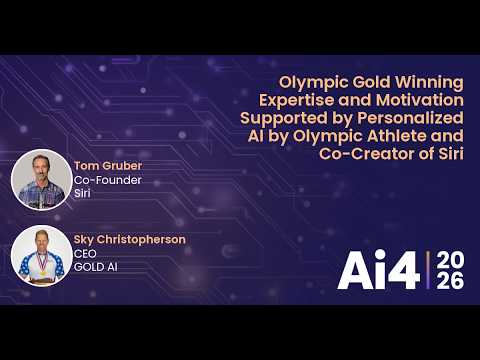
Siri Co-Founder, Ex-Olympian Launch GOLD AI to Fight Metabolic Sickness
Ai4
Applying Olympic quantified-self protocols via synthetic AI coaches can reverse metabolic disease at scale because daily behavioral interventions outweigh genetic factors.
## Background
This content was published on YouTube by Ai4 on August 21, 2026. The description introduces GOLD, an AI and human-powered health app that translates Olympic medal-winning innovation into personalized, real-time guidance for metabolic health, fitness, and overall well-being.
## TL;DR
Former Olympic cyclist Sky Christopherson and Siri co-founder Tom Gruber present GOLD AI, a health platform designed to combat the widespread metabolic health crisis by scaling elite athletic coaching methods. Christopherson details how data-driven N-of-1 experiments led to track cycling world records and an Olympic medal for the underdog US Women's Track Cycling team. Gruber explains how combining deterministic scientific algorithms with conversational AI avatars transforms raw biometric tracking into accessible, real-time daily motivation. The presentation highlights key hardware partnerships, agentic proactive coaching models, and the strategy to scale Olympic expertise to the general public.
## Atmosphere & style
The presentation carries an inspiring and visionary tone, balancing hard-hitting health statistics with narrative storytelling. Christopherson brings personal authenticity and emotional weight, contrasting the dark realities of elite doping scandals and startup burnout with the dramatic triumph of the London Olympics. Gruber adds authoritative tech-pioneer energy, shifting the atmosphere into a grounded yet ambitious exploration of humanistic AI. Watching the session feels like witnessing an intimate, high-level tech keynote that seamlessly weaves personal vulnerability, scientific rigor, and revolutionary health tech ambition.
## Key takeaways
- [00:03](https://www.youtube.com/watch?v=gHTbjVsNqGw&t=3s) Over 60% of adult Americans live with a chronic illness, driven primarily by widespread metabolic dysfunction where only 12% are metabolically healthy.
- [00:03](https://www.youtube.com/watch?v=gHTbjVsNqGw&t=3s) Tom Gruber introduces 'humanistic AI', emphasizing that artificial intelligence should tackle critical human challenges like chronic health rather than trivial tasks.
- [02:55](https://www.youtube.com/watch?v=gHTbjVsNqGw&t=175s) Sky Christopherson highlights how traditional sports and startup cultures often glorify overwork and sleep deprivation, ignoring physiological health.
- [02:55](https://www.youtube.com/watch?v=gHTbjVsNqGw&t=175s) Using an N-of-1 quantified self approach, Christopherson discovered that cooling ambient sleep temperature to 60°F restored deep slow-wave sleep and enabled a world-record track cycling performance.
- [09:50](https://www.youtube.com/watch?v=gHTbjVsNqGw&t=590s) The US Women's Track Cycling team applied longitudinal data science tracking sleep, meal timing, and light exposure to overcome 50-to-1 odds and win an Olympic medal.
- [09:50](https://www.youtube.com/watch?v=gHTbjVsNqGw&t=590s) Manual high-touch coaching creates a severe scalability bottleneck, requiring AI and software automation to bring personalized Olympic-level guidance to the general public.
- [20:54](https://www.youtube.com/watch?v=gHTbjVsNqGw&t=1254s) GOLD AI combines deterministic scientific algorithms backed by eight patents with synthetic conversational avatars to scale personal health coaching globally.
- [26:06](https://www.youtube.com/watch?v=gHTbjVsNqGw&t=1566s) Effective health behavior change requires shifting from raw metric tracking to forward-looking, real-time guidance and continuous emotional motivation.
- [26:06](https://www.youtube.com/watch?v=gHTbjVsNqGw&t=1566s) The GOLD AI interface acts like a real-time navigation system, continuously recalculating daily recommendations when disruptions occur.
- [32:01](https://www.youtube.com/watch?v=gHTbjVsNqGw&t=1921s) Partnerships with hardware providers like BioLink aim to enable continuous multi-marker sensing, including glucose, cortisol, lactate, and hormones.
- [35:20](https://www.youtube.com/watch?v=gHTbjVsNqGw&t=2120s) The system architecture uses frontier LLMs primarily for natural conversational interaction, while relying on deterministic medical and performance logic for core advice.
- [35:20](https://www.youtube.com/watch?v=gHTbjVsNqGw&t=2120s) Background agentic workflows allow the virtual coach to continuously monitor continuous data streams and proactively initiate nudges and check-ins.
## Detailed walkthrough
### [00:03](https://www.youtube.com/watch?v=gHTbjVsNqGw&t=3s) The Metabolic Health Crisis and Humanistic AI
Former elite athlete Sky Christopherson opens the presentation by polling the audience on how many people wake up feeling refreshed and energized. Turning the floor over to Siri co-founder Tom Gruber, Gruber frame-shifts the topic around his concept of "humanistic AI"—the idea that artificial intelligence should be applied to humanity's hardest, most critical challenges rather than just low-hanging fruit. He singles out human health as one of the most urgent global problems, noting that over 60% of adult Americans live with at least one chronic illness, such as type 2 diabetes, hypertension, or cardiovascular disease.
Gruber highlights that at the core of this chronic disease epidemic lies metabolic syndrome, which is evaluated through five objective clinical measures: blood sugar, blood lipids, visceral fat, blood pressure, and related markers. If an individual is out of range on three or more of these parameters, they are clinically considered very sick—a threshold currently met by 42% of the US population. Even more alarming is the inverse statistic: a staggering 87.5% of adult Americans are metabolically unhealthy, leaving only 1 in 8 (12%) in normal range. Among older demographics, Gruber notes that as few as 2% are metabolically healthy without relying on pharmaceutical interventions like statins or blood pressure medications.
- **Chronic Disease Burden**: 60%+ of US adults live with a chronic condition like diabetes or cardiovascular disease.
- **Metabolic Syndrome Criterion**: Clinical diagnosis relies on 5 objective criteria (blood glucose, blood fats, visceral fat, blood pressure, etc.); failing 3 indicates severe illness.
- **Population Severity**: 42% of US adults qualify as clinically sick under metabolic syndrome criteria.
- **Healthy Population Baseline**: Only 1 in 8 (12%) of US adults are metabolically healthy; for older demographics without medications, that figure drops to roughly 2%.
---
[02:55](https://www.youtube.com/watch?v=gHTbjVsNqGw&t=175s) Clean Cycling, Startup Burnout, and the N-of-1 Experiment
Sky Christopherson takes over to share his personal trajectory from elite cycling to entrepreneurship. As a member of the US National Track Cycling Team for Project 96 ahead of the Atlanta Olympics, he experienced firsthand a sport deeply compromised by systemic doping. Christopherson recounts how his team's East German training templates were engineered to complement illegal performance-enhancing drugs. While teammates like Lance Armstrong embraced blood doping and EPO, clean riders like Sky wore white armbands marked "clean" in felt-tip marker as a silent protest. Frustrated by rampant sickness, injury, and rampant cheating, Sky retired from professional cycling, moved to UC San Diego, and eventually entered the Seattle tech startup scene.
In the startup world, Sky found a toxic work culture where sleep deprivation and all-nighters were celebrated as badges of honor. He observed a sharp contrast between sports, where the founder's physical core is the primary asset, and business, where all Key Performance Indicators (KPIs) center on the venture while ignoring human health. Over a few years, his physical condition degraded to the point where he suffered an emergency room scare for a suspected heart attack, compounded by severe physical ailments like anal fissures caused by prolonged sedentary computer work.
A turning point came at a TEDx event where cardiologist Dr. Eric Topol delivered a talk titled *"Living by Numbers: The Personal Digital Health Revolution."* Inspired by Topol's vision of the "quantified self," Sky partnered with Topol as an advisor to design an "N-of-1" tracking experiment using newly available consumer health hardware—including continuous glucose monitors (CGMs) and Zeo sleep-tracking headbands. While training to break a track cycling world record at age 35, Sky noticed a troubling monthly drop in his deep slow-wave sleep. Suspecting room temperature rather than overtraining or stress, he introduced a water-cooled mattress topper set to 60°F. The intervention dramatically restored his deep sleep and recovery, allowing him to successfully break the world record—a record previously held by an athlete serving a lifetime ban for testosterone use.
- **Project 96 & Doping Split**: US Cycling's training program relied on East German templates designed for drug use; clean athletes wore "clean" armbands in protest before retiring.
- **Startup Culture vs. Athletic KPIs**: Tech startup cultures glorify sleep deprivation, tracking business KPIs while completely ignoring founder and team physiological health.
- **Health Crisis Point**: Extreme sedentary strain led to systemic infection and an ER admission for suspected cardiovascular heart attack.
- **N-of-1 Sleep Discovery**: Deep slow-wave sleep was dropping monthly during high-volume training; dropping ambient sleep temperature to 60°F via a water-cooled mattress topper restored full deep sleep recovery.
- **World Record Milestone**: At age 35, Christopherson broke the track cycling world record previously held by a banned doper using data-driven physiological optimization.
---
[09:50](https://www.youtube.com/watch?v=gHTbjVsNqGw&t=590s) The Women's Track Cycling Team & The Personal Gold Project
Following the exposure of Lance Armstrong's doping scandal and the fallout between Floyd Landis and Armstrong, the US men's track cycling program collapsed. Just five months prior to the London Olympic Games, the underfunded US Women's Track Cycling team stood as the country's sole remaining hope on the velodrome, facing daunting 50-to-1 odds against powerhouse nations like Great Britain, Australia, and France. Possessing no corporate funding, a single coach, and zero support staff, team member Jenny Reed accepted Sky Christopherson's offer to implement an intensive N-of-1 quantified self protocol.
Lacking budget for professional personnel, the project recruited the athletes' husbands to handle logistics—cooking, cleaning, laundry, and daily chores—so the cyclists could focus exclusively on training, data logging, and recovery. Generating vast streams of longitudinal data across sleep, nutrition, heart rate, and training intensity, the team partnered with data scientists to visualize multi-variate correlations using circular relationship diagrams. The data revealed critical performance levers: stabilizing blood sugar spikes through precise meal timing and eliminating late-night hotel room light exposure by physically unscrewing light bulbs.
At the London Olympics, the underdog US team advanced to the semifinals against Australia. Behind early in the race by two full seconds, the women mounted an extraordinary comeback, crossing the finish line ahead of Australia by just 8/100ths of a second (0.08s) to break their lifetime best track time by three seconds. The ride secured the first US women's track cycling Olympic medal in 20 years. The story was captured in the feature documentary *Personal Gold*, which was acquired by Netflix and screened globally. However, as audience members repeatedly asked how to apply these methods to their own lives, Christopherson found himself overwhelmed by the impossibility of manually scaling high-touch coaching to thousands of individuals—setting the stage for AI-driven personal health guidance.
- **Olympic Team Odds**: The US Women's Track Cycling team entered the London Olympics as 50-to-1 underdogs with no official support staff or budget.
- **Data Interventions**: Uncovered performance gains by correcting blood sugar drops via meal timing and unscrewing bright lightbulbs in hotel rooms to safeguard sleep quality.
- **Historical Victory**: Beat Australia in the semifinal by 0.08 seconds, trimming 3 seconds off their personal best and claiming the first US women's track cycling medal in two decades.
- **Scalability Bottleneck**: Following the release of the documentary *Personal Gold*, manual coaching proved impossible to scale beyond a handful of individuals without software automation.
[20:54](https://www.youtube.com/watch?v=gHTbjVsNqGw&t=1254s) Meeting Tom Gruber and Scaling Olympic Expertise
Sky Christopherson recounts meeting Tom Gruber through Apple’s health and fitness team, including Jake Blanik and Jules Arney. Upon learning Gruber was on campus, Christopherson met him over coffee at the Apple café. Inspired by Gruber’s humanistic approach to technology, Christopherson asked him to join GOLD AI as a founding adviser. Gruber brings experience scaling AI from his time co-founding Siri, which grew to handle roughly one billion uses per day. Addressing the challenge of scaling a high-touch coaching service beyond ten clients to millions, Gruber draws parallels to Siri's origins, where synthetic personal assistant avatars offered a scalable model that Steve Jobs championed.
- Siri was designed as a synthetic assistant model to scale personalized support to a global user base.
- Gruber highlights that AI assistant models remain the dominant delivery mechanism across major foundation labs today.
- GOLD AI aims to take the "N-of-4" Olympic athlete insights and apply them to metabolic health for the general public.
- Eric Topol’s meta-review for his research on super-agers and longevity highlights that daily behavior is significantly more influential than genetics in determining health outcomes.
[26:06](https://www.youtube.com/watch?v=gHTbjVsNqGw&t=1566s) Moving Beyond Numbers to Personalized Motivation
Gruber explains that basic daily recommendations do not require cutting-edge AI, as standard health advice is well-understood. Instead, modern AI is critical for two key capabilities: personalizing recommendations to fit an individual’s daily life and providing continuous motivation. While quantified self-tracking historically appealed to "nerds and geeks," achieving mainstream impact requires shifting from raw metric tracking to actionable, real-time guidance.
```
+-------------------------------------------------------------------+
| GOLD AI SYSTEM FLOW |
+-------------------------------------------------------------------+
| [ Biometric Sensors & User Input ] (Continuous Data Streams) |
| | |
| v |
| [ Deterministic Algorithms ] (8 Core Patents / Science Model) |
| | |
| v |
| [ LLM & Conversational Avatar ] (Personalized Action / Voice) |
+-------------------------------------------------------------------+
```
- Real-time advice adapts to unexpected metabolic responses, such as recommending light exercise immediately following a high-carbohydrate meal to manage blood sugar spikes.
- The interface functions like a navigation system, continually recalculating daily schedules when real-world disruptions or lifestyle choices (e.g., caffeine or alcohol consumption) occur.
- Beyond metric tracking, emotional support and feeling cared for were identified by Olympic cyclists as crucial factors in achieving breakthroughs.
[32:01](https://www.youtube.com/watch?v=gHTbjVsNqGw&t=1921s) Product Architecture, Partnerships, and Conversational Interface
Christopherson introduces GOLD AI, a company created to channel the inspirational feeling of Olympic victory into continuous personal support. Rather than relying on traditional fitness apps filled with historical graphs, GOLD AI focuses on a forward-looking time horizon of the next few hours, answering the core question: "What should I do and when?" The system combines deterministic core algorithms backed by eight patents with large language models (LLMs) used to drive scalable conversational avatars.
- GOLD AI is pursuing a partnership with Team USA to create a pipeline for Olympians and contenders to serve as AI coaching personalities.
- Hardware partner BioLink is developing a DNA aptamer-based patch sensor for continuous monitoring of glucose, cortisol, lactate, testosterone, and estrogen.
- Discussions are also underway for integration with the Oura Ring.
- The company completed a pre-seed round and is initiating further financing in the San Francisco Bay Area while onboarding early adopters.
[35:20](https://www.youtube.com/watch?v=gHTbjVsNqGw&t=2120s) Audience Q&A: LLM Infrastructure and Agentic Workflows
During the Q&A session, an audience member inquires about the specific LLM powering the application. Gruber and Christopherson clarify that they have not committed to a single frontier model, as the core health recommendations rely on deterministic algorithms. The primary requirement for the LLM is conversational fluency, context management, and cost-efficiency to keep the product accessible to consumers. Addressing a second question regarding agentic capabilities, Gruber explains that the AI operates on a continuous background loop to proactively nudge users based on real-time data changes.
- The application uses LLMs for natural language interaction while relying on proprietary, deterministic models for medical and performance logic.
- To ensure widespread consumer adoption, the architecture balances conversational performance with low compute costs per user.
- Proactive agentic features allow the virtual coach to monitor data 24/7 and initiate check-ins when users miss planned activities.
## Notable quotes
> [02:55](https://www.youtube.com/watch?v=gHTbjVsNqGw&t=175s) Living by Numbers: The Personal Digital Health Revolution. — Sky Christopherson
> [00:03](https://www.youtube.com/watch?v=gHTbjVsNqGw&t=3s) humanistic AI — Tom Gruber
> [32:01](https://www.youtube.com/watch?v=gHTbjVsNqGw&t=1921s) What should I do and when? — Sky Christopherson
## Mentioned
Tom Gruber, Sky Christopherson, Siri, GOLD AI, Ai4, Apple, Jake Blanik, Jules Arney, Eric Topol, Jenny Reed, Lance Armstrong, Floyd Landis, Team USA, BioLink, Oura Ring, TEDx, Personal Gold, Netflix, UC San Diego, US National Track Cycling Team
## Video description
Tom Gruber - Co-Founder, Siri
Sky Christopherson - CEO, GOLD AI
Witness the world premier launch of GOLD — the app that turns medal-winning innovation into simple, real-time guidance for your health and fitness goals. Always by your side with AI and supported by real coaches. All ages. All levels.
GOLD is an AI and human-powered health app that brings Olympic medal-winning innovation into everyday life. It uses AI personas modeled after real Olympians to deliver world-class expertise in a way that feels personal, motivating, and simple to follow—along with optional live coaching when you want human support. From meals and movement to sleep and recovery, GOLD turns proven methods into real-time guidance that helps anyone improve health, well-being, and quality of life, one day at a time.
See the product on stage in conversation with Olympic athlete Sky Christopherson and AI expert Tom Gruber, co-creator of the first mainstream AI product that is used billions of times daily.
Former elite cyclist Sky Christopherson and Siri co-founder Tom Gruber argue that the widespread chronic health crisis can be mitigated by translating Olympic-level 'N-of-1' biometric tracking into scalable, personalized AI guidance that emphasizes daily behavioral motivation over passive data tracking.
The Chronic Disease Crisis and Metabolic Syndrome (0:03)
Siri co-founder Tom Gruber frames personal health as an urgent application for 'humanistic AI,' arguing that artificial intelligence should address society's most difficult problems rather than minor conveniences. Gruber highlights that over 60% of adult Americans live with at least one chronic illness, such as cardiovascular disease, hypertension, or type 2 diabetes. Underlying this trend is metabolic syndrome, which clinicians evaluate using five objective markers: blood sugar, blood lipids, visceral fat, blood pressure, and related metrics.
According to Gruber, failing three or more of these markers indicates severe illness, a threshold currently met by 42% of the United States adult population. Overall, 87.5% of adult Americans are metabolically unhealthy, leaving only 12% (1 in 8) within normal clinical ranges. Among older populations not taking prescription medications such as statins or blood pressure drugs, Gruber notes that as few as 2% remain metabolically healthy.
N-of-1 Biometrics and Personal Recovery (2:55)
Sky Christopherson details his transition from the US National Track Cycling Team—where systemic doping led clean athletes to retire in protest—to the tech startup sector. In the technology industry, Christopherson encountered a culture celebrating severe sleep deprivation, tracking enterprise metrics while neglecting physical health. This lifestyle culminated in severe physical ailments and an emergency room admission for a suspected heart attack.
Prompted by cardiologist Dr. Eric Topol's research on the 'quantified self' and findings that daily behavior outweighs genetics in longevity, Christopherson launched a personalized 'N-of-1' tracking experiment using continuous glucose monitors and sleep headbands. While training at age 35 to break a track cycling world record, data showed regular drops in his deep slow-wave sleep. By cooling his mattress to 60°F, Christopherson restored his deep sleep cycles and broke the world record, which had previously been set by an athlete later banned for testosterone use.
Olympic Breakthrough and the Scalability Bottleneck (9:50)
Five months before the 2012 London Olympics, the underfunded US Women's Track Cycling team entered the competition as 50-to-1 underdogs with no official support staff. Christopherson applied the N-of-1 quantified self methodology to the squad, relying on the athletes' spouses for daily logistics while data scientists tracked sleep, glucose, heart rate, and training loads. Multivariate analysis revealed that precise meal timing stabilized glucose levels and removing hotel light bulbs eliminated late-night light pollution, safeguarding recovery.
The intervention culminated in the team cutting three seconds off their lifetime best and edging out Australia by 0.08 seconds in the semifinals to secure the first US women's track cycling medal in 20 years. While chronicled in the documentary *Personal Gold*, Christopherson found that delivering this manual, intensive coaching model could not scale to meet broad consumer demand without software automation.
Architecting Scalable Conversational AI for Health (26:06)
To transition from manual coaching to an automated platform, Christopherson and Gruber established GOLD AI. Gruber explains that standard health recommendations are already well established; the true barrier is real-time personalization and sustained motivation. Drawing from Siri's synthetic assistant framework, the platform shifts user focus away from retrospective graphs toward immediate, forward-looking guidance answering what an individual should do over the next few hours.
The system utilizes a hybrid technical architecture: core health logic and schedule adjustments are handled by deterministic, patented algorithms, while commercial large language models (LLMs) provide natural language interactions and avatar interfaces. Rather than committing to a single frontier LLM, the company prioritizes conversational capability and compute cost efficiency. Operating via an agentic background loop, the virtual coach monitors real-time biometric streams—incorporating data from wearables like Oura and emerging continuous sensors from partners like BioLink—to proactively prompt users when disruptions occur.
GOLD AI seeks to adapt elite athletic optimization for general metabolic health by pairing deterministic physiological models with proactive conversational agents. The venture's long-term impact depends on successfully converting high-touch athletic protocols into everyday consumer habits, managing compute costs per user, and validating emerging continuous biosensors like aptamer-based patches.
## Background
该视频由 YouTube 频道 Ai4 于 2026 年 8 月 21 日发布。视频内容为 Siri 联合创始人 Tom Gruber 与 GOLD AI 首席执行官、前奥运自行车选手 Sky Christopherson 的现场对谈,正式发布基于个性化 AI 与奥运冠军经验的健康应用 GOLD,旨在将顶尖运动健康理念带给大众。
## TL;DR
面对现代社会高达 42% 成年人患有代谢综合征的严峻健康危机,前奥运自行车选手 Sky Christopherson 结合自身从过度透支到通过“量化自我”打破世界纪录并带领美国女子车队逆袭夺牌的真实经历,联合 Siri 联合创始人 Tom Gruber 共同打造了 GOLD AI。该应用摒弃传统健康软件滞后的历史图表,基于 8 项专利确定性算法与四大健康支柱,以如同实时导航般的动态调度指导用户“何时做何事”。产品通过真实奥运选手为原型的 AI 对话式化身与 24/7 主动式 Agent,将原本昂贵的精英级运动健康指导规模化普及给普通大众。
## Atmosphere & style
整场对谈兼具深刻的危机警示与振奋人心的竞技叙事,开场即用严峻的代谢健康数据击中现代人的生活痛点。随着 Sky 讲述队内对抗兴奋剂的暗淡岁月、硅谷创业透支崩塌,再到绝境中依靠微观数据实现 0.08 秒奥运奇迹的跌宕起伏,现场气氛由沉重逐渐转为热血与震撼。Tom Gruber 的宏大人文视角与工程沉淀,与 Sky 的运动员坚韧特质形成了完美互补,让观众既能感受到硬核科技与运动科学的严谨,又能体会到充满温度的情绪共鸣与陪伴感。
## Key takeaways
- [00:03](https://www.youtube.com/watch?v=gHTbjVsNqGw&t=3s) 全球代谢健康陷入严峻危机,美国仅12.5%的成年人代谢指标完全正常,技术界亟需从追求短期商业利益转向利用AI攻克慢性病等人类根本健康难题。
- [03:00](https://www.youtube.com/watch?v=gHTbjVsNqGw&t=180s) 盲目套用针对服药者的传统高强度训练模板,加之科技创业圈将睡眠剥夺浪漫化的文化,印证了忽视个体生理底盘与健康指标所带来的严重代价。
- [06:35](https://www.youtube.com/watch?v=gHTbjVsNqGw&t=395s) “量化自我”个体实验表明,通过连续数据监测锁定环境温度对慢波深睡眠的抑制并引入水冷床垫干预,能以纯自然恢复的方式打破世界纪录。
- [09:48](https://www.youtube.com/watch?v=gHTbjVsNqGw&t=588s) 在兴奋剂丑闻摧毁车队、女子队毫无官方科研支持且夺牌赔率仅1:50的绝境下,全套“N of 1”数据驱动模型成为备战伦敦奥运的核心转折点。
- [12:07](https://www.youtube.com/watch?v=gHTbjVsNqGw&t=727s) 机器学习关联分析确立了健康与运动表现的四大支柱(睡眠恢复、膳食营养、运动训练、心态压力),微观数据干预能带来决定性的边际增益。
- [15:48](https://www.youtube.com/watch?v=gHTbjVsNqGw&t=948s) 数据驱动方案助力美国女子队以不可思议的0.08秒优势逆转夺牌并打破20年奖牌荒,纪录片《Personal Gold》引发了公众对专业健康指导普及化的迫切需求。
- [19:13](https://www.youtube.com/watch?v=gHTbjVsNqGw&t=1153s) 传统高接触(High-touch)人类专家指导受限于人力难以普惠大众,促成了奥运冠军团队与Siri联合创始人携手探索规模化教练方案。
- [22:16](https://www.youtube.com/watch?v=gHTbjVsNqGw&t=1336s) 实现从“AI即个人助理(Siri模式)”到“AI即个人教练”的范式跃迁,旨在通过合成替身将少数精英专享的顶级教练能力赋能给普通大众。
- [24:11](https://www.youtube.com/watch?v=gHTbjVsNqGw&t=1451s) 改善代谢健康的核心在于行为改变而非盲目加压,长期医学研究证实后天生活习惯对健康长寿的决定性影响远超先天基因。
- [26:06](https://www.youtube.com/watch?v=gHTbjVsNqGw&t=1566s) 现代健康AI的价值在于超越冷冰冰的极客式量化自我,将泛化的健康常识转化为针对当下的“实时动态调控”与“持续心理激励”。
- [28:18](https://www.youtube.com/watch?v=gHTbjVsNqGw&t=1698s) 摒弃传统健康软件回顾滞后图表的误区,引入顶级运动员的前瞻性调度思维,核心回答用户“接下来几小时内该做什么、何时去做”。
- [30:08](https://www.youtube.com/watch?v=gHTbjVsNqGw&t=1808s) 系统采用类似GPS导航的动态调度机制,当日程变动时自动重算饮食与活动安排,并结合反直觉的代谢干预保护线粒体细胞能量与夜间睡眠。
- [32:16](https://www.youtube.com/watch?v=gHTbjVsNqGw&t=1936s) 采用双层技术架构设计:由8项专利的确定性算法确保生理干预指令的严谨可靠,由大语言模型(LLM)与奥运数字化身提供有温度的共情交互。
- [35:20](https://www.youtube.com/watch?v=gHTbjVsNqGw&t=2120s) 消费级健康应用并不依赖前沿尖端大模型,核心在于确定性健康算法与极低LLM推理成本的平衡,以确保产品的大规模普及与平价可用。
- [37:00](https://www.youtube.com/watch?v=gHTbjVsNqGw&t=2220s) 针对健康数据碎片化痛点,AI Agent需具备7×24小时后台持续监测与主动介入调控的能力,并提供随叫随到的实时通话支持。
## Detailed walkthrough
### [00:03](https://www.youtube.com/watch?v=gHTbjVsNqGw&t=3s) 代谢综合征危机:当今社会的慢性健康陷阱
会议以一个看似轻松的互动开场:台下有多少人早晨醒来时感到精力充沛、神清气爽?Siri 的联合创始人 Tom Gruber 随即接过话题,将这一日常感受引向了更深层的严肃议题。Gruber 回顾了自己前一天关于“人文主义人工智能”(Humanistic AI)的演讲,再次呼吁 AI 界不应只盯住唾手可得的商业利益,而必须利用技术去攻克关乎人类命运的重大核心难题——其中首当其冲的便是全球性的健康危机。以美国为例,超过 60% 的成年人正长期遭受糖尿病、高血压、心血管疾病等慢性病的折磨,而绝大多数慢性病的根源,都指向了同一个底层病理状态:代谢综合征(Metabolic Syndrome)。
代谢综合征并非玄学,而是由临床医学长期定义的五项客观生理指标构成的评估体系:空腹血糖、血脂、内脏脂肪(腰围/体脂分布,而非单纯的体重数值)以及血压等。在长达数十年的临床医学标准中,如果一个人在这五项指标中有三项超出正常范围,就会被判定为临床意义上的“重病患者”。令人震惊的是,目前已有 42% 的美国成年人处于这种严重的患病状态,演变成了一场无声却致命的慢性危机。人类在漫长的进化中本应拥有健康的代谢系统,然而现状却是:仅有八分之一(约 12.5%)的美国成年人能够维持正常的代谢功能;而在 Gruber 所在的年龄段,不依靠降压药、他汀类降脂药等药物干预能够保持代谢健康的比例甚至仅有惨淡的 2%。面对这场严峻的健康危机,Gruber 正式引出连续创业者、前奥运自行车运动员 Sky Christopherson,由他分享如何从竞技体育的至暗时刻走向数字化健康革命。
- **慢性病蔓延现状**:美国超过 60% 的人群患有至少一种慢性疾病,42% 的人口满足代谢综合征的重症诊断标准(五项关键生理指标中有三项异常)。
- **正常代谢极为罕见**:仅有 1/8(12.5%)的成年人代谢指标完全正常;在老年群体中,未借助处方药物而实现代谢完全健康的比例仅占 2%。
```mermaid
flowchart TD
accTitle: 代谢综合征与健康危机演进逻辑
subgraph S1["临床指标与诊断"]
A["5大核心生理指标<br/>(血糖 / 血脂 / 血压 / 内脏脂肪等)"] --> B{"是否有 3 项及以上超标?"}
B -- "是 (42% 美国人群)" --> C["确诊为临床重病 / 代谢综合征"]
B -- "否 (仅 12.5% 完全健康)" --> D["正常代谢机能 (老年无药健康仅 2%)"]
end
subgraph S2["后果与慢性疾病"]
C --> E["心血管疾病"]
C --> F["2型糖尿病"]
C --> G["高血压及其他退行性病变"]
end
```
---
### [03:00](https://www.youtube.com/watch?v=gHTbjVsNqGw&t=180s) 从奥运体制到创业至暗:传统模板训练与恶性加班文化的代价
Sky Christopherson 登台后直言,如果扣除极少数职业运动员,普通大众的代谢健康状况恐怕比“八分之一”的数据更加糟糕。Sky 回忆了自己在 1996 年亚特兰大奥运会前夕入选美国国家自行车队“96计划”(Project 96)的往事。当时队伍虽然配备了顶级装备,但训练模式却完全照搬从前东德购买的固定训练模板(Template Training)——而这套模板本质上是专门为配合违禁药物(兴奋剂)打造的高负荷方案。Sky 与兰斯·阿姆斯特朗(Lance Armstrong)师从同一位教练,队内逐渐分裂为两派:一边是系统性使用兴奋剂的选手,另一边则是坚持干净参赛的运动员。坚持不服药的 Sky 与队友们感到无比痛苦与愤怒,甚至在比赛时用马克笔在白袖标上写下“CLEAN”(干净)以示抗议。在严苛模板的过度消耗下,未服药选手的身体频繁出现伤病和感染,心灰意冷的 Sky 最终选择退役,彻底离开自行车运动。
退役后,Sky 先后前往加州大学圣地亚哥分校(UC San Diego)和西雅图投身科技创业,却一头扎进了硅谷盛行的恶性创业文化中。在这个圈子里,通宵达旦、剥夺睡眠被当成“荣誉勋章”互相炫耀。作为一名前运动员,Sky 感到极为荒谬:“在商业世界里,所有 KPI 都聚焦在公司业务指标上,完全没有人关注核心团队和创始人的身体健康 KPI,但对运动员而言,身体机能才是唯一的底盘。”长期透支最终带来了毁灭性的身体崩塌。几年后的一天,Sky 因剧烈不适被救护车紧急送医,医护人员甚至一度贴上电极片怀疑他突发心肌梗死。虽然最终排除了心梗,但他的血压高得惊人,多项生理指标全面亮起红灯。雪上加霜的是,由于长期久坐电脑前,他患上了严重的肛裂,导致细菌侵入血液循环,整个人陷入了彻底的极度衰竭与绝望之中。
- **前东德训练模板的毒性**:盲目照搬专为服药选手设计的高强度模板,导致坚持自然训练的纯净运动员频繁发生免疫崩溃与运动损伤。
- **创业文化的错位关注**:过度追求商业 KPI,忽视创始人与核心团队的生物学健康指标,将睡眠剥夺和慢性透支浪漫化。
- **健康危机的爆发**:长期的久坐与高压导致 Sky 出现疑似心梗症状、严重高血压及局部组织感染引发的全身性代谢耗竭。
---
### [06:35](https://www.youtube.com/watch?v=gHTbjVsNqGw&t=395s) 量化自我与个体实验:利用数据打破世界纪录
正当 Sky 处于人生低谷时,一场 TEDx 演讲彻底改变了他的轨迹。著名数字医学先驱 Eric Topol 发表了题为《数字化生活:个人数字健康革命》(Living by Numbers: The Personal Digital Health Revolution)的演讲,系统阐述了“量化自我”(Quantified Self)的理念——即利用新兴的消费级连续监测设备(如睡眠监测、连续血糖监测等),建立个人健康的数据看板。受到启发的 Sky 主动邀请 Eric Topol 担任顾问,启动了一场针对自身的“N of 1”(个体单样本)生物追踪实验。随着身体各项指标逐步恢复,Sky 设立了一个大胆的目标:以 35 岁的年龄打破场地自行车世界纪录。
在严密监测训练的过程中,Sky 借助 Zeo 脑电睡眠头带追踪自身的慢波睡眠(深睡眠)。然而数据却显示,从 1 月、2 月到 3 月,随着训练推进,他的深度睡眠时长竟出现了逐月下降的诡异趋势。现场观众猜测这可能是训练压力或心理焦虑所致,但 Sky 通过排除法锁定了真正的变量:随着春夏季节交替,由于西雅图的住处没有安装空调,室温持续上升阻碍了体温下降。为了验证这一假设,Sky 引入了水冷降温床垫,在夜间将床铺温度强行降至 60 华氏度(约 15.5 摄氏度)。数据反馈立竿见影——慢波深度睡眠时间出现报复性反弹,白天的精神状态和体能储备也随之彻底逆转,彻底消除了午后的疲惫感。最终,35 岁的 Sky 凭借科学的数据化恢复策略成功打破了世界纪录。更具讽刺意味的是,该纪录的原保持者曾因使用睾酮类兴奋剂被终身禁赛,却因规则漏洞保留了该项纪录;Sky 用纯粹的数据干预与自然恢复,完成了对药物作弊者的终极正名。
- **量化自我理念引入**:将原本用于商业的 KPI 思维转移至人体生物学指标,利用可穿戴设备实现连续数据闭环。
- **温度与深睡眠干预**:利用水冷床垫将睡眠环境温度精准控制在 60°F(约 15.5°C),直接逆转了由于夏季室温上升导致的慢波睡眠(Slow-wave sleep)流失。
- **打破药物神话**:在 35 岁高龄、零药物辅助的情况下,打破了由终身禁赛兴奋剂选手保持的世界纪录。
```mermaid
flowchart LR
accTitle: 个体量化实验与深睡眠恢复流程
subgraph DataTracking["连续数据监测"]
A["Zeo 脑电头带<br/>监测慢波深睡眠"] --> B["发现异常趋势:<br/>1月至3月深睡眠逐月下降"]
end
subgraph Hypothesis["假设与归因"]
B --> C{"排查核心诱因"}
C -- "排除训练与压力" --> D["锁定环境因素:<br/>西雅图无空调导致室温上升"]
end
subgraph Intervention["干预与突破"]
D --> E["引入水冷床垫<br/>(降温至 60°F / 15.5°C)"]
E --> F["深睡眠时长报复性反弹<br/>身体恢复力与日间精力大幅提升"]
F --> G["35岁打破世界纪录<br/>击败兴奋剂保持者"]
end
```
---
### [09:48](https://www.youtube.com/watch?v=gHTbjVsNqGw&t=588s) 绝境突围:伦敦奥运前夕的女子自行车数据救赎
在 Sky 迎来个人突破的同时,美国场地自行车界却因兴奋剂丑闻陷入了彻底的毁灭。兰斯·阿姆斯特朗与其前队友弗洛伊德·兰迪斯(Floyd Landis)在幕后彻底决裂。面对阿姆斯特朗摧毁其名誉的威胁,兰迪斯毅然选择向媒体全盘托出车队系统性服药的内幕。随着阿姆斯特朗在奥普拉访谈中做出毫无悔意的公开承认,美国男子场地自行车队树倒猢狲散,整个国家队体系被完全解散。距离 2012 年伦敦奥运会仅剩五个月的时间,全美场地自行车项目仅存的火种落在了女子团体追逐赛队伍身上。然而,这支女子队伍面临着极其残酷的现实:没有任何官方资金支持、全队只有一名主教练、没有任何科研或后勤保障人员,外界给出的夺牌赔率低至 1 赔 50。
面对绝境,Sky 拨通了前国家队队友、女子车队核心成员珍妮·里德(Jennie Reed)的电话,提议将这套行之有效的“量化自我 N of 1”数据实验全套复制给女子车队,帮助她们备战伦敦奥运会。队伍在西班牙设立了简陋的训练营,由于没有预算聘请专业保障团队,随行前往西班牙探亲的队员丈夫们被当场“抓了壮丁”——这些原本以为只是来度假加油的家属,不得不承担起全部的数据采集、后勤支持与日常保障工作。Sky 现场向观众展示了关于该项目的纪录片片段,揭示了他们如何通过实时监测每一位女性运动员的微观生理数据,逐步在落后、匮乏与不被看好的绝境中挖掘出突破人类体能极限的微小边际增益。
- **阿姆斯特朗丑闻的连锁冲击**:男子车队全军覆没并解散,美国场地自行车项目在伦敦奥运会前五个月仅剩女子队伍孤军奋战。
- **极度悬殊的资源差距**:女子车队夺牌赔率仅为 50:1,无任何官方资金与科研支持,由主教练与队员家属(丈夫们)临时组建后勤团队。
- **数据驱动的奥运实验**:将个体单样本(N of 1)量化健康模型应用于女子运动员的高强度备战,通过精准的睡眠、恢复与负荷监控实现逆风翻盘。
### [12:07](https://www.youtube.com/watch?v=gHTbjVsNqGw&t=727s) 数据过载与多维关联分析:四大健康支柱的早期干预
在备战奥运的高压节奏下,Sky Christopherson 与运动员之间形成了极其紧密的互信与协作。日常流程被精细切割为“训练、数据分析、进食、拉伸、按摩、再训练、再分析”的无休止循环,宛如将战士全副武装送上赛场。为了让运动员在训练之余得到充分的休息与恢复,Sky 几乎包揽了所有后勤杂务,从买菜、做饭、洗碗到打扫卫生和洗衣服。然而,当他们试图用手提电脑记录和处理海量生理指标时,数据量很快超出了个人处理能力的极限。Sky 意识到他们正站在重大发现的边缘,却受困于分析瓶颈,于是他联系了数据科学团队负责人 Stefan 寻求算力与分析支持。
Stefan 的团队利用机器学习技术对长期的多模态、多变量数据展开了深度挖掘,并绘制出一张圆环关系图谱(Circle Relationship Diagram)。图谱中不同维度之间的连线宽度直观展示了各项指标的关联强度。数据显示,运动员的训练表现、饮食摄入、睡眠质量以及环境压力之间存在着极其显著的高相关系数。基于这些强信号,团队确立了健康与运动表现的四大核心支柱:**睡眠与恢复(Sleep & Recovery)**、**膳食与营养(Meals & Nutrition)**、**运动与训练(Exercise & Training)**,以及**心态与压力负荷(Mindset & Stress / 皮质醇水平)**。
```mermaid
flowchart TD
accTitle: 四大支柱多维数据关联与干预模型
subgraph Pillars ["核心生理与行为支柱"]
A["睡眠与恢复<br/>(Sleep & Recovery)"]
B["膳食与营养<br/>(Meals & Nutrition)"]
C["运动与训练<br/>(Exercise & Training)"]
D["心态与压力<br/>(Mindset & Stress / Cortisol)"]
end
subgraph Interventions ["客观数据驱动的精准干预"]
E["环境控光:卸除睡房灯泡阻隔蓝光"]
F["动态调控:依据血糖曲线调整进餐时机"]
end
A <--> B
B <--> C
C <--> D
D <--> A
A --> E
B --> F
E & F --> G["赛场终极竞技表现提升"]
```
团队随即针对这些客观数据信号展开了微观层面的科学干预:
- **血糖波动调控**:监测日间血糖骤降(Blood sugar crash)现象,精准调整餐食搭配与进餐时机,平抑能量波动。
- **睡眠光环境干预**:为避免运动员睡前接触酒店房间的强光刺激,团队甚至亲自进入房间“把多余的灯泡拧下来”,确保无多余光源干扰褪黑素分泌。
- **综合表现提升**:这些细微干预的累加直接转化为赛道表现的稳步上升,让团队在动身前往伦敦时底气倍增。
---
### [15:48](https://www.youtube.com/watch?v=gHTbjVsNqGw&t=948s) 伦敦奥运逆转奇迹:0.08 秒的微光与纪录片《Personal Gold》
带着这套前沿的数据驱动方案,美国女子场地自行车队以不被看好的“绝对黑马(Underdogs)”身份奔赴 2012 年伦敦奥运会。在面对传统自行车强国澳大利亚、英国和法国的激烈竞争中,姑娘们一路杀入半决赛,迎来与澳大利亚队的决死一役。解说席直言,美国队若想保留争夺奖牌的希望,必须将历史最好成绩提升整整 3 秒以上。
比赛开局极为不利,澳大利亚队展现出凶猛攻势,赛程过半时美国队一度落后达 2 秒之多,现场解说和观众一度认为败局已定。然而在最后关头,队员 Sarah Hammer 带领全队发起绝地反扑,时间差距被一寸寸抹平。最终冲线时刻,美国队以 3 分 16 秒的成绩逆转取胜,领先优势仅有不可思议的 **0.08 秒(8/100 秒)**——短如一次眨眼。Sky 与团队在围栏边看到计分板亮起美国队排名第一时,甚至怀疑计时系统出现了故障。这一战打破了美国女子场地自行车长达 20 年的奥运奖牌荒。
这段由科技驱动、挑战生理极限的传奇经历随后被制作成长篇纪录片《Personal Gold》(时长 90 分钟),版权由 Netflix 购得,并在下一届奥运会黄金时段播出,团队还举办了 70 余场线下放映会。
---
### [19:13](https://www.youtube.com/watch?v=gHTbjVsNqGw&t=1153s) 从个人精力的瓶颈,到苹果园区偶遇 Siri 联合创始人
纪录片的广泛传播引发了公众意想不到的强烈共鸣。在多场展映会后,大量观众涌向 Sky,激动地拿出自己的健康数据与体检报告,急切地询问同一个问题:“我们普通人在日常生活中该如何做到这一点?我怎样才能拥有这样的突破并感觉更好?”面对大众对专业健康指导的渴望,Sky 却陷入了深深的无力感与瓶颈期。当时他甚至连一份宣传单页都拿不出,只能被动留下个人邮箱,随即被雪崩般涌入的咨询与数据请求彻底淹没——一对一的高接触(High-touch)专家支持根本无法单靠人力向成千上万的大众普及。
```mermaid
flowchart LR
accTitle: 从奥运高接触支持到大规模 AI 化的演进路径
A["奥运队高接触支持<br/>(1 对 1 专家团队)"] --> B["公众需求爆发<br/>(面临人力瓶颈与数据过载)"]
B --> C["苹果总部引荐<br/>(会面 Siri 联合创始人 Tom Gruber)"]
C --> D["构建 AI 个人教练<br/>(赋能数百万人实时精准指导)"]
```
带着“如何将少数精英享有的高规格支持规模化放大至千万人”的命题,Sky 前往苹果公司与健康与健身团队的 Jake Blanik 以及 Jules Arie 会面。会议尾声,苹果团队向 Sky 推荐了常驻园区的一位传奇人物——Siri 联合创始人 Tom Gruber,称他极度热衷于具有前瞻性、突破边界的特殊项目。当即发短信确认后,Tom 恰好在园区,两人便约在苹果员工咖啡厅见面。
这次对话给 Sky 留下了极其震撼的印象。在充斥着冰冷算力与芯片的数据世界里,Tom Gruber 展现出了宏大的思考格局与深厚的人文关怀(Humanistic approach)。两人一拍即合,自此保持长期深入探讨,Tom 随后正式出任 GOLD AI 的创始顾问,共同探索利用人工智能攻克规模化教练服务这一难题。
---
### [22:16](https://www.youtube.com/watch?v=gHTbjVsNqGw&t=1336s) “AI 即个人助理”的范式跃迁:打造人人可及的 AI 个人教练
作为兼具工程背景与前沿应用视野的 AI 先驱,Tom Gruber 阐释了他对“规模化(Scale)”的独到见解。在传统工程语境下,“规模化”往往意味着向硬件砸钱、堆砌成千上万的 CPU 与 GPU;然而在个性化健康领域,你无法简单地通过堆砌硬件来复制一个真实的人类专家。必须从产品隐喻和交互范式上寻找突破口——创造一个能够承载该项服务功能的“合成替身(Synthetic Placeholder)”。
Tom 回顾了 Siri 的诞生逻辑:其灵感可追溯至 1987 年苹果公司展示的“知识导航员(Knowledge Navigator)”概念片。当年开发团队立志让每个人都能拥有专属的个人助理(Personal Assistant)。这一构想得到了 Steve Jobs 的全力支持与推动,不仅打破了传统语音工具的局限,更确立了“AI 作为个人助理”的经典范式,至今该产品每天仍承载着约 10 亿次的交互,且各大主流基础模型实验室仍沿用这一架构。
如今,Tom 与 Sky 将这一成功范式迁移至大健康与运动领域,提出了 **AI 即个人教练(AI as a Personal Coach)** 的全新理念:
- **应用前景广阔**:教练指导(Coaching)在健康管理、运动健身、心理健康等垂直领域具有极高的落地价值。
- **超越单点工具**:不再局限于零散的数据记录,而是以拟人化、伴随式的智能体形式,将顶尖奥运级别的综合方法论转化为普通人每天触手可及的实时指引。
### [24:11](https://www.youtube.com/watch?v=gHTbjVsNqGw&t=1451s) 代谢健康的核心在于行为改变
讲座深入探讨了如何将奥运级别的专业指导转化为大众日常的代谢健康管理。这并不是教普通人每天去做多少个俯卧撑或跑多少圈,而是指导大家在维持正常生活与工作的同时,像奥运选手一样训练并获取顶级的代谢健康。这个挑战与“用 AI 寻找癌症疗法”截然不同——它本质上是一个人类行为学问题,AI 助手的真正使命是以规模化的方式,逐一改变每个人的日常健康行为。
创始顾问埃里克·托波尔(Eric Topol)在关于“超级老人”(SuperAgers)和长寿研究的大型元分析中指出,生活行为对健康的影响远远超出了学界以往的认知。过去人们往往侧重于先天基因与后天培养的争论,但科学数据表明,行为是决定长寿的最主要且可主动改变的因素。除了戒烟这种显而易见的常识,如何精准管理睡眠、运动与一日三餐,才是决定代谢健康的关键所在。
- 核心命题并非提升竞技极限,而是通过行为干预将普通人的代谢健康提升至奥运级水准。
- 埃里克·托波尔的研究证实:在决定健康与长寿的维度上,后天行为习惯比先天基因发挥着更具决定性的主导作用。
---
### [26:06](https://www.youtube.com/watch?v=gHTbjVsNqGw&t=1566s) 超越极客式的“量化自我”:AI 的真正价值在于个性化与动机赋能
大众并不需要现代 AI 来重复那些人尽皆知的泛化建议,比如“多运动”或“少吃碳水”。过去的“量化自我”(Quantified Self)模式往往只是技术极客的自嗨,堆砌了大量冷冰冰的数据指标。如果想让健康干预走向主流大众,AI 的核心价值在于两点:**极度个性化的实时方案**与**持续的情绪激励**。
真正的金牌教练之所以不可替代,是因为他们能根据每个运动员当下的状态做出微调——针对昨晚没睡好或午后血糖骤降提供即时调整,并给予强大的心理支持。现实中聘请私人教练价格昂贵,且一周最多只能见上一两次,而 GOLD AI 的愿景则是打造一个全天候 24/7 陪伴在身边的个性化代谢健康助理,将量化反馈与行动激励深度结合。
- 泛化的健康知识已经普及,AI 的突破口在于将“通用建议”转化为“针对你当下的个性化行动”。
- 传统量化自我止步于数据记录,而教练的核心价值在于提供基于量化模型的反馈并激发行动力。
---
### [28:18](https://www.youtube.com/watch?v=gHTbjVsNqGw&t=1698s) 摒弃滞后的历史图表:聚焦“接下来该做什么、何时做”
在 Google 图片中搜索任何健康或健身 App,展现在眼前的几乎全是无休止的数据曲线和历史图表,全部在回顾用户“过去做了什么”。但职业运动员的训练思维完全不同:运动员关注的是未来数小时的时间窗口,提前规划好下一餐吃什么、穿什么装备、安排怎样的日程、是该小憩还是冥想,以确保在关键节点拥有最佳的体能状态。
斯凯(Sky Christopherson)指出,年轻运动员可以把日程排得完美无瑕,但他现在已经年过五十且是两个幼儿的父亲,面临着完全不同的家庭与职场挑战。生活充满了不可预知的变化,因此健康产品的核心假设不应是回顾过去,而是极度简明地回答用户最核心的问题:“我现在该做什么,以及何时去做?”("What should I do and when?")
```mermaid
flowchart TD
accTitle: 从回顾性追踪到前瞻性调度的产品逻辑演进
subgraph Traditional["传统健康 App 模式"]
A["收集过去数据"] --> B["生成历史趋势图表"]
B --> C["用户自行解读历史表现"]
end
subgraph GoldAI["GOLD AI 核心引擎"]
D["锁定未来数小时窗口"] --> E["动态日程生成与实时重算"]
E --> F["明确指令:何时做何事"]
F --> G["生活突发变动"]
G -. 实时自适应重新调度.-> E
end
```
- 现有健康软件普遍深陷“回顾性追踪”(Retroactive Tracking)的误区,充斥着过去一周或一个月的滞后图表。
- 运动员式的思维是前瞻性的超前规划,以未来 2 至 3 小时为行动窗口来锁定能量水平。
---
### [30:08](https://www.youtube.com/watch?v=gHTbjVsNqGw&t=1808s) 如同实时导航般的动态生活调度与代谢科学
GOLD AI 的交互体验被设计得如同车载 GPS 导航系统一样简单直观:“2点向左转做这件事,3点做那件事”。当真实生活发生冲突(例如临时开会无法在下午2点锻炼)时,系统会自动后移并重新计算后续的所有安排,无缝适配现实约束。
系统底层融入了深厚的运动科学机制,甚至能处理违反直觉的代谢场景。例如,若用户血糖偏高且刚吃了一顿大餐,最科学的代谢干预不是静坐,而是立刻进行适量运动以平抑血糖尖峰;在摄入咖啡因或酒精等非理想物质时,系统也不会生硬禁止,而是指导用户在最佳时间窗口饮用,保护细胞线粒体自发的能量生成机制,避免过度压榨肾上腺,进而守住夜间的核心睡眠质量。
- **动态自适应**:如同导航重新规划路线,当日程变动时,后续运动、进食与休息安排自动顺延调整。
- **反直觉的代谢干预**:针对大餐后的血糖波动,即刻安排轻量运动能产生显著的代谢优化效果。
- **线粒体与能量保护**:科学规划咖啡因摄入时间窗,旨在从细胞线粒体层面构建天然精力,防止肾上腺疲劳并保护睡眠。
---
### [32:16](https://www.youtube.com/watch?v=gHTbjVsNqGw&t=1936s) 对话式 AI 化身、核心算法专利与奥运生态合作
汤姆·格鲁伯(Tom Gruber)强调,最自然的终极交互界面就是“对话”。通过现代生成式 AI 技术,团队打造了可规模化扩展的 AI 数字化身教练。核心的代谢与健康建议由严格的量化算法模型生成,绝非让大语言模型(LLM)去胡乱猜测“中午该不该吃火腿三明治”;大语言模型的真正用武之地,在于赋予这些严谨科学指令以富有人情味、具备共情力与激励性的对话形态,引导用户成为更好的自己。
斯凯回顾道,当年自行车队夺冠后,队员们表示除了数据干预外,最重要的是感受到“有人真正在乎并时刻支持着我们”。GOLD AI 团队不仅将这套奥运经验沉淀为 8 项核心算法专利,还与 Strava 联合创始人马克·盖尼(Mark Gainey)交流,致力于将奥运多元运动的趣味性融入产品。目前团队正与美国国家队(Team USA)推进合作通道,引入现役及潜力奥运选手作为 AI 教练性格原型;在硬件传感端,团队正与创新设备伙伴 Biolinq 合作,利用其基于 DNA 适体(DNA aptamer)技术的连续传感贴片,实现高精度的生理数据无缝监测。
- **8 项核心专利算法**:支撑底层健康决策,确保干预建议基于前沿运动科学而非大模型的随机幻觉。
- **双层架构设计**:硬核算法负责输出精准的科学干预指令,LLM 与数字人化身负责提供共情、温度与激励交互。
- **战略生态合作**:
- 与 Team USA 建立人才合作,将真实奥运选手转化为多样化的 AI 教练虚拟化身。
- 携手 Biolinq 开发基于 DNA 适体技术的连续体征监测贴片,提供下一代实时传感支持。
### [34:37](https://www.youtube.com/watch?v=gHTbjVsNqGw&t=2077s) 硬件生态合作、融资计划与早期用户招募
Sky Christopherson 深入探讨了 GOLD AI 在生物传感与硬件生态方面的拓展方向。除了目前常见的数据指标外,团队正着眼于葡萄糖、皮质醇、乳酸、睾酮和雌激素等新型生物标记物的连续监测流,并非常期待与生产这类传感器的厂商展开合作。此外,智能戒指品牌 Oura 也是他们正在积极沟通对接的天然合作伙伴。
在商业推进层面,Sky 透露自己已经完成了种子轮前(Pre-Seed)融资,紧接着将在旧金山湾区启动新一轮融资。他向现场观众发出邀请,无论是希望提供产品反馈的早期体验用户,还是潜在的投资人,都可以前来交流合作,共同塑造这款产品的未来走向。
- 计划接入更多连续生物传感器,涵盖葡萄糖(Glucose)、皮质醇(Cortisol)、乳酸(Lactate)、睾酮(Testosterone)及雌激素(Estrogen)等。
- 已与 Oura 等健康监测硬件品牌建立对接与合作洽谈。
- 已完成 Pre-Seed 轮融资,并在湾区正式开启新一轮融资通道。
---
### [35:20](https://www.youtube.com/watch?v=gHTbjVsNqGw&t=2120s) 大模型选型考量与消费级低成本架构平衡
在观众问答环节,有参会者询问 GOLD 团队目前使用的是哪家大语言模型(LLM),或是计划自研专用模型。现场虽有一定回音干扰,但嘉宾们对模型选型与系统架构给出了非常清晰的定位:系统并不依赖当月最新最前沿的“尖端模型”(Frontier Models),其核心诉求主要在于自然的对话流利度,以及处理用户当前各项健康指标与历史对话上下文的能力。
```mermaid
flowchart TD
accTitle: GOLD AI 技术架构与成本控制策略
subgraph Logic["核心计算层"]
A["确定性算法引擎<br/>(Deterministic Algorithms)"]
B["核心健康模型与规则逻辑"]
A --- B
end
subgraph Conversational["交互与上下文层"]
C["大语言模型(LLM)"]
D["上下文管理:当前健康指标 + 历史对话"]
C --- D
end
subgraph Strategy["消费级产品化挑战"]
E["模型推理成本极低化"]
F["保持高度个性化交互"]
E --- F
end
Logic --> Strategy
Conversational --> Strategy
```
团队特别指出,GOLD 最根本的健康分析算法完全是确定性的(Deterministic Algorithms),基础非常扎实。对于 LLM 部分,由于整个 AI 行业演进极快,团队尚未最终锁定某一款特定模型,而是需要在推理预算与功能表现之间寻找最佳平衡点。这类消费级健康应用必须做到极致的平价与可扩展性,如何在保持个性化体验的同时尽可能压低模型调用成本,是当前所有同类团队共同面临的核心挑战。
- 核心健康推断由确定性算法驱动,具备极高可靠性与严谨性。
- LLM 主要承担对话表达与上下文整合(实时生理指标 + 长期对话记录)。
- 尚未绑定特定 LLM 提供商,优先考量极低调用成本与规模化扩展能力的权衡。
---
### [37:00](https://www.youtube.com/watch?v=gHTbjVsNqGw&t=2220s) 碎片化健康数据整合与 7×24 小时主动式 Agent 机制
一位此前与 Sky 交流过的参会者分享了自己的痛点:目前市面上的健康追踪工具过于碎片化,用户需要穿梭于各个 App 之间记录数据,因此非常认可 GOLD 整合健康全貌的使命;同时他也提出了一个核心问题:团队如何看待 AI Agent(智能体)在产品中的实际落地形态。
Tom Gruber 对此进行了解答,阐明了 Agent 封装在健康场景中的工作方式。该产品的设计理念是让 AI 助手提供 7×24 小时全天候守护,运行在持续的监控与决策循环(Loop)中。当检测到生理数据或行为异常时,系统能主动发起介入,例如“我注意到你今天还没完成某项活动,建议你现在做些调整”。此外,Agent 还必须做到即时随叫随到,用户需要支持时只需一键发起通话即可获得实时指导。
- 解决当前个人健康数据散落在不同软硬件中的碎片化困境。
- Agent 运行全天候后台循环,具备主动提醒与干预能力(Proactive Intervention)。
- 支持一键直连通话,提供随时待命(On-tap)的实时语音交互。
## Notable quotes
> [03:00](https://www.youtube.com/watch?v=gHTbjVsNqGw&t=180s) 在商业世界里,所有 KPI 都聚焦在公司业务指标上,完全没有人关注核心团队和创始人的身体健康 KPI,但对运动员而言,身体机能才是唯一的底盘。 — Sky Christopherson
> [06:35](https://www.youtube.com/watch?v=gHTbjVsNqGw&t=395s) 数字化生活:个人数字健康革命 — Eric Topol
> [12:07](https://www.youtube.com/watch?v=gHTbjVsNqGw&t=727s) 把多余的灯泡拧下来 — Sky Christopherson
> [19:13](https://www.youtube.com/watch?v=gHTbjVsNqGw&t=1153s) 我们普通人在日常生活中该如何做到这一点?我怎样才能拥有这样的突破并感觉更好? — 现场观众
> [22:16](https://www.youtube.com/watch?v=gHTbjVsNqGw&t=1336s) AI 作为个人助理 — Tom Gruber
> [28:18](https://www.youtube.com/watch?v=gHTbjVsNqGw&t=1698s) 我现在该做什么,以及何时去做? — Sky Christopherson
> [30:08](https://www.youtube.com/watch?v=gHTbjVsNqGw&t=1808s) 2点向左转做这件事,3点做那件事 — Sky Christopherson
> [32:16](https://www.youtube.com/watch?v=gHTbjVsNqGw&t=1936s) 有人真正在乎并时刻支持着我们 — 美国女子自行车队队员
> [37:00](https://www.youtube.com/watch?v=gHTbjVsNqGw&t=2220s) 我注意到你今天还没完成某项活动,建议你现在做些调整 — Tom Gruber
## Mentioned
Tom Gruber, Sky Christopherson, Eric Topol, Lance Armstrong, Floyd Landis, Jennie Reed, Sarah Hammer, Jake Blanik, Jules Arie, Mark Gainey, Stefan, Siri, GOLD AI, Apple, UC San Diego, Zeo, Personal Gold, Netflix, Team USA, Biolinq, Strava, Oura, Ai4
## Video description
Tom Gruber - Co-Founder, Siri
Sky Christopherson - CEO, GOLD AI
Witness the world premier launch of GOLD — the app that turns medal-winning innovation into simple, real-time guidance for your health and fitness goals. Always by your side with AI and supported by real coaches. All ages. All levels.
GOLD is an AI and human-powered health app that brings Olympic medal-winning innovation into everyday life. It uses AI personas modeled after real Olympians to deliver world-class expertise in a way that feels personal, motivating, and simple to follow—along with optional live coaching when you want human support. From meals and movement to sleep and recovery, GOLD turns proven methods into real-time guidance that helps anyone improve health, well-being, and quality of life, one day at a time.
See the product on stage in conversation with Olympic athlete Sky Christopherson and AI expert Tom Gruber, co-creator of the first mainstream AI product that is used billions of times daily.
[Source](https://www.youtube.com/watch?v=gHTbjVsNqGw)
Source quotes
[3:00] Sky Christopherson: 在商业世界里,所有 KPI 都聚焦在公司业务指标上,完全没有人关注核心团队和创始人的身体健康 KPI,但对运动员而言,身体机能才是唯一的底盘。
[6:35] Eric Topol: 数字化生活:个人数字健康革命
[12:07] Sky Christopherson: 把多余的灯泡拧下来
[19:13] 现场观众: 我们普通人在日常生活中该如何做到这一点?我怎样才能拥有这样的突破并感觉更好?
[22:16] Tom Gruber: AI 作为个人助理
[28:18] Sky Christopherson: 我现在该做什么,以及何时去做?
[30:08] Sky Christopherson: 2点向左转做这件事,3点做那件事
[32:16] 美国女子自行车队队员: 有人真正在乎并时刻支持着我们
[37:00] Tom Gruber: 我注意到你今天还没完成某项活动,建议你现在做些调整
Source quotes
[2:55] Sky Christopherson: Living by Numbers: The Personal Digital Health Revolution.
[0:03] Tom Gruber: humanistic AI
[32:01] Sky Christopherson: What should I do and when?
Original transcript
[0:03] I just have a quick question. How how many in
general, how many of you wake up in the morning
[0:08] feeling refreshed and energized? I'm just curious.
Okay, it's good. Okay, hand it over to Tom here.
[0:18] So, why is he asking you about whether you
feel good? I don't know. It's a feel-good talk,
[0:22] right? Actually, maybe not. But it's interesting.
We're going to make it relevant. U I'm I'm Tom
[0:27] Gruber. Yesterday, some of you might have seen
my talk on humanistic AI. Hi. Um, in which I made
[0:33] the case that we should be trying to attack the
hard interesting important problems for humanity
[0:38] now with AI um rather than just going after the
lowhanging fruit and um one of them is health.
[0:44] Health is a big issue for the world. Now, how big?
Well, okay, this is talking about the US. 60% more
[0:53] than half of us live with a chronic disease like
diabetes, hypertension, cardiovascular disease.
[1:01] Most of us are sick. And most of these diseases,
there's an underlying condition called metabolic
[1:07] syndrome. And so today we're going to talk about
metabolic syndrome and what we might be able to do
[1:12] about it. Now this is the problem with metabolic
syndrome. It's it's it's not a it's not a new age
[1:18] thing. There's five objective measures. Probably
most of you gotten these done in your workup
[1:23] when you go to the doctor every year. There's
some blood tests for blood sugar, blood fats,
[1:28] and so on. They weigh you, but actually it's
not your weight. It's your as visceral fat that
[1:32] matters and your blood pressure. Now, if you you
think about it, uh well, if according to clinical
[1:41] research has gone on for decades, if you're out
of range for three of these, you are very sick.
[1:48] are considered clinically very sick and 42% of us
are that sick today. It's really a crisis and we
[1:57] don't hear much about it because it's a slowmoving
crisis, right? But then think about it another
[2:01] way. We evolved to be healthy. We evolved to have
a normal body and a normal body has all these
[2:08] in range. And so think guess how many of adult
Americans are normal or have healthy metabolic
[2:16] function. Any guesses? Anybody want to shout
out something? Well, I'll just guess. Actually,
[2:23] I know it's one in eight. One in eight. Hardly any
of us are metabolically healthy. And if you're if
[2:32] you're my age, according to some reports, only 2%
of people my age are metabolically healthy without
[2:39] using drugs. That is, you know, blood pressure
medicine, statins, and things like that. Now,
[2:44] it's crazy. So, it's a crisis. It's a real crisis.
So when we're thinking about what we can do with
[2:49] AI to help humanity, this is one of those areas.
So I'm going to turn over the the mic to Sky
[2:55] Chrisopson. He's an entrepreneur and he'll tell
you the story of how he became an entrepreneur in
[3:00] health and how he got here. Here you go. Thank
you, Tom. So yeah, one in eight metabolically
[3:07] healthy and I'm concerned that maybe that
one in the population could be athletes.
[3:13] So really we have to kind of remove that part
and you know we look at the broader population
[3:18] in general and those numbers are are very
concerning. So I had the honor of being on the
[3:25] US cycling team right before the Atlanta Olympic
Games. I was part of pro what they called project
[3:31] 96 which had us going into those Olympics with
the the best equipment, some of the best training
[3:37] programs but was all very focused on template
training. Actually, we purchased it from the
[3:43] Eastern East German uh program and and used that
as our training template, right, which was really
[3:49] designed to be used with drugs. And speaking on
of that topic, this was so I I was teammates with
[3:56] Lance Armstrong. We shared the same coach and on
the on the national team that year and it became
[4:02] a a division. So half the team, you know, now we
learned later, was was doping and using drugs. the
[4:09] other half was, you know, ve very bitter and, you
know, very uh resentful about that and it created
[4:15] this tension and this split and for me it was very
frustrating because being one of the holdouts, I
[4:20] mean literally we were my teammates and I on the,
you know, the clean side, we were going to races
[4:26] wearing white armbands with a magic marker written
clean. You know, that's that's how dirty cycling
[4:33] was at the time. So out of protest, right? So I
retired and I was very frustrated. I mean we it
[4:41] was common to get sick and injured and I just felt
so discouraged. So wanting to put sport completely
[4:48] behind me, I retired, went to UC San Diego, went
to Seattle and and did a startup. And I kind of
[4:54] dove head first into the startup culture, right?
where you have badges of honor for not sleeping,
[5:01] pulling all nighters, you know, these these kind
of very unhealthy behaviors are are celebrated.
[5:06] And and one quick side note, just as an athlete
coming into the the business and entrepreneur
[5:12] world, one of the things that blew my mind was
how all the KPIs are about the business and
[5:19] not about the health of the core team and the
founders. And and as an athlete, that's that's
[5:24] your only concern, right? is is is your is your
core. So that was remarkable remarkable to me,
[5:30] right? But I participated in it and it's tough to
say that I I actually deteriorated my health over
[5:39] a few year period and ended up in an ambulance
thinking I was having a heart attack. They told me
[5:47] they had the leads on me and they said, you know,
we we're sorry to say, but we we think you're we
[5:52] think you're having a heart attack. And I I went
in and and fortunately I was okay. They scanned
[5:59] everything and the doctor said though back to
these metrics, my blood pressure was high. I I had
[6:05] very concerning metrics. They wanted to put me on
medication and I had other issues from I'll just
[6:12] tell you guys. I don't care. I was sitting so much
at the computer that I actually had a they call a
[6:19] fissure. I get a fissure, right? and and uh what
it does is um on your butt and it lets uh bacteria
[6:27] into your bloodstream and and I was absolutely
exhausted and losing all hope. So, right just
[6:35] like a blessing from God, I went to a TED talk.
You guys remember TEDex? They're doing all these
[6:41] great community events. Eric Toppel, he was there
giving a a talk. It was called living by numbers,
[6:50] the personal digital health revolution. And the
idea was kind of this quantified self model that
[6:56] you would use personal data in all these new
devices that we had to track sleep, you know,
[7:01] overnight to track blood glucose, to continuously
track a lot of these things that we never had as
[7:07] athletes. And that's perfect for monitoring again
those KPIs of more of you as a as a founder or as
[7:14] an individual. So I I set up a kind of an
experiment with Toppel's help. He became
[7:20] an adviser. The idea was going to be to measure
myself using all these new consumer devices and I
[7:28] I started getting my health back and I quickly
kind of adjusted the target and said, "Okay,
[7:34] I want to try to break a world record." And and
as I as I was I started training for this at the
[7:41] turn of the year and one one thing here is that
I noticed in tracking the deep sleep and this is
[7:46] from a Zo headband with with slowwave sleep right
month to month January, February, March I saw my
[7:54] deep sleep was dropping as I was training for this
world record. Anyone have any ideas why deep sleep
[8:01] would be dropping monthto monthth? Anybody have
any ideas? Just just yell it out. Anybody live in
[8:08] Seattle? That's a big clue. Yeah, that's a very
that's a very great hypothesis. Stress, anxiety,
[8:17] the pressure of training. I thought maybe I mean
we didn't know right until we tested it. Somebody
[8:23] gave me the idea that it could be related to the
to the room temperature because actually I didn't
[8:28] have air conditioning. It was getting hotter into
the towards the summer. So to test this hypothesis
[8:34] on this NM1 experiment, I had a water cooling
mattress topper that that drops it down to like 60
[8:41] degrees. You get really cold when you're sleeping.
And look at the difference in the data after that
[8:47] intervention. That deep sleep, that's recovery.
You know, you have guys doing the tour to France
[8:53] who are EPO and they're there sleeping in hot
rooms with none of this kind of stuff and none
[8:59] of this data, but they're doing drugs, right? So
remarkable, right? In terms of the the boost and I
[9:06] you feel it even the next, you know, the next day
where you usually feel that that heaviness in the
[9:10] afternoon, you want to take a nap, just solid
energy, right? So I finished preparations. I I
[9:17] went to the um record attempt and I got it and I
broke the world record at 35 years old. Thank you.
[9:29] So, man, one of probably the coolest thing I
did in my career because not only got my health
[9:34] back and got my hope back, but this record was
held by a doper who because of a technicality,
[9:41] they they left the record for him. He had a
lifetime ban for testosterone use and I got
[9:46] it from him. So pretty cool thing. But now the bad
news was in terms of going to the Olympics again.
[9:53] The dis the track team I'm on the veladrome right
the sprinter the the men's team was disbanded more
[9:59] or less. Lance Armstrong and all those dominoes
fell. They have the thing they call the Merida.
[10:06] They all kept the secret for the doping. And
on the inside, I told you this yesterday,
[10:11] uh, Floyd Landis and Lance got into a kind of
a fight behind the scenes, and, uh, Floyd said,
[10:18] "Floy, I'm going to go tell the media everything."
Lance said, "Go ahead and try it. I'll I'll ruin
[10:23] your reputation. I'll tell him you're an
alcoholic. You know, I'll totally burn you."
[10:27] Floyd did it anyway. He went to the the press.
Next thing you know, Lance is on Oprah and he's,
[10:34] you know, confessing not an apology, but just kind
of, hey, everyone was doing it. Can you really
[10:40] blame me kind of thing? So, Lance is out. We
have the Olympics coming up in like five months,
[10:47] and the only hope left is the women's track
cycling team. No funding, one coach, no staff.
[10:56] That's my teammate right there, Jenny Reid, second
to the left. So I called Jenny. I said, 'Hey,
[11:02] why don't we try this quantified self experiment
to try to help you guys get ready for the London
[11:08] Olympics? They had 50 to1 odds against them,
right? Almost no chance of of winning a medal.
[11:15] So we go there and we start setting them up with
all this this this great uh N of one tracking uh
[11:21] experiments. Their husbands were really the only
other people around. We had no money for staff,
[11:27] right? So these guys, these great husbands,
thought they were coming on vacation to Spain
[11:32] to kind of cheer their wives on. Little did they
know, we're gonna have to put them to work. So as
[11:38] we were doing all the data collection and and
and training, uh these guys filled in all the
[11:43] other gaps. And uh we're going to show you guys
just a there's there was a film made about this
[11:48] which I'll I'll mention in a few minutes, but uh
I'll give you guys a couple excerpts from the film
[11:54] that was made about this project so you can kind
of see how we pulled together and then an example
[11:59] of of the insights from the data from these women.
It's step by step each of the husbands and and we
[12:07] bonded and and learned with each other and got
got it taken care of. train, [music] analyze,
[12:13] eat, stretch, massage, train, analyze, eat. It was
constant. It was uh it was like sending her out to
[12:20] battle, making sure she was fully prepared
to to dominate. When she wasn't training,
[12:25] she was resting and recovering, and it was my
job to fill in all the other gaps. The grocery
[12:32] shopping, the dishes, the cooking, cleaning,
the laundry. Yeah. I, you know, stayed busy.
[12:42] There's the B. We were storing and analyzing
all this data on our laptops. And the problem
[12:47] was we were generating so much data
that we couldn't analyze it anymore,
[12:52] which was a huge problem because we were finally
getting potentially to the good stuff here. So I
[12:58] set up a call with Stfan. As you guys are experts
in your field, we really good in analyzing
[13:06] large amount of data and this is a really exciting
project and if we can help we would like just to
[13:11] do that we would so I was excited now because we
were going to crunch and analyze and visualize
[13:17] this data at a level that we never could before
we have something for you you know it and we
[13:24] also get uh he leads our data scientist team
on the board let me show you this um so this
[13:30] a circle relationship diagram so this shows for
each athlete training diet sleep environmental
[13:36] data and how all those things are interrelated.
You see the width of the connection creates how
[13:42] much relation the different data sets have to
each other and that's the fascinating piece.
[13:48] We have a bunch of really high uh corrodation
coefficients. Strong signal. Wow. Yeah,
[13:57] it's really fascinating. We didn't see anything
like this before. One way you could look at this,
[14:03] I guess, is that you know seeing that everything
is interconnected. Yeah. So you can see what
[14:10] influences in the end basically performance.
Wow. Well, our team here is all fired up and
[14:17] um Thank you. The only thing we can do is
analyze data. If that somehow helps you guys,
[14:23] I mean we well we hold our fingers crossed and
we will be [music] glued in front of the TV and
[14:28] we will yell for you as loud as we can. Good luck
in London. Okay. Thank you. So that's an example
[14:37] of an insight that as you can see these guys were
pretty excited about. They said they'd never seen
[14:41] anything like that before. So this was pre-AII
days. This was machine learning and we were
[14:47] looking at this you know multi multimodal data
multivariate data longitudinally and there were
[14:53] these strong interconnections and the pillars
sort of arose it became clear the pillars of
[14:59] sleep and recovery meals nutrition exercise their
training and then the mindset and the stress let's
[15:08] say cortisol level right those things strongly
interconnected so we did interventions right
[15:14] in each into those categories. For example, um
blood sugar dropping and crashing during the day,
[15:20] adjusting the the meals and the meal timing,
right? Because we're getting objective data
[15:25] and and improving the performance. Even things
like light exposure, looking at bright lights
[15:30] in their hotel rooms before bed and going in
and actually unscrewing light bulbs so they
[15:35] they couldn't turn the lights on, right? So, so
all these interventions and we started seeing a
[15:40] rise in their their performance. So, we were we
were packing up. We had no idea what to expect.
[15:48] We're going to the London Olympics as total
underdogs. It's Great Britain and Australia
[15:53] and France and all of these countries that
are just dominant. And we're going in and we
[15:58] we made it to the semifinal ride. And I'll just
show you the clip so you can guys can see what
[16:04] happened. The business in United States against
Australia. This was the race that we were either
[16:11] going to walk out of that stadium knowing that
we were going to have an Olympic medal or not.
[16:20] For any hope of a medal, the Americans will
have to beat their lifetime best by 3 seconds
[16:25] here. And they're off. [cheering] Dealers love to
get in for that gold medal right off their bra.
[16:34] But man, Australia came out hot. The radio putting
it out Australia and it just got worse with with
[16:44] a K in. It was I think we were down by 2 seconds
and this gap was looking like it was not going to
[16:50] be closed. No way. Something special came out. The
girls, they rallied and uh the time just started
[16:59] coming down fast. pull it back and Sarah goes
for it and that time continues going down 642
[17:12] back very strongly. Can Australia react as she
did in qualifying as they were coming down the
[17:17] straightaway. I'm sitting in my corner
where I was for the simulation where I
[17:21] was for every training. I know they heard me
go for it at the head of the US lineup USA.
[17:34] Can Australia react action?
Am I thriving this team? USA
[17:38] very tight across the line. And
Australia have been beaten 316.
[17:47] [applause]
[17:53] Amazing. Oh, I'm just so proud. I can't I
can't tell you how much adversity. I think
[17:59] that's the coolest thing I've ever
seen in sporting. The fight. I mean,
[18:02] the they the rally they came back from behind.
It's just so cool. Made it all worth it.
[18:12] It's the first US [music] women's track cycling
medal in 20 years. I think that's something that
[18:19] we can, [music] you know, hopefully transfer over
to the general population. For anybody out there,
[18:27] anything you put your heart and soul
into, anything's [music] possible.
[18:41] 8100s of a second. That's like a blink of
an eye. And I was there on the rail next to
[18:48] Brandon. We looked at the scoreboard and US
popped up number one. I thought there it was
[18:54] broken. I thought there was a timing problem and
we were looking at each other kind of confused
[18:59] like wait is, you know, it's like reality kind of
reshuffleling. So yeah, and just as Sarah said,
[19:05] you know, anything you set your heart and soul to,
anything's possible. And that spirit, you know,
[19:12] fortunately we captured it and created this uh
film in Hollywood afterwards called Personal
[19:16] Gold. It was a feature documentary 90 minutes and
uh Netflix acquired it. We did 70 events. It was
[19:23] broadcast at the next Olympics prime time. And
one of the cool other coolest things was going
[19:30] to these screenings and just seeing people's
reactions, right? And they would come up to us
[19:36] afterwards with a very common question and it was
how can I how can we do this in our lives? Right?
[19:42] How can I do that? How can I feel better? How can
I have that that feeling or those breakthroughs?
[19:47] Now the problem and I had so many great stories
and they would give me I' I felt helpless
[19:53] because we inspired them and then I didn't have
anything to leave them with. I mean not even like
[19:58] a pamphlet or whatever. [laughter] It's like you
know here's my email address, right? like stay in
[20:04] touch. And so some of these people would they were
showing me data. They were wanting guidance. And I
[20:10] got instantly bogged down. I just couldn't right.
I got bottlenecked. And that goes into the key
[20:15] question here. And this is the exciting thing.
And we have the co-founder of Apple Siri here
[20:21] to help us navigate this this this question here
is like how to scale how to scale that hightouch
[20:28] you know you uh support that we did with the team
to the the dozens the hundreds the thousands the
[20:36] millions and so I actually had a meeting with
Apple we have an we have an current Apple Siri
[20:42] team member here which is another cool thing you
want to stand up and say hi here. [laughter] This
[20:48] is so cool. We have the we have the se the the
original Siri and we have the current Siri AI.
[20:54] And I was at Apple meeting with with the health
and fitness team there, Jake Blanik and Jules
[20:59] Arie. And after the meeting, they said, "You know
what?" But they said, "You should talk to this,
[21:04] we have this legend here around the Apple
campus. His name's Tom Gruber. He's really
[21:09] into these special projects and kind of pushing
the envelope." And they said, "You know what?
[21:13] he might he he's around, you know, sometimes.
You want us to text him? And I was like, "Yeah,
[21:19] sure." So, they text, they get a text back and
they said, "He's here today." And I said, "Wow,
[21:26] okay. Can can I meet him?" And they said, "Yeah,
pop over to the Apple uh cafe and he can meet you
[21:31] for coffee." And I was like, "Oh my god, this is
so cool." Like, you know, the co-founder of Siri.
[21:37] Tom and I sit down and what immediately stuck out
to me, I mean, talk about big thinking. I was so
[21:44] inspired, right, by you having this humanistic
approach. There's so much heart like just did
[21:50] you feel the guys feel the heart, right, of that?
And I feel like Tom has that which in the world of
[21:56] data and silicone, you know, it's it's a it's it's
a gem and and he was really wanting to do some
[22:01] some special projects there. So, we we stayed in
touch, kept talking. Now he's my founding advisor
[22:07] and me Tom maybe you could you could give a few
um just to help us navigate here this question
[22:15] of how do we scale that it's great because I can
put a foot in both camps you know like trying to
[22:22] do something good in application space but being
an engineer um scale that when you hear that word
[22:28] scale it man usually that means you know throw
money in CPUs and GPUs and that the problem and
[22:32] you know just do a lot more of it but you can't
you you can't put money and GPUs into him. It's
[22:38] not going to work. Right? So, we had He's like,
"How do we scale this stuff?" Because I'm I'm not
[22:43] worth doing if you're going to have 10 clients.
Let's have a million, whatever. Right. Right. So,
[22:48] I know I know something about scale because we
did it with Siri. Uh we decided to do AI for
[22:53] everyone. And we didn't get everyone, but we got
it. It's used about a billion times a day. So,
[22:57] it's a fairly decent chunk of people online have
have used it or do use it. Um, and it's been
[23:03] replaced by the newer, you know, newer stuff.
But, um, I don't know if any of you recognize
[23:08] the bow tie guy from the 1987 Apple Navigator
video, and this is my version of that. Um, but,
[23:14] you know, so that was our model is basically,
yeah, you can scale because you can, you know,
[23:17] can produce a a placeholder for the service. So,
in our case, it was personal assistant, right?
[23:23] We wanted to give everyone a personal assistant.
And, you know, you can't you can't just, you know,
[23:29] grow a bunch of personal assistants. You have to
do it synthetically. And so it was the metaphor
[23:33] of our it wasn't just a voice app. It was really
a whole assistant metaphor. And Steve Jobs loved
[23:37] that idea and wanted to really empower us to
do the whole thing. So that was the beginning
[23:42] of you know AI as an assistant. And I'm happy to
see actually that metaphor is still around. You
[23:46] see all the major foundation labs and using this
assistant model as the way of delivering AI. Now,
[23:52] in particular, what Sky and I talked about was
AI as a personal coach. And it's one of these,
[23:58] it's one of these great opportunities. Coaching
in all kinds of things from wellness, health,
[24:02] mental health care, and so on. Coaching is going
to be a really great application space for AI. Uh,
[24:07] it already is. But actually, in the case of
coaching, let's go back to slide one. You know,
[24:11] we're not talking about coaching for performance
in Olympics. We're talking about coaching for
[24:17] performance and metabolic health. And what does
that mean? Well, in this case, it's not so much
[24:22] about how many push-ups to do or how many laps
to run. It's it's really about advising you in
[24:28] your daily life how to train like an Olympian,
get metabolic health like an Olympian, but a but
[24:35] being a normal person, having a normal life.
And so, that's the metaphor we're using here,
[24:40] that essentially, well, a personal coach, if
you could hire a personal life coach or personal
[24:45] metabolic coach, this is the kind of thing we want
to be able to put in an assistant. And here the
[24:50] problem is this or the opportunity is this is that
it's actually not a problem like you would have AI
[24:56] cure find a cure for cancer. It's not that kind
of a problem. It's a behavior problem. And so the
[25:02] the role of the assistant is actually to change
human behavior at scale one person at a time.
[25:09] And the same core drivers apply. I mean these are
the things that drive metabolic health. Yeah. You
[25:15] guys remember that interconnected insight from
the N of let's call it N of4 athlete data. The
[25:22] more we researched afterwards, the more we found
those are overlapping with all of us. And our
[25:27] founding adviser, Eric Toppel, just finished
a big meta review for the book Long uh Super
[25:33] Agers. And they found that behavior was much more
influential than the field ever thought before.
[25:40] They thought genetics, you know, nature versus
nurture. And and that's incredible. In fact,
[25:45] Toppo Tppel is like the quantified self guy or
one of them. And uh he then did another book later
[25:50] showed that in longevity behavior is the dominant
preventable changeable thing in longevity as well.
[25:56] And we're talking, you know, of course behavior
some behavior like don't smoke of course is no
[25:59] no brainer. But behaviors like how to manage your
sleep, exercise, and meals. It's a big deal. Now
[26:06] you you might think, okay, so we're going to
show you like another quantified self app with
[26:10] AI driving all the metrics. And it turns out that
you don't need modern AI to figure to advise you
[26:17] on what when to eat, what to eat, what to do, all
that. You don't you especially don't need it for
[26:21] like uh uh what to what how many push-ups to do
or whatever. Okay? But what you need AI to do is
[26:27] advise you on your life the whole life. And really
the AI is going to come in not in giving better
[26:32] advice because we kind of know what the good
advice is. It's to make it personalized for you
[26:39] because you can read this stuff. Okay. Everyone
knows you should exercise more. You should eat low
[26:44] carb, you know, diets, whatever. Everyone knows
the general advice. But actually, the way that
[26:48] Sky coached the women's biking team to a medal
was personalized to every athlete. You are not
[26:55] sleeping well. We're going to change that. You
are getting a glucose drop in the middle of the
[26:59] day. We're going to change that. And so on. Not
just change it once, but every day. And this is
[27:04] sort of like quantified self was for G nerds. You
know, most of the people who do that were nerdy
[27:09] and geeky. Um and now but if you're gonna have a
mainstream effect on a population, we need to move
[27:13] beyond just getting the numbers. And so it's the
second piece of that is motivation. So delivering
[27:19] feedback based on a quantitative model, but doing
it in a way that actually motivates people to act
[27:26] on it. And that is actually what a real coach
does. If you shell the money for a personal
[27:30] trainer, the most of all, first of all, you're
only going to see them one or twice twice a week
[27:34] maybe. But even if you did that, what they want to
do is advise you on, you know, help you motivate,
[27:40] right? But if you could do a personal assistant
coach for metabolic health every day, 247, well,
[27:46] that's our vision. So now we're going to give it
some concrete clothes here in this application
[27:52] called Gold AI. Yes. So, Gold AI was a we created
a company and the core DNA will be to take that
[28:02] inspirational Olympic feeling which you guys
might have felt a little bit there [laughter] in
[28:07] that in that win and capture that, right? And
sort of channel that into supporting everybody
[28:13] for breakthroughs in their health and fitness,
whatever your goal is. And if you guys, you can
[28:18] do this, right? You go to Google, you can type in
health or fitness app. Click images just as like
[28:24] a visual landscape. You're going to see numbers
and graphs. Just add infin item, right? That's the
[28:32] current landscape, numbers and graphs. And it's
all about what you did in the past. And obviously
[28:38] they try to say, okay, you have these trends in
the past, you know, over the last week and month.
[28:42] As athletes, it always kind of it always kind
of blew my surprised me that because what we do
[28:48] is we plan we plan on the horizon of a few hours
ahead. Typically, we just make sure we're always,
[28:53] you know, dressed with the right thing. We're
we're we've eaten the right meal. We're going in,
[28:58] we have, you know, the right things scheduled and
we have the right energy level. If we don't take
[29:02] a nap or meditate or, you know, there different
techniques we would use, but it's it's about that
[29:09] time horizon right in front of you. That's where
the rubber meets the road and that's we feel like
[29:14] is just it's not being captured right now with
this retroactive tracking. So in designing a
[29:19] product the core question we we're embracing this
is our hypothesis. What should I do and when? And
[29:26] you're going to see a radically different product
design here. All this stuff I just showed you. And
[29:32] it's just that time horizon. It's that simple,
right? Well, it's not simple. It's extremely
[29:37] complicated but but it appears simple. and it's
day and night and it's those key targets and
[29:44] and most importantly it's like athletes make the
perfect schedules but as now that I'm in my 50s
[29:51] and I'm a father of two toddlers it's a completely
different daily puzzle as a lot of you guys know
[29:58] and your professional responsibilities and all
of that and it's always changing and so the key
[30:03] thing is what do we do when those behaviors change
and we adapt and we update those we let me add an
[30:08] example So for example, a simple thing and you may
not you know I was surprised to find out. So if
[30:14] you take a go back one slide just like that that
if you look at the a daily schedule of what you're
[30:18] going to be doing. Okay. Um if you let's say that
you're a Olympic athlete and you're training at
[30:23] the actual worldass level and you're going to be
pounding these carbs and then going out there and
[30:27] you can measure this energy. That's not the same
advice for everyone else. But every since it's
[30:31] personalized it can be the right advice. But
interestingly, let's say that you're actually
[30:35] having some blood sugar issues and you have a
giant meal. The unintuitive answer is go out and
[30:42] do some exercise right after the meal. [laughter]
You know, it's weird, but that's actually the best
[30:46] thing for your metabolic health in that particular
case. Yeah. Or like when you you know, and what
[30:50] kind of a meal depends on how what you did. Was
it a high energy workout or was it more of a
[30:54] endurance thing? Um you get more of a carb loaded
versus a fat or a protein thing. And these are uh
[31:01] these are known to exercise science and they're
known to quantified self the world. But what
[31:06] we're trying to do here is make it into a simple
thing. It's kind of like as simple as a na at a
[31:10] navigation system. It just goes, you know, make
a left turn, two o'clock, do this, then 3:00 do
[31:16] that, and then if you slide things around because
life happens. Sorry, I can't work out at two. It
[31:22] just slides everything else out to work to work
with its constraints. Yeah, absolutely. And even
[31:29] supporting all of our real world things like
alcohol, caffeine, things that are not optimal,
[31:36] but supporting those and always guiding you and
supporting you and in uh you know, let's say
[31:41] like caffeine, you know, when enjoy it, but for
what times for you, you know, when when to drink
[31:46] it and when to not drink it and how to preserve
your sleep and and build your energy naturally
[31:51] in the mitochondria of your cells, which is the
foundation of our energy, you know, not squeezing
[31:56] the adrenals with caffeine. So all of these things
you know this we we can build this very complex
[32:01] model to support all of these things but in the
end and this is where Tom came in is the ultimate
[32:08] simplicity and interface is a conversation and and
that's becoming the core design of this product
[32:16] you probably so just imagine you know having a
real coach uh who doesn't live with you how are
[32:22] you going to interact with that coach you're going
to call him or her up right you're going to take
[32:25] make a phone call so now with modern AI We can
do this virtually. We can have uh an AI scaled
[32:32] agent avatar, right, that can talk to you uh and
give you all that advice. The interesting thing is
[32:38] the advice that it's giving you is algorithmically
driven. It does it's not we're not asking Claude,
[32:44] should I have a ham sandwich? That we know from
the from the like Eric Tobble research. But what
[32:50] it is saying is putting it in a human form
like in a conversational way that people can
[32:55] accept. And then of course layering in all the
motivational things you'd want to do with a real
[33:00] coach and and the and the character AIs that are
being driven for mental health and not for mental
[33:07] addiction are full of these great ideas about how
to encourage people to be the better versions of
[33:12] themselves. And we're going to use those kinds
of ideas in the conversational interface. Yeah.
[33:16] because the you know the the equation half of it
is you know what should you do and when and it's
[33:21] all the data but the other half is that motivation
and the inspiration and someone just being there
[33:26] for you. I mean the women in the end when we asked
them what were the biggest things they said yeah
[33:30] those interventions mattered the other half of
it was that you cared and you were you were there
[33:36] for us and and that was a big part of it. So we
want to roll that into the company building this
[33:42] you know Olympic expertise as as the cultural
DNA into this. We had eight patents on the core
[33:48] algorithms which came from that innovation and a
lot of top science that you're not going to find
[33:52] in the in the language models. And what we use
the LLM for and these other you know AI tools
[33:58] are really to scale do what they're good at which
is scaling conversations scaling you know avatars.
[34:04] Um the I spoke to the co-founder of Strava Mark
Gayy recently and he said we have an opportunity
[34:09] to make this really fun. The Olympics are fun. You
have all the different sports and the different
[34:14] athletes and I have a partnership uh in the works
with team USA to kind of make a pipeline for all
[34:20] the Olympians and Olympic hopefuls to come in
and be potential coaching personalities. And
[34:26] then finally other partnerships we have a very
innovative device partner named Biolink and they
[34:32] have a patch sensor that's DNA opterrimer based.
It can do continuous sensing like the stuff we tal
[34:37] talked about before in new areas glucose cortisol
lactate testosterone estrogen and continuous
[34:49] streams of these. We we we would love to partner
with that sensor. Aura is another natural partner
[34:54] we've been speaking with. So, we are where we
are as a company. Uh, I've I've raised preede.
[35:01] We're doing a financing round right after this
starting in the Bay Area. And if you'd like to
[35:07] join us as an early adopter, I would love your
feedback and your input as we shape this. And uh,
[35:15] obviously if you're an investor, talk to us as
well. And we would and how much time we have for
[35:20] Q&A. Thanks very much. We do have about 3 minutes
for your questions. Any burning questions? Oh,
[35:25] any feel free. Even non-burning questions, come
on. Come up and we'll we'll repeat the question.
[35:29] If you don't have the mic, just shout it out. I'm
wondering which um LLM model are you guys using
[35:35] or are you you know trying to find one on your
own? I couldn't hear because of the echo. Oh,
[35:42] which which LLM model that we're using? It's a
little early to know which right now. Uh it's I
[35:47] don't think it requires frontier like a you know
this month's frontier. It's mainly conversational
[35:53] fluency and and being able to handle context
a reasonable amount of context you know like
[35:58] what's the current numbers on the on the user and
what's the history of the conversation. Yeah the
[36:02] core our core algorithms are deterministic. So
th those those are very solid uh algorithms and
[36:09] the other stuff you know I think we'll work out in
terms of budget and capability. It's all evolving
[36:15] so fast. Yeah, we'd love to know part of it. These
kind of these kind of applications are going to be
[36:20] uh we're going to have to learn with everyone
else making these kind of applications. How do
[36:23] you build on top of this amazing conversational
ability that's enabled by LLMs but but also give
[36:28] a product out that's almost free? Like it has to
be consumer so it's be super cheap and scalable.
[36:33] So all these companies including this one have
to work out that tradeoff and how do you keep
[36:38] the model model costs down while enabling that
sort of personalized touch? Do you have some
[36:44] ideas in that area? Oh, really? But it sounds
like you know exactly which LL models you are
[36:50] using are still like undetermined, right?
Well, I'm sorry because really bad echo,
[36:56] but we don't have we haven't committed
to a model yet to which one yet. Yeah,
[37:00] that's what you're asking. Thank you. Uh I met Sky
actually yesterday. Um I love the idea of this. I
[37:05] just actually want to see if how I can participate
to kind of give like user experience feedback. Um
[37:10] because I myself have just fragmented use of
apps that just track everything about my data,
[37:16] about my health. And I think one of the biggest
missions that you guys are doing is is just being
[37:21] able to have an idea of like how my health and
my metrics are going. Um, so I guess I guess I
[37:27] do have a question, but how do you see agentic
aspects of this being a part of the part of
[37:33] the product that you have like in terms of like
having an AI agent do something in this space?
[37:40] Yeah, I take that and it's a good question about
how does how does an agent wrapper around AI
[37:45] uh work here? Uh yeah, this this model is that
the assistant is always around 724 and so it's on
[37:51] a loop of some kind checking and it might even
do proactive like hey I noticed you didn't do
[37:56] X you might want to do Y that kind of thing. So
it's going to be agented to do that that kind of
[38:01] use case. Um and in general it needs to be on tap
like whenever they want to make a phone call just
[38:05] call the agent. Yeah guys, thank you so much. Come
and talk to us after if you have more questions.