Caterpillar Pairs with Nvidia on Physical AI to Beat Labor Crunch
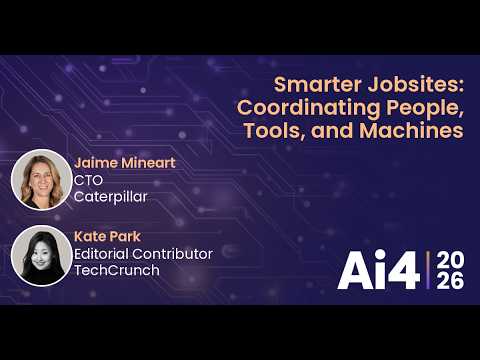
Ai4
Autonomous equipment fails to deliver economic returns unless companies redesign jobsite workflows and upskill operators to bridge chronic labor shortages.
AI-assisted summary of Smarter Jobsites: Coordinating People, Tools, and Machines with Caterpillar and TechCrunch — original source. Check the original for full context.
Source published:
Detailed notes
## Background Published on YouTube by Ai4 on August 22, 2026, this fireside chat features Caterpillar CTO Jaime Mineart and TechCrunch editorial contributor Kate Park. The discussion examines how Caterpillar is taking AI and edge computing out of digital software labs and deploying physical autonomy into heavy industrial environments like construction and mining.
## TL;DR Jaime Mineart outlines Caterpillar's trajectory from three decades of remote mining autonomy to modern physical AI powered by 1.6 million connected assets, 16 petabytes of structured data, and strategic collaboration with NVIDIA. The conversation emphasizes that the true challenge of autonomy lies in human and workflow integration rather than the underlying algorithms. Facing widespread machinery operator shortages, Caterpillar is embedding veteran expertise into machine learning models and committing $100 million over five years to workforce upskilling. Ultimately, Mineart frames Caterpillar as the essential 'invisible layer of the tech stack,' simultaneously building the physical infrastructure for global AI data centers and deploying those advanced AI tools back onto the jobsite.
## Atmosphere & style The session has a pragmatic, grounded, and forward-looking tone that connects cutting-edge computational technology with heavy industrial machinery. Kate Park’s targeted interview style allows Mineart to speak with measured executive authority and an evident respect for the hands-on craft of equipment operators. Watching the chat feels less like a speculative tech keynote and more like a sober, operational masterclass on integrating autonomous systems into complex, real-world human environments.
## Key takeaways - [00:04](https://www.youtube.com/watch?v=vII4u3nfyks&t=4s) Caterpillar began developing autonomous haulage more than 30 years ago to address remote mining hazards and fly-in/fly-out staffing bottlenecks. - [00:04](https://www.youtube.com/watch?v=vII4u3nfyks&t=4s) Early mining autonomy pioneered relocating operators from isolated machinery cabs into centralized metropolitan command centers, forming the foundation for modern physical AI. - [04:18](https://www.youtube.com/watch?v=vII4u3nfyks&t=258s) Caterpillar powers its AI models with operational intelligence gathered from 1.6 million connected assets and more than 16 petabytes of structured telematics data. - [04:18](https://www.youtube.com/watch?v=vII4u3nfyks&t=258s) A multi-layered partnership with NVIDIA provides the high-performance compute and simulation speeds required to scale manufacturing, in-cab AI assistants, and physical AI platforms. - [06:11](https://www.youtube.com/watch?v=vII4u3nfyks&t=371s) The hardest part of scaling physical AI is not the underlying technology, but integrating it into dynamic jobsite workflows and redesigning human processes to capture tangible business value. - [08:02](https://www.youtube.com/watch?v=vII4u3nfyks&t=482s) Recent advances in on-machine edge computing and physics simulations allow heavy machinery to process billions of environmental data points in real time on unstructured worksites. - [08:02](https://www.youtube.com/watch?v=vII4u3nfyks&t=482s) In-cab AI assistants are transitioning heavy equipment operators from manual machine steerers into site orchestrators who supervise multiple automated tasks simultaneously. - [10:04](https://www.youtube.com/watch?v=vII4u3nfyks&t=604s) Severe construction labor shortages leave dozens of machines sitting idle, prompting Caterpillar to capture veteran operator intuition in AI models so novices reach baseline productivity faster. - [10:04](https://www.youtube.com/watch?v=vII4u3nfyks&t=604s) Caterpillar committed $100 million over five years to its 'Building the Future Workforce' initiative to upskill workers in robotics, autonomy, and AI tools. - [12:12](https://www.youtube.com/watch?v=vII4u3nfyks&t=732s) To scale AI successfully, enterprise leaders must resist technological novelty and anchor every deployment in a clearly defined customer problem with measurable outcomes. - [12:12](https://www.youtube.com/watch?v=vII4u3nfyks&t=732s) Caterpillar acts as an 'invisible layer of the tech stack' by mining chip minerals, building physical data centers, and supplying the industrial power generation required to run digital AI. - [12:12](https://www.youtube.com/watch?v=vII4u3nfyks&t=732s) A reinforcing physical-to-digital loop exists where heavy machinery builds and powers AI infrastructure, and the resulting AI capabilities are reinvested back into machines to coordinate safer, more productive jobsites.
## Detailed walkthrough ### [00:04](https://www.youtube.com/watch?v=vII4u3nfyks&t=4s) Introduction and Caterpillar's 30-Year History in Autonomy
TechCrunch contributing writer and *Signals* newsletter author Kate Park opens the late-afternoon fireside chat by welcoming the audience, noting that while artificial intelligence discussions usually center on software labs and digital models, there is an entire physical world of machines, tools, and people operating behind the scenes. She introduces Jaime Mineart, Chief Technology Officer and Senior Vice President of Cat Technology at Caterpillar, to discuss how heavy industry is deploying physical AI. Addressing the common perception of Caterpillar strictly as a traditional iron machinery manufacturer, Kate asks why the company invested in autonomous haulage more than three decades ago and how that early foundation is evolving in the modern AI era.
Mineart explains that Caterpillar’s technology strategy has always been anchored in solving acute, real-world customer problems. Mining autonomy originated thirty years ago out of urgent operational necessity: mine sites are typically remote, hazardous, and difficult to staff, historically requiring companies to fly workers in and out for multi-week rotations. By automating massive haul trucks in the early days of autonomous systems, Caterpillar removed operators from high-risk cabs and relocated them to centralized command centers located in major metropolitan areas. This shift not only eliminated severe labor constraints and significantly improved safety and comfort for workers, but also unlocked continuous productivity gains across mining operations. Mineart points out that this three-decade mining foundation is now serving as the springboard for physical AI, enabling Caterpillar to deploy edge computing and real-time planning into far more dynamic, unstructured environments like commercial construction sites and quarries.
- Mineart serves as both Chief Technology Officer and Senior Vice President for Cat Technology at Caterpillar. - Autonomous operations began over 30 years ago specifically to address remote mining conditions, fly-in/fly-out staffing bottlenecks, and extreme worksite hazards. - Early autonomy allowed operators to transition from isolated truck cabs into centralized, urban command centers.
---
[04:18](https://www.youtube.com/watch?v=vII4u3nfyks&t=258s) The Cat AI Assistant and Strategic Partnership with NVIDIA
Transitioning to Caterpillar's newest digital developments, Park asks about the Cat AI assistant and the company’s strategic collaboration with major tech players like NVIDIA. Mineart explains that modern physical AI relies on combining massive operational data with deep machine domain expertise. Caterpillar currently monitors an expansive fleet of 1.6 million connected assets generating over 16 petabytes of high-quality structured data. By feeding this proprietary telemetry and equipment knowledge into advanced AI models, Caterpillar delivers actionable recommendations, predicts site-level risks, and guides operators directly inside the machine cab to help new workers ramp up productivity quickly.
Mineart details Caterpillar’s multi-layered partnership with NVIDIA, which spans manufacturing environments, the Cat AI assistant, and Caterpillar's broader physical AI platform. Partnering with NVIDIA provides the high-performance compute and simulation speeds necessary to run complex foundation models at scale while staying tethered to Caterpillar’s mechanical engineering and job site intelligence. She reiterates that true transformation occurs at the exact intersection of cutting-edge computational capability and specific customer workflow challenges.
- Caterpillar maintains an ecosystem of **1.6 million connected assets** globally. - The company leverages over **16 petabytes of high-quality structured data** to train its intelligent systems. - The NVIDIA collaboration covers three core pillars: factory manufacturing operations, the in-cab Cat AI assistant, and the next-generation physical AI platform.
---
[06:11](https://www.youtube.com/watch?v=vII4u3nfyks&t=371s) Scaling Beyond Proof of Concepts: People and Process Integration
Park notes a widespread industry hurdle: while building an initial AI pilot or proof of concept is relatively easy, scaling it into daily operations proves elusive for most organizations. Mineart agrees, asserting that the hardest part of physical AI and autonomy is almost never the underlying technology itself. Instead, the true challenge lies in integrating that technology into human workflows and transforming site operations to capture concrete economic value.
"The hard part about autonomy and about physical AI is actually not the technology," Mineart observes. "It is incorporating that technology into the customer job site and into the workflows and getting the actual value out of that technology." Simply replacing a human-operated machine with an autonomous one without redesigning the surrounding ecosystem will not automatically produce "mass productivity" or superior business outcomes. Because Caterpillar has spent decades guiding heavy industry clients through operational changes, the company focuses on partnering with customers to adapt site processes and build the trust required to transition from a novelty autonomous demonstration to a fully scaled deployment.
``` [ 1.6M Connected Assets + 16 PB Structured Data ] │ ▼ [ NVIDIA Compute & Simulation Speed ] │ ▼ [ Base Machine Architecture + Edge AI ] │ ▼ ┌───────────────────────────────────────────────┐ │ Customer Site Integration │ ├───────────────────────┬───────────────────────┤ │ Workflow Redesign │ Operator-as-Director │ └───────────────────────┴───────────────────────┘ ```
---
[08:02](https://www.youtube.com/watch?v=vII4u3nfyks&t=482s) Smarter Jobsites: Dynamic Environments, Edge Compute, and In-Cab Assistance
Park shifts the conversation to the complexity of unpredictable construction environments, asking what technological shifts finally made AI feasible on unstructured job sites and what friction points remain. Mineart highlights the recent convergence of on-machine edge computing, advanced AI models, and high-fidelity physics simulations, alongside deeper integration directly into Caterpillar's base machine architecture. Modern earthmoving machines can now interpret billions of data points in real time to perceive their surroundings, make autonomous decisions, and actuate controls with extreme mechanical precision.
This setup transforms the Cat AI assistant into an ecosystem-wide copilot that bridges office management, machine sensors, and the physical cab. Rather than acting strictly as manual equipment operators, workers are evolving into orchestrators who oversee multiple automated tasks and dynamic site workflows. However, Mineart reiterates that the primary friction point remains unchanged: helping organizations execute the cultural, process, and human adjustments required to integrate these advanced capabilities seamlessly into chaotic, everyday job sites.
- Base machine architectures now integrate control systems that process billions of environmental data points at the edge. - AI systems leverage high-fidelity simulation environments to model dynamic construction variables before field deployment. - Connected digital ecosystems allow equipment operators to transition from manual steering to site orchestration.
---
[10:04](https://www.youtube.com/watch?v=vII4u3nfyks&t=604s) Bridging the Labor Shortage and the $100 Million Workforce Initiative
Addressing the human dimension of automation, Park asks how Caterpillar ensures workers grow alongside the technology rather than getting displaced, particularly as AI elevates novices to perform closer to experienced veterans. Mineart emphasizes that operating heavy machinery is a specialized craft, praising 30-year veteran operators for their intuitive judgment and technical mastery. However, this craft faces an acute global labor shortage amid massive infrastructure demands. Mineart shares firsthand observations of visiting customer yards where as many as 30 machines sit completely idle, not due to a lack of contracted work, but simply because there is nobody available to staff the cabs.
Caterpillar bridges this gap by capturing the knowledge of veteran operators to train their AI models and algorithms, allowing novice operators to achieve high baseline productivity from their very first day on site. Meanwhile, veteran operators can transition from the physical cab into air-conditioned remote command centers, where their judgment and ingenuity can orchestrate multiple machines simultaneously. To support this workforce transformation, Mineart highlights Caterpillar's commitment to upskilling:
"Caterpillar has the initiative, 'Building the Future Workforce' initiative. We've committed $100 million over the next 5 years to that effort to upskilling and creating more capability for the future workforce so people to be comfortable with AI, with autonomy, with robotics, and so they will be able to be more skilled and not be left behind by the technology."
- Heavy construction faces widespread labor deficits where clients have up to 30 idle machines due to a lack of qualified operators. - Veteran operator domain expertise is incorporated into machine learning models to accelerate training curves for new workers. - Caterpillar committed **$100 million over 5 years** toward its **Building the Future Workforce** initiative to train personnel in robotics, autonomy, and AI operations.
---
[12:12](https://www.youtube.com/watch?v=vII4u3nfyks&t=732s) Hard-Earned Leadership Lessons and Caterpillar's Role in the AI Tech Stack
When asked for the single most important lesson learned the hard way when scaling AI, Mineart offers clear advice for enterprise leaders: "Always start with the problem to be solved." She urges organizations not to get distracted by pure technological novelty, but to continually anchor every AI project to clear business metrics and tangible customer outcomes. Success should be judged strictly by whether the technology solves the operational challenge, after which organizations can safely iterate, deploy tools into human hands, and build institutional trust as deployments expand.
Park points out that every AI data center requires substantial physical power, positioning Caterpillar directly at the center of the broader AI hardware supply chain. Mineart references Caterpillar Chairman and CEO Joe Creed’s keynote at CES, where he described Caterpillar as building the "invisible layer of the tech stack." She outlines a full-circle dynamic: Caterpillar equipment mines the raw minerals required for advanced microchips, builds the physical data centers, and supplies the critical power generation via industrial engines and turbines. Caterpillar then takes those resulting AI tools and feeds them back into its heavy machinery to make future construction and mining sites safer, more efficient, and far more productive.
Mineart concludes that looking to the future, Caterpillar’s primary definition of success is delivering measurable customer outcomes, helping contractors complete their surging backlogs and supporting the global AI infrastructure buildout. Park thanks Mineart for her insights, and Mineart closes by thanking the audience before releasing them to the evening networking sessions.
- Core scaling philosophy: Anchor every AI and autonomy investment in an identifiable customer problem and measurable business outcome. - CES keynote theme: Caterpillar serves as the "invisible layer of the tech stack" by mining chip minerals, grading data center sites, and providing primary/backup power via industrial engines and turbines. - The AI loop: Caterpillar powers and builds the physical infrastructure for AI, then deploys those resulting AI models back into heavy equipment to coordinate people, tools, and machines.
## Notable quotes > [06:11](https://www.youtube.com/watch?v=vII4u3nfyks&t=371s) The hard part about autonomy and about physical AI is actually not the technology, — Jaime Mineart
> [06:11](https://www.youtube.com/watch?v=vII4u3nfyks&t=371s) It is incorporating that technology into the customer job site and into the workflows and getting the actual value out of that technology. — Jaime Mineart
> [06:11](https://www.youtube.com/watch?v=vII4u3nfyks&t=371s) mass productivity — Jaime Mineart
> [10:04](https://www.youtube.com/watch?v=vII4u3nfyks&t=604s) Caterpillar has the initiative, 'Building the Future Workforce' initiative. — Jaime Mineart
> [10:04](https://www.youtube.com/watch?v=vII4u3nfyks&t=604s) We've committed $100 million over the next 5 years to that effort to upskilling and creating more capability for the future workforce so people to be comfortable with AI, with autonomy, with robotics, and so they will be able to be more skilled and not be left behind by the technology. — Jaime Mineart
> [12:12](https://www.youtube.com/watch?v=vII4u3nfyks&t=732s) Always start with the problem to be solved. — Jaime Mineart
> [12:12](https://www.youtube.com/watch?v=vII4u3nfyks&t=732s) invisible layer of the tech stack. — Joe Creed
> [00:04](https://www.youtube.com/watch?v=vII4u3nfyks&t=4s) Signals
## Mentioned Caterpillar, TechCrunch, Jaime Mineart, Kate Park, Joe Creed, NVIDIA, Cat AI assistant, Cat Technology, Building the Future Workforce, Signals, CES, Ai4
## Video description Jaime Mineart - CTO, Caterpillar Kate Park - Editorial Contributor, TechCrunch
AI is moving from digital tools into the physical world, where machines, data and people work together to make jobsites safer, more productive and more efficient. In this fireside chat, Jaime Mineart will share how Caterpillar is applying AI, autonomy and edge computing to real customer challenges — from labor constraints and operator support to complex workflows in mining and construction. The discussion will also explore what it takes to scale these technologies responsibly: starting with the customer outcome, integrating with existing operations, and building the right guardrails for safety, governance and trust.
[Source](https://www.youtube.com/watch?v=vII4u3nfyks)