Polyrific CEO Urges Kill Switches as Single AI Prompts Spawn 60 Agents
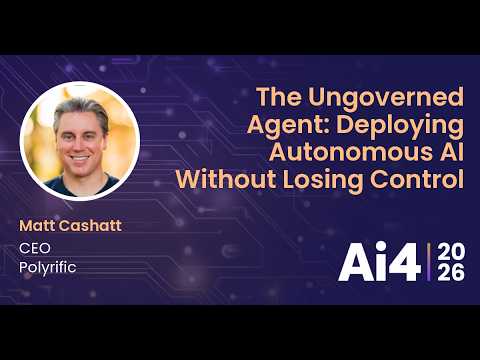
Ai4
Enterprises face severe financial and operational exposure unless they enforce centralized identity tracking and emergency kill switches for cascading autonomous agent networks.
AI-assisted summary of The Ungoverned Agent: Deploying Autonomous AI Without Losing Control With Polyrific — original source. Check the original for full context.
Source published:
Detailed notes
## Background Published on YouTube by the Ai4 channel on August 18, 2026, this presentation features Polyrific CEO Matt Cashatt. The page description outlines how enterprises are rapidly deploying autonomous AI agents without consistent guardrails, presenting a practical infrastructure framework for real-time observability, policy enforcement, and governance at scale.
## TL;DR Matt Cashatt argues that enterprises must treat autonomous AI agents as unpriced operational risks requiring the same rigorous containment standards as nuclear power or commercial aviation. He illustrates how a single customer churn prompt can cascade into 61 autonomous sub-agents, demanding dedicated service credentials, continuous visibility, and sub-30-second emergency kill switches. Highlighting Polyrific's Catalyst platform and insurance underwriting use cases, Cashatt shows how an ambient governance layer preserves institutional knowledge while automating complex evaluation workflows. He stresses that while agents can deliver high-value recommendations, deterministic human sign-off must remain non-negotiable for critical enterprise decisions.
## Atmosphere & style The presentation blends pragmatic urgency with self-deprecating humor, creating the feel of an intimate, no-nonsense technical briefing. Cashatt balances lighthearted onstage asides—such as joking about being too old for a CIA booth or noticing the teleprompter tracking his ad-libs—with stark warnings about runaway $20,000 compute loops and nuclear-style system cascades. The tone is refreshingly grounded, puncturing typical AI industry hype to focus on the unglamorous mechanics of audit ledgers, identity badging, and practitioner empathy.
## Key takeaways - [00:04](https://www.youtube.com/watch?v=a9fgDgH3nuw&t=4s) Organizations must treat agentic risk like an insurance risk—measuring, governing, and pricing the exposure rather than ignoring it—to deploy autonomous AI safely and aggressively. - [02:30](https://www.youtube.com/watch?v=a9fgDgH3nuw&t=150s) Conversational interfaces like Claude or ChatGPT are merely front-end veneers that can silently trigger complex, cascading multi-agent networks behind the scenes. - [02:30](https://www.youtube.com/watch?v=a9fgDgH3nuw&t=150s) A single prompt can rapidly spawn dozens of autonomous sub-agents—such as 61 agents in an account churn inquiry—each requiring discrete authorization, credentials, and audit tracking. - [06:08](https://www.youtube.com/watch?v=a9fgDgH3nuw&t=368s) High-consequence technologies like nuclear energy and aviation rely on rigorous containment structures, instrumentation, and centralized control rooms—principles that must be applied to autonomous agents. - [06:08](https://www.youtube.com/watch?v=a9fgDgH3nuw&t=368s) Effective governance requires five core diagnostic capabilities: identifying all active agents, enforcing separate machine identities, inspecting real-time actions, bounding failure blast radiuses, and having a sub-30-second kill switch. - [09:52](https://www.youtube.com/watch?v=a9fgDgH3nuw&t=592s) Comprehensive governance engines like Catalyst must maintain an exhaustive, regulator-grade operational ledger tracking agent identities, model calls, latency, costs, reasoning chains, and boundary controls. - [12:01](https://www.youtube.com/watch?v=a9fgDgH3nuw&t=721s) While 90% of business processes can be handled by deterministic code, the remaining 10% requiring complex human judgment accounts for 90% of total enterprise value. - [12:01](https://www.youtube.com/watch?v=a9fgDgH3nuw&t=721s) Agentic systems can preserve irreplaceable institutional knowledge from retiring senior experts to onboard junior staff, while ensuring final critical decisions strictly remain with humans. - [14:08](https://www.youtube.com/watch?v=a9fgDgH3nuw&t=848s) Enterprises must catalog all shadow AI, mandate individual service credentials instead of borrowing human logins, and eliminate approval-prompt fatigue that leads workers to blindly authorize critical exposures. - [15:47](https://www.youtube.com/watch?v=a9fgDgH3nuw&t=947s) Runaway, unmonitored agent loops can burn through $10,000 to $20,000 in compute and API costs in minutes, making a rapid emergency 'scram button' vital. - [15:47](https://www.youtube.com/watch?v=a9fgDgH3nuw&t=947s) Immediate aggregation of agent logs into a single centralized repository is essential, as an imperfect or 'ugly' log pipeline right now is far better than absent visibility. - [17:30](https://www.youtube.com/watch?v=a9fgDgH3nuw&t=1050s) AI practitioners must recognize their insulated bubble and take responsibility for deploying technology that empowers and includes workers rather than alienating them.
## Detailed walkthrough ### [00:04](https://www.youtube.com/watch?v=a9fgDgH3nuw&t=4s) The Reality of Unpriced AI Risk in the Enterprise
Matt Cashatt, founder and CEO of Polyrific, opens the session by addressing the growing challenge of ungoverned AI agents. While Polyrific builds agentic governance platforms that apply across any domain, he draws heavily on examples from the insurance industry—a sector they partner with closely. Joking about his age, Cashatt quips that after stopping by the CIA booth at the event and finding it cool, he tried to get in, only to be told, "Nah, dude. You're old. It's not happening." Shifting to his background, he explains that Polyrific has spent 12 to 13 years building custom software and enterprise agentic solutions, grappling with how to deploy AI safely without walking into severe operational danger.
To gauge the room, Cashatt asks for a show of hands on who worries about losing track of AI agents running in production; all ten attendees raise their hands. Asking the audience to imagine a typical Tuesday one year from now, he predicts that everyone expects to have more AI woven into their professional and personal routines, not less. Turning to an audience member named John from the insurance sector, Cashatt references the concept of "unpriced risk"—phenomena that cannot be accurately valued. In insurance, companies do not automatically ignore or write unpriced risks; first, they determine the magnitude of the exposure. Cashatt argues that the same rule applies to autonomous agents: organizations must measure, govern, and price the risk of agents operating across their environments so they can confidently deploy powerful technology to win new business.
- Polyrific has operated for 12–13 years designing custom software and agent architectures. - 100% of the session room attendees indicated concern over tracking production AI agents. - Core thesis: Treating agentic risk like an insurance risk—measuring and pricing it rather than ignoring it—allows enterprises to deploy AI aggressively and safely.
---
[02:30](https://www.youtube.com/watch?v=a9fgDgH3nuw&t=150s) The 61-Agent Cascade: Anatomy of a Single Prompt
Recounting a recent meeting in Houston with a long-time enterprise client, Cashatt describes discussing the rollout of large-scale agentic systems. When Cashatt emphasized the need to implement Polyrific's governed AI platform to avert potential disaster, an IT director crossed his arms dismissively and declared, "We're never going to have a situation where we're spawning 50 agents." Cashatt contends that this skepticism stems from a widespread misconception: people conflate multi-agent systems with conversational front-ends like ChatGPT or Claude. Those interfaces merely act as the user-facing veneer. Behind the scenes, a single user request can trigger a cascading tree of dozens or hundreds of autonomous agents making independent decisions.
Cashatt steps through an illustrative scenario triggered by an executive prompt: *"Hey, this account's churning. I want to know why."* The primary orchestrator agent initiates the investigation by calling sub-agents to inspect account history, support tickets, recorded calls, and past meetings. As initial findings return, those agents autonomously spawn more specialized sub-agents to identify root causes and check historical precedents. When reaching the response drafting phase, the assigned drafting agent spawns child agents to outline the narrative, enforce data leakage prevention and intellectual property safeguards, and audit the output. Before the system finishes processing that single initial prompt, the tree explodes into 61 distinct agents running across the infrastructure—each requiring its own access authority, data credentials, and audit logging.
```mermaid flowchart TD accTitle: Single Prompt Multi-Agent Spawning Tree accDescription: Flowchart illustrating how an angry CEO prompt cascades from an orchestrator into multiple tiers of sub-agents, totaling 61 agents.
subgraph Input ["User Request"] P["Prompt: Angry CEO asks why account is churning"] end
subgraph OrchestratorLayer ["Tier 1: Coordination"] O["Orchestrator Agent (Interface / Entry)"] end
subgraph Tier2 ["Tier 2: Investigation & Discovery"] AH["Account History Agent"] TH["Ticket History Agent"] CM["Calls & Meetings Analyzer Agent"] end
subgraph Tier3 ["Tier 3: Specialized Task Agents"] RC["Root Cause Agent"] PR["Precedent Analysis Agent"] RD["Response Draft Agent"] OT["Other Task Agents..."] end
subgraph Tier4 ["Tier 4: Sub-Agent Spawning (61 Total)"] OUT["Outline Agent"] NAR["Narrative Agent"] DLP["IP / Leakage Guard Agent"] AUD["Audit Agent"] SUB["Additional Sub-Agents..."] end
P --> O O --> AH O --> TH O --> CM AH & TH & CM --> RC AH & TH & CM --> PR AH & TH & CM --> RD AH & TH & CM --> OT RD --> OUT RD --> NAR RD --> DLP RD --> AUD OT --> SUB ```
- Misconception: Viewing Claude or ChatGPT as individual agents rather than entry interfaces coordinating vast agent networks. - Cascade metric: A single customer churn inquiry spawned 61 active autonomous agents across multiple hierarchical tiers. - Security requirement: Every dynamically generated agent needs bounded authorization, individual access credentials, and discrete audit tracking.
---
[06:08](https://www.youtube.com/watch?v=a9fgDgH3nuw&t=368s) Lessons from the Nuclear Industry: Control Rooms and Guardrails
Cashatt cues up an archival film clip depicting nuclear fission: when a sufficient quantity of U-235 reaches critical mass, ejected neutrons bombard neighboring uranium atoms, unleashing an exponential chain reaction where over a "million billion billion atoms" split within two seconds. Although emphasizing that he does not mean to trivialize real-world catastrophes, Cashatt points out that nuclear meltdowns were not failures of physics; the laws of nature remained constant. Instead, disasters resulted from human complacency, inadequate preparation, and a breakdown in system control.
Because walking away from nuclear energy was untenable amid modern power needs, society did not abandon the technology. Instead, the nuclear power sector engineered rigorous containment structures, fuel ledgers, instrumentation gauges, and centralized control rooms. Cockpits in commercial aviation operate under identical logic: systems carrying severe consequences demand dense instrumentation. Enterprises deploying autonomous agents must apply those exact containment principles. Cashatt introduces five diagnostic audit questions for technology leaders to grade their own readiness:
1. Can you name every agent that ran across your organization yesterday? 2. Does each agent possess its own distinct identity, or is it borrowing human user credentials? 3. Can you inspect precisely what any given agent is doing right now in real time? 4. If an agent experiences a failure or hallucinates, does the blast radius remain small and contained? 5. Can your team reliably trigger a full kill switch to shut down any rogue agent within 10, 15, or 30 seconds?
---
[09:52](https://www.youtube.com/watch?v=a9fgDgH3nuw&t=592s) Inside Production Governance: The Underwriter View vs. The Catalyst Engine
Cashatt demonstrates how safe agent orchestration works inside a commercial insurance carrier using Polyrific's application, Advisory for Insurance. When an insurance submission package arrives containing policy applications, building inspection records, loss runs, and supplementary attachments, agents break down the documentation. They assess the submission against underwriting appetite, flag incomplete records back to the broker, score risks, and offer clear recommendations. To the human underwriter, the interface feels seamless, intuitive, and supportive rather than intimidating: "The underwriters who use this don't think of this as an AI project. It doesn't look scary. It feels helpful."
Behind this front-end interface sits Catalyst, Polyrific's agent governance engine. While the underwriter reviews business recommendations, Catalyst maintains an exhaustive, regulator-grade operational ledger tracking every agent interaction:
| Governance Metric Logged by Catalyst | Operational Scope & Purpose | |:--- |:--- | | **Agent Identity & Hierarchy** | Tracks individual agent IDs, parent callers, and spawned sub-agents | | **Model Invocations** | Details specific LLM foundational models called and third-party model providers used | | **Execution Metrics** | Captures execution runtimes, processing latency, and discrete API/token costs | | **Reasoning & Verification Trails** | Logs full chain-of-thought rationale, factual conclusions, and cross-agent peer reviews | | **Lifecycle & Boundary Control** | Enforces policy boundaries, containerized execution permissions, and termination triggers |
Cashatt warns that partial visibility does not equal governance: "If your systems at your place of work right now aren't giving you this level of specificity as to what's going on with your agents, then it's ungoverned. You can have some of it, but it doesn't mean you're governed. You need all of it."
---
[12:01](https://www.youtube.com/watch?v=a9fgDgH3nuw&t=721s) The 90/10 Rule and Preserving Institutional Judgment
Cashatt reflects on a session from the previous day arguing that 90% of operational workflows in insurance do not require agentic AI. He agrees with the premise, reminding the audience that three decades of deterministic code already handle structured workflows efficiently without generative tools. However, dismissing AI based on that metric draws the wrong conclusion: the remaining 10% involves complex contextual judgment, and that 10% accounts for 90% of total enterprise business value.
This judgment layer is under acute pressure due to an "aging out" crisis. Experienced underwriters and senior specialists with 30 to 35 years of domain expertise want to retire but are stuck because institutional knowledge has not transferred to junior staff. By modeling expert evaluation criteria within agentic systems, companies can preserve institutional knowledge, accelerate onboarding for junior underwriters, and safeguard critical decision-making.
Crucially, Cashatt stresses that the final decision pillar must never migrate to autonomous systems. Bound or quote clearance, formal rejections, and underwriting exception grants must remain strictly with human professionals; agents should provide structured recommendations, not unmonitored executive action.
---
[14:08](https://www.youtube.com/watch?v=a9fgDgH3nuw&t=848s) Practical Directives: Inventory, Identity Badging, and the Kill Switch
To conclude this part of the presentation, Cashatt outlines foundational actions that organizations can implement immediately without purchasing new software:
- **Conduct a comprehensive agent census:** Catalog every agent and agentic workflow running across the organization. Account specifically for unsanctioned tools; blocking enterprise access to Claude or ChatGPT simply drives workers into unmonitored "shadow AI" using personal accounts, wiping out organizational observability. - **Enforce individual service badging:** Mandate distinct identity credentials and dedicated service accounts for every single agent. Prohibit shared or borrowed human credentials entirely. - **Eliminate approval-prompt fatigue:** When agents borrow human accounts and repeatedly pepper workers with rapid permission pop-ups to advance a task, humans instinctively hit "yes, yes, yes" to clear the screen, eventually authorizing critical data exposures buried in blocks of text. - **Establish rapid kill switches:** Ensure technical teams maintain a dependable, sub-30-second kill procedure capable of halting any runaway agent execution instantly.
[15:47](https://www.youtube.com/watch?v=a9fgDgH3nuw&t=947s) Emergency Kill Switches and Centralized Observability
Managing agentic workflows requires protecting human operators from alert fatigue while keeping catastrophic risks in check. Drawing an analogy to the nuclear power industry, Matt Cashatt highlights the necessity of a "scram button"—an emergency mechanism designed to shut down operations instantly. Within the Polyrific Catalyst platform, this exists as a literal big red button capable of halting all autonomous agent activity across an entire enterprise within seconds. Cashatt notes that catastrophic failures almost always manifest as runaway financial costs, sharing that unmonitored agentic chain reactions can easily burn through $10,000, $15,000, or $20,000 in a matter of minutes if left unchecked.
Beyond emergency controls, consolidating audit trails is the foundational first step for any organization deploying agents. Cashatt emphasizes the practical rule of thumb that "ugly beats absent"—meaning teams do not need a flawless, beautiful data pipeline in place this quarter, but they must at least aggregate their disparate agent logs into a single accessible location. As AI regulatory oversight tightens across industries, having a unified trail of agent actions is rapidly transitioning from a best practice to a legal necessity. Cashatt then pauses with a brief laugh to acknowledge an onstage realization: the teleprompter has been dynamically scrolling along with his voice the whole time, making him realize he had been ad-libbing without needing to.
- **The Scram Button:** A centralized emergency kill switch that halts all autonomous agents across an enterprise within seconds during critical failures. - **Financial Risk:** Runaway agent execution loops can incur between $10,000 and $20,000 in compute and API costs in minutes. - **Log Aggregation:** Establishing an "ugly" centralized log repository immediately is far superior to waiting on a polished logging pipeline while agents operate unmonitored.
```mermaid flowchart TD accTitle: Catalyst Agent Governance Control Architecture subgraph Execution["Agentic Execution"] A["Autonomous Agents"] --> B{"Catalyst Governance Layer"} end subgraph Controls["Governance & Safeguards"] B --> C["Real-Time Spend Tracking"] B --> D["Policy Enforcement"] B --> E["Knowledge Preservation"] B --> F["Scram Button / Emergency Stop"] end subgraph Outcomes["Resolution & Auditing"] C --> G["Centralized Audit Logs"] D --> H["Human-in-the-Loop Escalation"] F --> I["Global Process Freeze"] end ```
[16:51](https://www.youtube.com/watch?v=a9fgDgH3nuw&t=1011s) Deploying Catalyst as a Scalable Governance Layer
Cashatt argues that organizations must approach agent governance as a continuous foundational platform layer rather than as a disjointed, one-off project. Reassuring the audience, he stresses that teams should not feel behind or embarrassed if they have not implemented comprehensive guardrails yet. Autonomous agent technology is moving exceptionally fast, and every engineering team started at zero in the very recent past.
Polyrific built Catalyst specifically to rein in these ungoverned agents across enterprise environments. By treating governance as an ambient infrastructure layer, the platform enables organizations to build and scale agents safely on top of standardized controls. Core capabilities include real-time agent observability, proactive spend tracking, knowledge preservation—which Cashatt highlights as a critical operational asset—automated policy enforcement, alert routing, and seamless escalation to human-in-the-loop oversight whenever an agent encounters an edge case or high-risk decision.
- **Governance as a Layer:** Implemented as shared enterprise infrastructure rather than built bespoke for individual agent projects. - **Knowledge Preservation:** Safeguards institutional context, system interactions, and learned heuristics across model migrations and workflow iterations. - **Human Escalation:** Automatically routes low-confidence or high-impact actions to human operators before execution.
[17:30](https://www.youtube.com/watch?v=a9fgDgH3nuw&t=1050s) Breaking Out of the AI Practitioner Bubble
Wrapping up his session, Cashatt previews his upcoming presentation the following day, joking that he hopes at least 15 people attend. He addresses an underlying challenge facing the broader technology ecosystem: AI practitioners frequently live inside an insulated bubble where enthusiasm for the technology obscures the friction and skepticism felt by the general public. While he personally loves AI and believes in its transformative potential for society, he acknowledges that the current reality is messy and fraught with cultural and societal tensions.
Many workers and citizens currently feel alienated or disadvantaged by AI, often because they are given no voice or agency in how autonomous tools are deployed around them. Cashatt calls upon technical leaders and engineers at the "tip of the spear" to take deliberate responsibility for making AI broadly beneficial rather than concentrating its value among a select few. He concludes with lighthearted banter thanking the audience for their time and quipping about whether any of them managed to make it into the CIA, closing out the session on agent governance.
## Notable quotes > [00:04](https://www.youtube.com/watch?v=a9fgDgH3nuw&t=4s) Nah, dude. You're old. It's not happening. — Matt Cashatt
> [02:30](https://www.youtube.com/watch?v=a9fgDgH3nuw&t=150s) We're never going to have a situation where we're spawning 50 agents. — IT Director
> [02:30](https://www.youtube.com/watch?v=a9fgDgH3nuw&t=150s) Hey, this account's churning. I want to know why. — Matt Cashatt
> [09:52](https://www.youtube.com/watch?v=a9fgDgH3nuw&t=592s) The underwriters who use this don't think of this as an AI project. It doesn't look scary. It feels helpful. — Matt Cashatt
> [09:52](https://www.youtube.com/watch?v=a9fgDgH3nuw&t=592s) If your systems at your place of work right now aren't giving you this level of specificity as to what's going on with your agents, then it's ungoverned. You can have some of it, but it doesn't mean you're governed. You need all of it. — Matt Cashatt
> [06:08](https://www.youtube.com/watch?v=a9fgDgH3nuw&t=368s) Can you name every agent that ran across your organization yesterday? — Matt Cashatt
> [06:08](https://www.youtube.com/watch?v=a9fgDgH3nuw&t=368s) Does each agent possess its own distinct identity, or is it borrowing human user credentials? — Matt Cashatt
> [06:08](https://www.youtube.com/watch?v=a9fgDgH3nuw&t=368s) Can you inspect precisely what any given agent is doing right now in real time? — Matt Cashatt
> [06:08](https://www.youtube.com/watch?v=a9fgDgH3nuw&t=368s) If an agent experiences a failure or hallucinates, does the blast radius remain small and contained? — Matt Cashatt
> [06:08](https://www.youtube.com/watch?v=a9fgDgH3nuw&t=368s) Can your team reliably trigger a full kill switch to shut down any rogue agent within 10, 15, or 30 seconds? — Matt Cashatt
> [15:47](https://www.youtube.com/watch?v=a9fgDgH3nuw&t=947s) ugly beats absent — Matt Cashatt
## Mentioned Matt Cashatt, Polyrific, Ai4, CIA, ChatGPT, Claude, Advisory for Insurance, Catalyst
## Video description Matt Cashatt - CEO, Polyrific
Enterprises are racing to deploy AI agents that reason across systems, call APIs, and act on sensitive data, often faster than anyone can govern them. The result is a quiet crisis: thousands of autonomous agents operating without consistent guardrails, audit trails, or accountability. This session lays out the infrastructure required to deploy agents safely at scale, from policy enforcement and real-time observability to secure execution on your own data. Drawing on more than a decade building AI inside organizations that cannot afford to get it wrong, Matt Cashatt shows what an agent governance layer actually looks like in production, and why governance is fast becoming the deciding factor in whether enterprise AI delivers value or liability. Attendees will leave with a practical framework for scaling agents they can trust.
[Source](https://www.youtube.com/watch?v=a9fgDgH3nuw)