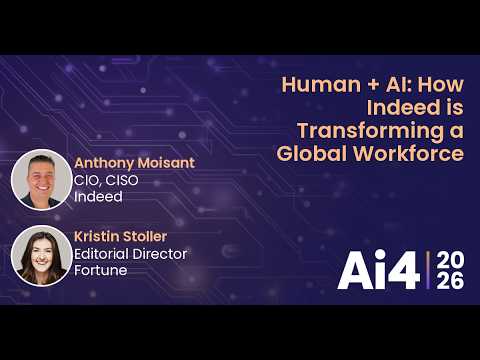
Indeed Shifts 70% of Hires to AI Matching as Tech Postings Rebound
Ai4
Enterprise AI recommendation systems now drive 70% of platform hires and expand software engineering demand by replacing rigid keyword filtering with behavioral capability matching.
## Background
Published on YouTube by the Ai4 channel on August 22, 2026, this session features Indeed CIO and CSO Anthony Moisant in conversation with Fortune Editorial Director Kristin Stoller. According to the page description, the discussion explores how Indeed operates under a 'safe speed' philosophy, transforming its global workforce into an AI-first organization while safeguarding security and human trust across millions of job seekers and employers.
## TL;DR
Drawing from his background in U.S. Navy nuclear submarines, Anthony Moisant explains how rigorous governance and security guardrails actively accelerate technological velocity rather than hindering it. He debunks fears of software engineering obsolescence with platform data, outlines how Indeed mitigates internal employee anxiety by building 'career currency,' and emphasizes the need for grounded semantic context to prevent agent sprawl. Moisant also details how Indeed is dismantling the broken ATS keyword-filtering loop, revealing that 70% of platform hires now originate from proactive behavioral AI recommendations.
## Atmosphere & style
The dialogue is brisk, pragmatic, and candid, blending lighthearted banter about family pesto recipes with rigorous operational philosophy. Kristin Stoller acts as an incisive interlocutor, pushing past corporate platitudes to examine employee friction and the broken dynamics of modern hiring black boxes. Moisant responds with disciplined, engineering-focused clarity, giving the exchange a reassuring, steady, and unpretentious tone that demystifies enterprise AI through the lens of naval preventative maintenance.
## Key takeaways
- [00:04](https://www.youtube.com/watch?v=tEmbGUuKidY&t=4s) Anthony Moisant applies discipline from the U.S. Navy's nuclear submarine school to AI, arguing that rigorous safety guardrails build confidence and accelerate innovation rather than slowing it down.
- [02:57](https://www.youtube.com/watch?v=tEmbGUuKidY&t=177s) Uniting CIO and CSO leadership under a single vision ensures that rapid technical experimentation never undermines the human trust layer of identity, security, and verification.
- [04:08](https://www.youtube.com/watch?v=tEmbGUuKidY&t=248s) Within ten years, dedicated AI conferences will likely disappear as AI becomes an invisible utility fabric embedded across all domains, analogous to the adoption of electricity.
- [04:08](https://www.youtube.com/watch?v=tEmbGUuKidY&t=248s) Contrary to predictions that software engineering is obsolete, U.S. software development job postings rose 15% following major AI engineering milestones, even as overall job postings fell 7%.
- [04:08](https://www.youtube.com/watch?v=tEmbGUuKidY&t=248s) Nearly 60% of foundational LLM inference workloads are dedicated to software engineering, elevating developers from routine coding to higher-level architecture and judgment.
- [08:38](https://www.youtube.com/watch?v=tEmbGUuKidY&t=518s) Unchecked proliferation of AI agents across non-technical teams requires heavy investment in data pipelines, semantic layers, and contextual guardrails to prevent hallucinations.
- [10:26](https://www.youtube.com/watch?v=tEmbGUuKidY&t=626s) To overcome employee anxiety and initial resistance toward AI adoption, Indeed focused on providing 'career currency' by training its workforce to build elite AI orchestration skills.
- [10:26](https://www.youtube.com/watch?v=tEmbGUuKidY&t=626s) AI innovation showcases and hackathons collapsed a nine-layer managerial hierarchy, allowing executive leadership to directly access frontline worker insights.
- [15:02](https://www.youtube.com/watch?v=tEmbGUuKidY&t=902s) Early career talent often possesses strong theoretical AI knowledge but lacks business acumen and judgment, making practical portfolios of AI-built projects a vital hiring signal.
- [15:02](https://www.youtube.com/watch?v=tEmbGUuKidY&t=902s) Indeed is actively working to dismantle the broken cycle where job seekers mass-apply with automated tools and employer ATS filters blindly reject them.
- [17:44](https://www.youtube.com/watch?v=tEmbGUuKidY&t=1064s) Approximately 70% of hires on Indeed now occur through proactive AI recommendations based on behavioral patterns and portable skills rather than manual keyword search queries.
## Detailed walkthrough
### [00:04](https://www.youtube.com/watch?v=tEmbGUuKidY&t=4s) Nuclear Submarine Lessons and the "Safe Speed" Philosophy
The session kicks off with lighthearted banter between Fortune's Kristin Stoller and Indeed's Anthony Moisant, joking about how difficult it is to follow the previous speaker, Zach, and sharing an aside about Anthony’s mother making the best family-secret pesto. Kristin introduces a key facet of Anthony’s background: graduating from the U.S. Navy’s nuclear submarine school. Operating inside a nuclear submarine is a high-stakes environment where a single mistake can lead to fatal tragedy. Anthony connects this discipline directly to his "safe speed" philosophy for artificial intelligence at Indeed, rejecting the conventional belief that security, governance, and safety act as bureaucratic roadblocks to innovation.
On a submarine, rigorous standards and safety protocols are precisely what instill operational confidence, and that confidence is what enables a crew to move quickly and at scale. Applying this framework to engineering at Indeed, guardrails and accountability are treated as the foundational architecture of trust. When algorithms help match people with employment, the stakes are profoundly human: doing it right opens doors to livelihood, while getting it wrong can devastate individuals, families, and communities. Building transparent guardrails from the outset reassures internal engineers, legal teams, and external regulators, which paradoxically accelerates innovation rather than stifling it.
```mermaid
flowchart LR
accTitle: The Safe Speed Confidence Loop
subgraph Foundation["Governance & Guardrails"]
A["Rigorous Safety & Transparency"] --> B["Trust & Accountability"]
end
subgraph Execution["Operational Momentum"]
B --> C["Workforce & Regulatory Confidence"]
C --> D["Rapid Innovation at Scale"]
D --> A
end
```
[02:57](https://www.youtube.com/watch?v=tEmbGUuKidY&t=177s) Wearing Dual Hats: Balancing Innovation as CIO with Security as CSO
Kristin highlights Anthony’s dual responsibilities as both Chief Information Officer and Chief Security Officer at Indeed, asking how he balances what might seem like conflicting objectives. Anthony explains that as CIO, his primary directive is driving technological transformation, business growth, and rapid product experimentation. Simultaneously, his CSO responsibilities encompass the entire "trust layer"—spanning physical and cyber security, trust and safety, content moderation, and identity verification to ensure that both job seekers and employers on the platform are authentic and verified.
Rather than existing in opposition, these roles reinforce the platform's core competitive advantage: velocity. Speed requires rapid experimentation and quick takeaways from failed tests, but experimentation without a secure trust layer compromises product integrity. By uniting technology leadership and security governance under a single strategic vision, Indeed ensures that rapid engineering output never undermines the human trust required by marketplace participants.
[04:08](https://www.youtube.com/watch?v=tEmbGUuKidY&t=248s) The 10-Year Horizon and Market Signals: Why Software Engineering Isn't Dead
Looking ahead, Anthony predicts that within ten years, standalone enterprise AI conferences will largely cease to exist. Drawing an analogy to the adoption of electricity, he notes that society no longer holds conferences dedicated to electricity itself; it simply became invisible, foundational utility fabric embedded across all domains. While current enterprise agentic workflows are still in their infancy—with many organizations struggling to prove clear ROI—Indeed’s multi-year investment in foundational models has already yielded substantial operational gains.
Addressing the speculative fear that AI agents will eradicate human workers, Anthony counters with real-world marketplace data from Indeed’s network of 650 million job seekers and 3.5 million employers:
- **Abundance of Intelligence:** Just as the internet democratized connectivity and made information abundant, AI makes intelligence abundant, unlocking higher-tier judgment and new business capabilities.
- **Software Developer Job Resurgence:** Despite doom-laden predictions that software development is obsolete, U.S. software development job postings rose by 15% following major AI engineering milestones like the Claude Code release, even while aggregate U.S. job postings fell by 7%.
- **Inference Reality:** Nearly 60% of foundational LLM inference workloads are dedicated to software engineering tasks.
- **Elevation of Work:** Automating repetitive coding tasks strips away mundane toil, allowing developers to move up the value chain toward architecture, judgment, and product creativity.
[08:38](https://www.youtube.com/watch?v=tEmbGUuKidY&t=518s) Preventative Maintenance, Agent Proliferation, and Grounded Context
When asked what excites him most, Anthony admits to a geeky appreciation for the unglamorous aspects of technology—drawing another parallel to the strict, daily preventative maintenance checklists required aboard nuclear submarines. In the current enterprise landscape, the democratization of AI allows non-technical employees, from customer support reps and sales agents to corporate lawyers, to build custom agents. While empowering, unchecked agent proliferation carries severe operational hazards if those agents lack semantic grounding and business context.
To prevent agents from hallucinating or giving flawed advice on critical tasks like contract review, organizations must invest heavily in high-quality data pipelines, semantic layers, and context-aware guardrails. Anthony and Kristin joke that "safe can be sexy," emphasizing that robust architectural scaffolding is the only way to ensure decentralized AI agents remain reliable and compliant.
[10:26](https://www.youtube.com/watch?v=tEmbGUuKidY&t=626s) Overcoming "Organ Rejection" and Building Employee "Career Currency"
Kristin challenges the popular corporate platitude that AI will automatically "free humans up to do meaningful work." Anthony acknowledges that Indeed faced internal friction early on, describing an initial "organ rejection" where employees experienced visceral anxiety regarding their job security, value, and future relevance. To address this gap, leadership shifted focus toward creating "career currency" for its workforce:
- **Enablement Guarantee:** While leadership cannot promise that individual job descriptions will remain static, they commit to training every employee to become "superhuman" using cutting-edge AI stacks.
- **Market Pedigree:** The goal is to ensure that having an "Indeedian" pedigree on a resume signals to the global market that the individual possesses elite AI orchestration skills.
- **Recognition and Flattening Latency:** To incentivize adoption, Indeed runs hackathons, distributes cash bonuses, awards AI innovation grants, and provides direct exposure to senior executives.
- **Breaking the 9-Layer Silo:** In a parent organization of 70,000 employees (and 10,000 at Indeed), strategic directives historically took nine managerial layers to reach hands-on keyboard staff. AI workflows and direct innovation showcases collapse this communication latency, allowing executive leadership to directly hear insights from frontline workers.
[15:02](https://www.youtube.com/watch?v=tEmbGUuKidY&t=902s) Navigating Early Career Realities and the AI Hiring Paradox
Regarding the debate over early career talent, Anthony dismisses the myth of the ready-made, fully capable "AI native" graduate. While recent college graduates often possess strong academic and theoretical knowledge of machine learning systems, they frequently lack business acumen, seasoned judgment, and the practical wisdom required to understand enterprise monetization. Instead of looking for purely theoretical skills, Indeed seeks candidates with intrinsic drive, curiosity, and a tangible portfolio of things they have actively built using AI tools.
Finally, Kristin points to the "AI hiring black box paradox," where job seekers deploy automated tools to spam hundreds of resumes, only for employer ATS systems and AI filters to automatically reject them without human review—exacerbating the problem of "ghost jobs." Anthony explains that Indeed is actively working to dismantle this broken cycle. Because human screeners struggle to evaluate massive applicant volumes accurately at scale, Indeed’s AI platform is designed to bypass arbitrary keyword filtering and directly match job seeker capabilities with verified employer requirements.
[17:44](https://www.youtube.com/watch?v=tEmbGUuKidY&t=1064s) Moving Beyond Resumes: AI Recommendations and Portable Skills
Anthony Moisant highlights a persistent shortcoming in traditional recruiting: screening candidates strictly through hard-skill filters while ignoring behavioral nuances and "portable" skills that carry over between different roles. He illustrates this dynamic through the experience of a colleague named Zach. Zach’s resume was tailored entirely around his primary professional track, yet Indeed’s AI platform is designed to look substantially deeper than static documents. By evaluating site behaviors alongside empirical patterns of what works across different employers, the system recognized Zach’s talent as an emcee. Even though Zach was not actively searching for an MC gig, the recommendation engine proactively surfaced the opportunity to him. Zach applied and landed the role, showcasing how intelligent discovery can reveal talent that rigid keyword matching routinely overlooks.
```mermaid
flowchart TD
accTitle: Evolution of Job Discovery on Indeed
accDescr: Flowchart contrasting the legacy search-and-apply hiring flow with Indeed's modern behavioral AI recommendation engine.
subgraph LegacyFlow["Legacy Hiring Model"]
A["Candidate Resume"] --> B["Recruiter Hard-Skill Filter"]
B --> C["Keyword Match / Filter Out"]
end
subgraph AgenticFlow["AI Recommendation Engine"]
D["Profile & Portfolio"] --> E["Behavioral Analysis & Cross-Employer Data"]
E --> F["Proactive Job Recommendation"]
F --> G["70% of Current Hires"]
end
```
Moisant explains that this shift addresses the tendency of recruiters to filter applicants out "based on what they think they know." Whereas the classic Indeed model relied on job seekers manually searching and applying for open listings, the platform has flipped that paradigm: approximately 70% of hires on Indeed now originate directly through AI recommendations rather than manual search queries. Moisant emphasizes that candidates can dramatically improve their outcomes by keeping an accurate profile and providing their portfolio, allowing the recommendation engine to surface career opportunities tailored to their complete capabilities. Fortune's Kristin Stoller warmly concludes the conversation, thanking Moisant and the audience before closing the session.
- **The Zach Case Study**: Zach's resume reflected his standard day job, but Indeed's behavioral signals identified his skill as an MC, recommending an emceeing role he was not searching for, which he applied for and secured.
- **70% Recommendation Benchmark**: 70% of hires made through Indeed now stem from algorithmic recommendations rather than traditional manual keyword search and application.
- **Key Candidate Advice**: Candidates are urged to fully complete and update their Indeed profiles and portfolios, providing the platform with the behavioral and contextual depth needed to deliver non-obvious role recommendations.
## Notable quotes
> [00:04](https://www.youtube.com/watch?v=tEmbGUuKidY&t=4s) Operating inside a nuclear submarine is a high-stakes environment where a single mistake can lead to fatal tragedy. — Kristin Stoller
> [00:04](https://www.youtube.com/watch?v=tEmbGUuKidY&t=4s) Building transparent guardrails from the outset reassures internal engineers, legal teams, and external regulators, which paradoxically accelerates innovation rather than stifling it. — Anthony Moisant
> [02:57](https://www.youtube.com/watch?v=tEmbGUuKidY&t=177s) Speed requires rapid experimentation and quick takeaways from failed tests, but experimentation without a secure trust layer compromises product integrity. — Anthony Moisant
> [04:08](https://www.youtube.com/watch?v=tEmbGUuKidY&t=248s) Just as the internet democratized connectivity and made information abundant, AI makes intelligence abundant, unlocking higher-tier judgment and new business capabilities. — Anthony Moisant
> [04:08](https://www.youtube.com/watch?v=tEmbGUuKidY&t=248s) Despite doom-laden predictions that software development is obsolete, U.S. software development job postings rose by 15% following major AI engineering milestones like the Claude Code release, even while aggregate U.S. job postings fell by 7%. — Anthony Moisant
> [04:08](https://www.youtube.com/watch?v=tEmbGUuKidY&t=248s) Automating repetitive coding tasks strips away mundane toil, allowing developers to move up the value chain toward architecture, judgment, and product creativity. — Anthony Moisant
> [08:38](https://www.youtube.com/watch?v=tEmbGUuKidY&t=518s) safe can be sexy — Anthony Moisant
> [10:26](https://www.youtube.com/watch?v=tEmbGUuKidY&t=626s) While leadership cannot promise that individual job descriptions will remain static, they commit to training every employee to become 'superhuman' using cutting-edge AI stacks. — Anthony Moisant
> [10:26](https://www.youtube.com/watch?v=tEmbGUuKidY&t=626s) In a parent organization of 70,000 employees (and 10,000 at Indeed), strategic directives historically took nine managerial layers to reach hands-on keyboard staff. AI workflows and direct innovation showcases collapse this communication latency — Anthony Moisant
> [15:02](https://www.youtube.com/watch?v=tEmbGUuKidY&t=902s) Instead of looking for purely theoretical skills, Indeed seeks candidates with intrinsic drive, curiosity, and a tangible portfolio of things they have actively built using AI tools. — Anthony Moisant
> [17:44](https://www.youtube.com/watch?v=tEmbGUuKidY&t=1064s) based on what they think they know. — Anthony Moisant
> [17:44](https://www.youtube.com/watch?v=tEmbGUuKidY&t=1064s) approximately 70% of hires on Indeed now originate directly through AI recommendations rather than manual search queries. — Anthony Moisant
## Mentioned
Indeed, Fortune, Anthony Moisant, Kristin Stoller, Zach, U.S. Navy, Claude Code
## Video description
Anthony Moisant - CIO, CISO, Indeed
Kristin Stoller - Editorial Director, Fortune
How does the world’s #1 job site in the world move at the speed of AI without breaking the foundation of human trust?
As both CIO and CSO at Indeed, Anthony Moisant operates at the critical intersection of speed and safety. He is the architect of a "safe speed" philosophy, driving radical innovation through Agentic AI while safeguarding the human trust of the hundreds of millions of job seekers and employers that depend on the platform.
Join Indeed CIO and CSO Anthony Moisant in conversation with Kristin Stoller, editorial director at Fortune to discuss how Indeed is transforming a global workforce into an AI-first, agentic organization while balancing the relentless drive for innovation with the absolute necessity of security and data integrity. This isn't just about new tools, it's about a fundamental shift in how employees interact with AI to automate the mundane and unlock a new tier of human creativity and strategy.
Indeed 将 70% 招聘转向 AI 匹配,科技岗位需求回暖
企业级 AI 推荐系统目前驱动了该平台 70% 的招聘,并通过以行为能力匹配取代刻板的关键词筛选,扩大了对软件工程的需求。
Anthony Moisant 结合他在美国海军核潜艇部队的服役背景,阐述了严格的治理与安全护栏如何积极加速技术迭代步伐而非阻碍创新。他利用平台数据打破了“软件工程正在过时”的恐慌,概述了 Indeed 如何通过构建“职业通货”(career currency)来缓解内部员工焦虑,并强调需要扎实的语义上下文来防止智能体泛滥。Moisant 还详细介绍了 Indeed 如何打破失效的 ATS 关键词筛选死循环,透露平台目前 70% 的招聘均源自基于行为的主动式 AI 推荐。
Anthony Moisant 借鉴美国海军核潜艇的严苛纪律,提出 Indeed 的“安全速度”哲学,强调严格的安全护栏与治理不仅不会拖慢创新,反而能构建团队信心、加速技术规模化落地。 (0:04)
针对软件工程消亡的悲观论调,Moisant 指出基础 LLM 近 60% 的推理负载均集中在编码任务,且在美国整体职位发布下降 7% 的背景下,软件开发岗位招聘逆势上升了 15%。 (4:08)
为缓解员工对 AI 取代岗位的恐惧,Indeed 致力于培训全员掌握前沿的 AI 编排能力以累积“职业筹码”,并借助黑客松与创新展示打破了原本多达 9 层的管理层级壁垒。 (10:26)
Indeed 正在从传统关键词简历筛选转向综合行为与便携技能的智能挖掘,目前平台上约 70% 的录用直接来自算法的主动推荐,而非求职者的手动搜索投递。 (17:44)
Reading summary
Indeed Chief Information Officer and Chief Security Officer Anthony Moisant argues that enterprise AI deployment requires a 'safe speed' philosophy, where rigorous governance, guardrails, and data context accelerate innovation rather than restrict it. Drawing on nuclear submarine discipline and Indeed's labor platform data, Moisant contends that AI will elevate human roles and reshape job matching rather than simply displace the workforce.
Submarine Discipline and the 'Safe Speed' Framework (0:04)
Drawing from his training at the U.S. Navy's nuclear submarine school, Moisant rejects the premise that safety, compliance, and governance act as bureaucratic brakes on innovation. In submarine operations, strict safety protocols establish the operational confidence required for crews to move rapidly in life-or-death environments. At Indeed, establishing transparent guardrails, identity verification, and content moderation provides internal developers and external regulators with the confidence needed to scale algorithmic experimentation safely.
Labor Market Signals and Developer Job Growth (4:08)
Addressing widespread speculation that autonomous agents will render human coders obsolete, Moisant cites data from Indeed’s network of 650 million job seekers and 3.5 million employers. Following major AI milestones like the release of Claude Code, U.S. software development job postings rose by 15%, even while aggregate national job openings fell by 7%. Furthermore, Moisant notes that roughly 60% of foundational large language model inference workloads are dedicated to software engineering.
Rather than eliminating jobs, Moisant predicts AI will follow the trajectory of electricity, evolving into an invisible, ubiquitous utility within a decade. By automating mechanical coding tasks, generative tools push software developers up the value chain toward architecture, critical judgment, and strategic product design.
Preventative Maintenance, Contextual Guardrails, and Organizational Buy-in (8:38)
As AI tools empower non-technical personnel across customer support, sales, and legal divisions to construct custom agents, Moisant warns of operational risks. Without strict semantic layers and data pipelines providing grounded business context, decentralized agents are prone to hallucinations and flawed outputs during critical operations like contract analysis.
To counter internal employee anxiety and potential rejection of AI workflows, Indeed's leadership emphasizes 'career currency.' Rather than guaranteeing that job descriptions will remain unchanged, the organization commits to training workers on advanced AI stacks, using internal hackathons, innovation grants, and executive showcases to incentivize adoption. This initiative also reduced organizational latency, collapsing the nine managerial layers that historically separated frontline engineers from senior executives across the broader 70,000-person parent company.
Overcoming the Hiring Paradox via Recommendation Engines (15:02)
Moisant criticizes the prevailing hiring paradox, where job applicants use generative tools to mass-submit resumes while employer applicant tracking systems use automated keyword filters to instantly discard them. Moisant argues that early-career candidates should focus on building demonstrable project portfolios rather than relying on theoretical machine learning coursework, as hiring managers increasingly prioritize proven initiative and business judgment over raw academic pedigree.
To bypass rigid keyword filters that ignore portable and behavioral skills, Indeed has pivoted from passive keyword searches toward behavioral AI recommendation models. Moisant reports that approximately 70% of hires on Indeed now originate through algorithmic matching rather than conventional search-and-apply actions, surfacing candidates based on broader capability patterns rather than narrow job descriptions.
While Indeed reports that recommendation engines now drive the majority of its platform's hires, the broader enterprise market continues to struggle with quantifying clear return on investment from early-stage agentic workflows, leaving the long-term balance between automated hiring tools and recruiter evaluation an ongoing industry challenge.
## Background
该内容由频道 Ai4 于 2026 年 8 月 22 日发布在 YouTube 平台。视频记录了 Indeed 首席信息官(CIO)兼首席安全官(CSO)Anthony Moisant 与《财富》(Fortune)杂志编辑总监 Kristin Stoller 的深度对谈,围绕 Indeed 如何在保障人类信任与数据安全的前提下推行“安全速度”哲学,以智能体 AI(Agentic AI)驱动全球劳动力转型并赋能业务创新展开探讨。
## TL;DR
访谈中,Anthony Moisant 结合核潜艇服役背景阐述了“安全速度”核心哲学,指出严格的治理护栏与信任基础是团队敢于全速创新的底气。他援引平台海量真实数据反驳了“AI 导致程序员失业”的论调,并警示在落地智能体时需警惕“智能体泛滥”,必须夯实业务上下文与语义层地基。为化解员工对 AI 替代的“器官排斥”,Indeed 承诺为员工注入“职业硬通货”,并通过创新机制压缩 9 层科层汇报延迟;目前平台 70% 的成功录用已由算法推荐驱动,标志着招聘范式正从被动搜索全面转向主动智能匹配。
## Atmosphere & style
整场对话在轻松风趣与硬核严谨之间取得了绝佳平衡,开场关于“母亲秘制青酱”的幽默调侃迅速拉近了距离,随后无缝切入核潜艇生存法则与底层工程哲学。主持人提问敏锐直接,直面技术失业焦虑与招聘黑盒等现实痛点,Moisant 则以极客特有的坦诚与热忱从容化解,生动诠释了“安全也可以很性感”的工程师浪漫。现场交流节奏明快、观点交锋真实落地,既有高管层面的战略高度,又充满对一线员工与求职者的人文关怀。
## Key takeaways
- [00:04](https://www.youtube.com/watch?v=tEmbGUuKidY&t=4s) 核潜艇服役经历塑造了“安全速度”(Safe Speed)哲学:严密的安全护栏与治理框架并非官僚阻碍,而是构建系统信任与放手极速创新的基石。
- [02:02](https://www.youtube.com/watch?v=tEmbGUuKidY&t=122s) 在招聘等关乎人生命运的领域,提前将透明度与安全护栏内置于架构中,能够化解监管顾虑并让团队获得更长远的创新自由。
- [02:02](https://www.youtube.com/watch?v=tEmbGUuKidY&t=122s) CIO(聚焦业务创新杠杆)与 CSO(主导信任层与平台真实性)的双重角色并不对立,二者统一于在安全信任底座上提升组织试错与交付的“速度”。
- [04:08](https://www.youtube.com/watch?v=tEmbGUuKidY&t=248s) AI 未来将如同电力一样融入时代基础设施:十年后除了极少数底层模型开发者外,将不再存在专门讨论如何应用 AI 的泛行业大会。
- [04:08](https://www.youtube.com/watch?v=tEmbGUuKidY&t=248s) 大模型自动化低级苦工促使人才向价值链上游迁移,自 Claude Code 发布后全美软件开发职位逆势增长 15%,反驳了 AI 导致程序员失业的悲观论调。
- [08:38](https://www.youtube.com/watch?v=tEmbGUuKidY&t=518s) 警惕企业内部“智能体泛滥”(Agent Proliferation)风险,必须为分散的 Agent 构筑统一的业务上下文、语义层与数据管道,确保生成结果真实可靠。
- [10:23](https://www.youtube.com/watch?v=tEmbGUuKidY&t=623s) 化解员工对 AI 的“器官排斥”恐慌:拒绝虚假承诺岗位不变,转而投资员工掌握顶尖 AI 工具栈,赋予其具有行业溢价的“职业硬通货”。
- [10:23](https://www.youtube.com/watch?v=tEmbGUuKidY&t=623s) 通过 AI 创新机制与跨层黑客松直连决策层与一线问题解决者,有效压缩大型企业内多达 9 层的科层汇报与沟通延迟。
- [15:02](https://www.youtube.com/watch?v=tEmbGUuKidY&t=902s) 企业在选拔早期人才时应看重创造力、求知欲以及亲自动手构建并兑现商业价值的 Builder Mindset,而非迷信空谈理论的“AI 原生毕业生”。
- [17:44](https://www.youtube.com/watch?v=tEmbGUuKidY&t=1064s) AI 深度匹配引擎正在打破“求职者 AI 海投与雇主 AI 刷人”的黑盒悖论,通过多维行为洞察主动发掘简历之外的可迁移潜能与软实力。
- [18:30](https://www.youtube.com/watch?v=tEmbGUuKidY&t=1110s) Indeed 上 70% 的成功录用已直接由算法推荐驱动,标志着招聘范式已从过去的“主动搜索-投递”彻底转向主动“算法匹配”时代。
## Detailed walkthrough
### [00:04](https://www.youtube.com/watch?v=tEmbGUuKidY&t=4s) 潜艇学校的生存法则:“安全速度”与信任基石
访谈伊始,主持人 Kristin Stoller(《财富》杂志编辑总监)打趣地提到,要接在刚刚演讲的 Zach 之后登场确实极具挑战。她与 Indeed 首席信息官(CIO)兼首席安全官(CSO)Anthony Moisant 互相调侃起来,Moisant 幽默地感叹“看来我们当中只有一个人有着真正爱他的母亲”,引得主持人笑称 Moisant 的母亲没能抽出时间赶来现场。Moisant 借机揭秘了当天最大的秘密——“我母亲做的罗勒青酱(pesto)全天下第一”,并嘱咐全场千万保密,这是家族独家私藏。随后,话题自然转入 Moisant 的硬核履历:他曾毕业于美国海军核潜艇学校。在核潜艇这种极高风险、任何微小疏忽都可能酿成灾难的环境中服役的经历,深刻塑造了他在 Indeed 推行 AI 战略时的核心理念——“安全速度”(Safe Speed)。
Moisant 阐述了潜艇生涯带给他在商业技术层面的关键顿悟:在传统商业认知中,人们常常把安全、信任与合规误认为是官僚主义,认为它们阻碍了创新与前进的速度。然而,潜艇上的严苛训练让他早早明白,恰恰是安全与严密的规则构建了绝对的“信心”,而正是“信心”才让人敢于全速前行并实现规模化扩张。Indeed 将这套工程哲学完全移植到了 AI 开发中:护栏(guardrails)、治理框架与问责机制绝非行政羁绊,而是建立信任的坚实地基。唯有建立起信任,工程师团队才能获得放手狂奔的底气,更快地迭代产品,最终帮助求职者更高效地找到工作。
```mermaid
flowchart LR
accTitle: 安全速度哲学循环
subgraph 潜艇安全哲学在AI工程中的映射
A["设立严密护栏与治理<br/>(Guardrails & Governance)"] --> B["奠定系统与业务信任<br/>(Foundation of Trust)"]
B --> C["建立团队前行信心<br/>(Builds Confidence)"]
C --> D["实现规模化极速创新<br/>(Safe Speed at Scale)"]
D --> A
end
```
---
### [02:02](https://www.youtube.com/watch?v=tEmbGUuKidY&t=122s) 双重头衔的协同:在创新提速与求职者生命线之间护航
针对企业内部对这套“安全哲学”的反馈,Moisant 指出,工程师本身就极度渴望明确边界与护栏所在;公司的法务团队同样需要透彻理解安全边界,而外部监管机构更是在高度关注决策透明度。在招聘就业领域引入 AI 具有非同寻常的伦理分量:如果 AI 系统做对了,就是为求职者推开改变命运的大门;如果算法产生偏差或做错了,则是对某个人甚至其背后的家庭和社会关上一扇关键的机遇之门,后果可能是灾难性的。因此,提前将透明度与护栏内置于架构中,不仅能够打消监管机构的疑虑,反而让企业从后续繁冗的合规审查中彻底解放出来,获得了前所未有的创新自由。
在谈及自己如何同时胜任 CIO 与 CSO 这两项看似存在天然冲突的职位时,Moisant 剖析了双重角色的互补协同:
- **CIO 职责**:牢牢聚焦于通过技术变革驱动业务增长与业务创新,寻求商业杠杆。
- **CSO 职责**:主导“信任层”(Trust Layer)的构筑,涵盖网络安全、物理安全、信任与安全(Trust & Safety)、内容与行为审核,以及在平台上验证求职者和雇主双向真实身份的整套机制。
Moisant 强调,这两个岗位绝不是对立的拉扯,它们统一于公司的终极核心竞争力——“速度”。业务需要高频试错与快速学习,而这一切必须建立在求职者与雇主所依赖的高质量、高信任平台之上,双帽兼戴恰好达成了安全与创新的无缝共振。
---
### [04:08](https://www.youtube.com/watch?v=tEmbGUuKidY&t=248s) 破解智能体泡沫:从十年前瞻到反直觉的程序员就业数据
展望智能体 AI(Agentic AI)在工作场所的演进轨迹时,Moisant 首先向现场观众抛出了一个引人深思的问题:“十年之后,在座有谁认为还会存在专门的‘AI 研讨大会’?”他以历史上的“电力”做类比:在电气化革命初期,人们确实会举办电力研讨会,但如今没有任何人会把电力当作独立的议题来讨论,它早已化作支撑一切运转的基础设施与时代织构。十年之后,除了极少数钻研底层大模型架构的专业从业者之外,AI 将像空气和水一样嵌入所有业务领域,不再会有专门讨论“如何应用 AI”的泛行业大会。回到当下,Moisant 认为智能体创造真实商业价值仍处于极早期,尽管多数企业尚未看到显著的投资回报率(ROI),但持续重度投入多年的 Indeed 已经捕捉到了惊人的业务红利,不过全行业整体依然处在爬坡的学习曲线上。
面对业界关于“未来公司将不再需要人类员工、岗位全由智能体取代”的极端论调,Moisant 拿出 Indeed 平台上涵盖的 6.5 亿求职者与 350 万雇主的庞大真实市场数据予以明确反驳:
| 指标维度 | 市场普遍悲观预期 | 实际平台监测数据与行业现实 |
|:--- |:--- |:--- |
| **软件开发岗位趋势** | 认为 AI 将导致程序员彻底失业 | 自 2 月份 Claude Code 发布以来,全美软件开发职位逆势**增长 15%**,而同期全美整体职位发布量**下滑 7%** |
| **大语言模型推理负载** | 广泛分散于各行各业各类任务 | 基础模型的推理使用场景中,近 **60%** 的计算负荷集中在软件开发与工程领域 |
| **劳动力演进本质** | 自动化任务 = 岗位永久消失 | 自动化消除低级苦工(Toil),促使人才向价值链上游迁移,释放判断力与创造力,催生更多新岗位与新商业形态 |
Moisant 总结道,正如互联网普及使得信息与连接变得无限充裕一样,AI 正在使“智能”变得充裕。每次工业革命都是在充裕性中创造出更多增量而非单纯剥夺机会,软件工程师的激增正是因为 AI 剥离了阻碍创造力的繁重杂务,让人类能够去做曾经想都不敢想的复杂创新。
---
### [08:38](https://www.youtube.com/watch?v=tEmbGUuKidY&t=518s) “安全也可以很性感”:智能体泛滥与语义层地基
当被问及当前在 Indeed 最让他兴奋的技术创新时,Moisant 笑称自己是个彻头彻尾的“极客”和“书呆子”(geek & nerd),最让他热血沸腾的反而是多数人觉得乏味无趣的底层工程。他再次借用核潜艇的例子:潜艇运行的核心是日常预防性维护,每天必须像钟表一样精准执行详尽的检查清单、重复性任务与护栏搭建,这虽然看起来一点都不酷,但却是保命和运转的前提。
当前 AI 落地的一大严峻隐患是“智能体泛滥”(Agent Proliferation)。随着大模型工具的普及,不仅是工程师,客服代表、销售人员、高管团队甚至法务人员都在构建专属智能体,且表现惊艳。但致命风险在于:如果这些分散构建的智能体缺乏统一的上下文地基与严密护栏,在法务合同审查等高精场景中,系统根本无法保证生成的回答是真实扎根于业务事实的。
- 必须为企业级智能体筑牢坚固的地基:引入严格的业务上下文(Business Context)、统一的语义层(Semantic Layers)以及高标准的数据管道。
- 主持人调侃道,这正证明了“安全其实也可以很性感(Safe can be sexy)”,Moisant 则欣然笑纳,戏称这可以作为团队新的宣传标语车贴。
---
### [10:23](https://www.youtube.com/watch?v=tEmbGUuKidY&t=623s) 击碎“器官排斥”:赋予员工职业硬通货与压缩九层汇报延迟
针对业界常年挂在嘴边的“AI 将人类解放出来从事更有意义的工作”这一说法,Kristin 犀利质疑到底由谁来定义何为“有意义”。Moisant 坦率承认这是极度棘手的现实难题。Indeed 推进 AI 初期曾遭遇过严重的“器官排斥(Organ Rejection)”:将 AI 植入组织肌体时,员工本能地产生剧烈的危机感与生理性排斥,陷入“我的岗位还在不在?我是否还有价值?”的恐慌。团队很快意识到这是自身早期逻辑与沟通上的重大疏漏。
为了消除恐慌、重塑信任,Moisant 提出了“职业硬通货(Career Currency)”的概念:
- **拒绝虚假承诺**:公司绝不自欺欺人地承诺某个岗位永远不发生颠覆性变化甚至消失,因为技术浪潮不可阻挡。
- **确立赋能承诺**:公司承诺对每一位员工进行全方位投资,确保他们熟练掌握最顶尖的 AI 工具栈,成长为无所不能的“超人(superhuman)”。
- **打造履历溢价**:塑造让业界公认的“Indeed 培养印记(Indeed pedigree)”,确保走出 Indeed 的员工无论走到哪里都是炙手可热的复合型顶尖人才。
在如何真诚激发员工应用 AI 意愿的讨论中,Moisant 强调,相比于单纯的现金刺激,更重要的是领导层“及时捕捉员工的闪光点(catch people doing good)”,给予坚定的资源支持和高层曝光度。Indeed 设立了涵盖黑客松的年度 AI 创新大奖,获奖者不仅能拿到奖金和培训积分,更能获得直面核心高管的宝贵机会。Moisant 坦言,母公司 Recruit 拥有 70,000 名员工,Indeed 自身也有约 10,000 人,日常管理中高管愿景传达到一线键盘工程师需要穿透整整 9 层管理架构;反过来,一线发现影响求职者体验的关键痛点,向上汇报同样受阻于这 9 层壁垒。密集的 AI 创新机制与跨层交流,正在奇迹般地压缩这 9 层科层体系带来的组织沟通延迟。
```mermaid
flowchart TD
accTitle: 组织科层延迟压缩
subgraph 传统科层结构的9层壁垒
E1["C-Suite 决策高层"] -->|战略愿景逐层衰减| L1["中间管理层 (共 9 层)"]
L1 -->|执行阻滞| F1["一线键盘操作员工"]
F1 -->|业务痛点反馈受阻| L1
L1 -->|信息延迟失真| E1
end
subgraph AI创新机制下的短路连接
E2["C-Suite 决策高层"] <-->|"AI黑客松 / 创新大奖 / 智能体直连<br/>(极速压缩延迟)"| F2["一线实际问题解决者"]
end
```
---
### [15:02](https://www.youtube.com/watch?v=tEmbGUuKidY&t=902s) 走出象牙塔的构建者,与打碎招聘“黑盒悖论”
谈及处于职场起步阶段的应届毕业生的困局,Moisant 击碎了当下企业盲目追捧所谓“AI 原生毕业生”的幻象。他指出,现实中根本不存在一毕业就能精通 AI 系统编排又兼具商业智慧的神童;高校毕业生往往空有书本与学术理论,却缺乏阅历、缺乏看穿业务拐点的商业变现直觉。面对这一断层,Indeed 在选拔早期人才时极其看重三项核心特质:
- **创造力(Creativity)**:跳出既定框架构想解法的灵性。
- **求知与成长驱动力(Drive to learn and grow)**:对新技术演进保持持久的饥饿感。
- **构建者本色(Builder mindset)**:无论是学软件工程、项目管理还是市场营销,最重要的不是空谈理论,而是“在大学期间真正用 AI 亲手构建过什么项目,并拿出作品集证明其能兑现出商业价值”。
在对话尾声,主持人抛出了困扰招聘行业的“AI 招聘黑盒悖论(AI Hiring Blackbox Paradox)”:求职者利用 AI 批量定制并疯狂海投简历,雇主端招聘人员同样用 AI 算法大批量自动化刷人,两端全被机器接管,真实的人类在其中完全隐身,导致了“投递上千家无音讯”的“幽灵职位(Ghost Jobs)”灾难。
Moisant 呼应了此前 Zach 的见解,坦言人类招聘官在大规模场景下识别精准人才与机遇的表现并不理想。Indeed 正在全力打造其专属 AI 平台,旨在通过更深入的智能匹配,将机械性的大规模人才初筛从人类手中剥离,以期彻底打破这种算法空转互搏的双向消耗,重构真实高效的招聘闭环。
### [17:44](https://www.youtube.com/watch?v=tEmbGUuKidY&t=1064s) 从简历筛选到行为洞察:Zach 的意外转型与 AI 推荐引擎
传统招聘流程往往存在严重局限,招聘人员往往过度依赖硬性技能的机械筛选,而忽视了候选人身上那些更具通用性、可迁移性的底层行为特征与软实力。Indeed 首席信息官兼首席安全官 Anthony Moisant 分享了一个生动的真实案例:一位名叫 Zach 的求职者,原本有一份自己专注的主要职业方向,其简历内容也是完全围绕该领域编写的。然而,Indeed 现在的 AI 平台所挖掘的维度远比一纸死板的简历要深得多。系统不仅会提取简历上的显性文本,还会持续分析用户在平台上的实时互动行为,并比对不同雇主之间的用人成效模式。
事实证明,Zach 实际上拥有极其出色的活动主持(MC, Master of Ceremonies)才能。尽管他根本没有在平台上主动搜索过任何主持类职位,但 Indeed 强大的 AI 推荐引擎敏锐捕捉到了这种潜质,并主动将一份主持工作推送到了他的面前。Zach 顺势提交了申请,最终顺利拿下了这份工作。这个例子深刻体现了 AI 如何打破传统认知的壁垒,帮助招聘者跳出“以为自己知道候选人适合什么”的既有成见,发掘出隐藏在履历之外的人才价值。
```mermaid
flowchart LR
accTitle: Indeed AI 深度匹配机制
subgraph S1["传统模式"]
A["求职者简历"] --> B["硬性技能机械筛选"]
B --> C["局限在特定职位"]
end
subgraph S2["Indeed AI 引擎"]
D["求职者档案与作品集"] --> E["全站行为分析与跨雇主匹配"]
E --> F["主动智能推荐<br/>(发掘未主动搜索的潜能)"]
F --> G["成功录用"]
end
```
### [18:30](https://www.youtube.com/watch?v=tEmbGUuKidY&t=1110s) 70% 招聘来自算法推荐:告别“主动搜索”,拥抱精准人岗匹配
这种技术演进彻底颠覆了求职者的求职习惯和雇主的招聘范式。过去数十年来,在 Indeed 找工作的标准流程始终是“搜索职位,然后申请职位”。虽然目前仍有许多人保持着这一惯性习惯,但数据表明底层逻辑已经发生质的跃迁——如今 Indeed 上高达 70% 的成功录用都是直接由算法推荐驱动的,而非来自求职者的手动搜索。
面对这一根本性转变,Anthony Moisant 对广大求职者提出了关键建议:充分且如实地填写个人档案,保证档案信息的准确性,并尽可能展示完整、详实的作品集(Portfolio)。算法只有掌握了丰富而真实的上下文数据,才能输出高精度的智能匹配,进而从根本上化解求职者与招聘方之间的信息不对称问题。在分享结束后,主持人 Kristin Stoller 对这一未来图景表达了由衷期待,并与 Anthony Moisant 一道向全场观众致谢,圆满结束了本次对谈。
- **70% 招聘转化率来自推荐**:Indeed 当前的成功录用中,有 70% 源自智能推荐引擎的主动分发,标志着招聘从被动“搜索-投递”时代步入主动“算法匹配”时代。
- **档案与作品集完整度至关重要**:求职者最大化利用 AI 推荐机制的核心在于完善个人档案的真实性与深度,并开放作品集供模型理解分析。
## Notable quotes
> [00:04](https://www.youtube.com/watch?v=tEmbGUuKidY&t=4s) 看来我们当中只有一个人有着真正爱他的母亲。 — Anthony Moisant
> [00:04](https://www.youtube.com/watch?v=tEmbGUuKidY&t=4s) 我母亲做的罗勒青酱(pesto)全天下第一,千万保密,这是家族独家私藏。 — Anthony Moisant
> [00:04](https://www.youtube.com/watch?v=tEmbGUuKidY&t=4s) 护栏、治理框架与问责机制绝非行政羁绊,而是建立信任的坚实地基。唯有建立起信任,工程师团队才能获得放手狂奔的底气。 — Anthony Moisant
> [04:08](https://www.youtube.com/watch?v=tEmbGUuKidY&t=248s) 十年之后,在座有谁认为还会存在专门的‘AI 研讨大会’? — Anthony Moisant
> [08:38](https://www.youtube.com/watch?v=tEmbGUuKidY&t=518s) 安全其实也可以很性感(Safe can be sexy)。 — Kristin Stoller
> [10:23](https://www.youtube.com/watch?v=tEmbGUuKidY&t=623s) 我的岗位还在不在?我是否还有价值? — Anthony Moisant
> [10:23](https://www.youtube.com/watch?v=tEmbGUuKidY&t=623s) 更重要的是领导层及时捕捉员工的闪光点(catch people doing good),给予坚定的资源支持和高层曝光度。 — Anthony Moisant
> [15:02](https://www.youtube.com/watch?v=tEmbGUuKidY&t=902s) 在大学期间真正用 AI 亲手构建过什么项目,并拿出作品集证明其能兑现出商业价值。 — Anthony Moisant
> [18:30](https://www.youtube.com/watch?v=tEmbGUuKidY&t=1110s) 如今 Indeed 上高达 70% 的成功录用都是直接由算法推荐驱动的,而非来自求职者的手动搜索。 — Anthony Moisant
## Mentioned
Anthony Moisant, Kristin Stoller, Zach, Indeed, Fortune, Ai4, Recruit, 美国海军核潜艇学校, Claude Code, Agentic AI
## Video description
Anthony Moisant - CIO, CISO, Indeed
Kristin Stoller - Editorial Director, Fortune
How does the world’s #1 job site in the world move at the speed of AI without breaking the foundation of human trust?
As both CIO and CSO at Indeed, Anthony Moisant operates at the critical intersection of speed and safety. He is the architect of a "safe speed" philosophy, driving radical innovation through Agentic AI while safeguarding the human trust of the hundreds of millions of job seekers and employers that depend on the platform.
Join Indeed CIO and CSO Anthony Moisant in conversation with Kristin Stoller, editorial director at Fortune to discuss how Indeed is transforming a global workforce into an AI-first, agentic organization while balancing the relentless drive for innovation with the absolute necessity of security and data integrity. This isn't just about new tools, it's about a fundamental shift in how employees interact with AI to automate the mundane and unlock a new tier of human creativity and strategy.
[Source](https://www.youtube.com/watch?v=tEmbGUuKidY)
Source quotes
[0:04] Anthony Moisant: 看来我们当中只有一个人有着真正爱他的母亲。
[0:04] Anthony Moisant: 我母亲做的罗勒青酱(pesto)全天下第一,千万保密,这是家族独家私藏。
[0:04] Anthony Moisant: 护栏、治理框架与问责机制绝非行政羁绊,而是建立信任的坚实地基。唯有建立起信任,工程师团队才能获得放手狂奔的底气。
[4:08] Anthony Moisant: 十年之后,在座有谁认为还会存在专门的‘AI 研讨大会’?
[8:38] Kristin Stoller: 安全其实也可以很性感(Safe can be sexy)。
[10:23] Anthony Moisant: 我的岗位还在不在?我是否还有价值?
[10:23] Anthony Moisant: 更重要的是领导层及时捕捉员工的闪光点(catch people doing good),给予坚定的资源支持和高层曝光度。
[15:02] Anthony Moisant: 在大学期间真正用 AI 亲手构建过什么项目,并拿出作品集证明其能兑现出商业价值。
[18:30] Anthony Moisant: 如今 Indeed 上高达 70% 的成功录用都是直接由算法推荐驱动的,而非来自求职者的手动搜索。
Source quotes
[0:04] Kristin Stoller: Operating inside a nuclear submarine is a high-stakes environment where a single mistake can lead to fatal tragedy.
[0:04] Anthony Moisant: Building transparent guardrails from the outset reassures internal engineers, legal teams, and external regulators, which paradoxically accelerates innovation rather than stifling it.
[2:57] Anthony Moisant: Speed requires rapid experimentation and quick takeaways from failed tests, but experimentation without a secure trust layer compromises product integrity.
[4:08] Anthony Moisant: Just as the internet democratized connectivity and made information abundant, AI makes intelligence abundant, unlocking higher-tier judgment and new business capabilities.
[4:08] Anthony Moisant: Despite doom-laden predictions that software development is obsolete, U.S. software development job postings rose by 15% following major AI engineering milestones like the Claude Code release, even while aggregate U.S. job postings fell by 7%.
[4:08] Anthony Moisant: Automating repetitive coding tasks strips away mundane toil, allowing developers to move up the value chain toward architecture, judgment, and product creativity.
[8:38] Anthony Moisant: safe can be sexy
[10:26] Anthony Moisant: While leadership cannot promise that individual job descriptions will remain static, they commit to training every employee to become 'superhuman' using cutting-edge AI stacks.
[10:26] Anthony Moisant: In a parent organization of 70,000 employees (and 10,000 at Indeed), strategic directives historically took nine managerial layers to reach hands-on keyboard staff. AI workflows and direct innovation showcases collapse this communication latency
[15:02] Anthony Moisant: Instead of looking for purely theoretical skills, Indeed seeks candidates with intrinsic drive, curiosity, and a tangible portfolio of things they have actively built using AI tools.
[17:44] Anthony Moisant: based on what they think they know.
[17:44] Anthony Moisant: approximately 70% of hires on Indeed now originate directly through AI recommendations rather than manual search queries.
Original transcript
[0:04] Thank you everyone. Uh it's going to be really
hard to beat Zach. I don't know how we're even
[0:09] going to begin to do that, but we're gonna we're
gonna try, right, Anthony? Incredibly difficult.
[0:14] Uh one of us has a mother that actually loves
them, apparently. I know. Yeah, Anthony. Your
[0:19] moment, couldn't couldn't make it. Couldn't take
the time. Well, now the cat's out of the bag on
[0:23] the biggest secret of the day, which is my mom
makes the best pesto. So, uh you all know that,
[0:27] but please don't tell anyone. We're trying to
keep it local in the family. Um, but Anthony,
[0:32] speaking of fun facts, one of my favorite
facts about you is that you are a graduate
[0:38] of the Navy's nuclear submarine school,
a place where I'm sure that, you know,
[0:42] mistakes can be very dangerous. It's a it's a
very risky environment. And now I want to connect
[0:48] that to AI because you are running the safe speed
philosophy um about AI at Indeed. tell me about,
[0:55] you know, the lessons you might have learned
from your time, you know, at the submarine
[0:58] school and how you can kind of apply those
today and what you're doing. Yeah, you know,
[1:02] it's fascinating. Uh, in in as a submariner, uh,
you are definitely in a put in a place where uh,
[1:09] life safety is critically important. Mistakes can
can end in a lot of tragedy. And uh I think from a
[1:16] business perspective sometimes we get confused
in the tension and think that safety, trust,
[1:21] security is actually bureaucracy or gets in the
way of speed, gets in the way of of innovation.
[1:27] And one of the things that I learned early on
in in uh on on the submarine is actually this
[1:32] is what builds confidence and confidence is what
builds speed. Confidence is allows you to move at
[1:38] speed and at at scale. Um so we've sort of taken
the same philosophy here at Indeed and from from
[1:44] an engineering perspective of you know guard
rails governance accountability isn't actually
[1:50] bureaucracy it's the foundation of trust and
that foundation of trust builds confidence which
[1:56] allows us to build faster uh and create better
outcomes and get folks jobs. Yeah, I love that.
[2:02] And how do your how does it land internally?
How do your employees react to that? You know,
[2:06] it's interesting. You would I would think that
uh you know engineers want to know where the
[2:11] guard rails are. In fact, sure. Uh our lawyers
want to understand how we're thinking about
[2:16] the guard rails as well. Regulators are wanting
to understand from a transparency perspective,
[2:22] how do we make decisions when when we're helping
people get jobs, when we're leveraging AI,
[2:26] if we do that right, we're opening the door, like
you heard from Zach earlier, we're opening a door
[2:31] for somebody. If we do that wrong, we're closing
the door on an opportunity. And that can have a
[2:36] disastrous effect on an individual, on a family,
on society. So, it's really, really important that
[2:41] we've got all of these guard rails in place that
we're transparent. And, you know, again, if we can
[2:47] be transparent, if we can build the guardrails
up front, regulators understand. Sure. And when
[2:52] regulators understand, it actually frees us up
from an innovation standpoint. Oh, excellent. Now,
[2:57] speaking of innovation, you have two titles. How
do you talk to us about those and how you balance
[3:02] both of those and what it means? Right. So I think
from a CIO perspective, so I am the CIO for Indeed
[3:08] and uh this is really firmly focused on creating
innovations for the business, growing the business
[3:13] through technology transformation and then I'm
also responsible with my chief security officer
[3:18] hat for the trust layer. So everything from cyber
security to physical security, trust and safety,
[3:26] moderation. How do we how do we validate
and verify humans that are on the platform,
[3:30] job seekers that are on the platform? How do we
validate employers that are on the platform? Um,
[3:36] and I think it's a it's uh it's it's it is
two very distinct jobs, but you can't have
[3:42] one without the without the other. Very important.
And both of them are actually not opposed from the
[3:48] underlying competitive advantage we have from a
business perspective which is speed. Mhm. So we
[3:54] want to innovate, we want to experiment, we want
to learn from experiments fast, but we also need
[3:59] to make sure that we've got a high quality product
for our job seekers and employers and that's where
[4:03] trust comes in. So this is definitely a a synergy
that happens between the two two hats that I wear.
[4:08] Yeah, that's nice. Now set the scene for us here.
Where is Agentic AI at in the workforce today?
[4:15] What does it look like right now? And then
where do you think it's heading, let's say,
[4:18] 10 years from now? Yeah, I think one of the things
I'll start 10 years out. I I'm curious if anyone
[4:25] here believes that there's going to be AI for a
conference 10 years from now. Yeah, raise your
[4:30] hand. Raise your hand if you think it's going
to still exist. I think what's happening is we,
[4:34] you know, I think people probably had a this, you
know, electricity conference in the past. We no
[4:41] longer talk about electricity as own thing. It's
just the means to an end. And I think AI is going
[4:46] to be more of the foundation, more of the fabric.
It's going to be embedded in everything that we're
[4:50] doing in every domain. I don't believe 10 years
into the future, we're going to treat this outside
[4:55] of the practitioners angle of how do you build
new AI platforms and things of that nature. From
[5:01] from a leverage of AI perspective, I don't think
we're going to have conferences like this anymore.
[5:05] Uh perhaps 10 years into the future. Um what what
I'm seeing and what we're seeing from an agentic
[5:11] standpoint right now is it's it's really early
days of creating real value for businesses. Y I
[5:17] think uh many studies out there would suggest that
uh most companies are not creating uh a ton of ROI
[5:25] yet but they are paving the pathway and I think
uh some companies are able to get ROI. Indeed
[5:32] happens to be one that that has been lucky enough
to invest for several years. We are seeing pretty
[5:37] amazing uh outcomes for for our business. U but
I think we're still on the learning curve. Sure.
[5:42] We're still on the learning curve. Yeah. But I I
know you know there's some who predict that maybe
[5:46] you know in the future we won't have employees or
a workforce or any of that. It'll all be agents.
[5:52] How do you feel about that? Is it it's not what
we're seeing in the data. It's actually not what
[5:56] we're seeing with our company. So put this into
context. We have about 650 million uh job seekers
[6:01] on our platform. That's a lot of a lot of people
engaging with the site every single day. Three and
[6:06] a half million employers. So I think we've got
we absolutely have the biggest marketplace out
[6:11] there of this kind of intelligence, this kind of
signal. What's happening with jobs? And I think
[6:17] much like the sort of the revolution when you
you've taken the internet democratized and made
[6:24] um abundant information and connectivity. AI is
making intelligence abundant and with intelligence
[6:34] we're actually opening up new ways of thinking
new things that we never thought were possible
[6:38] and that's actually fueling growth actually.
So I'll give you an example a a quick stat. Uh
[6:45] about a year and a half ago, two years ago, uh I'm
sure many of you heard that software development
[6:50] is dead. Software model, we're never going to have
software developers anymore. It's all going to be
[6:56] uh AI. M well actually funny fact uh since the
since the uh claude code release in February
[7:05] software development jobs are up 15% in the
United States whereas the rest of job postings
[7:12] in the United States are down 7%. You think about
what that would imply LLM so effectively when you
[7:20] look at the leverage of LLM these foundational
models almost 60% of inference use cases are
[7:25] software development in nature so meaning it's
like the biggest it's the biggest atomic issue
[7:30] that's being used in AI right now is towards
software development software engineering so
[7:35] why are we seeing growth in software developers
and I think it comes down to now we can do more
[7:42] now we can move up the value chain now we can
express more creativity, more judgment. AI is
[7:48] allowing us to strip away some of the toil that
was in the way of creativity. It was stripping
[7:53] away the toil that was in the way of building new
businesses, creating new capabilities. So, uh what
[7:58] we see in the data and what's supported in many
of our customers is as we automate away tasks,
[8:04] jobs change. Skills necessary to be successful
change, but jobs are not going away. In fact,
[8:12] we're creating more jobs than we're losing at this
point, and there's no reason to expect otherwise.
[8:18] Uh, every industrial revolution created more and
more from the abundance that was created before,
[8:25] and we're going to see that from the abundance
of information. I I I choose to believe that.
[8:29] That's interesting. So, there's hope for all
you software developers out there. You've heard
[8:32] it here. Absolutely. And we're and we're hiring,
by the way. Yes. Um, so so what about at Indeed,
[8:38] then? You know, what what are you working on
right now that excites you? How are you using
[8:41] AI in innovative ways? I think that um so I'm I'm
a I'm a geek in many in many ways. I'm a little
[8:49] bit of a nerd. What excites me doesn't excite
a lot of people. Uh and I think very similar to
[8:54] my learnings on a submarine is preventative
maintenance on a submarine is an absolute
[9:00] necessity. When you're going after a nuclear
submarine, you've got to make sure that you're
[9:04] going through your checklist every single day.
you're doing the sort of repetitive processes,
[9:10] the repetitive tasks, creation of the guard rails
like clockwork and it's not the sexiest thing. And
[9:17] so what excites me is actually not the sexiest
thing. It's the these are the foundations that
[9:22] a lot of people take for granted. Uh I'll give
you an example of this. Um, one of the one of the
[9:28] dangers of agent proliferation is as you start to
democratize the building and innovation throughout
[9:34] a company and it's no longer software engineers.
It's actually your CS people, your sales reps,
[9:40] your executive teams. We have lawyers that that
are building agents and they're doing a phenomenal
[9:44] job. But one mistake could be the proliferation
of agents where the agents have no guard rails.
[9:50] The agents have no foundation of context.
So, when you're asking an agent a question,
[9:55] let's say a contract review that a lawyer built
an agent for, how do we know that agent's actually
[10:00] giving a good grounded response, right? And in
order to do that, you've got to frame all of your
[10:05] agentic uh foundation in business contexts,
semantic layers, sort of data pipelines that
[10:12] are of high quality. So, I jump out of bed on
some of the most geeky things out there. No,
[10:17] I think safety safety is definitely also sexy.
So, safe safe can be sexy. Exactly. That's a new
[10:23] That's our new our new bumper sticker. Exactly.
Uh, another phrase that I hear that I think I am
[10:29] really really sick of and I'm curious if if you
are as well, but everyone, you know, for the past
[10:34] year has talked about, you know, AI is freeing
humans up to do so much more meaningful work.
[10:38] And I kind of pause because I'm like, you know,
what is meaningful? Who gets to decide? Like,
[10:43] how do you how do you think about that? And
how are you you thinking about that at Indeed?
[10:50] Yeah, that that's a really tricky question and
probably one of the things that we struggled with
[10:54] early on is what I would say organ rejection.
The body rejects the organ. Yeah. You know,
[11:00] you bring AI into into the sort of the body of
an organization and there's just an immediate
[11:05] visceral reaction of what's going to happen with
my role, what's going to h am I valuable now? Can
[11:12] I be valuable? Am I going to be valuable in the
future? And uh and I don't think we got that right
[11:16] originally. We did not pay enough attention to it.
Uh but we quickly identified that was a gap in our
[11:23] logic. It was a gap in our thinking. So we went
after okay how do we create the most amount of you
[11:30] know like I said trust creates greater confidence
and confidence creates more speed. So how do we
[11:36] create more confidence in the organization? A lot
of this was we need to create a career currency
[11:42] for the people working at Indeed. We need them
to know that we cannot ever promise that a job
[11:48] is not going to change so measurably that that it
goes away. We could not possibly say that. What
[11:54] we can say is we're going to invest in every
employee making sure that they are superhuman
[11:59] when it comes to the technology stack that we
have available to us that they've got all the
[12:03] best enablement around AI that if you are coming
from Indeed every company in the world will see
[12:10] any person coming from Indeed and know because of
that pedigree because of that enablement that the
[12:16] career currency carries forward and you'd be lucky
to hire an Indidian into one of your businesses.
[12:22] Yeah, I think a lot of the fear and
resistance also comes from, you know,
[12:26] incentivizing people to actually want to use AI in
the workplace. And on my panel yesterday, we were
[12:32] talking about how do you get people to that point
of being excited about it? Is it knowing that
[12:36] they're going to have this Indeed pedigree? Is it
a raise? Is it a bonus? Is it a promotion? How do
[12:41] you what do you think is the best way to get the
workforce excited? Yeah, I think it's not at least
[12:47] for Indeed in my in my experience, it's not even
you know what incentivize a a software engineer
[12:52] is sometimes different than a lawyer uh someone
that's got a book of business on the sales front,
[12:58] the CS front, etc. But there are a couple things
that we recognize. One is uh you have to express
[13:05] what you want the organization to look like and
how you want people to behave and you need to
[13:10] catch people doing good. So reward, recognition,
u I think proximity to leadership and and sort of
[13:17] that constant drum beat of this is important, this
is valuable, and that I've got your support like
[13:22] the the thing that I'm going to do as an executive
on my team, I'm going to make sure you've got the
[13:27] time to invest, to grow, to develop. Um, we do do
bonuses. We've got innovation awards. We in fact
[13:33] had a we have an annual award, which is sort of a
a bunch of hackathons leading up to an annual AI
[13:40] innovation award. Oh, nice. Bringing people into
uh to a central location. Uh there's cash bonuses.
[13:48] There are training uh credits that are being uh
deployed to the the people that have won. But more
[13:54] importantly, there's exposure to leadership. You
know, in a company, you know, our parent company
[14:00] that we've got 70,000 employees, indeed it's
about 10,000 employees. as an executive in our
[14:05] sea suite, it is very rare for me to have the
opportunity to spend time with a lot of people
[14:10] that are closest to the media's problems, those
those engineers, the CS reps, the sales reps. And
[14:15] so what we found is exposure is is probably the
biggest opportunity there. And and I'd say another
[14:24] benefit that that we get is latency between a
seauite and people that are closest to a problem
[14:30] happens because we don't actually communicate
very often and it goes through lots of layers
[14:36] of leadership. As an example, my vision takes
nine layers to go down to translate to the person
[14:41] that's on keyboard, right? and the person who has
hands-on keyboard identifying a problem that is
[14:47] really getting in the way of the best outcomes
for a job seeker, they have to go through nine
[14:52] layers to actually be heard. And so we think that
some of our AI programs and a lot of things that
[14:57] we're doing is actually shrinking the latency
and and uh in in that process as well. Well,
[15:02] let's talk about that person on the bottom rung
of the career ladder, the early career. I'm
[15:06] sure we've all gotten the whiplash of, you know,
graduates are screwed, graduates are not screwed,
[15:10] early career is dead, early career is fine.
Well, how do you think about it and what are you
[15:14] looking for in your your new hires and your early
career talent? Yeah, I think everyone says my view
[15:21] everyone says they want this AI native AI, you
know, intimate person that is coming out of school
[15:27] and just deeply knows how to wield and orchestrate
AI. Unfortunately, it doesn't exist. Even a lot of
[15:35] people that are coming from school today um they
have a lot of book knowledge, academic knowledge
[15:40] around AI and AI and systems, but it's not married
up with people that have wisdom of the years. It's
[15:46] not married up with someone that can see around
corners and understand how a business monetized
[15:52] as an example. So, um what we look for is I
think sort of the in the tangible intangibles
[15:59] if you will is like do you have creativity? Do
you have drive? Are you driven to learn and to
[16:05] grow? And are you a builder? And so I I'd say
that for a whether you're a software engineer,
[16:12] project manager, a marketer coming out of school,
one of the best things that we can get people to
[16:17] do is actually build with AI and demonstrate their
portfolio to the companies. Actually, I think more
[16:24] and more companies are going to be wanting and
interested in when you show up for a job. Yeah.
[16:29] Show me what you've done. Show me what you've
built. show me how what you've built can translate
[16:34] into business value. And I think we're starting
to see that from a lot of the entrepreneurs that
[16:39] are coming out of the CS programs right
now. And it's it's pretty exciting. Oh,
[16:42] exciting. The other thing I wonder about too is um
I like to call it the AI hiring blackbox paradox
[16:48] here is that you know job seekers are using AI
to make their resumes, send them out to as many
[16:54] people as possible. Recruiters are using AI to
screen it out. There's no real human there. How do
[17:00] you solve for that? especially on a platform like
Indeed which is is trying to solve the hiring loop
[17:05] here. Yeah. The I I think there's that paradox. I
think also there's a black hole problem. There is
[17:12] a I don't know if everyone is familiar with this
idea of a ghost job. Yeah. I apply and I never
[17:17] hear back. I apply to a thousand places. I never
hear back. One of the ways that we solve this and
[17:22] I had just a wonderful conversation with Zack.
I wish we I wish he was on our panel actually
[17:26] earlier is uh he actually hit it home with what
we are doing with our AI platform. More and more
[17:32] we're trying to strip away the identification
of talent opportunity from humans because they
[17:38] can't do a good job actually they cannot do a good
job uh at scale and a lot of the technologies out
[17:44] there are really around filtering in sort of hard
skills and they're not looking at other behaviors
[17:49] they're not looking at things that I think will
be more portable. Um, so Zach had this experience.
[17:54] He was look, he sort of has a a a primary job that
that he is interested in. That's how his resume is
[18:00] written. Our AI platform actually goes much deeper
than the resume. And we extract not just resume,
[18:07] but we look at behaviors on the site. We look at
what is working in one employer versus another
[18:12] employer. And he's a fantastic MC. And our
recommendation engine, he was not searching
[18:18] for an MC job. our recommendation engine suggested
the job to him. He applied for the job and he got
[18:26] the job. And I think more often than not, that's
what we're going to work on is recruiters not
[18:30] filtering out based on what they think they know.
In fact, 70% of what we do today. It used to be
[18:36] you go to Indeed, you search for a job and then
you would apply for a job. And a lot of people
[18:41] are doing that right now, but 70% of our hires
are coming from recommendations at this point.
[18:46] That's actually filling out your profile,
making sure your prof your profile is accurate,
[18:52] making sure that your portfolio is available
allows us to get better recommendations and that
[18:56] that's going to solve the problem. Excellent.
Well, I very much look forward to it. Thank
[19:00] you so much, Anthony, and thank you all for
joining us. Thank you, everyone. Thank you.