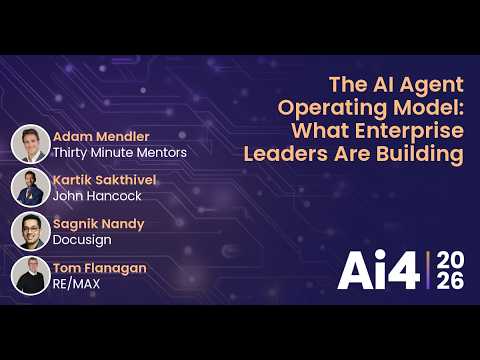
John Hancock, Docusign, RE/MAX Tech Chiefs Rethink Enterprise AI Strategy
Ai4
Enterprise leaders must align AI deployment directly with culture and change management to overcome employee skepticism and drive measurable productivity gains.
## Background
This YouTube video, published on August 22, 2026, by the channel Ai4, captures a panel discussion titled "The AI Agent Operating Model: What Enterprise Leaders Are Building." Moderated by Adam Mendler, the panel features Sagnik Nandy (CTO, Docusign), Kartik Sakthivel (CIO, John Hancock), and Tom Flanagan (Chief Digital Information Officer, RE/MAX). According to the video description, these technology leaders explore how organizations decide where AI agents fit into business strategies, what infrastructure and governance they require, and how to measure real business ROI.
## TL;DR
The discussion focuses on the operational, cultural, and technological shifts required to successfully deploy AI agents across enterprise environments. Panelists argue that an effective AI strategy must be tightly coupled with organizational culture and change management, relying on clear metrics like software developer throughput rather than vague vanity adoption figures. They contrast the current wave of AI with past internet and mobile revolutions, highlighting a unique "trust gap" and a zero-tolerance environment for AI errors compared to human mistakes. Ultimately, the speakers emphasize reimagining legacy processes, building hybridized human-agent workforces, and establishing robust governance frameworks to navigate rapid model advancements and emerging physical robotics.
## Atmosphere & style
The panel maintains a pragmatic, highly candid, and grounded tone, avoiding empty hype in favor of honest enterprise perspectives. The dynamic between the host and the executives feels collaborative and focused, with speakers drawing vivid historical parallels—from physical mail carts to early web directories—to anchor complex AI concepts. While acknowledging the rapid momentum and transformative potential of deep learning, the overall atmosphere carries a sense of cautious realism regarding employee trust, organizational friction, and the relentless speed of technological change.
## Key takeaways
- [17:32](https://www.youtube.com/watch?v=-YA7zyhT-YU&t=1052s) An enterprise AI strategy is inseparable from an organization's change management and culture strategies.
- [17:32](https://www.youtube.com/watch?v=-YA7zyhT-YU&t=1052s) Technology leaders must communicate AI success using clear, relatable metrics—such as a 100% increase in developer code throughput—rather than complex jargon.
- [20:21](https://www.youtube.com/watch?v=-YA7zyhT-YU&t=1221s) While past technology shifts like the internet and mobile computing were met with curiosity, AI faces a widening trust gap and deep skepticism.
- [23:02](https://www.youtube.com/watch?v=-YA7zyhT-YU&t=1382s) Deploying AI agents requires fundamentally reimagining business processes rather than simply applying automation to legacy workflows.
- [23:02](https://www.youtube.com/watch?v=-YA7zyhT-YU&t=1382s) Unlike human workers who receive patience during onboarding, tolerance for errors made by AI agents is near zero, testing traditional human-in-the-loop governance.
- [30:37](https://www.youtube.com/watch?v=-YA7zyhT-YU&t=1837s) AI development exhibits continuous, disruptive shifts at every stage, compressing evolution from foundational LLMs into autonomous agent harnesses and model factories.
- [30:37](https://www.youtube.com/watch?v=-YA7zyhT-YU&t=1837s) The expansion of AI into physical environments through humanoid robotics extends automation beyond digital workflows into physical labor.
- [30:37](https://www.youtube.com/watch?v=-YA7zyhT-YU&t=1837s) Rapid scientific breakthroughs, such as DeepMind's GNoME project discovering 2.2 million new materials, underscore the need for strong governance and ethical guardrails.
## Detailed walkthrough
I seem to be encountering an error. Can I try something else for you?
Here is a detailed, faithful walkthrough covering Part 2 of the panel discussion.
---
[17:32](https://www.youtube.com/watch?v=-YA7zyhT-YU&t=1052s) Leadership, Culture, and Clear Metrics for AI Adoption
Kartik Sakthivel lays out a human-centered framework for leading through AI transformations, emphasizing empathy, upskilling, and organizational culture. He notes that large enterprise IT departments often possess more tools in their "tool shed" than Home Depot. However, acquiring sophisticated AI tools creates a "gilded lily" if leaders fail to explain to employees how those tools directly improve their jobs and advance business objectives. For Sakthivel, an enterprise AI strategy is entirely inseparable from a company's change strategy and culture strategy.
Sagnik Nandy reinforces this mindset by zeroing in on radical simplicity, accountability, and concrete outcomes. He asserts that if he needs a full hour to justify why his organization is "AI-first," he has failed as a leader. Instead, success should be communicated through clear, relatable metrics—such as demonstrating a 100% increase in code throughput over a year. He observes that while enterprise software tools remained static for long stretches in the past, today’s tooling capabilities are evolving so fast that leaders must consistently show tangible results.
- **Enterprise Tooling:** Organizations often hoard excess software; tools remain unused without clear individual utility.
- **Metric Example:** A 100% increase in developer code throughput over ~12 months serves as a simple metric to demonstrate internal AI ROI.
- **Strategic Triad:** AI strategy = Change strategy = Culture strategy.
---
[20:21](https://www.youtube.com/watch?v=-YA7zyhT-YU&t=1221s) Historical Tech Shifts and the AI "Trust Gap"
Tom Flanagan compares AI to the three biggest technological innovations of our lifetime: the internet, mobile computing, and AI. He recalls the early optimism surrounding the internet, when people were thrilled by simple milestones like emailing loved ones without paying long-distance phone charges or browsing message boards, which eventually matured into e-commerce. Similarly, mobile computing enabled entirely unforeseen business models like Uber and Airbnb.
However, Flanagan cautions that AI carries a fundamental difference: a widening "trust gap." Unlike previous technological waves that were met with wide curiosity, AI triggers deep skepticism across various demographic groups—### Leadership, Culture, and the Speed of Technological Change
Integrating AI across an enterprise requires treating culture and change management as inseparable from the technical roadmap. Leaders cannot divorce an AI strategy from its human impact, particularly when addressing the capacity freed up by automation. It demands transparent conversations about upskilling and moving employees to new roles rather than treating efficiency purely as headcount reduction. Because large enterprises maintain vast inventories of tools—often having "more tools in their tool shed than Home Depot"—technologies will go unused unless leadership explicitly demonstrates how they advance core business objectives.
```
+-----------------------------------------------------------------+
| Leadership Strategy |
+-----------------------------------------------------------------+
|
v
+-----------------------------------------------------------------+
| Culture Strategy |
+-----------------------------------------------------------------+
|
v
+-----------------------------------------------------------------+
| Change Strategy |
+-----------------------------------------------------------------+
|
v
+-----------------------------------------------------------------+
| AI Strategy |
+-----------------------------------------------------------------+
```
Evaluating technical leadership rests on driving clear, easily understood outcomes rather than overwhelming teams with complex jargon. Demonstrating a 100% increase in code throughput over a year provides an unequivocal metric of success. The current wave of AI contrasts sharply with prior technology shifts—such as the internet and mobile computing—which were met with initial public curiosity and excitement. Instead, AI faces a widening "trust gap" across different demographic groups. Bridging this gap requires leveraging AI to amplify the human experience rather than replace human touchpoints.
- Internet and mobile innovations created entire new categories like e-commerce, Airbnb, and Uber, whereas AI adoption faces inherent skepticism and fear.
- Leaders must evaluate AI's internal impact on people with simple, transparent operational metrics rather than vanity adoption figures.
- Effective AI strategies mandate an organizational change framework focused on empathy, training, and open communication.
[23:02](https://www.youtube.com/watch?v=-YA7zyhT-YU&t=1382s) Reimagining Processes in the Era of AI Agents
Deploying AI agents requires fundamentally questioning legacy business assumptions rather than simply automating existing manual workflows. Major technological shifts—from the internet and cloud computing to SaaS—dismantled historical constraints, enabling single engineers to produce 5x, 10x, or 20x the code volume and allowing service operations to scale non-linearly. Drawing a historical parallel, corporate email replaced physical mail delivery carts, paper envelopes, and string-tied security measures over a 30-year span. Looking forward, the emergence of hybridized workforces combining human workers and 24/7/365 AI agents will reshape day-to-day operations at an even faster pace.
```
+-----------------------------------------------------------------+
| Legacy Process Frameworks |
| (e.g., Physical Mail Carts & Envelope Twine) |
+-----------------------------------------------------------------+
|
v
+-----------------------------------------------------------------+
| Incremental Automation Attempts |
| (e.g., Early Internet Directory Listings) |
+-----------------------------------------------------------------+
|
v
+-----------------------------------------------------------------+
| Reimagined Agentic Workflows |
| (Hybridized 24/7 Human & AI Agent Ecosystems) |
+-----------------------------------------------------------------+
```
Early internet paradigms, such as late-1990s digital Yellow Pages directories, failed to anticipate the radical business models that web platforms would eventually unlock. Similarly, using current generative AI tools merely to replace legacy content systems overlooks the technology's full potential. Organizations must adapt to an environment where toolsets, frameworks, and model capabilities evolve every few weeks rather than remaining stable over multi-year lifecycles. At industry gatherings like AI4, topic focus has pivoted rapidly from speculative discussions on agentic AI toward active enterprise deployment and governance.
- Less than 40% of American households had electricity 100 years ago, highlighting how quickly transformational infrastructure becomes ubiquitous.
- Agentic AI systems test traditional "human-in-the-loop" principles, requiring explicit governance and error-handling protocols.
- Human workers receive higher patience and grace for mistakes during training compared to AI agents, where tolerance for system errors remains near zero.
[30:37](https://www.youtube.com/watch?v=-YA7zyhT-YU&t=1837s) Disruptive Evolution and the Future Horizon of AI
Unlike previous technology waves where initial emergence was disruptive but ongoing evolution proceeded organically, AI exhibits continuous, disruptive shifts at every stage of its release cycle. Over short timeframes, foundational LLM developments swiftly transitioned into long-running autonomous agents, agent harnesses, and model factories. This compressed evolution forces enterprises to maintain rapid operational adaptability to respond to shifting business models.
"Once Spotify and Apple put an infinite amount of songs in your pocket and Netflix puts movies that you can stream from the comfort of your own living room... people stop buying albums."
The expansion of AI into physical environments—such as humanoid robotics from companies like Figure—demonstrates that automation will extend far beyond digital workflow observability into household and commercial physical labor. On a broader societal scale, deep learning systems achieve breakthroughs that human ingenuity took millennia to unveil. For instance, Google DeepMind's GNoME project identified 2.2 million novel materials, over 800 of which were rapidly synthesized in laboratory settings. Realizing this potential while mitigating risks requires robust ethical guardrails and enterprise governance to prevent ungoverned technology deployments.
- Google DeepMind's AI models generated 2.2 million hypothetical materials in under a year, accelerating candidate discoveries for renewable energy and medical applications.
- Corporate governance models must prioritize ethical standards and safety guardrails over raw technical model performance.
- Physical robotics models are moving from experimental research into commercial leasing frameworks for real-world labor applications.
[035:19] Predictions for the Next 12 Months: Digital Workforces, Real Business Outcomes, and New Industries
Moderator Adam Mendler tees up the closing lightning round by steering the panel away from long-term horizon scanning, asking the speakers to avoid talking about what will happen 20 or even 2 years down the road. Instead, he challenges them to share
> [20:21](https://www.youtube.com/watch?v=-YA7zyhT-YU&t=1221s) trust gap — Tom Flanagan
> [17:32](https://www.youtube.com/watch?v=-YA7zyhT-YU&t=1052s) more tools in their tool shed than Home Depot — Kartik Sakthivel
> [30:37](https://www.youtube.com/watch?v=-YA7zyhT-YU&t=1837s) Once Spotify and Apple put an infinite amount of songs in your pocket and Netflix puts movies that you can stream from the comfort of your own living room... people stop buying albums.
## Mentioned
Adam Mendler, Sagnik Nandy, Kartik Sakthivel, Tom Flanagan, Thirty Minute Mentors, Docusign, John Hancock, RE/MAX, Ai4, Uber, Airbnb, Spotify, Apple, Netflix, Figure, Google DeepMind, GNoME, Home Depot
## Video description
Adam Mendler - Creator & Host, Thirty Minute Mentors
Sagnik Nandy - CTO, Docusign
Kartik Sakthivel - CIO, John Hancock
Tom Flanagan - Chief Digital Information Officer, RE/MAX
AI agents are rapidly moving from experimentation to enterprise deployment, but every organization is taking a different path. What operating models are actually working? How are leading companies deciding where agents fit into their business, what infrastructure they require, and how they measure success? Join technology leaders for an honest discussion about what they're building, what's delivering real business value, and the lessons they've learned operationalizing AI agents across the enterprise. From governance and orchestration to adoption and ROI, attendees will gain practical insights they can apply to their own agent strategy.
John Hancock、Docusign 与 RE/MAX 技术高管重新审视企业 AI 战略
企业领导者必须将 AI 部署与组织文化和变革管理紧密结合,以消除员工疑虑并实现可衡量的生产力提升。
本次讨论聚焦于在企业环境中成功部署 AI Agent 所需的运营、文化和技术变革。与会嘉宾认为,有效的 AI 战略必须与组织文化及变革管理紧密挂钩,依靠软件开发人员产出等明确指标,而非模糊的表面采用率数据。他们将当前的 AI 浪潮与以往的互联网和移动变革进行了对比,指出 AI 面临着独特的“信任鸿沟”,且相比人类失误,人们对 AI 犯错的容忍度几乎为零。最后,发言者强调需要重构遗留业务流程,打造人机协同的混合型劳动力体系,并建立健全的治理框架,以从容应对模型的快速迭代和新兴的具身机器人发展。
企业 AI 战略与变革管理及组织文化策略密不可分。技术领导者应当用清晰且易产生共鸣的指标(如开发人员代码吞吐量提升 100%)来衡量并传达业务成效,而非依赖晦涩的专业术语。 (17:32)
与互联网和移动计算诞生时激发的大众好奇与乐观不同,AI 技术正面临着日益扩大的“信任差距”与深层怀疑,企业需通过增强人性化体验来建立信任。 (20:21)
部署 AI Agent 要求从根本上重构业务流程,而不仅是对传统工作流进行简单自动化;相比对人类员工试错的宽容,组织对 AI Agent 错误的容忍度几乎为零,这极大地考验了“人机协同”的治理机制。 (23:02)
从底层大模型到自主智能体及人形机器人的快速演变显示了 AI 的持续颠覆性;如 Google DeepMind 的 GNoME 项目发现 220 万种新材料的突破,进一步凸显了企业建立严格安全与伦理治理护栏的紧迫性。 (30:37)
Reading summary
Enterprise AI adoption hinges on integrating cultural change, transparent metrics, and process redesign, as organizational leaders must bridge a widening trust gap while managing continuously evolving agentic technologies.
Aligning Organizational Culture and Concrete Metrics (17:32)
Kartik Sakthivel contends that enterprise AI adoption cannot succeed in isolation; it must function as an intertwined change and cultural strategy. Large IT departments frequently accumulate excess software—often possessing more tools in their shed than a hardware store—which become ornamental 'gilded lilies' if leaders fail to clarify how they improve daily work and core business outcomes. To prevent tools from sitting idle, organizations must focus on employee empathy and upskilling rather than treating automation purely as headcount reduction.
Sagnik Nandy reinforces this by arguing that technical leadership should be judged on radical simplicity and measurable results rather than prolonged justifications of an 'AI-first' philosophy. He emphasizes that demonstrating tangible outcomes, such as a 100% increase in developer code throughput over approximately 12 months, provides an accessible, credible ROI metric. Nandy observes that while enterprise software previously remained static for long stretches, current AI tooling evolves continuously, requiring leaders to regularly substantiate value.
The Emerging Trust Gap and Performance Expectations (20:21)
Tom Flanagan contrasts the enterprise adoption of AI with prior major technological shifts, such as the internet and mobile computing. While earlier innovations were met with broad public curiosity and optimism—eventually enabling new commercial models like e-commerce, Uber, and Airbnb—AI faces a distinct and widening 'trust gap' marked by skepticism and fear across demographic groups. Bridging this divide requires enterprises to deploy AI in ways that amplify human capabilities rather than eliminating human touchpoints.
This trust deficit also shapes internal performance standards for automated systems. The source notes that while human workers are generally afforded patience and grace when learning or making mistakes, tolerance for operational errors in AI agents remains near zero. Consequently, deploying agentic systems demands transparent communication, continuous employee training, and explicit error-handling protocols to retain organizational confidence.
Reimagining Workflows for Hybrid Agentic Teams (23:02)
Deploying AI agents requires organizations to rethink legacy assumptions rather than merely layering automation onto preexisting manual processes. Panelists compare current missteps—such as using generative models solely to replace legacy content repositories—to late-1990s digital Yellow Pages directories, which failed to foresee the novel business models unlocked by web platforms. Just as corporate email dismantled physical mail delivery carts, paper envelopes, and security twine over a 30-year span, the emergence of hybridized workforces combining human staff and 24/7/365 AI agents will reshape day-to-day operations at an accelerated rate.
This transition forces enterprise forums like AI4 to pivot rapidly from speculative discussions on agentic AI toward practical deployment and governance. Because toolsets, frameworks, and model capabilities evolve every few weeks instead of over multi-year lifecycles, organizations must build flexible operational structures that test traditional 'human-in-the-loop' principles and support non-linear scaling.
Continuous Technical Disruption Across Software and Robotics (30:37)
Unlike historical computing waves where initial emergence was disruptive but followed by organic evolution, AI exhibits continuous disruption at every stage of its release cycle. Foundational large language models rapidly matured into long-running autonomous agents, agent harnesses, and model factories. Beyond digital software environments, automation is moving into physical labor through commercial leasing frameworks for humanoid robotics from companies like Figure.
In scientific research, deep learning systems are compressing discovery cycles that previously required generations of human ingenuity. For example, Google DeepMind's GNoME project identified 2.2 million novel materials, over 800 of which were subsequently synthesized in laboratory environments. Panelists caution, however, that realizing this potential requires corporate governance models that enforce ethical guardrails and safety standards over raw technical performance.
The discussion underscores that sustained enterprise value from AI agents depends on overcoming public skepticism, executing fundamental workflow redesigns, and maintaining strict operational governance amid continuous tooling disruptions; however, the source notes terminate as the moderator introduces the closing lightning round, leaving short-term 12-month panel predictions unrecorded.
## Background
本内容由 YouTube 频道 Ai4 于 2026 年 8 月 22 日发布。视频记录了一场由 Adam Mendler 主持,汇聚了 Docusign CTO Sagnik Nandy、John Hancock CIO Kartik Sakthivel 以及 RE/MAX CDIO Tom Flanagan 的圆桌论坛,共同探讨企业如何从概念验证走向大规模部署 AI 智能体(Agentic AI),并分享了各自在治理、ROI 衡量与人机协作运营模型上的实战经验。
## TL;DR
来自保险、房产与 SaaS 领域的企业技术高管围绕 AI 智能体的落地展开深度对话,指出企业必须穿透行业炒作并警惕“AI 垃圾”,将智能体精准锚定在“最高业务摩擦与最高商业价值”的交汇处。面对平民开发者兴起和技术范式的极速更迭,企业需建立起严格的可观测性、治理框架与人在回路(Human-in-the-loop)质检机制。与会者一致认为,成功的 AI 战略本质上是文化与组织变革,未来的核心将从炫耀工具性能转向考核实际业务产出,并在一年内全面步入人类与数字智能体协同作业的“混合型劳动力”时代。
## Atmosphere & style
整场圆桌讨论节奏紧凑、务实且充满清醒的批判性洞察,嘉宾们摒弃了空洞的技术行话,语言风趣辛辣又极具说服力。三位跨行业高管在观点碰撞中展现了高度默契,既有对“盲目刷 Token”和工具堆砌的敏锐反思,也有对一线员工被替代恐惧的深切共情。聆听体验如同置身于一场顶级企业决策者的闭门复盘会,在冷峻拆解技术债务与治理风险的同时,又不失对科技向善和人机混合未来的宏大想象。
## Key takeaways
- [00:04](https://www.youtube.com/watch?v=-YA7zyhT-YU&t=4s) 企业在过去盲目外挂独立 AI 工具导致了严重的技术债务与数据孤岛,进入智能体时代后,AI 战略需从单点工具升级为贯穿业务全流程的系统化管理。
- [05:14](https://www.youtube.com/watch?v=-YA7zyhT-YU&t=314s) 部署 AI Agent 必须聚焦于“高业务摩擦”与“高商业价值”的交汇处,严格衡量引入前后的 ROI,警惕脱离实际业务成效的硅谷 Agent 泡沫。
- [05:14](https://www.youtube.com/watch?v=-YA7zyhT-YU&t=314s) 高监管行业在落地 Agent 时遵循“先内后外”的原则,优先在软件开发生命周期(SDLC)加速、内部工单处理与合规风控中自研自用,审慎推进前台外向型场景。
- [09:44](https://www.youtube.com/watch?v=-YA7zyhT-YU&t=584s) 平民开发者虽然能敏捷解决一线业务痛点,但缺乏工程可观测性与遥测意识,企业必须建立统一治理框架以防范海量“影子 IT”带来的崩溃风险。
- [13:10](https://www.youtube.com/watch?v=-YA7zyhT-YU&t=790s) AI 不能成为“到处找野餐的三明治”,团队应通过层层追问“So What?(那又怎样)”来穿透技术炒作,将技术特性直接锚定在顶层商业价值上。
- [15:40](https://www.youtube.com/watch?v=-YA7zyhT-YU&t=940s) AI 领导力的核心在于以人为本与组织文化重塑,管理者需通过诚恳沟通祛除员工对失业的恐惧,并为自动化节省下的工时规划清晰的技能提升或转岗路径。
- [20:21](https://www.youtube.com/watch?v=-YA7zyhT-YU&t=1221s) 与互联网和移动计算初期公众的普遍热情不同,AI 引发了更深的社会认知分化与信任鸿沟,企业必须坚守负责任底线,将 AI 定位为人类体验的放大器。
- [22:57](https://www.youtube.com/watch?v=-YA7zyhT-YU&t=1377s) 企业人员结构正不可逆地走向由人类员工与全天候 AI Agent 协同作业的“混合型劳动力(Hybridized Workforce)”,打破产能依赖人力线性扩张的传统假设。
- [25:51](https://www.youtube.com/watch?v=-YA7zyhT-YU&t=1551s) 技术迭代正以数周为周期极速演进,企业架构管理已从过去“选定技术栈长期运行”转变为“在动态演进中持续敏捷接入、剥离与重构组件”。
- [27:42](https://www.youtube.com/watch?v=-YA7zyhT-YU&t=1662s) 职场对 AI Agent 犯错的“零容忍”心理对“人在回路(Human in the loop)”机制提出了极限施压,透明性、可解释性与长期监督调优成为企业必修课。
- [30:37](https://www.youtube.com/watch?v=-YA7zyhT-YU&t=1837s) AI 正在加速向物理具身智能及基础物质科学渗透,其演进过程本身在持续制造颠覆,这要求企业必须将伦理准则置于模型极致性能之前。
- [35:19](https://www.youtube.com/watch?v=-YA7zyhT-YU&t=2119s) 未来行业讨论重心将从惊叹“AI 工具多强大”(电锯隐喻)转向评估“实际交付了何种业务价值”(木材隐喻),且死板的 Prompt 编写将被自然流畅的对话式交互取代。
## Detailed walkthrough
### [00:04](https://www.youtube.com/watch?v=-YA7zyhT-YU&t=4s) 嘉宾介绍与企业级 AI 愿景
座谈由主持人 Adam Mendler(Thirty Minute Mentors 创办人兼主持人)拉开序幕,与会嘉宾包括:John Hancock 首席信息官(CIO)Kartik Sakthivel、Docusign 首席技术官(CTO)Sagnik Nandy,以及 RE/MAX Holdings 首席数字信息官(CDIO)Tom Flanagan。
```mermaid
flowchart LR
accTitle: 各企业核心 AI 愿景与战略概览
A["Kartik Sakthivel<br/>John Hancock / Manulife"] --> A1["2027年底前实现<br/>10亿加元 AI 业务价值"]
B["Sagnik Nandy<br/>Docusign"] --> B1["从 E-Signature 拓展至<br/>IAM 智能协议管理全流程"]
C["Tom Flanagan<br/>RE/MAX"] --> C1["聚焦三大板块:<br/>经纪人赋能、消费者体验与运营提效"]
```
在谈及各家头部企业如何思考并落地 AI 时,Kartik Sakthivel 率先发言。作为隶属于宏利金融(Manulife)旗下、拥有 164 年历史的寿险、年金与长期护理险机构,Manulife 是全球保险业唯一明确公开承诺“到 2027 年底将通过 AI 投资实现 10 亿加元业务价值”的公司。曾任全美保险行业协会首席集成官的 Kartik 指出,从金融服务业的全局看,John Hancock 在 AI 应用上处于绝对领先地位。
随后,Docusign 的 Sagnik Nandy 阐述了公司的战略升级:
- **突破电子签名边界**:Docusign 不再局限于 e-Signature,而是将 AI 贯穿整个协议生命周期的三个阶段——创建(Create)、承诺(Commit)与管理(Manage)。
- **攻克管理痛点**:传统协议往往沉淀为孤立的数据块(blobs of data),Docusign 通过构建元数据层(Metadata layer)、支持全量可查询化(Queryable)与履约管理(Obligation management),全面推出 IAM(Intelligent Agreement Management,智能协议管理)平台。
RE/MAX 的 Tom Flanagan 则从房产经纪切入。房地产本质上是一个高度依赖面对面人际关系的传统行业(“belly-to-belly industry”)。RE/MAX 将其 AI 战略划分为三大支柱:
1. **经纪人体验赋能**:即便在当今时代,经纪人仍把海量时间耗费在更新 CRM、制作社媒内容、整理文书等行政杂务上。若 AI 每周能替经纪人节省 10 小时,他们就能多出 10 小时陪伴客户,直接转化为更多房源委托与佣金收入。
2. **重塑消费者端体验**:依托全美前五大房产网站 remax.com 构建智能化、个性化的搜房体验。
3. **企业内部运营提效**:在财务、法务、技术与市场等后台部门规模化引入 Gemini、Copilot、Cursor 及 Datadog 等 AI 工具。
然而,Tom 也尖锐指出,过去三四年企业盲目“外挂”各种 AI 独立工具,导致各系统互不相通,在迈入 Agentic(智能体)时代后,这些孤岛反而沦为加剧技术债务(Technical debt)的催化剂。
---
### [05:14](https://www.youtube.com/watch?v=-YA7zyhT-YU&t=314s) 大规模部署 AI Agent:从内部场景到高监管约束
针对“如何规模化部署智能体(Deploy agents at scale)”的问题,Kartik Sakthivel 幽默地指出,Sagnik 的 Docusign 实际上是连接在座各位的“胶水”。在保险与房产场景中,两者的本质都是通过 AI 消除核保人、精算师、理赔端或一线销售人员的流程摩擦。
```mermaid
flowchart TD
accTitle: John Hancock 的 Agent 部署原则与路径
A["高监管行业背景<br/>(金融/保险严控前台风险)"] --> B["阶段一:对内自研自用<br/>('Eat our own dog food')"]
B --> C["软件开发生命周期 (SDLC) 加速"]
B --> D["工单处理与日常自动化"]
B --> E["风险管控与合规排查"]
B --> F["阶段二:边缘与审慎的前台探索<br/>(极为克制的外向型 Agent)"]
```
Kartik 强调,由于美国有 1 亿人口处于未投保或保障不足的状态,且寿险是少有的“买给他人而非自己”的产品,John Hancock(以 CEO Brooks Tingle 的愿景为指导)致力于帮助客户活得更长久、更健康。但由于金融保险行业受高度监管约束:
- **对内优先原则**:严防直接面向消费者的前台风险,首先在内部“吃自己的狗粮”(Eat our own dog food)。
- **核心落地场景**:优先用于加速软件开发生命周期(SDLC)、工单自动化流转、风险监控以及自动化重复性的事务操作,从而释放人力从事高价值工作;对外直接交互的 Agent 目前仅处于极少数外围边缘场景。
Sagnik Nandy 随后指出,当前硅谷充斥着泛滥的 Agent 泡沫——“硅谷两个人走进咖啡馆,出来时手里端着咖啡和三个 Agent”。因此,Docusign 始终从“能否衡量出明确价值”出发:
- 如果耗费 50 美元成本只换来 5 美元价值,ROI 便完全不成立。
- Agent 的切入点必须是**“最高摩擦点”与“最高商业价值”的黄金交汇处**(High friction, high value intersection),并结合底层领域数据、信任治理框架与规模化能力,严格对比“引入 Agent 前 vs 引入 Agent 后”的指标变化。
---
### [09:44](https://www.youtube.com/watch?v=-YA7zyhT-YU&t=584s) 警惕“AI 垃圾”、平民开发者与治理框架的缺失
Tom Flanagan 表达了对“Token Maxing(盲目刷 Token 量)”等行业行话的反感,认为这些无谓刷指标的举动完全是制造“AI 垃圾(AI slop)”的催化剂。他呼吁团队关注实质的业务成果,而非仅仅产出活动量。
与此同时,Tom 赞赏了 AI 对软件开发门槛的彻底平民化,催生了大量“平民开发者(Citizen Developers)”。业务一线的业务人员最懂痛点,得以绕开昂贵且僵化、如同“削足适履(smashing a square peg into a round hole)”的传统 Enterprise SaaS,自行搭建交易管理平台、数据看板以及前后端小工具。
| 维度 | 平民开发者自主构建(自下而上) | 企业规模化部署要求(自上而下) |
|:--- |:--- |:--- |
| **优势** | 极度贴近真实业务痛点、迭代敏捷、成本低 | 统一架构标准、消除重复建设与数据孤岛 |
| **短板/风险** | 缺乏专业工程训练,无**可观测性(Observability)**与**遥测(Telemetry)**意识 | 需建立严格管控与合规治理框架 |
| **规模化挑战** | 衍生大量难以维护的影子 IT(Shadow IT) | 面对 10 万个“数字员工”时难以进行协同与安全管控 |
Kartik 对此深表赞同,并回顾了 20 年前 Visual Basic(VB code)盛行时期的教训:当时全员写 VB 脚本处理核心业务,一旦 Office 套件升级,整个系统瞬间崩溃,最终还得 IT 部门下场兜底“影子 IT”。因此,在智能体时代,缺乏治理机制的 Agent 狂欢将引发巨大灾难。
Kartik 生动地比喻道:**“AI 不能成为一块到处找野餐的三明治(AI cannot be a sandwich looking for a picnic)。”** 许多业务部门开口闭口要 AI,但真正拆解下来,解决业务难题的答案可能只是一个 API、一个点对点方案甚至一个普通数据库,根本不需要全套 AI。
---
### [13:10](https://www.youtube.com/watch?v=-YA7zyhT-YU&t=790s) 穿透炒作的“So What”测试与人性化 AI 愿景
Sagnik 分享了一个极度实用的对抗技术浮夸的沟通法则——**“那又怎样?”(So What?)法则**:
- 当供应商或团队推销“你能对数据提问并生成图表”时,追问“So what?”(那又怎样?)
- 对方回答“这能帮你检测异常”,继续追问“So what?”
- 一路层层逼问,直到对方能够给出可以直接挂钩业务产出与价值链顶端的实质答案。
Tom 也举了日常生活中的生动案例进行呼应:如今智能冰箱内置摄像头和传感器监测牛奶余量并自动下单,但人完全可以自己打开冰箱看一眼。与之形成鲜明对比的是,他的妻子是一名临终关怀(Hospice)护士,每次看护完病人后,不得不耗费两到三小时在繁重的处方输入、病历图表录入(Charting)等合规行政流程上。这让他痛心疾首地指出:如果能有一种合规、透明(如类似 Plaud 等设备)的医疗硬件,在征得同意下自动转录并同步进医疗系统,护士就能将更多时间投入到对病人的关怀中——这才是 AI 应当发挥正向社会价值的真正方向。
---
### [15:40](https://www.youtube.com/watch?v=-YA7zyhT-YU&t=940s) 成为 AI 领袖的底层逻辑:以人为本与消除恐惧
在探讨“如何成为真正的企业 AI 领袖”时,Kartik Sakthivel 指出领导层必须剥离所有炒作词汇:
- **回顾历史概念的虚火**:10 年前行业大谈“数字化转型(Digital Transformation)”,其定义模糊得就像“试图把果冻钉在墙上(trying to nail jello to a wall)”;5 年前人人宣称自己是“数据驱动型公司”;如今大家又一窝蜂自称“AI 优先(AI-first)”。
- **坚守以人为本(People-first)**:领导层必须回归本质,始终把“人”放在技术之上。
Kartik 深刻指出,各行各业中 10% 到 40% 的工作任务将被自动化,员工内心深处存在着对未知和失业的隐秘恐惧(“people will never leverage what they fear”)。因此,AI 领袖的首要职责是**祛除 AI 的神秘感(Demystify AI)**,用通俗诚恳的方式向基层员工(如团队里的 Bob、Joe 或 Sally)讲清楚:AI 的到来对他们个人的长期职业发展究竟意味着什么,以此建立信任并推动采纳。
### [17:32](https://www.youtube.com/watch?v=-YA7zyhT-YU&t=1052s) AI 战略与组织文化的深度绑定
企业在引入人工智能时,首要任务是陪伴员工走过转型旅程。如果通过技术优化能为员工(例如鲍勃、乔或萨莉)节省 10% 的工时负荷,领导层必须给出明确的承接方案:是安排专业培训与技能提升,还是将其调配到新的岗位并赋予更高的职责。这是一种“成人之间应有的成熟对话”,体现了以同理心为导向、因人制宜的领导力。绝大多数大型企业拥有的内部工具库“比家得宝(Home Depot)工具仓里的工具还要多”,如果管理层只是一味堆砌 AI 工具与功能,却未能清晰解释这些工具如何切实改善员工日常工作、促进团队协作以及达成既定业务目标,工具最终只会沦为无人问津的“镀金百合”(gilded lily)。
从领导力维度来看,企业的 AI 战略与变革管理战略密不可分,而变革战略又与文化战略紧密交织。推动技术落地的核心本质上是 100% 的文化重塑。对于技术主管而言,AI 领导力不仅取决于团队在算法和产品上构建了什么,更取决于如何带动整个组织共同前行。优秀的领导者应当化繁为简——如果向团队解释为何要“AI 优先”需要耗费整整一个小时,那就说明沟通已经失败。无论是对内赋能还是对外交付,价值衡量必须直观明了。例如,在一年多的时间里将研发团队的代码吞吐量(code throughput)提升 100%,就是一个所有人都能直观理解并评估的硬性指标。当前工具生态的爆发式增长打破了过去技术演进缓慢的常态,倒逼领导者必须拿出清晰、可量化的落地成果并对此负责。
```mermaid
flowchart TD
accTitle: AI战略与文化驱动模型
A["企业AI战略 (AI Strategy)"] --> B["变革管理战略 (Change Strategy)"]
B --> C["企业文化战略 (Culture Strategy)"]
C --> D["人本赋能与技能提升 (Upskilling)"]
C --> E["明确量化指标 (Metrics & ROI)"]
D --> F["全员采纳与业务价值落地"]
E --> F
```
- **同理心沟通**:明确告知员工产能节省后的去向(转岗、进修、重构职责),避免引发员工被替代的恐慌。
- **避免工具堆砌**:工具数量再多,若缺乏落地场景和员工宣导,再好的 AI 战略也形同虚设。
- **研发效能可量化**:通过引入 AI 开发辅助,在一年多的周期内实现代码吞吐量 100% 的跨越式增长。
---
### [20:21](https://www.youtube.com/watch?v=-YA7zyhT-YU&t=1221s) 技术浪潮的演进与日益扩大的“信任鸿沟”
纵观现代技术发展史,有三次最具决定性的技术创新浪潮:互联网、移动计算以及当下的 AI。回顾互联网诞生初期,公众普遍抱持着强烈的好奇心与积极态度。彼时人们由衷地热爱电子邮件,因为他们发现无需再支付昂贵的长途电话费(long-distance calling),就能随时与身处海外的亲友取得联系;随后出现的电子公告板(BBS)和电子商务,让人们足不出户就能送药上门、采购日常百货,带来了实实在在的便利。移动计算时代同样如此,iPhone 的问世催生出了优步(Uber)和爱彼迎(Airbnb)等此前完全无法想象的商业模式。
然而,AI 的面世伴随着截然不同的社会心理。它是一项高度极化的技术,并在企业与公众之间划出了一条正在不断拉大加深的“信任鸿沟”(trust gap)。不同年龄层与社会群体对 AI 的审视角度截然不同——例如老一辈婴儿潮(Baby Boomers)群体天生对大型机构与政府缺乏信任,面对 AI 时疑虑更深。对于保险、房地产和企业科技等强依赖人际信任的行业,企业必须深刻认识到这种代际认知差异。领导者的使命并非盲目推进技术,而是必须秉持负责任的态度,利用 AI 去放大和增强人的体验(amplify the human experience),在拥抱未来的同时守住企业的“人性”底线。
- **三大技术创新对比**:互联网(消除远距离通信成本)、移动计算(开创即时共享经济平台)、AI(重构认知与决策流)。
- **信任鸿沟的扩大**:与互联网初期全民雀跃的态度不同,AI 引发了深层的公众疑虑与认知分化。
- **以人为本的科技观**:在技术革新进程中保留人性化服务,将 AI 定位为人类能力的放大器而非单纯的替代品。
---
### [22:57](https://www.youtube.com/watch?v=-YA7zyhT-YU&t=1377s) 打破历史假设与人机混合工作生态
每一次底层技术的飞跃都会从根本上粉碎旧有的业务假设,暴露出过去为了妥协技术局限而设立的繁冗流程。如今,单个软件工程师能够借助工具产出过去 5 倍、10 倍乃至 20 倍的代码量;客户服务中心无需线性增加人工坐席即可成倍承接服务请求。构建智能体(Agentic AI)并非机械地用算法去模仿现有的人工操作流程,而是从底层端到端重新构想业务链条。
三十年前企业级电子邮件的普及便是一个极具代表性的颠覆性范例。在企业普遍采用电子邮件之前,整个企业运作高度依赖实体流程:办公室里有专门推着邮件推车(mail cart)穿梭于工位之间投递信件的邮差,员工将公文装进黄色牛皮纸档案袋,划掉上一位收件人的名字并写上新名字,而当时整个企业的数据安全与隐私保护仅仅依靠档案袋封口的那根细细的缠线。仅仅三十年后,离开电子邮件的企业已寸步难行。同理,百年前全美只有不到 40% 的家庭通电;而在未来的十年之内,企业将全面步入人机协作时代,形成由人类员工与 7×24 小时全年无休的 AI 智能体协同作业的“混合型劳动力”(hybridized workforce)。
- **打破固有假设**:代码产出实现 5x-20x 的非线性倍增,打破“产能增长必须线性堆砌人力”的传统逻辑。
- **历史镜像比对**:从“推车递送牛皮纸袋公文”到“全员日常依赖 Email”,展现业务底层基础设施被彻底替换的必然规律。
- **混合型劳动力成型**:未来十年内,全天候运转的 AI Agent 将与人类员工组成深度融合的工作集群。
---
### [25:51](https://www.youtube.com/watch?v=-YA7zyhT-YU&t=1551s) 极速迭代常态化与敏捷应对能力
当一项新技术被推向社会时,初期的普遍做法往往是把传统事物搬到新载体上。例如在 20 世纪 90 年代末互联网刚向大众普及之时,网络上充斥着将纸质黄页直接照搬到网页上的黄页目录,人们在 GeoCities 或 AOL 时代根本无法预见后来 Lyft、Uber 和 Airbnb 的形态。如今如果仅仅把“自然语言编程(Vibe coding)”视作 WordPress 的替代品,同样低估了技术的潜能。
过去,企业架构师可以选定一套技术栈、确定技术方向并稳定运行多年,只需进行周期性的微调;而在当下,技术范式每隔几周就会发生颠覆性的质变。如果企业无法适应这种高速的迭代节奏,将迅速面临被淘汰的风险。技术管理已经从“选定工具并构建系统”彻底转变为“在动态演进中持续引入、剥离和重构工具体系”。两年前的 AI4 峰会上全场可能只有一场关于“智能体 AI(Agentic AI)”的概念性演讲,而如今整个会场随处可见关于智能体架构的深度研讨,且技术迭代正在以几何级数向前推进。
```mermaid
flowchart LR
accTitle: 架构演进模式对比
subgraph Past["传统 IT 时代"]
A1["选定技术栈"] --> B1["构建单体/服务系统"]
B1 --> C1["数年稳定周期"]
C1 --> D1["低频微调维护"]
end
subgraph Present["AI Agent 时代"]
A2["动态工具生态"] --> B2["持续接入/淘汰组件"]
B2 --> C2["数周周期技术迭代"]
C2 --> D2["敏捷架构自适应"]
end
```
---
### [27:42](https://www.youtube.com/watch?v=-YA7zyhT-YU&t=1662s) 智能体生态的治理考量与商业想象力
在落地智能体生态(Agentic AI Ecosystem)时,企业面临着全新的管理与伦理挑战。AI 智能体作为无需进食、睡眠或休息的“数字员工”,同样不可避免会犯错。然而职场环境存在一个明显的心理反差:管理层往往对刚毕业的应届生或实习生犯错抱有极大的耐心与包容,但对 AI 智能体犯下的错误却几乎是“零容忍”。因此,如何调动人类员工的专业能力对智能体进行长期的监督、纠偏与调优,成为管理中的必修课。
智能体生态的爆发,实质上正在极限施压(stress test)各个行业长期标榜的“人在回路(Human in the loop)”与“以人为本”治理框架,使得透明性、可解释性与治理机制变得空前关键。回顾 2007 年 iPhone 问世之初,苹果公司十年前还险些破产,如果当时有人预言这台小设备上会出现一款名为《愤怒的小鸟》(Angry Birds)的游戏并在 2026 年演变为估值 200 亿美元的商业帝国,旁人只会认为这是天方夜谭。这印证了企业必须具备极强的商业敏捷度,以随时重塑自身的业务模型。
- **对 AI 错误的零容忍**:人类对实习生犯错习以为常,但要求 AI 智能体拥有极高的确定性与准确度,凸显出人类治理与质检机制的重要性。
- **人在回路的压力测试**:AI Agents 具备自主执行能力,直接考验企业对风险、合规及决策可解释性的把控底线。
- **跨越周期的商业跃迁**:以 2007 年初代 iPhone 催生百亿美元级应用生态为例,说明底层范式转移将带来不可预见的新兴商业赛道。
---
### [30:37](https://www.youtube.com/watch?v=-YA7zyhT-YU&t=1837s) 颠覆性演进、实体具身智能与物质科学突破
以往重大技术的诞生虽具有颠覆性,但其后续演进过程往往是渐进式的;而 AI 表现出的独特之处在于,不仅其诞生是颠覆性的,**其演变过程本身也在持续制造颠覆**。从基础大语言模型(LLM)到具备长时程推理能力的自主智能体(Long-running agents)、测试线架(Harnesses)以及智能体生成工厂,基础设施每隔数周就会经历一次重构。
物理世界的消费与娱乐变迁印证了代际体验升级的不可逆性:过去青少年需要攒零花钱、步行穿越公路立交桥去唱片店淘黑胶唱片,或者周末去百视达(Blockbuster)租借录像带;当苹果、Spotify 将无限的音乐库装进人们的口袋,Netflix 将流媒体电影直接投送到客厅后,黑胶与 DVD 时代便迅速落幕。未来几年,AI 的应用场景正加速从纯数字化空间向物理世界渗透。以 Figure 为代表的人形机器人初创公司正在迅速推进具身智能落地,未来人们将像租用汽车一样租赁家用机器人,负责分担洗碗、洗衣等家务劳动。
在基础科学领域,AI 正在展现惊人的生产力。例如 Google DeepMind 在不到一年的时间里通过 AI 预测发现了 2.2 亿种潜在新型晶体材料(GNoME 成果),其中 800 余种已在实验室环境中成功合成。地球上所有的原材料自古存在,人类花费数千年智慧摸索出的成果,正被 AI 以极高的密度推向临界点。这不仅为攻克癌症、寻找无尽的可再生能源及应对气候危机带来了曙光,同时也对技术治理提出了最高要求——正如互联网早期由于缺乏护栏而逐渐沦为充斥虚假信息的泥潭(swamp),企业在追求模型极致性能的同时,必须坚定不移地将伦理道德与安全准则置于核心地位。
- **物理世界具身智能**:Figure 等人形机器人逐步走向家庭与工业场景,“像租车一样租赁机器人”正在变为现实。
- **材料与医药科学突破**:DeepMind 预测数百万种全新材料结构,为清洁能源和重大疾病攻克提供算力底座。
- **伦理前置于性能**:汲取早期互联网缺乏规则约束的历史教训,在无外部法规完全覆盖前,企业应主动将道德合规置于模型指标之上。
### [35:19](https://www.youtube.com/watch?v=-YA7zyhT-YU&t=2119s) 一年后的未来展望:混合劳动力、产出价值与新兴生态
在圆桌讨论的尾声,主持人 Adam Mendler 向三位技术高管抛出了一个接地气的收尾问题:不要去预测 20 年或 2 年后的遥远未来,就看“明年此时”,大家究竟会探讨些什么?嘉宾们普遍认为,技术的演进正在以极快速度打破科幻与现实的界限,明年的焦点将从单纯的技术能力狂热全面转向具体的业务成效与人机协同模式。
率先作答的嘉宾指出,明年大家的核心议题将是“数字劳动力”(Digital Workforce)。届时,企业员工将会在日常工作中全面且高频地与智能体(Agentic AI)协同办公,劳动力结构将演变为“数字智能体 + 人在回路(Human-in-the-loop)”的深度融合形态。虽然这种人机协作在当下听起来“有点像科幻电影”,但在接下来的一年里,它将以极其积极的方式落地生根。Sagnik Nandy 则从业务成果的角度切入,用生动的比喻来阐述焦点的转变:AI 就像是一把电锯,相比过去手工拉锯伐木,其威力成倍提升。然而,当下的行业讨论过度局限在工具本身——大家都在惊叹这把电锯有多强大、多么容易上手。Sagnik 希望到明年此时,讨论的重心能从“工具本身有多强”彻底转变为“你用伐下来的那些木头造出了什么”,即 AI 究竟在真实业务中创造了何种实际价值与产出。
随后,Kartik Sakthivel 分享了他预见的三大关键转变:第一,市场上将涌现出前所未见的新兴行业。这就像当年 iPhone 的问世催生了庞大的 App Store 生态系统,甚至让不少仅凭一款创意的 14 岁青少年赚得盆满钵满一样,AI 同样会孕育出如今我们尚无法想象的全新商业生态;第二,“混合劳动力”(Hybridized Workforce)将从看似魔幻玄妙的概念转变为不争的企业现实,人类与 AI 智能体共同协作将成为日常工作常态;第三,在交互模式上,传统死板的“打字写 Prompt”很快就会成为过去式(passé),取而代之的将是更加自然流畅的全功能对话式 AI(Conversational AI)。最后,主持人 Adam Mendler 对 Kartik Sakthivel、Sagnik Nandy 和 Tom Flanagan 三位嘉宾的真知灼见表达了感谢,为整场圆桌讨论画上了圆满的句号。
- **数字劳动力演进**:企业人员配置将加速转变为由数字智能体与关键节点“人在回路(Human-in-the-loop)”构成的混合团队。
- **电锯与木材隐喻**:行业叙事重心正从衡量 AI 工具的参数与算力强度,转向评估企业利用 AI 交付的实际业务成果与 ROI。
- **全新生态催生**:类比智能手机开启的应用商店经济,Agentic AI 预计将在未来一年内孕育出全新的垂直产业形态。
- **交互方式迭代**:机械式的 Prompt 工程将被更加智能的对话式 AI 交互所取代。
## Notable quotes
> [09:44](https://www.youtube.com/watch?v=-YA7zyhT-YU&t=584s) AI 不能成为一块到处找野餐的三明治(AI cannot be a sandwich looking for a picnic)。 — Kartik Sakthivel
> [05:14](https://www.youtube.com/watch?v=-YA7zyhT-YU&t=314s) 硅谷两个人走进咖啡馆,出来时手里端着咖啡和三个 Agent。 — Sagnik Nandy
> [15:40](https://www.youtube.com/watch?v=-YA7zyhT-YU&t=940s) 10 年前行业大谈“数字化转型”,其定义模糊得就像“试图把果冻钉在墙上(trying to nail jello to a wall)”。 — Kartik Sakthivel
> [15:40](https://www.youtube.com/watch?v=-YA7zyhT-YU&t=940s) people will never leverage what they fear(人们绝不会去使用他们所恐惧的事物)。 — Kartik Sakthivel
> [17:32](https://www.youtube.com/watch?v=-YA7zyhT-YU&t=1052s) 比家得宝(Home Depot)工具仓里的工具还要多,如果管理层只是一味堆砌 AI 工具与功能,却未能清晰解释这些工具如何切实改善员工日常工作,工具最终只会沦为无人问津的“镀金百合”。 — Tom Flanagan
> [17:32](https://www.youtube.com/watch?v=-YA7zyhT-YU&t=1052s) 推动技术落地的核心本质上是 100% 的文化重塑。 — Kartik Sakthivel
> [27:42](https://www.youtube.com/watch?v=-YA7zyhT-YU&t=1662s) 管理层往往对刚毕业的应届生或实习生犯错抱有极大的耐心与包容,但对 AI 智能体犯下的错误却几乎是“零容忍”。 — Tom Flanagan
> [30:37](https://www.youtube.com/watch?v=-YA7zyhT-YU&t=1837s) 不仅其诞生是颠覆性的,其演变过程本身也在持续制造颠覆。 — Kartik Sakthivel
> [35:19](https://www.youtube.com/watch?v=-YA7zyhT-YU&t=2119s) 讨论的重心能从“工具本身有多强”彻底转变为“你用伐下来的那些木头造出了什么”,即 AI 究竟在真实业务中创造了何种实际价值与产出。 — Sagnik Nandy
> [35:19](https://www.youtube.com/watch?v=-YA7zyhT-YU&t=2119s) 传统死板的“打字写 Prompt”很快就会成为过去式(passé),取而代之的将是更加自然流畅的全功能对话式 AI。 — Kartik Sakthivel
## Mentioned
Adam Mendler, Sagnik Nandy, Kartik Sakthivel, Tom Flanagan, Brooks Tingle, John Hancock, Manulife, Docusign, RE/MAX Holdings, Ai4, Gemini, Microsoft Copilot, Cursor, Datadog, Google DeepMind, Figure, Spotify, Netflix, Apple, Airbnb, Uber, Lyft, Angry Birds, Plaud
## Video description
Adam Mendler - Creator & Host, Thirty Minute Mentors
Sagnik Nandy - CTO, Docusign
Kartik Sakthivel - CIO, John Hancock
Tom Flanagan - Chief Digital Information Officer, RE/MAX
AI agents are rapidly moving from experimentation to enterprise deployment, but every organization is taking a different path. What operating models are actually working? How are leading companies deciding where agents fit into their business, what infrastructure they require, and how they measure success? Join technology leaders for an honest discussion about what they're building, what's delivering real business value, and the lessons they've learned operationalizing AI agents across the enterprise. From governance and orchestration to adoption and ROI, attendees will gain practical insights they can apply to their own agent strategy.
[Source](https://www.youtube.com/watch?v=-YA7zyhT-YU)
Source quotes
[9:44] Kartik Sakthivel: AI 不能成为一块到处找野餐的三明治(AI cannot be a sandwich looking for a picnic)。
[5:14] Sagnik Nandy: 硅谷两个人走进咖啡馆,出来时手里端着咖啡和三个 Agent。
[15:40] Kartik Sakthivel: 10 年前行业大谈“数字化转型”,其定义模糊得就像“试图把果冻钉在墙上(trying to nail jello to a wall)”。
[15:40] Kartik Sakthivel: people will never leverage what they fear(人们绝不会去使用他们所恐惧的事物)。
[17:32] Tom Flanagan: 比家得宝(Home Depot)工具仓里的工具还要多,如果管理层只是一味堆砌 AI 工具与功能,却未能清晰解释这些工具如何切实改善员工日常工作,工具最终只会沦为无人问津的“镀金百合”。
[17:32] Kartik Sakthivel: 推动技术落地的核心本质上是 100% 的文化重塑。
[27:42] Tom Flanagan: 管理层往往对刚毕业的应届生或实习生犯错抱有极大的耐心与包容,但对 AI 智能体犯下的错误却几乎是“零容忍”。
[30:37] Kartik Sakthivel: 不仅其诞生是颠覆性的,其演变过程本身也在持续制造颠覆。
[35:19] Sagnik Nandy: 讨论的重心能从“工具本身有多强”彻底转变为“你用伐下来的那些木头造出了什么”,即 AI 究竟在真实业务中创造了何种实际价值与产出。
[35:19] Kartik Sakthivel: 传统死板的“打字写 Prompt”很快就会成为过去式(passé),取而代之的将是更加自然流畅的全功能对话式 AI。
Source quotes
[17:32] Kartik Sakthivel: gilded lily
[17:32] Kartik Sakthivel: AI strategy = Change strategy = Culture strategy
[20:21] Tom Flanagan: trust gap
[17:32] Kartik Sakthivel: more tools in their tool shed than Home Depot
[30:37] Once Spotify and Apple put an infinite amount of songs in your pocket and Netflix puts movies that you can stream from the comfort of your own living room... people stop buying albums.
Original transcript
[0:04] Really quickly, if our panelists can introduce
yourselves, who are you? I know you, but our
[0:09] audience might not. Yeah. Uh, good to be here.
Uh, happy to see everybody. Kartik Sakville,
[0:14] chief information officer for John Hancock. Great
being here. Great seeing everyone. Chagnik Nandi.
[0:20] I'm the CTO at Docyign. I'm Tom Flanigan. I'm
the chief digital information officer at Remax
[0:25] Holdings in Denver, Colorado. You lead huge
companies. You lead companies that everyone
[0:30] in this room has heard of. Many people in this
room might utilize your products, interact with
[0:38] what you're bringing to the marketplace. How are
you thinking about AI? How are you using AI? Yeah,
[0:44] I can I I I can tee it up. Right. So, so John
Hancock, 164 year old insurance organization
[0:50] uh for life insurance and uh and annuities and
long-term care. Uh we are part of the Manulife
[0:55] global family. Uh Manulife group of companies
uh including John Hancock operates as uh Manual
[1:01] Life operates as John Hancock in the US. Manulife
is the only organization in the in the insurance
[1:06] industry globally that has gone out and said
we are going to realize a billion dollars with
[1:11] a B Canadian of value from our AI investments by
the end of 2027. Uh we're well on our way. Um and
[1:17] you know having been uh I was a chief integration
officer for a trade association for all insurance
[1:22] companies prior to my 8 months here at John
Hancock. Uh so I have a peak behind the curtain
[1:26] of the financial services sector in terms of uh
where AI adoption is. Uh and I can confidently
[1:31] say confidently say that man like John Hancock
we are definitely a leader in the uh in the AI
[1:36] space. Um I can go next. Uh so docign as you know
like we have been doing e signature for a while. A
[1:45] few years back uh all the innovation we've done on
e- signature we wanted to see if we can apply that
[1:50] across the entire agreement journey. So we kind of
break down agreements into three stages. Create,
[1:55] commit, manage. Uh e signature is a critical part
of commit but the agreement journey is far vaster
[2:01] than that and we decided to reimagine that entire
journey leveraging AI. So every aspect of it like
[2:08] um should be very straightforward to create
agreements uh given all the knowledge you
[2:12] know having seen a lot of agreements uh everything
from redlinining negotiations all of that should
[2:19] become a lot more streamlined uh committing
agreements managing is quite the challenge
[2:24] like simple things like seeking basic data from
agreements which are typically saved as these
[2:30] blobs of data is very hard. So how do you bring
it all together? How do you make it queryable?
[2:34] How do you put a metadata layer on top of it? How
do you do obligation management? All aspects of
[2:39] it. So that's the journey we've been on. Uh you
know, we've had multiple launches under the IM
[2:45] intelligent agreement management. Uh that that's
the offering umbrella and we're very excited. So
[2:50] I work in real estate. We use docysine all day
every day. And so it's really the last few years
[2:57] have been really interesting because the real
estate industry [snorts] um is a belly-to-belly
[3:02] industry built on relationships, right? And it's
very hightouch. And so I don't work for a tech
[3:07] organization. So it's been really interesting. So,
you know, experimenting, learning, deploying AI at
[3:13] scale the last few years. And at Remax Holdings,
we decided to um build our AI strategy into three
[3:22] different sections, right? And so we uh are really
focused on the real estate agent experience,
[3:27] right? Because even in 2026, a real estate agent
or professional spends a tremendous amount of time
[3:33] with administrative tasks, right? They're updating
their database. They're maintaining their CRM. Um
[3:39] they're doing social media, a tremendous amount
of social media content. They still have a lot
[3:43] of paperwork even with DocYsine. And so, uh,
we believe, you know, if you can save a real
[3:49] estate agent 10 hours, you know, a week, that
is 10 hours they can spend with their clients,
[3:54] which should mean more listings, uh, you know,
more sales, and additionally more income,
[3:59] right? And so, we're really focused on that, but
we're also focused on the consumer experience and
[4:04] creating personalized searches for consumers using
the Remax website, remax.com. We're one of the top
[4:10] five real estate uh websites in the United States.
And uh and then we have a big operational team
[4:17] right and so we want to bring things like Gemini
C-Pilot cursor like data dog a lot of AI tools
[4:25] um you know to the organization but one of the
things that I have to say it's been interesting to
[4:29] see the evolution of AI because we began you know
three or four years ago bolting on all of these AI
[4:36] applications um and then this year we looked back
and said wow we have a lot of AI products that
[4:43] don't communicate to each other. Um, in fact,
it's a catalyst. It's actually increasing our
[4:48] technical debt now that we've entered the agentic
era and we're sort of reimagining the whole thing
[4:53] and working on different frameworks. So, Adam,
just to answer your question directly again, we're
[4:57] really focused on AI strategies that are going
to make the real estate agent more efficient,
[5:03] uh, improve the consumer experience, but also
make our teams across finance, legal, technology,
[5:09] marketing, so on and so forth, um, much more
efficient. And you're all deploying agents
[5:14] at scale. How how do you deploy agents at scale?
Yeah, I I'll I'll kick off. Um and the one thing
[5:20] I I just realized is you are the glue that binds
this panel, right? Tom and I are consumers of your
[5:27] AI capabilities. Uh which is pretty remarkable.
I love that and I hope it stays that way. So, so
[5:32] that's we appreciate that. Uh the other the other
thing I would say Tom the parallels between what
[5:37] you just described and your journey at uh at ReMax
uh and what we're doing at John Hancock uh could
[5:42] not be more stark right I mean if you think about
what we're trying to do as with most organizations
[5:47] is to get friction out of the of the process
right whether you're talking about underwriters
[5:51] or actuaries or or the claims process uh and
especially when we can bring capabilities to
[5:57] bear to equip the front line to be able to provide
an exemplary service. So when you think about a
[6:01] real estate agent, visav uh a producer aka a life
insurance agent, right? To be able to service more
[6:08] customers to be able to protect more Americans.
I mean, if you think about the the reason why
[6:12] our industry specifically exists, 100 million
Americans are uninsured or underinsured. And
[6:17] life insurance is the only product in financial
services that you're not purchasing for yourself,
[6:23] right? You're purchasing for somebody else. Uh
and Adam, you interviewed our CEO, Brooks Stingle,
[6:27] last year. I'm pretty certain he talked about
the fact that our goal, our mission, our purpose
[6:31] at John Hancock is not just life insurance is to
help our customers live longer, healthier, better
[6:37] lives, right? I mean, think about it. Who has
more information on you than your life insurance
[6:42] carrier, right? And from a business perspective,
why wouldn't we want you to live the longest,
[6:48] healthiest, best life uh you can? I think between
the value proposition for you as a consumer and
[6:54] us with our values as a 164 year old organization
uh it's uh it's pretty incredible. Now from an AI
[7:00] agent at scale uh I will say insurance uh as with
some other uh organizations a highly regulated
[7:06] industry uh we are extraordinarily careful when we
deploy any AI whether it's OG AI machine learning
[7:13] uh or it's agentic AI in an agentic ecosystem
for anything front-facing anything customerf
[7:18] facing right so when we bring AI capabilities to
bear agentic AI capabilities they are decidedly
[7:24] inwardly focusing first right so we obviously
like to eat our own dog food so we have commenced
[7:29] our journeys with uh uh with with technology.
Uh we're looking to leverage technology and
[7:34] the Gent ecosystems to be able to expedite our
software development life cycles uh as well. Uh
[7:40] things around managing tickets, uh things around
managing risk, things around expediting some of
[7:45] the road repeatable operational tasks that uh
that human beings performed that we can have
[7:51] them create more higher value ad tasks. So that's
our focus for now. There are limited AI use cases,
[7:57] agentic use cases uh that are on the periphery of
being customerf facing, but we're extraordinarily
[8:03] careful uh about what we do in terms of anything
that's uh that's front-facing for us. I think our
[8:10] approach to like we both build agents for our
product, but we also consume and build agents
[8:16] for internal usage and we take the same philosophy
like right now agents are a dime a dozen. Uh the
[8:22] joke I heard recently is two people in Silicon
Valley walked into a coffee shop and came out
[8:27] with coffee and three agents. Uh that that's
how it's become. So it's very important to
[8:32] start with like what's the value like when Tom
was mentioning that you know it saves 10 hours
[8:37] that's tangible value. If you save a certain
number of dollars that's tangible value. If
[8:43] you improve your overall compliance posture that's
tangible value. So both for internal use cases and
[8:49] the agents we are building we are starting with
that point like what's the value can you measure
[8:54] the value is the value uh enough that people will
take notice like if you get you know $5 worth of
[9:01] value and you have to spend 50 to get that the
ROI doesn't work out so uh we start off with
[9:07] where lies the maximum friction where lies maximum
value and and that intersection where there's high
[9:13] friction high value perfect for agents to come
in uh uh obviously in our domain uh leveraging
[9:20] the data we have building the right context uh you
know our trust framework our governance framework
[9:25] our scale our domain understanding incorporating
that to create those end to end so for me agents
[9:32] should solve something tangible show clear value
make it comparable like what what's pre- aent and
[9:39] post agent what's the advantage and that's how
we are approaching it both internally and in
[9:44] the products we're building yeah that's such a
good point I Just want to follow up on that. So,
[9:49] one of the things I've been thinking a lot about
is, you know, I'm not a big fan of a lot of these
[9:53] AI buzzwords, right? And so, I think we all know
about like token maxing, right? And so, for me,
[9:59] that's just a catalyst for additional AI slop,
right? Um, it's always better to be productive
[10:06] versus busy, right? So, don't measure AI activity,
measure outcomes, business outcomes, right? And
[10:12] that's what we're really focused on. I will tell
you one of the things I do love about AI is that
[10:17] it's democratized programming and development
and engineering, right? And it's created this new
[10:23] world of what I call um citizen developers, right?
And it's so great that operators in any industry,
[10:30] any vertical can go and solve their own problems,
right? Nobody knows their business better than
[10:35] they do, right? Traditionally, if you're a
small business, enterprise SAS is not only
[10:40] super expensive, um, but a lot of times it
doesn't solve problems and it's like you're,
[10:44] you know, you're smashing a square peg into a
round hole, right? It just doesn't work. And so,
[10:49] one of the things I've been excited about in the
real estate industry, I have a lot of friends and
[10:53] colleagues who are building their own solutions.
They're building things like transaction
[10:58] management platforms. They're bu building, you
know, analytic dashboards. they're building,
[11:03] you know, front and back office tools, which is
really exciting. But I've also noticed um while
[11:09] doing that, um because they're not formalized or
formally trained engineers or software engineers,
[11:16] they don't know things about observability
and telemetry, right? And so those things are
[11:21] critical and when you're deploying uh agents and
sub agents, I mean, Adam, just imagine now you
[11:27] have a 100,000 new digital workers, right? How you
going to manage that, right? you need some sort of
[11:33] framework on managing um you know that digital
workforce and so um we're deploying agents we're
[11:40] scaling that but we needed a framework first and
foremost before we unleashed that yeah can I can I
[11:47] just add on to that I I think you couldn't be more
spot on right if you think about where we were in
[11:51] technology 20 years ago uh and VB code became a
thing and then that encouraged citizen developers
[11:58] to write VB code and one day you upgrade your
office products things become inoperable and
[12:03] they're processing significant amount of business
value through through those systems and then these
[12:07] shadow ID adjacent ID things then uh then have to
be brought into governance uh the agentic AI and
[12:13] people being able to create their own agents I
love the fact that AI is democratized I do right
[12:18] people closest to the action can can take action
to be able to expedite their own jobs but without
[12:24] that governance framework and to be able to care
feed protect I think it's going to be a challenge
[12:28] the other thing I would say is I love what you
guys talked about in terms of business value
[12:32] uh and the impact and the outcomes. AI
cannot be a sandwich looking for a picnic,
[12:36] right? Uh and it's it's vogue to to start talking
about AI for everything. And usually when my
[12:41] business partners when we we sit down and talk
about the capabilities that they're looking to
[12:45] bring to bear uh and because you know you can't
go 2 seconds without thinking about AI or talking
[12:50] about AI today, especially at an AI4 conference,
but like what is the business problem that you're
[12:55] trying to solve, right? And let's talk about
that and and that technology might be an ABI.
[12:59] It might be a point-to-point solution. It might
be a database. It might be access, right? It
[13:04] doesn't have to be AI uh every day all the time.
So, I I love the focus on on business outcomes.
[13:10] One quick thing on that. Uh someone recently
shared this with me. It's it's a fun thing,
[13:14] but I've started doing it in some conversations
because there's this proliferation of so many
[13:19] AI tools. It's this framework of so what. So, if
someone comes and pitches an AI solution, say so
[13:25] what. So like the other day someone was like hey
uh you can ask questions and get graphs out of
[13:31] this kind of data. So what don't you like graphs?
I'm like yes so what? And like well then you can
[13:38] detect things. It's like so what? Well then your
system can be more so keep asking so what till
[13:44] you actually push them up the value chain towards
something that tangibly applies to you and makes
[13:50] the value proposition clear. Yeah it's so true.
I mean technology for the sake of technology is
[13:55] gratuitous, right? And so AI is everywhere and
as opposed to sort of examining how that is,
[14:02] but just look at our everyday lives, right? Like
AI is in our doorbells, it's in our thermostats,
[14:07] it's even in our refrigerators. My wife was just
looking at a refrigerator where it would monitor,
[14:12] you know, if you you were low on milk and it
could even place the order for you and had
[14:16] cameras and sensors built in. And I'm like, you
know, I can actually open a refrigerator door and
[14:20] know if we need milk, right? And so my wife is
also a hospice nurse, right? And back to value,
[14:27] I I gave an example of real estate um you know,
but um she's a hospice nurse and after she has
[14:33] patient care, she'll actually, and this kills me
to watch her, she'll actually have to spend 2,
[14:38] three hours after a visit with a patient adding
in, you know, things like prescriptions, all of
[14:44] this um administrative work, charting, and and
and other things that nurses are required to do.
[14:49] And I watch her do this and I was thinking gosh
imagine if you had a device like by the way this
[14:54] is hypothetical and I'm aware of HIPPA right
and and transparency and disclosure but imagine
[14:59] if a nurse had a device that was approved and it
was transparent like plauded where she could sit
[15:04] with a patient patient and all of that information
was recorded then transcribed then automatically
[15:10] dumped into her medical platform. right now she
can spend more time with that patient caring for
[15:16] them than she is you know entering all that data
and following all those uh mandatory protocols. So
[15:22] that's where we really see like AI can have
a positive impact on people's lives. By the
[15:27] way Tom if somebody here invents such a thing
uh and gets it through approval and becomes a
[15:32] bajillionaire right they you were here first or at
least let me know so my wife can use the platform.
[15:40] Everyone on the stage is a leader in AI.
Cardig, you said we're leading in AI,
[15:47] but everyone here is leading in AI. How do you
become a leader in AI? What should leaders in
[15:54] AI do? Understand? No. You guys mind if I kick
it off? Uh, so we uh we had a little bit of this
[16:02] conversation yesterday, right? Uh, number one,
I I think starting with the business outcomes,
[16:06] right? Let's not get Look, AI is seductive.
There's no doubt the value proposition is there,
[16:09] right? we are going to realize value regardless of
industry or sector. we are going to realize value
[16:14] from AI but the the true thing that leadership
uh should should index towards is always always
[16:21] always the people right so 10 years ago we
were talking about digital transformations
[16:26] this was this nebulous amoeba like thing that
no one could define it was like trying to nail
[16:30] jello to a wall right did you get a participation
trophy after you've been digitally transformed we
[16:35] still can't define that 5 years ago everybody's
like oh we've got gobs and gobs of data we're
[16:39] now a data driven organization well what
does that mean right and now it's invogue
[16:43] to tell people we're an AI first company. How
about strip all of that away? Technology is going
[16:47] to do what technology is going to do and always
be a people first organization. And what does that
[16:52] mean? If you think about uh if you think about
where we are with AI and the change it's going to
[16:57] bring about in every industry, every sector, every
job, right? And there are tasks where some jobs
[17:03] 10% of those tasks will get automated. There are
other jobs where 40% might get automated, right?
[17:09] There is also a real fear out with people, right?
You might not see it. It might not be palpable,
[17:14] but there's an underlying theme of fear and people
will never leverage what they fear. It's the fear
[17:20] of the unknown. So, I think it's a leadership
responsibility to demystify AI and specifically
[17:26] what does AI mean for Bob, Joe, or Sally and their
long-term career prospect. So, that's number one.
[17:32] Number two, to be able to help them along the
journey. Right? If you're going to save 10% of
[17:36] your of your capacity, Bob, Joe, Sally, this
is how we're going to leverage it, right? We
[17:40] might send you for training. We might send you for
upskilling. We might move you to a different role,
[17:44] a different responsible. That's the right thing
to do. It's the adult conversation to have and
[17:48] it's leading with empathy and meeting people
where they are. Number three, I I think from
[17:53] a utility utility perspective, look, most of our
organizations, you guys run large organizations,
[17:58] uh we are privileged to run a large organization
as well. Large organizations have more tools uh
[18:02] in their tool share than Home Depot, right? Uh but
you can continue adding AI tools and capabilities,
[18:08] but unless you are going to explain to individuals
how they can use those AI capabilities to better
[18:14] their job, to better their organization, to
meet those business objectives and impact that
[18:18] we talked about, people aren't going to use
it, right? So, you can have this gilded lily,
[18:23] but if no one's actually doing anything with it,
no matter what how great your AI strategy is,
[18:28] it's not going to be effective. So from
a leadership perspective, I think your
[18:32] AI strategy is inseparable. You cannot divorce
your AI strategy from your change strategy and
[18:38] your change strategy from your culture strategy.
Right? It is 100% about culture and effectuating
[18:43] a cultural change in your organizations. Agree
100% with everything you said. For me again like
[18:50] when it comes to leadership and AI, there's both
what you're building with AI and then how are you
[18:54] bring the organization along. And I I am annoying
about metrics and outcomes. I think the same thing
[19:02] reflects like if I need an hour to explain to all
of you why like we are AI first or AI leaning then
[19:10] I have failed. If I can make it simple both
in terms of the products we are building as
[19:15] well as how we are leveraging AI internally
that to me is leadership. Same thing on the
[19:19] people aspect of it. So products you're building,
what you're doing with AI and the impact of it on
[19:24] uh folks should be very easy to explain. So
if if you ask me like are you using AI enough,
[19:29] I can point to uh 100% increase in code throughput
let's say over a period of uh a year and a little
[19:36] more. That's something I think most people
understand whether you think that's good,
[19:41] great, bad, like up to you but at least it's
something I can explain. Same thing with products,
[19:45] same thing with people that this is how I made
things better for folks. And I think as leaders,
[19:51] we have to hold ourselves accountable. And for
me, the tools we have now are more than we've ever
[19:58] had. For the longest time, the tools were roughly
the same with slight evolution over time. Now,
[20:06] both the number of tools and how much the tools
allow us to do has rapidly changed. So our ability
[20:12] to show clear outcomes with them needs to be very
very evident. Yeah. All great answers. I'll tackle
[20:21] this a slightly different way. Um when I think
of the three biggest technological innovations of
[20:28] our lifetime, right? Number one is the internet,
number two is mobile computing and number three
[20:34] is AI. And when I think back at the internet
um in the beginning like um there was a lot of
[20:40] uh curiosity and a lot of positivity like people
back in the day actually loved email when they
[20:46] discovered that they could email a loved one
living in a different country around the world and
[20:52] didn't have to pay long distance calling. Now I'm
showing my age. I don't know if anybody remembers
[20:57] long-distance calling but that was actually a
thing. People loved message boards right? And
[21:02] then came e-commerce. And when they find when
they discovered that they could have important
[21:07] everyday items like prescriptions and groceries
and everyday goods and services delivered to
[21:14] their doorstep, there was real value in that,
right? And the same thing with mobile computing,
[21:18] right? Like before the iPhone, we could have
never envisioned businesses like Airbnb or Uber,
[21:24] right? Um now both the internet and mobile devices
um certainly have their negativity, right? Um,
[21:32] but when they were released, people were excited
and curious to find to unlock what these new
[21:37] technologies can do. I think it's important, Adam,
for leaders to recognize that that's not the case
[21:44] with um AI, right? It's a very polarizing topic.
And something that I've been focused on in my
[21:49] leadership is the trust gap, right? And there is
a trust gap with AI. And it's not getting smaller,
[21:56] it's actually getting wider and longer, right?
uh consumers um different demographics look at AI
[22:03] uh differently, right? And um you know I know
my parents are baby boomers and they never trust
[22:08] the man the government right and uh they don't
trust AI and um we have to as businesses whether
[22:16] insurance or technology particularly in real
estate we have to recognize how different uh
[22:22] generations and demographics of people um you know
interact with behavior and we have to acknowledge
[22:28] that um and as leaders it is our job to be
responsible make good decisions and justify that,
[22:36] right? And put our team members and businesses in
the best places to succeed. Um, and so I'm really
[22:42] focused on that trust gap. How can we bring AI
into our company to amplify the human experience,
[22:49] right? We want to have our companies uh lean into
innovation, embrace the future without losing our
[22:57] humanity. And just one thing on that Tom I I
think as leaders this is an excellent time and
[23:02] opportunity for us to fundamentally revisit some
assumptions like many of the the big technical
[23:08] shifts you mentioned whether it's the internet you
mobile SAS cloud they all fundamentally broke down
[23:15] certain assumptions things which were not possible
suddenly become either more possible or possible
[23:21] more timely that that's a huge opportunity for
us to completely reimagine many things certain
[23:27] things which were not possible in the past were
driving factors for processes we've built for
[23:33] tools we've built and now that we have alternate
solutions. Uh the fact that you know now a single
[23:40] engineer can produce 5x 10x 20x the amount
of code that they could uh it's possible to
[23:46] scale out the number of service calls you're
taking without adding more people linearly to
[23:51] the mix. These things are now possible which
should force all of us as leaders to question
[23:57] What can we change end to end? This goes back to
the agentic conversation like when we are building
[24:02] agents, it's not just about mimicking an existing
process using AI. It's potentially re-imagining
[24:09] some of these processes because some of the such
a great point functions are no longer, you know,
[24:15] I I I saw this example quite a bit. It's one of my
favorite examples because it's so real, right? So,
[24:20] um you're here, it's 2026. uh email email as
a thing in corporate America is around 30ish
[24:26] years old, right? 30-ish years old. Imagine doing
anything in corporate America today without email,
[24:32] right? It's it's virtually impossible. Uh I mean
that is such a massive elemental business process
[24:38] transformation cuz it influenced everybody from
the CEO all the way to the fresh college hire,
[24:43] right? I mean, think about there was entire
job families where people used to walk around
[24:48] your office buildings with a mail cart, deliver
mail desk to desk. They used to take your mail,
[24:53] you used to put it in a yellow manila envelope,
you used to write the name of the recipient,
[24:57] scratch off the previous name, and our entire
cyber security and privacy policy was that little
[25:01] twine we put around the envelope, right? Classic.
So, um, so I mean, think about where we are 30
[25:07] years later, right? And you know I I say think in
terms of agentic ecosystems think about the number
[25:12] of things that it's going to change around us.
And it sounds magical and mystical today but if
[25:18] you think about 2026 less than 40% of American
households had access to electricity 100 years
[25:24] ago right? So in 10 years, not even that span of
time, in 10 years as organizations, as teams, you
[25:30] will have a hybridized workforce of people and AI
agents, uh, you know, that are going to be 24/7,
[25:37] 365 doing whatever business outcomes that you've
asked them to do. So, and that's not fantastical.
[25:44] It's going to be reality, uh, quite shortly.
Anything else you guys would like to share? No,
[25:51] I think that's just a great topic to explore.
Anytime a new technology is released right on
[25:57] society um you tend to have this thing like taking
traditional the way thing was and putting it into
[26:04] that new technology. Here's a quick example. When
the internet was released to the general public,
[26:08] let's call it the late 1990s, right? You saw a lot
of these like yellow page type directories, right?
[26:14] Like the yellow pages, but just on the internet.
Now, you had Craigslist, slightly different that
[26:19] still exists today. But I think our mentality was
we couldn't envision what that medium was going to
[26:25] invent, right? Like when the web came out and you
had things like Geo Cities and AOL, you couldn't
[26:30] have imagined, you know, Lyft and Uber and Airbnb,
right? you just couldn't imagine. And I think to
[26:36] your point, right, like we're still like like if
you're using Vibe coding to replace WordPress,
[26:41] right, that isn't a huge leap, right? It it's
helpful, but it's not really a huge leap forward
[26:46] and what AI is coming. So, I I can't wait for
the next 3 to 5 years. I mean, it's we're going
[26:52] to be working on things we would have never have
imagined today. I think even 10 years back it was
[26:58] possible to adopt a tech stack, a set of tools,
a technical direction, build something and stick
[27:06] with it for years periodically like evolve it. We
are now in a world where things are changing like
[27:14] every few weeks and I I think folks who don't
adapt to this rapid speed of change will really
[27:23] fall behind. It's not so much like oh now we
have these tools let's build a new system.
[27:27] It's all about continuously adding tools removing
tools revisiting the system questioning. I think
[27:34] our change our ability to change and our nimleness
has fundamentally altered post these changes and I
[27:42] think that'll continue. I mean if you think about
AI conference uh AI 4 2024 right maybe there was
[27:48] one session on something mythical called agentic
AI and AI agents and I can promise you if you walk
[27:54] down the aisle here you won't be able to walk a
block without at least four sessions on agentic
[27:59] AI right this conference 2 years from now we'll be
talking about something else with AI that we can't
[28:05] even envision today it is moving that rapidly it
is moving that fast uh and I can tell you from
[28:10] from implementation of an agentic AI ecosystem
Right. Uh the the rules aren't that complicated,
[28:15] right? It's just a continuation of the journey of
Ebanon. Number one, I I think it's important for
[28:20] us to be able to again going back to the people
first concept and mantra is to be able to explain
[28:25] clearly to our people what this new world means
to them, right? And and how they can cohabit with
[28:32] uh with AI agent. Uh you now have associates that
don't need to eat, sleep, or go to the bathroom,
[28:38] right? Uh but they also can make mistakes, right?
So, how are you equipping your people to be able
[28:43] to govern uh the AI agents that cohabit with them?
We have unlimited more patience when a college
[28:50] hire or an intern screws up than when an AI agent
screws up, right? Uh we have no patience for that,
[28:56] right? So, so I think it's important for
us to be able to leverage and deploy our
[29:00] human capabilities to be able to continually
make AI agents and agentic AI better. Two,
[29:05] uh I think it's important agentic AI in my
opinion, just one guy's opinion, right? We've
[29:10] talked about human in the center, human in the
loop, right? Uh every organization, every industry
[29:14] wants to continue espousing uh transparency,
explainability, and all of the illities with with
[29:20] respect to AI. Agentic AI ecosystems and AI agents
are the the one advent of AI that's truly going to
[29:27] stress test and pressure test that human in the
center, human in the loop, right? So, governance
[29:31] is going to be critically acutely important. Uh
number three, from an AI agent point of view,
[29:38] how quickly you can adapt and your your business
models and that business nimleness and business
[29:43] agility is going to be acutely important because
everything you know today, your business might
[29:47] fundamentally alter. And one of my other favorite
examples to site uh we talked about the iPhone uh
[29:52] coming out in 2007. I think it was the fall of uh
2007, right? Uh if Tom if I would have told you in
[29:57] January of 2007 like Tom someday you're going to
have a device called an Apple iPhone uh a company
[30:02] by the way BT Dubs that almost went bankrupt 10
years prior right uh you're going to have this
[30:07] device in your pocket and shortly after that
you're going to have a video game on it called
[30:12] uh of birds and pigs called Angry Birds. Uh and
this this video game of birds and pigs in 2026 is
[30:18] going to be a 20 billion franchise. I promise you
you would have had me institutionalized right? So,
[30:23] so those are the kind of things that we can't
even envision what the next 20 years holds
[30:27] for us uh with uh with with AI. I think it's
critically important for organizations to to
[30:32] be nimble and flexible and have that adaptability
to be able to uh to quickly change their business
[30:37] model. I love that you're thinking the 20 year
time frame. I'm thinking 20 days at a time,
[30:42] 20 hours maybe. something we were discussing
earlier today that one of the big shifts I
[30:47] feel is most of these other big technologies the
emergence was disruptive but the evolution was
[30:53] organic with AI I think not just the emergence
but also the evolution is disruptive so when it
[30:59] came all the LLM changes that was like massive
but every like just play back the last two years
[31:04] in your mind there were LLMs then agents came and
you know longunning agents harnesses governance
[31:10] like factories every few weeks there's something
big that fundamentally changes certain things and
[31:17] you have to move like the models are changing
every few weeks like what does what well uh the
[31:22] frameworks the problem space everything's changing
so I I think we just have to get used to this new
[31:27] world of rapid change rapid adaptation but that's
the world we are in now yeah I just want to lastly
[31:35] say um I don't want to sound like the old guy get
off my lawn and the crabby guy but when I was a
[31:40] kid literally I had walk to the record store and
like literally cross a highway overpass, right?
[31:47] And I'd spend two hours flipping through albums,
vinyl albums, right? And um you know, you know,
[31:54] I was a paper boy and I saved all my money and and
I would literally buy an album, right? And then
[31:58] walk it home and try to like dodge five vehicles
and almost get hit. Like I'm not exaggerating,
[32:04] right? Like that's what it was. And if you asked
Tom when he was that kid if he could just have a
[32:09] device in his pocket that had an infinite amount
of music that I could listen to, he would have
[32:14] never believed you, right? And same thing with
videos, right? I remember like going to like
[32:18] video stores like Blockbuster, right? And so my
point like is, you know, once um you know Spotify
[32:25] and Apple put an infinite amount of songs in your
pocket and Netflix uh puts, you know, movies that
[32:31] you can stream from the comfort of your own living
room. Um, right. and brings that convenience,
[32:36] right? People stop buying albums. They stop
buying, you know, there's no more Blockbuster.
[32:41] They stop buying DVDs and all these physical
media, right? And so that's next wave is going
[32:48] to happen, right? We can't predict what it's going
to be, but it's going to happen and it's going to
[32:53] be fascinating and it'll probably get weird,
right? Like we talk a lot about agentic AI and
[32:58] all these digital spaces and observability but we
don't talk really a lot about AI in the physical
[33:04] world which is happening right you know um there
is a robot company out there called figure check
[33:10] them out go to YouTube watch their robots right
and we're going to be leasing a robot just like
[33:16] we do a vehicle right and that that robot is going
to be in our house doing dishes and laundry right
[33:21] like by the way this isn't science fiction this
is available like today so it's going to get wid
[33:27] um and so strap in. It's going to be a wild ride.
It's going be an awesome ride though. I mean like
[33:31] I couldn't be more excited. The value proposition
of AI is there right? Not just to transform our
[33:35] industries and our people but our humanity right
our society you know uh what was that you're from
[33:41] the valley like Google's deep mind AI you know
hypo 2.2 two hypothetical new raw materials
[33:46] surfaced in less than a year. 800 of those have
been in active construction. Right? Everything
[33:51] that we have around us, all all of the things
that we've created, all the raw materials have
[33:55] always existed on this planet. We never imported
anything from Mars, right? It took thousands and
[33:59] thousands of years of human ingenuity to create
pretty much everything that we have around us.
[34:03] 2.2 million hypothetical neurom materials in less
than a year. The cure to cancer is probably in
[34:07] there somewhere. The answer to unlimited renewable
energy is in there somewhere. The clues on how to
[34:11] combat the climate crisis is in there somewhere.
So, you know, from an optimism point of view,
[34:15] right, you Adam, you and I talked about it
yesterday. I'm an eternal optimist, right? Uh,
[34:19] you know, I'm I'm indexed towards optimism
with AI, but you said something earlier, Tom,
[34:24] right? Any new technology that comes about, uh,
any new disruptive technology that comes about,
[34:30] unless you have some level of guardrails around
it, right? Uh, some governance, it can go out of
[34:34] control pretty quickly. Uh, the internet, great
example, everybody was excited about it, right?
[34:39] uh you didn't have to call uh long distance
after 9:00 p.m. So you get a better rate
[34:43] from MCI. Anybody remember MCI? Yeah. So uh
but I mean think about where we are today,
[34:48] right? So no guardrails. Uh the internet became
a swamp arguably uh and if without guardrails in
[34:55] our organizations, our industry, my industry, my
company, we always prioritize ethics and and and
[35:01] uh ethical issues versus model performances,
right? So I I feel we're pretty well governed.
[35:06] Uh but by and large I I would argue all industries
need to have that same level of guardrails absent
[35:12] regulation. So really quickly in our remaining
time you don't want to talk about what's going
[35:19] to happen 20 years from now. You don't want to
talk about what's going to happen 2 years from
[35:24] now. What are we going to be talking about
this time next year? I I'll go first. You
[35:30] know I think it moves really quickly. I'm going
to say digital workforce, right? We're going to
[35:35] be working with our aentic AI agents on a daily
basis. It's going to be our workforce is going to
[35:41] be a combination of digital agentic AI human in
the loop and it's going to feel like, you know,
[35:48] a year from now it'll feel like a little bit like
a sci-fi movie, but it's going to be a positive
[35:52] thing. I'll I'll tie it back to outcomes. Like I
often draw the analogy that AI is like a chainsaw.
[35:59] So much more powerful. If you were cutting trees
with a saw and now the chainsaw is that much more
[36:02] powerful. We are still largely talking about the
tool. We are still mostly talking about how the
[36:08] chainsaw became more powerful, how it's easy to
use. I think I'm hoping by next year we'll talk
[36:14] a lot more about what did you do with that
wood. Uh the the conversation will shift
[36:18] to what the tools are doing, what AI is doing as
opposed to how powerful is the AI. Uh number one,
[36:24] we are going to experience new emerging industries
that we haven't seen before. I mean, think about
[36:29] the iPhone created an entire ecosystem, made
some 14-year-olds uh a bunch of money because
[36:33] they invented an app that went on the app
store, right? So, we can't envision what those
[36:37] industries look like today. Two, uh I I think
the hybridized workforce is a very real thing,
[36:41] right? We're going to have humans cohabiting with
AI agents and it it seems magical and mystical at
[36:47] this point in time, seems fantastical, but that
is going to be reality with a fast follow with
[36:52] conversational AI. So giving inputs and prompts
to AI is going to be P A uh and conversational AI
[36:58] is going to take uh precedence. Cardik Shagnik
Tom thank you really appreciate it. Thank you.