Cisco Outshift Proposes Layer 9 Protocol for Cross-Vendor AI Agents
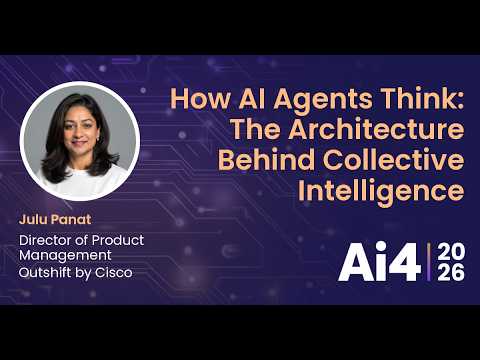
How AI Agents Think: The Architecture Behind Collective Intelligence With Cisco — Ai4

Ai4

Autonomous AI systems will fail to achieve collective intelligence through basic message passing alone because cross-vendor agents lack the standardized semantic grounding and cognitive protocols required to align intent.

AI-assisted summary of How AI Agents Think: The Architecture Behind Collective Intelligence With Cisco — original source. Check the original for full context.

Source published:

Detailed notes

## Background Published on YouTube by Ai4 on August 19, 2026, this presentation features Julu Panat, Director of Product Management at Outshift by Cisco. According to the session description, it explores the foundational architecture behind agent cognition, detailing shared memory layers, semantic alignment, reasoning protocols, and dynamic knowledge systems designed to enable multi-agent collaboration.

## TL;DR Panat maps the shift from deterministic enterprise computing to probabilistic multi-agent ecosystems, analyzing how systems evolve across topology, execution dynamics, and autonomous agency. He emphasizes that raw message passing is insufficient for true collaboration and introduces Project Agntcy, an open standard contributed to the Linux Foundation covering verifiable identity badges, fine-grained access control, directory discovery, and observability telemetry. To resolve semantic grounding disparities across cross-vendor agents, Panat details a stack featuring Layer 8 (the Internet of Agents) and Layer 9 (the Internet of Cognition). This architecture combines cognition state protocols, shared memory fabrics, and runtime mediation engines to transform isolated foundation models into scalable distributed superintelligence.

## Atmosphere & style The presentation carries a visionary yet grounded architectural tone, blending enterprise systems pragmatism with forward-looking engineering philosophy. Panat speaks with clear, methodical authority, enlivening technical protocol concepts with relatable operational analogies like human product teams, late-night SRE war rooms, and Cisco's historical role in birthing the internet. Watching the talk feels like sitting in on an executive technical briefing that moves briskly from current industry bottlenecks to an inspiring, structured roadmap for collective intelligence.

## Key takeaways - [00:04](https://www.youtube.com/watch?v=4HeFv-pr3VU&t=4s) Outshift by Cisco is applying the lessons of the early internet to create an 'internet for agents,' shifting focus from merely scaling foundational models to standardizing communication, governance, and architectural substrates. - [02:06](https://www.youtube.com/watch?v=4HeFv-pr3VU&t=126s) Enterprise computing is transitioning from deterministic to probabilistic paradigms, where identical inputs produce nuanced outputs, demanding new frameworks for trust, validation, and operational governance. - [03:29](https://www.youtube.com/watch?v=4HeFv-pr3VU&t=209s) Enterprise AI is advancing across four stages—from basic chat prompts and single-agent tool use to multi-agent orchestration and an imminent surge in open, cross-vendor agent networks as hardware bottlenecks ease. - [05:59](https://www.youtube.com/watch?v=4HeFv-pr3VU&t=359s) Agentic system architectures evolve across three key axes: Topology (centralized to decentralized), Execution (static to dynamic), and Agency (human-in-the-loop to autonomous). - [07:30](https://www.youtube.com/watch?v=4HeFv-pr3VU&t=450s) Multi-agent topologies range from centralized supervisor models to decentralized, peer-to-peer structures that mirror human team dynamics such as cross-functional product teams or SRE incident war rooms. - [09:22](https://www.youtube.com/watch?v=4HeFv-pr3VU&t=562s) Dynamic execution coupled with automated guardrails is necessary to prevent human operators from becoming systemic bottlenecks when handling edge cases in scaled multi-agent deployments. - [11:34](https://www.youtube.com/watch?v=4HeFv-pr3VU&t=694s) Simple network message passing between heterogeneous agents does not equal collaboration; genuine collaboration requires shared context, semantic negotiation, and persistent memory across vendor silos. - [14:03](https://www.youtube.com/watch?v=4HeFv-pr3VU&t=843s) Project Agntcy, donated to the Linux Foundation by Cisco, establishes open standards for agent identity badges, short-lived granular access controls, directory discovery via OASF, and cross-vendor MELT telemetry. - [17:20](https://www.youtube.com/watch?v=4HeFv-pr3VU&t=1040s) Open ecosystem standardization across OpenTelemetry and LF AI & Data supports diverse messaging topologies beyond simple request-response, including pub/sub and fire-and-forget patterns for streaming telemetry. - [18:18](https://www.youtube.com/watch?v=4HeFv-pr3VU&t=1098s) Operating above the OSI Application layer (Layer 7), Layer 8 defines the 'Internet of Agents' for A2A and MCP discovery and transport, providing the foundational plumbing for agent connectivity. - [19:07](https://www.youtube.com/watch?v=4HeFv-pr3VU&t=1147s) Cross-agent collaboration faces a major semantic grounding barrier when agents from different domains or vendors interpret identical terms (such as a 'P1 SLA') with conflicting operational definitions. - [21:10](https://www.youtube.com/watch?v=4HeFv-pr3VU&t=1270s) The Internet of Cognition introduces a three-tiered architecture: Cognition State Protocols for intent negotiation, Cognition Fabric for shared auditable memory, and Cognition Engines for real-time security and mediation. - [24:20](https://www.youtube.com/watch?v=4HeFv-pr3VU&t=1460s) Layer 9 (L9) represents the shift from connecting machines to connecting intelligence, enabling disparate AI agents to collectively reason and align context rather than just exchange raw data.

## Detailed walkthrough ### [00:04](https://www.youtube.com/watch?v=4HeFv-pr3VU&t=4s) Outshift by Cisco and the Internet for Agents

Julu Panat introduces the session by inviting the audience to look around the corner and peek into the future of collective intelligence. While much of the enterprise focus at the conference centers on tactical problem-solving for today, the broader vision mirrors the dynamic of the room itself: individual practitioners bringing unique experiences who, when gathered together, feed off each other and grow collectively. The mission is to replicate that exact dynamic across artificial intelligence agents.

Panat represents Outshift by Cisco, the company’s emerging technology incubation engine. Outshift operates with a charter to identify, explore, and shape nascent technologies across business, community, and open standards perspectives long before they reach mainstream enterprise markets. Their research teams are concentrated on three primary technological pillars: Agentic AI, Distributed Super Intelligence, and Quantum computing.

Drawing a historical parallel to Cisco’s founding heritage, Panat reflects on the inception of modern networking:

> "25 years ago, you know, we connected computers, the machine, and internet was born. Now we are at a place where we have agents getting connected and we need to build an internet for agents so that they can talk amongst themselves."

Achieving this vision requires far more than merely scaling up foundational models; it demands an entirely reinvented substrate encompassing communication protocols, governance frameworks, and system-level architectures.

[02:06](https://www.youtube.com/watch?v=4HeFv-pr3VU&t=126s) The Paradigm Shift: Deterministic to Probabilistic Computing

The industry is undergoing a foundational transition from deterministic computing to probabilistic computing. In traditional deterministic systems, providing an identical input guarantees an identical output every single time—a predictability upon which conventional enterprise software workflows have long relied. In contrast, probabilistic agentic computing processes inputs through subjective intent interpretation, contextual reasoning, and dynamic problem-solving.

Much like asking the same question to several different humans yields nuanced, varied responses, two agents processing the same prompt may arrive at divergent solutions. While this flexibility unlocks immense problem-solving capabilities, it introduces severe operational hurdles around validation and verification. Transitioning workloads from standard cloud architectures to agentic computing requires fundamentally rethinking trust, governance, enterprise security, orchestration, and operational runtime controls from the ground up.

[03:29](https://www.youtube.com/watch?v=4HeFv-pr3VU&t=209s) The Four Phases of Enterprise AI and the Coming Agent Surge

The enterprise adoption curve of artificial intelligence spans four distinct evolutionary buckets. The journey started with the widespread arrival of consumer chat interfaces like ChatGPT, enabling rapid text prompting and instantaneous content generation such as automated blog writing. That baseline expanded into single-agent implementations capable of reasoning over complex tasks and executing targeted actions by retrieving data through Model Context Protocol (MCP) tooling.

``` +-------------------------------------------------------------------+ | ENTERPRISE AI EVOLUTION PATH | | | | [1. Chat & Prompts] --> [2. Single Agents + Tools] | | Ad-hoc assistance Doc summarization, MCP calls | | | | | v | | [4. Open Agent Networks] <-- [3. Multi-Agent Orchestration] | | Cross-vendor protocols Domain workflows (Finance/Mktg) | +-------------------------------------------------------------------+ ```

Enterprises are currently navigating the third stage: multi-system orchestration. Because an individual generalist LLM cannot master every vertical enterprise function, organizations build specialized agents—such as dedicated finance or marketing agents—and orchestrate them across enterprise workflows in pilots or early production runs. However, Panat emphasizes that the most critical frontier is the fourth bucket: the imminent arrival of cross-vendor, interconnected agent networks.

- Current enterprise adoption is artificially constrained by infrastructure bottlenecks in compute, high-bandwidth memory, and data center capacity. - As hardware supply catches up with exponential enterprise demand, agent deployments will hit a sharp "hockey stick" surge. - This explosion of agents from competing vendors will immediately expose acute gaps in interoperability, security, cross-agent trust, and ecosystem-wide observability.

[05:59](https://www.youtube.com/watch?v=4HeFv-pr3VU&t=359s) The Three Architectural Axes: Topology, Execution, and Agency

Modern agentic systems evolve across three independent dimensions, each shifting from early, constrained paradigms toward scalable, autonomous designs.

``` TOPOLOGY: Centralized ----------> Decentralized EXECUTION: Static (Hardcoded) ----> Dynamic (Adaptive) AGENCY: Human-Triggered -------> Fully Autonomous ```

The first axis is Topology, which transitions from centralized, orchestrator-heavy designs to decentralized, distributed structures. The second axis is Execution, evolving from rigid, static, step-by-step task sequences into dynamic, adaptive execution where agents autonomously formulate plans. The third axis is Agency, moving away from human-in-the-loop prompt triggers toward background autonomous execution where agents proactively initiate and complete workflows without human intervention.

[07:30](https://www.youtube.com/watch?v=4HeFv-pr3VU&t=450s) Topology Patterns: Single Agent, Supervisor, and Peer-to-Peer War Rooms

Architectural topologies across multi-agent environments fall into three distinct implementation models:

1. **Single Agent Pattern**: Suited for straightforward, localized tasks such as document summarization or isolated tool queries over an MCP server. 2. **Supervisor Pattern**: Operates akin to a human project manager sitting at the center of a task. When a request arrives, the central supervisor decomposes the problem, delegates individual work items to specialized sub-agents or skills (such as engineering or design), and collects the outputs. This pattern provides strong determinism, clear audit trails, and strict organizational accountability. 3. **Decentralized / Peer-to-Peer Pattern**: Unites a team of equals collaborating side-by-side without routing every message through a central bottleneck.

Panat illustrates this peer-to-peer structure with real-world human collaboration analogies, such as cross-functional product teams—where design, engineering, and product marketing openly bounce ideas off one another—or an urgent incident war room where Site Reliability Engineering (SRE), project management, and developer agents swarm together to solve critical outages in real time.

[09:22](https://www.youtube.com/watch?v=4HeFv-pr3VU&t=562s) Dynamic Execution and Autonomous Incident Response

Static execution models work well for standard, linear operations—such as bank account opening workflows that sequentially mandate identity ingestion, background screening, and risk scoring. However, static logic fails the moment an agent encounters an unhandled exception or an edge case absent from its pre-programmed rulebook. Halting execution to wait for a human supervisor creates an unsustainable operational bottleneck:

> "When you have millions of agents running and now human becomes a roadblock... all the benefits that you got from the agent is now stuck behind a human."

The solution lies in dynamic workflows equipped with automated guardrails that empower agents to make bounded decisions autonomously.

``` +-------------------------------------------------------------------+ | AUTONOMOUS SRE INCIDENT RESPONSE | | | | [SLA Anomaly Detected] | | | | | v | | [Auto-create Ticket in ServiceNow] | | | | | v | | [Dispatch Triage Agent] ---> [Pull & Analyze Logs] | | | | | v | | [Reason & Root-Cause] | | | | | v | | [Engineer Wakes to Fix] | +-------------------------------------------------------------------+ ```

Panat points out the practical quality-of-life impact of moving to autonomous agency. Instead of being awakened at 2:00 AM by a pager for a frantic incident triage call, autonomous systems can proactively detect SLA degradations, open tickets in ServiceNow, spin up diagnostic triage agents to parse logs, and complete the underlying investigative grunt work while the engineer sleeps peacefully.

[11:34](https://www.youtube.com/watch?v=4HeFv-pr3VU&t=694s) The Silo Trap: Message Passing vs. True Collaboration

As multi-agent deployments multiply across enterprises, organizations inevitably end up with a fragmented tapestry of agents built across differing cloud infrastructures, varied identity providers like Okta or Microsoft Entra ID, and mixed model providers ranging from Anthropic and OpenAI to proprietary in-house models. Simply establishing a network connection between these heterogeneous entities does not constitute meaningful collaboration.

Panat highlights a fundamental distinction in agentic communication:

> "Message passing is not collaboration. Message passing is just putting stuff out the window and assuming that person understood it and acts on it."

True collaboration demands shared context, mutual intent alignment, dynamic semantic negotiation, and persistent shared memory. Without standardized protocols to establish this deep alignment, enterprises risk buying into isolated "pockets of intelligence" on vendor exhibition floors, where every proprietary platform demands that customers import their data and custom agents into yet another walled garden, creating severe vendor lock-in.

[14:03](https://www.youtube.com/watch?v=4HeFv-pr3VU&t=843s) Project Agntcy: Identity, Access, Directory, and Observability

To overcome the silo trap and deliver a vendor-agnostic foundation for an open internet of agents, Cisco's Outshift created Project Agntcy (spelled without the letter "e") and contributed it to the Linux Foundation. Supported by over 90 industry partners—including Google, Oracle, Dell, and Red Hat—the initiative standardizes open multi-agent interoperability across four core pillars:

``` +-------------------------------------------------------------------+ | PROJECT AGNTCY ARCHITECTURE | | | | 1. IDENTITY & BADGES 2. FINE-GRAINED ACCESS CONTROL | | - Verifiable credentials - Short-lived scoped permissions | | - Capabilities & vetting - Tool/task/transaction limiting | | - Traditional IDP + DID - Beyond coarse RBAC | | | | 3. AGENT DIRECTORY (OASF) 4. AGENT OBSERVABILITY (MELT) | | - Open standardized discovery - Distributed tracing | | - Standardized agent schemas - Unified evaluation metrics | | - Linux Foundation adoption - Cross-vendor fleet telemetry | +-------------------------------------------------------------------+ ```

- **Identity & Verifiable Credentials**: Replaces dangerous, all-access user or service account delegations with dedicated "verifiable credential identity badges." These badges explicitly declare an agent's identity, scoped capabilities, vetting lineage, and cryptographic backing via traditional enterprise IDPs (like Okta) or decentralized identity frameworks. - **Fine-Grained Access Control Management**: Moves beyond coarse role-based access control (RBAC) to enforce transaction-specific, tool-specific, and task-specific runtime boundaries that are strictly short-lived to minimize security blast radiuses. - **Discoverability & Agent Directory**: Establishes a standardized directory format (such as the Open Agent Schema Format / OASF) so heterogeneous agents can discover each other, parse metadata regarding agent creators, verify provenance, and negotiate communication parameters. - **Agent Observability**: Standardizes full-stack MELT (Metrics, Events, Logs, and Traces) telemetry and evaluation metrics specifically tailored for cross-vendor multi-agent interactions, moving beyond isolated single-agent or basic LLM tracing.

[17:20](https://www.youtube.com/watch?v=4HeFv-pr3VU&t=1040s) Standardizing Messaging Patterns and Donating to Open Ecosystems

Building an open multi-agent ecosystem requires moving past proprietary silos and single-pattern communications. In collaboration with partners like Microsoft, these foundational specifications have been contributed to OpenTelemetry (OTel) and the Linux Foundation (LF AI & Data). The underlying philosophy is straightforward: when every participant speaks the same structural language, the entire industry benefits. While early Agent-to-Agent (A2A) interactions relied almost exclusively on basic request-response mechanisms, complex enterprise use cases demand far greater flexibility. Transmitting data-heavy streams, such as video packages or continuous telemetry, requires robust asynchronous channels rather than blocking calls.

To address this diversity of workloads, the platform standardizes multiple core messaging topologies:

- **Request-Response:** Synchronous two-way exchanges suitable for deterministic queries and straightforward transactional commands. - **Publish-Subscribe (Pub/Sub):** Asynchronous topic-based distribution enabling agents to broadcast and ingest continuous or high-volume data streams without tight coupling. - **Fire-and-Forget:** One-way messaging patterns designed for alerts, heartbeats, or background event emission where receipt confirmation is unnecessary.

---

[18:18](https://www.youtube.com/watch?v=4HeFv-pr3VU&t=1098s) Layer 8: The Internet of Agents and the Limits of Basic Plumbing

To structure agent communication cleanly within existing networking paradigms, Cisco Outshift conceptualizes this interface as an extension of the classical OSI seven-layer model. Positioned directly above the Layer 7 Application layer sits **Layer 8: The Internet of Agents**. This layer does not replace standard network protocols; rather, it specializes them to manage Agent-to-Agent (A2A) and Agent-to-Model Context Protocol (MCP) interactions.

``` +---------------------------------------------------------+ | Layer 9: Internet of Cognition (Reasoning & Intent) | +---------------------------------------------------------+ | Layer 8: Internet of Agents (A2A, MCP, Discovery) | +---------------------------------------------------------+ | Layer 7: Application Layer (HTTP, gRPC, WebSockets) | +---------------------------------------------------------+ | Layers 1-6: Standard OSI Transport & Physical Stack | +---------------------------------------------------------+ ```

While Layer 8 successfully handles discovery, connection handshakes, and message transport, it only solves the "basic plumbing." Establishing raw connectivity does not guarantee effective collaboration. The deeper, unresolved challenge is cognitive: how disparate agents align their internal goals, establish common intent, share working memory, and co-reason through ambiguous objectives.

---

[19:07](https://www.youtube.com/watch?v=4HeFv-pr3VU&t=1147s) Human Evolution as a Blueprint and the Semantic Grounding Dilemma

The evolution of human collective intelligence offers a clear architectural blueprint for multi-agent systems. Individual human capability has expanded over time, but individual intellect alone did not drive civilizational breakthroughs. The exponential acceleration of human progress occurred only after the creation of shared tools—language, books, and educational institutions—that enabled cross-generational knowledge sharing and collective innovation. In the AI domain, model providers in Silicon Valley are rapidly pushing the boundaries of individual model capability; however, without cognitive protocols that allow these models to share context and reason collectively, that individual power remains isolated.

``` INDIVIDUAL INTELLIGENCE COLLECTIVE INTELLIGENCE +------------------------------+ +---------------------------+ | Smarter Foundation Models | | Cognitive State Protocols | | - Fast local reasoning | + | - Shared vocabulary | | - Tool use & execution | | - Semantic grounding | +------------------------------+ | - Distributed memory | +---------------------------+ │ ▼ Distributed Superintelligence ```

The core barrier to cross-agent collaboration is semantic grounding. When agents built by different vendors (for example, Acme and Outshift) or operating across different domains attempt to collaborate, they often lack a shared operational vocabulary. A prime example is the interpretation of a "Priority 1 (P1) SLA":

- **Engineering Operations Context:** Interprets a "P1 SLA" as a high-priority software ticket requiring resolution or mitigation within a one-hour window. - **Healthcare & Hospital Context:** Interprets a "P1 SLA" as an immediate life-and-death emergency demanding intervention within seconds.

If agents do not establish common grounding and align their contextual definitions *before* beginning execution, they inevitably arrive at conflicting or catastrophic results.

---

[21:10](https://www.youtube.com/watch?v=4HeFv-pr3VU&t=1270s) The Architecture of Distributed Superintelligence: Protocols, Fabric, and Engines

To bridge this coordination gap, Cisco is developing the **Internet of Cognition**—an open, interoperable fabric designed to support distributed superintelligence. This framework provides formal mechanisms for grounding, conflict resolution, automated negotiation, distributed coordination, and cross-agent evaluation.

``` +---------------------------------------------------------------+ | COGNITION ENGINES | | [Security Monitor] [Negotiator/Mediator] [Context Router] | +---------------------------------------------------------------+ │ +---------------------------------------------------------------+ | COGNITION FABRIC | | (Shared Context, Memory Layers, Decision Audits) | +---------------------------------------------------------------+ │ +---------------------------------------------------------------+ | COGNITION STATE PROTOCOLS | | (Shared Intent, Negotiation, Semantic Grounding) | +---------------------------------------------------------------+ ```

The architecture is built on three core pillars:

1. **Cognition State Protocols:** Standardized protocols that define how agents establish shared intent, synchronise state, and execute negotiation strategies. Different domains demand distinct bargaining dynamics; a buyer-seller interaction requires negotiation mechanics to close a commercial transaction, whereas a security agent needs strict guardrails (for example, interpreting a "rollback" command according to compliance policies rather than simple code reversal). 2. **Cognition Fabric:** The shared memory and context plane. High-fidelity agent collaboration collapses without rich context; the fabric ensures that cross-agent interactions, underlying decision intents, and state histories are persistent, visible, and fully auditable across enterprise boundaries. 3. **Cognition Engines:** Specialized runtime intelligence modules that observe agent-to-agent transactions and intervene when necessary: - *Security & Access Control Engines:* Actively inspect active transactions, instantly blocking attempts to access private data or export sensitive corporate assets out of bounds. - *Negotiation & Mediation Engines:* Step in as independent third-party arbitrators when two autonomous agents become trapped in circular negotiation loops. - *Context Building & Memory Routing Engines:* Dynamically assemble relevant background knowledge and route context across distributed nodes based on organizational policy.

---

[24:20](https://www.youtube.com/watch?v=4HeFv-pr3VU&t=1460s) Layer 9 and the Shift from Connecting Machines to Connecting Intelligence

The culmination of this architecture is the formalization of **Layer 9 (L9): The Internet of Cognition**, which layers cognitive state protocols on top of the Layer 8 agent messaging stack. Cisco Outshift is actively driving open research, technical webinars, white papers, and community newsletters to advance these standards across the broader industry.

The fundamental paradigm shift in modern computing centers on the nature of connectivity:

> "The last generation was probably about connecting computer machines together. This generation is about connecting intelligence together. And the difference that you would see which makes a company successful is when you can get these AI agents to reason together. Just connection is not enough. You have to build this collective intelligence together."

## Notable quotes > [00:04](https://www.youtube.com/watch?v=4HeFv-pr3VU&t=4s) 25 years ago, you know, we connected computers, the machine, and internet was born. Now we are at a place where we have agents getting connected and we need to build an internet for agents so that they can talk amongst themselves. — Julu Panat

> [09:22](https://www.youtube.com/watch?v=4HeFv-pr3VU&t=562s) When you have millions of agents running and now human becomes a roadblock... all the benefits that you got from the agent is now stuck behind a human. — Julu Panat

> [11:34](https://www.youtube.com/watch?v=4HeFv-pr3VU&t=694s) Message passing is not collaboration. Message passing is just putting stuff out the window and assuming that person understood it and acts on it. — Julu Panat

> [24:20](https://www.youtube.com/watch?v=4HeFv-pr3VU&t=1460s) The last generation was probably about connecting computer machines together. This generation is about connecting intelligence together. And the difference that you would see which makes a company successful is when you can get these AI agents to reason together. Just connection is not enough. You have to build this collective intelligence together. — Julu Panat

> [24:20](https://www.youtube.com/watch?v=4HeFv-pr3VU&t=1460s) The last generation was probably about connecting computer machines together. This generation is about connecting intelligence together. — Julu Panat

> [24:20](https://www.youtube.com/watch?v=4HeFv-pr3VU&t=1460s) Just connection is not enough. You have to build this collective intelligence together. — Julu Panat

## Mentioned Julu Panat, Ai4, Cisco, Outshift by Cisco, ChatGPT, Model Context Protocol (MCP), ServiceNow, Okta, Microsoft Entra ID, Anthropic, OpenAI, Project Agntcy, Linux Foundation, Google, Oracle, Dell, Red Hat, Open Agent Schema Format (OASF), OpenTelemetry (OTel), LF AI & Data, Microsoft, OSI model

## Video description Julu Panat - Director of Product Management, Outshift by Cisco

What does it take to build AI agents that can think, reason, and collaborate? This session breaks down the core architecture behind agent cognition—shared memory layers, semantic alignment, reasoning protocols, and the knowledge systems that make multi-agent collaboration work.

You’ll see how agents use dynamic, auditable knowledge systems to create persistent memory, reusable context, and trustworthy decisions. We’ll also cover how agents exchange meaning—not just data—to speed up collaboration and reduce rework.

Whether you’re exploring or deploying multi-agent systems, you’ll leave with clear patterns and practical guidance for designing true collective intelligence.

[Source](https://www.youtube.com/watch?v=4HeFv-pr3VU)

中文简报

思科 Outshift 提出面向跨厂商 AI 智能体的第 9 层协议 自主 AI 系统仅凭基础消息传递无法实现群体智能,因为跨厂商智能体缺乏对齐意图所需的标准化语义基础与认知协议。 Panat 梳理了从确定性企业计算向概率性多智能体生态系统的转变,分析了系统在拓扑结构、执行动态和自主能动性维度上的演进。他强调,单纯的消息传递不足以实现真正的协作,并介绍了贡献给 Linux 基金会的开放标准 Project Agntcy,涵盖可验证身份徽章、细粒度访问控制、目录发现和可观测性遥测。为解决跨厂商智能体之间的语义基础差异,Panat 详细阐述了包含第 8 层(智能体互联网)与第 9 层(认知互联网)的技术栈,该架构融合了认知状态协议、共享内存结构和运行时调解引擎,旨在将孤立的基础模型转化为可扩展的分布式超级智能。 思科旗下 Outshift 正在汲取早期互联网的发展经验打造“智能体互联网”,将重心从单纯扩展基础模型转向推进通信、治理及系统级架构基座的标准化。 (0:04) 企业计算正经历从确定性到概率性的范式转移;随着算力瓶颈缓解,企业 AI 将从当前的单智能体工具调用和多智能体编排,迅速迈向跨厂商的开放智能体网络激增阶段。 (2:06) 智能体系统正沿着拓扑(集中式到去中心化)、执行(静态到动态)和自主性(人工参与到完全自主)三个维度演进,需配合自动化安全护栏以避免人类操作员沦为扩展瓶颈。 (5:59) 简单的网络消息传递并不等同于协作,思科已向 Linux 基金会贡献开源项目 Agntcy,确立涵盖智能体数字身份凭据、细粒度短期访问控制、OASF 目录发现以及跨厂商 MELT 可观测性的开放标准。 (11:34) 在负责传输与发现的 Layer 8 智能体互联网之上,思科进一步提出 Layer 9“认知互联网”(Internet of Cognition),通过认知状态协议、共享记忆网络与仲裁引擎解决语义对齐与分布式协同推理难题。 (18:18)

Reading summary

Julu Panat of Cisco's Outshift argues that enterprise AI is advancing from basic tool use to decentralized multi-agent networks, requiring open protocols for identity, communication, and cognitive alignment rather than isolated proprietary platforms. The Evolution Toward Autonomous Probabilistic Networks (2:06) Enterprise computing is undergoing a structural shift from deterministic execution—where identical inputs guarantee uniform outputs—to probabilistic agentic workflows driven by intent interpretation and dynamic reasoning. Panat categorizes enterprise AI adoption into four phases: chat interfaces, single agents with tool access, multi-agent domain orchestration, and emerging cross-vendor agent networks. While current deployment is throttled by data center, compute, and high-bandwidth memory constraints, Panat forecasts an exponential surge in agent deployments once hardware bottlenecks ease. Architectural Dimensions and Operational Bottlenecks (5:59) Modern agent architectures evolve across three distinct axes: topology (centralized to decentralized), execution (static to dynamic), and agency (human-prompted to fully autonomous). Implementation models range from localized single agents and central supervisor patterns to decentralized peer-to-peer setups, such as cross-functional product groups or site reliability engineering (SRE) war rooms. Panat notes that static, rule-based execution collapses when agents encounter unhandled edge cases. Halting operations to await human intervention creates severe operational roadblocks across millions of running agents. In contrast, dynamic execution coupled with automated guardrails enables background automation, such as autonomous systems triaging SLA anomalies, parsing logs, and opening ServiceNow tickets without requiring immediate human intervention. Standardizing Agent Transport and Identity via Project Agntcy (11:34) Enterprises face a 'silo trap' when deploying heterogeneous agents across different cloud providers, identity systems like Okta or Microsoft Entra ID, and varied foundation models. To prevent proprietary vendor lock-in, Cisco's Outshift established Project Agntcy with over 90 industry partners, contributing specifications to the Linux Foundation and OpenTelemetry. Conceptualized as 'Layer 8: The Internet of Agents' above the OSI model, this transport foundation standardizes four capabilities: verifiable credential badges defining vetted agent capabilities, fine-grained short-lived access controls, standardized discovery directories via formats like the Open Agent Schema Format, and cross-vendor MELT (metrics, events, logs, traces) observability. It also standardizes core messaging topologies, supporting request-response, publish-subscribe, and fire-and-forget patterns. Layer 9 and the Internet of Cognition (19:07) Panat emphasizes that basic message passing does not equate to genuine collaboration, because disparate agents often lack shared semantic grounding. For instance, an engineering operations agent interprets a 'P1 SLA' as an incident requiring a one-hour response, whereas a healthcare agent treats it as a life-or-death emergency requiring action within seconds. Executing without prior contextual alignment risks systemic failure. To solve this, Cisco outlines 'Layer 9: The Internet of Cognition' to govern distributed superintelligence. This framework relies on Cognition State Protocols to formalize intent negotiation and semantic vocabulary, a shared Cognition Fabric to persist auditable context and memory across enterprise boundaries, and specialized Cognition Engines that mediate negotiation loops, enforce security policies, and manage memory routing. Cisco Outshift frames the generational shift in enterprise computing as moving from connecting physical machines to connecting autonomous intelligence. The central challenge remains whether the broader industry will adopt open semantic and cognitive protocols rapidly enough to avoid fragmented, vendor-locked pockets of intelligence.

精炼阅读摘要

Cisco旗下前沿技术孵化机构Outshift提出,企业人工智能正从单点工具和系统编排迈向跨厂商的互联网络,但单纯的消息传递无法支撑集体智能;行业亟需构建包含可验证身份、治理框架以及Layer 8与Layer 9认知协议的全新架构体系。 计算范式转变与智能体演进路径 (2:06) 企业计算正在经历从确定性向概率性的底层转型。传统的企业工作流依赖于输入与输出绝对一致的确定性规则,而智能体计算则依赖于对主观意图的解析、上下文推理和动态解题。这种转变虽然释放了灵活的问题解决能力,但由于相同提示词可能得出完全不同的结论,系统在验证、审计、安全性与运行控制方面面临严峻挑战。 Outshift技术负责人Julu Panat将企业AI的发展划分为四个阶段:最初是消费级对话与生成式提示,随后演进为具备模型上下文协议(MCP)工具调用能力的单智能体。当前企业正处于第三阶段,即在财务或营销等特定垂直领域进行多智能体编排。Panat指出,受制于算力、高带宽内存(HBM)及数据中心基础设施瓶颈,当前采用率受到一定压制,但随着供应链跟进,未来跨厂商智能体部署将迎来曲棍球棒式的陡峭激增,直接凸显互操作性与跨主体信任的空白。 架构三维坐标与去中心化执行拓扑 (5:59) 现代多智能体系统的进化依循三个独立维度展开:拓扑结构从中心化转向去中心化;执行方式从固化的线性流程转向自适应动态规划;自主权则从人类提示词触发演进为后台完全自主执行。在实际落地中,拓扑模式主要体现为三种形态:处理独立任务的单智能体、类似人类项目经理的主管模式(Supervisor),以及点对点对等网络(Peer-to-Peer)。主管模式具备强确定性、清晰的审计链路和权责划分,适合分发工程或设计任务。 去中心化的点对点模式则模拟人类跨职能团队或紧急事件作战室(War Room)。例如在站点可靠性工程(SRE)故障排查中,开发、运维与项目管理智能体能够实时协同。Panat强调,如果数百万个运行的智能体在遭遇未预设的边缘异常时必须暂停并等待人类干预,人类就会沦为系统瓶颈。动态执行机制赋予智能体在安全护栏内自主决策的能力,系统能够在凌晨检测到SLA异常时自动在ServiceNow建单、派发诊断智能体解析日志并定位根因,无需在深夜唤醒工程师进行机械性排查。 打破孤岛陷阱与Layer 8智能体标准 (11:34) 随着多云基础设施、不同身份提供商(如Okta与Microsoft Entra ID)及异构大模型(如OpenAI、Anthropic与私有模型)并存,企业极易陷入智能孤岛。Panat明确区分了消息传递与真正协同:单纯向外部管道发送信息并假定对方理解绝非协同,真正的协作必须依赖共享上下文、意图对齐和持久内存。若缺乏互操作标准,企业将受制于封闭平台的供应商锁定。 为建立中立基础,Outshift发起了开源项目Project Agntcy并贡献给Linux基金会,获得Google、Oracle、Dell及Red Hat等90多家行业伙伴支持。该项目聚焦四大支柱:采用密码学背书的可验证凭据身份徽章;超越粗粒度角色权限的短期、细粒度动态访问控制;基于开放智能体模式格式(OASF)的目录发现机制;以及统一的跨厂商MELT(指标、事件、日志、追踪)可观测性体系。在网络协议上,该体系被定义为叠加于OSI应用层之上的“Layer 8智能体互联网”,支持请求-响应、发布-订阅(Pub/Sub)及阅后即焚(Fire-and-Forget)等多类消息拓扑。 语义对齐鸿沟与Layer 9认知互联网 (19:07) 建立底层通信管道仅解决了连通性问题,无法保证智能体之间达成认知共识。人类文明演进的加速源于语言、书籍和制度等共享工具的出现,而当前AI模型的高速发展仍停留在单体能力层面。跨主体协作的核心阻碍在于语义基准(Semantic Grounding)的缺失。例如,“P1 SLA”在IT工程运维语境下通常代表一小时内处理的高优先级工单,但在医疗救援场景下则指代数秒内必须响应的生死危机。若缺乏统一的业务上下文对齐,不同厂商的智能体必然产生灾难性协作冲突。 针对这一断层,Cisco提出了位于系统顶层的“Layer 9认知互联网”架构,用以支撑分布式超智能。该架构由三部分组成:规范共享意图、状态同步与谈判规则的认知状态协议(Cognition State Protocols);提供跨边界持久记忆、上下文流转与决策审计的认知织网(Cognition Fabric);以及负责运行时动态干预的认知引擎(Cognition Engines),包括实时拦截违规数据提取的安全监控引擎、打破死循环的仲裁协商引擎,以及上下文构建与内存路由引擎。 Panat总结认为,上一代计算革命的核心是连接物理计算机设备,而当前的根本变革在于连接智能本身;只有通过开源标准建立起跨模型的认知协议与协同环境,企业才能真正从单体模型演进至具备群体推理能力的分布式集体智能。

Detailed notes — zh

## Background 该视频由 Ai4 频道于 2026 年 8 月 19 日发布在 YouTube 平台上,演讲者为思科旗下 Outshift 团队的产品管理负责人 Julu Panat。根据页面简介,本次分享深入探讨了构建具备思考、推理与协作能力的 AI 智能体背后的核心架构,涵盖共享内存层、语义对齐、推理协议以及赋能多智能体协同的知识系统。 ## TL;DR 演说系统梳理了企业级 AI 从单智能体应用向跨供应商多智能体群体智能(Collective Intelligence)演进的必然趋势。面对传统确定性计算向概率性智能体计算的转变,仅靠基础消息传递无法解决异构智能体间的协作难题,必须构建涵盖可信身份、细粒度权限与标准化目录的基础设施(如 Linux 基金会开源项目 Agntcy)。为此,思科 Outshift 提出了超越传统网络应用层的“L8/L9 认知层”与认知互联网架构,通过认知状态协议、认知织网与专用认知引擎,消弭语境歧义并实现意图对齐与动态协商,从而推动跨厂商 AI 智能体走向真正协同思考的分布式超级智能。 ## Atmosphere & style 整场演讲风格专业前瞻且条理清晰,充满了科技前沿探索者的自信与激情。演讲者巧妙地将硬核的底层系统架构与贴近现实的运维痛点(如深夜无需被报警叫醒)相结合,既有深刻的技术洞察,又具幽默风趣的现场感。通过将计算机网络连接的历史与当代“智能互联”的宏大愿景交织比喻,现场营造出一种正在见证并参与下一代计算范式变革的史诗感与使命感。 ## Key takeaways - [00:04](https://www.youtube.com/watch?v=4HeFv-pr3VU&t=4s) Outshift 致力于构建“智能体互联网”(Internet for Agents),推动从连接计算机硬件向连接智能体转变,核心聚焦于智能体 AI、分布式超级智能与量子计算三大领域。 - [02:06](https://www.youtube.com/watch?v=4HeFv-pr3VU&t=126s) 计算范式正经历从“确定性计算”向“概率性计算”的跨越,相同的输入会产生多样化结果,倒逼企业重构信任体系、安全防护、多智能体编排与全局运维控制。 - [03:29](https://www.youtube.com/watch?v=4HeFv-pr3VU&t=209s) 企业 AI 正从对话助手、单智能体、多系统编排演进至第四阶段——跨供应商智能体组成的网络化协同体系,未来将迎来曲棍球棒式的几何级规模爆发。 - [05:59](https://www.youtube.com/watch?v=4HeFv-pr3VU&t=359s) 智能体系统在拓扑维度上从单智能体、主管编排模式(Supervisor)走向去中心化对等协作模式(Peer-to-Peer),以跨职能“作战室”形态释放群体智慧。 - [09:22](https://www.youtube.com/watch?v=4HeFv-pr3VU&t=562s) 静态工作流抗扰动能力差且频繁依赖人工干预,在数百万级 Agent 并发的大规模企业场景下,人工决策将成为系统吞吐量与自动化的最大性能瓶颈。 - [10:21](https://www.youtube.com/watch?v=4HeFv-pr3VU&t=621s) 真正的自主性意味着“触发即自主”,如监控 Agent 在深夜感知服务异常后自动开单、调用排障 Agent 分析归因并形成闭环,无需人类在非工作时间介入抢修。 - [11:34](https://www.youtube.com/watch?v=4HeFv-pr3VU&t=694s) “传递消息并不等于协作”,跨供应商异构 Agent 之间单纯的 API 数据中继无法形成合力,真正的协作需要建立在共同目标、共享上下文与语义协商的基础之上。 - [14:03](https://www.youtube.com/watch?v=4HeFv-pr3VU&t=843s) Cisco 联合 Google、Oracle 等发起了捐赠给 Linux 基金会的开源项目 Agntcy,通过可验证凭证身份徽章、细粒度短期授权、OSAP 目录规范和 OTel 可观测性解决跨厂商孤岛问题。 - [18:26](https://www.youtube.com/watch?v=4HeFv-pr3VU&t=1106s) Outshift 提出应用层之上的“第八层:Agent 互联网”(Layer 8),底层解决网络连接与寻址,上层构建认知协议以消除不同行业在业务语境上的理解歧义。 - [20:53](https://www.youtube.com/watch?v=4HeFv-pr3VU&t=1253s) 为了解决智能体缺乏共同基准理解导致的结果偏差,Outshift 提出了“认知互联网”架构,专注于解决意图对齐、冲突裁决、博弈协商与协同编排机制。 - [21:49](https://www.youtube.com/watch?v=4HeFv-pr3VU&t=1309s) 分布式超级智能架构依赖三大支柱:定义共享意图与博弈协商的“认知状态协议”、提供透明可溯底座的“认知织网”、以及包含安全合规与调解仲裁的“认知引擎”。 - [24:20](https://www.youtube.com/watch?v=4HeFv-pr3VU&t=1460s) “认知互联网”被定义为网络协议栈之上的“OSI 第九层”(L9 认知层),其核心在于传输与协商“意图与认知”,标志着从单一智能体单打独斗走向群体智能协同推理。 ## Detailed walkthrough ### [00:04](https://www.youtube.com/watch?v=4HeFv-pr3VU&t=4s) Outshift 与思科的使命:构建“智能体互联网” Julu Panat(思科旗下前沿孵化团队 Outshift 的产品管理负责人)在演讲开场时强调,尽管 AI4 大会上有许多聚焦于当下企业落地与痛点解决的精彩分享,但本场议题希望将目光投向更远的未来——探讨如何将人类团队通过经验共享、相互激发而实现群体成长的模式,复刻并应用到 AI 智能体(Agent)的协作体系中,即“群体智能”(Collective Intelligence)。 Outshift 作为思科内部的技术孵化器,其核心职责是在前沿技术尚未成为大众市场主流之前进行前瞻性探索,从商业落地、开源社区建设与行业标准制定等多维度进行战略布局。目前团队重点聚焦于三大核心领域:智能体 AI(Agentic AI)、分布式超级智能(Distributed Super Intelligence)以及量子计算(Quantum)。Julu Panat 指出,思科之所以深耕该领域有着深厚的历史渊源:“25 年前,我们连接了计算机与机器,互联网由此诞生;而今天,我们正处于智能体相互连接的节点,我们需要为智能体构建一个专属的互联网(Internet for Agents)。”要让数以亿计的智能体顺畅对话与协作,仅靠基础大语言模型(LLM)能力的提升远远不够,必须围绕底层系统架构、通信协议、治理规范与安全机制展开全面的底层重构。 - **Outshift 核心使命**:探索前沿未成熟技术,涵盖商业转化、行业标准与开源社区生态。 - **三大前沿研究支柱**:智能体 AI(Agentic AI)、分布式超级智能(Distributed Super Intelligence)、量子技术(Quantum)。 - **愿景目标**:从 25 年前连接硬件机器构建全球互联网,转向构建面向 AI 智能体互联互通的通信基础设施与协作协议。 --- ### [02:06](https://www.youtube.com/watch?v=4HeFv-pr3VU&t=126s) 范式转移:从确定性计算走向概率性智能体计算 计算范式正在经历一场不可逆转的根本性变革,即从传统的“确定性计算”(Deterministic Computing)向“概率性计算”(Probabilistic Computing / Agentic Computing)跨越。在经典确定性计算中,系统遵循严格的逻辑,相同的输入必定产生完全一致的输出,这种高度可控性是企业构建传统业务流的基础;然而在概率性计算中,面对完全相同的输入或 Prompt,不同的智能体会根据自身的理解去推理意图、拆解问题并寻找解法,从而给出存在合理差异的多样化结果。 这种类似人类思考的机制虽然为复杂问题求解带来了惊人的灵活性与自主性,但同时也带来了严峻的企业级挑战——如何验证并确信 Agent 的行为始终处于正确、可信的轨道上?因此,从传统云计算迁移到智能体计算,绝不仅仅是上层软件架构的微调,而是一场涵盖信任体系、安全防护、合规治理、多智能体编排(Orchestration)以及全局运维控制(Operational Control)的全面系统重塑。 --- ### [03:29](https://www.youtube.com/watch?v=4HeFv-pr3VU&t=209s) 企业 AI 的演进路径与多供应商生态的未来挑战 回顾企业引入 AI 的实际历程,技术演进清晰地划分为四个阶段。最初是 ChatGPT 引发的内容生成与对话助手浪潮,企业通过编写 Prompt 即可在数秒内完成博客撰写和文档处理;随后演进到具备自主推理能力、能够调用外部工具(如通过 MCP 工具协议抓取数据)解决复合任务的单智能体(Single Agent)试点。目前,大多数领先企业正处于第三阶段,即“多系统编排”(Multi-system Orchestration),企业意识到单一通用模型无法包揽所有业务,必须针对财务、营销等垂直业务场景部署专门调教的专家智能体,并在试点或早期生产环境中不断打磨治理、可观测性与性能表现。 ```mermaid flowchart LR accTitle: 企业 AI 演进的四个阶段 subgraph S1["阶段一:生成式对话"] A["Chat Assistant\nPrompt 内容生成"] end subgraph S2["阶段二:单智能体"] B["Single Agent\n推理 + 工具/MCP调用"] end subgraph S3["阶段三:垂直编排"] C["Multi-System\n多系统编排/专精 Agent"] end subgraph S4["阶段四:群体智能"] D["Collective Intelligence\n跨供应商互联网络"] end A --> B B --> C C --> D ``` 真正决定产业终局的是第四个阶段——跨供应商智能体组成的网络化协同体系。当前由于算力、内存与数据中心等硬件供给端的客观限制,市场尚处于蓄力期,但一旦供给瓶颈被打破,企业部署的智能体规模将迎来“曲棍球棒式”(hockey stick)的爆发式几何级增长。届时企业内部将运行大量来自不同供应商的异构 Agent,这会带来一系列全新挑战:不同厂商的智能体如何相互理解与顺畅协作?如何确立跨系统的信任链条?如何实现端到端的全链路可观测性以确保合规?这些正是行业在全面爆发前亟待攻克的核心命题。 --- ### [05:59](https://www.youtube.com/watch?v=4HeFv-pr3VU&t=359s) 演进的三大维度与拓扑架构:单体、主管编排与对等协作 智能体系统的演进可以解构为三个核心维度:拓扑轴(Topology,从集中式走向去中心化)、执行轴(Execution,从静态规则走向动态应变)以及自主性轴(Agency,从人工触发 Prompt 走向全自主运作,让运维人员无需时刻盯盘介入,实现“安稳睡个好觉”)。 ```mermaid flowchart TD accTitle: 智能体系统的三大演进轴与拓扑模式 subgraph Axes["系统演进三大轴线"] T["拓扑轴:集中式 → 去中心化"] E["执行轴:静态工作流 → 动态应变"] A["自主轴:人类触发 → 全自主运作"] end subgraph Topologies["拓扑架构形态演进"] P1["单智能体模式\n(文档摘要 / 简单任务)"] P2["主管编排模式 Supervisor\n(类项目经理 / 强确定性与问责)"] P3["点对点协作模式 Peer-to-Peer\n(跨职能作战室 / 平等协同)"] P1 --> P2 P2 --> P3 end ``` 在拓扑维度上,架构形态正在经历三层迭代: 1. **单智能体模式(Single Agent)**:专注于执行文档摘要、轻量级信息提取等低复杂度独立任务。 2. **主管/编排者模式(Supervisor Pattern)**:类似于传统团队中的“项目经理”,由中央编排节点接收业务请求,进行任务拆解后分发派工给工程、设计等子智能体,并在任务完成后统一汇总。这种架构保留了较高的确定性与责任边界,是当前主流方案。 3. **点对点/去中心化模式(Peer-to-Peer Pattern)**:各领域专家智能体处于完全平等的地位,模拟人类跨职能“作战室”(War Room)的协同工作模式。例如在打造一款新产品或应对紧急突发事件时,产品经理 Agent、SRE 运维 Agent、架构师 Agent、设计师 Agent 与营销 Agent 围坐在一起实时交换上下文、相互激发并共同决策,真正释放群体智慧的协作潜能。 --- ### [09:22](https://www.youtube.com/watch?v=4HeFv-pr3VU&t=562s) 执行维度的跃迁:攻克静态流程与人工干预瓶颈 在执行维度上,传统的静态工作流在面对高度标准化的任务时表现出色,例如银行开户流程中收集个人信息、触发背景审查与发起风控调用等固定步骤。然而,静态流程的最大缺陷在于其抗扰动能力极弱——一旦遇到规则库未覆盖的边界情况或未知阻碍,工作流就会立即陷入停滞。 在这种情况下,系统往往不得不频繁回退并请求人类介入决策。在小规模试点阶段,人工兜底是保证安全的重要手段;但当企业未来运转着数百万个并发 Agent 时,频繁的人工审核请求将迅速使人类决策者沦为整个系统的严重性能瓶颈,最终彻底抵消多智能体自动化所带来的吞吐量与效率红利。因此,如何让智能体具备动态规划与自主应变能力,成为走向大规模落地的关键转折点。 ### [10:21](https://www.youtube.com/watch?v=4HeFv-pr3VU&t=621s) 走向完全自主:让 Agent 在深夜替你排障 在探讨多 Agent 协作前,首先需要理解工作流的演进阶段。系统从最初由人类严格定义每一个步骤,逐步发展为具备防护栏(guardrails)的动态工作流,Agent 被赋予在一定边界内自主决策的权力,而人类只需在必要时介入修正方向。更为理想的终极状态则是“触发即自主”(trigger to autonomous)。多数人目前习惯的模式依然是“人给指令,Agent 执行任务”,但真正的自主性远不止于此。 演讲者生动地描绘了生产运维中的痛点场景:你正处于甜美的睡梦中,以往每当深夜监控报警,工程师总会被刺耳的传呼台(pager)叫醒,心力交瘁地加入 SRE 故障排查会议或处理紧急事故报告。而自主 Agent 系统能彻底改变这种惨状——监控 Agent 持续巡检所有网站,一旦察觉服务异常或 SLA 指标面临违约,便自动在 ServiceNow 中创建工单;紧接着,系统触发排障分诊 Agent(triage agent)去检索并分析日志,提取关键信息并完成故障归因推理。所有脏活累活都在后台自动闭环,“你不需要在半夜被叫醒”,工程师只需在早晨醒来时做出最终确认或者审查报告,像管理优秀的员工一样对它们说一声“干得漂亮”。 --- ### [11:34](https://www.youtube.com/watch?v=4HeFv-pr3VU&t=694s) 跨厂商生态的困境:“传递消息”绝非“真正协作” 当企业内部部署了大量来自不同厂商的 Agent 后,全新的架构鸿沟随之浮现。现实环境中的 Agent 往往运行在截然不同的框架、云平台和访问控制体系之上——有的通过 Okta 认证,有的依赖 Microsoft Entra;有的底层接入 Anthropic 模型,有的运行 OpenAI 甚至自研大模型。如何让这群异构 Agent 互相理解并协同工作?许多人误以为只要建立了 API 连接就算实现了互通,但演讲者一针见血地指出:"传递消息并不等于协作"(Message passing is not collaboration)。仅仅把数据抛出窗外并假设对方能正确理解和执行,只是机械的消息中继;真正的协作必须建立在共同的目标、共享的上下文理解以及对语义的对齐与协商之上。 ```mermaid flowchart TD accTitle: 消息传递与协同认知的对比 subgraph Silo["传统孤立系统:消息中继"] A["厂商 A Agent (OpenAI/Okta)"] -->|"仅传递原始消息 (无意图对齐)"| B["厂商 B Agent (Anthropic/Entra)"] end subgraph Collective["真正的智能体协同:认知与互信"] C["共享意图与语义协商"] --- D["共享记忆与推理层"] D --- E["跨生态发现、可信身份与可观测性"] end ``` 如果无法实现跨系统的认知对齐,企业最终得到的只是一座座互不相通的“智能孤岛”(isolated pockets of intelligence),而非集体智慧系统。演讲者提到自己在展厅漫步时的观察:几乎每个软件厂商都在推销自家的封闭生态,宣称“把你的数据和 Agent 搬到我的平台上来”。如果全行业都退守到自建的围墙花园中,企业将面临极高的厂商锁定(vendor lock-in)风险。要打破这一僵局,系统必须解决三大核心诉求: - **可发现性与可信度(Discoverability & Trust)**:如何跨域检索可用的 Agent,并验证其声称的能力是否真实可信? - **安全互联(Secure Connectivity)**:如何在零信任前提下保障异构 Agent 之间的安全通信? - **统一可观测与评估(Observability & Evaluation)**:当跨厂商 Agent 联合执行任务时,如何全链路追踪它们的决策轨迹并评估协作效能? --- ### [14:03](https://www.youtube.com/watch?v=4HeFv-pr3VU&t=843s) 破局孤岛:Linux 基金会开源项目 Agntcy 与四大核心支柱 为了建立“Agent 互联网”(Internet of Agents),Cisco 旗下孵化团队 Outshift 联合 Google、Oracle、Dell、Red Hat 等 90 余家合作伙伴,共同发起了开源项目 **Agntcy**(拼写不含字母 e),并将其正式捐赠给 Linux 基金会(Linux Foundation),旨在打造一个厂商无关、开放互操作的通用标准化基础设施。Agntcy 针对企业级落地构建了四大核心支柱组件: ```mermaid flowchart LR accTitle: Agntcy 开源项目四大核心架构支柱 subgraph Agntcy["Agntcy 核心架构"] direction TB ID["1. 身份与凭证<br/>(可验证凭证徽章)"] AC["2. 细粒度权限控制<br/>(按工具/任务短期授权)"] DIR["3. 目录与发现<br/>(OSAP 格式标准化)"] OBS["4. 可观测与通信<br/>(OTel 追踪 + 灵活消息模型)"] end ``` - **可信身份体系(Identity)**:单纯复用传统的服务账号或人类用户账号风险极高,因为这意味着赋予 Agent 过宽的代理权限——"我不希望我的 Agent 跑去查看我的个人银行账户"。Agntcy 提出了“可验证凭证身份徽章”(Verifiable Credential Identity Badge),不仅明确界定 Agent 的自主身份、能力范围与有效期限,还标明背后的背书实体(支持 Okta、各类 AI IDP 及去中心化身份 DID),实现互操作与最小权限保障。 - **细粒度访问控制管理(Fine-grained Access Control Management)**:传统的基于角色的访问控制(RBAC)粒度过粗。Agntcy 强调基于工具维度、具体任务乃至单次交易进行短期授信,绝不允许授予长期有效的通用权限,防止失控引发灾难。 - **统一 Agent 目录(Agent Directory & OSAP)**:建立类似于应用商店的注册检索目录,采用标准化的 **OSAP 格式**描述 Agent 的作者、运行环境、访问凭证及能力边界,该规范已获 AI Alliance(AIF)等行业组织采纳与推广。 - **标准化多 Agent 可观测性与通信(Observability & Messaging)**:针对多厂商混合环境的 Trace、Log 与 Metrics 监控痛点,联合微软共同制定了标准化指标体系,并全数捐赠给 OpenTelemetry(OTel)。在通信层上,跳出单一 A2A(Agent-to-Agent)同步请求-响应模式,原生支持发布/订阅(Pub/Sub,适用于流式传输或视频多包分发)与即发即弃(Fire-and-Forget)等异步模式。 --- ### [18:26](https://www.youtube.com/watch?v=4HeFv-pr3VU&t=1106s) 构筑网络“第八层”:从网络连接迈向集体认知 在网络协议的演进史中,计算机通信建立在经典的 OSI 七层模型之上。而在应用层(Layer 7)之上,Outshift 提出了全新的**第八层:Agent 互联网(Layer 8: Internet of Agents)**。这一层并不替代原有的网络栈,而是面向 Agent 之间(Agent-to-Agent)以及 Agent 与模型上下文协议(Agent-to-MCP)之间的交互进行专门适配。如果说身份、寻址和消息传递解决了底层的网络互联问题("Plumbing"),那么架构最核心的攻坚战则是上层的**认知协议(Cognition Protocols)**——如何让 Agent 共享意图、校准目标、交换记忆并实现协同推理? 演讲者类比了人类智力的进化历程:每一代年轻人的个体智力似乎都在提升("我现在甚至都不跟小孩子们争论了,因为他们看起来比我聪明十倍")。但人类文明之所以产生爆发式创新,根本原因在于语言、文字、书籍和大学等工具的出现,促成了**集体智慧(Collective Intelligence)**的诞生。 当前硅谷的大模型日新月异,单个 Agent 的能力边界被不断刷新;然而,若缺乏认知层面的通用协议,多 Agent 协同便会沦为“巴别塔”式的混乱。即使两家不同厂商的 Agent 连通了物理信道,它们使用的业务语境也可能完全脱节。例如,当一个系统抛出“Priority 1 SLA”(一级优先级服务协议)时,工程研发 Agent 会将其理解为“响应时限为 1 小时的常规 P0 缺陷”;但若对接的是医院医疗系统的 Agent,“Priority 1”代表的则是“关乎生死的紧急抢救”。构建 Layer 8 认知协议的真正使命,正是消弭这种领域语境歧义,建立真正意义上的机器集体认知。 ### [20:53](https://www.youtube.com/watch?v=4HeFv-pr3VU&t=1253s) 认知互联网:构建分布式超级智能的认知织网 在多智能体交互中,如果双方在最底层缺乏共同的基准理解(Common Grounding),最终执行所得到的结果必然会南辕北辙。例如,同样面对紧急度,不同系统对“生死攸关的数秒之内”与日常事务的理解完全不同。因此,在任务正式执行之前,首要任务就是确立共同的语义与认知基准。 为了填补当前多智能体生态中所缺失的协调层,Cisco Outshift 提出了“认知互联网”(Internet of Cognition)这一核心愿景,旨在打造一个面向分布式超级智能(Distributed Superintelligence)的开放、互操作认知织网(Cognition Fabric)。该架构专门解决智能体交互中必不可少的关键机制,包括认知对齐(Grounding)、冲突裁决(Conflict Resolution)、博弈协商(Negotiation)、协同编排(Coordination)以及结果评估(Evaluation)。只有打通这一层,智能体之间才能真正理解彼此的意图并高效执行。 ### [21:49](https://www.youtube.com/watch?v=4HeFv-pr3VU&t=1309s) 分布式超级智能架构的三大核心支柱 实现分布式超级智能的技术架构由三大支柱组件构成,涵盖从协议规范、全局知识到专业控制引擎的完整闭环: ```mermaid flowchart TD accTitle: 分布式超级智能架构的三大支柱 subgraph Layer1["认知状态协议 (Cognition State Protocols)"] A["意图共享与对齐"] B["动态协商机制"] end subgraph Layer2["认知织网 (Cognition Fabric)"] C["全局共享上下文"] D["决策意图追踪与审计"] end subgraph Layer3["认知引擎 (Cognition Engines)"] E["安全与合规引擎"] F["第三方调解引擎"] G["上下文与记忆路由引擎"] end Layer1 <--> Layer2 Layer2 <--> Layer3 ``` 1. **认知状态协议(Cognition State Protocols)**:致力于在行业内建立标准化的协议规范,以定义多智能体之间的共享意图与协作状态。该协议引入了类似于人类讨价还价、拉扯博弈的多元协商机制。例如,买方智能体与卖方智能体的意图天然对立,协议需保障双方在博弈中促成交易;而在面对安全智能体时,若指令要求系统回滚,安全智能体不能盲目执行,而是需要根据自身职责进行安全研判与状态同步。 2. **认知织网(Cognition Fabric)**:知识与上下文是智能体协作的生命线,缺乏上下文必然导致低劣的决策输出。认知织网提供了一个透明、可追溯的数据底座,不仅让所有智能体能够跨系统共享信息,还能清晰呈现每一次决策背后的深层意图与逻辑推演链。 3. **认知引擎(Cognition Engines)**:扮演专业化监督与辅助智能体的角色,作为可插拔模块无缝接入认知织网中。 - **安全合规引擎**:全程监控智能体间的交互事务,一旦发现行为越界或试图窃取、外泄企业私有敏感数据,能够立刻介入并拦截阻断。 - **调解引擎(Negotiator)**:当两个智能体在协商过程中陷入死循环或僵局时,作为中立的第三方仲裁者介入调停,推动协作继续进行。 - **扩展引擎**:系统开箱即用支持访问控制、安全与协商引擎,企业也可根据自身业务需求,定制接入上下文构建引擎(Context Building Engine)或记忆路由器(Memory Router)。 ### [24:20](https://www.youtube.com/watch?v=4HeFv-pr3VU&t=1460s) OSI 第九层与从“连接机器”到“连接智能”的代际演进 在网络通信的参考模型演进中,“认知互联网”架构与认知状态协议被赋予了划时代的定位——即在传统网络协议栈之上构建全新的“OSI 第九层”(L9 认知层),专门负责高阶智能体之间的认知管理与意图编排。 回顾计算技术的发展历程,上一代技术革命的核心是“将计算机硬件连接在一起”(Connecting computer machines together),而当今时代的使命则是“将智能连接在一起”(Connecting intelligence together)。仅仅在物理或数据层面打通连接远远不够,未来决定一家企业能否脱颖而出的关键壁垒,在于能否让异构的 AI 智能体协同思考、共同推理,最终汇聚成真正的集体超级智能。 - **研究与生态互动**:Cisco Outshift 正持续推进该领域的深度研究,并对外发布了相关白皮书、专题网络研讨会(Webinar)与技术通讯,呼吁行业共同参与认知协议的标准化建设。 - **核心代际差异**:传统网络传输“数据”,L9 认知层传递与协商“意图与认知”,标志着从单一智能体单打独斗走向群体智能协同推理的范式转移。 ## Notable quotes > [00:04](https://www.youtube.com/watch?v=4HeFv-pr3VU&t=4s) 25 年前,我们连接了计算机与机器,互联网由此诞生;而今天,我们正处于智能体相互连接的节点,我们需要为智能体构建一个专属的互联网(Internet for Agents)。 — Julu Panat > [11:34](https://www.youtube.com/watch?v=4HeFv-pr3VU&t=694s) 传递消息并不等于协作 — Julu Panat > [11:34](https://www.youtube.com/watch?v=4HeFv-pr3VU&t=694s) Message passing is not collaboration — Julu Panat > [14:03](https://www.youtube.com/watch?v=4HeFv-pr3VU&t=843s) 我不希望我的 Agent 跑去查看我的个人银行账户 — Julu Panat > [18:26](https://www.youtube.com/watch?v=4HeFv-pr3VU&t=1106s) 我现在甚至都不跟小孩子们争论了,因为他们看起来比我聪明十倍 — Julu Panat > [24:20](https://www.youtube.com/watch?v=4HeFv-pr3VU&t=1460s) 将计算机硬件连接在一起 — Julu Panat > [24:20](https://www.youtube.com/watch?v=4HeFv-pr3VU&t=1460s) 将智能连接在一起 — Julu Panat > [24:20](https://www.youtube.com/watch?v=4HeFv-pr3VU&t=1460s) Connecting computer machines together — Julu Panat > [24:20](https://www.youtube.com/watch?v=4HeFv-pr3VU&t=1460s) Connecting intelligence together — Julu Panat ## Mentioned Julu Panat, Outshift, Cisco, AI4, ChatGPT, MCP, ServiceNow, Okta, Microsoft Entra, Anthropic, OpenAI, Google, Oracle, Dell, Red Hat, Linux Foundation, Agntcy, OSAP, AI Alliance (AIF), Microsoft, OpenTelemetry (OTel) ## Video description Julu Panat - Director of Product Management, Outshift by Cisco What does it take to build AI agents that can think, reason, and collaborate? This session breaks down the core architecture behind agent cognition—shared memory layers, semantic alignment, reasoning protocols, and the knowledge systems that make multi-agent collaboration work. You’ll see how agents use dynamic, auditable knowledge systems to create persistent memory, reusable context, and trustworthy decisions. We’ll also cover how agents exchange meaning—not just data—to speed up collaboration and reduce rework. Whether you’re exploring or deploying multi-agent systems, you’ll leave with clear patterns and practical guidance for designing true collective intelligence. [Source](https://www.youtube.com/watch?v=4HeFv-pr3VU)

Source quotes

[0:04] Julu Panat: 25 年前,我们连接了计算机与机器,互联网由此诞生;而今天,我们正处于智能体相互连接的节点,我们需要为智能体构建一个专属的互联网(Internet for Agents)。 [11:34] Julu Panat: 传递消息并不等于协作 [11:34] Julu Panat: Message passing is not collaboration [14:03] Julu Panat: 我不希望我的 Agent 跑去查看我的个人银行账户 [18:26] Julu Panat: 我现在甚至都不跟小孩子们争论了,因为他们看起来比我聪明十倍 [24:20] Julu Panat: 将计算机硬件连接在一起 [24:20] Julu Panat: 将智能连接在一起 [24:20] Julu Panat: Connecting computer machines together [24:20] Julu Panat: Connecting intelligence together

Source quotes

[0:04] Julu Panat: 25 years ago, you know, we connected computers, the machine, and internet was born. Now we are at a place where we have agents getting connected and we need to build an internet for agents so that they can talk amongst themselves. [9:22] Julu Panat: When you have millions of agents running and now human becomes a roadblock... all the benefits that you got from the agent is now stuck behind a human. [11:34] Julu Panat: Message passing is not collaboration. Message passing is just putting stuff out the window and assuming that person understood it and acts on it. [24:20] Julu Panat: The last generation was probably about connecting computer machines together. This generation is about connecting intelligence together. And the difference that you would see which makes a company successful is when you can get these AI agents to reason together. Just connection is not enough. You have to build this collective intelligence together. [24:20] Julu Panat: The last generation was probably about connecting computer machines together. This generation is about connecting intelligence together. [24:20] Julu Panat: Just connection is not enough. You have to build this collective intelligence together.

Original transcript

[0:04] Welcome to this session. I'm Zulip Onat. I'm part  of the Outshift by Cisco team and I lead product [0:09] management out there. And today I'm going  to talk about collective intelligence. Now, [0:16] we are looking a little bit forward around  the corner, a little bit into the future, [0:21] right? I think you had all great sessions at AI  4 today. All the information so helpful solving [0:27] problems today and how to get stuff going into  your enterprises and company. But today we are [0:33] going to talk a little bit different on how all  these people in the room here are all, you know, [0:39] individuals who have come with experiences,  but when you are all together collectively, [0:44] you're feeding off of each other and growing.  Same concept we want to have for agents. [0:49] And so with that, let's get started. And before we  get started, a little bit of Outshift, what what [0:54] Outshift is. So Outshift is an organization  within Cisco and we are the incubation team. [1:00] And what it means for us is we work on emerging  tech and we try to figure out what can we do in [1:06] this tech space for Cisco from a business  perspective, from a community perspective, [1:11] from standards perspective, and look at, you know,  technology platforms before it becomes mainstream [1:17] market. And so that's our charter and our mission  currently is focused primarily on um agentic AI, [1:25] distributed super intelligence, and quantum. So  we have research teams within our organization [1:30] who are looking ahead and saying, "Hey, these  are some of the problems that we need to start [1:34] thinking about today." And, you know, why Cisco  is looking into it, you know, 25 years ago, [1:40] you know, we connected computers, the machine,  and internet was born. Now we are at a place [1:45] where we have agents getting connected and  we need to build an internet for agents so [1:50] that they can talk amongst themselves. And this  is not just getting the models getting better. [1:55] It has to be more than that. It is a system. It's  a protocol. It's in the governance. All of those [2:00] things has to be reinvented for agents. And so,  that's what we are trying to think about look at. [2:06] So, I think everybody is familiar by now  on this idea that we are in this agentic we [2:11] are in this transformational pivot where we are  looking at, you know, moving from deterministic [2:15] computing to probabilistic computing. Now, what is  deterministic for, you know, everybody knows this, [2:21] but I'm going to still say say it. You have,  you know, you give the same input, you get the [2:26] same output. Great, right? We are all we like  the determinism in the workflows that we have. [2:32] But getting to probabilistic, you give the same  input, you might get slightly different output [2:37] because the agents have to interpret the intent  in the way they understand. They have to reason [2:43] about it, and they have to figure out how to  solve that problem, and then come to a solution. [2:47] Slightly different, just like any one of our  individuals, you give the same prompt, and you [2:52] might get a slightly different answer from each  other. This is exciting, but at the same time, [2:57] it's challenging. Like, how do you know it is  doing the right thing or not? So, that is where [3:01] we want to, you know, start looking at like  how do we address the system from moving from [3:07] cloud computing to agentic computing, and what are  the environments changes that we need to do from [3:12] that perspective. So, it's just not a different  software architecture that we're looking at, but [3:18] we want to build the trust, we want to build the  governance, the security, the orchestration, the [3:22] operational control. We have to think rethink all  of those from an agentic computing perspective. [3:29] So, let's start where we are today, and then  we'll see where we want to go, right? So, [3:33] if you look at the enterprise AI journey, like  everybody knows, you know, chat GPT came along, [3:38] changed entire universe for us. We started  writing prompts. You have a chat assistant [3:44] answering these questions, do creating content for  us, awesome content. We can now write blogs like [3:50] in matter of few seconds and minutes. Then came,  you know, okay, we have agents who can do it. [3:55] They're smarter, they can do some reasoning around  it. They can pull data from tools and they can [4:00] figure out our complex problems. You have seen  you have some initial single agents in production [4:05] or in pilots and we are still figuring out how to  make it better and put the governance in place. [4:11] And then we have the multi-system orchestration.  What we see talking to enterprise leaders is that [4:16] they have business workflows and they want  to make these business workflows better, [4:20] but there are specialized agents are  needed. You need a finance specialist, [4:24] you need a marketing specialist agent. An LLM  cannot do everything by itself. It has to be, [4:29] you know, taught like you have to write  the prompts appropriately for it. And so, [4:33] there are challenges associated with it,  but most of the companies are in pilot or [4:38] getting into production with one or two workflow  or use cases and trying to find value out of it. [4:43] And you know, correcting what they need to do  from a governance perspective, observability [4:47] perspective and performance perspective. But what  I am really interested is on the fourth bucket, [4:53] which is looking ahead. Let's say we have  a lot of agents out there and, you know, [4:58] that you have agents from different vendors. Now  you have is a gap, which is how do you determine [5:05] the the interoperability of these agents, right?  Is the agents able to understand each other? [5:11] How are they collaborating with each other? How  do you know they're trustworthy? How do you know [5:16] they have put in all the observability things  that you really need so that you can just you can, [5:22] you know, understand from a broader perspective  how these things work and is it doing the job it's [5:26] supposed to do. And this is this is where the  market will head very quickly even before you [5:31] know, because you know, as there is a right now  there's a constraint from the supply perspective, [5:37] the demand is growing. But the moment we solve the  supply problems where we have better compute, we [5:42] have memory, data centers, you will see the hockey  stick rise with the agents. You're going to have [5:48] network of agents out there. And so this is where  we are interested in solving those problems before [5:53] every industry comes there and say like how can  we solve this problem on behalf of our customers? [5:59] So, there are three major transitions that's  happening that I would say. The first one [6:05] the way I think about it is three axis,  right? So, the first one is the topology axis. [6:10] The topology axis is basically moving from  centralized to decentralized. Most workflows that [6:16] are implemented right now you have a supervisor or  an orchestrator. You get a request, it decides it [6:22] decides the task that needs to be broken down.  It assigns either through skills or sub-agents. [6:27] You delegate those tasks, then you wait for those  agents to complete the task come back, right? So, [6:32] there is that topology, but there is a motion to  go to decentralized. We'll go a little bit more [6:37] in detail in the next few slides. The next one is  execution. You're moving from static to dynamic. [6:43] Most companies start their pilots or the  POCs with a static workflow. Like I need [6:48] to do step one, step two, step three. And  then you go into dynamism where you are [6:52] given a task and then you have to figure out what  I need to do in that space. So, we want to go to [6:57] the dynamic side of things. Then you have agency.  I think everybody knows everybody starts with a [7:01] prompt where a human is entering a task and then  the agent picks it up, decomposes and assigns it. [7:08] But what we want to do is make it autonomous  so that the human can sit back and see what's [7:12] happening rather and have a good night's  sleep, right? Rather than having to keep [7:18] pushing or triggering the agent to do something.  So, there are these three axis and each one is [7:23] making progress towards the right. And we are in  different phases of the of this journey, right? [7:30] So, let's assume that let's look at the first one  which is centralized to decentralized. So, the [7:36] first one that we see is the single agent pattern  where you have one agent, it can do a lot of the [7:41] task that you assign to. And most often it's  very easy when you want to do doc summarization, [7:48] very simple use cases, it does a fairly good  job or get some information from some MCP tool, [7:53] it does a fairly good job there. The second one  we have is the supervisor pattern, the one that [7:58] I kind of talked about earlier where you have an  orchestrator in the middle. Think of it like a [8:02] project manager, right? You assign a task to a  project manager, project manager goes and gets [8:07] the engineer to do some work, the design team to  do some work. And it's kind of being this central [8:12] person who is getting all that information and  doing this. This is great for determinist where [8:17] you want some kind of a determinism, you want some  kind of accountability. And so this is definitely [8:23] used for those use cases. The third pattern is a  decentralized pattern or the peer-to-peer pattern. [8:29] Now this is where you have a team of experts,  a team of specialists coming together. And this [8:34] is very important because you need to be able to  collaborate. Everybody is of same level, right? [8:40] And you are giving your thoughts. So let's assume  that, you know, we're doing product management and [8:45] you come up with a product idea. You have people  from design sitting or you have people from, [8:50] you know, engineering sitting or product marketing  sitting and they're all collaborating together and [8:55] feeding off of the information from each other  to build an awesome product. Similar concept, [9:00] war room, right? There's a war, you go and  sit in a war room, you have the SRE agent, [9:05] you probably have, you know, the designer agent,  the marketing agent, the project manager agent, [9:09] the engineer, all of them together and working.  And that's how humans work, right? And this is [9:15] more closer to the humans and this gives  this power to the agents to collaborate. [9:22] The next axis is the execution axis. We  said about going from static to dynamic. [9:27] Now static is great when you know a specific task  has to be done and there are some steps. So for [9:32] example, if you're doing account opening, you  know you have to get some personal information, [9:37] you have to do a background check, you have to do  a risk call, very specific workflow things. But [9:43] what the challenges with this is if let's  say assume you run into a roadblock. [9:49] Now the agent now the workflow the agent doesn't  know what to do. That doesn't you don't want to go [9:54] back to the human person to always go and check in  like what do I do? I'm stuck. This information is [9:58] not that there's no rule book associated with it.  How do I go about it? And what happens is you go [10:03] to a human. Great. Human is making a decision.  That's how it should be. But when you have [10:08] millions of agents running and now human becomes  a roadblock. So all the benefits that you got from [10:14] the agent is now stuck behind a human. Which is  why we probably have to think about how do you go [10:21] into dynamic workflow where agents are given the  right guardrails in place to make those decisions [10:26] on your behalf. And definitely humans can play  a role in coming in and course correcting. [10:32] So let's look at the third one. The trigger  to autonomous. So this is everyone might be [10:38] familiar with this. This is we start with a human.  Human gives a task. Agents do the task. But won't [10:43] it be great like if you had an agent actually you  know scanning all your websites seeing if there is [10:49] anything going down is anomaly your SLAs are not  being met. It opens a ticket in service now. It [10:57] it fires out a you know a triage agent to go  and figure out what actually happened through [11:01] the logs. Pulls the logs, get the information,  does the reasoning. All of these things are [11:06] happening while you're having a sound sleep. I  don't know how many of you have been awakened by [11:11] you know a pager in the night like hey come join  SRE call or an incident report. You don't want [11:17] that right? You want the agents to do that grunt  work while you get to make the final call or at [11:21] least come back and say yeah great. This is this  is awesome employees right? Like that's where we [11:26] want to be. And so that's the autonomous side of  things where we want to go towards, right? So, [11:34] um moving on to let's assume that all  these all these accesses are happening [11:40] and we have this network of agents that's  available. What we are now facing is this [11:47] um is this uh aspect that we have agents from  different vendors, different frameworks, different [11:53] clouds, and different access methods because one  might be using Octa, one might be using Entra, [11:58] one might be using Anthropic model, one  might be using Open AI or homegrown model. [12:02] How do you bring these agents together to talk  to each other, right? And they cannot share [12:07] intent or they cannot negotiate any meanings  uh around the sense. So, they can connect here, [12:12] right? But they what we are missing is message  passing is not collaboration. Message passing is [12:18] just putting stuff out the out in the window and  assuming that person understood it and acts on it. [12:24] Collaboration comes when you have that shared  understanding, shared goal, and you can make sure [12:30] that we are aligned in what we want to collaborate  on. So, that's what we need to solve for is how [12:35] do you make them think together? And for that we  need shared intent, we need to have to negotiate [12:40] meanings, and shared memory, um or any emergent  behavior that comes along. And so, that's why [12:47] what we find is enterprises um you know, ending up  in isolated pocket of intelligence rather than a [12:52] collective system. Like I go to the exhibition  floor and what I find is every application, [12:58] every vendor has got their own silo, "Bring your  data to me. I have my agents. Bring your agent if [13:04] you want it to me." If every vendor does that,  where will you end, right? As an enterprise you [13:09] have to think about vendor lock-in. I think those  are some of the things that I would um you know, [13:14] consider. So, how do we open up the system,  right? How do you make sure that when you have [13:19] multiple agents available, how do you discover  those agents? How do you know those agents are, [13:25] you know, trustworthy, right? Is it clear  whatever it is claiming, does it do well, [13:30] right? Second is how do you securely connect these  agents together? It's important that they are able [13:35] to talk and also talk in a very secure manner.  And the third part is you need to observe and [13:42] evaluate. When these agents come together and they  are interacting and trying to solve a problem, [13:46] we need mechanisms in place so that we can know  these these agents that are built from different [13:51] vendors can actually, you know, collaborate and  how do you know that observability part of it? How [13:57] do you evaluate that diverse ecosystem? So these  are some of the challenges that we will run into. [14:03] And so when we thought about this from outset  perspective, we said we need to do something for [14:08] internet of agents, the connection of connectivity  to build agents together. And so that's what we [14:14] have done is this open interoperable internet for  connecting multi-agent systems. And we built a [14:21] project which is called agency without an E in  it. And we donated it to the Linux Foundation [14:26] because we were working with a lot of our  partners, 90 plus partners of which some [14:30] of them were Google, Oracle, Dell, Red Hat.  They all said, yes, we need this. We need an [14:36] open ecosystem where everybody gets to  benefit out of it and we can have this, [14:41] you know, vendor agnostic communication  that goes on and we will work on the [14:46] standardization of that. So with that we kind  of built four components as part of agency. [14:51] The first one is identity. We want we definitely  you can use service accounts and user accounts, [14:57] but there is risk in associating with those those  accounts because you're basically delegating [15:02] all your access permission to an agent. And if  the agent goes wrong, then you have a problem, [15:07] right? You don't want that to happen. Like I  don't want my agent to go and look at my bank [15:11] accounts. That's Nana, right? I want the agent to  do only the task it's supposed to do and I also [15:17] want to make sure that it only is it has got an  identity of itself. So we created something called [15:22] the verifiable credential identity badge, which  allows you to tell what the agent identity is, [15:28] what it can do, what are the capabilities  it can do, what is expiration, who vets it, [15:32] who is who is the person who's going to stand  behind it like an octa and AI IDP providers. So, [15:37] we want to do that. And we did it in a way that  we support a lot of the traditional IDP players. [15:42] We also support decentralized identity. So,  you can pick and choose and truly build an I [15:47] interoperable system. We also built access  control management, which allows you to [15:52] do fine-grained access control. So, just not our  back, because role-based is still coarse-grained [15:58] controls, right? You want to say limit it to what  is the tool that the agent is supposed to act. [16:04] What is the task the agent is trying to do?  Or what is the transaction that the agent is [16:07] supposed to do? So, we want to make sure that it's  fine-grained enough for that agent to do the task, [16:12] and it has to be short-lived. You don't want to  give long-lived access control, because that can [16:17] lead into other problems. So, we worked on that.  Then we worked on discoverability. So, we created [16:22] something called the agent directory, where you  can list your agents, and we have standardized [16:28] the format on how you describe the agent. Who  built the agent, where does the agent work, [16:33] how do you get the identity for the agent? All  that information which we created is called the [16:38] OSAP format, and now it's adopted by many um of  the people. Uh in fact, there is a um the there's [16:45] a forum on the AIF Foundation, which is like,  okay, we all agree and we will align on this. [16:51] So, it's getting adopted in that manner as well.  Then we worked on agent observability. We decided [16:56] if you have multi-agent, everybody talks about  LLM observability or single-agent observability. [17:01] But when you have agents or multi-agent  systems that's built by different vendors, [17:05] you need to have a common standard on how do  you you know, measure the traces, the melt data, [17:11] right? You want to make sure that you are  able to measure the evaluation metrics, the [17:15] the traces, the logs, all in a standardized  manner. And so, we kind of built that as well, [17:20] and we standardized with Microsoft, and  we donated that also to O Tel because we [17:25] believe that everybody gets to benefit out of  it, and if everybody speaks the same language, [17:29] it becomes easier for an open ecosystem. Finally,  we also built um agent messaging. So, initially, [17:36] there was A2A, which was request-response.  Simple request-response makes sense, [17:41] but every use case is not simple request-response.  If you're doing video um you know, video um [17:48] messages sending across, you probably need to send  many packages across, so you may probably need [17:53] a pub/sub, right? Where you have a lot of  information being passed asynchronously, [17:57] and the other agent takes that information that  way. So, there are different messaging patterns [18:02] that we support: fire-forget, request-response,  pub/sub. And that also we have donated uh to AIF, [18:08] and everything is coming together now. So, now we  are working with the industry leaders like A2A. [18:13] Let's join forces, create one standardized way  that everybody benefits out of it, and create [18:18] that open ecosystem. So, what that ended up is  we are all familiar with the OSI seven layer. [18:26] I think our networking chapter But what we built  is on top of this application layer, we built the [18:33] the layer eight, which is the Internet of Agents,  and that is basically showing how agent-to-agent [18:39] communication happens or agent-to-MCP happens.  And we are not replacing any of the layers. We're [18:46] just saying, "Hey, we are specializing it for the  agents so that they can know how to communicate." [18:51] Now, we've solved the connection problem, the  message passing problem, how to discover. This [18:56] is the basic plumbing, right? What we really need  to solve now is the cognitive function. How do you [19:02] align goals? How do you have common intents? How  do you share memory? How do you share reasoning? [19:07] And so, we all we take a chapter from our  human evolution itself, right? We have smarter [19:14] intelligence that has gone, you know, higher and  higher every every generation is smarter than us. [19:19] I don't know. I don't even talk to kids  anymore because they keep telling me like, [19:23] you know, they're they're like 10 times better  than me. So, the individual intelligence is going [19:29] up. And then what we found is the communicate  when there were tools when in terms of language, [19:37] knowledge sharing, you know, books, you know,  you go to universities, you learn, then you start [19:42] sharing this information, you found that there's  a collective innovation happening within humans. [19:47] The same concept, you know, applies for agents.  What we're seeing it what we're seeing in Silicon [19:54] Valley, right? The models are getting better and  better. So, individual agents are getting better. [19:59] But, if we build the tools and the connectivity,  which we're providing with the Internet of Agents, [20:03] we're still missing the last part, which is like  how do you bring those agents to understand? And [20:08] those are the cognition protocols that we need to  get in place so that we can share the information, [20:13] create that common understanding between agents.  So, that is what the Internet of Agent is. So, [20:19] in simple terms, if I had two vendor  vendors like Acme and Outshift and they have [20:25] agents from both of these companies and they  need to talk, but maybe, you know, they talk [20:30] different languages. They have Japanese versus  English. How do you create a common understanding? [20:35] A good example of it would be SLA priority  one SLA. If I say priority one SLA to [20:42] engineering org, they might say, "Oh, it's  a one-hour SLA. I understand what it is." [20:47] If I probably say to a hospital or a healthcare  agent, it'll say, "Priority one, oh, it's a life [20:53] and death matter. Probably few seconds." Very  different, right? So, unless you get that common [20:58] grounding between the two, you will end up with  different results at the end of the day. So, this [21:02] has to be done even before you start an execution  is to create get that common understanding. [21:10] And that's how we have been working on this  mission, which is the internet of cognition, [21:14] to build this open interoperable cognition fabric  for distributed superintelligence. And so, what we [21:21] are trying to do here is we want to make sure that  this there are mechanisms in place for grounding, [21:26] for conflict resolution, for negotiation, for  coordination, and evaluation, right? We want to [21:32] make sure that we are solving for all  these problems because this is important [21:37] in order for agents to understand each other and  execute on it. And that's what is, you know, the [21:44] the missing coordination layer that we don't have  today and the gap that we're trying to solve for. [21:49] And so, that brings us to our distributed  superintelligence. This is our architecture that [21:54] we're building. So, we have three components. The  first component is the cognition state protocols. [21:59] And the protocols, this is our attempt to see  if we can standardize or get industry to adopt [22:04] is this idea of how do you go about having shared  intent and shared cogni- coordination. And shared [22:12] intent also means that you have to figure out how  to negotiate. There are different techniques of [22:17] negotiation. Humans know that. We bargain, we  pull, we have all these mechanisms. We have to [22:22] teach or get those into the agent space, right?  And for different use cases, it'll be different. [22:28] When you're a buyer and seller, their intents  are very different, right? How do you get them to [22:34] have a purchase done, right? A sale completed.  Or when you're having it with a security agent, [22:40] their intent would be different. Like if I say  roll back, you don't want the security agent [22:43] to do a roll back. You probably want to see what  they should be doing differently in their space. [22:48] So, those are some of the things that we have to  figure out with cognition state protocols. How do [22:51] you set that state to between those two agents?  The next is cognition fabric. The knowledge is [22:57] the most important thing, right? If you don't have  the context, you will have a sub par outcome from [23:04] the agents. And you want to make sure that you are  building something that allows you to see all the [23:09] shared information across agents. You can see what  is the intent behind those decisions, all of those [23:15] things. Third is the cognition engines. Now, you  can have wide variety of cognition engines. Think [23:21] of it more like specialized agents. And their  agents could be like, I'm specialist in security, [23:26] but I can monitor what is happening. And based on  what you know, what what transactions happening [23:32] between the two agents, I can step in and act.  So, let's say it's going out of bond or it's it's [23:38] doing access to it's getting access to a private  data. You don't want that. You want to block it, [23:42] right? So, you block that so that the information  doesn't go outside your organization or used in [23:47] different manner. Or you want help in negotiation.  You have two agents going in a loop at it. [23:52] You want a third party mediator to come in  and help negotiate that situation. So, that's [23:57] something that we are building as well. So, those  are the cognition engines. It can be any, right? [24:01] You can build we can we provide you few out of  the box like security, negotiation, and you know, [24:08] access control, but it can be more. It can be like  context building cognition engine, memory router [24:14] cognition engine, whatever your organization  needs. It helps you to plug in into our fabric. [24:20] So, at a high level, this is what the Internet  of Cognition architecture looks like. Again, [24:24] you will have you will have all the protocols at  the bottom that still exist. What we are trying to [24:29] show is the yellow boxes which is new which will  help in the cognition management. [snorts] So, [24:35] with that, what we see is the new OSI layer where  you have the L9 layer which is the Internet of [24:40] Cognition which brings in the cognition state  protocol. So, with that, um you know, this is if [24:47] we have been actively working in the space, we're  doing a lot of research in the space. Uh if it's [24:52] something of interest and you want to continue the  conversation, please do visit us through our web [24:57] uh web white paper, webinar, or thing the  newsletter that you can also subscribe to. [25:03] One thing that I would leave if I had to, you  know, give a parting thought, it would be, [25:08] you know, we the last generation was probably  about connecting computer machines together. [25:14] This generation is about connecting intelligence  together. And, you know, the difference that you [25:19] would see which makes a company successful is when  you can get these AI agents to reason together. [25:26] It's just connection is not enough. You have  to build this collective intelligence together. [25:30] So, with that, thank you all for listening to  my session and looking forward to conversations.