Franklin Templeton Decouples AI Core to Enable Zero-Downtime Model Swaps
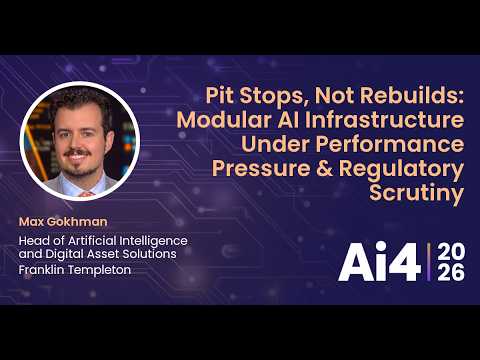
Ai4
Treating foundation models and orchestration as disposable components governed by rigid compliance contracts allows asset managers to upgrade AI capabilities continuously without risking regulatory breaches or engineering teardowns.
AI-assisted summary of Pit Stops, Not Rebuilds: Modular AI Infrastructure Under Performance Pressure & Regulatory Scrutiny — original source. Check the original for full context.
Source published:
Detailed notes
## Background Published by the Ai4 channel on YouTube on August 14, 2026, this presentation features Max Gokhman, Head of AI and Digital Asset Solutions at Franklin Templeton. The session description details a practical playbook for building modular, agentic AI harnesses within regulated enterprises, focusing on separating durable governance and compliance layers from rapidly evolving components like models and orchestration frameworks.
## TL;DR Using the evolution of motorsport pit stops as an architectural metaphor, Max Gokhman outlines how enterprises can achieve continuous, zero-downtime AI updates without breaching strict regulatory boundaries. He proposes decoupling the durable chassis—comprising core intellectual property, governance, audit trails, and standardized evaluations—from hot-swappable components like foundation models and data feeds via explicit coupling contracts. Gokhman contrasts a real-world hardcoded copilot project that suffered costly refactoring delays against a modular agentic analyst deployment that seamlessly incorporated multi-model routing in days. He concludes by explaining how agentic workflows resolve historical friction between fundamental portfolio managers and quantitative tools while establishing an enduring competitive moat.
## Atmosphere & style The session has an engaging, crisp, and high-velocity tone, propelled by Gokhman's dual passion for track racing and enterprise systems engineering. His speaking style is polished, confident, and direct, effortlessly translating complex architectural concepts like standardized harnesses and dynamic human-in-the-loop oversight through vivid analogies like Formula 1's Drag Reduction System. The atmosphere feels like an insider technical debrief from the racing paddock, effectively balancing the competitive urgency of rapid AI iteration with the disciplined risk management required in financial services.
## Key takeaways - [00:04](https://www.youtube.com/watch?v=4V5ikAAMdHg&t=4s) In regulated industries facing continuous 24/7/365 operations, the target for enterprise AI maintenance and model upgrades is '0.0 seconds' of downtime, surpassing even Formula 1's 1.8-second pit stops. - [00:04](https://www.youtube.com/watch?v=4V5ikAAMdHg&t=4s) The dilemma between freezing a tech stack for compliance and constantly chasing new frameworks is an architectural problem, not a governance problem. - [02:56](https://www.youtube.com/watch?v=4V5ikAAMdHg&t=176s) A modular AI architecture decouples the durable chassis (governance, risk limits, auditability, client objectives) from consumable, hot-swappable components (foundation models, data streams, orchestration frameworks). - [02:56](https://www.youtube.com/watch?v=4V5ikAAMdHg&t=176s) Couplings between the chassis and components must be treated as formal software contracts defining inputs, outputs, latency, and compliance requirements. - [05:04](https://www.youtube.com/watch?v=4V5ikAAMdHg&t=304s) Regulatory constraints must be directly hardcoded into software logic to prevent autonomous agents from discovering and exploiting compliance loopholes. - [05:04](https://www.youtube.com/watch?v=4V5ikAAMdHg&t=304s) Standardizing evaluation benchmarks across engineering, legal, cybersecurity, and compliance allows new models or frameworks to be deployed without renegotiating compliance approvals. - [05:04](https://www.youtube.com/watch?v=4V5ikAAMdHg&t=304s) Autonomous agents provide telemetry and point-in-time flight recorder replay, giving regulators completely transparent audit trails of observed data and reasoning steps. - [05:04](https://www.youtube.com/watch?v=4V5ikAAMdHg&t=304s) Human-in-the-loop oversight acts like aerodynamic downforce: it should be minimized on simple straightaways to maximize speed and concentrated selectively on complex, high-risk operational turns. - [08:50](https://www.youtube.com/watch?v=4V5ikAAMdHg&t=530s) Tightly 'welding' dependencies into early copilot systems caused a 3-month teardown at Franklin Templeton, whereas modular harnesses allowed intelligent model routing to be deployed in days. - [08:50](https://www.youtube.com/watch?v=4V5ikAAMdHg&t=530s) Enterprises should adopt a 'partner for a season, not for life' philosophy with external AI vendors, re-evaluating technology partnerships annually as capabilities evolve. - [11:43](https://www.youtube.com/watch?v=4V5ikAAMdHg&t=703s) While switching between comparable LLMs is straightforward, transitioning to fundamentally different architectures like world models requires engineering entirely different harnesses. - [11:43](https://www.youtube.com/watch?v=4V5ikAAMdHg&t=703s) Autonomous agents bridge the historic 'quantamental' divide by enabling fundamental analysts to leverage complex quantitative tools through natural language without requiring deep mathematical backgrounds.
## Detailed walkthrough ### [00:04](https://www.youtube.com/watch?v=4V5ikAAMdHg&t=4s) From 67 Seconds to 0.0: The Motorsport Metaphor and Enterprise AI
Max Gokhman introduces himself with a dual identity: on weekends, he races cars at Laguna Seca, while during the week, he leads the build-out for Franklin Templeton's artificial intelligence and digital asset solutions. His background spans running one of the earliest pure AI hedge funds and serving as deputy chief investment officer for Franklin Templeton’s multi-asset team. Drawing on motorsport, Gokhman contrasts the 67-second pit stop of a 1950 Indianapolis 500 racecar with McLaren's record-setting 1.8-second Formula 1 pit stop in 2023. The dramatic speed improvement was not achieved because racecars became simpler—modern race machines are orders of magnitude more complex—but because the pit stop evolved into an intricately choreographed routine where every critical part is designed to be modular.
In financial services, where the rise of asset tokenization and blockchain rails pushes markets toward 24/7/365 continuous operation, even a 1.8-second stop is unacceptable. The operational goal is "0.0": performing maintenance, model upgrades, and component swaps without ever taking the system offline. Gokhman notes that many enterprise leaders fall into a false dichotomy: they either freeze their tech stack under the guise of compliance and safety, or they frantically chase every emerging framework. Freezing a stack guarantees obsolescence—locking into a foundation model from 18 months prior leaves a firm "completely at the back of the grid." Conversely, constantly jumping between new frameworks is like "driving on wet cement because you've never let it dry." Gokhman emphasizes that resolving this dilemma is not a governance problem, but an architectural one.
- **1950 Indy Car Pit Stop**: 67 seconds. - **2023 McLaren F1 Pit Stop**: 1.8 seconds. - **Enterprise Target**: 0.0 seconds (zero-downtime hot swapping during live operations).
---
[02:56](https://www.youtube.com/watch?v=4V5ikAAMdHg&t=176s) The Core Architecture: Durable Chassis vs. Modular Components
To build an AI architecture capable of zero-downtime pit stops, Gokhman separates the system into two distinct layers: the durable "chassis" and the modular "components," joined together by standardized "couplings." The chassis represents the firm's core intellectual property, compliance standards, and business identity. It houses non-negotiable elements such as firm-wide governance policies, risk limits, client investment objectives, point-in-time audit logging, human-in-the-loop triggers, and standard evaluation suites (evals).
On the other side of the boundary are the components: foundational large language models, live data feeds, and orchestration frameworks. These are consumable elements that must be upgraded at the cutting-edge pace of the market rather than the slower pace of internal enterprise release cycles. The bridge between the chassis and components is the coupling—a formal software contract defining inputs, outputs, and governance constraints. When couplings and evals remain standardized, swapping one model or orchestration layer for another becomes seamless.
```mermaid flowchart LR accTitle: Modular AI Harness Architecture subgraph Chassis["Durable Chassis (Core IP)"] G["Governance & Risk Limits"] A["Point-in-Time Audit & Replay"] H["Human Oversight Triggers"] E["Standardized Eval Harness"] end
subgraph Couplings["Couplings (Contracts)"] C1["Input/Output Specifications"] C2["Governance Encodings"] end
subgraph Components["Modular Components (Hot-Swappable)"] M["Foundation Models"] D["Market & Alternative Data Feeds"] O["Orchestration Frameworks"] end
Chassis <--> Couplings <--> Components ```
- **Chassis Assets**: Proprietary investment IP, risk parameters, regulatory guardrails, point-in-time audit logs, human intervention rules, standardized evals. - **Coupling Contracts**: Explicit technical specifications governing inputs, outputs, latency, and compliance requirements. - **Modular Components**: Foundation models, external vendor data streams, agent orchestration engines.
---
[05:04](https://www.youtube.com/watch?v=4V5ikAAMdHg&t=304s) Staying Fast: Standardized Evals, Flight Recorder Replays, and Human Downforce
Gokhman details the operational mechanics that allow an enterprise to move quickly without breaching regulatory boundaries. First, constraints must be encoded directly into code rather than left to ambiguous guidelines. In motorsport, teams routinely comb through regulations looking for loopholes to exploit, but enterprises cannot afford to have autonomous agents discovering and exploiting loopholes in risk or compliance policies. Second, evaluations must be standardized across engineering, legal, cybersecurity, and compliance teams. By securing upfront stakeholder alignment on a single evaluation suite, any candidate component that passes the benchmark can be plugged directly into production without having to re-litigate compliance approvals from scratch.
Third, systems require complete telemetry and replay capabilities, mirroring the post-session debriefs where a racing driver and engineer analyze brake pressure, steering angle, and tire contact patches on the tarmac. In asset management, regulators require precise visibility into decision-making. If an investigator asks a human trader whether they acted on material non-public information (MNPI), the human reflexively denies it. An autonomous agent with a point-in-time audit trail, however, "technically isn't worried about going to jail or getting fined" and can supply a fully transparent record of exactly what data it observed, when it observed it, and how it reasoned.
Finally, Gokhman uses aerodynamics to explain the role of human-in-the-loop oversight. In race engineering, aerodynamic downforce creates drag that slows a car on straightaways, but provides the essential grip required to keep it from flying off the track in high-speed corners. Formula 1 introduced the Drag Reduction System (DRS) to shed downforce on straights while restoring it in corners. Similarly, human oversight should not bottleneck simple, high-throughput computational tasks; instead, human judgment must be concentrated selectively on nuanced, complex, high-risk, or ethically sensitive operational turns.
---
[08:50](https://www.youtube.com/watch?v=4V5ikAAMdHg&t=530s) Tales from the Paddock: The Welded Co-Pilot vs. The Modular Agentic Analyst
Gokhman contrasts two real-world enterprise deployments at Franklin Templeton to illustrate the difference between hardcoded systems and modular harnesses. The first project was an early client-facing copilot. The team tightly integrated and "welded" all dependencies—including the third-party orchestration layer—directly into the application. When an external vendor released a markedly superior orchestration framework, the team was forced to completely dismantle the software chassis, rebuild internal connectors, and re-engineer the pipeline. That refactoring effort consumed three months and brought the team dangerously close to missing their launch deadline.
Having learned from that failure, the team designed their subsequent project—an autonomous agentic research analyst—with full modularity from day one. Every sub-component was treated as a hot-swappable element connected to the core investment engine via explicit contracts. When a frontier AI lab introduced a top-tier model with steep API pricing, the team quickly deployed an intelligent router: complex, high-value tasks were routed to the expensive frontier model, while routine background tasks were directed to a cheaper commodity model. Because governance contracts and eval harnesses were already established, the change was executed in days rather than months.
- **Mistake ("Welding")**: Hardcoding dependencies and orchestration into the copilot chassis resulted in a 3-month teardown and near-missed deadline. - **Success ("Pit Stop")**: Building a modular agentic analyst enabled the team to insert a multi-model smart router in days to optimize frontier model costs. - **Core Takeaways**: 1. Separate core governance from modular components. 2. Treat couplings as rigid contracts—never weld components to the chassis. 3. "Partner for a season, not for life," re-evaluating external technology partners annually just as racing teams do.
---
[11:43](https://www.youtube.com/watch?v=4V5ikAAMdHg&t=703s) Q&A: Interoperability, Harness Types, and Fundamental Active Management
During the audience Q&A, Gokhman clarifies how Franklin Templeton approaches vendor interoperability, model architectures, and the long-term evolution of asset management:
```mermaid flowchart TD accTitle: Human-Agent Active Management Loop A["Human Portfolio Managers & Analysts"] -->|"Market intelligence, qualitative insights, hypothesis generation"| B["Agentic Systems & Quant Tools"] B -->|"Deep contextual computation, screening, automated synthesis"| A A -->|"Reinforcement & institutional investment logic"| C["Proprietary Knowledge Chassis"] C -->|"Governance & evaluation boundaries"| B ```
An audience member asks about the overhead of maintaining cross-vendor interoperability. Gokhman responds that standardized evaluation suites make it easy to benchmark competing vendors (e.g., orchestration framework A versus framework B) on identical criteria. This abstraction also allows the firm to deploy different component configurations across different use cases, much like using a single engine architecture across both a rally car and a GT track car while swapping the suspension and tires.
Addressing a question about model swappability and compatibility, Gokhman notes that swapping models is like matching a tire to a wheel rim: while moving between comparable LLMs (such as switching between GPT-4o and Claude 3.5 Sonnet) is straightforward, moving from an LLM to an embodied or world model requires building an entirely different harness. A world model harness prioritizes visual, spatial, and physics data while consuming unstructured text at a secondary layer, whereas an LLM harness does the opposite.
Asked about the future of investment management, Gokhman reflects on the post-2008 Global Financial Crisis (GFC) trend of "quantamental" investing, where firms attempted to pair quantitative analysts with fundamental portfolio managers. That initiative largely struggled across the industry due to deep cultural and methodological divides. Autonomous agents resolve this friction by acting as an intuitive interface: fundamental analysts can interact with agents in plain language without needing to understand the underlying quantitative mechanics, similar to how a driver relies on anti-lock brakes (ABS) without knowing the low-level mechanical engineering. Gokhman concludes that Franklin Templeton's competitive moat rests on combining human intelligence gathering with AI processing power to continuously expand the firm's proprietary investment IP across equities, fixed income, and private credit.
## Notable quotes > [00:04](https://www.youtube.com/watch?v=4V5ikAAMdHg&t=4s) completely at the back of the grid. — Max Gokhman
> [00:04](https://www.youtube.com/watch?v=4V5ikAAMdHg&t=4s) driving on wet cement because you've never let it dry. — Max Gokhman
> [05:04](https://www.youtube.com/watch?v=4V5ikAAMdHg&t=304s) technically isn't worried about going to jail or getting fined — Max Gokhman
> [08:50](https://www.youtube.com/watch?v=4V5ikAAMdHg&t=530s) Partner for a season, not for life, — Max Gokhman
## Mentioned Max Gokhman, Franklin Templeton, Laguna Seca, Indianapolis 500, McLaren, Formula 1, GPT-4o, Claude 3.5 Sonnet, Drag Reduction System (DRS), Ai4
## Video description Max Gokhman - Head of Artificial Intelligence and Digital Asset Solutions, Franklin Templeton
In motorsport, no team rebuilds the car mid-race — they engineer it so key parts can be swapped or adjusted in seconds without compromising safety or speed. Enterprises in regulated industries like investment management face the same challenge with AI: model capabilities are evolving monthly and peers keep competition fierce, but decision quality and compliance cannot be compromised. This session presents a practical playbook for building agentic harnesses that evolve at the speed of technological change — separating the durable layers like governance, client constraints, and auditability from the modular ones such as models, data streams, and orchestration frameworks. Attendees will leave with concrete frameworks, vendor-selection criteria, and lessons from building agentic systems inside one of the world's largest asset managers. If your AI roadmap changes every quarter but your scrutineers don't, this talk will help tune your chassis to perform within track limits.
[Source](https://www.youtube.com/watch?v=4V5ikAAMdHg)