Ogletree Deakins Caps AI Deals at 12 Months to Avoid Vendor Lock-In
Ai4
Rigorous governance frameworks accelerate rather than delay enterprise AI deployment, while limiting commercial vendor contracts to 12 months prevents law firms from locking into obsolete software.
AI-assisted summary of 1,100 Attorneys, One Million+ Prompts: Building a 50+ Tool AI Stack at a Global Law Firm — original source. Check the original for full context.
Source published:
Detailed notes
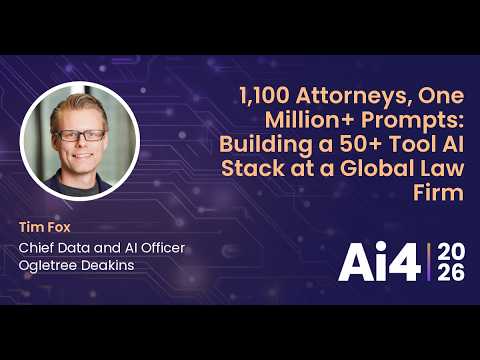
## Background Published on YouTube by the Ai4 channel on August 16, 2026, this presentation features Tim Fox, Chief Data and AI Officer at Ogletree Deakins. The session details how the global firm grew from zero AI applications to a portfolio of over 50 licensed and bespoke tools, logged over one million prompts, earned an ISO 42001 certification, and successfully navigated buy-versus-build tradeoffs across 1,100 attorneys.
## TL;DR Tim Fox details Ogletree Deakins' deliberate 'fast follower' strategy, moving from 2023 legal skepticism and hallucination concerns to deploying over 50 AI tools with 80% attorney adoption and 250,000 monthly prompts. He highlights critical mistakes—such as understaffing change management and engaging in superficial 'governance theater'—and counters them with proven strategies like peer-led demonstrations and converting shadow AI into enterprise platforms. The firm maintains a strategic balance by buying frontier foundation models and specialized research platforms on strict 12-month contracts while reserving in-house engineering for unique, low-market niches like immigration.
## Atmosphere & style The presentation is pragmatic, transparent, and authoritative, striking a sharp contrast to standard corporate AI hype through wry humor and hard-won operational realities. Fox speaks with the grounded credibility of both a veteran litigator and a tech founder, openly sharing internal missteps alongside success metrics. It feels like an authentic insider briefing on enterprise change management, demystifying the intersection of cutting-edge technology, strict legal ethics, and human behavior.
## Key takeaways - [00:04](https://www.youtube.com/watch?v=pu055hxdahs&t=4s) Ogletree Deakins adopted a deliberate 'fast follower' philosophy, allowing emerging AI tools to stabilize before implementing them to protect client confidentiality and comply with strict legal regulations. - [03:08](https://www.youtube.com/watch?v=pu055hxdahs&t=188s) The firm scaled its generative AI stack to over 50 tools, processing over one million cumulative prompts in under 18 months with 80% attorney adoption across 60 global offices. - [03:08](https://www.youtube.com/watch?v=pu055hxdahs&t=188s) Achieving ISO 42001 certification provided the foundational governance required to earn the trust of clients, attorneys, and leadership while rapidly expanding generative AI capabilities. - [05:16](https://www.youtube.com/watch?v=pu055hxdahs&t=316s) The 'build it and they will come' mentality failed; meaningful adoption only accelerated after the firm staffed dedicated enablement personnel to guide practicing attorneys. - [05:16](https://www.youtube.com/watch?v=pu055hxdahs&t=316s) Law firms must tailor AI tooling and enablement separately for practicing attorneys and administrative business professionals, as non-lawyers often avoid tools branded exclusively for legal work. - [05:16](https://www.youtube.com/watch?v=pu055hxdahs&t=316s) Over-indexing on policy drafting and mandatory seminars leads to 'governance theater,' which creates delays without eliminating inherent AI risks; leadership must accept controlled risk and trust professional judgment. - [07:50](https://www.youtube.com/watch?v=pu055hxdahs&t=470s) Peer-led demonstrations by practicing partners drove significant, sustained adoption spikes compared to top-down instruction from central IT or innovation teams. - [07:50](https://www.youtube.com/watch?v=pu055hxdahs&t=470s) Systematic data collection and prompt classification enabled the AI team to uncover user intent, report actionable metrics to leadership, and secure multi-million-dollar licensing budgets. - [09:51](https://www.youtube.com/watch?v=pu055hxdahs&t=591s) Rather than banning unapproved 'shadow AI,' the firm identified unmet employee needs and negotiated enterprise licenses, creating built-in pilot groups with pre-validated use cases. - [10:33](https://www.youtube.com/watch?v=pu055hxdahs&t=633s) Governance functions as an operational accelerator rather than a roadblock, making organizations significantly more likely to scale extensive generative AI deployments successfully. - [11:52](https://www.youtube.com/watch?v=pu055hxdahs&t=712s) The firm buys frontier LLM capabilities, statutory legal research tools, and commodity utilities, reserving internal software development strictly for high-volume niche workflows like immigration that vendors do not support. - [14:21](https://www.youtube.com/watch?v=pu055hxdahs&t=861s) Weekend 'vibe coding' prototypes do not equal enterprise readiness, as translating prototypes into secure, production-grade tools still requires 6 to 9 months of engineering and governance reviews. - [16:06](https://www.youtube.com/watch?v=pu055hxdahs&t=966s) To prevent vendor lock-in and avoid the massive switching costs of migrating millions of prompts, the firm enforces a strict policy of capping AI vendor contracts at 12 months. - [17:41](https://www.youtube.com/watch?v=pu055hxdahs&t=1061s) Successful enterprise AI scaling requires viewing AI as a change management challenge rather than a technical deployment, focusing equally on human input, technology, and human review.
## Detailed walkthrough ### [00:04](https://www.youtube.com/watch?v=pu055hxdahs&t=4s) Background and the Fast Follower Philosophy in Legal AI
Tim Fox introduces his background as the Chief Data and AI Officer at Ogletree Deakins, a global labor, employment, and immigration law firm comprising approximately 1,100 attorneys across 60 offices worldwide. A licensed attorney himself, Fox has worked at the intersection of law and artificial intelligence for over a decade, having co-founded the litigation-focused AI startup Legalmation in 2016. In addition to his leadership role at the firm, he teaches an AI fundamentals course at USC’s Gould School of Law and advises courts and judges as a member of the California Judicial Council’s Information Technology Advisory Committee. Opening with a touch of humor, Fox notes that he ran his slide deck and speaking notes through Claude and ChatGPT, which assured him this would be one of the top presentations at the conference—quipping that if it falls short, the audience can "blame AI for that."
Transitioning into the legal industry's structural constraints, Fox emphasizes that law firms face heavy regulatory and ethical burdens that make adopting technology on the bleeding edge nearly impossible. Because client confidentiality, ethical rules, and professional standards demand total reliability, legal organizations must wait for emerging technologies to stabilize before implementing them. Ogletree Deakins resolves this tension by adopting a deliberate "fast follower approach," purposefully choosing not to be the first to experiment with untested code, but moving decisively to adopt platforms the moment they are proven safe, robust, and compliant.
```mermaid flowchart LR accTitle: Fast Follower Adoption Framework in Legal Tech subgraph Market["Market Evolution"] A["Emerging Tech / Bleeding Edge"] --> B["Enterprise Stabilization"] end subgraph Firm["Ogletree Deakins Strategy"] B --> C["Safety & Compliance Vetting"] C --> D["Fast Follower Deployment"] D --> E["Firm-Wide Scale & Custom Workflows"] end ```
---
[02:07](https://www.youtube.com/watch?v=pu055hxdahs&t=127s) The 2023 Landscape: Skepticism, Sanctions, and Strategic Commitment
Looking back to early 2023, Fox characterizes the initial wave of generative AI in legal as fraught and chaotic. Hallucination incidents regularly made headlines, judges issued sanctions against lawyers who submitted briefs with fabricated case citations generated by tools like ChatGPT, and the models of that era offered questionable substantive value for rigorous legal drafting. Compounding the issue was deep professional anxiety: weekly studies oscillated wildly between claiming that AI would replace attorneys entirely and predicting a hiring boom to handle AI-generated complexity. Having heard warnings for fifteen years that technology was coming for their jobs, attorneys were understandably cynical. Fox acknowledges that in 2023, that skepticism was completely justified because the underlying technology was simply not ready for enterprise legal practice.
Despite the prevailing headwinds, Ogletree Deakins leadership identified generative AI as a transformative long-term priority rather than a passing fad. Rather than banning the tools or waiting passively on the sidelines, the firm established its foundational generative AI strategy in July 2023, laying the operational and governance groundwork for enterprise-level experimentation.
- **Industry Friction in 2023**: Frequent hallucination controversies and judicial sanctions for citing fake precedent. - **Lawyer Cynicism**: Decades of automated replacement narratives fostered natural resistance across the legal field. - **Strategic Mobilization**: Ogletree Deakins drafted and approved its initial generative AI strategy in July 2023.
---
[03:08](https://www.youtube.com/watch?v=pu055hxdahs&t=188s) From ODGPT to 1 Million Prompts: Scaling Tools and Enterprise Governance
The firm turned strategy into execution throughout 2024 by piloting major platforms across the industry, entering commercial licensing agreements with tools like Harvey and Lexis Protege, and engineering its own proprietary, firm-wide chatbot called ODGPT in October 2024. Fox marks the launch of ODGPT as the true turning point for firm-wide adoption. In its first month alone, ODGPT processed 9,000 prompts, initiating an exponential trajectory across the firm’s global footprint.
Within less than two years, the firm’s AI footprint expanded from a single internal prototype to an ecosystem of more than 50 deployed tools, split roughly evenly between commercial SaaS and homegrown applications. In May, the firm crossed the milestone of one million cumulative prompts in under 18 months from launch. Usage currently averages nearly 250,000 prompts per month, with projections on track to surpass two million prompts before the end of the calendar year. Beyond volume, adoption spans 80% of the firm's attorney population and accounts for more than 2,000 monthly active users (MAUs). Underpinning this infrastructure, Ogletree Deakins earned its ISO 42001 certification in June, becoming one of the earliest enterprises—and one of the first law firms globally—to certify its artificial intelligence management systems. This operational maturity has enabled the firm to co-develop bespoke, automated workflows directly with clients to lower costs and accelerate delivery while maintaining high-quality work product.
| Adoption Metric | Growth Milestone | |:--- |:--- | | **Tool Portfolio** | 50+ tools (balanced 50/50 buy vs. homegrown build) | | **Prompt Volume** | Crossed 1M in May (<18 months); ~250k/month; on pace for 2M+ | | **Attorney Penetration** | ~80% monthly active attorney utilization | | **Total Active Users** | 2,000+ monthly active users across global offices | | **Governance Standard** | ISO 42001 AI Management System Certified (June) |
---
[05:16](https://www.youtube.com/watch?v=pu055hxdahs&t=316s) Pain Points and Failures: What Didn't Work
To provide a realistic picture of organizational transformation, Fox outlines the operational mistakes and dead ends Ogletree Deakins encountered during rollout:
1. **The "Build It and They Will Come" Fallacy**: The firm initially assumed that making tools accessible on the intranet would naturally drive engagement. In practice, only the top 10% to 20% of curious early adopters explored the tools independently. The vast majority of the firm, particularly practicing attorneys with heavy caseloads, required hands-on enablement and guided demonstrations before altering their established workflows. 2. **Understaffing Adoption Initiatives**: Early implementation was managed exclusively by Fox and a single additional attorney, who juggled vendor vetting, pilot management, technical rollouts, policy writing, and firm-wide training. This lean setup proved unsustainable. Adoption directly accelerated only when dedicated personnel were brought in to manage enablement full-time, a correlation clearly visible on the firm's monthly utilization curves: "It is a hire people and you will drive adoption. I can literally show you on our usage curves when somebody was hired at the firm to help lead our adoption initiatives." 3. **Treating the Firm as a Single Audience**: Law firms function as two parallel organizations: practicing attorneys and administrative business professionals (such as marketing, HR, finance, and knowledge management). Early efforts prioritized revenue-generating attorneys, assuming business staff would naturally follow along. However, business professionals refused to touch legal-branded platforms like Harvey because they perceived them as strictly for lawyers. Successful adoption required dedicated tooling and tailored training designed around non-legal operations. 4. **Governance Analysis Paralysis & "Governance Theater"**: Fearing headlines, reputational risk, and regulatory fallout before launching ODGPT, the team spent excessive time drafting exhaustive policy documents and running mandatory compliance seminars. Fox candidly labels this "governance theater"—activities that comforted leadership internally but did nothing to advance productive adoption while causing major release delays. Generative AI carries inherent, irreducible risks that no document can fully eliminate; true governance requires providing strong tools, clear parameters, and ultimately trusting qualified professionals to exercise sound judgment. Moving forward decisively while accepting controlled risk provides a distinct competitive advantage.
---
[07:50](https://www.youtube.com/watch?v=pu055hxdahs&t=470s) What Worked: Peer-Led Training, Metric Tracking, and Change Management
Turning to the core strategies that drove successful implementation, Fox identifies three foundational pillars:
First, peer-led education proved vastly more persuasive than top-down IT instruction. During a regional shareholder meeting in California, a practicing shareholder demonstrated live workflows showing precisely how he used AI to draft briefs, research arguments, and manage case files. The session resulted in a standing-room-only room of 100 partners and drove an immediate, permanent spike in regular platform usage across that cohort. Academic and industry studies consistently reinforce that professionals adopt complex technology fastest when observing peers and direct managers doing so, rather than listening to central innovation teams: "People are tired of me talking about AI at my firm. They want to hear from their peers."
```mermaid flowchart TD accTitle: Pillars of Effective Legal AI Adoption subgraph Execution["Core Adoption Drivers"] P1["Peer-Led Enablement\n(Partner-to-partner demos)"] P2["Telemetry & Prompt Classification\n(Demonstrate ROI & secure funding)"] P3["Change Management Mindset\n(Focus on human inputs & outputs)"] end Execution --> Outcome["Sustainable Firm-Wide AI Utilization"] ```
Second, rigorous data collection and prompt classification allowed the AI team to demonstrate concrete value. Every prompt is classified to uncover true user intent, and monthly summaries are distributed directly to executive leadership. This reporting creates a positive feedback loop: broader awareness of rising firm usage stokes organic peer interest, while transparent utilization metrics justify multi-million-dollar software licensing budgets to executive management.
Finally, Fox stresses that rolling out AI is fundamentally an exercise in change management rather than a technology deployment. Technology represents only one-third of the operational loop—sandwiched between human input on the front end and human review on the back end. Innovation teams that concentrate solely on the technology layer while neglecting the human components inevitably struggle with low engagement and missed business outcomes.
[09:51](https://www.youtube.com/watch?v=pu055hxdahs&t=591s) Turning Shadow AI into Enterprise-Licensed Solutions
Focusing on the broader cultural and operational aspects rather than just technical deployment is vital for driving AI adoption. At Ogletree Deakins, a particularly successful strategy involved closely monitoring "shadow AI"—the unapproved tools employees were already bringing in to do their jobs. Rather than penalizing users or outright banning these unauthorized platforms, the firm actively examined what unmet needs those tools fulfilled.
Once a clear pattern emerged, the AI team sought enterprise licensing agreements to fold those specific tools directly into the firm’s formal governance framework. This approach turned existing user behavior into a massive operational advantage: the firm gained an immediate, built-in pilot group of enthusiastic users with pre-validated legal use cases. Crucially, it prevented the widespread frustration and complaints that typically follow when IT abruptly restricts access to popular software, transforming an administrative friction point into an enterprise-enabled workflow.
- Rather than cracking down on shadow AI, evaluate organic usage to identify real operational needs. - Enterprise licensing brings unvetted tools under corporate compliance while retaining existing user momentum. - Utilizing built-in pilot groups dramatically cuts discovery and testing time for the AI team.
---
[10:33](https://www.youtube.com/watch?v=pu055hxdahs&t=633s) Why Rigorous Governance Is the True Accelerator of AI
While governance is traditionally viewed as the bureaucratic black hole "where you send projects to die," it acts as an indispensable accelerator in the AI era. Citing recent industry research, Tim Fox points out that organizations with mature governance frameworks are 75% more likely to drive successful AI adoption and nearly four times as likely to scale extensive generative AI deployments.
```mermaid flowchart TD accTitle: Governance as an AI Accelerator subgraph GOV["Governance Foundation"] A["Formal Committees & Policies"] --> B["ISO 42001 Certification"] end subgraph TRUST["Stakeholder Alignment"] B --> C["Win Reluctant Clients"] B --> D["Reassure Attorneys"] B --> E["Obtain General Counsel Approval"] end subgraph SCALE["Enterprise Velocity"] C & D & E --> F["Rapid AI Adoption & Scale"] end ```
Ogletree Deakins achieved its ISO 42001 certification and established dedicated oversight committees precisely because attorneys, clients, and general counsels refuse to engage with generative AI if they do not trust its safety and privacy controls. Solid governance is what ultimately gives leadership the comfort level required to approve deployments quickly, proving that "you cannot move fast without good governance" while ensuring everyone can sleep at night knowing systems operate responsibly.
- Good governance yields a 75% higher likelihood of driving day-to-day AI adoption. - Organizations with formal oversight are nearly four times more likely to run large-scale AI operations. - Earning the ISO 42001 certification validates compliance and builds trust across attorneys, clients, and risk officers.
---
[11:52](https://www.youtube.com/watch?v=pu055hxdahs&t=712s) Strategic Buy vs. Build Framework: Frontier Models to Niche Tools
The firm’s 50+ tool stack is split evenly between purchased software and internally engineered tools. Deciding whether to buy or build rests on a clear division of labor: Ogletree Deakins buys frontier capabilities, specialized legal knowledge bases, and hyper-efficient niche utilities, while strictly reserving internal development for workflows that third-party vendors cannot serve.
| Acquisition Category | Target Tools / Providers | Strategic Rationale | |:--- |:--- |:--- | | **Frontier Capabilities** | Claude (Anthropic), Microsoft Copilot, ChatGPT (OpenAI) | Unreplicable core LLM foundations; firms cannot compete with trillion-dollar AI labs. | | **Domain-Specific Legal Research** | Harvey, Lexis+ AI / Lexis Protégé | Deep integration with proprietary statutory and case-law datasets unavailable internally. | | **Cost-Effective Niche Utilities** | Third-party deposition summarizers | Commodity point solutions available for roughly $20 per run that make custom development uneconomical. | | **Bespoke In-House Builds** | High-volume arbitration workflows, operations, immigration | Highly customized proprietary processes and data that vendors cannot or will not build for small addressable markets. |
Bespoke in-house builds are deployed heavily across unique practice groups like immigration. With only five to ten peer firms operating immigration practices of comparable scale, third-party software vendors lack the financial incentive to create specialized platforms for such a narrow market. Building proprietary tools for these specialized groups has automated massive portions of low-stakes arbitration and administrative work, saving the firm thousands of hours.
---
[14:21](https://www.youtube.com/watch?v=pu055hxdahs&t=861s) The Hard Realities of In-House Engineering and "Vibe Coding"
Engineering AI solutions in-house requires extreme caution because "just because you can build it does not mean you should build it." Creating a piece of software is never a one-off effort; long-term ownership requires an ongoing infrastructure to handle support, maintenance, model updates, changing data schemas, and documentation when key engineers leave.
The advent of modern generative AI creates a deceptive dynamic around prototyping. An attorney can now "vibe code" an impressive proof of concept over a single weekend and enthusiastically bring it to the AI team on Monday morning expecting immediate rollout. However, bridging the gap between a weekend prototype and an enterprise-grade production tool requires rigorous code reviews, value assessments, security vetting, and deployment pipelines—a process that still takes 6 to 9 months of manual effort, often causing user frustration if expectations are not carefully managed.
- Every custom build requires an enduring support plan for weekend trial emergencies, schema shifts, and engineer turnover. - Rapid weekend prototyping does not equal production readiness; enterprise scale still requires months of manual stabilization. - Generative AI accelerates initial code authoring but dramatically increases the downstream architectural and governance review burden.
---
[16:06](https://www.youtube.com/watch?v=pu055hxdahs&t=966s) Managing High Switching Costs and Capping AI Contract Durations
When purchasing commercial AI platforms, organizations must factor switching costs directly into their initial evaluations. Once a firm logs over one million prompts, the accumulated institutional knowledge, prompt history, and user habits become virtually impossible to extract or migrate between competing platforms. Jumping ship risks significant data loss and wrecks hard-won change management gains, leaving many law firms trapped with lagging legacy vendors due to pure institutional inertia.
Simultaneously, the breakneck pace of model evolution means specialized point solutions are frequently subsumed by newer frontier models. Attorneys consistently voice a strong preference for staying inside a single unified frontier environment rather than toggling across five standalone point solutions for marginal quality gains. To avoid being locked into obsolete platforms, Ogletree Deakins maintains a strict policy: never commit to generative AI vendor contracts longer than 12 months.
- Migrating a million prompts of institutional knowledge across platforms is currently technically and culturally unfeasible. - Rapid advances in frontier models routinely render narrow single-purpose legal AI startups obsolete within months. - Limit all generative AI vendor agreements to a maximum 12-month contract duration to preserve operational flexibility.
---
[17:41](https://www.youtube.com/watch?v=pu055hxdahs&t=1061s) Key Principles for Scaling Enterprise AI
Closing out the presentation, Tim Fox highlights five hard-earned operational rules for driving enterprise-wide AI transformation:
- **Staff adoption as a dedicated function:** Tools do not distribute or evangelize themselves; dedicated team members are required to manage onboarding and ongoing support. - **Lead with peer-led conversations:** Enlist active internal power users and AI practitioners to train and guide their colleagues rather than relying purely on top-down IT messaging. - **Measure success and champion usage continuously:** Track metrics systematically and present utilization reports to firm leadership to maintain executive momentum. - **Buy where possible, build only when necessary:** Factor switching costs and workflow stickiness into every purchase while keeping contracts capped at 12 months. - **Build governance before scaling adoption:** Establish robust security, ISO standards, and review frameworks first, as trustworthy governance is the single most critical accelerator for AI speed and user confidence.
## Notable quotes > [00:04](https://www.youtube.com/watch?v=pu055hxdahs&t=4s) blame AI for that — Tim Fox
> [05:16](https://www.youtube.com/watch?v=pu055hxdahs&t=316s) It is a hire people and you will drive adoption. I can literally show you on our usage curves when somebody was hired at the firm to help lead our adoption initiatives. — Tim Fox
> [05:16](https://www.youtube.com/watch?v=pu055hxdahs&t=316s) governance theater — Tim Fox
> [07:50](https://www.youtube.com/watch?v=pu055hxdahs&t=470s) People are tired of me talking about AI at my firm. They want to hear from their peers. — Tim Fox
> [10:33](https://www.youtube.com/watch?v=pu055hxdahs&t=633s) where you send projects to die — Tim Fox
> [10:33](https://www.youtube.com/watch?v=pu055hxdahs&t=633s) you cannot move fast without good governance — Tim Fox
> [14:21](https://www.youtube.com/watch?v=pu055hxdahs&t=861s) just because you can build it does not mean you should build it — Tim Fox
> [14:21](https://www.youtube.com/watch?v=pu055hxdahs&t=861s) vibe code — Tim Fox
## Mentioned Tim Fox, Ogletree Deakins, Legalmation, USC Gould School of Law, California Judicial Council Information Technology Advisory Committee, Claude, Anthropic, ChatGPT, OpenAI, Harvey, Lexis Protege, Lexis+ AI, Microsoft Copilot, ODGPT, ISO 42001
## Video description Tim Fox - Chief Data and AI Officer, Ogletree Deakins
In under 2 years, I helped take Ogletree Deakins from no AI tools to a stack of more than 50 licensed and homegrown tools, crossing well over one million prompts along the way and still climbing. We did it all while earning our ISO 42001 certification, ensuring enterprise governance for every decision. In this session, I'll cover the buy vs. build decisions behind that growth, including where Claude, Harvey, and Microsoft Copilot fit, and what worked and what didn't. I'll also share the use cases that actually drove adoption across the firm. You'll leave with lessons learned, practical use cases, and ideas on how to drive adoption at your own organization.
[Source](https://www.youtube.com/watch?v=pu055hxdahs)