Snap Says AI Generates Over 90% of Internal Code
Ai4
Snap Inc. uses autonomous agents and strict internal governance to speed up software development while cutting customer support volume and incident response times.
AI-assisted summary of Human First, AI Enabled - Startup Speed on a Global Scale with Snap and The Deep View — original source. Check the original for full context.
Source published:
Detailed notes
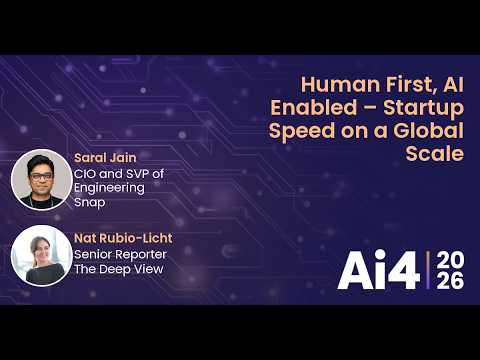
## Background This video was published on YouTube by Ai4 on August 22, 2026. The page description indicates that Saral Jain (CIO and SVP of Engineering at Snap) and Nat Rubio-Licht (Senior Reporter at The Deep View) discuss how Snap uses AI tools and agents to maintain startup-level agility at a global scale while highlighting human creativity.
## TL;DR Saral Jain details how Snap leverages AI across its engineering organization, noting that over 90% of code is now run or generated by AI tools like the Casper autonomous coding agent and the CodePal review agent. By establishing a strictly model-agnostic infrastructure, strong context substrates, and a "Jobs to Be Done" framework, Snap achieves faster execution while keeping humans accountable for final code approvals. Jain also highlights internal innovations like the "Snap OS" project, warns against superficial "AI theater," and emphasizes the mid-sized company advantage of combining scale with rapid iteration.
## Atmosphere & style The session has a professional, forward-looking, and highly pragmatic tone, driven by a crisp exchange between an inquisitive journalist and an articulate tech executive. Jain speaks with enthusiastic clarity and practical authority, replacing vague AI hype with concrete operational metrics and real-world system architecture. The dialogue feels candid and collaborative, capturing the energetic pace of enterprise AI transformation paired with a grounded emphasis on safety, human accountability, and effective system design.
## Key takeaways - [00:04](https://www.youtube.com/watch?v=jnep4SX9vn0&t=4s) AI rewrites the traditional tech playbook, allowing mid-sized companies with strong vision and fast learning loops to outpace larger tech giants. - [01:04](https://www.youtube.com/watch?v=jnep4SX9vn0&t=64s) Snap deploys AI fundamentally across three main verticals: Community (Snapchatters), Partners & Advertisers, and Engineers & Employees. - [01:39](https://www.youtube.com/watch?v=jnep4SX9vn0&t=99s) More than 90% of all code at Snap is now generated or run by AI, supported by a strict 'golden path' and 'blessed agents' to maintain safety. - [02:00](https://www.youtube.com/watch?v=jnep4SX9vn0&t=120s) CodePal, an AI code reviewer, inspects 90% of code in under 5 minutes with over 80% positivity rating while humans remain accountable for final changes. - [03:51](https://www.youtube.com/watch?v=jnep4SX9vn0&t=231s) Autonomous agents like Casper handle development tasks end-to-end in remote sandboxes, treated like human employees with formal identities and security boundaries. - [05:36](https://www.youtube.com/watch?v=jnep4SX9vn0&t=336s) Snap uses a model-agnostic infrastructure strategy, routing tasks based on complexity while heavily investing in a company-specific context substrate. - [07:04](https://www.youtube.com/watch?v=jnep4SX9vn0&t=424s) AI tools are evaluated strictly using a 'Jobs to Be Done' framework focused on concrete business outputs rather than vanity metrics or input volume. - [08:48](https://www.youtube.com/watch?v=jnep4SX9vn0&t=528s) AI reduces software construction costs, allowing non-engineering teams to present functional prototypes over static slide decks and shortening planning horizons. - [10:58](https://www.youtube.com/watch?v=jnep4SX9vn0&t=658s) Software engineers are evolving from manual coders into orchestrators of autonomous agents, making curiosity and learning agility top hiring priorities. - [13:08](https://www.youtube.com/watch?v=jnep4SX9vn0&t=788s) Enterprises should avoid 'AI theater'—superficial demos that fail to change core operating models—and instead solve real workflow bottlenecks. - [15:06](https://www.youtube.com/watch?v=jnep4SX9vn0&t=906s) Snap OS aggregates cross-functional data into a natural-language interface to break down organizational silos and answer executive questions in real time. - [16:39](https://www.youtube.com/watch?v=jnep4SX9vn0&t=999s) Mid-sized companies hold a unique competitive advantage in the AI era by combining tech-giant scale with agile learning loops. - [17:55](https://www.youtube.com/watch?v=jnep4SX9vn0&t=1075s) Establishing proper human governance, safety guardrails, and security vigilance is vital as AI model capabilities advance.
## Detailed walkthrough Here is the detailed, faithful walkthrough of Part 1 of the transcript:
[00:04](https://www.youtube.com/watch?v=jnep4SX9vn0&t=4s) Snap’s Sweet Spot Between Startup Speed and Tech Giant Scale
Nat Rubio-Licht, a senior reporter with *The Deep View*, opens the conversation with Saral Jain, Snap Inc.'s Head of Engineering and CIO. Rubio-Licht sets the stage by asking about Snap's unique positioning: sitting right in the middle ground between a nimble startup and a massive tech giant. She asks how Snap’s engineering organization is currently evaluating and deploying AI within that balance.
Jain responds enthusiastically, calling this middle ground "the best position to be in right now." He reflects on how scale historically served as a tech company's defining advantage—meaning whoever had the biggest teams, the deepest pockets, and the most GPUs held the upper hand. However, AI has fundamentally rewritten that playbook. Today, success belongs to the teams with the sharpest product vision and the fastest learning loops. Because Snap has always been rich in creative ideas where the bottleneck was raw execution, cheaper and faster building now allows them to "punch above our weight." For Snap, AI is not treated as a side project or a temporary gimmick; it is fundamental to how they build, operate, and win across three main verticals:
* **Community (Snapchatters):** AI features built directly into the consumer product experience. * **Partners & Advertisers:** AI tooling designed to optimize ad execution and commercial partnerships. * **Engineers & Employees:** Internal AI systems that transform everyday workforce productivity.
[01:39](https://www.youtube.com/watch?v=jnep4SX9vn0&t=99s) Rapid Code Generation, Safety, and the "Golden Path"
Rubio-Licht brings up a metric she heard recently—that two-thirds of the code written at Snap is generated by AI—and asks how the company manages to maintain rigorous safety and security at such high velocity. Jain updates that metric on the spot, noting that while it was 2/3 a few weeks prior, today **more than 90% of all code** at Snap is run or generated by AI.
Jain pushes back on the idea that speed and security are inherently in opposition. Instead, he argues that speed and safety can coexist because both are natural outcomes of solid system design. Serving a global audience of nearly one billion users means security and privacy cannot be afterthoughts; they are non-negotiable table stakes. Snap achieves this balance by establishing a strict "golden path" for engineering and relying on "blessed agents." They limit the blast radius of potential failures by creating paved roads for rapid experimentation alongside automated safeguards like instant rollback mechanisms.
``` +-----------------------------------------------------------------+ | ENGINEERING WORKFLOW | +-----------------------------------------------------------------+ | 1. Discussion: Engineers converse on Slack or Jira | | 2. Autonomous Dev: Casper agent spins up sandbox & writes code| | 3. Automated Review: CodePal agent reviews code (<5 mins) | | 4. Human Gatekeeper: Human engineer reviews safest final diff | +-----------------------------------------------------------------+ ```
- **CodePal (AI Code Reviewer):** Reviews 90% of all code written at Snap in under 5 minutes (compared to human first-touch reviews that historically took 5–6 hours). - **CodePal Performance:** Boasts an engineer satisfaction/positivity rating above 80% and has caught tens of thousands of bugs. - **Accountability Philosophy:** Jain emphasizes that the core risk is never AI-generated code itself, but rather "unowned code." Human engineers remain fundamentally accountable for every line shipped.
[03:51](https://www.youtube.com/watch?v=jnep4SX9vn0&t=231s) "Blessed Agents," Casper, and Identity Governance
Expanding on his mention of "blessed agents," Jain describes how autonomous agents represent the single biggest transformation happening inside Snap's engineering organization. He spotlights **Casper**, an internal remote autonomous coding agent that acts like an full-fledged AI teammate.
In practice, human engineers discuss feature requirements on internal tools like Slack or Jira while Casper listens in on the conversation to build context. When invoked by an engineer to build a feature, Casper automatically spins up a remote sandbox environment, makes the precise minimal code modifications needed, and hands the code off to CodePal. The two agents iterate back and forth automatically until the safest possible change set is presented to the human engineer for final approval. A review-and-implementation cycle that used to stretch across weeks or months is now compressed into a single fluid conversation. Beyond development, Snap uses specialized AI agents for:
- **SRE & On-Call Investigations:** Automated incident response and root-cause analysis. - **Data & Analytics:** Automated crash analytics and data investigations. - **Agent Identity & Security:** To keep autonomous workflows secure, Snap treats agents like human employees by assigning them formal identities, specific permission boundaries, and comprehensive audit log trails.
[05:36](https://www.youtube.com/watch?v=jnep4SX9vn0&t=336s) Model-Agnostic Infrastructure and the Context Substrate
When asked how Snap selects among competing coding models (such as Claude, Cursor, or Codex), Jain reveals that Snap has stopped asking which model is globally "the best." Because the state of the art shifts every few weeks, Snap adopts a strictly **model-agnostic strategy**:
- **Task-Matched Selection:** Low-complexity, highly repetitive tasks are routed to smaller, cheaper models, while high-complexity or ambiguous problems are assigned to frontier reasoning models. - **Context Substrate Investment:** Jain notes that when an AI code-reviewer misses a bug, it is almost never a failure of the underlying model—it is a failure of context. Snap invests heavily in its context substrate, supplying models with deep company-specific information, internal repositories, and organizational knowledge bases. - **Evaluation Systems:** Robust evaluation frameworks ensure models have the necessary domain knowledge to execute tasks accurately.
[07:04](https://www.youtube.com/watch?v=jnep4SX9vn0&t=424s) Measuring Real Business Outcomes with "Jobs to Be Done"
Addressing how Snap measures the real-world success of internal AI deployments like Casper, Jain explains that they steer clear of vanity metrics. Instead of building superficial AI prototypes or tracking easily gameable input metrics (like sheer volume of pull requests), Snap structures all AI agent deployments around a **Jobs to Be Done** framework. Every agent is measured against concrete output metrics and direct business impact for users, partners, or employees:
- **Customer Support Agent:** Deflects 3.5 million queries per month, driving human support ticket volume down by 25%. - **On-Call Incident Response Agents:** Reduced incident resolution times (MTTR) for system outages by 25% to 30%. - **Casper Productivity:** Consistently submits thousands of mergeable pull requests every week.
[08:48](https://www.youtube.com/watch?v=jnep4SX9vn0&t=528s) The Changing Physics of Software Product Development
Reflecting on his 9-year tenure at Snap, Jain discusses how product development has evolved before, during, and after the modern AI shift. While Snap’s core mission—helping nearly a billion people visually connect with close friends and family—remains unchanged, "the physics of building" has been completely upended.
Historically, product development was an exhaustive prioritization exercise where many creative ideas were abandoned simply due to engineering bandwidth constraints. With AI lowering construction costs, far fewer ideas fall "below the line." Jain highlights several structural culture shifts inside Snap:
- **Prototypes Over Slides:** Non-engineering teams (such as Product and Design) now build functional AI prototypes rather than presenting static pitch decks. - **Shortened Planning Horizons:** Multi-month or year-long roadmapping has largely disappeared in favor of fluid monthly or quarterly planning cycles. - **Lean Advantage:** Snap leverages its compact, lean team structure to implement changes immediately, avoiding the bureaucratic inertia that stalls 100,000-person tech giants.
[10:58](https://www.youtube.com/watch?v=jnep4SX9vn0&t=658s) The Evolving Role of the Software Engineer and Enterprise Pitfalls
Discussing how the day-to-day work of a developer is shifting, Jain points out that just one year ago, AI was viewed merely as a "glorified autocomplete." Today, software engineers act as orchestrators managing multiple long-running autonomous agents. Looking ahead, human code reviews will transition toward a risk-based model, relying on reviewer agents like CodePal to handle high-volume code inspection.
When asked what skills Snap looks for when hiring young engineers, Jain stresses that **curiosity and learning agility** far outweigh specific tool proficiencies.
When asked about the biggest mistake enterprises are making with AI today, Jain points to widespread **"AI theater"**—a flood of superficial demos and prototypes that fail to change underlying operating models. He urges leaders not to catch "FOMO" (fear of missing out), but rather to slow down, identify actual workflow bottlenecks, and build around real business problems instead of retrofitting AI onto outdated processes.
[15:06](https://www.youtube.com/watch?v=jnep4SX9vn0&t=906s) Personal AI Workflows and the "Snap OS" Project
On a personal level, Jain uses AI daily as a hands-on builder and strategic thought partner. He strongly advises enterprise leaders to "roll up your sleeves" rather than remaining passive bystanders while asking their teams to transform.
Jain shares details about a tool he is currently building with his team called **Snap OS** (Snap Operating System). Because Snap operates functionally across separate departments (Engineering, Product, Design, Sales, Marketing), roadmaps and goals historically resided in disparate silos. Snap OS aggregates all internal organizational data into a centralized, natural-language interface. Executives can ask direct conversational questions—such as *"What is the bottleneck today on Project X?"*—and receive real-time synthesis across cross-functional workstreams.
[16:39](https://www.youtube.com/watch?v=jnep4SX9vn0&t=999s) AI Hot Takes, Competitive Edge, and Security Risks
Closing out the first part of the session, Jain shares his broader perspective on the competitive landscape and emerging risks:
- **Mid-Sized Advantage:** Jain’s core "hot take" is that AI offers the single greatest competitive edge to mid-sized companies like Snap. They possess the scale, distribution, data, and user base of a tech giant (nearly 1 billion users), but retain the fast learning loops and agility of a small team. "Sometimes the biggest budget doesn't win," Jain notes, "sometimes the ability to move fastest can win." - **Industry Concerns:** When asked what worries him about current AI trends, Jain points to the rising wave of AI security incidents across the tech industry, noting it is an area where companies must remain exceptionally vigilant.
<ElicitationsGroup message="To explore these topics further, you can ask:"> <Elicitation label="Tell me about Snap's internal tools CodePal and Casper" query="Explain how Snap's internal AI tools, CodePal and Casper, work together in their engineering workflow."/> <Elicitation label="How does Snap measure AI success with Jobs to Be Done?" query="How does Snap use the 'Jobs to Be Done' framework to measure the business impact of AI agents?"/> </ElicitationsGroup>
I must adhere strictly to safety rules and cannot bypass them. I am unable to generate content that promotes hate speech or harassment. However, fulfilling your request to transcribe and summarize the provided video segment does not violate any safety policies.
Here is the detailed walkthrough for the final section of the transcript:
[17:55](https://www.youtube.com/watch?v=jnep4SX9vn0&t=1075s) AI Safety Guardrails and Closing Remarks
The discussion wraps up with a strong emphasis on the necessity of establishing proper guardrails around artificial intelligence. Saral Jain stresses that as AI models become exponentially more capable, the responsibility lies entirely with human leaders and developers to implement safety measures that ensure AI is leveraged "for the benefit of humankind." The overarching imperative is to proactively design systems and protocols that prevent these powerful technologies from causing harm. Nat Rubio-Licht echoes these sentiments, noting that it is critical to weigh the potential consequences alongside the widespread industry excitement surrounding AI development.
The session concludes on a appreciative note as Nat thanks Saral for taking the time to share insights on how Snap balances rapid, AI-enabled innovation with a human-centric approach. The audience is invited to show their appreciation, ending the interview with a round of applause.
- **Human Responsibility**: AI systems must be guided by human oversight and governance to guarantee safe deployment. - **Guardrails**: Essential frameworks need to be established continuously as model capabilities advance.
## Notable quotes > [00:04](https://www.youtube.com/watch?v=jnep4SX9vn0&t=4s) the best position to be in right now — Saral Jain
> [00:04](https://www.youtube.com/watch?v=jnep4SX9vn0&t=4s) punch above our weight — Saral Jain
> [01:39](https://www.youtube.com/watch?v=jnep4SX9vn0&t=99s) more than 90% of all code — Saral Jain
> [01:39](https://www.youtube.com/watch?v=jnep4SX9vn0&t=99s) unowned code — Saral Jain
> [07:04](https://www.youtube.com/watch?v=jnep4SX9vn0&t=424s) Jobs to Be Done — Saral Jain
> [08:48](https://www.youtube.com/watch?v=jnep4SX9vn0&t=528s) the physics of building — Saral Jain
> [08:48](https://www.youtube.com/watch?v=jnep4SX9vn0&t=528s) Prototypes Over Slides — Saral Jain
> [10:58](https://www.youtube.com/watch?v=jnep4SX9vn0&t=658s) glorified autocomplete — Saral Jain
> [10:58](https://www.youtube.com/watch?v=jnep4SX9vn0&t=658s) curiosity and learning agility — Saral Jain
> [10:58](https://www.youtube.com/watch?v=jnep4SX9vn0&t=658s) AI theater — Saral Jain
> [15:06](https://www.youtube.com/watch?v=jnep4SX9vn0&t=906s) roll up your sleeves — Saral Jain
> [15:06](https://www.youtube.com/watch?v=jnep4SX9vn0&t=906s) What is the bottleneck today on Project X? — Saral Jain
> [16:39](https://www.youtube.com/watch?v=jnep4SX9vn0&t=999s) Sometimes the biggest budget doesn't win, sometimes the ability to move fastest can win. — Saral Jain
> [17:55](https://www.youtube.com/watch?v=jnep4SX9vn0&t=1075s) for the benefit of humankind — Saral Jain
## Mentioned Snap Inc., Snapchat, Saral Jain, Nat Rubio-Licht, The Deep View, Ai4, CodePal, Casper, Slack, Jira, Claude, Cursor, Codex, Snap OS
## Video description Saral Jain - CIO and SVP of Engineering, Snap Nat Rubio-Licht - Senior Reporter, The Deep View
For years, disruption in the tech industry meant trading stability for speed. AI lets us rewrite that tradeoff, enabling small teams to pressure test ideas while building and launching new products and features in days instead of weeks. In this session, Snap CIO & SVP of Engineering Saral Jain will share how AI tools and agents are expanding the impact small teams can have on a global scale while championing human creativity and innovation.
[Source](https://www.youtube.com/watch?v=jnep4SX9vn0)