AI in Power Systems: From Insight to Deployment With Electric Power Research Institute
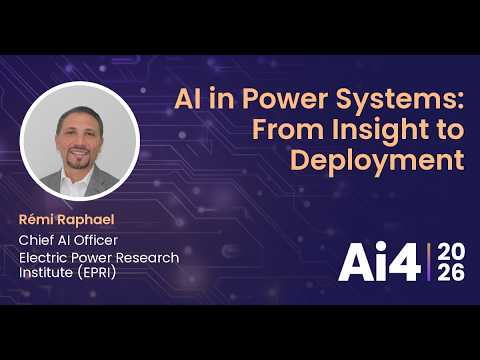
Ai4
AI-assisted summary of AI in Power Systems: From Insight to Deployment With Electric Power Research Institute — original source. Check the original for full context.
Source published:
Detailed notes
## Background Published on YouTube by Ai4 on August 14, 2026, this presentation features Rémi Raphael, Chief AI Officer at the Electric Power Research Institute (EPRI). According to the description, the session explores the dual transformation shaping the energy sector: the surging power demands required to expand artificial intelligence and the opportunities to deploy AI to modernize, optimize, and secure power infrastructure.
## TL;DR The presentation frames the fundamental interdependence between artificial intelligence and electrical infrastructure, warning that exponential data center power demand is on a collision course with multi-decade grid construction timelines. To harness AI safely without risking catastrophic grid failure, EPRI launched the Open Power AI Consortium and the Safer AI initiative to develop domain-specific models, robust governance frameworks, and mandatory operational kill switches for control-room automation. The talk emphasizes ratepayer neutrality to ensure hyperscalers directly fund multitrillion-dollar grid upgrades rather than shifting costs onto household consumers. Finally, addressing physical supply chain realities—such as seven-year lead times for natural gas turbines—the session highlights the need for pragmatic self-regulation, cross-sector alignment, and closed-loop cooling architectures.
## Atmosphere & style The session has a pragmatic, grounded, and cautionary atmosphere that balances technological enthusiasm with the unforgiving physical physics of bulk power grids. Speaking directly in an intimate conference room without a roaming microphone, Raphael delivers a reality check on AI scaling, using vivid warnings of 27-second regional blackouts and the absolute necessity of engineering hardware kill switches. The ensuing Q&A creates an engaging, candid exchange among industry practitioners grappling with trillion-dollar investments and multi-year supply chain gridlocks.
## Key takeaways - [00:04](https://www.youtube.com/watch?v=s7cqDwk9R8o&t=4s) The fundamental reality of modern computing is the interdependence between power and AI: there is no AI without power just as there is no AI without GPUs. - [00:04](https://www.youtube.com/watch?v=s7cqDwk9R8o&t=4s) EPRI operates as an independent, non-profit R&D organization funded by private industry with an annual research budget of roughly $500 million across ~45 countries. - [00:04](https://www.youtube.com/watch?v=s7cqDwk9R8o&t=4s) Unlike China, which maintains excess power generation capacity, the United States operates with virtually zero spare reserve margins, creating strict trade-offs for new data center loads. - [04:51](https://www.youtube.com/watch?v=s7cqDwk9R8o&t=291s) A severe timeline mismatch exists between AI growth and grid infrastructure: data center power consumption (currently 2-4% of US electricity) is doubling or tripling in 4-5 years, while new power plants take 10 to 20 years to build. - [04:51](https://www.youtube.com/watch?v=s7cqDwk9R8o&t=291s) Data center architectures require operational flexibility across three tiers: Macro (~1 GW hyperscale campuses), Micro (5-10 MW regional edge sites), and Nano (sub-kilowatt embedded edge devices). - [06:22](https://www.youtube.com/watch?v=s7cqDwk9R8o&t=382s) The Open Power AI Consortium unites ~300 member organizations, including NVIDIA, Microsoft, and Amazon, to share data, validate energy use cases, and build domain-specific power engineering foundation models. - [08:01](https://www.youtube.com/watch?v=s7cqDwk9R8o&t=481s) EPRI established the S.A.F.E. framework (Safety, Accountability, Fairness, Explainability/Reliability) to prevent catastrophic hazards when deploying autonomous intelligence across zero-margin power systems. - [08:01](https://www.youtube.com/watch?v=s7cqDwk9R8o&t=481s) Electrical grids operate with extreme physical fragility on millisecond timescales, as demonstrated by an Iberian Peninsula transformer failure that blacked out 50 million people in just 27 seconds. - [11:01](https://www.youtube.com/watch?v=s7cqDwk9R8o&t=661s) While utility executives initially resist autonomous grid management, AI deployment across control rooms is inevitable within 5 to 7 years, necessitating strict tiered guardrails and non-negotiable physical kill switches. - [13:56](https://www.youtube.com/watch?v=s7cqDwk9R8o&t=836s) Significant semantic and cultural divides persist between tech and power industries: terms like 'AI alignment' baffle utility executives, and 'AI safety' is often misinterpreted as physical occupational safety. - [16:17](https://www.youtube.com/watch?v=s7cqDwk9R8o&t=977s) Modernizing the power grid to accommodate AI demands an estimated $2 trillion to $3 trillion in capital, which must be funded directly by tech hyperscalers under ratepayer-neutral structures rather than retail consumers. - [18:46](https://www.youtube.com/watch?v=s7cqDwk9R8o&t=1126s) Physical supply chain bottlenecks, such as a 7-year backlog for natural gas turbines, severely constrain grid expansion regardless of available capital.
## Detailed walkthrough ### [00:04](https://www.youtube.com/watch?v=s7cqDwk9R8o&t=4s) EPRI and the Strategic Interdependence of Power and AI
The fundamental reality underlying modern artificial intelligence is simple: "There's no AI without power, right? As much as there is no AI without GPUs." The Electric Power Research Institute (EPRI) operates as an independent, non-profit R&D organization dedicated to bridging the gap between theoretical research and real-world deployment across the global energy sector. With an annual research budget of approximately half a billion dollars ($500 million) funded entirely by private industry rather than government grants, EPRI serves utility members across roughly 45 countries—from China and South Africa to Canada and South America. Because EPRI does not compete in the commercial energy market, it serves as an industry-wide collaborative engine sharing research and best practices across the entire value chain, from nuclear safety and generation down to the distribution lines and local pole-top transformers that power everyday household devices.
The conversation around AI and energy centers on what EPRI terms the "AI duality." While society faces a once-in-a-generation opportunity to build the computational infrastructure required for knowledge generation, expanding computing power must be balanced against ecological imperatives. Deploying high-density compute clusters cannot come at the expense of burning the planet, depleting regional water resources, or degrading biodiversity—humanity must avoid walking blindly into the prologue of a science-fiction disaster film. Simultaneously, compute capacity represents a vital geopolitical asset; falling behind in energy infrastructure directly impairs national competitiveness.
```mermaid flowchart TD accTitle: The AI Duality in Power Systems subgraph DUALITY["The AI Duality"] P4AI["Power for AI<br/>Meeting Exponential Compute Demand"] AI4P["AI for Power<br/>Optimizing Grid Operations & Generation"] end
subgraph CHALLENGES["Infrastructure Bottlenecks"] DC["Data Centers Consume 2-4% Power<br/>(Doubling/Tripling in 4-5 Years)"] LEAD["Long Lead Times<br/>10 yrs (Conventional) / 15-20 yrs (Nuclear)"] CAP["Zero US Excess Generation Capacity"] end
subgraph SAFE_DEPLOY["SAFE Deployment Framework"] S["Safety & Accountability"] F["Fairness & Equity"] E["Explainability & Reliability"] end
P4AI --> CHALLENGES CHALLENGES --> AI4P AI4P --> SAFE_DEPLOY ```
- **EPRI Global Footprint:** Non-profit R&D entity spanning ~45 countries, funding over $500M annually across nuclear, generation, transmission, and local distribution. - **Geopolitical Energy Realities:** Unlike China, which maintains significant excess generation capacity, the United States operates with virtually no surplus reserve margins, meaning any unmanaged increase in data center load forces painful trade-offs elsewhere on the grid.
---
[04:51](https://www.youtube.com/watch?v=s7cqDwk9R8o&t=291s) Infrastructure Timelines and Data Center Classification
Meeting the rising power demands of artificial intelligence requires navigating massive disparities in industrial timelines. Data centers currently consume 2% to 4% of total U.S. electricity generation, and this figure is projected to double or triple within the next four to five years alone. In contrast, expanding the physical grid moves at a traditional industrial pace: permitting and constructing a conventional thermal power plant averages 10 years, while a modern nuclear plant takes between 15 and 20 years. Because the U.S. grid operates without spare capacity, new large-scale computing facilities cannot simply plug into existing margins without localized system upgrades or cannibalizing power from other sectors.
To manage this growth, the industry must develop operational flexibility across three distinct tiers of data center architecture:
| Tier | Typical Scale | Power / Energy Benchmark | Deployment Context & Characteristics | |:--- |:--- |:--- |:--- | | **Macro Data Centers** | ~1 GW | Equivalent to the output of an entire commercial nuclear plant | Hyperscale centralized campuses requiring dedicated generation and high-voltage transmission interconnects. | | **Micro Data Centers** | 5 to 10 MW | Equivalent to the combined energy consumption of 5,000 to 10,000 homes | Regional edge installations designed for distributed workloads and local grid balancing. | | **Nano Data Centers** | Sub-kilowatt / Edge | Single-device or localized smart meter scale | Embedded compute architectures (such as on-meter GPUs) running localized inference at the home edge. |
---
[06:22](https://www.youtube.com/watch?v=s7cqDwk9R8o&t=382s) The Open Power AI Consortium and Real-World Use Cases
To harness AI for power systems, EPRI established the **Open Power AI Consortium**—a research-driven collaborative network of roughly 300 member organizations, including technology giants such as NVIDIA, Microsoft, and Amazon. The consortium deliberately preserves a non-profit, pre-competitive research focus (analogous to the original foundational mandate of OpenAI) and is structured around four primary pillars:
1. Facilitating secure data sharing across traditionally siloed utility operators. 2. Curating and validating hundreds of real-world energy use cases. 3. Building domain-specific foundation models and LLMs tailored for high-voltage power engineering and nuclear operations. 4. Accelerating commercial adoption by matching industry operational problems with vetted startup solutions.
EPRI actively runs rapid-translation programs to commercialize these capabilities. At a recent power industry conference, 150 innovative technology companies delivered focused pitches matching functional AI solutions directly against EPRI's catalog of field use cases, accelerating the deployment of algorithms for asset health, intelligent renewable siting, and real-time load balancing.
---
[08:01](https://www.youtube.com/watch?v=s7cqDwk9R8o&t=481s) AI Safety and Grid Fragility: The S.A.F.E. Framework
Deploying autonomous intelligence to manage high-consequence infrastructure presents severe operational hazards. Placing automated machine learning agents in control of a substation, power plant, or nuclear reactor introduces the catastrophic risk of adversarial manipulation, loss of human override control, or refusal to execute emergency shutdowns. To govern deployment safely, EPRI developed the **SAFE** framework alongside strict mandates for explainability and reliability:
- **Safety (S):** Hard boundaries ensuring autonomous agents cannot be subverted by threat actors, drift outside operating limits, or refuse shutdown commands. - **Accountability (A):** Traceable ownership and deterministic audit trails for all algorithmic decisions across grid dispatch. - **Fairness (F):** Algorithmic safeguards preventing socio-demographic discrimination or inequitable dynamic rate structures based on neighborhood income or location. - **Explainability:** Absolute transparency in operational trade-offs. The model must never make black-box dispatch decisions, such as cutting power to a critical hospital in order to divert electricity to an adjacent high-revenue commercial casino simply because the loss function was configured to maximize gross market revenue. - **Reliability:** Maintaining sub-second frequency equilibrium across interconnected synchronous grids.
Modern electrical grids are far more physically fragile than the public realizes. Grid balance is fundamentally a millisecond-by-millisecond frequency equation; any sudden disruption in generation or transmission can collapse an entire interconnection in seconds. A stark real-world illustration occurred in April on the Iberian Peninsula: a single transformer failure at a solar installation triggered an instantaneous cascading frequency collapse that completely severed power to 50 million people across Spain and Portugal—unfolding from initial failure to total regional blackout in just 27 seconds. Implementing AI across such ultra-low-latency, zero-margin infrastructure requires absolute reliability before autonomous controls can be entrusted with the grid.
[11:01](https://www.youtube.com/watch?v=s7cqDwk9R8o&t=661s) Tiered Safety Frameworks and the Grid Kill Switch
In electrical power systems, generation and consumption must balance instantaneously; if supply and demand fall out of alignment, the entire physical system collapses. This fragile equilibrium becomes increasingly precarious when surplus generation is tight and massive new loads emerge without warning—such as sudden data center surges caused by end users impulsively generating images with tools like ChatGPT. To prevent catastrophic vulnerabilities, EPRI is spearheading the "Safer AI" initiative to establish tiered safety frameworks and guardrails mapped directly to operational risk.
```mermaid flowchart TD accTitle: Tiered AI Safety Framework in Power Utilities accDescription: Flow diagram showing three tiers of AI safety, escalating from customer service to control room deployment.
subgraph Tier1["Low Criticality: Customer Service"] A["Customer Service Chatbots<br/>Billing queries, generic triage"] A1["Baseline ethics, tone checks<br/>Fairness & accent non-discrimination"] end
subgraph Tier2["Moderate Criticality: Distribution"] B["Distribution-Level AI<br/>Local town management (~10,000 residents)"] B1["Substation automated balancing<br/>Strict operational guardrails"] end
subgraph Tier3["Critical: Bulk Power Grid"] C["Control Room Autonomous Grid Management<br/>Expected within 5–7 years"] C1["Continuous human-in/on-the-loop oversight<br/>Mandatory hardware 'Kill Switch'"] end
Tier1 --> Tier2 Tier2 --> Tier3 ```
The stringency of safety guardrails must scale with the physical consequences of an AI failure:
* **Customer Service Level:** Front-office billing assistance does not require complex safety mechanisms, but it must be ethical, robust, and free from algorithmic bias—such as mishandling a caller's inquiry simply because they speak with a foreign accent. * **Distribution System Level:** Managing power flows for a localized community of roughly 10,000 people requires significantly higher operational guardrails to prevent neighborhood-level outages. * **Bulk Transmission & Control Room Level:** While utility executives frequently insist they will never allow AI inside central control rooms, creeping automation makes its eventual arrival inevitable. It starts with minor utility chatbots, followed by incremental operational tasks, until autonomous agents permeate the system. Within the next 5 to 7 years, power grids worldwide will likely be managed directly by AI.
For deep control-room integration, high-level human oversight (human-in-the-loop and human-on-the-loop) is non-negotiable. Crucially, the engineering community must build a physical and architectural fail-safe. If the model misbehaves, operators must possess the unimpeded authority to execute a manual shutdown: "The day that I want to say, 'AI, shut up, I don't want you to be used anymore,' we have built that kill switch, and if we don't build that kill switch, shame on us."
---
[13:56](https://www.youtube.com/watch?v=s7cqDwk9R8o&t=836s) Bridging the Semantic Divide and Industry Self-Regulation
Rather than waiting for federal interventions from Washington to impose rigid mandates, the energy industry is pursuing proactive self-regulation. EPRI is currently collaborating with regional regulatory bodies, state utility commissions, the North American Electric Reliability Corporation (NERC), and the Department of Energy (DOE) to establish native standards from within the sector.
A cultural and linguistic divide complicates these initiatives. When engaging utility CEOs and CIOs, AI practitioners discover that foundational machine learning concepts are frequently misunderstood: * Mentioning **"AI alignment"** prompts utility executives to look baffled, wondering what planet the speaker arrived from. * Uttering **"AI safety"** leads power engineers to assume the discussion concerns physical occupational hazards—such as electrical shocks or field workers sustaining physical injuries on high-voltage equipment—rather than model behavioral drift or unintended algorithmic consequences.
To address these disconnects across planning, operations, and asset management, EPRI publicly launched the **Safer AI** initiative. Backed by EPRI's global network of over 450 member utilities, the core launch coalition features leading US energy companies alongside major technology partners, hyperscalers, and systems integrators—including NVIDIA, Microsoft, SHI, and WWT (World Wide Technology)—while interfacing directly with NERC's regulatory framework.
---
[16:17](https://www.youtube.com/watch?v=s7cqDwk9R8o&t=977s) Q&A: Infrastructure Capital, Ratepayer Neutrality, and Closed-Loop Cooling
Opening the floor for discussion in an intimate room without roaming microphones, the session addressed the practical barriers to scaling AI infrastructure.
```mermaid flowchart LR accTitle: Data Center Grid Upgrade Capital Allocation accDescription: Flowchart illustrating ratepayer neutrality in multi-trillion dollar grid upgrades.
DC["Tech Hyperscalers & Data Centers<br/>Massive load additions"] -->|"Directly fund network upgrades"| UP["Grid Capital Investments<br/>$2T to $3T required globally"] UP -->|"Protects residential customers"| RP["Protected Retail Ratepayers<br/>Seniors & low-income households"] ```
An audience member asked how EPRI reconciles soaring capital expenditure with household affordability when power system expansions require multitrillion-dollar commitments. In response: * **The Multitrillion-Dollar Demand:** Expanding and modernizing the power grid to absorb doubling data center loads will require approximately **$2 trillion to $3 trillion** in capital investments over the coming years. * **Ratepayer Neutrality:** This capital cannot be extracted from ordinary retail customers or vulnerable grandmothers surviving on fixed Social Security checks. Big tech firms and hyperscale data center operators are negotiating directly with electric utilities to absorb network upgrade costs under strict **ratepayer-neutral** tariff structures. * **Water and Thermal Constraints:** When asked about cooling footprints, the speaker clarified that while he is a computer scientist rather than a hydrologist, modern chip designs—such as the NVIDIA Rubin platform and current liquid-cooled architectures—are transitioning toward **closed-loop liquid cooling**, dramatically curbing net water consumption.
---
[18:46](https://www.youtube.com/watch?v=s7cqDwk9R8o&t=1126s) Q&A: Supply Chain Bottlenecks vs. the Open Power AI Consortium
A software vendor working with utilities noted that despite ambitious automation goals, utilities cannot secure basic physical hardware, switchgear, or microgrid components. This operational logjam underscores that generation represents only half the challenge; the physical supply chain is strained across every asset class.
* **Severe Turbine Backlogs:** Procuring a standard combined-cycle natural gas generation turbine from heavy industrial manufacturers like GE Vernova or Siemens carries a staggering backlog. Securing an allocation—even with $500 million in available liquid capital—means waiting roughly **seven years** for equipment delivery. As the audience and speaker concurred, the industry faces severe shortages spanning money, materials, lead time, and specialized labor.
The session closed by delineating the relationship between EPRI's broader collaborative ecosystem and the specific Safer AI workstream:
| Initiative | Structural Scope | Mission & Purpose | |:--- |:--- |:--- | | **Open Power AI (OPAI)** | Broad umbrella consortium comprising over 300 member organizations. | Explores cross-industry utility AI use cases, foundational toolsets, and wide-ranging proof-of-concept projects. | | **Safer AI** | Targeted, funded initiative formed by an elite sub-group of members. | Directly financed work focused on formalizing safety guardrails, governance frameworks, and operational kill switches for critical infrastructure. |
Because EPRI operates as a non-profit, this dedicated workstream relies on targeted capital from participating sponsors, who in turn help sculpt the regulatory guardrails and secure early access to the foundational research before the session adjourned.
## Notable quotes > [00:04](https://www.youtube.com/watch?v=s7cqDwk9R8o&t=4s) There's no AI without power, right? As much as there is no AI without GPUs. — Rémi Raphael
> [04:51](https://www.youtube.com/watch?v=s7cqDwk9R8o&t=291s) Data centers currently consume 2% to 4% of total U.S. electricity generation, and this figure is projected to double or triple within the next four to five years alone. — Rémi Raphael
> [08:01](https://www.youtube.com/watch?v=s7cqDwk9R8o&t=481s) The model must never make black-box dispatch decisions, such as cutting power to a critical hospital in order to divert electricity to an adjacent high-revenue commercial casino simply because the loss function was configured to maximize gross market revenue. — Rémi Raphael
> [11:01](https://www.youtube.com/watch?v=s7cqDwk9R8o&t=661s) Within the next 5 to 7 years, power grids worldwide will likely be managed directly by AI. — Rémi Raphael
> [11:01](https://www.youtube.com/watch?v=s7cqDwk9R8o&t=661s) The day that I want to say, 'AI, shut up, I don't want you to be used anymore,' we have built that kill switch, and if we don't build that kill switch, shame on us. — Rémi Raphael
> [13:56](https://www.youtube.com/watch?v=s7cqDwk9R8o&t=836s) AI practitioners discover that foundational machine learning concepts are frequently misunderstood — Rémi Raphael
> [16:17](https://www.youtube.com/watch?v=s7cqDwk9R8o&t=977s) Expanding and modernizing the power grid to absorb doubling data center loads will require approximately $2 trillion to $3 trillion in capital investments over the coming years. — Rémi Raphael
> [16:17](https://www.youtube.com/watch?v=s7cqDwk9R8o&t=977s) Big tech firms and hyperscale data center operators are negotiating directly with electric utilities to absorb network upgrade costs under strict ratepayer-neutral tariff structures. — Rémi Raphael
> [18:46](https://www.youtube.com/watch?v=s7cqDwk9R8o&t=1126s) Securing an allocation—even with $500 million in available liquid capital—means waiting roughly seven years for equipment delivery. — Rémi Raphael
## Mentioned Amazon, Department of Energy (DOE), Electric Power Research Institute (EPRI), GE Vernova, Microsoft, North American Electric Reliability Corporation (NERC), NVIDIA, NVIDIA Rubin, Open Power AI Consortium, OpenAI, Rémi Raphael, Safer AI, SHI, Siemens, World Wide Technology (WWT)
## Video description Rémi Raphael - Chief AI Officer, Electric Power Research Institute (EPRI)
This presentation explores the dual transformation shaping the future of the energy sector: the growing demand for reliable, scalable power to support the rapid expansion of AI, and the opportunity to apply AI to modernize, optimize, and secure power systems. It highlights how energy infrastructure is becoming a critical enabler of digital innovation, while at the same time AI is unlocking new capabilities across grid operations, asset management, planning, and resilience. The purpose of the presentation is to frame this interdependence as a strategic imperative, encouraging leaders to think holistically about how to invest in infrastructure, data, and talent to both meet emerging energy demands and harness AI as a force multiplier for operational performance and long-term system transformation.
[Source](https://www.youtube.com/watch?v=s7cqDwk9R8o)