Nvidia-Backed Upscale Targets AI Fabric to Halt GPU Idle Time
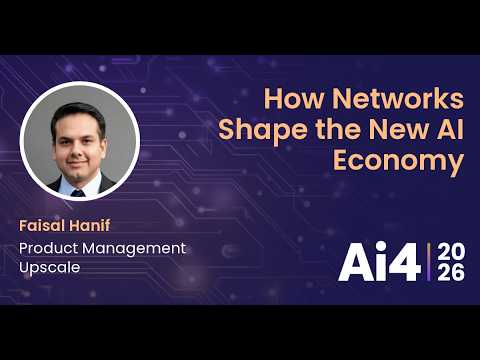
Ai4
Because frontier model sizes outpace semiconductor memory growth, fabric latency directly dictates GPU utilization and token economics, turning network architecture into the primary driver of AI profitability.
AI-assisted summary of How Networks Shape the New AI Economy With Upscale — original source. Check the original for full context.
Source published:
Detailed notes
## Background Published on YouTube by Ai4 on August 14, 2026, this session features Faisal Hanif from Product Management at Upscale discussing how networking defines the new AI economy. The presentation outlines why the transition of enterprise AI into production shifts the cost structure toward token unit economics, positioning network efficiency as the primary factor in tokens generated per dollar at scale.
## TL;DR As frontier AI models outgrow single-GPU memory capacities, networking has moved directly into the GPU execution cycle, turning communication latency into the primary bottleneck for compute utilization. Because synchronization patterns in data and expert parallelism mean a cluster is only as fast as its slowest link, network performance directly dictates key business metrics like tokens per second and tokens per watt. Upscale AI addresses these distributed computing challenges by integrating proprietary intra-node scale-up silicon with open, standards-based scale-out fabrics powered by NVIDIA Spectrum-X Ethernet. This unified, silicon-agnostic platform is architected to optimize heterogeneous AI workloads and prevent multi-million-dollar clusters from idling on stalled data transfers.
## Atmosphere & style The presentation carries a crisp, analytical, and authoritative tone structured for infrastructure engineers and enterprise leadership. Hanif delivers a measured, highly technical breakdown that moves methodically from the physical constraints of GPU high-bandwidth memory to top-line P&L balance sheets. The talk feels like an unvarnished masterclass in modern AI factory economics, emphasizing the hard physics of latency and interconnect bottlenecks over generic industry hype.
## Key takeaways - [00:04](https://www.youtube.com/watch?v=su1ZPDOd_fY&t=4s) Networking has shifted from background infrastructure plumbing to sitting directly within the GPU execution loop, making it the primary economic lever in modern AI systems. - [04:04](https://www.youtube.com/watch?v=su1ZPDOd_fY&t=244s) State-of-the-art frontier models (>1T parameters) vastly outpace single-GPU memory capacity (<300 GB HBM), making massively distributed cluster computing an inescapable baseline requirement. - [05:59](https://www.youtube.com/watch?v=su1ZPDOd_fY&t=359s) Maintaining the standard 400 ms conversational response window requires an inference decode loop that touches billions of parameters per token, where any network stall immediately halts compute execution. - [10:03](https://www.youtube.com/watch?v=su1ZPDOd_fY&t=603s) Distributed training and serving are tightly bound by Amdahl's Law and tail latency, meaning an entire cluster's execution speed is throttled to the pace of its slowest network link. - [10:03](https://www.youtube.com/watch?v=su1ZPDOd_fY&t=603s) Diverse workload architectures create distinct network bottlenecks, ranging from All-Reduce barrier synchronization in Data Parallelism to All-to-All bandwidth flooding in Mixture-of-Experts (MoE) models. - [14:24](https://www.youtube.com/watch?v=su1ZPDOd_fY&t=864s) Infrastructure metrics have shifted from traditional enterprise IT metrics like port count and uptime to direct business P&L KPIs: tokens per second, tokens per watt, and Model Flops Utilization (MFU). - [17:27](https://www.youtube.com/watch?v=su1ZPDOd_fY&t=1047s) The explosion of specialized heterogeneous accelerators (GPUs, LPUs, TPUs, and DPUs) demands open, unified fabric architectures to prevent costly hardware forklift upgrades as new ASICs emerge. - [02:29](https://www.youtube.com/watch?v=su1ZPDOd_fY&t=149s) Adopting open-standard frameworks such as the Ultra Ethernet Consortium (UEC) and SONiC is essential to prevent proprietary vendor lock-in across AI fabrics. - [20:30](https://www.youtube.com/watch?v=su1ZPDOd_fY&t=1230s) Upscale AI addresses fabric fragmentation by coupling custom intra-node scale-up silicon with open 800G Spectrum-X scale-out Ethernet managed under a unified software substrate.
## Detailed walkthrough ### [00:04](https://www.youtube.com/watch?v=su1ZPDOd_fY&t=4s) Networking as the AI Execution Loop
The AI industry is quietly learning the hard way that networking is no longer mere background plumbing. Instead, the network sits directly within the execution loop of every single GPU cycle. Every dollar invested in compute, every token generated, and every millisecond of latency traces back to how effectively the underlying fabric moves data between accelerators. Networking has emerged as the single largest economic lever in modern AI infrastructure, requiring a ground-up redesign rather than incremental adjustments to legacy data center switches.
Four primary shifts define this new landscape: AI workloads place fundamentally distinct demands on infrastructure compared to traditional enterprise computing; parallelism has become an inescapable physical requirement; the network dictates GPU execution cycles; and an explosion of heterogeneous silicon demands a unified, vendor-agnostic fabric.
```mermaid flowchart LR accTitle: Network within the GPU Execution Loop subgraph Compute["Compute & Memory"] A["GPU / Accelerator Cycles"] B["HBM / KV Cache"] end subgraph Network["Fabric Interconnect"] C["Scale-Up Interconnect\n(Intra-Node)"] D["Scale-Out Fabric\n(Spectrum-X / UEC)"] end subgraph Output["AI Economy KPIs"] E["Tokens per Second"] F["Tokens per Watt / Dollar"] end
A <--> C B <--> C C <--> D D --> E D --> F ```
[02:29](https://www.youtube.com/watch?v=su1ZPDOd_fY&t=149s) The Upscale AI Mission and Architecture
Founded in 2025 with a singular focus on purpose-built networking for AI infrastructure, Upscale AI approaches the challenge across both scale-up and scale-out domains. The goal is to support heterogeneous compute environments—encompassing GPUs, LPUs (Language Processing Units), XPUs, and DPUs—without locking customers into proprietary silos.
Upscale AI tackles scale-up interconnects using proprietary purpose-built silicon and systems for intra-node communication, while standardizing scale-out fabrics on NVIDIA Spectrum-X Ethernet. The company is backed by NVIDIA as an investor and leverages open standards such as SONiC and the Ultra Ethernet Consortium (UEC). With a team of over 275 engineers, Upscale AI delivers a full stack covering silicon, systems, software, orchestration, services, and support.
- Founded in 2025 with a 275+ person engineering team. - Architecture spans both intra-node scale-up silicon and scale-out Ethernet fabrics under a unified software layer. - Strategic partnership and investment from NVIDIA utilizing Spectrum-X technology. - Strict adherence to open standards (SONiC, UEC) to eliminate vendor lock-in.
[04:04](https://www.youtube.com/watch?v=su1ZPDOd_fY&t=244s) The Physics of Model Size and the 400ms Response
Modern AI infrastructure faces a rigid foundational constraint: state-of-the-art models simply do not fit into a single GPU. Frontier language models exceed one trillion parameters, while even flagship accelerators provide less than 300 GB of high-bandwidth memory (HBM). Because model sizes continue to expand much faster than semiconductor memory density—outpacing Moore's Law—distributing workloads across thousands of processors is the baseline starting condition for any serious AI deployment.
When a user interacts with a conversational interface like ChatGPT, receiving an answer within roughly 400 milliseconds feels instantaneous. However, that half-second window conceals billions of parameters across multi-layer models running on multi-million-dollar clusters coordinating in real time. The seamless user experience is the ultimate product, and network performance either guarantees or breaks that illusion.
[05:59](https://www.youtube.com/watch?v=su1ZPDOd_fY&t=359s) Anatomy of an Inference Request: Pre-Fill, Decode, and Workload Diversity
Deconstructing a typical 400 ms inference turn reveals the operational burden placed on the interconnect:
1. **Front-End Pipeline (10–15 ms):** API gateway ingress, load balancing, tokenization, and model routing consume roughly 5% of the total request time. 2. **Inference Engine (Remaining 95%):** - *Pre-fill Phase:* Ingests the full prompt context and constructs the Key-Value (KV) cache. - *Decode Phase:* Executes an iterative forward pass generating one token at a time across billions of parameters.
This decode process represents a hyper-sensitive loop of raw compute, high-bandwidth memory access, and fabric interconnects. If the network stalls during data exchange, the entire execution pipeline halts. Furthermore, modern infrastructure cannot be tuned for a single behavior; Large Language Models (LLMs), Mixture-of-Experts (MoE), diffusion architectures, and dense embedding models each place radically different bandwidth and communication demands on the same shared cluster.
- One token forward pass touches 175B+ parameters in fractions of a second. - Scaling to 10,000 concurrent users generates trillions of operations per second across a shared distributed fabric. - Inefficiencies in scheduling, routing, memory placement, or congestion translate directly into lost revenue for GPU-as-a-Service and neo-cloud providers.
[10:03](https://www.youtube.com/watch?v=su1ZPDOd_fY&t=603s) Parallelism Bottlenecks: Data, Expert, and Distributed Serving
Training a frontier model requires managing upwards of 25 terabytes of model state. Because a top-tier accelerator provides under 300 GB of capacity—addressing less than 1.4% of the requirement, leaving a massive 70%+ structural memory gap—parallel partitioning is unavoidable. Distributing workloads across thousands of chips forms a rigidly coupled system governed by Amdahl's Law and tail latency: the entire cluster moves only as fast as its slowest link.
```mermaid flowchart TD accTitle: Parallelism Communication Patterns subgraph DataParallel["Data Parallelism"] DP1["GPU 1..N"] -->|All-Reduce Synchronization| DP2["Global Barrier Wait"] end subgraph ExpertParallel["Mixture of Experts (MoE)"] EP1["GPU 1..N"] -->|All-to-All Token Exchange| EP2["Fabric Flooding / Cross-Traffic"] end subgraph InferenceServing["Distributed Serving"] IS1["Aggregator"] -->|Scatter-Gather| IS2["Worker GPUs"] IS2 -->|Tail Latency Bottleneck| IS1 end ```
- **Data Parallelism:** Imposes global `All-Reduce` synchronization barriers; if a single GPU or transceiver lags, all participating accelerators idle. - **Expert Parallelism (MoE):** Demands dense `All-to-All` communication matrices that saturate and flood cross-sectional network bandwidth. - **Distributed Inference Serving:** Employs scatter-gather patterns where a single delayed response link holds up token generation for the entire client session. - As workloads transition from memory-bound (fitting weights onto local chips) to communication-bound (exchanging states across nodes), the physical network boundary forms the hard performance ceiling.
[14:24](https://www.youtube.com/watch?v=su1ZPDOd_fY&t=864s) The AI Factory and the Shift to Business P&L
In an AI factory, GPUs, high-speed memory, storage, and networking operate in continuous synchronization to manufacture tokens. Inadequate synchronization directly suppresses tokens per second; sub-optimal routing introduces unpredictable latency spikes; and fabric congestion exacerbates tail-end stragglers, burning capital on idling compute hardware.
This architectural shift has fundamentally altered infrastructure Key Performance Indicators (KPIs). Traditional metrics like port density, uptime percentages, and packet counts have been supplanted by direct business metrics:
- **Time to First Token (TTFT) & Cluster Onboarding:** Taking 3 to 6 months to validate and deploy a new GPU cluster results in severe revenue loss during critical demand windows. - **Tokens per Second & Tokens per Watt:** The ultimate efficiency metrics for operational throughput and power economics. - **Effective GPU Utilization (MFU/HFU):** Mitigating idle time caused by communication wait states. - Infrastructure investments have officially migrated out of overhead IT budgets and straight into executive P&L statements.
[17:27](https://www.youtube.com/watch?v=su1ZPDOd_fY&t=1047s) Silicon Explosion and Unified Open Fabrics
Over a five-year trajectory, AI workload profiles have diversified dramatically. In 2023, infrastructure centered on dense pre-training workloads with predictable synchronization patterns across standard GPU/CPU nodes. By 2025, environments incorporated MoE architectures, disaggregated inference pipelines, LPUs, TPUs, and DPUs, culminating in persistent, always-on autonomous agents.
Because specialized accelerator silicon will continue multiplying, clusters cannot undergo full architectural redesigns or disruptive "forklift upgrades" whenever a new ASIC emerges. Networks must deliver open, multi-silicon interoperability across compute, memory, and storage fabrics.
```mermaid flowchart LR accTitle: Upscale AI Architectural Model subgraph HeterogeneousCompute["Heterogeneous Compute"] G["GPUs"] T["TPUs / XPUs"] L["LPUs / NPUs"] D["DPUs / Storage"] end subgraph UpscalePlatform["Upscale Unified Software Substrate"] SU["Scale-Up: Purpose-Built Silicon & Interconnects"] SO["Scale-Out: 64-Port 800G Spectrum-X Fabric"] end G & T & L & D <--> SU SU <--> SO ```
[20:30](https://www.youtube.com/watch?v=su1ZPDOd_fY&t=1230s) Upscale AI's Product Architecture and Core Tenets
Upscale AI resolves fabric fragmentation by coupling purpose-built intra-node scale-up interconnects with open scale-out systems under a single, unified software substrate. For scale-out deployments, Upscale delivers hardware such as a 64-port 800 Gbps switching platform powered by NVIDIA Spectrum-X Ethernet, incorporating hardware-accelerated load balancing, congestion-aware dynamic routing, and fine-grained telemetry specifically optimized for collective operations.
The Upscale AI architectural strategy is anchored on five core tenets: 1. **Full-Stack Ownership:** End-to-end integration across custom silicon, switching hardware, software stacks, orchestration tools, and enterprise services. 2. **Purpose-Built for AI:** Designed from scratch for high-throughput AI traffic patterns rather than repurposed from legacy enterprise or general cloud switches. 3. **Silicon-Agnostic Heterogeneity:** Native support across any mix of GPUs, XPUs, and LPUs without picking silicon winners. 4. **Open Standard Foundations:** Built upon Ethernet, Ultra Ethernet Consortium (UEC) frameworks, and SONiC to eliminate proprietary hardware lock-in. 5. **Unified Scale-Up and Scale-Out:** Consolidating intra-node and inter-node networking under one management and orchestration platform.
## Notable quotes > [00:04](https://www.youtube.com/watch?v=su1ZPDOd_fY&t=4s) networking is no longer mere background plumbing. Instead, the network sits directly within the execution loop of every single GPU cycle. — Faisal Hanif
> [00:04](https://www.youtube.com/watch?v=su1ZPDOd_fY&t=4s) Every dollar invested in compute, every token generated, and every millisecond of latency traces back to how effectively the underlying fabric moves data between accelerators. — Faisal Hanif
> [00:04](https://www.youtube.com/watch?v=su1ZPDOd_fY&t=4s) Networking has emerged as the single largest economic lever in modern AI infrastructure, requiring a ground-up redesign rather than incremental adjustments to legacy data center switches. — Faisal Hanif
> [04:04](https://www.youtube.com/watch?v=su1ZPDOd_fY&t=244s) state-of-the-art models simply do not fit into a single GPU. — Faisal Hanif
> [04:04](https://www.youtube.com/watch?v=su1ZPDOd_fY&t=244s) Because model sizes continue to expand much faster than semiconductor memory density—outpacing Moore's Law—distributing workloads across thousands of processors is the baseline starting condition for any serious AI deployment. — Faisal Hanif
> [05:59](https://www.youtube.com/watch?v=su1ZPDOd_fY&t=359s) If the network stalls during data exchange, the entire execution pipeline halts. — Faisal Hanif
> [10:03](https://www.youtube.com/watch?v=su1ZPDOd_fY&t=603s) Distributing workloads across thousands of chips forms a rigidly coupled system governed by Amdahl's Law and tail latency: the entire cluster moves only as fast as its slowest link. — Faisal Hanif
> [10:03](https://www.youtube.com/watch?v=su1ZPDOd_fY&t=603s) As workloads transition from memory-bound (fitting weights onto local chips) to communication-bound (exchanging states across nodes), the physical network boundary forms the hard performance ceiling. — Faisal Hanif
> [14:24](https://www.youtube.com/watch?v=su1ZPDOd_fY&t=864s) In an AI factory, GPUs, high-speed memory, storage, and networking operate in continuous synchronization to manufacture tokens. — Faisal Hanif
> [14:24](https://www.youtube.com/watch?v=su1ZPDOd_fY&t=864s) Traditional metrics like port density, uptime percentages, and packet counts have been supplanted by direct business metrics — Faisal Hanif
> [14:24](https://www.youtube.com/watch?v=su1ZPDOd_fY&t=864s) Infrastructure investments have officially migrated out of overhead IT budgets and straight into executive P&L statements. — Faisal Hanif
## Mentioned Faisal Hanif, Upscale AI, Ai4, NVIDIA, NVIDIA Spectrum-X, SONiC, Ultra Ethernet Consortium (UEC), ChatGPT, Moore's Law, Amdahl's Law
## Video description Faisal Hanif - Product Management, Upscale
Enterprise AI has moved past experimentation and into production, and the cost structure has fundamentally changed. Tokens are now the primary unit of AI value, and the network sits at the center of every decision around how many are produced, how fast, and at what cost. As inference workloads come to dominate AI spending, network efficiency directly determines tokens per dollar at scale. In this session, I will explore how organizations that architect for agentic workloads, disaggregated inference, and open fabric infrastructures today will be best positioned to compete in the AI economy of tomorrow.
[Source](https://www.youtube.com/watch?v=su1ZPDOd_fY)