StarCloud Plans 88,000 Orbital GPU Racks to Bypass Ground Power Grid
Ai4
Soaring terrestrial power grid delays and land restrictions will make space-based solar data centers cheaper and faster to deploy than ground facilities within years.
## Background
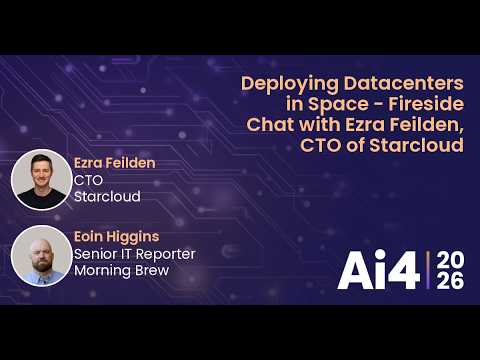
Published on YouTube by the Ai4 channel on August 21, 2026, this video features a fireside chat between Ezra Feilden, CTO of Starcloud, and Eoin Higgins, Senior IT Reporter at Morning Brew. The session explores the technical and economic case for deploying hyperscale AI datacenter infrastructure in orbit to bypass terrestrial power, thermal, and regulatory constraints.
## TL;DR
Ezra Feilden outlines Starcloud's vision to solve ground-based compute bottlenecks by launching modular, high-density AI data centers into low Earth orbit. The discussion covers how space provides virtually infinite real estate, direct solar energy, and radiative cooling, contrasting these advantages with terrestrial grid delays and public pushback. Feilden details key operational strategies, including fail-in-place GPU architectures, cost reductions enabled by reusable rockets like SpaceX's Starship, and Starcloud's filings for an 88,000-node constellation backed by a 100,000-square-foot mass manufacturing facility in Woodinville, Washington.
## Atmosphere & style
The conversation carries a pragmatic, forward-looking, and engineering-focused tone that grounds an ambitious concept in practical physical realities. Feilden speaks with calm authority as an industry insider, replacing speculative hype with clear discussion of thermodynamics, launch economics, and daily production rates. Higgins guides the chat with insightful journalistic curiosity, creating an engaging and balanced dynamic that makes orbital compute feel like an impending infrastructure shift rather than science fiction.
## Key takeaways
- [00:04](https://www.youtube.com/watch?v=cvmfj95Jpd0&t=4s) StarCloud was founded to solve Earth-bound compute bottlenecks by deploying large-scale AI data centers into low Earth orbit (LEO).
- [01:46](https://www.youtube.com/watch?v=cvmfj95Jpd0&t=106s) Terrestrial data centers face increasing political friction, municipal moratoriums, environmental resistance, and severe power grid delays.
- [01:46](https://www.youtube.com/watch?v=cvmfj95Jpd0&t=106s) Building compute infrastructure in space will become faster and cheaper than on Earth due to rapidly falling launch costs driven by reusable rockets like Starship.
- [03:32](https://www.youtube.com/watch?v=cvmfj95Jpd0&t=212s) Orbital data centers simplify infrastructure by using continuous solar power directly at the rack level, eliminating heavy ground-based transformers and HVAC units.
- [03:32](https://www.youtube.com/watch?v=cvmfj95Jpd0&t=212s) Thermal management relies on ultra-lightweight deployable radiators that radiate GPU waste heat into deep space via infrared emissions.
- [06:55](https://www.youtube.com/watch?v=cvmfj95Jpd0&t=415s) Orbital reliability is achieved through N+2 physical subsystem redundancy and a fail-in-place operational strategy that dynamically reroutes workloads around failing GPUs.
- [08:38](https://www.youtube.com/watch?v=cvmfj95Jpd0&t=518s) Custom lightweighting can reduce a standard 1-ton NVIDIA GPU rack down to roughly 300 kilograms for orbital launch efficiency.
- [11:09](https://www.youtube.com/watch?v=cvmfj95Jpd0&t=669s) StarCloud submitted regulatory filings for an 88,000-satellite constellation placed in dawn-dusk sun-synchronous orbits (SSO) for constant solar exposure.
- [12:44](https://www.youtube.com/watch?v=cvmfj95Jpd0&t=764s) While terrestrial solutions like subsea containers or nuclear power are being explored, space offers virtually infinite real estate and direct access to solar energy.
- [15:10](https://www.youtube.com/watch?v=cvmfj95Jpd0&t=910s) StarCloud keeps capital costs low by utilizing mass-produced terrestrial silicon solar cells costing approximately $0.05 per watt.
- [15:10](https://www.youtube.com/watch?v=cvmfj95Jpd0&t=910s) StarCloud launched its first satellite carrying an NVIDIA H100 GPU in November 2025, with a second test satellite prepared for immediate launch.
- [18:05](https://www.youtube.com/watch?v=cvmfj95Jpd0&t=1085s) To achieve daily satellite production, StarCloud established a 100,000-square-foot manufacturing plant in Woodinville, Washington.
## Detailed walkthrough
Answering the user's prompt by writing a detailed transcript walkthrough in Markdown format:
[00:04](https://www.youtube.com/watch?v=cvmfj95Jpd0&t=4s) Introduction and Background of StarCloud
The session opens with Senior IT Reporter Eoin Higgins introducing Ezra Feilden, co-founder and Chief Technology Officer of StarCloud. Feilden shares that before establishing StarCloud roughly two and a half years prior, he spent about a decade working in the space industry. He characterizes himself as fundamentally a "space guy" rather than an AI specialist, but highlights his excitement to speak at the conference about combining orbital operations with compute.
Founded alongside two co-founders, StarCloud aims to deploy large-scale AI data centers into low Earth orbit (LEO). Feilden explains that the project was created to overcome severe Earth-bound bottlenecks in scaling compute infrastructure. While building data centers in space was widely regarded as a "wacky idea" met with healthy skepticism back in 2024, the concept has seen rapid mainstream traction across the space sector over the prior six months. Feilden emphasizes that while orbital infrastructure sounds like science fiction, massive constellations of space-based data centers will become a reality and fundamentally transform the future scaling of AI infrastructure.
- **Speaker Background**: Ezra Feilden (CTO & Co-founder, StarCloud) has ~10 years of prior experience in the space industry.
- **Company History**: StarCloud was founded circa early 2024 (2.5 years prior to the chat).
---
[01:46](https://www.youtube.com/watch?v=cvmfj95Jpd0&t=106s) Terrestrial Obstacles vs. Orbital Scaling
Higgins highlights the intense political friction surrounding land-based data center development, noting local moratoriums such as those seen in Maine and New York. Feilden responds that municipal bans and public pushback against terrestrial data centers represent "just the beginning." He predicts that public anxiety surrounding AI will increasingly target physical data center structures, making ground-based development exponentially harder due to environmental, political, and federal regulatory headwinds.
Conversely, deploying hardware into space is becoming vastly cheaper and more accessible. Feilden points to SpaceX’s Starship heavy-lift launch system as a pivotal catalyst that will drastically increase orbital payload capacity while dropping transport costs. A critical inflection point is approaching where building infrastructure in space will cross over to become both faster and more economical than building on Earth.
```
TERRESTRIAL DATACENTERS ORBITAL DATACENTERS
----------------------- -------------------
[ Local Moratoriums & Bans ] [ Infinite Orbital Real Estate ]
[ Grid Interconnect Delays ] vs [ Near 24/7 Abundant Solar Power ]
[ Complex HVAC & Air Water ] [ Lightweight Radiator Cooling ]
[ High Land & Build Costs ] [ Mass-Produced Modular Nodes ]
```
- **Ground Challenges**: Public opposition, local moratoriums, environmental pushback, and lengthy power grid interconnect delays.
- **Space Advantages**: Rapid deployment avoiding terrestrial permits, unlimited spatial expansion, and access to constant solar energy.
---
[03:32](https://www.youtube.com/watch?v=cvmfj95Jpd0&t=212s) Architecture of a Space Data Center vs. Ground Facilities
Feilden contrasts the physical architecture of a terrestrial data center with an orbital facility. Ground data centers consist of large physical powered shells fed by high-voltage DC lines, complex transformer banks to step down voltages, thermally controlled server rooms, and massive HVAC units with cooling towers that dump waste heat into the atmosphere.
By contrast, an orbital data center replaces almost every component except for the server racks themselves:
Power is captured using large deployable silicon solar panels operating in continuous sunlight, supplying electricity directly to server racks without heavy transformer systems. Thermal management—the main engineering bottleneck—relies purely on radiative cooling since space lacks an atmosphere for convection. StarCloud's internal engineering team focuses heavily on developing ultra-lightweight, inexpensive radiator panels that circulate fluid coolant away from GPUs and radiate waste heat into deep space via infrared emissions. Connectivity relies on laser terminals (optical inter-satellite links) to route high-bandwidth data directly between orbital nodes and ground stations.
- **Thermal Technology**: Waste heat is moved from GPUs into coolant loops and emitted as infrared radiation through large deployable radiator surfaces.
- **Power Strategy**: Direct solar-to-rack power eliminates traditional high-voltage terrestrial transformer infrastructure.
- **Data Links**: Free-space optical lasers replace terrestrial fiber optics for high-speed routing.
---
[06:55](https://www.youtube.com/watch?v=cvmfj95Jpd0&t=415s) Maintenance, Redundancy, and Orbital Reliability
Addressing questions around maintaining 100% uptime in space without hands-on technician repairs, Feilden details a two-pronged reliability strategy:
1. **Subsystem Redundancy**: Critical infrastructure like fluid pumps, power routes, and cooling loops feature N+2 physical redundancy. This design ensures single-point mechanical failures cannot take down a satellite node over its expected 5- to 10-year lifespan.
2. **Fail-in-Place IT Operations**: Because individual GPUs or physical network cables cannot be swapped manually, the computing architecture operates on a fail-in-place strategy. When a GPU exhibits faults or fails completely, it is powered off remotely, and workloads are dynamically rerouted around the damaged chip to ensure a smooth, graceful degradation of compute capacity over time.
- **Node Lifespan**: Designed for 5 to 10 years of continuous operation in low Earth orbit.
- **System Tolerance**: N+2 redundancy for thermal and electrical hardware paired with dynamic workload rerouting across failing GPUs.
---
[08:38](https://www.youtube.com/watch?v=cvmfj95Jpd0&t=518s) Launch Logistics and Reusable Rockets
Feilden addresses the financial and logistical demands of lifting heavy compute infrastructure into orbit, positioning fully reusable vehicles like SpaceX's Starship, Blue Origin's rockets, and Stoke Space as foundational to StarCloud’s business model. Starship's capacity to lift over 100 metric tons per launch fundamentally changes launch economics.
While a standard NVIDIA NVL72 GB200 rack weighs approximately one ton, custom mass-optimization and lightweighting can strip a rack's weight down to roughly 300 kilograms. Combined with high-frequency, daily reusable launch cadences where rockets land, get caught by launch towers, and turn around rapidly, launch bottlenecks disappear.
- **Standard Rack Weight**: ~1 ton (e.g., NVIDIA GB200 NVL72).
- **Optimized Orbital Rack Weight**: Reduced down to ~300 kg per rack through custom structural modifications.
- **Payload Projection**: Reusable launch systems are expected to expand global orbital mass capabilities by up to 10,000x.
---
[11:09](https://www.youtube.com/watch?v=cvmfj95Jpd0&t=669s) Constellation Architecture: The 88,000-Node Filing
Feilden compares the operational reliability of orbital compute to SpaceX’s Starlink network. Rather than relying on isolated super-satellites, StarCloud's model deploys massive constellations containing tens or hundreds of thousands of rack-scale satellites functioning in tandem as a unified, distributed data center.
StarCloud recently submitted regulatory filings for an 88,000-satellite constellation placed in dawn-dusk sun-synchronous orbits (SSO). This orbital alignment keeps the satellite solar arrays in near-constant sunlight while enabling workload sharing across thousands of independent nodes, making the compute network resilient against individual satellite failures.
- **Constellation Scale**: Regulatory filing submitted for an 88,000-satellite orbital network.
- **Orbital Profile**: Dawn-dusk sun-synchronous orbit (SSO) to maximize continuous solar power exposure.
---
[12:44](https://www.youtube.com/watch?v=cvmfj95Jpd0&t=764s) Alternative Compute Solutions vs. Infinite Space
Discussing alternative experimental data center approaches—such as underwater containers (e.g., Atam Marine), floating facilities, remote solar-plus-storage setups, and terrestrial nuclear or fusion concepts—Feilden adopts an open "let a thousand flowers bloom" perspective. He stresses that exponentially skyrocketing AI energy demands require exploring every available option.
However, Feilden maintains that space remains uniquely scalable. Ground expansion inevitably faces physical limits where land and energy generation crowd out terrestrial environments. Space, by contrast, offers virtually infinite real estate and direct access to unattenuated solar radiation.
- **Terrestrial Alternatives**: Subsea containers, ocean barges, off-grid solar-battery installations, and dedicated nuclear reactors.
- **Core Distinction**: Space provides boundless expansion space and direct access to solar energy without land usage trade-offs.
---
[15:10](https://www.youtube.com/watch?v=cvmfj95Jpd0&t=910s) Ground Supply Chains and Hardware Milestones
When asked about technology transfer back to Earth, Feilden notes that StarCloud's infrared space radiators require the vacuum and deep-space thermal sink to operate, making thermal designs non-transferable to terrestrial environments. However, algorithms designed for fail-in-place management and distributed cluster routing could benefit ground infrastructure.
To keep capital costs low, StarCloud relies on mass-produced terrestrial silicon solar cells costing roughly $0.05 per watt, intentionally leveraging established terrestrial solar supply chains rather than expensive specialized aerospace arrays.
Feilden highlights StarCloud's rapid hardware delivery milestones:
- **First Satellite**: Launched in November 2025 carrying an NVIDIA H100—noted as the most powerful GPU sent into space to date.
- **Second Satellite**: Fully built and scheduled for launch within days of the chat.
- **Solar Cost Efficiency**: Utilizes standard terrestrial silicon solar cells at ~$0.05/watt.
- **Milestone Payloads**: First orbital testbed equipped with an NVIDIA H100 GPU launched November 2025; second test platform prepared for immediate deployment.
---
[18:05](https://www.youtube.com/watch?v=cvmfj95Jpd0&t=1085s) Mass Manufacturing in Woodinville
In contrast to hype-driven AI commentary, Feilden emphasizes that space data centers are fundamentally pragmatic physical infrastructure. Achieving necessary constellation scales requires transitioning from hand-crafted satellite builds to automotive-style assembly lines capable of pumping out multiple satellites per day.
To achieve these economies of scale, StarCloud is transitioning operations into a new 100,000-square-foot manufacturing facility located in Woodinville, Washington (just outside Seattle). This factory is specifically engineered for high-rate, standardized daily mass production of identical datacenter satellite units.
- **Facility Size**: 100,000 sq ft manufacturing plant in Woodinville, WA (Seattle metro area).
- **Production Target**: High-rate automotive-style mass production outputting multiple operational satellite nodes daily.
<ElicitationsGroup message="Explore related topics on orbital infrastructure and space-based computing:">
<Elicitation label="Explain thermal radiation mechanisms in space data centers" query="Explain the engineering principles and physics behind space-based radiator systems and thermal management for orbital data centers."/>
<Elicitation label="Compare StarCloud's orbital compute economics with ground data centers" query="Break down the cost comparison between terrestrial AI data centers and orbital space-based compute infrastructure."/>
</ElicitationsGroup>
## Notable quotes
> [01:04](https://www.youtube.com/watch?v=cvmfj95Jpd0&t=64s) wacky idea — Ezra Feilden
> [01:46](https://www.youtube.com/watch?v=cvmfj95Jpd0&t=106s) just the beginning — Ezra Feilden
> [12:44](https://www.youtube.com/watch?v=cvmfj95Jpd0&t=764s) let a thousand flowers bloom — Ezra Feilden
## Video description
Ezra Feilden - CTO, Starcloud
Eoin Higgins - Senior IT Reporter, Morning Brew
The next generation of hyperscale datacenters won't be built on land, but in orbit. In this fireside chat, Ezra Feilden makes the technical and economic case for deploying datacenter infrastructure in space, and why the shift may be closer than many think. Space offers a radically different set of tradeoffs in power, cooling, and scalability. Ezra will give a frank insight into the engineering challenges, launch considerations, and long-term vision behind orbital infrastructure. Join this session to understand how space-based datacenters will redefine the future of global compute.
StarCloud co-founder and CTO Ezra Feilden argues that deploying AI data centers into low Earth orbit will overcome growing terrestrial land, regulatory, and power bottlenecks as reusable rockets drastically reduce launch costs.
Terrestrial Constraints Driving Compute into Orbit (1:46)
Feilden states that terrestrial data center construction faces mounting obstacles, including municipal bans, local moratoriums in states like Maine and New York, environmental pushback, and lengthy grid interconnect delays. He forecasts that public anxiety surrounding AI will increasingly target physical facilities on Earth, making land-based development exponentially more difficult over time.
In contrast, Feilden views space as uniquely scalable, offering virtually limitless real estate and continuous solar radiation without the land-use trade-offs inherent to Earth. While acknowledging alternative concepts such as subsea pods, floating barges, and dedicated nuclear plants, he maintains that space-based infrastructure will cross an inflection point where it becomes both faster and cheaper to deploy than land-based facilities.
Orbital Hardware Architecture and Thermal Dissipation (3:32)
Orbital data center architecture strips away conventional building shells, HVAC units, cooling towers, and heavy transformer banks. Power is supplied directly from deployable solar arrays to server racks without voltage stepping systems. High-speed inter-node and ground connectivity is handled via free-space laser optical terminals rather than terrestrial fiber optics.
Because the vacuum of space lacks atmospheric convection, thermal control is the primary engineering bottleneck. StarCloud addresses this by circulating fluid coolant away from GPUs into lightweight radiator panels that emit waste heat into deep space as infrared radiation. To keep capital expenses down, the design pairs this specialized radiative cooling system with standard, mass-produced terrestrial silicon solar cells priced at roughly $0.05 per watt.
Uptime Strategies and Fail-in-Place IT (6:55)
Without physical access for technicians to replace components in orbit, StarCloud relies on a two-part reliability framework designed for a 5- to 10-year satellite operating lifespan. Critical mechanical and electrical infrastructure, including fluid coolant pumps and power lines, incorporates N+2 physical redundancy to eliminate single points of failure.
Compute hardware operates under a fail-in-place regime. Rather than replacing damaged GPUs or severed networking lines, the system powers off faulty chips remotely and dynamically reroutes workloads across remaining functional silicon, allowing computing capacity to degrade gracefully over the life of the node.
Launch Logistics, Constellations, and Factory Scale (8:38)
The economic viability of StarCloud's model depends on high-cadence, fully reusable heavy-lift launch vehicles such as SpaceX's Starship, Blue Origin platforms, and Stoke Space vehicles. Feilden notes that StarCloud lightweighted a standard one-ton NVIDIA NVL72 GB200 rack design down to roughly 300 kilograms for spaceflight, positioning it to take advantage of reusable launchers projected to expand global orbital lift capacity by up to 10,000 times.
To build operational resilience, StarCloud filed regulatory paperwork for an 88,000-satellite constellation operating in dawn-dusk sun-synchronous orbits, keeping arrays in near-constant sunlight. Operationally, the company launched its first test satellite carrying an NVIDIA H100 GPU in November 2025 and prepared a second for immediate launch. To supply this constellation, StarCloud is establishing a 100,000-square-foot factory in Woodinville, Washington, designed for automotive-style mass assembly producing multiple satellites daily.
StarCloud's vision depends entirely on the commercial delivery of ultra-low-cost, high-frequency heavy launch vehicles and the untested long-term durability of mass-produced commercial server hardware operating in radiation-heavy orbital environments.
[1:04] Ezra Feilden: wacky idea
[1:46] Ezra Feilden: just the beginning
[12:44] Ezra Feilden: let a thousand flowers bloom
Original transcript
[0:04] Well, thanks everybody uh for being here. Uh Ezra,
why don't we start with um can you just tell us a
[0:10] little bit about who you are and then we'll kind
of get to StarCloud from there. Yeah, for sure.
[0:15] Yeah, hi everyone. Uh nice to nice to be here. My
name is Ezra Fielden. I'm the co-founder and chief
[0:21] technology officer of a company called StarCloud.
Um before StarCloud, I was I've been in the space
[0:27] industry for about 10 years. I'm really a space
guy more than an AI guy. Um, but yeah, it's great
[0:33] to be here and talk to you. Great. So, let's
talk a little bit about what StarCloud is like
[0:39] like what it does and I think maybe like what you
guys are trying to do. For sure. So, [snorts] uh,
[0:48] I founded StarCloud with my two co-founders about
two and a half years ago to deploy AI data centers
[0:54] in space, specifically in in low Earth orbit. Um,
and the reason we are doing this is to solve for a
[1:03] number of the scaling issues and bottlenecks that
you see when deploying large scale data centers on
[1:09] Earth. Back in 2024 when we started this, it was
definitely a a wacky idea. Um, and we had our fair
[1:16] share of skepticism. Um, but it's been great,
especially in the last six months to see this
[1:21] idea really gain traction with a, you know, a huge
amount of support in the space industry now. And
[1:26] um it may sound sci-fi, but I assure you it's
going to happen. We are going to see huge
[1:32] constellations of space space data centers in in
Earth orbits and um and yeah, the it's going to be
[1:40] uh I believe really transformative to our
ability to scale AI infrastructure. Well,
[1:46] let's let's talk about that a little bit. Let's
dig into it a little bit. I mean, I think that
[1:51] data centers and uh data center infrastructure has
been kind of a hot topic recently, right? Like I
[1:58] live in Maine. We had a moratorum that was passed.
It was vetoed, but uh New York just had one. So,
[2:05] there is a lot of like I think I think kind of
political and I guess kind of populist rhetoric
[2:14] around that. And and I'm kind of curious like like
where you kind of see yourselves kind of being in
[2:21] in that space. For sure. Yeah. [snorts] I think
uh the problems that we're seeing the moratoriums
[2:28] and the outright um bans on uh data centers at
different in different county levels at state
[2:34] level. Um I think this is just the beginning. I
think the resistance to AI is only going to grow
[2:42] as people's anxieties about AI get attached to the
physical infrastructure that is the data centers.
[2:48] I strongly believe it's going to get harder and
harder to build data centers on the ground um
[2:52] for this reason and for for other reasons. Um and
you know in a few years time if we see a change of
[2:58] government we may see push back at federal level
as well. Meanwhile, in space, it's getting easier
[3:04] and easier to deploy hardware into space. SpaceX's
new Starship rocket is going to be a complete it's
[3:10] going to be a complete game changer for how how
much mass we can get into orbit and how cheaply
[3:14] it can be done. Um, so it's getting easier to
deploy things in space and it's getting harder
[3:19] to deploy things on the ground and there's a point
at which those two lines cross over and it becomes
[3:25] not only faster but more economical to to be
building large scale AI infrastructure in space.
[3:32] You know, I I I I think that part of the question
is probably that data centers on the ground have
[3:41] a lot of challenges. Um, how do you h how do
you see kind of putting them in space kind of
[3:47] solving those? For sure. Um, I think maybe it'
be helpful to start with um comparing what a
[3:56] terrestrial data center looks like compared to a
space data center. So on the ground, a terrestrial
[4:01] data center for those who are not uh not familiar
will look like a large building. Um uh a shell,
[4:08] what's known as a powered shell. There'll be
high voltage DC power coming in, a large bank of
[4:14] transformers that step that voltage down to a um
a voltage that the chips can use and and condition
[4:21] that power. There'll be the racks themselves in a
in a thermally controlled environment. Um and then
[4:27] there'll be the cooling system which is a very
large essentially a very large HVAC system. Um and
[4:34] on the end of that HVAC system there's a cooling
tower which dumps the waste heat from the uh from
[4:40] this the infrastructure into the atmosphere. Now
in space almost all of that looks different except
[4:46] for the racks. So instead of um high voltage DC
coming in we have very large deployable solar
[4:53] panels. Those solar panels are positioned in the
spacecraft is positioned in in a way that means
[4:58] it's uh in sunlight nearly 24/7. Um and that
greatly simplifies your power infrastructure.
[5:04] You have solar panels going essentially directly
into the to rack level. Uh no um banks of high
[5:10] voltage transformers. On the cooling side, this is
kind of the interesting one that people get ask a
[5:17] lot of questions about. Um so rather we we don't
have the atmosphere to dump our waste heat into.
[5:22] Um so that means the only way to get rid of waste
heat in space is through infrared radiation. The
[5:28] way this works is we circulate coolant through
the racks. They that coolant picks up the heat
[5:34] from the GPUs and distributes that heat out to
a very large deployed surface um which um which
[5:42] emits infrared radiation called a radiator. So the
the radiator is is one of the core core pieces of
[5:50] uh of technology which is going to enable AI data
centers and that's what StarCloud is about half
[5:55] of our team is working on lightweight cheap
radiators. Um but the physics of it is is is
[6:01] fairly straightforward. You just need to get that
radiator hot and then it will emit infrared. Um
[6:06] but the the engineering behind that and deploying
the these large surface areas is the is the the
[6:12] really interesting technical challenge. So that's
what a that's what the a space data center will
[6:18] look like. Very large solar panels, racks in the
center, and then large radiators to get rid of
[6:23] waste heat. And then for connectivity in space,
you you don't have a a fiber optic connectivity
[6:30] in space, obviously. Um so rather than fiber,
you use um optical interatellite links,
[6:36] which is essentially fiber optic, but without the
fiber. So you have a laser terminal which points
[6:41] at the nearest available uh node um either on the
ground or in space that can route traffic uh and
[6:48] can provide very high bandwidth connectivity in
space uh to almost anywhere on on earth. You know
[6:55] I've been talking with people over like the last
24 to 36 hours here who are really interested in
[7:02] orbital data centers and I think the possibility
here. But one thing they bring up to me a lot that
[7:08] that I wanted to ask you about is, you know,
how do you service it, right? Because because
[7:13] you want to have 100% uptime, right? But it's in
space. So, so I'm curious like like how how you
[7:18] solve that problem. Yeah, it's a great question.
The there's two parts to it. So, first of all,
[7:25] any of the critical subsystems, namely power and
cooling, you need to bring sufficient redundancy.
[7:33] You can't have a single failure in a pump take
down the entire node, for example. Um likewise
[7:38] for the power system, you can't have a single
um connection or a single element of the of the
[7:43] power system take out the entire satellite. So
you have generally N plus2 redundancy on the the
[7:51] power and thermal systems. Um so you have failure
tolerance there that gives you confidence a high
[7:57] level of confidence that you can um offer this
service for the lifetime of the mission which
[8:02] is usually between 5 and 10 years. So that's
the first piece and the second piece is the IT
[8:08] hardware itself. Um so we don't have the ability
to swap out GPUs or unplug and replplug network
[8:16] uh any network connections. Um and so we the
strategy then strategy there needs to be fail in
[8:24] place and so we have if if an individual GPU fails
then we switch it off we reroute the workloads
[8:31] dynamically around failed or suspect GPUs um and
thus we have a graceful degradation of performance
[8:38] over the mission lifetime. You know, the second
thing that I've heard from people is kind of like
[8:44] the like questions about the infrastructure, like
how you're going to get all of it up there. Um,
[8:52] you know, these are large pieces of hardware that
you have to get into orbit and and and I guess
[8:59] I'm kind of curious like like how you solve for
that problem both um infrastructurally and also
[9:05] uh financially like like these are expensive
things to do, right? Yeah. Yeah. So on the on
[9:10] the first piece uh launch um so Starship really
we're building StarCloud around the capability
[9:19] that Starship is bringing. There are some other
reusable launch vehicles which are on the cards. A
[9:24] company called Stoke Space for example um and a uh
Blue Origin is also developing a reusable rocket.
[9:31] Um but Starship is really center stage and
Starship can deliver over a 100 tons to orbit per
[9:38] per launch. Um a rack you say an NVL72 GB200 rack
weighs around one ton. If you strip out the if
[9:47] you do perform some mass optimization um and swap
out um you know some of the heavier components for
[9:55] um some lightweighted versions, you can get that
rack down to say 300 kg. So in terms of racks,
[10:02] you can launch a lot of racks per per Starship
launch. And Starship is going to be launching
[10:08] multiple times per day. Um it's truly going to
be a game changer. Um it's possibly 10 going to
[10:16] increase our ability to put mass into orbit
by a factor of 10,000. Um and that's because
[10:21] it's fully reusable. Uh and similar to a plane,
it's it launches payloads into space, it lands,
[10:28] is caught by the launch tower and then uh refuels
and can launch again later that day. Um which is
[10:34] a completely different paradigm to rockets today.
So you're kind of expecting like kind of a daily
[10:40] launch, a daily cadence. Yeah. Um, and this is
this is really important that we're not waiting
[10:46] around for months on end. Um, as one of the the
the the core advantages of space data centers
[10:53] is that we can deploy quickly. We're not waiting
around for permits as you would be on the ground.
[10:58] We're not um battling local opposition. We're not
waiting for a grid interconnect. And so yeah, the
[11:05] one of the key differentiators is we can deploy
quickly. And that's why frequent launch is going
[11:09] to be the game changer there. Now, what about lag
time? You know, like I mean obviously you want to
[11:14] be up 100% of the time, but also like you know the
the I I guess I'm just kind of curious like like
[11:22] how you kind of manage that. I mean obviously
we have satellites so the technology is there
[11:27] but I'm I'm just kind of curious like how you kind
of solve for any possible problems on that side.
[11:32] Yeah, I think um [snorts] Starlink is a is a
good example of how reliable a service can be
[11:40] um when you have a a proliferated constellation
of satellites. Um and that's really one of the
[11:47] key pieces is we're not just talking about a
single satellite here. We're talking about a
[11:51] constellation of tens of thousands if not hundreds
of thousands of rack scale satellites that work
[11:57] together to form a distributed data center. Um
and that gives you that that vastly increases your
[12:05] reliability rather than having a single a single
node where lots of things can happen. Um when
[12:12] you have when you can share a workload across a
large number of relatively independently operating
[12:18] nodes that gives you enormous increases in in
reliability and that's one of the reasons why we
[12:23] chose the the constellation architecture that we
did. Um so for example, StarCloud filed recently
[12:29] for um a constellation of 88,000 satellites in um
our particular orbits which is called a dawn dusk
[12:37] sun-synchronous orbit. Um so one of the reasons
for that's that such a high number is is uh this
[12:43] distributed reliability increase that you get.
you know, uh, during our conversation before this,
[12:50] um, we were talking about other possible data
center solutions, right? Like underwater or,
[12:58] you know, like like renewable energy, putting them
out in the middle of nowhere. You said something
[13:04] that I found really interesting where you kind of
like let let a thousand flowers bloom essentially
[13:08] like like, you know, kind of like like whatever
it is. as someone who is, you know, trying to
[13:17] push the conversation forward in in a way that's
maybe a little like orbital data centers is is is
[13:23] a kind of, you know, like like like you're doing
something that's that's not I think the normal
[13:32] solution to this. And so, so, so I'm curious
like how you feel about like that about all these
[13:36] different solutions and if you think that they're
kind of, you know, just just a larger web or if
[13:42] you feel like orbital is really the way to go or
if it's just kind of like we're just trying to I'm
[13:46] just kind of curious like like your take on that.
Yeah, I think um the the energy demand for AI is
[13:53] going to be is going to increase so exponentially
we need to throw everything we have at it.
[13:58] Um so I'm I'm hugely supportive of underwater
data centers, floating data centers. I know um
[14:04] Atam [snorts] Marine is in the room somewhere here
um who he's working on that. Um solar plus storage
[14:11] in remote locations. That's great. That that faces
some some similar similar challenges to space data
[14:17] centers actually when when you make things that
remote. Um nuclear absolutely fusion. Um yeah,
[14:24] I think uh we need to throw everything we have
at it. But the reason why I'm so bullish on space
[14:29] versus all of these other options is um I see it
as the truly scalable solution here. If you keep
[14:37] on scaling out AI infrastructure on the ground,
you're going to at some point you will reach
[14:41] um you we will reach a point where we've just
paved the the earth in data centers and and energy
[14:46] projects to to feed them. Um space is as far as
we know infinite and the sun is the the source of
[14:56] almost all energy that uh that lands on earth. Um
so by placing data centers in in somewhere where
[15:02] real estate is is free and and energy is abundant
um and uh and truly scalable um that's that's why
[15:10] I I'm so bullish on on space. Do you have some
hopes maybe that um any kind of technological
[15:17] innovation that you have especially as far as
like energy might be transferable to other data
[15:23] centers or even other parts of techstack. Um so
our radiators don't work on the ground. Um they
[15:33] they need deep space to to be able to dump their
their their waste heat somewhere. Um they they
[15:39] don't work in an atmosphere. Um so what we're
what we're doing on thermal management is uh
[15:44] is not applicable directly to the ground. It is
applicable to any high energy application that you
[15:49] have in space. So there are some very interesting
examples there um which we don't need to get into.
[15:56] Um what we're doing on power likewise is um we're
doing nothing too special on the solar arrays by
[16:03] by design. We're using silicon solar cells which
are you know 5 cents per watts um mass-produced.
[16:10] Um you know we've been very intentional to tie
oursel to the solar the terrestrial solar supply
[16:14] chain. Um I think where some where our technology
could be interesting to the ground is the way we
[16:22] um handle failures um and manage um distributed
clusters. We just have a few minutes here,
[16:30] but I wanted to kind of zoom out a little bit and
get maybe a little more philosophical, which is
[16:34] like not only about orbital data centers and not
only about data centers entirely, but the way that
[16:43] you're talking about this stuff is, I think, kind
of more logical and less hypy, right? Then yeah,
[16:52] then we hear a lot about like when people are
talking about AI and talking about data centers
[16:55] and and and I'm curious like how you feel about
that and kind of like how we talk about AI and
[17:02] how we talk about data centers and infrastructure
in general. Yeah, I think by kind of by its nature
[17:08] infrastructure is not the most hypy topic and and
space data centers ultimately are infrastructure.
[17:14] I think they're very cool infrastructure, but
at their heart um it's a it's a slightly drier
[17:21] topic than the applications of AI, I think,
which helps keep us keeps us grounded. Um and
[17:28] then I think just the fact that we are heads down
delivering satellites and really battling all all
[17:35] the problems and discovering all new all new
kinds of challenges um dayto-day. I think that
[17:41] also keeps us pretty grounded. So, you know, I
uh we're about to deliver our second satellite
[17:47] um um in in in a few days. We have delivered
our first satellite already, which has a H100
[17:53] on board. Um so that was that was launched in
November last year. Most powerful GPU that's
[17:58] ever been sent to space by a long way. Um and uh
yeah, I think being being close to the hardware,
[18:05] it's uh it keeps you pretty humble. Um, yeah.
You know, you say you have one out there,
[18:11] you're about to put up your second one, but a
constellation is is is a lot more. How are you
[18:17] going to kind of scale up to that? And I we only
have about a minute and a half, but I'm just kind
[18:20] of curious like there. Yeah. So, um, we need to
be building these satellites as as quickly as we
[18:27] build cars, you know. So, car production lines are
producing hundreds of thousands, if not millions,
[18:32] um, per per year. And we're designing our
satellites um in the end state to be stamped
[18:38] out like like a car is um and and mass-produced
where you can really start to capture economies
[18:43] of scale versus terrestrial data centers which
are often these kind of one-off projects where
[18:48] you have unique challenges each time. I think one
yeah one of the one of the besides time to time
[18:55] time to to to deployment one of the key advantages
of space data centers is you have economies of
[19:00] scale when you're producing so many of identical
satellites um so to do that um we are just about
[19:07] to move into a very large manufacturing facility
um up in Woodenville um just outside of Seattle
[19:14] um 100,000 square ft and designed to produce
multiple satellites per day. Excellent. Well, we
[19:20] only have about 30 seconds left, but I just want
to give you the opportunity if there's anything
[19:23] you wanted to add. No, I think uh I think you did
a great job. You covered tons of tons of good good
[19:30] ground. So, thank you. Well, thanks everybody for
coming out. We really appreciate it. [applause]