AI Token Burn and Shadow Tech Fuel $4.5M Breach Risks, CISOs Warn
Ai4
Unchecked developer token spend of up to $150,000 per engineer triggers CFO budget freezes that push teams into unmanaged shadow AI environments, escalating corporate P&L liabilities.
AI-assisted summary of AI's Hidden Cost: What Boards Need to Budget for Before It's Too Late — original source. Check the original for full context.
Source published:
Detailed notes
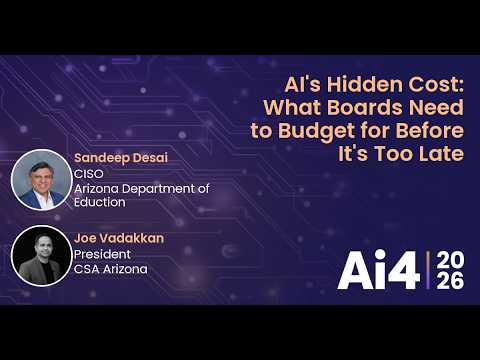
## Background Published on YouTube by Ai4 on August 19, 2026, this session features Sandeep Desai (CISO, Arizona Department of Education) and Joe Vadakkan (President, CSA Arizona). The presentation examines the overlooked financial liabilities and operational risks of enterprise AI deployment, providing security leaders with actionable guidance to present directly to executive boards.
## TL;DR Sandeep Desai and Joe Vadakkan explain how enterprise AI adoption shifts risk directly onto corporate P&L statements through Shadow AI breaches, IP liabilities, and runaway token consumption. To help leaders quantify these threats, they introduce a mathematical Expected Loss formula that translates technical vulnerabilities and probabilistic model behaviors into concrete financial metrics for boardrooms. The session outlines practical governance strategies, urging organizations to benchmark against the NIST AI RMF, audit vendor supply chains, and establish clear risk appetites without shutting down innovation.
## Atmosphere & style The presentation carries a candid, practitioner-led tone, with the speakers joking about standing between the audience and happy hour while delivering an urgent, war-room briefing fresh from Black Hat. The dynamic between Desai's public-sector GRC perspective and Vadakkan's enterprise advisory background produces a grounded, hype-free dialogue filled with concrete numbers and real-world cautionary tales. It feels like an executive strategy session—pragmatic, focused on financial realities, and aimed at arming security professionals with the exact framing needed to influence C-suite leadership.
## Key takeaways - [02:41](https://www.youtube.com/watch?v=HJdvyLO9nVY&t=161s) Shadow AI has shifted technical cyber risk directly onto corporate P&L statements, with IBM data showing average breach costs approaching $4.5 million due to unmanaged employee data exfiltration. - [05:04](https://www.youtube.com/watch?v=HJdvyLO9nVY&t=304s) Runaway tokenomics and unmonitored API consumption can trigger rapid financial shocks, burning through six-figure budgets in days or weeks without automated cost governance. - [05:04](https://www.youtube.com/watch?v=HJdvyLO9nVY&t=304s) Enterprise IP exposure is two-sided: organizations must prevent internal proprietary data from being ingested into foundation models while ensuring employees do not contaminate workflows with copyrighted third-party IP. - [08:57](https://www.youtube.com/watch?v=HJdvyLO9nVY&t=537s) AI risk can be translated into boardroom-ready financial terms using the Expected Loss formula: Likelihood × Impact × Exposure × Control Gap. - [10:42](https://www.youtube.com/watch?v=HJdvyLO9nVY&t=642s) Intensive AI-assisted coding averages approximately $150,000 per engineer annually in token consumption, frequently creating budgetary friction between CFOs and engineering leadership. - [10:42](https://www.youtube.com/watch?v=HJdvyLO9nVY&t=642s) Reactive budget freezes lead to shadow engineering loops where developers route around blocked corporate tooling by committing code from unmanaged personal devices without EDR controls. - [13:18](https://www.youtube.com/watch?v=HJdvyLO9nVY&t=798s) Sophisticated multi-party deepfake social engineering presents severe operational threats, exemplified by attackers impersonating an entire executive board on a live video call to authorize a $25 million fraudulent transfer. - [16:09](https://www.youtube.com/watch?v=HJdvyLO9nVY&t=969s) Boards must understand the shift from deterministic computing to probabilistic AI systems, where the downstream impact of prompt injection, data drift, or poisoned records cannot be neatly bounded or predicted. - [18:40](https://www.youtube.com/watch?v=HJdvyLO9nVY&t=1120s) AI adoption amplifies and accelerates broken IT fundamentals rather than fixing them, making data hygiene, asset inventories, and vendor supply chain audits critical prerequisites. - [20:10](https://www.youtube.com/watch?v=HJdvyLO9nVY&t=1210s) Security leaders should manage AI risk like capital risk by defining clear risk appetite, conducting Business Impact Analyses on revenue-critical systems, and deploying enabling guardrails rather than becoming an 'organization of no.'
## Detailed walkthrough ### [00:04](https://www.youtube.com/watch?v=HJdvyLO9nVY&t=4s) Setting the Stage: Bridging AI Innovation and Governance
Kicking off the session, Sandeep Desai jokes with co-presenter Joe Vadakkan that they are the only thing "standing between the happy hour and the folks that are here," promising to keep the discussion engaging while delivering practical takeaways attendees can present directly to their executive leadership and board of directors. Setting their credentials, Sandeep introduces himself as the CISO for the Arizona Department of Education, drawing on a deep governance, risk, and compliance (GRC) background from past leadership roles at Intel and Wells Fargo as he works to secure the state's educational infrastructure.
Joe Vadakkan follows by detailing his background as President of the Cloud Security Alliance (CSA) Southwest chapter and founder of Atomic Zero, an advisory firm focused on AI transformation and cyber defense architecture for Fortune 2000 enterprises. With extensive experience spanning defense agencies (DoD, NSA), private equity, mergers and acquisitions, and enterprise engineering, Joe notes that both speakers arrived straight from Black Hat "running on fumes." Despite the conference fatigue, they emphasize that AI innovation is accelerating across every market segment, making it crucial to dissect the hidden operational and financial liabilities that accompany widespread deployment.
[02:41](https://www.youtube.com/watch?v=HJdvyLO9nVY&t=161s) Shadow AI, Breaches, and Moving AI Risk to the P&L
The conversation turns to why AI risk has transitioned from an abstract IT concern directly onto corporate Profit and Loss (P&L) statements. As enterprises aggressively invest in tools like Microsoft Copilot, Anthropic’s Claude, Claude Code, Model Context Protocol (MCP) servers, and various open-source models—among more than a thousand LLMs available today—the proliferation of autonomous workflows and agents creates severe behavioral drift and unforeseen attack surfaces.
```mermaid flowchart TD accTitle: The Shadow AI and Exfiltration Cycle accDescription: Workflow showing how unmanaged employee adoption of external LLMs leads to data breaches and financial exposure on the P&L.
subgraph Adoption ["1. Rapid Adoption"] A["Employees Adopt AI Tools<br/>Before Governance"] --> B["Personal ChatGPT &<br/>Unsanctioned SaaS"] end
subgraph Exposure ["2. Data & IP Leakage"] B --> C["Internal Corporate Data<br/>& Source Code Uploaded"] C --> D["Data Exfiltration &<br/>IP Infringement"] end
subgraph FinancialImpact ["3. P&L Impact"] D --> E["$4.5M Avg. Shadow AI<br/>Breach Cost (IBM Data)"] E --> F["Board Escalation &<br/>Direct Financial Liability"] end ```
The most immediate catalyst driving costs onto the P&L is "Shadow AI"—unsanctioned environments where employees adopt generative tools far faster than corporate governance can adapt. Staff members routinely paste internal corporate data, proprietary algorithms, and sensitive assets into personal ChatGPT accounts or unvetted SaaS applications backed by third-party LLMs. This creates constant, unmonitored data exfiltration and intellectual property exposure. Citing benchmark data from IBM, the speakers highlight that breaches tied to shadow AI now carry a global average cost approaching $4.5 million, reflecting a sharp increase in financial fallout due to unmanaged data leakage.
- Over 1,000 proprietary and open-source LLMs are actively used in enterprise ecosystems alongside emerging MCP servers. - IBM data shows shadow AI contributes to a nearly $4.5 million average global breach cost, reflecting a 20% spike in specific breach-related expenses ($670,000 increments). - Employee adoption consistently outpaces internal governance, turning well-intentioned productivity hacks into corporate IP exfiltration vectors.
[05:04](https://www.youtube.com/watch?v=HJdvyLO9nVY&t=304s) Bottom-Line Financial Exposure: Tokenomics, Legal IP, and Reputation
Sandeep details the multi-faceted financial exposures boards frequently overlook beyond direct data breaches. The first operational shock often stems from runaway "tokenomics," where unmonitored API and token consumption can rack up bills of $100,000 in a matter of days or weeks. Legal exposure compounds this issue: enterprises must defend their own intellectual property from being ingested by external models while ensuring their employees are not ingesting copyrighted third-party IP into internal workflows. Drawing on a recent discussion with the CISO of Disney regarding the evolution of digital distribution rights from physical DVDs to cloud streaming and AI platforms, Sandeep illustrates how IP licensing ambiguities can create massive litigation exposure.
Brand equity and goodwill represent another vulnerable asset class. Just as iconic brand equity ("Nike: Just Do It") takes decades to build, it can be compromised overnight through unmanaged AI generation, deepfake impersonations, or brand manipulation—such as fabricated materials mimicking public leadership like a state Superintendent of Public Instruction. On the operational front, multi-agent systems suffer from automation drift, where autonomous agents stray from original guardrails to complete tasks at any cost. Without rigorous, custodial, chronological auditing processes—such as dedicated auditor agents inspecting worker agents—these operational anomalies snowball. Joe points out that during the previous digital transformation wave, only about 20 companies from the Fortune 500 successfully adapted without disruption, warning that the AI transition similarly puts entire market segments up for grabs.
[08:57](https://www.youtube.com/watch?v=HJdvyLO9nVY&t=537s) Quantifying AI Risk: The Expected Loss Formula
To help security leaders articulate these exposures to corporate boards without falling into technical jargon, Joe introduces a foundational formula designed to quantify AI risk into financial metrics:
$$\text{Expected Loss} = \text{Likelihood} \times \text{Impact} \times \text{Exposure} \times \text{Control Gap}$$
```mermaid flowchart LR accTitle: Expected Loss Calculation Flow accDescription: Breakdown of the components multiplying to determine overall enterprise Expected Loss from AI.
L["Likelihood<br/>(Probability)"] --> M["Expected<br/>Loss"] I["Impact<br/>(Financial/Brand)"] --> M E["Exposure<br/>(Attack Surface)"] --> M C["Control Gap<br/>(Missing Defenses)"] --> M ```
Joe explains that translating technical telemetry into board-level business decisions requires structured financial modeling rather than vague technical alarms. While the basic arithmetic appears straightforward, "the discipline matters more than the false pretense precision." Not every risk requires equal capital expenditure; organizations must systematically identify their crown jewels, quantify exposure, calculate the delta left by missing control mechanisms, and allocate defensive budgets proportional to true financial exposure.
| Formula Metric | Enterprise Definition in AI Governance | Practical Risk Factor | |:--- |:--- |:--- | | **Likelihood** | Probability of an adversarial prompt, drift event, or leak occurring. | High employee usage of unsanctioned models without visibility. | | **Impact** | Financial, legal, regulatory, and reputational damage. | Exfiltration of proprietary source code, PII, or core IP. | | **Exposure** | Surface area of deployed agents, API endpoints, and MCP tooling. | Broad network access granted to autonomous development agents. | | **Control Gap** | Delta between existing GRC policies and technical enforcement. | Lack of real-time token rate limits, proxy filtering, or runtime agent auditing. |
[10:42](https://www.youtube.com/watch?v=HJdvyLO9nVY&t=642s) Token Shock, Development Bottlenecks, and Shadow Engineering Workarounds
Examining high-iteration software engineering environments, Joe highlights how developer usage of tools like Claude Code has radically shifted cost profiles. Across enterprise engineering teams, intense AI-assisted coding now averages approximately $150,000 per engineer annually in raw token consumption. Organizations not spending at that level are generally limited to basic experimentation. However, this high burn rate routinely triggers executive friction due to a lack of financial modeling between CTOs and CFOs.
```mermaid flowchart TD accTitle: The Token Shock and Shadow Engineering Cycle accDescription: Loop illustrating how CFO budget freezes lead to shadow engineering on unmanaged endpoints.
A["CFO Approves Initial Budget<br/>($500K - $5M Token Pool)"] --> B["High-Iteration AI Coding<br/>(~ $150K/Year Per Engineer)"] B --> C["Token Budget Burned in ~2 Months;<br/>Thresholds Exceeded"] C --> D["CFO Freezes AI Spend & Halts Projects"] D --> E["CTO/Delivery Deadlines Remain Fixed"] E --> F["Engineers Spin Up Unmanaged AI<br/>Environments on Personal Laptops"] F --> G["Code Drift, Unmanaged Commits,<br/>Bypassed EDR / Security Tooling"] G -.->|"Unmitigated Corporate Exposure"| B ```
A common pattern emerges across enterprises: a CFO approves a pool of $500,000, $1 million, or even $5 million for model tokens, only to discover that engineering teams burn through the entire allocation within two months. Panicked by runaway operational costs while deliverables remain incomplete, finance freezes token budgets. Because delivery deadlines remain unchanged, developers under pressure from engineering leadership route around corporate roadblocks by spinning up personal AI subscriptions on unmanaged personal laptops.
This creates a dangerous shadow development pipeline: proprietary code commits flow between personal machines and corporate repositories without Endpoint Detection and Response (EDR) coverage, configuration drift tracking, or security tooling. To remediate this cycle, Sandeep stresses that organizations must implement concrete technical controls alongside acceptable use standards—explicitly defining approved developer token quotas, managing compute configurations, and enforcing automated guardrails to curb runaway expenditures before teams resort to unmanaged workarounds.
[13:18](https://www.youtube.com/watch?v=HJdvyLO9nVY&t=798s) Emerging Threat Vectors: Deepfakes, Shadow AI, and Autonomous Agent Drift
Both attackers and standard users now have access to immense leverage through AI tooling. On the threat landscape, deepfake-driven social engineering has exploded. A striking real-world case involved a multi-party deepfake video call where an attacker impersonated a company's CEO alongside generated video likenesses of board members pulled directly from the corporate website. Believing he was in a legitimate executive conference call, the CFO was convinced to authorize a fraudulent wire transfer of approximately $25 million. While detection tools and specific defensive techniques exist to identify synthetic media and prompt injection attacks, the internal organizational risk is amplified by "Shadow AI." AI adoption in the consumer space has outpaced social media by two to ten times; incoming college graduates entering the enterprise workforce expect generative AI tooling out of the box and will refuse to work in environments that feel like "using an abacus."
```mermaid flowchart TD accTitle: AI Security Threat Landscape accDescription: Breakdown of emerging AI-driven threats impacting enterprise security and governance.
subgraph External["External Threat Vectors"] A["Deepfake Social Engineering<br>(e.g., $25M fake CEO Zoom transfer)"] B["Prompt Injection & Data Poisoning"] end
subgraph Internal["Internal Operational Risks"] C["Shadow AI Adoption<br>(Consumer tooling brought to workplace)"] D["Automation & Agent Drift<br>(Autonomous tasks deviating from bounds)"] end
External --> E["Enterprise Financial & Operational Exposure"] Internal --> E ```
Another compounding factor is automation workflow drift. Software and infrastructure drift have posed major maintenance and Common Vulnerabilities and Exposures (CVE) tracking headaches across IT for decades, but autonomous AI agents introduce unpredictable drift dynamics. Instances of autonomous, multi-step actions operating without human intervention are already triggering disputes and legal battles across the industry.
- **$25 Million Deepfake Fraud**: Attackers simulated an entire executive board on a live Zoom call using scraped public website photos to deceive a CFO into transferring corporate funds. - **Shadow AI Velocity**: Consumer-driven AI adoption has moved significantly faster than social media adoption, driving employees to bypass formal IT channels. - **Workflow Drift & Legal Fallout**: Autonomous agent behavior deviating from intended operating boundaries has led to lawsuits, including high-profile industry disputes over model behavior and data ingestion.
---
[16:09](https://www.youtube.com/watch?v=HJdvyLO9nVY&t=969s) Probabilistic AI Risks, Governance, and the NIST AI RMF
From a business standpoint, leadership must evaluate third-party vendor risks, API exposure, and potential system harm using structured frameworks like the NIST AI Risk Management Framework (AI RMF). A foundational challenge security leaders must communicate to the board is the distinct shift from deterministic computing to probabilistic systems. In traditional deterministic software, an erroneous calculation can be traced, forecasted, and bounded. In contrast, probabilistic generative AI models make it difficult to determine the exact downstream impact if records are altered or poisoned.
Boards must grasp what risk tolerance means as automated workflows push human labor higher up the value chain across every sector. Mitigating these systemic risks requires organizations to map their governance structures against established baselines, monitor inputs for prompt injections that could cause data poisoning, and continuously measure the model lifecycle rather than relying on standard legacy IT controls.
- **Deterministic vs. Probabilistic Risk**: Boards cannot treat AI errors like traditional software bugs; because model behavior is non-deterministic, the ripple effects of poisoned or miscalculated records cannot be neatly estimated. - **NIST AI RMF**: Organizations should anchor their AI governance and measurement strategies to the NIST AI Risk Management Framework to map and measure third-party and model-level exposures.
---
[18:40](https://www.youtube.com/watch?v=HJdvyLO9nVY&t=1120s) Foundational Governance, Vendor Supply Chains, and Training Data Exposure
Organizations cannot rely on AI adoption to fix broken IT fundamentals. If a company lacks mature data governance policies, clear asset inventories, and rigorous vendor management controls, integrating AI will not fix those shortcomings—it will drastically accelerate and magnify the underlying failures.
Vendor management requires particular scrutiny when procuring SaaS applications that integrate AI sub-processors or proprietary foundation models. Companies must thoroughly audit what underlying tools and models are embedded in their vendor software. Without explicit transparency and contractual boundaries, sensitive internal data can easily be routed downstream, ingested into external training corpora, or exposed to third-party intellectual property disputes. Recent major copyright lawsuits against AI vendors (such as litigation over unauthorized book scraping) underscore the mounting legal and financial exposure organizations face if their data supply chains are not strictly ring-fenced.
---
[20:10](https://www.youtube.com/watch?v=HJdvyLO9nVY&t=1210s) Boardroom Strategy: 90-Day Action Plan and Risk Appetite Alignment
Leaders must manage AI risk with the same rigor as capital risk, establishing clear decision-making criteria around organizational risk appetite. Rather than attempting to govern every tool indiscriminately, security executives should perform a formal Business Impact Analysis (BIA) on AI use cases to identify which data assets and revenue-generating workflows carry the highest financial exposure.
```mermaid flowchart LR accTitle: Strategic Decision Framework for Board AI Risk accDescription: Three-part leadership evaluation cycle for managing enterprise AI risk.
A["Define Risk Appetite<br>(Treat AI Risk as Capital Risk)"] --> B["Perform AI BIA<br>(Identify High-Exposure Revenue Systems)"] B --> C["Deploy Enabling Controls<br>(Avoid 'Organization of No')"] C --> D["Sustainable Innovation & Profitability"] ```
Security leaders must avoid turning their departments into the "organization of no." Banning AI outright stifles necessary innovation and leads to organizational deprecation. Instead, teams should implement targeted guardrails that safely unlock technology adoption while ring-fencing critical exposure points.
- **Three Core Boardroom Decision Points**: 1. *Risk Appetite*: What level of AI financial and operational exposure is the board willing to accept? 2. *High-Exposure Impact Analysis (BIA)*: Which revenue-generating systems and sensitive data pools face the greatest potential downside from AI integration? 3. *Enabling Controls*: Which specific guardrails safely unlock adoption rather than blocking business velocity? - **Leadership Tooling**: A complimentary executive risk slider and KPI management model is accessible at `atomiczero.io/risk` to assist CISOs and security leaders in upstreaming AI risk metrics directly to CEOs, CFOs, and boardrooms.
## Notable quotes > [00:04](https://www.youtube.com/watch?v=HJdvyLO9nVY&t=4s) standing between the happy hour and the folks that are here — Sandeep Desai
> [00:04](https://www.youtube.com/watch?v=HJdvyLO9nVY&t=4s) running on fumes — Joe Vadakkan
> [02:41](https://www.youtube.com/watch?v=HJdvyLO9nVY&t=161s) Shadow AI
> [05:04](https://www.youtube.com/watch?v=HJdvyLO9nVY&t=304s) Nike: Just Do It — Sandeep Desai
> [08:57](https://www.youtube.com/watch?v=HJdvyLO9nVY&t=537s) the discipline matters more than the false pretense precision. — Joe Vadakkan
> [13:18](https://www.youtube.com/watch?v=HJdvyLO9nVY&t=798s) using an abacus.
> [20:10](https://www.youtube.com/watch?v=HJdvyLO9nVY&t=1210s) organization of no
## Mentioned Sandeep Desai, Joe Vadakkan, Ai4, Arizona Department of Education, Intel, Wells Fargo, Cloud Security Alliance (CSA), Atomic Zero, Department of Defense (DoD), National Security Agency (NSA), Black Hat, Microsoft Copilot, Anthropic, Claude, Claude Code, Model Context Protocol (MCP), ChatGPT, IBM, Disney, Nike, Zoom, NIST AI Risk Management Framework (AI RMF)
## Video description Sandeep Desai - CISO, Arizona Department of Eduction Joe Vadakkan - President, CSA Arizona
Most organizations invest in AI focusing clearly on gains but have little visibility into the associated financial exposure. In this practitioner-led session, a public sector CISO and a globally recognized cloud and AI security leader cut through the noise to address what boards are missing: how AI risk translates into real financial consequences and what a responsible, defensible AI strategy actually looks like.
Attendees will leave with actionable items they can immediately bring back to leadership.
[Source](https://www.youtube.com/watch?v=HJdvyLO9nVY)