Woxsen Ties AI Adoption Failures to Human Resistance Over Algorithms
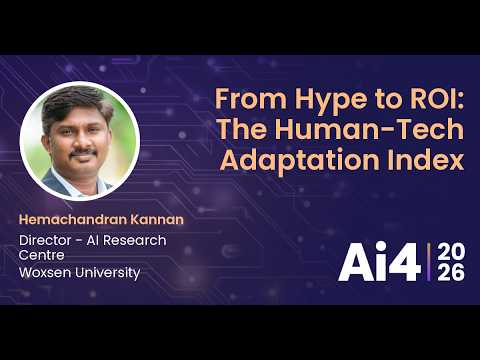
From Hype to ROI: The Human-Tech Adaptation Index With Woxsen University — Ai4

Ai4

Enterprise AI initiatives fail because workforces resist operational changes, requiring scoped pilot validation and human-in-the-loop governance to secure measurable returns.

AI-assisted summary of From Hype to ROI: The Human-Tech Adaptation Index With Woxsen University — original source. Check the original for full context.

Source published:

Detailed notes

## Background Published on YouTube by the Ai4 channel on August 19, 2026, this presentation features Hemachandran Kannan, Director of the AI Research Centre at Woxsen University. The session introduces the Human-Tech Adaptation Index (HTAI), a framework designed to diagnose human barriers to AI adoption and link change management, ethics, and workforce readiness directly to enterprise ROI.

## TL;DR Kannan cuts through the marketing hype in corporate and academic sectors to explain why enterprise AI initiatives fail when organizational readiness and workforce adaptation are ignored. He presents a structured 5-dimension evaluation model alongside the psychological stages of adoption, demonstrating how targeted frameworks like the 4Rs (Reason, Redesign, Routine, Recognition) overcome employee resistance. The talk outlines a disciplined 12-to-18-month phased implementation playbook that prioritizes scoped proof-grade pilots and vendor architectural transparency over premature infrastructure investments. Finally, he underscores the critical necessity of closed human-in-the-loop validation to combat generative hallucinations and mandates quarterly model audits to track tangible business impact instead of vanity metrics.

## Atmosphere & style The presentation carries a pragmatic, academic, and authoritative tone that directly challenges industry buzzwords and superficial adoption claims. Kannan delivers a measured, methodical breakdown of enterprise realities, shifting smoothly between systemic diagnosis and practical operational frameworks. Listening to the talk feels grounded and cautionary yet empowering, offering leaders a clear-eyed roadmap for navigating workforce psychology and institutional change.

## Key takeaways - [00:04](https://www.youtube.com/watch?v=Yw9pq9fZr00&t=4s) Much of the AI momentum in both higher education and enterprise is driven by marketing hype rather than genuine technological readiness or societal impact. - [00:04](https://www.youtube.com/watch?v=Yw9pq9fZr00&t=4s) The failure of enterprise AI adoption often stems from human resistance and unauthorized 'shadow AI' rather than software limitations. - [01:45](https://www.youtube.com/watch?v=Yw9pq9fZr00&t=105s) Before deploying AI, organizations must evaluate three foundational pillars: clear operational purpose, workforce familiarity, and strict governance frameworks. - [01:45](https://www.youtube.com/watch?v=Yw9pq9fZr00&t=105s) AI implementations should always begin as scoped pilot projects to validate accuracy and processes before committing significant capital to infrastructure. - [04:39](https://www.youtube.com/watch?v=Yw9pq9fZr00&t=279s) Woxsen University evaluates AI adoption across five interconnected dimensions: governance, organizational readiness, user acceptance, technology performance, and institutional impact. - [07:58](https://www.youtube.com/watch?v=Yw9pq9fZr00&t=478s) Employees progress through four psychological stages during AI adoption—exposure, trust, explanation, and integration—moving from initial skepticism to daily workflow usage. - [07:58](https://www.youtube.com/watch?v=Yw9pq9fZr00&t=478s) Overcoming employee resistance requires the '4R' operational framework: Reason, Redesign, Routine, and Recognition. - [09:56](https://www.youtube.com/watch?v=Yw9pq9fZr00&t=596s) Scalable enterprise impact demands a structured 12-to-18-month implementation playbook moving from strategic alignment to non-production pilots and scaled deployment. - [09:56](https://www.youtube.com/watch?v=Yw9pq9fZr00&t=596s) Organizations must demand architectural transparency from AI vendors to understand underlying mechanics and troubleshoot errors without rip-and-replace cycles. - [13:00](https://www.youtube.com/watch?v=Yw9pq9fZr00&t=780s) To counter AI hallucinations and safely deploy agentic workflows, organizations must maintain a closed-loop system with human experts validating outputs. - [15:02](https://www.youtube.com/watch?v=Yw9pq9fZr00&t=902s) Enterprises should abandon vanity metrics like login counts in favor of quarterly audits measuring accuracy, data drift, and task completion speed. - [15:02](https://www.youtube.com/watch?v=Yw9pq9fZr00&t=902s) Transferring AI models across different domains, such as healthcare to banking, requires disciplined revalidation and input tuning to handle altered data structures.

## Detailed walkthrough ### [00:04](https://www.youtube.com/watch?v=Yw9pq9fZr00&t=4s) The Reality Behind Enterprise and Higher-Ed AI Hype

Organizations and educational institutions around the world are rushing to position themselves at the forefront of artificial intelligence, yet much of this momentum is driven by marketing rather than true technological readiness. In higher education, numerous universities boast of being the "number one AI university" simply to attract admissions and optimize their financial ROI. In reality, many have merely embedded standard AI capabilities into their existing ERP systems without fundamentally transforming how students are trained or delivering tangible benefits to society.

A similar disconnect plagues corporate environments, where companies publicly proclaim their deep AI integration or dismiss their usage entirely, while employees quietly utilize unauthorized or integral ERP solutions—a dynamic known as "shadow AI." True adoption cannot occur by simply acquiring software; it requires a hard look at institutional readiness, clear purpose, and the human workforce expected to operate alongside these systems.

[01:45](https://www.youtube.com/watch?v=Yw9pq9fZr00&t=105s) Foundations of AI Implementation: Purpose, People, and Pilot-First ROI

Before an organization deploys any AI solution, leadership must evaluate three indispensable pillars: the explicit purpose of implementing the technology, the familiarity and capability of the employees who will operate it, and the governance frameworks overseeing it. The failure rate among startups and enterprise initiatives remains high because technology trends evolve rapidly—shifting from the basic ERP and SaaS research platforms of recent years to advanced agentic AI and governance platforms—while human adaptability lags behind.

```mermaid flowchart TD accTitle: AI Adoption Strategy Flow accDescription: Step-by-step path from evaluation pillars to pilot execution and enterprise scale.

subgraph CorePillars["1. Evaluation Pillars"] P1["Clear Purpose"] P2["Workforce Capability"] P3["Strict Governance"] end

subgraph PilotStage["2. Pilot Phase"] Test["Proof-Grade Testing"] Metrics["Process & Accuracy Validation"] end

subgraph EnterpriseScale["3. Scaled Production"] Prod["Infrastructure Investment"] ROI["Multiplied ROI & Efficiency"] end

CorePillars --> PilotStage PilotStage --> EnterpriseScale ```

To prevent costly enterprise-wide failures, AI tools must always begin as scoped pilot projects. When initial pilots are executed properly, scaling them to enterprise deployment can double operational return on investment without introducing unforeseen liabilities. In banking, for example, automating the paperwork and eligibility verification for loan applications can elevate a branch's output from 500 processed applications a month to 1,000, drastically cutting processing time and delivering immediate, measurable business value.

[04:39](https://www.youtube.com/watch?v=Yw9pq9fZr00&t=279s) The Five Core Evaluation Dimensions

To evaluate the real impact of AI beyond surface-level claims of 95% or 98% model accuracy, Woxsen University developed a framework built on five interconnected dimensions: governance, organizational readiness, user acceptance, technology performance, and institutional impact. Governance serves as the baseline, defining the rules of engagement and guiding whether the overall organization and its decision-making processes are prepared to integrate automated workflows.

```mermaid flowchart LR accTitle: The Five Dimensions of Human-Tech Adaptation accDescription: Sequential flow across the five core evaluation factors of the framework.

G["Governance"] --> OR["Organizational Readiness"] OR --> UA["User Acceptance"] UA --> TP["Technology Performance"] TP --> II["Institutional Impact"] ```

User acceptance remains one of the steepest hurdles in enterprise environments. Employees who are comfortable with legacy tools like Microsoft Excel frequently resist transitions to modern data stacks like Python or Power BI. Forcing adoption breeds friction; leaders must instead articulate a clear, purposeful vision—demonstrating how interactive dashboards and automated workflows save time and simplify reporting. When applied in educational settings, integrating AI-generated simulations and tailored use cases into coursework demonstrated institutional impact by raising student academic performance from historical averages of 60% up to 80% and 90%.

- **Governance**: Establishing policy, validation safeguards, and operational accountability. - **Organizational Readiness**: Preparing decision-making processes and leadership alignment. - **User Acceptance**: Transitioning staff from comfortable legacy workflows to new tools through purpose-driven communication. - **Technology Performance**: Benchmarking precision, speed, and real-world utility over raw benchmark scores. - **Institutional Impact**: Measuring quantifiable end outcomes, such as elevated student mastery or doubled operational throughput.

[07:58](https://www.youtube.com/watch?v=Yw9pq9fZr00&t=478s) Psychological Stages of AI Adoption and the 4R Resistance Framework

For employees to assimilate new AI systems into their daily work, they systematically navigate four distinct psychological stages: exposure, trust, explanation, and integration. In the initial exposure phase, employees inevitably question the relevance of the change, asking, "Why should I care?" Establishing trust requires letting them inspect sample data and witness accurate, transparent outputs firsthand before asking them to integrate the technology into standard workflows.

```mermaid flowchart LR accTitle: Psychological Stages of AI Adoption accDescription: The four progressive psychological phases employees pass through during technology adoption.

E["1. Exposure<br/>('Why should I care?')"] --> T["2. Trust<br/>(Reliability & safety)"] T --> EX["3. Explanation<br/>(Sample data & outputs)"] EX --> I["4. Integration<br/>(Day-to-day workflow)"] ```

Overcoming workforce hesitation requires targeted interventions across four core operational pillars, known as the "4Rs":

- **Reason**: Clearly explaining the specific rationale and expected outcomes behind adopting the AI tools. - **Redesign**: Restructuring decision-making frameworks and daily operational workflows to support human-AI collaboration. - **Routine**: Embedding the software into everyday, repetitive operational tasks until usage becomes second nature. - **Recognition**: Spotlighting and rewarding high-performing individuals and departments to motivate peers and directly enhance enterprise ROI.

[09:56](https://www.youtube.com/watch?v=Yw9pq9fZr00&t=596s) The 12–18 Month Implementation Playbook

Realizing scalable enterprise impact is not an overnight transition; structured execution requires an iterative playbook spanning 12 to 18 months. Organizations must begin with strategic alignment and use-case selection before testing proof-grade, non-production models in pilot settings. Committing capital to permanent cloud infrastructure, pipelines, and enterprise licensing prior to pilot validation introduces severe financial and architectural risks if the solution fails to deliver.

```mermaid flowchart TD accTitle: Enterprise AI Implementation Playbook accDescription: Multi-phase timeline from strategic scoping to deployment and governance.

subgraph Ph12["Phases 1 & 2: Strategy & Scoping"] A["Strategic Alignment"] B["Use-Case Selection & Sample Data"] end

subgraph Ph34["Phases 3 & 4: Pilot & Infrastructure"] C["Pilot Execution (Proof-Grade)"] D["Cloud & Pipeline Infrastructure Scaling"] end

subgraph Ph56["Phases 5 & 6: Deployment & Governance"] E["Role-Specific Training & Champions"] F["Human-in-the-Loop & Model Audits"] end

Ph12 --> Ph34 Ph34 --> Ph56 ```

Vendor transparency is critical during technology procurement. If leadership adopts third-party commercial models without understanding their architectural mechanics or training baselines, the enterprise is left defenseless when production errors arise. Leaders must demand visibility into model architectures to troubleshoot regressions directly rather than being forced into costly rip-and-replace software cycles.

[13:00](https://www.youtube.com/watch?v=Yw9pq9fZr00&t=780s) Human-in-the-Loop Governance and Agentic AI Safeguards

As enterprises integrate commercial generative tools, autonomous agents, and browser-driven workflows—ranging from research platforms like Perplexity and Comet to specialized code assistants—mitigating hallucinations remains paramount. Generative models frequently fabricate facts and source material, making autonomous open-loop deployments dangerous for mission-critical operations.

```mermaid flowchart LR accTitle: Human-in-the-Loop Validation Loop accDescription: Closed-loop architecture ensuring human expert verification before enterprise output release.

Input["System Prompt / Task"] --> Agent["AI / Agentic Model"] Agent --> Output["Draft Result / Generation"] Output --> Reviewer{"Human Expert Validation"} Reviewer -- "Approved" --> Final["Enterprise Output"] Reviewer -- "Hallucination / Error" --> Fix["Human Refinement & Tuning"] Fix --> Final ```

Deployments must always operate as a "closed loop with the human as an expert in that to validate it." Organizations must establish explicit escalation pathways for model errors, deliver role-specific training, and appoint departmental AI champions. Accountable internal owners must vet every model output to confirm factual integrity before operational execution.

[15:02](https://www.youtube.com/watch?v=Yw9pq9fZr00&t=902s) Moving Beyond Vanity Metrics: Audits, Cross-Domain Transfers, and ROI

Tracking surface-level vanity metrics—such as login frequencies or user account counts—obscures actual operational health. High-performing organizations enforce formal audits every three months to monitor model accuracy, detect algorithmic bias, and identify data drift. Because live enterprise data shifts constantly, quarterly evaluation cycles ensure models are retuned and refined before performance degrades.

| Dimension | Vanity Metrics (Insufficient) | True Value Metrics (Actionable) | |:--- |:--- |:--- | | **User Engagement** | Login counts, total active seats | Task completion velocity, voluntary daily tool routine | | **Model Reliability** | Static vendor accuracy claims (e.g., 98%) | Quarterly bias audits, hallucination drift, error escalation rate | | **Enterprise Impact** | AI marketing branding, tool acquisition count | Doubled operational output, faster decision-making cycles, verified ROI |

When core models are redeployed across distinct sectors—such as migrating predictive algorithms from healthcare (managing patient queries and hospital bed availability) into banking or manufacturing—the underlying data structures change completely. Baseline models must undergo disciplined input refinement and accuracy revalidation for the new domain. Ultimately, the long-term success and ROI of artificial intelligence rest not on the underlying algorithms alone, but on the speed of decision-making, the adaptability of the workforce, and institutional governance.

## Notable quotes > Most AI projects fail—not because of technology, but because humans aren’t ready to adapt. — Hemachandran Kannan

> Join me if you want AI that delivers value—not just headlines. — Hemachandran Kannan

> [00:04](https://www.youtube.com/watch?v=Yw9pq9fZr00&t=4s) number one AI university — Hemachandran Kannan

> [00:04](https://www.youtube.com/watch?v=Yw9pq9fZr00&t=4s) shadow AI — Hemachandran Kannan

> [07:58](https://www.youtube.com/watch?v=Yw9pq9fZr00&t=478s) Why should I care? — Hemachandran Kannan

> [13:00](https://www.youtube.com/watch?v=Yw9pq9fZr00&t=780s) closed loop with the human as an expert in that to validate it — Hemachandran Kannan

## Mentioned Hemachandran Kannan, Woxsen University, Ai4, Human-Tech Adaptation Index (HTAI), Microsoft Excel, Python, Power BI, Perplexity, Comet

## Video description Hemachandran Kannan - Director - AI Research Centre, Woxsen University

Most AI projects fail—not because of technology, but because humans aren’t ready to adapt. In this talk, I will introduce the Human-Tech Adaptation Index (HTAI), a field-tested framework that measures readiness and identifies the real barriers to AI adoption. I will share data from corporate and academic pilots, showing how HTAI links ethics, change management, and workforce capability directly to ROI. Attendees will learn a practical way to benchmark their organization and move from experimentation to enterprise-scale impact. Join me if you want AI that delivers value—not just headlines.

[Source](https://www.youtube.com/watch?v=Yw9pq9fZr00)

中文简报

Woxsen:AI落地失败主因在于人为抵触而非算法 企业AI举措的失败源于员工抵触业务变革,需通过限定范围的试点验证与人在回路治理确保可衡量回报。 Kannan拨开企业与学术界围绕AI的营销炒作迷雾,阐述了在忽视组织就绪度和员工适应力的情况下,企业AI举措为何屡屡受挫。他结合技术采纳的心理阶段提出了结构化的五维评估模型,并展示了如何运用4R(原因Reason、重构Redesign、常规Routine、认可Recognition)等针对性框架克服员工的抵触情绪。该演讲概述了一套严谨的12至18个月分阶段实施方案,主张优先推进小范围验证级试点并确保供应商架构透明,而非过早投入基础设施建设。最后,他强调了采用闭环“人在回路”验证以应对生成式AI幻觉的必要性,并要求实施季度模型审计,从而追踪真实的业务成效而非表面指标。 多数高校与企业的 AI 采纳多受营销噱头驱动,落地失败的主因通常是员工抵触及未经授权的“影子 AI”(shadow AI),而非技术本身受限。 (0:04) Woxsen University 建立了涵盖治理、组织就绪度、用户接受度、技术性能与机构影响的五维框架,从而摆脱单一的准确率指标,转而衡量真实的业务产出。 (4:39) 员工适应 AI 会经历接触、信任、解释与整合四个心理阶段,企业可通过“4R”框架(Reason 原因、Redesign 重构、Routine 常规、Recognition 认可)有效化解抵触情绪。 (7:58) 企业实现规模化落地需制定 12 至 18 个月的阶段性路线图,在重金投资基础设施前必须经由原型试点验证,并部署人机协同(Human-in-the-Loop)闭环防范模型幻觉。 (9:56) 衡量 AI 成效需告别登录量等虚荣指标,每季度对算法偏差与数据漂移展开常规审计,并在跨领域迁移模型时严格重新校准,以确保持续的 ROI。 (15:02)

Reading summary

Artificial intelligence deployments frequently falter when driven by marketing hype rather than organizational readiness, requiring institutions to prioritize human adaptability, governance, and iterative execution over software acquisition. According to Woxsen University, generating measurable business returns requires moving past vanity metrics to structured pilots, human-in-the-loop controls, and systematic psychological support for employees. Hype Versus Human Readiness (0:04) Across corporate and academic sectors, AI initiatives are widely leveraged for promotional gain—such as universities claiming top AI status merely by embedding standard features into existing enterprise resource planning (ERP) platforms—without fundamentally updating training or producing public benefit. In corporate environments, this disconnect fosters either total dismissal or unmonitored shadow AI, where staff rely on unauthorized tools to complete everyday tasks. Technological progress has rapidly shifted from basic ERP and software-as-a-service platforms toward autonomous agents and governance engines, leaving human adaptability behind. High project failure rates persist because leadership often prioritizes software procurement over institutional capability. Woxsen University argues that deployment must start by evaluating three foundational pillars before selecting software: an explicit business purpose, the technical familiarity of the workforce, and clear governance frameworks. Frameworks for Workforce and Cultural Acceptance (4:39) To evaluate adoption beyond vendor claims of 95% to 98% accuracy, Woxsen University structures assessment across five interconnected dimensions: governance, organizational readiness, user acceptance, technology performance, and institutional impact. User resistance represents a central bottleneck, particularly when staff accustomed to legacy applications such as Microsoft Excel resist migrations to tools like Python or Power BI. In academic settings, applying tailored simulations and use cases demonstrated tangible institutional impact by elevating student performance averages from historical 60% baselines to between 80% and 90%. Employee assimilation follows four psychological stages: exposure, trust, explanation, and integration. Transitioning staff through these stages requires addressing the '4R' resistance model: Reason (explaining adoption goals), Redesign (restructuring workflows for collaboration), Routine (normalizing usage in daily tasks), and Recognition (spotlighting high-performing contributors). The 12–18 Month Implementation Playbook (9:56) Rather than committing capital prematurely to cloud infrastructure, pipelines, and enterprise licenses, organizations should execute an iterative implementation playbook spanning 12 to 18 months. Initiatives must begin with strategic alignment, use-case selection, and proof-grade pilot testing. When properly scoped and validated, enterprise scaling can double operational output; for example, automating document intake and eligibility verification in banking increased branch capacity from 500 to 1,000 processed loan applications per month. The framework also warns against procurement opacity. Adopting third-party commercial systems without visibility into their underlying architectures and training baselines leaves enterprises unable to troubleshoot model errors, risking expensive software replacement cycles. Agentic Governance and Value Auditing (13:00) Because generative platforms and autonomous agents risk producing hallucinations, mission-critical operations cannot rely on unmonitored, open-loop deployments. Organizations must maintain a closed-loop framework where human experts validate model outputs prior to execution, supported by clear error escalation pathways, role-based training, and departmental champions. Evaluating performance requires abandoning superficial vanity metrics like total logins or active seats in favor of task velocity and voluntary workflow integration. Models require formal audits every three months to mitigate algorithmic bias and live-data drift. Furthermore, transferring core models across sectors—such as adapting healthcare bed-allocation algorithms to banking or manufacturing—demands rigorous input refinement and validation to handle fundamentally different data architectures. Ultimately, operational returns on artificial intelligence depend less on raw algorithmic performance and more on institutional governance, fast decision-making, and whether an organization actively equips its workforce to adapt to evolving workflows.

精炼阅读摘要

沃克森大学(Woxsen University)的研究指出,当前高等教育与企业界对人工智能的追捧普遍充斥着营销炒作,而真正将AI转化为投资回报率(ROI)的关键,不在于技术算法本身,而在于由明确业务目的、劳动力适应力与严格治理构建的人机协同机制。 破除AI营销泡沫与确立实施基石 (0:04) 根据相关观察,全球诸多大学与企业竞相标榜自身在AI领域的领先地位,但多数举措仅停留在公关宣传层面。部分高校自称“第一AI大学”以吸引生源并优化财务收益,实际仅是在既有ERP系统中嵌入基础AI功能,并未改变人才培养模式或创造实质社会效益;企业界亦普遍存在一方面对外宣称深度集成、另一方面员工私下使用未经授权工具的“影子AI”(Shadow AI)现象。 要打破这种脱节,机构在引入AI前必须确立三大核心支柱:明确的技术实施目的、操作员工的熟练程度与能力,以及健全的治理框架。初创项目与企业技术倡议之所以失败率高,主要原因在于技术从传统SaaS与ERP迅速演进至智能体(Agentic AI)平台,而人类劳动力的适应能力却未能同步跟进。 沃克森五维评估模型与试点先导策略 (4:39) 为超越供应商宣称的95%或98%静态模型准确率等表面指标,沃克森大学提出了涵盖五个维度的评估框架:治理(制定政策与问责机制)、组织就绪度(决策机制与领导层对齐)、用户接纳度(推动员工由旧工作流平稳过渡)、技术表现(实际应用中的精度与速度)以及机构影响(最终产出的量化改善)。在教育场景中,通过引入AI模拟与定制案例,学生的学业掌握度从历史平均的60%提升至80%至90%。 为规避全企业范围推广带来的高昂试错风险,AI工具必须从严格界定范围的试点(Pilot)起步。经充分验证的试点在规模化部署后,有望使运营投资回报率翻倍。例如在银行业务中,将贷款申请的文书处理与资质审核自动化,可使单家分支机构的月处理量从500份直接提升至1000份,显著缩短审批时间并带来立竿见影的商业价值。 员工适应心理阶段与4R阻力化解框架 (7:58) 员工将新AI系统内化至日常工作的过程,通常会经历四个心理阶段:接触(产生“为何要在意”的疑问)、信任(建立安全与可靠感)、解释(通过样本数据直观审视透明输出)以及最终的日常整合。在传统工作模式中,习惯使用Excel等成熟工具的员工往往抵触向Python或Power BI等现代数据架构过渡,强制推行只会加剧摩擦。 针对员工的抵触情绪,框架提出了“4R”干预措施:明确原因(Reason,清晰传达技术引入的具体逻辑与预期收益)、重构流程(Redesign,重塑决策机制与日常业务流程以支持人机协作)、例行化(Routine,将软件融入日常重复性任务直至成为下意识习惯),以及激励认可(Recognition,表彰高绩效个人与部门,激励团队并直接赋能ROI提升)。 12至18个月落地路径与人机协同闭环 (9:56) 实现企业级AI规模化赋能需要遵循一个历时12至18个月的渐进式指南。机构必须以战略对齐和应用场景筛选为开端,首先在非生产环境中利用样本数据运行概念验证级试点;若在试点验证前就盲目投入资本采购永久性云基础设施、数据管道或高额企业授权,将面临严重的财务与架构风险。同时,采购外部模型时必须坚持厂商透明度,企业唯有掌握底层模型架构与训练基准,方能在生产环境出错时直接排查,避免被迫全盘替换软件。 面对生成式AI、自主智能体及浏览器端工作流(如Perplexity、Comet及代码助手)固有的事实虚构与幻觉缺陷,企业绝不能允许缺乏监管的开环运行。关键任务部署必须坚持“人在回路”(Human-in-the-Loop)的闭环架构,由具备专业知识的业务负责人对每一项AI生成结果进行核验,并设立清晰的错误上报升级机制与部门AI督导员,确保上线内容的准确性。 季度动态审计与跨领域模型迁移适配 (15:02) 评估AI的真实价值必须彻底摒弃登录频次、开通账号数等“虚荣指标”,转而追踪任务完成速度与日常主动应用频率等行动性指标。高绩效组织通常建立每三个月一次的正式审计周期,动态监测模型准确率、算法偏差以及数据漂移现象。鉴于企业生产环境数据持续变动,季度复盘机制能确保模型在性能恶化之前得到及时微调与校准。 此外,当核心算法跨领域迁移应用时,底层数据结构会发生显著变化——例如将医疗领域中用于处理患者问询与病床分配的预测模型移植到银行信贷或制造业时,算法绝不可直接套用,必须重新进行输入精炼与精度再验证。AI系统的长期效能最终不取决于算法单点性能,而取决于组织的决策周转效率与治理深度。 人工智能投资能否实现从表面炒作到实质ROI的跨越,本质上取决于机构如何系统化化解技术与人力之间的磨合阻力;然而,如何在保持12至18个月严格实施周期的同时,动态应对外部基础大模型与智能体技术的超高速迭代,仍是企业治理面临的持续挑战。

Detailed notes — zh

## Background 该内容由行业组织 Ai4 于 2026 年 8 月 19 日在 YouTube 平台发布,主讲人为沃克森大学(Woxsen University)AI 研究中心主任赫马钱德兰·坎南(Hemachandran Kannan)。演讲围绕人机适应指数(HTAI)展开,探讨了多数 AI 项目因组织与人员适应滞后而失败的深层原因,旨在指导企业打破炒作、建立合规与评估闭环,实现从实验性试点向企业级高 ROI 的平稳落地。 ## TL;DR 演讲首先揭示了高校与企业界普遍存在的 AI 虚假宣传与失控的“影子 AI”痛点,指出单看模型准确率往往是本末倒置。主讲人提出推行 AI 必须立足于业务目的、人员技能与制度治理三大支柱,并通过包含组织就绪度、用户接受度和制度性影响在内的五大维度进行成效衡量。为化解员工抵触心理,企业应遵循采纳的四大心理阶段与“4R”管理法则,并在 12 至 18 个月的落地周期中严格遵循“先低成本试点验证、后投建基础设施”的次序。最终,结合“人在回路”的闭环审核与季度模型审计,企业才能确保数据安全与算法可靠,将 AI 真正转化为翻倍的业务回报。 ## Atmosphere & style 整场演讲风格务实冷峻且一针见血,开篇便毫不留情地刺破了行业内狂热的营销泡沫与虚荣指标。演讲者的语调沉稳自信、条理分明,善于将宏观战略与银行业务、教学管理等具体场景无缝衔接。聆听体验如同一剂清醒剂,引导观众从浮躁的追逐技术前沿,理性回归到流程重塑、人员适应与风险控制的扎实落地实践中。 ## Key takeaways - [00:04](https://www.youtube.com/watch?v=Yw9pq9fZr00&t=4s) 大多数 AI 项目失败的根源并非技术本身,而是组织与员工的人本适应能力未能跟上技术迭代。 - [00:04](https://www.youtube.com/watch?v=Yw9pq9fZr00&t=4s) 高校与企业普遍存在 AI 炒作假象,管理失控往往导致未受监管的“影子 AI”(Shadow AI)在内部滋生。 - [01:45](https://www.youtube.com/watch?v=Yw9pq9fZr00&t=105s) AI 落地成功依赖三大支柱:明确业务目的(Purpose)、提升人员技能(People)与健全合规治理(Governance)。 - [01:45](https://www.youtube.com/watch?v=Yw9pq9fZr00&t=105s) 企业推进 AI 必须坚持“先小范围试点验证、后企业级规模化推广”的路径,以控制风险并实现 ROI 翻倍。 - [04:39](https://www.youtube.com/watch?v=Yw9pq9fZr00&t=279s) 不能单纯迷信模型准确率,而应通过治理规范、组织就绪度、用户接受度、技术性能及制度性影响五大维度综合衡量落地成效。 - [07:58](https://www.youtube.com/watch?v=Yw9pq9fZr00&t=478s) 员工采纳 AI 经历接触暴露、建立信任、原理释疑与最终集成四个心理阶段,企业需通过“4R法则”(理由、流程重塑、日常惯例、认可激励)消除阻力。 - [10:12](https://www.youtube.com/watch?v=Yw9pq9fZr00&t=612s) 在 12 至 18 个月的落地周期中,必须在试点验证成功后再启动大规模云资源与数据管道的基础设施投资,避免巨额沉没成本。 - [12:23](https://www.youtube.com/watch?v=Yw9pq9fZr00&t=743s) 管理层必须了解 AI 模型的底层逻辑与架构透明度,杜绝采购黑盒系统以防后续故障无法排查。 - [12:23](https://www.youtube.com/watch?v=Yw9pq9fZr00&t=743s) 面对 AI 幻觉与偏见,必须建立专家把关的“人在回路”(Human-in-the-Loop)闭环验证流程,拒绝完全放任的自动化开环。 - [14:06](https://www.youtube.com/watch?v=Yw9pq9fZr00&t=846s) 摒弃登录频次等虚荣指标,对动态数据系统建立每季度至少一次的模型准确率与偏见审计及微调机制。 - [16:08](https://www.youtube.com/watch?v=Yw9pq9fZr00&t=968s) 跨行业迁移 AI 模型时,必须对输入数据进行针对性清洗与重新校准,以保障在全新业务场景下的预测可靠性。 - [16:08](https://www.youtube.com/watch?v=Yw9pq9fZr00&t=968s) 推动企业投资回报率(ROI)持续攀升的核心,在于快速决策响应能力、数据流转效率以及组织与员工对新技术的深度适配。 ## Detailed walkthrough ### [00:04](https://www.youtube.com/watch?v=Yw9pq9fZr00&t=4s) 高校与企业的 AI 炒作假象与“影子 AI”痛点 在 Ai4 大会开场,演讲者开门见山地指出,当前全行业都在大谈特谈 AI,但极少有人真正审视组织本身是否做好了接纳技术的准备。以高等教育领域为例,许多大学为了争夺生源、提高投资回报率(ROI),纷纷宣称自己是“全美或全球第一的 AI 大学”。然而剥开营销的外衣,很多高校仅仅是在内部 ERP 系统中接入了一点 AI 功能,就大肆标榜自己领先。演讲者叹息道,这完全偏离了教育的本质——大学的核心在于如何切实培养学生,以及如何向社会输出实际价值,而非单纯借概念炒作获取商业利益。 这种浮夸风气在企业界同样普遍存在。如今几乎每家公司都宣称自己是“AI 集成型组织”,但实际情况却走向两个极端:要么是高管自豪地声称自己清楚哪里该用 AI,实际上却催生了大量未受监管的“影子 AI”(Shadow AI),员工在 ERP 等核心业务系统中私下使用各种工具;要么是在对外宣传中坚决否认使用 AI,背地里却在重度依赖。组织若想跳出这种混乱局面,就必须在引入任何 AI 工具之前建立清晰的评估标准,明确技术背后的真实动机与落地路径。 --- ### [01:45](https://www.youtube.com/watch?v=Yw9pq9fZr00&t=105s) AI 落地的三大支柱与从试点(Pilot)到规模化(ROI 翻倍)的路径 企业要成功推行 AI 应用,必须紧扣三大核心要素:第一是**目的(Purpose)**,即明确组织引入 AI 的根本原因;第二是**人员(People)**,即实际操作工具的员工是否具备足够的使用技能与熟悉度;第三是**治理(Governance)**。演讲者回忆道,回顾上一届大会,展区里充斥的大多是基于 ERP 的 SaaS 平台和基础 AI 研究工具;而今年整个行业迅速跃升至“智能体 AI”(Agentic AI)与合规治理的新阶段。技术形态每年都在快速迭代,但人的适应能力却往往严重滞后。 ```mermaid flowchart TD accTitle: AI实施路径图 subgraph S1["第一阶段:准备与验证"] A["明确业务目的<br/>Purpose"] --> B["员工专项培训<br/>People Training"] B --> C["小范围试点验证<br/>Pilot Phase"] end subgraph S2["第二阶段:规模化扩张"] C -->|"成效达标 & 风险可控"| D["企业级全面部署<br/>Enterprise Rollout"] D --> E["业务效率翻倍<br/>Double ROI"] end ``` 针对技术与人员脱节的问题,演讲者强调绝不能在一开始就全盘盲目上线。企业必须将初始阶段严格限制在小规模试点(Pilot)中运行,由试点团队验证效果并承担风险,否则一旦在大规模部署中失败,巨大的财务与业务损失将无人能够承担。只有当试点证明流程顺畅、技术能够切实解决业务痛点时,才能推进到企业级全面落地。以银行业务为例: - 在传统贷款审批场景下,繁重的纸质材料审核与人工流转导致效率低下,单月审批量可能仅有 500 份。 - 引入经过试点验证的 AI 工具后,系统能够精准筛选符合资质的贷款申请人,大幅压缩流程耗时,单月审批量直接翻倍跃升至 1000 份,真正实现 ROI 翻倍增长。 --- ### [04:39](https://www.youtube.com/watch?v=Yw9pq9fZr00&t=279s) 衡量落地成效的五大维度:从模型准确率到制度性影响 许多技术团队在推销方案时,总喜欢炫耀“我的 AI 准确率高达 95% 或 98%”,但演讲者直言,单看算法准确率完全是本末倒置。Woxsen University AI 研究中心为此开发了一套专门衡量 AI 实际落地成效的评估体系,其核心由五个环环相扣的维度构成: ```mermaid flowchart LR accTitle: 评估体系五大维度 A["1. 治理规范<br/>Governance"] --> B["2. 组织就绪度<br/>Org Readiness"] B --> C["3. 用户接受度<br/>User Acceptance"] C --> D["4. 技术性能<br/>Tech Performance"] D --> E["5. 制度性影响<br/>Institutional Impact"] ``` 1. **治理规范(Governance)**:首要前提是确定工具的使用边界、数据合规以及组织决策机制。 2. **组织就绪度(Organizational Readiness)**:评估组织整体架构是否具备承接新技术的条件,决策流程如何与新工具匹配。 3. **用户接受度(User Acceptance)**:解决员工“不愿用、不敢用”的问题。例如许多财务或数据人员精通 Excel,若突然强迫他们改用 Python 或 PowerBI,往往会遭遇巨大阻力;此时管理层不能强推硬塞,而应通过清晰说明工具的业务目的,展示如何用新工具快速搭建可视化看板、在极短时间内完成过去繁重的工作,以此引导员工自发拥抱变革。 4. **技术性能(Technology Performance)**:在健全的治理与用户适应前提下,评估系统的实际运算性能与稳定性。 5. **制度性影响(Institutional Impact)**:最终衡量工具对整个机构核心指标的推动作用。例如在高校教学场景中,过去传统授课模式下学生平均成绩仅为 60 分;而在引入 AI 生成的教学模拟案例和互动工具后,学生成绩普遍提升至 80 到 90 分,这才是技术落地的真正成效所在。 --- ### [07:58](https://www.youtube.com/watch?v=Yw9pq9fZr00&t=478s) 员工采纳 AI 的四大心理阶段与克服阻力的“4R”法则 任何员工在面对组织推行 AI 时,都会经历四个循序渐进的心理认知阶段。企业必须遵循这一客观心理规律,帮助员工完成认知过渡: - **接触暴露(Exposure)**:员工往往会产生防范心理,质疑“我为什么要关心这个新工具?我现有的工作方式好好的,凭什么要换?”因此首要任务是向员工全面展示工具。 - **建立信任(Trust)**:在正式使用前,让员工逐步了解工具的可靠性,建立对技术的基本信任。 - **原理释疑(Explanation)**:通过导入样本数据进行试跑,向员工透明展示系统是如何得出结果的、输出质量与准确度到底如何。 - **最终集成(Integration)**:当员工消除疑虑、理解机制后,再将工具正式无缝接入日常业务流。 为了彻底消除员工层面的抵触情绪,企业在推进变革时需要严格执行**“4R”管理法则**: - **明确理由(Reason)**:为组织引入的每一款 AI 工具给出充分且合理的业务理由。 - **流程重塑(Redesign)**:对现有的决策链条和业务工作流进行重新梳理与优化设计。 - **日常惯例(Routine)**:推动员工在日常工作中高频使用该工具,将操作转化为肌肉记忆与工作常态。 - **认可激励(Recognition)**:在各部门内部设立评优机制,表彰并奖励那些在 AI 应用中表现出色的员工与团队。通过树立标杆激发全员学习动力,最终将积极性转化为全公司 ROI 的持续攀升。 --- ### [10:12](https://www.youtube.com/watch?v=Yw9pq9fZr00&t=612s) 12至18个月落地实操指南:先验证试点再投资基础设施 组织完成这一整套 AI 适配与转型绝非一朝一夕之功,通常需要持续深耕 **12 至 18 个月**。演讲者分享了其团队在自身机构内反复验证并取得成功的实操演进路线(Playbook),将整个落地周期划分为明确的先后阶段: | 阶段 | 核心任务与执行要点 | |:--- |:--- | | **阶段一 & 阶段二:战略基石与范围界定<br/>(Strategic Foundations & Scoping)** | • 明确业务战略目标,完成战略对齐。<br/>• 挑选匹配的高价值用例(Use Case Selection)。<br/>• 利用样本数据对员工进行实操培训,让员工在低风险环境中熟悉工具特性与实际应用方式。 | | **阶段三 & 阶段四:价值验证与规模构建<br/>(Providing Value & Building Scale)** | • **严格区分概念验证级(Proof Grade)与生产级(Production Grade)**。<br/>• **严控资本支出顺序**:在试点验证成功前,严禁提前大额采购云资源和构建庞大数据管道(Data Pipelines),避免试点失败造成巨额沉没成本。<br/>• 只有在试点取得确定性成果后,才启动大规模基础设施投资、系统全面部署与长效治理闭环。 | 演讲者特别提醒在场的企业创始人与 CEO 们:在采购外部 AI 方案时,技术供应商必须提供清晰的合规验证并保持高度透明。如果企业最高管理者对所采购的 AI 工具底层逻辑与运作机制一无所知,一旦在后续生产部署或规模化扩张中出现重大系统漏洞与业务故障,管理层将完全陷入束手无策的被动境地。 ### [12:23](https://www.youtube.com/watch?v=Yw9pq9fZr00&t=743s) 模型透明度与部署管理:人在回路(Human-in-the-Loop)的关键性 在引入 AI 工具之前,企业必须重点关注工具的透明度,弄清楚其背后的运行逻辑以及具体采用了何种模型架构。如果缺乏透明度,一旦系统出现故障或无法达到预期,企业要么被迫寻找新工具进行替换,要么直接承受投资损失。虽然有些供应商不会主动公开所有技术细节,但使用者必须搞清底层逻辑,以便在未来遭遇错误或异常时能够精准定位并迅速解决问题。 进入部署、变革与治理阶段(阶段五与阶段六)时,需要提供针对特定岗位的技能培训,并在每个部门内部发掘并激励“AI 推广倡导者”(Champions)。更重要的是建立幻觉错误的升级上报机制。以 ChatGPT 为例,虽然它能够快速撰写文章,但其中常常夹杂大量幻觉,并非全部基于真实数据和事实。因此,“人在回路”(Human-in-the-Loop)的介入必不可少:系统不能采用完全放任的开放回路,而必须构建由领域专家负责把关的闭环验证流程,由具体责任人严格审核 AI 输出的准确性并在必要时进行人工修正。 ```mermaid flowchart TD accTitle: Human-in-the-Loop Closed-loop Governance Flow subgraph InputStage["输入与生成"] A["业务数据 / 用户 Prompt"] --> B["AI 核心模型"] end subgraph EvaluationStage["评估与介入 (闭环)"] B --> C{"输出结果检验"} C -- "存在幻觉 / 偏见" --> D["人工专家介入 (Human-in-the-Loop)"] D --> E["模型微调与数据修正"] E --> B end subgraph OutputStage["验证与落地"] C -- "审核通过" --> F["正式业务交付与决策支持"] end ``` - 明确各部门负责具体 AI 工具的责任人,由其对输出质量负最终审查责任。 - 拒绝完全自动化的“开环”运行模式,强制推行专家把关的“闭环”验证。 --- ### [14:06](https://www.youtube.com/watch?v=Yw9pq9fZr00&t=846s) 智能体工具演进与季度模型审计机制 当前业界对 Agentic AI(智能体 AI)的讨论非常热烈,但在日常实际工作中,各类智能工具已经在逐步渗透。例如在 Perplexity 平台及其 Comet 浏览器插件中,用户只需输入一段 Prompt,系统就能自动创建 Google 表单;随后 Google 浏览器原生能力、Anti-gravity 等各类智能体产品也层出不穷。无论智能体技术如何演进,人类在回路中的结果验证始终是不可替代的核心。 评估 AI 落地成效时,绝不能依赖登录凭证或登录频次等“虚荣指标”(Vanity Metrics),真正的衡量标准在于系统的运行准确率以及是否存在算法偏见。对于处理动态海量数据的企业,必须建立至少每三个月一次的定期审计制度: - 持续追踪准确率波动与潜在偏见倾向。 - 依据审计结果对模型进行微调(Fine-tuning)与重新校准,确保预测结果的高度可靠。 - 如果属于数据不变的常规日常重复任务,维护成本较低;但一旦业务涉及大规模流动态数据,季度审计则是刚性要求。 --- ### [16:08](https://www.youtube.com/watch?v=Yw9pq9fZr00&t=968s) 跨行业复用与推动 ROI 的三大核心支柱 将 AI 应用于医疗场景时,系统不仅可以处理患者咨询与疑问解答,还能实时监测空余床位并进行预测性维护,但前提是必须保持持续规范的日常监控。若将同一套基础模型迁移至银行系统或制造业等其他初创场景,由于输入数据的属性和分布发生了根本变化,必须在初期阶段对数据和模型进行针对性的重新清洗与精炼,以确保跨场景迁移后的高准确度。 衡量任何企业 AI 项目成功与否,核心依赖于三个关键维度:快速决策能力、数据处理与产出结果的响应时间,以及员工对新技术的实际适应程度。最终能够带来切实业务影响和投资回报率(ROI)的,从来不是 AI 技术本身,而是企业的组织就绪度(Organizational Readiness)、治理机制(Governance)以及组织中员工的适应能力。 ## Notable quotes > Most AI projects fail—not because of technology, but because humans aren’t ready to adapt. — Hemachandran Kannan > [00:04](https://www.youtube.com/watch?v=Yw9pq9fZr00&t=4s) 在内部 ERP 系统中接入了一点 AI 功能,就大肆标榜自己领先。这完全偏离了教育的本质——大学的核心在于如何切实培养学生,以及如何向社会输出实际价值,而非单纯借概念炒作获取商业利益。 — Hemachandran Kannan > [04:39](https://www.youtube.com/watch?v=Yw9pq9fZr00&t=279s) 很多技术团队总喜欢炫耀‘我的 AI 准确率高达 95% 或 98%’,但单看算法准确率完全是本末倒置。 — Hemachandran Kannan > [01:45](https://www.youtube.com/watch?v=Yw9pq9fZr00&t=105s) 企业必须将初始阶段严格限制在小规模试点(Pilot)中运行,由试点团队验证效果并承担风险,否则一旦在大规模部署中失败,巨大的财务与业务损失将无人能够承担。 — Hemachandran Kannan > [10:12](https://www.youtube.com/watch?v=Yw9pq9fZr00&t=612s) 在试点验证成功前,严禁提前大额采购云资源和构建庞大数据管道(Data Pipelines),避免试点失败造成巨额沉没成本。 — Hemachandran Kannan > [10:12](https://www.youtube.com/watch?v=Yw9pq9fZr00&t=612s) 如果企业最高管理者对所采购的 AI 工具底层逻辑与运作机制一无所知,一旦在后续生产部署或规模化扩张中出现重大系统漏洞与业务故障,管理层将完全陷入束手无策的被动境地。 — Hemachandran Kannan > [12:23](https://www.youtube.com/watch?v=Yw9pq9fZr00&t=743s) 系统不能采用完全放任的开放回路,而必须构建由领域专家负责把关的闭环验证流程,由具体责任人严格审核 AI 输出的准确性并在必要时进行人工修正。 — Hemachandran Kannan > [14:06](https://www.youtube.com/watch?v=Yw9pq9fZr00&t=846s) 评估 AI 落地成效时,绝不能依赖登录凭证或登录频次等‘虚荣指标’(Vanity Metrics),真正的衡量标准在于系统的运行准确率以及是否存在算法偏见。 — Hemachandran Kannan > [16:08](https://www.youtube.com/watch?v=Yw9pq9fZr00&t=968s) 最终能够带来切实业务影响和投资回报率(ROI)的,从来不是 AI 技术本身,而是企业的组织就绪度(Organizational Readiness)、治理机制(Governance)以及组织中员工的适应能力。 — Hemachandran Kannan ## Mentioned Hemachandran Kannan, Woxsen University, Ai4, Human-Tech Adaptation Index (HTAI), Shadow AI, Agentic AI, ChatGPT, Perplexity, Comet, Google, Anti-gravity, Python, PowerBI, Excel ## Video description Hemachandran Kannan - Director - AI Research Centre, Woxsen University Most AI projects fail—not because of technology, but because humans aren’t ready to adapt. In this talk, I will introduce the Human-Tech Adaptation Index (HTAI), a field-tested framework that measures readiness and identifies the real barriers to AI adoption. I will share data from corporate and academic pilots, showing how HTAI links ethics, change management, and workforce capability directly to ROI. Attendees will learn a practical way to benchmark their organization and move from experimentation to enterprise-scale impact. Join me if you want AI that delivers value—not just headlines. [Source](https://www.youtube.com/watch?v=Yw9pq9fZr00)

Source quotes

Hemachandran Kannan: Most AI projects fail—not because of technology, but because humans aren’t ready to adapt. [0:04] Hemachandran Kannan: 在内部 ERP 系统中接入了一点 AI 功能,就大肆标榜自己领先。这完全偏离了教育的本质——大学的核心在于如何切实培养学生,以及如何向社会输出实际价值,而非单纯借概念炒作获取商业利益。 [4:39] Hemachandran Kannan: 很多技术团队总喜欢炫耀‘我的 AI 准确率高达 95% 或 98%’,但单看算法准确率完全是本末倒置。 [1:45] Hemachandran Kannan: 企业必须将初始阶段严格限制在小规模试点(Pilot)中运行,由试点团队验证效果并承担风险,否则一旦在大规模部署中失败,巨大的财务与业务损失将无人能够承担。 [10:12] Hemachandran Kannan: 在试点验证成功前,严禁提前大额采购云资源和构建庞大数据管道(Data Pipelines),避免试点失败造成巨额沉没成本。 [10:12] Hemachandran Kannan: 如果企业最高管理者对所采购的 AI 工具底层逻辑与运作机制一无所知,一旦在后续生产部署或规模化扩张中出现重大系统漏洞与业务故障,管理层将完全陷入束手无策的被动境地。 [12:23] Hemachandran Kannan: 系统不能采用完全放任的开放回路,而必须构建由领域专家负责把关的闭环验证流程,由具体责任人严格审核 AI 输出的准确性并在必要时进行人工修正。 [14:06] Hemachandran Kannan: 评估 AI 落地成效时,绝不能依赖登录凭证或登录频次等‘虚荣指标’(Vanity Metrics),真正的衡量标准在于系统的运行准确率以及是否存在算法偏见。 [16:08] Hemachandran Kannan: 最终能够带来切实业务影响和投资回报率(ROI)的,从来不是 AI 技术本身,而是企业的组织就绪度(Organizational Readiness)、治理机制(Governance)以及组织中员工的适应能力。

Source quotes

Hemachandran Kannan: Most AI projects fail—not because of technology, but because humans aren’t ready to adapt. Hemachandran Kannan: Join me if you want AI that delivers value—not just headlines. [0:04] Hemachandran Kannan: number one AI university [0:04] Hemachandran Kannan: shadow AI [7:58] Hemachandran Kannan: Why should I care? [13:00] Hemachandran Kannan: closed loop with the human as an expert in that to validate it

Original transcript

[0:04] Today I'm going to present on um the tool which  we have developed but why we have developed [0:09] that is very important here in this particular A4  event because everyone talks about AI but how the [0:18] organization look at it whether the organization  is ready to accept it because if you see about [0:26] higher education many universities is are now  claiming that we are number one a university. [0:34] You know why? To get more admissions because they  want to increase the ROI. [sighs and gasps] But [0:39] at the same time, who is getting benefited about  it? Because they just use AI in the ERP system [0:47] and they're claiming that they are the number  one AI university. But it's not about that. [0:53] how you train the students and how you have been  giving back to the society that is very important [1:00] for the university. Now coming to the  organization if I run an organization [1:05] in my presentation today what I'm going to  say is how the organizations need to adopt AI [1:12] and what is the key important things which they  need to look at it before adapting to the AI [1:18] because any organization if you take everyone are  claiming that we are a integrated organization. [1:25] Some of them are saying that proudly that we know  where to use AI that comes under the shadow AI [1:31] because they use lot of integral applications like  ERP systems but they outside they're claiming that [1:37] they are like not using AI at any cost  but they are using it. Now coming to this [1:45] if an organization wants to implement any AI  applications that is very important to see three [1:53] major things. One is what is the purpose of  implementing AI in the organization. Second [1:59] who are going to use it the people who  are the employees of the organization [2:03] whether they are very familiar to use that AI tool  in that or not. Second third is the governance. [2:10] If these three things are keen to look at it then  only you can implement AI in your organization. [2:16] Now if you see that across the globe the the  failure of a startups are more even this is the [2:25] second time coming to this AFO conference the last  time when I see that in the expo there are lot of [2:31] like startups are in the form of ERPs SAS  platforms then most of them are used in the AI [2:38] research tools in that such a way only I see lot  of expose but this year I'm seeing completely the [2:45] next level everyone been using their of about  agentic AI. The second one is the governance. [2:52] So every year the AI has been changing but  whether the people are adapting to that particular [2:57] technology or not that is very important. So  my concern is like when you're integrating any [3:04] AI tools or any agentic AI in your organization,  [snorts] it has to be properly defined with your [3:11] purpose of why you are implementing it and the  employees, the people who are going to work on it, [3:17] they are should be well trained on that and  then only have to implement in the full-fledged [3:23] like enterprise. till that it should be run like  a pilot because if it fails then who will take [3:30] the ownership and it's a loss for the loss for  the corporate so it has to be done only through [3:35] the pilot initial phase and then moving towards  it can be implemented into the enterprise level [3:42] now if I am implementing AI in the organization  in terms of a successful uh like I done the pilot [3:49] very well now I implemented in the enterprise  now you can see that there will be the [3:54] ROI will increase a double because there is  no issues in your uh thing and uh even uh the [4:01] what purpose you made like for example if it is  a a bank purpose then in that if I want to check [4:08] which other people are eligible for the loans  if those things are happening perfectly then [4:14] it it reduce my time consuming of the process  the paper process paperwork and all those things [4:20] then I'm feel more happy that okay in  a month if I'm if I'm closing around [4:26] 500 uh loan applications after integrating AI  now I'm closing around thousand applications [4:33] that adds value for me in  that case I can go with that [4:39] now if you see that this is what the tool  which we developed mainly to measure the impact [4:45] of any AI tool which you are integrating in your  organization the five things are very important [4:51] the first one here is is the governance.  Second one is the organizational readiness. [4:57] Third user acceptance. Fourth is technology  performance and fifth is the institutional [5:03] impact. These are the key factors which are  majorly utilized for our tool especially for our [5:12] institution majorly to look into it and to measure  the impact of what tools which we have used it in [5:18] the classroom activity as well as in uh uh kind of  chat boards whichever we have implemented in the [5:27] the uh websites of university and other platforms.  Now when you talk about the the tool which we have [5:36] implemented here the major thing is the techn  everyone talks about my AI it gives around 98% or [5:45] around 95% of accuracy but before measuring those  things the key things which you have to look at [5:52] the first one is the governance of what kind of  governance you're going to implement for utilizing [5:58] that particular AI tool in the organization that  very important once Once the governance is ready [6:04] that drives the next is the organizational  readiness. The people who are working [6:08] whether the organization is ready to accept the  thing and also um need to understand that how [6:16] the decision process making is been happening.  That is very important in that. Then that drives [6:22] to the next one is the user acceptance whether the  employees are ready to accept it or not. Because [6:28] see um in many organizations where the people have  been well trained on Excel now if you ask them to [6:35] work on Python programming or PowerBI they are not  much aware of it they say that I am more expert in [6:42] Excel I'll go with Excel itself but when the  technology is there we we need to adapt but [6:47] I'm not saying that we should force them to do it  but at the same time we can explain to them in the [6:53] purposeful way that this is what happening where  this might this when you use this kind of a tool [6:58] easily we can create a dashboards and we can  showcase to them and lot of things we can do [7:03] it in a short time. So like that if you explain  the purpose of why you are integrating that in [7:08] the organization that makes sense for them to  understand so that they also will adapt to that [7:14] technology and they will work on it. Then  finally institutional impact. Institutional [7:19] impact is the overall of for example if if I  am taking a particular course for the student [7:27] how the student has taken up and how he has  performed. Previously when I have not used the AI [7:32] tool I see that the student has scored only 60%.  But after I integrated AI technology like teaching [7:39] them with the simulations use cases generated by  AI. If I do that then I see that the performance [7:46] of the student increased to 80 to 90%. That is  the success of the technology implemented in that [7:51] that is what the institutional impact which I can  say here is an example which I given to you here [7:58] there are four psychological things stages  for the AI adoption like any employee if you [8:03] take these are the things which need to go  through it. The first one is the exposure. [8:09] Why should I care? The people will ask about if  you implement why I should think about it. I know [8:13] that technology I can use it. Why I need to do  this? So first exposure should be given to the [8:18] people. Second is a trust. The people has to trust  it before using that tool what they're going to do [8:25] it. And third is the explanation is nothing but it  just give a kind of a sample data which I give it [8:33] to it and I see that how how much accuracy what  kind of output is getting it and then I will try [8:39] to put it into the the final stage of integration.  So this flow in any every organization should be [8:47] followed for the employees to go with that that  helps them to understand clearly the process then [8:55] to adapt to the organizational readiness  to work with them. The overcoming the four [8:59] resistance which is among the all employees.  The first one is the reason the reason why you [9:06] are implementing that in your organization any  AI tools which are it can be multiple AI tools [9:12] but you need to give a proper reason for that. The  second one is the redesigning should be done among [9:18] the decision process and the workflows what you're  going to do it and third is the routine make them [9:25] to work on day-to-day basis on the same tool so  that they will adapt to that and the last one is a [9:30] recognition and in each department identify which  one has performed well in the particular tool what [9:36] you have uh incorporated in the organization and  that makes them to motivate to learn the things [9:43] and make the better results out of that leads  to your enhancement of ROI of your organization [9:50] because one if you make them motivate then  only the the things will happen with that. So [9:56] if you want to measure those things it will not  happen in a day it takes around 12 to 18 months [10:02] to work on it. This is what the playbook  which we have done it in my organization [10:06] and we have checked it. It perfectly went well  and now I'm just presenting to you all this. [10:12] The first stage is the strategic and alignment to  be done. The second is the use case selection and [10:18] third is a pilot execution. Fourth infrastructure  and data. As I said before, initially we have to [10:24] do the pilot and if the pilot went perfectly then  only you have to plan about your infrastructure, [10:30] the data pipelines and all those things  because in the pilot if doesn't work well [10:36] and if you already implemented the infrastructure  and everything then it is a loss for your company. [10:40] So do the pilot and then see how much results  you're getting up all those things and then [10:46] you go with the kind of implementation to the next  level then deployment and finally the governance [10:53] to be done for that. So coming to the phase one  and two is a strategic foundations and scoping [11:00] it is mainly on like if you have you have done  the tool but the tool need to be understanded by [11:05] the employee. So for that I can take lot of use  cases and give to the people to understand that [11:10] and also I can take a sample data of it and makes  them to work with that so that they will be more [11:18] flexible with that kind of tool that how they  want to use it and how they want to implement [11:24] and in real time how they can work in that. So  that is very important for them to understand. [11:30] Phase three and four providing a value  and building scale. It is mainly on [11:34] two things. One is like a proof grade and  non-production grade. Uh it is it is like [11:42] before pilot you should not go with the  infrastructure only after pilot you have [11:47] to go with the infrastructure cloud whatever you  feel like to do it you can invest those things [11:52] that is very important because even when you  see that in pilot if some issues are happening [11:59] and and also you need that the the company  which have been sold that AI tool for you [12:06] that that company has to a proper validation to  you and should be like more transparent because [12:12] if if you are the founder or the CEO and if you  are not well aware about that particular AI tool [12:18] then if any issues are happening moving  further then you don't have the solution for it [12:23] either you have to replace the tool with any other  new AI tool which is available in the market or [12:30] it's a loss for the company so before doing it you  have to keen on the transparency of the tool how [12:36] it works what kind of models have been used. Some  companies will not just openly say to that but you [12:43] should be clear on understanding that how it works  and the model works so that it will be easy for [12:49] you if any error comes in the future or anything  need to be addressed where you can look into it [12:54] and you can sort this out. The phase five and six  is the deployment and change and governance. Yes, [13:00] the role specific training to be provided  then a champions need to be identified [13:05] in the each department and should be  motivated and fourth and third is the [13:10] escalation process of hallucination errors. As  you know that in charge GPD there lot of things [13:16] are happening where if you ask to write a kind  of article it will write but it it use lot of [13:20] hallucinations not use the real data real facts.  So human loop intervention is very important. [13:27] Whatever the AI tool which you're  using it going to implement in the AI [13:31] or in the in your organization where you should  be clear on what result has been giving up and [13:38] who is the responsible of that particular tool  is being utilized that person has to vet properly [13:44] that the output given by the AI is perfect or if  any need changes need to be made where the human [13:50] has to do it. So human loop intervention is very  important. It should not be like a open loop. It [13:57] should be always a closed loop with the human as a  expert in that to validate it. Then coming to this [14:06] agentic AI and all those things  are been the governance where [14:12] you see that um in real time might be you might  hear a lot of people have been talking about [14:18] a agents and in expose but in real in real  time in our day-to-day life we use perplexity [14:24] in perplexity we have a comet platform web browser  in comet you can do a lot of things that is a base [14:30] that is a like initial phase of everyone talks  about agentic AI if I want to create a Google form [14:36] I can create a Google form with the comet just  give a prompt automatically it will create for me [14:40] same way after that ask Google like we have in the  Google browser we got it then we have anti-gravity [14:48] so lot of platforms are coming at but whatever you  do as a human loop intervention is very important [14:54] the result has been come up with the AI the human  validation is more important in all those aspects [15:02] The vanity metrics is not about just a login  credentials or the how many number of times you [15:06] log in. The thing is how it works perfectly what  kind of accuracy you got whether have you showing [15:12] any bias or not. If I in my organization if I'm  using any AI tool every three months I need to [15:18] do an audit and see that what kind of accuracy  I'm getting it how much bias has been showing up [15:24] and uh how I can refine or retune my model so  that my accuracy will always be high and also [15:32] it should be predicted. So those things has to  be done properly. Auditing is very important [15:38] in any organization to look at it because every  day the data has been changing. If you are using [15:44] it for the routine work and the data is same then  there is no problem. If the datas are different [15:50] and uh where a huge data is coming up. So  in that case every 3 months at least once [15:56] you have to audit it and you have to see the um  accuracy and bias and then you have to properly [16:03] take up a decision on whether you're going go up  with this or you want to make any modifications [16:08] in your model. So um this thing which is the use  case which have taken for the healthcare yes in [16:15] healthcare if if you taken any hospital in that  hospital if you want to implement AI and it it it [16:21] covers about uh how to address the patients issues  then uh queries especially you can say then um if [16:28] you want to see that number of beds has been  free so all those things if I want to use AI to [16:33] completely monitor and need to guide me with the  kind of predictive maintenance Yes, it can be done [16:39] but at the same time I have to see that regularly  monitored properly and to be used. Now I have this [16:47] startup. Now I want to go with another startup  which is like in the banking system or uh if it [16:53] is in the manufacturing where I can use the same  model but the problem is like we have to see that [16:59] how accuracy you are getting it but the data  will be changed here. So what kind of data it is? [17:05] So initial phase of refining to be done so  that automatically you can use the same model [17:11] for getting a more validation and for the better  results. In all those aspects if you see the main [17:17] success of any company if you see the first  one is the fast decision making. The second one [17:23] is we can say the the the time it takes to process  and give the results and third is majorly the how [17:33] people are adapting to that particular technology.  So this is what I just want to conclude here like [17:40] any organization if you are going to implement AI  it is not about the AI is going to make the impact [17:46] the impact is based on the organizational  readiness then the governance and the people who [17:52] are working in the organization that is the key  three things are very important for any success [17:57] of the company and for the enhancement  of return on investment. Thank you all.