Fedcap Data Head Enforces Five-Step ROI Gate on AI Spending
Ai4
Enterprise AI projects face rapid adoption decay and runaway token costs unless organizations anchor deployments in existing staff workflows and measurable business outcomes before development begins.
## Background
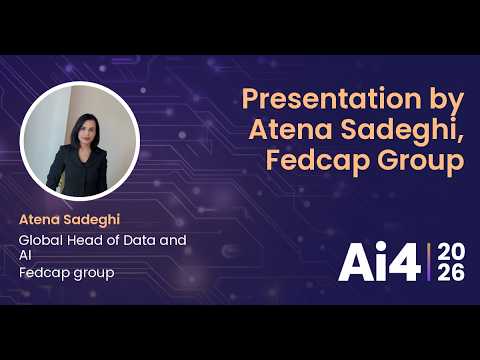
Published on YouTube by Ai4 on August 19, 2026, this presentation features Atena Sadeghi, Global Head of Data and AI at Fedcap Group. The session outlines an executive approach called the Enterprise AI Value Realization Framework, designed to help organizations move past technology hype, align AI investments directly with business strategy, and measure tangible outcomes.
## TL;DR
Atena Sadeghi addresses the urgent boardroom challenge of demonstrating tangible ROI on enterprise AI investments by moving beyond technical hype to a disciplined five-question value realization framework. She emphasizes that AI initiatives must prioritize business outcomes—such as revenue generation, cost reduction, or mitigating employee burnout—over tool-driven novelty and uncontrolled token spending. Using a real-world enterprise case study, she demonstrates how embedding an AI assistant directly into existing frontline workflows resolved an information retrieval crisis, curbed new-hire turnover, and enabled regional scaling without linear headcount growth. Ultimately, Sadeghi concludes that sustainable enterprise AI will become an invisible utility whose success depends entirely on high-quality data readiness and outcome-focused leadership.
## Atmosphere & style
Pragmatic, executive, and firmly anchored in operational realities, the talk cuts cleanly through tech-industry hyperbole with authoritative, no-nonsense delivery. Sadeghi communicates with the directness of a data leader who has faced boardroom budget interrogations, balancing cautionary warnings about developer token costs with structured, actionable solutions. The tone is encouraging yet disciplined, transforming the overwhelming complexities of enterprise AI deployment into a clear, methodical blueprint for business leaders.
## Key takeaways
- [00:04](https://www.youtube.com/watch?v=g5N-_7duB3M&t=4s) Boardrooms and executive leadership are increasingly demanding tangible ROI and clear business justifications for enterprise AI investments rather than accepting technology-driven hype.
- [00:04](https://www.youtube.com/watch?v=g5N-_7duB3M&t=4s) Enterprise AI is repeating the early trajectory of classical machine learning, where technical teams built complex models without grounding them in concrete business outcomes.
- [04:16](https://www.youtube.com/watch?v=g5N-_7duB3M&t=256s) Ungoverned experimentation and massive developer token consumption can rapidly inflate cloud and data warehouse costs without delivering measurable enterprise returns.
- [04:16](https://www.youtube.com/watch?v=g5N-_7duB3M&t=256s) A strict five-question gating framework should be used to screen and reject incoming project proposals before committing engineering resources or budget.
- [06:23](https://www.youtube.com/watch?v=g5N-_7duB3M&t=383s) High-value AI opportunities are best identified by three criteria: heavy employee search burdens, the presence of internal data, and significant decision impact.
- [06:23](https://www.youtube.com/watch?v=g5N-_7duB3M&t=383s) To prevent adoption failure, AI solutions must be embedded directly into existing daily workflows rather than forcing employees to learn standalone applications or portals.
- [10:24](https://www.youtube.com/watch?v=g5N-_7duB3M&t=624s) Success metrics must be business- and outcome-focused—such as reduced employee search hours, lowered attrition, or expanded capacity—rather than tied to technical vanity metrics.
- [12:33](https://www.youtube.com/watch?v=g5N-_7duB3M&t=753s) Technical deployment and stable CI/CD pipelines represent only the starting line; without continuous workflow integration and data updates, enterprise AI suffers rapid adoption decay.
- [12:33](https://www.youtube.com/watch?v=g5N-_7duB3M&t=753s) Enterprise governance, data permissions, and role-based access controls must be resolved before model deployment to prevent unauthorized data exposure.
- [14:39](https://www.youtube.com/watch?v=g5N-_7duB3M&t=879s) Solving internal information discovery bottlenecks with embedded AI can directly reduce new-hire onboarding friction and curb employee turnover.
- [18:49](https://www.youtube.com/watch?v=g5N-_7duB3M&t=1129s) Deploying workflow-native AI with role-based context enables organizations to expand regional operations and scale transaction volume without linear increases in analytical headcount.
- [22:51](https://www.youtube.com/watch?v=g5N-_7duB3M&t=1371s) As AI models become ubiquitous and invisible, enterprise differentiation will depend on trusted data readiness and strategic leadership that frames AI around business value.
## Detailed walkthrough
### [00:04](https://www.youtube.com/watch?v=g5N-_7duB3M&t=4s) Moving from AI Hype to Boardroom ROI and Business Value
Setting aside discussions of code, algorithms, and cloud infrastructure, the focus shifts squarely onto day-to-day enterprise use cases and the pressing question facing organizations after two years of intense AI excitement: how many leaders can clearly explain the tangible value derived from deployed AI applications? AI capabilities have firmly penetrated the boardroom. During a board meeting just weeks prior, board members pressed data leadership with direct questions regarding the exact capital invested in AI initiatives and the concrete returns being generated. For leaders managing enterprise data warehouse solutions and corporate data programs, justifying these expenditures has become an urgent mandate. The bottleneck is no longer the underlying technology itself, but whether organizations know how to leverage that technology to unlock measurable business value.
```mermaid
flowchart TD
accTitle: Enterprise AI Evaluation Pipeline
subgraph S1["1. Strategy & Outcome"]
A["Identify Strategic Outcome<br/>(Revenue, CSAT, Risk, Efficiency)"]
end
subgraph S2["2. Opportunity & Adoption"]
B["Screen High-Value Criteria<br/>(Time spent, data exists, decision impact)"]
C["Embed in Existing Workflow<br/>(Frictionless user adoption)"]
end
subgraph S3["3. Measurement & Continuity"]
D["Measure Concrete Metrics<br/>(Time saved, churn reduced, cost)"]
E["Sustain Long-Term Value<br/>(Ongoing operationalization)"]
end
A --> B --> C --> D --> E
```
This dynamic mirrors the evolution of classical machine learning when it transitioned from research laboratories into the enterprise. In what can be considered "Data Science 101," technical teams frequently defaulted to building complex Random Forest or deep learning models for problems that did not require them. The hardest challenge was never the modeling, but establishing the business justification for costly technologies. Early enterprise machine learning encountered friction around operationalization, ownership, adoption, and expense until organizations anchored deployments to specific business outcomes—such as generating revenue, reducing operational risk, expanding capacity, or trimming operational costs. AI is undergoing the exact same technology transformation, requiring that business strategy strictly lead technical execution rather than letting tool-driven fascination dictate investments.
[04:16](https://www.youtube.com/watch?v=g5N-_7duB3M&t=256s) The Gating Framework: Five Core Questions for AI Investment
Enterprise AI value realization stalls when teams lead with hype—asking narrow questions like "What can I do with Copilot?"—instead of identifying the business problem first. When managing global technical teams, such as 40 developers worldwide where each developer could easily consume 1 million tokens per day, unanchored experimentation creates massive data warehouse and infrastructure costs that cannot be defended at fiscal year-end. Innovation has clear value, but "innovative is cool, but till certain extent"; eventually, leadership must prove what financial and operational returns were generated from corporate budgets.
To prevent uncontrolled spending on low-impact ideas, every incoming project proposal on work management platforms like monday.com must clear five fundamental gating questions. If a project cannot supply clear answers, it is rejected without production deployment, budget allocation, or engineering resources:
- **Strategic alignment over technical novelty:** AI should never be deployed for its own sake; initiatives must tie directly to core corporate objectives.
- **Cost scalability:** Enterprise-grade token usage across dozens of developers and thousands of end users compounds exponentially if left ungoverned.
- **Strict qualification gate:** Projects lacking defined outcomes and user-adoption pathways are terminated before incurring infrastructure overhead.
[06:23](https://www.youtube.com/watch?v=g5N-_7duB3M&t=383s) Business Outcomes, Opportunity Ranking, and Frictionless Adoption
The evaluation process begins with Question 1: *"What business outcome are we trying to improve?"* Proposals must articulate the specific strategic objective being supported—be it boosting revenue, increasing customer satisfaction, elevating employee productivity, or mitigating enterprise risk. Without an explicit business outcome, value realization remains impossible. Once an outcome is established, Question 2 determines whether the proposal represents one of the organization's highest-value opportunities. When presented with dozens of candidate initiatives aimed at operational efficiency, projects are qualified using three distinct criteria:
| Criterion | High-Value Characteristic |
|:--- |:--- |
| **Information Search Burden** | Employees currently lose substantial work hours hunting for information across databases, countless Power BI dashboards, or unstructured documents. |
| **Data Availability** | The required information already exists internally within the organization's data ecosystem. |
| **Decision Impact** | Faster, higher-quality decisions directly produce measurable business value. |
Question 3 addresses adoption and change management: *"Will people actually use it?"* Rather than forcing exhausted staff to learn separate software systems or log into isolated portals, effective solutions embed directly into day-to-day workflows. Tools must feel frictionless and native to the work environment, empowering employees to execute their core tasks more efficiently rather than creating an additional software burden.
[10:24](https://www.youtube.com/watch?v=g5N-_7duB3M&t=624s) Defining Success Metrics and Sustaining Long-Term Value
Question 4 focuses on quantifying success. When the initial business outcome is properly defined in Step 1, establishing objective success metrics becomes straightforward. Depending on the project's intent, metrics may track the reduction in hours spent searching for data, decreased turnover among new hires who previously felt overwhelmed by mundane administrative tasks, or direct sales performance gains. These business measures remain technology- and model-agnostic, providing leadership with auditable proof of performance before navigating governance and responsible AI guardrails. Finally, Question 5 introduces the critical challenge that engineering teams must resolve: *"How do we sustain the value?"* over the entire lifecycle of the deployment.
[12:33](https://www.youtube.com/watch?v=g5N-_7duB3M&t=753s) Sustaining Value Beyond Technical Deployment
Technical deployment is only the starting point of an AI project rather than the finish line. Engineering teams often celebrate successful initial milestones—reporting that CI/CD pipelines are running smoothly, jobs are not failing, and infrastructure is stable—yet this operational stability does not guarantee long-term value. Without proactive planning, enterprise AI initiatives routinely suffer from adoption decay within a few months. Users stop engaging when the tool fails to integrate smoothly into their daily workflow, when underlying business information evolves without being reflected in the system, or when critical governance and security oversights surface post-launch.
```mermaid
flowchart TD
accTitle: Enterprise AI Lifecycle and Adoption Risks
subgraph S1["Technical Foundation"]
A["CI/CD & Deployment"] --> B["System Stability & Jobs Running"]
end
subgraph S2["Pitfalls & Risks"]
B --> C{"Adoption Friction"}
C --> D["Workflow Inconvenience"]
C --> E["Data Drift & Stale Knowledge"]
C --> F["Late Governance & Security Gaps"]
end
subgraph S3["Sustained Value"]
D & E & F --> G["Business-First Value Framework"]
G --> H["Continuous Enterprise Value"]
end
```
A common and costly failure mode occurs when an AI solution is fully deployed and consuming tokens before the organization realizes that unauthorized personnel have access to restricted data. Governance, role-based access, and security guardrails must be established long before deployment. Solving all core framework questions up front ensures the initiative creates enterprise-level business value before engaging engineering teams, establishing a clear justification for recurring monthly operational costs.
- CI/CD stability and low job failure rates do not equate to sustained business adoption.
- Adoption decay typically happens within months if workflow integration and data updates are neglected.
- Governance and role-based permissions must be resolved before deployment to prevent sensitive data leaks.
---
[14:39](https://www.youtube.com/watch?v=g5N-_7duB3M&t=879s) Case Study: Solving an Information Access Crisis
Moving from theory to practice, Sadeghi shares a real-world case study developed alongside a team of students in New York City. The project involved an international enterprise with hundreds of employees serving thousands of clients daily, many of whom required complex appointment scheduling, application tracking, and medical support. Frontline employees spent massive portions of their workday navigating fragmented enterprise platforms just to answer basic operational questions: daily visitor volume, task prioritization, delayed client applications, regional performance metrics, and new organizational policies.
The organization did not have a data shortage; rather, it suffered from an information access and discovery bottleneck. Handing this problem directly to software engineers would typically result in a rush to build an AI assistant simply because cloud algorithms and API access were available. Instead, the initiative was anchored in the value realization framework:
1. **Define the Business Outcome**: Eliminate operational friction and drastically reduce the hours employees spent querying dozens of disparate dashboards and overwhelming internal data teams.
2. **Prioritize the Highest-Value Problem**: Address the root cause of new-hire turnover. Employees were quitting due to the overwhelming frustration of manual data retrieval, creating an unsustainable cycle of hiring and attrition during a phase of rapid business growth.
- The organization handled thousands of customer requests daily across medical needs and complex applications.
- Existing internal systems included dozens of separate reporting dashboards that overwhelmed both frontline staff and central data teams.
- High onboarding friction and repetitive manual data searching directly contributed to employee turnover.
---
[18:49](https://www.youtube.com/watch?v=g5N-_7duB3M&t=1129s) Embedded Workflow Integration and Measuring Measurable ROI
To guarantee user adoption, the AI interface was integrated directly into the day-to-day software tools employees already used, eliminating the need to log into separate applications. The solution leveraged role-based access control (RBAC), allowing the AI assistant to instantly understand each user's specific region, permissions, and responsibilities. Frontline workers could ask natural language questions (such as identifying their highest-priority tasks for the day) and immediately receive actionable, localized answers.
```mermaid
flowchart LR
accTitle: Workflow-Integrated AI Architecture
subgraph UserContext["Frontline Worker"]
A["User Query (Natural Language)"]
B["RBAC & Regional Context"]
end
subgraph Platform["Embedded AI Layer"]
C["Unified Enterprise Data"]
D["Security & Audit Logging"]
end
subgraph BusinessOutcomes["Realized Business Impact"]
E["Reduced Dashboard Searching"]
F["Flat Headcount via Capacity Gains"]
G["Faster Customer Service"]
end
A --> C
B --> C
C --> D
D --> E
D --> F
D --> G
```
Measuring success required tracking tangible operational outcomes over the year-long deployment rather than relying on vanity metrics. The project yielded clear, defensible returns that justified the investment at scale:
- **Search Time Reduction**: Direct queries via the assistant replaced manual navigation across disparate reporting dashboards.
- **Operational Capacity**: Open requisition requirements flattened, allowing the company to delay or eliminate costly backfills while handling higher customer volume.
- **Scalable Regional Expansion**: As new geographic regions were onboarded, existing high-skilled teams managed the increased workload without needing linear increases in analytical headcount.
- **Governance and Auditability**: Unified datasets and complete audit logs ensured full enterprise visibility into system usage and security compliance.
---
[22:51](https://www.youtube.com/watch?v=g5N-_7duB3M&t=1371s) The Future of Enterprise AI: Invisible Tech and Trusted Data
Looking ahead, enterprise AI will become largely invisible, silently embedded into core infrastructure, analytics pipelines, and day-to-day productivity software. Because basic AI tooling is becoming ubiquitous, competitive differentiation will depend on two foundational pillars:
1. **Trusted, High-Quality Data**: Data readiness is the essential prerequisite for orchestration layers, autonomous agents, and reliable execution.
2. **Strategic Leadership**: Leaders who can pinpoint specific business value and navigate the core evaluation questions will consistently outperform those chasing technology for its own sake.
When executives or stakeholders ask, *"What is the AI ROI?"*, the conversation must be reframed to ask: *"What business value should AI create?"* Anchoring AI investments in clear business outcomes ensures long-term executive support, predictable token consumption costs, and sustainable enterprise transformation.
- AI capabilities will become an ambient, invisible component of enterprise software and infrastructure.
- Fragmented or unvetted data architectures prevent AI agents and orchestration frameworks from functioning effectively.
- Reframing AI ROI around concrete business outcomes prevents wasteful token expenditures on underutilized prototypes.
[24:56](https://www.youtube.com/watch?v=g5N-_7duB3M&t=1496s) Closing Remarks and Conference Wrap-Up
Concluding her presentation on enterprise AI value realization, Atena Sadeghi brings the session to a close by thanking the audience for their time and attention. She signs off with a warm parting thought, telling the attendees, "thank you very much for your time, and I hope you enjoy the rest of the conference," before the talk concludes to applause from the room.
## Notable quotes
> What business value should AI create? — Atena Sadeghi
> [04:16](https://www.youtube.com/watch?v=g5N-_7duB3M&t=256s) What can I do with Copilot? — Atena Sadeghi
> [04:16](https://www.youtube.com/watch?v=g5N-_7duB3M&t=256s) innovative is cool, but till certain extent — Atena Sadeghi
> [06:23](https://www.youtube.com/watch?v=g5N-_7duB3M&t=383s) What business outcome are we trying to improve? — Atena Sadeghi
> [06:23](https://www.youtube.com/watch?v=g5N-_7duB3M&t=383s) Will people actually use it? — Atena Sadeghi
> [10:24](https://www.youtube.com/watch?v=g5N-_7duB3M&t=624s) How do we sustain the value? — Atena Sadeghi
> [22:51](https://www.youtube.com/watch?v=g5N-_7duB3M&t=1371s) What is the AI ROI? — Atena Sadeghi
> [24:56](https://www.youtube.com/watch?v=g5N-_7duB3M&t=1496s) thank you very much for your time, and I hope you enjoy the rest of the conference — Atena Sadeghi
## Mentioned
Atena Sadeghi, Fedcap Group, Ai4, Copilot, monday.com, Power BI, Random Forest, New York City
## Video description
Atena Sadeghi - Global Head of Data and AI, Fedcap Group
Everyone is asking what AI can do. I believe the better question is: What business value should AI create? In this session, I will introduce the Enterprise AI Value Realization Framework, a practical executive approach for identifying high-value AI opportunities, aligning investments with business strategy, and measuring success through meaningful business outcomes. I will share the principles and lessons learned from leading enterprise AI initiatives to demonstrate how organizations can improve employee productivity, accelerate decision-making, and create lasting business value. Attendees will leave with a repeatable framework they can use to prioritize AI initiatives, gain executive buy-in, and move beyond experimentation to measurable business impact.
Fedcap数据主管为AI支出设立五步ROI门禁准则
企业AI项目面临采用率急剧衰退和Token成本失控的风险,除非组织在开发启动前将部署锚定在员工现有工作流与可衡量的业务成果之上。
面对董事会要求证明企业AI投资具备切实投资回报率(ROI)的紧迫诉求,Atena Sadeghi提出跨越技术炒作,采用严谨的五问价值实现框架。她强调,AI项目必须优先考虑具体的业务成果——如增加收入、降低成本或缓解员工倦怠——而非受工具驱动的新奇感或放任失控的Token开销。结合一个真实的企业案例,她展示了将AI助手直接嵌入现有的一线工作流程,如何化解信息检索危机、抑制新员工流失率,并在不按线性比例增加人员编制的情况下实现跨区域业务扩张。Sadeghi最终总结道,可持续的企业级AI将演变为一种隐形的公共效用设施,其成败完全取决于高质量的数据就绪状态与以成果为导向的领导力。
随着企业董事会和高管对 AI 投资回报率(ROI)及明确业务依据的诉求日益迫切,企业 AI 正在重构投资逻辑,必须以具体的业务成果而非纯粹的技术热度为主导。 (0:04)
为避免全球开发者无节制消耗 Token 导致云与数据仓库成本激增,企业应引入严格的“五问”准入框架,在投入预算与工程资源前直接淘汰缺乏明确成果的项目。 (4:16)
高价值 AI 场景主要具备“员工搜索负担重、内部已有现成数据、对决策影响显著”三大特征,且工具必须直接嵌入现有工作流以避免被弃用。 (6:23)
评估 AI 项目必须以减少工时、降低人员流失或扩充业务产能等具体业务指标为核心,单纯依靠 CI/CD 流程稳定无法避免部署后采用率下滑的困境。 (12:33)
Reading summary
Atena Sadeghi of Fedcap Group argues that enterprise AI initiatives must transition from tool-driven experimentation to a rigorous, business-outcome gating framework to justify capital expenditures and avoid severe adoption decay.
Boardroom Scrutiny and the Machine Learning Precedent (0:04)
Following two years of widespread AI excitement, corporate boards are actively questioning the measurable financial returns generated by enterprise AI and data warehouse investments. Sadeghi notes that the current technical bottleneck is no longer algorithm capability or cloud infrastructure, but the organizational ability to translate those technologies into verifiable business value, such as cost reduction, risk mitigation, or revenue growth.
This trend mirrors the enterprise adoption curve of classical machine learning. In early enterprise data science, technical teams routinely defaulted to building complex deep learning or Random Forest models for problems that did not require them. Machine learning only generated sustainable value once technical execution was subordinated to specific business justifications, a transition that enterprise AI must now repeat.
The Five-Question Investment Gating Framework (4:16)
Unanchored experimentation across global developer teams can rapidly generate unsustainable cloud and token costs, such as 40 developers each consuming one million tokens daily. To prevent spending on low-impact ideas, Sadeghi's organization enforces a five-question gating framework on work management platforms like monday.com, rejecting proposals before budget or engineering hours are allocated.
The framework requires project sponsors to explicitly define the intended business outcome and verify that the initiative targets a high-value opportunity. Projects qualify as high value only when employees face a heavy information search burden across siloed dashboards, the necessary data already exists internally, and faster decision-making produces clear operational impact. Furthermore, initiatives must specify frictionless adoption pathways directly inside existing user workflows, establish model-agnostic performance metrics, and detail an ongoing maintenance plan.
Preventing Adoption Decay Beyond Technical Deployment (12:33)
Sadeghi cautions that technical milestones—such as stable CI/CD pipelines, low job failure rates, and reliable infrastructure—do not represent the completion of an AI project. Without proactive workflow planning, enterprise deployments routinely suffer from adoption decay within months as user interest wanes or underlying enterprise information changes.
A frequent failure mode involves deploying an application without resolving data access governance in advance. Allowing systems to consume tokens before establishing role-based permissions risks leaking restricted enterprise data. Governance, security guardrails, and ongoing workflow alignment must be resolved prior to deployment to justify recurring operational costs.
Operational Validation Through Workflow Integration (14:39)
Sadeghi illustrates this value framework through a case study of an international organization serving thousands of clients daily with complex scheduling and medical requirements. Frontline staff previously navigated dozens of fragmented Power BI dashboards and enterprise platforms to locate operational data, creating severe friction that directly drove new-hire turnover.
Instead of building a standalone assistant that added software overhead, the team embedded an AI interface directly into daily tools using role-based access control to deliver localized answers. Over a year-long deployment, the solution eliminated manual dashboard searches, flattened open headcount requisitions by increasing operational capacity, and allowed regional service expansions without requiring linear increases in analytical staff.
Looking ahead, Sadeghi anticipates that AI tools will become an invisible, ambient component of enterprise software. As basic tooling becomes commoditized, long-term competitive differentiation will depend on trusted, high-quality data readiness and leadership that frames investments around concrete business value rather than novel technology.
## Background
本内容由 YouTube 频道 Ai4 于 2026 年 8 月 19 日发布,主讲人为 Fedcap Group 全球数据与 AI 负责人 Atena Sadeghi。视频简介指出,本场演讲旨在介绍一套实用的“企业 AI 价值实现框架”,帮助高管从容应对投资回报质询,将 AI 投资与业务战略精准对齐,推动项目从单纯的技术实验走向可量化的商业成果。
## TL;DR
Atena Sadeghi 从直面董事会对 AI 投资回报率的尖锐质问切入,强调企业必须打破技术炒作与工具崇拜,回归“业务价值主导”的根本常识。她提出了用于筛选并把关 AI 项目的五个黄金问题:锁定具体业务成果、甄别最高价值机会、确保员工无缝嵌入使用、科学量化商业指标,以及建立兼顾治理与扩展的可持续性。最后,她结合一个跨国机构的真实案例拆解,证明了将 AI 深度隐形嵌入现有工作流,不仅能有效遏制新员工流失与看板内耗,更能抚平招聘增长曲线,依靠坚实的高质量数据底座实现规模化商业变现。
## Atmosphere & style
整场演讲干练务实、直击痛点,彻底剥离了虚浮的技术玄学与代码演示,充满了一线高管面对真实预算审查时的冷静与清醒。Sadeghi 以稳健而具有穿透力的职场洞察开局,用切身体会唤起技术负责人的强烈共鸣,随后层层递进地展开严密的逻辑推演与案例剖析。台下听众仿佛置身于一场严肃的战略决策复盘会,既能感受到高额 Token 账单悬在头顶的现实紧迫感,又能从她条理清晰的落地方法论中获得拨开炒作迷雾、掌控业务终局的从容与底气。
## Key takeaways
- [00:04](https://www.youtube.com/watch?v=g5N-_7duB3M&t=4s) 董事会正在直接拷问 AI 的高昂投入与实际回报,技术与数据团队的职责必须从单纯维护模型数仓转变为扎实的商业价值论证。
- [01:38](https://www.youtube.com/watch?v=g5N-_7duB3M&t=98s) 汲取机器学习的发展教训(Data Science 101):企业级落地必须始于明确的战略与业务成果(增收、降本、风控),而非盲目炫耀复杂算法。
- [03:48](https://www.youtube.com/watch?v=g5N-_7duB3M&t=228s) 跨国团队日常研发中高频消耗的 Token 和算力极易推高成本,必须设立严苛的项目准入机制,坚决拒绝无法回答商业问题的“噱头式创新”。
- [06:23](https://www.youtube.com/watch?v=g5N-_7duB3M&t=383s) 最高价值 AI 用例需满足三项基准:员工在信息检索上耗费巨量精力、底层支撑数据真实可用、更优决策能直接转化为可量化的业务价值。
- [09:18](https://www.youtube.com/watch?v=g5N-_7duB3M&t=558s) 保障用户采纳的关键在于“隐形嵌入”:AI 必须无缝融入原有工作流,不增加额外登录和学习负担,让疲惫的一线员工顺手完成工作。
- [10:18](https://www.youtube.com/watch?v=g5N-_7duB3M&t=618s) 成功衡量指标必须与立项初衷紧密闭环,通过信息查找耗时缩短、新员工离职率下降或成单率上升等客观指标来检验成效。
- [12:33](https://www.youtube.com/watch?v=g5N-_7duB3M&t=753s) 模型部署上线只是起点,许多项目数月后面临采纳率崩盘,根源在于脱离工作流、业务知识未能动态吸收以及缺乏事前的数据权限治理。
- [14:39](https://www.youtube.com/watch?v=g5N-_7duB3M&t=879s) 很多企业的根本痛点并非“缺乏数据”,而是数据散落在割裂系统中导致的“信息获取无门”,这给前线员工造成了极沉重的认知负荷。
- [17:02](https://www.youtube.com/watch?v=g5N-_7duB3M&t=1022s) 通过引入 RBAC 角色权限控制与自然语言交互,帮助员工从“盲目找数据”转为“依据数据采取行动”,有效止血了繁杂流程导致的高离职率。
- [20:04](https://www.youtube.com/watch?v=g5N-_7duB3M&t=1204s) 成功的企业级 AI 能打破业务扩张与人力线性增长的依赖,不仅让盲目查看看板的行为降温,更能有效冻结新增招聘需求。
- [22:51](https://www.youtube.com/watch?v=g5N-_7duB3M&t=1371s) 未来的企业 AI 将像水电一样“隐形且无感”,算法工具不再是壁垒,高质量可信的数据底座与以商业价值为导向的领导力才是核心护城河。
## Detailed walkthrough
### [00:04](https://www.youtube.com/watch?v=g5N-_7duB3M&t=4s) 抛开技术炒作,直面董事会的拷问:AI 究竟创造了什么商业价值?
演讲一开始,Atena Sadeghi 便向在场听众作出了明确承诺:今天绝不讲枯燥的代码、复杂的底层模型或云计算架构,而是聚焦于她在日常管理中必须直接面对的实际业务用例。环顾会场,她向台下抛出了一个非常尖锐的问题:在过去两年生成式 AI 席卷行业的热潮中,大家看过了太多炫酷的演示,但究竟有多少人能向管理层和利益相关方清晰解释自家部署的 AI 应用和模型到底带来了怎样的具体业务价值?从目前整个行业的实际反馈来看,能答上来的人寥寥无几。
这种价值拷问如今已不再停留在技术讨论层面,而是直接进入了企业的最高决策层。Sadeghi 分享了不久前她与集团董事会开会时的亲身经历:董事会成员毫不客气地直接质问:“我们到底在 AI 上投了多少钱?我们收回的实际价值又在哪里?”当这类问题在董事会会议室被正式摆上台面时,负责掌管全公司数据仓库解决方案以及数据战略规划的数据团队,就必须承担起为这些高昂成本进行商业论证的绝对责任。正如此前讲者 Nitin 所分析的,目前行业普遍感受不到预期回报率(ROI)的根本原因早已不是技术本身不够先进,而在于企业究竟如何运用这项技术来萃取切实的商业价值。
- **董事会的两大核心拷问**:在 AI 领域到底累计投入了多少资金?这些投入换来了哪些可量化的商业回报?
- **数据与技术团队的职责转移**:从单纯的模型构建与数仓维护,转变为必须为每一笔 AI 开支提供扎实的商业合理性论证。
---
### [01:38](https://www.youtube.com/watch?v=g5N-_7duB3M&t=98s) 数据科学的演进教训:从“随机森林与深度学习”到业务价值主导
Sadeghi 指出,自己之所以对商业价值有如此深刻的执念,源于她在数据科学领域的长期职业背景。在过去的技术周期中,当业务部门提出需求时,工程师们往往热衷于炫技,端出结构复杂的随机森林模型、各类机器学习甚至前沿的深度学习算法,然而这些极度昂贵的复杂方案往往根本不是解决实际业务痛点的最佳手段。当时最难回答的问题从来不是模型精度有多高,而是“为什么我们非要用这种昂贵的技术?”这种商业合理性论证被她称为“数据科学第一课”(Data Science 101)——一切探索必须始于业务价值,而非背后的算法。
回顾机器学习从学术研究实验室走向企业级落地的历程,业界最初充斥着一系列困惑与阻碍:这项技术到底能不能工程化落地?企业如何从中获益?为什么成本居高不下?到底该由谁来负责运维?又该如何确保一线员工真的会去使用?直到整个行业经历了一次关键的思维转变,企业开始将技术与明确的商业目标相挂钩——探寻它能否开辟新的收入来源、能否提升客户满意度、能否释放运营产能、能否优化端到端的工作流效率。一旦技术与增加收入、降低风险、削减成本等业务指标深度绑定,投资与预算争议便迎刃而解,项目才真正得以顺利推向生产环境。
```mermaid
flowchart TD
accTitle: 机器学习落地演进路径
accDescription: 展示技术方案如何从实验室研究走向与业务成果挂钩并最终实现商业价值生产化落地的流程。
subgraph LabPhase ["技术探索阶段"]
A["复杂算法与模型构建<br/>(随机森林 / 深度学习)"] --> B{"技术导向的困境<br/>(高昂成本 / 落地困难)"}
end
subgraph BusinessShift ["思维范式转移"]
B --> C["回归 Data Science 101:<br/>业务价值优先"]
C --> D["对齐战略核心目标"]
end
subgraph ValueRealization ["生产化与价值变现"]
D --> E1["开辟新营收渠道"]
D --> E2["降低运营与合规风险"]
D --> E3["提升产能与客户满意度"]
E1 & E2 & E3 --> F["成功推向生产环境<br/>获得持续预算与资源"]
end
```
---
### [03:48](https://www.youtube.com/watch?v=g5N-_7duB3M&t=228s) 拒绝“噱头式创新”:面对堆积如山的用例,如何建立严格的筛选把关机制
面对当前的生成式 AI 浪潮,Sadeghi 强调这与当年的数字化及机器学习转型没有任何本质区别,企业同样必须遵循“业务战略引领技术方案,而非技术绑架业务”的铁律。然而现实中,大量企业却在被市场炒作牵着鼻子走,整天纠结于“我们能拿 Copilot 做什么”、“哪个大模型参数更强”,陷入了严重的工具崇拜。这正是业界空有先进技术却迟迟见不到真实商业价值的根本症结。
为了打破这种局面,Sadeghi 在实际工作中设立了极其严苛的项目准入机制。她在项目协同平台 monday.com 上随时都积压着两三十个被各部门标记为“高优先级”的 AI 用例,但一旦仔细审视这些项目的底层价值,往往根本无法覆盖高昂的资源消耗。她算了一笔非常现实的账:作为全球数据与 AI 负责人,她麾下管理着分布在全球各地的 40 名技术开发者;如果每个开发人员每天消耗至少 100 万个 Token,到年底累计的数据仓库与算力账单将是一个天文数字。如果这些消耗没有对应的业务目标作为支撑,在年终复盘时技术团队就会面临被全盘否定的窘境。“创新固然很酷,但也得有个限度”,企业不可能无限期为纯粹的技术尝鲜买单。为此,她总结出了挑选 AI 项目必问的五个黄金问题,凡是无法清晰作答的项目都会被她无情否决,绝不批复预算与人力资源,坚决不让其进入生产阶段。
- **多区域团队的 Token 消耗隐患**:以 40 名跨国开发者团队为例,若人均日消耗达 100 万 Token,年化算力与数仓成本极易失控。
- **项目审批铁律**:无论提案包装得多么前沿,只要五个核心商业问题答不上来,直接拒绝立项,零预算分配。
---
### [06:23](https://www.youtube.com/watch?v=g5N-_7duB3M&t=383s) 关键问题一与二:锁定核心业务成果与最高价值机会
Sadeghi 提出的第一个关键问题是:“我们到底试图改善哪项具体的业务成果?”(What business outcome are we trying to improve?)她反复告诫团队,向高管汇报申请预算时,绝不要把“部署 AI”作为项目的开场白,而应将对话的核心彻底转移到企业战略目标上——这项举措究竟是为了拉动营业收入、提升客户满意度、增强运营效率、释放员工生产力,还是为了防范和降低组织内的潜在风险?如果最终的业务成果定义模糊,那么所谓的商业价值也就无从谈起,这正是大部分项目在价值变现环节遭遇的第一个拦路虎。
紧接着的第二个问题是:“在全公司众多需求中,该用例是否属于最高价值的机会?”(Is this use case one of your highest value opportunities?)打开任务看板,可能光是宣称能“提高运营效率”的 AI 项目就有 20 个,但企业级部署绝非服务 10 个人的小打小闹,它面向全球规模,成本极度昂贵,不可能雨露均沾。在筛选这 20 个项目时,Sadeghi 遵循了三条明确的高优先级特征基准:
1. **员工在信息查找上耗费了大量精力**:员工每天在杂乱的数据库、数不清的报表看板(如海量的 Power BI 页面)或堆积如山的文档中痛苦摸索;
2. **数据在企业内部真实存在且可用**:支撑决策所需的数据并非空中楼阁,已存在于企业的数字化底座之中;
3. **更优的决策能够直接带来可量化的商业价值**:一旦解决信息获取瓶颈并做出更好决策,能立竿见影地反映在业务指标上。只有完全契合这三点的极少数项目,才真正配得上企业的重金投资。
---
### [09:18](https://www.youtube.com/watch?v=g5N-_7duB3M&t=558s) 关键问题三与四:员工是否真正使用与如何客观衡量成功
第三个必须正视的问题是:“员工最终真的会去使用它吗?”(Will people actually use it?)这触及了传统的变革管理(Change Management),但在做大规模组织动员和灌输“为什么要做”之前,必须先反思技术设计本身是否给员工增加了过重的认知负担。既然目标用例挑选的是那些在信息检索中筋疲力尽的岗位,员工在日常高压工作后早已疲惫不堪,他们绝不愿意为了找个答案再去学习一套全新的软件或频繁登录额外的平台。因此,成功的 AI 必须是“润物细无声”地无缝嵌入员工原有的日常工作流中。员工无需察觉自己在操作什么颠覆性的新工具,只觉得手头的日常工作完成得更快、更顺手,AI 才能真正被广泛采纳。
第四个问题则是对成效的终极审视:“如何客观衡量项目的成功?”(How do we measure success?)Sadeghi 指出,如果前三个问题已经理清,指标定义就会水到渠成。指标必须与第一步设定的业务目标紧密闭环:如果立项初衷是提升运营效率、减少检索时间,那么上线后员工的信息检索时长是否确实大幅缩短?该如何科学采样与量化?如果初衷是希望减轻新员工被繁琐重复性杂务淹没的现状,那么新员工的高离职率(Churn Rate)在系统上线后是否出现显著下降?衡量指标可以是削减成本、开辟增量收入,也可以是赋能销售团队促成更多签约。无论采用何种底层模型与架构,只要第一步的业务终局足够清晰,成功度量的标尺就永远不会发生技术偏航。
---
### [11:37](https://www.youtube.com/watch?v=g5N-_7duB3M&t=697s) 关键问题五的前奏:价值的可持续性与治理
在进入第五个问题之前,Sadeghi 补充强调,衡量成功与项目交付的范畴远不止于代码上线。在真正的企业级应用中,负责任 AI(Responsible AI)的伦理审查与数据治理工作,早在模型投产前很久就必须全面介入并贯穿始终。当技术工具与模型本身都逐渐被解耦、成为可替换的基础组件时,清晰的业务成果定义就是确保项目不迷失方向的唯一定盘星。
梳理完业务目标、高价值机会筛选、用户采纳度以及成效度量之后,Sadeghi 抛出了支撑整个企业 AI 战略长期运转的最后一个核心问题:“我们该如何让这种价值持续下去?”(How do we sustain the value?)面对这一触及长期运营生命力的命题,开发团队往往会给出截然不同的技术视角,而这正是企业迈向规模化 AI 必须攻克的新关卡。
### [12:33](https://www.youtube.com/watch?v=g5N-_7duB3M&t=753s) 部署只是起点:为什么许多 AI 项目在数月后遭遇采纳衰减
技术团队在交付项目时,往往有着自己的一套评估标准。当被问及“系统是否平稳运行”时,技术人员习惯于回答:“我们已经完成部署了,CI/CD 流程运行顺畅,后台任务没有报错,一切都很好,这项技术可以永远持续运行下去。”然而,Atena Sadeghi 指出,这根本没有回答真正的核心问题。技术的高可用性不等于持续的业务价值创造,尤其是在大模型及其配套架构如此昂贵的情况下,企业必须从长远视角审视投资回报。
现实中,模型上线部署绝非终点,往往仅仅是挑战的开端。绝大多数项目在上线数月后就会遭遇采纳率(Adoption)的剧烈滑坡。员工之所以弃用,主因通常在于缺乏便利性:要么是设计初期没有深入思考如何将其无缝缝合到日常工作流中;要么是业务层面的新知识、新规则源源不断地涌入,而 AI 系统却未能及时吸收和更新。更为致命的是治理与合规的脱节——很多团队在 CI/CD 阶段完全忽略了数据治理与安全基准,导致系统上线、Token 账单持续产生后,才赫然惊呼:“糟糕,部分流程节点上的员工根本没有权限查看这批敏感数据!”这种事前治理与安全规范的缺失,会直接使昂贵的技术投资付诸东流。只有严谨回答了业务、优先级、工作流采纳、指标评估与可持续性这五个维度的问题,才能确保企业级价值的落地。因此,解决之道在于“从业务出发,而非从技术出发”,这也是每月向管理层证明高昂技术成本合理性的唯一途径。
### [14:39](https://www.youtube.com/watch?v=g5N-_7duB3M&t=879s) 真实案例拆解:跨国机构的信息孤岛与一线员工的认知负荷
为了避免流于空洞的理论说教,Atena 强调自己虽然受过正规的数据科学学术训练、曾在大学执教,但她骨子里极其厌恶纯理论空谈。随后,她拆解了一个高度通用化的典型企业案例。该案例源自她在纽约市与一批学生共同参与的外部协作项目,能完整复现从接手业务痛点第一天起的破题逻辑。
该机构是一家拥有数百名员工的全球化国际组织,每天需要支持数以千计面临复杂医疗健康问题、申请流程繁冗以及需要协调大量预约的客户。一线员工每天一上班就得应对极其繁复的运营问询:“今天有多少客户要来现场办访?”“我今天该优先处理哪些紧急任务?”“哪些客户的申请落后于时间节点,卡在了哪一步?”“我所在区域的整体考核表现如何?”“企业最新出台了哪些我必须掌握的规章政策?”
这些信息在企业内部实际上全部存在,该机构面对的根本不是“缺少数据”的数据匮乏问题,而是“获取无门”的信息访问与检索难题。数据七零八落地散落在众多互相割裂的跨业务系统中,一线员工每天要把大把宝贵时间耗费在翻找数据上。如果把这个需求直接扔给开发团队,工程师的第一本能绝对是:“太棒了,我们做个 AI 助手吧!我们有云算法,能调取所有数据端点,为什么不做?”但这种纯技术视角的冲动,恰恰是错误路线的开端。
```mermaid
flowchart TD
accTitle: 从信息孤岛到 AI 工作流嵌入架构
subgraph S1["传统痛点:分散系统与认知负荷"]
D1["分散的业务系统与报表"] --> W1["员工多平台反复登录检索"]
D2["底层数据仓库异构/缺陷"] --> W1
W1 --> B1["一线员工精力耗损 / 离职率高企"]
W1 --> B2["数据团队不堪应付日常临时问询"]
end
subgraph S2["框架重构:业务驱动的嵌入式解决方案"]
A1["业务目标明确:消除日常检索摩擦"] --> E1["RBAC 角色权限控制系统"]
E1 --> E2["统一数据层与自然语言 AI 助手"]
E2 --> E3["无缝嵌入现有工作软件与流程"]
E3 --> R1["直接以自然语言问答获取指令与洞察"]
R1 --> R2["即时采取业务行动,释放产能"]
end
```
### [17:02](https://www.youtube.com/watch?v=g5N-_7duB3M&t=1022s) 回归价值框架:业务成果界定与离职率止血
面对信息检索泥潭,团队没有直接写代码,而是退回到“企业 AI 价值实现框架”的第一问:我们试图改善的业务成果到底是什么?核心目标极其明确——彻底消除员工日常办公中的摩擦阻力,大幅削减他们在各个分散平台上寻找答案的时间损耗。当时一线人员面前摆着数十个互不相通的数据看板(Dashboard),但由于底层数仓结构复杂、报表林立,数据团队每天依然被基础性问题淹没,普通员工依然找不到想要的数据。
第二问随之而来:这是当前优先级最高的核心用例吗?答案是极其坚定的“是”。信息查找流程的沉重负荷已经对组织运营构成了实质性伤害——数据显示,大量新入职员工因为受不了这种繁琐低效的折磨而选择离职。新员工离职后,企业又不得不重新招聘新人去做同样枯燥琐碎的找数据工作,导致人员流失陷入恶性循环。在企业高速扩张的阶段,如果不从根源解决系统性内耗,就只能无休止地招聘与流失员工。因此,这绝非一个简单的“AI 试水机会”,而是一个挽救组织生产力的核心业务战役。
紧接着是第三问:如何确保员工愿意使用?团队设定的方案是必须将交互能力深度“隐形嵌入”到现有工作流之中。员工无需跳转登录任何新系统,在日常使用的办公界面内,就能直接与 AI 助手用自然语言对话。系统内置了基于角色的访问控制(RBAC),当员工登录后,智能体立刻识别其所在区域和岗位身份,员工只需口语化提问:“我今天的最高优先任务是什么?”系统即刻在当前界面返回精准答案。员工从“盲目找数据”直接升级为“基于数据采取行动”,采纳门槛被降至最低。
### [20:04](https://www.youtube.com/watch?v=g5N-_7duB3M&t=1204s) 商业成效量化:从看板降温到冻结招聘需求的规模化验证
在衡量商业成功(第四问与第五问)方面,团队从立项第一天就锚定了清晰的度量体系。整个落地推广周期长达一年,而非仅仅三个月的短期原型测试。由于自始至终有明确的基线,团队在企业级规模化推广时能够拿出无可辩驳的商业论据:
- **看板访问频率归于理性**:后台监测显示,员工在那些杂乱看板上的低效盲目搜索行为大幅下降。
- **业务承载力与客户交互提升**:一线员工省下了漫长的找数据时间,能够将精力全面转移到核心客户的服务与互动上,对于以客户为核心的业务形态而言,带来了直接的营收与客户满意度飞跃。
- **打破人力扩张依赖(招聘需求冻结)**:企业业务规模持续扩大,但前台新增招聘需求(Open Reqs)的增长曲线却被彻底抚平,许多原本挂出的招聘岗位直接转为延后或暂停。
- **兼顾治理透明度与扩展弹性**:随着业务流程被梳理重塑,团队构建了统一的数据底座,所有基于角色的访问权限、审计追踪完全具备企业级可见性。当新业务区域并入时,企业不再需要为新业务批量招聘初级分析师,依托现有的高技能骨干与成熟的 AI 智能体,即可轻松消化新增区域的业务流量。
### [22:51](https://www.youtube.com/watch?v=g5N-_7duB3M&t=1371s) 企业的未来:隐形 AI 与高质量数据铸就的核心护城河
放眼企业级 AI 的未来格局,Atena 认为随着这场变革的纵深推进,绝大多数 AI 能力将像水电一样变得“无感且隐形”(Invisible AI)。它将彻底融入底层基础设施、日常分析管道乃至日常文档与幻灯片制作工具中,嵌入到每一项日常动作之中。届时,技术本身将不再构成核心壁垒。
未来在市场竞争中脱颖而出的真正分水岭将取决于两点:
1. **可信且高质量的数据沉淀**:很多企业在推进智能体架构(Agentic Workflows)或模型编排层(Orchestration Layer)时举步维艰,核心原因就是数据底座存在巨大摩擦、数据没有就绪。
2. **懂得以业务价值为导向的领导力**:管理层必须具备识别“何种用例能在企业级创造真实价值”的战略敏锐度。
技术的本质是使能工具,其最终目的在于帮助企业实现卓越运营与效率跃迁。演讲最后,Atena 向全体从业者呼吁:未来如果行业中还有人跑来问“AI 的投资回报率(ROI)到底是多少”,不要落入技术指标的陷阱,而应当用一个更有力的问题反问对方——“AI 到底应当为企业创造何种业务价值?”手握这五大价值评估问题,企业才能精准筛选出能产生长效价值的项目,从容掌控技术,而不是在月底对着暴涨的 Token 账单茫然不知所措。
### [24:56](https://www.youtube.com/watch?v=g5N-_7duB3M&t=1496s) 演讲结语与致谢
在结束关于企业级 AI 价值实现框架(Enterprise AI Value Realization Framework)的完整分享后,Atena Sadeghi 向全场参会者致以诚挚的谢意。她对现场观众抽出宝贵时间聆听表示感谢,并热情地祝愿大家尽情享受接下来在大会期间的各项议程与交流活动("Thank you very much for your time, and I hope you enjoy the rest of the conference.")。随着话音落下,全场报以热烈的掌声,本次演讲在此圆满落幕。
## Notable quotes
> [00:04](https://www.youtube.com/watch?v=g5N-_7duB3M&t=4s) 我们到底在 AI 上投了多少钱?我们收回的实际价值又在哪里? — 董事会成员
> [01:38](https://www.youtube.com/watch?v=g5N-_7duB3M&t=98s) 为什么我们非要用这种昂贵的技术? — Atena Sadeghi
> [03:48](https://www.youtube.com/watch?v=g5N-_7duB3M&t=228s) 业务战略引领技术方案,而非技术绑架业务 — Atena Sadeghi
> [03:48](https://www.youtube.com/watch?v=g5N-_7duB3M&t=228s) 创新固然很酷,但也得有个限度 — Atena Sadeghi
> [06:23](https://www.youtube.com/watch?v=g5N-_7duB3M&t=383s) 我们到底试图改善哪项具体的业务成果? — Atena Sadeghi
> [06:23](https://www.youtube.com/watch?v=g5N-_7duB3M&t=383s) 在全公司众多需求中,该用例是否属于最高价值的机会? — Atena Sadeghi
> [09:18](https://www.youtube.com/watch?v=g5N-_7duB3M&t=558s) 员工最终真的会去使用它吗? — Atena Sadeghi
> [09:18](https://www.youtube.com/watch?v=g5N-_7duB3M&t=558s) 如何客观衡量项目的成功? — Atena Sadeghi
> [11:37](https://www.youtube.com/watch?v=g5N-_7duB3M&t=697s) 我们该如何让这种价值持续下去? — Atena Sadeghi
> [12:33](https://www.youtube.com/watch?v=g5N-_7duB3M&t=753s) 我们已经完成部署了,CI/CD 流程运行顺畅,后台任务没有报错,一切都很好,这项技术可以永远持续运行下去。 — 技术开发团队
> [12:33](https://www.youtube.com/watch?v=g5N-_7duB3M&t=753s) 从业务出发,而非从技术出发 — Atena Sadeghi
> [22:51](https://www.youtube.com/watch?v=g5N-_7duB3M&t=1371s) AI 到底应当为企业创造何种业务价值? — Atena Sadeghi
> [24:56](https://www.youtube.com/watch?v=g5N-_7duB3M&t=1496s) Thank you very much for your time, and I hope you enjoy the rest of the conference. — Atena Sadeghi
## Mentioned
Atena Sadeghi, Fedcap Group, Ai4, Nitin, monday.com, Power BI, Copilot, 企业 AI 价值实现框架 (Enterprise AI Value Realization Framework), 基于角色的访问控制 (RBAC), CI/CD, 负责任 AI (Responsible AI)
## Video description
Atena Sadeghi - Global Head of Data and AI, Fedcap Group
Everyone is asking what AI can do. I believe the better question is: What business value should AI create? In this session, I will introduce the Enterprise AI Value Realization Framework, a practical executive approach for identifying high-value AI opportunities, aligning investments with business strategy, and measuring success through meaningful business outcomes. I will share the principles and lessons learned from leading enterprise AI initiatives to demonstrate how organizations can improve employee productivity, accelerate decision-making, and create lasting business value. Attendees will leave with a repeatable framework they can use to prioritize AI initiatives, gain executive buy-in, and move beyond experimentation to measurable business impact.
[Source](https://www.youtube.com/watch?v=g5N-_7duB3M)
Source quotes
[0:04] 董事会成员: 我们到底在 AI 上投了多少钱?我们收回的实际价值又在哪里?
[1:38] Atena Sadeghi: 为什么我们非要用这种昂贵的技术?
[3:48] Atena Sadeghi: 业务战略引领技术方案,而非技术绑架业务
[3:48] Atena Sadeghi: 创新固然很酷,但也得有个限度
[6:23] Atena Sadeghi: 我们到底试图改善哪项具体的业务成果?
[6:23] Atena Sadeghi: 在全公司众多需求中,该用例是否属于最高价值的机会?
[9:18] Atena Sadeghi: 员工最终真的会去使用它吗?
[9:18] Atena Sadeghi: 如何客观衡量项目的成功?
[11:37] Atena Sadeghi: 我们该如何让这种价值持续下去?
[12:33] 技术开发团队: 我们已经完成部署了,CI/CD 流程运行顺畅,后台任务没有报错,一切都很好,这项技术可以永远持续运行下去。
[12:33] Atena Sadeghi: 从业务出发,而非从技术出发
[22:51] Atena Sadeghi: AI 到底应当为企业创造何种业务价值?
[24:56] Atena Sadeghi: Thank you very much for your time, and I hope you enjoy the rest of the conference.
Source quotes
Atena Sadeghi: What business value should AI create?
[4:16] Atena Sadeghi: What can I do with Copilot?
[4:16] Atena Sadeghi: innovative is cool, but till certain extent
[6:23] Atena Sadeghi: What business outcome are we trying to improve?
[6:23] Atena Sadeghi: Will people actually use it?
[10:24] Atena Sadeghi: How do we sustain the value?
[22:51] Atena Sadeghi: What is the AI ROI?
[24:56] Atena Sadeghi: thank you very much for your time, and I hope you enjoy the rest of the conference
Original transcript
[0:04] I promise you today I will be talking about
the use cases that I'm always dealing with
[0:09] on day-to-day activity. Nothing about
the code, nothing about the models,
[0:13] nothing about the cloud and everything like
that. So, um we are not that many here,
[0:19] but I'm pretty sure a lot of you have seen a
lot of it on AI for the past 2 years and uh
[0:26] may I ask you how many of you actually can
clearly explain the the value that you are
[0:32] getting from the like all the AI application
and the model that you have been deploying?
[0:37] Not much from the industry that I'm hearing is
the questions these days. And quite frankly,
[0:43] the AI and the capabilities of AI has made its
way to board room. So, we had a meeting quite
[0:51] few weeks ago uh with our board members and
they were even asking these type of questions,
[0:56] how much money are we investing on our AI and
like what is the value we are getting at? So,
[1:01] when these type of question makes their way to the
board room, it's going to be our responsibility on
[1:07] the data team, owning the data warehouse solution
and all the data program within the company,
[1:12] to justify the cost that we are like
um asking them, right? So, that's why
[1:19] I believe right now the reason we don't see the
value in our uh like or the ROI as Nitin was
[1:26] explaining was not about the technology
anymore. It's about how are you trying to
[1:31] use this technology to derive the value,
to derive the like business value. Um my
[1:38] the reason I have this type of idea is because I
think my background being in a data science world,
[1:44] always all the time back then when we wanted to
build any kind of model, um people would come up
[1:50] with like this crazy uh random forest model, all
these like machine learning solution, all these
[1:57] deep learning algorithm, which was not
the case for a lot of business questions.
[2:03] Most of the time, the hardest part of question
that we needed to answer was that why do we need
[2:09] to use this technology, which are expensive
for us? So, the business justification of the
[2:16] question was always the matter for us, and that's
something which I call it data science 101. Most
[2:22] of the time, it either starts with the business
value, not the technology behind it. So, when
[2:28] machine learning solution made their way out of
the research lab to corporate, to enterprise, um
[2:37] the first few questions from everybody was can we
operationalize this? Can we use it in a way that
[2:43] we can benefit from it? Why is it so expensive?
Who is going to own it? And how can we make sure
[2:49] that people are actually using it? Eventually,
after all those questions, something shifted in
[2:55] the industry, and then people started asking,
"Okay, create new revenue with this solution?
[3:04] Can we create more customer satisfaction? Can
we create operational capacity, increase the
[3:12] the way we are working, or create some sort of
operational efficiencies within the workflow?"
[3:18] Then, when we had business solution attached to
this technology, the investment cost or question.
[3:28] So, we managed to go to the production because now
we had everything tied to some sort of business
[3:35] some sort of business values. It was either
like revenue, it was either reducing the risk,
[3:41] it was either reducing the cost, or anything else
that people in business would like care about.
[3:48] Before I give you like the framework, I
I just wanted to let you know when we are
[3:55] dealing with these AI solution out there, I see
no exception. It's the same process, the same
[4:01] technology transformation that we are going
through. And as we are going through this trans
[4:07] make sure like we follow the same strategy as any
other technology deployment. So, make sure you're
[4:16] trying to make sure that business and what they
need is at the core. Then apply technology, which
[4:22] means that your business strategy always all the
time should be lead your technology solution, not
[4:28] the other way around. So, I think that's the main
reason for not to see much of a value from such
[4:34] a great technology these days because the main
focus right now is what can I do with Copilot?
[4:40] What is this model? What is that model? We are
being driven by the hype than focusing on the
[4:45] technology. So, my goal today is to tell you what
are the first five questions I pay attention to
[4:54] in order to pick any kind of AI project that comes
to my desk. If I open monday.com, probably I have
[5:02] 20, 30 use cases that are there, all of them high
priority use cases, but when I look at the value,
[5:10] I don't see where where in business I can
like justify all the cost of the tokens.
[5:16] So, if I have for example 40 developers
on their my management across the globe,
[5:23] imagine every single one of them want to
utilize at least 1 million token per day.
[5:29] What's going to be the cost of the data warehouse
at the end of the year? Can I justify it? If it's
[5:33] not attached to any kind of business business
goal? No, we will be questioned and the end of the
[5:39] what have you done with all the money that we
gave it to you? Where is the value? And the
[5:44] value always all the time can't be We are training
people for the something innovative. Innovative is
[5:50] cool, but till certain extent. After that, you
should be able to justify all the money that
[5:56] you've been spending on the company for these new
technologies. So, it's a very uh straightforward
[6:04] um questions, five of them, and I follow them
all. If I don't have the answer, then the that the
[6:10] project will be easily rejected from my side. Will
never go to the production and no budget, hence no
[6:17] uh resource allocation or anything related to
that. The first question that I always ask is,
[6:23] "What business outcome are we trying to
improve?" So, most people uh start with, "Okay,
[6:31] let's deploy AI. This is AI." Don't uh start with
that. Don't lead any kind of like project that you
[6:38] are expecting to get the money from your executive
to talk about AI. Instead, shift your question to
[6:45] what a strategic objective are we trying to
support? Are we trying to support revenue?
[6:51] Are we trying to support customer satisfaction?
Are we trying to support operational efficiency?
[6:58] Um employee productivity? Are we trying to
reduce any kind of risk within the organization?
[7:04] If the business outcome is not clear, neither
is the value. So, that's your first problem
[7:11] when it comes to value realization. The second
question is that, "So, now think that you have
[7:18] your business outcome. You know, okay, I have a
goal I want to reach that." So, is this use case
[7:24] is your one of the highest value highest value
opportunity that you have within the company?
[7:30] Okay. So, if I go to monday.com, I see a lot of
value like uh related to business, 20 different
[7:38] like AI-based solution that engineers are
trying to deploy I are related to operational
[7:43] efficiencies, for example. That's one of the
metric they are trying to tell me that this
[7:49] model is going to do that, this project is going
to provide that. But, is this our highest one?
[7:56] Is this our highest priority? 20 of them.
How can I choose from these 20? All of them
[8:02] worth investing? We know that it's going to
be an expensive solution at the scale. We are
[8:07] talking about enterprise, not a little team,
not impacting 10 10 team 10 people group. No,
[8:14] it's at enterprise level. It's global, so we need
to think about the scale. Out of all these 20,
[8:20] how can I find some projects which are going to
help me to drive that operational efficiency? So,
[8:27] there are three criteria that I always look.
Usually, uh high priority use cases have few
[8:34] characteristics that you need to pay attention.
Employee, usually within the company, has spent
[8:40] a lot of time searching through information. Uh
these information are either in the databases,
[8:46] either in gazillion dashboards, Power BI they
are trying to getting it out, or like through
[8:51] some documents. So, the data also exists within
the company. And if they make better decision,
[8:58] they can create measurable business value. Here
it is your use case. Out of 10 or 20 operational
[9:06] efficiency project that they are introduced
that they are asking you to give the money,
[9:11] only very few are worth investment. And that's
how you can pick which one worth the money
[9:17] to be invested. The third question question
here is that will people actually use it?
[9:24] It's the famous question of change management, but
before going through the change management, which
[9:30] needs a lot of organizational talk, connection,
preparation, explaining the people the why, it's
[9:37] going to be are we expecting people within the
company to learn a new thing. I just told you that
[9:44] like this use case is useful because people are
spending tremendous amount of time. So, I assume
[9:51] at the end of the day they are exhausted working.
They don't want to learn a new technology.
[9:55] They don't want to log into something else and
figure data or the answer to the question. So,
[10:01] we need to think if this is going to be part of
their day-to-day workflow, meaning that they don't
[10:07] have to feel that it's something new that they
have to learn. It's part of the the workflow, so
[10:12] it's easy for them and it helps them to do their
job much better. So, it's not a new application
[10:18] for them. It's just simply is there for them to
do their job way much better and more efficiently.
[10:24] Now, the famous question of measuring the
success. So, if you follow question 1 2 3,
[10:33] now it should be easy for you to define the
measure. What is the success that you were
[10:38] looking for? So, you were looking for operational
efficiencies that help employee, for example,
[10:44] to reduce the amount of time they are searching
for information. Did that happen? How are you
[10:50] going to measure it? If you were looking to make
sure that every single time there is a problem,
[10:58] your new hired are not over overwhelmed with the
all these like mundane job that they are doing on
[11:04] day-to-day activity and because of that you have
a high churn in your team, did that metric went
[11:10] down or is it still high after the deployment?
So, when you define your business outcome at the
[11:17] beginning of your work, then defining the measure
to evaluate the success is going to be way much
[11:24] easier for you. If you have problem at a step one,
then I highly recommend you focus on a step one
[11:31] because that makes your life hell a lot easier if
you figure it out at the beginning of the work.
[11:37] And we are not even talking about the
deployment and after that that a lot of like um
[11:42] responsible AI and all the governance that need to
be done way much before all of these deployments.
[11:50] Um there are other part of like uh measuring
the success that like business people are like
[11:55] looking for, but pretty much um model agnostic
technology agnostic. Anything you want to do,
[12:02] if your business outcome is clear, you should
be able to define the success measure easily.
[12:08] It can It can be either cost, operational
efficiencies, uh or new source of revenue,
[12:13] or like helping sales team to do their job way
much better, bringing more customer. Anything will
[12:18] be easier if you know the answer to question one.
The last question which I always think about is
[12:25] how do we sustain the value? So, if I ask
this question from the team of developers,
[12:33] the answer to this question from their side would
Well, we deployed it. The CI/CD process is in
[12:40] place. The jobs are not failing. Um they are
good. We can sustain this like technology that
[12:47] we deployed forever. But that's not the answer to
your question. Sustain like continuous sustaining
[12:53] the value of what you're creating, especially when
it's expensive, you need to think about the long
[12:59] term. So, most of the time when you deploy a
technology, it's just the beginning of your
[13:04] work. Why? Because after a few months, you see
a decay in the adoption. And it's mainly because
[13:11] people stopped using it. It's not convenient for
them anymore. It's either you didn't think about
[13:17] the process of how to fit it in the workflow,
or the new uh information about the like whole
[13:23] business are merging in and you haven't adopt that
new like information or as part of this like um
[13:32] uh continuous deployment, you haven't thought
about all these governance and security that
[13:37] needed to be done way much before like deploying
the product or the the AI project. A lot of time
[13:45] the project goes to deployment. You have it, it's
ready, it's utilizing your token, then you realize
[13:51] oops, some people in the process are not supposed
to see the data. What happened to your governance
[13:56] and security which was supposed to be in place
way ahead of the time. So, when you have answered
[14:02] answered to all these five questions, you are sure
that you will be creating value at the enterprise
[14:09] level. When this is done, it's the time for you to
go to your technology group and ask for a solution
[14:15] around it. So, basically, instead of a starting
with technology itself, start with the business.
[14:22] That's how you can actually have like justify all
the like cost that you're dealing with like on a
[14:30] month-to-month basis. I don't want to leave you
guys here with just like a theory. I'm I'm a data
[14:39] scientist by training, so I I I went to a school,
I taught at university at some point in my life,
[14:45] but I don't like leaving things in theory. I
want to walk you through an example, a use case,
[14:52] and the use is quite generalized. It has nothing
to do with the company that I'm working with.
[14:58] It's something that on a side hustle I've done
with a bunch of students in New York City, and
[15:05] I wanted to tell you how did we actually formulate
the the question since day one that it reached our
[15:11] desk. So, imagine an international company, a
global organization with hundreds of employees,
[15:19] and they are supporting like thousands of
customers every day with various questions. This
[15:25] company is dealing with a lot of people who might
be going through like a lot of medical issues and
[15:31] a lot of like needs for their application, a
lot of appointments. So, people on day-to-day
[15:38] life have to answer questions like how many
people are coming to visit this the office today?
[15:44] What are the tasks I need to prioritize today?
How many like of people are actually behind
[15:50] from the application? What is the application
they are behind? And where I am in my region?
[15:55] How am I performing? And also, what are the new
like emerging the knowledge that are happening at
[16:02] enterprise and I need to be aware of? All of
this information existed within the company,
[16:07] right? It's not something that
like they didn't have access to.
[16:13] Um and but the information is a scattered across
multiple enterprise system. And employees spend
[16:21] significant portion of their day figuring it out
where this data is located. So, um we like instead
[16:31] of like this organization like did not have the
data problem, they had the like information access
[16:37] issue. So, if I were to give this use case to
my developers, the first thing they would do,
[16:43] they would come up with let's build AI assistant.
We can do that. We have cloud algorithm,
[16:48] why not? We have access to all of these data
points, why not? So, that's not how we are start
[16:55] a process for building a solution for this group.
So, what we did, we went back to the framework,
[17:02] to the question one. What is the business problem
or what is the business outcome we were trying to
[17:08] improve? That's the main thing we needed to focus
on. The business outcome we were trying to improve
[17:14] was to remove the friction that people were
dealing with day-to-day on day-to-day activity.
[17:20] And that was like reducing the amount of time they
were investing on various platform to figure out
[17:27] the answer to the question. They had like tens
of dashboards, each every single one of them.
[17:34] But yet, the data team was overloaded with the
question, so they couldn't find the answer.
[17:39] In between between all of these like shenanigans
of finding the data, probably there were a lot of
[17:46] issues with their underlying data warehouse as
well. So, they couldn't find the data easily.
[17:52] Then, back to the second question. Is this the
highest priority use case for this company?
[17:59] I would say yes. Why? Finding the
information is overwhelming, and then they
[18:06] had a report of a lot of new hired leaving the
company because of that. And imagine those who
[18:12] would be hired again to do the same mundane job.
They would end up leaving as well. In long term,
[18:18] when the business is growing super fast, we
either have to keep hiring people and losing them,
[18:25] or we have to find a solution around it. So,
for for us looking at this project, looking
[18:31] at this process, it wasn't just AI opportunity.
It was a business productivity opportunity that
[18:40] we needed to focus on. Then, the third question
of these like all these things that we follow is
[18:49] are we going to How are we going to make sure
that people are going to use it? So, we the
[18:54] the solution that we were looking for needed to
be embedded within the day-to-day workflow. So,
[19:02] people, employees, instead of searching through
a lot of information or logging to something new,
[19:08] simply interact with these like AI assistant
uh ask questions. Okay, I am in this region.
[19:15] Build role-based access control is created. So,
when they can log in, then they uh start asking.
[19:21] The agent know where they are. They ask questions
like what is the priority use case for me? They
[19:27] simply ask natural language questions.
They would get the answers right away.
[19:32] And it was within their workflow or the
application they were they were already in.
[19:37] So, the adoption was easily defined because it
was part of the day-to-day workflow for them.
[19:43] So, basically, the solution that we
provided to them but it doesn't Okay.
[19:51] They start by interacting with the
employee in their today-to-day activity.
[19:56] They uh started taking an action instead of like
spending a lot of time looking for information.
[20:04] And now the famous question of like how do we
measure the success, right? So, remember back
[20:09] to question one. We wanted to remove all these
We wanted to decrease the amount of time we are
[20:16] spending on the searching for the information.
So, that's our business like uh goal. That was the
[20:22] goal that they they were trying to like achieve.
So, at the end of the day, by deploying this
[20:28] we could see that the search through all of
these dashboard, which I'm pretty sure all of
[20:33] you know how to measure the activity on those like
respective dashboards. They did like we did most
[20:40] and we could see the employees like like the
number of open position that they needed to
[20:46] um have open req like remained like flat, meaning
that we either had to delay them or not like hire
[20:54] people for like a longer period of time. And it
wasn't just like a 3-month project. It was like
[20:59] a it took us a year for the whole process to go
in. So, when it come to measuring business value,
[21:05] since we uh stopped since day one, we know
what we were trying to do. They could easily
[21:12] defend this project at a scale because we now
know that there are less time searching through
[21:17] information, more customer engagement is happening
because that was a heavily like oriented industry
[21:24] towards the customer, the more they would come
in, it would benefit the business way much more.
[21:30] Increase the operational capacity. When we
measured it by the number of open rates that
[21:35] we had and the number of people like like position
that we posted before and they were on hold. So,
[21:43] throughout the process, we are thinking about
enterprise level solution, we are thinking about
[21:48] how to a scale it up. Along the way, definitely
there were processes that we found they are not
[21:53] efficient. As because the goal was clear, we
had to operate those as well. We had access
[21:59] to unified data set for our employee to get
them to be got to for agent to have access to.
[22:07] All the role based access control security,
audits for like who is doing what was also
[22:14] available. So, we had enterprise level visibility
on what is happening within this ecosystem
[22:20] and it was re- really easy for us because when
you have it at a scale and it's deployed, now
[22:27] the new region is merging, you have new business,
it's growing, so you don't have to think about,
[22:32] "Okay, I need bunch of new analysts to
be able to answer these new customers."
[22:37] Easily, your agent is there with a with a very
few experienced, talented, high-skilled employee,
[22:44] you could handle the new region traffic as
well. So, that's how measured the success.
[22:51] Now, when it comes to the future of enterprise,
in my point of view, as we are going through this
[22:59] new journey of AI transformation across the
board. Going forward, majority of the work
[23:05] that we are like doing right now is embedded
in our day-to-day work. It's not It's I would
[23:11] I would call it AI is going to be invisible
to a lot of like platform that we are using.
[23:16] Either it's going to be in our infrastructure, in
our like like analytics that we do, a lot of the
[23:21] slides that we prepare. It's going to be embedded
in our day-to-day work. So, what's going to be
[23:26] the differentiator in the market going forward? I
think companies who invested a lot on their data,
[23:33] as we see a lot of friction in data is not helping
us to have a way much more efficient agentic
[23:39] related work or even orchestration layer because
your data is not ready. Um companies with trusted
[23:46] data and leadership who can identify cases that
creates value at enterprise are going to win the
[23:53] game. At the end of the day, technology is here to
enable us to do way much better job, to help us to
[24:01] um I don't know, gain more like operational
efficiencies or anything for when it comes to
[24:06] corporate. So, if your data is ready and your
leadership has the awareness, the execution
[24:12] is going to be way much more efficient for you
guys. And that's I think where we are heading to.
[24:18] And going forward, I think if anybody in the
industry is asking you, "What is the AI ROI?" you
[24:25] should ask them with the the new question, "What
business value AI create?" And you already have
[24:32] your five questions to know how to evaluate which
one is going to benefit you, and you already have
[24:38] all the technology that you want in order to make
it to the life. And yeah, that's it from my side,
[24:44] and I hope I was helpful for every one of you
to pick project and create value and not to be
[24:51] questions what's happening with all the token
that like you are getting billed for. Uh thank
[24:56] you very much for your time, and I hope you enjoy
you enjoy the rest of the conference. [applause]