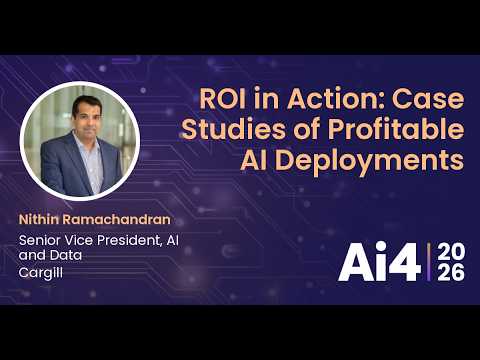
Cargill AI Chief Links AI Value to Operating Income Metric
Ai4
Enterprise AI initiatives deliver up to 10x ROI only when organizations standardize tooling early and shift focus from task automation to proprietary moats and operating income impact.
## Background
Published on YouTube by Ai4 on August 20, 2026, this video features Nithin Ramachandran, Senior Vice President of AI and Data at Cargill. According to the page description, the presentation outlines a practical framework for identifying where AI creates enterprise value, establishing an execution strategy, and implementing a measurement model to bridge the gap between AI expenditure and measurable outcomes.
## TL;DR
Nithin Ramachandran presents a strategic playbook for scaling enterprise AI from initial experimentation to measurable economic returns. He introduces a three-horizon framework that categorizes AI investments into foundational competency, process transformation, and proprietary differentiators that generate the majority of enterprise value. To evaluate these initiatives, he details a four-layer measurement hierarchy spanning system performance, behavioral telemetry, operational capabilities, and overarching enterprise value. Ultimately, Ramachandran advises consolidating all financial impacts into a single master metric, Return on Operating Income (ROOI), to align AI execution with boardroom expectations.
## Atmosphere & style
The presentation carries a pragmatic, authoritative, and boardroom-ready tone, driven by Ramachandran's extensive experience across space research, venture capital, and enterprise transformations. His delivery is structured and polished, using clear visual schematics and personal anecdotes to translate complex AI strategy into actionable business principles. The atmosphere feels like a high-level executive masterclass, steadily building confidence as it moves from technical friction points to concrete metrics that resonate with C-suite leadership.
## Key takeaways
- [00:04](https://www.youtube.com/watch?v=YdU9-hoTZhY&t=4s) The primary constraint facing enterprise AI is no longer technical capability, but demonstrating clear, quantifiable economic value in the boardroom.
- [00:04](https://www.youtube.com/watch?v=YdU9-hoTZhY&t=4s) A major gap exists between growing AI spend and tangible value realization across enterprise organizations.
- [00:33](https://www.youtube.com/watch?v=YdU9-hoTZhY&t=33s) Organizations evolve through three stages of AI adoption: Early Experimentation (Phase 1), Focused Use Cases (Phase 2), and Intentional Scaling (Phase 3).
- [00:33](https://www.youtube.com/watch?v=YdU9-hoTZhY&t=33s) Uncoordinated tools and a lack of governance cause enterprises to hit a value dip between Phase 2 and Phase 3, preventing effective multi-agent orchestration.
- [00:33](https://www.youtube.com/watch?v=YdU9-hoTZhY&t=33s) Establishing rigid architectural and tooling standards early is mandatory to prevent operational friction and enable smooth AI scaling.
- [00:30](https://www.youtube.com/watch?v=YdU9-hoTZhY&t=30s) Horizon 1 investments—workforce prompt literacy and foundational data—are fixed 'pay to play' costs that should not be expected to yield exponential ROI on their own.
- [00:30](https://www.youtube.com/watch?v=YdU9-hoTZhY&t=30s) Poor prompting incurs direct financial costs for the enterprise.
- [00:30](https://www.youtube.com/watch?v=YdU9-hoTZhY&t=30s) Horizon 2 focuses on end-to-end process transformation rather than localized task automation, generating 20% to 25% of total enterprise AI value.
- [00:30](https://www.youtube.com/watch?v=YdU9-hoTZhY&t=30s) Automating isolated sub-tasks rarely reduces headcount or cost structure unless the entire process workflow is redesigned.
- [00:30](https://www.youtube.com/watch?v=YdU9-hoTZhY&t=30s) 75% of total enterprise AI value resides in Horizon 3, which involves applying custom-built AI to a company's unique, proprietary moats.
- [00:30](https://www.youtube.com/watch?v=YdU9-hoTZhY&t=30s) Horizon 3 projects should be managed like a venture capital portfolio by testing multiple concepts and scaling only the top differentiators.
- [12:00](https://www.youtube.com/watch?v=YdU9-hoTZhY&t=720s) A multi-tiered measurement framework must connect system performance (Level 4), human behavioral adoption (Level 3), and capability metrics (Level 2) to enterprise value (Level 1).
- [12:00](https://www.youtube.com/watch?v=YdU9-hoTZhY&t=720s) Tracking human behavioral telemetry—whether users actively accept and act on AI suggestions—is a critical metric missing in most enterprise rollouts.
- [16:08](https://www.youtube.com/watch?v=YdU9-hoTZhY&t=968s) All financial outcomes should be consolidated into a single master financial metric—Return on Operating Income (ROOI)—to communicate value effectively to the board and C-suite.
- [16:08](https://www.youtube.com/watch?v=YdU9-hoTZhY&t=968s) Communicating AI success requires tailoring metrics to organizational altitude: system telemetry for engineers, behavioral metrics for product leads, and ROOI for executives.
## Detailed walkthrough
### [00:04](https://www.youtube.com/watch?v=YdU9-hoTZhY&t=4s) Strategic Alignment: Shifting Focus from Use Cases to Enterprise Value
Nithin Ramachandran, Senior Vice President of AI and Data at Cargill, frames his perspective around driving macro-level enterprise impact rather than narrow, isolated use cases. The core mandate in executive AI leadership is to deliver results that resonate directly with the CEO, the CFO, and the board. Reflecting on his own career trajectory, Ramachandran recounts starting as a research engineer in the Indian space research program (ISRO). What struck him most was not just the intricate physics simulations, but the sheer economic leverage of data and AI—such as delivering the Indian moon mission (Chandrayaan) at one-tenth the cost of a typical NASA program by replacing physical rocket launches with AI-driven statistical modeling and simulations.
His professional journey spans both the investment and operational sides of technology. He ran a startup accelerator collaborating with Silicon Valley venture capitalists, hyperscalers, and healthcare enterprises to translate intellectual property into commercial outcomes. Later, in management consulting for the hospitality and travel sectors, he helped transform loyalty programs from balance sheet liabilities into major profit centers—akin to how Delta Air Lines or Marriott derive substantial profitability from the proprietary algorithms underpinning their loyalty ecosystems. Having led enterprise transformations at companies like Ecolab, 3M, and now Cargill, Ramachandran emphasizes that the primary constraint facing modern enterprises is no longer technical capability—which is already proven—but demonstrating clear, quantifiable economic value in the boardroom.
- Typical AI initiatives Ramachandran has spearheaded deliver an executive-level return of **4x to 10x ROI**.
- Broad enterprise adoption and boardroom discussions are heavily informed by recent research from firms like Deloitte and McKinsey showing a gap between AI spend and value realization.
[00:33](https://www.youtube.com/watch?v=YdU9-hoTZhY&t=33s) The AI Maturity Curve: Overcoming the Phase 2 Scaling Chasm
Organizations typically navigate a predictable three-stage progression when scaling artificial intelligence. The journey begins with **Phase 1: Early Experimentation**, characterized by high organizational enthusiasm, widespread deployment of AI assistants, and compelling anecdotal proof points—such as drafting emails faster or speeding up document review. This momentum transitions into **Phase 2: Focused Use Cases**, where leadership selects high-priority areas to deploy production-grade solutions targeting specific workflows and customer experiences. The ultimate goal is **Phase 3: Intentional Scaling**, where proven use cases are systematically expanded into enterprise playbooks to generate exponential financial returns.
```
AI MATURITY & VALUE CURVE
-------------------------
Value
^ / Phase 3: Intentional Scaling
| / (Exponential Value Creation)
| /
| Phase 2: /
| Focused Bets /
| () <-- DIP / (Caused by uncoordinated
| / \__________/ tooling & lack of standards)
| Phase 1:
| Early Exp.
+--------------------------------------------------------> Time
```
However, most enterprises stumble into a critical trough between Phase 2 and Phase 3 due to **uncoordinated AI scaling**. When thousands of employees across a multi-billion-dollar enterprise adopt disparate tools without central governance—for instance, software engineering teams fragmenting between Codium, Cursor, GitHub Copilot, or Jira—it creates severe operational friction. These fragmented point solutions prevent multi-agent orchestrators from calling APIs efficiently and stop teams from linking isolated workflows into end-to-end business processes. To avoid this scaling trap, enterprises must establish rigid architectural standards extremely early in their AI journey.
- Early experimentation relies heavily on personal productivity gains, but isolated efficiency does not automatically compound into balance-sheet returns.
- Standardizing tools early is mandatory to enable orchestration agents to operate smoothly across corporate systems.
[00:30](https://www.youtube.com/watch?v=YdU9-hoTZhY&t=30s) The Three Horizons of AI Value Creation
To build a self-sustaining engine for continuous return on investment, enterprise leaders should organize their strategy across three distinct, reinforcing horizons:
```
+-------------------------------------------------------------------+
| THE THREE HORIZONS FLYWHEEL |
+-------------------------------------------------------------------+
| Horizon 1: Organizational Competency & Data Foundations |
| (Table stakes / Fixed Cost - "Pay to Play") |
+-------------------------------------------------------------------+
|
v
+-------------------------------------------------------------------+
| Horizon 2: Capability & Process Transformation |
| (Competitive Parity - 20-25% of Total AI Value) |
+-------------------------------------------------------------------+
|
v
+-------------------------------------------------------------------+
| Horizon 3: Proprietary Differentiation & Custom Moats |
| (Market Leadership - 75% of Total AI Value) |
+-------------------------------------------------------------------+
```
1. **Horizon 1: Organizational Competency & Foundations.** This involves upskilling workforce prompt literacy, training knowledge workers to re-engineer their daily routines, and breaking down enterprise data silos. Ramachandran highlights an insightful industry rule of thumb: *"When someone writes a really bad prompt, who pays the price? It is the enterprise that pays the price."* Horizon 1 investments must be treated as a fixed cost or table stakes—the price of admission to participate in AI—rather than expecting it to generate immediate exponential returns.
2. **Horizon 2: Business Capability Transformation.** Real financial impact begins when AI is applied to entire end-to-end processes rather than localized tasks. For example, giving a customer service representative an AI drafting tool might help them write replies faster, but it won't reduce overall resolution time if the rest of the ticket-routing pipeline remains bottlenecked. Furthermore, targeting workforce reduction by automating 10% of a job's task list rarely eliminates the role itself; it simply spends budget to optimize fragmented sub-tasks without changing headcount or cost structure. Horizon 2 focuses on process-level redesign, unlocking **20% to 25%** of AI's total potential value.
3. **Horizon 3: Strategic Differentiation & Custom Moats.** The remaining **75% of total enterprise value** stems from applying AI directly to a company's unique, competitive moat—such as proprietary datasets, trade secrets, domain expertise, or supply chain networks (analogous to Amazon's two-day shipping logistics or Google's search algorithms). While Horizon 1 and 2 capabilities can be powered by off-the-shelf third-party tools to maintain competitive parity, Horizon 3 requires custom-built solutions. Organizations should manage Horizon 3 like a venture capital portfolio: test 10 high-impact proof-of-concepts, advance 4 into monetizable pilots, and scale 1 or 2 into enterprise-wide differentiators.
[12:00](https://www.youtube.com/watch?v=YdU9-hoTZhY&t=720s) Structuring a Multi-Tiered Measurement Framework
A common failure mode in AI execution is relying exclusively on delayed financial metrics or narrow activity counts. Enterprise programs require a clear distinction between **leading metrics** (which verify operational progress) and **lagging metrics** (which prove final financial outcomes). Drawing on an initiative from his tenure at 3M, Ramachandran describes building an agentic real-time sales coach. Waiting 12 months for sales revenue or customer retention numbers (lagging metrics) would leave leadership blind to whether the deployment was working in real time. Instead, the program evaluated progress across a four-layer measurement hierarchy:
- **Level 4 (System Telemetry):** Engineers monitor base platform operational metrics, such as model accuracy, drift, system latency, and token cost spend.
- **Level 3 (Behavioral Telemetry):** Product managers track human behavior—verifying whether sales reps actually open, accept, and act upon the AI recommendations rather than ignoring them. Ramachandran notes this behavioral layer is missing in almost every initial enterprise rollout he reviews.
- **Level 2 (Business Capability Metrics):** Operational leaders measure domain-specific process improvements, such as reduced sales cycle times, improved first-contact resolution, or increased customer retention.
- **Level 1 (Enterprise Value Metrics):** Executive leaders map all underlying use cases into four core business drivers: revenue growth, cost reduction, risk mitigation, or improved customer experience.
[16:08](https://www.youtube.com/watch?v=YdU9-hoTZhY&t=968s) Unifying AI ROI: The Return on Operating Income (ROOI) Standard
While multi-tiered scorecards are essential for operational execution, CEOs and boards do not want to manage dozens of disparate use-case metrics. To communicate AI performance effectively to executive leadership and external investors, all financial impacts across revenue growth, gross margins, cost-to-serve, and general administration expenses should be consolidated into a single master balance-sheet metric: **Return on Operating Income (ROOI)**.
By linking foundational investments (treated as capital/infrastructure baseline) and operational rollouts directly to operating income improvement, the enterprise avoids presenting isolated "vanity metrics." Operating income is the exact financial line item that investors and board members evaluate because it reflects net cash generated from business operations. Tailoring communication to the appropriate organizational altitude—discussing system performance with engineering, behavioral adoption with product managers, capability efficiency with operational VPs, and ROOI with the board—aligns technical execution directly with shareholder value.
<ElicitationsGroup message="Where should we go from here with this framework?">
<Elicitation label="Draft an executive memo for a CEO proposing this AI framework" query="Draft an executive memo to a CEO and CFO proposing Nithin Ramachandran's 3-Horizon AI Framework and ROOI measurement model for our company."/>
<Elicitation label="Create a multi-tiered AI scorecard template in Markdown" query="Create a detailed template for a multi-tiered AI scorecard covering System, Behavioral, Capability, and Enterprise ROOI metrics."/>
</ElicitationsGroup>
[18:45](https://www.youtube.com/watch?v=YdU9-hoTZhY&t=1125s) Concluding Remarks and Final Q&A Invitation
Nithin Ramachandran wraps up his presentation by reflecting on the core goals of the talk, expressing hope that the insights shared provide valuable perspective for enterprise leaders and peers seeking to optimize their own AI and data programs. He emphasizes that the framework presented is meant to offer practical strategies that audience members can immediately bring back to their organizations to refine their strategy, establish clear value metrics, and bridge the gap between AI expenditure and measurable business outcomes.
Following his closing remarks, Ramachandran extends a warm thank you to the audience for their time and attention, expressing his gratitude to the conference organizers for the platform before opening the floor to questions from attendees. The session concludes with appreciative applause as he wishes everyone a productive and enjoyable remainder of the event.
## Notable quotes
> [03:00](https://www.youtube.com/watch?v=YdU9-hoTZhY&t=180s) When someone writes a really bad prompt, who pays the price? It is the enterprise that pays the price. — Nithin Ramachandran
## Mentioned
Nithin Ramachandran, Cargill, Ai4, Indian Space Research Organisation, ISRO, Chandrayaan, NASA, Ecolab, 3M, Deloitte, McKinsey, Codium, Cursor, GitHub Copilot, Jira, Delta Air Lines, Marriott, Silicon Valley
## Video description
Nithin Ramachandran - Senior Vice President, AI and Data, Cargill
Your AI token spend keeps climbing — but can you actually prove what it's buying you?
Enterprises are caught in an impossible bind: pressured to deploy AI aggressively, yet held accountable for results they often can't quantify. Most organizations have already cycled through mass experimentation and then a retreat to "focused bets" — and neither approach has consistently delivered the value leadership expected.
Attendees will learn a foundational framework for identifying the specific points where AI drives enterprise impact, moving beyond generic use-case lists to a structured way of evaluating where investment actually translates into outcomes. The talk then walks through how to construct an execution strategy paired with a rigorous measurement framework — so value is planned, tracked, and defended rather than hoped for. This is a battlefield-tested approach, refined through real enterprise deployment with tangible results behind it.
Whether you're leading AI strategy, managing a budget that increasingly includes AI spend, or trying to bring discipline to a chaotic experimentation pipeline — this talk offers a practical path from AI activity to AI value, and a framework you can start applying the moment you leave the room.
Nithin Ramachandran, Senior Vice President of AI and Data at Cargill, argues that enterprise AI initiatives often stall because organizations prioritize isolated task automation over board-level economic returns. He contends that scaling AI effectively requires bridging the operational chasm between early experimentation and strategic differentiation by enforcing early architectural standards, redesigning end-to-end processes, and aligning all initiatives to operating income.
Overcoming the Phase Two AI Scaling Chasm (0:33)
Enterprises generally progress through three phases of AI maturity: early personal productivity experimentation (Phase 1), focused production bets on specific workflows (Phase 2), and intentional enterprise scaling (Phase 3). However, organizations frequently encounter a severe performance trough between the second and third phases. According to Ramachandran, this stall is driven by uncoordinated scaling, in which decentralized departments adopt competing, fragmented tooling—such as engineering teams arbitrarily splitting between GitHub Copilot, Cursor, Codium, and Jira.
This lack of architectural consistency creates operational friction that prevents multi-agent orchestrators from accessing corporate APIs and prohibits teams from linking isolated workflows into cohesive pipelines. Ramachandran warns that while isolated productivity gains drive early excitement, they do not compound into balance-sheet improvements. To clear this chasm, leadership must establish rigid architectural and integration standards early in their deployment lifecycle.
Allocating Investment Across Three Value Horizons (0:30)
To construct a sustainable economic engine, Ramachandran outlines a three-horizon framework. Horizon 1 encompasses foundational organizational competency, data silo remediation, and workforce prompt literacy. Ramachandran emphasizes that when an employee writes poor prompts, the enterprise absorbs the financial cost. Consequently, Horizon 1 must be treated as a non-negotiable fixed cost of admission rather than a source of immediate exponential returns.
Horizon 2 targets end-to-end business capability transformation, which generates an estimated 20% to 25% of total AI value. Ramachandran cautions against the common pitfall of automating 10% of an individual employee's tasks, noting that shaving fragmented minutes does not eliminate headcount or structurally reduce costs; impact requires re-engineering entire workflow pipelines. Finally, Horizon 3 captures the remaining 75% of enterprise value by building custom, proprietary algorithms atop defensible corporate assets, such as unique supply chains, proprietary datasets, or trade secrets. He recommends managing Horizon 3 like a venture portfolio—testing ten high-impact concepts to yield one or two enterprise-wide differentiators.
Tracking Execution Through Multi-Layered Telemetry (12:00)
Enterprise AI execution frequently fails when leaders rely exclusively on delayed lagging indicators, such as annualized revenue or customer churn. Citing an agentic sales-coach deployment from his tenure at 3M, Ramachandran advocates for a four-level measurement hierarchy that balances leading operational progress with lagging business outcomes.
At the foundational tier, engineers track Level 4 system telemetry, including model drift, inference latency, accuracy, and token expenditures. Level 3 evaluates behavioral telemetry—a layer Ramachandran finds missing in most enterprise audits—verifying whether frontline staff actively accept and act upon AI recommendations. Operational vice presidents monitor Level 2 capability improvements, such as first-contact resolution rates or shortened sales cycles, while executive leadership evaluates Level 1 financial drivers spanning revenue growth, margin expansion, risk mitigation, and cost reduction.
Unifying Executive Measurement Under Operating Income (16:08)
While functional managers require granular operational telemetry, C-suite executives and boards of directors cannot manage dozens of disparate use-case metrics. Ramachandran asserts that all foundational investments, productivity improvements, and cost-to-serve reductions should ultimately consolidate into a single financial standard: Return on Operating Income (ROOI).
Because operating income directly measures the net cash generated from business operations, it aligns technical achievements directly with shareholder expectations and institutional investor scrutiny. Ramachandran stresses the importance of matching reporting altitude to the stakeholder: engineering teams review technical accuracy and drift, product managers monitor adoption behavior, business unit leaders track capability efficiency, and the board evaluates ROOI.
Ramachandran reports that his enterprise AI programs consistently target executive returns of 4x to 10x ROI; however, broader enterprise adoption remains constrained by documented industry gaps between technological spending and realized value. Sustained execution depends on whether corporate leadership can enforce centralized governance over fragmented software tools before decentralized experimentation calcifies into unmanageable technical debt.
## Background
本视频由 Ai4 频道于 2026 年 8 月 20 日发布在 YouTube 平台上。演讲嘉宾为嘉吉(Cargill)AI 与数据高级副总裁 Nithin Ramachandran,内容主要探讨企业在面对日益攀升的 AI 支出时,如何跨越无序实验与单点用例的瓶颈,构建一套将 AI 投入切实转化为可衡量商业回报与底线收益的实战框架。
## TL;DR
演讲者结合在 ISRO、3M 及嘉吉等机构的实战经验,指出企业实现 AI 价值的核心障碍在于跨部门的无序扩张与缺乏统一标准。为此,他提出了“三大层级(Three Horizons)”价值模型,强调约 75% 的核心商业价值源于基于专有数据自主构建的护城河,而非通用型 AI 工具。在落地与衡量层面,他倡导采用“10-4-1”的风险投资组合筛选机制,并构建从领先指标到滞后指标的四层度量体系。最终,他建议企业统一使用“营业利润回报率(ROOI)”向高管和董事会汇报,实现 AI 项目对全局财务报表的直接赋能。
## Atmosphere & style
整场演讲展现出极其沉稳、干练且直击本质的跨国企业高管风范,彻底跳脱了微观技术细节与虚幻的市场炒作。演讲者以从容自信且逻辑严密的语调,将航天工程与财富 500 强企业的转型案例娓娓道来,叙事兼具宏观商业格局与落地实操性。聆听过程充满理性与清醒感,让人清晰感受到从狂热的技术狂欢向严谨的商业与财务纪律回归的力量。
## Key takeaways
- [00:04](https://www.youtube.com/watch?v=YdU9-hoTZhY&t=4s) 当前企业 AI 发展的核心瓶颈已从“技术能否实现”转向“能否兑现可量化的企业级商业价值(Enterprise Value)”。
- [03:34](https://www.youtube.com/watch?v=YdU9-hoTZhY&t=214s) 企业在经历早期实验与聚焦用例阶段后,常因部门各自为战、工具不兼容和数据孤岛,陷入无法规模化的“成熟度断谷”。
- [03:34](https://www.youtube.com/watch?v=YdU9-hoTZhY&t=214s) 在规划 AI 价值创造的早期,必须自上而下确立企业级统一的技术与数据标准,为后续高阶 Agent 编排奠定基础。
- [06:30](https://www.youtube.com/watch?v=YdU9-hoTZhY&t=390s) 第一层级(Horizon 1)的全员 AI 普及与基础设施属于“入场门票(Fixed Cost)”,并不直接贡献超额 ROI。
- [06:30](https://www.youtube.com/watch?v=YdU9-hoTZhY&t=390s) 第二层级(Horizon 2)需优化端到端业务价值流而非孤立用例,通过提升流程效率释放约 20% 至 25% 的 AI 价值。
- [06:30](https://www.youtube.com/watch?v=YdU9-hoTZhY&t=390s) 企业约 75% 的核心商业价值(第三层级 Horizon 3)来自自主研发定制方案,并将 AI 与专有数据和业务护城河深度融合。
- [11:32](https://www.youtube.com/watch?v=YdU9-hoTZhY&t=692s) 企业应采取类似风险投资(VC)的组合筛选模式,通过“10 个 PoC -> 4 个试点 -> 1 个规模化落地”梯次推进 AI 创新。
- [12:12](https://www.youtube.com/watch?v=YdU9-hoTZhY&t=732s) 评估 AI 价值不能仅依赖滞后指标,需构建涵盖系统技术、行为遥测、业务能力和企业价值的四层指标体系。
- [12:12](https://www.youtube.com/watch?v=YdU9-hoTZhY&t=732s) 行为遥测(Behavioral Telemetry)是当前企业度量中最常缺失的领先指标,缺少对用户实际使用行为的监测就无法保障最终商业成果。
- [16:13](https://www.youtube.com/watch?v=YdU9-hoTZhY&t=973s) 向董事会与高管汇报时,应将所有零散用例的财务收益统一归结为营业利润回报率(ROOI),用高管熟悉的财务语言论证 AI 投资价值。
## Detailed walkthrough
### [00:04](https://www.youtube.com/watch?v=YdU9-hoTZhY&t=4s) 个人背景与企业级 AI 价值的宏观视角
演讲者 Nithin Ramachandran 首先明确了本次分享的视角定位:与许多关注具体单点用例(Use Case)的技术讨论不同,作为企业高管,他的职责是推动能够获得 CEO、CFO 及董事会全面认可与支持的“企业级价值”(Enterprise Value)。因此,本次分享跳过微观的技术实现细节(如 GitHub 代码提交等),从宏观的商业回报与经济效益切入。
随后,他回顾了自己跨越科研、投资与大型企业转型的 AI 历程。他的 AI 之旅始于印度空间研究组织(ISRO)担任研究工程师。当时最令他震撼的不是复杂的模拟仿真本身,而是数据与 AI 所带来的巨大经济效益——印度的月球探测任务(Moon Mission)预算仅为 NASA 类似项目的十分之一,其核心原因正是借助基于机器学习与统计学的 AI 仿真大幅减少了昂贵的实际火箭发射次数。此后,他转向投资领域,运营初创加速器,与硅谷风投(VC)、超大规模云厂商(Hyperscalers)及医疗客户合作,将知识产权转化为商业价值;接着在酒店与旅游业从事咨询,主导将达美航空(Delta)、万豪(Marriott)等企业的客户忠诚度计划(Loyalty Programs)从资产负债表上的“成本亏损项”转变为核心“利润中心”;最终,他将这些经验带入大型跨国企业,先后在 3M、Ecolab(艺康)以及现在的 Cargill(嘉吉)主导全球级数字化与 AI 转型。在这些企业级实践中,他所负责的项目均实现了 4 到 10 倍的投资回报率(ROI)。
- **技术能力的成熟 vs. 商业价值的断层**:德勤(Deloitte)和麦肯锡(McKinsey)等多家机构的调研显示,当前企业 AI 发展的核心瓶颈已不再是“技术能否实现”,而在于“企业级价值能否兑现”。
- **分享初衷**:面对行业内普遍存在的“AI 投入大却见不到底线收益”的焦虑,提炼一套经过实战验证的价值管理框架。
---
### [03:34](https://www.youtube.com/watch?v=YdU9-hoTZhY&t=214s) 企业 AI 成熟度曲线与“规模化陷阱”
企业在规模化应用 AI 的进程中通常会经历四个主要阶段,但在落地过程中往往会在中期遭遇严重的价值断层:
```mermaid
flowchart LR
accTitle: 企业 AI 成熟度与扩展困境演进图
subgraph S1["早期探索"]
A["阶段一:广泛实验<br/>(Early Experimentation)"]
end
subgraph S2["重点攻关"]
B["阶段二:聚焦用例<br/>(Focused Use Cases)"]
end
subgraph S3["断层与规模化"]
C{"成熟度断层<br/>(无序扩张与数据孤岛)"}
D["阶段三:刻意规模化<br/>(Intentional Scaling)"]
end
subgraph S4["终极目标"]
E["阶段四:指数级价值创造<br/>(Exponential Value Creation)"]
end
A --> B
B --> C
C -->|建立统一标准与消除孤岛| D
D --> E
```
1. **阶段一:早期实验(Early Experimentation)**:企业为员工普遍配发 AI 助手,组织内部充满热情。这一阶段充斥着各种主观个案证据(Anecdotal Evidence),例如“写邮件更快了”、“审阅文档更高效了”或“回复客户更及时了”。
2. **阶段二:聚焦用例(Focused Use Cases)**:企业开始在特定战略领域加大投资,打造生产级的 AI 解决方案,以优化客户体验和部分业务流程。
3. **阶段三:刻意规模化(Intentional Scaling)**:企业不再依赖零散的单点工具,而是通过规范化的业务打法(Playbooks),在整个组织内系统性推广 AI 价值。
4. **阶段四:指数级价值创造(Exponential Value Creation)**:这也是上市公司管理层向投资者和董事会承诺并追求的终极商业回报。
**阶段二到阶段三之间的“价值断谷”**:
许多企业在完成单点用例开发后,无法跨越到指数级增长阶段。其根本原因在于**无序的 AI 扩张(Uncoordinated AI Scaling)**。在拥有数万名员工、年营收数十上百亿美元的大型组织中,各部门往往各自为战,引入各种互不兼容的特定工具(例如研发团队中一部分人用 Cursor,另一部分人用 GitHub Copilot)。缺乏统一标准导致当企业试图构建高阶的智能体编排系统(Orchestrator Agent)进行跨系统多重调用时,协作成本急剧上升,无法将孤立的用例串联进端到端的完整业务流程中。
- **核心认知原则 1**:在规划 AI 价值创造的极早期阶段,就必须确立并推行企业级统一的技术与数据标准。
---
### [06:30](https://www.youtube.com/watch?v=YdU9-hoTZhY&t=390s) AI 价值创造的三大飞轮层级(Three Horizons)
为了体系化推动 AI 价值落地,Nithin Ramachandran 提出了一个环环相扣、相互促进的“三大层级(Three Horizons)”飞轮模型:
| 规划层级 (Horizons) | 核心定位与投入重点 | 价值属性与预期回报占比 | 实施策略 (Buy vs. Build) |
|:--- |:--- |:--- |:--- |
| **第一层级 (Horizon 1)**<br/>组织能力与数据基座 | 普及 AI 助手、全员工作流融合培训、打通底层数据孤岛 | **入场门票 (Fixed Cost / Pay to Play)**<br/>不直接产生超额 ROI | 采购成熟第三方工具 (Third-party Tools) |
| **第二层级 (Horizon 2)**<br/>端到端流程能力重塑 | 跨单点用例,重构完整业务流程与价值流(如端到端客诉解决) | **竞争均势 (Competitive Parity)**<br/>贡献约 20% ~ 25% 的 AI 潜在价值 | 采购成熟工具 + 深度流程集成 |
| **第三层级 (Horizon 3)**<br/>核心护城河与差异化创新 | 放大企业专有数据、专有知识与独特业务优势(如核心搜索、极速履约) | **差异化竞争优势**<br/>贡献约 75% 的核心商业价值 | 自主研发定制方案 (Proprietary Build) |
#### 第一层级(Horizon 1):组织素养与基础设施建设
该层级关注员工赋能与数据基石。仅仅分发 AI 软件账号远远不够,关键在于培训员工如何正确提问并将其无缝嵌入日常工作。“当有人写出一条极差的 Prompt 时,真正为此买单的是企业。”如果十万名知识工作者无法实质性改变日常工作习惯,AI 赋能就沦为空谈。此外,解决阶段二向阶段三跨越失败的关键在于打破数据孤岛。管理层常犯的一个典型错误,是将属于第一层级的投入(如给全员配置 Copilot)误以为能带来指数级的商业回报。实际上,这部分投入属于**固定成本(Fixed Cost)**,只是进入 AI 时代的“入场券”(Pay to play),本身并不直接贡献超额 ROI。
#### 第二层级(Horizon 2):业务流程与能力构建
进入第二层级,企业必须停止针对孤立“用例”做局部优化,转而优化整个**业务流程与价值流(Value Streams)**。以客户服务为例,让客服代表写邮件的速度提升 10%,并不能缩短案件的最终解决时间(Resolution Time),因为后续审批与流转环节依然存在瓶颈。同样,很多管理者把“削减人力”(Workforce Reduction)作为 AI 的核心衡量指标,但如果 AI 仅仅优化了某员工 10% 的日常琐碎工作,该岗位根本无法被精简,企业实际上花费了巨资却一无所获。只有在端到端的流程级别应用传统 ROI 计算模型进行重塑,才能释放 AI 约 20% 至 25% 的潜在价值。
#### 第三层级(Horizon 3):专有护城河与核心差异化
决定企业成败的最关键价值(约占 75%)绝不会来自“在 Claude 与 Copilot 之间做选择”,也不会来自“选择 AWS 还是微软”。真正的核心价值来源于将 AI 与企业的**专有护城河(Proprietary Moat)**深度融合——无论是亚马逊(Amazon)的两日达履约体系,还是谷歌(Google)对搜索算法的极致深耕,每家企业都有其独特的专有数据、专有知识和产品体系。这一层级的超额回报必须通过**自主构建(Build)**高度定制化的专有解决方案来实现,而非依赖标准化的行业通用软件。
### [11:32](https://www.youtube.com/watch?v=YdU9-hoTZhY&t=692s) 以风险投资组合模式推进 AI 实验与落地
在企业内部推动人工智能创新时,必须采取类似风险投资(VC)的组合管理策略。如果仅仅依靠单一的试点项目,很难挖掘出企业价值的最大潜能。演讲者建议,企业可以挑选 10 个极具前景的创意开展概念验证(PoC);在验证阶段后,从中筛选出 4 个具备商业变现能力的方案推向试点阶段;最终挑选出 1 个真正能够规模化落地的项目,以实现全公司范围内的价值释放。只有通过这种层层筛选的 VC 式组合管理模式,企业才能解锁高达 75% 的潜在价值。
当这些规划在纸面上完成后,CEO 与 CFO 都会感到满意。然而,进入日常运营与执行层面时,许多企业往往会在衡量标准上败下阵来。
- **10 个 PoC 项目**:初期的广泛创新与验证。
- **4 个试点项目**:评估商业化与变现可能性。
- **1 个规模化项目**:最终落地并释放全量业务价值。
### [12:12](https://www.youtube.com/watch?v=YdU9-hoTZhY&t=732s) 构建四层指标体系:从领先指标到滞后指标
企业在评估 AI 效果时,最大的误区之一是过于依赖滞后指标(Lagging Metrics),例如直接统计“节省了多少成本”或“节省了多少时间”。演讲者特别强调,这些指标并不能及时指导过程控制,企业必须构建包含领先指标(Leading Metrics)在内的四层度量体系。
以演讲者此前在 3M 公司的实际经验为例,当时他们引入了智能体 AI(Agentic AI)作为销售团队的实时教练。为了确保项目走向成功,他们将指标划分为多个阶段:首先验证模型本身是否运行正常且输出准确;其次监测销售人员行为是否发生改变、是否积极采纳 AI 建议;接着观察客户互动与参与度的提升;最终在 12 个月后,才体现为客户留存率和整体营收的增长。
```mermaid
flowchart TD
accTitle: 四层 AI 评估与沟通指标体系
subgraph L1 ["第一层:基础技术层"]
A1["成本与资源利用率"]
A2["模型准确率与漂移"]
end
subgraph L2 ["第二层:用户行为层"]
B1["行为遥测数据"]
B2["产品实际使用率"]
end
subgraph L3 ["第三层:业务能力层"]
C1["缩短作业周期"]
C2["首次联系解决率"]
end
subgraph L4 ["第四层:企业价值层"]
D1["增加营业收入"]
D2["降低运营成本"]
D3["控制业务风险"]
D4["提升客户体验"]
end
L1 --> L2
L2 --> L3
L3 --> L4
```
在这套四层体系中,不同岗位与层级关注的指标截然不同,沟通时也应因人而异:
| 指标层级 | 评估核心内容 | 沟通与汇报对象 |
|:--- |:--- |:--- |
| **第一层:系统与技术指标** | 成本、利用率、模型准确率、模型漂移(Leading) | 工程与技术团队 |
| **第二层:行为遥测指标** | 用户是否如预期般频繁且正确地使用产品(Leading) | 产品经理与业务实施团队 |
| **第三层:业务能力指标** | 周期缩短、首次联系解决率、准时交付率(Leading/Lagging) | 业务部门领导与运营主管 |
| **第四层:企业价值指标** | 增收、降本、风控、提升客户体验(Lagging) | 董事会、CEO 与 CFO |
演讲者特别指出,**行为遥测(Behavioral Telemetry)** 是目前绝大多数企业项目中最常缺失的一环。如果不知道用户是否真的按照设计意图去使用 AI 工具,就无法保障最终的业务成果。
### [16:13](https://www.youtube.com/watch?v=YdU9-hoTZhY&t=973s) 统一汇报语言:用营业利润回报率(ROOI)打动高管
企业董事会与 CEO 已经厌倦了听取那些“无法累加到企业全局财务报表上”的局部用例胜利。为了让高层清晰看到投资回报,企业必须将所有 AI 用例的成果映射并归结为一个核心财务指标。
在排除基础设施等一次性建设投入后,AI 应用的持续运行、变更管理与用例开发成本,最终都要映射到营收、边际利润与服务成本等财务驱动因素上。演讲者极力推荐使用**营业利润回报率(Return on Operating Income, ROOI)** 作为统一的 ROI 指标。
在财务利润表中,营收、成本、边际利润以及 SG&A(销售、通用与行政费用)等不同项目虽然散布在各行,但“营业利润”(Operating Income)是唯一能将所有因素融会贯通的指标。这不仅是投资者最关心的核心数据,更是直接反映企业盈利能力的“最终成果”。通过将所有用例的贡献归纳至 ROOI,企业便能用统一且严谨的语言向高层展示 AI 投资的真正价值。
- **基层运营团队**:聚焦于使用率、采纳率等技术与行为指标。
- **业务与财务高管**:关注准时履约、客户问题解决率及 sales 增长等业务能力。
- **董事会与 CEO 决策层**:关注单一的 ROOI 核心指标,以及能够决定企业未来胜负的差异化竞争优势。
## Notable quotes
> [00:04](https://www.youtube.com/watch?v=YdU9-hoTZhY&t=4s) 当前企业 AI 发展的核心瓶颈已不再是‘技术能否实现’,而在于‘企业级价值能否兑现’。 — Nithin Ramachandran
> [03:34](https://www.youtube.com/watch?v=YdU9-hoTZhY&t=214s) 在规划 AI 价值创造的极早期阶段,就必须确立并推行企业级统一的技术与数据标准。 — Nithin Ramachandran
> [06:30](https://www.youtube.com/watch?v=YdU9-hoTZhY&t=390s) 当有人写出一条极差的 Prompt 时,真正为此买单的是企业。 — Nithin Ramachandran
> [06:30](https://www.youtube.com/watch?v=YdU9-hoTZhY&t=390s) 让客服代表写邮件的速度提升 10%,并不能缩短案件的最终解决时间,因为后续审批与流转环节依然存在瓶颈。 — Nithin Ramachandran
> [06:30](https://www.youtube.com/watch?v=YdU9-hoTZhY&t=390s) 很多管理者把‘削减人力’作为 AI 的核心衡量指标,但如果 AI 仅仅优化了某员工 10% 的日常琐碎工作,该岗位根本无法被精简,企业实际上花费了巨资却一无所获。 — Nithin Ramachandran
> [06:30](https://www.youtube.com/watch?v=YdU9-hoTZhY&t=390s) 决定企业成败的最关键价值绝不会来自‘在 Claude 与 Copilot 之间做选择’,也不会来自‘选择 AWS 还是微软’。真正的核心价值来源于将 AI 与企业的专有护城河深度融合。 — Nithin Ramachandran
> [11:32](https://www.youtube.com/watch?v=YdU9-hoTZhY&t=692s) 企业在内部推动人工智能创新时,必须采取类似风险投资(VC)的组合管理策略。如果仅仅依靠单一的试点项目,很难挖掘出企业价值的最大潜能。 — Nithin Ramachandran
> [12:12](https://www.youtube.com/watch?v=YdU9-hoTZhY&t=732s) 行为遥测(Behavioral Telemetry)是目前绝大多数企业项目中最常缺失的一环。如果不知道用户是否真的按照设计意图去使用 AI 工具,就无法保障最终的业务成果。 — Nithin Ramachandran
> [16:13](https://www.youtube.com/watch?v=YdU9-hoTZhY&t=973s) 企业董事会与 CEO 已经厌倦了听取那些‘无法累加到企业全局财务报表上’的局部用例胜利。 — Nithin Ramachandran
> [16:13](https://www.youtube.com/watch?v=YdU9-hoTZhY&t=973s) 在财务利润表中,营业利润是唯一能将所有因素融会贯通的指标。这不仅是投资者最关心的核心数据,更是直接反映企业盈利能力的‘最终成果’。 — Nithin Ramachandran
## Mentioned
Nithin Ramachandran, Cargill (嘉吉), ISRO (印度空间研究组织), NASA, Delta (达美航空), Marriott (万豪), 3M, Ecolab (艺康), Deloitte (德勤), McKinsey (麦肯锡), Cursor, GitHub Copilot, Claude, AWS, Microsoft (微软), Amazon (亚马逊), Google (谷歌)
## Video description
Nithin Ramachandran - Senior Vice President, AI and Data, Cargill
Your AI token spend keeps climbing — but can you actually prove what it's buying you?
Enterprises are caught in an impossible bind: pressured to deploy AI aggressively, yet held accountable for results they often can't quantify. Most organizations have already cycled through mass experimentation and then a retreat to "focused bets" — and neither approach has consistently delivered the value leadership expected.
Attendees will learn a foundational framework for identifying the specific points where AI drives enterprise impact, moving beyond generic use-case lists to a structured way of evaluating where investment actually translates into outcomes. The talk then walks through how to construct an execution strategy paired with a rigorous measurement framework — so value is planned, tracked, and defended rather than hoped for. This is a battlefield-tested approach, refined through real enterprise deployment with tangible results behind it.
Whether you're leading AI strategy, managing a budget that increasingly includes AI spend, or trying to bring discipline to a chaotic experimentation pipeline — this talk offers a practical path from AI activity to AI value, and a framework you can start applying the moment you leave the room.
[Source](https://www.youtube.com/watch?v=YdU9-hoTZhY)
Source quotes
[0:04] Nithin Ramachandran: 当前企业 AI 发展的核心瓶颈已不再是‘技术能否实现’,而在于‘企业级价值能否兑现’。
[3:34] Nithin Ramachandran: 在规划 AI 价值创造的极早期阶段,就必须确立并推行企业级统一的技术与数据标准。
[6:30] Nithin Ramachandran: 当有人写出一条极差的 Prompt 时,真正为此买单的是企业。
[6:30] Nithin Ramachandran: 让客服代表写邮件的速度提升 10%,并不能缩短案件的最终解决时间,因为后续审批与流转环节依然存在瓶颈。
[6:30] Nithin Ramachandran: 很多管理者把‘削减人力’作为 AI 的核心衡量指标,但如果 AI 仅仅优化了某员工 10% 的日常琐碎工作,该岗位根本无法被精简,企业实际上花费了巨资却一无所获。
[6:30] Nithin Ramachandran: 决定企业成败的最关键价值绝不会来自‘在 Claude 与 Copilot 之间做选择’,也不会来自‘选择 AWS 还是微软’。真正的核心价值来源于将 AI 与企业的专有护城河深度融合。
[11:32] Nithin Ramachandran: 企业在内部推动人工智能创新时,必须采取类似风险投资(VC)的组合管理策略。如果仅仅依靠单一的试点项目,很难挖掘出企业价值的最大潜能。
[12:12] Nithin Ramachandran: 行为遥测(Behavioral Telemetry)是目前绝大多数企业项目中最常缺失的一环。如果不知道用户是否真的按照设计意图去使用 AI 工具,就无法保障最终的业务成果。
[16:13] Nithin Ramachandran: 企业董事会与 CEO 已经厌倦了听取那些‘无法累加到企业全局财务报表上’的局部用例胜利。
[16:13] Nithin Ramachandran: 在财务利润表中,营业利润是唯一能将所有因素融会贯通的指标。这不仅是投资者最关心的核心数据,更是直接反映企业盈利能力的‘最终成果’。
Source quotes
[3:00] Nithin Ramachandran: When someone writes a really bad prompt, who pays the price? It is the enterprise that pays the price.
Original transcript
[0:04] And as we talk through today, um I'm going to
share a little bit of a zoomed out perspective.
[0:10] Um so my role, um in my role, a lot of the
focus around it is not to deliver specific
[0:17] use case level value, but it's to drive
enterprise value, something that the CEO,
[0:22] the CFO, and the board can go behind. So a
little bit of what you're going to hear today
[0:27] is is a little bit of a zoomed out perspective
that's not at a use case level but more at an
[0:32] enterprise level. So let's get to it. Um so
I want to give you a little bit of background
[0:39] um to my journey with AI. Um I kind of started out
as a research engineer the Indian space research
[0:47] program and what fascinated me was not necessarily
all of the simulations. They were amazing. But
[0:54] what fascinated me was the economic impact of
leveraging data and AI. The Indian moon mission
[1:01] program was delivered at onetenth of the budget
um that a NASA program would take and that was all
[1:07] because of how we reduced the number of launches
we had to do by leveraging AIdriven simulation. So
[1:14] machine learning and statistics that was as it was
called in that time. Um I went on later to more of
[1:20] the investment side running a startup accelerator
working with Silicon Valley VCs uh hyperscalers as
[1:28] well as with healthcare customers to convert
intellectual property into economic value.
[1:33] So it was kind of a different viewpoint um to the
economics of leveraging data and AI and then went
[1:41] on to kind of do consulting with hospitality
businesses uh where we essentially transfer
[1:48] loyalty programs from what used to be a loss
on the balance sheet to a profit center. If you
[1:54] look at companies like Delta or Marriott today, a
lot of their profitability is actually driven by
[1:59] loyalty programs and a lot of it is the algorithms
that run behind it. And finally, my journey has
[2:05] taken me to enterprise level programs where I'm
driving transformations with global companies
[2:10] like Col 3M and now at Cargill. And the entire
focus is more less on the technology but more on
[2:18] driving economic value that's actually meaningful
for investors. So a lot of what I'm going to share
[2:23] is perspective from that background, right? So
we're not going to do a lot of technology. I'm not
[2:28] going to be talking about GitHub commits and and
some of those pieces, but we could take a zoomed
[2:33] out viewpoint. The fact is the technology is here.
Many of you are from product companies that are
[2:40] building amazing products and the reality is the
technology has proven himself itself. when you
[2:46] actually look at discussions that are happening
in the boardroom at the seuite level and that's
[2:51] proven out by studies from Deote and McKenzie
many other firms is we're not seeing the value
[2:57] right and there's a pattern that the constraint is
no longer the capability it's proven value at the
[3:04] enterprise level now as I've run these programs
all the programs that I've had the joy of running
[3:13] have delivered somewhere between 4x to 10x of an
ROI equation, right? And what I wanted to do is
[3:18] because I've been hearing this narrative from many
of my peers as well. It's one of the reasons why
[3:23] when I was invited to talk at AI4, I thought it
would be a good idea to share kind of some of the
[3:28] frameworks that I use as I run these programs.
Right? But let's zoom out a little bit and
[3:34] actually start looking at what journey a company
goes through um when it's starting to leverage AI
[3:40] at scale, right? There's an initial phase of early
experimentation. There's a lot of excitement. We
[3:46] put AI assistance in everybody's hands. People are
excited about it. There's a lot of experimentation
[3:52] that happens. There's a lot of anecdotal evidence
around value, right? You can type an email faster,
[3:57] analyze a document faster, respond to a customer
faster. The story is there. And so that leads to
[4:04] kind of more investments into focus use cases.
companies start to pick strategic areas that
[4:10] they want to focus on and they want to deliver
production grade AI solutions that drive customer
[4:16] experiences and business process workflows. The
idea of where we want to get to on that journey
[4:24] is intentional scaling, right? When you can scale
these one-off use cases that are in production to
[4:31] scale value across the enterprise, you're able
to drive defined playbooks on how to leverage
[4:37] AI and the ultimate goal is to get to exponential
value creation. Right? So when when the narrative
[4:44] happens, when there's when if you're on a public
company talking to investors, if you're talking
[4:51] to executive teams, when they are thinking about
value, they're thinking about that exponential
[4:56] value creation. The problem though is somewhere
in the middle. Many of the companies are either
[5:02] in phase one where they're just starting that AI
journey or they're executed on the you on some use
[5:07] cases. They're seeing some value, but they're
looking for that exponential value creation.
[5:13] The issue though is when you look at the AI
maturity curve of how AI maturity is approaching,
[5:18] you start seeing that dip between phase two
and phase three. And that dip is because of
[5:23] uncoordinated AI scaling. So there are a lot
of products like we've seen a lot of talks
[5:29] where there were a lot of products introduced. I
have the vantage point where I sit and listen to
[5:32] pitches of a lot of companies that are solving
very specific problems very well. By the way,
[5:39] the problem though is when you work in, you
know, a company that's about, you know, multiple
[5:45] billions in size with thousands of employees,
everybody wants to use their own tool. You don't
[5:51] have standards in place on how to solve problems.
If you have software engineers, for example, some
[5:57] of them want to use Kira, some of them want to use
Copilot. What happens is you get uncoordinated AI
[6:03] solutions. So when you think about scaling and
you want to have an AI like an a an orchestrator
[6:09] agent that needs to make multiple calls suddenly
it starts to become inefficient. It's it becomes
[6:14] difficult to tie use cases together to actually
impact a process. So learning number one really
[6:21] important from a value creation standpoint to
think about standards extremely early. So let's
[6:30] talk a little bit about leading the AI value
journey. If you're at the vantage point where
[6:34] you're having to drive the conversation around
AI value, let me share a little bit about how I
[6:39] think through it, right? And how I've driven these
programs. So I think about it in three horizons.
[6:44] And these three horizons work together to as a
flywheel, right? That drives continuous value. So
[6:51] each flywheel building on the other. The first one
is about investing into organizational competency.
[6:58] So this is not just ensuring that people are given
assistance but they are actually shown how to use
[7:04] them. I think there was one of the speakers that I
was listening to and he made a great statement. He
[7:08] was like when someone writes a really bad prompt
who pays the price right it is the enterprise
[7:14] that pays the price. So teaching people how to use
tools effectively become important, right? And I
[7:20] sit at a vantage point where yes, there's a lot of
value delivered by software engineering, but a lot
[7:26] of value is also delivered when you have 100,000
knowledge workers around the world leveraging AI
[7:32] assistance to optimize their day-to-day work. The
Horizon 1 investment has to also be on teaching
[7:38] people how to integrate AI into their day-to-day
work. So if you give someone an assistant,
[7:44] they'd love to play around with it. I mean I can
sit on clude all day long but the key part is am
[7:49] I being shown how I can change the way I work and
it would be seen to be such an obvious thing to do
[7:55] but the reality is it doesn't happen that way and
I've seen that many times over. So teaching people
[8:00] how to integrate in AI into their day-to-day work
becomes critical. It's a critical value driver.
[8:06] The third part is investing into foundations.
Data foundations are extremely important. That
[8:13] phase 2 to phase three scaling issue a lot of the
time happens because of data silos. So investing
[8:19] into that data becomes important. So if we go back
to all of these CEOs and CIOS talking about how
[8:26] they're not able to see value, here's problem
number one. They're in horizon one. They've
[8:33] given people assistance, right? and they're expan
expecting exponential value. So the way I look at
[8:40] it is you have to treat that as a fixed cost. It
is not even a value equation. This is pay to play
[8:47] in the AI space. This is not where you're going to
get your value from. Where you get start getting
[8:52] value from is when you start getting to the next
phase. When you start building to horizon 2,
[8:58] that is about building capability within
the company. This is not about use cases.
[9:03] This is about changing processes and value
streams within the company. So for example,
[9:09] if you're in a customer service workflow,
for example, where there are tickets coming
[9:13] in and you're putting in an assistant in a
customer service rep's hand telling them, hey,
[9:18] you can now type an email faster. That's great.
That doesn't mean the resolution is faster because
[9:23] there are multiple other steps in that process.
So the idea around capability building is to pick
[9:30] an entire process and solve at a process level.
That's when you start seeing value. Many a time I
[9:37] sit down with peers and they talk about not seeing
value at a use case level but not seeing value at
[9:44] an enterprise level. And usually the culprit
is they've optimized for the use case. They
[9:49] haven't optimized for the process. Right? Trying
to optimize. For example, many folks talk about
[9:54] workforce reduction, which by the way, I think is
the worst metric for AI. But let's assume that's
[9:59] a good metric for the sake of argument. You're
only optimizing for 10% of a person's everyday
[10:07] work. Have you actually eliminated that role?
You have not. Right? You what you have done is
[10:13] you've spent a lot of money to optimize for
nothing. So when you think about capability,
[10:18] it's about applying that traditional ROI equation
but at a process level. And that's where you see
[10:24] about 20 to 25% of the potential value from AI.
The key value from AI will not come by choosing
[10:32] between cloud or copilot or choosing between
one vendor over another or AWS versus Microsoft.
[10:39] It comes from taking a step back and thinking
about what differentiates your company. Is it
[10:45] two-day shipping by Amazon? Is it Google doubling
down on search? Every company has a competitive
[10:52] differentiator. They have a proprietary moat that
they sit on. It's proprietary data, proprietary
[10:57] knowledge, proprietary offerings. And the key part
over there is how do you magnify that with AI and
[11:04] that usually will not come from an industry
standard solution that'll come from build. So
[11:09] the way when I think about it and I think about
how we drive value with AI, it's about bringing
[11:14] thirdparty tools to drive Horizon 1 and two
capabilities that are about competitive parity and
[11:20] then talking deeply about differentiation where
you start thinking about what can I build that's
[11:24] unique that differentiates the company and that's
where you see 75% of the value. This is where you
[11:32] drive a lot of experimentation. You run it like
a VC style portfolio. take 10 amazing ideas,
[11:39] run proof of concepts with it, move four out of
those 10 into a pilot stage to make sure that
[11:45] it's monetizable and then maybe pick one out of
them to actually drive scaled value. But you have
[11:51] to run it as a VC style portfolio. And that's how
you see the 75% of the potential value. All right.
[11:59] So now that we've done the value, everybody's
convinced, CEO is happy, CFO is happy. Now we
[12:05] get to the day-to-day operational, you know, kind
of execution of that strategy. This is all good.
[12:12] Looks great on paper, but then at a measurement
standpoint, it falls apart. So a lot of how we
[12:18] talk through or how I drive conversations around
these is not just around lagging metrics. Many a
[12:24] time we talk about how many dollars were saved,
how much time was saved. That is not the right
[12:30] metric to look at. That is a leading metric. That
is not a lagging metric. So a leading metric is
[12:35] metrics that tell you that you're on the right
path. A lagging metric is something that tells
[12:40] you you've achieved the outcome. So for example,
I worked at 3M where one of the key processes we
[12:45] implemented was leveraging agentic AI to provide
insights to the sales team, right? So we had a
[12:51] real-time coach that was working with every sales
team member. So the way we set up the metrics, the
[12:56] leading metrics were one, is the model functioning
well? Is it providing the right outcomes? Second,
[13:04] are we seeing the behaviors come out from right
behaviors from the sales team? Are they using
[13:09] these insights? Third, is the customer engaging?
And finally, we get to our revenue outcome. So,
[13:16] the first three set of metrics that we talk
about are leading metrics. They just tell you
[13:20] that you're on the right path. They don't
tell you that you've achieved the outcome.
[13:24] Your outcome usually comes later. In this sales
example, for example, it was a customer retention
[13:30] use case. And essentially you see the outcome 12
months later. How do you wait for 12 months and
[13:36] you know how do you know that you're on the right
direction? So it's about thoughtful construction
[13:40] of measurements. Your leading metrics first
come from your platform. So this was like for
[13:45] example the earlier talk that we had um that
talked about how you really think about you
[13:51] know your basic measurements in terms of your
cost, your utilization um your model accuracy,
[13:56] your model drift, all of those pieces, right?
Those are your basic foundational AI system level
[14:01] measurements that tells you that your technology
is working right. The second part of it is working
[14:07] with the users of that technology and making
sure that you're actually seeing the behavior.
[14:12] The behavioral telemetry is the one piece I have
seen missing in almost every use case that I have
[14:18] talked about and it's usually one of the first
things I have to ask teams to implement. It's
[14:23] about driving that behavioral telemetry. How do
you know that the user is actually leveraging
[14:28] the product as intentive? Right? And then you
get to the lagging metrics, right? So you get
[14:34] to the business capability metrics which is are
you reducing cycle time? Did you have your first
[14:38] contact resolution? Right? That is your use
case level metrics. But ultimately what the
[14:46] board and the CEO and the CFO care about is about
very simple metrics. Did you grow your revenue?
[14:54] Did you cut your costs? Did you minimize risk?
Have you driven better customer experiences? Those
[15:00] are just the four metrics that everyone cares
about. So the key part over here is that final
[15:05] layer that you get is taking all of your use cases
and mapping it into one of those four categories
[15:11] so that you can report out on it. And that's
how you drive the conversation. You sit down
[15:15] with the engineers, talk about that level four
metric. You sit down with product managers and the
[15:21] implementation team from a business standpoint,
talk about product behavior telemetry, sit down at
[15:27] a leadership level, the leaders that are guiding
each of these initiatives and executing and talk
[15:32] to them about the capability metrics and at the
seuite at the board, we discuss the enterprise
[15:38] value. Right? So that's essentially how you set
up. Now I have stayed away from recommending tools
[15:45] or talking about tools because honestly a lot of
what I care about is about how to think through
[15:49] the problem right and you can have a variety of
different tools. I'm sure that there are a lot of
[15:54] providers over here who provide you telemetry in
each of these categories and and you can there are
[16:00] a lot of choices that you have but the question at
the end of the day is making sure that you bring
[16:05] this framework back together. All right, we'll
get to the final piece which is how you drive that
[16:13] coherent metric and how you drive that reporting.
Bringing all of this back together, right? So, as
[16:18] I said, CEOs and boards are tired of hearing about
use case wins that never add up at the enterprise
[16:23] level. Right? So, your first part is talking about
the investments that you're making. Remember,
[16:29] you're taking your foundational AI investments out
of the picture. Your horizon 1 investments are not
[16:34] counted in this. This is one-time build, your
change management investments and your ongoing
[16:39] operations as you build use cases on top of the
foundations. You're mapping it to financial value
[16:47] drivers from a revenue margin and cost to serve
standpoint. Right? And once you're doing that,
[16:54] the question at the end of the day is
the CEO still needs one metric, not four.
[16:59] And so the metric that I usually always recommend
is your return on operating income. So if you
[17:06] think about a financial statement, you have your
revenue, you have your cost, you have your margin,
[17:11] you have your SGNA, and then your operating
income, right? So your use cases are going to
[17:16] hit at different lines, but your operating income
is the one line item that combines everything and
[17:22] is a number that investors care about because
that's ultimately the money that's coming out
[17:27] of the door, right? And so when we have that,
you now have your singular ROI metric, right?
[17:36] And this has been extremely useful because when
you think about driving value at scale, you want
[17:42] everything to line up and add up to a singular
metric. So as I guide these conversations, it's a
[17:50] lot about when I'm talking to the operating teams,
a lot of what I'm talking about is utilization
[17:54] metrics. Are we seeing the right utilization? Are
we seeing the right adoption? When we're talking
[17:59] at a business leadership level, at the CFO level
and operational leadership, we're talking about
[18:04] business capability. Are you seeing results? Are
you seeing on-time fulfillment? Are you seeing
[18:09] better customer resolution, issue resolutions? Are
you seeing more sales? And when we're talking at
[18:15] the boardroom level, we're talking about the
singular metric and we're talking about our
[18:20] differentiators, things that we are investing into
today that allow us to win in the future, right?
[18:28] So hopefully that gives you something to think
about. It's a little bit more zoomed out than
[18:33] most of the talks that I've seen over here,
but this is my day-to-day perspective that I
[18:37] have to work with. And hopefully if you're product
companies and you're talking to executive teams,
[18:41] please know this is the perspective that they
have. So hopefully this helps you in your
[18:45] discussions. If you're a peer of mine running
it, hopefully this offers some perspective as
[18:50] well into maybe things you can take back and and
optimize your own program. But thank you so much
[18:55] for listening in. appreciate the opportunity.
Happy to answer any questions. [applause]
[19:06] All righty. Well, thank you so
much for your time. I appreciate
[19:09] it. And thanks again. I hope you
enjoy the rest of the conference.