Agibot Ships 16,000 Humanoids as Physical AI Enters Commercial Use
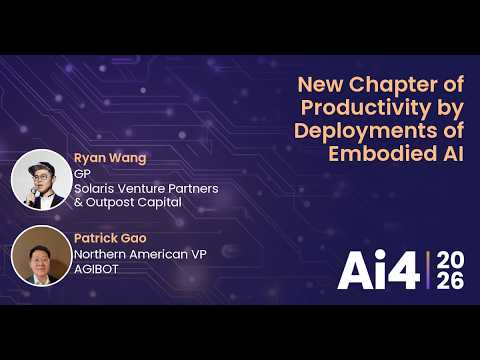
New Chapter of Productivity by Deployments of Embodied AI with Solaris Venture Partners and AGIBOT — Ai4

Ai4

Humanoid robotics will become the largest industry in human history by combining mobile phone volume with automobile unit value as deployments transition from research labs to factory floors.

AI-assisted summary of New Chapter of Productivity by Deployments of Embodied AI with Solaris Venture Partners and AGIBOT — original source. Check the original for full context.

Source published:

Detailed notes

## Background This fireside chat video was published by Ai4 on YouTube on August 21, 2026. The description outlines a discussion between Patrick Gao (North American VP, AGIBOT) and Ryan Wang (General Partner, Solaris Venture Partners & Outpost Capital) on the real-world deployment, manipulation models, and software-hardware integration of embodied AI and humanoid robotics in physical enterprise operations.

## TL;DR Ryan Wang and Patrick Gao discuss the transition of humanoid robotics from research labs into full-scale enterprise workflows, marking 2026 as 'Year One' for commercial deployment. AGIBOT highlights its full-stack approach, six product lines, and real-world deployment cases such as automated QA testing at a Samsung plant. The session breaks down the XYZ curve framework, data collection via teleoperation farms, a 5-layer enterprise robotics architecture, and the shift toward continuous Robotics-as-a-Service (RaaS). Finally, Patrick touches on his personal motivation, comparing the physical AI revolution to past industrial shifts like the transition from horses to automobiles.

## Atmosphere & style The session carries an engaging, forward-looking, and pragmatic tone, balancing venture capital insights with real-world engineering realities. Ryan leads the conversation with structured investor-focused questions, allowing Patrick to articulate technical frameworks and operational metrics with measured enthusiasm. Rather than relying on superficial hype, the dialogue feels grounded in practical business strategy, closing on a thoughtful and visionary note about human productivity.

## Key takeaways - [00:04](https://www.youtube.com/watch?v=jfXNimEvm0s&t=4s) The focus in humanoid robotics is shifting away from initial hype and academic research toward real-world commercial adoption in enterprise workflows. - [00:04](https://www.youtube.com/watch?v=jfXNimEvm0s&t=4s) AGIBOT has shipped and deployed over 16,000 humanoid robots globally across six product lines, placing its shipment volume among the largest in the world. - [00:04](https://www.youtube.com/watch?v=jfXNimEvm0s&t=4s) Humanoid robotics combines the unit volume of cell phones with the high value of automobiles, positioning it to become a multi-trillion-dollar ecosystem. - [00:04](https://www.youtube.com/watch?v=jfXNimEvm0s&t=4s) Physical AI development follows three curves: the saturated X Curve (locomotion), the scaling Y Curve (basic operations), and the upcoming Z Curve (massive productivity gains). - [06:23](https://www.youtube.com/watch?v=jfXNimEvm0s&t=383s) AGIBOT differentiates itself as a full-stack physical AI company developing hardware, foundation models, application-level models (VA, RL, world models), and using Forward Deployment Engineers. - [06:23](https://www.youtube.com/watch?v=jfXNimEvm0s&t=383s) In a continuous seven-day trial at a Samsung tablet assembly plant, AGIBOT humanoids replaced a team of 16 skilled workers and slightly exceeded human efficiency. - [06:23](https://www.youtube.com/watch?v=jfXNimEvm0s&t=383s) Humanoid deployment is progressing across three phases: structured industrial environments (Phase 1), commercial retail and customer service (Phase 2), and unstructured households (Phase 3). - [11:35](https://www.youtube.com/watch?v=jfXNimEvm0s&t=695s) Usable data is the primary bottleneck for scaling physical AI, driving a shift toward egocentric data capture and teleoperation data farms using VR headsets. - [11:35](https://www.youtube.com/watch?v=jfXNimEvm0s&t=695s) Robotics-as-a-Service (RaaS) has evolved from short-term event rentals and academic research models into enterprise RaaS for continuous model training and production workflows. - [11:35](https://www.youtube.com/watch?v=jfXNimEvm0s&t=695s) AGIBOT introduced the 'working' as a unit metric for physical AI output, defined as the active number of deployed robots multiplied by their continuous autonomous operational hours. - [11:35](https://www.youtube.com/watch?v=jfXNimEvm0s&t=695s) The enterprise robotics architecture consists of five layers: proprietary process data, custom models, tailored hardware, targeted deployment via FDEs, and work consumption. - [18:32](https://www.youtube.com/watch?v=jfXNimEvm0s&t=1112s) Patrick Gao envisions physical AI as the next industrial revolution that will delegate manual labor and grant humans the freedom to explore new frontiers.

## Detailed walkthrough Here is a detailed, faithful walkthrough based on the transcript provided:

[00:04](https://www.youtube.com/watch?v=jfXNimEvm0s&t=4s) Introduction and the Shift from Hype to Real-World Adoption

Ryan Wang introduces himself as the founding partner of Outpost Capital and co-founder of Solaris Venture Partners. Having spent 11 years investing in early-stage frontier tech, his focus over the past two years has shifted heavily toward physical AI and robotics. He brings Patrick Gao onto the stage to discuss moving humanoid robotics beyond the initial hype of previous years into real-world commercial adoption.

Patrick Gao, North American VP of AGIBOT (spelled "AIBOT" or "Edgebot" in portions of the raw transcript), details the company's background. Founded in March 2023, the Santa Clara-based startup operates a localized team providing sales, service, marketing, and customer support across North America. Across its six product lines—which include full-size humanoids, semi-size humanoids, quadruped robots, cleaning robots, industrial build platform robots, and dexterous hands—AGIBOT has already shipped and deployed over 16,000 humanoid robots globally, making its shipment volume among the largest in the world.

Patrick emphasizes that while collaborative robots (cobots) are already standard in manufacturing, humanoid robots represent a broader form of physical AI. He notes that 2026 will mark "Year One" for true commercial deployment, shifting the market away from purely academic or scientific research into continuous enterprise workflows. He highlights that robotics possesses the unique potential to become the largest industry in human history—combining the unit volume of cell phones with the high value of automobiles to create a multi-trillion-dollar ecosystem.

- **XY Z Curve Framework**: Patrick describes the evolution of physical AI via three development curves: - **X Curve**: Focuses on locomotion intelligence (walking, dancing, basic balance), which is reaching saturation. - **Y Curve**: Focuses on basic commercial and industrial operations, where deployment scales rapidly as agility and task capabilities grow. - **Z Curve**: Represents the upcoming "ChatGPT moment" for physical AI, leading to massive productivity gains.

[06:23](https://www.youtube.com/watch?v=jfXNimEvm0s&t=383s) AGIBOT's Competitive Edge and North American Market Strategy

When comparing AGIBOT to competitors like Tesla Robotics, Figure AI, and Unitree, Patrick explains that AGIBOT is a full-stack physical AI company rather than just a hardware manufacturer. The company develops its own hardware, foundation models, and application-level models across Vision-Action (VA), Reinforcement Learning (RL), and world models. Additionally, AGIBOT employs Forward Deployment Engineers (FDEs)—a strategy adapted from Palantir—to work directly alongside enterprise clients, cutting down deployment timelines and localized integration costs. Ryan notes that future enterprise needs may dictate non-humanoid designs, such as six-legged spider-like robots, which Patrick agrees could be adopted if they offer superior operational efficiency.

Addressing their North American rollout, Patrick shares concrete examples of real-world deployments. In one commercial trial at a Samsung tablet assembly plant, AGIBOT humanoids replaced a team of 16 skilled workers who previously handled manual Quality Assurance testing and material transfers between aging testing machines and assembly lines. The robots matched—and slightly exceeded—human efficiency in a live seven-day continuous broadcast.

- **Three Phases of Humanoid Deployment**: 1. **Phase 1 (Current)**: Industrial and structured environments handling repetitive actions like material loading/unloading (which makes up ~30% of tasks in 10,000-worker factories), commercial cleaning, and security patrols. 2. **Phase 2**: Commercial retail and guided customer service applications. 3. **Phase 3**: Unstructured household environments, which remain the most complex due to unpredictable surroundings and tasks.

[11:35](https://www.youtube.com/watch?v=jfXNimEvm0s&t=695s) Data Collection Infrastructure and Enterprise Business Models

Discussing the primary hurdles to scaling humanoid AI, Patrick points to usable data as the most scarce resource. The industry is rapidly shifting from top-down robot data collection toward egocentric and human-centric data capture. AGIBOT leverages its scale to run large-scale data farms, utilizing teleoperation where human operators wear VR headsets and motion controllers to train robots on specific skills. Linking dozens or hundreds of small VA and RL models together enables the robots to rapidly expand their operational agility.

On the business and commercialization side, Ryan and Patrick address the ongoing discussion surrounding CapEx vs. OpEx models. Patrick traces the evolution of Robotics-as-a-Service (RaaS) across three distinct stages: 1. **Stage 1**: Short-term rentals for public events, gala performances, and entertainment. 2. **Stage 2**: Rental models geared toward corporate R&D and academic research. 3. **Stage 3 (Current RaaS)**: Enterprise RaaS focused on continuous model training and production workflows.

To quantify productivity in physical AI, Patrick introduces a new industry metric: the "working" (analogous to a "token" in digital LLMs). A "working" represents the unit of autonomous work output derived by multiplying the active number of deployed robots by their continuous autonomous operational hours.

- **The 5-Layer Enterprise Robotics Architecture**: 1. **Proprietary Process Data**: Enterprise-specific operational workflows (e.g., Ford or GM assembly techniques). 2. **Custom Models**: Domain-specific AI models trained on internal factory data. 3. **Tailored Hardware**: Custom form factors designed for specific factory constraints. 4. **Targeted Deployment**: On-site integration managed by Forward Deployment Engineers (FDEs). 5. **Work Consumption**: Continuous execution of "workings" to maximize operational ROI.

[18:32](https://www.youtube.com/watch?v=jfXNimEvm0s&t=1112s) Personal Motivation and the Potential of Physical AI

Closing the session with an unscripted question, Ryan asks Patrick what driven him personally to transition from his academic PhD background and renewable energy work into the humanoid robotics sector. Patrick attributes his transition to pure curiosity and a desire to bridge the gap between academic research and practical industry application.

He draws a historical parallel to past industrial revolutions, comparing the shift from horse-drawn carriages to automobiles, and from fossil fuels to renewable energy. Patrick believes humanoid robotics represents the next great leap in human productivity, granting people the capability to delegate manual labor and explore new frontiers while augmenting human creativity.

## Notable quotes > combining the unit volume of cell phones with the high value of automobiles to create a multi-trillion-dollar ecosystem. — Patrick Gao

> ChatGPT moment — Patrick Gao

> working — Patrick Gao

## Mentioned AGIBOT, Ai4, Figure AI, Ford, GM, Outpost Capital, Palantir, Patrick Gao, Ryan Wang, Samsung, Solaris Venture Partners, Tesla Robotics, Unitree

## Video description Ryan Wang - GP, Solaris Venture Partners & Outpost Capital Patrick Gao - Northern American VP, AGIBOT

As artificial intelligence evolves beyond screen-based models, embodied AI and general-purpose humanoid robotics are entering physical operations at commercial scale. In this 20-minute fireside chat, Patrick Gao (North American VP, AGIBOT) and Ryan Wang (General Partner, Solaris Venture Partners & Outpost Capital) explore how real-world deployment, advanced manipulation models, and hardware-software integration are ushering in a new chapter of enterprise productivity. Key Takeaways: • Transitioning humanoid robotics from research labs into continuous enterprise workflows. • Real-world commercial deployment milestones, dexterity, and operational ROI. • Investor and builder perspectives on the trillion-dollar embodied AI ecosystem.

[Source](https://www.youtube.com/watch?v=jfXNimEvm0s)

中文简报

具身智能迈入商用,Agibot出货1.6万台人形机器人 随着应用从实验室走向工厂车间,人形机器人兼具手机级的出货规模与汽车级的单品价值,将成为人类历史上规模最大的产业。 Ryan Wang与Patrick Gao共同探讨了人形机器人从科研实验室走向全流程企业工作流的转变,并将2026年视为商业化落地的“元年”。AGIBOT重点介绍了其全栈式方案、六大产品线,以及在三星工厂进行自动化QA测试等落地案例。本次对话还解析了XYZ曲线框架、通过遥操作集群采集数据的方式、5层企业级机器人架构,以及向持续性机器人即服务(RaaS)的转型。最后,Patrick谈及个人初心,将这场具身智能革命比作历史上从马车向汽车过渡等重大产业变革。 智元机器人(AGIBOT)在全球已发货并部署超过16,000台人形机器人,覆盖全尺寸与半尺寸人形、四足及灵巧手等六大产品线,出货规模位居全球前列。 (0:04) 物理AI的发展遵循三条曲线:移动智能(X曲线)已趋于饱和,基础工业操作(Y曲线)正伴随敏捷度提升快速放量,而即将到来的Z曲线将迎来推动生产力跃升的“ChatGPT时刻”。 (0:04) 在三星平板组装厂为期7天的连续测试中,AGIBOT人形机器人成功替代了由16名熟练工人组成的质检与转运团队,效率已略微超越人工水平。 (6:23) 面对可用数据短缺的核心瓶颈,AGIBOT通过佩戴VR头显的遥操作数据农场加速技能训练,并提出了衡量物理AI自主工作输出的新量化指标“working”。 (11:35)

Reading summary

Patrick Gao of AGIBOT and investor Ryan Wang contend that humanoid robotics is transitioning from experimental hype to structured enterprise deployment, forecasting 2026 as the commercial inflection point for physical AI. Commercial Adoption Timelines and Phased Industrial Rollout (0:04) Patrick Gao projects that 2026 will mark "Year One" for commercial humanoid deployment, shifting the sector from academic demonstrations to continuous enterprise workflows. Under Gao's XYZ framework, the industry has largely saturated locomotion intelligence (the X curve) and is now scaling commercial and industrial task execution (the Y curve), ahead of an anticipated "ChatGPT moment" in physical autonomy (the Z curve). Deployment follows three sequential environments: structured industrial facilities handling repetitive tasks, commercial customer service, and finally unstructured households. In manufacturing, material transfer and loading represent approximately 30% of manual tasks in plants with 10,000 workers. To demonstrate commercial viability, Gao cites a trial at a Samsung tablet assembly plant where AGIBOT units replaced 16 quality-assurance technicians handling transfers across testing machines, matching and slightly exceeding human throughput during a continuous seven-day broadcast. Full-Stack Integration and On-Site Engineering Deployment (6:23) Gao positions AGIBOT as a full-stack physical AI developer rather than an equipment assembler, maintaining in-house control over hardware, foundation models, and application-specific Vision-Action, Reinforcement Learning, and world models. AGIBOT reports shipping over 16,000 robots globally across six product lines, including full-size and semi-size humanoids, quadrupeds, and dexterous hands. To bridge the gap between foundation models and bespoke factory floors, the company utilizes Forward Deployment Engineers (FDEs)—a operational structure borrowed from Palantir—to conduct localized integrations. While humanoids remain the core focus, Gao and Wang note that form factors remain flexible; alternative mechanical designs, such as multi-legged robots, could be deployed if specific factory environments require them for greater efficiency. Addressing Data Scarcity Through Teleoperation Farms (11:35) Gao identifies high-quality physical interaction data as the primary bottleneck limiting embodied AI scaling. In response, data acquisition is shifting away from top-down simulation toward egocentric and human-centric collection. AGIBOT operates large-scale teleoperation farms where human technicians using VR headsets and motion controllers direct robots through targeted physical tasks. Chaining together dozens or hundreds of specialized Vision-Action and Reinforcement Learning models trained on this demonstration data allows the systems to incrementally expand their operational agility. Enterprise RaaS Models and Productivity Metrics (11:35) Commercial models in robotics are moving through three distinct Robotics-as-a-Service (RaaS) phases: short-term event rentals, academic research leasing, and continuous enterprise production workflows. To structure enterprise adoption, Gao details a five-layer operational stack: proprietary enterprise process data, domain-specific AI models, tailored hardware, on-site deployment via FDEs, and continuous work execution. To quantify productivity, Gao introduces the "working"—a metric derived by multiplying deployed active robots by their continuous autonomous operating hours. Gao frames this unit as the physical counterpart to compute tokens in digital large language models, providing a baseline to assess autonomous operational output. Gao envisions robotics eventually becoming a multi-trillion-dollar industry by combining consumer electronics production volumes with automotive-scale unit values. Near-term adoption remains constrained to structured industrial environments, while complex, unstructured household operations represent a distant commercial phase.

精炼阅读摘要

AGIBOT北美副总裁Patrick Gao与投资机构Solaris Venture Partners联合创始人Ryan Wang指出,具身智能与人形机器人正从早期的技术概念炒作阶段迈入工业生产的实际部署期。Patrick预测2026年将成为具身AI商业化落地的“元年”,通过全栈技术自研与驻场工程化支持,人形机器人将在结构化工业场景中逐步实现连续作业与效率超越。 商业化落地拐点与三阶段演进路径 (0:04) AGIBOT成立于2023年3月,目前已构建包括全尺寸人形机器人、半尺寸人形机器人、四足机器人、商用清洁机器人、工业构建平台机器人以及灵巧手在内的六大产品线。Patrick透露,公司在全球范围内已累计出货并部署超过1.6万台人形机器人,出货规模处于行业前列。Patrick认为,虽然协作机器人(cobots)已在制造领域普及,但具身AI代表了适用范围更广的物理智能;他预测2026年将成为具身智能告别纯学术实验、正式融入企业连续生产工作流的商业化“元年”,并主张兼具手机出货规模与汽车单体价值的机器人行业,具备成长为数万亿美元级超大产业的潜力。 为阐述物理AI的发展路径,Patrick提出了“XYZ曲线”演进框架:X曲线代表聚焦行走、跳舞和基础姿态平衡的运动智能,该维度技术正逐步趋于饱和;Y曲线代表面向实际商业与工业的基础操作能力,正随动作敏捷度与任务泛化性的提升而迅速规模化;Z曲线则代表物理智能即将迎来的类似“ChatGPT时刻”,届时将释放巨大的生产力增量。在落地节奏上,具身机器人将分阶段推进:第一阶段集中于结构化工业环境,承接物料上下料等高重复性工序(在万人工厂中此类工序约占全部工作量的30%)以及商业清洁与安防巡检;第二阶段延伸至零售与商业导购;第三阶段则最终迈向不确定性最高、技术难度最大的非结构化家庭环境。 全栈技术架构与驻场工程化交付 (6:23) 相较于Tesla Robotics、Figure AI和宇树科技(Unitree)等行业参与者,Patrick强调AGIBOT定位为全栈物理AI公司而非单纯的硬件制造商。其核心布局不仅涵盖硬件本体研发,还涵盖了视觉动作模型(VA)、强化学习(RL)以及世界模型等基础大模型与应用级算法。为加速企业端交付,AGIBOT借鉴了Palantir的前置部署工程师(FDE)机制,派驻工程师直达客户现场协助系统集成与痛点攻关,从而有效压缩部署周期并控制本土化适配成本。针对Ryan Wang提出未来工业场景是否会衍生出六足蜘蛛型等非人形机器人的设想,Patrick回应称AGIBOT保持形态开放性,若特定非人形结构展现出更优的作业效能,亦可纳入技术采纳范围。 在商业落地验证方面,Patrick列举了北美市场的实测案例。在三星平板电脑组装产线的商业化测试中,AGIBOT人形机器人成功替代了由16名熟练技术工人组成的作业班组,独立承担老化测试设备与生产流水线之间的物料转运和人工质量检测(QA)工序。Patrick指出,在为期7天的持续作业直播中,机器人的实际运行效率达到了人类基准且略有超出,初步验证了具身AI在复杂严苛的工业制造一线替代人工操作的可行性。 遥操作数据农场与RaaS商业模式 (11:35) Patrick明确提出,高质量且真实可用的大规模数据是制约具身AI向更高级别演进的主要瓶颈。行业数据采集正经历范式转移,由传统的机器人自上而下自发收集,转变为以自我为中心(egocentric)及以人为中心的多视角协同捕获。AGIBOT依托其规模化优势运营大型“数据农场”,由操作人员穿戴虚拟现实(VR)头显和动作控制器进行高精度遥操作示范,针对特定任务生成训练数据。通过将数十乃至上百个轻量化视觉动作模型与强化学习模型串联,系统能够快速提高机器人的复杂操作能力与敏捷度。 在商业模式层面,Ryan与Patrick探讨了企业客户在资本支出(CapEx)与运营支出(OpEx)之间的权衡,并梳理了机器人即服务(RaaS)的三代演变历程:第一阶段为针对展会、晚会及演出的短期娱乐租赁;第二阶段升级为面向企业技术研发与高校科研机构的研发型租赁;当前正在成型的第三阶段,则是以模型持续训练和工业现场连续生产为核心的企业级RaaS服务,为企业按需引入具身智能提供柔性商业架构。 五层企业落地架构与生产力度量标准 (11:35) 为了规范并指引具身机器人在大型企业中的规模化实施,Patrick提出了五层企业级落地架构:第一层是企业专有的流程数据,涵盖福特或通用等制造企业的核心装配工艺与专属流程;第二层是基于企业内部数据定制训练的专用AI模型;第三层是适应具体厂房物理环境约束的定制化硬件;第四层是由前置部署工程师负责的现场定向系统集成;第五层则是终端的作业消耗(Work Consumption),通过持续输出有效作业确保企业实现投资回报率(ROI)最大化。 为精确评估物理AI的实际工作产出,Patrick提出了名为“working”的全新生产力计量单位,将其比作大语言模型(LLM)领域的“token”。该指标通过处于活跃状态的部署机器人数量乘以其连续自主运行工时计算得出,旨在建立一套跨行业量化物理智能连续劳动力输出的标准标尺,推动产业认知从单纯评估机器人硬件性能转向考核其实际生产价值。 对话最后将具身AI的崛起置于工业革命的历史进程中,将其比拟为马车向汽车、传统能源向可再生能源的结构性转变。尽管高价值训练数据的稀缺性仍是当前的核心技术制约,且人形机器人在复杂非结构化家庭场景的普及仍有较长的探索周期,但以AGIBOT为代表的全栈自研、数据农场训练与前置工程集成模式,正在加速具身AI在结构化工业生产线上的真实替代进程。

Detailed notes — zh

## Background 本视频由 YouTube 频道“Ai4”于 2026 年 8 月 21 日发布。视频记录了 Solaris Venture Partners 与 Outpost Capital 创始合伙人 Ryan Wang 与智元机器人(AGIBOT)北美区副总裁 Patrick Gao 的炉边对话,重点探讨具身智能与通用人形机器人如何跨越实验室阶段、实现企业级规模化部署并重塑实体生产力。 ## TL;DR 对话深入剖析了具身机器人从概念炒作迈向商业化规模落地的关键拐点。Patrick 分享了智元机器人全球交付超 16,000 台的实践经验与运动、操作、敏捷智能的“XYZ 演进曲线”,并以三星产线连续 7 天无故障质检为标杆,阐述了三阶段落地路线图与 FDE 现场工程交付模式。面对核心物理数据瓶颈,AGIBOT 通过 VR 遥操作数据农场与模块化 VLA/RL 策略协同攻坚;同时首次提出物理算力消费单位“Worken(工作代币)”与企业五层落地架构,展望了人类由繁重物理劳动中解放、专注于源头创新的终极图景。 ## Atmosphere & style 对谈整体基调务实、专业且极富前瞻性,褪去了行业早期的虚浮泡沫,洋溢着工程师与一线投资人躬身入局的实干底气。Ryan 与 Patrick 的交流节奏紧凑、思维敏锐,既有对车间上下料、良品率与数据采集细节的严谨推演,也有关于多足形态探索的风趣互动。从具体产线 ROI 测算自然升华至人类历次工业革命的宏大叙事,给听众带来一种脚踏实地又充满探索激情的沉浸体验。 ## Key takeaways - [00:00](https://www.youtube.com/watch?v=jfXNimEvm0s&t=0s) 具身智能与机器人产业正从概念热炒期全面转向真实物理世界的规模化商业落地与生产力验证期。 - [01:05](https://www.youtube.com/watch?v=jfXNimEvm0s&t=65s) 智元机器人(AGIBOT)已构建涵盖全尺寸人形、双足、四足、清洁、移动底盘及灵巧手的 6 大产品矩阵,全球累计出货超过 16,000 台。 - [01:05](https://www.youtube.com/watch?v=jfXNimEvm0s&t=65s) 机器人产业兼具智能手机的出货体量与汽车的高单价附加值,具身智能的演进遵循从运动控制(X轴)、操作智能(Y轴)到跨场景敏捷泛化(Z轴)的 XYZ 曲线。 - [06:23](https://www.youtube.com/watch?v=jfXNimEvm0s&t=383s) AGIBOT 坚持硬件、底层具身大模型及 VLA/RL 策略的全栈自研,并借鉴 Palantir 模式引入现场部署工程师(FDE)以大幅降低客户产线集成摩擦成本。 - [06:23](https://www.youtube.com/watch?v=jfXNimEvm0s&t=383s) 机器人形态不应局限于标准人形,人形是适配人类环境的最佳起点,但未来将针对不同生产工位因地制宜拓展出多足或轮式等多样化形态。 - [09:01](https://www.youtube.com/watch?v=jfXNimEvm0s&t=541s) AGIBOT 在三星平板老化质检产线替代了 16 名工人并实现 7x24 小时连续作业,目前商业落地规划分为受控确定性场景、半结构化商业场景与开放非结构化家庭场景三个阶段。 - [12:14](https://www.youtube.com/watch?v=jfXNimEvm0s&t=734s) 高质量物理交互数据是制约具身智能泛化的最大瓶颈,行业正通过 VR 动捕遥操作数据农场与以人为中心(Egocentric)的数据采集体系加速模型迭代。 - [14:43](https://www.youtube.com/watch?v=jfXNimEvm0s&t=883s) 对标数字 AI 的 Token,AGIBOT 提出了衡量物理生产力与结算工时的“Worken”概念,有效生产力等于在网活跃机器人数量与单机无故障运行工时的乘积。 - [14:43](https://www.youtube.com/watch?v=jfXNimEvm0s&t=883s) 未来大型企业将基于私有工艺数据训练专属具身模型、定义专属硬件,并经由 FDE 部署进入持续消耗“Worken”的五层落地方案。 - [18:32](https://www.youtube.com/watch?v=jfXNimEvm0s&t=1112s) 具身机器人将与蒸汽机、内燃机和电力一样成为重塑生产力的核心工具,推动形成人类专注顶层创新、实体机器人承揽物理执行的全新协作范式。 ## Detailed walkthrough ### [00:00](https://www.youtube.com/watch?v=jfXNimEvm0s&t=0s) 具身智能从概念热炒转向真实落地:开场与嘉宾介绍 投资人 Ryan Wang 登台主持并为本次炉边对话定调。Ryan 介绍自己是风险投资机构 Outpost Capital 的创始合伙人,并在两年前联合创立了私募与风投机构 Solaris Venture Partners。在过去 11 年间,他始终深耕前沿科技的早期投资,而在最近的一到两年中,他的投资重心全面转向物理 AI(Physical AI)与具身机器人(Embodied Robotics)领域。 Ryan 邀请智元机器人(AGIBOT)北美区副总裁 Patrick Gao 上台,指出整个机器人行业在过去一年充斥着各种资本概念与市场炒作,而到了当下节点,行业最关键的课题是如何让机器人真正走出实验室、进入真实物理世界并实现商业化规模落地。 - **投资人背景**:Ryan Wang 专注前沿硬科技投资 11 年,掌舵 Outpost Capital 与 Solaris Venture Partners。 - **行业核心拐点**:机器人产业正从“预期炒作期”全面迈向“实体商业落地与生产力验证期”。 --- ### [01:05](https://www.youtube.com/watch?v=jfXNimEvm0s&t=65s) 智元机器人(AGIBOT)的崛起与具身智能的“XYZ 发展曲线” Patrick Gao 介绍了智元机器人(AGIBOT)的发展历程与业务布局。Patrick 本人在北美获得博士学位,目前负责 AGIBOT 北美销售与本土化运营团队。AGIBOT 成立于 2023 年 3 月,总部位于加州圣克拉拉(Santa Clara),设有涵盖销售、技术支持、市场和运维的完整本地团队。尽管成立时间不长,公司已迅速拓展出 6 大产品线,包括全尺寸人形机器人、半尺寸双足机器人、四足机械狗、商用清洁机器人、工业级移动平台底盘以及高精度灵巧手(Dexterous Hands)。截至目前,公司全球累计交付与部署量已超过 16,000 台,出货规模位居全球人形及具身机器人企业前列。 Patrick 指出,行业正迎来从科研教育采购转向工厂实质交付的“规模化部署元年”(Year One of Deployment)。长远来看,机器人产业将经历“交互智能”、“运动智能”到“操作智能”的跃升,有望成为人类历史上规模最大的产业,引领第四次工业革命。它兼具“智能手机的普及出货量规模”与“汽车的高单价附加值”,二者乘数效应将孕育出一个数万亿美元级别的庞大市场。为了具象化技术演进路径,Patrick 提出了人形机器人发展的“XYZ 三维曲线”: ```mermaid flowchart LR accTitle: 人形机器人智能演进的 XYZ 曲线 subgraph S1["X 轴:运动智能 (Locomotion)"] A["基础行走与跳舞"] --> B["运动控制逐渐接近饱和"] end subgraph S2["Y 轴:操作智能 (Operation)"] C["工业/商用基础操作"] --> D["受控环境自动化作业"] end subgraph S3["Z 轴:泛化敏捷智能 (Agility)"] E["跨场景自适应学习"] --> F["爆发 ChatGPT 时刻 / 万亿级蓝海"] end S1 --> S2 --> S3 ``` - **出货里程碑**:全球累计交付超 16,000 台具身机器人设备,全面覆盖 6 大产品矩阵。 - **经济模型潜力**:出货体量比肩智能手机,单机价值量看齐汽车工业,形成数万亿美元的复合产业规模。 - **XYZ 技术演进逻辑**:X 曲线代表当下趋于成熟的平稳行走与运动控制;Y 曲线代表在工商业中承担具体作业的操作能力;Z 曲线则是具备高泛化敏捷智能后的“具身 AI ChatGPT 时刻”。 --- ### [06:23](https://www.youtube.com/watch?v=jfXNimEvm0s&t=383s) 全栈自研、本土 FDE 支持与形态探索:AGIBOT 的核心差异化优势 面对 Ryan 提及的特斯拉(Tesla Optimus)、Figure AI 以及宇树科技(Unitree)等强劲对手,Patrick 深入拆解了 AGIBOT 的核心竞争优势。他强调 AGIBOT 绝非单纯的机械硬件集成商,而是一家“全栈自研”(Full-Stack)的物理 AI 实体企业。机器人与传统汽车或机床截然不同,它是承载实体智能的计算终端,公司不仅自主研发所有核心硬件与灵巧手,还深度构建了底层基座模型,并全面融合视觉-语言-动作模型(VLA)、强化学习(RL)以及世界模型(World Models)。 在北美本地化交付层面,AGIBOT 借鉴了 Palantir 的前线部署工程师模式(Forward Deployment Engineer, FDE),组建了能下沉至客户车间的现场工程团队,将原本动辄耗时数月、耗费数万甚至数十万美元的产线 POC 与调试流程大幅压缩。关于机器人是否必须拘泥于标准人形的问题,Patrick 直言人形是当前理解与适配人类设计环境的最佳模板,但未来形态必然多元化。Ryan 风趣地补充道:“未来哪怕看到 AGIBOT 推出六足甚至八足的蜘蛛形工业机器人,我们也完全不用惊讶。”Patrick 笑着赞同:“只要它能提升生产效率,为什么不呢?” - **全栈技术闭环**:自研核心关节/灵巧手硬件 + 底层具身基座大模型 + VLA/RL 策略与世界模型应用。 - **本土 FDE 驻场服务**:复刻 Palantir 现场部署工程师机制,消除跨国交付与产线系统集成的摩擦成本。 - **形态多元化哲学**:以人形为切入点,但不局限于人形,因地制宜适配最优作业形态(如多足、半身或特种轮式)。 --- ### [09:01](https://www.youtube.com/watch?v=jfXNimEvm0s&t=541s) 工业落地案例与部署路线图:从平板产线 QA 到三阶段商业场景 Patrick 分享了 AGIBOT 在制造业一线的具体战果。目前机器人的可靠性与工业级复现度已跨越临界点,在实际工厂中实现了产线无缝嵌入。一个代表性案例来自三星(Samsung)平板电脑组装测试产线:传统流程中需要 16 名熟练工人负责将平板从老化测试机(Aging Testing Machine)中取出、质检并回流至总装线;AGIBOT 的人形机器人已完全接管该工序,其操作节奏与良品率持平甚至略快于熟练熟工,官方为此在 YouTube 上进行了长达连续 7 天(7x24小时)的不间断实况直播。 围绕场景的复杂度与落地节奏,AGIBOT 制定了清晰的三阶段商业落地路径: ```mermaid flowchart TD accTitle: 具身智能三阶段落地场景规划 Phase1["阶段一:受控确定性场景 (当下量产)"] Phase2["阶段二:半结构化商业场景 (拓展中)"] Phase3["阶段三:非结构化开放场景 (长远挑战)"] Phase1 --> P1_A["工厂上下料与QA检测 (占大型工厂30%工时)"] Phase1 --> P1_B["商用地面清洁与园区安防巡检"] Phase2 --> P2_A["商超零售补货与陈列整理"] Phase2 --> P2_B["展馆/前台交互式导览指引"] Phase3 --> P3_A["复杂家庭环境助老与家政看护"] ``` Patrick 强调,在拥有上万名工人的大型制造企业中,物料的上下料搬运占到了整体工时的 30% 左右。这类高重复性、环境可控的工序是人形机器人最理想的“Phase 1”阵地;而诸如家庭看护等无序开放环境,则是最终极也是最具挑战性的目标。 - **标杆案例**:三星平板老化质检产线替代 16 名质检员工,连续 7 天无中断公开展播验证稳定性。 - **工业痛点攻坚**:瞄准大型制造业中占比 30% 的物料流转与上下料环节,迅速实现 ROI 闭环。 --- ### [12:14](https://www.youtube.com/watch?v=jfXNimEvm0s&t=734s) 突破数据瓶颈:从 VR 遥操作采集到 VLA/RL 模型泛化 在被问及从“想象中无所不能”到“真实商业 ROI 闭环”之间的最大阻碍时,Patrick 明确指出:高质量、可用的物理交互数据匮乏是当前全行业最核心的瓶颈,北美市场尤为紧缺。学术界与产业界正在经历极快的数据范式迭代——从早期基于真机本体遥操作(Teleoperation)采集,到 2025 至 2026 年快速演进为结合第一人称视角的以人为中心(Egocentric / Human-centric)数据捕获体系。 Ryan 结合自己的亲身体验分享道,他曾受邀参观过 AGIBOT 的大型数据采集基地(Data Farm),现场多名测试操作员头戴 VR 头显、手握动作捕捉手柄,实时遥操作各类机器人进行海量任务技能训练,场面极为震撼。Patrick 阐述道,AGIBOT 拥有规模庞大的多形态试验场与自研硬件底座,能够以高迭代频率吸收前沿学术成果。当企业将几十、几百乃至上千个针对特定原子操作的小型 VLA 与强化学习(RL)模型级联拼装在一起时,通用敏捷操作智能的晨曦便会真正显现。 - **数据收集范式演进**:从单纯依赖真机低效遥测,转向 Egocentric 人体多模态数据与仿真生成协同。 - **数据农场矩阵**:通过 VR 沉浸式动捕系统与多构型机器人集群,大规模构建端到端技能数据资产。 - **模型组合策略**:通过海量专用轻量级 VLA / RL 策略网络的组合连接,自下而上涌现通用操作能力。 --- ### [14:43](https://www.youtube.com/watch?v=jfXNimEvm0s&t=883s) 商业模式演进与企业级五层架构:从算力 Token 到实体劳动力“Worken” 针对企业级客户采纳机器人时面临的资产模式选择(CapEx 一次性买断 vs. OpEx 订阅租赁),Patrick 梳理了机器人即服务(RaaS, Robot as a Service)经历的三个发展阶段:第一阶段是企业年会与舞台庆典等短租表演娱乐;第二阶段是高校、科研机构与初创团队用于软硬件算法研发的样机租赁;如今正在步入第三阶段——面向模型训练、数据采集与实际产线作业的真正 RaaS 生产力交付。 随着云端模型训练与长时自主作业的成熟,Patrick 首次对外公布了 AGIBOT 内部推演的物理生产力计算公式与企业级具身智能五层架构: $$\text{有效生产力} = \text{在网活跃机器人数量} \times \text{单机自主无故障运行工时}$$ 在大语言模型(LLM)中,算力消耗与输出衡量标准是 **Token**;而在物理具身世界中,AGIBOT 将机器人的有效作业工时定义为 **“Worken”**(Work Token,工作代币)。 ```mermaid flowchart TD accTitle: 未来大型企业具身智能五层落地架构 L1["第一层:专有工艺数据层 (企业制造 Know-how 与机密产线数据)"] L2["第二层:定制化模型训练层 (基于工艺数据微调专属具身大模型)"] L3["第三层:适配硬件形态定义 (按工位需求定义人形/多足/轮式专用机)"] L4["第四层:现场 FDE 快速部署 (专业工程师下沉车间完成软硬件系统接入)"] L5["第五层:Worken 物理算力消费 (将自主作业工时转化为极致 ROI 生产力)"] L1 --> L2 --> L3 --> L4 --> L5 ``` Patrick 解释道,未来不同汽车主机厂(如福特与通用汽车)的核心工艺各不相同,企业绝不会将机密产线数据交由通用模型处理。企业将依托自身工艺数据训练专属模型,选择或定制专属硬件底座(如特定八足或灵巧机械臂),经由 FDE 快速部署后持续消耗“Worken”,以此在旧厂改造与新厂投产中实现最高投入产出比(ROI)。 - **RaaS 模式进阶**:从“舞台杂耍表演”和“科研样机租赁”,跃迁为以交付“自主作业工时”为核心的生产力订阅。 - **行业新概念“Worken”**:对标数字 AI 世界的 Token,将机器人的“持续有效作业工时”标准化为物理 AI 的价值结算单元。 - **企业核心壁垒**:制造企业专属的工艺数据与工装 Know-how,构成了训练专属具身智能模型的私域护城河。 --- ### [18:32](https://www.youtube.com/watch?v=jfXNimEvm0s&t=1112s) 探索未知的终极驱动力:从学术科研到重塑人类生产力范式 在对谈尾声,Ryan 抛出了一个未按台本准备的“突袭”问题。Ryan 回忆自己从小就是一个机器人迷,怀揣着拥有个人专属机器人的童年梦想,这份热爱驱使他成为具身 AI 领域的专业投资人。他以此询问 Patrick,在经历成功的跨界学术与职业生涯后,究竟是什么驱动他坚定投身 AGIBOT 与机器人事业。 Patrick 坦言,自己的根本驱动力是“对未知的纯粹好奇心(Curiosity)”。他在完成北美博士学业并从事一段学术研究后,深刻体会到学术前沿与产业实际痛点紧密结合的重要性;此后他曾涉足新能源领域,最终选择全面扎根机器人赛道。Patrick 回顾了人类历史上的历次工业与能源革命:从马车到汽车,从化石燃料到电力与新能源,每一次技术跃迁都在成倍放大人类探索与改变物理世界的能力边界。在他看来,具身机器人将成为人类历史上最强大的探索与解放力量——未来人类可以足不出户专注于源头创新与创意构思,而实体机器人助手则将这些灵感无缝转化为现实物理成果,彻底重构人类的生活与生产方式。 - **个人成长轨迹**:工学博士毕业后历经前沿学术科研、新能源产业洗礼,最终选择具身智能作为终身赛道。 - **历史技术视角**:将机器人与蒸汽机、内燃机、电力并列,视为人类突破体能限制、拓展世界认知边界的终极生产力工具。 - **人机共生图景**:人类负责顶层创意与战略决策,机器人助手承揽复杂繁琐的物理执行,开启全新的文明生活范式。 ## Notable quotes > [00:00](https://www.youtube.com/watch?v=jfXNimEvm0s&t=0s) 行业最关键的课题是如何让机器人真正走出实验室、进入真实物理世界并实现商业化规模落地。 — Ryan Wang > [01:05](https://www.youtube.com/watch?v=jfXNimEvm0s&t=65s) 行业正迎来从科研教育采购转向工厂实质交付的“规模化部署元年”(Year One of Deployment)。 — Patrick Gao > [01:05](https://www.youtube.com/watch?v=jfXNimEvm0s&t=65s) 它兼具“智能手机的普及出货量规模”与“汽车的高单价附加值”,二者乘数效应将孕育出一个数万亿美元级别的庞大市场。 — Patrick Gao > [06:23](https://www.youtube.com/watch?v=jfXNimEvm0s&t=383s) AGIBOT 绝非单纯的机械硬件集成商,而是一家“全栈自研”(Full-Stack)的物理 AI 实体企业。 — Patrick Gao > [06:23](https://www.youtube.com/watch?v=jfXNimEvm0s&t=383s) 未来哪怕看到 AGIBOT 推出六足甚至八足的蜘蛛形工业机器人,我们也完全不用惊讶。 — Ryan Wang > [06:23](https://www.youtube.com/watch?v=jfXNimEvm0s&t=383s) 只要它能提升生产效率,为什么不呢? — Patrick Gao > [09:01](https://www.youtube.com/watch?v=jfXNimEvm0s&t=541s) 在拥有上万名工人的大型制造企业中,物料的上下料搬运占到了整体工时的 30% 左右。 — Patrick Gao > [12:14](https://www.youtube.com/watch?v=jfXNimEvm0s&t=734s) 高质量、可用的物理交互数据匮乏是当前全行业最核心的瓶颈,北美市场尤为紧缺。 — Patrick Gao > [14:43](https://www.youtube.com/watch?v=jfXNimEvm0s&t=883s) 在大语言模型(LLM)中,算力消耗与输出衡量标准是 Token;而在物理具身世界中,AGIBOT 将机器人的有效作业工时定义为 “Worken”(Work Token,工作代币)。 — Patrick Gao > [14:43](https://www.youtube.com/watch?v=jfXNimEvm0s&t=883s) 未来不同汽车主机厂(如福特与通用汽车)的核心工艺各不相同,企业绝不会将机密产线数据交由通用模型处理。 — Patrick Gao > [18:32](https://www.youtube.com/watch?v=jfXNimEvm0s&t=1112s) 未来人类可以足不出户专注于源头创新与创意构思,而实体机器人助手则将这些灵感无缝转化为现实物理成果,彻底重构人类的生活与生产方式。 — Patrick Gao ## Mentioned Ryan Wang, Patrick Gao, Solaris Venture Partners, Outpost Capital, AGIBOT (智元机器人), Palantir, Tesla Optimus, Figure AI, Unitree (宇树科技), Samsung (三星), Ford (福特), General Motors (通用汽车), YouTube ## Video description Ryan Wang - GP, Solaris Venture Partners & Outpost Capital Patrick Gao - Northern American VP, AGIBOT As artificial intelligence evolves beyond screen-based models, embodied AI and general-purpose humanoid robotics are entering physical operations at commercial scale. In this 20-minute fireside chat, Patrick Gao (North American VP, AGIBOT) and Ryan Wang (General Partner, Solaris Venture Partners & Outpost Capital) explore how real-world deployment, advanced manipulation models, and hardware-software integration are ushering in a new chapter of enterprise productivity. Key Takeaways: • Transitioning humanoid robotics from research labs into continuous enterprise workflows. • Real-world commercial deployment milestones, dexterity, and operational ROI. • Investor and builder perspectives on the trillion-dollar embodied AI ecosystem. [Source](https://www.youtube.com/watch?v=jfXNimEvm0s)

Source quotes

[0:00] Ryan Wang: 行业最关键的课题是如何让机器人真正走出实验室、进入真实物理世界并实现商业化规模落地。 [1:05] Patrick Gao: 行业正迎来从科研教育采购转向工厂实质交付的“规模化部署元年”(Year One of Deployment)。 [1:05] Patrick Gao: 它兼具“智能手机的普及出货量规模”与“汽车的高单价附加值”,二者乘数效应将孕育出一个数万亿美元级别的庞大市场。 [6:23] Patrick Gao: AGIBOT 绝非单纯的机械硬件集成商,而是一家“全栈自研”(Full-Stack)的物理 AI 实体企业。 [6:23] Ryan Wang: 未来哪怕看到 AGIBOT 推出六足甚至八足的蜘蛛形工业机器人,我们也完全不用惊讶。 [6:23] Patrick Gao: 只要它能提升生产效率,为什么不呢? [9:01] Patrick Gao: 在拥有上万名工人的大型制造企业中,物料的上下料搬运占到了整体工时的 30% 左右。 [12:14] Patrick Gao: 高质量、可用的物理交互数据匮乏是当前全行业最核心的瓶颈,北美市场尤为紧缺。 [14:43] Patrick Gao: 在大语言模型(LLM)中,算力消耗与输出衡量标准是 Token;而在物理具身世界中,AGIBOT 将机器人的有效作业工时定义为 “Worken”(Work Token,工作代币)。 [14:43] Patrick Gao: 未来不同汽车主机厂(如福特与通用汽车)的核心工艺各不相同,企业绝不会将机密产线数据交由通用模型处理。 [18:32] Patrick Gao: 未来人类可以足不出户专注于源头创新与创意构思,而实体机器人助手则将这些灵感无缝转化为现实物理成果,彻底重构人类的生活与生产方式。

Source quotes

Patrick Gao: combining the unit volume of cell phones with the high value of automobiles to create a multi-trillion-dollar ecosystem. Patrick Gao: ChatGPT moment Patrick Gao: working

Original transcript

[0:04] My name is Ryan Wong. Patrick, get on stage.  Um, I'm the founding partner of a VC firm called [0:11] Outpost Capital. And also two years ago, I  also co-ounded another venture capital and [0:17] private equity firm called Solar, Solaris Venture  Partners. So basically for the past 11 years, [0:23] I've been focused on early stage frontier tech  investment. And in the most recent year or two, [0:28] I've been very much uh focused on physical  AI and robotic investments. So today I have a [0:35] great honor to invite a dear friend Patrick who  is um the head of North America for AGI bot and [0:43] uh we're going to have a conversation around  robotics and uh you know how do we get the [0:48] robot into the real world because last year it's  all about the hype but this year we need to see [0:53] the real world adoption happen for the industry  with that u Patrick why don't you give a quick [0:59] intro and uh would love to see uh I think we are  all here wanted to learn more about a AI bot as [1:05] well. Okay. Uh thank you. Uh good morning ladies  and gentlemen. Uh thank you very much for the warm [1:11] introduction Ryan. Uh actually uh AIOT is uh a  humanoid robot company basically. So we make all [1:20] kinds of uh uh we call the embodiment  intelligence robots. Uh so my name is [1:25] uh Patrick Patrick G. Um so I received uh the PhD  degree from North America and now uh in charge [1:32] of uh the sales department for Edgebot uh North  America. So we are a company based in Santa Clara [1:40] uh California uh with a localized team in charge  of all the sales, service, marketing operation [1:48] uh and give the full support to our customers  in the states. Uh, AIBOT is founded in March [1:57] 2023. Uh, so it's a very new startup company. Uh,  yet uh we grow very fast. Uh so far we developed [2:06] uh six product lines including full-size humanoid  robots, semi-size humanoid robots, uh quadropad [2:13] robot, uh the cleaning robots, industrial  uh build platform robots, dactious hands, [2:21] uh and we are already shipped deployed the global  wise more than uh 16,000 humanoid robots. Uh so [2:30] far we believe uh we're probably the uh largest  shipment around among the world. Uh so today is [2:39] mainly talk about uh we call the year one for the  de uh deployment. Um so be before there's always a [2:48] discussion like what the current humanoid robot  can do. We are all aware of uh the industrial [2:56] robots deployment we call the collaborative robots  used in factories used in all of the manufacturing [3:03] and the fabrication process uh and humanoid  robots indeed uh everybody believes that the [3:11] uh form of a physical AI will become even from  a years ago scientific movie uh become in the [3:19] main force probably the secondary agility force of  humanity. Uh but when will this become a reality? [3:27] When will become a real productivity? We believe  probably 2026 will be the year one. Okay. Uh so [3:34] we talk about this shipment. Um so this will be  a important break point. Uh previously you see a [3:41] lot of education scientific research purpose.  Uh and now we start to ship to the factories. [3:50] Okay. And we believe that's a a  very huge or or fabulous market [3:58] uh that uh the robot will have the potential  starting from uh interactive intelligence, [4:06] local motion intelligence until the operation  intelligence and they be probably have the [4:12] potential to become the largest industry in  the human history and create the the fourth [4:19] uh revolution. of industry. So that's can be a  possibility to have the volume or the scale of [4:26] a cell phone and have the the value of a vehicle.  So that's a multi multiply the the skill and the [4:35] value will create a trillions of dollars of  industry in the future. Uh but then when will [4:42] be we call the strategy moment for the humanoid  robots. So we believe there will be a XY Z curve. [4:52] Uh so for the X curve that's almost for today and  the past. Uh and we believe it's already close to [5:00] the saturation that the robots can walk, can  dance, can re receive a a skill level of local [5:08] motion and become a a uh uh intelligence on  the local motion. And then the y curve starts [5:17] when the robot start to take care of some basic  functions uh used in industry using in commodity [5:25] used in commercialization and then if you receive  the agility intelligence the robot become to boom [5:34] and start to become the secondary agility uh form  of the humanity. So that's a curve and will become [5:42] uh a chat GPD moment and we start to have  that trillions of dollars of markets. [5:50] Okay. So that's so far our layout of the  products uh pretty wide cover majority of [5:57] uh the possibilities. Okay. And uh that's  uh we probably will talk with Ryan together [6:06] uh for what it become a productive productivity  tool uh in industry in commercialization and [6:15] uh even in research and scientific. Thank you um  Patrick for such a great overview. Uh so we have [6:23] limited time. Let's start with the um the most  important questions right. Um I think everyone [6:29] here knows about Tesla robotics figure AI right um  many of them have played with unitry but AGI bot [6:38] have exceeded unitry in term of number of humanoid  shaped last year right so it's really really uh [6:45] big competitor so um tell tell us you know what's  the biggest difference of AJI bot compared to you [6:53] know all these other robotic companies thank you  very much uh so we are a footstack company. So [6:59] we are not not only a hardware company. So robot  robot we believe is different than other hardware [7:08] uh is not a vehicle is not a a machine. So that's  a a physical intelligence uh establishment of uh [7:17] uh the physical AI. So we make all of the hardware  we make all of the the foundation models also we [7:25] have the the application towards VA RL and world  model applications. So that become important when [7:34] you start to have the deployment process. Uh in  America we believe it's very important to have [7:41] the local team and local service to be together  with the customers. uh we still remember like uh [7:48] uh the planter technology proposed that idea to  have a FDE the forward the deployment engineer. [7:54] So we start to have this also on board in house.  Uh so where uh you takes month or thousands of [8:03] dollars to deploy a PC that's can be only possible  if you have a local support. Uh so another thing [8:11] is we have a pretty wide product range uh from  a semi-size to to full size to to industrial [8:18] level robots. Uh so this is a discussion like  why the robot need to be human size probably [8:26] it's not probably don't need uh but it's always  going to be a debate [laughter] at least at this [8:32] moment you need to to have a template to start to  understand and target the market and we believe in [8:39] the future is always need to be a customized and  all kinds of different types of robots to fit the [8:44] different applications so in that case uh I think  we shouldn't be surprised If down the road we see [8:50] like a six leg spiderish type of robot coming  out of AGI bot as well. If it's can be a more [8:56] efficiency of why not. Yeah. Yeah. Definitely. Uh  so Patrick you are in charge of the North American [9:01] market for AGI bot. Right. So can you share with  us a little bit what's the company's strategy and [9:08] development plan in the North American market?  Yeah sure. Um so um we now are experiencing [9:15] uh a massive production. Uh so we're already  past that period that the robot will have the [9:22] reliability issue will have the implementation  issue. So we now are using the robots in industry [9:29] already. Uh one of the example we had done that  uh is in a tablet. It's actually Samsung tablets [9:37] uh assembly factory. Uh so the robot is become  a chain of a product line. uh previously there [9:44] will be a 16 skill workers in charge of testing QA  process uh so they take the tablet from the aging [9:51] testing machine and back to the assembly line. So  so far this process already replaced by the robots [9:58] and achieved a similar even a little bit quicker  uh efficiency than human skill workers. Uh we had [10:05] that broadcast live stream uh for uh consecutive  seven days. Um so you can still search that on [10:12] YouTube. So we believe that will be our first  stage. Uh like uh we now have a seven deployable [10:21] scenario and applications uh simple application  including commercial cleaning uh security patrol [10:28] and a little bit difficult including this kind  of factory uploading in a 10,000 uh skill worker [10:35] factory 30% of the work is uploading the material  downloading the material. So it's a very massive [10:42] production uh and can easily be replaced by  humanoid robot because it's repetitive and [10:49] controlled environment. So we believe that's  a phase one. uh we will have more and more [10:54] such application scenario uh for example retail  for example uh they guided toward this kind of [11:02] applications that will be the second phase and we  believe household care will be the most difficult [11:08] part because it's uncontrolled environment and  uncontrolled task sounds like uh you know a lot of [11:15] phase one use cases are very much focused on the  commercial and industrial use cases right and so [11:21] any of you if you are running such a operation and  thinking about adopting robotics definitely talk [11:26] to uh Patrick and the AGI bot team. Um so Patrick  um here's my question. There is a huge gap between [11:35] what we imagine robot can do in the commercial  and industrial use cases whereas you know what [11:42] it actually can do and can do it very easily can  integrate very easily and can perform very well [11:49] especially from a unique economics perspective  beating the traditional way of doing things right. [11:55] So what do you think currently is the biggest  hurdle? Do you think it's a model? Do you think [12:00] it's a data? Is it deployment? Is it integration?  Where is it like service? Where do you see is the [12:06] biggest hurdle? And how does AJ bot solve this uh  this particular hurdle to for real world adoption? [12:14] Great. Um so we believe uh a um actually usable  data is a very limited resource and difficult [12:23] to achieve especially for America. Um we all  understand now it's a like probably that's the [12:30] the most uh busy and uh growing academic research  like how to use the limited data to effectively [12:39] train the models. uh we start to have that  experience from 2025 to 2026 we're experiencing [12:46] the data retrieval data collection research  topic from using the real robot from a top then [12:55] uh changing to the ecoentric or humanentric  data. So that happened in months and even [13:01] now we start to say different method different  equipment and different way to train the models. [13:08] So how to to revolute your model effectively in  fast pace? Uh that's actually a big leap uh to [13:16] towards the agility of a robots. Uh so from us  because we have a relatively uh large deployable [13:25] uh environment. So we have our data farm we  have a different types of robots we can create [13:31] uh different trial different testing environment  very quickly in fast pace. So we start to follow [13:38] uh very quickly on the academic research world.  Uh we believe once you have a several probably [13:47] 10 20 to 100 to thousands of small VA small RL  models you link them together you start to see [13:54] the morning period the down period of the agility.  Definitely. And um how many of you have been to a [14:01] data collection facility for robotics? Uh okay, I  see a few hands. Um yeah, so I was lucky enough to [14:11] um to to visit the data collection facility of  AJI bot a few months ago. I think that's quite [14:18] impressive, right? I see a lot of uh you know um  operators, they are wearing the VR headsets using [14:24] motion controllers and develop you know each  of the scale for and train the robots for uh [14:30] for each of the applications as well. So I think  uh you know it's definitely quite interesting to [14:35] see how the intelligence of robots is developed in  this kind of process. Um so let's um let's uh make [14:43] a switch and uh go to the business side right so  there has been um a debate um you know what's the [14:50] best business model for rob for for the adoption  of robots especially on the enterprise side right [14:58] um one of the argument is saying that hey um  most of enterprise it might be challenging for [15:03] them to own the robots outright and uh there  has been a little bit ongoing discussion um [15:10] you know a capex versus a opex based model where  you know some of the manufacturers might be able [15:16] to rent the robots or license robots to the to  the customer. So on your side what do you think [15:23] is the best practice? What do you think works best  uh when you are working with your customers? Okay, [15:29] cool. Um so it's interesting um previously even  from the collaborative robot industry robots we [15:37] there is already this concept called RAS robot  as a service uh so we have experienced uh three [15:44] phases three stages from phase one the robot  renting become a business when there's a a [15:51] company gala dinner like it's a performance event  you use robots do for pure entertainment purpose [15:58] and phase too. Um lot of researchers, developers,  even startup company wants to have the robot as a [16:05] rental model to to develop an R&D. Uh now the  stage three is a robot as a service. So people [16:13] start to have the robot even equipment for uh  model training for data form purpose. So so far [16:21] like the the cloud can already continuous operate  in tens of hours. So and the iteration of the the [16:29] LLM probably will also take like several tens  100 hours. Once the continuous workable hours [16:37] exceed the iteration time then the the model can  iterate itself. So you you don't need to take care [16:43] of that. So it's a daily revolution. So I think  that happens on robot 2. uh we define a formula [16:50] probably that's a first time we talk about this in  in um that because before is all all our own R&D [16:58] discussion so you have a active quantity of robot  so multiply by uh the autonomous working hours [17:08] from each robot you you get the productivity or  get a production from the robots so in AI or the [17:16] pure AI world is called token, right? So like the  computing hours, effective computing hours called [17:22] token. But what about for the robots? So we define  a word we call the working. So work hours or work [17:29] token we call working. So now in the future all  the big enterprises will probably have this five [17:36] layers of structures. So you have your own data  that data is trained in your real uh fabrication [17:44] uh mechanism uh different than factory. That's  the top secret like how do they have the effective [17:50] uh like production process probably Ford has its  own like GM has its own and that totally different [17:57] uh then you have your own data you train your  own models then you define your own customized [18:04] hardware like eight L spider robots then you have  your own robot that fits yourself and have the [18:11] best optimized cost and the best efficiency then  you deploy deploy from FDE. You can deploy this [18:18] in all kinds of your old factories and your new  factories. Then you have your own work to consume. [18:26] So in this way you can achieve the best ROI and  best efficiency. Got it. Got it. Running short on [18:32] time. We I probably ask you one last question  as a ambush because this is unscripted. So [18:40] um you know how many of you love robots?  Awesome. I I I see everyone love robots. [18:47] I think you know there are many reasons for me  why I go to the robotic industry. I can say hey [18:52] that's a future of physical AI. That's where  you know the next unicorn come from. That's [18:57] where the biggest opportunity is. But at the  end of the day I love robots since I was a kid, [19:03] right? Like you know I always dream of having  my own personal robots. So that's what motivated [19:08] me to spend time and to become a professional  um in this industry. Patrick, you have a very [19:15] successful career prior joining to AJI bot. So why  did you join Aji bot? Why what motivate you to you [19:25] know to spend time and be a professional in this  particular industry? What's your biggest passion [19:30] in this industry? Uh I think it's uh curiosity.  Um so my my career my career is start from [19:40] uh the academic research researcher after I  graduated from after my P degree so after I [19:47] graduated from my PD program I've been doing  a little bit of research uh then I start to [19:52] realize um so that's a link very tight link from  academia and industry uh and how do you solve the [20:02] real problem define your your your limit. Uh then  I start to do a little bit of renewable energy. [20:11] Uh then join the robot industry. It's always a  curiosity like how this new kind of technology [20:18] will change the way we leave will benefit uh  the way uh humanity the creative creativity. [20:27] uh so we believe that the robots it become a  very big assistant to to human even give you [20:34] the possibility to increase your exploration of  the world. So previously uh let's think of all of [20:42] industry revolutions like from the the horse cargo  to the car uh from the traditional fossil fuel to [20:51] uh electricity even renewable energy that increase  uh the enormous uh power like people can explore [20:59] the world and change the world and the robot can  be the greatest I believe so far in the history [21:05] uh the force that you can explore the world  believe like now you can stay home and think [21:12] of some of the innovations and the robot  assistant can help you to achieve this [21:17] right that's a totally different lifestyle right  definitely driven by curiosity I got it well uh [21:23] Patrick thank you so much let's give another  round of applause for Patrick thank you This